Integrating Network Management For
Cloud Computing Services
Peng Sun
A Dissertation
Presented to the Faculty of Princeton University in Candidacy for the Degree
of Doctor of Philosophy
Recommended for Acceptance by the Department of
Computer Science
Adviser: Professor Jennifer Rexford
c
Copyright by Peng Sun, 2015. All rights reserved.
Abstract
Cloud computing is known to lower costs of corporate IT. Thus enterprises are eager to move IT applications into public or private cloud. Because of this trend, networks connecting enterprises and cloud providers now play a critical role in delivering high-quality cloud applications.
Simply buying better devices is not viable for improving network quality, due to high capital costs. A more attractive approach is to better utilize network resources with proper network management. However, there are two problems with current network management: separately managing network components along the end-to-end path, and heavily relying on vend-to-endor-specific interfaces with devices.
This dissertation takes a practical approach driven by operational experiences of cloud services to tackle the two problems. With knowledge of real-world challenges, we have designed proper abstractions for low-level device interactions, and have built efficient and scalable systems to integrate the management of various network com-ponents. With commercial deployment, our operational experiences feed back into revision of the abstraction and system design.
In this dissertation, we make three major contributions. We first propose to consolidate the traffic and infrastructure management in datacenters. Our system, called Statesman, simplifies management solutions by providing a uniform abstraction to interact with various aspects of devices. Statesman then allows multiple solutions to run together, resolves their conflicts, and prevents network-wide failures caused by their collective actions. Statesman has been operational worldwide in Microsoft’s public cloud offering since October 2013.
The second contribution consists of joining end hosts with networks for cooperative traffic management. Our Hone system brings in the fine-grained knowledge of cloud applications in the hosts, and offers an expressive programming framework with a
uniform view of both host and network data. Hone has been integrated into Verizon Business Cloud.
The final contribution consists of bridging enterprises and Internet service providers (ISPs) for fine-grained control of inbound traffic from cloud applications. Our Sprite system enables enterprises to directly decide how traffic enters the enter-prise networks via which ISPs, offering expressive interface and scalable execution. In collaboration with Princeton’s Office of Information Technology, Sprite was tested with campus-network data and live Internet experiments.
Acknowledgments
I am very grateful to have had Jennifer Rexford as my advisor through the ups and downs in my PhD journey. Jen has been a great advisor on computer-networking research. Her solid expertise and sharp intellect have guided me through the chal-lenges of research, e.g., brainstorming new ideas, clarifying research problems, delving into technical solutions, improving paper writing, making engaging presentation, etc. Also being a mentor for me, Jen encouraged me to explore different career paths, and help me discover and start the best one for my career development. Thanks to her best imaginable supports, I spent significant portion of my time on industrial research projects seeking both academic and production impacts, and I built my confidence and passion in practically applying technologies from cutting-edge research. I have al-ways been inspired by her thoughtfulness, humility, and kindness to everyone around her, which make her my role model for years to come. My five years at Princeton were one of the best times in my life because of the fortune of working with and learning from Jen.
I am also very fortunate to have worked with Lihua Yuan and Dave Maltz. As mentors of my two-year internship in Microsoft Azure, they put enormous trust on me to drive a complete roadmap of applying my research: from architecting solu-tions, securing resources from the management layer, to developing and delivering the product. Their rigorous attitude and expert skills in solving practical problems set a great example for my career.
I would like to thank David Walker, Nick Feamster, Margaret Martonosi, and Kai Li for serving on my thesis committee, and giving me valuable feedback on my works. I also want to thank my colleagues for the papers we co-authored: Ming Zhang, Ratul Mahajan, Ahsan Arefin, David Walker, Minlan Yu, Michael Freedman, and Laurent Vanbever. The major chapters of this dissertation would not be possible
inspiring and rewarding experience. I also would like to thank Chuanxiong Guo, Guohan Lu, Randy Kern, Albert Greenberg, Walter Willinger, and many others for their valuable feedback to my research.
My research at Princeton was supported by the National Science Foundation [34, 52], Intel [33], DARPA [35], and the Office of Naval Research [101]. My research at Microsoft was supported by Microsoft Azure and Microsoft Research. Many thanks to them for making my works possible.
My Princeton experience would have been incomplete without my friends. I bene-fited a lot from the candid conversations and the fun social activities with the members of our Cabernet group. Minlan Yu, Eric Keller, and Rob Harrison helped me boot the graduate student career in my first year on both research and life. In the same class with me, Srinivas Narayana gave me kindhearted supports in many joys and struggles that we shared in the graduate school. I would also like to thank Xin Jin, Naga Katta, Nanxi Kang, Mojgan Ghasemi, Arpit Gupta, Theophilus Benson, Laurent Vanbever, and Joshua Reich for the fun discussions on my work and life in Princeton.
I also want to thank my friends in the rest of the Computer Science Department for making me feel like home: Jude Nelson, Matt Zoufly, Jeff Terrace, Wyatt Lloyd, David Shue, Erik Nordstrom, Xiaozhou Li, Tianqiang Liu, Yiming Liu, Jingwan Lu, Xiaobai Chen, Tianlong Wang, Sapan Bhatia, Andy Bavier, Christopher Tengi, Yida Wang, Cole Schlesinger, Christopher Monsanto, and many others. I also owe a special thank you to Melissa Lawson, our retired graduate coordinator, for her kind helps on making my extended internship possible. I thank Brian Kernighan for helping me improve the communication and teaching skills.
I also thank my friends in other departments in Princeton (Zhuo Zhang, Zhikai Xu, Shaowei Ke, Xiaochen Feng, Haoshu Tian, Liechao Huang, Pingmei Xu), in Microsoft (George Chen, Huoping Chen, Murat Acikgoz, Kamil Cudnik, Jiaxin Cao, Shikhar
Suri, Dong Xiang, Chao Zhang, Varugis Kurien, Hongqiang Liu, Yibo Zhu), and too many others to mention for making my life in Princeton and Seattle much more fun. I thank my parents, Shufang Ma and Shusen Sun, for their enduring love and belief, without which I would not have finished the journey.
Above all, I want to thank my fianc´ee, Jiaxuan Li, for her love and unwavering faith in me. It is the happiness and optimism from her that drives me through the five years of PhD. I dedicate this dissertation to her.
Contents
Abstract . . . iii
Acknowledgments . . . v
List of Tables . . . xiii
List of Figures . . . xiv
1 Introduction 1 1.1 Problems of Current Network Management . . . 4
1.2 Research Approach . . . 7
1.3 Contributions . . . 8
1.3.1 Safe Datacenter Traffic/Infrastructure Management . . . 9
1.3.2 End-host/Network Cooperative Traffic Management . . . 10
1.3.3 Direct Control of Entrant ISP for Enterprise Traffic . . . 10
2 Statesman: Integrating Network Infrastructure Management 12 2.1 Introduction . . . 12
2.2 Network State Abstraction . . . 17
2.2.1 Three Views of Network State . . . 17
2.2.2 Dependency Model of State Variables . . . 18
2.2.3 Application Workflow . . . 19
2.4.1 The State Dependency Model . . . 23
2.4.2 Using and Extending the Dependency Model . . . 25
2.5 Checking Network State . . . 27
2.5.1 Resolving Conflicts . . . 27
2.5.2 Choosing and Checking Invariants . . . 29
2.5.3 Partitioning by Impact Group . . . 31
2.6 System Design and Implementation . . . 32
2.6.1 Globally Available and Distributed Storage Service . . . 32
2.6.2 Stateless Update on Heterogeneous Devices . . . 34
2.6.3 Network Monitors . . . 36
2.6.4 Read-Write APIs . . . 36
2.7 Operational Experiences . . . 37
2.7.1 Deployment in Microsoft Azure . . . 38
2.7.2 Maintaining Network-wide Invariants . . . 39
2.7.3 Resolving Conflicts of Management Solutions . . . 41
2.7.4 Handling Operational Failures . . . 43
2.8 System Evaluation . . . 45
2.9 Related Work . . . 49
2.10 Conclusion . . . 50
3 Hone: Combining End Host and Network for Traffic Management 51 3.1 Introduction . . . 51
3.2 Hone Programming Framework . . . 55
3.2.1 Measurement: Query on Global Tables . . . 56
3.2.2 Analysis: Data-Parallel Operators . . . 59
3.2.3 Control: Uniform and Dynamic Policy . . . 62
3.2.4 All Three Stages Together . . . 64
3.3.1 Distributed Directory Service . . . 65
3.3.2 Lazily Materialized Tables . . . 66
3.3.3 Host-Controller Partitioning . . . 67
3.3.4 Hierarchical Data Aggregation . . . 68
3.4 Performance Evaluation . . . 70
3.4.1 Performance of Host-Based Measurement . . . 71
3.4.2 Performance of Management Solutions . . . 73
3.4.3 Effects of Lazy Materialization . . . 75
3.4.4 Evaluation of Scalability in Hone . . . 76
3.5 Case Studies . . . 80
3.5.1 Elephant Flow Scheduling . . . 80
3.5.2 Distributed Rate Limiting . . . 81
3.6 Related Work . . . 83
3.7 Conclusion . . . 84
4 Sprite: Bridging Enterprise and ISP for Inbound Traffic Control 86 4.1 Introduction . . . 86
4.2 Inbound TE Using Source NAT . . . 89
4.3 Scalable Sprite Architecture . . . 90
4.3.1 Data Plane: Edge Switches Near Hosts . . . 91
4.3.2 Control Plane: Local Agents Near Switches . . . 93
4.4 Dynamic Policy Adaptation . . . 94
4.4.1 High-level Traffic Engineering Objectives . . . 94
4.4.2 Computing Network Policy . . . 95
4.5 Implementation . . . 98
4.5.1 Design for Fault Tolerance . . . 98
4.5.4 BGP Stability . . . 101
4.6 Evaluation . . . 102
4.6.1 Princeton Campus Network Data . . . 102
4.6.2 Multi-ISP Deployment Setup . . . 104
4.6.3 Inbound-ISP Performance Variance . . . 105
4.6.4 Effects of Dynamic Balancing . . . 106
4.7 Related Work . . . 107
4.8 Conclusion . . . 108
5 Conclusion 109 5.1 Summary of Contributions . . . 110
5.2 Open Issues and Future Works . . . 111
5.2.1 Combining Statesman and Hone in Datacenters . . . 111
5.2.2 Supporting Transactional Semantics in Statesman . . . 112
5.2.3 Hone for Multi-tenant Cloud Environment . . . 112
5.3 Concluding Remarks . . . 113
List of Tables
2.1 Input and Output of Each Component in Statesman . . . 22
2.2 Examples of Network State Variables . . . 25
2.3 Read-Write APIs of Statesman . . . 37
3.1 Global Tables Supported in Hone Prototype . . . 57
3.2 Measurement Query Language Syntax . . . 59
3.3 Control Policy in Hone Prototype . . . 63
3.4 Average CPU and Memory Usage of Execution . . . 75
3.5 Average CPU/Memory Usage with Hierarchical Aggregation . . . 80
3.6 Hone-based Traffic Management Solutions . . . 81
4.1 Syntax of High-level Objective . . . 95
List of Figures
1.1 End-to-end Structure of Cloud-based Software Services . . . 2
1.2 Practical and Iterative Research Approach . . . 7
1.3 Scope of Integration for Projects in the Dissertation . . . 9
2.1 Example of Conflicts between Management Solutions . . . 14
2.2 Example of Safety Violation by Collective Actions . . . 15
2.3 Statesman Architecture Overview . . . 21
2.4 Network State Dependency Model . . . 23
2.5 Flow of The Checker’s Operation . . . 28
2.6 Statesman System Design . . . 33
2.7 Network Topology for The Scenario in§2.7.2 . . . 39
2.8 Device Upgrade Process while Statesman Maintains Safety . . . 40
2.9 WAN Topology for The Scenario in§2.7.3 . . . 42
2.10 Conflict-Free TE and Device Upgrade with Statesman . . . 43
2.11 Time Series of Firmware Upgrade at Scale . . . 44
2.12 External-Force Failure in Device Upgrade . . . 45
2.13 End-to-end Latency Breakdown . . . 46
2.14 Network State Scale & Checker Performance . . . 47
2.15 Read-write Micro-benchmark Performance . . . 48
3.2 Three Stages of Traffic Management . . . 56
3.3 Partitioned Execution Plan of Elephant-Flow Solution . . . 68
3.4 Aggregation Tree: 8 Hosts with Branching of 2 . . . 70
3.5 Overhead of Collecting Connection Statistics . . . 72
3.6 Latency of One Round of Execution of Management Solutions . . . . 75
3.7 Breakdown of Execution Latency . . . 76
3.8 Effects of Lazy Materialization . . . 77
3.9 Buffering Delay of Merging Data from Hosts on Controller . . . 78
3.10 End-to-end Execution Latency with Hierarchical Aggregation . . . 79
3.11 Time Series of Application Throughput . . . 83
4.1 Example of How Sprite Works . . . 90
4.2 Three Levels of Abstraction in Sprite . . . 91
4.3 Sprite System Components . . . 92
4.4 Workflow of Network Policy Adaptation . . . 96
4.5 Network Policy Adaptation for Dynamic Perf-driven Balancing . . . . 97
4.6 System Architecture of Sprite Implementation . . . 99
4.7 Stacked Chart of Inbound and Outbound Traffic Volume . . . 103
4.8 Stacked Chart of Inbound Traffic via Three ISPs . . . 104
4.9 Setup of the Multihomed Testbed on AWS VPC . . . 105
4.10 Histogram of Video Quality via Two ISPs . . . 106
Chapter 1
Introduction
Cloud computing is reshaping the Information Technology (IT) industry. It offers utility computing by delivering the applications as services over the Internet and pro-viding these services with well-organized hardware and software in datacenters. The utility computing model eliminates the large capital barrier of purchasing hardware for enterprises, and it also lowers the IT operational costs by allowing enterprises to pay for what they actually use. These benefits motivate an ongoing effort of enter-prises to move their IT applications into the public cloud and/or build their private cloud [1, 15, 23].
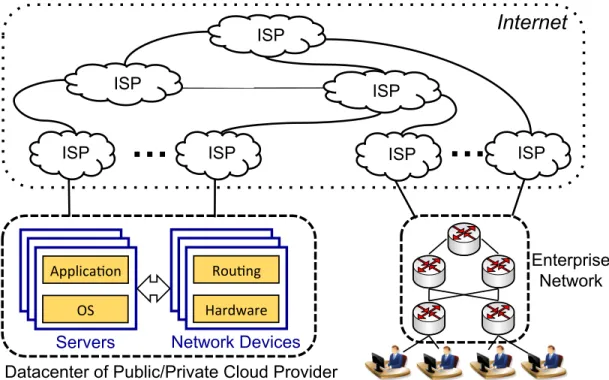
The delivery of the promise of cloud computing depends on the quality of the end-to-end network. As shown in Figure 1.1, the Internet now plays a critical role in carrying the traffic of IT applications between enterprises and datacenters of pub-lic/private cloud providers. The performance of cloud-based IT applications depends on not only the application software in the cloud, but also the reliability, efficiency, and performance of the networks in the middle.
Improving the network quality could be achieved by deploying more network de-vices with higher bandwidth. However, this brute-force approach no longer works due to the high capital costs and the rapidly growing traffic demands [7]. A more
Servers Applica'on OS Network Devices Rou'ng Hardware
Datacenter of Public/Private Cloud Provider
Enterprise Network
ISP
…
ISP ISP…
ISPISP ISP
ISP
Internet
Figure 1.1: End-to-end Structure of Cloud-based Software Services
attractive approach is to build proper network management solutions to better uti-lize the existing network resources. Yet the current practice of network management has two main problems which have become the main bottlenecks in adopting cloud computing. The two problems of network management solutions are:
• Disjoint management of the end-to-end components:
Providing an efficient network involves multiple components on the end-to-end path: from the network stack of the datacenter servers’ operating systems, the hardware configuration and the routing control of network devices in datacenters, the traffic exchange of Internet service providers (ISPs), to the setup of enterprise networks. Each component can affect the quality of the networks. Yet these com-ponents (e.g., servers, network device hardware, and traffic routing) are managed separately with different systems, since traditionally these components are spread across multiple places. In the cloud era, these components become much more
concentrated in the datacenters than before, and the lack of integration among management systems limits the quality improvement of the networks.
• Low-level interfaces for interacting with network devices:
Network devices are heterogeneous with different models from various vendors of varying ages. Interacting with the devices is complicated since the configuration APIs with devices are usually low-level and vendor-specific. Human network op-erators have to heavily use these low-level APIs in day-to-day operations, and it has been an error-prone process to configure the devices to run the right protocols with the right parameters using the right APIs. Using these APIs also tightly binds the solutions to specific device features by vendors, making it difficult to adapt the solutions to evolving business objectives. In datacenters, the heavy re-liance on low-level device interfaces becomes one of the major sources of failures in network operations, especially when the datacenter network is growing in scale and adopting more commodity hardware from multiple vendors [8, 27, 28].
The programmability of management solutions has received much attention in the research community [64]. The concept of Software-Defined Networking (SDN) aims at providing a better way to program traffic management solutions. The literature on SDN, especially the ones surrounding the OpenFlow technology [45, 74, 97], promise to automate managing the traffic routing in networks with high-level programming paradigms [66, 67, 99, 128]. With existing literature focusing on programming traffic management on network devices, two other problems are much less explored beyond just traffic management: disjoint management of network components (e.g., server, device hardware), and low-level device interaction limiting a broader scope of network management (e.g., infrastructure management).
This dissertation focuses on solving these two problems. Rather than proposing clean-slate solutions, the dissertation takes a practical approach driven by operational experiences of cloud services. We identify the real-world opportunities and challenges
of integrating the management of different network components on the end-to-end path, and then propose proper abstractions to unify and hide the low-level component interactions. Guided by the abstractions, we design and build systems of integrated management platforms for cloud providers and enterprises that are simple to use, and safe, efficient, and scalable in day-to-day operations [120, 123]. Having deployed the systems in major cloud providers [17, 26], we leverage the operational experiences as feedback to revisit the abstraction and system design.
We first elaborate the problems of network management with examples of man-agement solutions in§1.1. We then discuss the research approach of this dissertation in§1.2, and summarize the major contributions of this dissertation in §1.3.
1.1
Problems of Current Network Management
Current practices of network management have two main problems: 1) disjoint man-agement of the network components, and 2) heavy reliance on the low-level interfaces with devices. These problems become more severe in the era of cloud computing, and have become the main limiting factors in building more reliable and more efficient network management solutions.
Considering the first problem, many components are involved in the end-to-end path of cloud applications. Applications are running on the servers in datacenters, and the servers send traffic to other servers or the outside via datacenter networks. A series of ISPs deliver the application traffic to the enterprise networks, which finally deliver it to the users. Traditionally, these components are managed as three separate areas: 1) Application and server provisioning for placing the applications and controlling the servers’ operating environments, 2) network infrastructure for configuring and operating the device hardware from power control to topology setup, and 3) traffic
The status quo results from the traditional division of labor among the entities of the Internet business in the pre-cloud-computing era. In the past, the entity who hosts applications has the majority of traffic going directly to users; not among the application instances inside. Thus it focuses on server provisioning with lower stakes in network operations. In contrast, the ISPs focus on the networks, separating infras-tructure management and traffic engineering because the two run at vastly different paces (e.g., infrastructure changes over years while traffic changes in minutes).
The emergence of the cloud breaks the balance. The datacenters of cloud providers see a new majority of traffic coming from the server-to-server communication inter-nally among application instances [41, 83], because more applications are built with multi-tier architecture as distributed systems [43, 57]. This new traffic pattern moti-vates big changes of datacenter network architecture with intensive usage of commod-ity devices [38, 73, 76, 77, 87, 104]. The architectural change significantly increases the quantity and the evolution speed of network infrastructure in datacenters. As in-terest in application provisioning, infrastructure management, and traffic engineering concentrates on the cloud providers, the current separation of management systems becomes a bottleneck in improving the performance of applications.
Additionally, the cloud-based applications have highly asymmetric traffic patterns to the enterprises [7]. For instance, our measurements at Princeton University show that the campus receives an average of eight times more traffic than it sends. Enter-prises would like to control the incoming traffic, but they lack direct control because the function of traffic engineering mainly belongs to the ISPs [51].
In fact, there exists a great opportunity to consolidate disjoint management sys-tems, especially within the scope of cloud providers. For instance, Google [82] and Microsoft [81] have both built traffic management systems on their wide area networks that combine the knowledge and functions of servers and networks. The systems col-lect application traffic demands directly from servers, and combine them with the
network statistics to compute a solution to scheduling the traffic. The systems then enforce the solution with both the rate limiting on servers and the routing control in networks. These integrated systems have significantly improved the bandwidth utilization levels of the wide area networks of Google and Microsoft.
Besides the separation problem, network management is also limited by the low-level interfaces with heterogeneous devices. Each device vendor develops their own interfaces with their network devices. As device hardware grows more specialized when vendors differentiate themselves, interfaces become tightly bound with specific vendors and specific hardware features. As specialized devices are heavily used, the network operators have to rely on low-level vendor APIs to configure and run the networks. This makes network operation heavily dependent on the experiences and manual control of the network operators.
Use of low-level device interfaces by network operators becomes a barrier to au-tomating management of datacenter networks of cloud providers. Because of the architectural changes, the number of network devices is much larger in datacenters of cloud providers than in traditional networks. The management process has to be automated with software, rather than by manual configurations to be scalable and sustainable for future growth. Also, datacenters of cloud providers use large amounts of commodity devices, rather than specialized hardware from specific vendors, to save the purchase and operational costs for the economy of scale. The difference in interfaces among vendors and models of hardware actually becomes an obstacle in developing network management solutions for cloud services.
Major cloud providers have already started to reduce their reliance on vendor-specific APIs, and use commodity device features to build their management solutions with the help of server-based software [68, 107, 132]. For example, load balancing used to be carried out by specialized devices. However, configuring and maintaining the
Simple and
high-‐level
programming
abstrac5on
Efficient and
scalable system
for execu5on
Deployment in
real world
Iden5fy
Opportunity of
Integra5on
Figure 1.2: Practical and Iterative Research Approach
stead, Microsoft and Amazon [2] build software-based load balancing systems. These systems use the basic features of network devices (e.g., ECMP), and run software on a group of servers to distribute the traffic among application instances. Such systems greatly improve the stability of the cloud services by reducing operational failures.
1.2
Research Approach
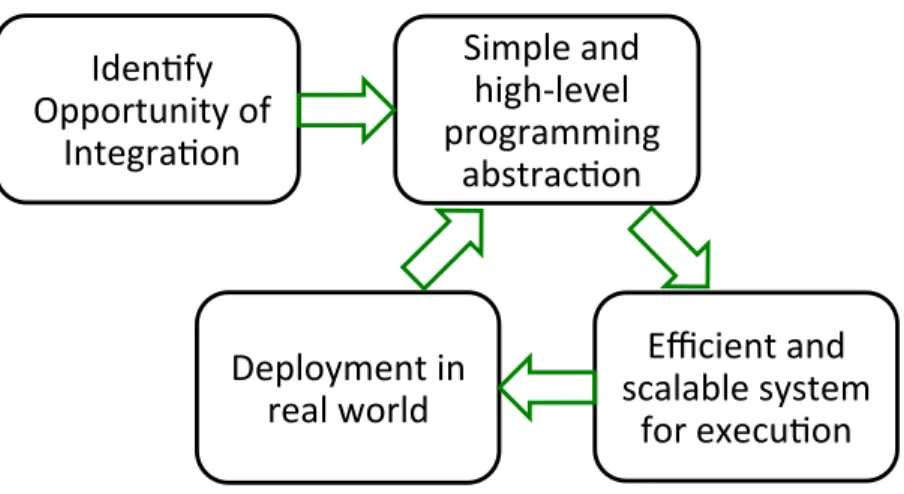
Instead of designing clean-slate solutions, we take a practical approach driven by operational experience in cloud computing services. Figure 1.2 outlines the iteration cycle of our approach.
The first step is to identify real-world management scenarios where an integrated management system could benefit. We work closely with major cloud providers and enterprises to find problems that they encounter in the network operations. We then examine these problems, and understand how we can improve the operations by rethinking the division of labor.
Upon finding an opportunity for improvement, we start the iteration of designing and building a network management platform for integration. The design starts with high-level abstraction to unify the differences among the network components or the management entities, and hide the low-level interactions with device hardware. The
design of abstraction aims at a simple-to-use programming interface to build network management solutions which can utilize the benefits from the integration.
Based on the design of the programming abstraction, we then design the system part and build the management platform to execute the solutions across the newly consolidated network components. The goals of our systems are safety, efficiency, and scalability in the operations of datacenter networks in the cloud providers and enterprise networks of the cloud-service users.
In the process of building our management platforms, we actively seek deploy-ment in commercial environdeploy-ments. Collaborating with several cloud providers and enterprises, we run the platforms to accumulate operational experiences. These ex-periences and the real-world constraints of deployment are fed back to the design of abstraction and systems to make our platforms more practical.
This research approach represents our careful balance between the advancement of research frontier in the area of network management and the engineering efforts in impacting the commercial operations of the cloud computing services.
1.3
Contributions
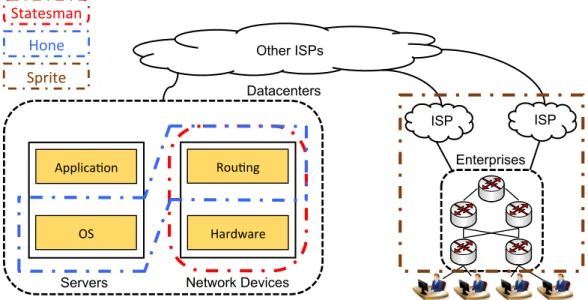
In this dissertation, we have designed and built three integrated management plat-forms to consolidate three areas along the end-to-end path of cloud services. Figure 1.3 shows which network components each platform has consolidated. Our works sim-plify and improve the traffic and infrastructure management in datacenters of cloud providers, and provide enterprises with more direct control over incoming traffic from cloud services. We make three major contributions as illustrated below.
OS Applica*on Rou*ng Hardware Enterprises ISP ISP Other ISPs Datacenters
Servers Network Devices
Statesman
Hone
Sprite
Figure 1.3: Scope of Integration for Projects in the Dissertation
1.3.1
Safe Datacenter Traffic/Infrastructure Management
The cloud providers run many automated solutions simultaneously for traffic and infrastructure management in datacenters. Individually complicated to build and operate, these solutions can have conflicts which inadvertently affect the operations of each other, and they can collectively cause unintentional network-wide failures.
We propose a system called Statesman to consolidate the operations of traffic and infrastructure management solutions, and offer a common layer of interacting with network devices to resolve conflicts and maintain network-wide safety invariants (e.g., maintaining the network connectivity). The core feature of Statesman is the loosely coupled model of running multiple management solutions with the abstraction of network state. Network state captures various aspects of the network, such as which links are alive and how devices are forwarding traffic. Statesman offers three distinct views of the network state as a pipeline to build and run management solutions. Working together with Microsoft, we have deployed the Statesman system in the datacenters of the Azure public cloud service worldwide. Operational since October
2013, Statesman becomes the fundamental layer for Microsoft Azure networking. The work is published in ACM SIGCOMM 2014 [120].
1.3.2
End-host/Network Cooperative Traffic Management
The providers of cloud services and cloud-based applications carefully manage their traffic through the underlying networks for various performance objectives. These traffic management solutions are confined in the scope of network devices. In ad-dition to the limited CPU and memory resources, network devices cannot provide knowledge in layers higher than the network layer, limiting the solutions’ insights into the application-traffic behaviors.
We propose to join the end hosts with the network devices, so we can utilize the rich application-traffic statistics in the end hosts to build better traffic management solutions. Our system, named Hone, abstracts the diverse collection of statistics on both end hosts and network devices into a uniform view of data. We then design a framework based on functional reactive programming [61, 103] to simplify program-ming management solutions with the uniform data model. Hone has been adopted by Overture Networks to use in the Verizon Business Cloud service. With the host-side data from Hone, the customers of Verizion Business Cloud enjoy better quality of their connections with the datacenters of Verizon for the improved performance of cloud-based applications. Our work on Hone is published in Springer Journal of Network and Systems Management [122, 123].
1.3.3
Direct Control of Entrant ISP for Enterprise Traffic
With the rise of cloud computing services, enterprise networks receive much more traffic than they send. Although enterprise networks typically connect with multiple upstream ISPs, they have very limited control over which of their ISPs to carry the
functionalities divided between the enterprises and the ISPs in routing the traffic, i.e., the path that the traffic takes is mainly decided by the ISPs.
We propose to bridge the boundary between enterprises and their upstream ISPs to exert direct and fine-grained control over the entrant ISP for incoming traffic. In our proposed system called Sprite, we design three levels of abstraction to simplify the expression of traffic engineering objectives with the highest level of abstraction, and dynamically translate the objectives into lower levels of abstraction for efficient and scalable execution. In collaboration with the Office of Information Technology of Princeton University, we have tested Sprite with the traffic data collected on the campus network and with live Internet experiments on the PEERING testbed [115, 125]. The work is published in ACM SIGCOMM Symposium on SDN Research 2015 [121].
Chapters 2, 3, and 4 describe Statesman, Hone, and Sprite in detail respectively. Chapter 5 presents open issues and future works, and concludes the dissertation.
Chapter 2
Statesman: Integrating Network
Infrastructure Management
2.1
Introduction
Today’s cloud-based applications (e.g., search, social networking, and online storage) depend on large datacenter networks. Keeping these networks running smoothly is difficult, due to the sheer number of network devices, and the dynamic nature of the environment. At any given moment, multiple network devices may experience component failures, may be brought down for planned maintenance or saving energy, may be upgraded with new firmware, or may be reconfigured to adapt to prevailing traffic demand. In response, the cloud providers have developed an array of auto-mated systems for managing the traffic (e.g., traffic engineering [81, 82], server load balancing [68, 107], and network virtualization [89]) and theinfrastructure(e.g., hard-ware power control for failure mitigation or energy saving [78, 132], device firmhard-ware upgrade, and device configuration management [48, 49]).
re-a “control loop” thre-at mere-asures the current stre-ate of the network, performs compu-tation, and then reconfigures the network. For example, a traffic engineering (TE) solution measures the current traffic demand and network topology, solves an op-timization problem, and then changes the routing configuration to match demand. These solutions are complicated because they must work correctly even in the pres-ence of failures, variable delays in communicating with a distributed set of devices, and frequent changes in network conditions.
Designing and running a single network management solution is challeng-ing. Large datacenter networks must simultaneously run multiple management solutions—created by different teams, each reading and writing some part of the network state. For instance, both a TE solution and a solution to mitigate link failures need to run continuously to, respectively, adjust the routing configuration continuously and detect and resolve failures quickly.
These management solutions can conflict with each other, even if they interact with the network at different levels, such as establishing network paths, assigning IP addresses to interfaces, or installing firmware on devices. One solution can inadver-tently affect the operation of another. As an example in Figure 2.1, suppose the TE solution wants to create a tunnel through the switch B, while the firmware-upgrade solution wants to upgrade B. Depending on which action happens first, either the TE solution fails to create the tunnel (because B is already down), or the already-established tunnel ultimately drops traffic during the firmware upgrade.
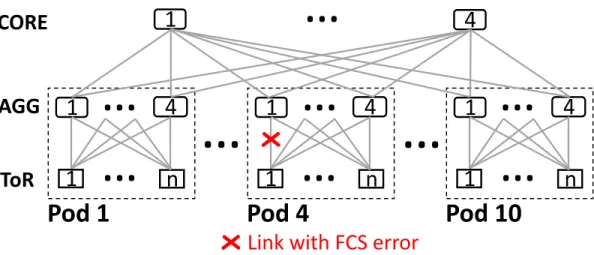
Running multiple management solutions also raises the risk of network-wide fail-ures because their complex interactions make it hard to reason about their combined effect. Figure 2.2 shows an example where one management solution wants to shut down switchAggB to upgrade its firmware, while another wants to shut down switch
AggA to mitigate packet corruption. While each solution acting alone is fine, their joint actions would disconnect the top-of-rack (ToR) switches. To prevent such
disas-Switch A Switch B Switch D Switch C TE solution allocates traffic on the path through Switch B Switch-firmware-upgrade solution schedules switch B for upgrading Traffic lost at B
Figure 2.1: Example of Conflicts between Management Solutions
ters, it is imperative to ensure that the collective actions of the management solutions do not violate certain network-wide invariants, which specify basic safety and per-formance requirements for the network. For instance, a pod of servers must not be disconnected from the rest of datacenter, and there must be some minimum band-width between each pair of pods.
The cloud providers could conceivably circumvent the problems that stem from running multiple solutions by developing a single management solution that performs all functions, e.g., combining TE, firmware upgrade, and failure mitigation. However, this monolithic solution would be highly complex, and worse, it would need to be extended repeatedly as new needs arise. Thus, the cloud providers need a way to keep the management solutions separate.
Another option is to have explicit coordination among the management solutions. Corybantic [98] is one recent proposal that follows this approach. While coordination may be useful for some management solutions, using it to solve the problem of multi-solution coexistence imposes high overhead on each multi-solution, requiring each multi-solution to understand the intended network changes of all others. To make matters worse, every time a solution is changed or a new one is developed, the cloud providers would need to test again, and potentially retrofit some existing solutions, in order to ensure that all of them continue to coexist safely.
Switch-firmware-upgrade solution assumes Agg A is up, and schedules Agg B for upgrading.
Agg A Agg B
Failure-mitigation solution tries to shut down flaky Agg A,
assuming Agg B is up. Connectivity
of ToRs is lost
ToRs Core
Routers Pod
Figure 2.2: Example of Safety Violation by Collective Actions
We argue that network management solutions should be built and run in a loosely coupled manner, without explicit or implicit dependencies on each other, and conflict resolution and invariant enforcement should be handled by a separate management system. This architecture would simplify development of management solution, and its simplicity would boost network stability and predictability. It may forgo some performance gains possible through tight coupling and joint optimization. However, as noted above, such coupling greatly increases the complexity of management so-lution. Furthermore, since management solutions may have competing objectives, a management system to resolve conflicts and maintain invariants would be needed anyway. We thus believe that loose coupling of management solutions is a worthwhile tradeoff in exchange for significant reduction in complexity.
We propose Statesman, a network-state management service that supports multi-ple loosely-coumulti-pled management solutions in large datacenter networks. Each solution operates by reading and writing some part of the network state at its own pace, and Statesman functions as the conflict resolver and the invariant guardian. Our design introduces two main ideas that simplify the design and operation of network man-agement solutions:
• Three views of network state (observed, proposed, target): In order to prevent conflicts and invariant violations, management solutions cannot change the state of the network directly. Instead, each solution applies its own logic to the network’s observed state to generate a proposed state that may change one or more state variables of the network. Statesman merges all proposed states into one target state. In the merging process, it examines all proposed states to resolve conflicts and ensures that the target state satisfies an extensible set of network-wide invariants. Our design is inspired by version control systems like Git. Each solution corresponds to a differentGit user and (i) the observed state corresponds to the code each user “pulls”, (ii) the proposed state corresponds to the code the user wants to “push”, and (iii) the target state corresponds to the merged code that is ultimately stored back in the shared repository.
• Dependency model of state variables: Prior works on abstracting network state model the state as independent variable-value pairs [90, 91]. However, this model does not contain enough semantic knowledge about how various state vari-ables relate to each other, which hinders detecting conflicts and invariant violations. For example, a tunnel cannot carry traffic if the path includes an administratively down device. To ensure safe merging of proposed states, Statesman uses a depen-dency model to capture the domain-specific dependencies among state variables.
Statesman has been deployed and operational in ten datacenters of Microsoft Azure cloud service since October 2013. It currently manages over 1.5 million state variables from links and devices across the globe. We have also deployed two man-agement solutions—device firmware upgrade and link failure mitigation, while a third one—inter-datacenter TE—is undergoing pre-deployment testing. The diverse func-tionalities of these solutions showcase how Statesman can safely support multiple management solutions, without them hurting each other or the network. We also
tency for conflict resolution and invariant checking is under 10 seconds even in the largest datacenter network with 394K state variables. We believe that our experi-ence with Statesman can inform the design of future management systems for cloud providers.
2.2
Network State Abstraction
In this section, we provide more details on the abstraction of network state underlying Statesman, and how management solutions use the abstraction.
2.2.1
Three Views of Network State
Although management solutions have different functionalities, they typically follow a control loop of reading some aspects of the network state, running some computation on the state, and accordingly changing the network. One could imagine that each management solution reads and writes states to the network devices directly.
However, direct interaction between the devices and the management solutions is undesirable for two reasons. First, it cannot ensure that individual solution or their collective actions will not violate network-wide invariants. Second, reliably reading and writing network state is difficult because of response-time variances and device failures. When a command to a device takes a long time to execute, the management solution has to decide when to retry, how many times, and when to give up. When a command fails, the management solution has to parse the error code and decide how to react.
Given the issues above, Statesman abstracts the network state as multiple variable-value pairs. Furthermore, it maintains three different types of views of network state. Two of these are observed state (OS) and target state (TS). The OS is (a latest view of) the actual state of the network, which Statesman keeps up-to-date. Management
solutions read the OS to learn about current network state. The TS is the desired state of the network, and Statesman is responsible for updating the network to match the TS. Any success or failure of updating the network towards the TS will be (eventually) reflected into the OS, from where the management solutions will learn about the prevailing network conditions.
The OS and TS views are not sufficient for resolving conflicts and enforcing safety invariants. If management solutions directly write to the TS, the examples in Fig-ure 2.1 and 2.2 can still happen. We thus introduce the third type of view called proposed state (PS) that captures the state desired by management solutions. Each solution writes its own PS.
Statesman examines the various PSes and detects conflicts among them and with the TS. It also validates them against a set of network-wide invariants. The invari-ants capture the basic safety and performance requirements for the network (e.g., the network should be physically connected and each pair of server pods should be able to survive a single-device failure). The invariants are independent of which manage-ment solutions are running. Only non-conflicting and invariant-compliant PSes are accepted and merged into the TS.
2.2.2
Dependency Model of State Variables
Management solutions read and write different state variables of the network, e.g., hardware power, device configuration, traffic routing, and multi-device tunneling. Statesman thus provides the state variables at multiple levels of granularity for the needs of management solutions (more details in §2.4 with examples in Table 2.2).
However the state variables are not independent. The “writability” of one state variable can depend on the values of other state variables. For example, when a link interface is configured to use the traditional control-plane protocol (e.g., BGP or
when the firmware of a device is being upgraded, its configuration cannot be changed and tunnels cannot be established through it. Thus, when proposing new values of state variables, conflicts can arise because a state variable in one solution’s PS may become unchangeable due to somedependent state variables in another solution’s PS. Requiring management solutions to understand the complex cross-variable depen-dency will go against our goal of running them in a loosely coupled manner. For instance, it will be difficult for a TE solution to have to consider how one specific device configuration affects its operation. Therefore, Statesman does not treat the network state as a collection of independent variables but includes a model of depen-dencies among the state variables. These dependepen-dencies are used when checking for conflicts and invariant violations. Based on the dependency model, Statesman also exposes the “controllability” of each state variable as an additional logical variable. Thus, a management solution can read just the state variables of interest and their controllability variables to decide whether it is able to propose new values for those variables of interest. For example, a TE solution can read the “path” variable (i.e., a tunnel through multiple devices) and determine whether it is currently controllable. This is computed by Statesman based on various hardware and routing configura-tions of the devices along the path; the TE solution does not need to reason about the related hardware and routing configurations itself.
2.2.3
Application Workflow
In the observed-proposed-target pipeline, the workflow of management solutions is simple. Each solution reads the OS, runs its computational logic, and writes a newly generated PS. Statesman generates the new TS after resolving conflicts and invariant violations in the PSes and merging the accepted ones.
In this model, some proposals may be rejected. Handling this rejection does not impose extra overhead on management solutions; even if the interaction with network
devices was not mediated by Statesman, management solutions have to be prepared to be unable to update the network to the desired state (e.g., due to failures during the update process). When Statesman rejects a proposal, the proposer gets detailed feedback on the reason for rejection (§2.5), at which point it can propose a new PS in an informed manner.
Per our desire for loose coupling, management solutions make proposals indepen-dently. It is thus possible that PSes of two solutions frequently conflict or we do not compute a target state that satisfies all management solutions (even though such a state may exist). In our operational experience with Statesman, such cases are not common. Thus, we believe that the simplicity of loose coupling outweighs the complexity of tight coupling. In cases where coordination among two management solutions is highly beneficial, it may be done out of band such that the solutions make proposals after consulting each other. In this way, most management solutions and the Statesman system as a whole stay simple, and the complexity cost of coordination is borne only in parties that benefit the most from the coordination.
2.3
System Overview
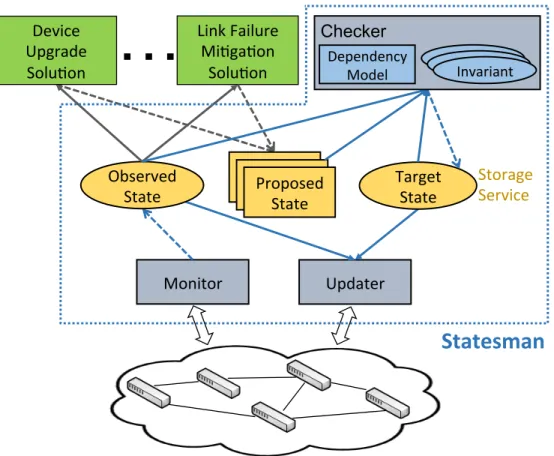
Figure 2.3 shows the architecture of Statesman. It has four components: storage service, checker, monitor, and updater. We outline the role of each below, and the following sections present more details.
Storage service is at the center of the system. It persistently stores the state variables of OS, PS, and TS and offers a highly-available, read-write interface for other components and management solutions. It also handles all data availability and consistency issues, which allows all other components to be completely stateless— in each round of their operations, they just read the latest values of the needed
Monitor Updater Device Upgrade Solu4on Link Failure Mi4ga4on Solu4on
…
Proposed State ObservedState Target State
Statesman
Storage Service Dependency Model Checker Invariant Invariant InvariantFigure 2.3: Statesman Architecture Overview
state variables. This stateless mode of operation simplifies the design of the other components.
The checker, monitor, and updater independently interact with the storage service, and the latter two also interact with the network devices. Table 2.1 summarizes the input and output of each component.
Checker plays a pivotal role of generating the TS. After reading the OS, PSes, and TS from the storage service, the checker first examines whether the PSes are still applicable with respect to the latest OS (e.g., the proposed change may have already been made or cannot be made at all due to a failure). It then detects conflicts among PSes with the state dependency model and resolves them with one of two configurable mechanisms: last-writer-wins or priority-based locking. After merging the valid and non-conflicting PSes into the TS, the checker examines the TS for the
Component Input Output
Monitor Device/link statistics OS
Checker
OS
TS PSes
TS
Updater OS Device update commands
TS
Table 2.1: Input and Output of Each Component in Statesman
operator-specified safety invariants. It writes the TS to the storage service only if the TS complies with the invariants. It also writes the acceptance or rejection results of the PSes to the storage service, so management solutions can learn about the outcomes and react accordingly.
Monitorperiodically collects the statistics from the devices and links, transforms them into values of OS variables, and writes the new values to the storage service. In addition to simplifying other components and management solutions to learn about current network state, the monitor also shields them from the heterogeneity among devices. Based on the device vendor and the supported technologies, it uses the corresponding protocol (e.g., SNMP or OpenFlow) to collect the network statistics, and it translates protocol-specific data to protocol-agnostic state variables. Other components and management solutions use these abstract variables without worrying about the specifics of the underlying infrastructure.
Updater reads the OS and TS and translates their difference into update com-mands that are then sent to the devices. The updater is memoryless—it applies the latest difference between the OS and TS without regard to what happened in the past. Like the monitor, the updater handles how to update heterogeneous devices with a command template pool, and allows other components and management solutions to work with device- and protocol-agnostic state variables.
Opera&ng System Setup
Link Interface Config
Device
Power
Rou&ng Control
Link Power
Path/Traffic Setup
Link
Path
Dependency
Device Configura&on
Figure 2.4: Network State Dependency Model
2.4
Managing Network State
We now describe the various aspects of Statesman in more details, starting with the network-state data model. We use the examples in Table 2.2 to illustrate how we build the state dependency model, and how to use and extend the model.
2.4.1
The State Dependency Model
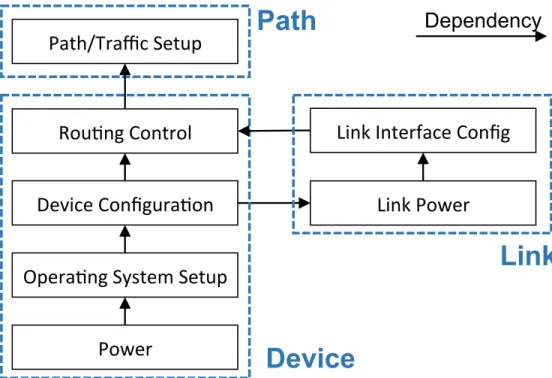
Managing a datacenter network involves multiple levels of control. To perform the final function of carrying traffic, the network needs to be properly powered and con-figured. Statesman aims to support operations in the complete process of bringing up a large datacenter network from scratch to normal operations. In order to cap-ture the relationship among the state variables at different levels of the management process, we use the state dependency model of Figure 2.4. We use the process of bootstrapping a datacenter network as an example to explain this model.
At the bottom of the dependency model is the power state of network devices. With the power cable properly plugged in and electricity properly distributed to the devices, we then need to control which operating system (i.e., firmware) runs. Running a functioning firmware on a device is the prerequisite for managing device configuration, e.g., use device vendor’s API to configure the management interface, boot up compatible OpenFlow agent, etc.
With device configuration states ready, we are able to control the link interfaces on the device now. The fundamental state variable of a link is its being up or down. The configuration of a link interface follows when the link is ready to be up. There are various link-interface configuration states, such as IP assignment, VLAN setup, ECMP-group assignment, etc. Consider an example of control plane setup where a link interface can be configured to use the OpenFlow protocol or traditional protocols like BGP. For the chosen option, we need to set it up: either an OpenFlow agent needs to boot and take control of the link, or the BGP session needs to start with proper policies. These control plane states of the link determine whether and how the device’s routing can be controlled.
We can manage the routing states of the devices when all the dependent states are correct. We represent the routing state in a data structure of the flow-link pairs, which is agnostic to the supported routing protocols. For example, the routing states can map to the routing rules in OpenFlow or the prefix-route announcement or withdrawal in BGP. When management solutions change the value of the routing state variable, Statesman (specifically the updater) automatically translates the value to appropriate control-plane commands.
One level higher is thepath state which controls tunnels through multiple devices. Creating a tunnel and assigning traffic along the path depend on all devices on the path having their routing states ready to manage. Again, Statesman is responsible
Entity Level in dependency Example state variables Permission
Path Path/traffic setup Devices on path ReadWrite
MPLS or VLAN configuration ReadWrite
Link
Link interface configuration IP assignment ReadWrite Control plane setup ReadWrite
Link power Interface admin status ReadWrite
Interface oper status ReadOnly
N/A (counters) Traffic load ReadOnly
Packet drop rate ReadOnly
Device
Routing control Flow-link routing rules ReadWrite Link weight allocation ReadWrite Device configuration Management interface setup ReadWrite OpenFlow agent status ReadWrite
Operating system Firmware version ReadWrite
setup Boot image ReadWrite
Power Admin power status ReadWrite
Power unit reachability ReadOnly
N/A (counters) CPU utilization ReadOnly
Memory utilization ReadOnly Table 2.2: Examples of Network State Variables
for translating the path’s states into the routing states of all devices on the path, and the management solution only needs to read or write the path states.
2.4.2
Using and Extending the Dependency Model
For simplicity, management solutions should not be required to understand all the state variables and their complex dependencies. They should be able to simply work with the subset of variables that they need to manage based on their goals. For instance, a firmware-upgrade solution should be able to focus on only the Device-FirmwareVersion variable. However, this variable depends on lower-level variables, such as device power state whose impact cannot be completely ignored; firmware cannot be upgraded if the device is down.
We find that it suffices to represent the impact of these dependencies by using a log-ical variable that we call controllabilityand expose it to management solutions. This boolean-valued variable denotes whether the parent state variable is currently con-trollable, and its value is computed by Statesman based on lower-level dependencies. For instance, DeviceFirmwareVersion is controllable only if the values of variables such as device power and admin states are appropriate. Now the firmware-upgrade solution can simply work withDeviceFirmwareVersion and DeviceFirmwareVersion-IsControllable variables to finish its job.
To give another concrete example, the variable DeviceConfigIsControllable tells whether management solutions can change various state variables of device configu-ration, such as the management interface setup. The value of DeviceConfigIsControl-lable is calculated based on whether the device is powered up, whether the device can be reachable via SSH/Telnet from the management network (indicating the firmware is functioning), and whether the device is healthy according to the health criterion (e.g., CPU/memory utilizations are not continuously 100% for certain amount of time). Similarly, links have LinkAdminPowerIsControllable calculated with the De-viceConfigIsControllable of the two devices on the link’s ends.
Exposing just the controllability variables makes the dependency model extensible. The functions calculating the controllability are implemented in the storage service of Statesman. When a new state variable is added to Statesman, we just need to place it in the dependency model, i.e., find what state variables will be dependent on the new one. Then we modify the controllability functions of the corresponding state variables to consider the impact of the new variable. For management solutions that are not interested in the new variable, no modifications are necessary.
2.5
Checking Network State
The checker plays a pivotal role in Statesman. It needs to resolve conflicts among management solutions and enforce network-wide invariants. Its design also faces scal-ability challenges when handling large networks. We first explain the state checking process and then describe techniques for boosting scalability of the checker. Figure 2.5 outlines the checker’s operation.
2.5.1
Resolving Conflicts
Multiple types of conflicts can occur in the network state due to the dynamic nature of datacenter networks and uncoordinated management solutions:
• TS–OS: The TS can conflict with the latest OS when changes in the network render some state variables uncontrollable, although they have new values in the TS. For instance, if the OpenFlow agent on a device crashes, which is reflected as DeviceAgentBootStatus=Down in the OS, any routing changes in the TS cannot be applied.
• PS–OS:When the checker examines a PS, the OS may have changed from the time that the PS was generated, and some variables in the PS may not be controllable anymore. For example, a PS could contain the new value of a LinkEndAddress variable, but when the checker reads the PS, the link may have been shut down for maintenance.
• PS–TS: The TS is essentially the accumulation of all accepted PSes in the past. A PS can conflict with the TS due to an accepted PS from another management solution. For example, assume that a firmware-upgrade solution wants to upgrade a device and proposes to bring it down; its PS is accepted and merged into the TS. Now, when a TE solution proposes to change the device’s routing state, it conflicts with the TS even though the device is online (i.e., no conflict with the OS).
Examine TS+PS
for invariants.
TS=TS+PS if pass.
Read OS, TS.
Resolve TS-‐OS
conflicts.
Read next PS.
Resolve PS-‐OS
conflicts.
Resolve PS-‐TS
conflicts.
Write new TS
back.
Figure 2.5: Flow of The Checker’s Operation
The first two types of conflicts are because of the changing OS, which makes some variables in the PS or TS uncontrollable. To detect these conflicts, the checker reads the controllability values from the OS, which are calculated by the storage service based on the dependency model when relevant variable values are updated. It then locates the uncontrollable variables in the PS or TS. To resolve TS–OS conflicts, we introduce a flag calledSkipUpdate for each variable in the TS. If set, the updater will bypass the network update of the state variable, thus temporarily ignoring the target value to resolve the conflict. The checker will clear the flag once the state variable is controllable again.
For uncontrollable state variables in a PS, the checker removes them from the PS, i.e., rejecting the part of PS that is inapplicable on the current network. The choice of partial rejection is a tradeoff between the progress of management solutions and the potential side-effects of accepting a partial PS. An asynchrony is normal between the OS views of the management solution and the checker. By rejecting the whole PS due to a small fraction of conflicting variables, Statesman will be too conservative and will hinder the progress of management solution. We thus allow partial rejection. We have not yet observed any negative consequences in our deployment from this choice. In the future, we will extend the PS data structure such that solutions can group variables. When a variable in a group is uncontrollable, the entire group is
For PS–TS conflicts, which are caused by the conflicting proposals, Statesman supports an extensible set of conflict resolution mechanisms. It currently offers two mechanisms. The basic one is last-writer-wins, in which the checker favors the value of state variable from the newer PS. The more advanced mechanism is priority-based locking. Statesman provides two levels of priorities of locks for each device and link. Management solutions can acquire a low-priority or a high-priority lock before proposing a PS. In the presence of a lock, management solutions other than the lock holder cannot change the state variables of the device or link. However, the high-priority lock can override the low-high-priority one. The choice of the conflict resolution mechanism is not system-wide and can be configured at the level of individual devices and links.
Although simple, these two conflict resolution strategies have proved sufficient for the management solutions that we have built and deployed thus far. In fact, we find from our traces that last-writer-wins is good enough most of the time since it is rare for two management solutions to compete for the same state variable head-to-head. For our intra-datacenter infrastructure, we configure the checker with the last-writer-wins resolution; for our inter-datacenter network, we have enabled the priority-based locking. If needed, additional resolution strategies (e.g., based on access control) can be easily added to Statesman.
2.5.2
Choosing and Checking Invariants
Network-wide invariants are intended to ensure the infrastructure’s operational sta-bility in the face of development bugs or undesired effects of collective actions of the management solutions. They should capture minimum safety and performance requirements, independent of which management solutions are currently running.
Choosing invariants: The choice must balance two criterion. Firstly, the in-variant should suffice to safeguard the basic operations of the network. As long as it
is not violated, most services using the network would continue to function normally. Second, the invariant should not be so stringent that it interferes with the manage-ment solutions. For instance, an invariant that require all devices up is likely too strict and interferes with a firmware-upgrade solution.
Following the criterion above, we currently use two invariants in the checker. Both are solution-agnostic and relate to the topological properties of the network. The first invariant considers network connectivity. It requires that every pair of ToR devices in the same datacenter are (topologically) connected and that every ToR is connected to the border routers of its datacenter network (for WAN connectivity). Here, we ignore the routing configurations on the devices (which could result in two ToRs not being able to communicate) because management solutions can intentionally partition a network at the routing level for multi-tenant isolation.
The second invariant considers network capacity. We define the capacity between two ToRs in the same datacenter as maximum possible traffic flow between them based on the network topology. The invariant is that the capacity between p% of ToR pairs should be at least t% of their baseline, when all links are functional. The values of p and t should be based on level of capacity redundancy in the network, tolerance of the hosted services to reduced capacity, and implications of blocking a management solution that violates the invariant. We currently usep= 99 andt= 50, i.e., 99% of the ToR pairs must have at least 50% of the baseline capacity.
Although Statesman currently maintains only two invariants, the set of invariants is extensible. The invariant checking is implemented as a boolean function over a graph data structure that has the network topology and all state variables. It is straightforward to add more invariants by implementing new functions with the same interface. For example, some networks may add an invariant that requires the absence of loops and black holes, which can be checked using the routing states of the devices.
Checking invariants: When checking whether the TS obeys the invariants, the checker first creates a base network graph using variable values from the OS. Then, it translates the difference between a variable’s observed and target values into an operation on the network graph, e.g., bringing a device offline, changing the routing state to the target value, etc. Finally, the invariant checking functions are run with the new network graph.
The invariant checking is invoked in two places. The first is when the checker reads the TS from the storage service. The TS was compliant when written but can be in violation when read due to changes in the network (i.e., the TS–OS conflict). While running the invariant checking as described above, the checker clears or sets the SkipUpdate flags in the TS respective of its compliance status.
The second place is when the checker tries to merge a PS into the TS after conflict resolution. The checker analyzes TS+PS, as if the PS was merged into the TS. If TS+PS passes the check, the PS is accepted and merged into the TS. Otherwise, the PS is rejected.
The acceptance or rejection (and reasons) for each PS is recorded by the checker into the storage service. We categorize the rejection reasons into three groups: state variable became uncontrollable; invariant was violated; and TS was unreachable. The reasons are encoded as machine-readable status code as values of a special state vari-able calledProposalStatus for each PS. Management solutions use the same interface as for reading the OS to read their PSes’ statuses. They can then react appropriately (e.g., generate a new PS that resolves the conflicts with the latest OS).
2.5.3
Partitioning by Impact Group
The checker needs to read all the state variables in the OS and TS to examine conflicts and invariants every round of operation. The sheer number of state variables in the datacenters and the WAN poses a scalability threat.
To help scale, we observe that the impact of state changes for a given device or link is limited. For instance, changes to an aggregation router in one datacenter do not affect the connectivity and capacity of ToRs in another datacenter. Similarly, changes to border routers in a datacenter do not impact the capacity and connectivity within the datacenter, though they do impact other datacenters’ WAN reachability.
Based on this observation, we partition the checker’s responsibility into multiple impact groups. We set up one impact group per datacenter and one additional group with border routers of all datacenters and the WAN links. These groups are indepen-dent with respect to the state checking process. In our deployment of Statesman, we run one instance of checker per impact group, which has enabled the state checking to scale (§2.8).
2.6
System Design and Implementation
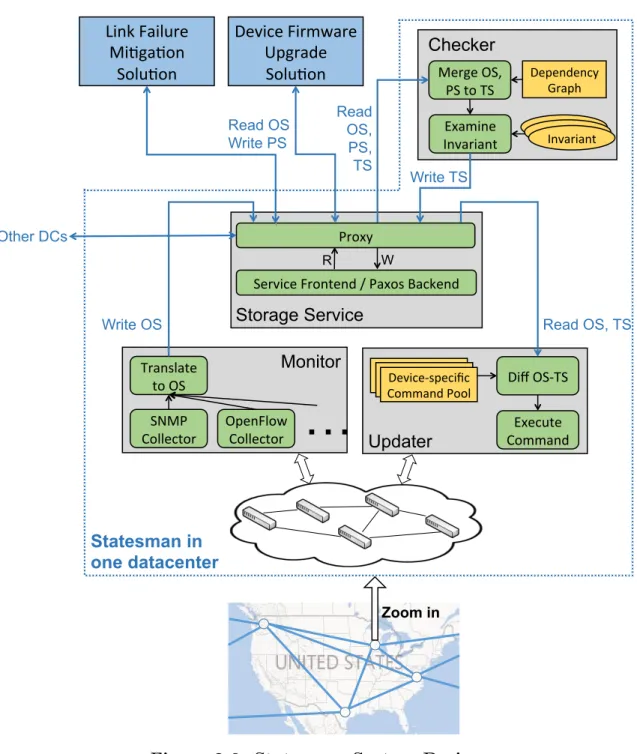
We now describe in more details the design and implementation of Statesman. We start with the storage service, followed by the updater and monitor; we skip the checker as it was covered in details in §2.5. Figure 2.6 provides a closer look at various components in a Statesman deployment. Our implementation of Statesman has roughly 50 thousand lines of C# and C++ code, plus a number of internal libraries. At its core, it is a highly-available RESTful web service with persistent storage. Below, we also describe Statesman’s read-write APIs.
2.6.1
Globally Available and Distributed Storage Service
The storage service needs to persistently and consistently store the network states. We thus use a Paxos-based distributed file system. However, two challenges prevent us from using a single big Paxos ring to maintain all the states for all our datacenters.
Service'Frontend'/'Paxos'Backend' Proxy' R W Storage Service Dependency'' Graph' Merge'OS,' PS'to'TS' Examine' Invariant' Checker SNMP' Collector' OpenFlow' Collector'
…
Translate' to'OS' Monitor Execute' Command' Diff'OSGTS' DeviceGspecific' Command'Pool' Updater Other DCs Write OS Read OS, PS, TS Write TS Read OS, TS Statesman in one datacenter Zoom in Device'Firmware' Upgrade' SoluJon' Link'Failure'' MiJgaJon' SoluJon' Read OSWrite PS Invariant'Invariant'Invariant'
Figure 2.6: Statesman System Design
connectivity to all others, or two datacenters may not be able to reach each other. To protect Statesman from such failures, the storage instances need to be located in multiple datacenters.
A second challenge stems from the volume of state data. In datacenters, there are hundreds of thousands of devices and links, each with dozens of state variables.