Effect of combined microwave heating and impinging hot-air on
rubberwood drying
Nuchtida Promtong
1,a, Thanate Ratanawilai
2,band Chayut Nuntadusit
3,c1,2
Department of Industrial Engineering, 3 Department of Mechanical Engineering
Faculty of Engineering, Prince of Songkla University, Hat Yai, Songkla 90112, Thailand.
a
[email protected], [email protected], [email protected]
Keywords: microwave drying; hot-air; rubberwood; mechanical and physical properties
Abstract. Applying microwave heating and impinging hot-air is one of the most interesting methods to increase the higher drying rates of rubberwood drying based on acceptable quality. A maximum microwave power level of 200W at a frequency of 2.45GHz with maximum working temperature of 70˚C, only hotair (70˚C) and combined microwave (200W) - hotair (70˚C) were choosed to evaluate the effect of rubberwood drying by different width sizes (1, 2, 3 and 4 in.) by 46 in. length by 1 in. thick. In all cases, the drying time is reduced significantly from 168 h to less than 8-15 h in various wood widths and resulted in saving to an extent of about 91% of drying time from initial moisture content ranges of 73%-49% to 15% percent of moisture level. Drying stresses from prong test no found during drying and total color of rubberwood changed after high temperature drying is a natural surface when compared to fresh wood. The values of six strength compared to the reference values are concentrated in the ranges of 16.9-23.9 (11.0)MPa for shearing strength parallel to grain, 4291.1-6701.6 (4350)N for hardness, 73.3-110.2 (66.0)MPa for MOR, 7059.5-12856.7 (9240.0) MPa for MOE, 27.2-14.3 (5.0)MPa for compressive strength perpendicular to grain and 60.6-35.7 (32.0)MPa for compression strength parallel to grain. These results show that it is possible to develop a drying process for rubberwood using microwave-hot air in investigating further in this area.
Introduction Rubber trees are wood material used and exported instead of natural forest for wood
processing industries in the South of Thailand. Before delivery to a customer, drying of rubberwood is the most important process because of time consuming and high cost. The common used method in rubberwood industry is to heat the lumber by steam in lumber-drying kiln [1]. Rubberwood is usually
arranged in stacks and dried in a 400–600 m3 chambers at temperatures of 80–100oC and the drying
time varies from 7 to 16 days depending on the thickness of the lumber and initial moisture content (about 0.85–0.95 db for freshly chemically treated wood) [2]. Because of reasonable cost, drying time is expected to be shortened by high-temperature drying but a higher drying rate is not always desirable because higher drying rates develop greater stresses that may cause the timber to crack or distort [3]. Microwave drying is one of the most significant methods due to the possibility of heating and drying materials much faster than conventional methods that the temperature is the higher at the surface and the lower in the interior of lumber. There are many successful of drying woods by applying microwave energy including southern pine strands, softwood, norway spruce and scots pine [4-9]. However, a major drawback with microwave heating is the inherent non-uniformity of the electromagnetic field within microwave cavity [10] and one more is that too rapid mass transport by microwave power may cause quality damage [11]. In recent years, microwave in combination heating with hot air is one of the most interesting methods used to achieve uniform temperatures [12]. A 22–30% increase in uniformity has been observed for combination microwave and jet impingement heating over microwave-only heating [13]. The plant materials investigated using mirowave assisted hot-air include apple, laurel berry, corn, grapes and carrots [14-19]. Although, microwave technology assisted hot air has found wide application in many materials, but there is no study on the drying of rubberwood with significant contribution to the wood industry. Therefore, the objective of research
All rights reserved. No part of contents of this paper may be reproduced or transmitted in any form or by any means without the written permission of TTP, www.ttp.net. (ID: 202.12.74.65-15/06/12,04:03:32)
0 10 20 30 40 50 60 70 80 0 10 20 30 40 50 60 70 80 90 M o is tu re C o n te n t (% d .b .) Drying Time(hr)
Drying Curve of Rubberwood
(1.15 m. long x 1 in. thick x 2 in. wide)
Microwave Hot air
Microwave and Hot air
15% MC 15 hrs.
21 hrs. 26 hrs.
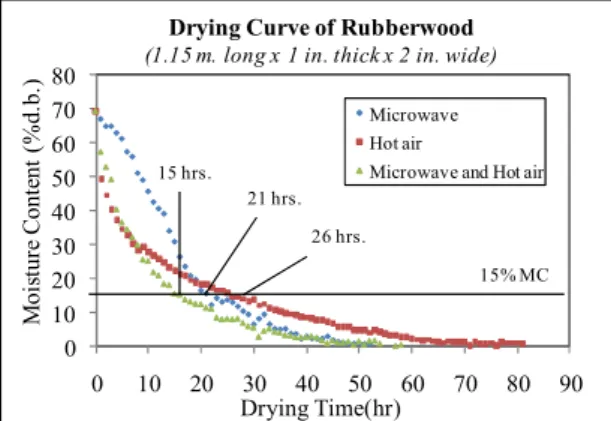
Fig. 2 Rubberwood drying time of 3 methods.
Fig. 1 Construction of rubberwood dryer.
was to examine the feasibility of combination of microwave heating and hot air in helping to attain increased uniformity of heating and to determine properties of the obtained wood compared with conventional drying in an experimental kiln.
Materials and methods
The rubberwood of 1 in. (thickness) by 46 in. (length) with width ranging from 1 to 4 in. were
obtained from Wood Work Factory in Songkhla province, Thailand. The construction of the microwave-hot air dryer is shown in Figure 1., with detailed information in two main components as follows table 1. During the experiments, a 0.001 kg precision load cell with capacity of 5 kg. on the top of drying cavity is integrated into the computer system in online measurement of the center rubberwood weights with string holder for continuous recording every 5 minute.
Table 1: Components of microwave-hot air dryer
Experiments were conducted in two parts; (1) comparisons of hot air, microwave and combined microwave-hot air heating and (2) effect of different rubberwood width on combined microwave-hot air heating. For the first part, the size of rubberwood with 46 in. length x 2 in. width x 1 in. thick was selected to evaluate the drying time and defects of each technique. The second part was carried out using only combination technique with different width sizes (1, 2, 3 and 4 in.) by 46 in. length by 1 in. thick. Three replications were done for each test. After constant weight, the drying wood quality in physical properties was evaluated regarding occurrence of drying defects such as cup, bow and spring, colors, casehardening. The mechanical properties were also tested including bending test, compression test according to the ASTM standard D143, BS373 and ISO3787, shear strength parallel to grain according to the BS373 and ISO3346 and hardness according to the BS373 and ISO3350, respectively. All specimens were conditioned to the ambient room environment over several weeks in the Wood Mechanics Laboratory, Walailak University, Thailand.
Results and discussions
Comparisons of hot air, microwave and
combined microwave-hot air heating: Hot air at
70˚C, a microwave power level of 200W at a frequency of 2.45GHz with maximum working temperature of 70˚C and combined microwave (200W)-hotair (70˚C) heating are the setting values of each experiment. The results shown in Figure 2, indicate that the trend of combined microwave-hot air heating are faster in drying rubberwood than hot air only and microwave only drying technique. All samples showed minimal colour change and no defects. The time required
for combination heating from initial moisture content ranges of 70% to 15% of moisture level is 15 hours, which is less than the 21 hours needed for microwave heating or the 26 hours needed for hot air only. The experimental results could help to identify some of the potential problems. For hot air drying, the moisture content gradient decreased very fast in earliest stage and then decreases in the
Cavity size: 23.6(W) x 7.9(D) x 59.1(H) in.3
Hot-air:
Orifice diameter (D) 0.4 in. Jet-to-jet distance (S) 5D Jet velocity (Vj) Jet Temperature (Tj) Blower An electrical heater 10 m/s 70oC 2 HP with 3000 r.p.m. 3 kW Microwave: 200W at 2.45 GHz
0 10 20 30 40 50 60 70 80 0 5 10 15 20 25 30 35 40 M o is tu re C o n te n t ( % d .b .) Drying Time(hrs.) Drying Curve of Rubberwood (1.15 m long x 1 in. thick x 1 in. wide)
Sample 1 Sample 2 Sample 3 Average 15% MC Avg. = 8 hrs. 0 10 20 30 40 50 60 70 80 0 5 10 15 20 25 30 35 40 45 50 M o is tu re C o n te n t (% d .b .) Drying Time (hrs.) Drying Curve of Rubberwood (1.15 m long x 1 in. thick x 2 in. wide)
Sample 1 Sample 2 Sample 3 Average 15% MC Avg. = 11 hrs. 0 10 20 30 40 50 60 0 5 10 15 20 25 30 35 40 45 50 55 M o is tu re C o n te n t (% d .b .) Drying Time(hr) Drying Curve of Rubberwood (1.15 m long x 1 in. thick x 3 in. wide)
Sample 1 Sample 2 Sample 3 Average 15% MC Avg. = 12 hrs. 0 10 20 30 40 50 60 70 0.0 10.0 20.0 30.0 40.0 50.0 60.0 M o is tu re C o n te n t ( % d .b .) Drying Time(hr) Drying Curve of Rubberwood (1.15 m long x 1 in. thick x 4 in. wide)
Sample 1 Sample 2 Sample 3 Average 15% MC Avg. = 12 hrs.
falling rate period with long drying times. As microwave drying method is slower in drying rate period of rubberwood than hot air only and combined microwave-hot air drying because the air in the microwave oven was saturated around rubberwood, preventing effective evaporation of moisture from the rubberwood. Meanwhile, the vapour pressure in the rubberwood is higher than that of the environment, the rubberwood starts to lose moisture, but at a slow rate. Considered the drying times in three drying methods, it is possible to dry rubberwood much faster in processing times with combined heating in acceptable physical properties.
Second Experiment: The moisture content versus time curves for combined microwave
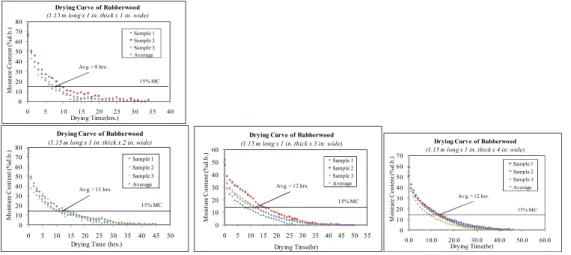
(200W)-hot air (70˚C) of rubberwood drying as influenced by different width sizes (1, 2, 3 and 4 in.) by 46 in. length by 1 in. thick are shown in Figure 3. As a result, the average time spent for combination heating from initial moisture content ranges of 73%-49% to 15% percent of moisture level was 8, 11, 12 and 12 h for width 1 in., 2 in., 3 in. and 4 in. samples, respectively. The positive interaction between microwave and hot air treatments on rubberwood is possibly due to a direct heat generation inside the rubberwood, coupled with the convective heat transfer at the rubberwood surface by hot air. This coupling effect for microwave and hot air significantly shortened the drying time without excessive degradation. In addition, sample sizes used in combined microwave (200W) -hotair (70˚C) heating similar reduction rate, it is possible to dry rubberwood in the variables as moisture content and the various width size under similar conditions.
Fig. 3 Drying curves of rubberwood in different width size using combination method.
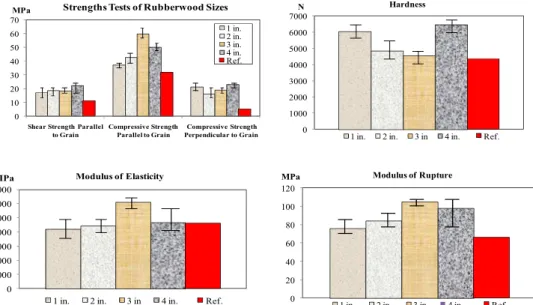
In the case of applying microwave-hot air drying methods has been found a critical form of warp, 22% by bow and spring in 1 in. width, 33% by bow and spring in 2 in. width, 22% by bow in 3 in. width and 11% by bow in 4 in. width wood samples will be rejected. Total color of rubberwood changed after high temperature drying is a natural surface compared to fresh wood. Typical prongs test was slight bend which the internal residual stress was relieved by combined microwave-hot air methods. The values of six strength compared with reference values obtained from W. Killman and L.T. Hong [20] in Figure 4. are concentrated in the ranges of 16.9-23.9 MPa for shearing strength parallel to grain, 4291.1-6701.6N for hardness, 73.3-110.2MPa for MOR, 7059.5-12856.7 MPa for MOE, 27.2-14.3MPa for compressive strength perpendicular to grain and 60.6-35.7MPa for compression strength parallel to grain. All mechanical properties of rubberwood was extremely higher average value than the reference value except the MOE of rubberwood with width 1 and 2 in., were values of 8442.7±1383.21 MPa and 8915.92 ±368.84 MPa, respectively only slightly higher than that of the reference value (9240 MPa) due to an increase in variation. However, rubberwood with 3 in. width size has the highest compression strength parallel to grain, MOE and MOR and rubberwood with 4 in. width has a maximum shear strength in parallel-to-grain, compressive strength perpendicular to grain and hardness.
0 10 20 30 40 50 60 70
Shear Strength Parallel to Grain
Compressive Strength Parallel to Grain
Compressive Strength Perpendicular to Grain
MPa Strengths Tests of Rubberwood Sizes 1 in. 2 in. 3 in. 4 in. Ref. 0 1000 2000 3000 4000 5000 6000 7000 N Hardness
1 in. 2 in. 3 in 4 in. Ref.
0 2000 4000 6000 8000 10000 12000 14000
MPa Modulus of Elasticity
1 in. 2 in. 3 in 4 in. Ref. 0 20 40 60 80 100 120
MPa Modulus of Rupture
1 in. 2 in. 3 in 4 in. Ref.
Fig. 4 The mechanical properties of rubberwood using combination method.
Conclusions
In all cases, the drying time is reduced significantly to less than 8-15 h in various wood widths from initial moisture content ranges of 73%-49% to 15% of moisture level. Good quality in physical and mechanical properties of dried rubberwood were also obtained. Applying the microwave and hot air drying show that it is possible to develop a drying process for rubberwood using microwave-hot air in investigating further in this area.
Acknowledgements
The authors gratefully acknowledge financial support from Rubberwood Technology and Management Research Group (ENG-51-2-7-02-0025-S), Faculty of Engineering, Prince of Songkla University, Thailand.
References
[1] S. Srivaro, T.Wongprot, N. Matan and B. Kyokong: Songklanakarin J. Sci. Technol., 2008.
[2] R. Yamsaengsung and T. Sattho: submitted to Drying Technology, 26: 798–805, 2008.
[3] L.J. Pordage and T.A.G. Langrish: submitted to Drying Technol 17(1-2):237-256, 1999.
[4] G. Du,S. Wangand Z. Cai: Drying Technology, 23: 1–16, 2005
[5] L. Hansson, A.L. Antti: Journal of Materials Processing Technology 141 (2003) 41–50
[6] N. Terzie:In 4thCOST E15 Workshop on Methods for improving drying quality of wood, 2002.
[7] S. Vongpradubchai, P. Rattanadecho: Chemical Engineering and Processing 48 (2009)
[8] A. Treu, H. Rieche and H. Militz: the 39th Annual Meeting Istanbul, Turkey, 25-29 May 2008.
[9] R. Seyfarth, M. Leiker and N. Mollekopf:8th Inter. IUFRO Wood Drying Conference,2003.
[10] M. Zhang, J. Tang, A.S. Mujumdar and S. Wang: Food Science & Technology 17 (2006)
[11] H. H. Nijhuis, H. M.Torringa, S. Muresan, D. Yuksel, C. Leguijt, & W. Kloek: Food Science and Technology, 9, 13-20. (1998)
[12] A. K.Datta, S. S. R.Geedipalli and M. F. Almeida: Food Technology, 59(1), 36–40(2005). [13] S. Geedipalli, A.K. Datta and V. Rakesh: food and bioproducts processing 86(2008)53–63. [14] G.R. Askari, Z. Emam-Djomeh and S.M. Mousavi: Food Sci.and Tech. International ,2006. [15] A.Andres, C. Bilbao and P. Fito: Journal of Food Engineering 63 (2004) 71–78
[16] S.Oztekin, T.Erdem and S.Karaaslan: African Journal of Agricultural Research, 2011
[17] S. Gunasekaran: Drying Technology, 8(5), 1039-1047(1990).
[18] T.N. Tulasidas, G.S.V. Raghavan& E. R.Norris,: Transaction of ASAE, 36, 1861-1865.
[19] D.G. Prabhanjan, H.S. Ramaswamy & G.S.V. Raghavan, Journal of Food Engineering, 1995.
[20] W. Killman and L.T. Hong: Rubberwood – the success of an agricultural by-product, 2000.
Effect of Combined Microwave Heating and Impinging Hot-Air on Rubberwood Drying