EFFECTIVE TEACHERS
OF NUMERACY
Mike Askew, Valerie Rhodes,
Margaret Brown, Dylan Wiliam and
David Johnson
Report of a study carried out for
the Teacher Training Agency
by the
School of Education, King's College, London
1997
Citation:
Askew, M., Brown, M., Rhodes, V., Wiliam, D., & Johnson, D. (1997). Effective Teachers of Numeracy: Report of a study carried out for the Teacher Training Agency. London: King's College, University of London.
Contents
Effective teachers of numeracy: Summary
Chapter 1: Identifying effective teachers of numeracy
1.1 Introduction
1.2 What were the aims of the study? 1.3 How do we define numeracy?
1.4 How do we define effective teachers? 1.5 Identifying 'focus' schools
1.6 Identifying 'validation' schools
1.7 Identifying a sample of teachers for more detailed case study 1.8 The tests
1.9 The results of this approach to identifying and selecting effective teachers
1.10 How does this sample compare with primary teachers in general?
Chapter 2: A framework for beliefs, knowledge and practice
2.1 Introduction
2.2 Beliefs, knowledge and practice
2.3 Aspects of beliefs and pedagogic content knowledge
2.4 Gathering information on beliefs and pedagogic content knowledge
Chapter 3: Teachers' belief systems
3.1 Introduction
3.2 Orientations towards mathematics teaching 3.3 The connectionist orientation
3.4 The transmission orientation 3.5 The discovery orientation
3.6 Summary of characteristics of orientations 3.7 Aspects of orientations in practice
3.8 Orientation and the role and nature of mental strategies in pupils becoming numerate
3.9 Orientation and teacher expectations 3.10 Orientation and style of interaction
3.11 Orientation and the role of using and applying 3.12 Discussion and implications of orientations
Chapter 4: Teachers' pedagogic content knowledge
4.1 Introduction
4.2 Knowledge of teaching approaches 4.3 Numeracy subject knowledge
4.4 Knowledge of content and relationships
4.5 Numeracy subject knowledge and teaching orientations 4.6 Numeracy subject knowledge and key stage
4.7 Teachers' mathematical qualifications
4.8 Correctness, adequacy and excellence of subject knowledge 4.9 Discussion and implications
4.10 Knowledge of pupils
4.11 Teachers' knowledge of pupils: aspects identified 4.12 Teachers' knowledge of pupils and pupil gains 4.13 Orientation, assessment and record keeping 4.14 Discussion and implications
Chapter 5: Professional development experience and effectiveness
5.1 Introduction
5.2 Continuing professional development and pupil gains
5.3 Continuing professional development and teaching orientation 5.4 Initial training
5.5 Own experience of mathematics as a pupil/student 5.6 Other teacher factors
5.7 School influences
5.8 Summary and discussion
Chapter 6: Implications
6.1 Personal factors affecting teaching effectiveness 6.2 School factors affecting effectiveness
6.3 Recommendations for further research
Appendices
1.1 Characteristics of the focus schools 1.2 Characteristics of the validation schools 1.3 Development of pupil tests
2.1 Teacher research instruments and outcome data
Effective Teachers of Numeracy: Summary
Summary of Findings
This project explores the knowledge, beliefs and practices of a sample of effective teachers of numeracy. It is one of a small number of projects where effectiveness is defined on the basis of learning gains: i.e. teachers were identified as highly effective if their classes of pupils had, during the year, achieved a high average gain in numeracy in comparison with other classes from the same year group.
i. What distinguished highly effective teachers from other teachers was a particular set of coherent beliefs and understandings, which underpinned their teaching of numeracy. Their beliefs focused upon:
• what it means to be numerate
• the relationship between teaching and pupils' learning of numeracy • presentation and intervention strategies.
The beliefs determined, for example, what type of questions teachers asked and how they followed them up, irrespective of whether they were talking to pupils individually, in a group or in the whole class.
ii. Highly effective teachers believed that being numerate requires:
• having a rich network of connections between different mathematical ideas
• being able to select and use strategies, which are both efficient and effective.
They used corresponding teaching approaches that:
• connected different areas of mathematics and different ideas in the same area of mathematics using a variety of words, symbols and diagrams • used pupils' descriptions of their methods and their reasoning to help
establish and emphasise connections and address misconceptions • emphasised the importance of using mental, written, part-written or
electronic methods of calculation that are the most efficient for the problem in hand
iii. Highly effective teachers believed in relation to pupils' learning that: • almost all pupils are able to become numerate
• pupils develop strategies and networks of ideas by being challenged to think, through explaining, listening and problem solving.
They used teaching approaches that:
• ensured that all pupils were being challenged and stretched, not just those who were more able
• built upon pupils' own mental strategies for calculating, and helped them to become more efficient.
iv. Highly effective teachers believed, in relation to teaching that:
• discussion of concepts and images is important in exemplifying the teacher's network of knowledge and skills and in revealing pupils' thinking
• it is the teacher's responsibility to intervene to assist the pupil to become more efficient in the use of calculating strategies.
These teachers used teaching approaches that encouraged discussion, in whole classes, small groups, or with individual pupils.
4. One group of less effective teachers of numeracy believed in the importance of pupils acquiring a collection of facts and standard methods, and that pupils varied in their ability to remember these. They used teaching approaches that:
• dealt with areas of mathematics discretely
• emphasised teaching and practising standard methods and applying these to abstract or word problems without considering whether there were alternative more efficient ways of solving a particular problem.
5. A second group of less effective teachers believed in the importance of developing numeracy concepts using practical equipment and waiting until pupils were ready to move onto more formal methods. They used teaching approaches that emphasised pupils working things out for themselves, using any method with which they felt comfortable.
6. Some teachers combined some characteristics of highly effective and less effective teachers. The classes taught by such teachers had gains that were between those of the highly effective and less effective groups.
7. Highly effective teachers of numeracy had knowledge and awareness of inter-relations between the areas that they taught of the primary
mathematics curriculum. Being highly effective was not associated with having an A-level or degree in mathematics. Less effective teachers of numeracy, including some with mathematics qualifications, displayed knowledge that was more compartmentalised and in some cases were reliant on procedures.
8. Highly effective teachers of numeracy used systematic assessment and recording methods to monitor pupils' progress and record their strategies for calculation, to inform planning and teaching. Less effective teachers either used little assessment or used it as a check that taught methods had been learned.
9. The mathematical and pedagogical purposes behind particular classroom practices are as important as the practices themselves in determining effectiveness. For example both highly and less effective teachers
demonstrated a range of classroom organisation styles, and sometimes used mental tests with the whole class.
10. Highly effective teachers were much more likely than other teachers to have undertaken mathematics-specific continuing professional development over an extended period, and generally perceived this to be a significant factor in their development.
11. In some schools, experienced and highly effective staff were able, over time, to make other teachers more effective through working closely with them in detailed planning and evaluation, and working together in the classroom.
Aims and overall rationale of the study
The aims of the study Effective Teachers of Numeracy were to identify:
1 key factors which enable teachers to put effective teaching of numeracy into practice in the primary phase
2 strategies that would enable those factors to be more widely applied. The working definition of numeracy used by the project was a broad one:
Numeracy is the ability to process, communicate and interpret numerical information in a variety of contexts.
The identification of effective teachers of numeracy was based on increases in pupil attainment on specially designed tests of numeracy, administered by teachers.
Having assessed pupils at the beginning of the Autumn term and again at the end of the Spring term the gains in pupils scores were compared for particular
teachers and used to identify which teachers, on the basis of the tests, were the most highly effective.
For these teachers it was possible to explore how their classroom practice in teaching numeracy was influenced both by their beliefs and their knowledge. This was then compared with the beliefs and knowledge of other teachers who were not so highly effective.
The framework for analysis
We examined three aspects of beliefs that might influence the teaching of numeracy:
• Beliefs about the nature of numeracy. This includes teachers' beliefs about:
–the nature of numeracy
–expectations of learning outcomes.
• Beliefs about pupils and how they learn to become numerate. Included here are beliefs about:
–whether or not some pupils are naturally more mathematical –the type of experiences that best bring about learning
–the role of the pupils in lessons.
• Beliefs about how best to teach pupils to become numerate. These are related to beliefs about teaching numeracy in terms of:
–perception of the teachers' role in lessons;
Three areas of knowledge were also explored:
• Numeracy subject knowledge: understanding of mathematics and numeracy content knowledge appropriate to what is being taught. • Knowledge of pupils: what particular pupils currently being taught
understand as well as knowledge of pupils more generally, for example aspects of the numeracy curriculum that are generally found difficult. * Knowledge of numeracy approaches and representations: understanding
of ways of working with pupils and ways of presenting numeracy to pupils so that they gain access to the subject knowledge.
Methods
Evidence was gathered from a sample of 90 teachers and over 2000 pupils on what the teachers believed, knew, understood and did and outcomes in terms of pupil learning.
From an initial sample size of all the primary schools in three local education authorities (some 587 schools), together with Independent (private) schools, eleven schools were selected, providing a sample of 90 teachers. We selected the majority of these eleven schools on the basis of available evidence suggesting that the teaching of mathematics in these schools was already effective.
A specially designed test ('tiered' for different age ranges) of numeracy was administered to the classes of these 90 teachers, first towards the beginning of the autumn term 1995, and again at the end of the spring term 1996. Average gains were calculated for each class, providing an indicator of 'teacher effectiveness' for the teachers in our sample.
In order to broadly classify the relative gains, the teachers were grouped into three categories of highly effective, effective, or moderately effective. This
classification was made by putting the classes in rank order within year groups according to the average gains made.
From the sample of 90 teachers the research team worked more closely with 33 teachers. Intensive work with 18 of these teachers (the case study teachers) provided data over two terms (Autumn 1995 and Spring 1996) on classroom practices together with data on teacher beliefs about, and knowledge of, mathematics, pupils and teaching.
The further 15 teachers (the validation teachers) were also observed and interviewed in the summer term 1996, although less intensively than the case study teachers. This data was used to supplement and check out hypotheses made on the basis of the case-study data and the whole sample.
Five methods were selected and developed to provide data on teachers': • beliefs
• knowledge
• professional development experiences • practices
Questionnaire: A questionnaire was administered to all 90 teachers.
Classroom observations: In total, 84 lessons were observed, three for each of the case study teachers and two for each of the validation teachers.
Head teacher interviews: Interviews were carried out with the 6 head teachers of the schools from which the case study teachers were selected.
Teacher interviews: 54 interviews with case study teachers were carried out, three for each of the 18 teachers. Specific interview instruments were developed to assess numeracy content knowledge and knowledge about pupils
numeracy.
Validation teacher interviews: Each of the fifteen validation teachers was also interviewed on two occasions.
Chapter 1: Identifying Effective Teachers of Numeracy
1.1 Introduction
There is currently much concern about national standards of numeracy. This arises partly from comparatively poor performance in numeracy in international surveys. There is also some evidence of decline in performance over time (Keys, Harris, & Fernandes, 1996; Reynolds & Farrell, 1996).
While concern has been expressed at all levels from early years to undergraduate intake, Ofsted focus on the later years in primary schools, reporting that:
'In Key Stage 2, mathematics is judged to be the weakest subject in the curriculum...Pupils' understanding of mathematics is judged to be particularly weak in half of all schools... Teachers have little theoretical understanding about how progress in learning number occurs...Immediate benefit would be seen if teachers' confidence in their own mathematical competence could be improved.'
(Office for Standards in Education, 1994).
The Teacher Training Agency (TTA) shared this concern of Ofsted and as a result the TTA responded by financing a study relating to the professional development of teachers of numeracy in primary schools. This study, entitled Effective Teachers of Numeracy, was carried out by staff at the School of Education, King's College
London in co-operation with teachers and advisers in three LEAs (Berkshire, Croydon and Wandsworth) and the Incorporated Association of Preparatory Schools.
1.2 What were the aims of the study?
The aims of the study Effective Teachers of Numeracy were to identify:
1 key factors which enable teachers to put effective teaching of numeracy into practice in the primary phase
2 strategies, which would enable those factors to be more widely applied. This report provides evidence from a sample of 90 teachers and over 2000 pupils on what teachers know, understand and do, and the relation of this to the outcome in terms of pupil learning.
Before addressing these issues it is necessary to set out both how we defined
1.3 How do we define numeracy?
The working definition of numeracy used by the project was a broad one:
Numeracy is the ability to process, communicate and interpret numerical information in a variety of contexts.
Although this definition encompasses the ability accurately to carry out arithmetical calculations, it goes beyond that to include conceptual understanding of number, a 'feel for number', and the ability to apply arithmetic.
1.4 How do we define effective teachers?
Careful identification of teachers believed to be effective in teaching numeracy was crucial to this study. Building on our definition of numeracy we defined effective teachers of numeracy as teachers who help pupils:
• acquire knowledge of and facility with numbers, number relations and number operations based on an integrated network of understanding, techniques, strategies and application skills
• learn how to apply this knowledge of and facility with numbers, number relations and number operations in a variety of contexts.
Judgments about the effectiveness of teachers in bringing about the above learning outcomes may be based on expectations of and evidence about one or more of the following:
• teacher behaviour • pupil behaviour
• pupil learning outcomes.
Identifying effective teachers of numeracy in terms of expectations of teacher
behaviour.
The origins of notions of effective teacher behaviour are numerous. For example, teachers may respond to influences such as:
• what teacher trainers, local advisors and mathematics co-ordinators in school expect;
• what Ofsted recommends;
• what the media and literature suggest as 'good practice'.
For this research to be based on expectations of teacher behaviour it would have been necessary to identify what is known about what kind of teacher behaviour leads to sound pupil learning. To date, research on learning mathematics has largely been separate from research on teaching mathematics. Factual evidence about what actually works in terms of bringing about effective learning of numeracy is limited.
In the absence of evidence about specific behaviour which promotes learning, judgments about teachers' behaviour are likely to be unsubstantiated and determined according to the belief system of the observers (in this case members of the research team), based on what they perceive to be 'good' practice. This was a situation we and the TTA were keen to avoid.
Identifying effective teachers in terms of expectations of pupil behaviour.
Significant factors relating to effectiveness here would include taking into account not simply what the teacher does but how the pupils respond within lessons, how engaged pupils are with activities and evidence of how understanding appears to develop within the context of the lesson.
While this focus on pupils adds an important dimension to determining effective teaching it still presents difficulties. For example, learning cannot be observed directly, so 'proxies' such as 'time on task' are used as substitutes. Recent research demonstrates that time on task may be a poor proxy for measures of learning (Boaler, 1996). While pupils may demonstrate understanding of the mathematics within the context of the lesson, the question of the extent of continued understanding or
understanding in other contexts remains open. Once again there is a need for evidence about what kinds of behaviour, this time pupils' behaviour, are indicators of sustained learning.
Identifying effective teachers in terms of pupil learning outcomes
The idea that effective teachers are those who bring about identified learning
outcomes was our starting point for the project. It was decided that as far as possible the identification of effective teachers of numeracy would be based not on
presumptions of 'good practice' but on rigorous evidence of increases in pupil attainment. We could then address the question of what practices appear to be most effective in promoting pupils' learning as judged by gains in levels of attainment on an appropriate assessment instrument.
Because our focus was at the level of teachers rather than schools, it was necessary to gather data on improvement in pupil and class performance between two test
administrations within the same school year. We did this by administering specially designed tests of numeracy to whole classes of pupils, first towards the beginning of the autumn term 1995, and again at the end of the spring term 1996. The tests related as far as possible to the definition of numeracy and the outcomes of effective teaching given above. Average gains could then be calculated for each class, and so provide an indicator of 'teacher effectiveness' for the teachers in our sample.
This decision to rely on evidence of pupil performance was not without its difficulties. Waiting until after the second test administration would enable us to identify which classes had made the most gains but would leave it too late in a 1-year project to study in detail the knowledge, understanding and practices of the teachers of these classes. Where performance data already existed it related only to school
On the other hand, identifying teachers before the pupil gain results were known ran the risk that their pupils might not make especially good gains and that we might therefore have spent time working with a group of teachers who turned out to be less effective.
How then were we to maximise the likelihood that the sample of teachers with whom we worked would include some who were effective? Our solution was a two-stage approach to identifying a sample of effective teachers through:
• identifying a sample of focus schools which appeared to be effective in teaching mathematics
• identifying a sample of teachers, believed by head teachers and others to be effective, within these schools.
1.5 Identifying 'focus' schools
The focus schools were a group of schools identified on the basis of being already known to be performing well above expectations in relation to numeracy.
Three Local Education Authorities (Berkshire, Croydon and Wandsworth) were approached, each known already to hold considerable school-level data on standards in numeracy in relation to other school variables. On the basis of this data, each LEA agreed to assist in identifying two 'effective focus schools'.
In order to identify schools that were effective in terms of 'value-added' rather than just high scoring, we analysed LEA data that included IQ scores, reading test scores, baseline assessments and National Test results. On the basis of this analysis, no schools emerged as particularly outstanding in 'value-added' terms but we were nevertheless able to select schools from a group identified as effective. Priority was given to including focus schools with more than one teacher per age group in order to enable some differentiation between the effect of a school and the effect of an
individual teacher. We also checked that the sample contained schools with different socio-economic intakes in different environments (inner city, suburban, rural). In order to include teachers in independent schools, we also approached the
Incorporated Association of Preparatory Schools, and were assisted in identifying two further focus schools in the independent sector within the Home Counties that were acknowledged to be effective in teaching numeracy.
Because of other pressures, two of the eight schools initially selected as focus schools, each from a different LEA, had to withdraw from the study. This left in the study six focus schools. (Details of the six focus schools are given in Appendix 1.1).
Teachers in these six focus schools would provide the main sample of teachers (66 in all). Data from these teachers, matched against the pupil gains achieved, would help to identify 'key factors' characterising effective teachers of numeracy.
A sub-sample of teachers from each school, selected as likely to be particularly effective, would provide additional detailed case-study material (see 1.7 below for further details about the selection of the 'case-study' teachers).
Having checked with the test results towards the end of the year which of these case study teachers were indeed the most effective in terms of pupil gains in numeracy, we would be able to use this case study data to provide a fuller account and deeper understanding of the key factors characterising effective teachers of numeracy. However there would still be some way to go before concluding that these factors were the significant ones. How were we to know that any factors identified were common to other effective numeracy teachers in other schools? And that such factors were not shared by any less effective teachers? In other words, how were we to know our findings were valid?
Our check on validity was to test out the findings from the focus schools with a variety of other teachers in a varied group of other schools, from the same LEAs and in the independent sector. Hence a second set of schools was designated validation schools; this second sample of five schools was identified as likely to include between them a variety of effective, average and less effective teaching in mathematics.
1.6 Identifying 'validation' schools
Whereas the 'focus' schools were selected on the basis of good ('value-added')
attainment in mathematics, the group of validation schools was chosen to demonstrate a range of performance in mathematics.
To provide this variety, and particularly to include some smaller schools in the sample, five schools were selected as validation schools. In order to make this selection, judgments about school performance had to be made on the basis of available data including National Test and other results. These judgments about 'good', 'average' and 'weak' results should be interpreted not on an absolute scale but in relation to the available data on the intake and environment of the school.
• 1-form entry school with good mathematics and English results • independent school with good mathematics and English results • small village school with average results
• school with good English but average mathematics results • school with weak mathematics and English results
Our selection of both focus and validation schools was not random but chosen on the basis of two criteria:
• evidence of performance in the teaching of mathematics;
• providing a representative range of schools in terms of size, socio-economic intakes and environments (inner city, suburban, rural).
1.7 Identifying a sample of teachers for more detailed case study
In order to provide the necessary level of detail in our data to understand the factors contributing to the development of effective teachers, it should be emphasised that our sample went through a series of progressive filters.
587 schools in 3 LEAs plus Independents
6 focus schools
66 teachers
5 validation schools
24 teachers
18 core case
study teachers
15 validation
teachers
Figure 1.1 The sample of teachers
From an initial sample of all the primary schools in three LEAs (some 587 schools), together with Independent schools, we had selected eleven schools; six focus schools and five validation schools, to study in detail, giving an overall sample of 90 teachers. Pupil test data (on our specially designed tests of numeracy, see section 1.8) and teacher questionnaire data was to be gathered for all 90 teachers in both core and validation schools. Further subsamples of 33 teachers (18 case study teachers from the 6 focus schools and 15 validation teachers from the 5 validation schools) within the 90 were selected to provide more detailed case study data.
From the six focus schools, we decided to work closely with 18 teachers, 3 in each school. This group of 18 teachers would form our sample of case study teachers, providing data on classroom practices, teacher beliefs about, and knowledge of, mathematics, pupils and teaching. The 3 teachers in each school were identified as those most likely to prove effective. Selection was done through discussion with head teachers in the focus schools and, where appropriate, with advice from the LEA inspectors and advisors. While the emphasis was on identifying effective teachers, the
group of 18 was chosen so that teachers were reasonably evenly distributed across year groups 1-6.
Pupils in the validation schools were assessed at the beginning of the academic year and two terms later in exactly the same way and at the same time as the pupils in the focus schools. However, since the visits to the validation schools would not be until the summer term, details of class average gains would be available to assist in the selection of 15 validation teachers for closer study. Again, three teachers would be selected in each of the five schools for closer study. However, given the time scale of the work, less detailed data would be available on these teachers than on the case study teachers in the focus schools.
1.8 The Tests
In order to measure the gains in numeracy over the six month period October to April, a set of three 'tiered' tests for different age ranges (Years 1 and 2, Years 3and 4, Years 5 and 6) were developed and trialled. These were based on a diagnostic test assessing mental facility with numbers, and the ability to apply this, which had previously been designed and used at King's. The test had been shown to have high indices of validity and reliability, and the construct validity was further checked against the requirements of the national curriculum
appropriate to each tier.
Aspects of numeracy which were covered in the tests were:
• Understanding of the number system, including place value, decimals and fractions
• Methods of computation, including both known number facts and efficient and accurate methods of calculating
• Solving numerical problems, including complex contextualised word problems and abstract mathematical problems concerning the relationships between operations.
An aural mode of testing was chosen where the teacher read out questions and pupils wrote down answers in specially designed answer books. This was done mainly to control the time pupils were allowed for each question; a wholly written test would not have enabled efficient methods to be so readily distinguished from more primitive time-consuming strategies based mainly on counting. Reading out questions was also more appropriate for younger children and weaker readers, enabled repetition where necessary, and maintained concentration for all groups. (It was decided that most of the year 1 pupils would only be included in the April testing round as some would not be sufficiently mature in the October.)
The tests were designed to be "fine grained" enough to demonstrate gains in
occasion that they took the tests, the assessments were judged as successful both in differentiating pupils' performance and in allowing progress to be measured. Further details about the tests are given in Appendix 1.3.
The tests were marked and analysed at King's College; no data was fed back to schools between the two administrations of the tests.
Because it was harder for pupils to make high gains if their initial test score was close to the total, the scores were adjusted to take this 'ceiling effect' into account. (The adjustment is described in Appendix 1.3.)
Details of the final sample of classes tested are given in Table 1.1. Because some teachers in focus schools taught more than one class, sometimes in different year groups, there are fewer teachers than classes. In contrast, in some of the validation schools more than one teacher taught some classes. Equally, several classes, especially in the smaller validation schools, contained pupils of two or more Year groups.
Number of classes Number of teachers Year 2 to Year 6 (tested twice) 86 (70 in focus schools, 16 in validation schools) 73 (54 in focus schools 19 in validation schools)
Year 1 (tested once) 17 (12 in focus schools, 5 in validation schools)
17 (12 in focus schools, 5 in validation schools)
Total 103 90
Table 1.1 Details of sample tested
Because of the greater difficulties in judging the success of Year 1 teachers, with in most cases only the final set of test scores, it was decided to refer for most of the analysis to teachers of Years 2 to 6 only.
1.9 The results of this approach to identifying and selecting effective teachers
This approach to the research enabled data from the teacher questionnaires to be directly related to a measure of effectiveness in terms of the gains in class mean test scores (adjusted). This was possible for the sample of all the 73 teachers of Year 2 to Year 6 in the focus and validation schools.
However for the purpose of identifying effective teachers of numeracy and
contrasting their characteristics with those of other teachers by analysis of qualitative data, we decided that it would be simpler to group the 73 teachers into broad
categories according to their relative effectiveness, as measured by mean adjusted class gains.
All the classes of the 73 teachers in Years 2-6 displayed increased mean class scores at the second time of testing. Few, if any, ineffective teachers had been anticipated in the sample, and in the event all classes showed reasonable gains. However, there was sufficient variation between the class gains for it to be clear that some of the teachers were more effective than others, as judged by class gains.
A broad classification of the relative gains for all of the 73 teachers of Years 2–6 (from both focus and validation schools) was made. In order to do this, the teachers were grouped into three categories of highly effective, effective, or moderately effective according to whether the mean gains of the classes they taught were high, medium or low relative to those of the other teachers in the study.
This classification was carried out by putting the classes in rank order within year groups according to the average (adjusted) gains made. This was done first within the groups of classes of pupils who took the same tests: Years 5 and 6 together, Years 3 and 4 together and Year 2 separate. The cut-off points between high, medium and low gains were decided on pragmatic grounds, so that classes in each year group fell into three roughly equal groups, but avoiding any situation where classes with nearly equal adjusted gains were allocated to different groups. The groups should not be
interpreted as representing any predetermined quantitative differences between the classes based on expectations of what a 'medium' gain should be.
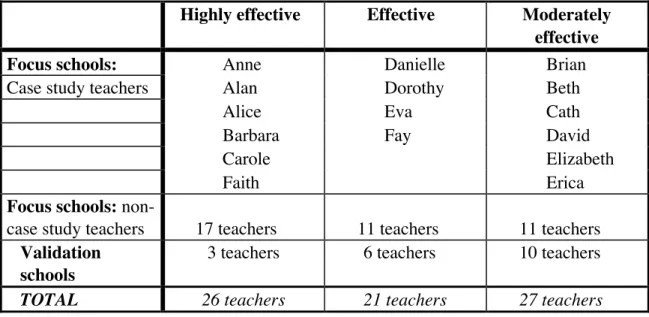
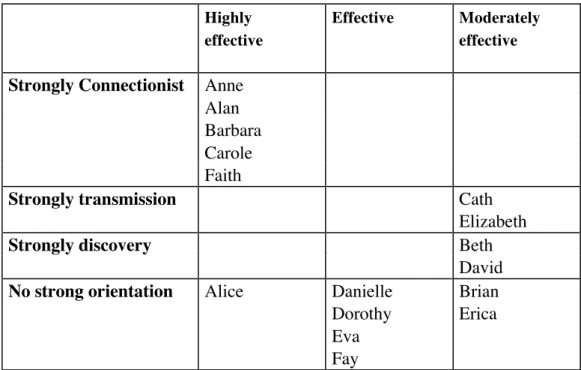
Table 1.2 presents the distribution of teachers in focus and validation schools in the three effectiveness categories, including the pseudonyms of 16 of the 18 case study teachers in focus schools. (Two case study teachers, Claire and Frances, are excluded from this table because they both taught Y1 for which gain scores were not available.) The initial of the pseudonym given to each teacher indicates which focus school they came from; for example Anne, Alan and Alice were the three case-study teachers in School A.
Highly effective Effective Moderately effective
Focus schools: Anne Danielle Brian
Case study teachers Alan Dorothy Beth
Alice Eva Cath
Barbara Fay David
Carole Elizabeth
Faith Erica
Focus schools:
non-case study teachers 17 teachers 11 teachers 11 teachers
Validation schools
3 teachers 6 teachers 10 teachers
TOTAL 26 teachers 21 teachers 27 teachers
Table 1.2: Teachers grouped according to relative mean class gains. As can be seen, only six of the teachers we had selected for case study in the focus schools were placed in the highly effective category. This group of teachers had many common features, which were not shared by case study teachers in the moderately effective group. Hence the group, although smaller than expected, was thought large enough to act as a sample to enable key factors to be elicited. The findings were later supported by reference to the additional three highly effective teachers in the
validation schools.
However it is interesting to note the large number of highly effective teachers who were not selected for case study. One reason for this was that nine of these other 17 teachers all came from School A, which already had three teachers in the highly effective group. In the case of other schools, some of the remaining eight highly effective teachers might have been selected by their heads but were not. Several possible reasons may account for this. The most likely reason is that some highly effective teachers were unwilling because of other pressures to take part in the case study work, which required additional interviews and observation.
Perhaps more surprisingly, several teachers, who had been selected as effective numeracy teachers in schools with good mathematics performance, turned out only to be moderately effective compared to the remaining teachers in their schools. Possible reasons for this include heads not recognising who were the most effective teachers of numeracy in the school, or perhaps either knowingly or unknowingly directing us to teachers for other reasons, such as firmness of class control.
The fact that our sample of case study teachers from focus schools spanned the highly effective, effective and moderately effective scale was helpful to the analysis in so far as the detailed data on these teachers helped to inform the contrast between more and less effective teachers.
As a result the data from validation schools was used mainly to supplement the more detailed qualitative data from the case-study teachers in focus schools. In all cases the data from the validation schools supported findings from the focus schools.
1.10 How does this sample compare with primary teachers in general?
Clearly the sample of schools participating in the study was biased towards schools effective in teaching numeracy. Eight of the eleven schools, all six focus schools and two of the five validation schools, were selected as effective on evidence of value-added performance (or, in the case of independent schools, expert opinion). However in the case of state schools (8 out of the 11 schools) the data used for selection suggested that these were members of a large set of effective schools rather than members of an elite set of schools with outstanding results. The results of the study seemed to confirm that this was indeed generally the case.
The findings show that two schools (both state and both from the 6 focus schools) stood apart as performing better than the others. One of these schools achieved outstanding results, which put 12 of its 13 teachers in the highly effective category. The mean gains for different classes in the remaining six schools selected as effective suggested that each contained at least one highly effective teacher and a small number of effective teachers. However both results and classroom observation suggested that about half the teachers in these remaining six effective schools seemed to be at best averagely competent in teaching numeracy, with a few probably below average. This is confirmed by the data from the three other validation schools. Two of these were selected as being of only average effectiveness in their numeracy teaching using value-added criteria, with the third weak. Judged by the class gains in this study, none of these three schools was distinguishable from most of the eight schools selected as effective. Translating mean gains into teacher effectiveness, they contained roughly the same distribution of teachers between the three effectiveness categories as most of the group of effective schools. (The detailed data is in Table 5.1.)
In the case of the independent schools, the initial data available was very limited, so the selection of three effective schools was based mainly on expert advice. It would seem that in comparison with most of the state schools in the sample, two were
slightly more effective, while the third was less effective than any of the state schools. None of the three was as effective as were the best two state schools.
The finding that two schools suggested by LEA-held value-added mathematics data to be average, and one suggested to be weak, were not noticeably different in numeracy gains from three schools which were suggested by the LEA data to be above average, would suggest that our sample of schools contained mainly schools which were average to good in numeracy teaching in comparison with the overall population of
below average in gains, one (state) school that was very good and another where the performance was outstanding.
On the basis of this it would seem likely that, in relation to the national population of teachers, the moderately effective category of teachers were likely to be about average in numeracy effectiveness, with some below average and some slightly above. The
effective teachers would seem likely to be good to very good, with the highly effective
group showing outstanding performance. The labels for the categories were chosen to reflect this distribution.
Because of the difficulties demonstrated in this study in identifying the comparative effectiveness of both schools and teachers on the basis of current data available, no closer estimate of the nature of the sample can be made.
1.11 References for Chapter 1
Boaler, J (1996) Case studies of alternative approaches to mathematics education: situated cognition, sex and setting. Unpublished PhD thesis, King's College, University of London.
Keys, W; Harris, S & Fernandes, C (1996). Third international mathematics and science study. First national report, part 1. Achievement in mathematics and science at age 13 in England. Slough: National Foundation for Educational Research.
Office for Standards in Education (OFSTED) (1994). Science and mathematics in schools: a review. London, UK: Her Majesty's Stationery Office (HMSO).
Reynolds, D & Farrell, S (1996). Worlds apart? A review of international surveys of educational achievement involving England (Ofsted reviews of research series). London: HMSO.
Chapter 2: A framework for beliefs, knowledge and practice
2.1 Introduction
In this chapter we set out a model of the interplay and relationship between beliefs, knowledge and classroom practices. Each, we suggest, informs and is informed by the others. Understanding why some teachers may be more effective than others requires an examination of each of these aspects. We examine these aspects in the following sections:
2.2 Beliefs, knowledge and practices
2.3 Aspects of beliefs and pedagogic content knowledge
2.4 Gathering information on beliefs and pedagogic content knowledge The model we present here will be used as a framework for the analysis of the findings of the study in Chapters 3 and 4.
2.2 Beliefs, knowledge and practices
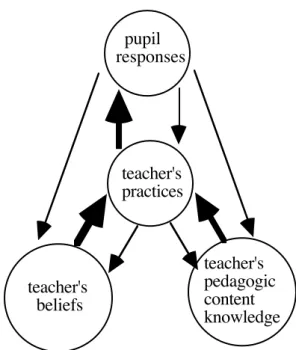
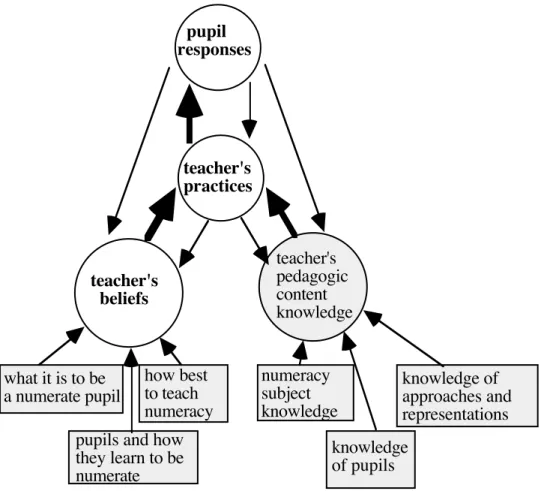
Our starting point for understanding effective teachers is a model of teachers' classroom practices informed by two complementary aspects: a set of beliefs, and a collection of knowledge (including subject knowledge) and understandings that teachers have about numeracy and its teaching which we refer to as pedagogic content knowledge. The model developed builds upon research previously carried out in teachers' beliefs and knowledge (see for example Aubrey, 1994; Bennett, Summers, & Askew, 1994; Lerman, 1990; Shulman, 1987; Thompson, 1984; Thompson, 1989) We start with the assumption that practice in the classroom, in lessons, is the major factor influencing learning outcomes. Teachers' beliefs and knowledge and their practices outside the classroom, for example in their lesson planning, will all inform and influence lessons. However, it is the interactions between teachers and pupils as they occur in lessons that will be the most significant influence that a teacher has on pupils' learning.
We do not suggest that the interaction is only a one-way process from teacher to child. Teachers' perceptions of pupils' knowledge, understanding and behaviour in lessons will feed back and influence their own beliefs, knowledge and practices. The relationship is actually even more complex since our evidence to be presented in Chapter 3 and the evidence of previous studies leads us to suggest that the implicit beliefs or theories that teachers have, together with their knowledge, themselves influence the way that teachers interpret classroom events. For example, if a teacher believes that the major factor in learning mathematics is the rote memorisation of routines, then pupil errors are more likely to be interpreted as the result of pupil carelessness or lack of attention. On the other hand, a teacher who believes that pupils are trying to make sense of information may interpret errors as arising from a
pupil responses teacher's practices teacher's beliefs teacher's pedagogic content knowledge
Figure 2.1 A model of the interplay and relationship between beliefs, knowledge and classroom practices
The arrows in the diagram also indicate that the relationship between teacher beliefs and teacher practices does not go only in one direction. For example, changes in practice that are driven by pragmatic reasons may lead to changes in beliefs. One of our teachers told us that she had started to get pupils to explain their methods to each other as it was an effective way of controlling a lively class. Through this practice she had come to realise the benefits of pupils articulating and sharing methods and now believed that it was an effective way of furthering the pupils' understanding. Another of the teachers talked about how her beliefs about pupils' abilities had been
challenged through activities with pupils that she had been required to carry out on a CPD(continuing professional development) course.
Although the model does indicate this feedback loop, the use of bold arrows in the diagram indicates that we suggest that the strongest effect is likely to be that of teachers' implicit or explicit beliefs and pedagogic content knowledge shaping what happens in the classroom.
2.3 Aspects of beliefs and pedagogic content knowledge
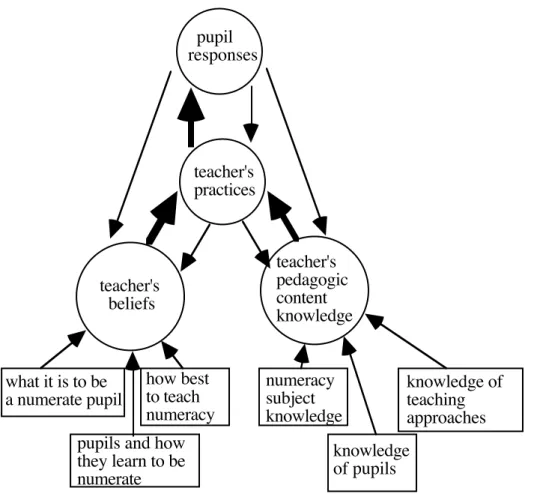
We suggest that there are three aspects of beliefs that influence the teaching of numeracy:
• Beliefs about what it is to be a numerate pupil. This includes teachers' beliefs about:
–the nature of mathematics in general –numeracy in particular
–expectations of learning outcomes.
• Beliefs about pupils and how they learn to become numerate. Included here are beliefs about:
–whether or not some pupils are naturally more mathematical –the type of experiences that best bring about learning
–the role of the pupils in lessons.
• Beliefs about how best to teach pupils to become numerate. These are related to beliefs about teaching numeracy in terms of:
–perception of the teacher's role in lessons
–the influence of the 'accepted' wisdom of 'good' primary practice.
While a teacher's beliefs are important in shaping lessons, they are only part of the story. Different aspects of the teacher's knowledge also contribute in significant ways. A teacher might believe that pupils learn best through direct instruction. However, if a teacher's subject knowledge is limited or incorrect, what the pupils are likely to learn is going to be affected by this knowledge.
Similarly, if a teacher does not have good knowledge of pupils in terms of what they already know or how they, as individuals, approach tasks, the pupils may be expected to learn either something that they already know or something that is too complex for their current knowledge state.
Finally, while a teacher may have a sound understanding of a mathematical idea, suitable teaching approaches need to be used in order to make the idea accessible to pupils. For example, the mathematical concept of a fraction encompasses many different applications (part of a whole shape and part of a collection of items, to name but two). What is essentially a generalised abstract concept has to be presented to pupils through more concrete models (diagrams, physical materials, verbal analogies). Over time, pupils need to be introduced to a range of representations in order to understand the more abstract idea. For example, too much reliance on fractions being represented as congruent parts of a whole shape (e.g. three fifths as three pieces of a 'pizza' already cut into five sector pieces) may lead to a limited understanding of fractions and later difficulties in relating fraction notation to the idea of a ratio (e.g.
expressing one price as 7/5 of another) or of a rational number (representing 7/5 as a point on the number line between 1 and 1.5).
The types of representations used in lessons not only depends on a teacher's knowledge of teaching approaches but may also, in part, be determined by the teacher's belief orientation. For example a belief in the importance of being able to physically manipulate objects may lead to less attention being given to diagrams. But the greater a teachers' knowledge is in terms of awareness of different forms of representation the more likely it is that she will provide pupils with access to this range.
These three areas together contribute to what we are calling pedagogic content knowledge:
• Numeracy subject knowledge: understanding of mathematics and numeracy appropriate to what is being taught.
• Knowledge of how pupils learn numeracy: what particular pupils currently being taught understand as well as knowledge of pupils more generally, for example aspects of the numeracy curriculum that are generally found difficult, common misconceptions and models of progression.
• Knowledge of numeracy teaching approaches: understanding of teaching styles and different ways of presenting numeracy ideas to pupils, including a range of diagrammatic and verbal representations, so that they gain access to the subject knowledge.
This model of teacher beliefs and pedagogical content knowledge does not exist in isolation. The contexts in which teacher operate should also be taken into account. Contextual influences include:
• school practices and ethos
• the context of the National Curriculum and educational policies • parental and pupil expectations.
But every study has to set boundaries and concentrate on the variables most relevant to its goals. For our study, the goal is knowledge about characteristics of teachers and factors that influence these so that others (the Teacher Training Agency, teacher trainers and teachers themselves) will benefit. Our attention to contextual influences will therefore be limited to those that help with this understanding.
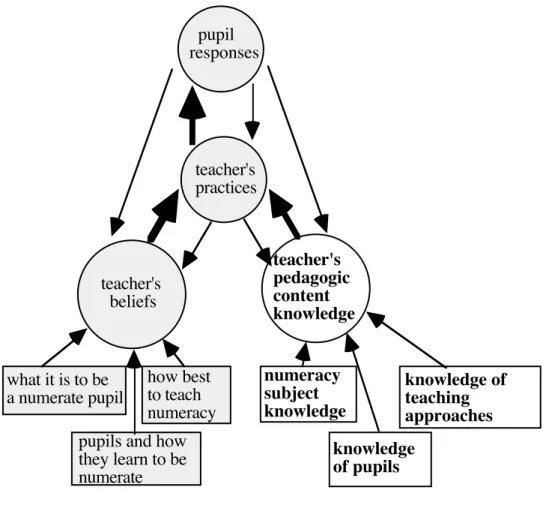
pupil responses teacher's practices teacher's beliefs teacher's pedagogic content knowledge what it is to be a numerate pupil
pupils and how they learn to be numerate how best to teach numeracy numeracy subject knowledge knowledge of pupils knowledge of teaching approaches
Figure 2.2 The elaborated model
2.4 Gathering information on beliefs and pedagogic content knowledge In order to gather information on teachers' beliefs and pedagogic content knowledge, five methods were selected and developed to provide data, both qualitative and quantitative, on the teachers in the sample.
Questionnaire
A questionnaire was administered to all 90 teachers in both focus and validation schools.
This provided background data on:
• organisation and planning for mathematics teaching • resources and classroom materials
• training and continuing professional development and about teachers' perceptions of:
• teaching styles
Classroom observations
In total, 84 lessons were observed, three for each of the 18 case study teachers in focus schools and two for each of the 15 validation teachers. Data was gathered from observation in classrooms, including a focus on:
• organisational and management strategies - how time on task is maximised, catering for collective and individual needs, coping with the range of attainment • teaching styles - intervention strategies, questioning styles, quality of
explanations, assessment of attainment and understanding, handling pupil errors • teaching resources - sources of activities, range of tasks, resources available,
expected outcomes
• pupil responses - ways of working, evidence of understanding.
Detailed accounts were given of the flow, content and context of lessons. The attention that teachers paid to providing instruction in and discussion of more sophisticated strategies for calculation (as opposed to relying on counting strategies) was a focus of attention.
Head teacher interviews
Interviews were held with the 6 head teachers of the focus schools. These interviews probed issues arising out the refinement of teacher data, including:
• school policy, management and approaches to continuing professional development (CPD) as related to the research
• heads' perceptions of teachers' confidence, ability and approaches to teaching.
Case study teacher interviews
Fifty-four interviews with case study teachers in focus schools were carried out, three for each of the 18 teachers.
• background interview: this interview provided evidence to supplement the questionnaire on training and experience as well as information on beliefs, knowledge and practices in teaching numeracy; teachers' own perceptions of what has made them successful teachers of numeracy, and reasons for factors identified
• 'concept mapping' interview: this interview was based around a task that explored the teachers' understanding of aspects of mathematics related to teaching numeracy
• 'personal construct' interview: this interview was structured around a task that focused on the particular group of pupils that the teacher was currently teaching in order to explore the beliefs and knowledge about pupils and how they came to be numerate.
Validation teacher interviews
Each of the fifteen validation teachers was interviewed. These interviews were structured around a series of statements derived from the interviews with the case study teachers and selected to elicit responses to factors thought to be significant. Appendix 2.1 provides further details on each of these sources of data.
The next chapter sets out our findings about teacher beliefs arising from this data, while Chapter 4 explores the teachers' pedagogic content knowledge.
References for Chapter 2
Aubrey, C (1994). The Role of Subject Knowledge in the Early Years. London: Falmer.
Bennett, N; Summers, M & Askew, M (1994). Knowledge for teaching and teaching performance. In A. Pollard (Ed.) Look Before You Leap? Research Evidence for the Curriculum at Key Stage Two London: the Tufnell Press.
Lerman, S (1990). Alternative perspectives of the nature of mathematics and their influence on the teaching of mathematics. British Educational Research Journal, 16(1), 53-61.
Shulman, L S (1987). Knowledge and teaching: foundations of the new reforms. Harvard Educational Review, 57, 1-22.
Thompson, A G (1984). The relationship of teachers' conceptions of
mathematics and mathematics teaching to instructional practice. Educational Studies in Mathematics, 15, 105-127.
Thompson, A G (1989). Learning to teach mathematical problem solving: changes in teachers' conceptions and beliefs. In National Council for Teachers of Mathematics Research Agenda for Mathematics Education: The Teaching and Assessing of Mathematical Problem Solving (pp. 232-243). Reston, VA: NCTM/Lawrence Erlbaum Associates.
Chapter 3: Teachers' belief systems
3.1 Introduction pupil responses teacher's practices teacher's beliefs teacher's pedagogic content knowledge what it is to be a numerate pupilpupils and how they learn to be numerate how best to teach numeracy numeracy subject knowledge knowledge of pupils knowledge of teaching approaches
Figure 3.1 Focus on the part of the model concerned with a teacher's beliefs In this chapter we focus on teachers' beliefs, and present three models of sets of beliefs that emerged as important in characterising, and helping to understand, the approaches teachers took towards the teaching of numeracy. We discuss these three models in terms of three orientations towards teaching mathematics:
• connectionist • transmission • discovery.
These orientations are "ideal types": no one teacher did, or is ever likely to, fit exactly within the framework of beliefs of any one of the three orientations; many combined several characteristics of two or more orientations.
However, it was clear that those teachers with a strongly connectionist
orientation were more likely to have classes that made greater gains over the two terms than those classes of teachers with strongly discovery or transmission orientations.
Such beliefs are often implicit and tend to shape rather than directly control behaviour. One use for these findings is for other teachers to examine the extent of match between their own personal belief system and those of the teachers in this study whose pupils made most learning gains.
Our examination of these orientations is dealt with in the following manner: 3.2 Orientations towards mathematics teaching
3.3 The connectionist orientation 3.4 The transmission orientation 3.5 The discovery orientation
3.6 Summary of characteristics of orientations 3.7 Aspects of orientations in practice
3.8 Orientation and the role and nature of mental strategies in pupils becoming numerate
3.9 Orientation and the type of tasks set to pupils 3.10 Orientation and style of interaction
3.11 Orientation and the role of using and applying 3.12 Discussion and implications of orientations
3.2 Orientations towards mathematics teaching
An understanding of the teachers' beliefs and practices was built up from data from three sources
• questionnaire data from the full sample of 90 teachers
• observations of 54 mathematics lessons with the 18 case study teachers and 30 lessons with the 15 validation teachers
• three interviews with each of the 18 case study teachers and two with each of the 15 validation teachers, in particular but not exclusively the
'background' interviews with each teacher, following observation of a lesson, which explored teachers' perceptions of and explanations for their practice, both in these lessons and more generally.
The transcripts of interviews with and field notes of observations of the 18 case study teachers were coded and analysed using a 'constant comparative' method, identifying similarities as well as differences in the teachers' belief systems and practices. The data pertaining to teachers with relatively high and relatively low gains was examined first, and later the analysis was extended to data for other teachers. Validity of the findings was assisted both by triangulation between the different data sources on each teacher, and by the fact that each transcript for the case study teachers was analysed and discussed by at least three members of the research team.
As a result of this analysis, we suggest that the similarities allow the beliefs to be characterised into three contrasting orientations towards the teaching of
numeracy. These orientations were also apparent in the data from the 15 validation teachers, although the data for this group of teachers is less comprehensive.
Before setting out key differences in these orientations we offer three examples of classroom practice to provide some flavour of how each orientation may look in practice. The examples have been taken from field notes of actual lessons observed.
Example 1: Connectionist orientation
A Y6 class. The teacher has put a chart on the white board that has columns for fractions, decimal fractions, percentages and ratios. One value has been entered in each row and the pupils are working in pairs to convert from one form of
representation to another. They are using a variety of methods but working mainly in their heads and most are checking using a different method. As they begin to complete the task the teacher brings the class together. Individuals are invited to provide the answers and explain the method of calculation used. The other pupils are attentive to these explanations. More efficient methods are offered and errors dealt with in a supportive manner either by the teacher or other pupils. Finally they discuss the sort of contexts where the different representations would be used.
Example 2: Transmission orientation
A class of Y4 pupils is working on equivalent fractions. The teacher draws a diagram on the board to demonstrate a means of converting 1/2 into quarters. She explains that quarters are the fraction to convert to and so the pupils will need to draw a rectangle divided into four equal parts.
1
4
2
=
Since a half is required then two of these parts need to be shaded in.
'
1
4
2
=
2
'So, a half is equivalent to two quarters', explains the teacher. 'On the other hand', she continues, ' we could just look at the numbers on the bottom of the fraction. I have to multiply 2 (pointing to the 2 on the bottom of the 1/2) by 2 to make 4 (pointing to 4 on the board of a yet denominator free quarter fraction), so I multiply the 1 (pointing to the 1 on the top of the 1/2) by 2 also. So we get 2/4, which is the same as we got when we drew the diagram.'
'
1
4
2
=
2
x 2 x 2The pupils are given a number of fractions to convert into equivalents and told they can either use the diagram method or the multiplication method. As the teacher moves around the class, once pupils have done a few examples using the diagram, she suggests to them that it will be quicker to use the other method. Example 3: Discovery orientation
This Y2 class is organised in ability groups. The teacher is working with a low attaining group on doubling. The pupils spend a long time counting out individual cubes, fitting them together and recounting them. The teacher sets them a series of numbers to double, reiterates how to find the answer using the cubes and goes to join another group. The pupils are able to talk about what double four hundred might be and quickly move onto discussing doubling three thousand, six million and so on. After the lesson the teacher explained that she was concerned that the pupils were not ready to be working with large numbers, particularly as no Dienes blocks had been got out so that they could see that double three thousand was six thousand.
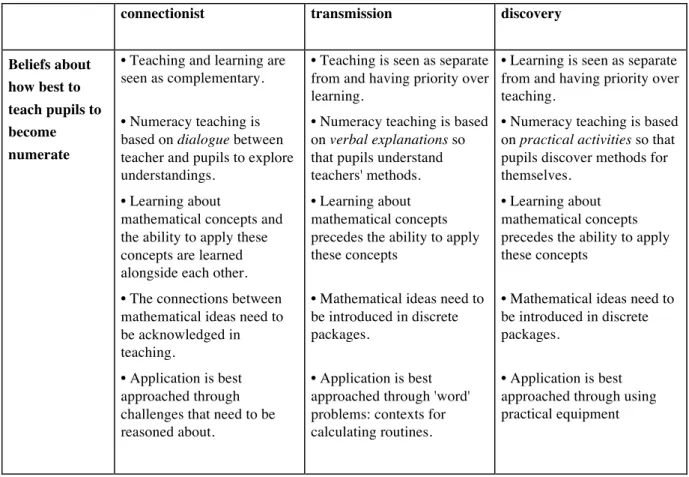
The following three sections (3.3, 3.4 and 3.5) describe characteristics of each of these orientations according to the three aspects of beliefs shown in the elaborated model in Figure 3.1. These are then summarised in a table presented in section 3.6.
3.3 The connectionist orientation
Connectionist beliefs about what it is to be a numerate pupil
We characterise a connectionist orientation as including the belief that being numerate involves being both efficient and effective. For example that while 2016 - 1999 can be effectively calculated using a paper and pencil algorithm, it is more efficient to work it out mentally. However, for calculating 2345 - 1767, a reliable paper and pencil method (possibly but not necessarily one of those traditionally taught) would be both effective and efficient for many pupils. Methods of calculation are not completely divorced from the size and type of numbers being operated upon and connections need to be established between numbers and methods. Being numerate, for the connectionist orientated teacher, requires an awareness of different methods of calculation and the ability to choose an appropriate method.
Connectionist orientated teachers also emphasise the links between different aspects of the mathematics curriculum. Again, appropriateness is important in
appreciating these links, for example in working with pupils to help them decide whether a problem presented in the form of fractions is best solved as fractions or whether to convert these and work with decimals.
The application of number to new situations is important to the connectionist orientation: they encourage pupils to draw on their mathematical understandings to solve realistic problems. But connectionist teachers go beyond interpreting Using and Applying Mathematics (UAM) (as set out as an Attainment Target in the National Curriculum) as the inclusion in the curriculum of investigations or contextual problem solving. The connectionist orientation places a strong
emphasis on developing reasoning and justification leading to the proof aspects of UAM. Reasoning about number is as important as its application, and as such UAM becomes integral to the teaching of number.
Connectionist beliefs about pupils and how they learn to become numerate Associated with the connectionist orientation is a belief that most pupils are able to learn mathematics given appropriate teaching, which explicitly introduces the links between different aspects of mathematics.
Further to this is a belief that pupils come to lessons already in possession of mental strategies for calculating but that the teacher has a responsibility for intervening, working with the pupils on becoming more efficient. Any
misunderstandings that pupils may display are seen as important parts of lessons, needing to be explicitly identified and worked with in order to improve
understanding.
Connectionist beliefs about how best to teach pupils to become numerate The primary belief here is that teaching mathematics is based on dialogue
between teacher and pupils, so that teachers better understand the pupils' thinking and pupils' can gain access to the teachers' mathematical knowledge. This belief manifested itself in practice through extensive use of focused discussion to help pupils explore efficient strategies and interpret the meaning of mathematical problems.
Alongside this was a belief that some of the complexity of mathematical ideas had to be presented to pupils. For example, fractions, decimals and percentages were taught together, rather than as separate topics.
3.4 The transmission orientation
Transmission beliefs about what it is to be a numerate pupil
The transmission orientation entails a belief in the importance of a collection of procedures or routines, particularly in regard to paper and pencil methods, one for doing each particular type of calculation regardless of whether or not a different method would be more efficient in a particular case.
The transmission orientation encompasses a view of using and applying as the application of mathematics to word problems (basic calculations set in a real world context). These word problems can be tackled after learning to do
calculations or procedures in an abstract form. Since the numeracy emphasis is on the ability to perform set routines, the transmission orientated teacher, at primary level, does not give much attention to the reasoning, logic and proof aspects of UAM.
Transmission beliefs about pupils and how they learn to become numerate Since the transmission orientation places such emphasis on the ability to reproduce set methods and routines, what the pupil already knows is of less importance, unless it forms part of a new procedure. Methods that pupils have created themselves are not used as the basis from which to build more efficient and effective methods.
Pupils are believed to vary in their ability to become numerate; if the teaching has explained a method clearly and logically, then any failure to learn must be the result of the pupils' inability rather than a consequence of the teaching. Any misunderstandings that pupils may display are seen as the result of the pupils’ failure to 'grasp' what was being taught; they need to be remedied by further reinforcement of the 'correct' method and more practice to help them remember. Transmission beliefs about how best to teach pupils to become numerate
The transmission orientation places more emphasis on teaching than learning. Thus teaching is believed to be most effective when it consists of clear verbal explanations of routines. Interactions between teachers and pupils tend to be question and answer exchanges in order to check whether or not pupils can reproduce the routine or method being introduced to them.
Application problems tend to be 'word' problems - situations, often contrived, that are used as context for the further practice of calculating routines. Teaching is focused on the introduction of strategies for 'decoding' word problems to identify the operation they 'contain'.
Further, this emphasis on a number of routines and methods to be learned leads to the presentation of mathematics in discrete packages, for example, fractions are taught separately from division.
A transmission orientation also results in the use of 'track laying' - the use of paper and pencil methods and styles of recording in advance of when they may be appropriate. The use of vertical forms of recording encourages a concentration on operating with single digits, concentrating on one 'place' at a time (e.g. first dealing with the units, then the tens, and so on). These may well be introduced first with single digit and simple 2-digit numbers that would more efficiently be operated on mentally.
3.5 The discovery orientation
Discovery beliefs about what it is to be a numerate pupil
The discovery orientated teacher tends to treat all methods of calculation as equally acceptable. As long as an answer is obtained, whether or not the method is particularly effective or efficient is not perceived as important. Pupils' creation of their own methods is a valued process, and is based upon building up their
confidence and ability in practical methods. Calculation methods are selected primarily on the basis of practically representing the operation. The mathematics curriculum is seen as being made up of mostly separate elements.
Using and applying mathematics is seen as primarily concerned with the use of practical equipment.
Discovery beliefs about how pupils learn to become numerate
The primary belief here is that becoming numerate is an individual activity derived from actions on objects. Learning takes precedence over teaching and the pace of learning is determined by the pupils. Pupils' own strategies are the most important: understanding is based on working things out for themselves.
Pupils are seen as needing to be 'ready' before they can learn certain mathematical ideas. This results in a view that pupils vary in their ability to become numerate. Pupil misunderstandings are the result of pupils not being 'ready' to learn the ideas.
Discovery beliefs about how best to teach pupils to become numerate
Teaching pupils requires extensive use of practical experiences that are seen as embodying mathematical ideas so that pupils discover methods for themselves. Mathematical ideas need to be introduced in discrete packages.
Learning about mathematical concepts precedes the ability to apply these concepts and application is introduced through practical problems.