University of Virginia Law School
The John M. Olin Program in Law and Economics Working Paper
Series
Year Paper
Habeas Settlements
Anup Malani
∗∗University of Virginia, [email protected]
This working paper is hosted by The Berkeley Electronic Press (bepress) and may not be commer-cially reproduced without the permission of the copyright holder.
http://law.bepress.com/uvalwps/olin/art3 Copyright c2005 by the author.
Anup Malani
Abstract
Why is it that criminal cases nearly always settle, but habeas corpus cases do not? The vast majority of criminal cases are resolved by guilty pleas, without a trial. But it is the rare habeas petition that is resolved out of court, rather than litigated to completion. This is an interesting puzzle because criminal and habeas corpus cases have a lot in common. They involve the same parties and the same attorneys. They also involve similar bargains: the defendant or prisoner receives a shorter, more certain sentence and the prosecutor or government attorney avoids having to litigate a criminal or habeas case, respectively. This is an important puzzle because active settlement of habeas cases could reduce habeas caseloads by nearly one-third. Although most habeas petitions are sure-losers under current law, I estimate that at least 28 percent are sufficiently credible – or costly for the government to defend – that they warrant settlement.
I attempt to resolve this puzzle and propose a series of reforms to pave the way for more active (but safe) settlement of habeas cases. Most notably, I propose that Rule 35 of the Federal Rules of Criminal Procedure be modified to permit courts to amend sentences upon a habeas settlement, regardless of whether the modified sentence is within the sentencing guideline range for the prisoner’s offense. And, to ensure that any growth in habeas settlements is not at the expense of prisoners’ rights, I propose that courts be required to conduct Rule 11-type colloquies with prisoners before accepting habeas settlements.
Anup Malani†
ABSTRACT
Why is it that criminal cases nearly always settle, but habeas corpus cases do not? The vast majority of criminal cases are resolved by guilty pleas, without a trial. But it is the rare habeas petition that is resolved out of court, rather than litigated to completion. This is an interesting puzzle because criminal and habeas corpus cases have a lot in common. They involve the same parties and the same attor-neys. They also involve similar bargains: the defendant or prisoner receives a shorter, more certain sentence and the prosecutor or gov-ernment attorney avoids having to litigate a criminal or habeas case, respectively. This is an important puzzle because active settlement of habeas cases could reduce habeas caseloads by nearly one-third. Al-though most habeas petitions are sure-losers under current law, I es-timate that at least 28 percent are sufficiently credible – or costly for the government to defend – that they warrant settlement.
I attempt to resolve this puzzle and propose a series of reforms to pave the way for more active (but safe) settlement of habeas cases. Most notably, I propose that Rule 35 of the Federal Rules of Criminal Procedure be modified to permit courts to amend sentences upon a habeas settlement, regardless of whether the modified sentence is within the sentencing guideline range for the prisoner’s offense. And, to ensure that any growth in habeas settlements is not at the expense of prisoners’ rights, I propose that courts be required to conduct Rule 11-type colloquies with prisoners before accepting habeas settle-ments.
†
Associate Professor of Law, University of Virginia Law School, and Research Affiliate, Joint Cen-ter for Poverty Research, NorthwesCen-tern University/University of Chicago. I thank Barbara Armacost, Ahilan Arulanantham, Scott Baker, Marc Falkoff, Michelle Friedland, Jeremy Gaston, William Gould, John Harrison, Joseph Kennedy, Michael Leiter, Daniel Ortiz, John Pfaff, Micah Schwartzman, Eliza-beth Scott, participants at the University of Virginia Birdwood Conference, and workshop participants at the University of North Carolina for helpful comments; Stephen Smith for spending hours explaining federal habeas law to me; Marc Falkoff for access to his data base of post-AEDPA federal habeas claims by state prisoners in the Eastern District of New York; John Pfaff for access to his data on the distribu-tion of prison release by admission date; Michael Snypes, Maulshree Solanki, Bradford Wenban, and especially Adam Humphreys for outstanding research assistance; and last, but not least, the many state and federal public defenders and prosecutors who took time to discuss with my research assistants and me their experiences with plea bargaining and habeas settlements.
INTRODUCTION
Why is it that criminal cases nearly always settle, but habeas corpus cases do not? The vast majority of criminal cases are resolved by guilty pleas, without a trial. But it is the rare habeas petition that is resolved out of court, rather than litigated to completion.
This is an interesting puzzle because criminal and habeas cor-pus cases have a lot in common. They involve the same parties and the same attorneys. Prosecutors who actively negotiate plea agree-ments in criminal cases are very often the attorneys responsible for defending the government in habeas cases. The public defenders who actively negotiate pleas on behalf of their clients are nearly al-ways prisoner’s counsel in credible habeas cases. Settlement of criminal and habeas cases also involve similar bargains: the defen-dant or prisoner receives a shorter, more certain sentence and the prosecutor or government attorney avoids having to litigate a crimi-nal or habeas case, respectively.
This is an important puzzle because active settlement of ha-beas cases could reduce haha-beas caseloads by nearly one-third. Al-though most habeas petitions are sure-losers under current law, I es-timate that at least 28 percent are sufficiently credible – or costly for the government to defend – that they warrant settlement. These cases include ones where petitioners are appointed counsel by the court; win at least one vote to grant, even though they are ultimately denied; or are ultimately granted at the state or federal level. (This last cate-gory alone accounts for 8 percent of cases.) Moreover, habeas set-tlements are as valid under the constitution as plea bargains because the former involve rights no more important than those waived by the latter.
In this paper I attempt to resolve this puzzle and propose a se-ries to reforms to pave the way for active (but safe) settlement of ha-beas cases. Based on extensive interviews with prosecutors and pub-lic defenders, as well as statistical analysis of data on habeas filings and judgments, I identify three primary obstacles to habeas settle-ments. First, parties to habeas cases simply do not think to settle. There is no culture of out-of-court, private resolution of habeas claims. This is not to suggest that there is opposition to compromise: most attorneys interviewed said they would welcome settlement, but it had just never come up. Second, in cases where settlement is con-sidered, rigidities in the federal sentencing guidelines often rule out any reasonable compromise. The reason is that even sentences aris-ing from habeas settlements must comply with sentencaris-ing guidelines, and many compromises lie outside the guidelines range for the crime that the prisoner committed. (This hurdle may be cleared if Blakely
v. Washington1 invalidates sentencing guidelines. But it could persist if, instead, prosecutors simply submit sentencing factors to juries.) A third obstacle to habeas settlements is that few state and no federal courts have the authority revise a prisoner’s sentence after a habeas filing and settlement. Therefore, to implement habeas settlements, government attorneys have to concede a prisoner’s habeas claims on the condition that the prisoner pleads to a lesser-included crime. The need to maintain good relations with police – or simply pride – often prevents prosecutors from making such a concession and thus im-plementing a settlement.
There are two basic reforms that would, for the most part, eliminate these obstacles to settlement. One is that training programs for prosecutors and public defenders should include modules on ha-beas settlements just they currently include modules on plea bargain-ing. The other reform is that Rule 35 of the Federal Rules of Crimi-nal Procedure, and its state aCrimi-nalogues, should be amended to permit courts, upon the government’s motion, to amend a prisoner’s sen-tence if the prisoner drops her habeas claims, regardless of whether the new sentence conforms to sentencing guidelines.
Just as the bargaining power asymmetries raise concerns about prosecutors taking advantage of defendants in plea negotia-tions, they also raise concerns about government attorneys exploiting prisoners in habeas settlement talks. Therefore, in order to ensure that habeas compromises are fair to defendants, I recommend two additional reforms. Following Rule 11, which requires that courts conduct a formal colloquy with defendants to ensure they understand the implication of their guilty pleas, Rule 35 and it analogues at the state level should be amended to require similar colloquies with pris-oners to ensure they understand the implications of any habeas set-tlement that they sign. This reform is uniquely important because most of the habeas settlements I have uncovered are oral contracts, which are difficult to reconstruct and enforce. The second reform is that courts should always permit prisoners to challenge a habeas set-tlement on the grounds that it was not voluntary and knowing be-cause the prisoner received ineffective assistance of counsel with re-gard to the settlement. There is little reason to fear that this excep-tion would negate the value of habeas settlements to government at-torneys because the use of Rule 11-type colloquies to vet settlements would render facially baseless most complaints about ineffective as-sistance of counsel.
Before diving into a discussion of habeas settlements, it is important to distinguish them from a related phenomenon: so-called
1
“habeas waivers.” These are clauses in plea agreements that waive, in addition to a defendant’s right to a trial, the defendant’s right to collaterally challenge her conviction. In other words, habeas waivers occur during plea bargaining, before a defendant files a habeas peti-tion, and they bar the defendant from ever filing a habeas petition. By contrast, habeas settlements occur after a prisoner files her habeas petition and resemble ordinary out-of-court settlements of criminal or other civil cases. The relationship between habeas settlements and habeas petitions is analogous to the relationship between plea agree-ments and an indictment, but it is habeas waivers, not habeas settle-ments, that are part of the plea bargaining process.
Although this paper – to be thorough – also examines why habeas waivers are less common than waivers of trial rights in plea agreements, I do not advocate the use of habeas waivers. The reason is that there are no gains to trade with habeas waivers. Habeas waiv-ers purchase defendants only trivial reductions in sentence because defendants who plead guilty retain few procedural rights that can be vindicated on collateral review and generally receive sentences that expire before the habeas review can be completed. Moreover, habeas waivers offer prosecutors little respite from habeas litigation because a small percentage of all habeas petitions are filed by prisoners who pleaded guilty and habeas petitions by such prisoners are truly never granted.
The remainder of this paper may be outlined as follows. Be-cause the case law on habeas waivers sets benchmarks against which the legality of habeas settlements are judged, Section I offers a brief account of the prevalence and enforceability of habeas waivers. It also expands on why such waivers are of little value to defendants or prosecutors. Section II returns to the primary focus of this paper, and examines prevalence and enforceability of habeas settlements. Sec-tion III discusses the constituSec-tional validity and the policy benefits of settlement to parties in habeas litigation. It follows up by recom-mending procedural reforms to promote habeas settlements. The conclusion takes up the benefits of habeas settlements that flow to courts and the quality of habeas case law. Appendix A provides ex-amples of habeas settlement agreements. Appendix B summarizes the data employed by the analysis in Sections I and II. Appendix C complements Section III with text for an amendment to Rule 35 that would give courts the authority to review and implement habeas set-tlements.2
2
In order to place it in academic context, this paper can be said to advance the literature on state and federal habeas review in three ways. It is, to the best of my knowledge, the first paper to discuss the settlement of habeas petitions after they are filed. Second, it is the first to conduct a nationwide survey to determine the prevalence of both habeas waivers and habeas settlements. Third, Appendix B offers
I. HABEAS WAIVERS
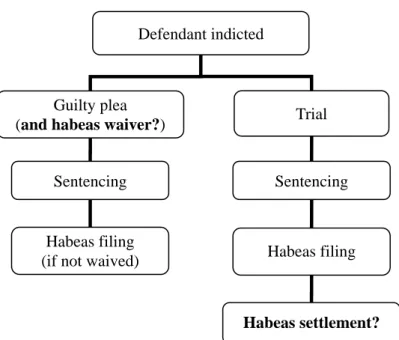
Defendants can trade their habeas corpus rights for sentencing concessions from prosecutors at either of two points during the criminal process (see Figure 1). They can be traded before trial, as part of a plea bargain. In exchange for a further reduction in her sen-tence, the defendant could waive, in addition to her right to trial, her right to collaterally attack her conviction in a habeas petition. Such agreements may be called “habeas waivers.” Alternatively, if the de-fendant opts for trial, is convicted and sentenced, and then files a ha-beas petition, she may surrender her haha-beas claim in return for a downward adjustment to her sentence before the courts complete their adjudication of her habeas petition. I refer to these latter ar-rangements as “habeas settlements.” Note that habeas waivers and habeas settlements are mutually excusive. If a defendant signs a ha-beas waiver, she cannot file a haha-beas petition. But without a haha-beas petition, there are no claims to motivate a habeas settlement.
Although the aim of this paper is to explain habeas settlements, this first section focuses on habeas waivers. This is not merely be-cause habeas waivers precede habeas settlements in the criminal process or because their mutual exclusivity means the prevalence of habeas waivers may partially explain the paucity habeas settlements. It is also because the case law on habeas waivers sets the benchmarks against which the legal validity of settlements is judged. This, in turn, is because the case law on habeas waivers is better developed than that on habeas settlements. Moreover, habeas waivers, which surrender the right to challenge errors in the criminal process before they occur, are in some sense more provocative than habeas settle-ments, which surrender the right to challenge procedural errors that have already occurred.
the first detailed examination of outcomes in 28 U.S.C. § 2254 cases after the Anti-terrorism and Effec-tive Death Penalty Act (AEDPA). This analysis is based on a detailed study of nearly 300 cases filed in the Eastern District of New York in 2001-2002 and gathered by Marc Falkoff, the special master ap-pointed by Judge Jack Weinstein to handle a backlog of habeas cases in that district. It is also the first to employ prisoner release data (as opposed to merely sentencing data), assembled by John Pfaff, to con-struct a more accurate estimate of the number of prisoners with effective habeas rights.
This section begins with some examples of habeas waivers, and then discusses the enforceability of these waivers. I proceed to sur-vey and explain patterns in the usage of habeas waivers. In the end, however, my investigation suggests that habeas waivers do not pro-vide sufficient value to defendants or prosecutors to warrant a policy of promoting such agreements. The data for the discussion in this section and the next are drawn from a nationwide survey of state and federal prosecutors and public defenders. This survey was answered by parties to criminal and habeas litigation in 23 states and 41 federal districts.3 Approximately 10 percent of the survey relies on open-ended phone conversations with respondents. The remainder is based on a formal survey instrument filled out by respondents over the phone or by fax.
Figure 1. Timing of habeas bargains in criminal process.
Habeas settlement?
Habeas filing Habeas filing
(if not waived)
Sentencing Sentencing
Trial Guilty plea
(andhabeas waiver?)
Defendant indicted
3
The states which responded are Alabama, Colorado, Connecticut, Delaware, Florida, Georgia, Il-linois, Indiana, Iowa, Kentucky, Louisiana, Maryland, Massachusetts, Michigan, Mississippi, Missouri, New Jersey, New Mexico, Pennsylvania, South Carolina, Washington, and Wisconsin. The federal dis-tricts that responded are S.D. Ala., D. Alaska, D. Ariz., E.D. Ark., W.D. Ark. C.D. Cal., E.D., Cal., N.D. Cal., D. Colo., D. Conn., D. Ha., D. Idaho, S.D. Ill., D. D.C., N.D. Fla., E.D. La., M.D. La., W.D. La., W.D. Mich., D. Minn., E.D., Mo., W.D. Mo., D. Nev., E.D. N.C., D. N.J., D. N.M., N.D. N.Y., W.D. N.Y., E.D. Okla., N.D. Okla., W.D. Okla., D. Ore., M.D. Penn., D. S.D., E.D. Tex., M.D. Tex., S.D. Tex., D. Utah, D. Vt., D. Wash., and D. Wyo.
A. Examples
Consider initially the case of U.S. v. Nicoloff.4 The defendant, a convicted felon, was arrested in Oklahoma while in possession of a firearm. She was charged under 18 U.S.C. §§ 922(g)(1) and 924(a) (2003) and pleaded guilty rather than risk trial. Importantly, her agreement with the prosecutor stipulated that
[t]he defendant agrees to waive all appellate rights, including any and all collateral attacks including but not limited to those pursued by means of a writ of habeas corpus, save and except claims of ineffective assistance of counsel.5
This is a fairly standard example of a habeas waiver. It surrenders the right to collateral review of a defendant’s sentence except in the case where the defendant challenges the effectiveness of defense counsel. (The value of this exception should not be overstated since every jurisdiction that enforces habeas waivers has carved an implicit exception for ineffective assistance claims that attack the voluntary-and-knowing nature of the plea agreement.)
It is difficult to determine from the text of most plea agreements how much prosecutors agree to reduce a defendant’s sentence in re-turn for a habeas waiver. There is typically a list of concessions by the defendant followed by a list of concessions by the prosecutor, with no express language connecting specific concessions by each side. Occasionally, however, habeas waivers are made conditional on a certain sentence. This sheds some light on the marginal contribu-tion of the habeas waiver to the defendant’s welfare. Consider the following example from a plea agreement arising out a felon-in-possession indictment in Minnesota:
In the event that the Court accepts the plea agreement, including the guidelines calculations set out in paragraph 5, and sentences the defendant at or below the guidelines range for an offense level of 17 and a criminal history of III, the defendant waives his right to appeal or to contest, directly or collaterally, his sentence on any ground, with the exception of the grounds of ineffective assistance of counsel, unless the Court should impose a sentence in violation of the law apart from the sentencing guidelines.6
4
U.S. v. Nicoloff, No. 03-CR-109-K (N.D. Okla. 2003).
5
Plea Agreement, U.S. v. Nicoloff, No. 03-CR-109-K (N.D. Okla. 2003), at 3 (§(A)(2)(b)). This agreement was provided by Julie O’Connell, Assistant Federal Public Defender, District of Oklahoma, Dec. 3, 2003.
6
Plea Agreement and Sentencing Stipulations, United States of America v. Robert Michael Martin, No. 03-109 (02), D. Minn., [Date] at 6 (¶ 8).
In this case the parties disagreed on the proper sentence for the de-fendant under the federal sentencing guidelines. The dede-fendant thought he deserved a sentence of 30-37 months as implied by an of-fense level of 17 for a defendant in criminal history category III. The prosecutor believed the defendant deserved a sentence of 46-57 months as implied by an offense level of 21 and criminal history category III.7 Thus the agreement suggests that the defendant was willing to exchange his appellate and habeas rights for a sentence less than 37 months rather than one greater than 46 months.
The reader has surely noted that both agreements above involve waivers of both appellate and habeas rights. This appears to be true of all the plea agreements. Some plea bargains contain appellate waivers without habeas waivers, but I have found none that contain a habeas waiver without an appellate waiver. Moreover, none of the defense attorneys or prosecutors I interviewed could recall a plea agreement with only a waiver of collateral review rights.8
B. Legal status and scope
Habeas waivers have been accepted in all jurisdictions but one (Indiana) that has considered them.9 That said, I have found a
7
United States Sentencing Guideline Manual, Ch. 5 pt. A at 632 (2003) (hereinafter U.S.S.G.).
8
Finally, while most habeas waivers in plea agreements are the product of an exchange of collateral review rights for marginal reductions in sentence, there are cases where parties say a habeas waiver’s primary purpose is to secure compliance with the remainder of the contract rather than secure additional sentence reductions. For example, if the parties agree that, given the uncertainty of conviction, the ex-pected sentence for a defendant is less than the statutory minimum for the crime he has committed, no deal may be possible if the defendant pleads to that crime. A deal may be possible, however, if the de-fendant pleads to a different crime that he has not technically committed but that permits a sentence that approximates the expected sentence were the defendant to go to trial for the crime he did commit. The difficulty is that such a plea agreement is vulnerable to a collateral challenge on the grounds that the de-fendant is innocent of the crime to which he pleaded. The dede-fendant would have to demonstrate the plea was involuntary or unintelligent because of, e.g., ineffective assistance of counsel, but the risk that the plea agreement will unravel is greater than zero. To eliminate this risk, parties will agree to habeas waivers. As in waiver-for-sentence bargains, however, such plea agreements contain both appellate and habeas waivers. Unlike waiver-for-sentence bargains, such agreements do not contain appellate waivers without habeas waivers. Telephone interview with Daniel Scott, Assistant Federal Public Defender, Dis-trict of Minnesota (Dec. 3, 2003); Telephone conversation with Ahilan Arulanantham, Assistant Federal Public Defender, Western District of Texas (Nov. 20, 2003).
9
Garcia-Santos v. U.S., 273 F.3d 506, 508-509 (2d Cir. 2001); U.S. v. Craig, 985 F.2d 175, 178 (4th Cir.1993) (per curiam); U.S. v. Wilkes, 20 F.3d 651, 653 (5th Cir. 1994); Watson v. U.S., 165 F.3d 486, 488-89 (6th Cir. 1999); Mason v. U.S., 211 F.3d 1065, 1069 (7th Cir. 2000); DeRoo v. U.S., 223 F.3d 919, 923 (8th Cir. 2000); U.S. v. Abarca, 985 F.2d 1012, 1014 (9th Cir. 1993); U.S. v. Cockerham, 237 F.3d 1179, 1181-82 (10th Cir. 2001); Allen v. Thomas, 161 F.3d 667, 670-671 (11th Cir. 1998); Boglin v. State, 840 So.2d 926, 929-930 (Ala. 2002); Allen v. Thomas, 458 S.E.2d 107, 108 (Ga. 1995). Indiana rejects habeas waivers, though such a waiver does not void the entire plea. See Majors, 568 N.E.2d at 1067-68. It is likely that other jurisdictions which reject appellate waivers – Arizona and certain juris-dictions in Michigan – would reject habeas waivers, if for no other reason than that most jurisjuris-dictions that permit habeas waivers do so because they liken habeas waivers to appellate waivers, which they en-force.
ful of examples where federal district courts have held that a habeas waiver bars a petitioner’s habeas claims, but nonetheless addressed those claims on the merits.10 These cases will probably dwindle as habeas waivers become more commonplace. Finally, at least one dis-trict court has held – in an unpublished memorandum opinion – that if a prisoner files a habeas petition despite a habeas waiver in his plea, the prosecution may treat the plea agreement as having been breached by the prisoner.11
Because a habeas waiver is supplements a guilty plea, in order to determine the scope of rights that can be relinquished by the waiver, one must determine which rights remain after the guilty plea. When a defendant agrees to plead guilty, whether as part of an agreement with the prosecutor or not, she waives her right to a trial12 and causes the criminal process to skip the trial phase. The plea also has impli-cations for post-trial phases. Most importantly, a plea generally waives the right to challenge on appeal or collateral review all consti-tutional errors predating the plea.13 This waiver may be called the
Tollett rule, for the Supreme Court case that established it.14 The scope of this waiver is described in Table 1.
Even when a defendant pleads guilty, she retains the right to raise certain claims on appeal. These claims can be partitioned into two groups. The first group includes claims that the trial court was without jurisdiction to convict the defendant or that the sentence im-posed was otherwise illegal.15 The first group also includes any chal-lenge that the defendant’s plea was not voluntary and knowing,16 e.g., because its terms were ambiguous, the court failed to inform him of its salient terms, or defense counsel rendered ineffective assistance with regard to the plea.17
The second group of claims includes challenges based on certain narrow pre-plea rights, such as the right to protection from prosecuto-rial vindictiveness or the privilege against double jeopardy.18 The
10
See, e.g., Rodriguez v. U.S., 2003 WL 21638079 (S.D.N.Y.).
11
U.S. v. Schaffer, 2002 WL 31748619 (N.D.Ill. 2002).
12
See, e.g., Fed. R. of Crim. Proc. 11(c)(3) (enumerating the rights the court must explain to the de-fendant are waived by a guilty plea).
13
See Tollett v. Henderson, 411 U.S. 258, 267 (1973) (involving waiver of claim of discrimination in the selection of the grand jury).
14
Id.
15
U.S. v. Broce, 488 U.S. 563, 569 (1989); Fireman v. U.S., 20 F. Supp. 2d 229, 233 (D. Mass 1998).
16
Brady v. U.S., 397 U.S. 742, 747 (1970) (citing Boykin v. Alabama, 395 U.S. 238, 242 (1969)).
17
McMann v. Richardson, 397 U.S. 759, 769-770 (1970).
18
Blackledge v. Perry, 417 U.S. 21, 28 (1974) (upholding a collateral attack on a guilty plea by a defendant who was re-indicted on felony charges following his appeal of a misdemeanor conviction, on the grounds that the re-indictment was the product of prosecutorial vindictiveness); Menna v. New York, 423 U.S. 61, 62, 63 n.2 (1975) (per curiam) (acknowledging that, while a plea agreement that includes a
second group also includes claims based on certain statutory excep-tions to the Tollett rule.19 For example, in California and New York the defendant may raise claims challenging trial court decisions on motions to suppress specific evidence.20 A final set of claims in the second group includes those challenging any errors made by the trial court in determining the defendant’s sentence.21
Although a plea agreement does not bar appeals based on claims in either group above, courts will permit the defendant to waive his rights to appeal claims in the second group.22 Such appellate waivers are accepted in all but three states – Arizona, Indiana, and Michigan – and all federal districts except the District of Columbia.23 For certain claims, such as prosecutorial vindictiveness and double jeopardy, however, that the Supreme Court has said survive the plea and claims
specific double jeopardy waiver waives any double jeopardy claims, a general plea does not automati-cally do so).
It should be noted, however, that the Supreme Court appears to have backed off, though not over-ruled, the decisions that created these exceptions to the Tollett rule. Bordenkircher v. Hayes, 434 U.S. 357, 363, 365 (1978) (rejecting claim of vindictiveness where prosecutor threatened to reindict defen-dant on more serious charges if he did not plead to existing charges, because competent counsel pro-tected defendant from prosecutors and prosecutor’s statements were interpreted as only presenting de-fendant with the legal risks of failing to plead); Broce, 488 U.S. at 569 (rejecting claim of double jeop-ardy where defendants plead to two conspiracies but district court found in a subsequent, related case that there had been only one conspiracy, because the plea was counseled and voluntary).
19
Lefkowitz v. Newsome, 420 U.S. 283, 291-293 (1975) (permitting such statutory exemptions to the Tollet rule). Note that the plea agreement may also permit with specific language the defendant to challenge certain pre-plea errors.
20
Cal. Penal Code § 1538.5(m) (West 2002); N.Y. Crim. Proc. Law § 710.20(1) (McKinney 1998). A 1989 study by the National Center for State Courts (NCSC) found that appeals based on these statu-tory exceptions account for a significant percentage of appeals. Specifically, it noted that appeals from guilty pleas and other non-trial dispositions averaged between 14 percent and 25 percent of all appeals in states without statutory exceptions to the Tollett rule and 43 percent of appeals in certain California and New York jurisdictions. National Center for State Courts, Understanding Reversible Error in Criminal Appeals 31, 44 n. 8 (1989).
21
See, e.g., U.S. v. Hahn, 2004 U.S. App. Lexis 4230 (10th Cir.).
22
See, e.g., U.S. v. White, 258 F.3d 374 (5th Cir. 2001) (ruling that appellate waiver does not imply waiver of right not to be imprisoned for legal conduct).
With respect to sentencing errors, most federal courts permit all sentencing error expressly to be waived on appeal even though the nature of the error was unknown to the defendant at the time of the plea and appellate waiver. See, e.g., U.S. v. Rutan, 956 F.2d 827, 830 (8th Cir. 1992); U.S. v. Melancon, 972 F.2d 566, 572 (5th Cir. 1992); U.S. v. Navarro-Botello, 912 F.2d 318, 320 (9th Cir. 1990). Califor-nia permits sentencing error to be waived only if the language of the appellate waiver is specific. See People v. Vargas, 17 Cal. Rptr. 2d 445, 451 (Cal. Ct. App. 1993); People v. Sherrick, 24 Cal. Rptr. 2d 25, 25-26 (Cal. Ct. App. 1993). Only Minnesota does not allow any appellate waiver of sentencing errors. Ballweber v. State, 457 N.W.2d 215 (Minn. Ct. App. 1990).
23
See Kristine Cordier Karnezis, Validity and Effect of Criminal Defendant’s Waiver of Right to Appeal as Part of Negotiated Plea Agreement, 89 Amer. L. Rep. 3d 864, § 3[a] (1979).
Appellate waivers are per se unenforceable only in Arizona and Indiana. See State v. Ethington, 592 P.2d 768 (Ariz. 1979); Majors v. State, 568 N.E.2d 1065 (Ind. Ct. App. 1991). They are question-able in Michigan. Compare People v. Butler, 204 N.W.2d 325 (Mich. App. 1972) (appellate waiver un-enforceable), and People v. Stevenson, 231 N.W.2d 476 (Mich. App. 1975) (same), with People v. Rod-riguez, 480 N.W.2d 287, 291 (Mich. Ct. App. 1991) (rejecting reasoning in Butler).
falling under statutory exemptions to the Tollett rule, the waiver lan-guage must be specific to the claim in order to be enforceable.24 Moreover, appellate waivers, like plea agreements, are not enforce-able if the waiver was not voluntary and knowing,25 perhaps because the defendant received ineffective advice of counsel with respect to the waiver.26 Where a waiver is held invalid, the remedy is typically to allow the appeal to proceed, perhaps with the prosecutor also given the option to void the plea bargain.27 Finally, appellate waivers do not bar prisoners from raising claims from either group in a state or federal PCR motion, to the extent that such claims are not proce-durally barred.
Appellate waivers are important to habeas waivers for two rea-sons. First, because courts that approve of habeas waivers analogize them to appellate waivers, the scope of rights that they can surrender is likely the same as the scope surrendered in appellate waivers. Specifically, they can waive claims based on certain narrow pre-plea rights, such as the right to protection from prosecutorial vindictive-ness or the privilege against double jeopardy; claims based on state statutory exceptions to the Tollett rule; and claims asserting sentenc-ing errors. They cannot waive claims that the trial court was without jurisdiction to convict the defendant; claims that the sentence im-posed was otherwise illegal; and claims that the defendant’s plea was not voluntary and knowing. Moreover, to be enforceable, habeas waivers like appellate waivers must themselves be knowing and vol-untary,28 a condition that requires the defendant to have received ef-fective assistance of counsel with regard to the habeas waiver.29 Where a habeas waiver is invalidated, the prisoner may proceed with
24
People v. Williams, 331 N.E.2d 684, 685 (N.Y. 1975) (involving waiver of right to appeal deci-sion regarding suppresdeci-sion motion); People v. Charles, 217 Cal. Rptr. 402, 409 (Ct. App. 1985) (same); U.S. v. Andis, 333 F.3d 886, 890 (10th Cir. 2003); U.S. v. Hernandez, 242 F.3d 110, 114 (2nd Cir. 2001).
25
Courts have, in specific instances, held appellate waivers invalid where relevant language in the plea was ambiguous, see, e.g., U.S. v. Joseph, 38 Fed. Appx. 667 (2d Cir. 2002) (finding that waiver was ambiguous); U.S. v. Phillips, 174 F.3d 1074 (9th Cir. 1999) (finding that amount of restitution required under plea agreement was ambiguous); or the court’s plea colloquy failed properly to inform the defen-dant that as part of the plea agreement he had agreed to waive the right to appeal or was otherwise de-fective, see, e.g., U.S. v. Benson, 63 Fed. Appx. 88 (4th Cir. 2003) (finding that court failed address waiver during plea colloquy); U.S. v. Normand, 58 Fed. Appx. 679 (9th Cir. 2003) (finding that court mistakenly informed defendant he had a right to appeal); U.S. v. Portillo-Cano, 192 F.3d 1246 (9th Cir. 1999) (finding plea colloquy was otherwise defective).
26
See, e.g., Jiminez v. U.S., 168 F.Supp.2d 79 (S.D. N.Y. 2001).
27
Majors, 568 N.E.2d at 1068 (permitting the appeal to proceed); Gibson, 348 A.2d 769, 775 (N.J.
1975) (permitting the appeal to proceed and the prosecutor to void the plea bargain). But see Butler, 204 N.W.2d at 331 (voiding the conviction).
28
See, e.g., Cockerham, 237 F.3d at 1183; Allen, 458 S.E.2d at 108.
29
See, e.g., Craig, 985 F.2d at 178; Boglin, 840 So.2d at 931. See also U.S. v. Steadman, 198 F.Supp.2d 730, 733-34 (2002) (habeas waiver not enforceable because judge failed to mention it during the plea colloquy).
her post-conviction review (PCR) or habeas claims.30 (I shall use the terms PCR and habeas interchangeably.)
Second, as mentioned in the Section I.A, every habeas waiver I have found has been accompanied by an appellate waiver. This is important because appellate waivers render a habeas waiver far less valuable. Most states require that a prisoner raise her PCR claims on direct appeal unless this procedural default can be excused. The fed-eral government has an analogous rule requiring the exhaustion of all state remedies – whether a direct appeal or a state PCR motion – be-fore a claim may be brought in a federal habeas petition. Exhaustion may be excused at the federal level for either the reasons that excuse exhaustion at the state level or because the state remedies are inade-quate. Although the law on the interaction between appellate and ha-beas waivers is not yet firm, a number of state and federal courts have held that an appellate waiver does not excuse the exhaustion
Status Claims
Waived by plea Right to trial (and thus trial-type errors)
Most errors predating the plea
Certain double-jeopardy and prosecutorial vindictiveness claims (if waiver is specific)
Not waived by plea, but may be waived by appellate waiver
Certain double-jeopardy and prosecutorial vindictiveness claims (if waiver is specific)
Statutory exceptions to Tollet (if waiver is specific)
Errors by the court with respect to sentencing (CA (if waiver is specific), NY, most federal courts), but not illegal sentences
Not waived by plea or appellate waiver, but may be waived by habeas waiver
Claims for which exhaustion is excused
Cannot be waived Jurisdiction
Plea was not voluntary and knowing
Ineffective assistance of counsel with respect to the plea
Specific rights in specific states, e.g., speedy trial or defendant’s competency to stand trial in NY.
Sentencing error (MN); illegal sentences (CA, NY, most federal courts)
Table 1. Claims waived by plea, appellate waivers, and habeas waivers.
30
quirement for state and federal habeas relief, respectively.31 There-fore, an appellate waiver effectively bars state or federal PCR relief on most claims that survive a plea because it prevents exhaustion of claims on direct appeal. The only claims that may succeed are those that are excused from exhaustion. See Table 1.
C. Prevalence
Judging by my selection of examples of waivers in Section I.A, one might get guess that habeas waivers are mainly found in federal plea agreements. This would be correct. Although habeas waivers are employed in approximately half of the states I surveyed,32 they are not used with any serious frequency in these states. States where habeas waivers are employed include Alabama, Connecticut, Florida, Georgia, Iowa, Kentucky, Mississippi, New Mexico, South Carolina, and Washington. States that never appear to use habeas waivers in-clude Colorado, Delaware, Louisiana, Maryland, Massachusetts, Michigan, Missouri, New Jersey and Wisconsin.
Habeas waivers are more common in federal pleas, but there is significant heterogeneity across federal districts in the rate with which these waivers are employed. One-quarter of districts never employ habeas waivers.33 This group includes, for example, the Western District of Missouri, the District of Columbia District, and the Northern District of Florida. Of the districts that employ habeas waivers, one-half use them in all plea bargains.34 This group includes the Districts of Arizona and Hawaii. The remaining federal districts that employ habeas waivers do so on a case-by-case basis.
Moreover, those federal jurisdictions that use waivers with fre-quency appear to have done so only starting in the last five or ten years. The earliest example I could find of a habeas waiver was from 1984 in California.35 This waiver appears to be an outlier, judging from the rare acknowledgment of such waivers by courts. California and North Carolina use waivers more frequently in the early 1990s,36 although dramatic growth in usage of habeas waivers did not occur
31
See, e.g., U.S. v. Pipitone, 67 F.3d 34, 39-40 (2nd Cir. 1995). Indeed, on court has held that a plea agreement itself implies both an appellate and a habeas waiver, U.S. v. Viera, 931 F.Supp. 1224, 1228 (M.D. Pa. 1996), and another that an appellate waiver in a plea agreement implies a habeas waiver, Bouseley v. Brooks, 97 F.3d 284, 288-89 (8th Cir. 1996). For criticisms of these cases, see Sanford I Weisburst, Adjusting a Criminal Defendant’s Sentence After a Successful Collateral Attack, 64 U. Chi. L. Rev. 1067, 1075-1079 (1997).
32
Habeas waivers were found in 10 of 19 states.
33
Specifically, waivers were found in only 28 of 37 districts contacted.
34
Fourteen of the 28 districts that use habeas waivers, use them in every plea agreement.
35
In the Matter of Philip A. DeMassa, 1 Cal. State Bar Ct. Rptr. 737 (1991).
36
U.S. v. Henslee, 1996 WL 622789 (9th Cir.(Cal.)); U.S. v. Miller, 1995 WL 627710 (4th Cir.(N.C.)).
until the late 1990s. A commonly cited trigger among federal prose-cutors is a 1997 directive from the Department of Justice encouraging all assistant U.S. attorneys (AUSAs) to include appellate and habeas waivers in plea agreements.37
The remainder of this subsection attempts to explain these pat-terns in the usage of habeas waivers. As a backdrop to this discus-sion, it is important to understand the nature of the bargain struck in a habeas waiver. The defendant gets her expected sentence given the probability of habeas litigation and outcomes in habeas litigation,38 plus an increment in her sentence to reflect the fact that a settlement permits the risk-averse defendant to avoid the risk of suffering an er-ror in criminal procedure and the uncertainty of erer-ror-correcting ha-beas litigation. If the government is risk neutral or risk averse, the government should not oppose the elimination of the risks of error and error-correction by means of a settlement. Since the government is akin to a monopoly seller of a risk-reduction technology,39 if the defendant is risk averse, the government should be able extract from the defendant a sentence enhancement to reflect the amount the de-fendant would be willing to pay to avoid these risks. For the gov-ernment, a settlement avoids the expected cost of defending against a habeas claim. The transaction cost of a habeas waiver is the time re-quired of defense counsel and the prosecutor to negotiate a trade of habeas rights. Because there is a constitutional right to counsel in criminal cases, these costs are mainly borne by the government. The incremental cost of a habeas waiver is rather small, however, because the parties are already negotiating a plea agreement.
1. Why are habeas waivers less common in state plea agreements? The first puzzle with regard to the prevalence of habeas waivers is why they are less common in state plea agreements than federal plea agreements. Perhaps it is because the cost of habeas litigation – and therefore the value of a habeas waiver – is lower for state prose-cutors. One reason may be that state prisoners are less litigious than federal prisoners. This is illustrated by Table 5in Appendix B, which
37
David E. Carney, Waiver of the Right to Appeal Sentencing in Plea Agreements with the Federal
Government, 40 Wm. & Mary L. Rev. 1019, 1019 (1999).
38
Interestingly, if habeas litigation is a statistically complete error-correction method, i.e., the aver-age correction measured in reduction of sentence length is the same as the averaver-age error measured in in-crease in sentence length, then the expected sentence should be the same with or without a habeas waiver. If the defendant is risk neutral, this may be a useful test for the efficacy of habeas litigation. Were habeas litigation a poor error correction device, one should expect to see plea agreements with ha-beas waivers have a lower sentence than plea agreements without such waivers.
39
The government does not, by consenting to a settlement, sell insurance. The reason is that a set-tlement does not transfer the risk from the defendant to the government. Rather, it eliminates the risk of litigation altogether.
suggests, for example, that in 1998 each state prisoner filed less than one federal habeas petition while each federal prisoner appears to have filed more than two such petitions. State prisoners may be less litigious because federal habeas rights are less valuable to state pris-oners than to federal prispris-oners. This in turn may be due to the respect federal courts give to state appellate and post-conviction review court judgments. Alternatively, it may be due to higher success rate that state prisoners have with PCR claims in state court than in federal court. This is illustrated in Table 7 of Appendix B, which suggests that the rate at which state prisoner petitions are granted is as high as 11 percent in state court, but no higher 2 percent in federal court. Of course, the fact that state prisoners file fewer federal habeas petitions than federal prisoners does not mean they file fewer state habeas pe-titions. Therefore, there is insufficient evidentiary support for the proposition that state prisoners are less litigious overall than federal prisoners.
Perhaps the cost of habeas litigation is lower for state prosecu-tors because states have simpler sentencing systems than the federal sentencing guidelines so that there are fewer sentencing errors at the state level than at the federal level. Moreover, the state systems may impose greater limits on the rights of defendants to challenge sen-tencing errors than the federal guidelines. There are a number of problems with these assertions. To begin with, an increasing number of states, like the federal government, have complicated sentencing systems.40 Indeed, one National Center for State Court study found that sentencing errors comprise a quarter of state direct appeals and that state appeals courts find error in a quarter of cases where sen-tencing issues are raised.41 Moreover, errors in sentencing guideline calculations by federal district courts are mainly addressed on direct appeal, not on habeas review. To raise them in a habeas petition, the federal prisoner has to demonstrate ineffective assistance of trial and appellate counsel to excuse her failure to raise the errors on direct appeal – rather substantial hurdles. Because sentencing errors are unlikely to explain habeas litigation by federal prisoners, differences in sentencing regimes are unlikely to explain differences in habeas litigation rate by federal versus state prisoners.
Even if the costs of habeas litigation are no lower at the state level than the federal level, perhaps federal prosecutors are more likely to insist on a habeas waiver because they are more likely to
40
See, e.g., Cal. Penal Code, §§ 1168-1170.6 (West 1985); Ill. Ann. Stat. ch. 38, ¶¶ 1005-8-1 to 1005-8-4 (Smith-Hurd 1981); Ind. Code Ann. §§ 35-50-1-1 to 35-50-6-6 (Burns 1991); N.Y. Penal Law §§ 70.00(2)-(3), 70.02, 70.06, 220.00-43 (McKinney 1987); Ala. Code § 13-A-5-6 (2003); GA. Code Ann. § 17-10-1 (2002); N.M. Stat. Ann. § 9-3-10 (2004).).
41
ternalize the cost of habeas litigation than state prosecutors. At the federal level, the prosecutor who secures the conviction of a prisoner is responsible for defending the government against any habeas claims filed by that prisoner. The same may not be the case at the state level. For example, in New York, the state district attorneys’ of-fices have special appellate counsel who only handles habeas ap-peals.42 The same is true of the U.S. Attorney’s office in the District of Columbia, which also handles “state” crimes in that jurisdiction. Even in states where the prosecutor who secures a conviction is re-sponsible for related habeas claims, turnover may make it less likely that the prosecutor who secures the conviction is around to defend against derivative federal habeas claims. (The costs of state habeas litigation are substantially addressed by appellate waivers, which are more common.) The time that elapses between conviction and filing of a federal habeas claim is much longer for a state prisoner than a federal prisoner because the former must exhaust state remedies. If states prosecutors’ offices have a turnover rate that is roughly equal to the rate in federal prosecutors’ offices, then a state prosecutor is less likely to bear the cost of defending against a federal habeas claim related to one of her convictions than a federal prosecutor is.43 This is the most promising explanation, along perhaps with the higher rate of habeas litigation by federal prisoners, for the difference in state and federal usage of habeas waivers in plea agreements.
2. Why is there heterogeneity in the frequency of habeas waivers in pleas across federal jurisdictions?
The second puzzle with regard to the prevalence of habeas waiv-ers is why there is heterogeneity in the rates at which these waivwaiv-ers are employed in different federal jurisdictions. To be clear, the mys-tery is not only why some Assistant U.S. Attorney (AUSA) offices never request habeas waivers, but also why some AUSA offices re-quest habeas waivers in all plea agreements. Surely there are cases where the parties cannot agree on a price for the waiver or where the sentence negotiated in the plea expires before the defendant could possibly file a habeas agreement.44 I have no satisfying explanation
42
Telephone interview with Michael Green, District Attorney, Monroe County, New York (Dec. 9, 2003).
43
If the state has a higher turnover rate, this would also be true for a state habeas claims related to a state conviction. But I do not have the data to support such a claim and it is likely that appellate waivers substantially address the cost of state habeas litigation to the state.
44
At first blush it is also a mystery why plea agreements with appellate waivers also include habeas waivers given cases which hold that appellate waivers do not excuse waiver for federal prisoners. But the mystery vanishes when one realizes that these cases do not span all federal jurisdictions and there are other excuses available even in the presence of appellate waivers, such as, for the purpose of bring an ineffective assistance of trial counsel claim, that trial counsel would have been appellate counsel as
for this observation. Some assistant federal defenders have suggested that certain prosecutors will accept no plea agreements that do not contain a habeas waiver.45 This bargaining position is hardly credible unless the prosecutors clearly value habeas waivers a great deal. In that case, defendants should be able to obtain a very good price for the waiver, a fact which none of the federal public defenders inter-viewed concede.
Why do some AUSA’s never request habeas waivers? A few as-sistant federal defenders I interviewed suggested that certain prosecu-tors simply do not think it fair to extract habeas right from defen-dants.46 This behavior is hard to reconcile, however, with the will-ingness of the same prosecutors to extract trial and appellate rights from defendants. Perhaps these prosecutors believe that habeas rights are “special.” But there is reason to be skeptical given that prosecutors are repeat players who know the limited value of habeas rights and cost of habeas litigation – but more on that in Section I.D. An alternative explanation for the variation in use of habeas waivers is that there may be some AUSA offices that suffer higher turnover than others. Offices with lower turnover have greater incen-tive to include habeas waivers in plea agreements because prosecu-tors in these offices will more likely bear the cost of habeas litigation related to any given plea agreement. While this explanation has the advantage that it can be verified, I do not have the data to validate it. This leaves me without any satisfactory explanation for the heteroge-neity in the usage of habeas waivers across federal districts.
3. Why are habeas waivers in federal pleas only a recent phenomenon?
The last empirical puzzle with respect to habeas waivers is why federal plea agreements began to include habeas waivers with fre-quency only in the last decade or so. There are two possible reasons. The first is the adoption of the federal sentencing guidelines in 1987, which may explain why habeas waivers were rarely used prior to the 1990s. Before the federal sentencing guidelines, judges had a great deal of discretion with regard to determination of sentences and this discretion could not be challenged unless the sentence lay above the maximum prescribed in the statute defining the substantive criminal offense. The guidelines changed all that. Judicial discretion is now substantially constrained by a series of calculations that depend,
well.
45
Telephone interview with Mark Hosken, Public Defender, W.D.N.Y. (Dec. 5, 2003).
46
Telephone interview with Alexander Bunin, Public Defender, N.D.N.Y. and D. Vt. (Dec. 5, 2003).
among other things, on the seriousness of the offense, the criminal history of the defendant, and the assistance rendered by the defendant to the prosecutor. These calculations can be quite complicated, and certainly generate a lot of errors.47 Moreover, the guidelines provide a mechanism for defendants to challenge these errors. Although the intended forum for these challenges is the direct appeal, a good num-ber of these claims likely find their way into habeas claims piggy-backed on ineffective assistance of counsel claims.48
A second explanation for the recent popularity of habeas waivers is the boom in habeas filings by federal prisoners since the mid-1990s. This is demonstrated by the solid line in Figure 2, which plots the relevant habeas filing data from Table 5 in Appendix B for the pe-riod 1980-2000. The cause of this boom in habeas litigation is uncer-tain. It could be anticipation of Anti-terrorism and Effective Death Penalty Act (AEDPA).49 Certainly AEDPA dramatically increased fil-ings in April 1997 when its one-year statute of limitations on extant claims expired. A Bureau of Justice Statistics study, though, has sug-gested that the level of filings probably would have been lower, though grown at the same rate, even after 1997 in the absence of AEDPA.50 In any case, the growth rate of filings does appear to have increased since the mid-1990s, whatever the distortion introduced by AEDPA. This caseload has increased the resources required to han-dle habeas litigation in AUSA offices, but sufficient additional re-sources have not been made available to these offices. The shortfall is illustrated by the dotted line in Figure 2, which also plots the num-ber of attorneys working in AUSA offices from 1989-2000.51 The additional workload per attorney increased the return to a waiver of habeas rights in a plea agreement.
47
See David E. Carney, Waiver of the Right to Appeal Sentencing in Plea Agreements with the
Fed-eral Government, 40 Wm. & Mary L. Rev. 1019, 1020-21 (1999).
48
Telephone interview with Gary Weinberger, Assistant Federal Public Defender, District of Con-necticut (Dec. 3, 2003).
49
Pub. L. No. 104-132, 110 Stat. 1214 (1996) (codified in scattered sections of 8, 18 U.S.C.).
50
John Scalia, Prisoner Petitions Filed in U.S. District Courts, 2000, with Trends 1980-2000 (Bu-reau of Justice Statistics Special Report) 6 (Jan. 2002).
51
These data are drawn from Ann L. Pastore and Kathleen Maguire, eds., Sourcebook of Criminal Justice Statistics 2001 (Bureau of Justice Statistics) 61 (Table 1.57) (2002); U.S. Department of Justice, Executive Office for United States Attorneys, United States Attorneys’ Annual Statistical Report: Fiscal Year 1998, at 2-3, and Fiscal Year 2000, at 2-3.
0 5000 10000 15000 20000 25000 198 0 198 2 1984 1986 198 8 199 0 199 2 1994 1996 199 8 200 0
Federal pris oners Federal
prosecutors
Figure 2. Habeas filings by federal prisoners and number of federal prose-cutors, by year.
A number of federal prosecutors and public defenders I have in-terviewed suggested that a 1995 directive from the Department of Justice52 may have triggered a jump in the use of both appellate and habeas waivers. Of course, this explanation only begs the question why the directive was issued. Given the timing of the directive and the fact that data on habeas filings are readily available to the De-partment of Justice, it appears likely that the directive was a response to the growth in habeas litigation by federal prisoners. Even if this growth did not cause the directive, the directive provides a plausible – if not intellectually appealing – explanation for the growth in use of habeas waivers since the mid-1990s.
D. Habeas waivers have little value
Whatever the explanations for the variation in use of waivers, it is also quite natural to wonder why habeas waivers would ever be in-cluded in plea bargains at either the state or federal level. The poten-tial for habeas relief is of little benefit to prisoners who plead guilty. The only significant procedural risks these defendants face and can waive with a habeas waiver are sentencing errors.53 But such errors
52
U.S. Department of Justice Memorandum to All U.S. Attorneys from John C. Keeney, Acting As-sistant Attorney General at 3 (Oct. 4, 1995).
53
Sec-are generally resolved on appeal, not on habeas. The trivial value of habeas rights to defendants who plead guilty suggests that the direct value of that right in trade, i.e., in terms of a shorter sentence, is also small.
Nor do those rights have “nuisance” value. From the prosecu-tor’s perspective, the expected cost of habeas litigation by defendants who plead guilty is also very low. Appendix B suggests that most prisoners do not file a habeas petition because they are released from prison before their habeas petitions are adjudicated. Therefore, ha-beas relief rarely offers an actual reduction in sentence. This is espe-cially true for prisoners who plead guilty because their plea typically affords them a shorter sentence than average for their crime. Not surprisingly, a small percentage of federal habeas petitions are filed by prisoners who were convicted following a guilty plea. Appendix B also demonstrates that the probability of success conditional on having pleaded guilty is very close to – if not exactly – zero. This is consistent with the above claim that defendants who plead guilty re-tain few procedural rights that can be vindicated on habeas review,
These facts suggest that habeas waivers are low value transac-tions. It may be true that they are relatively cheap to insert in plea agreements. Although courts require that habeas waivers are volun-tary and knowing, defendants already have access to counsel for the guilty plea. Because the value of habeas waivers are low, prosecutors need only offer a negligible sentence reduction, if any, to induce a waiver. The fact that waivers are of low cost, however, does not war-rant legal reforms to encourage waivers. Let the system run its course. If waivers proliferate, so be it. They offer no serious, under-valued benefit that needs encouragement from legislatures or courts.
II. HABEAS SETTLEMENTS
This brings us to habeas settlements, the central topic of the pa-per. Once a prisoner files a post-conviction review (PCR) or habeas petition (terms I use interchangeably), she or the government’s attor-ney may settle her claims outside of court in the same way a plaintiff and defendant might settle any civil suit. The resulting habeas agreement would involve an exchange of the prisoner’s habeas claims for a reduction in sentence. This section provides examples of such settlements and discusses whether they are subsequently en-forceable in court. More importantly, it attempts to explain why so few habeas petitions are resolved in this manner. This is surprising because all prisoners were once defendants in criminal cases and
most criminal cases are settled via plea agreements. It is also surpris-ing because habeas settlements have a great deal of value to all par-ties involved – though that discussion is deferred until Section III and the conclusion.
A. Examples
Although it may be obvious, note that, whereas federal prisoners may only file federal habeas petitions, state prisoners may file both state and federal habeas petitions. This fact suggests the sorting of habeas settlements into three categories: (1) those involving state prisoners, a state government defendant, and a state PCR petition; (2) those involving state prisoners and state government but a federal ha-beas petition; and (3) those involving federal prisoners, the federal government, and a federal habeas petition. I have been able to find examples in the wild, so to speak, of settlements from the first and last category, but none involving state actors and a federal petition.
For a typical example of a settlement involving a state PCR peti-tion, consider the case of Clinton Flud.54 Flud was convicted in an Arkansas trial court of rape and sexual solicitation of a child and was sentenced to 10 years for the first charge and six on the second, to be served concurrently. After his direct appeal failed, Flud brought a state PCR motion. His claim had sufficient merit that he was ap-pointed counsel, who subsequently negotiated a deal with the state prosecutor whereby a first-degree sexual abuse conviction would be substituted for the rape charge. The benefit to Flud was not only that the sexual abuse charge carried a sentence that was one year shorter, but also that he avoided an Arkansas rule that a prisoner must serve 70 percent of his sentence if convicted of rape before he may be pa-roled.55
For examples of habeas settlements involving federal prisoners, consider the habeas compromises that came on the heels of Bailey v. United States.56 If an individual possesses a firearm during commis-sion of a violent or drug crime, her sentence can be enhanced two levels under U.S.S.G. § 2D1.1. Before Bailey, he could also be con-victed for “use” of a firearm under 18 U.S.C. §924(c). Because a § 2D1.1 enhancement was not available if an individual was also con-victed under § 924(c) and because a § 924(c) conviction carried a longer sentence – five years to be served consecutively – than § 2D1.1, federal prosecutors almost always sought a § 924(c)
54
Flud v. State, No. CR-99-240 (Ark. 11th 2002).
55
Telephone interview with Craig Lambert, Assistant Federal Public Defender, District of Arkansas (Dec. 5, 2003).
56
tion rather than a § 2D1.1 enhancement. In Bailey, the Supreme Court ended this practice when it held that a conviction under § 924(c) requires active employment of a firearm. Mere possession is insufficient.57 There were two groups of § 924(c) convicts who were benefited. The first had clearly not actively employed a firearm and therefore would certainly prevail on a § 2255 motion. The only risk they faced concerned their remedy: would they simply have five years knocked off their sentences or could the district court re-sentence them using the § 2D1.1 enhancement, in which case their sentences would be reduced by less than five years? For convicts in the second group, the facts of their cases suggested that they did not actively employ a firearm, but that conclusion was less than certain. These convicts therefore faced a second risk: they might not even win their §2255 claims. Unfortunately for convicts in the first group, the federal sentencing guidelines eliminated any scope for a negoti-ated settlement with prosecutors. Once prosecutors seek a § 2D1.1 enhancement, courts must increase the defendant’s offense level by two levels. They do not have discretion to raise the offense level by only one level. Therefore, the law gave prosecutors a choice only be-tween seeking no enhancement or a two-level enhancement, which is identical to a choice between total capitulation and total success. There was no room to bargain. In contrast, the law did permit con-victs in the second group to settle their habeas claims with prosecu-tors. Because there was a risk that these convicts would lose their § 2255 claims and receive no sentence reductions, they were willing to plead to a § 2D1.1 enhancement if the prosecutors would concede the convicts’ habeas claims. Many prosecutors took this deal because it gave them a certain two-level sentence enhancement and avoided the risk of losing both a § 2255 claim and a request to re-sentence the de-fendant with the § 2D1.1 enhancement.
Most habeas settlements, whether at the state or federal level, appear to be oral agreements. They are neither on the record or re-duced to a written contract. I have found only two exceptions. The first is Clinton Flud’s case, which was presented orally, but on the re-cord, at a hearing before the Arkansas trial court to which Flud’s PCR motion was assigned. To protect himself, Flud requested a copy of the transcript from that hearing. The second exception is post-Bailey
habeas settlements from the Northern District of California. An ex-ample is the case of prisoner David Eliot Everett, who filed a Motion to Vacate and Sentence citing Bailey. Before the district court ruled on the motion the parties settled and requested that the court treat the prisoner’s motion as one for relief under § 2255, grant such relief and
57
vacate the § 924(c) conviction, and accept a plea agreement whereby the prisoner accepts a § 2D1.1 enhancement. Both the court tran-script from Flud’s case and the agreement from Everett’s case can be found in Appendix A.
Habeas settlements are implemented in one of two ways. More typical are cases like Flud’s and Everret’s. In each a prosecutor con-ceded the prisoner’s PCR claim on the condition that he sign a plea agreement with a sentence that was lower than his present sentence but not as low as he would have received had he won his PCR claim. An alternative approach is to request the court with jurisdiction over the prisoner’s sentence to amend his sentence to reflect, e.g., the fact that he provided assistance to prosecutors. An example of this ap-proach is the case of Susan Smith.58 Charged with killing her hus-band, Smith was convicted by an Arkansas jury of second-degree murder and sentenced to 20 years in prison. After losing her direct appeal she filed a state habeas petition claiming that her counsel was ineffective because he failed to both raise a colorable battered-woman syndrome defense and object that the prosecutor violated
Griffin v. California by commenting on Smith’s invocation of her right to remain silent during closing arguments. Her claim was suffi-ciently credible that, before any court had an opportunity to evaluate her claims, Smith’s PCR counsel and the prosecutor negotiated an oral settlement whereby Smith would drop her PCR motion in return for the prosecutor filing a motion requesting that the court amend Smith’s conviction to manslaughter and sentence to 8 years.59
The circumstances in which habeas settlements may be found are quite varied. They involve sentences less than life, life sentences (as will be illustrated by examples below), and capital sentences.60 They also occur at different times during the criminal process, though by definition always after sentencing.61 The earliest example I have found involved a federal prisoner in the District of Columbia.62 The prisoner had plead guilty but at sentencing the defense counsel failed to alert the court to a fact that would have affected it’s sentencing guideline calculation and lowered the prisoner’s sentence. Unfortu-nately, because the issue was factbound, appellate counsel could not raise it on appeal. The prisoner could, however, raise it in a § 2255
58
The prisoner’s true name has been altered at the request of her PCR counsel, who is concerned about the legal validity of her habeas settlement.
59
Interview with Craig Lambert, supra note 55.
60
See Johnston, 739 N.E.2d at 123 n. 2 for examples of habeas agreements in capital cases.
61
See id. at 123 nn. 1 and 2, for examples of agreements reached just before the trial court and the appellate court, respectively, ruled on a state PCR motion.
62
The public defender for this prisoner requested that neither the prisoner nor the defender’s name be revealed.
motion as part of an ineffective assistance of trial counsel claim. Nevertheless, before filing the prisoner’s direct appeal, appellate counsel proposed and the federal prosecutor accepted an oral deal in which the prisoner would drop other admittedly weak claims on ap-peal and the prosecutor would not contest the prisoner’s § 2255 claim of ineffective assistance and permit the prisoner to be re-sentenced. All the recommendations from the original plea remained in place; the only change was the sentencing guideline calculation.
Like habeas waivers in plea agreements, habeas settlements are typically exchanges of habeas claims for sentence reductions. Occa-sionally, however, the terms differ. In at least two cases, I have found proposed habeas agreements involving exchanges of not just habeas claims for sentence reductions, but also a defense in subsequent civil suits by the prisoner. Both cases are from the same state in the Third Circuit.63 In each the prisoner had been convicted in the 1970s of first-degree murder and sentenced to life. After unsuccessful state PCR claims, the prisoner filed federal habeas claims.64 In the first case, the prisoner asserted that there was insufficient evidence that he was the shooter and that his counsel was ineffective for failing to ob-ject, e.g., to the prosecutors comments to the jury regarding the pris-oner’s invocation of his right to silence. In the second, the prisoner asserted that government witnesses intentionally altered documents and testified falsely as to his guilt. In both cases the prisoner won in the district court and the state offered a settlement. The state’s moti-vation was not simply to avoid losing the habeas claims, but to avoid liability for monetary damages were the prisoner to file a subsequent civil suit asserting, e.g., malicious prosecution. The settlement offer in each case was that the state would concede the habeas claims if the prisoner would plead to second-degree murder with a maximum 20-year sentence. The state’s hope was that the plea agreement would prevent the defendant from asserting he was innocent and thus make it difficult to assert that the state was malicious.65 In both cases the prisoner’s counsel recommended that he take the deal but the pris-oner did not. In the first case, the prispris-oner lost on appeal to the Third Circuit and continues to serve his life sentence. In the second the prisoner prevailed and is now suing the state in a civil action.
63
The names of the prisoners and the state are withheld at the request of an attorney who was in-volved in both cases and informed me of the agreement in both cases.
64
Technically in the second case the prisoner filed an unexhausted federal habeas claim, which he dropped to pursue his claim in a state PCR motion. Exhaustion was not required, but the prisoner’s counsel said that there were some advantages to pursuing an actual innocence claim in state court.
65
Although a guilty plea does not bar a subsequent civil action for damages under § 1983, see Har-ing v. Prosise, 462 U.S. 306, 323 (1983), where the Supreme Court has enforced an agreement in which the prisoner dropped a valid §1983 suit in return for dismissal of certain charges. See Newton v. Rumery, 480 U.S. 386, 392-98 (1987).