The Effect of Skepticism, Experience, And Intelligence on Audit
Opinions Decision with Time Budget Pressure as the Moderation
Variable
Desak Rurik Pradnya Paramitha Nida, Made Gede Wirakusuma, I Nyoman Wijana Asmara Putra Economics and Business Faculty, Udayana University, Bali, Indonesia
Abstract
The audit opinion decision may affected by professional auditor skepticism, audit experience and auditor intelligence. Time budget pressure weakens the relationship between these variables. This study aims to get the empirical evidence the effect of time budget pressures to moderate the effect of skepticism, audit experience, and auditor intelligence on audit opinion decision. The population is auditor at Bali Province Audit Board (BPK-RI) and Public Accounting Firm (KAP) in Bali. The samples are selected by purposive sampling method, totaling 98 auditors. The data is analyzed by Moderated Regression Analysis (MRA). The study results show that time budget pressure weakens the effect of skepticism and auditor intelligences on audit opinion decision. However, time budget pressure does not weaken the effect of audit experience on audit opinion decision.
Keywords: skepticism, audit experience, auditor intelligence, time budget pressure, public accounting firm, CPC (financial auditing body).
INTRODUCTION
Financial statements need audit to increase users' confidence for the neutrality and reliability level (Halim, 2015: 62). Auditing does not produce accounting data, but increases the information value generated by accounting process by critically appraising the information and communicating the results of such critical appraisal to interested parties. The assessment result is an audit opinion listed in auditor's report distributed to interested parties (Yusuf, 2014: 45-46).
Some cases show auditor fail to detect fraud or making inaccurate opinion decision. The Supervisory Board of United States Public Accounting Firm decided to fine the Public Accountant Firm Ernst & Young, Purwanto Public Accountant Firm, Sungloro & Surja and several affiliated partners for failing to audit the financial statements of PT Indosat Tbk operators claiming discrepancy of opinion. Their opinion is not based on inadequate evidence (Business Tempo, Sunday 11 February 2017). Another case relates to major punishment for a misconception about the value of project (Tribun Bali, Tuesday 22 March 2016). However, report on audit results of BPK RI in 2007 for financial statements of December 30, 2006 was declared fair with Exceptions (WDP), but did not mention related cases (BPK RI). The CPA failed to detect any non-compliance statement.
The third general standard, SA Section 230, PSA No. 04 mentioned that in conducting audits and its preparation, auditors use their professional proficiency thoroughly; collection and assessment of audit evidence consider the competence and adequacy of evidence (IAI, 2011-230.2). The standard requires auditors to have a skepticism attitude to evaluate and collecting audit evidence. The same is also shown in State Audit Standards (SPKN). The auditor (auditor) in performing his duties is required to comply with principles of State Auditing Standards; one of the principles is professional skepticism (CPC, 2017). Sutrisno (2014) said that skepticism becomes one of factors to decide the auditor's professional proficiency. However not all auditors can apply it optimally. Skepticism attitudes will lead auditor’s action to select effective audit procedures to get an appropriate audit opinion (Noviyanti, 2008). The higher auditor's skepticism may create more accurate audit opinion.
Hutabarat (2012) shows empirical evidence that experienced auditors find more unusual items (atypical). The effect of auditor's experience will significant on auditor's performance. The first common standard in SPAP requires auditor to have sufficient professional skills and technical training, (IAI, 2011). Adversely, Singgih and Bawono (2010) studies show that experience does not affect audit quality. It means the experience does not affect the provision of audit opinions. It is supported by Sutrisno and Diana's (2014) that auditor's experience directly has no effect significant on auditor's opinion.
Auditor not only adheres to professional standards and ethics, but is also supported by intelligence. The auditor responsibility is big. Auditor is required to not only use intellectual intelligence, but also his emotional and spiritual intelligence (Wijayanti, 2012).
External factors also can affect the auditor opinion for the financial statements fairness. Previous studies examined the effect of time budget pressure on audit opinions quality and found inconsistent results. The audit opinion decision in accordance with defined time budget is negatively related to dysfunctional behavior of auditor. Auditor is easily become subject to time budget pressure; it may encourage the auditor not to infringe on auditing standards and unethical behaviors to produce poor performance on low quality of audit opinions (Mcnamara and Liyanarachchi, 2008). Prasita and Adi (2007) shown that time pressure has a significant and
negative effect on audit opinion decision, causing stress which in turn encourages auditors to violate audit standards and encourage unethical or dysfunctional behaviors. It creates poor performance and low quality of audit opinion.
This research involves auditors in BPK and KAP without distinguishing the characteristics, but linking them to factors studied. Auditors in BPK and KAP are required to have skepticism, experience, and intelligence in performing their duties to make audit opinion. They also get time budget pressure factor. The following is an illustration of auditors in BPK and KAP regarding time constraints, which creates pressure in time budget. There is a difference between the auditor's period or duration owned by auditor working in KPK and KAP. The KAP has varied time, depending on employment order by supervisor or the auditor's agreement with client, comparison of auditors number and audit services users and auditors positioning to deal more than one client. This can lead to time budget pressures in KAP. Time budgets as part of work plans and work strategies are made by auditor themselves. Time travel is an internal factor from within auditor (innate), but also an external factor because the auditor time is determined by employer or in accordance with agreement with client (work contract). The complexity of duties and other matters beyond the control makes delays in delivery to conduct the audit process, holidays and others can put auditors in time budget pressures. The auditors time in BPK are fixed. The KPK has a standard time rule (regulated by law) in conducting the examination. However, this does not mean that auditors in BPK do not have time budget pressure. The audit scope and tasks complexity in each province or region differs, but the auditors time are same. The public relations BPK auditor said that only 50% of auditors from nearly 100 work at Bali. Bali consists of eight districts and one city. A comparison of number of auditors and districts in Bali can create time pressures.
Audits can effective and efficient if planned well. Planning involves developing an audit strategy and the design of an audit program (Boyntonet al 2002: 63). Planning of good audit program design includes proper time planning in audit implementation based on a time budget. Time pressure can strengthen or weaken the effect of each variable on audit opinion decision. Waggoner and Casshel (1991) found that limited time creates greater the transaction is not tested by auditor. This study examines how the auditor's perception affects the audit opinion decision. Therefore, the research hypotheses can be stated below.
H1: Time budget pressures weaken the effect of skepticism on auditors opinion decision.
H2: Time budget pressures weaken the effect of work experience on auditors opinion decision.
H3: Time budget pressure weakens the effect of auditor intelligence on auditors opinion decision.
RESEARCH METHODS
This study uses primary data from questionnaires. Samples are selected by purposive sampling method. Respondents who qualified in this study were auditors who worked at BPK Representative Province of Bali and auditors working in KAP who are still active and listed in Directory KAP and AP 2017 and are involved in audit opinions decision. Hypotheses are tested by Moderated Regression Analysis (MRA) with following equation:
PO = α+β1SP+β2PA+β3TB+β4KC+β5SP*TB+β6PA*TB+β7KC*TB+ε Description:
PO = Auditors opinion decision β1, β2, β3= Regression coefficients SP = Skepticism
PA = Experience
KC = Auditor intelligence TB = Time budget pressure
Classical assumption test was done before analyzing the hypotheses with multiple linear regression model. It includes residual normality, multicollinearity and heteroscedasticity test. The hypotheses testing are done coefficient of determination (R2) test and simultaneous significance test (F statistic test).
RESEARCH RESULTS AND DISCUSSION Description of Research Variables
This research was done to 98 respondents. Table 1 shows the statistic descriptive for the variables.
Table 1. Descriptive Statistics of Research Variables
Variables N Minimum Maximum Mean Standard Deviation
Auditor Skepticism 98 2,35 3,94 3,61 0,25
Audit Experience 98 1,83 4,00 3,56 0,31
Auditor Intelligence 98 3,06 3,94 3,56 0,17
Time Budget Pressure 98 2,80 3,60 3,22 0,18
Audit opinion decision 98 2,60 4,00 3,62 0,23
Source: Data processed, 2017
strongly agree. The mean value indicates the trend of answer. The standard deviation value indicates the percentage deviation of variable value from mean value.
Instrument Testing Validity test
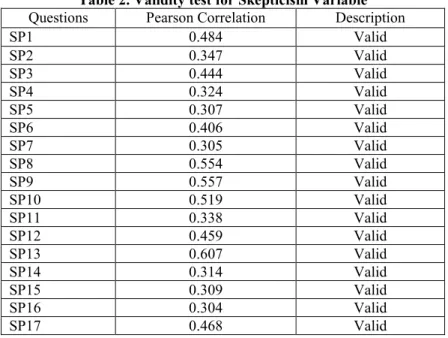
Tables 2 until table 6 show the validity test. Validity test is used to measure questionnaire validity. Pearson correlation above 0.3 means the research instrument is valid.
Table 2. Validity test for Skepticism Variable
Questions Pearson Correlation Description
SP1 0.484 Valid SP2 0.347 Valid SP3 0.444 Valid SP4 0.324 Valid SP5 0.307 Valid SP6 0.406 Valid SP7 0.305 Valid SP8 0.554 Valid SP9 0.557 Valid SP10 0.519 Valid SP11 0.338 Valid SP12 0.459 Valid SP13 0.607 Valid SP14 0.314 Valid SP15 0.309 Valid SP16 0.304 Valid SP17 0.468 Valid
Source: data processed, 2017
Table 2 shows the Pearson correlations of skepticism are above 0.3. The validity tests show significant results. It means the skepticism variable is valid.
Table 3. Validity Test for Audit Experience Variable
Questions Pearson Correlation Description
PA1 0.520 Valid PA2 0.327 Valid PA3 0.502 Valid PA4 0.386 Valid PA5 0.444 Valid PA6 0.481 Valid
Source: data processed, 2017
Table 3 shows the Pearson correlations of audit experience are above 0.3. The validity tests show significant result. It means the auditor experience variable is valid.
Table 4. Validity Test for Auditor Intelligence Variable
Questions Pearson Correlation Description
KC1 0.301 Valid KC2 0.310 Valid KC3 0.320 Valid KC4 0.308 Valid KC5 0.332 Valid KC6 0.321 Valid KC7 0.307 Valid KC8 0.326 Valid KC9 0.431 Valid KC10 0.370 Valid KC11 0.481 Valid KC12 0.350 Valid KC13 0.378 Valid KC14 0.351 Valid KC15 0.316 Valid KC16 0.473 Valid
Table 4 shows the Pearson correlations of auditor intelligence are above 0.3. The validity tests show significant result. It means the auditor intelligence variable is valid.
Table 5. Validity Test for Time Budget Pressure Variable
Questions Pearson Correlation Description
TBP1 0.303 Valid TBP2 0.301 Valid TBP3 0.444 Valid TBP4 0.311 Valid TBP5 0.513 Valid TBP6 0.427 Valid TBP7 0.390 Valid TBP8 0.303 Valid TBP9 0.302 Valid TBP10 0.310 Valid
Source: data processed, 2017
Table 5 shows the Pearson correlations of Time Budget Pressure are above 0.3. The validity tests show significant result. It means the Time Budget Pressure variable is valid.
Table 6. Validity Test for Audit Opinion Decision Variable
Questions Pearson Correlation Description
KO1 0.580 Valid KO2 0.382 Valid KO3 0.376 Valid KO4 0.301 Valid KO5 0.302 Valid KO6 0.429 Valid KO7 0.499 Valid KO8 0.340 Valid KO9 0.414 Valid KO10 0.376 Valid
Source: data processed, 2017
Table 6 shows the Pearson correlations of Audit Opinion Decision are above 0.3. The validity tests show significant result. It means the Audit Opinion Decision variable is valid.
Reliability Test
The instrument is reliable to measure the research variables if the Cronbach Alpha value > 0.60. Table 7 shows the results of reliability test.
Questions Pearson Correlation Description
Auditor Skepticism 0.773 Valid
Audit Experience 0.814 Valid
Auditor Intelligence 0.822 Valid
Time Budget Pressure 0.719 Valid
Audit opinion decision 0.729 Valid
Source: data processed, 2017
Table 7 shows the cronbach alpha value for each instruments > 0.6. It means that the instruments are reliable and can be used for future analysis.
Classic Assumption Test
The classical assumption tests consist of normality and heteroscedasticity. Tables 8 and 9 show the result of classical assumption test.
1. Normality Test
Table 8 shows the analysis results with Kolmogorov-Smirnov has significance value of regression model of 0.458. It is greater than 0.05, it can be concluded that the normality assumption in the research model has been met.
Table 8. Test Result of Normality Assumption
Sig. Description
0.458 Normal
Source: data processed, 2017
Table 9. Test Results of Heteroscedasticity Assumption
Variables Sig. Description
Constant 0.859 Nonheteroskedasticity SP 0.268 Nonheteroskedasticity PA 0.920 Nonheteroskedasticity KC 0.451 Nonheteroskedasticity TBP 0.806 Nonheteroskedasticity SP*TBP 0.358 Nonheteroskedasticity PA*TBP 0.815 Nonheteroskedasticity KC*TBP 0.392 Nonheteroskedasticity
Source: data processed, 2017
The heteroscedasticity test was performed with the glejser model. The Glejser test is performed by regressing the independent variable and residual absolute value. Table 9 shows that the values are significant. It means there is no heteroscedasticity problem.
Result of Regression Moderation Analysis
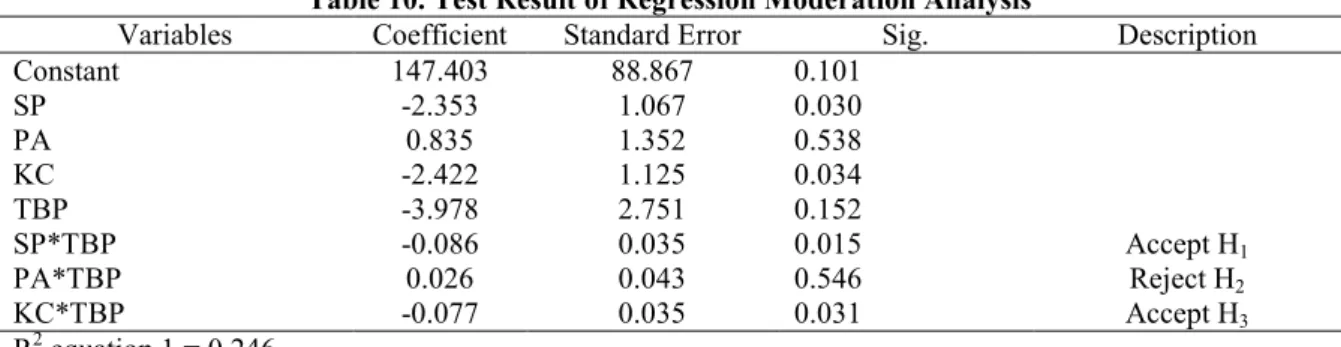
Regression Moderation Analysis is used to test the hypotheses. It is used to shows element of interaction. Table 10 shows the result of regression moderation analysis.
Table 10. Test Result of Regression Moderation Analysis
Variables Coefficient Standard Error Sig. Description
Constant 147.403 88.867 0.101 SP -2.353 1.067 0.030 PA 0.835 1.352 0.538 KC -2.422 1.125 0.034 TBP -3.978 2.751 0.152 SP*TBP -0.086 0.035 0.015 Accept H1 PA*TBP 0.026 0.043 0.546 Reject H2 KC*TBP -0.077 0.035 0.031 Accept H3 R2 equation 1 = 0.246 Source: data processed, 2017
Table 10 shows R2 value is 0.246. It indicates that the audit opinion decision can be explained 24.6% percent by skepticism, audit experience, auditor intelligence and time budget pressure, interaction between skepticism and time budget pressure, interaction between in-depth audit and pressure budget time, and interaction between auditor intelligence and time budget pressure. The equation is shown below.
PO = 147,403 – 2,353SP + 0,835PA –2,422KC –3,978TBP – 0,086SP*TBP + 0,026PA*TBP – 0,077KC*TBP
The equation show the constant has a value of 147.403. It means that if the interaction of skepticism, audit experience, auditor intelligence and time budget pressure on dependent variable are constant, the value of determination of auditor's opinion has a positive value of 147.403.
CONCLUSIONS AND SUGGESTIONS
The results show that first hypothesis and third hypothesis are accepted, while time budget pressure weakens the effect of skepticism factor and auditor intelligence on audit opinion decision. However, second hypothesis is rejected, meaning that time budget pressure cannot weaken the relationship of audit experience to audit opinion decision.
Based on results of analysis and conclusions, some suggestions may be made for further research and for interested parties. First, the auditors are expected to maintain professionalism by maintaining his skepticism in carrying out the audit assignment. They may improve the quality by improving emotional intelligence, intellectual and spiritual in audit opinion decision. Second, the respondents' answers indicate factors that need to be improved by auditor. Among others is ability to understand and time management to do audits in accordance with procedures. In order to overcome the problem, auditors can participate in training and development of self-character, continuing professional education, participating in seminars and symposium related to profession.
This study limitations is the questionnaire usage where the respondent gave his own assessment of himself. So for next research is expected to develop other measurement in order to get maximum results.
REFERENCES
Adnyani, Nyoman. 2014. “Pengaruh Skeptisme Profesional Auditor, Independensi, dan Pengalaman Auditor Terhadap Tanggungjawab Auditor dalam Mendeteksi Kecurangan dan Kekeliruan Laporan Keuangan (Studi Kasus pada Kantor Akuntan Publik (KAP) Wilayah Bali)”. e-Journal S1 Akuntansi Universitas Pendidikan Ganesha, 2(1).
Adrian, Arfin. 2013. “Pengaruh Skeptisisme Profeional, Etika, Pengalaman, dan Keahlian Audit Terhadap
Ketepatan Pemberian Opini Oleh Auditor (Studi Empiris Pada BPK RI Perwakilan Provinsi Riau)”. Jurnal
Akuntansi, 1(3). Universitas NegeriPadang.
Agustin, Ni Ketut Riski., Ni Ketut Lely Aryani Merkusiwati. 2016. “Pengaruh Tekanan Ketaatan, Senioritas
Auditor, dan Tekanan Anggaran Waktu terhadap Audit Judgement”. E-Jurnal Akuntansi Universitas
Udayana, 15(1), h. 433-462.
Ajzen. Icek.1991. “The Theory of Planned Behaviour”. In: Organizational Behaviour and Human Decision Process”. University of Massachusetts at Amherst, 50,h.179-211.
Alim, M. Nizarul. Trisni Hapsari dan Lilik Purwanti. 2007. “Pengaruh Kompetensi dan Independensi Terhadap Kualitas Audit Dengan Etika Auditor Sebagai Variabel Moderasi”. Simposium Nasional Akuntansi X. Makassar.
Alwi, Z. Iskandar. 2003. Pasar Modal : Teori dan Aplikasi, Edisi Pertama. Jakarta: Nasindo Internusa.
Anonim,2013. “Bupati Karangasem Tersandung Korupsi 29 Miliar”. 31 Agustus. [cited, 2017 April 18] available from URL: http://sp.beritasatu.com/home/bupati-karangasem-tersandung-korupsi-29-miliar/41017
Arens, Alvin A., Randal J.E dan Mark S.B. 2004. Auditing dan Pelayanan Verifikasi, Pendekatan Terpadu. Jilid
1, Edisi Kesembilan. Penerbit PT. Indeks. Jakarta.
Nasution,Arman Hakim. Indung Sudarsono, dan Lantip Trisunarno Arma. 2006. Manajemen Pemasaran untuk
Engginering. Yogyakarta: Andi.
Asih, Dwi Ananing Tyas. 2006. “Pengaruh Pengalaman Terhadap Peningkatan Keahlian Auditor Dalam Bidang Auditing”. e-jurnal-Skripsi. Fakultas Ekonomi Universitas Islam Indonesia. Yogyakarta.
Azwar, Saifuddin. 2004. Penyusunan Skala Psikologi. Yogyakarta: Pustaka Pelajar Offset.
Badan Pemeriksa Keuangan. “ Tentang BPK RI” [cited, 2017 April 18] available from URL: http://www.bpk.go.id/page/sejarah
Badan Pemeriksa Keuangan. “Dasar Hukum” [cited, 2017 April 17] available from URL: http://www.bpk.go.id/page/dasar-hukum
Badan Pemeriksa Keuangan. “ Laporan Keuangan dan Hasil Pemeriksaan” [cited, 2017 April 17] available from URL: http://www.bpk.go.id/page/lkpp
Badan Pemeriksa Keuangan. “Pendapat BPK” [cited, 2017 April 18] available from URL: http://www.bpk.go.id/page/pendapat-bpk
Belarminus, Robertus. “KPK Tahan Auditor BPK dalam Kasus Suap Temuan PDTT Sejak Rabu” [cited, 2018 Januari 18] available from URL: http://amp.kompas.com/nasional/read/2017/09/22/19140941/kpk-tahan-auditor-bpk-dalam-kasus-suap-temuan-pdtt-sejak-rabu
Boynton, et.al., 2002. Modern Accounting, Edisi Ketujuh, Jakarta:Penerbit Erlangga.
Budi, Sasongko. Basuki dan Hendaryatno. 2004. “Internal Auditor dan Dilema Etika”. Simposium Nasional Akuntansi (SNA)VII.
Budi,Winarno. 2004.Kebijakan Publik teori dan proses, cetakan kedua. Media Pressindo, Yogyakarta.
Candra,Putu. 2016. “Mantan Bupati Klungkung Dibui 15 Tahun, Aset Rp 42 Miliar Disita”. 22 Maret ., [cited, 2017 April 18] available from URL: http://bali.tribunnews.com/2016/03/22/mantan-bupati-klungkung-dibui-15-tahun-aset-rp-42-miliar-disita?page=all
Coram, Paul., Alma. Glavovic, Ng. Juliana. and David.R. Woodliff. 2008. “The Moral Intensity of Reduced Audit Quality Acts”. Auditing: A Journal of Practice & Theory, Vol. 27, No. 1, pp. 127-149. 27(1): 127-149.
Dharmawan, Deni. 2013. Sistem Informasi Manajemen. Bandung: Rosda.
DeZoort, Todd dan Lord Allan T. 1997. “A Review and Synthesis of Pressure Effects Research in Accounting”.
Journal of Accounting Literature, Vol. 16. University of South Carolina.
Eisenhardt, Kathleem. 1989. “Agency Theory: An Assesment and Review”. Academy of Management Review.
Festinger, Leon.1957. “La Teoria De La Disonancia Cognoscitiva”. Psicothema. 5(1), h. 201-206.
Ghozali, Imam. 2011. Aplikasi Analisis Multivariate dengan Program IBM SPSS. Semarang: Badan Penerbit Universitas Diponogoro.
Goleman, Daniel. 2003. Kepemimpinan Berdasarkan Kecerdasan Emosi. PT. Gramedia Pustaka Utama :
Bandung.
Gusti, Maghrifah dan Syahril Ali. 2008. Hubungan Skeptisme Profesional Auditor dan Situasi Audit, Etika, Pengalaman serta Keahlian Audit dengan ketepatan Pemberian Opini Auditor oleh Akuntan Publik.
Simposium Nasional Akuntansi (SNA) XI, Pontianak.
Penerbit dan Percetakan STIM YKPN.
Hanafi, Rustam. 2010. Spiritual Intelligence, Emotional Intelligence And Auditor’s Performance. JAAI, 14(1), h.29-40.
Hellena, Silvia., Kamaliah dan Rofika. 2015. “Pengaruh Etika Profesi, Independensi, Kecerdasan Intelektual, Kecerdasan Emosional, dan Kecerdasan Spritual terhadap Ketepatan Pemberian Opini Auditor”. Jurnal FEKON, 2(2), h. 1-15.
Herliansyah, Yudhi. Meifida Ilyas. 2006. “Pengaruh Pengalaman Auditor Terhadap Penggunaan Bukti Tidak
Relevan Dalam Auditor Judgment”. Simposium Nasional Akuntansi IX. Padang.
Herusetya, Antonius. 2007. “Pengaruh Sistem Informasi Tehnologi Elektronik Atas Task Performance - Auditor
Kap The Big 4”. Simposium Nasional Akuntansi (SNA) XIV.
Hutabarat, Goodman. 2012. “Pengaruh Pengalaman Time Budget Pressure dan Etika Auditor terhadap Kualitas Audit”.Jurnal Ilmiah ESAI, 6(1).
IAI. 2002. Standar Profesi Akuntan Publik. Jakarta : Salemba Empat.
Isabella. 2011. “Pengaruh Kecerdasan Emosional, Kecerdasan Spiritual Dan Kecerdasan Intelektual Terhadap
Kinerja Auditor Dalam Kantor Akuntan Publik”. Skripsi. Fakultas Ekonomi Universitas Katolik
Soegijapranata Semarang.
Jeffrey H.C, Leach, R.M. 1996.Atlas Helmintologi dan Parasitologi Kedokteran, EGC. Jakarta.
Jensen, Michael. C., and William H. Meckling. 1976. “Theory of The Firm: Managerial Behavior, Agency Costs and Ownership Structure”. Journal of Financial Economics 3(4), h. 305–360.
Jogiyanto. 2007. Metodologi Penelitian Bisnis: dan Pengalaman-penagalaman. Yogyakarta: BPFE.
Kautsarrahmelia, Tania. 2013. “Pengaruh Independensi, Keahlian, Pengetahuan Akuntansi Dan Auditing Serta
Skeptisme Profesional Auditor Terhadap Ketepatan Pemberian Opini Audit Oleh Akuntan Publik”. Skripsi.
Fakultas Universitas Islam Negeri Syarif Hidayatullah Jakarta.
Kreitner, Robert dan Kinicki, Angelo. 2005. Perilaku Organisasi, buku 1 dan 2, Jakarta : Salemba Empat. Kulas, J. T. Stachowski, A. A. 2009. “Middle category endorsement in odd-numbered Likert response scales:
Associated item characteristics, cognitive demands, and preferred meanings”. Journal of Research in Personality, 43(3), pp: 489-493.
Kurnia, Pipin Yusralaini dan Yesy Tria Anita. 2014. “Pengaruh Time Pressure, Resiko Audit, Locus of Control, dan Turnover Intentions terhadap Penghentian Prematur atas Prosedur Audit (Studi Empiris pada Kantor
Akuntan Publik di Pekanbaru, Padang, Jambi, dan Batam)”. Jurnal FEKOM, 1(2), h. 1-15.
Kusuma, Wijaya. 2011. Penelitian Tindakan Kelas. Jakarta: PT Indeks.
Maghfirah Gusti dan Syahril Ali. 2008. “Hubungan Skeptisisme Profesional Auditor Dan SituasiAudit, Etika, Pengalaman Serta Keahlian Audit Dengan Ketepatan Pemberian Opini Auditor Oleh Akuntan Publik”. Simposium Nasional Akuntansi (SNA)XI, Pontianak: Universitas Andalas.
McNair, C.J. 1991. “Proper Compromises: The Management Control Dilemma in Public Accounting and Its Impact on Auditor Behavior”. Accounting, Organizations and Society, vol. 16, issue 7, pages 635-653. McNamara, S. M., and Liyanarachchi, G. A. 2008. “Time Budget pressure and Auditor Dysfunctional Behavior
Within An Occupational Stress Model”. Accountancy Business and the Public Interest, 7(1), hal.1-43. Messier et. al. 2006. Auditing and Assurance Services. Terjemahan Nuri Hinduan, Jakarta: Salemba Empat. Nadirsyah, Mirna Indriani, dan Iskandar Utama. 2011. “Pengaruh Anggaran Waktu Audit, Kompleksitas
Dokumen Audit dan Pengalaman Auditor terhadap Pertimbangan Audit Sampling pada Badan Pemeriksaan
Keuangan (BPK) Republik Indonesia Perwakilan Provinsi Aceh”. Jurnal Telaah dan Riset Akuntansi, 4(2),
h. 176-186.
Nasution,Arman Hakim., Indung Sudarsono, dan Lantip Trisunarno Arma. 2006. Manajemen Pemasaran untuk
Engginering. Yogyakarta: Andi.
Nasution. 2014. Hukum Perlindungan Konsumen Suatu Pengantar, Jakarta:Diadit Media.
Noviyanti dan Bandi.2002. “Pengaruh Pengalaman dan pelatihan terhadap Struktur Pengetahuan Auditor tentang
Kekeliruan”. Jurnal Akuntansi dan Auditing,UNS : Desember.
Noviyanti, Suzy.2008. “Skeptisisme Profesional Auditor Dalam Mendeteksi Kecurangan”.Jurnal Akuntansi dan
Keuangan Indonesia, 5(1), hal. 102-125.
Oktaresa, Betrika.2014. “Analisis Hubungan Pengalaman, Pengetahuan Mendeteksi Kecurangan dan Skeptisisme Profesional Dengan Kemampuan Pendeteksian Kecurangan Pada Perwakilan BPKP Provinsi Riau”.Jurnal. Sekolah Tinggi Akuntansi Negara. Tanggerang Selatan.
Oktavia, Reni. 2006. “Pengaruh Pengalaman Audit dan Self-Efficacy Terhadap Keputusan Auditor: Survey Pada
Auditor Pemerintah”. E-jurnal. Fakultas Ekonomi. Universitas Lampung.
Otley, D. W. Pierce, B. 1995. “The Control Problem in Public Accounting Firms an Empirical Study of Impact ofLeadership Style.” Accounting, Organizations and Society, 20, pp: 405-420.
Peraturan Menteri Keuangan No. 17/PMK.01/2008 tentang Jasa Akuntan Publik.
Kualitas Audit dengan Moderasi Pemaham terhadap Sistem Informasi”. Jurnal Ekonomi dan Bisnis, 13(1). Pratiwi, Komang Asri.2013. “Pengaruh Independensi dan Komptensi Auditor Pada Kualitas Audit dengan Due
Professional Care Sebagai Variabel Intervening di Kantor Akuntan Publik (KAP) se-Provinsi Bali”. Tesis.
Fakultas Ekonomi dan Bisnis Universitas Udayana.
Putra, Nugraha Agung Eka. 2012. “Pengaruh Komptensi, Tekanan Waktu, Pengalaman Kerja, Etika, dan Independensi Auditor terhadap Kualitas Audit”. Skripsi, Fakultas Ekonomi UNY.
Rachmi, Filia. 2010. “Pengaruh Kecerdasaan Emosional, Kecerdasaan Spiritual dan Perilaku Belajar terhadap Tingkat Pemahaman Mahasiswa Akunatnsi. (Studi Empiris pada Mahasiswa Akuntansi Universitas di
Ponegoro Semarang dan Universitas Gadja Mada Yogyakarta)”. Skripsi. Semarang: Fakultas Ekonomi
Universitas Diponegoro Semarang.
Ridwan. Kuncoro, Ahmad. 2007. “Transformasi Data Ordinal”. Disertasi. Bandung: FPIKIP.
Sabrina., Indira Januarti. 2009. “Pengaruh Pengalaman, Keahlian, Situasi Audit, Etika dan Gender terhadap Ketepatan Pemberian Opini Auditor melalui Skeptisme Profesional Auditor”. Jurnal Akuntansi 1, h. 1-34. Singgih, Elisha Muliani dan Icuk Rangga Bawono. 2010. “Pengaruh Independensi Pengalaman,Due Professional
Care dan Akuntabilitas terhadap Kualitas Audit”.Simposium Nasional Akntansi (SNA) XIII UJSP.
Purwokerto.
Simanjuntak, Piter. 2008. “Pengaruh Time Budget Pressure dan Resiko Kesalahan Terhadap Penurunan Kualitas
Audit (Reduced Audit Qaulity): Studi Empiris Pada Auditor Kap Di Jakarta”. Tesis. Universitas Diponegoro. Semarang.
Sofiani,Maria Magdalena Oerip Liana dan Tjondro, Elisa. 2014. “Pengaruh Tekanan Ketaatan, Pengalaman Audit, Dan Audit Tenure Terhadap Audit Judgement”.Tax & accounting review,4(1).
Sudrajat, Lalu Agus., Ahmad Rifai., dan Endar Pituringsih. 2015. “Pengaruh Time Budget Pressure,
Kompleksitas Audit, dan Skeptisme Profesional Auditor terhadap Kualitas Hasil Pemeriksaan (Studi Empiris pada Inspektorat se-Pulau Lombok)”. Jurnal Akuntansi Aktual, 3(2), h. 135-145.
Sugiyono. 2012. Metode Penelitian Bisnis. Bandung : Alfabeta.
Sukendra, I Putu., Gede Adi Yuniarta., Anantawikrama Tungga Atmaja. 2015. “Pengaruh Skeptisme Profesional, Pengalaman Auditor, dan Keahlian Audit terhadap Ketepatan Pemberian Opini oleh Auditor (Studi Empiris
pada Inspektorat Kabupaten Buleleng, Kabupaten Bangli dan Kabupaten Karangasem)”. E-journal
Akuntansi Universitas Pendidikan Ganesha, 3(1).
Sukriah, Ika., Akram dan Biana Adha Inapty. 2009. “Pengaruh Pengalaman Kerja, Indepedensi, Obyektivitas, Integritas, dan Kompetensi terhadap Kualitas Hasil Pemeriksaan”. Simposium Nasional Akuntansi XII Palembang, h. 1-38.
Susetyo, Budi. 2009. “Pengaruh Pengalaman Audit Terhadap Pertimbangan Auditor Dengan Kredibilitas Klien
Sebagai Variabel Moderating”. Tesis, Magister Sains Akuntansi Universitas Diponegoro Semarang.
Sutrisno., dan Diana Fajarwati. 2014. “Pengaruh Pengalaman, Keahlian, Situasi Audit, dan Gender terhadap Ketepatan Pemberian Opini Auditor melalui Skeptisme Profesional Auditor (Studi Kasus pada KAP di Bekasi)”. JRAK, 5(2), h. 1-15.
Swari, I. A. Putu Candra Mitha dan I Wayan Ramantha. “Pengaruh Independensi dan Tiga Kecerdasan terhadap
Pertimbangan Pemberian Opini Auditor”. E-Jurnal Akuntansi Universitas Udayana, 4(3), h. 489-508.
Tasmara, T. 2006. Spiritual Centered Leadership. Jakarta: Gema Insani. Undang-undang Dasar Negara Republik Indonesia Tahun 1945.
Undang-Undang Republik Indonesia No.15 Tahun 2006 Tentang Badan Pemeriksa Keuangan. Undang-Undang Republik Indonesia No.5 Tahun 2011 Tentang Akuntan Publik.
Undang-Undang Republik Indonesia No. 34 Tahun 1954 Tentang Pemakaian Gelar Akuntan (Accontant).
Umar, Husein. 2008. Metode Penelitian untuk Skripsi dan Tesis Bisnis. Edisi Kedua, Jakarta : PT. Raja Grafindo Persada.
Widiyastuti, Marcellina dan Sugeng Pamudji.2009. “Pengaruh Kompetensi, Independensi, dan Profesionalisme
Terhadap Kemampuan Auditor dalam Mendeteksi Kecurangan (Fraud)”. Value Added, 5(2).
Wiguna, Floreta. 2015. “Pengaruh Skeptisme Profesional dan Independensi Auditor terhadap Pendekatan
Kecurangan”. Jurnal Ekonomi dan Bisnis. Universitas Telkom Bandung.
Williams, Dudley H. 2007. Spectroscopic Methods in Organic Chemistry (UK Higher Education Science & Technology Chemistry), Sixth Edition. England: Mc Graw Hill Book Company.
Wijayanti, Gersontan Lewi. 2012. “Peran Kecerdasan Emosional Dan Kecerdasan Spiritual Dalam
Meningkatkan Kinerja Auditor”. Jurnal Ilmiah Mahasiswa Akuntansi, 1(2).
Wiramihardja, Sutardjo. 2007. Pengantar Psikologi Klinis. Bandung: PT. Refika Aditama.
Yusuf. 2014. Metode Peneltian; Kuantitatif, Kualitatif dan Penelitian Gabungan. Jakarta.