Stereoscopic
video
quality
assessment
based
on
3D
convolutional
neural
networks
Jiachen Yang
a,
Yinghao Zhu a,
Chaofan Ma a,
WenLu
b, ∗, Qinggang Meng
ca SchoolofElectricalandInformationEngineering,TianjinUniversity,Tianjin,China b SchoolofElectronicEngineering,XidianUniversity,Xian,China
c DepartmentofComputerScience,LoughboroughUniversity,Loughborough,UK
Keywords:
3D convolutional neural networks Stereoscopic video quality assessment Quality score fusion
a
b
s
t
r
a
c
t
Theresearchofstereoscopicvideoqualityassessment(SVQA)playsanimportantroleforpromotingthe developmentofstereoscopicvideosystem.ExistingSVQAmetricsrelyonhand-craftedfeatures,whichis inaccurateandtime-consumingbecauseofthediversityandcomplexityofstereoscopicvideodistortion. Thispaperintroducesa3Dconvolutionalneuralnetworks(CNN)basedSVQAframeworkthatcanmodel not onlylocalspatio-temporalinformation butalsoglobaltemporal informationwith cubicdifference videopatchesas input.First, insteadofusinghand-craftedfeatures,wedesign a3DCNNarchitecture toautomaticallyandeffectivelycapturelocalspatio-temporalfeatures. Thenweemployaqualityscore fusionstrategyconsideringglobal temporalclues toobtainfinalvideo-levelpredicted score.Extensive experimentsconductedontwopublicstereoscopicvideoqualitydatasetsshowthattheproposedmethod correlateshighlywithhumanperceptionandoutperformsstate-of-the-artmethodsbyalargemargin.We alsoshowthatour3DCNNfeatureshavemoredesirablepropertyforSVQAthanhand-craftedfeatures inpreviousmethods,andour3DCNNfeaturestogetherwithsupportvectorregression(SVR)canfurther boosttheperformance.Inaddition,withnocomplexpreprocessingandGPUacceleration,ourproposed methodisdemonstratedcomputationallyefficientandeasytouse.
1. Introduction
Nowadays,alargenumberofstereoscopicvideosarecreatedfor variousfieldssuchasentertainmentandeducation.Highly associ-atedwiththeusers’QualityofExperience(QoE),visualqualityisa fundamentalyetcomplexcharacteristicofastereoscopicvideothat maysuffervarying degreesofdamage inthesuccessivestagesof stereoscopic video production,including processing, compression, transmissionanddisplay.Hence,theresearchofstereoscopicvideo qualityassessment(SVQA)playsanimportantroleinthe develop-ment of stereoscopic video systems. In orderto reach higher ef-ficiencyandfeasibility, unattendedandautomaticobjective SVQA methodsinsteadofsubjectivemethodsareingreatdemand.
Depending onthe amountof pristine videoinformation avail-able, the objective SVQAmethods can fall into three types: full-reference (FR),reduced-reference (RR) andno-reference (NR). NR methodscanassessthequalityoftestedstereoscopicvideos with-out any information from reference content, while FR methods andNR methods requirepristine video orits partial information.
∗ Corresponding author.
E-mailaddress:[email protected](W. Lu).
Unfortunately, considering that reference video is unavailable in most practical applications, only the NR methods have potential tosatisfytheactual requirement.Asaresult,ourworkfocuseson moreappealingandchallengingNRmethods,andtriestopropose anewgeneral-purposeNRframeworkforSVQA.
Consideringthe developmentofNR metrics [1,2],we can find thatmostofthem havesimilarframeworks,whichcan be gener-allydivided into two steps:(1) extracts features that can reflect visualqualitybasedonrelativelyperceptualmodels;(2)mapsthe obtained feature vectors to subjective quality scores by learning regressionmodels.Butinreal-worldscenarios, becauseofthe di-versity and complexityof video distortions, it is very difficult to identifywhatfeatures aresensitive androbust toall sortsof dis-tortions.Therefore,simplyutilizingagroupofartificiallydesigned features to represent video quality results in inaccurate assess-mentsandhighcomputationalcosts.
Recently,itisawell-knownfactthatdeeplearningmodels, es-peciallyconvolutionalneuralnetworks(CNN),haveachievedgreat success in many challenge computer vision tasks, such as im-age classification [3,4], object detection [5,6], video classification [7,8]andvideo actionrecognition [9,10].CNNisa biologically in-spired architecture consisting of a stack of convolutional layers
andpoolinglayers,automaticallyextractingahierarchyof power-fulfeaturesfromrowdata.Lately, CNNalsodemonstratedits su-periorityforimagequality assessment(IQA)andstereoscopic im-age quality assessment (SIQA). Kang et al. [11] and Zhang et al. [12]proposedtwoCNNbasedNRmetricstorealizeeffective qual-ityassessmentof2Dimagesandstereoscopicimages,respectively. In this work, we attempt to explore a CNN based stereo-scopic video quality assessmentmetric. Apparently, a straightfor-wardmannerinspiredbypreviousCNNbasedIQA/SIQAmodelsis toregardstereoscopicvideoframesasstereoscopicpairs and em-ployCNNattheframelevelsequentially.Nevertheless,suchan im-agebased methodcannot yield superior performance dueto ne-glectof the motion information contained in the adjacent video frames. To address this problem, we construct a 3D CNN archi-tecturetolearnspatio-temporal featuresforNRSVQAtask,which is able to adequately encapsulate information related to stereo-scopic video quality. The experimental results demonstrate that ourmethodsignificantlyoutperformsthecutting-edgemethods.In summary,ourkeycontributionsareasfollows:
• Wepresenta3DCNNbasedframeworkforSVQA,whichisable tomodellocalspatio-temporalinformationbutalsoglobal tem-poralinformationwithcubicdifferencevideopatchesasinput. To thebest of ourknowledge, we are the pioneersto exploit the3DCNNtoevaluatethequalityofstereoscopicvideo. • Afterour3DCNNarchitectureeffectivelycapturinglocal
spatio-temporal features, we design a quality score fusion strategy considering global temporal clues to pool patch-level quality scores into video-level quality score. Through a large number of extensive experiments, our proposed method achieves the bestperformancetodateonbothtwochallengingstereoscopic videoqualitydatabasesandoutperformscurrentbest perform-ingmethodsbyalargemargin.
• Our proposed framework takescubic difference video patches asinputanddoesnotrelyonanycomplexpreprocessingsuch as optical flow and gradients, so it is computationally effi-cient andapplicable inrealapplicationscompared with previ-ousmethods.
The restofthispaperisstructuredasfollows:we firstreview the works related to our method in Section 2. Section 3 details proposed method.The experimental resultsandsome analysis of keyissuesoftheproposedmethodareshownin Section4.Finally weconcludeourworkin Section5.
2. Relatedwork
2.1.ConventionalStereoscopicvideoqualityassessment
SVQA is a significant but intractable task in computer vision, attracting more and more attention in recent years. As a re-sult,various methodswere proposedforthissubject. Initially, re-searchers expected to accomplish the evaluation of stereoscopic video quality using 2D IQA metrics or 2D video quality assess-ment(VQA) metrics, proposed Peak Signal to NoiseRatio (PSNR) basedmethod [13],StructuralSimilarityIndexMetric(SSIM)based method [14]andVQMbasedmethod [15].Inthiscase,2Dmetrics wereperformedontwoviewsofstereoscopicvideoseparately,and thenaveraged to integrate thefinal quality score.However, since the depth information and temporal information of stereoscopic videowere notconsidered sufficiently, theaforementioned meth-ods failed to obtain convincing results. As a consequence, some methodswereproposedtomeasurethe3Dvideoperceptual qual-itybyapplyingboth2Dand3Dinformationextractedfrom stereo-scopicvideo.Forexample,Malekmohamadietal. [16]proposeda RRmethodthatencodedspatialneighboringinformationfromgray levelco-occurrencematricesforbothcoloranddepthsections.In
[17], left-right views quality metric anddepth perception metric weredesignedandpooledintoSVQAscore.Moreconcretely, left-right views quality was assessed based on significant pixels and just noticeable distortion model, while depth perception quality evaluated by deploying three-dimensional wavelettransform. Re-cently,someapproachesexploitingthehumanvisualsystem(HVS) modelbegantoemerge,showingmorereliableperformance. Tak-ingthetemporalcharacteristicsofvideoandbinocularperception inHVSintoaccount,aRRSVQAmethodwasproposedbyYuetal. [18].In [19],Galkandageetal.presentedaFR SVQAmethodbuilt on a HVS model incorporatingthe phenomena ofbinocular sup-pression and recurrentexcitation. Despiteof theseachievements, alloftheabove methodsare FRorNRmethods withoutpractical value andfew NRmethods werepresented.Inourprevious work [20], a NR SVQA metric was proposed for the first time, which jointlyfocused on the spatialinformation,the temporal informa-tionandtheinter-framespatiotemporalinformationemploying lo-calbinarypatternsstatisticalfeaturesandlocalflowstatistical fea-tures.Overall, whetherbasedon 2D metrics orHVSmodel,most oftheexistingSVQAmethodsrelyonartificiallydesignedfeatures that can represent stereoscopic video quality, which is inflexible andtime-consuming.
2.2. Neuralnetworkbasedvisualcontentqualityassessment
There weremanyearly worksapplyingneural networksto vi-sual contentquality assessment.In [21],Liet al.developeda NR IQA algorithmthat deployed ageneral regressionneural network (GRNN) withperceptualfeatures includingphase congruency, en-tropyandtheimage gradientsasinput.Chetouanietal. [22]used a neural network to combine multiple distortion-specific NR IQA measures. In [23], a machine learningmethod waspresentedfor evaluating blocking artifacts in JPEG images anda SVR model is adopted to learn the underlying relations between features and perceived blocking artifacts. However, these methods require ar-tificially designedfeatures andonly adopted shallow neural net-workswithonlyone ortwo hiddenlayers tolearntheregression function.
2.3. Deeplearningbasedvisualcontentqualityassessment
Withremarkable success deeplearning models haveachieved in various computer vision tasks, a few deep learning based vi-sual contentquality assessmentmethods haveshownremarkable performance. On the one hand, some researchers explored deep learning models to transform lower-level features into more ab-stractandhigher-levelrepresentationsforvisualquality.For exam-ple,Tangetal. [24]constructedasemi-supervisedrectifier neural network toblindly measure2D image quality.Adeep belief net-work (DBN) [25] of three layers was adoptedto provide a high-level feature representations of LBIQ features [26], and the final quality was predicted with Gaussian Process regression. Ghadi-yaramandBovik [27] proposednatural-scene-statistics-based per-ceptual imagefeatures witha DBNto tacklethedifficultproblem ofblindly imagequalityassessmentonauthenticallydistorted im-ages.Houetal. [28] proposedaNRIQAmodeltolearnqualitative evaluationsbyusingafour-layerdiscriminativedeepmodel,which ispre-trained withDBNanddiscriminatively fine-tunedby back-propagation.Shaoetal. [29] trainedtwoseparate2D deepneural networks(DNN)from2Dmonocularimagesandcyclopeanimages to evaluate the quality of stereoscopic image. In [30],a NR VQA approach based on 3D shearlet transformand 1D CNN was con-structed,andhigh-levelspatiotemporalfeatureswereproducedby performing1DCNNonthesimplefeaturesdirectlyextractedfrom videos.
On the other hand, only a few researchers tried to apply 2D CNNonIQA/SIQAtaskwithoutusinghand-craftedfeatures,which took rawvisual content as input andincorporated feature learn-ing intothetrainingprocess.In [11],Kangetal.pioneereda CNN based 2D IQA method to integrate feature extractionand regres-sionintoone optimizationprocess.Theexperimentdemonstrated that the proposed CNN can learn the local structures which are sensitive to human perception and representative for perceptual qualityevaluation.Inspiredbythiswork,Zhangetal. [12]designed twodifferentCNNswithdifferentinputs,namelyone-columnCNN withonlytheimagepatchfromthedifferenceimageasinput,and three-columnCNN withtheimage patches fromleft-view image, right-viewimage,anddifferenceimageastheinput.
2.4. Videoanalysisusingconvolutionalneuralnetworks
In last years, CNNs have made a series of significant break-throughsonimagerecognition,alotofpowerfulCNNarchitectures [3,31,32] were created for image feature learning. Driven by the successin2D image processingtasks,CNNhasalsobeenutilized forvideo analysis.Karpathy etal. [33] presentedseveralmethods for extending the connectivity of CNNto capturethe spatiotem-poral information, which showed that CNN can generate strong improvementoverhand-craftedfeatures.SimonyanandZisserman [34] proposed a twostream CNN network forvideo classification. One network analyzed the spatial information while the second analyzed multi-frame dense optical flow. Jain et al. [35] articu-latedhuman poseestimationin videosusinga CNNarchitecture, whichincorporatedbothcolorandmotionfeatures.However,only 2D convolution and2D poolingoperationswereadoptedin these approaches,whichcannotnaturallymakeuseofthemotion infor-mationinthenetwork.
In this work, we extend 2D CNN to 3D CNN to remain and propagatetemporalinformationacrossthenetwork,whichis well-suitedforSVQAtask.Therehavebeensomeexplorationof3DCNN innumerousresearchtopics.Forinstance,in [36],anovel3DCNN architecture was proposed for human action recognition, imple-menting data representations fromboth spatialand temporal di-mensions. Besides,Tran etal. [37] designedand trained3D CNN modelsonlargevideodatasets,whichweredemonstratedeffective for several video analysis tasks including action recognition and scene recognition.In [38],a 3D CNN baseddiscrimination model wasdevelopedto participateinthedetectionof cerebral microb-leeds, sufficiently representing the spatialcontextual information and hierarchicallyextractinghigh-level features. As evidenced by theseprevious works, CNNin3D fashionis a promisingsolution totacklevideoanalysisproblems.
3. Proposedmethod
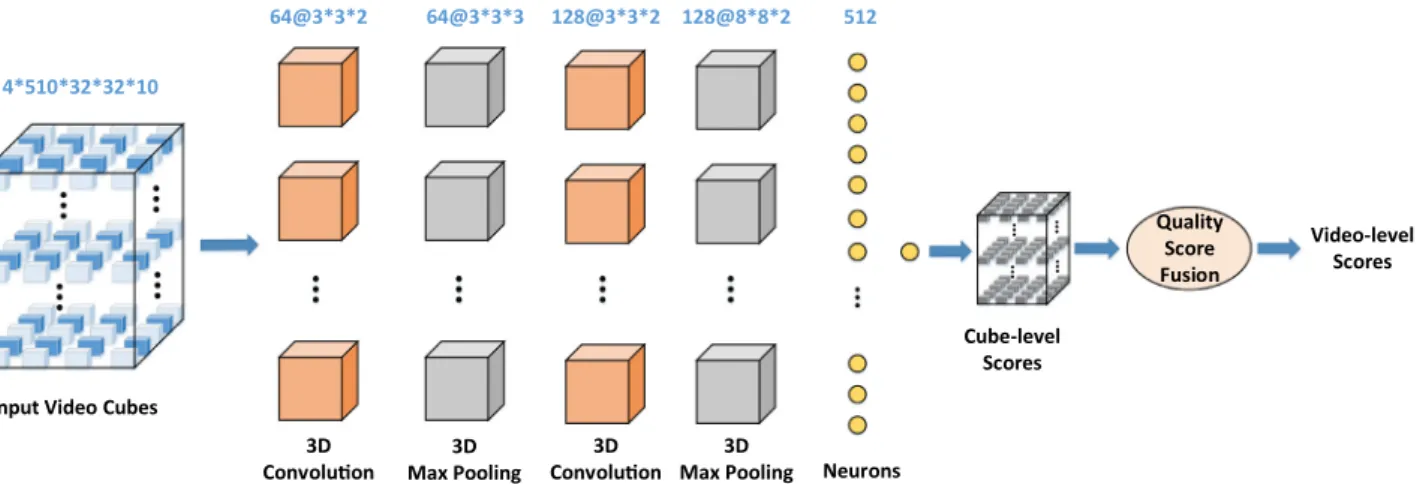
Asillustratedin Fig.1,weconstructano-referencestereoscopic video quality assessment framework built on 3D CNN, which is able to adequately encapsulate local spatiotemporal information andglobal temporalinformation.Specifically, a 3D CNN architec-ture is devised to extract local spatiotemporal information while aqualityscorefusionstrategyconsideringglobaltemporalcluesis adoptedtoobtainfinalvideo-levelpredictedscores.Inthissection, we describe thekey components ofthe proposed framework, in-cludingdatapreprocessing,3DCNNarchitectureandqualityscore fusion.
3.1. Datapreprocessing
3.1.1. Differencevideo
Stereoscopic video consists of two 2D videos with disparity, which incorporates more visual information than ordinary 2D
image and video. Therefore, to measure the perceived quality of 3Dvideo,weshouldconsiderthenon-intuitiveinteractionof sev-eralcomplicatedvisualfactors,includingvideocontentqualityand depthperception.Inourpreviouswork [39–41],thedifference im-age calculated from left and right views has been demonstrated toretain stereoscopic perception information,which can be used to represent the quality of stereoscopic image. Additionally, Ma etal. [42] concluded that the difference image is more valuable thanthe left andrightviewsinSIQA task.Similarly, we evaluate stereoscopicvideoqualitybyconductingour3DCNNonthe differ-encevideoratherthandirectlyontheleft andrightviewsinthis work. One reasonis that the difference video incorporates video contenttogetherwithdepthperceptioninformation,whichis suit-ableasrawdataforfurtheranalysisofstereoscopicvideoquality. Anotherreasonisthatapplying thedifferencevideo isapplicable forstereovideoanalysiswithmassivedataduetoitslow compu-tationalcomplexity.SupposeVL andVRdenoteleftandrightviews ofstereoscopic video andthevalue of thedifference video DL at position(x,y,z)iscomputedas:
DL
(
x, y, z)
=|
VL(
x, y, z)
−VR(
x, y, z)
|
(1)Fig.2showsindividualframessampledformtwodifferencevideos withdifferentquality.Comparing Fig.2 (a)and(b),it canbe no-ticedthat the differencevideo capturescontour information cou-pled with depth information,and can represent the stereoscopic videoquality.
3.1.2. Datasetaugmentation
Note that training effective deep learning models requires a large numberof labeled data. However, unlike visual recognition subjects,theamountofdatainexistingstereoscopicvideoquality datasetsislimited.Asaresult,inordertomakeourdeeplearning modelgeneralize better,wefirstneedtotacklethebasicproblem ofefficientdatascarcitybeforeapplyingCNNtoourtask.
For many deep learning tasks, dataset augmentation is com-pleted through creating newfake data withtransformations like translating, rotating or scaling. Unfortunately, we cannot adopt thesetransformationsforSVQAdatasetaugmentationbecausethey mayinfluencethe quality ofstereoscopicvideo. In thiswork,we proposeanapplicabledatasetaugmentationschemeforSVQAtask. Therawvideoissplitinbothspatialandtemporaldimensions, re-sultinginnumerouslow-resolutionshortvideocubes.Specifically, thesizeofeachcubicvideopatchissetas10×32×32,namely10 frameswitharesolutionof32×32.Inthisdesign,32×32 rectan-gleboxesarecroppedatthesamepositionof10sequentialframes, generatingcubeswithvisualperceptioninformation.Thenweare requiredtolabeltheseresultingcubesinordertoobtainvaliddata fortraining.Basedontheassumptionthatthequalitydegradation is homogeneous throughout the whole stereoscopic video, each video cube isannotated witha quality scoreconsistent with the subjectivescore of the entire video, thus expanding the amount ofefficientdata,whichsatisfiesthedemandofCNNfordata.The experimentin Section4verifiesthecorrectnessofourassumption. Videoanalysisandprocessingare always time-consumingand costly. However,there ishighredundancyinvideo data.Thereby, tomake ourobtaineddata moreefficient,we needto reduce re-dundancywhileincreasingtheamountofdata.Inthiswork,a sub-samplingstrategy inalldimensionsofvideoisadoptedtoreduce redundancy. Specifically, we slide a 32×32 box with a stride of 32tocropthewholevideoinspacialdimensionandselectframes withastrideof8intemporaldimension.Asaresult, weobtaina cubicvideopatchsetforeachvideoasfollows:
Pcubic=
64@3*3*2 3D Convoluon 64@3*3*3 3D Max Pooling 3D Convoluon 3D Max Pooling 128@3*3*2 128@8*8*2 Neurons 512 Quality Score Fusion 4*510*32*32*10
Input Video Cubes
Cube-level Scores
Video-level Scores
Fig.1. The architecture of the 3D CNN based SVQA framework. A video is divided into numerous cubic patches and each cubic patch is fed to our 3D CNN to complete cube-level prediction. Finally, we employed a quality score fusion strategy to obtain final video-level perceptual quality score. Our 3D CNN architecture consists of two 3D convolution layers, two 3D pooling layers and two fully-connected layers. Detailed descriptions are given in the text.
Fig.2. (a) 150 th frame of a reference stereoscopic video (MOS = 4.75) and the corresponding difference frame. (b) 150 th frame of a distorted stereoscopic video (MOS =
1.10) and the corresponding difference frame.
SP(i)=
⎛
⎜
⎜
⎜
⎝
C11(i) C12(i) · · · C1(iN) C21(i) C22(i) · · · C2(iN) .. . ... ... ... CM(i)1 CM(i)2 · · · CMN(i)⎞
⎟
⎟
⎟
⎠
(3)where C is a 10×32×32 cubic patch and SP(i) denotes the ith segment in temporal dimension. Ultimately, we build a training set consisting of 204,000 video cubes base on NAMA3DS1-COSPAD1database [43],whichis2040timeslargerthanthe orig-inaldatabase. Ourdatapreprocessingsuccessfullylaythe founda-tionforthetrainingofourdeeplearningmodels.
3.2.3Dconvolutionalneuralnetworks
Generally,typicalCNNarchitecture stacksmultipleconvolution layersandpoolinglayers alternativelytoprocess theinputsignal, andthen implements the mapping between features and objec-tiveinthefully-connectedlayer.In2DCNN,convolutionoperation andpoolingoperationare employed inspatialdimension merely, whichis not suitable forthe process ofvideo streams withboth spatialandtemporalinformation.Tothisend,weextend2D CNN
to3DCNNforSVQAtaskbyvirtueofcarryingout3Dconvolution and3D poolingonthecubicvideopatches.Nextwewilldescribe 3D convolution operation, 3D poolingoperation andour3D CNN architecture.
3.2.1. 3Dconvolution
Convolution employed at the convolutional layers in CNN is a special linear operation betweeninput data and severalkernel functionsto producefeature maps.Onthis basis,3D convolution iscompleted by convolving3D convolutionkernel withthe cubic patches composedofmultipleadjacent framestoensurethat the temporal informationis preservedandabstracted acrossthe net-work,whichisformallyexpressedinanelement-wiseform:
v
l ki(
x, y, z)
= r p q hl−1 k(
x−p, y−q, z−r)
W l i(
p, q, r)
(4)wherekdenotestheindexofthefeaturemap inthe
(
l −1)
layer connected to the current convolution kernel,hlk−1 represents kth 3Dfeaturemap in(
l−1)
thlayer,Wli isith3Dconvolutionkernel in lth layer that convolves over the hlk−1. After convolution com-pleted, an additive bias term and an nonlinear activation func-tionare performedtogetthe final featuremap. Formally,theith
Input image 2D feature map
(a) The workflow of 2D convolution
Input frames
3D feature volume
(b) The workflow of 3D convolution
Fig.3. Comparison of (a) 2D and (b) 3D convolutions. 2D convolution slides the 2D convolution kernels on spatial dimension whereas 3D convolution slides the 3D convolution kernels on both spatial dimension and temporal dimension. In 3D con- volution, each location of the 3D feature maps are connected with several adjacent input frames, which preserves temporal information of input frames.
featuremapinthelthlayerisgivenas
hli= f
kv
l ki+ b l i (5) wherebliistheadditive biasterm,f(·) isthenonlinearactivation function,suchassigmoidfunction,hyperbolictangentfunctionand rectifiedlinearfunction.Thecomparisonof2Dconvolutionand3D convolutionisshownin Fig.3.
3.2.2. 3Dpooling
In addition to the convolution layer, the pooling layer is also a main component of typical CNN, which sub-sampling the fea-turemaptransmittedfromtheconvolutionlayerbasedonthe lo-cal correlation principle. The poolingoperation outputs the sum-marystatisticofadjacentunitsatacertainlocationoffeaturemap, therebyreduce theamountofdatawhileretainingvaluable infor-mation. Forexample,the max poolingoperation [44]reportsthe maximumvaluewithinarectangularneighborhoodoffeaturemap. Similarly, we apply 3D pooling to produce invariance to transla-tionoverbothspatialandtemporaldimensionsofthecubicvideo patches.Taking maxpoolingasanexample,3Dpoolingoperation isformulatedas uli
(
x, y, z)
= max m,n,jh l k(
x+ m, y+ n, z+ j)
(6) 3.2.3. 3DCNNarchitectureBasedonthe3Dconvolutionand3D poolingelaboratedabove, we construct a 3D CNN architecture to automatically and effec-tively capturelocalspatiotemporal featuresforSVQAtask.In the-ory,thedeepermodelhasgreatercapacity,whichmeansitcan ac-complish morecomplextasksbutrequiresmoredataatthesame time. Althoughdatasetaugmentation schemeisapplied, available valid data forSVQA taskis so scarce that the complex modelis easy to fall into over-fitting. Hence, the proposed network has a simpleyet effectivearchitecturewithatotal ofsixlayers, includ-ingtwo3DconvolutionlayersC1,C2,two3DpoolinglayersS1,S2 andtwofully-connected layersFC1,FC2.After datapreprocessing, weconsidernumerous10×32×32(10inthetemporaldimension and 32×32 inthe spatialdimension) cubic video patches as in-puts to the 3D CNN model. For each convolution kernel,we fix
Table1
Configurations of the proposed 3D CNN architecture.
Layer Kernel sze Stride Output size Feature maps
Input − 1 10 ×32 ×32 1
C1 2 ×3 ×3 1 9 ×30 ×30 64 S1 3 ×3 ×3 1 3 ×10 ×10 64
C2 2 ×3 ×3 1 2 ×8 ×8 128
S2 2 ×8 ×8 1 1 ×1 ×1 128
thespatialreceptive fieldto 3×3accordingtothefindingsin2D CNN [31]that small receptive fields of 3×3 convolution kernels yield best results. Then we vary and search the temporal depth of the 3D convolution kernels according to our experiments. As a result, thetwo 3D convolutional layers havefilters witha ker-nel size of2×3×3. WithC1 and C2 layers, multiple3D feature maps are hierarchically generated to represent the stereoscopic video. After each convolution layer, a 3D max-pooling layer per-formssub-samplingon3D featuremaps,whichreducesthe reso-lutionoffeaturemapsinspatialandtemporaldimensions simulta-neously.Specifically,thekernelsizesoftwo3Dmax-poolinglayers are3×3×3and2×8×8,respectively.Finally,theproposed net-workendswithtwofully-connectedlayers:FC1contains512 neu-ronstoflatten3Dfeaturemapsintoa512-DfeaturevectorandFC2 onlycontains1neurontopredictacube-levelscorecorresponding tothequality ofinputcubic videopatches. Insummary,our net-worksettingsareshownin Table1.
WetrainthemodelusingSGDoptimizerwithaminibatchsize of128andapply aNesterovmomentumof0.9. Thelearningrate isinitializedto0.001.Thefinalnetworkhas215361parameters to-tallyandallthetrainableparameters inthismodelareinitialized randomly andtrainedby the onlineerror back-propagation algo-rithm asdescribed in [45].The rectifier linearunit(ReLU) [46] is utilized for the non-linear activation function in the C and FC layers.
Inorder toavoid over-fitting,we use dropoutstrategy [47] in thefully-connected layers todropthe inputunitswitha fraction of0.5,andadoptaobjectivefunctionconsistingoftheoriginalcost functionandaregularizationtermasfollows:
min θ 1 N N i=1
(
f(
xi)
−yi)
2+λ
||
θ
||
2F (7) whereyiandf(xi)denoteground-truthqualityscoreandpredicted score,respectively.λ
isthe regularization parameter.Furthermore, batchnormalizationisusedbetweeneachconvolutionand follow-ingactivationtoacceleratenetworktraining.3.3.Qualityscorefusion
After thetrain-test process ofour 3D CNNmodel,we can ac-quirethepredictedscoreofeachinputcubicpatchsplitfrom test-ingstereoscopicvideo.Inordertoobtainvideo-levelqualityscore effectively,we employ a qualityscore fusion strategyconsidering global temporal information. First, average pooling is utilized to integrate thecube-level scores inthe spatialdimension. Thereby, eachvideogets ascoreset
{
S1,S2,...,Si,SI}
andSirepresentsthe quality of the ith segment in each stereoscopic video. To model globaltemporalinformation,wecompute theweight ofeach seg-mentbased onthe motionintensity.For efficiency,a simpleway toacquiremotionintensityisdefinedas:I =
x,y,t
[V
(
x, y, t)
−V(
x, y, t −1)
]2 (8) Supposed Ii denotes the motion intensity of the ith segment of stereoscopic video in temporal dimension, the corresponding(a) Barrier gate (b) Basket (c) Boxers (d) Hall (e) Lab
(f) News report (g) Phone call (h) Soccer (i) Tree branches (j) Umbrella
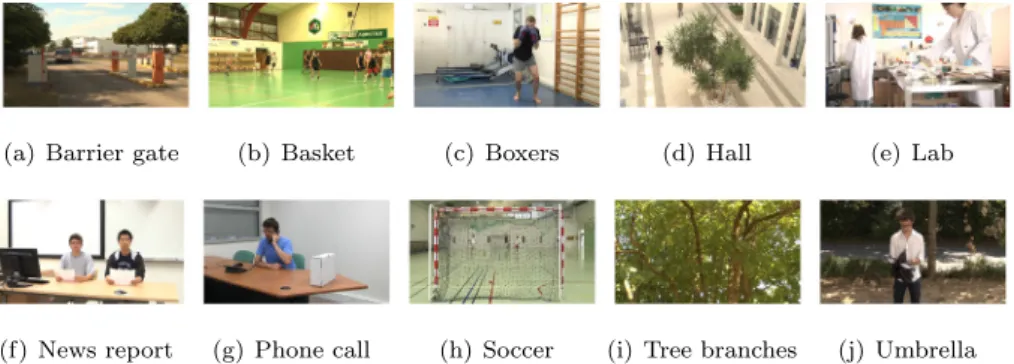
Fig.4. The 100th frames of ten reference stereo videos in the NAMA3DS1-COSPAD1 stereo video database (only right views are shown).
weightoftheithsegmentisformulatedas:
wi=
Ii N i Ii
(9) Finally,weaggregatethevideo-levelpredictedscoreasfollows:
F=
i
wiSi (10)
whereSiisthequalityscoreoftheithsegmentaveragedfrom cu-bicpatchesinspatialdimension.Notethatweadoptascorefusion methodin temporal dimension based on motionintensity rather than using the simple average fusion, which incorporates global temporalinformationandmodelstheaffectofmotionintensityon stereoscopicvideoquality.
4. Resultanddiscussion
In this section, we first introduce the stereoscopic video databases and evaluation metrics used in the experiment. Then the effectiveness of the proposed method is validated on these databases.Furthermore,wetreatourmodelasa featureextractor andreveal that our 3D CNN features havemore desirable prop-ertyforSVQAthan hand-craftedfeatures.Nextwe verifythe cor-rectness ofthe hypothesis that the quality degradation is homo-geneous throughoutthe stereoscopic video. Finally,our proposed methodisdemonstratedcomputationally efficientcompared with previousmethods.
4.1.Stereoscopicvideodatabase
In our work, we utilize theNAMA3DS1-COSPAD1 stereoscopic video quality database [43] and the stereoscopic video quality databasein [48](we nameit QI-SVQAforsimplicity) toevaluate theperformanceofourproposedmethod.
4.1.1. NAMA3DS1-COSPAD1stereoscopicvideoqualitydatabase
The NAMA3DS1-COSPAD1 database consists of 10 original stereoscopicvideoswitharesolutionof1080×1920at25fpsand 100symmetrically distortedstereoscopicvideosderived fromthe originalvideos.Therearefivetypesofdistortionconsideredinthis database,includingH.264/AVC,JPEG2000,reductionofresolution, imagesharpeninganddownsampling&sharpening.Themean opin-ionscores (MOS) rangingfrom 1 to 5is adopted to indicate the subjective quality of stereoscopic video, and higher MOS means bettersubjectivequality.Thefirstframesoftenoriginalvideosare summarizedin Fig.4.
4.1.2. QI-SVQAdatabase
The QI-SVQA databaseis in the format ofuncompressed YUV 4:2:0, which has 9 original videos and 450 symmetric or asym-metricdistortedvideosthat are dividedinto twodistortion type:
Table2
Overall performance comparison on NAMA3DS1-COSPAD1. NAMA3DS1-COSPAD1 database
Algorithm PLCC SROCC KROCC RMSE
PSNR 0.6699 0.6470 0.4800 0.8433 SSIM 0.7664 0.7492 0.54 4 4 0.7296 PQM [49] 0.6340 0.6006 0.4391 0.8784 PHVS-3D [50] 0.5480 0.5146 0.3572 0.9501 SFD [51] 0.5965 0.5896 0.4025 0.9117 3D-STS [52] 0.6417 0.6214 0.4544 0.9067 Feng [48] 0.6503 0.6229 0.4575 0.8629 Yang et al [20] 0.8949 0.8552 0.6913 0.4929 MNSVQM [53] 0.8545 0.8394 0.6439 0.4538 BSVQE [54] 0.9239 0.9086 0.7622 0.3754 Image-based method 1 0.9145 0.9082 0.7107 0.3908 Image-based method 2 0.9012 0.8985 0.7225 0.4056 3D CNN 0.9316 0.9046 0.7533 0.4161 3D CNN +SVR 0.9478 0.9231 0.7883 0.3514
GaussblurandH.264.Theframerateofallvideosinthisdatabase is 25fps whilethe resolution andthe number offramesare di-verse. Similarly, the MOS accessible in the database also varies from1(bad)to5(excellent).
4.2. Overallperformanceevaluation
Four commonly used measures are applied to quantitatively evaluate the effectiveness of the proposed method: Pearson lin-earcorrelation coefficient(PLCC),Spearmanrankcorrelation coef-ficient(SROCC),Kendallrank-ordercorrelationcoefficient(KROCC) andRoot meansquarederror (RMSE).The PLCC assesses the lin-earityofan IQAindex, whiletheSROCC measuresits monotonic-ity. The objective scores are passed through the five-parametric nonlinearregression beforecomputingPLCC andSROCC for map-ping to DMOSor MOS space. When the objective score and the subjectivescoreareexactlymatched,PLCC=SROCC=KROCC=1,
RMSE = 0.
Inthissubsection,weevaluateour3DCNNbasedSVQAmethod on abovementioned NAMA3DS1-COSPAD1 and QI-SVQAdatabase, andcompare itseffectiveness withthebest performing methods. Inordertoguaranteethereliabilityofthetestresults,weconduct the train-test process 100 times and adopt median value as the final performance evaluationresults.Eachtime we picked60% of the datasetas trainingset, 20% asthe validationset andthe re-maining 20%astestset.Theoverall performanceofthe proposed methodontwodatabasesandcomparisonarereportedin Tables2 and 3, respectively.The best performance across all the methods arehighlightedinboldface.
Notably,ourproposedmethodyieldscompetitiveresults,which issignificantly outperformedthan all previous SVQAmethods in-cludingFRandNRmodels.Comparedwithcurrentbestperforming
Table3
Overall performance comparison on QI-SVQA database. QI-SVQA database
Algorithm PLCC SROCC KROCC RMSE
PSNR 0.8496 0.8637 0.6832 0.5122 SSIM 0.8185 0.8281 0.6418 0.5580 PQM [49] 0.7852 0.8165 0.6365 0.6158 PHVS-3D [50] 0.7082 0.7195 0.5353 0.7021 SFD [51] 0.6483 0.6633 0.5021 0.7571 3D-STS [52] 0.8311 0.8338 0.6553 0.5520 Feng [48] 0.8415 0.8379 0.6650 0.5372 Yang et al [20] 0.9208 0.9175 0.7730 0.3709 MNSVQM [53] 0.8823 0.8573 0.7039 0.4073 BSVQE [54] 0.9394 0.9387 0.7963 0.3543 Image-based method 1 0.9166 0.9051 0.7259 0.3891 Image-based method 2 0.8978 0.8856 0.7012 0.3908 3D CNN 0.9318 0.9284 0.7848 0.3586 3D CNN +SVR 0.9503 0.9426 0.8038 0.3333
method,weobserveabsoluteperformancegainsofaround0.02for PLCC,SROCC,KROCCandRMSEonNAMA3DS1-COSPAD1database. AndalthoughQI-SVQAdatabasehasbothsymmetricallyand asym-metrically distortedstereoscopic videos, we alsoacquire absolute performance gains of around 0.01 for PLCC, SROCC, KROCC and RMSE. These desirableexperimental results demonstratethat our 3D CNNbased architecture isan efficientandrobust solution for evaluatingthequalityofwhethersymmetricallyorasymmetrically distorted stereoscopicvideos, asit hascapability tocapturelocal spatiotemporalinformationandglobaltemporalinformation auto-maticallyinadatadrivenway.
In addition, we also compare our method with image-based methodsandthecorrespondingexperimentalresultsareshownin Tables2and 3.Therearetwoimage-basedmethodswehavetried. Thefirstoneonlytakesthedifferenceimageofeachframeasthe input of2D CNNwhilethesecond onetakesleft andrightviews ofeach frameasinput. Inthesecond method,weset uptwo 2D CNNbranchestoencodetheleftviewinputandtherightview in-put asrepresentation vectors, then we concatenate thesevectors intofinal representationofeach frame.Theseresultsdemonstrate the superiorityoftheproposed 3DCNN basedmethodcompared tothestraightforwardmethodbasedon2DCNN.
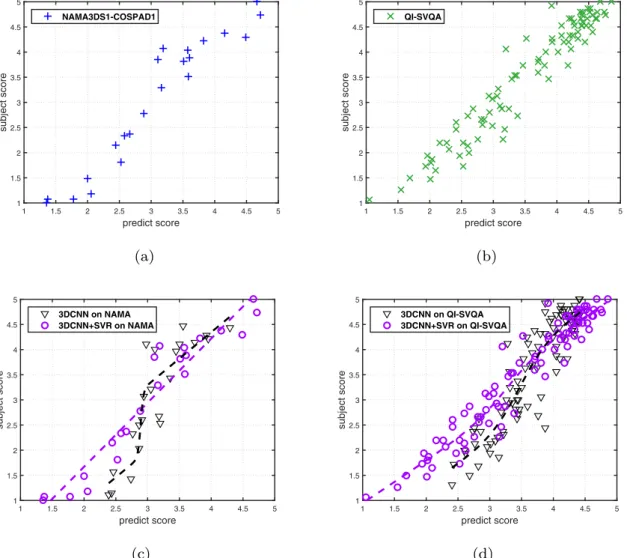
We also present scatter plots of predicted quality scores by proposed method against the corresponding MOS values on two databases in Fig.5 (a)– (b).These scatterplots illustratethat the objectivescoresobtainedbyourmethodhaveagoodlinear corre-lationwiththesubjectivescore.
4.3. 3DCNNvideodescriptor
Inthissubsection,we useour3DCNNmodelasafeature ex-tractor.Insuchausecase,thelastfully-connectedlayerFC2is re-moved and 512-Dactivationsof thepenultimate layer FC1 is ex-tracted as features to represent each input cubic video patches. Then we aggregatethesecube-levelfeatures toa video-level rep-resentationusingL1-norm.Asaresult,a512-Dfeaturevectoris learnedforeachstereoscopicvideobyour3DCNNmodel.Forthe sakeofverifyingthediscriminationcapabilityofour3DCNNvideo descriptor,weembedthesehighdimensionalfeaturevectorsto2D spaceutilizingthet-SNEtoolbox [55]. Fig.6qualitativelyvisualizes andcomparesthecapabilityofour3DCNNfeaturesandthe hand-craftedfeaturesextractedfromtheveryrecentstate-of-the-artNR SVQAmethod [20]. Yang etal. [20] proposed aSVQAmethod by modelingthebinocularperceptioneffectinmulti-views,including spatialdomain,temporaldomainandthespatial-temporaldomain, whichextractstextureanalysisfeaturesbyassociatingthecurvelet transformandlocalbinarypatternhavebeenusedintheanalysis
Table4
The contribution analysis of each component on NAMA3DS1-COSPAD1 database.
3D CNN Score Fusion SVR NAMA3DS1-COSPAD1
PLCC SROCC KROCC RMSE
√ × × 0.9216 0.9046 0.7533 0.4161 √ √ × 0.9374 0.9144 0.7592 0.4120 √ × √ 0.9410 0.9182 0.7650 0.3910 √ √ √ 0.9478 0.9231 0.7883 0.3614 Table5
The contribution analysis of each component on QI-SVQA database. 3D CNN Score Fusion SVR QI-SVQA
PLCC SROCC KROCC RMSE
√ × × 0.9318 0.9284 0.7848 0.3586 √ √ × 0.9362 0.9335 0.7892 0.3521 √ × √ 0.9465 0.9395 0.7954 0.3485 √ √ √ 0.9503 0.9426 0.8038 0.3333
ofdistortiononthespatialandspatial-temporaldomain.As illus-trated in Fig. 6, our 3D CNN features are semantically separable comparedwithartificiallydesignedfeatures, whichindicates that our learnedfeatures are more effective than artificially designed featuresusedinpreviousmethodsforSVQA.
Additionally,the3D CNNrepresentationsare passedtoa sup-portvector regressor(SVR)insteadoffullyconnectedMulti-Layer Perceptron(MLP)forqualityprediction.Asshownin Fig.5(c)–(d), thepredicted scores of3D CNNfeature extractorcombined with SVRhavebettercorrelationwiththeMOSoftestingsetthanusing 3DCNNonly.First,thelearningalgorithmofMLPisbasedonthe Empirical RiskMinimization, which attemptsto minimize the er-rorsbytheback-propagationalgorithminthetrainingset.SoMLP oftenconverges onlocal minimaratherthan globalminima. Fur-thermore,SVR aims tominimize the generalization errorson the unseendatawithafixeddistributionforthetrainingset,byusing theStructuralRiskMinimization principle.Therefore,the general-izationabilityofMLPislowerthan thatofSVR. Theseresults re-confirmthe factthat our3D CNNfeature extractorissuperior to theartificiallydesignedfeatureextractors.
4.4.Thecontributionanalysisofeachcomponent
Ourframework ismadeup ofthree componentsincluding3D CNN, quality score fusion and SVR, where 3D CNN is the major partandtheothertwoaretheauxiliaryparts.Wenowinvestigate thesignificanceofeachcomponentandanalyzetheircontribution viaacomparisonexperiment.Inourexperiment, different combi-nationsofthesecomponentsare conductedon SVQAdatasetsfor discussion. Tables 4 and 5 show the performance evaluation re-sults when using each combination for predicting video quality. The symbol√ and × in thefirst three columnsof Tables 4and 5indicate whetherthe corresponding component isused or not. Specifically,the symbol × inthecolumn“Score FusionStrategy” meansadoptingaveragefusionstrategyinsteadofourproposed fu-sionstrategy,andthesymbol × inthecolumn“SVR” meansusing MlPinsteadofSVRtocompleteregression.Forexample,the meth-odsdescribedinthefirstrowof Tables4and 5obtainpatch-level scoreby 3DCNNrepresentationswithMLPandadoptaverage fu-sionstrategytopoolthescoresofcubicvideopatchesinto video-levelscore.Itisclearlyobservedthatthecombinationadoptingall threecomponentsyieldsbestperformance.Meanwhile,ourquality scorefusionstrategyconsideringglobaltemporalcluesareverified complementary to3D CNN,and3D CNN features incombination withSVRcanfurtherimprovetheperformance.
predict score 1 1.5 2 2.5 3 3.5 4 4.5 5 subject score 1 1.5 2 2.5 3 3.5 4 4.5 5 NAMA3DS1-COSPAD1
(a)
predict score 1 1.5 2 2.5 3 3.5 4 4.5 5 subject score 1 1.5 2 2.5 3 3.5 4 4.5 5 QI-SVQA(b)
predict score 1 1.5 2 2.5 3 3.5 4 4.5 5 subject score 1 1.5 2 2.5 3 3.5 4 4.5 5 3DCNN on NAMA 3DCNN+SVR on NAMA(c)
predict score 1 1.5 2 2.5 3 3.5 4 4.5 5 subject score 1 1.5 2 2.5 3 3.5 4 4.5 5 3DCNN on QI-SVQA 3DCNN+SVR on QI-SVQA(d)
Fig.5. Predicted MOS versus subjective MOS on two databases. (a) Scatter plot on NAMA3DS1-COSPAD1. (b) Scatter plot on QI-SVQA. (c) Performance comparison of 3D CNN and 3D CNN combined with SVR on the same data in NAMA3DS1-COSPAD1 database. (d) Performance comparison of 3D CNN and 3D CNN combined with SVR on the same data in QI-SVQA database.
(a) Hand-crafted features extracted from the very recent SVQA method
(b) Features learned by our 3D CNN model
Fig.6. Feature embedding visualizations of state-of-the-art NR SVQA method [20]and our 3D CNN method on NAMA3DS1-COSPAD1 by t-SNE toolbox [55]. (a) Hand-crafted features extracted from the very recent state-of-the-art SVQA method. (b) Features extracted by our 3D CNN model. After dimensionality reduction, the feature vector of each stereoscopic video is visualized as a point and different colors represent different quality levels. We divide video quality into 4 grades in all.
4.5.Localqualityevaluation
After producedfromrawvideos,numeroussmallcubicpatches arelabeled witha quality scoreconsistent withtheentirevideo. Wecan dothisbecausewe hypothesize thequality degrades ho-mogeneously throughout the whole stereoscopic video. Next we
willexperimentallyprovethatthesmallcubicpatcheshavea con-sistentqualityconditionwiththeentirevideo.
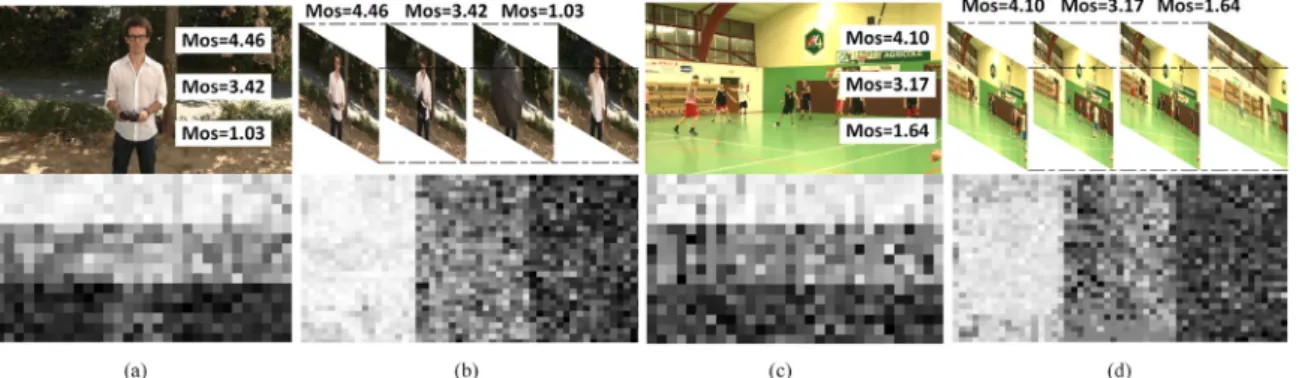
We pick out several stereoscopic videos distorted in differ-ent degradation levels of same distortion type from NAMA3DS1-COSPAD1 database, and these videos do not participate in the trainingstage. First, we divideeach stereoscopic videointo three segments vertically inspatialdimension andsplice thesegments
Fig.7. Spatially and temporally synthetic stereoscopic video examples and the visualization of corresponding local quality predicted scores. The first raw shows synthetic stereoscopic videos generated by splicing video segments distorted in three different degradation levels of (a) JPEG20 0 0 (b) JPEG20 0 0 (c) H.264 (d) H.264. (a) and (c) are synthesized in spatial dimension while (b) and (d) are synthesized in temporal dimension. The second row shows corresponding quality maps and brighter pixels indicate higher quality.
Table6
The performance comparison with different patch size on NAMA3DS1-COSPAD1 dataset.
Patch size 16 24 32 48 64 128 256
PLCC 0.9340 0.9429 0.9478 0.9467 0.9483 0.9480 0.9470
SROCC 0.9224 0.9228 0.9231 0.9237 0.9238 0.9225 0.9227
distortedindifferentlevelstogenerateaspatiallysynthetic stereo-scopic video. Then the similar process is carriedout intemporal dimensiontoobtaintemporallysyntheticstereoscopicvideo.Next, our trained 3D CNN based SVQA method conducts on both spa-tially and temporally synthetic stereoscopic videosto implement qualityevaluation.Theestimatedqualityscoresofallcubicpatches are normalizedinto[0,255]andthenvisualized inaquality map. Fig. 7 presents the predicted quality map of both spatially and temporallysyntheticstereoscopicvideodistortedinJPEG2000and H.264.Itisclearlyobservedthatproposedmethodhas discrimina-tion capabilityto evaluate thequality of localcubic patches, and thequalitydegradeshomogeneouslythroughoutthewhole stereo-scopicvideo.Theseresultsprovideamuchmorereliablebasis for ourdatapreprocessing.
In addition, to observe how the patch size affects the over-all performance, we conduct a comparative experiment on the NAMA3DS1-COSPAD1 dataset and the experimental results are shown in Table 6. To guarantee that the number of patches per video remains roughly the same when patch size varies, we adopted overlap sampling with fixed sampling stride. As Table 6 shows, as the size of the block increases, there is a very slight fluctuation andno significant improvementin perfor-mance.However, usinglargervideopatcheswillspendmoretime when do convolution operations. Therefore, the configuration of thepatchsizeisstill32×32inspatialdimension.
4.6. Runtimeanalysis
In addition to accuracy, efficiency is also an important crite-riontomeasureaSVQAalgorithm.Wedevelopour3DCNNmodel by usingthe python deeplearning libraryKeras on a PC witha single 3.2 GHz CPU and a single GTX1080 GPU. With no com-plex preprocessingandGPUacceleration,ourproposedmethodis demonstrated computationally efficient.We measure theruntime ofourproposedmethodandcompareitwithYang [20],MNSVQM [53] and BSVQE [54],which are theonly three NR SVQAmodels proposedasfarasweknow.Yangetal. [20]constructedaquality evaluator based on optical flow that is a time-consuming opera-tion. For effective comparison, two implementations are adopted in our experiment to compute the optical flow: CPU implemen-tation in Matlab and GPU implementation in OpenCV. MNSVQM
Table7
The runtime analysis on NAMA3DS1-COSPAD1 dataset.
Method Usage Runtime(h) Test time per video(s)
Yang et al. [20] CPU 117.5 250
Yang et al. [20] GPU 29.4 63
MNSVQM [53] CPU 67.9 45
BSVQE [54] CPU 15.4 18
Proposed method GPU 2.6 2
extractedstatisticalfeaturessuchasgeneralizedGaussian distribu-tion(GGD),asymmetricGGD,spatialentropy,spectralentropy as-sociatedwithtwoviews,andspectralentropyrelatedtodepth per-ceptionofstereoscopicvideo.InBSVQE,thebinocular summation anddifference operationsare integratedtogether withthefusion naturalscene statistic measurement and the ARDEmeasurement torevealthekey influencefromtextureanddisparity.Asaresult, theruntimeofthesemethodsforthewholeNAMA3DS1-COSPAD1 datasetisreportedin Table7.Itcan beclearlyobservedthat our method is far more efficient than the three NR methods above. Therefore,the proposed methodisnot only effectivebutalso ef-ficient,whichisa morefeasiblesolutionforreal-timeapplication ofSVQA.
5. Conclusion
Inthispaper,we havepresentedaNR SVQAframework based on3D CNN,whichcaneffectivelymodelnotonlylocal spatiotem-poralinformationbutalsoglobaltemporalinformationwithcubic differencevideopatchesasinput.Intheframework,wefirstdesign a3D CNNarchitecturetoautomaticallycapturelocal spatiotempo-ral features insteadof using hand-crafted features andthen em-ploy a quality score fusion strategy considering global temporal clues to obtain final video-level predicted scores. Extensive ex-periments on two challenging stereoscopic video databases have shown that our proposed method correlates highly with human perceptionandsignificantlyoutperformsstate-of-the-artmethods. Inaddition,withnocomplexpreprocessingandGPUacceleration, our proposed method is demonstrated computationally efficient comparedwithpreviousmethods.
Despitedeeplearningbasedmethodshaveachievedgreat suc-cessinmany challenge tasks,few network architecturesare pro-posedto evaluatethequality ofvisualinformation,especiallythe qualityofstereoscopicvideo. Ourworkinthispaperexplores3D CNN to evaluate the quality of stereoscopic video for the first time.Inthefuture,wewillcontinuetofocusondevelopingdeep learningmodels forSVQAtask. Moreover, we plan to establisha largeSVQAdatasettoaddresstheproblemoflabeleddatascarcity, whichdefinitelymeetstheneedsofdeeplearningmodels. Acknowledgments
This work was supported by the Foundation of Pre-Research on Equipment of China (No.61403120103) and the National NaturalScienceFoundationofChina(Nos. 61372130, 61432014). References
[1] L.Li,W.Lin,X.Wang,G.Yang,K.Bahrami,A.C.Kot,No-referenceimageblur assessmentbasedondiscreteorthogonalmoments,IEEETrans.Cybern.46(1) (2016a)39–50.
[2] L.Li,Y.Zhou,W.Lin,J.Wu,X.Zhang,B.Chen,No-referencequalityassessment ofdeblockedimages,Neurocomputing177(2016b)572–584.
[3] A.Krizhevsky,I.Sutskever,G.E.Hinton,Imagenetclassificationwithdeep con-volutionalneuralnetworks,in:ProceedingsoftheAdvancesinNeural Infor-mationProcessingSystems,2012,pp.1097–1105.
[4] Z.Akata,F.Perronnin,Z.Harchaoui,C.Schmid,Goodpracticeinlarge-scale learningforimageclassification,IEEETrans.PatternAnal.Mach.Intell.36(3) (2014)507–520.
[5] S.Ren,K.He,R.Girshick,J.Sun,FasterR-CNN:towardsreal-timeobject detec-tionwithregionproposalnetworks,in:ProceedingsoftheAdvancesinNeural InformationProcessingSystems,2015,pp.91–99.
[6] J.Redmon,S.Divvala,R.Girshick,A.Farhadi,Youonlylookonce:unified, re-al-timeobjectdetection,in:ProceedingsoftheIEEEConferenceonComputer VisionandPatternRecognition,2016,pp.779–788.
[7] J. Yue-Hei Ng, M. Hausknecht, S. Vijayanarasimhan, O. Vinyals, R. Monga, G. Toderici,Beyondshortsnippets:deepnetworksforvideoclassification,in: ProceedingsoftheIEEEConferenceonComputerVisionandPattern Recogni-tion,2015,pp.4694–4702.
[8] Z.Wu,X.Wang,Y.-G.Jiang,H.Ye,X.Xue,Modelingspatial-temporalcluesina hybriddeeplearningframeworkforvideoclassification,in:Proceedingsofthe ACMInternationalConferenceonMultimedia,ACM,2015,pp.461–470. [9] C.Feichtenhofer,A.Pinz,R.Wildes,Spatiotemporalresidualnetworksforvideo
actionrecognition,in:ProceedingsoftheAdvancesinNeuralInformation Pro-cessingSystems,2016a,pp.3468–3476.
[10] C.Feichtenhofer,A.Pinz,A.Zisserman,Convolutionaltwo-streamnetwork fu-sionforvideoactionrecognition,in:ProceedingsoftheIEEEConferenceon ComputerVisionandPatternRecognition,2016b,pp.1933–1941.
[11]L. Kang, P. Ye, Y. Li, D. Doermann, Convolutional neural networks for no-ref-erenceimagequalityassessment,in:ProceedingsoftheIEEEConferenceon ComputerVisionandPatternRecognition,2014,pp.1733–1740.
[12] W.Zhang,C.Qu,L.Ma,J.Guan,R.Huang,Learningstructureofstereoscopic imageforno-referencequalityassessmentwithconvolutionalneuralnetwork, PatternRecognit.59(2016)176–187.
[13] C.Hewage,S.T.Worrall,S.Dogan,A.Kondoz, Predictionofstereoscopicvideo qualityusing objectivequality modelsof 2D video, Electron.Lett. 44 (16) (2008)963–965.
[14] S.Yasakethu,C.T.Hewage,W.A.C.Fernando,A.M.Kondoz, Qualityanalysisfor 3Dvideousing2Dvideoqualitymodels,IEEETrans.Consum.Electron.54(4) (2008).
[15] M.H.Pinson,S.Wolf,Anewstandardizedmethodforobjectivelymeasuring videoquality,IEEETrans.Broadcast.50(3)(2004)312–322.
[16] H.Malekmohamadi,A.Fernando,A.Kondoz,Anewreducedreference met-ricforcolorplusdepth3Dvideo,J.Vis.Commun.ImageRep.25(3)(2014) 534–541.
[17]H.Zhu,M.Yu,Y.Song,G.Jiang,Astereovideoqualityassessmentmethodfor compressiondistortion,in:ProceedingsofInternationalConferenceon Com-putationalScienceandComputationalIntelligence,IEEE,2015,pp.481–485. [18] M.Yu,K. Zheng, G.Jiang, F.Shao,Z.Peng,Binocularperception based
re-duced-referencestereovideoqualityassessmentmethod,J.Vis.Commun. Im-ageRep.38(2016)246–255.
[19] C.Galkandage,J.Calic,S.Dogan,J.-Y.Guillemaut,Stereoscopicvideoquality as-sessmentusingbinocularenergy,IEEEJ.Sel.Top.SignalProcess.11(1)(2017) 102–112.
[20]J. Yang, H. Wang, W.Lu, B. Li, A. Badii, Q. Meng, A no-reference optical flow-basedqualityevaluatorforstereoscopicvideos incurveletdomain,Inf. Sci.414(2017)133–146.
[21]C.Li,A.C.Bovik,X.Wu,Blindimagequalityassessmentusingageneral regres-sionneuralnetwork,IEEETrans.NeuralNetw.22(5)(2011)793.
[22]A.Chetouani,A.Beghdadi,S.Chen,G.Mostafaoui,Anovelfreereference im-agequalitymetricusingneuralnetworkapproach,in:Proceedingsofthe
In-ternationalWorkshopVideoProcess.QualityMetricsConsumerElectron,2010, pp.1–4.
[23]L.Li,W.Lin,H.Zhu,Learningstructuralregularityforevaluatingblocking ar-tifactsinJPEGimages,IEEESignalProcess.Lett.21(8)(2014)918–922. [24]H.Tang,N.Joshi,A.Kapoor,Blindimagequalityassessmentusing
semi-super-visedrectifiernetworks,in:ProceedingsoftheIEEEConferenceonComputer VisionandPatternRecognition,2014,pp.2877–2884.
[25]G.E.Hinton,R.R.Salakhutdinov,Reducingthedimensionalityofdatawith neu-ralnetworks,Science313(5786)(2006)504–507.
[26]H. Tang,N.Joshi, A.Kapoor,Learning ablindmeasureofperceptualimage quality,in:ProceedingsoftheIEEEConferenceonComputerVisionand Pat-ternRecognition,IEEE,2011,pp.305–312.
[27]D.Ghadiyaram,A.C.Bovik, Blindimagequalityassessmentonrealdistorted imagesusingdeepbeliefnets,in:ProceedingsoftheIEEEGlobalConference onSignalandInformationProcessing,IEEE,2014,pp.946–950.
[28]W.Hou,X.Gao,D.Tao,X.Li,Blindimagequalityassessmentviadeeplearning, IEEETrans.NeuralNetw.Learn.Syst.26(6)(2015)1275–1286.
[29]F.Shao,W.Tian,W.Lin,G.Jiang,Q.Dai,Towardablinddeepqualityevaluator forstereoscopicimagesbasedonmonocularandbinocularinteractions,IEEE Trans.ImageProcess.25(5)(2016)2059–2074.
[30]Y.Li,L.-M.Po,C.-H.Cheung,X.Xu,L.Feng,F.Yuan,K.-W.Cheung,No-reference videoqualityassessmentwith3Dshearlettransformandconvolutionalneural networks,IEEETrans.CircuitsSyst.VideoTechnol.26(6)(2016)1044–1057. [31]K.Simonyan,A.Zisserman,Verydeepconvolutionalnetworksforlarge-scale
imagerecognition,in:ProceedingsoftheInternationalConferenceonLearning Representations,2015.
[32]K.He,X.Zhang,S.Ren,J.Sun,Deepresiduallearningforimagerecognition,in: ProceedingsoftheIEEEConferenceonComputerVisionandPattern Recogni-tion,2016,pp.770–778.
[33]A.Karpathy,G.Toderici,S.Shetty,T.Leung,R.Sukthankar,L.Fei-Fei, Large-s-cale videoclassificationwithconvolutionalneuralnetworks,in:Proceedings ofthe IEEE Conferenceon ComputerVisionand PatternRecognition, 2014, pp.1725–1732.
[34]K. Simonyan, A. Zisserman, Two-stream convolutional networks for action recognitioninvideos,in:ProceedingsoftheAdvancesinNeuralInformation ProcessingSystems,2014,pp.568–576.
[35]A.Jain,J.Tompson,Y.LeCun,C.Bregler, MoDeep:adeeplearningframework usingmotionfeaturesforhumanposeestimation,in:ProceedingsoftheAsian ConferenceonComputerVision,Springer,2014,pp.302–315.
[36]S.Ji,W.Xu,M.Yang,K.Yu,3Dconvolutionalneuralnetworksforhumanaction recognition,IEEETrans.PatternAnal.Mach.Intell.35(1)(2013)221–231. [37]D.Tran,L.Bourdev,R.Fergus,L.Torresani,M.Paluri, Learningspatiotemporal
featureswith3Dconvolutionalnetworks,in:ProceedingsoftheIEEE Interna-tionalConferenceonComputerVision,2015,pp.4489–4497.
[38]Q.Dou,H.Chen,L.Yu,L.Zhao,J.Qin,D.Wang,V.C.Mok,L.Shi,P.-A.Heng, Automaticdetectionofcerebralmicrobleedsfrommrimagesvia3D convolu-tionalneuralnetworks,IEEETrans.Med.Imaging35(5)(2016)1182–1195. [39]J.Yang,Y.Lin,Z.Gao,Z.Lv,W.Wei,H.Song,Qualityindexforstereoscopic
im-agesbyseparatelyevaluatingaddingandsubtracting,PloSOne10(12)(2015a) e0145800.
[40]J.Yang,Y.Liu,Z.Gao,R.Chu,Z.Song,Aperceptualstereoscopicimagequality assessmentmodelaccountingforbinocularcombinationbehavior,J.Vis. Com-mun.ImageRep.31(2015b)138–145.
[41] J. Yang,Y. Wang, B.Li, W.Lu,Q.Meng, Z.Lv,D.Zhao,Z.Gao,Quality as-sessmentmetricofstereoimagesconsideringcyclopeanintegrationandvisual saliency,Inf.Sci.373(2016)251–268.
[42]L.Ma,X.Wang,Q.Liu,K.N.Ngan,ReorganizedDCT-basedimagerepresentation forreducedreferencestereoscopicimagequalityassessment,Neurocomputing 215(2016)21–31.
[43]M. Urvoy, M. Barkowsky, R.Cousseau,Y. Koudota, V.Ricorde, P. LeCallet, J. Gutierrez,N.Garcia,NAMA3DS1-COSPAD1:subjectivevideoquality assess-mentdatabaseoncodingconditionsintroducingfreelyavailablehighquality 3Dstereoscopicsequences,in:ProceedingsofFourthInternationalWorkshop onQualityofMultimediaExperience,IEEE,2012,pp.109–114.
[44]Y.LeCun,Y.Bengio,etal., Convolutionalnetworksforimages, speech,andtime series,Handb.BrainTheoryNeuralNetw.3361(10)(1995)1995.
[45]Y.LeCun,L.Bottou,Y.Bengio,P.Haffner,Gradient-basedlearningappliedto documentrecognition,Proc.IEEE86(11)(1998)2278–2324.
[46]V.Nair,G.E.Hinton,RectifiedlinearunitsimproverestrictedBoltzmann ma-chines,in:ProceedingsoftheInternationalConferenceonMachineLearning, 2010,pp.807–814.
[47]G.E.Hinton,N.Srivastava,A.Krizhevsky,I.Sutskever,R.R.Salakhutdinov, Im-proving neural networks bypreventing co-adaptation of feature detectors, Comput.Sci.3(4)(2012)212–223.
[48]F.Qi,D.Zhao, X.Fan,T.Jiang,Stereoscopicvideoqualityassessment based onvisualattentionandjust-noticeabledifferencemodels.,SignalImageVideo Process.10(4)(2016)737–744.
[49]P.Joveluro, H.Malekmohamadi, W.C.Fernando,A.Kondoz, Perceptualvideo qualitymetricfor3Dvideoqualityassessment,in:Proceedingsofthe3DTV– Conference:TheTrueVision-Capture,TransmissionandDisplayof3DVideo, IEEE,2010,pp.1–4.
[50]L.Jin,A.Boev,A.Gotchev,K.Egiazarian,3D-DCTbasedperceptualquality as-sessmentofstereovideo,in:ProceedingsofIEEEInternationalConferenceon ImageProcessing,IEEE,2011,pp.2521–2524.
[51]F.Lu,H.Wang,X.Ji,G.Er,Qualityassessmentof3Dasymmetricviewcoding usingspatialfrequencydominancemodel,in:Proceedingsofthe3DTV
Con-ference:TheTrueVision-Capture,TransmissionandDisplayof3DVideo,IEEE, 2009,pp.1–4.
[52] J.Han,T.Jiang,S.Ma,Stereoscopicvideoqualityassessmentmodelbasedon spatial-temporalstructuralinformation,in:ProceedingsoftheVisual Commu-nicationsandImageProcessing,IEEE,2012,pp.1–6.
[53] G.Jiang,S.Liu,M.Yu,F.Shao,Z.Peng,F.Chen,Noreferencestereovideo qual-ityassessmentbasedonmotionfeatureintensordecompositiondomain,J. Vis.Commun.ImageRep.50(2018)247–262.
[54] Z.Chen,W.Zhou, W.Li, Blindstereoscopicvideo qualityassessment:from depthperception tooverall experience,IEEE Trans. ImageProcess. PP(99) (2018)721–734.
[55] L.v.d.Maaten,G.Hinton, Visualizingdatausingt-SNE,J.Mach.Learn.Res.9 (2008)2579–2605.
Jiachen Yang received the M.S. and Ph.D. degrees in communication and information engineering from Tian- jin University, Tianjin, China, in 20 05 and 20 09, respec- tively. He is currently a professor at Tianjin University. He is a visiting scholar with the department of computer sci- ence, school of science, Loughborough University, U.K. His research interests include multimedia quality evaluation, stereo vision research and pattern recognition.
YinghaoZhu received the B.S. degree in communication and information engineering from Hohai University, Nan- jing, China, in 2016. He is currently pursuing the M.S. degree at the school of electrical and information engi- neering, Tianjin University, Tianjin, China. His research in- terests include multimedia quality evaluation, stereo vi- sion research and pattern recognition.
ChaofanMa received the B.S. degree in materials science and engineeringfrom Tianjin University, Tianjin, China, in 2016. He is currently pursuing the M.S. degree at the school of electrical and information engineering, Tian- jin University, Tianjin, China. His research interests in- clude stereo vision research, pattern recognition and deep learning.
WenLu received the M.S. and Ph.S. degrees in electrical engineering from Xidian University, China, in 2006 and 2009, respectively. He is currently a professor at Xidian University. His research interests include image and video understanding, visual quality assessment, and computa- tional vision.
QinggangMeng received the B.S. and M.S. degrees from the School of Electronic Information Engineering, Tian- jin University, China, and the Ph.D. degree in computer science from Aberystwyth University, U.K. He is a Se- nior Lecturer with the Department of Computer Science, Loughborough University, U.K. His research interests in- clude biologically and psychologically inspired learning algorithms and developmental robotics, service robotics, robot learning and adaptation, multi-UAV cooperation, drivers distraction detection, human motion analysis and activity recognition, activity pattern detection, pattern recognition, artificial intelligence, and computer vision. He is a Fellow of the Higher Education Academy, U.K.