Methodological Review
What can natural language processing do for clinical decision support?
Dina Demner-Fushman
a,*, Wendy W. Chapman
b, Clement J. McDonald
aa
U.S. National Library of Medicine, National Institutes of Health, Bethesda, MD 20894, USA
bDepartment of Biomedical Informatics, University of Pittsburgh, 200 Meyran Avenue, M-183 VALE, Pittsburgh, PA 15260, USA
a r t i c l e
i n f o
Article history:
Received 21 November 2008 Available online 13 August 2009 Keywords:
Natural language processing Decision support techniques Clinical decision support systems Review
a b s t r a c t
Computerized clinical decision support (CDS) aims to aid decision making of health care providers and the public by providing easily accessible health-related information at the point and time it is needed. natural language processing (NLP) is instrumental in using free-text information to drive CDS, represent-ing clinical knowledge and CDS interventions in standardized formats, and leveragrepresent-ing clinical narrative. The early innovative NLP research of clinical narrative was followed by a period of stable research con-ducted at the major clinical centers and a shift of mainstream interest to biomedical NLP. This review pri-marily focuses on the recently renewed interest in development of fundamental NLP methods and advances in the NLP systems for CDS. The current solutions to challenges posed by distinct sublanguages, intended user groups, and support goals are discussed.
Published by Elsevier Inc.
1. Introduction
The goal of clinical decision support (CDS) is to ‘‘help health professionals make clinical decisions, deal with medical data about patients or with the knowledge of medicine necessary to interpret such data”[1]. Clinical decision support systems are defined as ‘‘any software designed to directly aid in clinical decision making in which characteristics of individual patients are matched to a computerized knowledge base for the purpose of generating patient-specific assessments or recommendations that are then presented to clinicians for consideration”[2]. A CDS system struc-ture could be envisioned as a neural reflex arc: its receptors reside in, and are activated by patient data; its integration center contains decision rules and the knowledge base; and its effectors are the patient-specific assessments and recommendations.
Patient data can be manually entered into a CDS system by cli-nicians seeking support, but then they only get support when they recognize the need and have time to find and enter the req-uisite data. Support is thus much more effective when the com-puterized system has access to electronic heath record (EHR) data that can trigger reminders or alerts automatically as situa-tions arise that require physician action.1The EHR will often carry
some clinical information, for example, laboratory results, phar-macy orders, and discharge diagnoses in a structured and coded form. Today, a major portion of the patients clinical observations, including radiology reports, operative notes, and discharge summa-ries are recorded as narrative text (dictated and transcribed, or di-rectly entered into the system by care providers). And in some systems even laboratory and medication records are only available as part of the physician’s notes. Moreover, in some cases the facts that should activate a CDS system can be found only in the free text. For example, the CDC technical instructions for tuberculosis screening and treatment2 define a complete screening medical
examination for tuberculosis as consisting ‘‘of a medical history, physical examination, chest radiography (when required), determi-nation of immune response to Mycobacterium tuberculosis anti-gens (i.e., tuberculin skin testing, when required), and laboratory testing for human immunodeficiency virus infection . . . and M. tuberculosis (when required.)” Notably, medical history, physical examination, and chest radiography results are routinely obtained in free-text form. Indications for further tuberculosis screening could be identified in these clinical notes using NLP methods [3] at no additional cost.
In principle, natural language processing could extract the facts needed to actuate many kinds of decisions rules. In theory, NLP systems might also be able to represent clinical knowledge and CDS interventions in standardized formats[4–6]. That is, NLP could potentially enrich all three major components of CDS systems. The goal of this review is to present the current state of clinical NLP, its contributions to CDS, and the development of biomedical NLP
1532-0464/$ - see front matter Published by Elsevier Inc. doi:10.1016/j.jbi.2009.08.007
*Corresponding author. Address: Communications Engineering Branch, Lister Hill National Center for Biomedical Communications, U.S. National Library of Medicine, Bldg. 38A, Room 10S-1020, 8600 Rockville Pike MSC-3825, Bethesda, MD 20894, USA. Fax: +1 301 402 0341.
E-mail address:[email protected](D. Demner-Fushman). 1
According to the Personalized Health Care (PHC) Initiative team at the Depart-ment of Health and Human Services data collection supported by CDS tools is either active or passive. http://www.hhs.gov/healthit/ahic/materials/09_07/phc/
background.pdf. 2http://www.cdc.gov/ncidod/dq/pdf/ti_tb_8_9_2007.pdf.
Contents lists available atScienceDirect
Journal of Biomedical Informatics
j o u r n a l h o m e p a g e : w w w . e l s e v i e r . c o m / l o c a t e / y j b i ntowards processing of clinical narrative and information resources required for further and more involved participation in the CDS process.
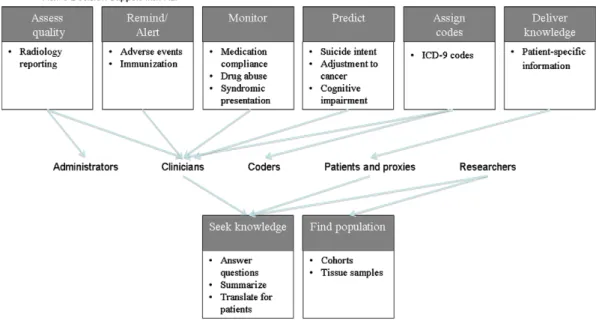
Since their introduction about 40 years ago, CDS systems have improved practitioner performance in approximately 60% of the re-viewed cases[7]. Several features are correlated with decision sup-port systems’ ability to improve patient care: automatically and proactively providing decision support as part of clinician work-flow; providing recommendations rather than assessments; and providing decision support at the time and location of decision making[8]. If CDS systems were to depend upon NLP, it would re-quire reliable, high-quality NLP performance and modular, flexible, and fast systems. Some NLP applications have been integrated in both active and passive CDS. Active NLP CDS applications leverage existing information and push patient-specific information to users. Passive NLP CDS applications require input by the user to generate output.
Active NLP CDS includes alerting, monitoring, coding, and reminding. Active NLP CDS is considered quintessential by most interested parties. Passive NLP CDS has focused on providing knowledge and finding patient populations. This review presents the view of NLP CDS which includes active and passive support, and leaves out the related burgeoning areas of tutoring[9]and clinical text mining[10]. Both active and passive NLP CDS systems process a variety of textual sources, such as clinical records, bio-medical literature, web pages, and suicide notes. A variety of NLP CDS systems have been targeted to clinicians, but other users are researchers, patients, administrators, students, and coders. Although the application types targeted to clinicians represent a diverse set of active tools, there appears to be a recent trend to-ward a higher volume of passive tools being targeted to clinicians and researchers.Fig. 1demonstrates the types of active and passive CDS applications to which NLP tools have contributed and have po-tential to contribute in the future.
The scope and workflow of an idealized NLP system capable of supporting various clinical decisions and text types are discussed in Section3. The rest of the review is organized as follows: Section 2presents a short overview of CDS systems. Section4provides an overview of the fundamental NLP methods applied to clinical text. Section5describes integrated and end-to-end medical natural lan-guage processing systems. Section 6presents methods and
sys-tems for generation of bottom-line advice to clinicians and the public, which are likely to be integrated with CDS systems in the near future. Section7presents research on direct applications of NLP in diagnosis, treatment, and other healthcare decisions. The re-view concludes with potential future directions in natural lan-guage processing for clinical decision support.
2. Current state of clinical decision support systems
Clinical decision support systems can be described along several axes[11,12]:
access (integrated with an EHR or stand-alone systems) setting (used in ambulatory care or inpatient setting)
task (targeting a specific clinical or administrative task such as diagnosis, immunization, or quality control)
scope (general or targeting a specialty)
timing (before, during, or after the clinical decision is made) output (active, for example, reminders, or passive)
implementation (knowledge-based, statistical)
A thorough review of the systems is beyond the scope of this paper, but further information on CDS and CDS systems can be found in[1,2,4,5,11,12].
Much of the data that could support CDS is textual and there-fore cannot be leveraged by a CDS system without natural lan-guage processing. For example, Aronsky and colleagues studied the usefulness of NLP for a CDS system that identified commu-nity-acquired pneumonia in emergency department patients and showed that performance was significantly better with the NLP output [13]. The following examples of integrated CDS systems demonstrate the possibilities for NLP in the context of CDS.
2.1. An outpatient reminder system
In the early 1970s, the Regenstrief Institute introduced prospec-tive, protocol-driven reminders in the outpatient clinics of Wishard Memorial Hospital. The reminder system searched patients’ charts for conditions specified initially in about 300 rules in two catego-ries: ordering specific tests after starting certain drug therapy;
and changing drug therapy in response to abnormal test results [11]. For example, if a patient’s serum aminophylline level had not been measured within a certain time after starting aminophyl-line therapy, the system generated a reminder for the responsible physician suggesting to order the test. The messages suggesting specific actions and explaining the rationale with references to re-search articles were printed on paper before each patient encoun-ter and attached to the front of the patient’s chart[11,15,16].
In a summative 2-year evaluation of the expanded system, the clinicians who received reminders undertook the expected actions at a significantly higher rate (44–49% vs. 29%) than those who did not receive the reminders. Interestingly, the study participants never requested articles referenced in the reminders because of time pressures or because they knew the evidence that justified the reminder [11,15]. Reduction of time required for analysis of evidence presented in research articles is the goal of text summa-rization and question answering methods discussed in Section6. Further details on over a quarter century of CDS experience at the Regenstrief Institute can be found in[11,15,16].
2.2. Inpatient reminder and diagnostic decision support systems
The HELP (Health Evaluation through Logical Processing) Hospi-tal Information System insHospi-talled in the Intermountain Healthcare hospitals provides examples of CDS in the inpatient setting. In addition to alert, critique, and suggestion systems similar to the Regenstrief reminder system, the HELP system provides diagnostic decision support. For example, a rule-based subsystem helps diag-nose adverse drug events (ADE) through identifying patients with specific chemistry test results, drug level tests, orders for drugs that are commonly used to treat ADEs, and a program in which providers choose symptoms that may be caused by ADEs (e.g., rash, change in heart rate, respiratory rate, mental status, etc.) [17]. Manual entry of the symptoms that may be caused by ADEs could be facilitated or replaced by an NLP tool for extraction of symptoms from free text (for example, from patients’ progress notes), partic-ularly because several NLP systems (discussed in Section5) are al-ready in use at Intermountain Healthcare.
The Antibiotic Assistant[18], initially developed and imple-mented at LDS Hospital, identifies patients with potential nosoco-mial infections, alerts physicians to the possible need for anti-infective therapy, and suggests dose and regiment for individual patients. Evans et al. have shown that use of the Antibiotic Assis-tant decreased the number of ADEs, length of stay, morbidity, and significant reductions in adverse drug events and cost[18]. Re-cently, the Antibiotic Assistant has been deployed in multiple IHC hospitals and a commercialized version is being marketed across the U.S.3A key element in the diagnostic reasoning for the Antibiotic
Assistant is whether there is radiographic evidence of bacterial pneumonia. Fiszman et al.[19]showed that application of an NLP system to identification of pneumonia performed better than the simple keyword-based method implemented in the Antibiotic Assis-tant, but integrating the NLP system in a production-level system proved too complex, and the Antibiotic Assistant still uses the inter-nal keyword-based algorithm. If the NLP system were deployed, pro-cessing clinical reports in real-time, and storing the NLP annotations, as is the case at Columbia University (see Section5.1), making use of the NLP system’s output would be more straightforward for existing CDSs.
2.3. Decision support centered on CPOE
Many computerized provider order entry (CPOE) systems use controlled vocabularies to avoid unstructured narrative that can
‘‘result in confusion among the lab technicians and pharmacists who receive completed orders”[20]. This, however, does not pre-clude NLP contributions to CDS systems. A passive CPOE-centered NLP CDS system would have the advantage of receiving structured input in the form of patient-specific variables plugged into a text template. It would still need to formally represent knowledge in textual resources and find matching representations. For example, an NLP CDS system could contribute to educational information provided by the Vanderbilt University Medical Center HEO (Hori-zon Expert Orders, McKessonÒ), formerly the WizOrder system,
which (in addition to recommendations about patient safety and quality of care issues traditionally provided by CPOE systems [16,17]) provides summaries of disease-specific national guidelines [21]by matching formal representations of guidelines relevant to a specific order. An NLP system could also contribute by processing free text collected by the HEO system, which ranges from com-ments to structured fields such as orderables for baby aspirin to completely free-text nursing orders (personal communication with Dr. Dominik Aronsky and Dr. Russ Waitman). For example, if the system can process a skin-care related order ‘‘turn every three hours”, it can then search the EHR for the last documented turn and issue a reminder, if the elapsed time exceeds the ordered time. Centering CDS on CPOE allows decision support at various stages of order entry (initiation, patient selection, order selection, order construction, and order completion)[21]. For example, deci-sion support at Partners Healthcare originated at the Brigham and Women’s Hospital as a set of passive tools focused on referential knowledge, anticipated order sets, guidelines and feedback and evolved into an active system integrated with the workflow. For example, if a physician prescribes a drug that lowers potassium, the system displays the patient’s potassium lab values[22].
CPOE systems provide a mechanism for complex, interactive decision support based on protocols and guidelines[21,23]. Only decidable guidelines shown to be useful in clinical trials and tested against patients’ cases should be provided for CDS in the form of preprogrammed suggestions [23]. Although CPOE systems often collect patient data in structured form, NLP systems could enrich CDS through linking data collected through CPOE with additional information contained in the free-text fields of the EHR and provid-ing assistance in guideline generation, monitorprovid-ing programmed guidelines for applicability, and generating updates.
3. NLP for CDS: scope and models
The existing NLP and CDS systems provide a solid foundation for the generalized models presented in this section. The models of NLP–CDS systems range from specialized systems dedicated to a specific task, to a set of NLP modules run by a CDS system, to stand-alone systems/services that take clinical text as input and generate output to be used in a CDS system. The implementation and expansion or retargeting of these models differ along the axes shown inFig. 2. The three axes represent relationship types be-tween the NLP and CDS modules: whether the NLP system (1) is integrated within a CDS or coupled with it to various degrees of tightness, (2) is governed by a CDS or implements knowledge and logic necessary to support decisions, or (3) has been developed
3
for a specific task or as a generalized tool that could be customized for different tasks.
Particular combinations of system features along the three axes will result in specific NLP–CDS models. Some of those are described in the next section and illustrated inFigs. 3 and 4.
3.1. NLP models
A coupled or integrated NLP system that performs one specific task can, for example, determine whether a chest radiograph re-port shows evidence of pneumonia or assign a pre-defined subset of ICD-9-CM codes to radiology reports for billing purposes[24]. Such a system might be activated when a new radiology report is submitted to an EHR. The coupled NLP system will be invoked by the EHR (SeeFig. 3), whereas the integrated system will monitor the incoming reports and start the task as needed (SeeFig. 4). The NLP system might be self-contained and resort to searching phrases and regular expressions associated with each code or use some of the basic tools described in Section4. The ICD-9-CM codes obtained by the system and submitted to an EHR could be used to assist human coders while assigning codes or to enable quality control after code assignment. For example, a sophisticated NLP engine is used in a successful, widely-deployed, commercial com-puter-assisted coding solution, which employs human review for quality assurance of the system output and in cases of low confi-dence in automatic coding.4
An NLP system governed by a CDS system comprises a suite of modules that can be selected from and aligned into a pipeline cus-tomizable for a variety of tasks. In this model, the CDS system drives and monitors the tightly integrated set of NLP modules and ensures application-specific workflow. Software systems such as the National Library of Medicine’s Unified Medical Language System (UMLS), developed to facilitate clinical data processing and linking to biomedical knowledge [25], General Architecture for Text Engineering (GATE),5systems based on the Unstructured Information Management applications (UIMA)6 and provided by
the Open Health Natural Language Processing (OHNLP) Consortium,7
and LingPipe8can be used in this type of customizable NLP–CDS
sys-tem coupling.
A specialized NLP system is provided with information about the tasks and takes over the management of the process. The NLP system could be loosely coupled with a CDS system. For example, it may get a signal and text for performing a certain task from a CDS system, perform the task independently, and deliver the pre-specified output to the CDS system, which then incorporates the results into an EHR. Or the NLP system could be used as a module integrated directly in an EHR. Such a system could also use readily available software systems (UMLS, UIMA, GATE, etc.) for basic NLP tasks. A schematic representation of such a system, which seems to be the current model partially implemented at the leading clinical centers, is shown inFig. 4.
The idealized system inFig. 4will have a module that monitors an EHR for insertion of new data into specific fields. When a radiol-ogy report of a patient admitted to a hospital after a pedestrian acci-dent, for example, is entered into the EHR, the NLP system could activate the basic processing pipeline. Processing the following impression section: ‘‘Right lower lung opacity, which could be contu-sion or pneumonia,” the system will extract information about po-tentialpneumoniaorpulmonary contusion. The system will look up decision rules forsuspected pneumoniathat might, for example, con-tain instructions to retrieve the structured results of blood tests and evaluate the white blood cell count. If the count were high, the re-minder message generated by the system would say the patient is more likely to havepneumoniathanpulmonary contusion. The sys-tem could use the results of the text analysis to solicit more infor-mation (for example, find evidence for best approaches to management of both disorders) and present succinct summaries of the information. At this point, the NLP system can hand off the re-minder text and summaries to the CDS system, or issue the remin-der directly and insert the summaries into designated EHR fields.
The above idealized systems would have to deal with unique challenges faced by existing NLP systems that have to process text and document types ranging from informal notes typed into a pa-tient’s record by various caregivers to highly structured peer-re-viewed publications in scientific journals. It is not clear whether an NLP system can be designed to handle all text types, applying common modules to both clinical notes and literature, or whether specialized clinical text processing systems should communicate with specialized biomedical literature processing systems using common representation and messaging.
3.2. Text and document types encountered in CDS
Successful processing of clinical narrative is the key to overall success of any NLP–CDS system. This type of text is particularly
Fig. 3.A coupled task-specific NLP system governed by the CDS module. Fig. 4.An integrated self-governed multi-task NLP–CDS system.
4 http://library.ahima.org/xpedio/groups/public/documents/ahima/bok1_032028. html. 5 http://gate.ac.uk/. 6 http://incubator.apache.org/uima/index.html. 7 https://cabig-kc.nci.nih.gov/Vocab/KC/index.php/OHNLP_Documentation_ and_Downloads. 8 http://alias-i.com/lingpipe/.
challenging, because clinical notes are often entered by healthcare providers who have limited time and therefore frequently use do-main-specific abbreviations and do not check spelling. Develop-ment of NLP processors of clinical text requires access to large volumes of such text, but privacy considerations present barriers to such access Privacy issues have stimulated research in de-iden-tification and anonymization of clinical records[26,27], in order to reduce the privacy constrains and generate the corpora needed to advance the field. Some modest number of de-identified clinical narratives has been made available to the community[24], how-ever, much larger sets are needed to unleash the potential of NLP and provide access to clinical narratives to NLP researchers work-ing outside of medical centers.
Because CDS involves not only patient-specific information from the clinical record but also general medical knowledge regarding best practices in diagnosing or treating conditions expe-rienced by the patient, NLP beyond current capabilities is needed to find and formally represent publications containing guidelines, CDS rules, and actionable recommendations offered in free text in publicly available online databases (such as MEDLINE/PubMed,9
BioMed Central,10and PubMedCentral11) that provide access to
sci-entific literature. Another publicly available resource is ‘‘gray litera-ture,” which is more likely to report preliminary, non-significant or negative results than peer-reviewed, commercially published litera-ture. Taking grey literature into account when analyzing and sum-marizing best available evidence may provide a more complete and objective answer to the question under consideration[28]. For example, averaging over 39 manually conducted meta-analyses alone, treatment was shown to be more effective for preventing an undesirable health outcome compared to manual analysis which including abstracts of conference proceedings, Food and Drug Administration (FDA) documents, and unpublished resources in addition to published literature [28]. Bringing together evidence from formal studies and grey literature is a promising venue for NLP CDS.
CDS-specific language processing builds upon the fundamental clinical text processing briefly described in the next section. The biomedical natural language processing of different document and text types is discussed in parallel throughout the remainder of this review.
4. NLP building blocks
Even sophisticated NLP systems are built on the foundation of recognizing words or phrases as medical terms that represent the domain concepts (named entity recognition) and understanding the relations between the identified concepts.
4.1. Text pre-processing
The pre-processing steps leading to term and relation identifi-cation usually include tokenization, part-of-speech tagging, and syntactic parsing. Processing of clinical notes often starts with spelling correction and context specific expansion of abbreviations. Unlike many abbreviations in the literature, abbreviations in clin-ical notes are not often expressed in parenthetclin-ical phrases follow-ing the expansion; therefore, researchers sometimes treat abbreviation expansion as a word sense disambiguation problem. Similarly, spell checking algorithms that use NLP techniques, such as word sense disambiguation and named entity recognition,
per-form better than traditional string edit distance algorithms at cor-recting spelling in clinical notes[29–32].
Part-of-speech tagging is an essential step in natural language understanding. For example, the following phrase found in a pa-tient’s record can be interpreted differently depending on the as-signed part-of-speech tag (the contextually correct tag in square brackets follows the word, the wrong tag assigned by the part-of-speech-tagger is shown in parenthesis): ‘‘hemorrhagic [adjective] corpus [adjective](noun) luteum [adjective](noun) cyst[noun], left [adjective](verb) ovary [noun](adjective).” Given the tagging provided by the part-of-speech-tagger, we should interpret the phrase as a report about the cyst disappearing from the ovary, as opposed to a correct interpretation of a specific cyst found in the left ovary.
Several part-of-speech taggers (POS-taggers) were developed specifically for biomedical domain: the MedPost tagger, based on a hidden Markov model (HMM) and the Viterbi algorithm, was trained and tested on 5700 manually tagged sentences, achieving 97% accuracy on sentences extracted from various thematic MED-LINE subsets[33]. Despite an opinion that at the part-of-speech tagging level, sublanguage differences seem to vanish[34], there is evidence that POS-taggers trained and tested on formal text that does not include clinical documents do not achieve state-of-the-art performance. For example, training a POS-tagger on a relatively small set of clinical notes improves the performance of the POS-tagger trained on Penn Treebank from 90% to 95% in one study [35]and from 79% to 94% in another study[36].
One of the main causes of errors when porting part-of-speech taggers to new domains is assignment of tags to out-of-vocabulary words in the new domain. Errors at the part-of-speech level can propagate upward to create more errors at the syntactic processing level. Errors in syntactic analysis, which provides information nec-essary for semantic interpretation of both the clinical narrative and the biomedical literature text, can, in turn, cause errors in text understanding.
4.2. Ner
Named entity recognition (NER) involves identifying the bound-aries of the name in the text and understanding (and disambiguat-ing) its meaning, often through mapping the entity to a unique concept identifier in an appropriate ontology[37].
4.2.1. Dictionary-based NER
By its nature, dictionary-based NER needs resources that at a minimum provide a list of names for a given entity type. For exam-ple, the NCI Dictionary of Genetics Terms,12 contains about 100
terms and their definitions that support genetics cancer information summaries. This and other dictionaries and thesauri are included in the UMLS that preserves information from the original contributing sources and enriches it through linking and adding meta-informa-tion, such as semantic types. The UMLS 2009AA version13includes 2,125,395 concepts with 8,006,171 distinct names contributed by 152 sources and merged into the Metathesaurus (UMLS Meta). Many NER methods (applied to both the clinical narrative and the biomed-ical literature text) utilize UMLS Meta and tools developed within the UMLS.
The expanse and origins of the UMLS Metathesaurus present the need for customization to address specific needs and sublanguages, as demonstrated in the comparative study of UMLS content views to support NLP processing of biomedical literature and clinical text [38]. One of the issues faced by dictionary-based methods is
9 http://www.ncbi.nlm.nih.gov/sites/entrez. 10 http://www.biomedcentral.com/. 11 http://www.pubmedcentral.nih.gov/. 12 http://www.cancer.gov/cancertopics/genetics-terms-alphalist. 13 http://www.nlm.nih.gov/research/umls/release_metadata.html#sb6_0.
whether the lexicon coverage is sufficient for specific sub-domains [39]. The coverage of the semantic lexicon could be increased employing morphosemantics-based systems capable of generating definitions for unknown terms[40]. In clinical NLP, it might be desirable to use a local lexicon instead of or in addition to signifi-cant domain knowledge captured in the UMLS. Manual integration of local terminologies and the UMLS can be aided through Word-Net-based mapping methods[41].
4.2.2. Statistical NER
One of the successful alternatives to dictionary-based methods is the supervised machine learning approach to biomedical NER. This approach usually requires a substantial manual annotation ef-fort. For example, in one effort 1442 MEDLINE abstracts were man-ually tokenized and annotated for automatic recognition of malignancy named entities [42]. Reducing annotation effort for NER can be achieved through dynamic selection of sentences to be annotated[43]or through active learning[44]. These methods could be of value for annotation of clinical notes because the exist-ing collections of annotated clinical notes are significantly smaller than those of the medical literature (most dataset owners report gold standards around 160 notes [45,46]. The F-scores achieved for statistical NER on these collections range from low 70s[46] to 86%[47]. It remains to be seen if a larger annotated collection of clinical notes will prove beneficial for statistical NER.
An in-depth overview of the dictionary-based, rule-based, sta-tistical, and hybrid approaches to automatic named entity recogni-tion in biomedical literature is provided in Krauthammer and Nenadic[48]. Meystre et al. review information extraction from clinical narrative[49].
4.3. Context extraction
The key functions of clinical decision support systems require understanding the context from which an event or a named entity is extracted. For example, supporting clinical diagnosis and treat-ment processes with best evidence will require not only recogniz-ing a clinical condition, but determinrecogniz-ing whether the condition is present or absent. Several algorithms have been developed for negation identification[50–53]. Chapman et al.[54]developed a stand-alone algorithm, ConText, for identifying three contextual features: negation (for example, no pneumonia); historicity (the condition is recent, occurred in the past, or might occur in the fu-ture); and experiencer (the condition occurs in the patient or in someone else, such asparents abuse alcohol). In many cases it is desirable to detect the degree of certainty in the context (for exam-ple,suspected pneumonia). Solt and colleagues described an algo-rithm for determining whether a condition is absent, present, or uncertain[55], and Uzuner and colleagues compared rule-based and machine learning approaches to assertion classification[56]. Aramaki et al. developed an application for creating tables from clinical texts that places information in the context of whether the information is negated, may occur in the future, and is needed, planned, or recommended[57]. Denny and colleagues developed an application for identifying timing and status of colonoscopy testing from reports, including whether a test was described in the context of being refused or scheduled[58]. A comprehensive review of temporal reasoning with medical data can be found in [59].
4.4. Associations and relations extraction
A better understanding of the clinical narrative text might be gained through identification and extraction of meaningful rela-tionships between the identified entities and events. Similarly to NER, relation extraction can be decomposed into relation detection
and determination of the relation type. Several resources contain relation types for the biomedical domain, for example, the UMLS Semantic Network14that defines binary relations allowed between the UMLS semantic types. Although annotation efforts sometimes in-clude relations[46,60], it remains to be seen whether explicitly sta-ted relations occur in clinical narrative regularly and frequently enough to be necessary or useful for clinical decision support and whether experience in relation extraction from the literature [61,62]can be leveraged in clinical text processing.
In the absence of explicitly stated relations, researchers rely on co-occurrence statistics of certain semantic types to infer a rela-tionship. For example, Chen et al. [10]applied the Medical Lan-guage Extraction and Encoding System (MedLEE) and BioMedLEE [63]to discharge summaries and MEDLINE articles to identify dis-ease and drug entities and the chi-square statistic to measure the significance of associations between diseases and drugs. The sub-sequent overview of the top five disease–drug associations by a medical expert across eight diseases confirmed the appropriate-ness of the method for extracting disease–drug associations from both text sources[10].
To date, the bulk of the relation extraction experience stems from processing of the literature. One of the leading systems in this research, SemRep, is a rule-based, symbolic natural language pro-cessing system developed to identify relations defined in the UMLS Semantic Network. SemRep relies on its ‘‘indicator” rules to map syntactic elements (such as verbs and nominalizations) to predi-cates in the Semantic Network, such as TREATS, CAUSES, and LOCATION_OF. Argument identification rules (which take into account coordination, relativization, and negation) then find syntactically allowable noun phrases to serve as arguments for indicators[64]. Propositional representation (predications) of the TREATS(DISORDER, PHARMACOLOGICAL_SUBSTANCE) relation iden-tified using SemRep significantly outperformed the co-occurrence frequency method in finding evidence for treatment suggestions for over 50 diseases, gaining 0.17 in mean average precision[65].
5. Current state of clinical NLP systems
The currently existing systems roughly fall into two categories: general-purpose clinical NLP architectures (increasingly publicly available), and specialized systems developed for specific tasks.
5.1. General-purpose clinical NLP systems
The early vision of medical NLP was implemented in the Lin-guistic String Project (LSP) system that developed the basic compo-nents and the formal representation of clinical narrative, and implemented the transformation of the free-text clinical docu-ments into a formal representation[66]. The LSP system evolved into the Medical Language Processor (MLP) that includes the Eng-lish healthcare syntactic lexicon and medically tagged lexicon, the MLP parser, parsing with English medical grammar, selection with medical co-occurrence patterns, English transformation, syntactic regularization, mapping into medical information format struc-tures, and a set of XML tools for browsing and display.15
MedLEE is an NLP system that extracts information from clinical narratives and presents this information in structured form using a controlled vocabulary. MedLEE uses a lexicon to map terms into semantic classes and a semantic grammar to generate formal rep-resentation of sentences. It is in use at Columbia University Medi-cal Center, and is one of the few natural language processing
14
http://semanticnetwork.nlm.nih.gov/. 15
The system, provided by Colorado-based Medical Language Processing, L.L.C. corporation, can be downloaded fromhttp://mlp-xml.sourceforge.net/.
systems integrated with clinical information systems. MedLEE has been successfully used to process radiology reports, discharge summaries, sign-out notes, pathology reports, electrocardiogram reports, and echocardiogram reports[10,67–70]. An in-depth over-view of the system and a case scenario are provided in[71].
The Text Analytics architecture developed in collaboration be-tween the Mayo Clinic and IBM is using Unstructured Information Management Architecture (UIMA) to identify clinically relevant entities in clinical notes. The entities are subsequently used for information retrieval and data mining[72]. The ongoing develop-ment of this architecture resulted in two specialized pipelines: medKAT/P, which extracts cancer characteristics from pathology reports, and cTAKES, which identifies disorders, drugs, anatomical sites, and procedures in clinical notes. Evaluated on a set of manu-ally annotated colon cancer pathology reports, MedTAS/P achieved
F1-scores in the 90% range in extraction of histology, anatomical entities, and primary tumors[73]. A lower score achieved for met-astatic tumors was attributed to the small number of instances in the training and test sets[73]. cTAKES and HiTEx, described below, are the first generalized clinical NLP systems to be made publicly available.
Developed at the National Center for Biomedical Computing, Informatics for Integrating Biology & the Bedside (I2B2), the Health Information Text Extraction (HiTEx) tool based on GATE is a mod-ular system that assembles a different pipeline for extracting spe-cific findings from clinical narrative. For example, a pipeline to extract diagnoses is formed by applying sequentially a section splitter, section filter, sentence splitter, sentence tokenizer, POS-tagger, noun phrase finder, UMLS concept mapper, and negation finder[74]. A pipeline for extraction of family history from dis-charge summaries and outpatient clinic notes evaluated on 350 sentences achieved 85% precision and 87% recall in identifying diagnoses; 96% precision and 93% recall differentiating family his-tory from patient hishis-tory; and 92% precision and recall exactly assigning diagnoses to family members[75].
The MediClass (a ‘‘Medical Classifier”) system was designed to automatically detect clinical events in any electronic medical re-cord by analyzing the coded and free-text portions of the rere-cord. It was assessed in detecting care delivery for smoking cessation; immunization adverse events; and subtypes of diabetic retinopa-thy. Although the system architecture remained constant for each clinical event detection task, new classification rules and terminol-ogy were defined for each task[76]. For example, to detect possible vaccine reactions in the clinical notes, MediClass developers iden-tified the relevant concepts and the linguistic structures used in clinical notes to record and attribute an adverse event to an immu-nization or vaccine[77]. The identified terms and structures were encoded into rules of a MediClass knowledge module that defines the classification scheme for automatic detection of possible vac-cine reactions. The scheme requires detecting an explicit mention of an immunization event and detecting or inferring at least one finding of an adverse event[77]. In 227 of 248 cases (92%), Medi-Class correctly detected a possible vaccine reaction[77].
5.2. Specialized clinical NLP systems
The evaluation of the general-purpose architectures in specific tasks and the use of the general-purpose systems as components or foundation of many task- or document-specific systems, make the line between these system types somewhat fuzzy. The differ-ences are most probably not in the end-results but in the initial goals of developing a system to process free text for any task versus solving a specific clinical task. Independent of the starting point and reuse of the general-purpose components, solving a specific task at minimum requires developing a task-specific database
and decision rules. Some examples of task-specific systems are provided in this section.
5.2.1. Clinical events monitoring
Clinical events monitoring is one of the most common and essential tasks of CDS systems. Particularly important are detection and prevention of adverse events. Murff et al. found the electronic discharge summaries to be an excellent source for detecting ad-verse events; however, practically useful automatic detection of those events could not be achieved using simple keyword queries to trigger an alert[78]. Building upon rule-based extraction of clin-ical conditions from radiology reports[67], Hripcsak et al. describe a NLP-based framework for adverse event discovery[79]. The event discovery process involved seven steps: (1) identification of the target event, for example, drug interactions; (2) selection of a clin-ical data repository for monitoring; (3) natural language processing to formally represent clinical narrative. The formal representation was generated by MedLEE[68]; (4) query generation for event detection and classification; (5) verification of the accuracy of detection and classification; (6) error analysis; (7) iterative improvement of steps 1, 3, and 4 based on findings in steps 5 and 6. The framework sensitivity ranged from 0.15 to 0.37 at 0.99 specificity levels in identifying 45 types of adverse events such as pulmonary embolism, wound dehiscence requiring repair,
medication errors, and other serious adverse events[79].
5.2.2. Processing radiology reports
Radiology reports are probably the most studied type of clinical narrative. This extremely important source of clinical data provides information not otherwise available in the coded data and allows performing tasks from coding of the findings and impressions [67,80], to detection of imaging technique suggested for follow-up or repeated examinations[81], to decision support for nosoco-mial infections[19], to biosurveillance[82]. The complete descrip-tion of systems developed for processing of radiology reports is beyond the scope of this review. This section outlines the scope and research directions in processing of radiology reports and omits most of the radiology report studies based on the described above general-purpose systems.
A family of systems with the initial goal of processing radiology reports was developed at the LDS Hospital (Intermountain Health-care). The Special Purpose Radiology Understanding System (SPRUS) extracts and encodes the findings and the radiologists’ interpretations using information from a diagnostic expert system [80]. SPRUS was followed by the Natural language Understanding Systems (NLUS) and Symbolic Text Processor (SymText) systems that combine semantic knowledge stored and applied in the form of a Bayesian Network with syntactic analysis based on a set of augmented transition network (ATN) grammars[83,84]. SymText was deployed at LDS Hospital for semi-automatic coding of admit diagnoses to ICD-9 codes[85]. SymText was also used to automat-ically extract interpretations from Ventilation/Perfusion lung scan reports for monitoring diagnostic performance of radiologists [86]. The accuracy of the system in identifying pneumonia-related concepts and inferring the presence or absence of acute bacterial pneumonia was evaluated using 292 chest X-ray reports annotated by physicians and lay persons. The 95% recall, 78% precision, and 85% specificity achieved by the system were comparable to that of physicians and better than that of lay persons[19]. SymText evolved to MPLUS (M+), which also uses a semantic model based on Bayesian Networks (BNs), but differs from SymText in the size and modularity of its semantic BNs and in its use of a chart parser [87]. M+ was evaluated for the extraction of American College of Radiology utilization review codes from 600 head CT reports. The system achieved 87% recall, 98% specificity and 85% precision in classifying reports as positive (containing brain conditions)[87].
M+ was also evaluated for classifying chief complaints into syn-drome categories[88]. Currently, M+ has been redesigned as Onyx and is being applied to spoken dental exams[89]. These evolving NLP systems provide examples of successful retargeting to coding of other types of clinical reports.
Elkin et al. [82] presented a specialized tool based on the general-purpose architecture, which was used to code radiology reports into the SNOMED CT reference terminology. The subse-quent processing was based on the SNOMED CT encoded rule for the identification of Pneumonias, Infiltrates or Consolidations or other types of pulmonary densities[82]. The rule consisted of 17 increasingly complex clauses, starting with ‘‘if pneumonia 233604007 Positive Assertion Explode Impression Section –> Posi-tive Assertion Pneumonia”. Identification of pneumonias was eval-uated on 400 reports and resulted in 100% recall (sensitivity), 97% precision (positive predictive value), and 98% specificity[82].
The REgenstrief data eXtraction tool (REX) coded raw version 2.x Health Level 7 (HL7) messages to a targeted small to medium sized sets of concepts for a particular purpose in a given kind of narrative text [90]. REX was applied to 39,000 chest X-rays performed at Wishard Hospital in a 21-month period to identify findings related to CHF, tuberculosis, pneumonia, suspected malig-nancy, compression fractions, and several other disorders. REX achieved 100% specificity for all conditions, 94–100% sensitivity, and 95–100% positive predictive value, outperforming human cod-ers in sensitivity[90]. In contrast, mapping six types of radiology reports to a UMLS subset and then selectively recognizing most salient concepts using information retrieval techniques, resulted in 63% recall and 30% precision[91].
5.2.3. Processing emergency department reports
Topaz targets 55 clinical conditions relevant for detecting pa-tients with an acute lower respiratory syndrome[92]. Topaz uses three methods for mapping text to the 55 conditions: index UMLS concepts with MetaMap [93]; create compound concepts from UMLS concepts or keywords and section titles (e.g., Sec-tion:Neck + UMLS concept for lymphadenopathy = Cervical Lym-phadenopathy); and identify measurement-value pairs (e.g., ‘‘temp” + number > 38 degrees Celsius = Fever). Topaz is built on the GATE platform and implements ConText as a GATE module for determining whether indexed conditions are present or absent, experienced by the patient or someone else, and historical, recent, or hypothetical. After integrating potentially multiple mentions of a condition from a report, agreement between Topaz and physi-cians reading the report was 0.85 using weighted kappa.
5.2.4. Processing pathology reports
Surgical pathology reports are another trove of clinical data for locating information about appropriate human tissue specimens [94]and supporting cancer research. For example, a preprocessor integrated with MedLEE to abstract 13 types of findings related to risks of developing breast cancer achieved a sensitivity of 90.6% and a precision of 91.6%[69].
In MEDSYNDIKATE, an NLP system for extraction of medical information from pathology reports, the basic sentence-level understanding of the clinical narrative (that takes into consider-ation grammatical knowledge, conceptual knowledge, and the link between syntactic and conceptual representations) is followed by the text-level analysis that tracks reference relations to eliminate representation errors[95].
Liu et al. assessed the feasibility of utilizing an existing GATE pipeline for extraction of the Gleason score (a measure of tumor grade), tumor stage, and status of lymph node metastasis from free-text pathology reports[96]. The pipeline was evaluated on committing errors related to the text processing and extraction of values from the report, and errors related to semantic
disagree-ment between the report and the gold standard. Each variable had a different profile of errors. Numerous system errors were ob-served for Gleason Score extraction that requires fine distinctions and TNM stage extraction requiring multiple discrete decisions. The authors conclude that the existing system could be used to aid manual annotation or could be extended for automatic annota-tion [96]. These findings second observations of Schadow and McDonald that general-purpose tools and vocabularies need to be adapted to the specific needs of surgical pathology reports [94]. The Cancer Text Information Extraction System (caTIES) sys-tem, built on a GATE framework, uses MetaMap[93]and NegEx [51] to annotate findings, diagnoses, and anatomic locations in pathology reports. caTIES provides researchers with the ability to query, browse and create orders for annotated tissue data and physical material across a network of federated sources using auto-matically annotated pathology reports.16
5.2.5. Processing a mixture of clinical note types
The above studies indicate that natural language processing acceptable for clinical decision support is better achieved using tools developed for specific tasks and document types. It is there-fore not surprising that processing of a mixture of clinical notes is successful when the task is well-defined and a small knowledge base is developed specifically for the task. For example, Meystre and Haug created a subset of the UMLS Metathesaurus for 80 prob-lems of interest to their longitudinal Electronic Medical Record and evaluated extraction of these problems from 160 randomly se-lected discharge summaries, radiology reports, pathology reports, progress notes, and other document types [97]. The evaluation demonstrated that using a general purpose entity extraction tool with a custom data subset, disambiguation, and negation detection achieves 89.2% recall and 75.3% precision[97].
The MediClass system[76]was configured to automatically as-sess delivery of evidence-based smoking-cessation care [98]. A group of clinicians and tobacco-cessation experts met over several weeks to encode the recommended treatment model using the concepts and the types of phrases that provide evidence for smok-ing-cessation medications, discussions, referral activities, quitting activities, smoking and readiness-to-quit assessments. The treat-ment model involves five steps, ‘‘5A’s”: (1) ask about smoking sta-tus; (2) advise to quit; (3) assess a patient’s willingness to quit; (4) assist the patient’s quitting efforts; and (5) arrange follow-up. Eval-uated on 500 patient records containing structured data in addi-tion to progress notes, patient instrucaddi-tions, medicaaddi-tions, referrals, reasons for visit, and other smoking-related data, MediClass per-formance was judged adequate to replace human coders of the 5A’s of smoking-cessation care[98].
The InfoBot system under development at the National Library of Medicine identifies the elements of a well-formed clinical ques-tion [99] in clinical notes. It subsequently invokes a question answering module (the CQA 1.0 system described in Section6.3) that extracts answers to the question about the best care plan for a given patient with the identified problems from the literature, and delivers documents containing the answers[100]. In a pilot evaluation by 16 NIH Clinical Center nurses, each evaluating 15 pa-tient cases, documents containing answers were found to be rele-vant and useful in the majority of cases[101]. It remains to be seen if such automated methods of linking evidence to a patient’s record can achieve the accuracy of more controlled delivery implemented in Infobuttons, decision support tools that deliver information based on the context of the interaction between a clinician and an EHR[102]. Automatic linking of external knowledge bases and patients’ records will be useful if the NLP systems achieve
accept-16
able accuracy in extraction of bottom-line advice and presentation of this information in an easily comprehensible form. Extraction of the bottom-line advice and answers to clinical questions are pre-sented in the next section.
6. Providing evidence: personalized context-sensitive summarization and question answering
The need to link evidence to patients’ records was stated in the 1977 assessment of computer-based medical information systems undertaken because of increased concern over the quality and ris-ing costs of medical care[103]. The assessment concluded that the quality and cost concerns could be addressed by medical informa-tion systems that will supply physicians with informainforma-tion and incorporate valid findings of medical research[103]. The results of medical research might soon become directly available through querying clinical research databases, however to date, findings of medical research can be primarily found in the literature. Follow-ing the 1977 report, medical informatics research focused on understanding physicians’ information needs and enabling physi-cians’ access to the published results of clinical studies. This re-search provides a solid foundation for NLP aimed at satisfying physicians’ desiderata. The most desired features include compre-hensive specific bottom-line recommendations that anticipate and directly answer clinical questions, rapid access, current informa-tion, and evidence-based rationale for recommendations[104].
One important summarization task is to provide an overview of the latest scientific evidence pertaining to a specific clinical situa-tion. The secondary sources that compile evidence found in the sci-entific publication (such as Family Physicians Inquiry Network17
and BMJ Clinical Evidence18) deliver expert-generated support in the form of short answers to clinical questions followed by summa-ries. This model is partially implemented in several systems de-scribed in this section.
6.1. Clinical data and evidence summarization for clinicians
Unlike the comparatively better researched summarization and visualization of structured clinical data[105–108], summarization of clinical narrative is an evolving area of research. Afantenos et al. surveyed the potential of summarization technology in the medical domain[109]. Van Vleck et al. identified information physicians consider relevant to summarizing a patient’s medical history in the medical record. The following categories were identified as necessary to capturing patient’s history: Labs and Tests, Problem and Treatment, History, Findings, Allergies, Meds, Plan, and Identi-fying Info [110]. Meng et al. approached generation of clinical notes as an extractive summarization problem[111]. In this ap-proach, sentences containing patient information that needs to be repeated are extracted based on their rhetorical categories determined using semantic patterns. This extraction method com-pares favorably to the baseline extraction method (the position of a sentence in the note) on a test set of 162 sentences in urological clinical notes[111]. Cao et al summarized patients’ discharge sum-maries into problem lists[70].
The PERSIVAL project (a prototype system, not currently in use) summarized medical scientific publications [112,113]. The sum-marization module of the PERSIVAL system generated summaries tailored for physicians and patients. Summaries generated for a physician contained information relevant to a specific patient’s re-cord. Each publication was represented using a set of templates.
Templates were then clustered into semantically related units in order to generate a summary[112,113].
Based on the semantic abstraction paradigm, Fiszman et al. are developing a summarization system that relies on SemRep for semantic interpretation of the biomedical literature. The system condenses SemRep predications and presents them in graphical format[114]. We hope to see in the future if the above method holds promise for summarization and visual presentation of clini-cal notes.
6.2. Clinical data and evidence summarization for patients
The online access to personal health and medical records and the overwhelming amount of health-related information available to patients (alternatively called health care consumers and lay users) pose many interesting questions. Hardcastle and Hallet studied which text segments of a patient record require tion before being released to patients and what types of explana-tion are appropriate [115]. Elhadad and Sutaria presented an unsupervised method for building a lexicon of semantically equiv-alent pairs of technical and lay medical terms[116].
Ahlfeldt et al. surveyed issues related to communicating techni-cal meditechni-cal terms in everyday language for patients and generating patient-friendly texts[117]. The survey presents research on alle-viating the lack of understanding of clinical documents caused by medical terminology. This research includes generation of patient vocabularies and matching those vocabularies and problem lists with standard terminologies; generation of terminological re-sources, corpora and annotation tool; development of natural con-sumer language generation systems; and customization of patient education materials[117]. Green presents the design of a discourse generator that plans the content and organization of lay-oriented genetic counseling documents to assist drafting letters that sum-marize the results for patients[118].
6.3. Clinical question answering
One of the principal purposes of CDS is answering questions [14]. Questions occurring in clinical situations could pertain to ‘‘information on particular patients; data on health and sickness within the local population; medical knowledge; local information on doctors available for referral; information on local social influ-ences and expectations; and information on scientific, political, le-gal, social, management, and ethical changes affecting both how medicine is practiced and how doctors interact with individual pa-tients” [119]. Some questions do not need NLP and can be an-swered directly by a known resource. For example, the NLM Go Local service19(which connects users to health services in their local
communities and directs users of the Go Local sites to MedlinePlus health information) was established to answer logistics questions by providing access to local information. Questions about particular patients are currently answered by manually browsing or searching the EHR. Answering these questions can be facilitated by summari-zation (which requires NLP if information is extracted from free-text fields) and visualization tools[105–108]. Facilitating access to med-ical knowledge by providing answers to clinmed-ical questions is an area of active NLP research[120]. The goal of clinical question answering systems is to satisfy medical knowledge questions providing an-swers in the form of short action items supported by strong evidence.
Jacquemart and Zweigenbaum studied the feasibility of answer-ing students’ questions in the domain of oral pathology usanswer-ing Web resources. Questions involving pathology, procedures, treatments,
17
http://www.fpin.org/mc/page.do. 18
http://clinicalevidence.bmj.com/ceweb/about/history.jsp. 19
examinations, indications, diagnosis and anatomy were used to de-velop eight broad semantic models comprised of 66 different syn-tactico-semantic patterns representing the questions. The triple-based model ([concept]–(relation)–[concept]) combined with
which,why, anddoesmodalities accounted for a vast majority of questions. The formally represented questions were used to query 10 different search engines. Search results were checked manually to find a passage answering the question in a consistent context [121].
The [concept]–(relation)–[concept] triples generated by Sem-Rep can be used to generate conceptual condensates that summa-rize a set of documents[114], or answer specific questions, for example, finding the best pharmacotherapy for a given disease [65]. Within the EpoCare project, the same question type is an-swered by using an SVM to classify MEDLINE abstract sentences as containing an outcome (answer) or not and extracting the high-ranking sentences [122]. The CQA-1.0 system also imple-ments an Evidence Based Medicine (EBM)-inspired approach to outcome extraction[120]. In addition to extracting outcomes from individual MEDLINE abstracts to answer a wide range of questions, the CQA-1.0 system aggregates answers to questions about the best drug therapy into 5–6 drug classes generated based on the individual pharmaceutical treatments extracted from each ab-stract. Each class is supported by the strongest patient-oriented outcome pertaining to each drug in the class. The EpoCare and CQA-1.0 systems rely on the Patient-Intervention-Comparison-Outcome (PICO) framework developed to help clinicians formulate clinical questions[99]. The MedQA system answers definitional questions by integrating information retrieval, extraction, and summarization techniques to automatically generate paragraph-level text[123].
7. Clinical NLP: direct applications of NLP in healthcare
In addition to processing text pertaining to patients and gener-ated by clinicians and researchers, NLP methods have been applied directly to patients’ narratives for diagnostic and prognostic purposes.
The Linguistic Inquiry and Word Count (LIWC)20tool was used
to explore personality expressed through a person’s linguistic style [124]. The LIWC tool (which calculates the percentage of words in written text that match up to 82 language dimensions) was evalu-ated in predicting post-bereavement improvements in mental and physical health[125], predicting adjustment to cancer[126], differ-entiating between the Internet message board entries and homepag-es of pro-anorexics or recovering anorexics[127], and recognizing suicidal and non-suicidal individuals [128]. Pestian et al. demon-strated that the sequential minimization optimization algorithm can classify completer and simulated suicide notes as well as mental health professionals[129].
Another potential clinical NLP application is assessment of neu-rodegenerative impairments. Roark et al. studied automation of NLP methods for diagnosis of mild cognitive impairment (MCI). Automatic psychometric evaluation included syntactic annotation and analysis of spoken language samples elicited during neuropsy-chological exams of elderly subjects. Evaluation of syntactic com-plexity of the narrative was based on analysis of dependency structures and deviations from the standard (for English) right-branching trees in parse trees of subjects’ utterances. Measures rived from automatic parses highly correlated with manually de-rived measures, indicating that automatically dede-rived measures may be useful for discriminating between healthy and MCI sub-jects.[130].
Clinical NLP is also used for medication compliance and drug abuse monitoring. Butler et al. explored usefulness of content anal-ysis of Internet message board postings for detection of potentially abusable opioid analgesics[131]. In this study, attractiveness for abuse of OxyContinÒ, VicodinÒ, and KadianÒdetermined
automat-ically (using the total number of posts by product, total number of mentions by product (including synonyms and misspellings), total number of posts containing at least one mention of each product, total number of unique authors, and the number of unique authors of posts referencing any of the 3 target products) was compared to the known attractiveness of the products. The numbers of men-tions of the products were significantly different and corresponded to the product attractiveness. Based on this and other metrics, the authors conclude that a systematic approach to post-marketing surveillance of Internet chatter related to pharmaceutical products is feasible[131]. Understanding patient compliance issues could help in clinical decisions. This understanding could be gained through processing of informal textual communications found in the publicly available blog postings and e-mail archives. For exam-ple, Malouf et al. analyzed 316,373 posts to 19 Internet discussion groups and other websites from 8731 distinct users and found associations (such as cognitive side effects, risks, and dosage re-lated issues) the epilepsy patients and their caregivers have for dif-ferent medications[132].
To the best of our knowledge, the applications described in this section are experimental rather than deployed and regularly used in clinical setting. The difficulties in translation of clinical NLP re-search into clinical practice and obstacles in determining the level of practical engagement of NLP systems are discussed in the next section.
8. Conclusions and thoughts on future work
Discussing the road ahead for the clinical decision support sys-tems, Greenes notes that despite the demonstrated benefits and lo-cal successes of CDS systems, the past 45 years of CDS research have not been translated into widespread use and daily practice [14]. This observation can be expanded to NLP systems and meth-ods for CDS. The strong foundation and local successes combined with the renewed community-wide interest to medical language processing provide hope that mature NLP systems for CDS will be-come available to the wider community in the near future.
Most of the above presented methods and systems were devel-oped for specific users, document types and CDS goals. Future re-search might indicate if such systems could be easily retargeted for new users and goals and whether the retargeted systems can compete with those designed for specific tasks and clinical sys-tems. Evaluation methods for measuring the impact of NLP meth-ods on healthcare in addition to reliable standardized evaluation of NLP systems need to be developed.
For several issues very important to the future development of NLP for CDS, there is currently only anecdotal evidence and sparse publications. For example, with few exceptions, we do not know which of the reviewed NLP–CDS systems are actually implemented or deployed, and what makes these systems worthwhile. We might speculate that, for example, MedLEE is successfully integrated with a clinical information system because it was developed and adapted, as needed, for specific users and CDS goals, but the reason for its success could also be its sophisticated NLP. We could better judge which features determine whether NLP–CDS systems are ap-plied outside of the experimental setting if we had more data points. We believe it would be valuable to have a special venue for presenting case studies and analysis of applied NLP systems in the near future.
Priorities in NLP development will be determined by the readi-ness of intended users to adopt NLP. The early successes in NLP and
20