FINAL PERFORMANCE REPORT
Federal Aid Grant No. F10AF00236 (T-55-R-1)
Population Size Estimations of Mexican Free-Tailed Bat,
Tadarida
brasiliensis,
at Important Maternity Roosts in Oklahoma
Oklahoma Department of Wildlife Conservation
August 23, 2010 through July 31, 2013
1
FINAL PERFORMANCE REPORT
State: Oklahoma Grant Number: F10AF00236 (T-55-R-1)
Grant Program: State Wildlife Grants
Grant Title: Population Size Estimations of the Mexican Free-tailed Bat, Tadarida brasiliensis, at Important Maternity Roosts in Oklahoma
Grant Period: August 23, 2010 – July 31, 2013 Principal Investigators:
William Caire, Ph.D., Professor of Biology
University of Central Oklahoma, 100 North University Drive, Edmond, OK 73034 Phone: 405-974-5480, FAX: 405-974-5726
Email: [email protected]
Raymond S. Matlack, Ph.D., Associate Professor of Wildlife Biology
West Texas A&M University Box 60808, Canyon, TX 79016 Phone: 806-651-2583, FAX: 806-651-2928
Email: [email protected]
Kyle B. Ganow, MS, Graduate Student
West Texas A&M University Box 60808, Canyon, TX 79016 Phone: 806-651-2583, FAX: 806-651-2928
Email: [email protected]
Abstract
Historically, Brazilian free-tailed bats, Tadarida brasiliensis, population sizes have been difficult to estimate because of their nocturnal flight activity, migration, and often large
population sizes. Recent estimates of Tadarida population sizes suggest that many of the populations have historically been overestimated. However, a slow decline is believed to be occurring across their range but accurate data on the sizes of Oklahoma populations is lacking. To estimate the sizes of four Brazilian free-tailed bat maternity populations in Oklahoma during the summer of 2010-11 and 2011-12, we used thermoimaging to record emergence flights and Thermal Target Tracker software version 1 (T3 software) to count the bats recorded on tape. A strong positive relationship exists between the number of bats manually counted on film and the number of bats estimated by the T3 software. The four Oklahoma maternity caves were:
Merrihew Bat Cave which averaged 66,708 bats for all emergences with a maximum emergence rate of 4,072 bat/min, Reed Bat Cave which averaged 165,057 bats for all emergences with a maximum emergence rate of 7,567 bats/min, Selman Bat Cave which averaged 54,238 bats for all emergences with a maximum emergence rate of 3,270 bats/min, and Vickery Bat Cave which averaged 84,252 bats for all emergences with a maximum emergence rate of 3,798 bats/min.
2
Based on this study, the use of thermal cameras to estimate bat populations is non-invasive and is reliable. This study suggests there is a sizable difference in the population size estimates of free-tailed bats at Oklahoma maternity roosts compared to historic estimates using other methods. These differences might be due to the improved accuracy of thermoimaging or because there is a true decline in bat numbers in Oklahoma occurring or both.
Objective
The objective of this project is to determine the size of the major maternity colonies of Tadarida brasiliensis in western Oklahoma using thermal videography imaging. We will estimate the size of the populations soon after the bats return to Oklahoma in the spring, in mid-summer and in early fall. We also will take small tissues biopsies for future genetic diversity analyses in the different maternity caves.
Introduction
One of the most abundant bats in Oklahoma is the Brazilian free-tailed bat, Tadarida brasiliensis (Caire et al. 1989). It is listed as a species of special concern in Oklahoma by the Oklahoma Department of Wildlife Conservation (ODWC). It migrates into western Oklahoma from Mexico in early spring (March and April) to establish maternity roosts in a few western gypsum caves (Glass 1958, 1982; Caire et al. 1989). These are some of the northern most maternity roosts of this species in the Great Plains. Exactly where each population in each Oklahoma maternity caves migrates to during winter and the route used is not well known (Kunz and Fenton 2003). Banding studies have recorded free-tailed bats flying over 1,300 km south into Mexico and shown that the bats do move among caves in Texas, Oklahoma and New Mexico during seasonal migrations to and from Oklahoma (Cockrum 1969, Glass 1958; 1982, Villa and Cockrum 1962).
Free-tailed bats use a variety of roost sites such as caves, bridges, hollow trees, rock crevices and buildings; however, caves and bridges are the most commonly utilized sites (Schmidly 1994). Some of the maternity colonies historically have been reported to contain millions of bats (Betke et al. 2008). Most mating of males and females probably occurs from February to March prior to the northward migration of the females (and a few males) to the northern maternity caves. After a gestation period ranging from 77 to 100 days, a single altricial pup is born in June or July (Feldhamer et al. 2003, Wilkins 1989). After the pups are volant and ready to migrate, the Oklahoma maternity caves are usually emptied by mid to late October.
Recent developments in infrared thermal videography imaging equipment (e.g.
automated counting software, ease of transport, improved quality of images, reduction in cost of thermal cameras) have enhanced the accuracy and feasibility of estimating the size of large bat populations at cave entrances (Sabol and Hudson 1995; Havens and Sharp 1998; Frank et al. 2003; Melton et al. 2005; Betke et al. 2008; Hristov et al 2008, 2010). Using this noninvasive technique, biologists can determine if bat populations are increasing, decreasing or are stable while ever increasing anthropogenic activities impact bat environments.
The objective of this project was to use thermal videography imaging to estimate the population sizes of the four major maternity colonies of T. brasiliensis in western Oklahoma. These population size estimates will provide base line values against which future conservation actions can be framed to insure the survival of the species in Oklahoma.
3
Methods
To estimate the size of the Brazilian free-tailed bat populations in western Oklahoma, each of the four remaining major maternity caves (Conner Bat Cave has apparently been abandoned) was visited five times; twice in 2011 and three times in 2012. The caves were Merrihew Bat Cave, Woods County; Reed Bat Cave, Greer County; Selman Bat Cave, Woodward County; and Vickery Bat Cave, Major County.
Permission was obtained from land owners before each cave visit. University of Central Oklahoma Institutional Animal Use Committee approval of the project was obtained before the project began. A Scientific Collectors Permit was obtained from the Oklahoma Department of Wildlife Conservation.
A FLIR Systems SR-19 thermal camera (FLIR Systems. Inc., Goleta, CA) was used to detect the bats and record each emergence flight on a Sony GV-D800 digital video recorder (Sony Corporation, Minato, Japan). Most of the emergences required the use of several video tapes. Tape changes were made at the 1 hour mark of each tape, and required about 10 seconds. Emergence estimates from each tape were combined to arrive at a minimum estimate of the bat population size for a particular cave.
The thermal camera was positioned and aimed in a direction that minimized background thermal signatures but still allowed capturing the bats’ thermal image on tape. Cooler
backgrounds provide a higher thermal contrast between each bat and the surroundings. The preferred background surface was a flat rock surface which had limited exposure to the sun during the day; however, the nighttime sky at some sites provided, on clear nights, an effective cool background. The thermal camera was positioned in approximately the same spot at each cave (Frank et al. (2003).
Thermal Target Tracker version 1 software (T3 software) obtained from the Army Corps of Engineers was used to automatically count the bats recorded on the tapes from the thermal camera. The T3 software also recorded emergence rates (bats/min) in a separate file which was used to estimate emergence rates over the duration of an exit flight.
To assess the accuracy of the T3 software, manual counts of 10 segments of 30-second duration were isolated and manually counted for each 60 minutes of video. Each 30- second clip was taken from a different 6 minute interval. Six minute intervals were selected in order to evaluate the accuracy of the T3 software during different rates of emergence (Herreid and Davis 1966). The 30- second visual counts for each emergence were compared to the corresponding T3 software count. Linear regression was used to compare the relationship between the manual counts and the estimates from T3 software for each cave. Because multiple comparisons were being made at each cave, α was corrected to control overall error. Proportion of error was
calculated as [|(manual count – T3 software count)| / manual count], for each 30- second manual count and corresponding T3 software estimate. The proportion of error was averaged for each 60 minute tape. We assumed the manual counting had no error because tapes could be viewed frame by frame for the entire 30 second clip. This allowed us to determine if the T3 software varied in accuracy (a higher proportion of error) with increasing emergence rates.
Each recording session began when bats congregated near the cave entrance in a swarming pattern with a few leaving the swarm to exit the cave (beginning of emergence). It
4
was concluded when more bats were returning to the cave than leaving for a period of more than 5 minute (end of emergence).
After each recording session at every cave site, the United States Fish and Wildlife (USFWS) White-nose Syndrome (WNS) decontamination protocol was followed to prevent the spread of Pseudogymnoascus destructansspores to other sites (U. S. Fish and Wildlife Service 2009).
A sweep net was used to capture a small number of emerging bats at each maternity site during the summer of 2012. The relative age (young, adult), sex, reproductive status (pregnant, lactating, postlactating), was recorded. A 3 mm diameter tissue biopsy was taken from the wing patagium and deposited in the University Of Central Oklahoma Museum Of Natural History. The sweep net and other sampling equipment were decontaminated using the WNS
decontamination protocols (U. S. Fish and Wildlife Service 2009).
Results
During the maternity seasons of 2011 and 2012, the four major T. brasiliensis maternity caves in Oklahoma were visited and the sizes of the emergence flights were estimated (Table 1.). Each cave was visited 5 times over the two seasons (twice in 2011 and three times in 2012). Population sizes were successfully estimated on 19 of the 20 emergence flights (on July 20, 2012 at Reed Bat Cave, the T3 software was overwhelmed due to the size of the emergence and camera placement). A total of 33.5 hours of emergence flights were recorded at the caves. The average number of bats per all emergences counted by the T3 software was 89,109 bats. Bat emergence rates ranged from 0 bats/min to
7,567 bats/min.
Table 1. —Number of Brazilian Free-tailed bats (Tadaridabrasiliensis)estimated to be in Oklahoma
maternity caves during 2011 and 2012.
*Overload of T3 Software due to camera position
The sweep net data from the 2012 emergences (Table 2.) revealed that each of the four caves was an active maternity colony. Of the 402 bats sampled, 126 were pregnant females in May and June, lactating females were captured in early June (n = 5) and in July (n =50). In late-summer (end of July through September), 71 post-lactating females and 128 young of year were captured (Table 2). Only 22 males were captured.
Merrihew Bat Cave Reed Bat Cave Selman Bat Cave Vickery Bat Cave Totals for All Caves
Date Count Total Date Count Total Date Count Total
Date Total
Count Season Total Bats
28 May 2011 41,020 3 Jun 2011 163,067 27 May 2011 21,139 9 Jun 2011 76,119 Early 301,345
8 Sep 2011 121,787 13 Aug 2011 232,192 9 Sep 2011 47,821 10 Sep 2011 87,876 Late 489,676
18 May 2012 20,156 7 Jun 2012 245,163 17 May 2012 36,064 19 May 2012 22,378 Early 323,761
27 Jul 2012 48,382 20 Jul 2012 135,253 26 Jul 2012 121,683 28 Jul 2012 61,685 Middle 367,003
5
Table 2. — Results of sweep net samples of Brazilian Free-tailed bats (Tadaridabrasiliensis) from
Oklahoma maternity caves from May 2012 through September 2012.
____________________________________________________________________ Reproductive Status
Pregnant Lactating Post-
Lactating Female Young Male Adult Male Young
Merrihew 18 May 2012 50 0 0 0 6 0 27 Jul 2012 0 12 8 5 1 4 7 Sep 2012 0 0 5 13 0 15 Reed 1 Jun 2012 30 5 0 0 0 0 20 Jul 2012 0 22 11 0 0 1 31 Aug 2012 0 0 10 27 0 2 Selman 17 May 2012 30 0 0 0 11 0 26 Jul 2012 0 16 16 7 1 3 8 Sep 2012 0 0 6 20 0 7 Vickery 19 May 2012 16 0 0 0 3 0 28 Jul 2012 0 0 2 1 0 0 15 Sep 2012 0 0 13 14 0 9 Totals 126 55 71 87 22 41
Merrihew Bat Cave is located in Woods County. A total of 8.1 hours of emergence was recorded. The average of all the emergences lasted 1.6 hours. The smallest estimated emergence size of 20,156 bats occurred on May 18, 2012, and the largest estimated emergence was on September 8, 2011, with an estimated minimal emergence of 121,787 bats (Table 1.). The maximum rate of emergence was 4,072 bats/min (September 8, 2012) with an average of 837 bats/min (Figure 1.).
Figure 1. —Rate of emergence of Brazilian Free-tailed bats (Tadaridabrasiliensis) from Merrihew Bat
Cave from May 2011 until September 2012. Emergence rates derived from Thermal Target Tracker Software version 1.
6
Reed Bat Cave is located in Greer County. A total of 8.2 hours of emergence was recorded. The average of all emergences lasted 1.3 hours. The smallest estimated emergence size of 135,253 bats occurred on 27 July 2012, and the largest estimated emergence was on June 7, 2011, with an estimated minimal emergence of 245,163 bats (Table 1.). The emergence of July 20, 2012, was probably the largest emergence recorded at Reed Bat Cave; however, due to the rate of bat emergence and the position of the camera, the T3 software did not accurately estimate the number of bats. The maximum rate of emergence at Reed Bat Cave was 7,576 bats/min (June 7, 2011) with an average of 1,867 bats/min (Figure 2.).
Figure 2. — Rate of emergence for Brazilian free-tailed bats (T. brasiliensis) from Reed Bat Cave from
June 2011 until August 2012. Emergence rates derived from Thermal Target Tracker Software version 1. Selman Bat Cave is located in Woodward County. A total of 5.7 hours of emergence was recorded. An average emergence lasted 1.2 hours. The smallest estimated emergence of 21,139 bats was on May 27, 2011, and the largest estimated emergence was on July 26, 2012, with an estimated minimal emergence of 121,683 bats (Table 1.). The maximum rate of emergence was 3,270 bats/min (July 26, 2012) with an average of 745 bats/min (Figure 3).
7
Figure 3. — Rate of emergence for Brazilian free-tailed bats (T. brasiliensis) from Selman Bat Cave from
May 2011 until September 2012. Emergence rates derived from Thermal Target Tracker Software version1.
Vickery Bat Cave is in Major County. A total of 11.5 hour of emergence was recorded. An average emergence lasted 2.1 hour. The smallest estimated emergence of 22,378 bats was on May 19, 2011, and the largest estimated emergence occurred on September 14, 2012, with a minimum emergence size of at least 173,200 bats (Table 1.). The maximum rate of emergence was 3,798 bats/min (September 14, 2012) with an average of 745 bats/min (Figure 4.).
Figure 4. — Rate of emergence for Brazilian free-tailed bats (T. brasiliensis) from Vickery Bat Cave
from May 2011 until September 2012. Emergence rates derived from Thermal Target Tracker Software v1.
8 y = 0.9497x - 0.2277 R2 = 0.9852 0 200 400 600 800 1000 1200 1400 1600 1800 0 200 400 600 800 1000 1200 1400 1600 1800
Manual Count (bats/ 30)
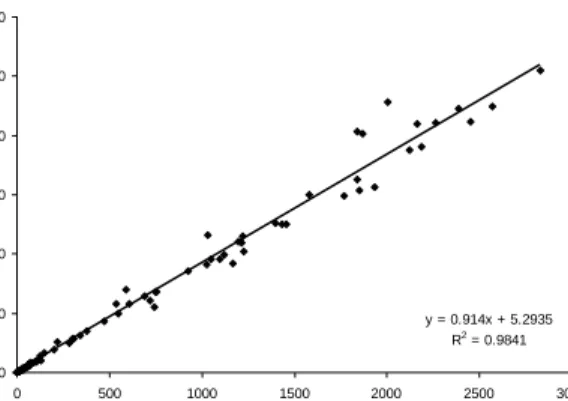
T3 S of tw a re C ou nt ( ba ts /3 0 s ) y = 0.914x + 5.2935 R2 = 0.9841 0 500 1000 1500 2000 2500 3000 0 500 1000 1500 2000 2500 3000
Manual Count (bats/ 30 s)
T3 S of tw a re C ou nt ( ba ts /3 0 s )
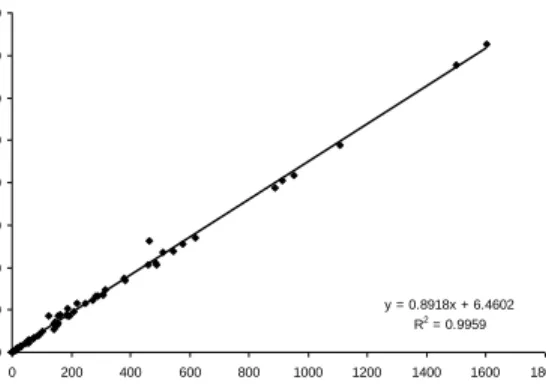
There was a strong positive relationship between manual counts and T3 software estimates for each cave (p < 0.001 for all caves, Figures 5-8) and this relationship remained significant when adjusted for multiple comparisons (p < 0.001). There was also a strong positive relationship between the size of an emergence with the calculated proportion error (p < 0.001, Figure 9). However, proportion error remained less than 0.15 at all but the largest emergence sizes in which the T3 software was unable to count the emergence (Reed Bat Cave 07/20/2012).
Figure 5. — Relationship between manual counts of emerging bats versus the number of bats estimated by Thermal Target Tracker Software version 1. Each point represents 30 seconds of emergence for Merrihew Bat Cave (p < 0.001).
Figure 6. — Relationship between manual counts of emerging bats versus the number of bats estimated by Thermal Target Tracker Software version 1. Each point represents 30 seconds of emergence for Reed Bat Cave (p < 0.001).
9 y = 0.8918x + 6.4602 R2 = 0.9959 0 200 400 600 800 1000 1200 1400 1600 0 200 400 600 800 1000 1200 1400 1600 1800
Manual Count (bats/30 s)
T3 S of tw a re C ou nt ( ba ts /3 0 s ) y = 0.9125x + 6.3403 R2 = 0.9879 0 500 1000 1500 2000 2500 3000 3500 4000 0 500 1000 1500 2000 2500 3000 3500 4000 4500
Manual Count (bats/30 s)
T3 S of tw a re C ou nt ( ba ts /3 0 s )
Figure 7. — Relationship between manual counts of emerging bats versus the number of bats estimated by Thermal Target Tracker Software ver.1. Each point represents 30 seconds of emergence for Selman Bat Cave (p < 0.001).
Figure 8. — Relationship between manual counts of emerging bats versus the number of bats estimated by Thermal Target Tracker Software version 1. Each point represents 30 seconds of emergence for Vickery Bat Cave (p < 0.001).
10 y = 3E-07x + 0.0774 R2 = 0.3867 0.00 0.10 0.20 0.30 0.40 0.50 100 1000 10000 100000 1000000
Emergence Estimate (video tape)
P ro p o rt io n E rr o r
Figure 9. —Relationship between proportion error and emergence estimate for the hour of recorded emergence (p < 0.001). Emergence estimate (x-axis) is on a logarithmic scale.
Discussion
Brazilian free-tailed bat populations have been reported to be in a decline in recent years (Betke et al. 2008, Hristov et al. 2008, McCracken 2003). Because the four largest free-tailed bat caves in Oklahoma are some of the northern most maternity caves in the Great Plains and no consistent estimates of their sizes have been made, we used thermal imaging to estimate the free-tailed maternity caves population sizes in western Oklahoma.
Bat populations are particularly hard to census due to their nocturnal nature, subjectivity of the viewer, their flying and the sheer numbers present at many roost sites (Altenbach 1988, McCracken 2003, Betke et al. 2008; Hristov et al. 2008; Hristov 2010,). Although some
methods (e.g. fly-over grids photography, exit flight photography, multiple visual counts during exit flights, areal extent of ceiling discoloration) of estimating bat populations provide a rough count of how many bats might be at a certain roost, these estimates are now being challenged by thermoimaging techniques. Betke et al. (2008) and Hristov et al. (2010) suggest that historic estimates are less reliable indicators of past colony sizes.
Because bats are endothermic they have a heat signature which can be detected by thermal cameras (Frank et al. 2003, Betke et al. 2008, Hristov 2008). By recording the
emergence of bats from a cave with a thermal camera and through the use of automated counting software, an accurate estimate of bat populations size can be made as they emerge (Havens and Sharp 1998, Frank et al. 2003, Betke et al. 2008, Hristov et al. 2010). However, as the use of thermoimaging technology is becoming more popular, potential limitations (e.g. camera vantage point, image resolution, bats hidden from the camera by other bats, false detection of heat signatures from insects and vegetation, ability of software to count all the bats at different emergence rates) of the technology need to be carefully considered (Frank et al. 2003). By minimizing as many of these factors as possible, the accuracy of the resultant estimation is increased (Frank et al. 2003).
11
Most population estimates of Oklahoma free-tailed bat maternity caves based on thermoimaging are less than previous estimates which have been made (Table 3 compared to Table 1) (Betke et al. 2008, Elliott 1994, Goodman and Kennedy 2004, Hristov et al 2008, Hristov et al. 2010).
Table 3. Historic numbers of Brazilian Free-tailed bats (Tadaridabrasiliensis) estimated to be in
Oklahoma and at specific maternity caves
It is difficult to distinguish whether the downward trend in free-tailed bat populations are due to anthropogenic factors (e.g., habitat loss, pesticides, wind energy) or if populations only appear to be declining due to the differences between historically used counting methods and the improved accuracy of thermoimaging counting methods (Betke et al. 2008, Hristov et al., 2008, Hristov et al. 2010 Ammerman et al. 2012). It appears that most historically reported population sizes were overestimations (Hristov et al. 2010) and many of the historic estimates of colony size might not be reliable indicators of the change in free-tailed bat populations (Hristov et al. 2010). Nevertheless, the apparent decline in free-tailed bat populations is likely a combination of both more accurate counting methods and a slow but steady decline in population sizes due to other factors (Ammerman et al. 2012; Betke et al. 2008).
Although the traditional methods of estimating bat population sizes provide some idea of how many bats might be at a certain cave, these estimates have probably been seasonally
variable and inconsistent, being limited by light conditions, method used and human error (Altenbach 1988; McCracken 2003, Wilkins 1989) and do not provide an accurate evaluation of what is happening to the bat population size at a certain cave (Hristov et al. 2010). Betke et al. (2008) developed an adjustment for free-tailed bat populations through the use of thermal imaging of free-tailed bat caves. Applying the adjustment, the historic estimate of a total of 3 million bats at Vickery, Selman, Merrihew, and Connor Bat caves would be adjusted to
approximately 200,000 bats (Betke et al. 2008). This adjustment is consistent with the average
CAVE DATE Estimated # BATS
OK Caves Combined 1963 (Perry, 1965) 6,060,000 Tadarida in state
OK Caves Combined ? (Glass 1982) approx 3,000,000 fledged bats
Merrihew Cave 1963 (Perry 1965) 60,000
1993 (Elliot 1994) 500,000
1956 (Twente 1956)
1993 (Adams1995) 100,000 100,000
Reed Bat Cave 1963 (Perry 1965) 4,000,000
1993 (Elliot 1994) 500,000 to 1,000,000
Selman Bat Cave 1963 (Perry 1965) 800,000
1993 (Elliot 1994) 500,000 to 1,000,000
Vickery Bat Cave 1963 (Perry 1965) 1,400,000
1993 (Elliot 1994) 500,000 to 1,000,000
1971 (Looney1972) 1,400,000
1974 (Looney1974) 1,500,000
1969 (Humphrey 1971) 1,000,000
Conner Cave 1963 (Perry 1965) 700,000
1993(Elliot 1994) 500,000
1999 Chapman (pers. comm.) several hundred thousand 1986 (Baker and Bozeman 1986) several hundred thousand
12
of these estimates of emergences at Vickery, Selman, and Merrihew of 205,198 bats during this study.
Free-tailed bat emergence is highly variable and can fluctuate drastically. All the maternity caves in this study experienced seasonal variation (Table 1.). The estimates made during this study (Table 1.) support this in that the number of bats fluctuated between visits and seasonally, which is consistent with the thermoimaging study of Carlsbad Caverns by Hristov et al. (2010).
The number of Tadarida estimated by thermoimaging to be present in Oklahoma during the early part of both maternity season (May and early June in 2011 and 2012) was 301,345 and 323,761 respectively. These are rough estimates of the number of bats migrating back to Oklahoma from their overwintering regions. The number of Tadarida estimated by
thermoimaging to be present in Oklahoma during the late part of the 2011 maternity season and just before the bats migrated south was 489,676 bats. The difference between how many started the season in 2011 and the number at the end of the season in 2011 was 188,331 bats. This would roughly reflect the number of pups added in Oklahoma during the 2011 season and possibly some overflow from smaller maternity sites in the area. Because of the overload of the T3 Software at Reed Bat Cave on 31 August 2012, a similar estimate of the number of pups being added is not possible. If however, we use the estimate of how many bats were at Reed Bat Cave in September 2011 (232,192 bats) as a late season estimate for 2012 of the number of bats that might have been at Reed Bat Cave, then a very crude estimate of the number of pups added in Oklahoma would be the difference of 323,761 bats (number present in Oklahoma at the start of the maternity season) and 552,074 bats (this estimated number for the end of the 2012 season) or 228,313 bats (pups). This is not too different from that of the 2011 maternity season.
The number of Tadarida present in Oklahoma at the start of the 2012 maternity season was 323,761. The difference (165,915 bats) between the number of bats at the end of the 2011 season (489,676 bats) and the number returning to Oklahoma in 2012 (323,761 bats) roughly estimates bat mortality during the winter and/or the failure of bats to return to Oklahoma from the previous year.
The use of thermal cameras and T3 software not only expedites counting the number of bats during emergences but also provides a reliable estimate of colony size. Manual counts of 30 s segments compared to the corresponding T3 software counts (Figures 5-8) were positively and linearly correlated suggesting the T3 software is functioning as designed and can be used to accurately obtain an estimate of how many bats are emerging. However, as the emergence rates increased the calculated error increased slightly (Figure 9).
Thermal cameras seemingly offer a better representation of bat population trends among months and years at particular caves than the traditionally used methods (Betke et al. 2008, Hristov et al. 2010). The use of thermoimaging should be considered for continued conservation assessments (Frank et al. 2003, Hristov et al. 2010). Even though bat population size estimates might not be perfect through the use of thermal cameras and T3 software, its value lies in providing a minimum population size estimate of bats using a cave on a given night with minimal effort and interference to the bats. With planned periodic recordings, the T3 software will be useful in gaining an understanding of the daily, monthly and seasonal dynamics of a bat population at a roost. Only once throughout this study was there a large enough population of
13
bats exiting a cave (Reed Bat Cave on July 20, 2012) that the system, due to the position of the camera, was not able to count the bats and emergence estimate was considered questionable.
Herreid and Davis (1966) stated that free-tailed bats often demonstrate two distinct emergence types: a diffuse flight with little group integrity and slow emergence rate or a more condensed/concentrated serpentine flight with many individuals exiting rapidly. While the T3 software is computing an estimate of the total number of bats emerging, the software also saves a file that records the rates of emergence throughout the emergence. These emergence rates might suggest how a cave entrance influences the exit rate. This study revealed emergence rates that varied from 0 bats per min up to 7,576 bats per min. The caves with higher rates of bat
emergence per minute, Reed Bat Cave and Merrihew Bat Cave, had large cave openings and fewer obstructions near the mouth of the cave. The lowest average emergence rates observed were at Selman Bat Cave and Vickery Bat Cave. These caves had accumulating vegetation at the entrance or a partially collapsed entrance respectively. The impact of cave collapse and vegetation growth overtime on bat exit flights have not been well documented in terms of their influence on changing emergence rates of free-tailed bats. This warrants further study to understand the importance of habitat management needs at the mouth of caves and the
preservation of potentially useful caves for Tadarida. Vickery Bat Cave has experienced a major collapse in the last few years and the opening is now less than half of what it was when Elliot (1994) observed the exit flight. The vegetation at the mouth of Selman Bat Cave is encroaching on the entrance and some emerging bats collide with the trees. The ODWC is taking steps to remove the encroaching vegetation.
Herreid and Davis (1966) noted that free-tailed bats began to emerge, then stopped or slowed down to almost no bats emerging, and then after a few minutes, began to emerge again. This behavior is known as a “double peak emergence or “a split flight.” These were noted on a number of occasions at the Oklahoma maternity roosts (Figs. 1-4). Differing emergence behaviors have been linked to energy demands (of pregnancy and lactation), the physical and social situations these bats face, and it is suggested that this helps avoid predation (Herreid and Davis 1966, Reichard et al. 2009, Wilkins 1989).
Bats currently face conservation issues that are unique. There is limited research related to the population status of T. brasiliensis outside of the United States and Mexico (Wilkins 1989) and assessing the conservation status is difficult due to a paucity of data from southern portions of the range (Barquez et al. 2008). Wind energy is a thriving industry, rapidly expanding in Oklahoma (United States Department of Energy 2012). The migration and nightly feeding behaviors of free-tailed bats lead to increased encounters with wind turbines (Miller 2008, Piorkowski 2006). Arnett et al. (2008) reported that pregnant female free-tailed bats were found dead most often at a wind farm in Oklahoma. Piorkowski (2006) and Miller (2008) showed that free-tailed bats are one of the most common species found during carcass surveys at wind farms in Oklahoma. Free-tailed bats might be impacted more than other bats because they are usually the most abundant species in the region and they range so far in their nightly foraging activities (Miller 2008, Piorkowski 2006). Wind turbine farms are often located in areas with high topographical relief and studies have linked this region with increased bat mortalities (Arnett et al. 2008, Miller 2008, Piorkowski 2006). Additional studies in Oklahoma are necessary to determine what impact the increase in the number of turbines are having on the movements of free-tailed bats during migration and on their feeding habits.
14
White-nosed Syndrome is destroying bat colonies along the eastern coast of North America and some feel it is just a matter of time until the disease spreads coast to coast (Bat Conservation International 2012; United States Fish and Wildlife Service 2009). Bat populations of areas yet to be affected by WNS should have population estimates made and these estimations can be used to evaluate the effect of WNS at a particular cave and provide information on how populations are responding. Effects of WNS on free-tailed bats are unknown. However, the
United State Geological Survey has speculated that due to their migratory habits and relative year-round activity these bats might be less susceptible to WNS than bats that hibernate (United States Geological Survey 2012). However, because of their intercave movements, free-tail bats might still be involved in the spread of fungal spores from cave to cave.
Bats have many characteristics that require special consideration for conservation; these characteristics are rarity, slow growth rate, and low birth rates (Racey and Entwistle 2003). Because bat populations in North America are declining due to WNS and other factors including habitat loss, cave destruction, vandalism, and wind turbines, it is critically important to regularly monitor population sizes (Tuttle et al. 2009, United States Fish and Wildlife Service 2009, United States Geological Survey 2012). By increasing our understanding of their behaviors and activities, prudent conservation decisions can be made so that bat populations can continue to thrive.
A continued thermoimaging study of the Oklahoma maternity caves on a regular basis is warranted. It would greatly improve our understanding of the population dynamics on a daily, monthly and seasonal basis among the four caves during the maternity period in Oklahoma. More frequent thermoimaging estimates would help in understanding how bat nightly activities are influenced by other ambient factors such as temperature, rainfall, and barometric pressure as well as anthropogenic factors.
Although free-tailed bats currently face many challenges, the International Union for Conservation of Nature and Natural Resources states that T. brasiliensis is a species of least concern due to its wide distribution and presumably large populations and, if it is in decline, it is not declining fast enough to warrant listing in the threatened category in any portion of its range (Barquez et al. 2008). It will never be known for certain if this species had the population sizes that were once historically estimated, but enhanced conservation efforts is warranted to insure free-tailed bats continued survival in Oklahoma. Whether it is because of more accurate counting methods and/or other compounding factors; decreasing populations of these bats warrant further examination. The species should be regularly monitored, not only for its benefit to agriculture (Cleveland et al. 2006), but also because free-tailed bats are a part of Oklahoma’s natural heritage.
Acknowledgements
We thank the private landowners who allowed us access to their land and the students from UCO and WTAM who assisted in the field. We also thank the Oklahoma Department of Wildlife Conservation for funding the project. We appreciate assistance from the Oklahoma Department of Wildlife Conservation, the Nature Conservancy, the Oklahoma Biological Survey, for helping with various aspects of the project.
15
Literature Cited
Adams, S. P. 195. Status of bats in the gypsum hills of south-central Kansas. MS Thesis, Fort Hays State University. 39 pp.
Altenbach, J. S. 1988. Techniques for photographing bats. Pp125-140 in Ecological and Behavioral Methods for the Study of Bats (T. H. Kunz, ed.). Smithsonian Institution Press, Washington, D.C. Ammerman, L. K., C. L. Hice, and D. J. Schmidly. 2012. Bats of Texas. Texas A&M University Press,
College Station, USA.
Arnett, E. B., W. K. Brown, W. P. Erickson, J. K. Fiedler, B. L. Hamilton, T. H. Henry, A. Jain, G. D. Johnson, J. Kerns, R. R. Koford, C. P. Nicholson, T. J. O’Connell, M. D. Piorkowski, and R. D. Tankersley, Jr. 2008. Patterns of bat fatalities at wind energy facilities in North America. Journal of Wildlife Management 72:61-78.
Baker B. and S. Bozeman. 1986. Conner Bat Cave. Oklahoma Underground13:9-11. Barquez, R., M. Diaz, E. Gonzalez, A. Rodriguez, S. Incháustegui, and J. Arroyo-Cabrales.
2008. Tadarida brasiliensis. In: IUCN Red List of Threatened Species. Version 2011.1.
<http://www.iucnredlist.org/apps/redlist/details/21314/0>. Accessed 15 Oct 2011. Bat Conservation International. 2012. White-nose syndrome: Affected species.
http://www.batcon.org/index.php/what-we-do/white-nose-syndrome/subcategory/466.html <accessed 30 September 2012>.
Betke, M., D. E. Hirsh, N. C. Makris, G. F. McCracken, M. Procopio, N. I. Hristov, S. Tang, A. Bagchi, J. D. Reichard, J. W. Horn, S. Crampton, C. J. Cleveland, and T. H. Kunz. 2008. Thermal imaging reveals significantly smaller Brazilian free-tailed bat colonies than previously estimated. Journal of Mammalogy 89:18-24.
Caire, W., J. D. Tyler, B. P. Glass, and M. A. Mares. 1989. Mammals of Oklahoma. University of Oklahoma Press, Norman, Oklahoma, USA.
Cleveland, C. J., M. Betke, P. Federico, J. D. Frank, T. G. Hallam, J. Horn, J. D. Lopez Jr., G. F. McCracken, R. A. Medellín, A. Moreno-Valdez, C. G. Sansone, J. K. Westbrook, and T. H. Kunz. 2006. Economic value of the pest control service provided by Brazilian free-tailed bats in south-central Texas. Frontiers in Ecology and the Environment 4:238-243.
Cockrum, E L. 1969. Migration in the guano bat Tadarida brasiliensis. Miscellaneous Publications,
Museum of Natural History, University of Kansas 51:303-336.
Elliott, W. R. 1994. Conservation of western Oklahoma bat caves. Oklahoma Underground 17:44-53. Feldhamer, G. A., Thompson, B. C., and J. A. Chapman. 2003. Wild Mammals of North America:
Biology, Management, and Conservation. Johns Hopkins University Press, Baltimore, Maryland, USA.
Frank, J. D., T. H. Kunz, J. Horn, C. Cleveland, and S. Petronio. 2003. Advanced infrared detection and image processing for automated bat censusing. Proceedings International Society of Optical Engineering (SPIE) 5074:261-270.
Glass, B. 1958. Returns of Brazilian freetail bats banded in Oklahoma. Journal of Mammalogy 39:435-437.
Glass, B. 1982. Seasonal movements of Brazilian free-tailed bats Tadarida brasiliensis Brazilian a
banded in the Great Plains. Southwestern Naturalist. 27:127-133.
Goodman, M., and J. Kennedy. 2004. Status report of Stuart bat cave, Kickapoo Cavern State Park, Kinney/Edwards County, Texas, 15 March 2004. Unpublished report to Texas Parks and Wildlife Department and Bat Conservation International. 7pp.
Havens, K. J., and E. J. Sharp. 1998. Using thermal imagery in the aerial survey of animals. Wildlife Society Bulletin 26:17-23.
16
Hristov, N. I., M. Betke, and T. H. Kunz. 2008. Applications of thermal infrared imaging for research in aeroecology. Integrative and Comparative Biology: 1-10.
Hristov, N. I., M. Betke, D. E. H. Theriault, A. Bagchi, and T. H. Kunz. 2010. Seasonal variation in colony size of Brazilian free-tailed bats at Carlsbad Cavern based on thermal imaging. Journal of Mammalogy 91:183-192.
Humphrey, S.R. 1971. Photographic estimation of population size of the Mexican Free-tailed Bat,
Tadarida brasiliensis. American Midland Naturalist 86:220-223.
Looney, J. 1972. Predation on bats by hawks and owls. Oklahoma Ornithological Society 5:1-4. ________. 1974. Birds and bats at Vickery. Oklahoma Underground 7:14-16.
McCracken, G. F. 2003. Estimates of population sizes in summer colonies of Brazilian free-tailed bats
(Tadarida brasiliensis). United States Geological Survey, Biological Resources, Information and
Technology Report 2003-003:21-30.
Melton, R. E., B. M. Sabol, and A. Sherman. 2005. Poor man’s missile tracking technology: Thermal IR detection and tracking of bats in flight. Proceedings International Society of Optical Engineering (SPIE) 5811:24-33.
Miller, A. 2008. Patterns of avian and bat mortalities at a utility-scaled wind farm on the southern High Plains. Thesis, Texas Tech University, Lubbock, USA.
Perry,A.E. 1965. Population analysis of the guano bat Tadarida brasiliensismexicana (Saussure) using
the lens-weight method of age determination. Ph.D. Dissertation Oklahoma State University, Stillwater Oklahoma.
Piorkowski, M. D. 2006. Breeding bird habitat use and turbine collisions of birds and bats located at a wind farm in Oklahoma mixed-grass prairie. Dissertation, Oklahoma State University, USA. Racey, P. A., and A. C. Entwistle. 2003. Conservation ecology of bats. Pages 680-743 in T. H. Kunz and
M. B. Fenton, editors. Bat Ecology. University of Chicago Press, Chicago, Illinois, USA. Reichard, J. D., L. E. Gonzalez, C. M. Casey, L. C. Allen, N. I. Hristov, and T.H. Kunz. 2009. Evening
emergence behavior and seasonal dynamics in large colonies of Brazilian free-tailed bats. Journal of Mammalogy 90:1478-1486.
Sabol, B. M., and M. K. Hudson. 1995. Technique using thermal infrared-imaging for estimating populations of gray bats. Journal of Mammalogy 76:1242-1248.
Schmidly, D. J. 1994. The mammals of Texas, revised edition. University of Texas Press, Austin, USA. Short, H. L., R. B. Davis, and C. F. Herreid, II. 1960. Movements of the Brazilian free-tailed bat in
Texas. Southwestern Naturalist 5:208-216.
Tuttle, M. D., T. H. Kunz, D. Odegard, B. J. Ram, W. Wallace, T. Finamore, S. Kaczmarek, and N. Phillips. 2009. White-nose Syndrome Science Strategy Meeting II. Bat Conservation International.
Twente, J. W. Jr. 1956. Ecological observations on a colony of Tadarida mexicana. Journal of
mammalogy 37:42-47.
United States Department of Energy. 2012. Installed Wind Energy Capacity.
<http://www.windpoweringamerica.gov/wind_installed_capacity.asp/>. Accessed 15 August 2012.
United States Fish and Wildlife Service. 2009. Quick Reference for White-Nose syndrome (WNS) Containment and Decontamination Procedures for Cave Activity. U.S. Government Printing Office, Washington, D.C.
United States Fish and Wildlife Service. 2012. White-nose syndrome decontamination protocol. http://www.dfw.state.or.us/wildlife/rehabilitation/docs/WNS_Decontamination_Protocol.pdf. <Accessed 15 August 2012>.
United States Geological Survey. 2012. White-Nose Syndrome Threatens the Survival of Hibernating Bats in North America. <http://www.fort.usgs.gov/wns/>. Accessed 15 August 2012.