Increased Circulating Levels of Testosterone and
Corticosterone in Southern Toads, Bufo terrestris,
Exposed to Coal Combustion Waste
William A. Hopkins,*
,1Mary T. Mendonc¸a,* and Justin D. Congdon†
*Department of Zoology and Wildlife Science, Auburn University, 331 Funchess Hall, Auburn, Alabama 36849; and †The Savannah River Ecology Laboratory, P.O. Drawer E, Aiken, South Carolina 29802
Accepted July 2, 1997
This study describes an interrenal stress response in adult toads, Bufo terrestris, after exposure to coal combus-tion waste (characterized by a variety of trace elements). In the first portion of this study, free-ranging male toads captured at the coal ash polluted site exhibited signifi-cantly higher circulating levels of corticosterone (B) in both June/July and August than conspecifics captured at uncontaminated sites. In addition, both calling and noncalling males from the polluted site had higher B levels than conspecifics engaged in the same behaviors at reference sites. Testosterone levels were elevated in toads from the polluted site, regardless of capture month or behavioral state, suggesting altered androgen produc-tion, utilizaproduc-tion, and/or clearance. In the second portion of this study, male toads from reference sites were transplanted to enclosures at the polluted site or an uncontaminated site. Toads held at the polluted site exhibited significant increases in B after 10 days of exposure compared to toads held at the reference site. B levels remained significantly elevated in toads trans-planted to the polluted site after 12 weeks. We hypoth-esize that high concentrations of various trace elements in the polluted site are responsible for these hormonal responses. r1997 Academic Press
Glucocorticoids help mediate critical processes such as gluconeogenesis, enabling an organism to meet increased energy demands during stressful situations (Kaplan, 1996). Responding to a stressor, however, can interfere with other physiological processes such as digestion, growth, and reproduction (Sapolsky, 1987). Stress-induced elevations in glucocorticoids can poten-tially interfere with the release of reproductive hor-mones from the gonadal axis at the hypothalamic, pituitary, and gonadal levels. This inhibitory relation-ship has been examined in birds (Wingfield et al., 1982), reptiles (Lance and Elsey, 1986), fish (Carragher et al., 1989), mammals (Sapolsky, 1987), and amphibians (Moore and Zoeller, 1985).
Selye (1936) recognized that the stress response is highly conserved across taxa and can be provoked by a wide variety of conditions. Elevations in circulating glucocorticoids can be triggered by diverse stimuli such as competition for resources, captivity, and in-creased population density (Pickering, 1981; Licht et
al., 1983; Sapolsky, 1993). Additionally, it has been
demonstrated that many environmental pollutants can act as stressors and provoke a similar adrenal response (Donaldson et al., 1984). The majority of studies have centered on the hormonal response of teleosts to a variety of contaminants (Donaldson et al., 1984; Hon-tela et al., 1992; McMaster et al., 1994). Sewage, pulp mill effluent, landfill leachate, ammonia, pesticides, resin acids, and a variety of heavy metals have all been
1To whom correspondence should be addressed at present ad-dress: The Savannah River Ecology Laboratory, P.O. Drawer E, Aiken, SC 29802. Fax: (803) 952-7413. E-mail: [email protected].
shown to increase adrenal activity in teleosts (Donald-son, 1981; for review, see Donaldson et al., 1984).
Coal ash effluent produced by coal burning power plants has become a major source of global pollution. The effluent contains high concentrations of numerous trace elements including various heavy metals. By the end of this century it is estimated that 120 million tons of coal ash waste will be produced annually in the United States by coal burning power plants (USEPA, 1988). There is much concern that leachate from these sites will contaminate ground water since the majority of coal waste management facilities do not have leachate collection systems or protective liners to reduce offsite migration of wastes (USEPA, 1988).
Coal ash effluent has recently been shown to cause developmental abnormalities in bullfrog tadpoles (Rowe et al., 1996). In addition, the waste alters the tadpoles’ standard metabolic rates, grazing success, and ability to avoid predators (Rowe et al., 1996; Rowe, Kinney, Nagle, and Congdon, unpublished data; Rai-mondo, Rowe, and Congdon, unpublished data). Al-though no studies have evaluated the hormonal re-sponse of organisms to coal ash effluent, numerous studies on fish provide evidence that exposure to heavy metals (a significant component of coal ash) results in increased circulating levels of glucocorti-coids (Schreck and Lorz, 1978; James and Wigham, 1986; Pratap and Bonga, 1990; Gill et al., 1993). It has also been demonstrated that stress responses to heavy metals can have an inhibitory effect on androgen synthesis (Sangalang and O’Halloran, 1973). Elevated levels of glucocorticoids are energetically costly and can inhibit other physiological processes such as repro-duction. Thus, chronic elevations of adrenal hormones could have major systemic effects and potentially affect the health of individuals and populations.
It is possible that other organisms inhabiting contami-nated systems exhibit hormonal responses to pollut-ants similar to those documented for fish. Amphibians seem particularly important to study, since their com-plex life cycles include water-dependent and terrestrial stages, making them vulnerable to aquatic and edaphic xenobiotics (Dunson et al., 1992). In comparison to other vertebrate groups, little is known about the hormonal cycles in amphibians, let alone their endo-crine responses to contaminants. It is likely that
amphib-ians are also affected hormonally when exposed to high concentrations of trace elements in coal ash effluent.
Most studies of physiological responses to pollut-ants have been lab-based studies of one or a few contaminants. In this study, however, we attempt to quantify the hormonal responses of animals in the field, where they are exposed to the actual combina-tions and concentracombina-tions of xenobiotics that they en-counter in polluted habitats. Co-occuring pollutants can have complex synergistic and/or antagonistic relationships (Arnold et al., 1996). Therefore, field studies are critical to understanding the realistic physi-ological consequences that organisms endure in con-taminated ecosystems (see Guillette et al., 1996; Gend-ron et al., 1997).
This study examines whether exposure to a habitat contaminated by coal combustion wastes triggers an endocrine stress response in the southern toad, Bufo
terrestris. We also evaluate whether the gonadal axis is
affected by pollutant exposure. We report corticosteone and testosterone levels of toads residing naturally in the polluted site as well as in unpolluted sites. An experiment was also conducted in which toads were transplanted to the contaminated site to assess short- and long-term hormonal responses to conditions in the polluted habitat.
METHODS
Study Sites
A coal burning electric power plant with its associ-ated coal ash settling basins is locassoci-ated on the United States Department of Energy Savannah River Site, a National Environmental Research Park near Aiken, South Carolina. The coal ash produced by this plant is mixed with water and then pumped into a primary settling basin (15 ha). The water flows from the primary basin into a smaller secondary basin (6 ha) and then into a 2-ha swamp before finally reaching Beaver Dam Creek, a tributary of the Savannah River. The suspended ash settles as the effluent moves through the basins and the swamp. Previous studies indicate that the water and sediment in the basins and the swamp have elevated levels of a number of trace elements, including cadmium, arsenic, selenium, chro-mium, copper, and barium (Cherry and Guthrie, 1977;
Alberts et al., 1985; Rowe et al., 1996). In addition, ongoing studies indicate that some vertebrates inhabit-ing this area have elevated tissue concentrations of these trace elements (Rowe et al., 1996; Hopkins, Mendonc¸a, and Congdon, unpublished data).
The control (reference) habitats were within approxi-mately 13 km of the polluted site. The reference sites are historically uncontaminated by coal ash effluent, and toads sampled from these sites had low tissue concentrations of coal-derived trace elements when compared to toads from the polluted site (Hopkins, Mendonc¸a, and Congdon, unpublished data).
Animal Collection
Hormone levels of both free-ranging toads and transplanted toads were examined in this study. Free-ranging adult male B. terrestris were collected at the polluted site and at reference sites between 6 July and 25 August 1996. All individuals were captured by hand between 20:00 and 24:00, and the time of capture was recorded. The behavior of each male (calling or noncall-ing) as well as the location of capture was also noted. All toads were bled (see below) before being weighed on an Ohaus balance (to nearest 0.1 g) and toe clipped for identification.
The second portion of this study involved transplant-ing toads from the uncontaminated sites to enclosures located in the polluted site or in another uncontami-nated (reference) site (two enclosures/site). Thirty-two males captured between July 6 and 17, 1996, were placed in the enclosures (8 toads/enclosure) within 3 hr of being captured and bled in the field. One enclosure at each site (enclosure A) was sampled after 5 days and the other enclosure (enclosure B) at each site was sampled after 10 days. Individual toads were removed from each enclosure between 21:00 and 23:00 hr on the appropriate sampling day for bleeding. Toads were weighed and then returned to their respec-tive enclosures after all individuals were bled.
Enclosure A and B at each site were subsequently sampled after 12 and 7 weeks, respectively. Following the prolonged exposures, all individuals were re-turned to the laboratory, where they were weighed and then housed in plastic containers with moist paper towels. Toads were then held for 2 weeks to void gastrointestinal contents before being sacrificed for
determination of total body trace element concentra-tions (Hopkins et al., unpublished data).
Enclosures
Four enclosures (132 m) constructed of a PVC (polyvinyl chloride) pipe frame and galvanized mesh hardware cloth were stabilized by driving the frames into the polluted and unpolluted sediments. The mesh was anchored to the frames and a small portion was left loosely attached for access during feeding and sampling. Four months prior to the initiation of experi-ments, two of the enclosures were placed on the western edge of the primary ash settling basin and two were placed on the western edge of Fire Pond (a historically uncontaminated site located approxi-mately 13 km from the ash basins).
By the time experimental manipulations began in June 1996, all enclosures were surrounded by and contained substantial vegetation that provided cover and shade for the toads. For the duration of the experiments, ambient temperatures were recorded within the enclosures every 10 days at 08:00, 12:00, and 21:00 hr. The hardware cloth surrounding the enclo-sures had 1.5-cm openings which allowed naturally occurring prey items to move in and out of the enclosures freely. Although natural prey items were present, uncontaminated crickets were released in all of the enclosures once a week. Supplemental feeding was done to remove food limitation as a potential stressor.
Blood Collection
Toads were bled within 3 min of capture/removal from enclosure via cardiac puncture. Approximately 100 µl of blood was collected from each individual in heparinized 1-cc syringes, labeled, and placed on ice for transport to the laboratory. Blood collected from toads was centrifuged for 10 min at 3000 rpm. Separated plasma was pipetted off, frozen, and stored at220° for later analyses.
Plasma Extraction and Radioimmunoassay
Extraction and radioimmunoassay (RIA) procedures follow protocols detailed in Mendonc¸a et al. (1996). Thawed plasma samples were incubated with approxi-mately 1000 cpm of the particular tritiated steroid to be
assayed. Samples were equilibrated for 1 hr at room temperature before being extracted with 3 ml of anes-thesia grade diethyl ether (Aldrich, Milwaukee, WI). Extracted samples were then dried down under nitro-gen gas, resuspended in phosphate buffer, and allowed to equilibrate overnight at 4°.
Duplicate aliquots of the resuspended samples were incubated overnight at 4° with the appropriate triti-ated hormone (Dupont NEN; testosterone, NET-553; corticosterone, NET-399) and the appropriate antibody (Endocrine Sciences, Calabasas, CA; testosterone, T3-125; corticosterone, B21-42). A third aliquot was used to determine percent extraction efficiency. After being corrected for the plasma volume and percent extrac-tion efficiency, plasma steroid content was expressed as nanograms per milliliter of plasma. Percent extrac-tion efficiency for testosterone and corticosterone aver-aged 90 and 92%, respectively. Interassay and intraas-say variations averaged 11.6 and 6.3% for testosterone and 12.2 and 5.4% for corticosterone. The sensitivity of both assays was 10 pg/ml.
Statistics
Initial plasma samples collected from free-ranging toads inhabiting the polluted and unpolluted sites were tested for normality and homoscedasticity using the Shapiro–Wilk and Hartley’s tests, respectively. Data were log transformed. Testosterone and corticoste-rone levels were compared by one-way and two-way analyses of variance (ANOVA) using the general linear model procedure due to unequal sample sizes. Tukey’s pairwise comparisons were used to compare means.
In the transplant experiment, individual toads were treated as replicates for statistical analysis. Corticoste-rone and testosteCorticoste-rone levels in transplanted toads were log transformed and levels taken from the same indi-viduals over time were compared using one-way repeated measures analysis of variance. After using repeated measures, a Student–Newman–Keuls method was used to identify differing groups.
RESULTS
Free-Ranging Toads
Testosterone (T) and corticosterone (B) in toads captured during the last 2 weeks of June and the first 2
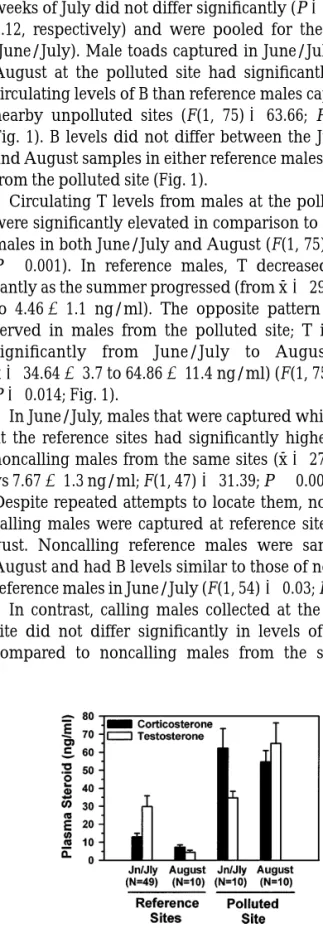
weeks of July did not differ significantly (P50.10 and 0.12, respectively) and were pooled for the analysis (June/July). Male toads captured in June/July and in August at the polluted site had significantly higher circulating levels of B than reference males captured at nearby unpolluted sites (F(1, 75)563.66; P,0.001; Fig. 1). B levels did not differ between the June/July and August samples in either reference males or males from the polluted site (Fig. 1).
Circulating T levels from males at the polluted site were significantly elevated in comparison to reference males in both June/July and August (F(1, 75)530.53;
P,0.001). In reference males, T decreased signifi-cantly as the summer progressed (from x¯529.7466.1 to 4.4661.1 ng/ml). The opposite pattern was ob-served in males from the polluted site; T increased significantly from June/July to August (from x¯534.6463.7 to 64.86611.4 ng/ml) (F(1, 75)56.39;
P50.014; Fig. 1).
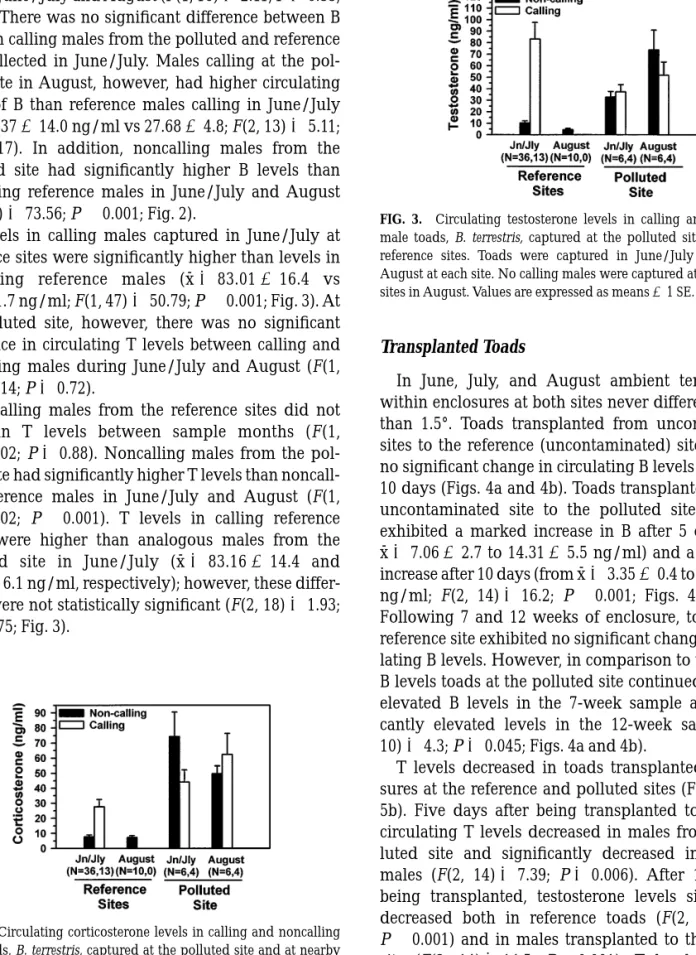
In June/July, males that were captured while calling at the reference sites had significantly higher B than noncalling males from the same sites (x¯527.6864.8 vs 7.6761.3 ng/ml; F(1, 47)531.39; P,0.001; Fig. 2). Despite repeated attempts to locate them, no actively calling males were captured at reference sites in Au-gust. Noncalling reference males were sampled in August and had B levels similar to those of noncalling reference males in June/July (F(1, 54)50.03; P50.85). In contrast, calling males collected at the polluted site did not differ significantly in levels of B when compared to noncalling males from the same site
FIG. 1. Circulating corticosterone and testosterone levels in free-ranging male southern toads, Bufo terrestris, captured at the polluted site and at nearby reference sites. Toads were captured both in June/July (Jn/Jly) and in August at each site. Values are expressed as means61 SE.
during June/July and August (F(1, 16)52.11; P50.55; Fig. 2). There was no significant difference between B levels in calling males from the polluted and reference sites collected in June/July. Males calling at the pol-luted site in August, however, had higher circulating levels of B than reference males calling in June/July (x¯562.37614.0 ng/ml vs 27.6864.8; F(2, 13)55.11;
P50.017). In addition, noncalling males from the polluted site had significantly higher B levels than noncalling reference males in June/July and August (F(1, 54)573.56; P,0.001; Fig. 2).
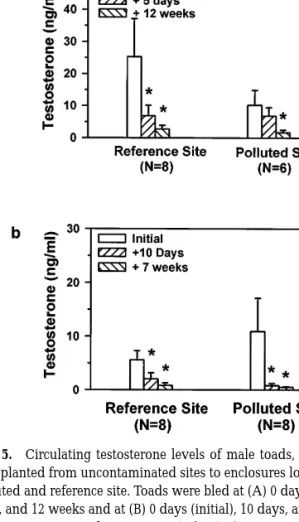
T levels in calling males captured in June/July at reference sites were significantly higher than levels in noncalling reference males (x¯583.01616.4 vs 7.8161.7 ng/ml; F(1, 47)550.79; P,0.001; Fig. 3). At the polluted site, however, there was no significant difference in circulating T levels between calling and noncalling males during June/July and August (F(1, 16)50.14; P50.72).
Noncalling males from the reference sites did not differ in T levels between sample months (F(1, 54)50.02; P50.88). Noncalling males from the pol-luted site had significantly higher T levels than noncall-ing reference males in June/July and August (F(1, 54)50.02; P,0.001). T levels in calling reference males were higher than analogous males from the polluted site in June/July (x¯583.16614.4 and 37.4066.1 ng/ml, respectively); however, these differ-ences were not statistically significant (F(2, 18)51.93;
P50.175; Fig. 3).
Transplanted Toads
In June, July, and August ambient temperatures within enclosures at both sites never differed by more than 1.5°. Toads transplanted from uncontaminated sites to the reference (uncontaminated) site exhibited no significant change in circulating B levels after 5 and 10 days (Figs. 4a and 4b). Toads transplanted from an uncontaminated site to the polluted site, however, exhibited a marked increase in B after 5 days (from x¯57.0662.7 to 14.3165.5 ng/ml) and a significant increase after 10 days (from x¯53.3560.4 to 19.8663.6 ng/ml; F(2, 14)516.2; P,0.001; Figs. 4a and 4b). Following 7 and 12 weeks of enclosure, toads in the reference site exhibited no significant changes in circu-lating B levels. However, in comparison to their initial B levels toads at the polluted site continued to exhibit elevated B levels in the 7-week sample and signifi-cantly elevated levels in the 12-week sample (F(2, 10)54.3; P50.045; Figs. 4a and 4b).
T levels decreased in toads transplanted to enclo-sures at the reference and polluted sites (Figs. 5a and 5b). Five days after being transplanted to each site, circulating T levels decreased in males from the pol-luted site and significantly decreased in reference males (F(2, 14)57.39; P50.006). After 10 days of being transplanted, testosterone levels significantly decreased both in reference toads (F(2, 14)515.3;
P,0.001) and in males transplanted to the polluted site (F(2, 14)514.5; P,0.001). T levels remained significantly lower in toads at both sites after 7 and 12 weeks (Figs. 5a and 5b).
FIG. 2. Circulating corticosterone levels in calling and noncalling male toads, B. terrestris, captured at the polluted site and at nearby reference sites. Toads were captured in June/July (Jn/Jly) and August at each site. No calling males were captured at the reference sites in August. Values are expressed as means61 SE.
FIG. 3. Circulating testosterone levels in calling and noncalling male toads, B. terrestris, captured at the polluted site and nearby reference sites. Toads were captured in June/July (Jn/Jly) and August at each site. No calling males were captured at the reference sites in August. Values are expressed as means61 SE.
DISCUSSION
Polluted vs Reference Site
Selye (1976) characterized the stress response as consisting of three phases: alarm reaction, resistance, and exhaustion. Circulating levels of glucocorticoids often increase during the initial alarm reaction. Typi-cally, when an organism is exposed to the stressor for prolonged periods of time, a stage of resistance results, which is characterized by decreased circulating levels of glucocorticoids. Indeed, a number of studies with teleosts indicate that lower levels of circulating cortisol often follow peak levels associated with initial expo-sure to heavy metals (Donaldson and Dye, 1975; Schreck and Lorz, 1978; James and Wigham, 1986; Pratap and Bonga, 1990). On the other hand, a more recent study indicates that the American eel, Anguilla
rostrata, exhibits hypercortisolemia even after 16 weeks
of exposure to moderate concentrations of cadmium (150 µg Cd/L) (Gill et al., 1993).
Our study examined populations residing in both the polluted ash basins and nearby uncontaminated reference habitats to determine whether the toads respond hormonally to coal ash effluent. In the refer-ence sites, we found that B. terrestris exhibited an apparently normal hormonal profile. That is, corticoste-rone levels were relatively low and did not change in reference toads as the summer progressed. Testoster-one levels in reference toads were higher in June/July (a time of high mating activity) than in late August (a time when breeding is rarely observed) (Fig. 1). The observed correlation between androgens and mating behavior is similar to that found in other spring breeding amphibians (Siboulet, 1981; Houck and Wood-ley, 1995). In contrast, corticosterone levels in toads
FIG. 4. Circulating corticosterone levels of male toads, B. terrestris, transplanted from uncontaminated sites to enclosures located at the polluted and reference site. Toads were bled at (A) 0 days (initial), 5 days, and 12 weeks and at (B) 0 days (initial), 10 days, and 7 weeks. Values are expressed as means 6 1 SE. *Denotes a significant (P#0.05) difference.
FIG. 5. Circulating testosterone levels of male toads, B. terrestris, transplanted from uncontaminated sites to enclosures located at the polluted and reference site. Toads were bled at (A) 0 days (initial), 5 days, and 12 weeks and at (B) 0 days (initial), 10 days, and 7 weeks. Values are expressed as means 6 1 SE. *Denotes a significant (P#0.05) difference.
from the polluted site were significantly elevated in comparison to reference toads during each of the sampling periods (Fig. 1). Toads captured at the pol-luted site were also found to have higher levels of several potentially stressful trace elements (including selenium, copper, cadmium, barium, and arsenic) in their tissues than toads from unpolluted sites (Hop-kins et al., unpublished data).
It is possible that elevated tissue concentrations of trace elements are provoking the chronic adrenal stress response in toads at the polluted site. Greenburg and Wingfield (1987) recognized that many circumstances can stimulate the release of glucocorticoids. Some more predictable activities, such as migration and reproduction, provoke an adrenal response and often occur while androgen levels are simultaneously ele-vated. True stressors (e.g., encountering a predator or pollutants), however, also stimulate pronounced adre-nal activity but typically result in the inhibition of the hypothalamo–hypophyseal–gonadal axis. Given the pronounced adrenal response of the toads inhabiting the polluted site and that stress affects the gonadal axis, we expected that these animals would exhibit depressed androgen levels. However, T levels were unexpectedly high in toads from the polluted site. Testosterone levels in these toads actually increased in August, a time when levels were declining in the reference toads (Fig. 1). In fact, with the exception of calling toads in June/July at the reference sites, toads from the polluted site had higher circulating testoster-one levels than all other reference toads.
It is possible that high concentrations of trace ele-ments at the polluted site alter steroid metabolism, steroid utilization, and/or metabolic clearance rates. Simultaneously elevated levels of both testosterone and corticosterone may be explained by one or any combination of these disruptions. Several studies on cadmium provide insight as to the possible mecha-nisms that may cause these disruptions to occur. For instance, a study on steroid metabolism in cadmium-treated rats indicated that testosterone synthesis in-creased in the adrenals but dein-creased in the testis (Favino et al., 1966). In another study, cadmium levels of only 1 part per billion, an order of magnitude less than the cadmium levels in the polluted ash basin sediment, have been shown to induce elevations in circulating levels of both testosterone and
11-ketotestos-terone in the brook trout, Salvelinus fontinalis (San-galang and Freeman, 1974). Additionally, androgen levels remained elevated in these cadmium-treated trout for weeks after testicular regression (Sangalang and Freeman, 1974). A combination of factors, includ-ing adrenal androgen synthesis and impaired steroid clearance mechanisms, may have caused these pro-longed elevations.
Steroid clearance mechanisms are of particular inter-est since they are partially dependent on enzymatic processes occurring in the kidneys and liver, two organs that accumulate high concentrations of seques-tered metals (Buhler et al., 1977; McCracken, 1987; Gill
et al., 1993; Eisler, 1994; Ojeda and Griffin, 1996). Heavy
metals such as lead, mercury, and cadmium can bind to thiol or sulfhydryl groups of enzymes and subse-quently inactivate the enzyme (Landis and Yu, 1995). In addition, cadmium can replace zinc as a cofactor in some enzymes and, in turn, inactivate enzymatic activity (Landis and Yu, 1995). A plausible explanation could be that by disrupting enzymatic efficiency, trace elements in the tissues of toads from the polluted site may greatly inhibit metabolic clearance of steroid hormones.
Behavior and Steroids
To date, only a few studies have examined the relationship between hormones and reproductive be-havior in Bufonids (for review see Houck and Wood-ley, 1995; Houck et al., 1996). Emerson and Hess (1996) provide androgen and corticosterone levels for a num-ber of calling tropical anurans, including Bufo asper, but they did not make intraspecies comparisons of hor-mone levels between calling and noncalling individu-als.
Although Orchnick et al. (1988) compared sex steroid levels with amplexus behavior, the present study is, to our knowledge, the first study to examine the hor-monal changes associated with calling behavior in a Bufonid. Androgen and corticosterone changes associ-ated with calling have been evaluassoci-ated in other anurans including the desert spadefoot toad, Scaphiophus
cou-chi, and the bullfrog, Rana catesbiana, but the
relation-ship of these hormones is quite different in the two species. It appears that R. catesbiana exhibits the classic inhibitory relationship between the adrenal and go-nadal axis (Licht et al., 1983). Calling R. catesbiana have
elevated corticosterone but depressed androgen levels in comparison to noncalling individuals in the popula-tion (Mendonc¸a et al., 1985). In contrast, circulating testosterone, dihydrotestosterone, and corticosterone levels are elevated in calling S. couchi relative to noncalling individuals (Harvey et al., 1997).
The reference populations of B. terrestris examined in this study exhibited increases in both testosterone and corticosterone while engaging in calling behavior (Figs. 2 and 3). In this respect, B. terrestris exhibits a hormonal pattern similar to that observed in calling spadefoot toads. It is likely that in these two anurans, simultaneous increases in androgens and corticoste-rone are critical to the initiation and maintenance of energetically costly sexual behaviors (Orchinik et al., 1988; Houck and Woodley, 1995; Harvey et al., 1997). Toads from the polluted site, on the other hand, exhibited no change in B or T levels while actively calling. Instead, both hormones were significantly elevated regardless of month or behavior (Figs. 2 and 3). Chronically elevated hormone levels in noncalling and calling toads from the polluted site may have energetic consequences as well as adverse effects on the timing of reproductive behavior. In fact, calling continued to occur for at least a month longer at the polluted site than at the nearby reference sites.
Transplanted Toads
In addition to sampling free-ranging toads, we also transplanted toads from uncontaminated reference sites to the polluted site to determine if we could mimic the responses exhibited by free-ranging toads. Toads transplanted to the polluted site had increased circulating corticosterone within a short time of expo-sure and levels remained elevated for the duration of the experiment (Fig. 4). The transplant experiments controlled for as many environmental parameters as possible (e.g., shade, temperature, access to food, toad density, etc.). The primary difference between the enclosures at the polluted and unpolluted sites was the heavily contaminated sediment at the polluted site. It is therefore possible that the incorporation of sediment contaminants in anuran tissues provoked the adrenal stress response observed in the free-ranging and trans-planted toads at the polluted site.
The transplant experiments also indicate that the process of bleeding, transport, and subsequent
enclo-sure has a negative impact on the levels of circulating testosterone regardless of the location of the enclo-sures. Toads transplanted to the polluted and unpol-luted sites experienced immediate (#5 days) suppres-sion of the gonadal axis. These low levels of testosterone persisted for the duration of the experiments (Fig. 5). The results were not surprising, since many studies have shown the direct inhibitory effects of capture and confinement on the gonadal axis (Moore and Zoeller, 1985; Lance and Elsey, 1986; Pickering et al., 1987).
The decrease in T was not the same pattern as observed in free-ranging toads at the polluted site. It could simply be that the additional stress of handling and confinement caused the observed decreases in circulating androgen. It is important to indicate, how-ever, that transplanted toads at each site only remained in the enclosures for 7 and 12 weeks and were fed uncontaminated food. As a result, the toads trans-planted to the polluted site did not ingest as much contaminated prey as they would in a more prolonged free-ranging situation. Thus, although whole body metal content was elevated in the toads transplanted to the polluted site, the levels were much lower than in free-ranging toads from the polluted site (Hopkins et
al., unpublished data). It is possible that higher levels
of the trace elements must be incorporated in order to provoke elevated androgen levels similar to those observed in the free-ranging ash basin toads.
The results observed in the free-ranging toads and in the transplant experiments suggest that coal ash efflu-ent provokes a stress response in B. terrestris. The toads exhibit elevated glucocorticoid levels characteristic of the Selyean alarm reaction. The high concentrations of trace elements at the polluted site may be causing the toads to exhibit chronic glucocorticoid elevations due to continual stimulation of the adrenal axis. Typically, organisms chronically exposed to a stressor will un-dergo a stage of resistance, resulting in lower glucocor-ticoid levels. The pattern of glucocorglucocor-ticoid secretion in the toads, however, appears to be more similar to the chronic hypercortisolemia exhibited by American eels. In addition, impaired steroid clearance mechanisms may contribute to the observed prolonged elevations of glucocorticoids in toads inhabiting the polluted site. Chronic elevations of glucocorticoids can have a num-ber of adverse consequences including depletion of energy reserves, muscle atrophy, loss of bone matrix,
depressed immune responsiveness, and inhibition of reproductive processes (Kaplan, 1996).
The simultaneous chronic elevation of testosterone was a particularly interesting result because it contra-dicts the accepted paradigm that stress-induced eleva-tions of glucocorticoids (as opposed to reproductively induced) have an inhibitory effect on the gonadal axis. Interference with a variety of mechanisms, including extragonadal androgen secretion and impaired enzy-matic clearance capacity, may be responsible for the simultaneous high circulating levels of both steroids in these exposed toads. Sublethal physiological dysfunc-tions such as these are difficult to detect, but their consequences can be critical both at the individual and population levels. Indeed, by simply lowering the reproductive capacity of organisms or by increasing the energy demands on the organisms, continuous exposure to contaminants might ultimately affect a population as effectively as a single lethal dose (Free-man et al., 1984).
ACKNOWLEDGMENTS
We thank Chad Blystone, Paul Buttenhoff, Scott Horne, and Jennifer Shelby for their assistance in the construction of the enclosures. We especially thank Chris Rowe and Joe Pechmann for their assistance and advice throughout this project. Chris Rowe and Larry Wit provided insightful comments on the manuscript. W. Hopkins was supported during this project by a U.S. Department of Energy/Savannah River Ecology Laboratory graduate research fel-lowship (U. S. Department of Energy Financial Assistance Award Number DE-FC09-96SR18546 to the University of Georgia Research Foundation). Financial support to M.T.M. was through Auburn University Experiment Station Grant ALA-16-019. Additional sup-port was provided through the contributions of R.P. and J.C. Jackson.
REFERENCES
Alberts, J. L., Newman, M. C., and Evans, D. W. (1985). Seasonal variations of trace elements in dissolved and suspended loads for coal ash ponds and pond effluents. Water Air Soil Pollut. 26, 111–128.
Arnold, S. F., Klotz, D. M., Collins, B. M., Vonier, P. M., Guillette Jr., L. J., and McLachlan, J. A. (1996). Synergistic activation of estrogen receptor with combinations of environmental chemicals. Science 272,1489–1492.
Buhler, D. R., Stokes, R. M., and Caldwell, R. S. (1977). Tissue
accumulation and enzymatic effects of hexavalent chromium in rainbow trout (Salmo gairdneri). J. Fish. Res. Board Can. 34, 9–18. Carragher, J. F., Sumpter, J. P., Pottinger, T. G., and Pickering, A. D.
(1989). The deleterious effects of cortisol implantation on reproduc-tive function in two species of trout, Salmo trutta L. and Salmo gairdneri Richardson. Gen. Comp. Endocrinol. 44, 310–321.
Cherry, D. S., and Guthrie, R. K. (1977). Toxic metals in surface water from coal ash. Water Resour. Bull. 13, 1227–1236.
Donaldson, E. M. (1981) The pituitary-interrenal axis as an indicator of stress in fish. In Stress and Fish (A. D. Pickering, Ed.), pp. 11–48. Arrowsmith, Bristol, Great Britain.
Donaldson, E. M., and Dye, H. M. (1975). Corticosteroid concentra-tions in sockeye salmon (Oncorhynchus nerka) exposed to low concentrations of copper. J. Fish. Res. Board Can. 32, 533–539. Donaldson, E. M., Fagerlund, U. H. M., and Mcbride, J. R. (1984).
Aspects of the endocrine stress response to pollutants in salmo-nids. In ‘‘Contaminant Effects on Fisheries, Vol. 16 in Advances in Environmental Science and Technology.’’ (V. W. Cairns, P. V. Hodson, and J. O. Nriagu, Eds.), pp. 197–211. Wiley, New York. Dunson, W. A., Wyman, R. L., and Corbett, E. S. (1992). A
sympo-sium on amphibian declines and habitat acidification. J. Herpetol. 26,349–352.
Eisler, R. (1994). A review of arsenic hazards to plants and animals with emphasis on fishery and wildlife resources. In ‘‘Arsenic in the Environment. Part II: Human Health and Ecosystem Effects, Vol. 27 in Advances in Environmental Science and Technology’’ (J. O. Nriagu, Ed.), pp. 185–259. Wiley, New York.
Emerson, S. B., and Hess, D. L. (1996). The role of androgens in opportunistic breeding, tropical frogs. Gen. Comp. Endocrinol. 103, 220–230.
Favino, A., Baillie, A. H., and Griffiths, K. (1966). Androgen synthesis by the testes and adrenal glands of rats poisoned with cadmium chloride. J. Endocrinol. 35, 185–192.
Freeman, H. C., Sangalang, G. B., and Uthe, J. F. (1984). The effects of pollutants and contaminants on steroidogenesis in fish and ma-rine mammals. In ‘‘Contaminant Effects on Fisheries, Vol. 16 in Advances in Environmental Science and Technology’’ (V. W. Cairns, P. V. Hodson, and J. O. Nriagu, Eds.), pp. 197–211. Wiley, New York.
Gendron, A. D., Bishop, C. A., Fortin, R., and Hontela, A. (1997). In vivo testing of the functional integrity of the corticosterone-producing axis in mudpuppy (Amphibia) exposed to chlorinated hydrocarbons in the wild. Environ. Toxicol. Chem. 16. [In press]. Gill, T. S., Leitner, G., Porta, S., and Epple, A. (1993). Response of
plasma cortisol to environmental cadmium in the eel, Anguilla rostrata Lesueur. Comp. Biochem. Physiol. 104C, 489–495.
Greenburg, N., and Wingfield, J. (1987). Stress and reproduction: reciprocal relationships. In ‘‘Hormones and Reproduction in Fish, Amphibians and Reptiles’’ (D. O. Norris and R. E. Jones, Eds.), pp. 461–505. Plenum, New York.
Guillette, L. J., Pickford, D. B., Crain, D. A., Rooney, A. A., and Percival, H. F. (1996) Reduction in penis size and plasma testoster-one concentrations in juvenile alligators living in a contaminated environment. Gen. Comp. Endocrinol. 101, 32–42.
Harvey, L. A., Propper, C. R., Woodley, S. K., and Moore, M. C. (1997). Reproductive endocrinology of the explosively breeding
desert spadefoot toad, Scaphiopus couchi. Gen. Comp. Endocrinol. 105,102–113.
Hontela, A., Rasmussen, J. B., Audet, C., and Chevalier, G. (1992). Impaired cortisol stress response in fish from environments polluted by PAHs, PCBs, and mercury. Arch. Environ. Contam. Toxicol. 22, 278–283.
Houck, L. D., and Woodley, S. K. (1995). Field studies of steroid hormones and male reproductive behaviour in amphibians. In ‘‘Amphibian Biology, Vol. 2: Social Behavior’’ (H. Heatwole and B. K. Sullivan, Eds.), pp. 677–703, Surrey Beatty, New South Wales, Australia.
Houck, L. D., Mendonc¸a, M. T., Lynch, T. K., and Scott, D. E. (1996). Courtship behavior and plasma levels of androgens and corticoste-rone in male marbled salamanders, Ambystoma opacum (Ambysto-matidae). Gen. Comp. Endocrinol. 104, 243–252.
James, V. A., and Wigham, T. (1986). The effects of cadmium on prolactin cell activity and plasma cortisol levels in the rainbow trout (Salmo gairdneri). Aquat. Toxicol. 8, 273–280.
Kaplan, N. C. (1996). The adrenal glands. In ‘‘Textbook of Endocrine Physiology’’ (J. E. Griffin and S. R. Ojeda, Eds.), pp. 284–313. Oxford Univ. Press, New York.
Lance, V. A., and Elsey, R. M. (1986). Stress-induced suppression of testosterone secretion in male alligators. J. Exp. Zool. 239, 241–246. Landis, W. G., and Yu, M. H. (1995). Introduction to environmental toxicology: Impacts of chemicals upon ecological systems. Lewis, Boca Raton, Florida.
Licht, P., McCreery, B. R., Barnes, R., and Pang, R. (1983). Seasonal and stress related changes in plasma gonadotropins, sex steroids, and corticosterone in the bullfrog, Rana catesbiana. Gen. Comp. Endocrinol. 50, 124–145.
McCracken, I. R. (1987). Biological cycling of cadmium in freshwater. In ‘‘Cadmium in the Aquatic Environment, Vol. 19 in Advances in Environmental Science and Technology’’ (J. O. Nriagu and J. B. Sprague, Eds.), pp. 89–116. Wiley, New York.
McMaster, M. E., Munkittrick, K. R., Luxon, P. L., and Van Der Kraak, G. J. (1994). Impact of low-level sampling stress on interpretation of physiological responses of white sucker exposed to effluent from a bleach kraft pulp mill. Ecotoxicol. Environ. Safety 27, 251–264.
Mendonc¸a, M. T., Chernetsky, S. D., Nester, K. E., and Gardner, G. L. (1996). Effects of sex steroids on sexual behavior in the big brown bat, Eptesicus fuscus. Horm. Behav. 30, 153–161.
Mendonc¸a, M. T., Licht, P., Ryan, M. J., and Barnes, R. (1985). Changes in hormone levels in relation to breeding behavior in male bullfrogs (Rana catesbiana) at the individual and population levels. Gen. Comp. Endocrinol. 58, 270–279.
Moore, F. L., and Zoeller, R. T. (1985). Stress-induced inhibition of reproduction: Evidence of suppressed secretion of LH-RH in an amphibian. Gen. Comp. Endocrinol. 60, 252–258.
Ojeda, S. R., and Griffin, J. E. (1996). Organization of the endocrine
system. In ‘‘Textbook of Endocrine Physiology’’ (J. E. Griffen and S. R. Ojeda, Eds.), pp. 3–17. Oxford Univ. Press, New York. Orchnick, M., Licht, P., and Crews, D. (1988). Plasma steroid
concentrations change in response to sexual behavior in Bufo marinus. Horm. Behav. 22, 338–350.
Pickering, A. D. (1981). Introduction: The concept of biological stress. In ‘‘Stress and Fish’’ (A. D. Pickering, Ed.), pp. 1–9. Arrowsmith, Bristol, Great Britain.
Pickering, A. D., Pottinger, T. G., Carragher, J., and Sumpter, J. P. (1987). The effects of acute and chronic stress on the levels of reproductive hormones in the plasma of mature male brown trout, Salmo trutta L. Gen. Comp. Endocrinol. 68, 249–259.
Pratap, H. B., and Bonga, S. E. W. (1990). Effects of water-borne cadmium on plasma cortisol and glucose in the cichlid fish Oreochromis mossambicus. Comp. Biochem. Physiol. 95C, 313–317. Rowe, C. L., Kinney, O. M., Fiori, A. P., and Congdon, J. D. (1996).
Oral deformities in tadpoles (Rana catesbiana) associated with coal ash deposition: Effects on grazing ability and growth. Freshwater Biol. 36, 723–730.
Sangalang, G. B., and Freeman, H. C. (1974). Effects of sublethal cadmium on maturation and testosterone and 11-ketotestosterone production in vivo in brook trout. Biol. Reprod. 11, 429–435. Sangalang, G. B., and O’Halloran, M. J. (1973). Adverse effects of
cadmium on brook trout testis and on in vitro testicular androgen synthesis. Biol. Reprod. 9, 394–403.
Sapolsky, R. M. (1987). Stress, social status, and reproductive physiology in free-living baboons. In ‘‘Psychobiology of Reproduc-tive Behavior: An Evolutionary PerspecReproduc-tive’’ (D. Crews, Ed.), pp. 291–322. Prentice Hall, New Jersey.
Sapolsky, R. M. (1993). Neuroendocrinology of the stress-response. In ‘‘Behavioral Endocrinology’’ ( J. B. Becker, S. M. Breedlove, and D. Crews, Eds.), pp. 287–324. MIT Press, Cambridge, Massachu-setts.
Selye, H. (1936). A syndrome produced by diverse nocuous agents. Nature 138, 32.
Selye, H. (1976). ‘‘Stress in Health and Disease,’’ pp. 1–1256. Butterworths, Boston.
Schreck, C. B., and Lorz, H. W. (1978). Stress response of Coho Salmon (Oncorhynchus kisutch) elicited by cadmium and copper and potential use of cortisol as an indicator of stress. J. Fish. Res. Board Can. 35, 1124–1129.
Siboulet, R. (1981). Variations saisonnieres de la teneur plasmatique en testosterone et dihydrtestosterone chez le crapaud de Maurit-anie (Bufo mauritanicus). Gen. Comp. Endocrinol. 43, 71–75. Wingfield, J. C., Smith, J. P., and Farner, D. S. (1982). Endocrine
responses of white-crowned sparrows to environmental stress. Condor 84, 399–409.
USEPA. (1988). ‘‘Wastes from the Combustion of Coal by Electric Utility Power Plants.’’ United States Environmental Protection Agency. Rep No. 530-SW-88-002, USEPA, Washington, DC.