RAINFALL RUNOFF MODELLING USING GEOGRAPHIC INFORMATION SYSTEM
NUR RASHIDAH BINTI IBRAHIM
A thesis submitted in fulfilment of the requirements for the award of the degree of
Master of Engineering (Environment)
Faculty of Civil Engineering Universiti Teknologi Malaysia
Specially dedicated to
my dad
,
thank you for your never ending support,
And also to the special man, my husband Ahmad Fithi
that always be together,
ACKNOWLEDGEMENT
Bissmillahirrahmanirrahim,
Alhamdulillah. Thanks to Allah SWT, for his blessing for giving me the opportunity to complete this master reaserch. Without His blessing it is imposible for me to finish this research.
I would like to express my deepest thanks to Dr Mohamad Hidayat Jamal, my supervisor and Mr. Kamarul Azlan Mohd Nasir, my co-supervisor who never give up in guiding and supporting me until this research is done. Also to Assoc. Prof Mohd Fadhil Md Din who show me the right path. Thank to my family, special mate of mine and friends that are generously helping during my hard time.
Last but not least, a special gratitude tu Universiti Teknologi Malaysia, for providing the appropriate place and financial for me to finish this research. Thank to FELDA for supporting me in financial for one year. Also thank to Drainage and Irrigation Department for providing the necessary data for me to be used in this study.
ABSTRACT
In Peninsular Malaysia, states located at the east such as Kelantan, Terengganu, Pahang and southeast part of Johor face flood problem especially during Northeast monsoon. In the state of Johor, the town of Kota Tinggi has the most flood occurrence. This is due to high rainfall intensity, its location at low lying area and urbanisation activities, which increase impervious areas and created higher surface runoff. The purpose of this study was mainly to investigate and develop the relationship of rainfall and runoff using Geographic Information System (GIS). Sungai Johor river basin where Kota Tinggi is located was selected as the study area. The river basin was modelled by using Hydrology Engineering Centre – Hydrological Modelling System (HEC-HMS). The simulated hydrograph was calibrated against the observed hydrograph at Rantau Panjang station (19 January 2003 to 26 January 2003). Then, the model was validated against the data on 9 July 2006 to 13 July 2006. The result of calibration and validation showed that simulated hydrograph was in good agreement with the observed hydrograph. The calibration and validation were evaluated by using Nush and Sutcliffe (N-S) model efficiency index and the scores are 0.91 and 0.72, respectively. These scores considered as excellent and very good. A model simulation was also conducted for flood event in January 2007. However, the simulated hydrograph is higher than observed hydrograph. This can be due to the telemetric station located at Rantau Panjang station was inundated by the extreme streamflow. For future development scenario, 25% increment of impervious area at selected subbasin is modelled. The results showed an increment of the flow discharge at Kota Tinggi for about 4.2% (subbasin 7 and 8), 6.5% (subbasin 1 and 2) and 23% (whole area). Besides that, simulation by using IDF curve for 5 minutes storm duration of 100 years return period (ARI) using S.M. Bukit Besar station showed that the runoff is still lower than the runoff during flood event in January 2007. This result showed that the rainfall intensity in January 2007 is much higher. As a conclusion, the SCS-CN method in the HEC-HMS model with GIS application is suitable for Sungai Johor river basin.
ABSTRAK
Di Semenanjung Malaysia, negeri di bahagian Timur seperti Kelantan, Terengganu, Pahang dan bahagian tenggara Johor berhadapan masalah banjir terutamanya ketika Monsun Timur Laut. Di negeri Johor, Kota Tinggi adalah bandar yang kerap dilanda banjir. Hal ini berlaku kerana lebatnya hujan, lokasinya di kawasan tanah rendah dan aktiviti pembangunan yang meningkatkan kawasan tidak telap air dan meningkatkan air larian. Tujuan utama kajian ini adalah untuk menyiasat dan menghasilkan hubungan antara hujan dan air larian menggunakan Sistem Maklumat Geografi (GIS). Lembangan Sungai Johor di mana terletaknya Kota Tinggi telah dipilih sebagai kawasan kajian. Lembangan ini dimodelkan dengan menggunakan Hydrology Engineering Centre – Hydrological Modelling System (HEC-HMS). Hidrograf simulasi telah dikalibrasi dengan hidrograf cerapan di stesen Rantau Panjang (19 Januari 2003 hingga 26 Januari 2003). Kemudian, model ini divalidasi dengan data pada 9 Julai 2006 hingga 26 Julai 2006. Hasil proses kalibrasi dan validasi menunjukkan hidrograf simulasi berhubung baik dengan hidrograf cerapan. Kalibrasi dan validasi ini telah dianalisis menggunakan model indeks efisien Nush dan Sutcliffe (N-S) dan nilainya adalah 0.91 dan 0.72. Nilai ini dikategorikan sebagai cemerlang dan sangat baik. Simulasi telah juga dilakukan untuk kejadian banjir pada Januari 2007. Namun, hidrograf daripada simulasi lebih tinggi daripada hidrograf cerapan. Hal ini mungkin disebabkan stesen telemetri di Rantau Panjang ditelenggami oleh aliran sungai yang luar biasa. Bagi senario pembangunan masa hadapan, 25% peningkatan kawasan tidak telap di kawasan lembangan yang terpilih telah dimodelkan. Hasilnya menunjukkan peningkatan kadar alir di Kota Tinggi sebanyak 4.2% (lembangan kecil 7 dan 8), 6.5% (lembangan kecil 1 dan 2) dan 23% (seluruh kawasan). Selain itu, simulasi menggunakan lengkung IDF tempoh 5 minit untuk kala kembali (ARI) 100 tahun di stesen S.M. Bukit Besar menunjukkan kadar alir masih rendah berbanding ketika banjir pada Januari 2007. Hasil ini menunjukkan lebatnya hujan pada Januari 2007 adalah sangat tinggi. Kesimpulannya, kaedah SCS-CN dalam model HEC-HMS dan GIS adalah sesuai untuk digunakan di lembangan Sungai Johor.
TABLE OF CONTENTS
CHAPTER TITLE PAGE
DECLARATION ii
DEDICATION iii
ACKNOWLEDGEMENTS iv
ABSTRACT v
ABSTRAK vi
TABLE OF CONTENTS vii
LIST OF TABLES xi
LIST OF FIGURES xiii
LIST OF ABBREVIATION xvii
LIST OF SYMBOLS xix
LIST OF APPENDICES xxi
1 INTRODUCTION 1
1.1 Introduction 1
1.2Problem Statement 3
1.3Objectives of the Study 5
1.4Scope of Study 5
1.5 Significance of the Study 7
1.6 Organization of the Thesis 8
2 LITERATURE REVIEW 9
2.1 General 9
2.2 Water Issue 9
2.3 Limitation of data 11
2.4.1 Lumped and Distributed Model 13
2.5 Determination of Runoff 14
2.5.1 Soil Conservation Service-Curve Number (SCS-CN) method 14 2.5.2 Rational method 16 2.6 Rainfall Characteristic 16 2.7 Rainfall Interpolation 18 2.7.1 Kriging 19 2.7.2 Spline 20
2.7.3 Inverse Distance Weighted (IDW) 21 2.8 Digital Elevation Model (DEM) selection 22 2.8.1 Light Detection and Ranging (LiDAR) 22 2.8.2 Shuttle Radar Topography Mission (SRTM) 23 2.8.3Advanced Spaceborne Thermal Emission and
Reflection Radiometer (ASTER)
24
2.8.4Topographic Map 25
2.9Rainfall Runoff Model 25
2.10 Selected Computer Model for Calibration and Validation
26
2.10.1. Abstraction (loss) methods 28
2.10.1.1 SCS Curve Number 28
2.10.1.2 Green-Ampt Method 29
2.10.2 Rainfall-Runoff Transformation Methods 31 2.10.2.1 SCS Dimensionless Unit
Hydrograph
33
2.10.2.2 Snyder’s Unit Hydrograph 34 2.10.2.3 Clark Unit Hydrograph 35 2.10.3 Hydrologic and Hydraulic Routing
Methods
36
2.10.3.1 Muskingum Method 37
2.10.3.2 Lag Method 38
3 METHODOLOGY 40
3.1 Introduction 40
3.2 Materials and Data Sources 41
3.2.1 Satellite Data 41
3.2.2 Ground Based Measurement Data 43
3.2.2.1 Rainfall Depth 43
3.2.2.2 Land Use and Hydrological Soil Group
45
3.3 Data Processing 49
3.3.1 Rainfall Depth 49
3.3.2 Curve Number 50
3.3.3 Digital Elevation Model (DEM) 52
3.4 Calibration 53
3.5 Validation 55
3.6 Evaluation of Model 56
3.7 Output 57
3.8 Summary 57
4 RESULTS AND DISCUSSIONS 59
4.1 General 59
4.2 Rainfall Analysis 59
4.3 Processes of Hydrological and Catchment Parameter 63
4.3.1 Rainfall Interpolation 63
4.3.2 Land Use Classification 65
4.3.3 Hydrological Soil Group 67
4.3.4 Curve Number 67
4.3.5 Digital Elevation Model 69
4.4 Model Calibration and Validation for Hydrograph Simulation
70
4.4.1 Model Calibration for Hydrograph Simulation
70
4.4.2 Model Validation for Hydrograph Simulation
4.4.3 Model Simulation for Flood Event (January 2007)
72
4.5 Surface Runoff 74
4.6 Future Case Scenario due to Development 4.7 Simulation on Different ARI
78 82
5 CONCLUSIONS AND RECOMENDATIONS 83
5.1 Conclusions 83
5.2 Recommendations 84
REFERENCES 86
LIST OF TABLES
TABLE NO. TITLE PAGE
1.1 Agencies involved with water management in Malaysia (Chan, 2004)
4
1.2 Basic Information of Sungai Johor river basin (Chikamori et al., 2012)
7
2.1 Monsoon regimes in Peninsular Malaysia (Shafie, 2009) 17
2.2 Runoff volume model (HEC-HMS, 2000) 28
2.3 Texture class estimation used in Green-Ampt model (Rawls et al., 1982)
30
2.4 Several studies of unit hydrograph 32
2.5 Direct runoff transformation method 33
2.6 Hydrologic and hydraulic routing methods (HEC-HMS, 2000)
37
3.1 Information of DEM data product 42
3.2 Information of rainfall station 43
3.3 Location and type of rain gauge stations 44
3.4 Information of land use data product 46
3.5 Land use type in study area 46
3.7 SCS hydrological soil classification system (after HR Wallingford, 1994)
48
3.8 Minimum infiltration rates associated with SCS soil group (after McCuen, 1982)
48
3.9 SCS soil cover quality definitions (after HR Wallingford, 1994)
49
3.10 Antecedent moisture condition (AMC) definition (after HR Wallingford, 1994)
49
3.11 CN value for forested and undisturb lands1 (DID, 2010) 51
3.12 CN value for agricultural and urbanized areas1 (DID,2010)
52
3.13 Coordinate of DEM data product 53
3.14 Information of DEM projection 53
3.15 Suggested ranges of N-S efficiency (IPASA, 2010) 56
LIST OF FIGURES
FIGURE NO. TITLE PAGE
1.1 The hydrological cycle (Source: USGS, 2014) 2
1.2 Sg Johor river basin for study area 6
2.1 Impact of urbanization into runoff hydrograph (Harbor, 1994)
10
2.2 Illustration of spatial interpolation 18
2.3 Illustration of autocorelation 19
2.4 Illustration of Spline work 20
2.5 Illustration of IDW interpolation 21
2.6 Ilustration of LiDAR (Dowman, 2004) 23
2.7 Transmission and receiving radar signal of SRTM (Dana et al., 2005)
24
2.8 The simplication of infiltration by Green and Ampt methods
29
2.9 Typical SCS Unit Hydrograph (Dimensionless) 34
2.10 Typical Snyder’s Unit Hydrograph 35
2.11 Clark’s method conceptual model (Kull and Feldman, 1998)
36
3.1 ArcGIS 9 model 40
3.2 HEC-HMS model 41
3.3 DEM obtained from SRTM 42
3.4
3.5
3.6
Location of rain gauge stations at study area
Land use map
Hydrological soil group map
44
45
47
3.7 Flow chart of obtaining Curve Number (CN) 50
3.8 The 9 sub basin with Rantau Panjang Station 54
3.9 Parameter of subbasin 55
3.10 Flow chart of methodology 58
4.1 Four rainfall stations within Sungai Johor river basin 60
4.2 Average annual rainfall for four stations in Sg. Johor river basin (data from 2003 to 2010)
61
4.3 Average monthly rainfall for four stations located at Sg. Johor river basin during North East Monsoon
61
4.4 Comparison of average monthly rainfall (January) with total rainfall of January 2007
62
4.5a,b,c,d Daily rainfall of January 2007 for four station a) Kota Tinggi station b) Ulu Remis station c) Layang-layang station d) Ulu Sebol station
62
4.6 Interpolation of rainfall depth 63
4.7 The graph of rainfall vs runoff of Sg. Johor river basin 64
4.8a,b Location of point randomly distributed around Sg. Johor river basin a) point location on rainfall depth b) point location on runoff amount
4.9 Land use type of Sg Johor river basin 66
4.10 Pie chart for percent of land use type area 66
4.11 Hydrological soil group of Sg Johor river basin 67
4.12 Curve number for Sg Johor river basin 68
4.13 DEM of Sg Johor river basin 69
4.14 Percent of slope for Sg Johor river basin 70
4.15 Hydrograph for calibration 71
4.16 Hydrograph for validation 72
4.17 Hydrograph for flood event (January 2007) 73
4.18 Hydrograph for flood event (December 2006) 73
4.19
4.20
Model builder of SCS method
Runoff on 12th January 2007 at Sg Johor river basin
74
75
4.21a,b Runoff distribution of Sg. Johor river basin (a) before flood and (b) during flood
76
4.22a,b Runoff increment for heavy flood 12 January2007 a) the percentage of runoff increment b) land use map
77
4.23 Total percentage of area affected by runoff increment (>60%)
78
4.24 Selected area for development (subbasin 7 and 8) 79
4.25a,b Runoff for development Subbasin 7 & 8 a) runoff before development b) runoff after development
79
4.26 Selected area for development (subbasin 1 and 2) 80
4.27 Runoff for development Subbasin 1& 2 a) runoff before development b) runoff after development
4.28 Whole area is selected for increase in development 81
4.29 Runoff for whole area development a) runoff before development b) runoff after development
81
4.30 Location of station Sek Men Bukit Besar 82
4.31 Runoff for ARI Sek Men Bukit Besar a) runoff of flood event b) runoff of 100 years ARI
LIST OF ABBREVIATION
ARI - Annual Recurrence Interval
ASTER - Advanced Spaceborne Thermal Emission and Reflection Radiometer
DEM - Digital Elevation Model
DID - Department of Irrigation and Drainage
DOA - Department of Agriculture
DOE - Department of Environment
GIS - Geographic Information System
GIUH - Geomorphologic Instantaneous Unit Hydrograph
GUI - Graphical User Interface
HEC-HMS - Hydrology Engineering Centre – Hydrological Modelling System
IDW - Inverse Distance weighted
InSAR - Interferometric Synthetic Aperture Radar
KeTTHA - Ministry of Energy, Green Technology and Water
LiDAR - Light Detection and Ranging
MMD - Malaysia Meteorological Department
PWD - Public Work Department
RSO - Rectified Skew Orthomorphic
SCS-CN - Soil Conservation Service-Curve Number
SMA - Soil moisture accounting
SRTM - Shuttle Radar Topography Mission
TMPA - TRMM Multi-Satellites Precipitation Analysis
TRMM - Tropical Rainfall Measuring Mission
UH Unit Hydrograph
WGS - World Geodetic System
LIST OF SYMBOLS
F - Actual retention
I - Initial abstraction
Q - Actual direct runoff
S - Watershed storage
P - Total rainfall
C - Runoff coefficient
i - Average rainfall intensity
A - Drainage area
Z(si) - Measured value at the ith location
λi - Unknown weight for the measured value at the ith
location
s0 - prediction location
N - Number of measured values
- Loss during period t
k - Saturated hydraulic conductivity
− - Volume moisture deficit
- Wetting front suction
c - Conversion constant
Tp - Time to UH peak
∆t - Duration of excess precipitation
T lag - Basin lag time
tr - Rainfall duration
Up - Standard peak of UH
Cp - Peak coefficient of UH
X - Dimensionless weight
K - Travel time of the flood wave through routing reach
L - Length of farthest path
Y - Percent of slope
E - Efficiency index
Qo - Mean of observed discharges
Qmt - Simulated dischrages at time t
LIST OF APPENDICES
APPENDIX TITLE PAGE
A Rainfall Data 98
B Water Discharge Data 99
CHAPTER 1
INTRODUCTION
1.1 Introduction
Water is a valuable component of human life. It supports life system globally and acts as a major controlling element of earth’s climate. In order to sustain this valuable resource, effective water management is needed to maintain this resource for drinking water, agriculture, industry, urbanisation, hydropower, fishery, transport and other activities. For successful and optimum management of water resources, knowledge on hydrology including hydrological cycle is greatly required. Figure 1.1 shows the water cycle which also knows as hydrological cycle. There are many elements involved in this never-ending cycle and runoff is one of its critical elements. Surface runoff takes place when water on earth surface neither infiltrates nor suffers evapotranspiration (Thompson, 1999).
Generally, average annual rainfall in Malaysia is about 3000mm per year (Chan, 2004). High amount of excessive runoff quantities on ground surface will cause all reservoirs such as river, lakes and many more meet the maximum storage capacity hence leads flood to occur.
Figure 1.1: The hydrological cycle (Source: USGS, 2014)
To continue, surface runoff is influenced by several factors. One of them is land use such as forest, urban area, open area and agriculture area (e.g. oil palm or rubber tree plantation). The influence of land use in runoff generation is very complicated. Land use and soil cover seize huge control on interception, surface retention, evapotranspiration, and resistance to overland flow (Olivera and Maidment, 1999). Every land use has different surface runoff as each possesses different soil type which causes differences in infiltration rates. Land use change from forest to agriculture activities reduces infiltration and increase runoff (Santillan et al,, 2011).
Excessive runoff can also cause flood. This can be due to high intensity of rainfall and urbanization. In Malaysia, flood event usually occurs during Northeast monsoon which usually starts around November to March. There are many states affected by flood in Malaysia especially in the east coast of Peninsular Malaysia, i.e Kelantan, Terengganu and Pahang, and south Peninsular Malaysia; Johor. Kota
Tinggi area possesses the highest flood occurrence in Johor. The worst flood occurrence in Johor in recent year was recorded in December 2006. The flood occurred in two separate phases in late December 2006 and early January 2007. The disaster had caused more than 100,000 people evacuated from the residents due to flood. Subsequently, in January 2011, Kota Tinggi was hit once again. Hence, Kota Tinggi an administrative town with a large population has been chosen for the study. Soil Conservation Service (SCS) is used because it suits Kota Tinggi soil condition as an agricultural town. SCS uses curve number in order to get accurate forecast. SCS method is also suitable to be used because it is able to take into account antecedent of soil moisture in its data collecting procedure which is a crucial process in identifying curve number.
1.2 Problem Statement
The negative effects of changes in land cover especially on watershed ecosystems have been widely recognized throughout the world. Changes such as forest cover reduction through deforestation and conversion for agricultural purposes can affect watershed response to rainfall which will result to the increasing of surface runoff volumes. Rise of runoff will contribute to the increasing chances of flooding and sedimentation from receiving water bodies (Santillan et al., 2011).
Flood and sedimentation can affect country’s economy as flood can cause a great damage. Most of irrigated lands have thin surface soil horizon which are prone to erosion and decrease of productivity if not properly managed (Carter, 1993).
Hence, it is very important for planners to formulate strategies beforehand in order to avoid or minimize the undesirable effects of future land-use changes especially after they understand on how land use changes have negative influence on stream flow pattern. Urbanization may have a huge impact whether directly or indirectly on hydrological processes such as changes in total runoff or stream flow, alteration of peak flow characteristics, and changes in river’s amenities (Alansi et al.,
2009). This study will also provide useful information for several other agencies which involved in water management in Malaysia as shown in Table 1.1.
Table 1.1: Agencies involved with water management in Malaysia (Chan, 2004)
Agency Responsibility
Department of Irrigation and Drainage (DID)
Responsible towards operation of water resources development projects that involve river, drainage, irrigation, flood mitigation and also operation of national hydrological network.
Ministry of Energy, Green Technology and Water (KeTTHA)
Responsible towards formulating policy directions and strategies on the whole water services industry including water supply and sewerage.
Water Supply Department (WSD)
Responsible towards planning and water supply for domestic and industrial sector.
Department of Environment (DOE)
Responsible towards coordinating all activities related to the discharge of wastes, and prevention and preservation of point source pollution.
National Water Resource Council (NWRC)
Responsible towards formulating the National Water Policy, Water Resources Master Plans, determining priority of water use, and facilitating more effective water management including the implementation of inter-state water transfer.
Malaysia Meteorological Department (MMD)
Responsible towards weather forecast, hydro-meteorology, and climatologic studies.
Forest Department Responsible towards technical directions and advices on forestry management and development, conservation of forests, assessment utilization, and also in development of forest resources.
Therefore, as runoff is a dynamic process which dependants on factors that varies in both spatially and temporally, a much more reliable data is needed in order to calculate the effectiveness of water management (Solomon, 2005). Conventional hydrograph methods that been used previously for this application are difficult to apply, time consuming, and expensive. Thus, an alternative method which is a combination of ground measurement with remote sensing and GIS technique was chosen to be applied for this study.
1.3 Objectives of the Study
Mainly, this study will investigate and generate the relationship of rainfall and runoff using Geographic Information System (GIS). The detail objectives to be achieved in this study are as follow:
1. To model Sungai Johor catchment by using Hydrology Engineering Centre – Hydrological Modelling System (HEC-HMS).
2. To calibrate and validate hydrological parameters.
3. To forecast and evaluate hydrograph/discharge at Sungai Johor river basin based on certain scenarios.
1.4 Scope of Study
The scopes of this study are as follow:
• This study used hydrological data that gathered from many departments such as rainfall data and stream flow discharge from Department of Irrigation and Drainage (DID), land use type and hydrological soil type obtained from
Department of Agriculture (DOA), and also Digital Elevation Model (DEM) data from satellite Shuttle Radar Topography Mission (SRTM).
• The rainfall data used in this study are within year 2003 to 2010
• Curve number was determined based on land use and soil types by referring to its curve number classes available in Guideline for Erosion and Sediment Control in Malaysia by DID
• Rantau Panjang station was selected for the purpose of calibration and validation as this is the only station that DID had a continuous data of flow discharge.
• Certain scenarios will be modelled; different land use and different Annual Recurrence Interval (ARI)
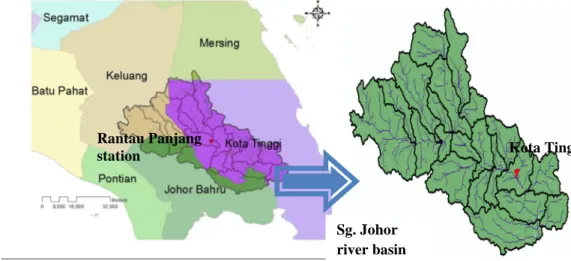
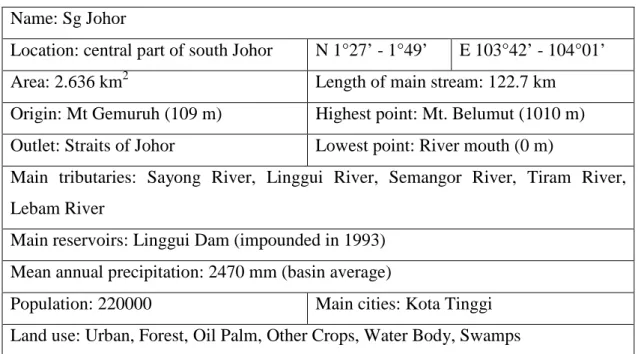
• Sungai Johor basin has a telemetric station at Rantau Panjang managed by DID. Rantau Panjang station is located at the upper stream of Kota Tinggi. Figure 1.2 shows the study area. Some basic information about Sungai Johor area can be found in Table 1.2.
Figure 1.2: Sg Johor river basin for study area
Rantau Panjang station
Sg. Johor river basin
Table 1.2: Basic Information of Sungai Johor river basin (Chikamori et al., 2012)
Name: Sg Johor
Location: central part of south Johor N 1°27’ - 1°49’ E 103°42’ - 104°01’ Area: 2.636 km2 Length of main stream: 122.7 km Origin: Mt Gemuruh (109 m) Highest point: Mt. Belumut (1010 m) Outlet: Straits of Johor Lowest point: River mouth (0 m)
Main tributaries: Sayong River, Linggui River, Semangor River, Tiram River, Lebam River
Main reservoirs: Linggui Dam (impounded in 1993) Mean annual precipitation: 2470 mm (basin average)
Population: 220000 Main cities: Kota Tinggi Land use: Urban, Forest, Oil Palm, Other Crops, Water Body, Swamps
1.5 Significance of the Study
This research can provide contribution and a better solution for water management especially when it is able to identify and gather details about runoff distribution. Nevertheless, this study will provide better solution that can help water related authorities such as DID, DOE, DOA and WSD such as SAJ, SYABAS etc., to manage water resources effectively. Therefore, we can sustain our water resource for future demands.
Other than that, utilizing the GIS and Remote Sensing technologies will give more benefit to water authorities. As we know, it is very difficult to get all the information needed such as DEM in using ground-based measurement especially in rural or remote area due to several limitations. Therefore these technologies will save our cost of operational as GIS will make the analyses of geospatial data quickly and easier.
In addition, this research is also very important for planners to formulate their strategies. This will help to ensure undesirable effects on changes of land-use can be minimized as it is highly influenced by runoff. Thus, this research will be very valuable for flood simulation.
1.6 Organization of the Thesis
The thesis is divided into two major parts: the objectives/ study area/ literature review (Chapter 1 and 2) and methodology/ results/ discussions (Chapter 3 and 4). Chapter 5 describes the major conclusions and recommendations for future works.
For Chapter 2, the detail review about i) water issues, ii) limitation of data, iii) GIS approach, iv) determination of runoff, v) rainfall characteristic, vi) rainfall interpolation, vii) DEM selection, viii) rainfall runoff model, ix) selected computer model for calibration and validation will be explained.
The detail of methodology will be explained in Chapter 3 on which methods will be used, what tool to be used for data processing and modelling work and how to calibrate and validate the obtained results.
Chapter 4 discussed the results obtained from the modelling work. This chapter is divided into: (1) Rainfall analysis; (2) processes of hydrological input parameters; (3) model calibration and validation; (4) evaluation of model efficiency; (5) simulation of surface runoff based on various scenarios of urbanization and Annual Recurrence Interval (ARI). Finally, Chapter 5 concludes the outcome of this study.
REFERENCES
Abdullah, R., Wai Y.H., Ghani, A.A. (2004). Calibration of the Soil Conservation Services (SCS) Method in Peninsular Malaysia using Sungai Tasoh Catchment, Negeri Perlis. 1st International Conference on Managing Rivers in the Century: Issues & Challenges. 21-23 September. Penang, 265-274
Abdullah. K., (2002). Integrated river basin management. In. Chan, N.W. (eds.). Rivers: towards sustainable development (pp. 3-14). Penang: Universiti Sains Malaysia.
Abustan, I., Sulaiman, A.H., Wahid N. A. (2008). Urban Rainfall-Runoff Study to Validate the Design Chart in the Malaysian Urban Stormwater Management Manual (MSMA). 11th International Conference on Urban Drainage. 31 August-5 September. UK, 1-9.
Ajami, N. K., Gupta, H., Wagener, T., Sorooshian, S., ( 2004): Calibration of a semi-distributed hydrologic model for streamflow estimation along a river system. Journal of Hydrology, 298, 112- 135.
Alansi. A.W., Amin, M.S.M., Halim, G.A., Shafri, H.Z.M, Thamer, A.M, Waleed, A.R.M, Aimrun, W., Ezrin, M.H., (2009). The Effect of Development and Land Use Change on Rainfall-Runoff and Runoff-Sediment Relationships Under Humid Tropical Condition: Case Study of Bernam Watershed Malaysia. European Journal of Scientific,.31(1), 88-105.
Al-Humoud, J.M., Esen, I., (2006). Approximate method for the estimation of Muskingum flood routing parameters. Water Resources Management, 20, 979-990.
Balaz, M., Danacova, M., Szolgay, J., (2010). On the Use of the Muskingum Method for the Simulation of Flood Wave Movements. Slovak Jounal of Civil Engineering, 3, 14 – 20.
Band, L.E., (1989). A Terrain-based watershed information with digital elevation models. Water Resour. Bul,. 22 (1), 15-24. London: John Wiley & Sons Ltd
Bennet, Todd, H., Peters, John, C., (2000). Continuous Soil Moisture Accounting in the Hydrologic Engineering Center Hydrologic Modeling System (HEC-HMS). Conference on Water Resource Engineering and Water Resources Planning and Management. 30 July-2 August. United State, 1-10.
Betson, R.P., (1964). What is watershed runoff? Journal of Geophysical Research, 69(8), 1541–1552.
Beven, K. J. (2001). Rainfall-Runoff Modeling: The Primer (2nd ed.). UK: John Wiley & Sons Ltd
Beven, K., (1985). Distributed models. In: Anderson, M.G., Burt, T.P. (Eds.), Hydrological Forecasting (pp. 405–435). New York: John Wiley & Sons Ltd. Beven, K., (1989). Changing ideas in hydrology – the case of physically-based
models. Journal of Hydrology, 105, 157–172.
Bhang, K.J., and Schwartz, F., (2008). Limitations in the hydrologic applications of C-band SRTM DEMs in low-relief settings. Geo-Sci Remote Sensing Lett, 5(3), 497–501.
Birkhead, A.L., and James, C.S., (2002). Muskingum river routing with dynamic bank storage, Journal of Hydrology, 264, 113–132.
Burke, D., Meyers, E., Tiner, R., Groman, H., (1988). Protecting Nontidal Wetlands. Planning Advisory Service, Report 412/413. Chicago: American Planning Association
Burrough, P.A. and McDonnell, R.A., (1998). Principles of Geographical Information Systems. Oxford: Oxford University Press.
Carter, D.L., (1993). Furrow irrigation erosion lowers soil productivity. Journal of Irrigation and Drainage Engineering, 119, 964–974.
Chan, N.W., (2004). A Critical Review of Malaysia’s Accomplishment on Water Resources Management under AGENDA 21. Malaysian Journal of Environmental Management, 5, 55 – 78.
Chen, F.W., and Liu, C.W., (2012). Estimation of the spatial rainfall distribution using inverse distance weighting (IDW) in the middle of Taiwan. Paddy Water Environment, 10(3), pp 209-222.
Chikamori, H., Heng, L., Daniell, T. (2012). Catalogue of Rivers for Southeast Asia and the Pacific-Volume VI. Indonesia: The UNESCO-IHP Regional Steering Committee for Southeast Asia and the Pacific
Chin, L.W., (2007). Study on Malaysian Urban Rainfall-Runoff Characteristics: Case Study of Sungai Kayu Ara, Damansara, Selangor. Master thesis, Universiti Sains Malaysia.
Chow, V.T., Maidment, D. R. and Mays, L. W., (1988). Applied Hydrology. New York: McGraw-Hill
Clark, C.O., (1945). Storage and the unit hydrograph. Transactions ASCE, 10, 1419-1446.
Dana, F., Jacobsen, K., Zavoianu, F., (2005). DEM Generation Using Optical / Radar Satellite Images - A Comparative Study. RevCAD. Journal of Geodesy and Cadastre,8, 37-46.
DID (2010). Guideline for Erosion and Sediment Control in Malaysia. Malaysia: Department of Irrigation and Drainage
DID (2011). Laporan Banjir Johor Daerah Muar, Johor Bharu, Kluang dan Kota Tinggi. Johor: Department of Irrigation and Drainage
DID (2012). Urban Stormwater Management Manual for Malaysia, MSMA 2nd edition. Malaysia: Department of Irrigation and Drainage
Djokic, D., and Maidment, D.R., (1991). Terrain analysis for storm water modeling. Hydrologic Processes, 5 (1), 115-124.
Dowman, I.J.; (2004) Integration of LIDAR and IFSAR for mapping. International Archives of Photogrammetry and Remote Sensing , XXXV (B2), 90-100.
Duan, Q.Y., Sorooshian, S., Gupta, V., (1992). Effective and efficient global optimization for conceptual rainfall–runoff models. Water Resources Research, 28 (4), 1015–1031.
Dunne, T., and Black, R.D., (1970). Partial area contributions to storm runoff in a small New England watershed. Water Resources Research, 6(2), 478–490
Eckert, S., Kellenberger, T., Itten, K., (2005). Accuracy assessment of automatically derived digital elevation models from ASTER data in mountainous terrain. ISPRS Journal of Photogrammetry and Remote Sensing, 26, 1943–1957.
Fahad, S.A., (2005). Rainfall-Runoff Modeling in Arid Regions using Geographic Information Systems and Remote Sensing: Case Study; Western Region of Saudi Arabia. Master thesis, King Abdulaziz University, Jeddah
Fredolin, T.T., Juneng, L., Salimun. E., Vinayachandran, P. N., Seng, Y. K., Reason, C. J. C., Beera, S. K., and Yasunari, T. (2008). On the Roles of the Northeast Cold Surge, the Borneo Vortex, the Madden-Julian Oscillation, and the Indian Ocean Dipole During the Extreme 20062007 Flood in Southern Peninsular Malaysia. Geophysical Research Letter, 35(14),: 1-6.
Ghavidelfar, S., Alvankar, S.R., Razmkhah, A., (2011). Comparison of the Lumped and Quasi-distributed Clark Runoff Models in Simulating Flood Hydrographs on a Semi-arid Watershed. Water Resour Manage, 25, 1775–1790.
Goonetilleke, A., Thomas, E., Ginn, S., Gilbert, D., (2005). Understanding the role of land use in urban stormwater quality management. Journal of Environmental Management, 74,31–42.
Grayson, R. and Blöschl, G., (2000). Spatial Patterns in Catchment Hydrology: Observations and Modelling. Cambridge: Cambridge University Press
Green, W.H., and Ampt, C., (1911). Studies of soil physics, Part I.-the flow of air and water through soils. J. Agr. Sci. 41-24
Gupta, P.K., and Panigrahy, S., (2008). Geo-Spatial Modeling of Runoff of Large Land Mass: Analysis, Approach and Results for Major River Basins of India. The International Archives of the Photogrammetry, Remote Sensing and Spatial Information Sciences, Vol. XXXVII. Part B2, 63-68.
Gupta, P.K., Punalekar, S,. Panigrahy, S., Sonakia, A, Parihar, J.S. (2012). Runoff Modeling in an Agro-Forested Watershed Using Remote Sensing and GIS. Journal of Hydrologic Engineering, 17(11), 1255-1267.
Harbor, J.M., (1994) A Practical Method for Estimating the Impact of Land‐Use Change on Surface Runoff, Groundwater Recharge and Wetland Hydrology,
Journal of the American Planning Association, 60(1), 95‐108.
Hawkins, R.H., (1978). Runoff curve numbers with varying site moisture. Journal of the Irrigation and Drainage Division, 104 (IR4), 389– 398.
Hawkins, R.H., (1993). Asymptotic determinations of runoff curve numbers from data. Journal of Irrigation and Drainage Engineering, 119, 334–345.
HEC-HMS (2000). HEC-HMS technical reference manual. US: US Army Corps of Engineer (USACE).
Ibrahim, H., (2010). Development Soil Parameters for Hydrologic Modelling in Upper Sungai Muar. Master thesis, Universiti Teknologi Malaysia, Johor
IPASA (2010). Final Report Optimization of Rainfall Observation Network on Model Calibration and Application for the Johor, Batu Pahat and Muar River Basin. Johor: IPASA.
Isaaks, E.H. and Srivastava, R.M., (1989). Applied Geostatistics. New York: Oxford University Press.
ITU-T (2010). ICT as an Enabler for Smart Water Management ITU-T Technology Watch Report. Geneva: ITU-T.
Kampf, S.K., and Burges, S.J., (2007). A framework for classifying and comparing distributed hillslope and catchment hydrologic models. Water Resources Research, 43(5), 1-24.
Khakbaz, B., Imam, B., Hsu, K., Sorooshian, S., (2012). From lumped to distributed via semi-distributed: Calibration strategies for semi-distributed hydrologic models. Journal of Hydrology, 418–419, 61–77.
Khan, K.N., (2002). A Geographic Information System Based Spatially Distributed Rainfall – Runoff Model. Master thesis, University of Pittsburgh.
Koren, V.I., Finnerty, B.D., Schaake, J.C., Smith, M.B., Seo, D.J., Duan, Q.Y., (1999). Scale dependencies of hydrology models to spatial variability of precipitation. Journal of Hydrology, 217, 285–302.
Krysanova, V., Bronstert A., Muller-Wohlfeil D.I., (1999). Modelling river discharge for large drainage basins: from lumped to distributed approach. Hydrological Sciences Journal, 44:2, 313-331
Kull, D.W., and Feldman, A.D., (1998). Evolution of Clark's Unit Graph Method to Spatially Distributed Runoff. J. Hydrol. Eng,.3, 9-19.USGS.
Kumar, D., and Bhattacharjya, R.K., (2011). Distributed Rainfall Runoff Modeling. International Journal of Earth Sciences and Engineering, 4(6), 270-275
Lewis, M.J., Singer, M.J., Tate, K.W., (2000). Applicability of SCS curve number method for a California Oak Woodlands Watershed. Journal of. Soil and Water Conservation, 53(2), 226–230.
Li, J., and Heap, A.D., (2008). A Review of Spatial Interpolation Methods for Environmental Scientists. Cranberra: Geoscience Australia.
Lim, C.H., (2008). State of Water Resources State of Water Resources in Malaysia. Dialogue on “Water Environment Partnership in Asia (WEPA)” Malaysia: Ministry of Natural Resources and Environment.
Mahmud, M.R., (2011). Runoff Modeling and Mapping using Rainfall and Evapotranspiration Estimates from Remote Sensing Data in Peninsular Malaysia. Master thesis, Universiti Teknologi Malaysia, Johor
Maidment, D.R. and Fread, D.L., (1993). Handbook of Hydrology. US: McGraw-Hill.
Mair, A., Fares, A., (2011). Comparison of Rainfall Interpolation Methods in a Mountainous Region of a Tropical Island. Journal of Hydrologic Engineering, 16(4), 371–383.
Mays, L.W., (2012). Ground and Surface Water Hydrology. US: John Wiley & Sons, Inc.
Mccarthy, G.T., (1938). The unit hydrograph and flood routing. Unpublished paper, Conference of North Atlantic Division, US Army Corps of Engineers, New London, CT. US Engineering.
McCuen, R.H., (1982). A Guide to Hydrological Analysis using SCS Methods. US: Prentice Hall inc
Melesse, A.M., and Shih, S.F., (2002). Spatially distributed storm runoff depth estimation using Landsat images and GIS. Computers and Electronics in Agriculture, 37, 173-183.
Merkel, W.H., Kaushika, R.M., Gorman, E., (2008). NRCS GeoHydro—A GIS interface for hydrologic modelling. Computers & Geosciences, 34, 918–930.
Moeller, R.A., (1991). Application of geographic information system to yydrologic modeling using HEC-1. In: Stafford, D.B. (Ed.) Civil Engineering Applications of Remote Sensing and Geographic Information Systems (pp. 269-277). New York: ASCE.
Muzik, I., and Pomeroy, S.J., (1990). A geographic information system for prediction of design flood hydrographs. Canadian Journal of Civil Engineering, 17 (6), 965-973.
Nash, J.E., (1959). Systematic determination of unit hydrograph parameters. Journal of Geophysical Research, 64(1), 111-115.
Nieuwolt, S., (1982). Agroclimatic zones in Peninsular Malaysia. Climatological notes, 30, 14-19.
Ogden, F.L., Garbrech, J., DeBarry, P.A., Johnson, L.E., (2001). GIS and distributed watershed models II: Modules, Interfaces, and Models. Journal of Hydrologic Engineering, 6(6), 506–514.
Olivera, F., and Maidment, D., (1999). Geographic Information Systems (GIS)-Based Spatially Distributed Model for Runoff Routing. Water Resources Research, 35(4), 1155-1164.
Osman, S., and Abustan, I., (2010). Estimating the Clark Instantaneous Unit Hydrograph Parameters for Selected Gauged Catchments in the West Coast of Peninsular Malaysia. Unpbublished article, Universiti Sains Malaysia.
Pilgrim, D.H., Chapman, T.G., Doran, D.G., (1988). Problems of rainfall runoff modeling in arid and semiarid regions. Hydrological Sciences Journal, 33(4), 379-400
Ponce, V., and Hawkins, R., (1996). Runoff Curve Number: Has It Reached Maturity?. Journal of Hydrologic Engineering, 1(1), 11–19.
Ponce, V.M., and Chaganti, P.V., (1994). Variable parameter Muskingum- Cunge method. Journal of Hydrology, 162(3-4), 433-439.
Ponce, V.M., and Theurer, F.D., (1982). Accuracy Criteria in Diffusion Routing. Journal of Hydraulics Division, 108(HY6), 747-757.
Ponce, V.M., and Yevjevich, V., (1978). Muskingum Cunge Method with Variable Parameters. Journal of Hydraulics Division, 104(HY12), 1663-1667.
Pradhan, R., Pradhan, M.P., Ghose, M.K., Agarwal, V.S., Agarwal, S., (2010). Estimation of RainfallRunoff using Remote Sensing and GIS in and around Singtam, East Sikkim. International Journal of Geomatics and Geosciences, 1(3), 466-476.
Pryde, J. K., Osorio, J., Wolfe, M.L., Heatwole, C., Benham, B., Cardenas, A., (2007). Comparison of watershed boundaries derived from SRTM and ASTER digital elevation datasets and from a digitized topographic map. ASABE Annual International Meeting. 17-20 June. Minneapolis, 1-10.
Ragan, R.M., and Jackson, T.J., (1980). Runoff synthesis using Landsat and SCS model. Journal of Hydrologics Division, 106 (HY5), 667–678.
Ragan, R.M., Kossicki, A.J., (1991). A geographic information system to support statewide hydrologic modeling with SCS-TR-20. In: Stafford, D.B. (Ed.) Civil Engineering Applications of Remote Sensing and Geographic Information Systems (pp. 250-258). New York: ASCE.
Rahman, M.M., Arya, D.S., Goel, N.K., (2010). Limitation of 90 m SRTM DEM in drainage network delineation using D8 method—a case study in flat terrain of Bangladesh. Applied Geomatics, 2, 49–58.
Rawls, W. J., Brakensiek, D. L., Saxton, K.E., (1982). Estimation of soil water properties. Transaction of ASAE, 25(5), 1316-2320.
Razi, M.A.M., Ariffin, J., Tahir, W., Arish, N.A.M., (2010). Flood Estimation Studies using Hydrologic Modeling System (HEC-HMS) for Johor River, Malaysia. Journal of Applied Sciences, 10(11), 930-939.
Refsgaard, J.C., (2000) Toward a formal approach to calibration and validation of models using spatial data. In: Grayson, R., Bloschl, G. (Eds.) Spatial Pattern in Catchment Hydrology Observed and Modeling (pp. 329–354). Cambridge: Cambridge University Press.
Sahoo, B., Chandranath, C., Narendra, S.R., Singh, R., Kumar, R., (2006). Flood Estimation by GIUH-Based Clark and Nash Models. Journal of Hydrologic Engineering, 11(6), 515-525.
Salami, A.W., (2009). Evaluation of Methods of Storm Hydrograph Development. International e-Journal of Engineering Mathematics: Theory and Application, 6, 17-28. http://www.ieems.net/iejemta.htm
Santillan, J., Makinano, M., Paringit, E., (2011). Integrated Landsat Image Analysis and Hydrologic Modelling to Detect Impacts of 25-Year Land-Cover Change on Surface Runoff in a Philippine Watershed. Remote Sensing, 3, 1067-1087.
Sarangi, A., Madramootoo, C.A., Enright, P., (2006). Comparison of Spatial Variability Techniques for Runoff Estimation from a Canadian Watershed. Biosystems Engineering, 95 (2), 295–308.
Sasowsky, K.C., and Gardner, T.W., (1991). Watershed configuration and geographic information system parameterization for SPUR model Hydrologic Simulations. Journal of the American Water Resources Association, 27 (1), 7 -18.
Shafie, A., (2009). Technical Report Extreme Flood Event: A Case Study on Floods of 2006 and 2007 in Johor, Malaysia. Colorado: Colorado State University Sherman, L.K., (1932). Streamflow from rainfall by unit-graph method. Engineering
News-Record, 108, 501-505.
Shi, P.J., Yuan, Y., Zheng, J., Wang J.A., Ge, Y., Qiu. G.Y., (2007). The effect of land use/cover change on surface runoff in Shenzhen region, China. Catena, 69, 31 – 35.
Singh, V.P., (1995).Watershed modeling. In: V. P. Singh (eds) Computer Models of Watershed Hydrology (pp.1-23). USA: Water Resources Publications
Slack, R.B., and Welch, R., (1980). Soil conservations service runoff curve number estimates from Landsat data. Water Resources Bulletin,16 (5), 887– 893.
Smith, M.B., and Brilly, M. (1992). Automated grid element ordering for GIS-based overland flow modeling. Photogrammetric Engineering and Remote Sensing, 58(5), 579-585.
Snyder, F. F., (1938). Synthetic unit-graphs. Trans. Am. Geophysical Union, 19, 447-454.
Soenario, I., and Sluiter, R., (2010). Optimization of Rainfall Interpolation. Netherland: Koninklijk Nederlands Meteorologisch Instituut
Solomon, H., (2005). GIS-Based Surface Runoff Modelling and Analysis of Contributing Factors; A Case Study of the Nam Chun Watershed, Thailand. Master thesis, International Institute for Geo-information Science and Earth Obervation Enschede, Netherland.
Steenhuis, T.S., Winchell, M., Rossing, J., Zollweg, J.A., Walter, M.F., ( 1995). SCS Runoff Equation Revisited for Variable-Source Runoff Areas. Journal of Irrigation and Drainage Engineering, 121(3), 234-238.
Stuebe, M.M., and Johnson, D.M. (1990). Runoff volume estimation using GIS techniques. Water Resources Bulletin, 26 (4), 611-620.
Tang, X., Knight, D.W., Samuels, P.G., (1999). Volume conservation in Variable Parameter Muskingum-Cunge Method. Journal of Hydrologic Engineering, 125(6), 610–620.
Thomas, N., Hendrix, C., Russell, G.C., (2003). A Comparison of Urban Mapping Methods Using High Resolution Digital Imagery. Photogrammetric Engineering & Remote Sensing, 69(9), 963–972.
Thompson, S.A., (1999). Hydrology for Water Management. Netherland: A. A. Balkema Publisher
USGS (2014). The Water Cycle. USGS Water Science School: US. http://water.usgs.gov/edu/watercycle.html
USGS. (2006). Earth Resources Observation and Science. Available at: http://edc/usgs.gov/index.html
Walesh, S.G., (1989). Urban Surface Water Management. New York: John Wiley and Sons.
Wallingford, H.R. (1994). RIBAMAN User Manual Version 1.22A. UK: HR Wallingford Ltd.
Webster, R., and Oliver, M., (2001). Geostatistics for Environmental Scientists. Chichester: John Wiley & Sons, Ltd.
Wilkerson, J.L., and Merwade, V.M., (2010). Determination of Unit Hydrograph Parameters for Indiana Watersheds. Indiana: Purdue University
Wilkerson, J.V., and Merwade, A.M. (2010). Incorporating Surface Storage and Slope to Estimate Clark Unit Hydrographs for Ungauged Indiana Watersheds. Journal of Hydrologic Engineering,15, 918-930.
Xiaoyang, L., Jietai, M., Yuanjing, Z., Jiren, L., (2003). Runoff Simulation Using Radar and Rain Gauge Data. Advances in Atmospheric Sciences, 20(2), 213-218.
Xiaoyong Z., and Huang M.L., (2004). Short communication ArcCN-Runoff: an ArcGIS tool for generating curve number and runoff maps. Environmental Modelling & Software, 19, 875–879.
Yusop, Z., Chan, C.H., Katimon, A., (2007). Runoff characteristics and application of HEC-HMS for modelling stormflow hydrograph in an oil palm catchment. Water Science & Technology, 56(8), 41-48.