journal homepage: http://jac.ut.ac.ir
Intelligent application for Heart disease detection
using Hybrid Optimization algorithm
Marzieh Eskandari
∗1and Zeinab Hassani
†21
Department of computer science, Alzahra University, Tehran, Iran.
2Department of computer science, Kosar University of Bojnord, Iran.
ABSTRACT ARTICLE INFO
Prediction of heart disease is very important because it is one of the causes of death around the world. More-over, heart disease prediction in the early stage plays a main role in the treatment and recovery disease and reduces costs of diagnosis disease and side effects it. Ma-chine learning algorithms are able to identify an effective pattern for diagnosis and treatment of the disease and identify effective factors in the disease. this paper is in-vestigated a new hybrid algorithm of Whale Optimiza-tion and Dragonfly algorithm using a machine learning algorithm. the hybrid algorithm employs a Support Vec-tor Machine algorithm for effective Prediction of heart
disease. Proposed method is evaluated by Cleveland
standard heart disease dataset. The experimental re-sult indicates that the SVM accuracy of 88.89 % and nine features are selected in this respect.
Article history:
Received 12, March 2018 Received in revised form 8, April 2019
Accepted 19 May 2019
Available online 01, June 2019
Keyword: Hybrid Optimization Algorithm, Support Vector Machine, Whale Optimization Algorithm, Dragonfly Algo-rithm, Feature Selection.
AMS subject Classification: 05C79.
∗Corresponding author: M. Eskandari Email: [email protected] †[email protected]
1
Introduction
Recent researches show that machine learning and data mining are employed for early Diagnosis of disease. Heart disease is the most common cause of death in the world. Besides, coronary artery disease (CAD) is the most common cardiovascular condition [20]. There are several methods to diagnose CAD, including stress test, Electrocardiography (ECG), echocardiography, coronary angiography or cardiac catheterization. All of the diagnostic methods have demerits such as feeling pain and apart from that it necessitates special processes which involve a lot of time, effort, cost, and should be done by trained people [6]. A computer-aided system can extract and detect effective attributes which in turn utilized in classifier to diagnose the disease. Algorithms of machine learning are employed to diagnose heart diseases that include decision tree [15], SVM [6], and neural network [5]. [6] introduced a methodology for the automatic diagnosis of normal and Coronary Artery Disease This method utilize Heart Rate Variability (HRV) signal extracted from electrocardiogram (ECG). They applied Principal Component Analysis (PCA) for reducing the dimension of the features and Support Vector Machine (SVM) for the classifier. Ritika Chadha et al. studied Artificial Neural Networks (ANN), Naive Bayes and Decision Tree on Cleveland heart disease dataset. Their observations showed that Artificial Neural Networks outperformed Naive Bayes and Decision Tree [4]. El-Bialy et al. considered different decision trees such as: C4.5 and Fast Decision Tree and evaluated their method by datasets of heart disease. The accuracy obtained from Statlog dataset was 78.06% [7]. [11] Presented Support Vector Machines (SVM), Multi-Layer Perceptrons Ensembled (MLPE) and generalized additive model (GAM) that investigated diagnosis and identification important features of heart disease. SVM and MLPE were 84.77%
and accuracy on Statlog dataset was 81.82%. The rest of the paper is organized as
follows: section 2 describes the concepts of Support Vector Machine, Whale Optimization Algorithm, Dragonfly algorithm, and feature selection. Section 3 explains Hybrid Whale Optimization Algorithm and Dragonfly algorithm. Experiment Setup and Result Analysis are discussed in section 4. Finally, in Section 5, conclusions are given.
2
Methods
2.1
Support Vector Machine (SVM)
computed as a decision surface that it can be modeled as follows:
z(x) =sgn(
N X
i=1
aiyi(xi, x) +b) (1)
Where xi are support vectors, N is the number of support vectors,b is bias, and yi(xi, x)
is the kernel function which used to map the data from the original dimension to higher dimensions in case the data is linearly separable in the mapped dimension. In this study, a Radial Basis Function (RBF) is selected as the kernel function. RBF can be expressed as:
z(x) =exp(−||x−y||2/2σ2) (2)
Where σ > 0 is a user specified constant which specifies the kernel width. The number and value support vectors in RBF kernel SVM determine the number of kernels and their centers [14]. SVMs belong to the general category of kernel methods. A kernel method is an algorithm that depends on the data only through dot-products. When this is the case, the dot product can be replaced by a kernel function which computes a dot product in some possibly high dimensional feature space. The four basic kernels are linear kernel, polynomial kernel, RBF kernel and sigmoid kernel. The kernel function determines the feature space in which the training set instances will be classified. Therefore the selection of an appropriate kernel function is important [1].
2.2
Whale Optimization Algorithm
Whale Optimization Algorithm (WOA) is introduced by Mirjalili and Lewis, in 2016 [12]. WOA is nature-inspired meta-heuristic optimization algorithm which mimic the social behavior of humpback whales. The algorithm is inspired by the bubble-net hunting strategy. The humpback whales usually prefer to hunt krills or small fishes which are close to the surface. Moreover, the most interesting thing about the humpback whales is their special hunting manner that is called bubble net feeding method. In this method, they swim around the prey and construct a distinctive bubbles along a circle or 9-shaped path. The mathematical model of WOA is defined in Encircling prey, Bubble net hunting method and Search the prey. From theoretical point of view, WOA can be considered a global optimizer because it includes exploration/exploitation ability.
2.2.1 Encircling prey
Humpback whales can identify the location of prey and encircle them. After the best search agent is determined, the other search agents will hence try to update their positions towards the best search agent. Furthermore, X* should be updated in each iteration if there is a better solution.
~
~
D=|C. ~~ X∗(t)−X(t)~ | (4)
~
A= 2.~a.~r−~a (5)
~
C = 2.~r (6)
Where X~∗(t),X(t) show the position of best solution and position vector respectively.~ t is Current iteration.A,~ C~ denote coefficient vectors. ~a shows directly diminished from 2 to 0. ~r Refers to a random vector [0, 1].
2.2.2 Bubble-net attacking method
Humpback whales swim around the prey within a shrinking circle and along a spiral-shaped path simultaneously. This manner includes shrinking encircling and spiral up-dating position approach. Shrinking encircling prey is defined by Eq.9. Spiral upup-dating position first evaluates the distance between the position of the whale and the prey. A spiral equation is then construct between the position of whale and prey to simulate the helix-shaped movement of humpback whales as follows:
X(t+ 1) =D0.ebl.cos(2.π.l) +X∗(t) (7)
To model this simultaneous behavior, to update the position of whales during optimiza-tion that there is a probability of 50% to choose between either the shrinking encircling mechanism or the spiral model. Where p is a random number in [0, 1].
X(t+ 1) =
(
~
X(t+ 1) =X~∗(t)−A. ~~ D if p <0.5
X(t+ 1) =D0.ebl.cos(2.π.l) +X∗(t) if p >= 0.5 (8)
2.2.3 Search for prey
In this pproach according the variation of the vector is employed to search for prey, this is called exploration phase. random search agent is chosen when |A| >1, while the best solution is chosen when |A| < 1 for updating the position of the search agents. The mathematical model is as follows:
~
X(t+ 1) =X~rand(t)−A. ~~ D (9)
~
D=|C. ~~ Xrand(t)−X(t)~ | (10)
Where X~rand shows a random position vector (a random whale) chosen from the current
Algorithm 1Whale Optimization Algorithm
Input:Initialize the whales population Xi (i = 1, 2, ..., n), Calculate the fitness of each search agent, X*=the best search agent
Output:The best solution and value of objective function of best solution.
1: while (t < maximumnumberof iterations) do
2: for each search agent do
3: Updatea, A, C, l, and p
4: if p <0.5 then
5: if |A|<1 then
6: Update the position of the current search agent by the Eq.4
7: elseIf|A|>= 1
8: Select a random search agent ( )
9: Update the position of the current search agent by the Eq.9
10: end if
11: elseIf p >= 0.5
12: Update the position of the current search by the Eq.7
13: end if
14: end for
15: Check if any search agent goes beyond the search space and amend it
16: Calculate the fitness of each search agent
17: Update X* if there is a better solution
18: t =t+ 1;
19: end while
2.3
Dragonfly algorithm
Dragonfly algorithm (DA) is introduced by Mirjalili in 2015 that is inspired by the unique and superior swarming behaviour of dragonflies [13]. Two swarming behaviours of the DA, static and dynamic swarming behaviours, are very similar to the two main phases of optimization that are exploration and exploitation. In the exploration phase, Dragonflies construct sub-swarms and move over different areas in a static swarm. In the static swarm, however, dragonflies move in bigger swarms and along one direction which is desirable in the exploitation phase[13] the behaviour of swarms follows five primitive principles of separation, alignment, cohesion, distraction from the enemies and attraction towards
the food. Each dragonfly in the swarm is considered to be a solution in the search
space. Therefore, DA is defined by five different operators such as Separation, Alignment, Cohesion, and Attraction towards food sources and distraction towards enemy sources [13, 16]. Separation (Si) that refers to the static collision avoidance of individuals from the other adjacent individuals. This behavior is modeled as follows:
Si = N X
i=1
X−Xj (11)
Where X denotes the position of the current individual, Xj shows is the position jth
neighbouring individual, and N is the number of neighbouring individuals. Alignment
(Ai) refers to the velocity matching of individuals to other individuals in neighbourhood.
Alignment is calculated as follows:
Ai = N X
i=1
vj/N (12)
Where vj corresponds to the velocity of jth neighbouring individual. Cohesion (Ci) refers
to the tendency of individuals towards the center of the mass of the neighbourhood. Cohesion is calculated as follows:
Ci = N X
i=1
xj/N−X (13)
Attraction towards food source, and distraction from enemies is calculated using Eqs. (14) and (15)
Fi =X+−X (14)
Ei =X−−X (15)
Where X shows the position of the current individual, X+ is the position of the food
source, and X− is the position of the enemy. DA uses two vectors step (∆X ) and
The step vector shows the direction of the movement of the dragonflies and can be defined based on five principles as follows:
∆Xt+1 = (s.Si +a.Ai+c.Ci+f.Fi+ +e.Ei) +w.∆Xt (16)
After calculating the step vector, the position vectors are updated as follows:
Xt+1 =Xt+ ∆Xt+1 (17)
Where t is the current iteration, s, a, c,f, and e correspond separation, alignment, cohe-sion, food, and enemy factors respectively. If there is no dragonfly in the neighbourhood radius the position of the dragonfly will be updated using Levy Flight equation, this improves the randomness, chaotic behaviour and global search capability of dragonflies. Levy Flight as follows:
Xt+1 =Xt+Levy(d).Xt+1 (18)
Where tshows the current iteration, and ddenotes the dimension of the position vectors. The fitness function is then calculated based on the updated position and velocitie that is continued till the stop condition is met. DA is shown Algorithm 2 [13, 16].
Algorithm 2Dragonfly algorithm
Input:Initialize the dragonflies population Xi (i≤i≤n), Initialize step vectors ∆Xi
(1≤i≤n)
Output:The best solution and value of objective function of best solution.
1: while (t < maximumnumberof iterations) do
2: Calculate the objective values of all dragonflies
3: Update the food source and enemy
4: Update w, s, a, c, f, and e
5: Calculate S, A, C, F, and E using Eq.11 to Eq.15
6: Update neighbouring radius
7: if adragonf lyhasatleastoneneighbouringdragonf ly then
8: Update velocity vector using Eq.16
9: Update position vector using Eq.17
10: else
11: Update position vector using Eq.18
12: end if
13: Check and correct the new positions based on the
14: boundaries of variables
15: t =t+ 1;
16: end while
2.4
Feature Selection
Feature selection evidently select out of the dataset in a way that it describes the dataset efficiently. In this regard, total information content have hardly unique features and con-tain maximum information about the classes [3]. Feature selection approaches classified into three methods: filter methods, wrapper methods, and embedded methods. Filter is one of the oldest methods of feature selection which deploys filter approach. This method use variable ranking techniques and is done before the execution of any classi-fication algorithm. Wrapper methods perform features selection according to learning algorithm Thus it seems the most “useful” and optimal features in comparison with fil-ter method. The Wrapper method is classified into Sequential Selection Algorithms and Heuristic Search Algorithms. Embedded methods consist of variable selection as part of the training process that measures the “usefulness” of feature subsets [3, 9]. To select of feature, most researchers use Heuristic Search Algorithms of wrapper methods. This study employs hybrid WOA and DA algorithms for feature selection that has described in the next section.
3
Hybrid WOA and DA
Algorithm 3Hybrid WOA and DA
Input:Initialize the whales populationXi (i≤i≤n), Calculate the fitness of each
search agent, X*=the best search agent
Output:The best solution and value of objective function of best solution.
1: while (t < maximumnumberof iterations) do
2: for each search agent do
3: Updatea, A, C, l, and p
4: if p <0.5 then
5: if |A|<1 then
6: Update the position of the current search agent by the Eq.4
7: elseIf|A|>= 1
8: Select a random search agent ( )
9: Update the position of the current search agent by DA algorithm
10: end if
11: elseIf p >= 0.5
12: Update the position of the current search by the Eq.7
13: end if
14: end for
15: Check if any search agent goes beyond the search space and amend it
16: Calculate the fitness of each search agent
17: Update X* if there is a better solution
18: t =t+ 1;
19: end while
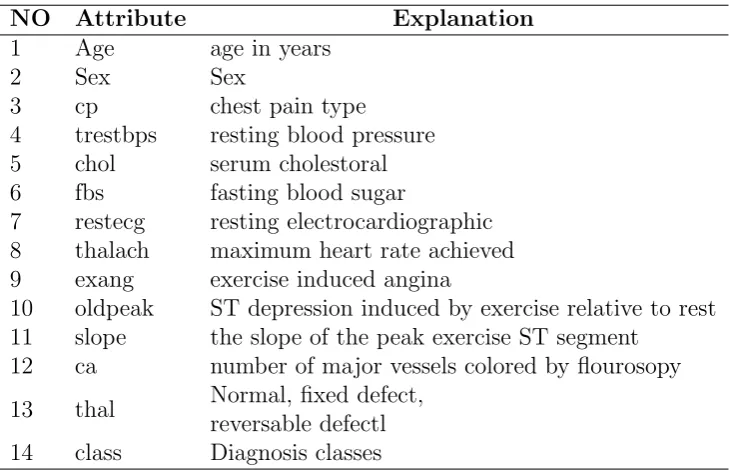
Table 1: Attributes of Statlog heart disease dataset
NO Attribute Explanation
1 Age age in years
2 Sex Sex
3 cp chest pain type
4 trestbps resting blood pressure
5 chol serum cholestoral
6 fbs fasting blood sugar
7 restecg resting electrocardiographic
8 thalach maximum heart rate achieved
9 exang exercise induced angina
10 oldpeak ST depression induced by exercise relative to rest
11 slope the slope of the peak exercise ST segment
12 ca number of major vessels colored by flourosopy
13 thal Normal, fixed defect,
reversable defectl
14 class Diagnosis classes
4
Experiment Setup and Result Analysis
In this study, the Statlog standard heart disease dataset is collected from the UCI machine learning repository [18]. The dataset includes 270 records of 14 attributes. 14 attributes of the dataset is shown in Table 1.
Several measuring tools are used to evaluate the performance of the proposed models. Among these tools accuracy, precision and recall .In the flowing, we define evaluation metrics:
Accuarcy= T P +T N
T P +T N+F P +F N (19)
P ercision= T P
T P +F P (20)
Recall= T P
T P +F N (21)
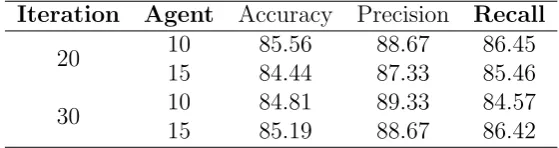
Table 2: Result of WOA on Statlog heart disease dataset
Iteration Agent Accuracy Precision Recall
20 10 85.56 88.67 86.45
15 84.44 87.33 85.46
30 10 84.81 89.33 84.57
15 85.19 88.67 86.42
Table 3: Result of HWOA-DA on Statlog heart disease dataset
Iteration Agent Accuracy Precision Recall
20 10 88.15 89.33 89.98
15 88.52 88.67 91.02
30 10 88.89 90 90.35
15 88.15 91.33 88.28
Table 2 and table 3 present the results of hybrid algorithm HWOA-DA and WOA for heart disease diagnosis. Best Accuracy obtained of HWOA-DA and WOA are 88.89 and 85.56 respectively and number features selection of HWOA-DA and WOA are 9 features. Results show that the hybrid algorithms are much better than the native one. Table 4 presents the comparison of the proposed algorithm with other previous methods on Statlog heart disease dataset. In the study, the HWOA-DA algorithm is a higher accuracy than other methods. Compared to previous studies, the proposed algorithm is superior.
5
Conclusion
Heart disease is one of the main causes of death, it should be correctly diagnosed at the early stage to get treatment. Algorithms of machine learning and metaheuristic are one of the tools that use for diagnosis of disease. In this paper, the proposed methods integrate DA algorithm with the global search of WOA. The proposed approach is compared with
Table 4: The comparison between proposed algorithm and other methods on Statlog heart disease dataset
Reference Method Accuracy
[18] 2015 C4.5 77.5
Fast Decision Tree 78.06
[19] 2017 SVM 81.82
MLPE 84.77
Proposed algorithm WOA 85.56
WOA algorithm. The results show that the hybridizing WOA and DA (HWOA-DA) of the collected dataset is 88.89 % higher than native one which is 85.56 %. The result obtained help to the effective performance of the medical diagnosis and analysis.
References
[1] Arockia Vanitha C, D., Devaraj D, Venkatesulu, M. , Gene Expression Data Classifi-cation using Support Vector Machine and Mutual Information-based Gene Selection, Procedia Computer Science. 47(2015) 13-21.
[2] Blum, C. , Roli, A. M., Sampels, Hybrid Metaheuristics - An Emerging Approach to Optimization, Springer, 2008. Doi: 10.1007/978-3-540-78295-7.
[3] Chandrashekar, G. , Sahin, F. , A survey on feature selection methods, Computers and Electrical Engineering, 40(2014) 16-28.
[4] Chadha, R. , Mayank, S., Prediction of heart disease using data mining techniques, Springer, December 2016.
[5] Das, R., Turkoglu, I. and Sengur, A., Effective diagnosis of heart disease through neural networks ensembles, Expert Systems with Applications, 36(2009) 7675-7680.
[6] Davari, A. , Esmael Zadeh Khadem, S., Automated Diagnosis of Coronary Artery Disease (CAD) Patients Using Optimized SVM, Computer Methods and Programs in Biomedicine 2016, http://dx.doi.org/doi: 10.1016/j.cmpb.2016.10.011
[7] El-Bialy, R. , Salamay, M.A. , Omar, H. , Karam3 and M.Essam Khalifa, Feature Analysis of Coronary Artery Heart Disease Data Sets, Procedia Computer Science. 65(2015) 459 - 468.
[8] Ghaddar, B. , Naoum-Sawaya, J., High Dimensional Data Classification and Feature Selection using Support Vector Machines, European Journal of Operational Research (2017), doi: 10.1016/j.ejor.2017.08.040
[9] Jain, D., Singh, V. , Feature selection and classification systems for
chronic disease prediction: A review. Egyptian Informatics J (2018),
https://doi.org/10.1016/j.eij.2018.03.002
[10] Kaur, G., Arora, S. , Chaotic whale optimization algorithm, Journal of Computa-tional Design and Engineering. 5(3), (2018) 275-284.
[12] Mirjalili, S., Lewis, A. , the Whale Optimization Algorithm, Advances in Engineering Software 95(2016) 51-67.
[13] Mirjalili, S., Dragonfly algorithm: a new meta-heuristic optimization technique for solving single-objective, discrete, and multi-objective problems, The Natural Com-puting Applications Forum 2015, DOI 10.1007/s00521-015-1920-1
[14] Sy Ahmad Ubaidillah, S.H., Sallehuddin,R., Mustaffa, N.H, Classification of Liver Cancer using Artificial Neural Network and Support Vector Machine, Proc. of Int. Conf. on Advances in Communication, Network, and Computing, CNC, 2014
[15] Shouman, M., Turner, T., Stocker, R., “Using Decision Tree for Diagnising Heart Disease Patients,” AusDM ’11 Proceedings of the Ninth Australasian Data Mining Conference, 121(2011) 23-30.
[16] Sree Ranjini, K.S., Murugan, S., Memory based Hybrid Dragonfly Algorithm for numerical optimization problems, Expert Systems With Applications 83 (2017) 63-78
[17] Talbi, E.G., A Taxonomy of Hybrid Metaheuristic. J. Heuristics, 8(2002) 541-546.
[18] UCI Machine Learning Repository. [Online]. Available
http://archive.ics.uci.edu/ml/datasets/statlog+(heart)
[19] Vapnik, VN., The Nature of Statistical Learning Theory. New York: Springer-Verlag 1995