Purdue University
Purdue e-Pubs
Charleston Library Conference
Beyond Implementation: Making your ERMS
work for you
Andrea Langhurst
University of Notre Dame, [email protected]
Stacey Marien
American University
Kari Schmidt
American UniversityFollow this and additional works at:http://docs.lib.purdue.edu/charleston
Part of theLibrary and Information Science Commons
An indexed, print copy of the Proceedings is also available for purchase at:http://www.thepress.purdue.edu/series/ charleston.
You may also be interested in the new series, Charleston Insights in Library, Archival, and Information Sciences. Find out more at:http://www.thepress.purdue.edu/series/charleston-insights-library-archival-and-information-sciences.
This document has been made available through Purdue e-Pubs, a service of the Purdue University Libraries. Please contact [email protected] for additional information.
Andrea Langhurst, Stacey Marien, and Kari Schmidt, "Beyond Implementation: Making your ERMS work for you" (2012).Proceedings of the Charleston Library Conference.
Beyond Implementation: Making Your ERMS Work for You
Andrea Langhurst, Acquisitions/Licensing Librarian, University of Notre Dame Stacey Marien, Acquisitions Librarian, American UniversityKari Schmidt, Electronic Resources Librarian, American University
Abstract
The University of Notre Dame started building CORAL (http://erm.library.nd.edu/), a modularized open source ERM, over 2 years ago. Implementation caused workflow changes including deeper information sharing with stakeholders, enhanced record-keeping, and increased efforts and options for institutional knowledge storage. Likewise, American University, after learning about CORAL’s workflow utilities,
implemented the Resources module to solve ongoing and emerging workflow issues when responsibility for some e-book ordering shifted from the ERM unit to the Acquisitions unit. Learn how ERM practices were enhanced and expanded at the two Libraries through the use ofthis flexible system.
From Building to Using, Moving Beyong
Implementation of CORAL at Notre Dame
The University of Notre Dame’s (ND) Hesburgh Libraries started a project to build the CORAL (Centralized Online Resources Acquisitions and Licensing) Electronic Resource Management (ERM) after evaluating existing ERM Systems versus local needs. The Licensing module was the first to be released as open-source software in 2010, and subsequent modules related to acquisitions of electronic resources (Resources Module), organization of vendor and account specific information (Organizations), and modules related to usage statistics and cancellations workflow have also been put into production at Notre Dame. In the almost 3 years since implementing CORAL-Licensing (CORAL-L), personnel involved in the acquisition and support of electronic resources have learned how to use CORAL, evaluated existing workflows, and explored changes to workflows and the way management of electronic resources is approached to take advantage of new ways of using CORAL to complete work more efficiently.
Improved Information Distribution
CORAL has changed the way we share information internally: where we look for information about existing orders, who has access to information about resources, and expectations related to
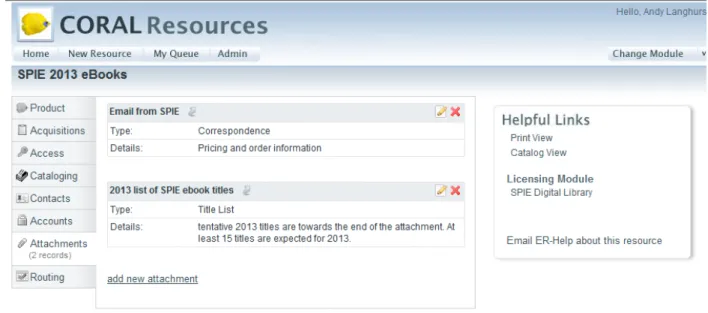
orders. Before the implementation of CORAL-Resources module (CORAL-R), bibliographers at ND would complete a web form providing information such as title, expected cost, fund to use for payment, and a handful of other fields required to proceed with an order, but there was not an easy or consistent way to track additional or supplementary information known at the time of order (price quotes, title lists, etc.), outside of the form. With the implementation of CORAL-R, functionality to associate attachments (Figure 1) with the initial order requests facilitated
improvements to expand access of information to anyone that looks at the record—bibliographers can provide background information on pricing expectations, attach title lists for e-book packages (e.g., to help personnel involved with batch loading of records to verify expectations for not-yet-published content), and share documentation already received from providers (e.g., license documentation to avoid duplication of work in requesting known information again). CORAL has also improved communication and allowed greater distribution of information among stakeholders. CORAL access has been provided not only to electronic resources personnel, but also to university legal counsel and external library stakeholders (as appropriate), in addition to local bibliographers, reference staff, and library administration. The electronic resources unit continues to look for new ways to streamline
Management/Administration 305
campus and to share information about licensed resources in a way that benefits the larger organization.
Finally, in terms of information-sharing, CORAL-R and CORAL-L have changed unit expectations
related to order historical information. Preserving information in CORAL through use of attachments removes possibility for uneven distribution of information by e-mail. CORAL will preserve information even if employees leave or change roles, or when it is unforeseeable that a colleague might need the information later on, thereby
providing an additional function as knowledge repository for electronic resource management. While historical information is not always vital after the order is placed, it can be helpful to look back at initial expectations for an order, often related to expectations regarding annual fees,
post cancellation expectations, number of user limits, or FTE provided at the time of order. CORAL also provides a mechanism for better record-keeping of license negotiations—providing a space to permanently save e-mail exchanges with vendors or correspondence with bibliographers to help document what was expected at the time of order (Figure 2).
Figure 1. Attachments Functionality in CORAL-Resources Module
Addressing Workflow Needs
After the initial implementation of CORAL-R in early 2011, library personnel added new functionality to improve management of MARC records and batch loading efforts related to electronic resources. Before CORAL, information about the availability of MARC record sets and the status of sets for batch loading had been tracked in a very large spreadsheet. Now, a cataloging tab has been added to CORAL-R records, to aid batch loading personnel in processing and tracking status of work. CORAL-R is used to track number of MARC records expected, source of the records, and status in the loading process (Figure 3).
Post Implementation
While putting a new ERM system into full production is not a project to be taken lightly, work does not end at implementation. In order to take full advantage of an ERM tool, it is important to continually consider how workflows can be improved and changed post implementation. In the last 10 months, the electronic resources unit at Notre Dame has experienced various
transitions through personnel changes and more
is the time for a new test of CORAL and the unit to see how we approach the changes and mirror our workflows accordingly. We are at the beginning stages of determining how to integrate employees that previously may have focused on other work in the library or employees that are completely new to the institution. One goal is to train new personnel on our existing processes, but to also reevaluate existing workflows to look for ways to grow and change as a unit and to help new unit members come up to speed as quickly as possible. Communication and information sharing is a vital part of our transition as we introduce new faces with different levels of institutional and unit-specific knowledge. The modularity of CORAL and
flexibility to change fields and workflows will help us move past transition and back into an efficient, if different, way of responding to requests for new resources and support for existing electronic materials.
E-Book Workflows and CORAL at AU
Library
American University (AU) Library implemented the Resources module of CORAL after a workflow
Management/Administration 307
exposed significant issues. CORAL was
implemented to not only solve these ongoing and emerging issues, but also to expand ERM practices within technical services when the Acquisitions unit took over responsibility for e-book ordering from the Electronic Resource Management (ERM) unit.
E-Book Workflow Analysis
AU Library’s collection development activities are coordinated by a Collection Management Team of six collection managers, each responsible for a school or multiple departments on campus. E-book acquisition at AU had been piecemeal, with the Library experimenting early on with
NetLibrary books and subscription packages more recently. Each posed different challenges in terms of access, ownership, and workflow. In 2009, the team purposefully shifted away from subscription-based acquisition models to an ownership model by implementing a patron driven acquisitions (PDA) program for e-books through Ingram’s MyiLibrary platform. Collection managers’ interest in building the Library’s e-book collection
blossomed in 2011 with individual collection development plans based on subject area
including acquisition of content from many e-book different publishers and vendors. Because of this, technical services realized that e-book ordering, receiving, cataloging, and access processes varied according to the unit handling the initial order request. What resulted was a workflow analysis to identify commonalities between the units, but also as a means of standardizing, as much as possible, the acquisition of e-books in technical
services. The workflow analysis resulted in the identification of four primary acquisition processes based on e-book type, each with variable issues. The four types identified were title-by-title purchases direct from a publisher, subscription packages ordered through a vendor, Patron Drive Acquisitions (PDA) managed by a vendor, and e-book collections purchased direct from publishers. Within each type, it became apparent that the Library lacked an actual ordering tool, as much of the work happened outside of the ILS or outside of the Library’s book jobber systems. Implementing CORAL provided a better tool for Collection Managers to order books and provided a path to standardizing e-book purchasing between the ERM and Acquisitions Unit. CORAL also allowed for staff training in the areas of ERM practices, licensing, access, and digital rights management (DRM).
Operationalizing E-Book Workflow Types in
CORAL
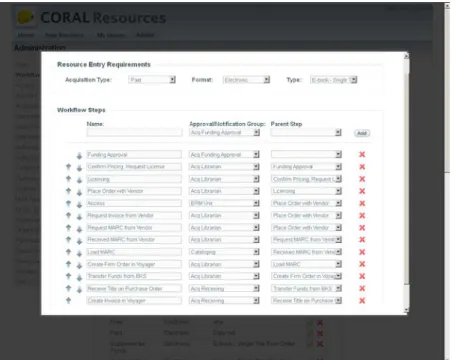
AU Library downloaded CORAL’s “Resources” module as a way to automate e-book ordering (and by extension the ERM Unit adopted CORAL for all e-resource requests). Each e-book type identified in the workflow analysis was assigned a Workflow Setup in CORAL, with the exception of PDA titles as they were managed through Coutts’ Oasis system or any firm order title that could be obtained through any of the Library’s book jobbers. In CORAL, each Workflow Setup is defined by Acquisition Type, Resource Format, and Resource Type.
Acquisition Type Resource Format Resource Type Paid / Supplemental
Funds Electronic E-book - Single Title Firm Order Paid / Supplemental
Funds Electronic E-book - Single Title Standing Order Paid / Supplemental
Funds Electronic E-book Collection (purchase) Paid / Supplemental
Funds Electronic E-book Package (subscription)
Within each Workflow Setup, tasks are defined based on the individual or group completing the task; for example, the Acquisition Librarian is assigned the task of creating a PO in the ILS after the order request is approved, or the Metadata Librarian is assigned the task of loading MARC records when they are received by the Acquisitions Librarian. The flexibility of the Workflow Setup allows for tasks to be dependent on previous tasks or to be completed alongside many tasks. Notifications are sent out to the
person or group responsible for an upcoming task. As tasks move through the workflow, notifications are linked to an individual’s account which also logs a queue of outstanding tasks to complete, so that when a user logs in to CORAL, all tasks requiring completion are listed. Within the order record there is also a Routing feature whereby requestors or any individual who is part of the workflow can view the status of the order request.
Management/Administration 309
Enhancing ERM Practices in Technical
Services
An interesting feature of the e-book workflow analysis at AU Library was the realization that e-books had been acquired on an ad hoc basis, without a formal collection development policy or standardized workflows. Instead, e-book order decisions were based on individual collection manager’s general comfort level with e-books as a format, and acquisitions processes were
shoehorned to fit existing workflows in the ERM unit or Acquisitions unit depending on what unit received the order request. Through AU Library’s implementation of CORAL, mapping the workflow steps based on the e-book acquisition types not only revealed the need for an overall e-book collection development policy, but also underscored how important it was to spread electronic resource management practices throughout technical services. Training in areas of
licensing, DRM, and access management was fundamental to shifting e-book orders to
Acquisitions, as was the understanding that while general principles of electronic resource
management are essential to any unit handling e-resources, all workflows are local. Adoption of these new workflows by Acquisitions was successful because the creation of the Workflow
Setups in CORAL was tailored to existing order requirements and skill sets in the unit. In addition, as e-book orders increased, workflows in CORAL were iteratively changed to reflect increased efficiencies in the unit that often came about as fluency with ERM practices increased. To some extent, the intangible nature of e-book
acquisitions was made tangible as the workflow was mapped out, and then altered, in CORAL. Tasks and alerts helped organize the overall workflow as well as an individual’s responsibilities within a workflow. In addition, Acquisitions was able to draw parallels to the print workflow for firm orders and standing orders. Purchase order creation, receiving, MARC downloads, and invoice creation were all conceptualized according to the steps followed within print workflows, alongside added tasks such as license negotiation, access and DRM management, and working with the ERM Unit on set up in the ERM system and Open URL resolver. Overall, the exercise of
operationalizing e-book workflows aided Acquisitions in understanding how these new processes worked in tandem with exiting workflows while teaching those involved new skills. Enhancing ERM practices throughout technical services at AU Library is a strategic goal as more of the monograph collection moves electronic-only. Workflow utilities, such as those
in CORAL, assist in this process, as collection development policies are refined and workflows evolve.
Next Generation Systems and Workflow
Utilities
ILS vendors are currently creating new library systems that promise to re-haul the business of libraries and provide technical services with a system that is flexible, open, and accommodates many format types, from print to electronic to streaming media and digital collections. Within these new systems, bifurcated print and electronic workflows and the multiple systems used to support them will all be consolidated. Workflow utilities, such as CORAL’s, are essential in this new systems environment as the majority of the collection moves electronic. The shortcomings of the ILS, in regard to managing electronic resource collections, in part, hinges on the very nature of ERM practices that are cyclic in nature, dependent
on multiple units in and outside the library, and mix locally owned resources with leased content which lives on external servers. E-book acquisition underscores the complexity of this environment as local workflows often determine how successful a given Library is at managing an e-book collection. Workflow utilities, such as what CORAL now offers, should be part of any new library system. When these systems are adopted widely, technical services staff will not only grapple with how to use them, but will, most likely, encounter a system that looks more like an ERMS based on a cyclic workflow and less like an ILS based on a linear workflow. Equipping systems with workflow utilities is essential as much of the work of technical services will deal with intangible electronic content, instead of a tangible item that can be passed from person to person. Workflow utilities must be integrated alongside content management and based on individual tasks and responsibilities in order to successfully manage a collection with multiple formats, metadata schemas, and access conditions.