Politecnico di Torino
Porto Institutional Repository
[Proceeding] entity2rec: Learning User-Item Relatedness from Knowledge
Graphs for Top-N Item Recommendation
Original Citation:
Palumbo, Enrico; Rizzo, Giuseppe; Troncy, Raphael (2017).
entity2rec: Learning User-Item
Relatedness from Knowledge Graphs for Top-N Item Recommendation.
In: RecSys ’17. pp. 32-36
Availability:
This version is available at :
http://porto.polito.it/2678879/
since: September 2017
Publisher:
ACM
Published version:
DOI:
10.1145/3109859.3109889
Terms of use:
This article is made available under terms and conditions applicable to Open Access Policy Article
("Public - All rights reserved") , as described at
http://porto.polito.it/terms_and_conditions.
html
Porto, the institutional repository of the Politecnico di Torino, is provided by the University Library
and the IT-Services. The aim is to enable open access to all the world. Please
share with us
how
this access benefits you. Your story matters.
Publisher copyright claim:
c
ACM 2017. This is the author’s version of the work. It is posted here for your personal use. Not
for redistribution.
entity2rec: Learning User-Item Relatedness from Knowledge
Graphs for Top-N Item Recommendation
Enrico Palumbo
ISMB Turin, Italy EURECOM Sophia Antipolis, France
Giuseppe Rizzo
ISMB Turin, Italy [email protected]Rapha¨el Troncy
EURECOM Sophia Antipolis, France [email protected]ABSTRACT
Knowledge Graphs have proven to be extremely valuable to rec-ommender systems, as they enable hybrid graph-based recommen-dation models encompassing both collaborative and content infor-mation. Leveraging this wealth of heterogeneous information for top-N item recommendation is a challenging task, as it requires the ability of effectively encoding a diversity of semantic relations and connectivity patterns. In this work, we propose entity2rec, a novel approach to learning user-item relatedness from knowledge graphs for top-N item recommendation. We start from a knowledge graph modeling user-item and item-item relations and we learn property-specific vector representations of users and items applying neural language models on the network. These representations are used to create property-specific user-item relatedness features, which are in turn fed into learning to rank algorithms to learn a global relatedness model that optimizes top-N item recommendations. We evaluate the proposed approach in terms of ranking quality on the MovieLens 1M dataset, outperforming a number of state-of-the-art recommender systems, and we assess the importance of property-specific relatedness scores on the overall ranking quality.
KEYWORDS
hybrid recommender system, node2vec, knowledge graph embed-dings, knowledge graph, neural language models, word2vec, learn-ing to rank, linked open data
1
INTRODUCTION
In the last years, research on recommender systems has shown that knowledge graphs are beneficial for hybrid recommender sys-tems, achieving high ranking quality and effectively tackling typi-cal problems of collaborative systems such as data sparsity or new items [5, 28]. A line of work focuses on Linked Open Data knowl-edge graphs [3], which represent a wealth of freely available multi-domain ontological knowledge and have successfully been used in the past to build recommender systems [7–9, 13]. The crucial point to leverage knowledge graphs to perform item recommendations is to be able to effectively model user-item relatedness from this rich heterogeneous network. To this end, it is highly desirable to opt for approaches that are able to automatically learn user and item representations from an optimization problem on this graph of interactions, minimizing the time-consuming endeavour of feature engineering and leading to better performance [2]. At the same time, it is also beneficial to use a recommendation model whose features have a straight forward interpretation and that can thus
be easily adapted to a specific recommendation problem. Last year, node2vec, a new approach to effectively perform feature learning from networks, which combines a flexible random walk strategy with the power of neural language models, has been proposed [11]. However, this approach is not tailored to knowledge graphs, as it does not distinguish among types of entities and of relations, and has never been applied to address recommendation problems.
Starting from this work, in this paper, we introduce entity2rec1, a
novel approach to measure user-item relatedness for top-N item recommendation. The contributions of the proposed work can be summarized as follows: (a) we use a knowledge graph encompass-ing both collaborative information from user feedback and item information from Linked Open Data; (b) we learn property-specific vector representations of knowledge graph entities in a completely unsupervised way via node2vec; (c) we compute property-specific relatedness scores between users and items using the obtained vector representations; (d) we combine the property-specific re-latedness scores in a global rere-latedness score using a supervised learning to rank approach optimizing top-N item recommendation; (e) we evaluate the effectiveness of the proposed approach with respect to four baselines; (f) we remark that, thanks to the explicit semantics of the properties of the knowledge graph, the model is easily adaptable to specific recommendation problems, as the features have a clear interpretation.
2
RELATED WORK
Recommendations using knowledge graphs: in the past years, several works have shown the effectiveness of external knowledge resources to enhance the performance of recommender systems. In [5, 28] the authors start from a graph-based data model encom-passing both user feedback and item relations to generate person-alized entity recommendations. In [19, 20] the authors adopt a hybrid graph-based data model utilizing Linked Open Data to ex-tract metapath-based feature that are fed into a learning to rank framework. In [24] the authors propose a content-based recom-mender system that automatically learns item representations using a feature learning algorithm on a knowledge graph and show the effectiveness of the learned representations in an Item-based K-Nearest Neighbor method.
Feature learning from networks: feature learning from net-works is a fundamental step in node and edge classification. Re-cently, some models have adapted neural language models to net-works, resulting in very effective feature learning processes. In gen-eral, it has been shown that these methods tend to work better than other dimensionality reduction techniques based on matrix factor-ization approaches [11]. In Deep Walk [21], the authors learn node representations by simulating random walks on a graph, generat-ing sequences that are successively processed by a neural language model. In [11], the authors propose node2vec, an improvement over Deep Walk, as it adopts a more flexible and sophisticated random walk exploration strategy.
Learning to rank: learning to rank consists in applying machine learning algorithms to learn a ranking function from training data. In this work, we focus on listwise methods, i.e. learning algo-rithms that are able to directly optimize ranking accuracy met-rics from training data. More in detail, we use Adarank [27] and LambdaMart [4]. Adarank is based on boosting, weak learners are iteratively trained to correct the errors of the previous iteration and finally combined together in a linear model. Adarank avoids the problem of the discontinuity of ranking accuracy metrics by optimizing an upper bound of the actual loss function. LambdaMart is the combination of LambdaRank and the boosted tree method MART [10]. The key idea is to optimize the loss function by directly modeling its gradients estimates with respect to the model scores.
3
APPROACH
3.1
Knowledge Graph
In this work, a knowledge graph is defined as a setK=(E,R,O)
whereEis the set of entities,R⊂ExΓxEis a set of typed relations
between entities andOis an ontology. The ontologyOdefines
the set of relation types (‘properties’)Γ, the set of entity typesΛ,
assigns entities to their typeO:e∈E→Λand entity types to their
related propertiesO:ϵ∈Λ→Γϵ ⊂Γ. Knowledge graph edges are
thus triples(i,p,j) ∈Rwherei∈Eandj∈Eare entities andp∈Γ
is a property. In our model, entities include usersu∈U ⊂Eand
itemsi∈I ⊂E\U. An observed positive feedback between a user
and an item (ratingr≥4 in this work) is described by a property
not defined by the ontologyO, which we name ‘feedback’. Thus,
p∈Γϵ+=Γϵ∪‘f eedback0. Throughout this work, the ontologyO
is represented by the DBpedia ontology [1] and we deal with items
of the typeϵ =‘dbo:Film’. The propertiesΓdbo:F ilmrelated to an
entity of the type ‘Film’ are available online2.
3.2
Property-specific user-item relatedness
As mentioned in Sec. 1, node2vec [11] has recently shown to be particularly effective at learning vectorial node representations. In a nutshell, node2vec works by simulating a random walk on the graph, generating sequences of nodes, which are then fed into a neu-ral language model (word2vec [18]) as if they were ‘sentences’ of a document to learn vector representations of the nodes. From these representations, the relatedness between two nodes can easily be computed using vector similarity measures. However, in a knowl-edge graph different properties have different semantic values and
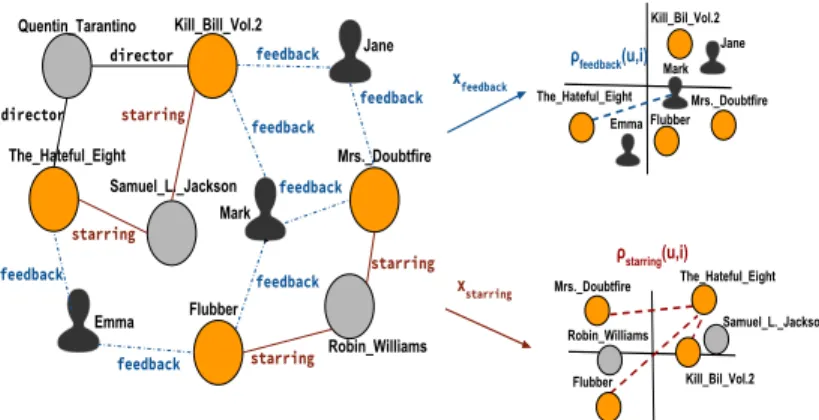
2http://mappings.dbpedia.org/server/ontology/classes/Film feedback Kill_Bill_Vol.2 director Quentin_Tarantino The_Hateful_Eight starring Samuel_L._Jackson Flubber starring Robin_Williams Mrs._Doubtfire Jane Mark Emma Jane Mark Emma Mrs._Doubtfire Flubber Kill_Bil_Vol.2 The_Hateful_Eight Robin_Williams Flubber xfeedback xstarring Samuel_L._Jackson ρfeedback(u,i) ρstarring(u,i) director starring feedback feedback feedback feedback Kill_Bil_Vol.2 Mrs._Doubtfire The_Hateful_Eight starring feedback feedback
Figure 1: Starting from the knowledge graph K, which con-tains users (black), items (orange) and other entities (grey), for each property, we generate vector representationsxp
with node2vec. The vector representations encode the struc-ture of the graph. Forp= ‘feedback’, we encode collabora-tive information, users and items are mapped close together in vector space according to their interactions and the relat-ednessρf eedback(u,i)can be computed directly. For other
properties, such asp= ‘starring’, we encode content informa-tion, items with similar starring actors are embedded close together. The relatednessρst ar r inд(u,i)has to be computed
by averaging the distance from itemsi0liked byuin the past.
should have different weights in judging the relatedness between two entities. Films can be related in terms of starring actors and not in terms of subject, share the same director but not the same writer, and processing the whole knowledge graph altogether neglecting the semantics of the properties would not allow to account for this. Thus, we start by learning property-specific vector representation of nodes considering one property at the time. For each property
p∈Γϵ+, we define a subgraphKpas the set of entities connected by
the propertyp, i.e. the triples(i,p,j). Note that for properties where
each entity is connected to more than one entity (e.g. ‘starring’ or
‘feedback’),Kpcan exhibit complex connectivity patterns. Then,
for eachKpindependently, we learn a mappingxp:e∈Kp→Rd,
optimizing the node2vec objective function [11]: max xp Õ e∈Kp (−logZe+ Õ ni∈N(e) xp(ni) ·xp(e)) (1)
whereZe =Ív∈Kpexp(xp(e)·xp(v))is the per-node partition
func-tion and is approximated using negative sampling [18],N(e) ∈Kp
is the neighborhood of the entityedefined by the node2vec random
walk and the optimization is carried out using stochastic gradient
ascent over the parameters definingxp. The optimization attempts
to maximize the dot product between vectors of the same neigh-borhood, i.e. to embed them close together in vector space. Thus,
from the vector representationsxp(e), property-specific relatedness
scores can be defined as follows:
ρp(u,i)= ( s(xp(u),xp(i)) i f p=‘f eedback0 1 |R+(u) | Í i0∈R +(u)s(xp(i),xp(i0)) otherwise 2
whereR+(u)denotes a set of items liked by the useruin the past
andsdenotes a measure of vector similarity (in this works= cosine
similarity). The features include both collaborative and content information and have a straight-forward interpretation (Fig. 1). When considering p = ‘feedback’, K is reduced to the graph of
user-item interactions and thusρf eedback(u,i)models collaborative
filtering.ρf eedback(u,i)will be high whenxf eedback(u)is close
to the itemxf eedback(i) in vector space, i.e. whenihas been
liked by users who have liked the same items ofu in the past
and are thus tightly connected in theKf eedback graph. On the
other hand, whenpcorresponds to other properties of the ontology
Othe features encode content information. For instance, ifpis
‘starring’,ρst ar r inд(u,i)will be high ifxst ar r inд(i)is close to items
xst ar r inд(i0), i.e. whenishares starring actors with items that the
useruhas liked in the past. The hybrid approach is able to tackle
the ‘new item’ issue, as for a new item with no feedback from users, we are still able to compute all the content-based features. For a
new useru, the scoresρp(u,i)can be computed by averaging the
ρp(u0,i)over all the other usersu0∈U.
3.3
Global user-item relatedness
For each user-item pair, we are now able to compute all property-specific relatedness scoresρ®(u,i)={ρp(u,i)}p∈Γ+
ϵ. We aim to use
these scores as features of a global user-item relatedness model that can be used to provide item recommendation. To this end, we define the global user-item relatednessρ(u,i;θ)=f( ®ρ(u,i);θ)as
a functionf of the property-specific scoresρ®(u,i)and of a set of
parametersθ. The key idea is that of finding the parametersθthat
optimize top-N item recommendation as a supervised learning to rank problem [16].
Training data: given a set of usersU={u1,u2..uN}, each useruk
is associated with a set of items from feedback datai®k={ik1,ik2..ikn(k)}
wheren(k)denotes the number of feedback released by the user
ukand a set of labelsy®k={yk1,yk2..ykn(k)}denoting the ground
truth relevance of itemsi®k(e.g. ratings with explicit feedback or
boolean values with implicit feedback). The training set is thus represented asT ={(uk,i®k,y®k)N
k=1}.
Ranking function:ρ(u,i;θ)is a ranking function, meaning that,
for each useruk, the corresponding itemsi®kare sorted according to
its score. More formally,ρ(u,i;θ)induces a permutation of integers
π(uk,i®k,θ), corresponding to sorting the list of itemsi®kaccording
its score.
Loss: the agreementM(π(uk,i®k,θ),y®k)between the permutation
π(uk,i®k,θ)induced byρ(u,i;θ)and the list of ground truth
rele-vance of itemsy®kcan be measured by any information retrieval
metric that measures ranking accuracy, such asP@N, Mean
Aver-age Precision (MAP), NDCG [22]. From this score, a loss function can be easily derived as:
C(θ)=
N Õ
k=1
(1−M(π(uk,i®k,θ)) (2)
Optimization: the learning process has thus the objective of
find-ing the set of parametersθthat minimize the loss functionCover
the training data: ˆ
θ=arg min
θ C(θ) (3)
The exact form off, of the loss functionC, the set of parameters
θto optimize and the approach used to optimize the loss function
depend on the learning to rank algorithm and on the metrics that are optimized. In this work, we use Adarank [27] and LambdaMart [27]
as ranking algorithms and we measureP@Nand MAP [22].
4
EXPERIMENTAL SETUP
Dataset: the dataset used for the evaluation of the proposed
ap-proach is MovieLens 1M3. MovieLens 1M [12] is a popular dataset
for the evaluation of recommender systems and it contains 1,000,209 anonymous ratings of approximately 3,900 movies made by 6,040 MovieLens users. In a previous work [20], MovieLens 1M items have been mapped to the corresponding DBpedia entities. We lever-age these publicly available mappings to make use of Linked Open Data in building the knowledge graph K. Since not every item in the Movielens data has a corresponding DBpedia entity, after this mapping we have 948978 ratings, from 6040 users on 3226 items.
Configuration: first, we define the set of propertiespfor which the features have to be computed. We start from the properties
associated to the class ‘Film’ by the DBpedia ontologyΓdbo:F ilm
and to this set we add ‘dct:subject’, which relates an entity to a set of possible categories, such as ‘American Films‘. For each of
these properties, we obtain the subgraphKpthrough SPARQL [23]
queries. The properties for which we obtain a sufficient number of
triples (>15) are those reported in Tab. 3. The subgraphKf eedback
is derived from the positive (r ≥4) ratings of the MovieLens 1M
dataset. The second part of the configuration consists in defining the hyper-parameters of the model, i.e. internal parameters that are not explicitly set by the learning process. For what concerns
node2vec, we optimize the parametersP,Qon validation data,
ex-perimenting the pairs(P,Q) ∈ {(1,1),(1,4),(4,1)}.P, also called
return parameter, controls the likelihood of returning to a
previ-ously visited node. Q, also calledin-out parameter, controls the
probability of moving further away from the source nodee. By
playing with(P,Q), node2vec achieves a random walk strategy able
to approximate a Breadth-First or a Depth-First search. For other parameters, we use the configuration obtained in a previous work,
i.e. a walk lengthl=10, a dimension of the embeddings vector
d=500, a number of walks per entityn=500, a context sizek=10
and a number of epochsη=5. Another hyper-parameter of the
proposed approach is the learning to rank model. We experiment two listwise algorithms, AdaRank [27] and LambdaMart [4], on val-idation data. The implementation of these models is that provided
by the software library RankLib4.
Evaluation protocol: we adopt an evaluation protocol that is sim-ilar to RelPlusN [25]. We split the ratings in temporal order, using 80% of data to create a training set and 20% to create a probe set. In
the training set, we consider ratingsr≥4 as relevant items and the
rest as not relevant. From the probe set, we sample a 4% of data to create a probe validation set and 16% to create a probe test set. Then,
from each of these two datasets, items with ratingr=5 are selected
and considered as relevant and for each user a numberN =100
of other items not rated by the user are randomly sampled as non-relevant examples, creating the validation and the test set. This
3https://grouplens.org/datasets/movielens/1m/ 4https://sourceforge.net/p/lemur/wiki/RankLib/ 3
P,Q Ranking model P@5 P@10 MAP 1,4 LambdaMart 0.0791 0.0293 0.1717 4,1 LambdaMart 0.0182 0.0193 0.0570 1,1 LambdaMart 0.0174 0.0188 0.0565 1,4 AdaRank 0.0134 0.0098 0.0278 4,1 AdaRank 0.0078 0.0083 0.0286 1,1 AdaRank 0.0109 0.0098 0.0358
Table 1: Results on the validation set of entity2rec for differ-ent combinations of hyper-parameters
Model P@5 P@10 MAP entity2rec 0.2814 0.2127 0.4232 MostPop 0.2154 0.1815 0.2907 NMF 0.1208 0.1150 0.1758 SVD 0.0543 0.0469 0.0888 ItemKNN 0.0463 0.0232 0.0990
Table 2: Results on the test set of entity2rec against the base-lines
evaluation protocol allows to avoid the limitations of the TestItems protocol, in which only rated items are ranked [26] and that is thus very different from the context of a real recommender system. Note that the effect of this evaluation protocol is that of underestimating the quality of the recommendations, as the assumption that all unrated items are not relevant is pessimistic. The set of elements
liked by a userR+(u)is defined as the items in the training set with
ratingsr = 5. We measure P@5, P@10 and MAP. As baselines,
we use state-of-the-art collaborative filtering algorithms based on Non-Negative Matrix Factorization (NMF) [17], on Singular Value Decomposition [15], ItemKNN with baselines [14] and the Most Popular Items recommendation strategy, which is known to be quite effective on MovieLens due to the power-law distribution of user feedback data [6] (see also Tab. XIV in [19]). The baselines are
implemented using thesurprisepython library5.
5
RESULTS
Comparison with state-of-the-art: the hyper-parameter opti-mization on validation data shows that LambdaMart performs better
than Adarank and that the pair(P,Q)=(1,4), which corresponds to
a walk lingering in the neighborhood of the starting node, approxi-mating Breadth-First-Search, works better than the other pairs. The
best score, for every metric, is obtained by the pair(P,Q)=(1,4)
and the model LambdaMart (Tab. 16). Thus, we evaluate this
config-uration on the test set, comparing it to the NMF, SVD, ItemKNN and Most Popular Items baselines (Sec. 4), outperforming all of them for all the metrics under consideration (Tab. 2).
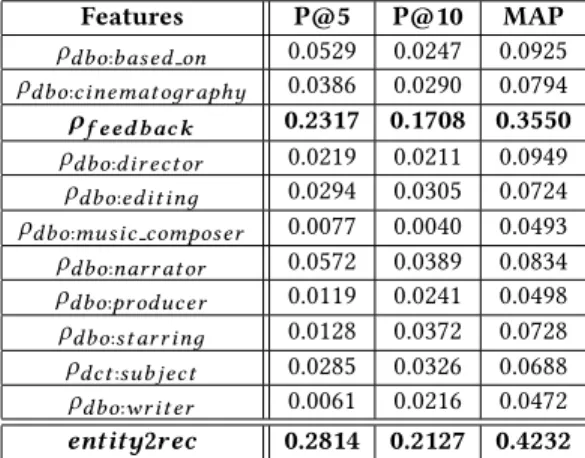
Feature selection: one of the strengths of the proposed approach is that of using features that have a clear interpretation. In this ex-periment, we try to evaluate the importance of the selected features
ρp(u,i)on the overall ranking quality. To this end, we select one
feature at the time and we compute the ranking accuracy (Tab. 3), observing that the feature ‘feedback’ is by far the best perform-ing one. However, includperform-ing content-based features improves the
5http://surprise.readthedocs.io/en/v1.0.2/matrix factorization.html
6Note that the scores obtained on the test set tend to be higher than those on the
validation set because the ratio of relevant/non-relevant items is higher in the latter.
Features P@5 P@10 MAP
ρdbo:based on 0.0529 0.0247 0.0925
ρdbo:cinemat oдr aphy 0.0386 0.0290 0.0794
ρf eed b ac k 0.2317 0.1708 0.3550
ρdbo:dir ect or 0.0219 0.0211 0.0949
ρdbo:edit inд 0.0294 0.0305 0.0724
ρdbo:music composer 0.0077 0.0040 0.0493
ρdbo:nar r at or 0.0572 0.0389 0.0834 ρdbo:pr oducer 0.0119 0.0241 0.0498 ρdbo:st ar r inд 0.0128 0.0372 0.0728 ρdct:sub ject 0.0285 0.0326 0.0688 ρdbo:wr it er 0.0061 0.0216 0.0472 entity2rec 0.2814 0.2127 0.4232 Table 3: Performance of the proposed approach considering one feature at the time
overall performance of the system, as can be seen by comparing ‘feedback’ with ‘entity2rec’, which includes all the features. We expect this difference to be even more relevant on other datasets affected by a higher sparsity as observed in similar experiments with hybrid recommender systems [19, 28]. It is also worth noting thatρf eedbackoutperforms all the collaborative filtering baselines
of Tab. 2, showing the effectiveness of the proposed approach in learning a measure of user-item relatedness even without content information.
6
CONCLUSIONS
In this work, we propose entity2rec, a new measure of user-item relatedness for top-N item recommendation. Starting from a knowl-edge graph, property-specific relatedness scores are obtained using a feature learning approach based on neural language models on property-specific subgraphs and then combined through a learn-ing to rank approach to generate a global user-item relatedness measure optimizing top-N item recommendations. This two-stage approach has two major benefits: it allows to configure the system to take into account a specific property when providing recom-mendations (e.g. recommend movies with similar actors) and it allows to let the learning to rank algorithm implicitly weight the properties to provide recommendations. The results on the Movie-Lens 1M dataset show that the proposed approach outperforms commonly used collaborative filtering techniques based on ma-trix factorization, nearest neighbors and the Most Popular items strategy. From the data to the ranking, the feature engineering effort is minimal and the manual intervention is limited to setting and configuring hyper-parameters of the learning process. Future work will involve a more comprehensive evaluation, comparing the model to other hybrid state-of-the-art recommender systems on different domains and datasets, and in a general improvement of the feasibility of the proposed approach in a real recommendation scenario (such as computational time, online updates, context of the recommendations).
REFERENCES
[1] S¨oren Auer, Christian Bizer, Georgi Kobilarov, Jens Lehmann, Richard Cyganiak, and Zachary Ives. 2007. Dbpedia: A nucleus for a web of open data. InThe
semantic web. Springer, 722–735.
[2] Yoshua Bengio, Aaron Courville, and Pascal Vincent. 2013. Representation learning: A review and new perspectives.IEEE transactions on pattern analysis
and machine intelligence35, 8 (2013), 1798–1828.
[3] Christian Bizer, Tom Heath, and Tim Berners-Lee. 2009. Linked data-the story so far.Semantic Services, Interoperability and Web Applications: Emerging Concepts
(2009), 205–227.
[4] Christopher JC Burges. 2010. From ranknet to lambdarank to lambdamart: An overview.Learning11, 23-581 (2010), 81.
[5] Rose Catherine and William Cohen. 2016. Personalized Recommendations using Knowledge Graphs: A Probabilistic Logic Programming Approach. InProceedings of the 10th ACM Conference on Recommender Systems. ACM, 325–332. [6] Paolo Cremonesi, Yehuda Koren, and Roberto Turrin. 2010. Performance of
recommender algorithms on top-n recommendation tasks. InProceedings of the fourth ACM conference on Recommender systems. ACM, 39–46.
[7] Tommaso Di Noia. 2016. Recommender Systems Meet Linked Open Data. In
International Conference on Web Engineering. Springer, 620–623.
[8] Tommaso Di Noia, Roberto Mirizzi, Vito Claudio Ostuni, Davide Romito, and Markus Zanker. 2012. Linked open data to support content-based recommender systems. InProceedings of the 8th International Conference on Semantic Systems. ACM, 1–8.
[9] Cristhian Figueroa, Iacopo Vagliano, Oscar Rodr´ıguez Rocha, and Maurizio Morisio. 2015. A systematic literature review of Linked Data-based recommender systems.Concurrency and Computation: Practice and Experience27, 17 (2015), 4659–4684.
[10] Jerome H Friedman. 2001. Greedy function approximation: a gradient boosting machine.Annals of statistics(2001), 1189–1232.
[11] Aditya Grover and Jure Leskovec. 2016. node2vec: Scalable feature learning for networks. InProceedings of the 22nd ACM SIGKDD International Conference on Knowledge Discovery and Data Mining. ACM, 855–864.
[12] F Maxwell Harper and Joseph A Konstan. 2016. The movielens datasets: History and context.ACM Transactions on Interactive Intelligent Systems (TiiS)5, 4 (2016), 19.
[13] Houda Khrouf and Rapha¨el Troncy. 2013. Hybrid event recommendation using linked data and user diversity. InProceedings of the 7th ACM conference on Recommender systems. ACM, 185–192.
[14] Yehuda Koren. 2010. Factor in the neighbors: Scalable and accurate collaborative filtering.ACM Transactions on Knowledge Discovery from Data (TKDD)4, 1 (2010), 1.
[15] Yehuda Koren, Robert Bell, and Chris Volinsky. 2009. Matrix factorization tech-niques for recommender systems.Computer42, 8 (2009).
[16] Tie-Yan Liu and others. 2009. Learning to rank for information retrieval.
Foun-dations and Trends® in Information Retrieval3, 3 (2009), 225–331.
[17] Xin Luo, Mengchu Zhou, Yunni Xia, and Qingsheng Zhu. 2014. An efficient non-negative matrix-factorization-based approach to collaborative filtering for recommender systems.IEEE Transactions on Industrial Informatics10, 2 (2014), 1273–1284.
[18] Tomas Mikolov, Ilya Sutskever, Kai Chen, Greg S Corrado, and Jeff Dean. 2013. Distributed representations of words and phrases and their compositionality. In
Advances in neural information processing systems. 3111–3119.
[19] Tommaso Di Noia, Vito Claudio Ostuni, Paolo Tomeo, and Eugenio Di Sciascio. 2016. Sprank: Semantic path-based ranking for top-n recommendations using linked open data.ACM Transactions on Intelligent Systems and Technology (TIST)
8, 1 (2016), 9.
[20] Vito Claudio Ostuni, Tommaso Di Noia, Eugenio Di Sciascio, and Roberto Mirizzi. 2013. Top-n recommendations from implicit feedback leveraging linked open data. InProceedings of the 7th ACM conference on Recommender systems. ACM, 85–92.
[21] Bryan Perozzi, Rami Al-Rfou, and Steven Skiena. 2014. Deepwalk: Online learn-ing of social representations. InProceedings of the 20th ACM SIGKDD international
conference on Knowledge discovery and data mining. ACM, 701–710. [22] David Martin Powers. 2011. Evaluation: from precision, recall and F-measure to
ROC, informedness, markedness and correlation.Journal of Machine Learning
Technologies(2011).
[23] Bastian Quilitz and Ulf Leser. 2008. Querying distributed RDF data sources with SPARQL. InEuropean Semantic Web Conference. Springer, 524–538.
[24] Jessica Rosati, Petar Ristoski, Tommaso Di Noia, Renato de Leone, and Heiko Paulheim. 2016. RDF graph embeddings for content-based recommender systems. InCEUR workshop proceedings, Vol. 1673. RWTH, 23–30.
[25] Alan Said and Alejandro Bellog´ın. 2014. Comparative recommender system evaluation: benchmarking recommendation frameworks. InProceedings of the 8th ACM Conference on Recommender systems. ACM, 129–136.
[26] Harald Steck. 2013. Evaluation of recommendations: rating-prediction and ranking. InProceedings of the 7th ACM conference on Recommender systems. ACM, 213–220.
[27] Jun Xu and Hang Li. 2007. Adarank: a boosting algorithm for information retrieval. InProceedings of the 30th annual international ACM SIGIR conference
on Research and development in information retrieval. ACM, 391–398. [28] Xiao Yu, Xiang Ren, Yizhou Sun, Quanquan Gu, Bradley Sturt, Urvashi
Khandel-wal, Brandon Norick, and Jiawei Han. 2014. Personalized entity recommendation: A heterogeneous information network approach. InProceedings of the 7th ACM international conference on Web search and data mining. ACM, 283–292.