PERCEPTIONS OF TASK AND SOCIAL RELATIONSHIPS IN GROUPS: EXPLORING THE EFFECTS OF COGNITIVE COMPLEXITY ON NETWORK
ACCURACY, CENTRALITY, AND STRUCTURATION
BY
MELISSA DOBOSH
DISSERTATION
Submitted in partial fulfillment of the requirements for the degree of Doctor of Philosophy in Communication
in the Graduate College of the
University of Illinois at Urbana-Champaign, 2014
Urbana, Illinois Doctoral Committee:
Professor Marshall Scott Poole, Chair Professor John Lammers
Associate Professor Leanne Knobloch
ABSTRACT
Given that studying both task and social relationships between and among group members is an inherently complex web, a network lens emerges as a valuable tool in
understanding and exploring the social side of groups. Using a model of network structuration, perceptions of group connections highlight underlying and enduring interaction patterns that shape how group members communicate with one another. In other words, communication networks are structures of perceived communication relationships that guide communication, but then are in turn shaped by that communication. In order to better understand these group
perceptions and network structuration, cognitive complexity, a variable tied to the development of an individual’s interpersonal construct system, emerged as a way to make sense out of these perceptions.
Cognitive complexity was proposed a mediating variable that impacted how accurately individuals perceive their communication networks, as well as shaped how central one was perceived to be in their communication networks. Leadership teams of social organizations where members worked closely together to accomplish task goals, while simultaneously balancing social relationships, were explored. While hypotheses directly linking cognitive complexity to both network accuracy and centrality were not supported, it emerges that satisfaction and organizational identity are playing larger role in the relationship between perceptions, accuracy, and centrality. Additionally, one’s perceived centrality in one network appeared to affect different types of communication relationships and the network structuration process.
For my mother, who relentlessly supported, loved, and believed in me. I know you would be proud.
ACKNOWLEDGMENTS
Many people helped me on this journey. I would like to thank my incomparable advisor, Dr. Scott Poole, for his continued support, advice, and faith in me and this project. This process was definitely a marathon, not a sprint, and I could not have done this without having him in my corner. I would also like to thank Dr. John Lammers, Dr. Leanne Knobloch, and Dr. Nosh Contractor. Not only did their expertise, insights, and advice help shape this project, but they, along with my advisor, showed me what high quality research, teaching, and mentoring look like. Finally, I am indebted to my amazing undergraduate researchers, Angeline and Jake, who assisted in the collecting and coding of my data.
My phenomenal family and friends stood behind me through not only this process, but all that life has thrown at me. Their willingness to always listen, encourage, and love has kept me grounded and I appreciate them all more than they could ever know. I am especially thankful to my dad for his unwavering support even when he does not completely agree with me. I am grateful to have husband who believes in me even when I doubt myself. Marrying Peter was the smartest thing I ever did. Finally, to my daughters Lila and Charlotte, thank you for
simultaneously distracting and motivating me. I am blessed and proud to be the mom of such beautiful and crazy girls.
TABLE OF CONTENTS
CHAPTER 1 INTRODUCTION ……….. 1
CHAPTER 2 LITERATURE REVIEW ….………. 7
CHAPTER 3 METHOD ...………. 51
CHAPTER 4 RESULTS ………...………. 75
CHAPTER 5 DISCUSSION ……...……….. 98
REFERENCES …..………. 107
APPENDIX A COGNITIVE SOCIAL STRUCTURE MEASURES ...………… 123
APPENDIX B COGNITIVE COMPLEXITY MEASURES ………. 126
CHAPTER 1 INTRODUCTION
When reflecting on our own personal group experiences, it makes sense that relational dynamics play a key role in group communication. While working in groups, the camaraderie that we experience (or fail to experience) often serves a key factor in how positively or
negatively we feel about the group. Engaging in small talk before a meeting begins, developing inside jokes with fellow group members, and providing tension release when task-related issues become too intense are just a few relationally-oriented experiences that group members can share. The connections we make with fellow group members, the type of climate that the group provides, and the satisfaction we feel both during and after the group interaction are all vital parts of the group process that both impact and extend beyond task accomplishment, highlighting the inextricable link between task and social dimensions of group communication.
Despite this link, much of group research has emphasized the task dimensions of group communication, offering only a superficial or secondary glance at the relational functions within a group (e.g., Barker et al., 2000; Keyton, 1999; Keyton, 2000; Keyton & Beck, 2009). In doing so, a truly rich understanding of groups is being held just beyond our reach. Therefore, in order to fully grasp the complexities of group communication, attention must be paid to both task and social relationship dimensions. It becomes necessary to refocus our attentions and more fully explore the implications and impacts of social communication, in addition to task
communication, in groups. Given that studying these relationships between and among group members is an inherently complex web, a network lens emerges as a valuable tool in
The communication discipline, specifically the study of communication networks, has largely relied on self-report data. This reliance was called into question during the late 1970s and early 1980s when several works by Bernard, Killworth, and Sailer indicated that what people said they were doing did not line up with what they were actually doing (for a review see
Bernard, Killworth, & Kronenfeld, 1984). While this seemed problematic, Freeman and Romney (1986) argued that, while people may inaccurately recall specific instances of
interaction, their recollections may actually highlight enduring patterns of interaction. Further, the well-known Thomas Theorem posits that “If men [sic] define their situations as real they are real in their consequences” (in Krackhardt, 1987, p. 112), highlighting the power that perception has in shaping reality. Richards (1985) also pointed out that many social and psychological theories are based on perceptions. Thus, there is great value in exploring people’s perceptions about both their own interactions and the interactions of people around them because they may highlight underlying communication patterns and shape the communication between people.
Perceptions have great power in shaping the ways in which people communicate,
significantly impacting communication networks. The perceptions that one individual has about their own relationships with fellow group or organization members may influence how they interact with them. However, it does not end there. Perceptions that this same person has of a fellow group member’s perception of a third party, known as three-party metaperception, can also impact this person’s interactions with all parties (Kenny, 1994; Kenny, Bond, Mohr, & Horn, 1996). An individual’s communication with another person may be shaped by who they think that person knows or does not know (Krackhardt, 1987). For example, if Person A
believes that Person B and C have a relationship, Person A’s communication to Person B may be shaped by the belief of Person B and C’s relationship. It is a moot point if Person B and C do
not have the relationship as perceived by Person A because just the belief of its presence is affecting communication in the network. Perceptions, not just actuality, affect the ways in which people communicate and should be explored.
Further, perceptions about the communication and relationships among the people that one interacts with can shape the ways in which they organize. According to Kenny et al. (1996), “If there is not agreement among members of a network concerning who likes whom, the social networks reflect only cognitive constructions and not a real social structure” (p. 929). In a sense, it is the perceptions of organization members that shape organizational dynamics. Further, the ability to accurately perceive these communication networks, thus understanding the social dynamics and structure, can serve as a source of power for group and organization members (Krackhardt, 1990). This has significant implications for communication in groups and organizations because one’s ability to accurately perceive the relationships among others can serve as means to either maintain or amplify power inequalities within the organization (Simpson, Markovsky, & Steketee, 2011).
Additionally, perceptions have very real consequences for how people act. Pittinsky and Carolan (2008) claimed that teachers managed their classrooms (e.g., assigning students to groups and creating seating charts) based on their perceptions of friendships among students. Unfortunately, their study found that teachers may be vastly under-perceiving the presence of these friendship ties. Perceptions, despite being inaccurate, informed teacher action. Further, Ryan (2011) found that people’s voting choices were potentially influenced by those they believed to have political knowledge. Again, simply the perception of political knowledge, not necessarily “real” knowledge, was enough to influence the perceiver and shape their subsequent actions. In both cases, perceptions, not necessarily what was deemed accurate or true, are
shaping actions. Thus, perceptions have real implications for how people communicate and interact and it becomes imperative to understand what shapes these perceptions.
Identifying and investigating variables that affect the perceptions that a person has about their own task and social relationships as well as those relationships between fellow group members will lead to a more comprehensive understanding of the communication networks. However, to say that this is a linear process where certain variables affect perceptions which then shape actions is too simplistic. Instead, Corman and Scott (1994) posited a different way of thinking about communication networks, claiming “the network is an abstract structure of perceived communication relationships that function as a set of rules and resources that actors draw upon in accomplishing communication behavior” (p. 181). In other words, one important class of rules and resources operating in this case are individuals’ perceptions about relationships among network members, which suggest rules for who they should talk to and who should talk to whom and is a resource to guide the individual’s behavior in the network. These perceived relationships guide their communication. However, the communication then serves to reshape the perceptions through the structuring process, which is complex and recursive.
Thus, when exploring group task and social relationships, the perceptions that people have about the relationships between fellow group members become especially important because they can shape communication with the group. Group members will act based on their perceptions of the social landscape and their observations of actions can potentially reshape or confirm their perceptions. Their understanding, whether accurate or not, of who is connected to whom will guide their interactions and has implications for the relational dynamics within the group. Therefore, this project seeks to explore task and social dimensions of groups, the
potentially impact these perceptions within a model of network structuration. Through
investigating socially-oriented groups facing significant task demands, this project will examine the perceptions that group members have about their own friendship and task associations with fellow group members, as well as their perceptions about the friendship and task associations between fellow group members. Variables that impact network perceptions will be discussed and, cognitive complexity, which has implications for social perception skill, impression formation, and communication, will be proposed as a new variable to explore in its relation to network perceptions and structuration.
This project will contribute to our understanding of the complexity of group
communication by exploring both the task and social relationships present within all groups. While socially-oriented groups engaging in significant task activities will be explored in this project, there are implications for all types of groups. By recognizing the inextricable link between task and social elements, this project will provide a rich, as well as realistic, view of the communicative relationships that make up the reality for most groups members in all types of organizations. Further, because perceptions are a class of rules and resources that guide and shape our expectations of communication, this project will provide insight into variables
affecting this process of network structuration, contributing to and extending Corman and Scott’s (1994) model. Recognizing and striving towards a comprehensive picture of the varied
communication present in groups will provide a richer understanding of how individuals communicate within their groups and organizations.
This dissertation is organized as follows: Chapter 2 will synthesize relevant literature on relational communication in groups, focusing on the importance of exploring both socially-oriented and task-socially-oriented communication. Relevant research on variables affecting network
perceptions, as well as a model for network structuration, will be discussed. Cognitive complexity will be proposed as a variable for better understanding these relationships and hypotheses and research questions will be proposed. Chapter 3 will outline the methods that were used to test the hypotheses and answer the research questions, while chapter 4 will present descriptive and correlation data for the variables investigated, as well as the analysis and findings surrounding the hypotheses and research questions. Finally, chapter 5 will discuss the findings and proposed explanations, discuss the strengths and limitations of this project, and provide future research directions.
CHAPTER 2 LITERATURE REVIEW
Through a review of the literature on personal relationships in groups, this chapter will explore the nature of socially-oriented groups, along with the effects and influences of both task and relational ties within and across these groups. First, the importance of understanding and investigating relational communication in groups will be discussed. Second, shifting from studying task-oriented groups to more socially-oriented and blended groups will offer fresh insights that enhance our understanding of group communication. Finally, several variables that influence relational group processes and outcomes will be explored for their impacts both within and across groups.
Further, the perceptions that individuals have about their own relationships with others, as well as their perceptions about the relationships between others will be discussed. Variables that impact these perceptions including demographic and personality variables, social structure, and interaction will be discussed. Additionally, since perceptions serve to highlight enduring patterns of interaction that both shape and are shaped by communication, Corman and Scott’s (1994) model will be posited as a framework for better understanding the impacts of these perceptions on group interaction.
Finally, cognitive complexity, which correlates to personality and social structure and impacts interactions, will be proposed as a variable which should be explored when investigating network perceptions. Cognitive complexity influences the ways in which people perceive and classify phenomena, form impressions, and then use that information to act, thus shaping the network structuration process.
Re(Focusing) on Relational Communication in Groups
A basic definition of group communication states that groups are comprised of
interdependent members united by a common goal or purpose (Beebe & Masterson, 2012). This goal may take many forms and can vary on a spectrum ranging from more task-oriented to more relationally-oriented goals. However the goal is characterized, groups will face both task and social realities as they work together towards this common purpose (Scheerhorn & Geist, 1997). As group members strive to make a decision or coordinate efforts, their task accomplishment is often contingent on the social reality of the group in terms of the communication and
relationships among members. Thus, relational communication helps to keep the group together so that it can accomplish a task (Scheerhorn & Geist, 1997).
Additionally, the group context differs from an interpersonal context due to the multiple relationships that are simultaneously being managed within a group (Keyton, 1999). As group size increases, so do the number of intertwined relationships among group members. The sheer complexity of overlapping and developing personal relationships among group members can be messy and has implications for all group processes. Relational communication in groups reflects its own unique and complex context and is defined below:
“Relational communication in groups refers to the verbal and nonverbal messages that create the social fabric of a group by promoting relationships between and among group members. It is the affective or expressive dimension of group communication, as opposed to the instrumental, or task-oriented, dimension “(Keyton, 1999, p. 192).
Relational communication has not necessarily been ignored in groups. Many group researchers readily acknowledge the importance that the impact of maintenance or relational
messages has on task elements of group interaction. Bales (1950, 1953) posited that groups face an equilibrium problem where they have to manage task and relational goals. In addition to coding group interaction for task-oriented messages concerned with providing or receiving information, opinions, and suggestions, he coded both positive and negative social-emotional messages concerned with showing solidarity or antagonism, agreement or disagreement, and tension release or tension. Bales acknowledged that laughing, joking, helping, rewarding, and agreeing, along with rejecting, withdrawing, defending one self and deflating others, all
contributed to and impacted the group interaction.
Benne and Sheats (1948) also heeded the relational side of groups, outlining functional group roles that reflected not just task achievement, but also group-building and maintenance. Such relational roles included encouraging, harmonizing, and compromising, along with engaging in gatekeeping, standard setting, observing, and following behaviors. Going a step further, Barge and Hirokawa (1989) included relational functions as an essential part of group’s communication competence. Having members help a group effectively manage conflict by focusing on issues rather than personalities and use positive verbal and nonverbal messages to maintain a supportive climate are seen as important factors that work alongside more the traditional task competencies associated with problem and solution orientation.
Relational issues are also highlighted in the Group Working Relationship Coding System (Poole, 1983; Poole & Roth, 1989) which is based on the idea that relationships can only be understood through focusing on interchanges among group members. Group communication is coded for periods of (1) focused work where focus is on the task with no member disagreement, (2) critical work where focus is on the task, but there is some member disagreement, and (3) opposition where disagreements are openly expressed and member take sides. Additionally,
strategies for managing opposition including (4) open discussion, (5) tabling, and (6)
capitulating. While these six coding categories are embedded in group member relationships, they are primarily task focused. However, a final coding category, (7) integration, highlights relational communication by reflecting on periods when the group is not task focused, displaying tangents, joking, and positive socioemotional interaction.
While these examples clearly indicate that relationships do matter in group
communication, the focus on the relational side of groups has been secondary or supplementary at best (Keyton, 2000). Often, relational variables, relational messages, and relational outcomes are simply given a cursory nod when compared to the in-depth focus that group task has
received. Several factors have contributed to this inequity. First, groups are united in a common goal or purpose and often viewed as “doing something”. This focus on accomplishment is often task-oriented in nature. Even more socially-oriented groups are often faced with decisions to make, problems to solve, and coordination. Thus, identifying and focusing on the task activity (even within social groups) is simpler (Keyton, 2000). It is easier to investigate group process and outcomes in terms of decisions being made, reports or projects being created, and solutions being implemented. Second, much of group research historically utilized zero-history groups in laboratory settings, often comprised of undergraduate students (Keyton, 1999, 2000).
Unfortunately, while these types of groups have offered unique insights into group dynamics and served as a stepping stone to exploring more naturally occurring groups, relational
communication issues tend to not be a substantial and integral part of these artificial settings. Finally, group communication research has reflected more traditional research interests, focusing on the individual over the group unit and reflecting a more male-oriented domain (Keyton, 1999,
2000). In order for relationships in groups to be adequately explored, the focus needs to be on interdependence of group members as opposed to the independence of group members.
Ignoring the relational side of groups has offered an incomplete picture of group interaction and shifting the focus to highlight relational communication as, at the very least, of equal importance to task communication in groups is essential. Embracing the relational communication group work that has been done and taking it even further has implications for how we communicate in all types of groups across all spectrums. In fact, most of the groups that individuals belong to are not necessarily the traditional task-oriented groups that have been studied. Many groups, such as friendship circles, book clubs, and church groups, exist solely to fulfill relational needs. Additionally, relational implications are intricately linked to task issues in all types of groups and the nature of group interdependence highlights the importance of member relationships (Keyton, 1999). Therefore, in ignoring or offering only a cursory glance at the relational side of group, researchers are limiting the capacity we have for understanding group communication.
Fortunately, in the last ten years or so, group researchers have begun to answer this call and fill the void in our understanding of groups. Recent research has shown a shift towards exploring more socially-oriented groups such as families, support and self-help groups, religious groups, play and peer groups, friendship groups, card groups, poker groups, book groups,
fraternities and sororities, and intramural teams. These are the types of groups that comprise a great number of our group memberships and, despite being socially-oriented, still have
implications for task accomplishment and our communication in more task-oriented groups. Additionally, relationally-oriented variables that affect both group process and outcomes such as
climate, satisfaction, conflict, cohesiveness, stress, group hate, commitment, trust, and affinity (Barker et al., 2000) are being increasingly explored.
However, there is still significantly more work to do in giving group relational
communication its rightful place. Keyton and Beck (2009) claimed “the focus on task groups and task-oriented interactions leaves the relational aspect of group interaction undertheorized” (p. 14). One such area of further exploration includes workplace friendships where personal and professional lines are blurred. Despite being prevalent in organizations, these relationships are still among the least studied types of organizational relationships (Sias, 2009). While
“workplace friendship” reflects an interpersonal, dyadic relationship, these relationships are embedded within a group and organizational context, influencing group processes and outcomes. Additional focus can also be placed on further explicating the task and relational aspects of communication messages, along with understanding how group relationships are impacted by the variety of collaborative communication technologies at a group’s disposal (e.g., Sias, Pedersen, Gallagher, & Kopaneva, 2012). Thus, continued efforts towards understanding socially-oriented groups, relational variables within all types of groups, and interdependence amongst group members is essential and offers many avenues for continued scholarship.
Shifting towards Socially-Oriented Groups
While all groups face both task and social realities, research has focused on more task-oriented groups. Often, these are groups that are unified by a task-task-oriented goals or needs. Within organizations, these are teams, committees, and task forces “identifying problems, proposing solutions, and implementing policies” (Greenbaum & Query, 1999, p. 539). While relational communication factors into the decision making and problem solving process, it is
often viewed in relation to task process and outcomes. While studying task-oriented groups is provides valuable insights into group communication, the reality is that we are embedded in all types groups from the day we are born and these groups are not just limited to task groups (SunWolf, 2008).
Furthermore, as group research trends towards the study of naturally occurring groups in lieu of (or in addition to) laboratory groups (e.g., Frey, 2002, 2003), socially-oriented groups emerge as a natural area for inquiry. Bona fide group theory, which emphasizes the permeability of group boundaries, posits that individuals are simultaneously managing multiple group
memberships and the roles that they play in certain groups influence expectations and
enactments of their roles in other groups. This suggests that our roles and experiences in one group could affect how we communicate in other groups to which we belong. Thus,
understanding how individuals communicate in socially-oriented groups may also provide insight for their communication in more task-oriented groups. Shifting towards an investigation of socially-oriented groups will allow a more inclusive understanding of group communication and the emphasis that these groups place on relational needs will allow us to better understand the relational side of all groups.
Socially-oriented groups are defined as those groups who exist primarily to fulfill personal and relational needs (Keyton, 1999). Membership to these groups can be voluntary (e.g., friendship circles and support groups) or involuntary (e.g., families) (SunWolf, 2008). In both cases, these groups strive to fulfill member needs for inclusion and affection and the relationships among members are the primary emphasis. The first example of these oriented groups is our family, but our memberships to a variety of other types of socially-oriented groups extend throughout our life span. Additional examples include children’s play
and social groups, neighborhood groups and gangs, church groups, social support and self-help groups, and friendship groups. Card, poker, and book groups, along with intramural sports teams and fraternities and sororities, are also considered socially-oriented groups.
Families
Socha (1999) claimed that “group communication learned in families, the first group, might form a foundation for principles that govern people’s behavior in other groups” (p. 476). Similar to other types of groups, families are characterized as a collective unit that also has a complex web of personal relationships between and among family members. Socha argues that what is learned in a family of origin goes on to shape what happens in future families and, by extension, what happens in groups outside the family. Learned communication patterns, whether effective or ineffective, will often be relied upon when communicating with members of groups outside the family. Further, the tensions that families experience, such as balancing flexibility and stability, along with managing constantly shifting boundaries throughout a life span, are similar to challenges face by more traditional, task-oriented groups.
Petronio, Jones, and Morr (2003) investigated how families managed their privacy. Families, as a single unit or dyads, triads, and larger coalitions within the family unit, coordinate rules and negotiate boundaries in connection with how private information is handled. Family privacy dilemmas refer to “privacy predicaments managed by family members making decisions collectively or individually that results in consequences (costs and benefits) for one or more family group members where there is no satisfying solution” (Petronio et al., 2003, p. 30). Family members struggled with expectation of being privy to private family information, while also desiring to be separate from potential consequences of private information. This dilemma
reflects the challenge faced by not only by families, but by all groups: the struggle to be both a group member and an individual member of a group.
Children Peer Groups
If the family of origin serves provides initial context for group interaction, children peer and social groups also serve as a fertile ground for learning and applying group communication principles. According to SunWolf and Leets (2003), “A significant portion of every child’s life develops in the context of small social peer groups” (p. 356). These are peer groups
characterized by game play and little to no adult supervision. As children enter into a world beyond the family context, they are thrust into learning the sometimes harsh lessons about being included or excluded. They join (or are excluded) from groups, receiving a crash course in how to interact within these groups and identifying boundaries that separate insiders from outsiders. Their sense of self that has been in development based on family interaction is challenged or altered as new identities emerge from their play group interaction (SunWolf & Leets, 2003).
In children’s task groups, Socha and Socha (1994) found that children had trouble
managing conflict, dividing up tasks, and using time effectively. Children shouted suggestions at one another, whispered in dyads, spoke at the same time, while also engaging in uneven turn-taking and marginalizing some group members. These behaviors go against basic
recommendations of effective small group communication (e.g., Beebe & Masterson, 2012). However, these were groups with adult supervision. When unsupervised and engaging in game play, behaviors and communication that lead to inclusion or exclusion may become more extreme.
In a series of studies that explored peer group social exclusion, adolescent participants referred back to traumatic incidents of being excluded from early childhood as opposed to more recent middle or high school years (SunWolf & Leets, 2003; SunWolf, 2008). Negative feelings associated with peer rejection at such an early age stuck with participants, with several
participants indicating feelings of continuously being left out. These experiences also impacted how adolescents reacted to the exclusion of others, often feeling heightened levels of stress than when compared to their more included peers. Additionally, being rejected in childhood peer groups has been linked to later antisocial behavior (e.g., Dodge, et al., 2003), as impacting later school adjustment resulting in feelings of loneliness, desire to avoid school, and decreased participation at school (e.g., Buhs & Ladd, 2001). This suggests that early group experiences, especially if negative, can impact our future group experiences, potentially leading individuals to minimize their presence in groups or avoid them altogether.
Neighborhood Groups and Gangs
Neighborhood groups and gangs also have implications for group communication. Defining a neighborhood may start with geography or spatial boundaries but quickly extends to encompass dimensions such as social networks, professions, politics, race, economics, history, and architecture (Buchalter, 2003). Group members struggle to define themselves, their relationship to others, and their relationship to the environment as part of the process of
understanding the permeable boundaries of their neighborhood. This struggle to ascertain borders both enables and constrains communication amongst members and can be extended to all group contexts.
Additionally, gangs, which often emerge from common neighborhood groups, are generally characterized by criminal activity (SunWolf, 2008), but may also be described as engaging in anti-social behavior (Ingoldsby et al, 2006). However, Conquergood (1994) also reported that gangs engage in nurturing and domestic communication emphasizing the
relationship among group members as familial. Gang members communicate intricately and ritualistically, using both verbal and nonverbal messages that have meaning inherent in the context and work to define and redefine organizational boundaries by creating a sense of groupness through common language, as well as territorial lines.
Going beyond family and children peer groups, children often begin to spend more time with members of their neighborhood, including similar aged members, but also influential older peers. Ingoldsby et al. (2006) found that children experiencing significant conflict with their parents and living in a “disadvantaged” neighborhood were more likely to eventually engage in anti-social behavior and later join groups characterized by high anti-social behaviors. This is just one example of how communication in one group affects communication in another group and connections and implications of socially-oriented groups.
Religious Groups
Individuals often join religious groups to fulfill not just faith-based needs, but also to seek support and affiliation. Emphasizing the social nature of religious groups is instrumental in maintaining the health of the religious group. Scheitle and Adamczyk (2009) claimed, “Getting people to attend, participate, give money, and stay in a congregation are all influenced by how embedded they are in social network of the group” (p. 16). The church group well-being
do this (and enjoy it) when in conjunction with their friends. Thus, church groups are motivated to facilitate social ties amongst members.
These friendships among church group members develop for a couple of reasons. First, the regular activities provided by the church group allows for numerous opportunities for church members to develop personal relationships with other church members. For example, Smith (2003) found that parents and children’s social networks were unintentionally merged through active participation in church activities. Second, church members may seek out personal relationships with other simply because they share the same faith (Kalmijn, 1998) or similar experiences (Kim, 2004).
Whether as a result of shared activities or a desire for similarity, Scheitle and Adamczyk (2009) found that the stronger an individuals’ exclusive theological beliefs, the more likely they were to have friends coming from their church group. Specifically, a church member with exclusive theological beliefs is more likely to have many fellow church members as friends. A church group with similarly exclusive theological beliefs is more likely to foster friendships amongst its members. Finally, if the level of exclusive theological belief is equally high between a member and the church group, there will be even greater success developing friendships among church members. While these friendships among members provide great outcomes for the church group, these strong social ties among members may hurt the inclusion of new members who struggle to be included (Scheitle & Adamczyk, 2009).
Social Support and Self-Help Groups
While social support is often a side benefit to membership in family, neighborhood, and religious groups, social support groups formally organize for the main purpose of providing
mutual aid to members who face a common problem or have a common need (Cline, 1999). These dilemmas can stem from physical and mental illnesses to addictions and members turn to social support or self-help groups to fulfill support needs that are not adequately being met by other types of groups. Membership in self-help or support groups (as the terms are often used interchangeably) is voluntary and group members’ share a common dilemma and search for common solutions to the dilemma while simultaneously providing and receiving support. Social support refers to individuals’ needs for relational, confirmational, and instrumental care and is “manifest in communication processes” (Cline, 1999, p. 520). In other words, social support emerges from the verbal and nonverbal messages shared between and among group members as they strive to make sense out of and adapt to a difficult situation. They learn, practice, and modify communication skills that carry over to other group and interpersonal contexts.
The intersection between technology and support groups offers a new space for continued investigation. The internet offers individuals ways to connect either synchronously (reading and sharing messages at the same time) or asynchronously (reading and sharing messages at different times) and has allowed the make-up of support groups to change. Support groups that meet face to face often do so at predetermined times, include less than 15 members, and have a loose structure (Alexander, Peterson, & Hollingshead, 2003). However, the internet has allowed support groups to evolve where membership is no longer limited geographically and allows public access to the group 24 hours a day, 7 days a week. Similar to face-to-face support groups, online support groups provide informational, emotional, esteem, and tangible support in difficult times.
Many factors contribute to the types of support provided in online support groups. Campbell & Wright (2002) found a link between emotional support and online support group
member receptivity, immediacy, and similarity. In other words, appearing interested in fellow group members’ problems, listening to them without judgment, and appearing to understand what they are going through is all linked to the provision of emotional support. Additionally, formal dominance was linked to less emotional support, while online support groups that promoted equality amongst members was linked with more emotional support. Finally, large, heterogeneous groups were found to provide more informational support, while smaller, more homogeneous groups provided more emotional support (Alexander et al., 2003).
Great challenges, however, lie in being able to effectively communicate social support online. Communicating receptivity, immediacy, similarity, and equality may be inherently more difficult through computer mediated channels where nonverbal messages are limited (or look very different than in face-to-face settings) (Alexander et al., 2003). Communicating concern or advice may be interpreted negatively by the recipient as they feel blamed for the problem or as though they are being criticized or directed (Burleson & MacGeorge, 2002). Additionally, there can be a disconnect between what is hoped to work in the online support environment and what people actually do (Aakhus & Rumsey, 2010). In other words, it is not necessarily the socially supportive act (e.g., offering advice), but the performance of the act (e.g., actually taking the advice) and the ongoing interaction between parties that provides the most effective support.
Friendship Groups and Blended Relationships
Our friendship groups or circles provide fertile ground for negotiating relationships, engaging in relational communication, and potentially influencing our group communication contexts. Unfortunately, within the communication field, friendship has largely been explored within a dyadic context and there is much to be gained through shifting the focus to friendship
groups (Goins, 2011). As groups increase in size, so does the complexity and number of personal relationships influencing group interaction.
According to Rawlins (1994), friendship is contextually negotiated so that it allows for diverse social forms. Friendship differs from other relationships in its voluntariness,
personalistic focus, nature of affective ties, and nature of development (Sias & Cahill, 1998). People choose to be friends and privately negotiate the relationship. Friends do not limit the other to one role (such as an organizational role), instead viewing each other as a whole person. Friendships have affective ties, but differ from romantic relationships in terms of sexual feelings, possessiveness, and exclusivity. Finally, friendships appear to develop gradually, without the culminating turning points that mark changes other types of relationships (Sias & Cahill, 1998).
Friendships, while standing as its own type of group, also serve as an element of all other groups. For example, friendships have been considered especially important for marginalized groups. Specifically, friendships among Black females serve as sites of empowerment and resistance from oppression (Goins, 2011). These friendships groups serve as a “homeplace” where Black females feel safe to express and empower themselves, relax, share stories, gain strength, and maintain harmony in their lives (p. 531).
Additionally, workplace relationships often blend task and friendship elements creating a situation where working groups are inevitably impacted by the friendships among members. Within organizations, coworker friendships are plentiful and the development of these
relationships results in significant benefits for both the individuals involved in the relationship and the organization in which the relationships develops (Sias, 2009, 2005). For example, Kram and Isabella (1985) found workplace friends provided decision-making, influence-sharing, and instrumental and emotional support systems for one another. Additional benefits of workplace
friendships include providing invaluable support and advice, easing stress, and preventing organizational burnout (Sias & Bartoo, 2007). Work friends tend to share and receive higher quality information (Sias, 2005), while also aiding in career advancement and serving as a buffer between superiors and subordinates (Sias, 2009). In addition to individual benefits,
organizations enjoy reduced turnover, improved morale, and increased creativity. Thus,
attending to both task and relational elements within the workplace and developing multi-faceted and close workplace relationships can positively benefit all involved.
However, there can be a negative side to workplace friendships. They can cause conflict and unethical behavior within the organization (Sias, 2009). Additionally, not all friendships stand the test of time. Consequences of workplace friendship deterioration include emotional stress, reduced ability to perform tasks, turnover, and altered perceptions regarding the role of friendships in the workplace (Sias, Heath, Perry, Silva, & Fix, 2004).
While there are benefits and potential downsides to these coworker friendships, they highlight that task and relational issues need to be attended to within all groups. These
relationships, where friendship and business associations are fused together, are best described as blended relationships (Bridge & Baxter, 1992). In these blended relationships, the demarcation between task and social dimensions are not always so clear. The challenge lies in learning to navigate the different types of communication, both social and task-oriented, that will inevitably be relevant at some point.
Moving towards “Blended” Groups: The inevitability of both task and social dimensions The delicate balance of navigating these blended task and social associations is hardly limited to co-worker friendships. To some degree, all groups are “blended”. For example, a
work team may start out as being predominantly task focused. Communication between group members may center on the task. However, as personal relationships develop among members, social communication (e.g., discussing personal lives, making plans outside of work) may become more prevalent. Balancing the different types of communicative relationships between group members becomes essential. Ignoring one over the other could hurt the group and new group goals of maintaining and protecting the friendships may become equal to, or even
outweigh, the original task goal. The task and social realities of groups must both be considered when studying group communication.
While social realities are inevitable in more groups considered “task-oriented”, the likewise is true for “social” groups. Even for groups that come together for social reasons, task needs will emerge amongst members. Families manage finances, make decisions, and plan for the future. Religious groups, which rely on shared spiritual beliefs and co-participation in activities, are governed by leadership teams and committees which strive to recruit and retain members, plan activities, encourage participation in those activities, and manage financial contributions. Even in support groups, where support can take the form of information
(providing factual advice or information), esteem (expressing interpersonal solidarity), network (facilitating interpersonal connections), or tangible (providing practical aid) (Xu & Burleson, 2001), the task and social realities of group communication are apparent.
Thus, a move towards conceptualizing all groups as blended to some degree may help to highlight the importance (and inevitability) of both task and social dimensions of communication and refocus on the relational side of groups as equally important to task. In order to have a comprehensive and complete picture of group dynamics, attention must be paid to both task and social realities of all groups.
Emphasizing Relational Dynamics Within and Across Groups
While groups may be described as being task or socially-oriented, relational dynamics will play a large role in all types groups. Group formation, interactions, and outcomes are all shaped by relational communication and variables. These variables both shape and are shaped by the group context. This next section will explore relational dynamics both within and across groups.
Variables such as gender, social identity, culture, and family impact relational
communication in groups (Barker et al., 2000). Experiences connected to gender, social identity, culture, and family contribute to one’s self-concept, impacting the formation, process, and
outcomes of groups. For example, Kim (2004) found that second generation Korean-Americans sought out religious groups with other second generation Korean-Americans because of the shared experiences and culture. Goins (2011) found that Black female friendship groups
provided a source empowerment for this marginalized group. Valenti and Rockett (2008) found that gender differences impacted a group member’s tendency to interact within their group’s friendship and advice network. Additionally, Socha (1999) claimed that what is learned in the family group continues to impact the expectations and interactions we bring to other groups.
Relational messages also influence group process and outcomes (Keyton, 1999). While all messages include task and relational content, the levels vary based on the specific message. In their investigation of breast cancer support groups, Keyton and Beck (2012) found that more socioemotional or relational messages helped create a supportive group climate. However, even within this socially-oriented group, there were significantly less relational messages than task messages being shared among members. Despite this abundance of task-oriented messages,
relational messages were still instrumental in creating the positive group climate, highlighting the power and impact of even a few relational messages.
However, relational messages still need to be communicated effectively and skillfully. At the beginning of a semester, freshmen who perceived themselves as skillful communicators were more likely to utilize friendship formation strategies throughout the semester, resulting in reports of more available resources from their social network (McEwan & Guerrero, 2010).
Additionally, effective use of teasing messages is reliant on group context. Schnurr (2009) found that the teasing styles of group leaders were shaped by group norms, while also simultaneously shaping those group norms.
The channels used to communicate also impact relational communication in groups. Computer mediated communication plays a large role in shaping how group members interact (Barker et al., 2000). For example, variables that were linked to friendship in face-to-face
groups such as proximity were not as central when groups used technology to communicate (Sias et al., 2012). Instead, shared task was a larger contributor to friendship development. Use of the internet also impacted communicative processes and outcomes in social support groups (e.g., Alexander et al., 2003; Wright & Campbell, 2002).
These variables impact the relational process, highlighting the dynamic nature of group interaction and the continuous development of the group, relationships, and meaning (Keyton, 1999). One example lies in the management of tensions between task and relational elements in groups. Galanes (2009) found that leaders were not just having to manage task concerns with a group, but were also concerned with socializing, expressing feelings, having fun, harmonizing, attending to relationships, and managing discussions of the group. Thus, effective leadership is
potentially contingent on a group leaders’ ability to successfully manage the relational dynamics in conjunction with the task needs.
Successful processes can result in positive group outcomes such as developing group norms, enhancing group cohesiveness, establishing consensus, creating a supportive climate, and creating feelings of satisfaction (Keyton, 1999; Barker et al., 2000). Satisfaction can be specific to an interaction or result from interaction (Keyton, 1991). Either way, group members who experience satisfaction with their group, also report their groups as being more cohesive and more likely to establish consensus (Anderson, Martin, & Riddle, 2001). Consensus, where everyone agrees with the decision, has been linked to supportive climates characterized by feelings of groupness (Pavitt & Curtis, 1998). Successful relational communication can also positively affect members’ socialization into new groups and help them manage organizational change (Hart, Miller, & Johnson, 2003).
Unfortunately, there can be a dark side to groups that can occur when the relational processes go awry (Cupach & Sptizberg, 1994; Keyton, 1999, Barker et al., 2000). Groups that ineffectively manage conflict can have power struggles and escalation of discontent resulting in bullying behaviors among members (Tracy, Sandvik, Alberts, 2006). Further, when group members attribute failure to other group members, the result is having more negative socioemotional and maintenance messages present in the group interaction (Bazarova &
Hancock, 2012). Groupthink can result from a group establishing a norm where consensus is the highest priority, resulting in a lack of critical thinking and false belief that everyone is in
agreement (Janis, 1982). Further, group stress can occur when groups experience change such as from membership changes (Keyton, 1999).
While these relational dynamics mutually affect relational processes and outcomes within groups, they also impact communication across groups. Our perceptions of the relational
dynamics in one group have implications for how we act in other groups. We carry multiple group memberships and these groups are often interdependent. Bona fide group theory relies on this concept, highlighting permeable boundaries and interdependence (Putnam & Stohl, 1996). For example, experiences of conflict experienced in the family group can predict affiliation with certain neighborhood groups (e.g., Ingoldsby et al., 2006) and memories of being excluded from childhood peer groups impacts our perceptions when we see others being excluded (SunWolf, 2008). Technological advancement also allows for increased intergroup communication as it allows for access to groups on a 24 hour a day, 7 day a week basis. Internet support groups offer more convenient meeting times, making it easier for members to be a part of and manage many more support group memberships (Alexander et al., 2003). Technology allows us to have friends not limited by geography (e.g., Sias et al., 2012) and may allow us to maintain relationships with more people.
When investigating groups, whether they are task or socially-oriented, it is important to recognize the implications of both task and relational elements. To ignore one in favor of the other simplifies the communication between group members and ignores the complexity of groups and organizations. Relational communication is a vital element of understanding group communication because many groups exists solely to fulfill relational needs, relational
implications are related to task issues in all types of groups, and relationships are important due to the interdependent nature of groups (Keyton, 1999). However, exploring both task and social dimensions is important and, through refocusing group research on socially-oriented groups and emphasizing relational dynamics, in addition to task elements, within these groups, a richer and
more complex understanding of group communication will emerge. By focusing on the perceptions that group members have about these intertwined social and task relationships, a natural starting off point emerges as a way to better understand not just how members think about the connections in their group, but also how they then communicate with others.
What impacts our perceptions?
A number of variables have been explored for their impacts on perceptions of a variety of communication networks. Demographic characteristics and personality traits have implications for network perceptions, both in terms of accuracy and member attributions. Additionally, several elements of social structure have impacted perceiver accuracy, as well as how network members are perceived by others. Finally, the interaction between group members has served as a catalyst for how people perceive fellow group and organization members.
Demographic and Personality Variables
Several demographic and personality variables have been explored for their impact on network perceptions. The theory of homophily predicts that individuals are more likely to interact with individuals they believe to be similar to themselves in terms of a variety of
characteristics and qualities (Monge & Contractor, 2003). If individuals perceive themselves to be similar to certain others in their groups, they may be more likely to engage in communication with them. For example, several researchers hypothesized that similarity in sex and race would encourage more communication ties between group and organization members. However, Yuan and Gay (2006) found that similarity in gender and race had no impact on the development of network ties and Valenti and Rockett (2008) partially supported this finding. Research results indicated that differences in age did not affect advice, friendship, or work-related networks.
Differences in sex, however, only impacted advice networks. Specifically, in male or female dominated groups, the members of the minority sex were less likely to seek advice from fellow group members. While there may be conflicting findings on these variables influencing the development of ties, Heald, Contractor, Koehly, and Wasserman (1998) reported that individuals of the same gender, in the same department, and in a supervisor-subordinate relationship were likely to have similar perceptions of their network.
In addition to sex, age, and race, religion also potentially influences network perceptions. Scheitle and Adamczyk (2009) found that individuals who had exclusive theological beliefs and belonged to a congregation with similarly exclusive beliefs were more likely to seek out
friendships within the congregation. The perception that other members shared equally
exclusive beliefs led to friendship development. These perceptions of similarity have significant implications for organized religious groups who actually can benefit from closer social ties among congregation members as these ties often result in more organization involvement, commitment, and even financial donation.
The need for achievement, along with affiliation and extraversion, has been linked to accurate perceptions of networks. Casciaro (1998) found that individuals who had a high need for achievement were more accurate in their perceptions of both friendship and advice networks within an organization. In other words, individuals who had a strong desire to succeed within their organizations were more accurate in predicting who went to whom for advice and which fellow members were friends. Additionally, Casciaro found that individuals with a strong need for affiliation and/or an extroverted personality were more accurate in perceiving friendship networks. However, this appeared to be at the expense of accurately perceiving advice networks.
In this case, it may be that more “people-oriented” individuals, characterized by a need for affiliation and extraversion, are more attentive to the social cues of their organization.
Another variable impacting perceptions networks is positive affectivity and engagement. Casciaro, Carley, and Krackhardt (1998) found that happy, enthusiastic, and positive people had a more accurate picture of the social dynamics occurring around them, accurately perceiving friendship ties of fellow organization members. Unfortunately, this accuracy did not necessarily transcend to their own perceptions about their place within the social structure of the group. Individuals characterized by positive affectivity significantly misperceived their role with advice networks, potentially perceiving more ties than they actually had. While positive affectivity affects the accuracy of member’s perceptions, Ryan (2011) found that engagement was positively related to one’s perceptions of another’s political expertise. Individuals who were passionate and enthusiastic about political issues were perceived by others as having more expertise. Unfortunately, this perception of “expertise” was based on how much they seemed to care about politics and not necessarily real knowledge.
Dominance and self-control have also been linked to network perceptions. Adolescents characterized as having less self-control were more likely to perceive higher acts of delinquency among their peers (Young, Barnes, Meldrum, & Weerman, 2011). These individuals were often engaging in more delinquent behavior and inaccurately projected their behavior onto others in their peer group. Further, dominance impacts perceptions in groups. Members perceived as highly dominant were also accurately perceived as being more central within their group. In other words, fellow group members accurately perceived that dominant group members were both receiving and sending more messages than less dominant members during group interaction (Brown & Miller, 2000).
Social Structure
In addition to demographic and personality variables, one’s position within the social structure of a group or organization has implications for network perceptions. As discussed earlier, the ability to accurately perceive the relationships among group and organization
members can serve as a source of power for organization members. This power can be formal or informal. Krackhardt (1990) found that members who accurately assessed their advice networks were seen as being more powerful by others in their network. However, Simpson et al. (2011) found that those low in power, from either a disadvantaged position or from a standard method of priming low power, were more accurate in assessing social ties than higher power individuals. Additionally, both Krackhardt (1990) and Casciaro (1998) found that individuals who held a formal position high in an organization’s hierarchy had less accuracy in perceiving advice and friendship networks. The conflicting results may indicate base of one’s power, as well as the type of network being addressed, impact perception accuracy. Further, members with less power, whether from a formal or informal base, may be more motivated to accurately understand the lay of the land within their group or organization so as to better shape their communication with more powerful members.
Centrality, which refers to how many connections and relationships one has with others in their network, also impacts perception accuracy. Grippa and Gloor (2009) found that
members with high centrality in their organization were actually less accurate in recalling interactions with others. However, when it came to assessing the expertise of others, Su (2012) found that the type of centrality matters. Organization members with high degree centrality, engaging in direct communication with many other members on a frequent basis, were more
accurate in perceiving other’s knowledge, while members with betweenness centrality, serving as “broker” between less connected individuals, were not found to be more accurate. Again, similar to power, it appears that less central members may be more motivated to accurately assess the relationships among group members. Unfortunately, their lower status position within the social structure of the group may hinder their ability to do so accurately.
Other social structure factors, such as working remotely or “part time” and tenure, further influence network perceptions. Casciaro (1998) found that part time workers were less accurate in perceiving advice networks in organizations. While this relationship did not hold up for friendship networks, this was attributed to the fact that some of the part time workers
investigated had strong friendship ties already established with several coworkers and socialized with them outside of work, thus potentially increasing the accuracy of their perceptions
(Casciaro, 1998). Further, Su (2012) found that individuals working remotely were less accurate in perceiving the expertise of fellow organization members. Finally, Yuan and Gay (2006) reported that student groups working together using computer-mediated technology developed more ties with members who were geographically local versus those who were not and Yuan, Gay, and Hembrooke (2006) posited that groups geographically dispersed tend to be more
fragmented. These findings suggest that “being present” has real implications for how accurately individuals perceive the relationships, both work-oriented and personal, among fellow
organization and group members.
Interaction
While demographic and personality variables, along with social structure, can shape perceptions, the ways in which people think about and actually interact with fellow organization
and group members can impact their perceptions about relationships. Feelings and direct actions with others shapes perceptions about the relationships among other group members (Kenny et al., 1996). For example, how Person A feels about Person B and C will influence how they think Person B and C feel about each other. Several heuristics shape these “third party
metaperceptions”. The agreement heuristic suggests that if Person A likes and interacts with both B and C, then they will perceive that B and C also like and interact with one another. Additionally, the reciprocity heuristic suggests that if Person A perceives that B likes C, they will also perceive that C likes B. In other words, an individual’s perceptions and feelings about their own ties impact their perceptions about the ties between other people. Additionally, armed with their own knowledge of and relationship with fellow group members, Kenny et al. (1996) actually found that perceivers were pretty accurate in their assumptions about feelings that other group members had about each other.
The power of “liking” fellow group or organization members continues to impact
network perceptions. For example, Xia, Yuan, and Gay (2009) found that individuals disliked by their peers were rated as performing poorly in their group despite being characterized as
conscientious, emotionally stable, and open to experiences. Interestingly, members who engaged in frequent communication were perceived as more likeable and performing better with in the group. This suggests that engaging in frequent communication with fellow group and
organization members can offset negative feelings and lead to more positive perceptions of individual performance.
However, Corman and Bradford (1993) claim “that a perceived social relationship with a group affects one’s tendency to overestimate communication with its members” (p. 832). So, if group members like each other, they may perceive that there is more communication ties among
the group than there really is. One reason for this may be that individuals tend to prefer balanced relationships among group and organization members (Krackhardt & Kilduff, 1999). So, if an individual believes that they have strong communication ties with fellow group members, they may be more apt to believe that these communication ties are reciprocated and shared within and among the group.
Additionally, one’s perception about their own communication skill has implications for how they perceive their communication networks. For example, freshman who perceived themselves as skilled communicators were more confident in their ability to make new friends. They reported using more friendship formation strategies, leading to developing more
friendships, and resulting in perceptions of a high availability of resources from their friendship network (McEwan & Guerrero, 2010).
Frequency of communication and interaction within groups serves as a double-edged sword when it comes to accurate perceptions. Young et al. (2011) found that peers in networks where everyone spent a lot of time interacting were more likely to misperceive peer delinquency. In this case, frequent communication led to inaccurate perceptions. However, Ottesen, Foss, and Gronhaug (2004) explored top management teams of small to medium sized organizations. They found that managers inaccurately perceived the amount of information being shared with
customers, suppliers, and competitors. Despite these perceptual errors, and through interaction and careful discussion of issues with fellow management team members, top management teams were able to “recalibrate” their environmental perceptions and improve their perceptual accuracy of the communicative landscape. This suggests that communication among a group may lead to misperceptions, but can also serve as a tool for checking in and assessing accuracy with fellow members.
Structuration of Networks
This project has explored the very real implications for how perceptions of
communication networks actually shape communication. Several variables have been explored for their effects on the accuracy of these perceptions. However, it is too simple to say that this a linear process. Instead, the process is complex where perceptions shape actions, but actions then in turn shape perceptions. Perceptions have real implications for how people communicate and there are several variables that influence the accuracy of perceptions. Corman and Scott’s (1994) model of network structuration offers a framework for understanding the complex social
cognitive processes and social activation processes that shape communication behavior and perceived network links.
Corman and Scott’s (1994) model is based on structuration theory. Giddens (1984) highlighted the duality of the observable pattern of relationships in a group (system) and the rules and resources that members draw upon to generate and maintain the group (structure). Structuration refers to “the processes by which systems are produced and reproduced through members’ use of rules and resources” (Poole & Dobosh, 2010, p. 390). In other words, network members draw on rules and resources to continuously produce and reproduce itself. For
example, a sports team may have rule that says that if player misses a practice the day before a game, they do not play in the game. When a player misses that practice and are forced to sit out the next day’s game, the rule is being reproduced and becoming not just an action, but also an outcome. The rule becomes even more firmly grounded within the group reality. If the rule was not enforced and the player was allowed to play, the outcome would be that the rule becomes more fluid with open interpretation by group members. There are constant tensions between
action and structure and the structuration approach attempts to unearth and understand these tensions.
In acknowledging the duality of communication where every action simultaneously both draws on and constitutes structure, Corman and Scott (1994) posited that there is no network of communication per se, “instead the network is an abstract structure of perceived communication
relationships that function as a set of rules and resources that actors draw upon in accomplishing communication behavior” (p. 181). In other words, communication networks, whether task or socially oriented, are structures of perceived communication relationships that network
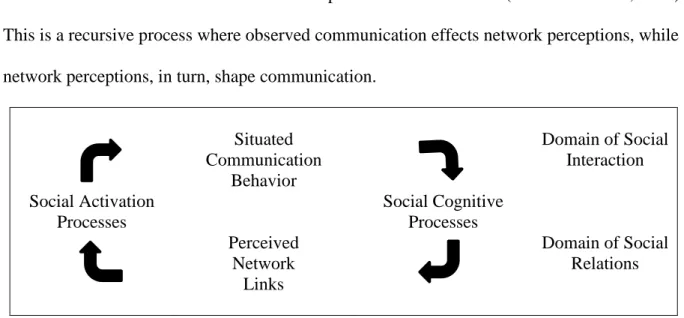
members’ communication, but then is also simultaneously shaped (or reshaped) by members’ communication. Figure 1 shows that perceived network links become evident in observable communication behavior through social activation processes, while social cognitive processes mediate the effects of the communication on perceived network links (Corman & Scott, 1994). This is a recursive process where observed communication effects network perceptions, while network perceptions, in turn, shape communication.
Situated Communication Behavior Domain of Social Interaction Social Activation Processes Social Cognitive Processes Perceived Network Links Domain of Social Relations
Figure 1. Relationship and mediating processes between observable communication and
perceived networks (Corman & Scott, 1994).
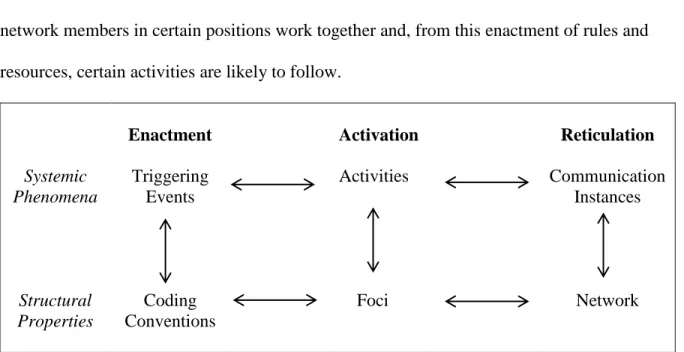
In order to “clarify the main dimensions of the duality of structure in interaction, relating knowledge capacities of agents to structural features” (Giddens, 1984, p. 28), Corman and Scott (1994) identified three key modalities: reticulation, activation, and enactment (see Figure 2).