Zurich Open Repository and Archive University of Zurich Main Library Strickhofstrasse 39 CH-8057 Zurich www.zora.uzh.ch Year: 2018
Dynamic ab initio Methods for Vibrational Spectroscopy
Luber, SandraAbstract: Our group focuses on the development of computational methods derived from quantum me-chanics and their application to a variety of challenging systems ranging from (bio-)molecules over coor-dination compounds to solar light-driven processes. In this review, we describe our recent activities for accurate calculation of spectroscopic properties. Emphasis is put on forefront methods for vibrational spectroscopy, in particular with respect to condensed phase systems, based on ab initio molecular dy-namics. This approach has several advantages compared to standard static approaches and proven to be a highly valuable tool for in-depth analysis of complex systems.
DOI: https://doi.org/10.2533/chimia.2018.328
Posted at the Zurich Open Repository and Archive, University of Zurich ZORA URL: https://doi.org/10.5167/uzh-162381
Journal Article Published Version Originally published at:
Luber, Sandra (2018). Dynamic ab initio Methods for Vibrational Spectroscopy. CHIMIA International Journal for Chemistry, 72(5):328-332.
*Correspondence: Prof. Dr. S. Luber Department of Chemistry C University of Zurich
Winterthurerstrasse 190, CH-8057 Zurich E-Mail: [email protected]
Dynamic
ab initio
Methods for Vibrational
Spectroscopy
Sandra Luber*
Abstract:Our group focuses on the development of computational methods derived from quantum mechanics and their application to a variety of challenging systems ranging from (bio-)molecules over coordination com-pounds to solar light-driven processes. In this review, we describe our recent activities for accurate calculation of spectroscopic properties. Emphasis is put on forefront methods for vibrational spectroscopy, in particular with respect to condensed phase systems, based onab initiomolecular dynamics. This approach has several advantages compared to standard static approaches and proven to be a highly valuable tool for in-depth analysis of complex systems.
Keywords: Chirality · Density functional theory · Interface · Molecular dynamics · Spectroscopy
Sandra Luber obtained her MSc de-gree in chemistry at ETH Zurich in 2007, followed by a PhD degree in (relativistic) quantum chemistry at ETH Zurich in 2009. After a post-doctoral stay at Biozentrum at the University of Basel (2010), she joined the Department of Chemistry at Yale University (2010–2011). She then worked for BASF SE in Germany (2012) before becoming project group leader at the University of Zurich. The habilitation thesis was finished in 2016, and she has been SNSF professor since 2017. Research awards include the IBM Research Prize for Computer Modelling and Simulations in Chemistry, Biology, and Materials Science and the ETH medal for an outstanding PhD thesis. Moreover, she has been the first the-oretician to receive the Clara Immerwahr
Award and the first female scientist to ob-tain the Hans G. A. Hellmann Award of the Arbeitsgemeinschaft Theoretische Chemie (awarded annually since 1999) and the Robin Hochstrasser Young Investigator Award for chemical physics. Additionally, she is the recipient of the Werner Prize 2018 of the Swiss Chemical Society. Her research focuses on the development and application of static and dynamic compu-tational methods at the interface of chemis-try, biology, physics, and materials science with an emphasis onab initiomethods.
1. Introduction
Modelling is nowadays an important tool and becomes even more and more im-portant in view of the fast growing power of computers and simulation methods. In the field of chemistry dealing with sys-tems on an atomic level, various methods derived from quantum mechanics have been developed in order to obtain detailed
and accurate insight into a wide range of properties and processes. For instance, in our group, we have, among others, focused on solar light-driven water splitting[1–12]for sustainable hydrogen production and in silicodesign for catalysis, which will be described in more detail in a forthcoming CHIMIA issue.
Calculations are often used in con-junction with experiments where they can not only confirm experimental findings but also provide essential additional in-formation not available from experiment. Ideally, computations are used at the first place to reliably predict chemical systems with certain desired properties (in silico
design) so that potentially expensive and hazardous experiments can be avoided. The knowledge gained from the detailed computational study of the properties and behaviour of the system of interest and its spectroscopic characterization lay the ground for profound structure–activity re-lationships paving the way for informed design of novel compounds (see Fig. 1). Image taken by
Alessandro Della Bella.
Fig. 1. Interplay between different research direc-tions pursued in our group: computational spectroscopy, study of functional com-pounds, andin silico
dynamics (MD) where the electronic and nuclear motions are decoupled in that sense that the time-independent electronic Schrödinger equation is solved by means of DFT for every nuclear configuration along the AIMD trajectory with the elec-trons being in the ground state.[30]The nu-clei move as classical particles according to Newton’s equation of motion in a poten-tial given by the Born–Oppenheimer po-tential energy surface evaluated by solving the electronic Schrödinger equation and corresponding electronic energy gradients at each nuclear configuration. Using DFT-based MD, the conformational phase space can be explored at ambient conditions, tak-ing into account realistic thermodynamic conditions and environmental effects as employed, for example, in experiment. Vibrational spectra can be obtained from MD trajectoriesviaFourier transformation of certain time correlation functions. This ansatz has the advantage that band shapes are directly obtained from the calculation and no artificial broadening needs to be ap-plied in contrast to the static approaches mentioned above. Additionally, certain an-harmonicity effects are included since no specific shape of the potential energy sur-face is assumed contrary to the harmonic approximation.[31]
Environmental effects and generally condensed phase systems can be treated in a reliable way by using periodic boundary conditions. A simulation box size, which is large enough to recover the bulk proper-ties of the solvent(s) far enough from the solute(s), ensures that the system contains enough solvent molecules to capture all interactions between the solvent(s) and solute molecule(s). A DFT-based MD ap-proach leads in general to a higher compu-tational cost, in particular due to the larger model systems containing more solvent molecules and the required sampling times (usually in the range of picoseconds), com-pared to a static calculation within the har-monic approximation dealing only with the solute in the gas phase or combined with approximate solvent continuum model and/or several explicit solvent molecules.
3. Novel Approaches Based on
ab initioMolecular Dynamics
3.1Efficient Analysis of Spectra of Complex Systems
IR spectra are obtained from MD simu-lations via time autocorrelation functions of the electric dipole moment (see ref. [31] and references cited therein). MD trajecto-ries provide a wealth of information due to the sampling of the conformational phase space and the typically quite large number of molecules in the simulation cell. In order to facilitate an analysis of the
correspond-Qj=L(j)·Rmw= M l=1 3 α=1 L(lαj)R mw lα , (2)
where the normal modeL(j) specifies the
motion of the nuclei corresponding toQj. In order to solve the electronic Schrödinger equation, Kohn–Sham DFT[18] is com-monly employed. It usually yields the best compromise between accuracy and com-putational effort and is also the method of choice for the calculations presented in this article.
2.Ab initioMolecular Dynamics for
Vibrational Spectroscopy
Employing DFT and the harmonic ap-proximation is currently the standard way to obtain vibrational spectra at a rather low computational cost. This comes with sev-eral drawbacks since the dynamics of the systems is not considered and anharmonic-ities are not included into the calculation. The system under study is assumed to be at its equilibrium structure,i.e.a geometry optimization is performed before the vibra-tional analysis assuming a temperature of 0 K, which can be in particular problematic for molecules with many conformational degrees of freedom and hydrogen-bonded systems. Since such calculations provide only vibrational frequencies and corre-sponding intensities (depending on the type of spectrum computed), band shapes are obtained by applying an artificial broadening after the vibrational calcula-tion. Certain anharmonic effects may be included using, for example, perturbation theory,[19–22] vibrational self-consistent field[23–26]or vibrational configuration in-teraction[23,24,27] approaches leading to a significantly higher computational effort. Moreover, the compound of interest is typically only optimized in gas phase. In a liquid environment, the effect of the sol-vent can be included by solsol-vent continuum models, which mimic solvation effects in an ‘average’ way.[28] However, such ap-proximate models are parameterized for specific test sets of molecules and have, for instance, difficulties to describe direct-ed bonds such as hydrogen bonds. Several explicit solvent molecules can additionally be included into the calculations in order to improve their description. This introduces a bias with respect to the exact position and number of solvent molecules employed in the static calculation,[7]which can remark-ably influence the calculated spectrum.[29]
A more sophisticated way is obtained fromabinitiomoleculardynamics(AIMD), which samples the conformational phase space, hydrogen-bonding dynamics, and other local geometric arrangements. We rely on Born–Oppenheimer molecular In chemical laboratories,
spectrosco-py is a default way to elucidate the com-pounds of interest, and a large variety of different methods have evolved. For in-stance, refinement procedures based on Kohn–Sham density functional theory (DFT), extended X-ray absorption fine structure calculations and/or computed Mössbauer parameters and experimental data have been developed to determine the detailed structure of the oxygen-evolving complex in nature’s photosystem II[13]and an enzyme,[14]respectively.
A highly valuable approach is vibra-tional spectroscopy, which has been ap-plied to systems in the gas and condensed phase. It can provide information about structures as well as associated dynamics as hase.g.been shown for proton-coupled electron transfer in the excited state.[15] Among the different techniques in vi-brational spectroscopy, infrared (IR) and Raman spectroscopy are the most common ones used experimentally. The spectra may in general easily be analyzed for structur-ally simple, small molecules but become increasingly crowded and complicated for larger compounds. Here, calculations are of great help for in-depth interpretation of spectra.
The usual way to calculate vibrational spectra in so-called ab initioapproaches is based on the Born–Oppenheimer ap-proximation,[16] which is derived in a non-relativistic framework from the time-independent Schrödinger equation, and the harmonic approximation.[17]Here, the electronic energy Eel(Rmw) derived from
the electronic Schrödinger equation is expanded in a Taylor series around the equilibrium structure (the minimum of the potential energy is set to the coordinate origin0for the sake of simplicity in the following): Eel(Rmw) = Eel(0) + M k=1 3 α=1 ∂Eel ∂Rmw kα 0 Rmw kα +1 2 M k=1 M l=1 3 α=1 3 β=1 ∂2Eel ∂Rmw kα∂R mw lβ 0 Rmw kαR mw lβ +. . . (1) M is the number of nuclei and the Greek subscripts refer to the Cartesian (x/y/z) di-rections. The mass-weighted coordinate of nucleus kwith mass mkin α direction is evaluated asRmw
kα =
√m
kRkα. In the harmonic
approximation, the expansion is truncated after the term containing the second deriv-atives of the electronic energy with respect to mass-weighted nuclear coordinatesRmw,
which is the so-called Hessian matrix. The first derivatives are zero due to the expan-sion around the equilibrium structure. Diagonalizing the Hessian matrix leads to eigenvectors which are built from linear combinations of the mass-weighted nu-clear coordinates and are so-called normal coordinatesQj,
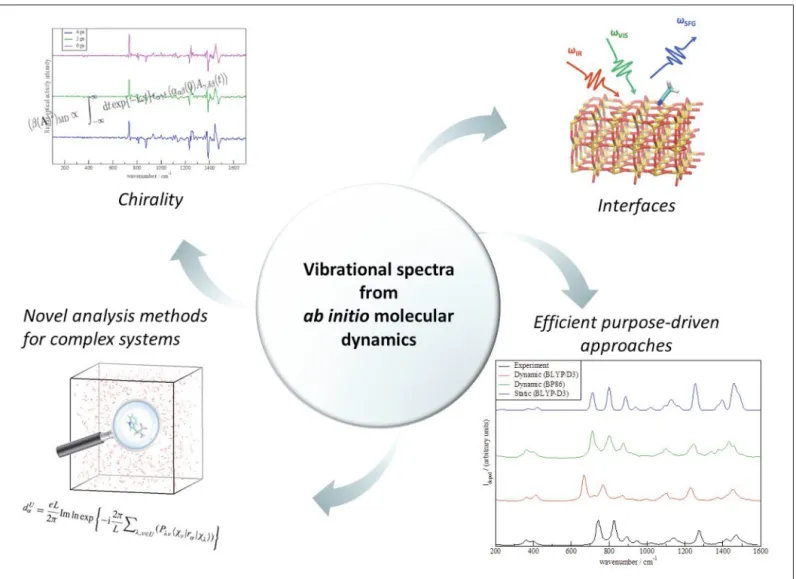
types of vibrational spectroscopy, which require properties beyond the electric di-pole moment. Only a few other types of vibrational spectra from AIMD have been published so far. This includes Raman spectroscopy for which the electric-dipole– electric-dipole polarizability is needed in order to calculate a spectrum. The latter can be obtained by numerical derivatives using the electric dipole moment in the presence of external electric fields.[31]A more accu-rate and computationally cheaper approach is based on perturbation theory. Using den-sity functional perturbation theory,[46] we have implemented an efficient approach into the CP2K package.[45] Furthermore, deeper analysis based on local properties such as inter- and intramolecular polariz-abilities is easily available (without the use of computationally more expensive MLWFs), giving desired supplemen-tary insight in the system under study.[45] An example is given in Fig. 2 for the liquid (S)-methyloxirane. The spectra obtained from AIMD agree very well with the one from experiment, in particular with respect to the band shapes. This is in contrast to electronic density of the whole system into
electronic densities of subsystems. The lat-ter are calculated with Kohn–Sham DFT[18] whereas the computationally cheaper, less accurate Hohenberg–Kohn formulation[41] can be used to treat the interactions be-tween the subsystems. Our derived expres-sion for local electric dipole moments for periodic systems allows a computationally efficient evaluation of local properties and detailed analysis of subsystems and their IR spectra.[42]Moreover, electrons do not need to be assigned to atoms and no approxima-tions are introduced via diagonalization/ localization as in the case of MLWFs, and neutral subsystems are automatically ob-tained. It has been applied to solvated mol-ecules, liquid mixtures, and molecules on surface[42](see Fig. 2).
3.2Raman and Raman Optical
Activity Spectroscopy
The calculation of IR spectra from AIMD relies on knowledge about electric dipole moments. This is in contrast to other ing vibrational spectra, it is preferable to
evaluate not only the electric dipole mo-ment of the whole simulation cell but also local properties such as local electric dipole moments. This allows access to the contri-butions of the different compounds/sub-systems in the simulation cell (e.g.of each molecule in a liquid) and provides a way for calculation of vibrational spectra for only the compounds/subsystems of interest. A particular difficulty for systems treated with periodic boundary conditions is the fact that the electric dipole moment operator is ill-defined. The calculation of local electric dipole moments is thus standardly based on maximally localized Wannier functions (MLWFs).[32,33]This requires a localization procedure, which is computationally not in-expensive, in particular within the Gaussian and plane waves approach[34,35]used in our AIMD calculations. Computationally more efficient approaches are therefore highly de-sirable. We have derived a novel approach based on subsystem DFT-embedding,[36–40] which allows computationally cheap access to local electric dipole moments The basic idea of DFT-embedding is to divide the
Fig. 2. Vibrational spectroscopy fromab initiomolecular dynamics: first DFT-based MD spectra for Raman optical activity spectroscopy (top, left-hand side; adapted from ref. [43]), SFG spectroscopy for interfaces (top, right-left-hand side; adapted from ref. [44]), novel analysis for local properties (bottom, left-hand side; see ref. [42] for further details), and efficient calculation of Raman spectra (bottom, right-hand side; adapted from ref. [45]).
4. Conclusion and Outlook
We have briefly reviewed our recent activities for the development of new com-putational approaches in the field of vibra-tional spectroscopy. Emphasis has been laid on forefront ab initiomolecular dy-namic methods, which, although coming in general with a higher computational cost than standard static ab initioapproaches, surpass the latter in several aspects, espe-cially due to inclusion of anharmonicities and band shapes in very good agreement with experiment. In particular, they have been shown to be essential for accurate modelling of compounds with high confor-mational flexibility and hydrogen-bonding dynamics and sophisticated inclusion of environmental and solvent effects in con-densed phase systems such as liquids. We have presented various novel, computa-tionally efficient directions ranging from calculation and in-depth analysis of IR and Raman spectra to chirality- and sur-face-sensitive approaches such as Raman optical activity and sum frequency genera-tion. These methodologies can be applied to a broad range of systems, both in the gas and condensed phase. This opens up exciting ways for thorough investigation and additional insight in a broad range of compounds such as proteins in solution, complex interfaces, and catalysts for func-tional processes.
Acknowledgment
The author thanks Thomas Bürgi and his co-workers at the University of Geneva for the collaboration on vibrational spectrosco-py. Funding by the University of Zurich, the Swiss National Science Foundation (grant no: PP00P2 170667), and the University Research Priority Program LightChEC is gratefully ac-knowledged. We thank the Swiss National Supercomputing Center for computing re-sources (project ID: s502, s745, and s788).
Received: February 25, 2018
[1] F. Evangelisti, R. Güttinger, R. Moré, S. Luber, G. R. Patzke,J. Am. Chem. Soc. 2013,135, 18734.
[2] F. Evangelisti, R. Moré F. Hodel, S. Luber, G. R. Patzke,J. Am. Chem. Soc.2015,137, 11076. [3] Y. Gurdal, S. Luber, J. Hutter, M. Iannuzzi,
Phys. Chem. Chem. Phys.2015,17, 22846. [4] F. Hodel, S. Luber,ACS Catal.2016,6, 1505. [5] F. Hodel, S. Luber,ACS Catal.2016,6, 6750. [6] F. Hodel, S. Luber,J. Chem. Theory Comput.
2017,13, 974.
[7] F. Hodel, P. Deglmann, S. Luber, J. Chem. Theory Comput.2017,13, 3348.
[8] M. Schilling, G. R. Patzke, J. Hutter, S. Luber,
J. Phys. Chem. C2016,120, 7966.
[9] F. Song, R. Moré, M. Schilling, G. Smolentsev, N. Azzaroli, S. Luber, G. R. Patzke, J. Am. Chem. Soc.2017,139, 14198.
[10] M. Schilling, F. H. Hodel, S. Luber,
ChemSusChem2017,10, 4561.
[11] D. Scherrer, T. Fox, R. Alberto, C. J. Richmond,
Dalton Trans.2016,45, 19361. bands could not be assigned to structural
features without computational analysis. In-depth evaluation of AIMD results, in particular with respect to dihedral angles, made clear that the achiral counterion pref-erably adopts an overall chiral conforma-tion due to the presence and strong inter-action with the chiral amino acid ion.[57] This in turn leads to additional bands in the ROA spectrum, which would not have been observed if the counterion would be achiral (induced chirality).
3.3Sum Frequency Generation
Besides variants of vibrational spec-troscopy probing chirality such as the above-mentioned ROA method, there are various other techniques depending on the system under study and the properties of interest. Interfaces, for instance, are omni-present in chemistry, be it a liquid–liquid, gas–liquid, gas–solid or liquid–solid in-terface. Sum frequency generation (SFG) becomes increasingly popular for the study of such interfaces giving precious insight into the structure and orientation of the molecules at the interface. SFG relies on a second-order nonlinear process result-ing from spatial and temporal overlap of two laser beams (one in the visible and one in the IR light range) at the interface. Computation of SFG signals requires the evaluation of nonlinear susceptibilities. Static DFT-based approaches and classi-cal molecular dynamics have been mostly employed for SFG computations whereas only a few AIMD calculations have been presented dealing with air–liquid,[58–60] liq-uid–liquid[61]or ice interfaces.[62]A com-putationally efficient approach for SFG is based on density functional perturbation theory, which made it possible to model the first SFG spectra involving a semiconduc-tor and a gas–solid interface.[44]As an ex-ample, gas acetonitrile molecules adsorbed on a TiO2(rutile) surface were chosen (see Fig. 2 and ref. [44] for more details), the latter being of high interest with respect to a variety of processes such as catalysis and design of functional materials for sus-tainable energy storage and conversion. Preferred orientation of the molecules on the rutile surface derived from our calcula-tions was found to be in good agreement with the one derived from empirical mod-elling and experiment.[63] As mentioned above, this dynamic ab initio approach comes with several advantages compared to static methods – such as consideration of the complex dynamics at interfaces at ambient conditions, inclusion of anhar-monicities, and band shapes without the need for artificial broadening – and paves the way for highly sought-after accurate modelling of SFG for interfaces, in par-ticular involving insulator/semiconductor surfaces.
the spectrum obtained from a standard static calculation in the harmonic approxi-mation, the band shapes of which show significant deviations from the ones from AIMD calculation and experimental data. Although the analysis of the AIMD trajec-tories showed that this liquid has no strong intermolecular interactions, this example demonstrates that a dynamic ab initio ap-proach is still required to have a profound description of the liquid and its dynamics influencing the vibrational spectrum.
For chiral molecules, Raman spec-troscopy has been extended to vibrational Raman optical activity (ROA) spectrosco-py,[47–50]leading in general to bands with positive and negative intensities (there may be certain cases,e.g.resonance with an electronically excited state, giving rise to monosignate spectra[51–53]). Compared to Raman spectroscopy, this gives thus ad-ditional information about the stereochem-istry of the system of interest. The com-putation of such spectra is more involved because polarizability tensors accounting for electric quadrupole and magnetic di-pole interactions are needed as well. The latter lead to additional complications due to possible origin dependence in calcula-tions. Using computationally efficient density functional perturbation theory, we have recently presented the first ROA cal-culations using the efficient Gaussian and plane waves approach and the first spectra completely derived from AIMD (see Fig. 2).[43] This approach has great potential opening up new ways for calculation of ROA spectra at ambient conditions con-sidering dynamics and anharmonicities in a natural way. Since its development about 30 years ago, ROA spectroscopy has mainly been applied to biomolecules in so-lution. Chiral transition metal complexes have attracted attention only recently (see refs. [53,54] for first ROA spectra in this field) though ROA for coordination com-pounds and solids as well as other variants like magnetic ROA hold great promise (see ref. [55] for the first review about this topic). One of the first experimental spectra for a chiral metal complex devoid of reso-nance with electronically excited state(s) has been measured in the group of T. Bürgi (University of Geneva).[56] Theoretical analysis based on AIMD showed that the solvent molecules strongly interact with the Rh-complex under study, and it was necessary to use solvation shells extracted from AIMD in order to reach good agree-ment with experiagree-mental data.[56] Another project where AIMD proved to be highly valuable has dealt with chiral ionic liquids. An ionic liquid consisting of chiral alanine anions and achiral counterions has been ex-perimentally investigated by P. Ouleveyet al.[57]The measured optical activity spectra had been difficult to interpret and several
[12] M. Gil-Sepulcre, M. Böhler, M. Schilling, F. Bozoglian, C. Bachmann, D. Scherrer, T. Fox, B. Spingler, C. Gimbert-Surinach, R. Alberto, X. Sala, S. Luber, C. J. Richmond, A. Llobet,
ChemSusChem2017,10, 4517.
[13] S. Luber, I. Rivalta, Y. Umena, K. Kawakami, J.-R. Shen, N. Kamiya, G. W. Brudvig, V. S. Batista,Biochemistry2011,50, 6308. [14] S. Luber, S. Leung, C. Herrmann, W. Han Du,
L. Noodleman, V. S. Batista, Dalton Trans.
2014,43, 576.
[15] S. Luber, K. Adamczyk, E. T. J. Nibbering, V. S. Batista,J. Phys. Chem. A2013,117, 5269. [16] M. Born, R. Oppenheimer,Ann. Phys.1927,84,
457.
[17] E. B. Wilson, Jr., J. C. Decius, P. C. Cross, ‘Molecular Vibrations’, McGraw-Hill: New York,1955.
[18] W. Kohn, L. J. Sham,Phys. Rev.1965,140, A1133.
[19] L. S. Norris, M. A. Ratner, A. E. Roitberg, R. B. Gerber,J. Chem. Phys.1996,105, 11261. [20] S. Dressler, W. Thiel,Chem. Phys. Lett.1997,
273, 71.
[21] M. Rosenstock, P. Rosmus, E. A. Reinsch, O. Treutler, S. Carter, N. C. Handy, Mol. Phys.
1998,93, 853.
[22] A. Miani, E. Cané, P. Palmieri, A. Trombetti, N. C. Handy,J. Chem. Phys.2000,112, 248. [23] J. M. Bowman,J. Chem. Phys.1978,68, 608. [24] K. M. Christoffel, J. M. Bowman,Chem. Phys.
Lett.1982,85, 220.
[25] N. J. Wright, R. B. Gerber, T. J. Tozer,Chem. Phys. Lett.2000,324, 206.
[26] G. M. Chaban, J. O. Jung, R. B. Gerber,J. Chem. Phys.1999,111, 1823.
[27] S. Carter, J. M. Bowman, N. C. Handy,Theor. Chem. Acc.1998,100, 191.
[28] B. Mennucci,J. Phys. Chem. Lett.2010,1, 1666. [29] S. Luber,J. Phys. Chem. A2013,117, 2760. [30] D. Marx, J. Hutter, ‘Ab initio Molecular
Dynamics: Basic Theory and Advanced
Methods’, Cambridge University Press,
Cambridge,2009.
[31] M. Thomas, M. Brehm, R. Fligg, P. Vöhringer, B. Kirchner,Phys. Chem. Chem. Phys.2013,
15, 6608.
[32] G. H. Wannier,Phys. Rev.1937,52, 191. [33] N. Marzari, D. Vanderbilt,Phys. Rev. B1997,
56, 12847.
[34] G. Lippert, J. Hutter, M. Parrinello,Mol. Phys.
1997,92, 477.
[35] J. VandeVondele, M. Krack, F. Mohamed, M. Parrinello, T. Chassaing, J. Hutter, Comput. Phys. Commun.2005,167, 103.
[36] R. G. Gordon, Y. S. Kim,J. Chem. Phys.1972,
56, 3122.
[37] Y. S. Kim, R. G. Gordon,J. Chem. Phys.1974,
60, 1842.
[38] G. Senatore, K. R. Subbaswamy,Phys. Rev. B
1986,34, 5754.
[39] P. Cortona,Phys. Rev. B1991,44, 8454. [40] T. A. Wesolowski, A. Warshel,J. Phys. Chem.
1993,97, 8050.
[41] P. Hohenberg, W. Kohn,Phys. Rev.1964,136, B864.
[42] S. Luber,J. Chem. Phys.2014,141,234110. [43] S. Luber,J. Chem. Theory Comput.2017,13,
1254.
[44] S. Luber,J. Phys. Chem. Lett.2016,7, 5183. [45] S. Luber, M. Iannuzzi, J. Hutter,J. Chem. Phys.
2014,141, 094503.
[46] A. Putrino, D. Sebastiani, M. Parrinello, J. Chem. Phys.2000,113, 7102.
[47] P. W. Atkins, L. D. Barron,Mol. Phys.1969,16, 453.
[48] L. D. Barron, A. D. Buckingham,Mol. Phys.
1971,20, 1111.
[49] W. Hug, S. Kint, G. Bailey, J. R. Scherer,J. Am. Chem. Soc.1975,97, 5589.
[50] L. D. Barron, M. P. Boogard, A. D. Buckingham,
J. Am. Chem. Soc.1973,95, 603. [51] L. A. Nafie,Chem. Phys.1996,205, 309. [52] S. Luber, J. Neugebauer, M. Reiher,J. Chem.
Phys.2010,132, 044113.
[53] S. Luber, M. Reiher,ChemPhysChem2010,11, 1876.
[54] S. Luber, M. Reiher,Chem. Phys.2008,346, 212. [55] S. Luber,Biomed. Spectrosc. Imaging2015,4,
255.
[56] M. Humbert-Droz, P. Oulevey, L. M. Lawson Daku, S. Luber, H. Hagemann, T. Bürgi,Phys. Chem. Chem. Phys.2014,16, 23260. [57] P. Oulevey, S. Luber, B. Varnholt, T. Bürgi,
Angew. Chem. Int. Ed.2016,55, 11787. [58] M. Sulpizi, M. Salanne, M. Sprik, M.-P.
Gaigeot,J. Phys. Chem. Lett.2013,4, 83. [59] T. Ohto, K. Usui, T. Hasegawa, M. Bonn, Y.
Nagata,J. Chem. Phys.2015,143, 124702. [60] T. Ohto, E. H. G. Backus, W. Mizukami, J.
Hunger, M. Bonn, Y. Nagata,J. Phys. Chem. C
2016,120, 17435.
[61] T. Ohto, E. H. G. Backus, C.-S. Hsieh, M. Sulpizi, M. Bonn, Y. Nagata, J. Phys. Chem. Lett.2015,6, 4499.
[62] Q. Wan, G. Galli,Phys. Rev. Lett.2015,115, 246404.
[63] J. H. Jang, F. Lydiatt, R. Linday, S. Baldelli,J. Phys. Chem. A2013,117, 6288.