WEED SCIENCE
Assessing the Potential for Fluridone to Reduce the Number of Postemergence
Herbicide Applications in Glyphosate-Resistant Cotton
Zachary T. Hill*, Jason K. Norsworthy, L. Tom Barber, and Edward Gbur
Z.T. Hill and J.K. Norsworthy, University of Arkansas, Department of Crop, Soils, and Environmental Sciences, 1366 West Altheimer Drive, Fayetteville, AR 72701; L.T.
Barber, University of Arkansas, Department of Crop, Soils, and Environmental Sciences, 102 Northeast Front Street Suite 2, Lonoke, AR 72086; and E. Gbur, University of Arkansas, Agriculture Statistics Lab, 935 West Maple Street,
Fayetteville, AR 72701
*Corresponding author: [email protected] ABSTRACT
With the evolution of glyphosate-resistant weeds, cotton producers now rely on multiple applications of soil-residual herbicides tank-mixed with postemergence (POST) herbicides. However, the current soil-residual herbicides represent a relatively low number of herbicide mechanisms of action (MOAs), with the same few MOAs being utilized year after year. There-fore, it is important to introduce new MOAs to slow the likelihood of further resistance
de-velopment. A field experiment was conducted in 2012 and 2013 to determine if fluridone, a
bleaching herbicide currently not used in any agronomic cropping system, applied
preemer-gence (PRE) would provide effective season-long
control of Palmer amaranth as well as reduce the number of POST applications throughout the season. Fluridone PRE at 224, 336, and 448 g ai ha-1 did not eliminate the need for POST herbicides for Palmer amaranth control in cot-ton in either year. Fluridone, regardless of rate,
provided comparable control to fluometuron in 2012; however in 2013, fluometuron provided less control than fluridone. Although moder -ate season-long control was observed in 2013, greater seed cotton yields were obtained in 2013 than in 2012, which is likely a result of greater control during the critical period for weed
control. Based on this experiment, fluridone will not provide effective season-long Palmer
amaranth control in the absence of a multiple POST-herbicide program.
P
rior to the commercialization of glyphosate-resistant (GR) crops in 1997, weed management in cotton (Gossypium hirsutum L.) relied upon combining several factors: 1) multiple soil-residual herbicide applications, 2) multiple POST-herbicide applications, and 3) tillage (Burke et al., 2005; Young, 2006). Since then, the adoption of this technology has increased from 37% utilization in 2000 to almost 100% utilization by 2011 (Norsworthy et al., 2011; USDA NASS, 2000, 2011). For several years following GR cotton commercialization, producers were limited to applying glyphosate before the four-leaf cotton growth stage; however, enhanced GR cotton was commercialized allowing multiple applications of glyphosate throughout the growing season in 2006(Huff et al., 2010). Additional benefits of utilizing
GR technology included less reliance on tillage, reduced herbicide costs, and minimal crop injury
(Young, 2006). However, the benefits of a GR crop
lead to producers relying on glyphosate as a sole means of weed control. With time, the evolution of GR weeds was inevitable (Culpepper et al., 2006).
Currently, 14 weeds have been confirmed resistant
to glyphosate in the U.S. (Heap, 2015), seven of which can be found in Arkansas (Heap, 2015).
Palmer amaranth (Amaranthus palmeri S. Wats.) has become the most troublesome GR weed across the southern U.S., due in part, to its extended emer-gence period (Jha and Norsworthy, 2009; Jha et al.,
2006) and prolific growth capabilities (Norsworthy et al., 2008; Sellers et al., 2003). This prolific growth
rate allows Palmer amaranth to reach heights greater than 2 m (Horak and Loughin, 2000), which exceeds the heights of soybean [Glycine max (L.) Merr.] and cotton. As a dioecious plant, female plants are easily distinguishable from male plants with a thick, spiked
inflorescence up to 0.5 m in length and sharp bracts throughout the inflorescence (Horak and Peterson,
Palmer amaranth allows for the GR trait to rapidly
spread across a field and larger geographies. As a
result of these characteristics, Palmer amaranth can be extremely competitive with agronomic crops such as cotton, with cotton lint yield reductions up to 92% at 0.9 plants m-2 (Rowland et al., 1999).
The standard cotton weed management program for GR cotton in Arkansas consists of seven to nine herbicides applied periodically throughout the sea-son. These include burndown, preemergence, pos-temergence, post-directed, and layby applications. Previous research has reported that the exclusion of soil-residual herbicides at the layby application could allow late-season weed interference, for which the likelihood of cotton lint yield reduction is highly probable (Tingle and Chandler, 2004).
Most of the herbicides that make up the standard cotton weed management program in Arkansas are soil-residual herbicides belonging to multiple herbi-cide method of action (MOA)s. Weed Science
Soci-ety of America (WSSA) Group 7 (fluometuron and diuron), Group 14 (fomesafen and flumioxazin), and
Group 15 (metolachlor and acetochlor) herbicides are heavily relied upon for residual weed control in cotton. With the high propensity for Palmer amaranth to evolve resistance to herbicides, it would be
ben-eficial to use another effective MOA for its control
in cotton, especially because the aforementioned herbicides also are used commonly in soybean.
Developed as EL-171 in the early 1970s, flu
-ridone is a pigment inhibitor classified as a WSSA
Group 12 herbicide (Waldrep and Taylor, 1976) that has been used extensively to control submersed and
floating weeds in aquatic environments (Richardson, 2008). Though fluridone was extensively tested in
cotton, registration for use was not pursued.
How-ever, fluridone PRE at 0.3 to 2.4 kg ai ha-1 did not
injure cotton and controlled annual grass and broad-leaf weeds such as barnyardgrass (Echinocloa crus-galli L. Beauv), johnsongrass (Sorghum halepense L.), tall morningglory (Ipomoea purpurea L. Roth), and redroot pigweed (Amaranthus retroflexus L.) (Waldrep and Taylor, 1976).
Considering fluridone is a Group 12 herbicide
that currently is not used in cotton, has lengthy soil persistence (Banks et al. 1979; Shea and Weber, 1983), and activity on many grass and broadleaf weeds, it is important to determine if this herbicide can be incorporated into a cotton weed management program. Therefore, the objective of this experiment
was to evaluate the efficacy of PRE-applied fluridone
compared to fluometuron. Additionally, fluridone and fluometuron were used to determine the number of POST-herbicide applications needed for effective
weed control in GR cotton.
MATERIALS AND METHODS
Field experiments were conducted in 2012 and 2013 at the Lon Mann Cotton Research Center in
Marianna, AR, on a Zachary silt loam soil (fine-silty, mixed, active, thermic Typic Albaqualfs) with 8%
sand, 80% silt, 12% clay, 1.8% organic matter, and a pH of 6.9. The experimental design was a random-ized complete block design in a two-factor factorial arrangement of treatments replicated four times. The two factors were four PRE-herbicide treatments and
five POST treatments.
PRE-herbicide treatments included fluome-turon at 1,120 g ai ha-1 and fluridone at 224, 336,
and 448 g ha-1 applied immediately after planting.
The POST-herbicide treatments included: 1) no POST herbicide (hereafter referred to as NO POST), 2) monosodium acid methanarsonate (MSMA) at 2,240 g ai ha-1 plus flumioxazin at 72 g ai ha-1
ap-plied post-directed/layby (PDIR/LAYBY) (here-after referred to as 1-POST), 3) glyphosate at 840 g ae ha-1plus prometryn at 1,120 g ai ha-1 applied
to 8- to 10-leaf cotton followed by MSMA plus
flumioxazin (PDIR/LAYBY) (hereafter referred
to as 2-POST), 4) glyphosate plus S-metolachlor at 1,070 g ai ha-1 applied to 4- to 5-leaf cotton
fol-lowed by glyphosate plus prometryn to 8- to 10-leaf
cotton followed by MSMA plus flumioxazin (PDIR/
LAYBY) (hereafter referred to as 3-POST), and 5) glyphosate plus S-metolachlor (2-leaf) followed by glyphosate plus S-metolachlor (4- to 5-leaf) followed by glyphosate plus prometryn (8- to
10-leaf) followed by MSMA plus flumioxazin (PDIR/
LAYBY) (hereafter referred to as 4-POST). A nontreated control was included for comparison. Plot size was 7.6 m long with four 0.96-m rows in both years. Herbicide treatments were applied with a CO2-pressurized backpack sprayer calibrated to
deliver 140 L ha-1 at 276 kPa using TeeJet 110015
flat-fan nozzles (TeeJet Technologies, Springfield,
IL). The PDIR/LAYBY treatments were applied using the same CO2-pressurized backpack sprayer
setup equipped with TeeJet 110015 flat-fan drop
Phytogen 375 (Widestrike®, Genuity®, Roundup
Ready Flex®) was seeded at 11 seeds m-1 row on 9 May
2012 and 16 May 2013. Cotton was seeded 2.5-cm deep in both years. All studies were conducted using no-till methods with standard cotton production practices.
Control of barnyardgrass, broadleaf signalgrass [Urochloa platyphylla (Nash) R.D. Webster], Palmer amaranth, and pitted morningglory (Ipomoea lacunosa L.) was evaluated. In both years, the test site contained a natural population of mixed GR and GR-susceptible Palmer amaranth. For the four evaluated weeds, plant populations and heights were recorded in the nontreated plot immediately following each POST application. In both years, Palmer amaranth populations averaged be-tween 40 to 50 plants m-2; with heights ranging between
8 to 25 cm at the second POST timing, 38 to 45 cm at the third POST timing, and 50 to 60 cm at the fourth POST timing. Pitted morningglory populations aver-aged between 24 to 28 plants m-2; with height ranging
between 8 to 20 cm at the second POST timing, 76 to 81 cm at the third POST timing, and 91 to 121 cm at the fourth POST timing. Barnyardgrass populations averaged between 20 to 35 plants m-2; with heights
ranging between 15 to 25 cm at the second POST tim-ing, 30 to 38 cm at the third POST timtim-ing, and 45 to 60 cm at the fourth POST timing. Broadleaf signalgrass populations averaged between 8 to 30 plants m-2; with
heights ranging between 15 to 20 cm at the second POST timing, 25 to 30 cm at the third POST timing, and 38 to 45 cm at the fourth POST timing.
Plots were visually evaluated every 7 to 14 days after treatment (DAT) for weed control and cotton injury on a scale of 0 to 100%, with 0 being no control or injury and 100% being plant or crop death; however, only the 3 and 12 weeks after planting (WAP)
evalua-tions are presented. Seed cotton yield was determined by harvesting the center two rows of plots using
con-ventional harvesting equipment on 2 November 2012
and on 25 October 2013.
All data were analyzed by ANOVA using JMP Pro Version 10.0 (SAS Institute Inc., Cary, NC), and means
were separated with Fisher’s LSD (α = 0.05). Due to
observed interactions with year, treatments were ana-lyzed separately for 2012 and 2013. Seven preplanned
contrasts were constructed to compare: 1) fluridone
PRE at 224 g ha-1 vs. fluometuron, 2) fluridone PRE at
336 g ha-1 vs. fluometuron, 3) fluridone PRE at 448 g
ha-1 vs. fluometuron, 4) 4-POST program vs. 3-POST
program, 5) 4-POST program vs. 2-POST program, 6) 4-POST program vs. 1-POST program, 7) 4-POST
program vs. NO-POST program, with differences
reported at a p ≤ 0.05.
RESULTS AND DISCUSSION
Environmental Data and Cotton Growth. In
2012, PRE-herbicide treatments received insufficient
precipitation for proper activation, which decreased weed control. In an attempt to overcome the lack of precipitation, furrow-irrigation was utilized with 1
wk after the first POST application. However, early
season cotton growth was slowed as a result of the limited precipitation, particularly in herbicide pro-grams lacking an early POST application.
In 2013, timely precipitation was received through-out the growing season, with approximately 5 cm of rainfall received within days of the PRE-herbicide
ap-plications. Furthermore, cotton growth benefited from the frequent precipitation and irrigation events received
throughout the 2013 growing season. Regardless of
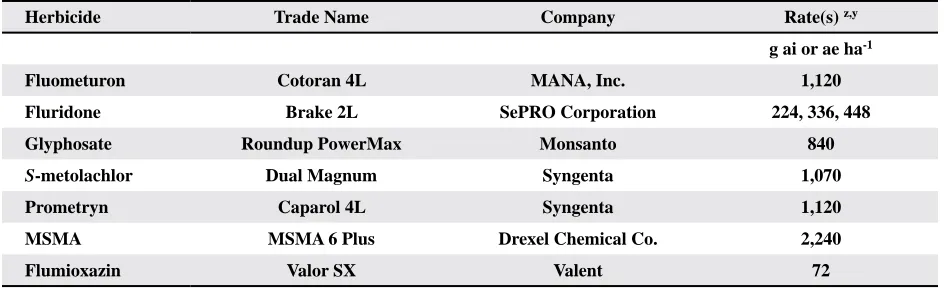
Table 1. Herbicide products used, production company, and application rate of treatments applied at the Lon Mann Cotton Research Center near Marianna, AR in 2012 and 2013
Herbicide Trade Name Company Rate(s) z,y
g ai or ae ha-1
Fluometuron Cotoran 4L MANA, Inc. 1,120
Fluridone Brake 2L SePRO Corporation 224, 336, 448
Glyphosate Roundup PowerMax Monsanto 840
S-metolachlor Dual Magnum Syngenta 1,070
Prometryn Caparol 4L Syngenta 1,120
MSMA MSMA 6 Plus Drexel Chemical Co. 2,240
Flumioxazin Valor SX Valent 72
provided 75 to 85% control of Palmer amaranth, which was greater than POST programs containing two or fewer timings (11-65%). However, Palmer amaranth control 12 WAP following the 3-POST pro-gram was comparable to the 4-POST propro-gram. Scott
et al. (2002) emphasized the need for an effective
POST herbicide to be tank-mixed with soil-residual herbicides in cotton to provide extended control of Palmer amaranth, most importantly in instances where soil-residual herbicides are not activated. precipitation amounts during the season, no cotton
injury was observed either year (data not shown).
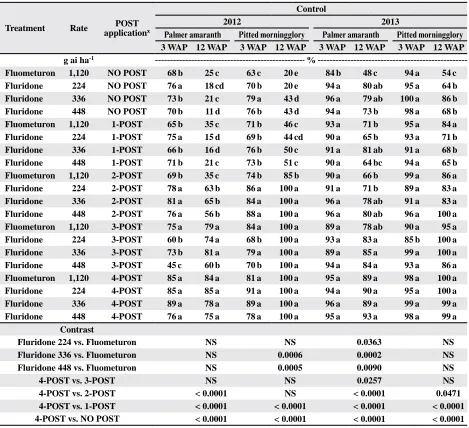
Palmer Amaranth and Pitted Morningglory Control. No PRE treatment provided greater than 80% control of Palmer amaranth at 3 WAP in 2012 (Table 2), which was due to the lack of activating precipitation. Regardless of the POST application
timings, little to no differences were observed be
-tween fluometuron and fluridone at all rates PRE.
Averaged over PRE herbicides, the 4-POST program
Table 2. Palmer amaranth and pitted morningglory control as influenced by preemergence herbicide and postemergence
application timing at the Lon Mann Cotton Research Center near Marianna, AR in 2012 and 2013z,y
Treatment Rate POST
applicationx
Control
2012 2013
Palmer amaranth Pitted morningglory Palmer amaranth Pitted morningglory
3 WAP 12 WAP 3 WAP 12 WAP 3 WAP 12 WAP 3 WAP 12 WAP
g ai ha-1 %
Fluometuron 1,120 NO POST 68 b 25 c 63 c 20 e 84 b 48 c 94 a 54 c
Fluridone 224 NO POST 76 a 18 cd 70 b 20 e 94 a 80 ab 95 a 64 b
Fluridone 336 NO POST 73 b 21 c 79 a 43 d 96 a 79 ab 100 a 86 b
Fluridone 448 NO POST 70 b 11 d 76 b 43 d 94 a 73 b 98 a 68 b
Fluometuron 1,120 1-POST 65 b 35 c 71 b 46 c 93 a 71 b 95 a 84 a
Fluridone 224 1-POST 75 a 15 d 69 b 44 cd 90 a 65 b 93 a 71 b
Fluridone 336 1-POST 66 b 16 d 76 b 50 c 91 a 81 ab 91 a 68 b
Fluridone 448 1-POST 71 b 21 c 73 b 51 c 90 a 64 bc 94 a 65 b
Fluometuron 1,120 2-POST 69 b 35 c 74 b 85 b 90 a 66 b 99 a 86 a
Fluridone 224 2-POST 78 a 63 b 86 a 100 a 91 a 71 b 89 a 83 a
Fluridone 336 2-POST 81 a 65 b 84 a 100 a 96 a 78 ab 91 a 83 a
Fluridone 448 2-POST 76 a 56 b 88 a 100 a 96 a 80 ab 96 a 100 a
Fluometuron 1,120 3-POST 75 a 79 a 84 a 100 a 89 a 78 ab 90 a 95 a
Fluridone 224 3-POST 60 b 74 a 68 b 100 a 93 a 83 a 85 b 100 a
Fluridone 336 3-POST 73 b 81 a 79 a 100 a 89 a 85 a 99 a 100 a
Fluridone 448 3-POST 45 c 60 b 70 b 100 a 94 a 84 a 93 a 86 a
Fluometuron 1,120 4-POST 85 a 84 a 81 a 100 a 95 a 89 a 98 a 100 a
Fluridone 224 4-POST 85 a 85 a 91 a 100 a 94 a 90 a 95 a 100 a
Fluridone 336 4-POST 89 a 78 a 89 a 100 a 96 a 89 a 99 a 99 a
Fluridone 448 4-POST 76 a 75 a 78 a 100 a 95 a 93 a 98 a 99 a
Contrast
Fluridone 224 vs. Fluometuron NS NS 0.0363 NS
Fluridone 336 vs. Fluometuron NS 0.0006 0.0002 NS
Fluridone 448 vs. Fluometuron NS 0.0005 0.0090 NS
4-POST vs. 3-POST NS NS 0.0257 NS
4-POST vs. 2-POST < 0.0001 NS < 0.0001 0.0471
4-POST vs. 1-POST < 0.0001 < 0.0001 < 0.0001 < 0.0001
4-POST vs. NO POST < 0.0001 < 0.0001 < 0.0001 < 0.0001
z Means within a column followed by the same lowercase letter are not statistically different based on Fisher’s LSD (0.05). y Preemergence herbicides were applied the day of cotton planting.
x Timing of POST applications: (4-POST) glyphosate plus S-metolachlor (2-lf) followed by glyphosate plus S-metolachlor
(4- to 5-lf) followed by glyphosate plus prometryn (8- to 10-lf directed) followed by MSMA plus flumioxazin (Layby
directed); (3-POST) glyphosate plus S-metolachlor (4- to 5-lf) followed by glyphosate plus prometryn (8- to 10-lf
directed) followed by MSMA plus flumioxazin (Layby directed); (2-POST) glyphosate plus prometryn (8- to 10-lf directed) followed by MSMA plus flumioxazin (Layby directed); (1-POST) MSMA plus flumioxazin (Layby directed).
Overall initial control of Palmer amaranth in 2013 was greater than 2012. This is likely a result of better activation of soil-residual her-bicides within seven days of application. Three
WAP, all PRE herbicide programs provided ≥
89% control of Palmer amaranth control except
for fluometuron alone with 84% control (Table 2).
By 12 WAP, variable control of Palmer amaranth (48-93%) was observed across the herbicide pro-grams. When no POST herbicide was applied, no
differences were observed among fluridone rates
for Palmer amaranth control 12 WAP (73-80%)
and all rates of fluridone provided greater control than fluometuron PRE (48%). This difference in
control is likely a result of the extended residual
control of fluridone on Amaranthus weeds as noted previously (Waldrep and Taylor, 1976). However,
no differences were observed between fluridone and fluometuron when followed by a POST her -bicide application (Table 2). Contrasts revealed that a 4-POST program provided greater Palmer amaranth control than any other POST program.
Similar to Palmer amaranth control in 2012, pitted morningglory control was variable (63-91%) depending on the number of POST herbi-cides applied 3 WAP (Table 2). In the absence of
a POST, fluridone PRE provided 70 to 79% pitted morningglory control, whereas fluometuron pro -vided only 63% control 3 WAP. Greater activity of
fluridone over fluometuron on pitted morningglory
was evident based on contrasts. However, multiple POST applications were necessary to achieve ef-fective control of pitted morningglory throughout the growing season.
In 2013, greater than 90% pitted morningglory control was observed at 3 WAP from most of the treatments (Table 2). These data suggests that when fully activated, soil-residual herbicides like
fluridone and fluometuron can provide moderate to effective early season control of pitted morning -glory. By 12 WAP, pitted morningglory control ranged from 86 to 100% when PRE herbicides were followed by 3- or 4-POST applications. Similarly, contrasts revealed that pitted morningglory control following the 4-POST program was superior to all programs that had two or fewer POST applica-tions. Most of the POST applications contained glyphosate, and Scott et al. (2002) reported that the addition of glyphosate with soil-residual herbicides
was beneficial for providing effective control of
multiple Ipomoea spp. in cotton.
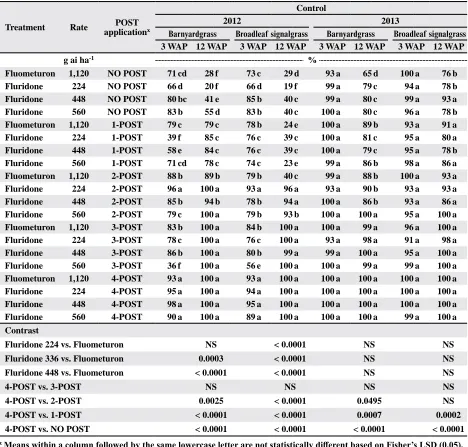
Barnyardgrass and Broadleaf Signalgrass Control. Barnyardgrass and broadleaf signalgrass control in this experiment were similar (Table 3). In both years, barnyardgrass and broadleaf signalgrass control were greater following the use of glyphosate in one or more of the POST applications. Similarly, previous research has shown that an application of S-metolachlor with glyphosate can provide excellent season-long control of barnyardgrass (Scroggs et al., 2007). In 2012, greater barnyardgrass at 12 WAP was
obtained when fluridone was applied at either 336
or 448 g ha-1 than fluometuron PRE. Differences
in barnyardgrass and broadleaf signalgrass control
with fluridone and fluometuron were not observed
12 WAP in 2013.
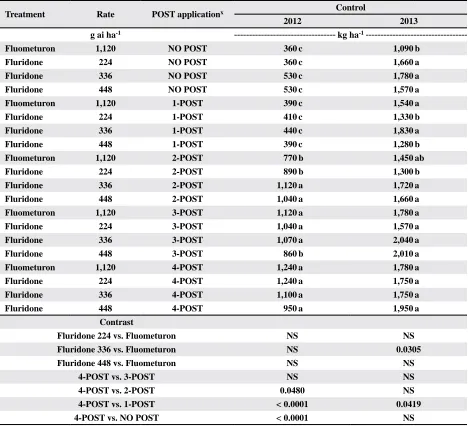
Seed Cotton Yield. Due to poor activating rainfall in 2012, herbicide programs that did not contain multiple POST-herbicide applications had
a significant decrease in cotton yield (Table 4).
The shading of cotton by Palmer amaranth greatly contributed to the low cotton yields observed in 2012. In 2013, cotton yields were improved with
no differences between the PRE treatments when
followed by either 3-POST or 4-POST programs (Table 3).
Seed cotton yield following fluridone-based
programs was similar to most fluometuron-containing programs over both years (Table 4). Furthermore, the value and need for multiple POST applications to protect against cotton yield reductions from weed interference was apparent in the drier year when the programs having 4-POST applications resulted in greater yield than those having 2-POST applications or fewer. In 2013, when the PRE-applied herbicides were activated, the need for POST herbicides to protect against cotton yield loss was less obvious, with only the 1-POST program having lower yields than the 4-POST program.
Fluridone and fluometuron require activation
by rainfall or overhead-irrigation following appli-cation. Although not evaluated in these studies, it is
important to note that the specific amount of rainfall
or irrigation needed for optimum activation can
differ between these two herbicides (unpublished data). Regardless of sufficient rainfall following application, fluridone-based herbicide programs pro
-vided equal to or superior weed control compared to fluometuron-based programs. Although fluridone has
of time (Banks et al., 1979), as well as provide an extended level of control of redroot pigweed
(Wal-drep and Taylor, 1976), fluridone PRE alone will
not provide season-long control of Palmer amaranth and supplemental POST applications will continue to be needed. In both years, Palmer amaranth was present at crop harvest, regardless of the intensity
of the weed control program. Producers should be
reminded frequently that escapes persisting through
harvest will greatly contribute to the soil seedbank and further spread of herbicide resistance (Norswor-thy et al., 2014); hence, alternative methods such as hand removal or other means of preventing seed additions to the seedbank might be needed.
Table 3. Barnyardgrass and broadleaf signalgrass control as influenced by preemergence herbicide and postemergence
application timing at the Lon Mann Cotton Research Center near Marianna, AR in 2012 and 2013z,y
Treatment Rate POST
applicationx
Control
2012 2013
Barnyardgrass Broadleaf signalgrass Barnyardgrass Broadleaf signalgrass
3 WAP 12 WAP 3 WAP 12 WAP 3 WAP 12 WAP 3 WAP 12 WAP
g ai ha-1 %
Fluometuron 1,120 NO POST 71 cd 28 f 73 c 29 d 93 a 65 d 100 a 76 b
Fluridone 224 NO POST 66 d 20 f 66 d 19 f 99 a 79 c 94 a 78 b
Fluridone 448 NO POST 80 bc 41 e 85 b 40 c 99 a 80 c 99 a 93 a
Fluridone 560 NO POST 83 b 55 d 83 b 40 c 100 a 80 c 96 a 78 b
Fluometuron 1,120 1-POST 79 c 79 c 78 b 24 e 100 a 89 b 93 a 91 a
Fluridone 224 1-POST 39 f 85 c 76 c 39 c 100 a 81 c 95 a 80 a
Fluridone 448 1-POST 58 e 84 c 76 c 39 c 100 a 79 c 95 a 78 b
Fluridone 560 1-POST 71 cd 78 c 74 c 23 e 99 a 86 b 98 a 86 a
Fluometuron 1,120 2-POST 88 b 89 b 79 b 40 c 99 a 88 b 100 a 93 a
Fluridone 224 2-POST 96 a 100 a 93 a 96 a 93 a 90 b 93 a 93 a
Fluridone 448 2-POST 85 b 94 b 78 b 94 a 100 a 86 b 93 a 86 a
Fluridone 560 2-POST 79 c 100 a 79 b 93 b 100 a 100 a 95 a 100 a
Fluometuron 1,120 3-POST 83 b 100 a 84 b 100 a 100 a 99 a 96 a 100 a
Fluridone 224 3-POST 78 c 100 a 76 c 100 a 93 a 98 a 91 a 98 a
Fluridone 448 3-POST 86 b 100 a 80 b 99 a 99 a 100 a 95 a 100 a
Fluridone 560 3-POST 36 f 100 a 56 e 100 a 100 a 99 a 99 a 100 a
Fluometuron 1,120 4-POST 93 a 100 a 93 a 100 a 100 a 100 a 100 a 100 a
Fluridone 224 4-POST 95 a 100 a 94 a 100 a 100 a 100 a 100 a 100 a
Fluridone 448 4-POST 98 a 100 a 95 a 100 a 100 a 100 a 100 a 100 a
Fluridone 560 4-POST 90 a 100 a 89 a 100 a 100 a 100 a 99 a 100 a
Contrast
Fluridone 224 vs. Fluometuron NS < 0.0001 NS NS
Fluridone 336 vs. Fluometuron 0.0003 < 0.0001 NS NS
Fluridone 448 vs. Fluometuron < 0.0001 < 0.0001 NS NS
4-POST vs. 3-POST NS NS NS NS
4-POST vs. 2-POST 0.0025 < 0.0001 0.0495 NS
4-POST vs. 1-POST < 0.0001 < 0.0001 0.0007 0.0002
4-POST vs. NO POST < 0.0001 < 0.0001 < 0.0001 < 0.0001
z Means within a column followed by the same lowercase letter are not statistically different based on Fisher’s LSD (0.05). y Preemergence herbicides were applied the day of cotton planting.
x POST timing applications: (4-POST) glyphosate plus S-metolachlor (2-lf) followed by glyphosate plus S-metolachlor
(4- to 5-lf) followed by glyphosate plus prometryn (8- to 10-lf directed) followed by MSMA plus flumioxazin (Layby
directed); (3-POST) glyphosate plus S-metolachlor (4- to 5-lf) followed by glyphosate plus prometryn (8- to 10-lf
directed) followed by MSMA plus flumioxazin (Layby directed); (2-POST) glyphosate plus prometryn (8- to 10-lf directed) followed by MSMA plus flumioxazin (Layby directed); (1-POST) MSMA plus flumioxazin (Layby directed).
ACKNOWLEDGMENT
This research was supported by SePRO Corporation.
REFERENCES
Banks, P.A., M.L. Ketchersid, and M.G. Merkle. 1979. The
persistence of fluridone in various soils under field and
controlled conditions. Weed Sci. 27:631–633.
Burke, I.C., S.C. Troxler, S.D. Askew, J.W. Wilcut, and W.D. Smith. 2005. Weed management systems in glyphosate-resistant cotton. Weed Technol. 19:422–429.
Culpepper SA, Grey TL, Vencill WK, Kichler JM, Webster TM, Brown SM, York AC, Davis JW, Hanna WW (2006) Glyphosate-resistant Palmer amaranth (Amaranthus palmeri) confirmed in Georgia. Weed Sci 54:620-626
Table 4. Seed cotton yield at the Lon Mann Cotton Research Center near Marianna, AR in 2012 and 2013z,y
Treatment Rate POST applicationx Control
2012 2013
g ai ha-1 kg ha-1
Fluometuron 1,120 NO POST 360 c 1,090 b
Fluridone 224 NO POST 360 c 1,660 a
Fluridone 336 NO POST 530 c 1,780 a
Fluridone 448 NO POST 530 c 1,570 a
Fluometuron 1,120 1-POST 390 c 1,540 a
Fluridone 224 1-POST 410 c 1,330 b
Fluridone 336 1-POST 440 c 1,830 a
Fluridone 448 1-POST 390 c 1,280 b
Fluometuron 1,120 2-POST 770 b 1,450 ab
Fluridone 224 2-POST 890 b 1,300 b
Fluridone 336 2-POST 1,120 a 1,720 a
Fluridone 448 2-POST 1,040 a 1,660 a
Fluometuron 1,120 3-POST 1,120 a 1,780 a
Fluridone 224 3-POST 1,040 a 1,570 a
Fluridone 336 3-POST 1,070 a 2,040 a
Fluridone 448 3-POST 860 b 2,010 a
Fluometuron 1,120 4-POST 1,240 a 1,780 a
Fluridone 224 4-POST 1,240 a 1,750 a
Fluridone 336 4-POST 1,100 a 1,750 a
Fluridone 448 4-POST 950 a 1,950 a
Contrast
Fluridone 224 vs. Fluometuron NS NS
Fluridone 336 vs. Fluometuron NS 0.0305
Fluridone 448 vs. Fluometuron NS NS
4-POST vs. 3-POST NS NS
4-POST vs. 2-POST 0.0480 NS
4-POST vs. 1-POST < 0.0001 0.0419
4-POST vs. NO POST < 0.0001 NS
z Means within a column followed by the same lowercase letter are not statistically different based on Fisher’s LSD (0.05). y Preemergence herbicides were applied the day of cotton planting.
x POST timing applications: (4-POST) glyphosate plus S-metolachlor (2-lf) followed by glyphosate plus S-metolachlor
(4- to 5-lf) followed by glyphosate plus prometryn (8- to 10-lf directed) followed by MSMA plus flumioxazin (Layby
directed); (3-POST) glyphosate plus S-metolachlor (4- to 5-lf) followed by glyphosate plus prometryn (8- to 10-lf
directed) followed by MSMA plus flumioxazin (Layby directed); (2-POST) glyphosate plus prometryn (8- to 10-lf directed) followed by MSMA plus flumioxazin (Layby directed); (1-POST) MSMA plus flumioxazin (Layby directed).
Heap, I. 2015. The International Survey of Herbicide Resis-tant Weeds. Available online at http://www.weedscience. com (verified 28 June 2017).
Horak, M.J., and D.E. Peterson. 1995. Biotypes of Palmer amaranth (Amaranthus palmeri) and common water-hemp (Amaranthus rudis) are resistant to imazethapyr and thifensulfuron. Weed Technol. 9:192–195. Horak, M.J., and T.M. Loughin. 2000. Growth analysis of
four Amaranthus species. Weed Sci. 48:347–355.
Huff, J.A., D.B. Reynolds, D.M. Dodds, and J.T. Irby. 2010.
Glyphosate tolerance in enhanced glyphosate-resistant cotton (Gossypium hirsutum). Weed Technol. 24:289– 294.
Jha, P., and J.K. Norsworthy. 2009. Soybean canopy and
tillage effects on emergence of Palmer amaranth ( Ama-ranthus palmeri) from a natural seed bank. Weed Sci. 57:644–651.
Jha, P., J.K. Norsworthy, M.S. Malik, S.K. Bangarwa, and M.J. Oliveira. 2006. Temporal emergence of Palmer amaranth from a natural seed bank. Proc. South. Weed Sci. Soc. 59:177.
Keeley, P.E., C.H. Carter, and R.J. Thullen. 1987. Influence of
planting date on growth of Palmer amaranth (Amaran-thus palmeri). Weed Sci. 35:199–204.
Norsworthy, J.K., G. Griffith, T. Griffin, M. Bagavathiannan, and E.E. Gbur. 2014. In-field movement of
glyphosate-resistant Palmer amaranth (Amaranthus palmeri) and its impact on cotton lint yield: evidence supporting a zero-threshold strategy. Weed Sci. 62:237–249.
Norsworthy, J.K., G.M. Griffith, R.C. Scott, K.L. Smith, and L.R. Oliver. 2008. Confirmation and control of glypho -sate-resistant Palmer amaranth (Amaranthus palmeri) in Arkansas. Weed Technol. 22:108–113.
Norsworthy, J.K., K.L. Smith, and G. Griffith. 2011. Evalu
-ation of combin-ations of paraquat plus photosystem
II-inhibiting herbicides for controlling failed stands of maize (Zea mays). Crop Prot. 30:307–310.
Norsworthy, J.K., K.L. Smith, L.E. Steckel, and C.H. Koger. 2009. Weed seed contamination of cotton gin trash. Weed Technol. 23:574–580.
Richardson, R.J. 2008. Aquatic plant management and the
impact of emerging herbicide resistance issues. Weed Technol. 22:8–15.
Rowland, M.W., D.S. Murray, and L.M. Verhalen. 1999. Full-season Palmer amaranth (Amaranthus palmeri) interference with cotton (Gossypium hirsutum). Weed Sci. 47:305–309.
Scott, G.H., S.D. Askew, and J.W. Wilcut. 2002. Glyphosate systems for weed control in glyphosate-resistant cotton (Gossypium hirsutum). Weed Technol. 16:191–198.
Scroggs, D.M., D.K. Miller, J.L. Griffin, L.E. Steckel, D.C.
Blouin, AM Stewart, and P.R. Vidrine. 2007. Reduced-input, postemergence weed control with glyphosate and residual herbicides in second-generation glyphosate-resistant cotton. Weed Technol. 21:997–1001.
Sellers, B.A., R.J. Smeda, W.G. Johnson, and M.R. Ellersieck. 2003. Comparative growth of six Amaranthus species in Missouri. Weed Sci. 51:329–333.
Shea, P.J., and J.B. Weber.1983. Fluridone adsorption on
mineral clays, organic matter, and modified Norfolk soil.
Weed Sci. 31:528–532.
Sonoskie, L.M., T.M. Webster, D. Dales, G.C. Rains, T.L. Grey, and A.S. Culpepper. 2009. Pollen grain size, den-sity, and settling velocity for Palmer amaranth (Amaran-thus palmeri). Weed Sci. 57:404–409.
Tingle, C.H., and J.M. Chandler. 2004. The effect of herbi -cides and crop rotation on weed control in glyphosate-resistant crops. Weed Technol. 18:940–946.
United States Department of Agriculture, National Agricul-tural Statistics Service (USDA NASS). 2000. Acreage
report: farmer reported genetically modified varieties.
Available online at http://usda.mannlib.cornell.edu/usda/ nass/Acre//2000s/2000/Acre-06-30-2000.pdf (verified 28 June 2017).
United States Department of Agriculture, National Agricul-tural Statistics Service (USDA NASS). 2011. Acreage report: biotechnology varieties. Available online at http:// usda.mannlib.cornell.edu/usda/nass/Acre//2010s/2011/ Acre-06-30-2011.pdf (verified 28 June 2017). Waldrep, T.W., and H.M. Taylor. 1976.
1-Methyl-3-phenyl-5-[3-(trifluoromethyl)phenyl]-4(1H)-pyridinone, a new
herbicide. J. Agric. Food Chem. 24:1250–1251. Young, B.G. 2006. Changes in herbicide use patterns and