Normalizing Incomplete Databases
Leonid Libkin
AT&T Bell Laboratories
600 Mountain Avenue, Murray Hill, NJ 07974 USA E-mail: [email protected]
Abstract
Databases are often incomplete because of the presence of disjunctive information, due to conicts, partial knowl-edge and other reasons. Queries against such databases often ask questions about various possibilities encoded by the stored data, rather than the stored data itself. Nor-malization, which is a mechanism for asking such queries, was presented in [LW93a]; however, it had exponential space complexity.
The main goal of this paper is to develop a general theory of answering queries against incomplete databases with disjunctive information, and use it to design practi-cal algorithms for query evaluation. We dene the seman-tics of such databases and prove normalization theorems for set- and bag-based complex objects. These theorems provide us with programming primitives that one needs in order to obtain the list of all possibilities encoded by a complex object with disjunctions.
We study two ways of making query evaluation faster and more space ecient. Partial normalization allows us to disregard some of the disjunctions if they do not aect a given query. We also design a new normalization algo-rithm that produces objects represented by an incomplete database one-by-one, rather than all at once. It has linear space complexity and allows us to speed up many classes of queries.
Algorithms presented in this paper have been imple-mented in existing dbpl. We present experimental results that demonstrate substantial improvement over standard algorithms, both in space and time.
1 Introduction
Information stored in databases is usually incom-plete. One of the typical sources of partiality, along
with null values [AKG91, IL84], is disjunctive infor-mation that occurs primarily in the areas of design and planning, as was noticed in [INV91a, INV91b]. It may also arise due to conicts that occur when dierent databases are merged.
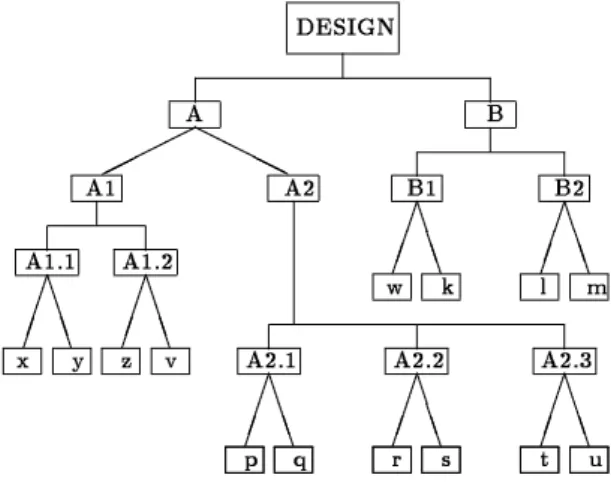
A number of approaches to querying databases with disjunctions are known in the literature. The idea of using and-or trees to develop a new object oriented data model with an ad hoc query facility was exploited in [INV91a, INV91b]. The query com-plexity in this model was analyzed in [IMV89]. Re-cently, a functional query language for databases with disjunctions was designed [LW93a] and implemented [GL94]. In these papers two kinds of queries have been distinguished: structuralqueries ask questions about the data stored in a database, whereas concep-tualqueries ask questions about the data encoded by the informationin a database. To illustrate the dier-ence between the structural and conceptual queries, consider the following example of an incomplete de-sign borrowed from [GL94], see gure 1.
B B B B B B B B B B B B B B B B B B B B B H H H H A2 B1 B2 x y z v w k l m q s t A1.2
A2.1 A2.2 A2.3 A1.1
A1
A B
p r u
DESIGN
Figure 1: Incomplete design
subparts that must be included in the design, while the sloping lines represent possible choices. For example, the whole design consists of two parts: A and B. An A is either an A1 or an A2, and a B consists of a B1 and a B2, where a B1 is either a w or a k. Structural queries ask about the structure of a given object. For example, \what is the least expensive choice for B2" and \how many subparts does A2 have" are examples ofstructural queries.
Conceptual queries ask questions about possible completed designs. For example, \how many com-pleted designs are there" and \is there a comcom-pleted design that costs under $100 and has reliability at least 95%" are examples of conceptual queries.
To distinguish ordinary sets from collections of disjunctive possibilities, we call the latteror-sets, see [INV91a, LW93a, Rou91]. We use hi to denote
or-sets. In the example in gure 1, the whole design can be represented as a set fA;Bg, while A is an or-set hA1;A2iand B2 is an or-sethw;ki. Note that or-sets
have two distinct representations. With respect to structural queries, or-sets behave like sets, but with respect to conceptual queries, an or-set denotes one of its elements. For example,h1;2iis structurally a
two-element set, but conceptually it is an integer that equals either 1 or 2.
A mechanism for answering conceptual queries against complex objects with or-sets, called normal-ization, was presented in [LW93a]. Roughly speaking, it provides us with a small number of programming primitives that, when repeatedly applied to an object o, create an or-set that lists all possibilities encoded by o (like completed designs). This or-set is called the normal formof o. Then conceptual queries are simply structural queries on normal forms.
Normalization, as presented in [LW93a], provides the solid theoretical foundation for developing lan-guages in which conceptual queries can be formu-lated. It also has led to development of a prototype [GL94]. However, there are several theoretical prob-lems that must be addressed in order to develop prac-ticalmethods for answering conceptual queries.
Only sets have been considered in [INV91a,
INV91b, LW93a, Rou91], but many practical languages are based on bags (multisets). In the past few years several approaches to design ofbag
languages have been proposed. Moreover, most approaches agree on what constitutes the basic set of bag operations [Alb91, GM93, LW93b, LW94]. Thus, we believe the normalization mechanism must be extended to bags.
Normalization may cause exponential blowup in
the size of objects. For objects of size n, the size of their normal forms is bounded (roughly) by n 1:45n [LW93a]. Therefore, we need
better normalization tools. One possibility is to normalize partially. If some of the disjunctions do not aect the conceptual query that is asked, there is no need to unfold those disjunctions. The problem of partial normalization has not been addressed in the literature.
Normalization, as presented in [LW93a], requires
that the whole normal form be created before any conceptual queries could be asked. Therefore, it has exponentialspace complexity. Alternatively, one may want to produce normal form elements (e.g. completed designs) one-by-one, rather than all at once, thus making the space usage linear. The main goal of the paper is to address these shortcomings of the normalization process. As the outcome, we shall have much better tools for querying databases with disjunctive information and much better understanding of their structure. The main contributions of this paper are listed below.
1. We rigorously dene normal forms (or conceptual semantics) of objects with or-sets and prove normalization theorems giving us a small number of operations that construct normal forms. We do this forboth set and bagsemantics.
2. We prove apartial normalizationresult that tells us when the normalization process need not be completed in order to answer a conceptual query. We give a restriction on types of objects for which this can be done.
3. We design alinear space algorithmthat produces all elements in the normalform, and suggest a new programming primitive based on it. This primi-tive allows us to express a number of important queries (including a class of existential conceptual queries) in a uniform fashion.
4. We consider interaction of disjunctive information with traditional forms of partial information, represented via orders on objects, and prove both normalizationand partial normalizationtheorems in this setting.
5. We implement the new space-ecient algorithm in the system for querying databases with dis-junctions [GL94]. We compare it with the stan-dard algorithm and demonstrate substantial im-provement. We show how the new programming
primitive can be used together with some heuris-tics to answer conceptual queries approximately, when normalization process is very expensive.
Organization.
We dene structural semantics and normal forms in section 2. Normalization theorems for sets and bags and partial normalization theorem are proved in section 3. The space-ecient normalization algorithm and a programming primitive based on it are presented in section 4. Normalization in the presence of partial information is studied in section 5. Experimental results are presented in section 6.Remark. Our approach to disjunctive information as a form of partial information should not be confused with the work on disjunctive deductive databases [LMR92]. For dierences between these approaches, see [INV91a, INV91b].
2 Semantics and normal forms
As we mentioned before, objects with or-sets can be treated at the structural and conceptual levels. Consequently, there are two dierent semantics for or-objects. One of them treats or-sets as collections, while the other takes into account that an or-set denotes one of its elements.
To state this precisely, we rst dene types of objects. There are two type systems of interest: one dealing with sets and the other with multisets (bags): (ST) t := b j tt j ftg j hti
(BT) s := b j ss j fjsjg j hsi
Here b ranges over a collection of base types such as integers, booleans etc. tt
0is the product type; its
elements are pairs (x;y) where x has type t and y has type t0. Values of the set type
ftgare nite sets of
elements of type t. Values of fjtjg and hti are nite
bags and or-sets of values of type t respectively. If
P
fin(X) stands for the nite powerset of X and Pb(X)
for the family of nite bags over X, then, assuming that a domain Dbof each base type is given, we dene
thestructural semantics of types as follows:
[[b]]s= Db [[tt 0]] s= [[t]]s[[t 0]] s [[ftg]]s= [[hti]]s=P fin([[t]]s) [[fjtjg]]s=Pb([[t]]s)
An object whose type is in the type system (ST) is called a set-based complex object. An object whose type is in (BT) is called abag-based complex object. Any object containing or-sets is also called an or-object.
We need two translations between (ST) and (BT)
and between set-based and bag-based objects. First, for any type t in (ST), we dene tBag in (BT) by
replacing all set brackets by bag brackets. Type sSet is dened as s in which all bag brackets
are replaced by set brackets. For any object X of an (ST) type t, dene XBag of type tBag by
replacing each set in X by a bag with the same elements and all multiplicities equal 1. For example, (f1;2g;f3;4g)
Bag= (
fj1;2jg;fj3;4jg). Conversely, for
Y of a (BT) type s, YSet of type sSet is dened by
replacing each bag in Y with the set containing all elements of that bag (i.e. duplicates are eliminated). For example,fjfj1;1;2jg;fj1;2;2jgjg
Set
=ff1;2gg.
It should be noted that (tBag)Set = t for any
(ST) type t, and (tSet)Bag = t for any (BT) type
t. However, while (XBag)Set = X for any
set-based object X, it is not necessarily the case that (YSet)Bag= Y for a bag-based object Y .
Before we dene the conceptual semantics, which will be callednormal form, we need the notion of the
skeleton of a type. The skeleton sk(t) of a type t is dened to be the type formed by removing all or-set brackets from t. That is, sk(b) = b, sk(tt
0) =
sk(t)sk(t 0),sk(
ftg) =fsk(t)g, sk(fjtjg) =fjsk(t)jg
andsk(hti) =sk(t).
Next, we dene a binary relation x l y among
objects whose meaning intuitively is \x is in the conceptual representation of y". (For example, dl
DESIGN i d is a completed design.)
For any x;x 0of a base type, x0 lx i x = x 0. (x 0;y0) l(x;y) i x 0 lx and y 0 ly. fjx 0 1;:::;x 0 njg l fjx 1;:::;xn jg i there exists a
permutation onf1;:::;ngsuch that x 0 ilx (i) for all i = 1;:::;n. fx 0 1;:::;x 0 ng l fx 1;:::;xk g i there exists a partition X1;:::;Xnof fx 1;:::;xk
gsuch that for
any i = 1;:::;n and for any x2Xi: x 0
ilx. xl hx
1;:::;xk
i i xl xi for some xi. (Recall
that an or-set denotes one of its elements.) Note that in the set clause it is not enough to ask for a permutation of elementsfx
1;:::;xn
gthat would
satisfy x0
ilx
(i)because some of those x 0
imay then
be the same and fx 0 1;:::;x
0
ng would not be a set.
Hence, we need partitions.
Denition.
For any object X, its normal formnf(X) is dened as the or-set hx
1;:::;xn
i of all
objects xi such that xi lX. Note that the normal
Lemma 1
If X is of type t, then any xl X is oftype sk(t). In particular, for any or-objectX of type
t, its normal form nf(X)is of typehsk(t)i. 2
In other words, the normal form of an object lists all possibilities that are encoded by the disjunctions present in that object. Each normal form entry is a regular complex object, i.e. does not have any or-sets.
3 Normalization theorems
The general idea of the normalization theorems is to give a list of operations that can be repeatedly applied to an object until the normal form is produced. Such a list was rst presented in [LW93a]; here we go further in several aspects. First, we clearly distinguish between set and bag semantics. Second, we prove a partial normalization result that can be viewed as normalization at intermediate types. That is, while the standard normalization theorems nd a unique representation of an object of type t at type
hsk(t)i, the partial normalization result nds such a
representation at type s where s is \between" t and
hsk(t)i. To guarantee uniqueness, some restrictions
on types must be imposed.
We need a language to express the operations used for normalizing objects. We adopt the framework of [LW93a] which in turn is based on [BBW92] and nds its origins in [AB88, BBN91]. The operators together with their most general types are given in gure 2.
Recall briey the semantics of the general and set operators. fg is composition of functions; (f;g) is
pair formation. 1and 2are the rst and the second
projections. ! always returns the unique element of a special base type unit. eq is equality test; id is the identity andcond is conditional. For set operations: Kfgis the function that represents the constantfg;
forms singletons: (x) = fxg; [ takes union of
two sets; attens sets of sets: (ff1;2g;f2;3gg) = f1;2;3g; map(f) applies f to all elements of a set;
and 2 is pair-with: 2(1;
f2;3g) =f(1;2);(1;3)g.
Operators on or-sets are exactly the same as oper-ators on sets except that the prex oris added. Op-erators on bags are similar to those on sets, but ad-ditive union that adds up multiplicities is used. Also, attening for bags is additive: b (fjB
1;:::;Bn jg) =
B1
]:::]Bn.
Finally, andb provide interaction between sets and or-sets and between bags and or-sets. Assume thatX =fX 1;:::;Xn gandY=fjY 1;:::;Yn jgwhere Xi =hxi 1;:::;xin i iand Yi =hyi 1;:::;yin i i. Let F be
the family of \choice" functions fromf1;:::;ngtoN
General op erators g:u!s f:s!t fg:u!t f:u!s g:u!t (f;g) :u!st 1: st!s 2: st!t ! :t!unit eq:tt!bool id:t!t c:bool f:s!t g:s!t cond(c;f;g) :s!t Op erators onsets Kfg:unit!ftg 2:sftg!fstg [:ftgftg!ftg :t!ftg f:s!t mapf:fsg!ftg :fftgg!ftg Op erators onbags Kfjjg:unit!fjtjg b2:sfjtjg!fjstjg ]:fjtjgfjtjg!fjtjg b:t!fjtjg f:s!t b mapf :fjsjg!fjtjg b :fjfjtjgjg!fjtjg Op erators on or-sets
Khi:unit!hti or 2:
shti!hsti
or[:htihti!hti or:t!hti f:s!t
or mapf:hsi!hti or:hhtii!hti Interaction
:fhtig!hftgi b :fjhtijg!hfjtjgi
Figure 2: Operators ofor-NRL andb or-NRL
such that 1f(i)ni for all i. Then
(X) =hfxif (i) ji = 1;:::;ng j f 2Fi b (Y) =hfjyif (i) ji = 1;:::;njg j f 2Fi
The main dierence between these two denitions is that duplicates are removed from sets but not from bags. For example, (fh1;3i;h2;3ig) evaluates to hf1;2g;f1;3g;f2;3g;f3gi, but b (fjh1;3i;h2;3ijg) is
equal tohfj1;2jg;fj1;3jg;fj2;3jg;fj3;3jgi.
Denition
(see also [LW93a]). The languageor-NRL over type system (ST) includes all general
operators, set operators, or-set operators and. The language b or-NRL over type system (BT) includes
all general operators, bag operators, or-set operators and b .
3.1 Normalizing types
Dene the following rewrite rules on types:
shti!hsti hsit!hsti hhtii!hti fhtig!hftgi fjhsijg!hfjsjgi
Dene the rewrite system (STR) on (ST) types as the three rules in the rst line and fhtig ! hftgi.
The rewrite system (BTR) on (BT) types is dened as the top three rules andfjhsijg! hfjsjgi. We use
the notation s??!!t if s rewrites to t in zero or more
steps. Recall [DJ90] that a normal form of a rewrite system is a term that cannot be further rewritten.
Proposition 2 (
see [LW93a]) Both (STR) and (BTR) are terminating Church-Rosser rewrite sys-tems. Consequently, each type has a unique normal form that can be calculated as hsk(t)i for any type tthat involves or-sets. 2
3.2 Normalizing complex objects
It was suggested in [LW93a] to assign functions in the language to the rewrite rules so that for every rewriting from s to t there would be an associated denable function of type s ! t. The goal of this
assignment is to obtain a function of type s!hsk(s)i
that produces the normal forms for objects of type s. In subsection 3.3 we explain how to do this for bags. Subsection 3.4 deals with sets. We recall the result of [LW93a] and explain how normalization process for sets interacts with duplicate elimination. In subsection 3.5 we consider the case when the target type is notsk(s) but an intermediate type t such that s ??!! t ??!!hsk(t)i. We nd types t for which any
object of type s would have a unique representation at type t; the process of nding such a representation is calledpartial normalization.
3.3 Normalizing bag-based complex objects
We associate the following functions with the rewrite rules: or 2 : s hti!hsti or 1 : hsit!hsti or : hhtii!hti b : fjhsijg!hfjsjgi: Hereor1=or map(( 2;1)) or 2 ( 2;1) is
pair-with over the rst argument.
Now, following [LW93a], we dene the function
appb(r) : s ! t where r is a rewrite strategy that
rewrites s to t. First assume that t is a type and p a
position in the derivation tree for t such that applying a rewrite rule with associated function f to t at p yields type s. We dene a functionappb(t;p;f) : t!
s showing the action of rewrite rules on objects by induction on the structure of t:
if p is the root of the derivation of t, then appb(t;p;f) = f; if t = t 1 t 2 and p is in t1 , then appb(t;p;f) = (appb(t 1;p;f) 1;2); if t = t 1 t 2 and p is in t2, then appb(t;p;f) = (1; appb(t 2;p;f) 2); If p is in t 0, then appb(fjt 0 jg;p;f) = b map(appb(t 0;p;f)); If p is in t 0, then appb(ht 0 i;p;f) = or map(appb(t 0;p;f)).
For a rewrite strategy r := t f1 ?! t 1 f2 ?! ::: fn ?!
tn = t0 such that the rewrite rule with associated
function fi is applied at position pi, we extend
appb to appb(t;t 0;r) : t ! t 0 by appb(t;t 0;r) = appb(tn ?1;pn;fn) :::appb(t 1;p2;f2) appb(t;p 1;f1).
Theorem 3 (Normalization for bags)
For any bag-based or-objectxof typet and any rewrite strat-egy r : t??!!hsk(t)i, the following holds:appb(t;hsk(t)i;r)(x) = nf(x)
3.4 Normalizing set-based complex objects
The normalization theorem for set-based objects was proved in [LW93a], though details were not explained there. Here we give its statement that follows immediately from theorem 3.
Let r be a rewriting t1
! :::! tn where all tis
are types from (ST). By rBagwe mean the rewriting
tBag 1
! ::: ! t Bag
n of (BT) types. Note that if
t1 ??!!tnis in (STR), then t Bag 1 ??!!t Bag n is in (BTR).
Theorem 4 (Normalization for sets)
For any set-based or-object x and any rewrite strategyr : t??!!hsk(t)i, the following holds:
(appb(t Bag;
hsk(t Bag)
i;r
Bag)(xBag))Set = nf(x)
In other words, turn x into a bag-object, and apply rBag by using
appb to obtain some object y. Then
Note that the statement of theorem 4 is dif-ferent from (and in fact stronger than) the nor-malization theorem in [LW93a], which stated that (appb(t
Bag; hsk(t
Bag) i;r
Bag)(xBag))Set does not
de-pend on the choice of r, and dened normal forms as the result of application of any such rewriting r.
The question arises if it is possible to construct the normal form without using the bag semantics. The answer to this question is negative. To see this, dene
app(t;t
0;r) for set-based objects in the same way we
denedappb, but usingmapinstead ofb mapto map
over sets, and using instead ofb .
Proposition 5
There exist set-based objects x of type t such that for no rewriting r : t ??!! hsk(t)iisapp(t;hsk(t)i;r)(x) the normal form ofx. 2
The main reason that it is impossible to express normalization by means ofappinor-NRLis that
du-plicate elimination does not commute with normal-ization. That is,nf(xSet) is generally dierent from
nf(x)Set, whilenf(yBag)Set=nf(y). We must admit
here that proposition 5 contradicts a claim made in [LW93a] that normalization does not add expressive-ness toor-NRL. It does not enhance b or-NRL, but
does add expressive power toor-NRL.
3.5 Partial normalization
Suppose that a conceptual query asks a question about possibilities that are encoded only by some of the disjunctions, and that it does not take into account other disjunctions present in a given object. Do we have to complete the normalization process to answer such a query? If a query q can be answered by having an object of type s, and we have an object x of type t such that t??!!s, can we nd a representation
of x at type s to answer q?
In this section we explain when such a partial normalization can be performed. First notice that it is not always possible. Take x = hhh1;2i;h2;3iii
of type hhhintiii. Thenor (x) =hh1;2i;h2;3iiand
or map(or)(x) =hh1;2;3ii{ these are two dierent
objects of the same type hhintii.
Theorem 9 below says that essentially we only have to exclude situations like this. We consider bags here; the result for sets can be readily obtained, just as theorem 4 was obtained from theorem 3.
First, we need a criterion that would check if a type s can be rewritten to t. (We did not have this problem before, as it was easy to check if t = hsk(s)i.) Let
t s mean that s is obtained from t by removing
some of the or-set brackets, i.e. s has fewer disjunctions. Now we dene a new relation C on
types using the rules below. tCt tCt 0 s Cs 0 tt 0 Css 0 tCs fjtjgCfjsjg tt 0 t0 Cs tChsi
Proposition 6
The above rules are sound and com-plete for??!!. That is,s??!!t isCt. 2The last rule for C introduces a new variable t 0
instead of suggesting a proof search strategy. One might think that this leads to (at least) exponential time algorithms for verifying sCt. (This somewhat
resembles the situation with the cut rule in sequent calculus. Although it can be eliminated, the cost is a hyperexponential blow-up in the proof length, cf. [Gir87].) Fortunately, this phenomenon is not observed for our rewrite system.
Proposition 7
There exists a linear time complexity algorithm that, given two types sand t, returnstrueif s??!!t andfalse otherwise. 2
Now we say that a type t is a -type if it does not have a subtype of the form hhvii. We
next dene the concept of a -rewritingbetween -types. Intuitively, -rewritings resolve all ambiguities arising from subtypes of form hhvii. Formally, let
s and t be two distinct -types such that s ??!! t.
Let r be a rewriting between s and t: s = s0 ?!
s1
?!:::?!sn= t. For each i = 0;:::;n?1, let
s1
i;:::;smi
i be all the types such that si ?! sji (in
one step) and sji ??!!t. Let pji be the position in si
at which rewrite rule is applied to obtain sji from si,
j = 1;:::;mi.
Then the rewriting r : s ??!! t is a -rewriting
(written as r : s ??!! t) if either n = 1 (one step
rewriting) or n > 1 and it satises the following two properties for every i = 0;:::;n?2:
1. If one of sjis is a -type, then si+1 is a -type.
2. If all sji have subtypes of form hhvii, then (a)
si+1 = s
j
i such that there is no pli closer to the
root than pji, and (b) si+2 is obtained from si+1
by applying the rule hhvii ?!hvi on the newly
This denition resolves ambiguities arising from subtypes of form hhvii. The rst property says
that they need not be introduced unless absolutely necessary, and the second property dictates that once we cannot avoid introducing a subtypehhvii, it must
be done as close to the root as possible, and then gotten rid of at the next step of the rewriting. To give an example,hfhtigis!hfhtigsi!hhftgisi! hhftgsii!hftgsiis a -rewriting, but the one
that achieves the same result by doinghfhtigis! hhftgiis rst is not because introduction of the
double or-set subtype can be avoided.
Proposition 8
Lets and t be -types and s??!!t.Then there exists a-rewritingr : s??!!t. 2
Using this proposition, we can formulate the partial normalization theorem.
Theorem 9 (Partial Normalization)
Letsand tbe -types such that s ??!! t. Then for any two
-rewritingsr1;r2 : s
??!! t and for any object x of
types, the following holds:
appb(s;t;r
1)(x) =
appb(s;t;r 2)(x)
This theorem tells us that any object of a -type s has an unambiguous representation of a -type t if s C t. This representation is obtained by applying
any -rewrite strategy that rewrites s to t.
One may wonder if restricting rewritings to -rewritings only is really necessary, and if so, are both the conditions on -rewritings necessary. The following proposition shows that it is.
Proposition 10
It is possible to nd -types s andt, an object xof types and two rewritingsr1 and r2
fromstotwhich violate either the rst or the second property of -rewritings such that appb(s;t;r
1)(x) 6 = appb(s;t;r 2)(x). 2
4 Normalization algorithms and
primitives
There is, of course, a trivial normalization algorithm based on the general normalization theorems. We present it below for bag-based complex objects.
If X is not an or-object, then nf(X) =hXi. If X is (x;y) of type s t, then nf(X) =
or cartprod(nf(x);nf(y)) if both s and t involve or-sets,nf(X) =or1(nf(x);y) if only s involves
or-sets and nf(X) = or 2(x;nf(y)) if only t
involves or-sets. If X = fjx 1;:::;xn jg, then nf(X) = b (fjnf(x 1);:::;nf(xn) jg).
This algorithm does calculate the normal form, as follows from theorem 3. It can be readily adapted to the set-based complex objects.
The problem with this algorithm is its exponential space complexity, as shown in [LW93a]. It creates the whole normal form before any conceptual queries can be asked. We believe it would be more reasonable to design a new evaluation strategy, that produces the elements in the normal form one-by-one. Then the space usage would be linear and, in addition, some conceptual queries can be evaluated much faster.
For example, for an existential query over a normal form, satisability can now be veried for each newly produced entry. If the condition is satised, the evaluation stops without producing all elements in the normal form. That is, if x is of type t and p is of type sk(t) ! bool, and we want to nd
out if there is an element of nf(x) that satises p (e.g. is there a cheap reliable design?), then we should be able to stop when such an element is found. The query 9p which will be shown later in
this section does precisely that. Note that using the straightforward normalization algorithm, even evaluation of 9(x:true) requires exponential space
as the normal form must be produced rst!
The evaluation strategy that we are going to present is essentially the depth rst search on the and-or tree underlying a complex object. This strategy will work for both set- and bag- based complex objects, as sets and bags will be translated into lists to give an order of evaluation. Using this evaluation strategy, we shall also suggest new, more exible, normalization primitives.
We create a special data structure, calledannotated complex objects, to represent and-or trees. Basically, an annotation gives a choice of an element for each or-set and also contains local conditions telling whether all possibilities encoded by an object are exhausted. For each object type t, we have a new annotated type A(t) and the initial translation t!A(t). From each
annotated object, we can get an entry in the normal form. At the heart of the algorithm lies a procedure that takes an annotated object and produces the \next" one. This enables us to list all normal form entries sequentially.
We translate sets and bags into lists, assuming some ordering. No matter which ordering is chosen, the algorithm will produce all normal form entries. However, the orderin which they are produced does
depend on the translation, and can be used for additional optimizations.
In what follows, we present the algorithm for set-based complex objects. The algorithm for bag-set-based complex objects can be obtained by repeating it verbatim and replacing \set" by \bag". We denote the type of lists of type t by [t].
Denition (Annotated complex objects).
TypeK (kind) has four possible values: B (base), P
(product), S (set), and O (or-set). For each type t, we produce anannotatedtype A(t)as follows:
A(b) = Kbif b is a base type. A(st) = Kbool (A(s)A(t)): A(ftg) = Kbool[A(t)]:
A(hti) = Kbool [(A(t)bool)]:
The boolean value in these translation is set to
true if there are still entries encoded by the object that have not been looked at. For or-sets, the boolean component inside lists is used for indicating the element that is currently used as the choice given by that or-set. In all algorithms only one entry in such a list will have thetrue boolean component.
Now we dene three functions: initial : t! A(t)
produces the initial annotation of an object; pick : A(t)!sk(t) produces an element of the normal form
given by an annotation; end : A(t) ! bool returns
true i all possibilities encoded by its argument have been exhausted.
The denitions of initial and pick are given in gure 3. By void we mean a special object used to indicate the end of the process of going over the normal form. P1{P5 give a simplied version ofpick
in whichvoidis not propagated to the top level. Such propagation is done to detect inconsistencies encoded by empty or-sets.
The function end always returns true on (B;x). On any other annotated object x = (k;c;v),end x =
:c. We also dene a functionreset: A(t)!A(t) that
disregards the annotation of an object and restores the initial one. The denition almost verbatim repeats initial and is omitted here.
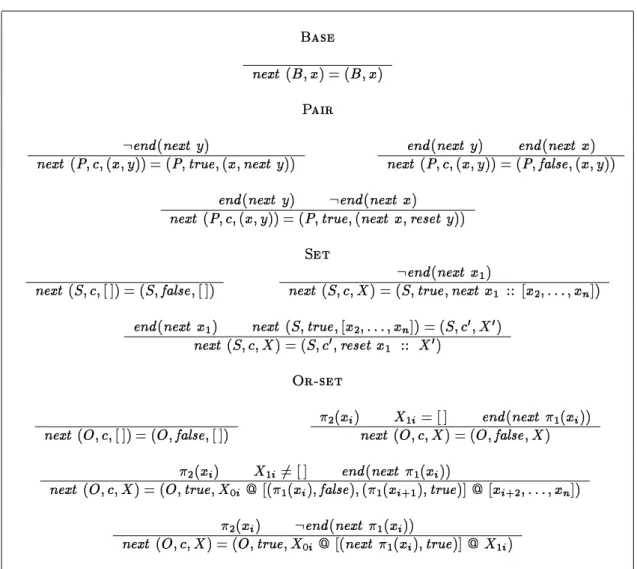
A recursive algorithm for next is given in gure 4. We use the [] brackets for lists. For any list X = [x1;:::;xn], Xoi stands for [x1;:::;xi?1] and
X1i denotes [xi+1;:::;xn] (they may be empty). We
use the notation :: and @ for consing and appending. That is, a::x puts a as the new head before the list x, and x@y appends y to the end of x.
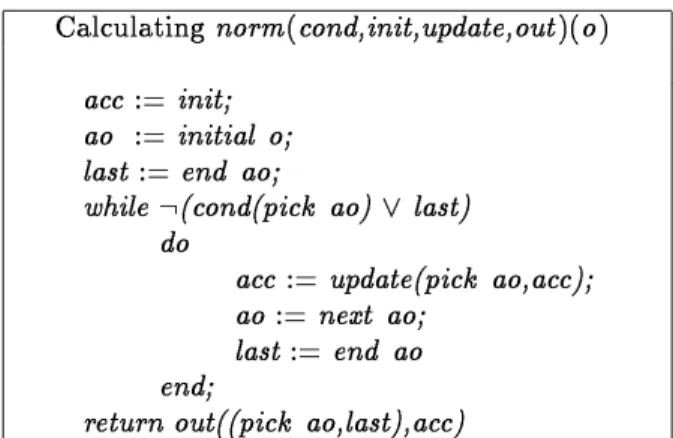
Now we can produce the following algorithm that lists elements of the normal form of an or-object o.
Calculatingnorm(cond,init,update,out)(o)
acc:=init; ao :=initial o; last:=end ao;
while:(cond(pick ao)_ last)
do
acc:=update(pick ao,acc); ao :=next ao;
last:=end ao end;
return out((pick ao,last),acc)
Figure 5: Algorithm fornorm
ao :=initial o;
repeat
print(pick ao);
ao :=next ao until end(ao)
Theorem 11
For any or-object o, the algorithm above prints all elements of nf(o)and nothing else. Moreover, it has linear space complexity. 2Although no duplicate elimination is done in this algorithm, it does not produce unnecessary copies.
Corollary 12
Let o be an or-object such that all or-sets in it are pairwise disjoint. Then the above algorithm prints each entry in nf(o)exactly once. 2The correctness result suggests adding new, more exible normalization primitives to or-NRL. We
propose the following one callednorm.
cond :sk(t)!bool update:sk(t)u!u
out: (sk(t)bool)u!s init: u
norm(cond,init,update,out) : t!s
Its \semantics" is given by the algorithm in gure 5. Intuitively, the output value is accumulated in
acc, cond is used to break the loop if the condition is satised,lastindicates if all possibilities have been looked at, andout forms the output.
Now, a number of functions can be dened using
norm. Here we consider just two. In the rst denition, p is of typesk(t)!bool.
9pnorm(p;false;x:y:false; 1)
normalizenorm(x:false;hi;x:y:or(x)or[y; 2)
I1 initial x = (B;x) if x is of base type. I2 initial (x;y) = (P;true;(initial x;initialy)). I3 initial fx 1;:::;xn g= (S;true;[initial x 1;:::;initial xn]). I4 initial hx 1;:::;xn
i= (O;true;[(initial x
1;true);(initial x2;false);:::;(initial xn;false)]).
I5 initial hi= (O;false;[]).
P1 pick (B;x) = x.
P2 pick (P;c;(x;y)) =if cthen (pick x;pick y) else void. P3 pick (S;c;[x1;:::;xn]) =if c then
fpick x
1;:::;pick xn
gelse void.
P4 pick (O;c;[x1;:::;xn]) =if cthen pick 1(xi)else void where 2(xi) =true.
P5 pick (O;c;[]) =void.
Figure 3: Denitions ofinitial (I1{I5) andpick (P1{P5)
Base
next (B;x) = (B;x)
Pair
:end(next y)
next (P;c;(x;y)) = (P;true;(x;next y)) nextend(P;c;(x;y)) = (P;(next y) endfalse(next;(x;y))x)
end(next y) :end(next x)
next (P;c;(x;y)) = (P;true;(next x;resety))
Set
next (S;c;[]) = (S;false;[]) :end(next x 1)
next (S;c;X) = (S;true;next x1 :: [x2;:::;xn])
end(next x1) next (S;true;[x2;:::;xn]) = (S;c 0;X0)
next (S;c;X) = (S;c0;resetx 1 :: X
0) Or-set
next (O;c;[]) = (O;false;[]) 2(xi) X1i= [] end(next 1(xi))
next (O;c;X) = (O;false;X) 2(xi) X1i
6
= [] end(next 1(xi))
next (O;c;X) = (O;true;X0i@ [(1(xi);false);(1(xi+1);true)] @ [xi+2;:::;xn])
2(xi)
:end(next 1(xi))
next (O;c;X) = (O;true;X0i @ [(next 1(xi);true)] @ X1i)
Corollary 13
For any or-objecto, 1) 9p(o) = (x;c)where x is a normal form entry satisfying p if c =
false and there are no normal form entries satisfying
pifc =true, and 2) normalize(o)is its normal form.
2
Note that9p is very useful in evaluation of existential
queries. If an entry that satises p is found,9p stops
and returns that entry without producing all other normal form entries. In contrast to the standard algorithm that requires exponential space to evaluate such queries even if p is x:true, 9(x:true) needs
linear time and space to be evaluated.
As another application of the new evaluation strategy, it is possible to run normalization for a given time, and get the best entry in the normal form obtained in that time. This is often helpful if an approximate solution is satisfactory.
Space-ecient evaluation of recursive
queries using normalization.
Now we show a somewhat surprising application of our normaliza-tion algorithm { it deals withalgorithmic expressive power of query languages. Recall that the Abiteboul-Beeri algebraA&B[AB88] is the nested relationalal-gebra (general and set operators in gure 2) plus the
powerset operator. While the nested relational al-gebra cannot express recursive queries such as tran-sitive closure (tc) [LW94], A&B can express tc by
rst producing all possible relations on a given set of nodes and then selecting those that contain a given one and are transitive. Of course this way of com-puting tc uses exponential space. A remarkable re-sult of [SP94] says that no matter how we write an
A&B-expression to computetc, it will use exponential
space. However, it is based on a contrived restriction that a \natural" evaluation strategy is used. If this restriction is dropped, then it is possible to devise an evaluation strategy that computes tc in polynomial space, as shown in [AH95].
It was proved in [LW93a] that has essentially the expressive power of the powerset operator. Hence, we can viewor-NRLas an extension ofA&Bwith
or-sets. Now we explain how to usenormto computetc
space-eciently in this language. We use some meta-notation, but everything can be expressed inor-NRL.
Let R : fb bg be a nonempty binary relation.
Dene NR = map( 1) R [map( 2) R (the set of nodes of R) andN 2
R ascartprod(NR;NR). Now let PR=map(z:or[(or(fg);or( z))) (N
2
R)
That is, for each pair of nodes (x;y), the set PR
contains an element hfg;f(x;y)gi. Let rc : ft
tg ft tg ! ft tg compute the relational
composition (it can be done in any language that contains relational algebra as a sublanguage). Let e be of type bb (i.e. an edge). Dene
ce = S:(rc( S; S) = S)&(R S)&(e62 S)
Finally, lettce = norm(ce;();x:();2
1)( PR).
Proposition 14
tceevaluates totrueifeis in tc(R) and it evaluates to false otherwise. Consequently, tc(R) can be computed in polynomial space usingnorm. 2
This proposition can be regarded as a counterpart of the result of [AH95] saying thattc can be evaluated in A&B using polynomial space under a special
evaluation strategy. Here we used our space-ecient strategy for normalization to achieve the same result.
5 Objects with partial information
and antichain semantics
The antichain semantics, dened in [Lib95, LW93a] and based on the ideas from [BJO91, Lib91], is used for objects with partial information. The key idea is that the notion of partiality can be conveyed by orderings, with x y meaning that y is more
informative than x.
This ordering is usually given for base types. For example, a null value
ni
(no information) is less informative than any integer or boolean. For pairs, (x;y)(x 0;y0) i x x 0and y y 0. It was explainedin [LW93a] that the following two orderings, well-known in semantics of concurrency [Gun92], must be used for sets and or-sets respectively:
X v[Y , 8x2X 9y2Y : xy
X v]Y , 8y2Y 9x2X : xy
Using these orderings suggests a new semantics in which an object can denote any other object that is more informative. This allows elimination of redundancies given by comparable elements, because X v[Y i maxXv[Y and Xv]Y i minXv]Y ,
where maxX and minX are sets of maximal and minimal elements of X.
In maxX and minX elements are pairwise in-comparable. Such sets are called antichains. Using
A
fi n(A) for the family of antichains over a poset A,
we dene the following (structural) antichain-based semantics. Here we consider only set-based objects.
[[b]]a= (Db;b) [[ts]]a= [[t]]a[[s]]a [[ftg]]a= (A fi n([[t]]a); v[) [[hti]]a= (A fin([[t]]a); v])
As follows from the claims above, for each object x of type t there exists a semantically equivalent object xin [[t]]
a dened by the following rules:
x
= x for x of a base type. (x;y) = (x;y): fx 1;:::;xn g = max fx 1;:::;x ng: hx 1;:::;xn i = min hx 1;:::;x ni:
Consequently, for each operation f : s ! t in or-NRL, we dene a new operation fa that takes
x2[[s]]a and returns f(x)
2[[t]]a. It is known (see
[Lib92, LW93a]) that a is an isomorphism between
[[fhtig]]aand [[hftgi]]a. Using these operations fa, it is
possible to deneappa(t;t 0;r) : t
!t
0that applies a
rewrite strategy r : t??!!t
0, exactly in the same way
as we denedapp, but using the index a everywhere.
The following two results state the normalization theorem for the antichain semantics, and the partial normalization theorem.
Theorem 15
Let x 2 [[t]]a be an object of type tsuch that t involves or-sets. Then, for any rewriting
r : t??!!hsk(t)i, the following holds: appa(t;hsk(t)i;r)(x) = nf(x)
Theorem 16
Let s and t be two -types such thats ??!! t. Then for any two -rewritings r 1;r2 : s??!!tand any x2[[s]]a, appa(s;t;r 1)(x) = appa(s;t;r 2)(x)
6 Experimental results
The basic normalization algorithm and the new space ecient normalization algorithm have been implemented in the system OR-SML1 [GL94], which
is a database programming language built on top of Standard ML of New Jersey [HMT90].
We ran a number of experments to compare the speed of the basic algorithm with the new algorithm described in this paper. As our test objects, we chose objects that are known to cause exponential blow-up in the size of the normal form [LW93a]. In addition, these objects are not well suited for the OR-SML duplicate elimination algorithm [GL94], so we could compare the speed of the standard algorithms for sets and bags.
In the table below, the rst column shows (approx-imately) the number of entires in the normal form. Entries themselves are relatively small. The second
1[GL94] describes the version of OR-SML in which the
primitivenormis not available.
column shows running time2 for the standard
algo-rithm for sets; that is, at the end duplicates are elimi-nated. The third column is running time for the stan-dard algorithm for bags. The last column is running time for the new algorithm. Note that we compare time rather than space. Despite its space eciency, then new algorithmstill has to compute exponentially many entries. There are several reasons why gures in the last column are better; among them is winning in time due to not running garbage collections.
# entries time (1) time (2) time (3)
>19,000 >11min 0.9sec 1.8sec >59,000 >90min 8.9sec 5.8sec >175,000 >16hr 31.1sec 19.1sec >525,000 >2 days 1min35sec 59sec >1:510
6 not done memoryout of 3min9sec >4:510
6 not done same 9min56sec >1410
6 not done same 31min51sec
We have also considered an application of the normalization algorithm where one has to select a normal form entry which is best according to some criterion F. If the normal form is large, it is possible to run the algorithm for a given time, returning the best entry that was found so far. In one of our examples, with almost 3.5 billion entries in the normal form (going over them takes about 5 days), we obatined the value of F within 7% of the optimal by running the algorithm for only 15 seconds, and the value within 4% of the optimal in 30 minutes.
7 Conclusion
In this paper we have studied various techniques for normalizing databases with disjunctive information represented by or-sets. This problem is particularly important in the areas of application such as design and planning, as well as merging databases. Queries against such databases often ask questions about possibilities encoded by the database, rather than the information that is stored there. We rigorously dened the concept of normalization for both set and bag semantics. We explained how normal forms that list all possibilities encoded by an incomplete object can be calculated. Only a limited number of operations are needed for calculation of normal forms, and the sequence in which they are applied is irrelevant for both set and bag semantics.
Since normal forms can be of size exponential in the size of the objects, we need better tools for answering conceptual queries. We demonstrated two. Partial
2On SGI Challenge XL { 8 R4400 150MHz processors with
normalization allows us to answer queries without normalizing completely. We have also designed a new space-ecient normalization algorithm.
There are immediate practical benets of the rsults presented in this paper. The new space e-cient algorithm has been implemented in OR-SML { a system for querying databases with disjunctions. In addition to being space ecient and faster than the standard algorithm, it allows more control over the process of normalization. This makes the normaliza-tion techniques applicable in practical problems, such as computer automated design.
Acknowledgements:
Thanks to Rick Hull, Tomasz Imielinski and Kumar Vadaparty for right-fully disputing the claimin [LW93a] that the produce-all normalization is the way to answer conceptual queries. I am very grateful to Peter Buneman, Elsa Gunter, Jon Riecke, Val Tannen and Limsoon Wong for their comments, help and criticism, and to An-thony Kosky for a careful reading of the manuscript.References
[AB88] S. Abiteboul, C. Beeri, On the power of languages for the manipulation of complex objects, In Proc. of Int. Workshop on Theory and Applications of Nested Relations and Complex Objects, Darmstadt, 1988. [AH95] S. Abiteboul and G. Hillebrand. Space usage
in functional query languages. InLNCS 893: Proc. ICDT-95, pages 437{454.
[AKG91] S. Abiteboul, P. Kanellakis and G. Grahne. On the representation and querying of sets of possible worlds. TCS78 (1991), 159{187. [Alb91] J. Albert. Algebraic properties of bag data
types. InVLDB-91, pages 211{219.
[BBN91] V. Breazu-Tannen, P. Buneman, and S. Naqvi. Structural recursion as a query language. In
Proc. of DBPL-91, pages 9{19.
[BBW92] V. Breazu-Tannen, P. Buneman, and L. Wong. Naturally embedded query languages. InLNCS 646: Proc. ICDT-92, pages 140{154.
[BDW91] P. Buneman, S. Davidson, A. Watters, A semantics for complex objects and approximate answers, JCSS43(1991), 170{218.
[BJO91] P. Buneman, A. Jung, A. Ohori, Using pow-erdomains to generalize relational databases,
TCS91(1991), 23{55.
[DJ90] N. Dershowitz and J.-P. Jouannand. Rewrite systems. In: Handbook of Theoretical Com-puter Science, North Holland, 1990, pages 243{ 320.
[Gir87] J.-Y. Girard. \Proofs and Types", Cambridge, 1987.
[GM93] S. Grumbach and T. Milo. Towards tractable algebras for bags. InPODS-93, pages 49{58. [Gun92] C. Gunter. \Semantics of Programming
Lan-guages". The MIT Press, 1992.
[GL94] E. Gunter and L. Libkin. OR-SML: A func-tional database programming language for disjunctive information and its applications.
LNCS 856: Proc. DEXA-94, pages 641-650. [HMT90] R. Harper, R. Milner, and M. Tofte. \The
Denition of Standard ML", The MIT Press, 1990.
[IL84] T. Imielinski, W. Lipski. Incomplete infor-mation in relational databases. J. of ACM
31(1984), 761{791.
[INV91a] T. Imielinski, S. Naqvi, and K. Vadaparty. Incomplete objects | a data model for design and planning applications. In SIGMOD-91, pages 288{297.
[INV91b] T. Imielinski, S. Naqvi, and K. Vadaparty. Querying design and planning databases. In LNCS 566: DOOD-91, pages 524{545. Springer-Verlag.
[IMV89] T. Imielinski, R. van der Meyden and K. Vada-party. Complexity tailored design: A new methodology for database design. To appear inJCSS. Extended abstract inPODS-89. [Lib91] L. Libkin, A relational algebra for complex
objects based on partial information, InLNCS 495: MFDBS-91, pages 36{41.
[Lib92] L. Libkin, An elementary proof that upper and lower powerdomain constructions commute,
Bulletin of the EATCS, 48 (1992), 175{177. [Lib95] L. Libkin. Approximation in databases. In
LNCS 893: Proc. ICDT-95, pages 411{424. [LW93a] L. Libkin and L. Wong. Semantic
represen-tations and query languages for or-sets. In
PODS-93, pages 37{48.
[LW93b] L. Libkin and L. Wong. Some properties of query languages for bags. In DBPL-93, Springer Verlag, 1994, pages 97{114.
[LW94] L. Libkin and L. Wong. New techniques for studying set languages, bag languages and aggregate functions. InPODS-94, pages 155{ 166.
[LMR92] L. Lobo, J. Minker and A. Rajasekar. \Founda-tions of Disjunctive Logic Programming". The MIT Press, 1992.
[Rou91] B. Rounds, Situation-theoretic aspects of databases, InProc. Conf. on Situation Theory and Applications, CSLI vol. 26, 1991, pages 229-256.
[SP94] D. Suciu and J. Paredaens. Any algorithm in the complex object algebra with powerset needs exponential space to compute transitive closure. InPODS-94, pages 201{109.