DYNAMIC DATA-DRIVEN FRAMEWORK FOR
REPUTATION MANAGEMENT
by
OLUFUNMILOLA OLADUNNI ONOLAJA
A thesis submitted to
The University of Birmingham
for the degree of
DOCTOR OF PHILOSOPHY
School of Computer Science
College of Engineering and Physical Sciences
The University of Birmingham
University of Birmingham Research Archive
e-theses repository
This unpublished thesis/dissertation is copyright of the author and/or third parties. The intellectual property rights of the author or third parties in respect of this work are as defined by The Copyright Designs and Patents Act 1988 or as modified by any successor legislation.
Any use made of information contained in this thesis/dissertation must be in accordance with that legislation and must be properly acknowledged. Further distribution or reproduction in any format is prohibited without the permission of the copyright holder.
University of Birmingham Research Archive
e-theses repository
This unpublished thesis/dissertation is copyright of the author and/or third parties. The intellectual property rights of the author or third parties in respect of this work are as defined by The Copyright Designs and Patents Act 1988 or as modified by any successor legislation.
Any use made of information contained in this thesis/dissertation must be in accordance with that legislation and must be properly acknowledged. Further distribution or reproduction in any format is prohibited without the permission of the copyright holder.
University of Birmingham Research Archive
e-theses repository
This unpublished thesis/dissertation is copyright of the author and/or third parties. The intellectual property rights of the author or third parties in respect of this work are as defined by The Copyright Designs and Patents Act 1988 or as modified by any successor legislation.
Any use made of information contained in this thesis/dissertation must be in accordance with that legislation and must be properly acknowledged. Further distribution or reproduction in any format is prohibited without the permission of the copyright holder.
University of Birmingham Research Archive
e-theses repository
This unpublished thesis/dissertation is copyright of the author and/or third parties. The intellectual property rights of the author or third parties in respect of this work are as defined by The Copyright Designs and Patents Act 1988 or as modified by any successor legislation.
Any use made of information contained in this thesis/dissertation must be in accordance with that legislation and must be properly acknowledged. Further distribution or reproduction in any format is prohibited without the permission of the copyright holder.
Abstract
The landscape of security has been changed by the increase in online market places, and the rapid growth of mobile and wireless networks. Users are now exposed to greater risks as they interact anonymously in these domains. Despite the existing security paradigms, trust among users remains a problem. Reputation systems have now gained popularity because of their effectiveness in providing trusted interactions.
We argue that managing reputation by relying on history alone and/or biased opinions is inadequate for security, because such an approach exposes the domain to vulnerabilit-ies. Alternatively, the use of historical, recent and anticipated events supports effective reputation management.
We investigate how the dynamic data-driven application systems paradigm can aid reputation management. We suggest the use of the paradigm’s primitives, which in-cludes the use of controller and simulation components for performing computations and predictions.
We demonstrate how a dynamic framework can provide effective reputation management that is not influenced by biased observations. This is an online decision support system that can enable stakeholders make informed judgments. To highlight the framework’s usefulness, we report on its predictive performance through an evaluation stage. Our results indicate that a dynamic data-driven approach can lead to effective reputation management in trust-reliant domains.
Acknowledgements
Firstly, I would like to thank my Supervisor, Dr. Rami Bahsoon for his support from the inception of this research. Throughout the study he has given invaluable suggestions and ideas. His contribution and guidance towards my PhD experience has been of great impact, which will always be remembered. This research has been funded by the School of Computer Science, University of Birmingham and I am grateful for the enabling environment that the School has provided. The members of my thesis group - Prof. Uday Reddy and Dr Volker Sorge, have provided valuable perspectives that helped in directing the course of this research. The biannual meetings were very beneficial and always gave me inspiration to continue; I am delighted to have worked with them.
This thesis will not be complete without my acknowledging some of the people that have been of immense help to me. Many thanks to some of my friends who studied drafts of this thesis - Tolu Fapojuwo, Adetayo Bankole, Freda Raymond-Obi, Ifedolapo Fajinmade, Debola Ogunoiki, Dayo Fashina and Kanayo Eruchalu. My thanks also goes to Rehana Yasmin and Vivek Nallur, who helped to critically review the initial drafts of the thesis. I am indeed indebted also to my senior friends - Tope and Debola Adeleye that have provided moral support and encouragement. In addition, my gratitude goes to Dr. Georgios Theodoropoulos, who was part of my PhD at the start, gave very valuable
I am grateful for all the good friends that have contributed to my success in different ways. I am constrained by space; else I would have listed all their names here. However, I feel highly honoured to have had great and supportive friends through this research.
I am thankful for my siblings - Adesola, Seun, Lanre, Taiwo and Kehinde, I am fortunate to have and to call them family.
Finally, I am extremely appreciative of my parents Prof. and Mrs Onolaja. Their support and prayers have gone a long way in helping me to achieve all that I have. They have taught me to always believe and not to give up but to push till something happens; they are both truly appreciated and this thesis is dedicated to them.
Contents
List of Tables xi
List of Figures xiii
1 Introduction 3 1.1 Background . . . 3 1.2 Motivation . . . 4 1.3 This Thesis . . . 6 1.4 Research Perspective . . . 7 1.5 Introductory Example . . . 8
1.5.1 Trust in Traffic Monitoring and Management . . . 8
1.6 Objectives and Contributions . . . 11
1.7 List of Publications . . . 13
1.8 Roadmap of Thesis . . . 14
2 The Notion of Reputation and Trust 17 2.1 Background . . . 17
2.2 Reputation and Trust . . . 19
2.3 Reputation and Trust-Based Models . . . 23
2.3.1 Misbehaviour . . . 25
2.3.2 Reputation System Architectures . . . 27
2.4 Summary . . . 30
3 Computational Reputation and Trust Models 33 3.1 Introduction . . . 33
3.2 Node Cooperation Enforcement . . . 36
3.2.1 Collaborative Reputation Mechanism to Enforce Node Cooperation 36 3.2.2 Cooperation of Nodes: Fairness in Dynamic Ad-Hoc Networks . . . 38
3.3 Incentive Based Scheme . . . 39
3.4 TrustGuard . . . 41
3.5 Secure MANET Routing with Trust Intrigue . . . 43
3.6 High Integrity Networks Framework . . . 43
3.7 EigenTrust Algorithm . . . 45 3.8 Online Markets . . . 46 3.9 Comparative Analysis . . . 47 3.9.1 Information Gathering . . . 47 3.9.2 Monitoring . . . 48 3.9.3 Information Representation . . . 51 3.9.4 Information Sharing . . . 52 3.9.5 Scalability . . . 53
3.10 Semi-Distributed Models with Trusted Third Party components . . . 55 3.11 Gap Analysis . . . 58 3.11.1 Collusion . . . 58 3.11.2 Prediction . . . 60 3.11.3 Architecture . . . 60 3.11.4 Other Gaps . . . 61 3.12 Summary . . . 63
4 Reputation and Trust Dynamics: A Data-Driven Simulation Approach 65 4.1 Introduction . . . 65
4.2 Dynamic Data-Driven Application Systems . . . 67
4.2.1 Event Correlations in Sensor Networks . . . 68
4.2.2 Leveraging the Cell Phone Network . . . 68
4.2.3 Rail Monitorring . . . 69
4.2.4 Injecting Dynamic Real-Time Data into a DDDAS . . . 71
4.3 Dynamic Data-Driven Application Systems and Reputation Management . 73 4.3.1 Trust Dynamics . . . 73
4.3.2 Gap Analysis . . . 75
4.3.3 The Paradigm in this Thesis . . . 76
4.4 Summary . . . 78
5 A Predictive Framework for Modelling Reputation 81 5.1 Introduction . . . 81
5.2 Overview of the Realisation of the D3-FRT Model . . . 82
5.5 Agent-Based Modelling in D3-FRT . . . 89
5.5.1 Modelling and Simulation . . . 89
5.5.2 Agent Behaviours, Properties and Rules . . . 92
5.5.3 The Concept of Time . . . 95
5.6 Semi-Distributed Approach . . . 96 5.6.1 Postulations . . . 97 5.7 Initial Version of D3-FRT . . . 98 5.7.1 Computing Ratings . . . 101 5.8 Improved Version of D3-FRT . . . 104 5.8.1 Physical System . . . 105 5.8.2 Controller . . . 106 5.8.2.1 Data Aggregation . . . 107 5.8.2.2 Data Transformation . . . 108 5.8.2.3 Data Repository . . . 109 5.8.2.4 Computation of Reputation . . . 110 5.8.3 Simulation . . . 112
5.9 D3-FRT and Other Reputation Systems . . . 116
5.10 Summary . . . 118
6 Empirical Study 119 6.1 Introduction . . . 119
6.2 Experimental Setup . . . 121
6.2.2 Error Rate in Predictions . . . 125
6.2.3 Pair-Wise Collusion versus n-wise Collusion in D3-FRT . . . 130
6.2.4 Demonstrating the Dynamism of D3-FRT . . . 133
6.2.5 Performance in Varying Conditions . . . 136
6.2.6 Verifying the Requirement of the Simulation and Controller Com-ponents . . . 138
6.2.7 An Experimental Comparison of TrustGuard and D3-FRT . . . 141
6.3 Qualitative Evaluation . . . 147
6.4 Discussions and Summary . . . 148
7 Conclusion and Future Work 153 7.1 Introduction . . . 153
7.2 Contributions . . . 155
7.3 Limitations and Future Work . . . 156
7.3.1 Improvements to the Current Framework . . . 156
7.3.2 Identity Persistence . . . 158
7.3.3 Cost . . . 159
7.3.4 Applications and Extensions . . . 160
7.4 Conclusion . . . 162
Bibliography 165 Appendix A: Attack Modelling 183 A.1 Introduction . . . 183
A.1.3 Network Goals . . . 184 A.1.4 Attackers Goals and Capabilities . . . 185
List of Tables
3.1 Summary table of reputation and trust models . . . 49
5.1 Table showing the degrees of reputation and corresponding regions of risk . 110 5.2 Summary table comparing existing RTMs with key functions of D3-FRT . 117
6.1 Parameter list for sensitivity test . . . 129 6.2 Simulation parameters . . . 139 6.3 Comparison of D3-FRT with TrustGuard using the mean variation estimate
approach . . . 146 6.4 Comparison of D3-FRT with other predictive approaches . . . 148
List of Figures
2.1 Brainwashing (U-untrusted, T-trusted) . . . 26
2.2 Node behaves as expected for some time to build a good reputation and suddenly begins to misbehave, such that the reputation fails to detect the node . . . 26
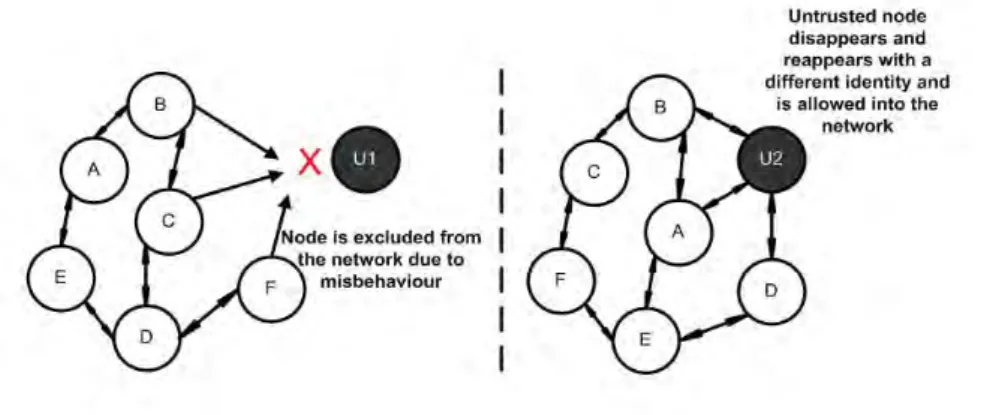
2.3 The node returns with a different identity and is allowed to collaborate. . . 27
3.1 Architectural design of RFSN . . . 44
3.2 System Model by Lin et al. [LLYT05] . . . 56
3.3 Reputation brokering system in TRAVOS [Tea06] . . . 57
3.4 Domain members can misbehave by colluding and covering up for one another to deceive the system . . . 58
4.1 DDDAS feedback-loop between systems and simulation . . . 66
4.2 The Simulation Process [HSV10] . . . 70
4.3 Prediction methods by Rodriguez et al. [RCM10] . . . 71
4.4 Simulation Cycle . . . 76
for reputation management systems . . . 77
5.1 High-level diagram of initial version of D3-FRT . . . 83
5.2 Implementation Architecture Extending Repast . . . 84
5.3 Reactive approaches that compute ratings after each member interaction . 86 5.4 Proactive approach that predicts misbehaviour . . . 86
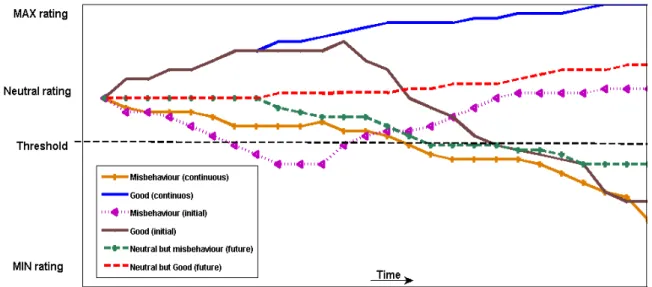
5.5 Expected changes to RVs as agents exhibit different behaviours as time progresses . . . 87
5.6 A typical agent by Macal and North in [MN10] . . . 90
5.7 Properties of agents in simulation . . . 90
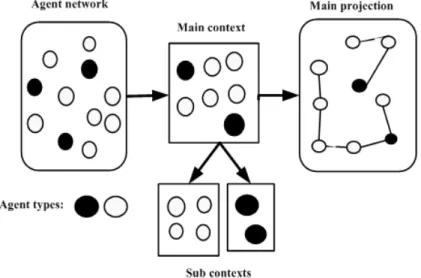
5.8 The relationships between agents in the system, contexts and projections . 91 5.9 Hierarchical topology . . . 97
5.10 Flowchart of agent interaction and trust simulation and computation . . . 99
5.11 High-level diagram showing the components of the framework . . . 104
5.12 Steps to reputation computation and prediction . . . 105
5.13 Agent attributes and behaviours . . . 106
5.14 A more detailed diagram that depicts the components of the D3-FRT . . . 107
5.15 A sample dataset from D3-FRT . . . 108
5.16 Model for the simulation rating process, where arrows indicate the scenarios S that Agent A is considered . . . 114
5.17 Breakdown of reputation system components [MGM06] . . . 116
6.1 Average reputation value prediction error . . . 123
6.3 θr and θf,µo = 0.5 . . . 125 6.4 Estimation error, µo = 0.5 . . . 125 6.5 θr and θf,µo = 0.6 . . . 126 6.6 Estimation error, µo = 0.6 . . . 126 6.7 θr and θf,µh =µo = 0.3 . . . 127 6.8 Estimation error, µh =µo = 0.3 . . . 127
6.9 Comparison of ratings in different values of the scaling factors for collusive agents . . . 127
6.10 Comparison of ratings in different values of the scaling factors for intoxicating agents . . . 129
6.11 Comparison of ratings in different values of the scaling factors for collusive and intoxicating agents . . . 130
6.12 Comparison of ratings in different values of the scaling factors for agents that exhibit good behaviour . . . 131
6.13 Current ratings . . . 132
6.14 Predicted ratings . . . 133
6.15 Changes in current RVs as simulation progresses . . . 134
6.16 Changes in current RVs as simulation progresses . . . 135
6.17 Rate of interaction versus rate of changes to RVs . . . 136
6.18 The number of misbehaving agents versus TTD . . . 137
6.19 The number of misbehaving agents versus TTD with 20% misbehaving in the population . . . 138
6.22 Predicted versus actual . . . 142 6.23 D3-FRT’s error of estimate . . . 142 6.24 Predicted versus actual . . . 143 6.25 TrustGuard’s error of estimate . . . 143 6.26 Mean error values with corresponding error bars . . . 144 6.27 TTD versus the time of misbehaviour in the presence of collusion attack
only in TrustGuard . . . 145 6.28 TTD versus the time of misbehaviour in the presence of collusion attack
only in D3-FRT . . . 145 6.29 TTD versus the time of misbehaviour in the presence of intoxication attack
only in TrustGuard . . . 146 6.30 TTD versus the time of misbehaviour in the presence of intoxication attack
only in D3-FRT . . . 146
1
Part I
The purest treasure mortal times afford is spotless reputation; that away, men are but gilded loam or painted clay.
Chapter 1
Introduction
1.1
Background
The expansion of the global computing infrastructure such as the Internet, cloud etc, has raised new and difficult security challenges, such as anonymous collaboration among participants and changes in environmental conditions. Likewise, the global infrastructure is highly dynamic with continuously appearing and disappearing entities, services and changes in entity behaviour. In response to these challenges, the goals of reputation and trust management in the infrastructure are to allow collaborating entities reason about the trustworthiness of each other and to make security decisions on the basis of trust. These goals require the development of computational reputation and trust models that enable the entities to reason about trust and verify the security properties of any collaboration and interaction. For these reasons, it is essential that associated computational models are able to incorporate effective reputation management into their functionalities [IFI11].
Furthermore, with the increase in the use of the Internet, mobile devices, computers,
online market places, and wireless networks, users are exposed to greater risk as they collaborate with one another. In order to reduce risk and improve performance (effectiveness and reliability), applications on the infrastructure must manage trust relationships among users, by motivating cooperation and honest participation. Introducing trust to such large-scale distributed applications and domains is a difficult challenge, but one well suited for reputation and trust management[SAB10].
During the past decade, reputation and trust management has provided cogent answers to emerging challenges in the global computing infrastructure relating to computer and network security, electronic commerce, virtual enterprises, social networks and cloud computing (in terms of trusted communications). It is vital in establishing a healthy and efficient collaboration among a group of participants and players that might have insufficient prior knowledge about each other [LS10]. This thesis aims to contribute to reputation management field by catering for the dynamism in the interactions and relationships among anonymous users.
1.2
Motivation
Computational reputation and/or trust is central to the use of the global computing infrastructure, especially in domains that are based on collaboration among members. Over the years, as these trust-reliant domains have evolved, risky collaboration with potentially unknown and misbehaving parties has resulted in new attacks. The need to minimise these risks resulted in the development of several Reputation and Trust-based Models (RTMs) that have been shown to be useful. Despite the proliferation of the models, there remain outstanding challenges of prediction, dynamism and susceptibility to attacks
1.2 Motivation 5
in the domains. These challenges include: the dynamic nature of reputation and trust, likely changes in entities’ behaviour over time, dynamics of their interactions, emerging behaviour resulting from their interactions, new or emerging computing paradigms in global computing and their security concerns, new or unanticipated attacks, group dynamics and formulations, etc.
Additionally, behavioural expectation in any context can be motivated from a social perspective, where individuals within a society are expected to behave in certain ways. A disreputable person could redeem himself through consistent honest actions over time whilst a trusted person could become less reputable if they demonstrated deceit over time [AD05]. This implies that reputation can change randomly over time, and is therefore dynamic. We refer to this nature as Trust Dynamics in this thesis.
In the RTM research domain, it is usually assumed that the predictive power of a reputation and trust management model depends on the supposition that past behaviour is an indication of future behaviour. This premise is not always effective because it results in attacks on the reputation management system itself [OTB11, OBT12].
This research is motivated by these challenges. In order to enhance trusted communic-ations among a domain of participants, reputation and trust management models should provide the essential primitives for reliable reputation and trust management, address trust dynamics and the making of predictions. Also in response to these challenges, this thesis proposes and investigates Dynamic Data-Driven Framework for Reputation Management (D3-FRT), which is a decision support system, that exploits the Dynamic Data-Driven Application Systems (DDDAS) [DDD06] approach for managing reputation.
1.3
This Thesis
Over the last decade, RTMs [BLB02, GBS08, MM02, QHC06] have gained popularity over the years borrowing ideas from both Game Theory and Bayesian networks. These models are described as systems that provide mechanisms to produce a metric encapsulating reputation for each identity in any given application domain [HZNR09]. The metric is subsequently referred to as Reputation Value (RV) in this thesis.
Basically, RTMs aim to provide information that allows members to distinguish between trustworthy and untrustworthy members. The models encourage the cooperation of domain members by the provision of incentives and discourage maliciousness by using punishment schemes such as isolation and service denial [OTB11]. RTMs have been adopted in applications that rely on members’ cooperation in order for the application to function correctly. The models have been used extensively in various electronic commerce and online communities such as YouTube, Amazon and eBay. Some literatures also suggest their use in domains ranging from Peer-To-Peer (P2P) to mobile networks.
From our study of some of these models, we concluded that whilst they aim to solve trust related issues in their domains, the models invariably introduce other issues. There is therefore a need for a framework (presented in this thesis), that is capable of providing dynamic trust ratings at runtime and predicting the future ratings of entities within a domain. The framework does not only rely on collective opinion and ratings to determine the reputation of domain entities. Instead the framework uses its simulation, feedback and control mechanisms to make predictions about a potential compromise before it occurs. For these reasons, D3-FRT which is proposed in this thesis, is a proactive decision support system that provides useful information about domain events to enable the making
1.4 Research Perspective 7
of informed decisions. Therefore providing the necessary primitives for addressing the challenge of reputation and trust dynamics.
1.4
Research Perspective
Despite recent advances in the state-of-art and practice in areas related to computational models and frameworks for managing reputation and trust in networks, the problem of managing trust dynamics, which we explicate in this research, is still an open research challenge. In particular, this research by and large aims at understanding:
• The problem of trust dynamics. We consider how managing trust dynamics can be fundamentally different from other assumptions.
• The usefulness of anticipating futuristic events in the prediction of reputation. More precisely, we analyse the relationship between domain and anticipated events to identify any correlations.
• The underlying architectural choices, design decisions and primitives which are necessary for realising such requirements and for engineering frameworks for managing reputation and trust dynamics. In this context, we argue that the effectiveness of any dynamic reputation and trust management system is sensitive to the choices of the underlying architectural style - i.e. whether it is fully distributed, centralised or a combination of both architectures.
These are studied using relevant scenarios through our proposed and unique semi-distributed approach for predictive reputation management; a first in its kind. Our novel framework sought inspirations from the generic DDDAS paradigm and adopts much of its
underlying primitives. The research aims to understand the extent to which DDDAS and its primitives can induce new methods for managing reputation and trust dynamics.
1.5
Introductory Example
This section introduces an application that is representative of the class of trust and reputation-reliant applications that this research targets. In particular, the focus is on the issues of trust dynamics, and the predictability of trust. The aim of this sub-section is to highlight these issues and introduce the value of this research to the reputation landscape.
1.5.1
Trust in Traffic Monitoring and Management
Consider a network of mobile sensor nodes that are deployed along the roadside to monitor vehicular movement in order to obtain real traffic flow data and conditions. The network runs a reputation and trust management system where the sensors are equipped with wireless interfaces with which they form the network. The nodes can sense, measure and gather information from the environment and, based on predetermined or some local decision process [YMG08], transmit the data to a central control server or network controller. This information is used by the server for decisions about the nodes and for traffic control in order to, for example, judge the cause of a road accident, traffic jam or redirect traffic to other routes.
Collaboration
The effectiveness of the traffic management system is dependent on the expected behaviour of the nodes. Nodes collaborate to collect and process the data that generate information about traffic conditions. When a sensor node receives information from another, it is
1.5 Introductory Example 9
combined and fused with local information. The information is sent to all nodes in the path for the same processing before being sent to the server.
Each node watches the transmission of neighbouring nodes, and then reports any deviation from expected behaviour and makes recommendations. In a normal situation, if a sensor nodeA needs to forward a message M to another node D, it relays the message to its next hop neigbour B and B forwards the message to C. Node C then relays M to nodeD.
Challenges: The nodes are vulnerable to various internal and external attacks due to their dynamic and volatile nature. An ad-versary may compromise a sensor node, which in turn compromises other nodes. It is possible that B colludes with C and does not report to A when C alters message M to M#, before spreading the bogus message (collusion attack). Although a message was delivered to the recipient, the originator is unaware that a wrong message has been delivered. Therefore, trust decisions to be made by the controller have been corrupted through recommendations made by the colluding nodes.
Can nodes be trusted to provide accurate information about domain events? How can the system quickly and accurately distinguish misbehaving nodes from trusted nodes? How can misbehaviour be penalised and how can expected behaviour be effectively encouraged? How can the system identify colluding nodes that cover-up for one another?
The trust management system should be designed to be reliable and effective. Reputa-tion and trust have to be predictable for each entity in the domain. The system should not rely only on the collective opinion and recommendations of the domain entities in making trust decisions.
Dynamism
The reputation management system provides a RV representing the reputation of each wireless sensor node in the network. The nodes are rated according to behaviours they
exhibit, for example, sending more conflicting information when compared to other neighbouring nodes results in a negative rating whilst a consistent propagation of correlating information earns a positive value. After each event in the network, nodes’ trust values are updated using the rating earned for the event. Past events that resulted in a node’s current value help the reputation system identify nodes in the network that can be trusted.
Challenges: A node sends accurate information for an extended period of time in order to earn high ratings and trust value. The node subsequently suddenly begins to misbehave by propagating inaccurate information about vehicular movement across the network (intoxication attack).
Will the provision of recent ratings aid the identification of sudden behavioural changes? How can the anticipation of misbehaviour help in preventing this form of attack?
The assumption that past behaviour is an indication of futuristic behaviour is not valid with sudden behavioural changes and is inadequate in providing a trusted system. Historical events in the network should have less effect on more recent events when computing the trust of each member. Sudden changes in node behaviour should be captured and analysed by the reputation system. If misbehaviour is anticipated using historical, current and possible future events, such misbehaviours can most likely be prevented.
The example in this section has highlighted the consequences of ill-management of reputation trust, and therefore, highlighting the need for a new framework that focuses on the dynamic nature of reputation and trust.
1.6 Objectives and Contributions 11
1.6
Objectives and Contributions
The objective of this thesis is to investigate a novel approach for managing the dynamics of reputation. The goal is to be able to facilitate dynamic reputation computation, prediction and provision of useful information for domain stakeholders such as the network administrator. We aim to suggest solutions to the issue of corruption of trust decisions by domain entities, also to distinguish between members, penalise misbehaving ones and provide dynamic reputation management.
This thesis presents a piece of work that can be useful in critical domains such as in military networks, traffic management systems, and mobile ad-hoc or sensor networks and so on. Therefore, this thesis contributes a simulation framework for reputation management. The contribution is sub-divided in the following.
• In DDDAS an application can accept and respond dynamically to new data, and in reverse, the application can dynamically control itself. In essence, the DDDAS unifies complex computational models of a system with real-time data acquisition and aids the controlling of the system. Our research is the first of its use of the DDDAS paradigm for reputation management. This thesis shows that the use of monitoring, simulation, and feedback in terms of prediction and control mechanisms, can potentially improve on the reliability of systems that rely on reputation management to function.The proposed framework has the capability of providing a high level of dynamism by updating the ratings of domain members as the collaborate.
not to be effective and reliable. This is because the domain is then exposed to vulnerabilities such as intoxication.
We present in this thesis, an approach that does not rely on historical data alone for trust decisions. The approach also considers more recent data and anticipates possible futuristic events that could occur in the domain.
• In a distributed architecture for reputation and trust management, each participant maintains the trust information of other participants, whereas in a centralised system, a trusted entity manages the reputation of all participants. A semi-distributed reputation management system is more desirable as it combines the advantages of both distributed and centralised architectures.
When compared to completely distributed reputation and trust-based models, a semi-distributed predictive framework may have a relatively higher performance overhead, but is timelier in terms of misbehaviour detection. The semi-distributed architecture for reputation management that is described here will be most applicable in niche environments where the security requirement is more critical compared to other non-functional requirements.
• As it was described earlier in Section 1.5.1, trust decisions that is generated by a reputation system can be corrupted by relying on domain members. In the approach suggested in this thesis, decision making is not dependent only on the collective opinion of domain members, but also based on observations captured by the controller of domain events within a specific time frame. This form of monitoring and feedback system prevents collusion attack among domain members. Thesimulation component of D3-FRT makes prediction about future events in the system. These predictions
1.7 List of Publications 13
are not only useful at the network level but at a higher level, providing adequate and timely information that allows for countermeasures and for enabling the making of informed and security-aware decisions by stakeholders. The prediction gives the system enough time for preventive measures, making the framework proactive compared with some other models. The framework can be proactive in terms of providing controls such as downgrading the rating of suspect or misbehaving members before they perpetuate an attack.
1.7
List of Publications
The work presented in this thesis is based on and extends several papers that have been published in the last three and a half years. The papers include:
[OBT12]: O. Onolaja, R. Bahsoon, and G. Theodoropoulos. Agent-based trust man-agement and prediction using D3-FRT. In ICCS’12: Proceedings of the International Conference on Computational Science in the Journal of Procedia Computer Science,
volume 9, pages 1119-1128, 2012.
[OBT11]: O. Onolaja, R. Bahsoon, and G. Theodoropoulos. Trust Dynamics: A Data-Driven Simulation Approach. In IFIPTM’11: 5th IFIP WG 11.11 International Conference on Trust Management of International Federation for Information Processing (IFIP), volume 358 of Advances in Information and Communication Technology (AICT),
pages 323-334, Springer, 2011.
[OTB11]: O. Onolaja, G. Theodoropoulos, and R. Bahsoon. A Data-Driven Framework for Dynamic Trust Management. InICCS’11: Proceedings of the International Conference on Computational Science in the Journal of Procedia Computer Science, volume 4, pages
1751-1760, 2011.
[OBT10]: O. Onolaja, R. Bahsoon, and G. Theodoropoulos. Conceptual Framework for Dynamic Trust Monitoring and Prediction. In ICCS’10: Proceedings of the International Conference on Computational Science in the Journal of Procedia Computer Science, volume 1, pages 1235-1244, 2010.
[OBT09]: O. Onolaja, R. Bahsoon, and G. Theodoropoulos. An Architecture for Dynamic Trust Monitoring in Mobile Networks. In OTM’09: 4th International Workshop on mobile and networking technologies for social applications, volume 5872 of LNCS, pages 494-503, 2009.
This thesis should be regarded as the definitive account of the work.
1.8
Roadmap of Thesis
This thesis is made up of four parts that are sub-divided into eight chapters. Part I includes the first two chapters, introduces and gives the background of this thesis. Chapter 1 provides the motivating context and the focus of this thesis. In Chapter 2, the concepts of reputation, trust and reputation management are introduced. The chapter discusses the usefulness, objectives and some problems of reputation and trust management systems.
Part II details an overview of reputation and trust-based models and a background of the DDDAS paradigm. Chapter 3 considers the existing problems of reputation and trust management and critically reviews literature focused on reputation and trust management models with proposed solutions to the trust related problems that have shown useful results. The chapter describes how the existing models attempt to solve the problems; each with its merits and faults. Comparative and gap analysis of the models are discussed extensively in
1.8 Roadmap of Thesis 15
this chapter. Chapter 4 introduces the dynamic data-driven application systems paradigm and motivates the usefulness of the paradigm for reputation management. The chapter discusses the DDDAS computational model in the context of examples of novel capabilities enabled through its implementation in different application areas. In addition, notable literature that adopts the paradigm is comprehensively described. The chapter elaborates on the issues of trust dynamics. We also describe how the DDDAS coupled with an agent-based simulation approach can be useful for the problem of trust dynamics.
In part III, we present the approach adopted in this thesis and an evaluation. Chapter 5 builds on the gaps in the literature that are identified in Chapters 3 and 4. The chapter introduces the novel framework (D3-FRT) for the predictive reputation management system that adopts a rich agent-based simulation approach. The chapter describes how D3-FRT is capable of providing dynamic trust ratings of domain members at runtime and making predictions. Chapter 6 applies the proposed framework in a network situation to examine its effectiveness in providing trusted communications among participants. D3-FRT’s performance in terms of its predictive capability, dynamism, and scalability and in varying scenarios is evaluated in this chapter.
Part IV summarises this thesis. Chapter 7 presents the overall conclusions based on the work done, reviews the contributions that this thesis has made and details some promising directions for future work.
Finally, Appendix A gives the attack modelling on the reputation system as they have been implemented in this research and in Appendix B, a sample of the data that is generated by the D3-FRT is presented.
Chapter 2
The Notion of Reputation and Trust
2.1
Background
The spread of Internet usage, proliferation of mobile devices, computers, and online market places, as well as the rapid growth of wireless networks and other related domains have changed the landscape of security. Users are exposed to greater risks as they collaborate anonymously with one another within diverse domains. The domains rely primarily on cooperative user behaviour for their effective operations because without this cooperation, they cannot fulfil their functions.
In order to reduce risks and improve performance, applications must manage trust relationships between users, by motivating cooperation and honest participation [SAB10]. P2P networks for example have undergone rapid progress and significant developments in recent years in this regard. However, due to their anonymous and open nature, malicious users can abuse the system by disseminating bogus files or acting together to commit as much damage as possible (collusion attack) [OBT12]. For such networks to be effective in
fulfilling their purpose of anonymous sharing, they should be relatively reliable, efficient and secure [CLB10]. Moreover, Internet applications have evolved from centralised and private computing platforms to distributed and collaborative computing systems. Collaboration is in fact today a fundamental Internet computing requirement.
Reputation and Trust Management is well suited for the requirements and the research is highly interdisciplinary [LS10], involving researchers from networking and communications: Mobile Adhoc Networks (MANETs)1, Wireless Sensor Network (WSNs)2 and P2P, data management and information systems, e-commerce and online communities: YouTube, Amazon and eBay, Artificial Intelligence, and also the Social Sciences and Evolution Biology. The concepts of trust and reputation have been developed into Reputation and Trust-based Models (RTMs). These models have gained popularity because they have been shown to be promising in the area of reputation and trust management as they aim to collect, aggregate, and disseminate feedback about a user’s behaviour, based on some predetermined premise.
Reputation and trust management is useful for establishing healthy and efficient collaborations among a network of participants and users that might not have sufficient prior knowledge about each other [LS10]. For example, eBay has several millions of auctions simultaneously open, serving as a listing service where buyers and sellers assume all associated risks with transactions [RZFK00]. There are occurrences of fraudulent transactions however there is a higher rate of successful transactions as well, which are primarily attributed to the reputation system on eBay called the Feedback Forum. This is
1Infrastructureless networks that have no fixed routers; all nodes are capable of movement and can be
connected dynamically in an arbitrary manner [RCK99]
2These are a large number of densely deployed nodes that mainly use broadcast communication
2.2 Reputation and Trust 19
a prime example of a RTM which is getting to be a commonplace in many other domains as well.
Despite the proliferation of RTMs in the trust-reliant domains, ensuring trusted collaborations among participants remains a challenge. Several unaddressed threats (discussed in the later part of this chapter) still limit the effectiveness of reputation
systems.
Furthermore, some of the existing RTMs in literature focus on historical and recent information in determining the reputation of domain members. However, the dynamic nature of reputation and trust requires an equally dynamic approach to computing and resolving trust related issues in any domain.
2.2
Reputation and Trust
The reputation of a node in the survey of Djenouriet al. [DKB05] is the amount of trust that a trustor grants a trustee regarding the trustee’s cooperation and participation in the domain. In this thesis, an entity is said to be trusted when it has obtained positive feedbacks from its interactions with others coupled with high ratings in a domain.
Reputation and trust have been used interchangeably and synonymously in literature. However, some studies [JIB07, BAS09] indicate that whilst there is some correlation between them, there is a clear difference between the concepts. An example is given by Josang et al. in [JIB07] detailing the differences between the concepts as:
1. Trust systems produce a score that reflects the relying party’s subjective view of an entity’s trustworthiness, whereas reputation systems produce an entity’s reputation score as seen by all.
2. Transitivity is an explicit component in trust systems, whereas reputation systems usually only take transitivity implicitly into account.
3. Trust systems usually take subjective and general measures of trust as input, whereas information or ratings about specific events, such as transactions, are used as input in reputation systems.
Furthermore, Momani and Challa in [Mom10] defines trust as a derivation of the reputation of an entity. In the work, the authors state that based on the reputation, a level of trust is bestowed upon an entity. By motivating from a social perspective, reputation is built over time based on a person’s history of behaviour, and determines the level of trust that is bestowed on the person in a society. Reputation is said to be the amount of trust inspired by a particular member of a community in a specific domain. These definitions show the interlink between both concepts (trust and reputation); which is also the position of this thesis. For simplicity, this thesis describes reputation as the overall status of an entity within a particular domain and context while an entity is said to be trusted if it obtains high ratings from its interactions (reputation). Also, we focus on reputation rather than the subjectivity of trust, the time-dependency of reputation and direct trust relationships are highlighted in this thesis.
2.2.1
Properties of Reputation and Trust
The general properties of reputation and trust in the work of Liu and Issarny [LI04], and Adam and Davies in [AD05] are discussed below:
• Subjective: The subjective property of trust implies that an entity in a domain may have different RVs depending on the individual perception of other entities.
2.2 Reputation and Trust 21
That is, node A might have a very good reputation as perceived by B, but just an average reputation with C.
• Context Dependent: Reputation is context dependent because it is possible for an individual to exhibit contrasting behaviours in different situations. An example is a domain member that may be a good seller but not a good buyer on an online auctioning system.
• Time Dependent and Dynamic: From the social perspective, a person’s be-haviour in a society can fluctuate with time and the person can be classified as reputable at a certain time but become less reputable at another time. This implies that trust (and reputation) change over time and are therefore, dynamic and time dependent.
• Transitive: Transitivity can be described using the example: if a node A trusts B
and B trusts C then A trusts C. There is a conflict about the transitivity of trust in literature. This is due to the fact that trust can either be treated as subjective or global. When trust is regarded as subjective, then it is not transitive whereas the reverse is the case when it is global [BAS09]. In this research, trust is treated as a global property and is therefore transitive.
2.2.2
Trust Relationships
Trust relationships, which are a major component of reputation management, shows the connections between participants. They help in capturing the behaviour of domain members through monitoring, whether cooperative or otherwise as evidence to compute
their level of trustworthiness and of course, reputation.
According to Srinivasan et al [STW+08], trust relationships can be broadly classified
into:
1. First-hand (direct trust): This is a direct trust relationship that represents a trust assertion of a member (trustor) about another (trustee). It is a one-to-one trust relation between both parties. The trust relation is maintained locally by trustors and represents the trustors’ personal opinion about the trustee [SRIT11]. The system therefore uses direct observation or its own experience to update reputation. Typical examples of this are a trust relationship among friends in a social context such as on Facebook.
2. Second-hand (Recommendation-based trust): This is a third-party’s opinion about another entity. It can either be a one-to-many or many-to-one relationship. In this relationship, the system uses information provided by domain members about a certain participant.
Most systems proposed so far use both first-hand and second-hand information to update reputation. This allows the system to make use of the experience of its neighbours to form its opinions. Some systems choose not to use both types of information. In systems that use only first hand information, a node’s reputation value of another node is not influenced by others.
2.3 Reputation and Trust-Based Models 23
2.3
Reputation and Trust-Based Models
RTMs have been studied, applied and found useful in diverse disciplines such as in Social Sciences, Economics and Computer Science. In Computer Science, RTMs aim to provide mechanisms to produce a metric encapsulating reputation (referred to asReputation Value) for a given domain for each identity in the system [HZNR09].
These models are essential for establishing a healthy and efficient collaboration among a network of participants and players that may not have prior knowledge of one another [LS10]. An illustration can be given from some online auctioning systems that provide a means of obtaining quality ratings of participants of transactions by having the buyer and seller give each other feedback.
The main goals of an RTM as identified by Srinivasanet al. in [STW+08] are to:
1. Provide information that allows nodes to distinguish between trustworthy and non-trustworthy members;
2. Encourage members to be trustworthy by incentivising good behaviour;
3. Discourage the participation of untrusted members;
4. Cope with any kind of observable misbehaviour;
5. Minimise the damage caused by insider attacks.
Furthermore, when designing reputation and trust management systems, the following properties ([ZH07]) should be considered:
• High accuracy: To help distinguish reputable members from non-reputable ones, the system should calculate the trust ratings as close to their real trustworthiness as
possible.
• Adaptability: In domains where, members join and leave dynamically such as in an open P2P system, the RTM should adapt to these changes rather than being reactive.
• Scalability: The RTM should be able to scale to serve a large number of members in term of accuracy, convergence speed, and extra overhead per member.
• Robustness to misbehaviour: The system should be robust to various attacks by whether from independent domain members or collective.
• Fast convergence: Behaviour changes are expected in dynamic domains causing reputation to vary over time. Therefore, reputation aggregation should converge fast enough to reflect the true changes in behaviours.
• Low overhead: The system should only consume limited computation and bandwidth resources for reputation monitoring and evaluation.
Additionally, RTMs are a very robust solution to curtail insider attacks compared to the use of cryptography and other solutions. This is because the misbehaving or compromised nodes are a part of the domain and have access to the cryptographic keys of other members. However, RTMs also come along with added overhead, both in computation and communication and add another dimension of security consideration. That is, the fact that an adversary has another vector: the reputation system itself, to attack the system with.
2.3 Reputation and Trust-Based Models 25
2.3.1
Misbehaviour
Behavioural expectation in any domain can be considered from a social perspective, where individuals are expected to behave in certain ways within the society. The behaviour of an individual, whether good or bad, will determine how others will cooperate with the individual. Using the introductory example in Chapter 1, the expected behaviour of a sensor node set up for monitoring vehicular movement is expected to be cooperative with neighbouring sensor nodes in collecting and transmitting honest and observed data.
Misbehaviour is the deviation from the norm, i.e. the expected behaviour in the domain. Entities that misbehave are said to beuntrusted or misbehaving in this thesis. An example of misbehaviour among nodes in a Mobile Adhoc Network (MANET) ispacket dropping
where a malicious node selectively drops packets that should be forwarded. Similarly, malicious peers in a file sharing P2P network may change or forge files, resulting in lack of integrity for the files in the networks; this is referred to as modification.
Misbehaviour can either be selfish or malicious. Nodes may for example selfishly save battery power or memory by not forwarding packets that are of interest in a network. However, malicious misbehaviour tends to maximise damage to the system even at the cost of the nodes benefit themselves. Hence, the only remedy for such members is exclusion from the domain [STW+08].
Furthermore, misbehaving members can employ different strategies, likebrain washing,
collusion, intoxication and identity spoofing in influencing their reputation.
• Brain washing depicted in Figure 2.1, is described as when colluding lying nodes surround a node A for example, and the node is tricked into believing false information. When the node moves into a different neighbourhood with honest nodes, it will not
Figure 2.1: Brainwashing (U-untrusted, T-trusted)
believe them since their information deviates too much from its own. This is a form of collaborative attack because it takes two or more nodes to collude in order to brainwash another.
• A node may try to gain trust from others by behaving as expected over a sustained period of time and at a later time (when it has built a good reputation) it starts to misbehave as shown in Figure 2.2; this is referred to as intoxication. An example is with an online auctioning system with incidents such as buyers building a high rating with low-valued transactions and then suddenly misbehaving with a high-valued one.
Figure 2.2: Node behaves as expected for some time to build a good reputation and suddenly begins to misbehave, such that the reputation fails to detect the node
2.3 Reputation and Trust-Based Models 27
Persistence (IP) and allowing a badly rated node the chance to disappear and reappear with a different identity [AEKHES08, STW+08].
The existing RTMs fuse data from multiple sources in order to produce meaningful results for the end user. There is a reliance on domain members to provide accurate information in the models. An example of the problem that arises from the reliance on such recommendations is collusion, where two or more members team up to behave maliciously. Without countermeasures, the effects of this attack have been shown to dramatically affect the network performance as evidenced in poor reliability and quality of service, higher overhead and throughput degradation [BLB02, GBS08, LJT04]
Figure 2.3: The node returns with a different identity and is allowed to collaborate.
2.3.2
Reputation System Architectures
There are two main types of RTM architectures, the centralised and distributed architec-tures. In centralised architectures, trust is managed by a trusted central server(s) (Trusted Third Party (TTP) also referred to as controller in this thesis) that is connected to all or some of the identities in the system. The centralised architecture has been successfully deployed in real life applications such as eBay and Amazon. On eBay’s feedback forum
[eBa12] that is managed centrally for example, buyers and sellers can rate each other after each transaction. Members receive: +1 point for each positive rating, 0 points for each average rating, −1 point for each negative rating. The overall reputation of each entity is the sum of these ratings over a couple of months. The RTM uses a positive feedback percentage to rate members, which is:
P ositives
P ositives+N egatives ∗100 (2.1)
where Positives are the number of positive feedbacks within 12 calendar months and vice versa forNegatives.
This simple reputation management has drawbacks because the approach used is linear. This implies that a rater gives either positive or negative scores per transaction, therefore, failing to capture the dynamic nature of reputation effectively. Also generally, the downsides of centralised architecture are the performance bottleneck of the central entity and the resulting lack of scalability. However, many e-commerce deployments of RTMs such as eBay have successfully utilised centralised systems which allow for long-term storage and better internal auditing of all reputation data [HZNR09].
Contrarily, a purely distributed approach requires each entity or domain member to maintain trust-related information about other nodes in the system. This indicates that the reputation management is determined, spread and shared among the nodes. This approach introduces the additional requirement of obtaining and propagating information across the system. In this member or node-centric architecture, each node monitors, analyses and computes the trustworthiness of other nodes of interest, based on some pre-defined metric(s). However, the low computational power of certain mobile device for
2.3 Reputation and Trust-Based Models 29
example, does not allow for such analysis. Also, a purely distributed approach results in some real-life problems, such as the corruption of trust decisions through recommendations made by nodes. This approach exposes the system tofalse praise/accusation andcollusion attack and can be considered as biased. These vulnerabilities are attributed to existing RTMs lacking well analysed approaches to determining the bias of each node [BVLT07]. The use of a distributed architecture is an issue because the correct functioning of the system relies on the cooperation of domain members in terms of good behaviour, which cannot always be guaranteed.
There is also a semi-distributed approach (described in more details in Section 3.10) which is a combination of centralised and distributed architectures. This approach recognises the need for a distributed architecture but with a form of control to aid reputation management. The semi-distributed approach is adopted in this research where a domain member collaborates in a distributed manner with its reputation not being entirely determined and managed by other possibly biased members, but by a TTP or other entities (this is similar to the architecture of hierarchical intrusion detection systems in [RMK08]).
The ultimate aim of any RTM is to achieve trusted communications among a group of collaborating members by meeting the domain requirements. The downsides of purely distributed and centralised systems make a semi-distributed approach more desirable, as it combines the upsides of both types of architecture. The presence of a TTP in a semi-distributed architecture for trust management is therefore more appropriate allowing for collaboration and at the same time providing unbiased monitoring and feedback in the system, and resulting in a better reputation management.
2.4
Summary
In this chapter, the notions of trust and reputation have been introduced. We discussed how RTMs have been found useful in domains that rely on the cooperation of a network of participants. The models aid the collaboration required and the effectiveness of trust-reliant domains.
The use of reputation and trust management however, introduces an additional overhead, giving an adversary a vector to attack the system which is the reputation system itself. Intoxication, collusion, brainwashing, identity spoofing are some of the attacks that the models are exposed to. Without countermeasures, the effects of these attacks have been shown to dramatically affect the security and performance at runtime [BLB02] as evidenced in poor reliability and quality of service, higher overhead and throughput degradation. In order to address the problems of intoxication and collusion attack in reputation management, this thesis proposes a novel semi-distributed, predictive and dynamic data-driven framework that is described in Chapter 5.
2.4 Summary 31
Part II
That men do not learn very much from the lessons of history is the most important
of all the lessons of history.
Chapter 3
Computational Reputation and
Trust Models
3.1
Introduction
Generally, RTMs [BVLT07, BLB02, CWHG08, GBS08, HWK04, MM02, QHC06] provide the mechanism to monitor, gather the behaviour of members in a network and compute reputations of nodes based on the information obtained by monitoring. They also coordinate approaches to storing and exchanging of reputation information among nodes within the domain. RTMs are described as systems that provide mechanisms to produce RVs or trust ratings for each identity in the domain. Generally, RTMs aim to provide information to distinguish between trustworthy and untrustworthy members. As stated in Chapter 1, the trust models encourage members to cooperate by providing incentives and discourage maliciousness by punishment schemes such as isolation and service denial.
Normally, RTMs rely on recommendations provided by entities in the domain to
determine the reputation of others. Each model addresses some of the trust issues but not all of the problems or in the process of solving one issue, other issues are introduced. An example of the problems that arise from the reliance on these recommendations is
collusion. Incentive policies that are used in P2P networks to ensure cooperation between peers are also generally susceptible to collusion attack [LZY+07].
In this section, a comparative literature review is conducted on models that have contributed to reputation and trust management in literature and give insights to developing the framework proposed in this thesis. Researchers proposed trust models to solve trust related issues and they have shown positive results. Foundational distributed frameworks were already based on social trust considerations, in that they evolved trust based on first-hand experiences and recommendations, and they integrated some trust properties: context, subjectivity, and (only later) time. The general concept of trust in Computer Science was proposed by Marsh [Mar94]. Abdul-Rahman and Hailes [ARH00] later proposed the use of recommendations for managing context-dependent and subjective trust, based on Marsh’s approach [Que09]. Their model is based on a word-of-mouth mechanism, which allows agents to decide which other agents’ opinion they trust more. They use direct and indirect (recommendations) trust and they introduced the semantic distance of the ratings in their model [Mom10].This work was foundational but was architectural in style and for example lacked a process for trust evolution [QHC06]. A notable literature by Riegelsberger et al [RSM05], although targeted at the Human Computer Interaction (HCI) community suggests basic requirements in designing a trust system. We will not go into reviewing these papers as the scope of our work is on the infrastructure level. However, 3 of the requirements stated by Riegelsberger et al that are relevant to our work include: stable
3.1 Introduction 35
identity, which we refer to as identity persistence in this thesis, traceability accountability, that involves the capability of tracing outcomes from actions, group membership and group identity.
We are specifically searching for the way design decisions are made in infrastructure related models. The design decisions include: 1) susceptibility to collusion, 2) predictive capability, and 3) architecture of the system which serves as the taxonomy for comparison. A number of literature have focused on the problem collusion and one that is noteworthy amongst them is the work of Liu and Issarny [LI04]; they proposed a (reputation-based) trust framework that is robust to both defamation and collusion attacks. [MM02, KSGM03, BLB02] are some other models that are susceptible to the attack as a result of the inherent properties of their approach and assumptions in their work. In terms of prediction, there are only a few literatures on trust management that focus on predictive accuracy. Prominent amongst them is the lightweight distributed trust propagation [Que09] that shows high predictive accuracy on a large real-world dataset, and, in contrast to existing approaches, it is fully decentralised. Other relevant work on reputation predictions include: [HCH08, LC10]. The architecture of trust models determines how information can be gathered, processed and disseminated in the domain; these and related literatures are discussed in Sections 3.10 and 3.11.3 of this chapter.
The selection of the RTMs in subsequent sections is based on the objective that each system is applicable in a one unique network domain and/or work that has been built on by other research. The architectural design is another factor that was put into consideration for our selection. Each system is chosen to provide insights into the assortment of reputation and trust management applications and to show the adaptation
of the components of reputation management systems. The models reviewed are those that are infrastructure based with the following design decisions and issues: Information gathering, Monitoring, Information representation, Recommendations and Information sharing, Scalability, Prediction & Dynamism, and Reputation metric. These serve as criteria for comparison between the RTMs; the extent to which the systems meets or fails to meet each criterion is discussed.
Additionally, this chapter describes the problem of the corruption of trust decisions resulting from recommendations made by members with interest in the domain. A gap analysis of pending problems and comparative analysis are given and these serve as the motivation of this research.
3.2
Node Cooperation Enforcement
3.2.1
Collaborative Reputation Mechanism to Enforce Node
Cooperation
In the COllaborative REputation mechanism to enforce node cooperation (CORE) [MM02], reputation is formed and updated with time through direct observations and information provided by network nodes. Nodes have to contribute continuously to the community to remain trusted or their reputation will be degraded until they are eventually excluded.
Each node monitors the behaviour of its neighbours with respect to a particular function, observing the execution of the function. These observations are recorded on a Reputation Table (RT) stored by every node. The table contains a list ofReputation Values (RVs) (referred to as reputation values in this research) representing the behaviour of each node in specific functions and a global RT is used to combine the RVs.
3.2 Node Cooperation Enforcement 37
CORE suggests the use of subjective, indirect and functional reputation types. The subjective reputation [−1,1] refers to the reputation calculated directly through a neigh-bouring node’s observation. Indirect reputation is influenced by information from other members in the network and the functional reputation is the combination of both subjective and indirect reputation with respect to an evaluation/observation criteria.
Pros
• Only positive information is shared in the CORE protocol, therefore preventing the distribution of false negative information about other entities.
• CORE determines the overall reputation of a specific node by considering its reputa-tion in different funcreputa-tions.
Cons
• CORE suffers from collusion attack where misbehaving malicious nodes extend each other’s survival time through false praise reports;
• This model unifies the reputation of a node for various functions such as packet forwarding function and routing function into a global reputation value. This approach may not be effective as it allows a malicious node to cover its misbehaviour with respect to one function by being well behaved in others [STW+08].
• The CORE mechanism can only enforce cooperation effectively in non-mobile net-works [CN06]. It is ineffective in a dynamic network or with high mobility because the watchdog requires a node to have information about its neighbourhood that may not be available to the node.
3.2.2
Cooperation of Nodes: Fairness in Dynamic Ad-Hoc
Networks
Each node maintains areputation rating and atrust ratingabout every other node of interest in the Cooperation of Nodes: Fairness in Dynamic Ad-Hoc NeTworks (CONFIDANT) [BLB02] protocol. The reputation rating represents the opinion formed by a trustor about a trustee in the base system (such as the ad-hoc network) while the trust rating
represents a node’s opinion about the honesty of another node. Nodes monitor and detect misbehaviour in their neighbourhood by means of an enhanced packet acknowledgment
(PACK) mechanism where confirmation of acknowledgment comes indirectly by overhearing the next node’s transmissions.
A cooperation factor which is the frequency of misbehaviour relative to the cumulative activity of a node is used. Every node i keeps a cooperation factor (Rij) of every other nodej. This factor is expressed as a function of the number of misbehaviours and expected behaviours. Second-hand recommendations from other nodes are accepted only if they are compatible, thus reducing the impact of false accusations.
Pros
• Only recent observations are propagated and more weight is given to these than past observations. This prevents the possibility of a node obtaining a good reputation initially and then misbehaving.
Cons
• There is heavy reliance on information provided by other nodes, making it difficult to detect problems when there is a collusion among nodes.
3.3 Incentive Based Scheme 39
vulnerability. This makes it simple for a misbehaving node to distribute false information about other nodes, in order to initiate a denial of service attack. Also, a malicious node will realise it has been discovered and change its attack strategy as a result of the propagated information.
• CONFIDANT does not take into account the context in order to determine the overall trust and reputation of network members.
• The model assumes that nodes are authenticated and no node can pretend to be another in order to get rid of a bad reputation.
• Nodes that are excluded from the network recover after a certain period and this gives malicious nodes the opportunity to resume attack unless revoked after a threshold of re-entrance. This model allows malicious nodes to redeem themselves quickly [AD05, STW+08].
3.3
Incentive Based Scheme
In another related study, Secure and Objective-Reputation based Incentive (SORI) [HWK04] scheme, a promiscuous mode of operation is assumed where a node overhears the transmissions of its neighbours (even if the packet is not intended for the node) and maintains a neighbour list. Each node keeps counters of the number of packets requested for forwarding and those actually forwarded, and a reputation rating is calculated from these counts along with the derived confidence metric [BLB05]. The confidence metric relies on two parameters: Request-for-Forwarding (RFN(X)) and Has-Forwarded (HFN(X)). The RFN(X) indicates the total number of packets that node N has transmitted to X
for forwarding and HFN(X) corresponds to the total number of packets that has been forwarded by X and noticed by N.
Given RFN(X) and HFN(X), node N creates a local evaluation record denoted by
LERN(X), which contains a confidence metric that is used to depict how confident N is for its judgement on the reputation of X. LERN(X) consists of two entries, GN(X) and
CN(X), where GN(X) = HFRFN(X)
N(X) and CN(X) = RFN(X).
An incentive scheme is proposed to stimulate packet forwarding, consisting of neigh-bour monitoring, reputation propagation and punishment. Neighbour monitoring is the collection information about misbehaviour of neighbours and objective quantification of the neighbours” reputation while reputation propagation is aimed at sharing information among neighbouring nodes. Punishment encourages packet forwarding and disciplines selfish nodes.
Pros
• The propagation of reputation is secured by a one-way hash function which makes it difficult for a selfish node with a bad reputation to send packets or fake broadcast information to influence its reputation by impersonating a trusted node.
Cons
• This approach assumes that nodes are not malicious and there is no conspiracy amongst nodes.
• Each node operates in promiscuous mode and even listens to packets not intended for the node.

![Figure 3.3: Reputation brokering system in TRAVOS [Tea06]](https://thumb-us.123doks.com/thumbv2/123dok_us/9449411.2819269/79.892.205.730.485.741/figure-reputation-brokering-system-in-travos-tea.webp)
![Figure 4.2: The Simulation Process [HSV10]](https://thumb-us.123doks.com/thumbv2/123dok_us/9449411.2819269/92.892.90.769.140.708/figure-the-simulation-process-hsv.webp)