TA 7055-IND: Capacity Development of National Capital Region Planning Board (NCRPB) – Package 1 (Components A and C)
TRAINING NEEDS ASSESSMENT AND STRATEGIC TRAINING PLAN
February 2009
Submitted By:
Infrastructure Professionals Enterprise Private Limited, India in association with
ACRONYMS
NCRPB National Capital Region Planning Board
NCR National Capital Region
TNA Training Needs Assessment
GIS Geographic Information System
UNCHS United Nations Centre for Human Settlements
NCT National Capital Territory
IAs Implementing Agencies
DPR Detailed Project Report
TA Technical Assistance
MIS Management Information System
ERP Enterprise Resource Planning
DEAS Double Entry Accrual Based Accounting System
PPP Public Private Partnership
UP Uttar Pradesh
PHED Public Health Engineering Department
GDA Ghaziabad Development Authority
GMC Ghaziabad Municipal Corporation
UPJN Uttar Pradesh Jal Nigam
SWM Solid Waste Management
HPDA Hapur-Pilukhwa Development Authority
HMC Hapur Municipal Council
NGO Non-Government Organisation
CRRI Central Road Research Institute
ISTM Institute of Secretariat Training and Management
NTP National Training Policy
DoPT Department of Personnel and Training
HRD Human Resource Development
ToT Training of Trainers
AMDA Association of Municipalities and Development Authorities
MP Madhya Pradesh
IIM Indian Institute of Management
IIT Indian Institute of Technology
NIBM National Institute of Banking Management IIBM Indian Institute of Banking Management
Contents
EXECUTIVE SUMMARY...1
I. TRAINING NEEDS ASSESSMENT ...3
1.1 INTRODUCTION...3
1.2 TRAINING NEEDS ASSESSMENT: THE FRAMEWORK...3
1.3 TRAINING NEEDS ASSESSMENT: METHODOLOGY ADOPTED...4
1.4 TRAINING NEEDS ASSESSMENT: THE UNIVERSE...5
1.5 NATURE OF RESPONSES OBTAINED...7
1.6 COMPETENCY GAPS...7
II. TRAINING IMPLICATIONS OF NCR PLAN...8
III. SUBJECT AREAS OF TRAINING ...9
3.1. REGIONAL PLANNERS...9
3.2. PLANNING ASSISTANTS & DRAUGHTS MEN...10
3.3. FINANCE FUNCTIONARIES...10
3.4. ADMINISTRATION STAFF...11
3.5. IMPLEMENTING AGENCIES...11
3.6 RELATED SUBJECT AREAS OF TRAINING...13
IV. INSTITUTIONAL ARRANGEMENT FOR TRAINING...14
4.1 POTENTIAL TRAINING INSTITUTIONS...14
4.2 DELIVERY OF TRAINING...15
V. INSTITUTIONALISING TRAINING IN NCRPB ...16
5.1 NATIONAL TRAINING POLICY...16
5.2 STEPS SUGGESTED FOR INSTITUTIONALISATION OF TRAINING WITHIN THE NCRPB...16
5.3 EVALUATION OF TRAINING...18
ANNEXES ...19
ANNEX I: INSTRUMENTS OF TRAINING NEEDS ASSESSMENT...19
ANNEX II: INSTITUTIONAL ANALYSIS OF POTENTIAL TRAINING INSTITUTIONS...25
ANNEX III: ADDRESSES OF POTENTIAL TRAINING INSTITUTIONS...34
ANNEX IV: SUBJECT AREAS OF TRAINING, TARGET GROUPS OF TRAINING AND POTENTIAL TRAINING INSTITUTIONS FOR PLANNERS OF THE NCRPBAND NCR PLANNING AND COORDINATION CELLS LOCATED IN CONSTITUENT STATES...36
ANNEX V: SUBJECT AREAS OF TRAINING, TARGET GROUPS OF TRAINING AND POTENTIAL TRAINING INSTITUTIONS FOR IMPLEMENTING AGENCIES...42
Executive Summary
Training constitutes an important part of the capacity development initiative Organisations are increasingly adopting appropriately targeted and structured training for enhancing knowledge and skills and for bringing a positive change in the attitudes of their staff members. Training, in order to be meaningful, needs to be driven by the demand of the functionaries at different levels for up-gradation of knowledge and skills. Demand driven training needs to be based on a formal and objective training needs assessment (TNA). A meaningful training programme therefore must be supported by training impact evaluation for assessing the extent to which the learning events are relevant for the needs of the participant trainees and the extent of actual transfer of learning in actual work situation. Knowledge about the impact of training helps design a new cycle of intervention for refurbishing training (if the impact is poor) and further improvements in organisational performance (in case the impact is positive).
Training Needs Assessment
Functions mandated to the NCRPB have implications for training especially in the spheres of planning, programming, financing, monitoring of implementation and coordination amongst a multiple agencies in an inter-state jurisdiction. With a view to ascertain the subject areas of training required by the staff and officials of the agencies engaged in plan preparation, financing and implementation, a Training Needs Assessment was conducted at all the three levels viz. (i) NCRPB located in the national capital, and (ii) NCR Planning and Monitoring Cells and (iii) Implementing Agencies located in the constituent states. TNA was carried out for all the officers and the staff presently working in the three sections of the Board, viz. Planning, Finance and Administration. Besides the NCRPB, all the four NCR Planning Cells located in Ghaziabad Delhi, Jaipur, and Chandigarh were as well brought within the scope of the TNA. In view of a very large number of IAs as mentioned above, it was decided in consultation with the Project Director of this TA to take a sample of implementing agencies for conducting the TNA.
TNA yielded diverse responses in diverse subject areas of training. In many instance, the respondents gave multiple responses relating to the same subject area of training. These had to be refined and firmed up. All such responses obtained form the respondents were therefore gone through by the thematic experts in the consulting team .of this TA. Distinct subject areas of training were determined, finalised and firmed up in consultation with the thematic experts. This resulted in identification of large number of subject areas of training for the Planners, Finance Managers and administrative staff. These along with the target group of participants, potential training institutions, and duration of training courses, fee and the commencement of courses are detailed out in Annexes lV & V.
Institutional Arrangement for Training
For conducting the identified training courses, potential training institutions have been identified. The identified potential training institutions constitute a mix of public and private sector institutions managed by non-government organizations. These include the reputed professional institutions in the public sector such as the Indian Institutes of Management, Indian Institutes of Technology, banking management institutes, institutions working in the field of remote sensing and GIS technology, and other institutions in the private sector. Barring centres of excellence such as IIMs, IITs, NIBM, institutional analysis for other institutions has been done to comprehend their institutional capabilities in conducting the identified training courses.
Institutionalizing Training in NCRPB
Training is not and should not be conceived as a single shot exercise simply because of the fact that learning is a continuous process. NCRPB, therefore, needs to put in place a
sustainable instructional arrangement for mainstreaming training in the Board itself. The National Training Policy as well alludes to mainstreaming of training in public organisations. This report therefore suggests basic steps for institutionalization of training within the NCRPB. These steps include budget allocation for training, designation of Training and HRD Manager, creation of a Training Advisory Committee for oversight and advising on training and HRD and concurrent and post-evaluation of training.
I.
Training Needs Assessment
1.1 Introduction
1. This report sets out a training plan for the National capital Region Planning Board (NCRPB) and other support organisations in the constituent states that are involved in the implementation of the Regional Plan for the National Capital Region (NCR). This is done for three sets of organisations viz. (i) the NCRPB located in the national capital, (ii) the NCR Planning and Monitoring Cells, and (iii) the Implementing Agencies located in the constituent states. Besides containing the subject areas of training for the functionaries working in the above mentioned organisations, it also contains a list of potential training institutions that have the required capabilities for conducting the training courses identified on the basis of a formal training needs analysis. This report is divided into six Sections.
Section l contains conceptual framework for the Training Needs Assessment (TNA) for devising a training plan for the NCRPB and discusses the methodology adopted for conducting the TNA;
Section ll analyses training implications of the National Capital Region Planning Board by looking at the functions mandated to the Board by the NCRPB Law 1985;
Section lIIgives an overview of the subject areas of training for the various types of functionaries in the NCRPB and the support organisations;
Section IVdiscusses an institutional arrangement for conducting of training courses identified in the Training Plan; and
Section Vsuggests basic steps for institutionalising training in the NCRPB.
1.2 Training Needs Assessment: The Framework
2. Training constitutes an important part of the capacity development initiative. It enhances organisational skills needed to overcome gaps in performance and contributes to achievement of organisational goals. Accomplishment of organisational competence is brought about by developing competencies of individuals, groups and hence of the entire organisation as such. Therefore organisations are increasingly adopting appropriately targeted and structured training for enhancing knowledge and skills and for bringing a positive change in the attitudes of their staff and officials. Training, in order to be meaningful, needs to be driven by the demand of the functionaries at different levels for up-gradation of knowledge and skills. However, training presently is largely driven by supply; the training institutions, on the basis of their claim of having a better understanding of the training needs of human settlement organisations, structure and deliver training courses that largely are in the nature of generic training. Such generic training courses are of little help in enhancing organisational performance. Training in order to be targeted for addressing performance discrepancies in human settlement organisations, therefore, have to be based on a formal and objective training needs assessment. TNA helps in identification of the subject areas of training that are needed for developing the competencies of individuals, groups, and the organisation as a whole.
3. It needs to be mentioned that though TNA helps in identifying realistic and demand driven subject areas of training, there are other important elements for a meaningful and effective training programme. These include (i) structure of training courses, (ii) competence of the training faculty, (iii) evaluation of the impact of the training courses both concurrent and post-evaluation, and (iv) feedback received from training impact evaluation. These constitute the primary elements of a demand driven training programme. Having identified the subject areas of training, the next step in the a demand driven training programme is the structuring of the capacity building learning event such that it contains relevant training modules for up-grading knowledge and skills and inculcating a positive attitude amongst the
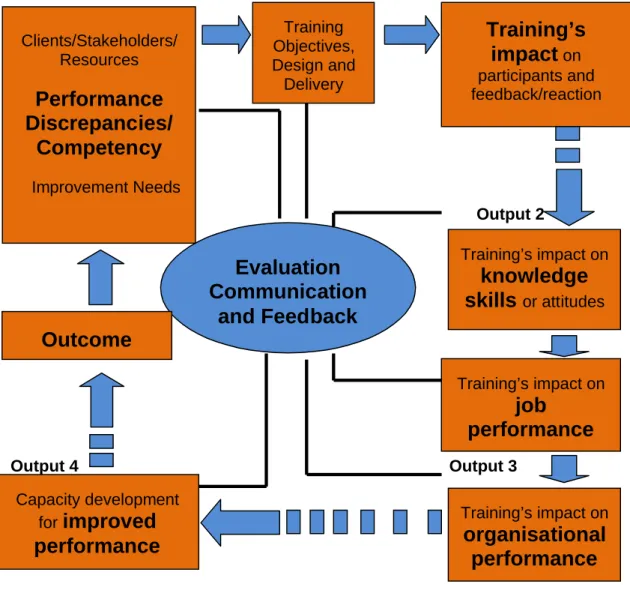
functionaries. A meaningful training programme therefore must be supported by training impact evaluation for assessing the extent to which the learning events are relevant for the needs of the participant trainees and the extent of actual transfer of learning in actual work situation. Knowledge about the impact of training helps design a new cycle of intervention for refurbishing training (if the impact is poor) and further improvements in organisational performance (in case the impact is positive). Such a framework of a demand driven training is depicted in the Figure l. It depicts the outputs to be derived from an appropriately designed and delivery of training courses, the outcomes arising out of training outputs and the feedback received from appropriately structured training courses that are to be used as valuable outputs for next round of training design.
Figure 1: Systems model of a demand driven Training Plan
Input Process Output 1
Output 2
Output 4 Output 3
1.3 Training Needs Assessment: Methodology Adopted
4. With a view to ascertain the subject areas of training required by the staff and officials of the agencies engaged in plan preparation, financing and implementation, a Training Needs Assessment was conducted at all the three levels mentioned above. The methodology suggested by the UNCHS (Habitat) was used for conducting the TNA at the
Clients/Stakeholders/ Resources
Performance
Discrepancies/
Competency
Improvement Needs Training Objectives, Design and DeliveryTraining’s
impact
on participants and feedback/reaction Training’s impact onknowledge
skills
or attitudes Training’s impact onjob
performance
Training’s impact onorganisational
performance
Capacity development forimproved
performance
Evaluation
Communication
and Feedback
Outcome
three levels.1 The UNCHS methodology suggests scanning of work situation to comprehend (i) the existing discrepancies, and (ii) the potential discrepancy. The former may persist in an organisation because the employees may not have the required skills for discharging the responsibilities entrusted to them (lack of knowledge and skills), or they do not wish to do so (lack of positive attitude). Potential performance discrepancy occurs due to gaps in knowledge or skills that may be required due to changes in organisational policy or actions initiated in the organisation such as administration of altogether new programmes. Scanning performance discrepancy is conducted through:
i. Studying records and reports of an organisation;
ii. Direct observation of the way the employees carry out their duties, communicate with each other; and
iii. Asking questions (Refer Annex-I-TNA instruments)
5. The methods mentioned above were used in ascertaining the training needs of staff and officials of the organisations mentioned above. This provided insights into gaps in the entry behaviour and the required behaviour of the functionaries and the staff at the three levels.
1.4 Training Needs Assessment: The Universe
6. As mentioned above, assessment of training needs was conducted at three levels viz, (i) the National Capital Region Planning Board, (ii) the National Capital Planning and Monitoring Cells located in the three constituent states and in the NCT of Delhi, and (iii) Implementing Agencies. These were therefore brought within the purview of TNA.
7. NCRPB: NCRPB being the nodal organisation for preparation and implementation of
the Regional Plan, TNA was carried out for all the officers and the staff presently working in the three sections of the Board, viz. Planning, Finance and Administration. The Member Secretary of the NCRPB was also brought within the purview of TNA. However, TNA in case of the Member Secretary was confined to structured discussions for eliciting the training need, if any for him. For the staff other than the Member Secretary, all three methods mentioned above were used for conducting the TNA.
8. Recourse was, however, taken more to asking questions. In order to elicit the required information for TNA, a questionnaire was prepared in consultation with the NCRPB. After it was finalised and approved, the same was administered amongst the staff working at different levels. The questionnaires were developed separately for the supervisory staff and the subordinate staff. Perception of the subordinate staff relating to his/her training needs was cross checked with the perception of the supervisory staff. This was supplemented by discussion with the respondents about their work situation, the responsibilities required to be discharged by them and the gap between the existing skill and knowledge and the ones required for effective discharge of their responsibilities.
9. NCR Planning and Monitoring Cells: All four NCR Planning Cells located in Ghaziabad (in the state of Uttar Pradesh), Delhi (in the NCT of Delhi), Jaipur (in the state of Rajasthan), and Chandigarh (in the state of Haryana) were as well brought within the scope of the TNA. These Cells were visited for conducting the Training Needs Assessment. The methodology adopted was the same as discussed above for the NCRPB.
1
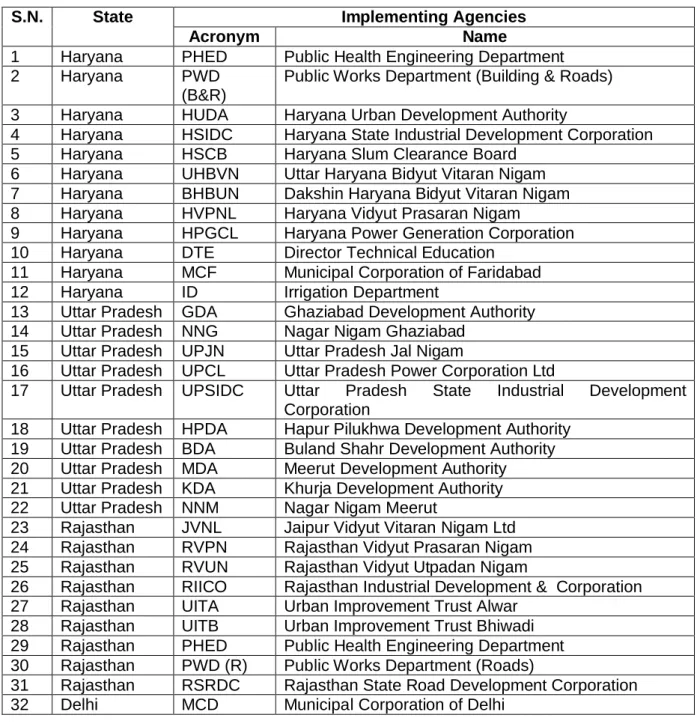
10. Implementing Agencies: A very large number of implementing agencies (IAs) are presently involved in the implementation of the NCR Regional Plan. This is evident from the Table 1 given below.
Table 1: Implementing Agencies of the Regional Plan for the NCR
S.N. State Implementing Agencies
Acronym Name
1 Haryana PHED Public Health Engineering Department
2 Haryana PWD
(B&R)
Public Works Department (Building & Roads)
3 Haryana HUDA Haryana Urban Development Authority
4 Haryana HSIDC Haryana State Industrial Development Corporation
5 Haryana HSCB Haryana Slum Clearance Board
6 Haryana UHBVN Uttar Haryana Bidyut Vitaran Nigam 7 Haryana BHBUN Dakshin Haryana Bidyut Vitaran Nigam
8 Haryana HVPNL Haryana Vidyut Prasaran Nigam
9 Haryana HPGCL Haryana Power Generation Corporation
10 Haryana DTE Director Technical Education
11 Haryana MCF Municipal Corporation of Faridabad
12 Haryana ID Irrigation Department
13 Uttar Pradesh GDA Ghaziabad Development Authority 14 Uttar Pradesh NNG Nagar Nigam Ghaziabad
15 Uttar Pradesh UPJN Uttar Pradesh Jal Nigam
16 Uttar Pradesh UPCL Uttar Pradesh Power Corporation Ltd
17 Uttar Pradesh UPSIDC Uttar Pradesh State Industrial Development Corporation
18 Uttar Pradesh HPDA Hapur Pilukhwa Development Authority 19 Uttar Pradesh BDA Buland Shahr Development Authority 20 Uttar Pradesh MDA Meerut Development Authority 21 Uttar Pradesh KDA Khurja Development Authority 22 Uttar Pradesh NNM Nagar Nigam Meerut
23 Rajasthan JVNL Jaipur Vidyut Vitaran Nigam Ltd 24 Rajasthan RVPN Rajasthan Vidyut Prasaran Nigam 25 Rajasthan RVUN Rajasthan Vidyut Utpadan Nigam
26 Rajasthan RIICO Rajasthan Industrial Development & Corporation 27 Rajasthan UITA Urban Improvement Trust Alwar
28 Rajasthan UITB Urban Improvement Trust Bhiwadi 29 Rajasthan PHED Public Health Engineering Department 30 Rajasthan PWD (R) Public Works Department (Roads)
31 Rajasthan RSRDC Rajasthan State Road Development Corporation
32 Delhi MCD Municipal Corporation of Delhi
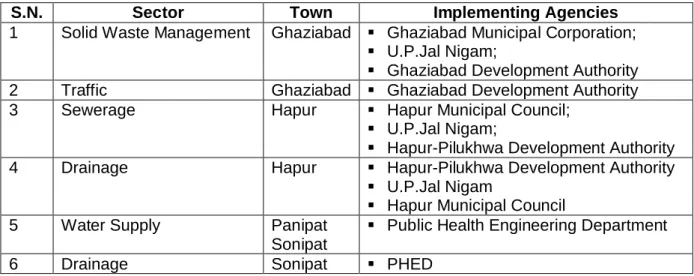
11. In view of a very large number of IAs as mentioned above, it was decided in consultation with the Project Director of this TA to take a sample of implementing agencies for conducting the TNA. It was also decided that as the Component B of the ADB TA does not have training specialist, the sample to be selected should be relevant for this component as well. As six demonstration feasibility studies and detailed project reports (DPRs) are being prepared for six different sectors with the involvement of a diverse types of IAs, it was finally decided to confine the TNA with respect to the IAs that are to be involved in implementation of the model DPRs being prepared under Component B of this TA. Accordingly, the IAs mentioned in Table 2 below were selected for conducting the TNA for the IAs.
Table 2: Projects and Implementing Agencies for Feasibility Studies and DPRs
S.N. Sector Town Implementing Agencies
1 Solid Waste Management Ghaziabad Ghaziabad Municipal Corporation;
U.P.Jal Nigam;
Ghaziabad Development Authority
2 Traffic Ghaziabad Ghaziabad Development Authority
3 Sewerage Hapur Hapur Municipal Council;
U.P.Jal Nigam;
Hapur-Pilukhwa Development Authority
4 Drainage Hapur Hapur-Pilukhwa Development Authority
U.P.Jal Nigam
Hapur Municipal Council
5 Water Supply Panipat
Sonipat
Public Health Engineering Department
6 Drainage Sonipat PHED
All above IAs were visited for ascertaining the number and type of staff to be involved in project implementation and for conducting the TNA.
1.5 Nature of Responses Obtained
12. Conducting of TNA yielded a number of subject areas of training. Quite many of these, however, turned out to be duplication of the same subject area of training but described differently. Some of the respondents, for example, expressed training in “Managing Treasury Function” while another wanted training in “Treasury Management”. These subject areas, however, form part of stand alone training in Principles of Financial Management. Another respondent expressed to get training in “Ratio Analysis” while still another expressed the need to be trained in “Debt Portfolio Management”. These form part of Principles of Financial Management. Some of the responses obtained were found to be quite abstract (need for training in “Work Culture”), and the need for training in “Exposure to the Working of Joint Ventures” that could form part of a study visit. Likewise, while some of the respondents wanted to be trained in GIS, others suggested to be trained in “Arc GIS” which is a type of software for GIS.
1.6 Competency Gaps
13. TNA of the functionaries working at the Board and in the NCR Cells has revealed gaps in the existing knowledge and skills amongst all types of functionaries such as planners, finance managers, and the support staff. It has also enabled gaining insights into institutional gaps that are beyond the purview of training. As the NCRPB envisions scaling up of its project planning, financing and implementation processes, the gaps in the knowledge and skills that would be required for this widens still further. TNA has revealed gaps in competence required for (i) planning especially in the spheres of project planning, project development, and the tools for these, (ii) financial management especially in terms of financial resource mobilisation, treasury management, loan management and documentation, project appraisal and management, and (iii) Monitoring and evaluation of plan implementation and the related areas for effective implementation of the Regional Plan. TNA also threw light on gaps the very institutional arrangement in the constituent states for planning and coordination for regional plan that are beyond the purview of training and entails interventions required for institutional restructuring. The subsequent sections of this report addresses process for enhancing competencies through a need-based training intervention. The nature of gaps in institutional arrangement in the constituent states and in the NCT of Delhi as also the interventions required for addressing these gaps forms the subject matter of the next Report on Human Resource Gaps and Management.
II.
Training Implications of NCR Plan
14. Training implications for the National Capital Region Plan flows from the specific functions mandated for the National Capital Region Planning Board by the National Capital Region Planning Board Act, 1985. The Act enjoins upon the Board to perform a number of functions relating to preparation, implementation and other functions incidental to these primary functions. The specific functions having training implications at the three levels mentioned above are mentioned below2:
i. To prepare the Regional Plan and the Functional Plans;
ii. To co-ordinate the enforcement and implementation of the Regional Plan, Functional Plans, Sub-Regional Plans and Project Plans through the participating States and the Union territory ;
iii. To ensure proper and systematic programming by the participating States and the Union territory in regard to project formulation, determination of priorities in the National Capital Region or sub-regions and phasing of development of the National Capital Region in accordance with stages indicated in the Regional Plan; and
iv. To arrange for, and oversee, the financing of selected development projects in the National Capital Region through Central and State Plan funds and other sources of revenue.
15. The functions mentioned above requires systematic planning and programming by the constituent states and the Union Territory of Delhi for project formulation, prioritisation of projects, phasing of development and arranging and overseeing financing of selected development projects. These constitute prime activities that have substantial training implications for the Board, the NCR Cells and the Implementing Agencies. Preparation of Regional Plan, Functional Plans by the Board and Sub-Regional Plans and Project Plans by the constituent states itself has lot of training implications for data generation, management, and analysis by taking recourse to emerging tools and technology of remote sensing, GIS and information technology. Plan implementation entails monitoring, evaluation and financing. These again require appropriate training for enhancing knowledge and skills of the functionaries in the spheres of project development, structuring, appraisal, monitoring, financial resource mobilisation for augmenting the funds for financing plan implementation, treasury management, and debt management.
16. Implementing Agencies would as well require training for effective implementation and operations and maintenance of the basic urban infrastructure such as water supply, waste water management, solid waste management, drainage, transport systems, energy, environment, etc. These would require up-gradation of skills for managing the infrastructure to be provided as part of the implementation of the Regional and Functional Plans.
17. It should be apparent that training implications of preparation, financing, implementation and monitoring of the Regional Plan, and a hierarchy of plans to be prepared and implemented under the aegis of the Regional Plan has substantial implications for training. The National Capital Region Planning Board Act, 1985 details the basic elements that must be contained in the Regional Plan. These provisos themselves are quite elaborate that require necessary knowledge and skills for plan preparation and evaluation of Sub-Regional Plans to be prepared by the constituent states3. Training needs pertain to three levels viz. (i) NCRPB located in the national capital, and (ii) NCR Planning and Monitoring Cells and (iii) Implementing Agencies located in the constituent states.
2
Section 7, National Region Planning Board Act, 1985 3
III.
Subject Areas of Training
18. As mentioned above, Member Secretary was also brought within the fold of TNA. It is worth mentioning that since the position of Member Secretary belongs to Indian Administrative Service, the incumbents of this service are required to go through an elaborately structured training programme conceived especially for them. Current Member Secretary has already gone through a number of training in governance, administrative systems, leadership, communication and team building and other related areas of knowledge and skills. Nevertheless, as his present posting in an organisation that deals largely with regional planning and financing of infrastructure, he showed interest in environmental issues in urban and regional Planning. But the learning events in his case will have to be short in a capsule form as his presence at the NCRPB for providing leadership and drive to the Board will not enable him to attend a long duration course.
19. TNA for staff yielded diverse responses in diverse subject areas of training. In many instance, the respondents gave multiple responses relating to the same subject area of training. These had to be refined and firmed up. All such responses obtained form the respondents were therefore gone through by the thematic experts in the consulting team .of this TA. Distinct subject areas of training were determined, finalised and firmed up in consultation with the thematic experts. Distinct subject areas of training arising out of the TNA are mentioned below along with the Target Groups.
3.1. Regional Planners
20. Regional Planners at the NCRPB and the planners posted in the NCR Planning and Coordination Cells in the constituent states suggested the number of subject areas in which they would like to have training. These are mentioned below. TNA revealed that all the planners working at top, middle and lower levels should have training in subject areas dealing with planning and the planning tools.
21. Training courses on (i) Solid Waste Management, (ii) Project Appraisal, (iii) Financial Resource Mobilisation for Infrastructure Financing, (iv) Financial Structuring and Development of Projects, (v) Urban Good Governance, (vi) Project Monitoring and Evaluation, and (vii) MIS should be left as optional depending on individual choice for learning. However, the Planner(s) working in the Project Management and Coordination Cell of the NCRPB, will have to undergo training in Project Monitoring and Evaluation, Financial Structuring and Development of Projects, Project Appraisal besides the training courses in core subject areas of planning mentioned below.
• Concepts, Tools and Technology for Regional Planning
• Transport Planning Techniques and Financial Options
• Planning for Power (Energy),
• Planning and Management for Water Supply and Waste Water Disposal
• Solid Waste Management
• Geographic Information System
• Project Planning and Development
• Project Appraisal (Technical, Financial, Environmental, Social, and Institutional)
• Financial Resource Mobilisation for Infrastructure Financing
• Financial Structuring and Development of Projects
• Demographic Analysis and Projections – Tools and Techniques
• Remote Sensing and Aerial Photography
• Software and Simulation for Environment Planning
• Data Base Management
• Project Monitoring and Evaluation
• GIS (Arc GIS, Map Info etc)
• MIS and ERP System
3.2. Planning Assistants & Draughts Men
22. Planning Assistants and Draughts Men working at the NCRPB and also in the NCR Planning and Coordination Cells mentioned the following subject areas of training. Some of these are common with those suggested by Planners. It needs to be emphasized that the Planning Assistants and the Draughts Men should have training in all the subjects mentioned below except data base management that does not constitute a core function to be performed by them. They should have an option in going through these subject areas of training.
• Auto Cad
• GIS (Arc GIS, Map Info)
• Data Base Management
• Design Software (Photo Shop, 3D Max Studio etc.)
23. Behavioural Science: Some of the Planners and Planning Assistants also
suggested getting training in behavioural aspects. These are mentioned below separately for the supervisory staff and the sub-ordinate staff. Discussion with some of the supervisory staff and also observation of work situation suggest that training in Team Building, Leadership and Communication will me desirable only for the supervisory staff who needs to build a team and work with it. This training will be desirable also for the supervisory staff in Finance and Administration.
3.3. Finance Functionaries
24. The staff dealing with financial management as well indicated an impressive list of subject areas of training for their capacity development. These subject areas together consist of concepts, principles, tools and techniques. These are mentioned blow.
• Introduction to Financial Management (Ratio Analysis, Treasury Management, Working Capital)
• Project Appraisal (Technical, Financial, Environmental, Social, and Institutional)
• Project Monitoring Tools and Techniques
• Risk Management
• Project Finance
• Financing Urban Infrastructure Projects
• Credit Assessment (Credit Profiles of Borrowers and Projects)
• Accounting Principles (including DEAS)
• Computerised Financial Accounting System: Use of Tally
• MIS
• PPP for Infrastructure Projects
25. On further discussion, it was ascertained that the lower level staff who are engaged in maintaining of accounts, will need training especially in Accounting Principles including DEAS and Tally based Financial Accounting System. Even the middle level functionaries in Finance section have shown interest in learning Tally and DEAS. However, a call needs to be taken whether to hire staff in Tally or offer training to all staff members once the proposed ERP system is implemented. Hence barring the Director of Finance who heads the finance section, all the functionaries will go for training in Tally and DEAS besides the other subject areas of training mentioned above.
3.4. Administration Staff
26. The subject areas of training mentioned below are meant not only for the administrative staff of the NCRPB but of the NCR Planning and Coordination Cells located in the constituent states and the NCT of Delhi as well. Training for the administrative staff of the implementing agencies is not recommended here as the IAs do not have dedicated staff for implementation of the NCR projects exclusively.
• Office Management (including File Management)
• Use of IT in Record Management
• Inventory Management
• Vigilance and Disciplinary Procedures
• Basic Computer Skills (MS Office, Accessing the Web, E-mailing)
• Right to Information Act
• Management Information System (MIS)
• Income Tax
• Human Resource Development
• Retirement & Terminal Benefits
• Communication Skills
3.5. Implementing Agencies
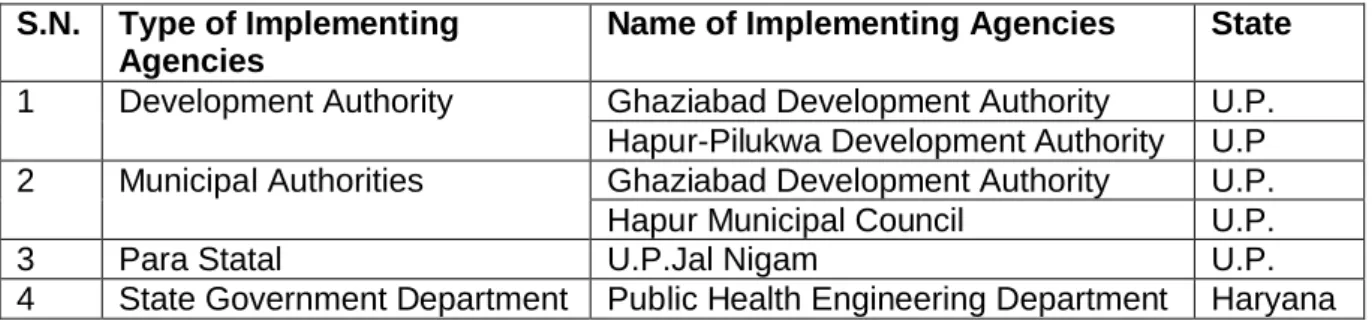
27. Table 2 given above depicts that the sample IAs are of four types as mentioned below.
Table 3: Types of Sample Implementing Agencies for TNA
28. TNA for these IAs was conducted keeping in view the type of projects they are to be involved with. TNA and the consequent training for the IAs therefore are project specific. Enhancing knowledge and skills of the entire staff in the IAs is not and should not be the objective of the TNA. This will require altogether different scale of raining which is also not the objective of the present TA. Training needs have therefore been assessed only for the members of the staff that are to be involved in project implementation.
29. It should be obvious from Table 3 that the nature of role of the IAs are diverse; some of them are to be involved in project formulation while others are to be involved in operations and maintenance. Development Authorities and the U.P. Jal Nigam, for example, largely perform development functions that involve formulation and implementation of projects. PHED (Haryana) is involved in both development and maintenance; having formulated and implemented the projects, it also operates and maintains the water supply systems and administers user charges. The municipal authorities are to be involved largely in operations and maintenance. This has larger implications for the nature and scale of training that is discussed subsequently in this report.
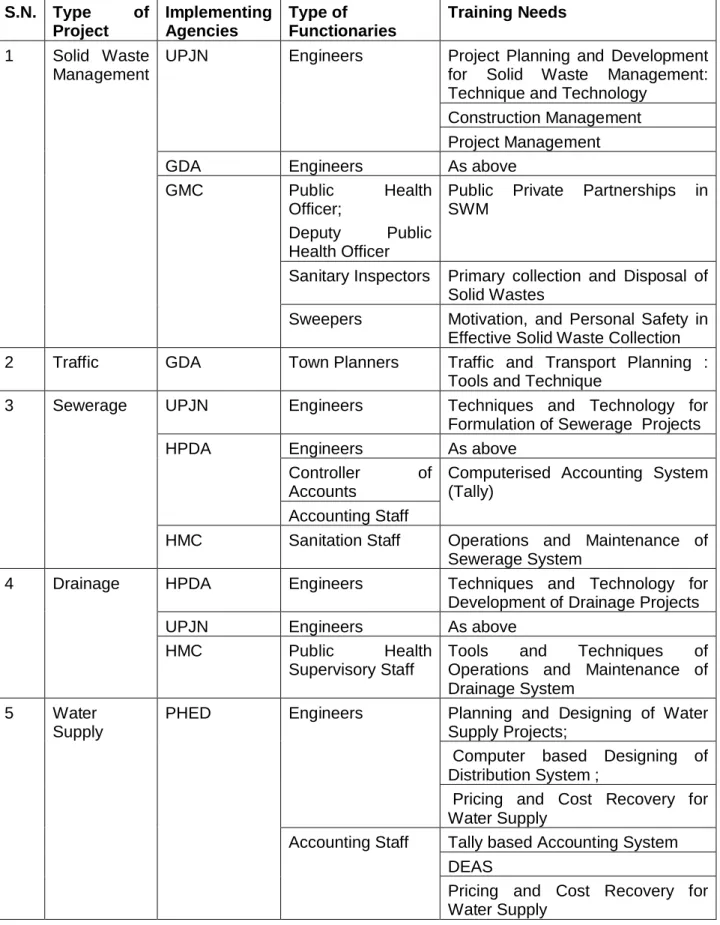
30. Training needs on the basis of the types of projects and involvement of the functionaries of the various IAs are mentioned below.
S.N. Type of Implementing
Agencies
Name of Implementing Agencies State
1 Development Authority Ghaziabad Development Authority U.P. Hapur-Pilukwa Development Authority U.P 2 Municipal Authorities Ghaziabad Development Authority U.P.
Hapur Municipal Council U.P.
3 Para Statal U.P.Jal Nigam U.P.
Table 4: Training Needs of Implementing Agencies of the NCR Plan S.N. Type of Project Implementing Agencies Type of Functionaries Training Needs 1 Solid Waste Management
UPJN Engineers Project Planning and Development for Solid Waste Management: Technique and Technology
Construction Management Project Management
GDA Engineers As above
GMC Public Health
Officer;
Deputy Public Health Officer
Public Private Partnerships in SWM
Sanitary Inspectors Primary collection and Disposal of Solid Wastes
Sweepers Motivation, and Personal Safety in Effective Solid Waste Collection 2 Traffic GDA Town Planners Traffic and Transport Planning :
Tools and Technique
3 Sewerage UPJN Engineers Techniques and Technology for
Formulation of Sewerage Projects
HPDA Engineers As above
Controller of Accounts
Computerised Accounting System (Tally)
Accounting Staff
HMC Sanitation Staff Operations and Maintenance of Sewerage System
4 Drainage HPDA Engineers Techniques and Technology for
Development of Drainage Projects
UPJN Engineers As above
HMC Public Health
Supervisory Staff
Tools and Techniques of Operations and Maintenance of Drainage System
5 Water
Supply
PHED Engineers Planning and Designing of Water Supply Projects;
Computer based Designing of Distribution System ;
Pricing and Cost Recovery for Water Supply
Accounting Staff Tally based Accounting System DEAS
Pricing and Cost Recovery for Water Supply
UPJN: U.P.Jal Nigam; GDA: Ghaziabad Development Authority: GMC: Ghaziabad Municipal Corporation; HPDA: Hapur-Pilukhwa Development Authority; HMC: Hapur Municipal Council; PHED: Public Health Engineering Department; DEAS: Double Entry Accounting System.
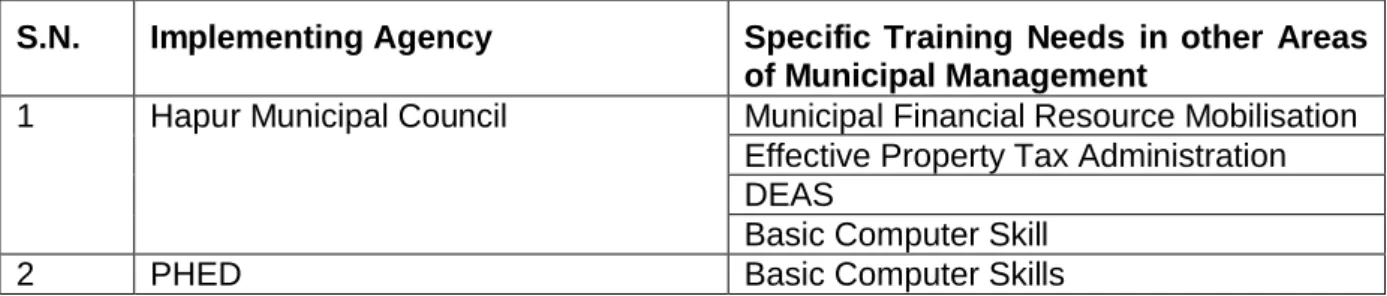
31. Besides the above mentioned subject areas of training for the various categories of staff of the IAs, some of them in particular expressed the need for training in accounting and financial resource mobilisation. These are mentioned below:
Table 5: Specific Training Needs of Some of the Implementation Agencies
S.N. Implementing Agency Specific Training Needs in other Areas
of Municipal Management
1 Hapur Municipal Council Municipal Financial Resource Mobilisation Effective Property Tax Administration DEAS
Basic Computer Skill
2 PHED Basic Computer Skills
32. HMC’s training need for Municipal Financial Resource Mobilization and Property Tax Administration is impelled by its weak fiscal capability and the need for mobilisation of additional financial resources for augmentation of basic municipal services and effective operations and maintenance of services. Enhanced fiscal capacity of HMC will help effective operation and maintenance of assets to be created under the aegis of the NCRPB. Poor resource base and accompanying weak institutional capacity result in deterioration and decay of capital projects. It would be therefore advisable to help the HMC by conducting the capacity building training workshops mentioned above.
3.6 Related Subject Areas of Training
33. Though training needs based on formal TNA are contained in Annex lV and V,
institutional analysis of potential training institutions revealed well structured courses being conducted by some of them in the subjects that are either very similar to the ones derived from the TNA or these courses could be quite relevant especially for the functionaries engaged in financial management of the NCRPB. The NCRPB may have a look on these courses being conducted by some of the reputed centres of excellence and nominate its staff and officers in the courses relevant for its work situation.
S N Name of the learning Event Institution
1 Contract Management Indian Institute of Management, Ahmadabad
2 ERP Systems; Technology Planning and Implementation
Indian Institute of Management, Ahmadabad
3 Advanced HR Management Indian Institute of Management, Ahmadabad
4 Infrastructure Development and Financing Indian Institute of Management, Ahmadabad 5 Leadership and Change Management Indian Institute of Management, Ahmadabad
6 Project Management Indian Institute of Management, Ahmadabad
7 Interpersonal Effectiveness & team building Indian Institute of Management, Ahmadabad
8 Credit Analysis National Institute of Bank Management, Pune
9 Credit Management National Institute of Bank Management, Pune
10 Financing Infrastructure Projects (Focus-Project Appraisal and Risk Analysis)
National Institute of Bank Management, Pune 11 Financial Analysis for Credit Rating National Institute of Bank Management, Pune 12 Estimation and Mitigation techniques in Credit
Risk (Focus: Credit Derivatives and securitization)
National Institute of Bank Management, Pune
IV. Institutional Arrangement for Training
34. Training needs assessment for the staff and officials of the planning and implementing organisation in the previous section has indicated the need for training in diverse subject areas. In view of this, the choice for training institutions as well will have to be as diverse as the subject areas of training. This is so largely because the expertise required for conducting of capacity building training workshops in the identified subject areas of training is unlikely to be found in a single training institution.
35. In view of this, the potential training institutions have been identified by way of (i) visiting the web sites of reputed training, professional and academic institutions, (ii) visiting such institutions that are easily accessible, and (iii) by discussing with some of them on phone. Barring the IIMs, the IITs, Indian Institute of Remote Sensing Institute, Banking Management Institutes of the Reserve Bank of India, the National Financial Management Institute, Faridabad that are reputed for being centres of excellence; an institutional analysis was conducted for other training/professional institutions to ensure that these institutions do possess the required expertise for conducting of training course.
4.1 Potential Training Institutions
36. As mentioned earlier, an intuitional analysis of such training institutions is contained
in Annex Il. Addresses and contact numbers of the potential training institutes are contained
in Annex Ill. The search for potential training institutions yielded large number of institutions
that have the required expertise for conducting the training courses that are conceived for the NCRPB and other organizations involved in planning and plan implementation in the NCR. The identified potential training institutions constitute a mix of public sector, private sector and the institutions managed by the NGOs. These include the reputed professional institutions in the public sector such as the Indian Institutes of Management, Indian Institutes of Technology, Banking management institutes, institution working as part of the Space Research organization, and other institutions in the private sector. The potential training institutions identified for delivery of training plan are mentioned below:
i. Indian Institute of Management Ahmedabad ii. Indian Institute of Management Calcutta iii. Indian Institute of Management Indore iv. Indian Institute of Technology Madras
v. Indian Institute of Remote Sensing, Dehradun vi. School of Planning, CEPT Ahmedabad
vii. School of Planning and Architectures, New Delhi viii. National Power Training Institute Faridabad
ix. National Banking Management Institute Pune x. Indian Institute of Banking Management Guwahati xi. National Institute of Financial Management Faridabad
xii. National Environmental Engineering Research Institute, Nagpur xiii. Central Road Research Institute, Delhi
xiv. Institute of Secretariat Training and Management, New Delhi
xv. Association of Municipalities and Development Authorities, New Delhi xvi. Sambodhi, Delhi
xvii. Envirosyz, Hyderabad xviii. SCI Software India Pvt.Ltd
xix. APTECH
xx. National Institute for Information Technology (NIIT) xxi. ESRI
37. These institutions have a track record of conducting training in the subject areas of training identified for the NCRPB and other organizations engaged in planning and plan
implementation in the NCR. As some of the identified potential training institutions are centres of excellence, institutional analysis of these institutions has not been done as part of this report on training plan. Institutional analysis has been done, however, for other institutions (Annex lI). Subject areas of training along with the suggested target groups for these, potential training institutions for conducting the identified subject areas of training and other related details for the staff and officials of the NCRPB, the NCR Planning and Monitoring Cells and the implementing agencies are presented in Annex IV and V
respectively.
4.2 Delivery of Training
38. The training courses identified on the basis of TNA would need to be conducted in two ways:
i. The TA Consultants will conduct courses on (i) Project Appraisal with separate training modules on Financial, Technical, Environmental, Social, and Institutional appraisal, and (ii) MIS Concept and Tools. The Board has agreed to conduct these courses in the NCRPB premises on closed holidays so that the usual work of the Board is not disrupted. The Project Appraisal Training will be conducted first in the beginning of March, 2009 in stages; one training module of this course will be taken up in each stage. The second training course on MIS Concept and Tools will be taken up in May, 2009, and,
ii. Other training courses in the Training plan are to be conducted by the training/professional institutions identified in the Training Plan. The Training and HRD Manager of the NCRPB will operate with the potential training institutions identified in the Training Plan at least three month before the commencement of each training course. As suggested below, the NCRPBN will have to allocate a budget for conducting of the training courses.
39. It is important to mention that institutional analysis of training revealed that almost all the identified institutions are already engaged in their usual pre-determined professional, academic and training schedules. They therefore indicated that the request for conducting training for the NCRPB should be intimated to them at least three months in advance. Some of them also indicated the fee structure. Others indicated that the fee structure is subject to negotiation as it will depend on course duration that itself will have to be firmed up in consultation with the training institutions concerned. Some of the training institutions such as CRRI, ISTM indicated that besides the course fee, board and lodging facilities will have to be paid separately. Some of the training institutions such Sambodhi, SCI Software do not have board and lodging facilities. NCRPB will therefore has to look for these on their own. These details are important and the NCRPB will have to look at these so that learning events are pre-meditated.
V.
Institutionalising Training in NCRPB
40. It needs to be mentioned that training is not and should not be conceived as a single shot exercise simply because of the fact that learning is a continuous process. NCRPB, therefore, needs to put in place a sustainable instructional arrangement for mainstreaming training in the Board itself. It is important to mention in this regard that the broader contours of the National Training Policy and the imperatives for this also entail institutionalisation of training.
5.1 National Training Policy
41. The government of India constituted a Working Group in 1993 for formulation of a National Training Policy (NTP). The Working Group submitted its report in 1994 and after considering the report in consultation with various ministries and departments, the DoPT issued operational guidelines on various aspects of a strategy for implementation of NTP. It defined training objectives and the broader concerns of training and envisaged ‘training for all’ “starting, from the lowest and cutting edge to the highest in policy making”. It especially stressed the need to train the front line functionaries who interact with the citizens on a day-to-day basis for delivery of public services, implementation of various public programmes at the grass root level. Besides ‘training for all’, it envisaged the need for induction training, training at the time of changing of jobs, promotion, and different stages of career progression.
42. The NTP suggests to create a high powered National Training Council headed by the Minister-in-charge of Personnel, Public Grievances and Pensions, Government of India, having representatives of state governments, administrative heads of major ministries and other major functional organizations of the government of India, major training institutions in and outside government and also reputed training consultants and experts for advising the central government on training policy, design and implementation. It suggests for creating similar Training Council in each state and for appointing a Training Manager in each Department, who will ensure an integrated approach to training. It is suggested in the policy that s/he he will be involved in various activities relating to organisation of training programmes such as analysis of training requirements, design of training programmes, selection of appropriate training institutions and the evaluation of training. S/he will advise on right kind of interventions required for right kind of intervention for overcoming specific problems of performance. S/he is envisaged to act as an interface between the state and the training institutions. For funding training programmes, the National Training Policy document suggests to pool 5 percent of wages and salary bills of all the Departments to create a training fund to be kept under a separate budget.
43. Such an institutional arrangement provides a sustainable framework wherein training needs of not only of the NCRPB but also of the other organisations engaged in planning and plan implementation could be managed. In order to ensure that the training becomes part of the Board’s activities, it is suggested that the NCRPB should strive to institutionalise training within the Board.
5.2 Steps Suggested for Institutionalisation of Training within the NCRPB
44. The scale of training conceived as part of this strategic Training Plan and even beyond it, entails that training would need to be institutionalised within the NCRPB. Delivery of training and the processes involved in it as very briefly discussed in the preceding paragraph all the more requires institutionalising training within the NCRPB. Basic steps for this are mentioned below.
45. Allocate Budget for Training and HRD: Conducting of training courses as part of this Strategic Training Plan and even after the implementation of this Training Plan will require availability of funds. The NCRPB would therefore need to create a training fund.
46. Appoint HRD Manager: The NCRPB would need to identify one of its functionaries for managing training on a sustainable basis. With a view to minimise the need for recruitment of additional staff for this, the NCRPB should entrust the responsibility of managing training and HRD related initiatives (to be elaborated in the forthcoming Report on Human Resource Management for NCRPB) to the existing Deputy Director of Administration. He will ensure that the Strategic Training Plan contained in this report is implemented by negotiating the conducting of training coursed with the potential training institutions identified in this Strategic Training Plan.
47. Train the HRD Manager in Training and HRD: The HRD Manager will require knowledge and skills for implementing the Strategic Training Plan and human resource management. For this end in view this Strategic Training Plan has a component for training of trainer (ToT) in HRD along with the potential training institution (Annex lV). The HRD Manager (Deputy Director of Administration in the NCRPB) would subsequently need to undergo the courses on (i) Training Design, and (i) Direct Trainers’ Skill. These are extremely useful training course being conducted by the by the DoPT in accredited training institutions such as Uttaranchal Academy of Administration, Nainital, ISTM, Delhi, and M.P. Academy of Administration, Bhopal.
48. Constitute a Training and HRD Advisory Committee: Training and human
resource development activities would need to be overviewed by a Training and HRD Advisory Committee on a regular basis. In order to facilitate this task, the NCRPB would need to create a Training and HRD Advisory Committee. To be chaired by the Member Secretary of the NCRPB, the Committee will have the Chief Regional Planner, the Director of Finance of the NCRPB, the Director of AMDA, and a training expert to be co-opted by the Committee as its members. HRD Manager (Deputy Director of Administration in the NCRPB) will be the Member Secretary of the Training and HRD Advisory Committee. The Committee will overview and also review operational matters relating to training and will provide policy direction, support and guidance to the HRD Manager in the spheres of training and human resource management. The Committee should meet at least twice in a year
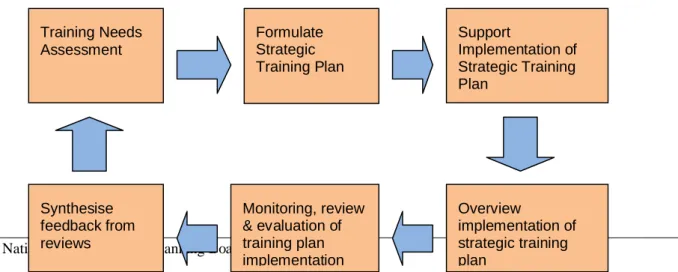
49. Functions of the HRD Manager: The HRD Manager will play an important role in implementation of the Strategic Training Plan and sustaining training and HRD initiatives in future. Sustenance of training would require the HRD Manager to operate within the framework mentioned below. The framework entails that training will need to be driven by training needs of the staff and the officials of the NCRPB and even other players involved in planning and plan implementation in the NCR. For this the HRD Manager would need to go for periodical training needs assessment. The inputs from the TNA will have to be used for formulation of strategic training plan on a regular basis. This will be followed by an oversight by the NCRPB of implementation of the training plan by the identified training institutions. Conducting of training courses will have to be monitored and evaluated for identifying bottlenecks and gaps, if any, and most importantly for understanding the extent of actual transfer of learning.
Figure ll: Basic Framework of Formulation & Implementation of a Strategic Training Plan Training Needs Assessment Formulate Strategic Training Plan Support Implementation of Strategic Training Plan
50. In view of the framework suggested above, the HRD Manager will have to perform the following functions:
To play a crucial role in training by planning, delivery and evaluation of capacity building training and HRD initiatives in the NCRPB;
To be responsible for all day-to-day operational matters relating to implementation, management and evaluation of training to be conducted by different training institutions;
To modify the Strategic Training Plan on the basis of feedback to be received from the review and evaluation of the training courses conducted by the training institutions;
Conduct training needs assessment after the Strategic Training Plan is fully implemented;
To identify new training institutions if needed;
To arrange and facilitate visits to the good practices in regional planning, project financing and plan implementation elsewhere in the country;
To prepare a new training plan on the basis of fresh assessment of training needs of the NCRPB functionaries; and
To arrange for training of the NCRPB staff and officials on induction, on promotion, and on transfer from one section to another.
5.3 Evaluation of Training
51. Preparation of a strategic training plan on the basis of inputs from a formal training needs assessment notwithstanding, the training courses to be conducted would need to be evaluated on a regular basis to get insights into (i) the usefulness of training for the participants, and (ii) transfer of learning. In order to get at the usefulness of training for the participants, the HRD Manager in the NCRPB will ensure that the participating training institutions evaluate the training courses conducted by them through concurrent evaluation. This entails that the concerned training institution will get the training course evaluated by the participants in terms of the extent to which:
The course content and structure is relevant to the learning needs of the participants;
The training course has contributed to enhancement of knowledge and skills of the participants for improving their performance;
The resource persons were individually able to deliver the training session allocated to them;
The training materials supported the various training sessions; and
Training infrastructure including board and lodging facilities (if relevant) are satisfactory to the participants
52. In addition to the concurrent evaluation mentioned above, the HRD Manager will have to conduct a post-evaluation of the training courses after at least three months of completion of a training course. This would require getting back to the participants for administering a structured questionnaire to gain insights into actual transfer of learning. The feed back received from concurrent evaluation will have to be used by the training institutions concerned for restructuring of the next learning even. The feedback to be received from post-evaluationwill be used for resurrecting the entire training plan.
In sum, it needs to be emphasised that if training has to be used for addressing performance discrepancies, which it must, the framework of training as also the basic steps for delivery of training will have to be followed in letter and spirit. Training should not be treated as a fad and go for it casually and in a rudimentary manner.
ANNEXES
Annex I: Instruments of Training Needs AssessmentADB Project on
Capacity Development of National Capital Region Planning Board Training Needs Assessment
(Questionnaire for the Chief Regional Planner)
As you now, the Asian Development Bank has given a Technical Assistance (TA) to the National Capital Region Planning Board (NCRPB) for capacity development of the NCRPB. Training being an important component of capacity development initiative, the TA envisages
putting in place a scheme of demand driven training based on training needs assessment of the NCRPB staff at all levels in the organisation. Your kind cooperation is therefore solicited for devoting some of your time for filling in this questionnaire. This will provide useful insights for assessment of training needs of the NCRPB and preparation of training plan.
Name: _________________________________ Designation: _________________________________
Name of the Organisation: __________________________________________ 1. How long have you been working at the National Capital Region Planning Board?
___________Years
2. What do you like most about working for your organisation? (Tick the relevant statement(s). 1. A congenial work environment
2. Supportive Staff
3. Contributing to the development of NCR gives me job satisfaction 4. Being a reputed organisation, gives me a sense of pride
5. Any other (specify) ____________________________________ ____________________________________________________
3. What do you like the least about working for your organisation? (Tick the relevant statement(s).
1. It does not have a proper work culture 2. Sitting arrangement is not to my liking 3. Staff is not sincere to their work 4. Office is too noisy
5. Any other (specify) ______________________________________________ _____________________________________________________________ 1. It does not have a proper work culture
2. Sitting arrangement is not to my liking 3. Staff is not sincere to their work 4. Office is too noisy
5. Any other (specify) ______________________________________________ _____________________________________________________________
A. Training Needs for Performing Existing Jobs
4. Kindly mention the most important activities you are required to perform in your day-to-day functioning as part of your professional duties and responsibilities at the NCRPB.
1._________________________________________ 2._________________________________________ 3._________________________________________ 4._________________________________________ 5__________________________________________
5. As you know, Training is about enhancing knowledge and skills for effective performance of your duties and responsibilities in the organisation. Do you require up-gradation of your knowledge and skills for improving your abilities for performing your duties mentioned above much more effectively and efficiently?
Yes No
6. If yes, kindly mention the subject areas of training for acquiring the required knowledge and skills for performing the most important activities mentioned above (in response to question 4 above). 1._________________________________________ 2._________________________________________ 3._________________________________________ 4._________________________________________ 5__________________________________________
7. Discharging official responsibilities, many often, requires working in a team. Do you like working in a Team?
Yes No
8. Do you think, working in a team requires skills for team building, communication and leadership?
Yes No
If Yes, would you like to strengthen these skill through training?
Yes No
B. Training Needs for Performing Anticipated Jobs
9. Urban and Regional Planners now have an opportunity to use a host of emerging technologies and techniques such as Digital Spatial Database, Remote Sensing, Auto Cad and new method and techniques of data management for planning and monitoring of plan implementation.
Kindly mention in which of the emerging planning concepts, tools and technologies you will like to acquire new skills?
1._________________________________________ 2._________________________________________ 3._________________________________________ 4._________________________________________
5__________________________________________ 6__________________________________________ 7__________________________________________
C. For Supervisor only (Chief Regional Planner)
10. You have been supervising the performance of your sub-ordinates in the Planning section of the NCRPB. Kindly mention five most important areas of their working in the present work situation that they need skill up-gradation (training).
1._________________________________________ 2._________________________________________ 3._________________________________________ 4._________________________________________ 5__________________________________________
11. In the event of use of emerging newer tools, equipments, and new technology for plan preparation and monitoring, in which of these (kindly refer to Question 9) should your planners and planning staff acquire knowledge and skills?
1._________________________________________ 2._________________________________________ 3._________________________________________ 4._________________________________________ 5__________________________________________
12. At times, organisational compulsions require the staff perform functions that do not form part of their job description. What according to you the members of staff overviewed by you are doing that they should not be doing?
i.___________________________________________________________________ ii.___________________________________________________________________ iii.____________________________________________________________________ iv.___________________________________________________________________
v.____________________________________________________________________ 13. What the members of the staff overviewed by you are not doing that they should be doing?
i.____________________________________________________________________ ii.____________________________________________________________________ iii.____________________________________________________________________ iv.____________________________________________________________________ v.___________________________________________________________________
ADB Project on
Capacity Development of National Capital Region Planning Board Training Needs Assessment
(Questionnaire for Director, Finance)
As you know, the Asian Development Bank has given a Technical Assistance (TA) to the National Capital Region Planning Board (NCRPB) for its capacity development. Training being an important component of capacity development initiative, the TA envisages putting in place a scheme of demand driven training based on training needs assessment of the NCRPB officials and staff at all levels in the organisation. Your kind cooperation is therefore solicited for devoting some of your time for filling in this questionnaire. This will provide useful insights for assessment of training needs of the NCRPB and preparation of a training plan for its functionaries.
Name: _________________________________ Designation: _________________________________
Name of the Organisation: __________________________________________
1. How long have you been working at the National Capital Region Planning Board? ___________
2. What do you like most about working for your organisation? (Tick the relevant statement (s). 1. A congenial work environment
2. Supportive Staff
3. Contributing to the development of NCR gives me job satisfaction 4. Being a reputed organisation, gives me a sense of pride
5. Any other (specify) ____________________________________ ____________________________________________________
3. What do you like the least about working for your organisation? (Tick the relevant statement(s).
1. It does not have a proper work culture 2. Sitting arrangement is not to my liking 3. Staff is not sincere to their work 4. Office is too noisy
5. Any other (specify) ______________________________________________ _____________________________________________________________
A. Training Needs for Performing Existing Jobs
4. Kindly mention the most important activities you are required to perform in your day-to-day functioning as part of your professional duties and responsibilities at the NCRPB.
1._________________________________________ 2._________________________________________ 3._________________________________________ 4._________________________________________ 5__________________________________________
5. As you know, Training is about enhancing knowledge and skills for effective performance of your duties and responsibilities in the organisation. Do you require up-gradation of your knowledge and skills for improving your abilities for performing your duties mentioned above much more effectively and efficiently?
6. If yes, kindly mention the subject areas of training for acquiring the required knowledge and skills for performing the most important activities mentioned above (in response to question 4 above). 1._________________________________________ 2._________________________________________ 3._________________________________________ 4._________________________________________ 5__________________________________________
7. Discharging official responsibilities, many often, requires working in a team. Do you like working in a Team?
Yes No
8. If yes, do you think, working in a team requires skills for team building, communication and leadership?
Yes No
If Yes, would you like to strengthen these skill through training?
Yes No
B. Training Needs for Performing Anticipated Jobs
9. An organisation is evolving on a continuous basis due to a host of reasons such as changes in technology, external environment, and above all due to changes in policy or actions instituted by the management. For example, new skills may be required to work with a newly introduced technology or new systems of management.
In the event of increase in the scale of NCRPB’s present operation in financing a very large number of projects as targeted for the 11thFive Year Plan and thereafter, kindly mention the areas/aspects of financial management, treasury management, prudential norms and the like in which you would like to acquire new skills.
1._________________________________________ 2._________________________________________ 3._________________________________________ 4._________________________________________ 5__________________________________________ 6__________________________________________ 7__________________________________________ C. For Supervisor only (Director, Administration and Finance)
10. You have been supervising the performance of your sub-ordinates. Kindly mention five most important areas of their working in the present work situation that they need skill up-gradation (training). 1._________________________________________ 2._________________________________________ 3._________________________________________ 4._________________________________________ 5__________________________________________
11. In the event of scaling up of NCRPB’s financing of projects, in which of these (kindly refer to Question 9) should your staff acquire knowledge and skills?