The Commercial Development of Cell Therapy
– Lessons for the Future?
Survey of the Cell Therapy Industry and the
Main Products in Use and Development
Part 1: Summary of findings
Paul Martin, Ruth Hawksley and Andrew Turner
April 2009
www.nottingham.ac.uk/iss
This report was produced by the Institute for Science and Society, University of Nottingham. It is available for discussion purposes only and should not be quoted without the author’s permission.
Comments and suggestions are welcome and should be directed to the lead author. Dr Paul Martin
[email protected] Ruth Hawksley
Andrew Turner
This research was funded under the EPSRC Grand Challenge programme as part of remedi, a £9
million project led by Professor David J Williams from Loughborough University, that undertakes to explore the technical, economic, regulatory and social issues of creating a viable regenerative medicine industry in the UK.
EPSRC Grant reference: EP/C534247/1. www.remedigc.org
Part of this research was also supported by ESRC grant RES-340-25-0007 "Haematopoietic Stem Cells: The Dynamics of Expectations in Innovation" held by Paul Martin, Nik Brown, Alison Kraft and Philip Bath.
Executive summary
1. Aims of the survey: Great hopes currently surround the emerging field of regenerative medicine and the use of cells as therapeutic agents. In particular, much attention had been paid to the potential of novel stem cell based therapies, following a number of major scientific breakthroughs and media reports of potential new cures. These therapies have become the focus of a new sector of the biotechnology industry, which faces a number of major challenges in translating the promise of these scientific advances into widely used medical products.
This report forms part of a workpackage within the EPSRC funded Remedi Grand Challenge that addresses the issue of understanding user needs in regenerative medicine. It summarises the findings of a survey of the cell therapy industry completed in January 2009 that set out to assess the current state of private sector activity, the prospects for the future of the industry and the main challenges it currently faces. In particular, it aimed to:
Map the commercial development of cell based therapies within regenerative medicine and tissue engineering – the size, location and growth of the industry;
Describe the main products on the market or in development, including the disease focus and the main cell types used;
Chart the changing pattern of industrial collaborations in this area, and the extent to which the cell therapy sector is being integrated into the pharmaceutical and device industries. 2. Definitions: Careful definitions of tissue engineering, regenerative medicine and cell therapy were used to provide a sound basis for the industry survey. A key difference was drawn between primary (cell based) products and secondary products that provided structural components (matrices, scaffolds and biocompatible materials) to enable cell growth. Another important set of
distinctions was made between: A) non-stem cell based first generation products and a second
generation of products based on stem cell technology; and B) autologous products (based on a
patient’s own cells) and allogeneic products (based on cells from an unrelated donor). These
categories proved a valuable way of segmenting and analysing the industry and its dynamics. 3. The size of the industry: The size of the cell therapy sector has increased significantly over the last five years and was composed of 138 primary firms and 49 secondary firms at the start of 2009. The survey also identified 177 cord blood banks. The latter were not profiled in detail as they are not directly involved in developing new therapies. The UK ranks in the top three countries in the world with 15 firms working in this area.
4. Sectoral composition: The sub-structure of the cell therapy industry has changed very substantially over the last five years and is now dominated by firms working on stem cells (71% of all primary firms). No new firms working on non-stem cell therapies have been founded since 2002. The shift to stem cells is also associated with a greater emphasis on allogeneic products across the industry.
5. Geography: The cell therapy industry is highly geographically concentrated. It is dominated by US firms, which together with German and UK companies account for ~75% of the primary industry. US firms are older and more mature. The European industry has lagged behind, but whilst it made good progress in narrowing the US lead in the late 1990s, growth in the EU has stalled in recent years. This is largely due to the shift to stem cell technology, which the US dominates and suggests further entrenchment of its competitive advantage over Europe.
6. Maturity and firm growth: The cell therapy sector is relatively well established compared to other parts of the biotechnology industry, as measured by age of firms, number of public companies and products on the market. Despite this, there is a very high level of turnover and commercial failure amongst primary firms. Furthermore, there are problems with company growth and the primary sector remains dominated by small companies. Both these features are largely due to problems getting access to finance. In contrast, there are a greater number of medium-sized secondary firms, reflecting their commercial success.
7. Disease focus: The most popular disease target worked on by firms was cardiovascular conditions. This was followed by classical tissue engineering applications in skin, bone and cartilage, and metabolic disorders. The only clinical areas that fell outside the broad field of tissue engineering were CNS diseases and blood/ immune disorders (including some haematological cancers). The latter mainly relates to the application of haematopoietic and cord blood stem cells, an area with a long pedigree stretching back to the 1980s. It therefore appears that the transition from tissue engineering to regenerative medicine that has been marked by the application of stem cell technology has not yet led to a dramatic shift in the diseases targeted by industry.
8. Cell type used: Over 50 firms are working on different types of adult stem cells, compared to ~20 firms working on hESCs and less than 15 on cord blood stem cells. This highlights the fact that most commercial activity is in the adult stem cell area and this is even more marked when looking at products in clinical development.
9. Products on the market: The cell therapy industry is unusual compared to other biotechnologies by having a relatively large number of companies with products on the market (48 out of 187). However, this is very unequally distributed: 30 of the 49 secondary firms have launched products, whereas only 18 of the 138 primary firms had marketed products. Of this latter group, only two stem cell firm have therapies for sale. Furthermore, all allogeneic products were launched by US firms, whilst all but one of the firms selling autologous products were European. A total of 97 products were identified by the survey, of which 88 were for skin, bone or cartilage. Most products were sold by small firms and the development time to market was 5-10 years.
10. Product sales: These were broken down by product type:
Autologous first generation (non-stem cell) products – The survey identified 17 autologous cell-based products (13 for cartilage repair; three for skin repair of burns and chronic wounds, and one for bone grafting). Sales of these products have been very limited, with only one product (Carticel) treating more than a 1,000 patients a year. There are a number of reasons for this including poor product specification, lack of clinical evidence of utility and the high cost of manufacturing.
Allogeneic first generation (non stem cell) products – Five allogeneic products were identified by the survey, of which four were for skin repair. These have generated significant sales and cell-based products for the active treatment of chronic skin wounds now have an established market. Organogenesis’ Apligraf is currently used on ~35,000 patients a year and has been used on over 200,000 patients in total since 1998. However, it is unclear if this success can be extended to other therapeutic areas, as issues of transplant rejection from unmatched tissue donors are not a major issue with skin repair, but may be far more important for other indications.
Second generation (stem cell based) products - Only two product based on stem cell technology had been launched at the time of the survey. These have only been on the market for a few years and have limited sales of less than $20M a year. It would be premature to make a judgment about likely peak sales of these or other stem cell based therapies that might reach the market in the next few years.
Secondary products – In contrast to the relatively poor sales for primary products, the sales of a number of secondary products are significant totalling over $750M a year. Sales of the leading bone related secondary products were over $180M in 2007 and secondary skin products $300M. The most successful product in this category was Integra Dermal Regeneration Template.
Taken together, sales of primary products (containing cells) totalled no more that $100M a year. When combined with sales of secondary products (> $750M a year) and the cord blood banking industry (sales of ~$200M a year), this gives an industry total of over $1 billion a year.
11. Products in development: There were 120 primary products in clinical development at the time of the survey. 64 (53%) were either Pilots, Phase I or Phase I/II; 34 (28%) were in Phase II; and 22 (19%) were in Phase III. Of the primary products in clinical development 35% were non-stem cell based and 65% used stem cells. Trials of primary non-stem cell therapies (autologous and allogeneic) and secondary products were mainly for classical tissue engineering conditions (skin, bone and cartilage). However, there were a number of trials for cardiovascular disorders. The clinical development of stem cell therapies was slightly different, split between classical tissue engineering conditions (28 trials), cardiovascular disorders (30 trials) and diseases treated by haematopoietic stem cells (13 trials, mainly for cancer). Only three trials were for metabolic conditions and one for a CNS disorder). No clinical trial involved human embryonic stem cells had started by January 2009, but one had just received approval from the FDA.
12. Industry pipeline: Based on the number of different products in clinical development, it can be estimated that approximately 28 new products might reach the market in the next 5-10 years. Of these six might be for cardiovascular conditions, 16 for classical tissue engineering and six for other indications, mainly cancer. Whilst this is largely illustrative, it provides a sense of the scale of potential product launches and strongly suggests that therapies for the treatment of skin, bone and cartilage are most likely to reach the market in the medium term (1-5 years), with a number of cardiovascular products reaching the market in 5-10 years.
11. Industry collaborations – Collaboration between companies is a good index of industrial activity and alliances with large companies are important for the development and growth of small firms. There were a total of 411 cell therapy deals between 1987 and the end of 2008. The great majority of these were formed after 2000. A total of 56 (14%) deals involved first generation primary product firms, 236 (57%) deals involving second generation stem cell firms and technology, and 119 (29%) were with secondary product companies. There are significantly fewer alliances per firm/ year than in other parts of the biotechnology industry, with few sizeable alliances with large money transactions (>$10M) taking place.
12. Collaboration with large companies: One of the most important features of the pattern of collaborations was the lack of investment from large companies. In total large firms formed 99 alliances in cell therapy since the mid-1980s. Of these, 33 (33%) were with pharmaceutical and biotechnology companies, with only six biotechnology companies (Genzyme, Teva, Centocor, Amgen, Serono and Genentech) and three pharmaceutical companies (Novartis, Pfizer and Novo
Nordisk) making more than one deal in the whole industry since it was founded. However, there are some signs that this might be starting to change. In addition, ten large device companies have invested in the sector forming a total of 49 (50%) collaborations. More recently, a number of major reagent and equipment firms have also invested in the stem cell industry.
13. Reasons for lack of demand: The key issue determining poor sales is the lack of clinical uptake of cell therapy products and this is mainly related to difficulties establishing clinical utility and cost-effectiveness. Creating an appropriate evidence base is the key to addressing this deficit. 13. Conclusions: These findings point to a significant risk of market failure for a number of types of cell therapy. Whilst the sales of non-stem cell allogeneic and secondary therapies appear sufficient to sustain companies working in these areas, this is not the case for non-stem cell autologous and most stem cell based therapies. The historic high level of company failure in this sector looks set to continue, but with far fewer new firms taking their place. Unless this situation changes, the industry will contract and the progress needed to develop important cell therapies will be adversely affected.
Another key conclusion is that the barriers facing the industry are largely structural rather than technical. These include establishing closer collaboration with clinical end-users, the funding of clinical studies, greater regulatory certainty and clearer reimbursement policies. In addition, there is the need to develop enabling technologies that could lower manufacturing costs. None of the barriers have changed as a result of the shift to stem cell as the underlying technology in the sector, but each can be addressed by public policy.
A comprehensive package of policies therefore needs to be developed that address the risk of market failure and the structural barriers facing firms. These might include:
Greater emphasis of public-private partnerships (PPPs) around particular therapies that are at risk of market failure, in which the costs and risks of development are shared in return for part of the profits/ royalties or lower cost access to products. PPPs are already being created in relation to hESCs and should be extended to other areas;
Help with the credit available to small firms and greater public support for R&D costs; Much more direct financial support for clinical studies that will help develop the evidence base required to establish clinical utility and cost-effectiveness;
Experiments with provisional reimbursement that would open-up access to the NHS whilst linking final market approval and the price paid for a product to clinical outcomes;
Speeding-up the adoption of a clearly defined and well supported regulatory framework; Increased public funding for the development of enabling manufacturing technologies aimed at reducing the cost of cell therapies;
At the same time it is important that a more realistic set of expectations is adopted about the level of resourcing and length of time needed to realise the potential of cell therapy. The history of the field is one of incremental change and the slow build-up of the social, technical and clinical infrastructure required to develop products that offer significant improvement in patient care. As with many other novel biotechnologies, long-term success will depend on the public sector playing a major role in supporting private companies through the difficult early stages of the translation process.
Table of contents
Executive summary ... 3
Table of contents ... 7
1. Introduction ... 8
1.1 Tissue engineering and the birth of regenerative medicine ... 8
1.2 The chequered history of the commercial cell therapy ... 9
1.3 Definitions and aims of the survey ... 10
2. The structure of the cell therapy industry ... 11
2.1 The size of the industry ... 11
2.1.1 The age, size and location of firms ... 12
Graph 1: Cumulative growth of new cell therapy firms by year founded and by type ... 12
Graph 2: Cumulative growth of new cell therapy firms by location and year founded ... 13
Chart 3: Breakdown of cell therapy firms by country ... 14
Chart 4: Primary cell therapy firms by autologous/ allogeneic distinction ... 15
2.1.2 Firm technology and disease focus ... 15
Chart 5: Cell therapy firms by disease focus ... 16
Chart 6: Primary stem cell firms by cell type ... 17
3. Products, technology and sales... 17
3.1 Cell therapy products ... 17
Chart 7: Breakdown of primary cell therapy products on market by geographical location .... 18
3.1.1 Products on the market ... 18
Table 8: Summary of products on the market by type and application area ... 19
3.1.2 First generation (non-stem cell based) primary products ... 19
Table 9: Sales and Application Data on Skin and Cartilage Products (2000-2008) ... 21
Table 10: Sales of Secondary Products ... 24
3.1.3 Second generation (stem cell based) primary products ... 25
Table 11: Summary of reagent sales by selected stem cell companies... 25
4. Products in development ... 25
Graph 12: Products in Clinical Development by Country ... 26
Table 13: Disease focus of all clinical trials ... 27
4.1 Industry pipeline ... 28
Table 14: Summary of products in Phase II/III and Phase III trials ... 29
Graph 15: Breakdown of Primary Products in Clinical Development by Cell Type ... 30
5. Industry collaboration ... 30
Graph 16: New company alliances by year ... 31
Graph 17: Cumulative Growth of Cell Therapy Company Alliances ... 31
Graph 18: Alliance Focus of Stem Cell Companies (Cumulative) ... 32
Graph 19: Alliance Focus of Non-Stem Cell Companies (Cumulative) ... 32
Graph 20: Alliance Focus of Secondary Companies (Cumulative) ... 33
Graph 21: Number of large company alliances in different periods ... 34
6. Summary and conclusions ... 35
6.1 A dynamic industry with increasing commercial success ... 35
6.2 The transition from tissue engineering to regenerative medicine ... 36
6.3 Major challenges to the commercial development of cell therapies ... 37
6.4 Why the lack of clinical demand/ uptake?... 39
6.5 Other important issues ... 39
1. Introduction
Great hopes currently surround the emerging field of regenerative medicine and the use of cells as therapeutic agents. In particular, much attention had been paid to the potential of novel stem cell based therapies, following a number of major scientific breakthroughs and regular media reports of potential new cures. In addition to creating a new generation of treatments for some of the most important and intractable chronic conditions, the development of cell-based therapies also offers to help stimulate the growth of the biotechnology and biopharmaceutical industries. This could bring important economic benefits through both the creation of a large number of highly skilled jobs and significant export sales. Government policy has therefore identified stem cells and regenerative medicine as an important area of the UK ‘knowledge economy’.
This study in part of a larger programme of work supported by the Engineering and Physical Sciences Research Council (EPSRC). The 'Regenerative Medicine - A New Industry' (remedi) Grand Challenge’s main aim is to demonstrate how established bio-science can be transformed into profitable commercial practice and generate affordable therapies while developing the science of
manufacture1. An important part of this programme is to understand the market for regenerative
medicine products and a specific workpackage is dedicated to this with the following aims:
• Survey the regenerative medicine industry and identify the main products in use and development;
• Map commercial and academic collaborations with clinicians in UK regenerative medicine; • Analyse the needs of clinical users in relation to regenerative medicine products;
• Assess the main factors shaping the adoption and acceptability of regenerative medicine products.
This report addresses the first of these aims, whilst the others are considered in a separate study2.
Before setting out the objectives of the survey it is useful to provide some background information and definitions.
1.1 Tissue engineering and the birth of regenerative medicine
The development of regenerative medicine has to be set in the context of the prior history of tissue engineering (TE) which emerged in the 1990s as a multidisciplinary field that had roots in a broad range of disciplines within clinical medicine, engineering and science, such as cell biology, transplantation science, biomechanics and biomedical engineering. Tissue engineering was primarily motivated as an innovative solution to important problems within clinical medicine. For instance, it responds to a number of difficulties associated with transplantation such as the shortage of donors, immunological complications and poor compatibility between artificial
substitutes and the human body3. In particular, tissue engineering promised:
1 See http://wolftest.lboro.ac.uk/research/healthcare/remedigc/aims-objectives.html 2
Rowley, E. and Martin, P (2009) Barriers to The Commercialisation and Utilisation of Regenerative Medicine In The UK. Nottingham; Institute for Science and Society.
3 National Science Foundation (2004) The Emergence of Tissue Engineering as a Research Field. National Science
‘… a more advanced approach in which organs or tissues can be repaired, replaced, or regenerated for more targeted solutions. This approach also responds to clinical needs that cannot be met by organ donation alone’4.
By the late 1990s a number of cell therapies had been developed using the principles of tissue engineering, mainly targeting skin, bone and cartilage disorders (referred to as ‘classical tissue engineering’ in this report). At the same time the fist stem cell therapies were starting to be developed. In particular, the use of adult haematopoietic stem cells (HSCs) for the treatment of
cancer started to enter routine clinical practice in the late 1990s5. However, it wasn’t until the
early 2000’s following the discovery of human embryonic stem cells (hESCs) that the field of regenerative medicine started to emerge, stimulated by high expectations that stem cells held the potential to transform medicine. This led to a major upsurge in commercial interest in the cell therapy field and the creation of a large number of new firms dedicated to this area.
1.2 The chequered history of the commercial cell therapy
However, despite the clinical success that cell therapy started to enjoy in the area of HSC therapy, it proved a difficult area for industry. In the 1990s a number of cell therapy firms were established to commercialise HSC therapies and novel treatments for diabetes, and despite generating great
interest from the pharmaceutical industry were ultimately unsuccessful6. Similarly, a number of
small firms were established to work on the first generation of tissue engineered products.
Previous studies by Lysaght and colleagues7, 8 have traced the emergence and development of the
commercial tissue engineering field, and have highlighted a number of issues for scientists, industry and policy makers. Commenting on a survey of the industry carried out in 2000 Lysaght
and Reyes concluded positively that “Tissue engineering remains a dynamic and growing private
sector ...New technology, new ideas, and new firms continue to invigorate this very promising new therapy.”9. However, by 2004 Lysaght and Hazlehurst had found that the field had suffered a number of important set-backs, with poor sales from the first wave of products, disappointing
results from clinical trials and cutbacks in investment4.
More recently this picture has started to change, with evidence of renewed private sector interest in the broad area of cell therapy following the further development of stem cells. This shift has become associated with the idea of regenerative medicine, of which tissue engineering is now seen as a core element. In 2007 Mason observed that there had been an important shift in the
field between 2002 and 2006, with a transition to what he has called Regenerative Medicine 2.010.
This is associated with a change in the industry’s core technology (to stem cells), company focus (translation) and diseases targeted. Further empirical evidence for increasing commercial activity has recently been given by Lysaght et al’s 2008 update in his longitudinal survey of the tissue
4 World Technology Evaluation Centre. WTEC Panel Report on: Tissue Engineering Research. 2002. Available from
http://www.wtec.org/loyola/te/final/
5 Martin, P., Brown, N., and Turner, A. (2008) Capitalising hope: the commercial development of umbilical cord blood
stem cell banking. New Genetics and Society. 27(2):127-143
6
Martin, PA., Coveney, C., Kraft, A., Brown, N and Bath, P (2006) The commercial development of stem cell technology: lessons from the past, strategies for the future. Regenerative Medicine 1(6): 801-807
7 Lysaght, M.J. and Reyes, J. (2001) The growth of tissue engineering. Tissue Engineering. 7: 485-493 8
Lysaght, M.J. and Hazlehurst, A.L. (2004) Tissue engineering the end of the beginning. Tissue Engineering. 10(1/2): 309-320
9 Lysaght, M.J. and Reyes, J. (2001) The growth of tissue engineering. Tissue Engineering. 7: 485-493. p490 10
engineering/ regenerative medicine industry11, in which they conclude that the growth of sales, patients treated, product s in development and staff employed in the industry:
‘…represents a remarkable recovery from the downturn in 2000-2002, at which time tissue engineering was in shambles because of disappointing product launches, failed regulatory trials, and the general investment pull back following the dot-com crash. Commercial success has resulted in large measure from identification of products that are achievable with available technology and under existing regulatory guidance. … The resilience of the field, as well as its current breadth and diversity, augurs well for the future of regenerative medicine.’ (p305) This study was carried out at roughly the same time, but independently of Lysaght’s work. In particular, it adopted a different approach that was more tightly focused and provided more detail about firm strategies and the technologies they are developing. Whilst it shares some of the same findings as Lysaght, it provides what we believe is a more nuanced account that leads to a rather different and more critical set of conclusions. These will be discussed at the end of the report. 1.3 Definitions and aims of the survey
Before describing the aims of the survey, it is important to highlight a few issues concerning the terms and definitions used. In general, there is a lack of any consensus on the definition of regenerative medicine, and to a lesser extend, tissue engineering. This makes it sometimes difficult to compare studies and reach common ground in discussions about overall trends. We have been careful to define the area of study in a way that enables some comparison with the work of Lysaght and others, whilst providing a tight technical focus. The terms we used are discussed at length in Appendix 1, where we present an operational definition of both tissue engineering and regenerative medicine. In contrast to some authors we deliberately excluded the development of a number of technologies which sometimes fall under the general rubric of regenerative medicine, most notably therapeutic proteins. Out focus is purely on therapies that either contain living cells (we term primary products) or provide an environment for the growth of cells (secondary products composed on scaffolds, gels and matrices); in doing so we adopt the broad term of ‘cell therapy’.
The aim of the survey was to:
Map the commercial development of primary and secondary cell based therapies within regenerative medicine and the subordinate field of tissue engineering – the size, location and growth of the industry;
Describe the main products on the market or in development, including the disease focus and the main cell types used;
Chart the changing pattern of industrial collaborations in this area, and the extent to which the cell therapy sector is being integrated into the pharmaceutical and device industries.. In doing so it provides a detailed overview of the global cell therapy industry at January 2009 and presents a picture of how this important set of technologies is being commercialised. The methods used for the survey are described in Appendix 2.
11 Lysaght, M.J., Jaklenec, A., and Deweerd, E. (2008) Great Expectations: private sector activity in tissue engineering,
This report is divided into two parts: Part 1 summarises the main findings and conclusion of the study, whereas Part 2 presents the detailed data, charts and tables and a series of appendices. Where data tables and charts referred to in the summary are also contained in Part 2, they are referred to as Data Tables.
2. The structure of the cell therapy industry
2.1 The size of the industryThe survey involved a search12 of over 700 biotechnology firms related to tissue engineering and
regenerative medicine and 187 were identified as belonging to the cell therapy industry as defined in Appendix 1. Of these 138 were classified as primary cell therapy companies (i.e. working on therapies containing living cells), of which seven were UK firms – see Data Tables 4.6, 4.7 and 4.8. A further 49 were classified as secondary companies (i.e. working on scaffolds, matrices and biocompatible materials to support tissue repair) of which four were UK based – see Data Table 4.9. The survey also identified 177 cord blood banks (120 private; 57 public) that were not involved in the development of new cell based therapies. However, those private cord banks actively creating cell-based therapeutics were included in the main survey. It should also be noted that firms working on biopharmaceuticals, such as growth factors, were not included in the survey. These findings mark a significant break with earlier surveys of the industry and suggest that its overall size has increased significantly in recent years. For example, Lysaght and Reyes profiled 73
tissue engineering companies in 200013; Lysaght and Hazlehurst profiled 89 companies in 200214;
and Bock, Ibarreta and Rodriguez-Cerezo profiled 113 companies in 200315. We deliberately
adopted a definition that enabled a broad comparison with these studies in order to identify recent trends. However, it must be stressed that differences in analytical categories and the way they have been applied only makes it possible for very general comparisons between the data gathered by different authors.
In terms of the focus on different types of products, firms working on first generation non-stem cell based structural products (e.g. skin, bone and cartilage) made up 27% of the sector in 2008 and those focused on non-stem cell based metabolic products (e.g. liver and pancreas) 2%. Companies working on second generation stem cell based therapies comprised 71% of the industry. This compares with Lysaght’s historic data that showed that cellular (i.e. stem cell based) firms composed 29% of the industry in 2000 and 47% in 2002; structural firms 58% in 2000 and 37% in 2002; and metabolic firms 12% in 2000 and 15% in 2002 (Lysaght and Hazlehurst, 2004). It therefore appears that the sub-structure of the cell therapy industry has changed very substantially since 2002 with a major shift to stem cell based therapies and a decline in the proportion of firms working on non-stem cell products. This broadly agrees with Lysaght’s latest
2008 survey16 and is supported by data on the founding of new firms (see Graph 4.2), which shows
continuing growth in the number of new stem cell firms (24 since the start of 2002) and a
12 See Appendix 2 for details of methodology and search and selection criteria. 13
Lysaght, M.J. and Reyes, J. (2001) The growth of tissue engineering. Tissue Engineering. 7: 485-493
14
Lysaght, M.J. and Hazlehurst, A.L. (2004) Tissue engineering the end of the beginning. Tissue Engineering. 10(1/2): 309-320
15 Bock, A.K., Ibarreta, D., and Rodriguez-Cerezo, E. (2003) Human tissue-engineered products - Today's markets and future prospects. Seville; IPTS/ ESTO.
16
Lysaght, M.J., Jaklenec, A., and Deweerd, E. (2008) Great Expectations: private sector activity in tissue engineering, regenerative medicine and stem cell therapeutics. Tissue Engineering 14(2) 305-315. Due to changes in the inclusion criteria we believe that no direct comparison can be made between this latest study and previous surveys.
complete lack of new non-stem cell based firms (0 since 2002). This shift to stem cell based therapies is most marked in the area of metabolic products (liver and pancreas therapies), where only three non-stem cell therapies remain. However, it should be noted that there continues to be significant commercial interest in metabolic products, with one stem cell based firms (Ixion) dedicated to metabolic products and a further 35 working on metabolic disorders (mainly diabetes) as part of their product portfolio. Overall, the shift to a focus on stem cell technology as the basis for the future development of tissue engineering/ regenerative medicine identified in earlier surveys is now a dominant feature of the industry. The possible reasons for this are discussed below.
An analysis of the 40 non-stem cell based firms shows that 27 (68%) are based on autologous cell processing and a further 13 (32%) are working on allogeneic products. In contrast, 24 (22%) stem cell based firms are working on autologous products and 51 (47%) on allogeneic products (see
Chart 4 below)17. It therefore appears that the shift to stem cell technology is also accompanied by
greater emphasis on allogeneic products. This distinction is important and will be discussed in more detail later in this summary.
2.1.1 The age, size and location of firms
In terms of the age of firms, the cell therapy sector is relatively well established compared to other sub-sectors of the biotechnology industry, with the first US firms being created in the early 1980s. The growth of new firms focusing on stem cells started in the 1990s (see Graph 1) and accelerated after 1998, although a number of these firms probably started life as non-stem cell companies and subsequently changed their technology focus. Similarly, the growth in new firms working on non-stem cell therapies started in the mid 1990s, but came to a complete halt after 2002.
Graph 1: Cumulative growth of new cell therapy firms by year founded and by type18
17 In addition there are a number of firms that are classified as ‘other’ and work on stem cell related technology. 18
Same as Data Graph 4.2
0 20 40 60 80 100 120 ?19 8 5 1986 1987 1988 1989 1990 1991 1992 1993 1994 1995 1996 1997 1998 1999 2000 2001 2002 2003 2004 2005 2006 Stem Cell Non-Stem Cell Secondary
Between the mid-1980s and the present, there has been a steady growth in the creation of new US firms (see Graph 2). In contrast, the first European firms were founded in the late 1980s and the industry only started to grow rapidly in the mid 1990s. This mirrors the more general expansion of the European biotechnology industry during this period, and represents a 5-7 year time lag between Europe and North America. However, this growth in Europe seems to have stalled after 2000/01.
It is important to note that Graphs 1 and 2 only describes the number of new firms founded in each year and not the cumulative total number of companies. This latter figure depends on also knowing the number of firms that ceased to belong to the sector in any year and is difficult to estimate. A comparison of the companies listed in Lysaght’s research indicates that only seven (out of 73 i.e. ~10%) companies from his 2000 survey and 14 (out of 89 i.e. ~15%) companies from his 2002 survey were included in this study. Further analysis indicates that a large number of companies identified in these previous surveys had either ceased trading or stopped working on cell therapy products, suggesting a high level of company turn-over and major problems sustaining commercially viable businesses in this area.
Graph 2: Cumulative growth of new cell therapy firms by location and year founded19
The relative maturity of the cell therapy industry is also reflected in the fact that 30% of primary and over 50% of secondary firms are listed on public markets. Floatation is normally only possible if a company has been established for a number of years and has products on the market or in late
19
Same as Data Graph 4.1
0 20 40 60 80 100 120 ? 1 9 8 5 1986 1987 1988 1989 1990 1991 1992 1993 1994 1995 1996 1997 1998 1999 2000 2001 2002 2003 2004 2005 2006
USA & Canada Europe Rest of World
stage development. It is an important step, as if gives firms easier access to capital, and is a feature of an established sector.
However, one of the most notable features of the cell therapy sector is the lack of company growth. Given that many firms have been in existence for 10-15 years and have successfully created new products (see below), it is surprising that nearly 85% (117/138) of primary firms are small (i.e. with less than 100 staff). Only 10 firms (out of 138) have between 100-500 employees and there were 11 large companies (out of 138) with more than 500 staff identified as being actively involved in the development of cell-based products. This industry structure probably reflects a lack of resources from relatively low product sales and limited support from large
pharmaceutical and healthcare companies – see below for details. In contrast, the profile of
companies working on secondary products (scaffolds, matrices etc.) was different with around 65% of firms being small, 25% medium sized and roughly 10% large. The greater number of larger companies reflects both the presence of large integrated device and medical supply companies (BD Biosciences, Biomet, Integra, Q-Med and Zimmer) and particularly the growth of medium sized specialist firms (Artes Medical, Celltrix, Cryolife, Fidia, Interpore, IsoTis, Kuros, LifeCell, OrthoVita, Osteotech, Regeneration Technolgies and Tissue Sciences Laboratories) working on synthetic bone grafts and collagen matrices. The existence of significant product sales in these areas is a key factor explaining this marked difference in industry structure and suggests long-term viability for secondary companies.
In terms of geographical location, primary TE companies were based in 20 countries around the globe, with 80 (59%) of the total based in North America, 37 (27%) in Europe and the remaining 18 (14%) based elsewhere in the world. There was a similar distribution of secondary firms.
Chart 3: Breakdown of cell therapy firms by country20
20
Same as Data Chart 4.4
Finland, 1 India, 1 Slovenia , 1 Spain, 1 Israel, 4 Korea , 4 Australia, 3 Belgium, 3 Denmark , 2 Italy, 2 S’pore, 2 Austria, 1 France , 4 Canada, 4 Switzerland, 5 UK, 15 Japan , 6 Sweden, 6 Germany , 15 USA, 107 China, 1
0 10 20 30 40 50 60 70 Autologous Allogeneic Non-Stem Cell Stem Cell
The countries with the most primary and secondary tissue engineering firms were the US with 107 (57%), the UK with 15 (8%), and Germany with 15 (8%) of the total number of companies (see Chart 3). Together these three countries accounted for nearly 75% of the global industry, reflecting a high level of geographical clustering. The most striking feature of a more detailed analysis of the geographical distribution of primary firms by sub-sector is the dominance of American firms (59 or 60%) and the small number of German firms (6 or 6%) working on stem cells. A similar picture is present for first generation (non-stem cell based) firms working on both allogeneic structural and metabolic products, where there are 10 US firms out of a total of 13. In contrast, there are similar numbers of US (9/27 – 33%) and German firms (7 or 26% of total) working on first generation autologous products.
It therefore appears that there is a marked international pattern of specialisation, with the US dominating second generation (stem cell) and first generation allogeneic technology, and Europe, especially Germany, playing a more important role in creating first generation autologous therapies. This has significant implications when placed in the context of the shift from first to second generation products and suggests further entrenchment of US dominance of the global cell therapy industry.
Chart 4: Primary cell therapy firms by autologous/ allogeneic distinction21
2.1.2 Firm technology and disease focus
A major division within the industry is between primary firms developing autologous and allogeneic products. Chart 4 provides an indication of the split within the industry and shows that slightly more firms are developing allogeneic than autologous products. However, there are marked differences between first generation and second generation products, with nearly twice as
21
0 5 10 15 20 25 30 35 40 Car di ov as c ul ar B on e S k in/ W ou nd Care Car ti lag e CNS Di ab ete s B loo d/ Imm un e O the r S oft Tis s ue Li v er O ph tha lmi c Non-s pe c ifi c RM Cel ls fo r Res ea rc h Non-Stem Cell Stem Cell
many non-stem cell firms working on autologous products compared to stem cell companies22. In
therefore appears that there is also a general shift from autologous to allogeneic products given the increasing dominance of stem cell technology.
Chart 5: Cell therapy firms by disease focus23
Data was also collected on the disease focus of firms (see Chart 5), which shows that the most popular category was cardiovascular diseases, a historically important target for tissue engineering. In addition, three of the four main diseases groups worked on were classical tissue engineering targets (bone, skin and cartilage), with metabolic disorders (diabetes and liver) also well represented. The only clinical areas that fell outside the broad field of tissue engineering (see definitions in Appendix 1) were CNS diseases and blood/ immune disorders (including some haematological cancers). The latter mainly relates to the application of haematopoietic and cord blood stem cells, an area with a long pedigree stretching back to the 1980s and given new
commercial life by the growth in cord blood banking24. It therefore appears that the transition
from tissue engineering to regenerative medicine that has been marked by the application of stem cell technology has not led to a dramatic shift in the diseases targeted by industry. With the notably exception of CNS disorders, these remain concentrated on well established clinical areas. However, in all disease areas outside classical tissue engineering (skin, bone, cartilage), stem cells now constitute the overwhelming mode of therapy.
22
Note that the numbers in the table do not add up to the total number of stem cell firms, as a small number work on both autologous and allogeneic, and others that work on enabling technology, such as cell lines and equipment rather than therapies . See Data Table 4.6 in data appendix for details.
23 Same as Data Chart 4.5 24
See Martin, PA., Coveney, C., Kraft, A., Brown, N and Bath, P (2006) The commercial development of stem cell technology: lessons from the past, strategies for the future. Regenerative Medicine 1(6): 801-807; Martin, P., Brown, N., and Turner, A. (2008) Capitalising hope: the commercial development of umbilical cord blood stem cell banking.
The therapeutic focus of the industry is reflected in the main stem cell types being used by companies (see Chart 6). Whilst the high number of firms with an interest in hESCs is unsurprising, it is striking that adult haematopoietic and mesenchymal stem cells and cord blood stem cells are well represented. Taken as a whole, over 50 firms are working on different types of adult stem
cells, compared to ~20 firms working on hESCs and less than 15 on cord blood stem cells. This
highlights the fact that most commercial activity is in the adult stem cell area; this is even more marked when products in clinical development are examined (see below).
Chart 6: Primary stem cell firms by cell type25
3. Products, technology and sales
3.1 Cell therapy productsThe cell therapy industry is unusual compared to other biotechnologies in the fact that a relatively
large number of companies have products on the market (48 out of 187)26. However, this is very
unequally distributed across different segments of the industry – 30 (60%) of the 49 secondary firms have launched products, whereas only 18 (13%) of the 138 primary firms had marketed products. Of this latter groups, 12 (45%) of the 27 autologous and four (40%) of the 10 allogeneic first generation structural firms had launched products, whereas no first generation metabolic firm and only two (2%) second generation stem cell firms (Osiris and Euroderm Biotech) had marketed products. This can largely be understood in terms of the time to market, with non-stem cell firms being generally founded significantly earlier that stem cell companies. The main focus of early firms working on tissue engineering was on autologous cell therapies for skin and cartilage
25
Same as Data Chart 4.7
26
For example, in the field of drug discovery and development, the majority of small firms only ever take products into early clinical development (Phase I or II) and only a handful ever sell drugs themselves. The product development process typically takes 10-15 years and most products are outlicensed to large companies at an early stage.
0 2 4 6 8 10 12 14 16 18 20 B M / H S C ESC C B S C M e s s e n c h y m a l S C N e u ra l S C A d ip o s e S C P la c e n ta l/ F e ta l S C M y o b la s ts E p ith e lia l S C E n d o th e lia l G e rm -l in e H a ir F o lic le S C O th e r
Slovenia, 1 Isreal, 1 France, 1 Denmark, 1 Belgium, 1 Australia, 1 UK, 1 USA, 8 Germany, 10
and the lack of any metabolic products reflects the great difficulties that have faced innovators trying to create substitutes for the liver and pancreas.
Nearly all firms with primary products on the market (15 out of 18) are small companies. The exceptions to this were Genzyme Biosurgery (a large US company established in 1981) Organogenesis (a medium sized US firm founded in 1986) and TiGenix (a medium sized Belgian firm founded in 2000). The majority of small enterprises with marketed primary products were created between 1993 and 2000, with most founded in the four years between 1997 and 2000. Only two firms created after 2000, Advanced Biohealing and Euroderm Biotech, had a product on the market. In the case of Advanced Biohealing their main product (Dermagraft) was acquired from Smith and Nephew and had been developed in the 1990s. This strongly suggests that the time required to get primary cell therapy products to market is roughly 5-10 years. This is significantly less than that needed for conventional drug therapies (10-15 years).
Chart 7: Breakdown of primary cell therapy products on market by geographical location27
The geographical location of the firms with products on the market is shown in Chart 7. A striking feature of the pattern of marketed products is that all allogeneic products, including the only stem cell therapy of this sort, were launched by US firms. In contrast, all but one of the 14 firms selling autologous products were based in Europe, with Genzyme Biosurgery being the only American company. Possible reasons for this are discussed below.
3.1.1 Products on the market
There were 97 cell-based products that had reached the global market place at the time of the survey – see Table 8 for summary. Of these, 22 were non-stem cell primary products and two second generation stem cell based primary product. In addition, there were 73 secondary products (matrices, gels, scaffolds bone substitutes etc).
27
Table 8: Summary of products on the market by type and application area
Application area Primary – cell based Secondary TOTAL
1st generation (non-stem cell) 2nd Generation (stem cell) Matrices, scaffolds, gels Cartilage 13 2 15 Skin 7 1 20 28 Bone 1 1 32 34 Bone (dental) 11 11 Ophthalmic 1 3 4 Aesthetic 1 1 Other 4 4 TOTAL 22 2 73 97
With respect to product sales, it is notable that there is very little publicly available data on primary cell therapy products identified in the survey. Although publicly traded companies disclose their total sales, few of these were broken down by product type. Considerable effort was made to contact firms with products on the market to get sales figures, but many companies were very reluctant to disclose this information. Based on previous experience, it seems likely that the main reason for this was lack of product sales. The data that was available was gathered from a number of sources (company documents, and reports, statutory filings, direct contact with firms and previous studies) and has been compiled into a composite table (Table 2.3) giving sales for a number of products by different years. These data will be discussed in detail in the next section, which describes the main groups of cell therapy products. It is notable that significantly greater sales data was available for secondary products.
3.1.2 First generation (non-stem cell based) primary products A) Autologous structural products (for cartilage, skin, bone etc)
By January 2009 there were 17 autologous cell therapies on the market – 13 for cartilage repair in joints (using chondrocytes), three for skin repair of chronic wounds and burns (using epidermal cells) and one bone graft (using cambrium cells). These were manufactured by 12 different companies, 11 of which were from Europe (seven from Germany, one from the UK), and only one from the USA (Genzyme Biosurgery).
The only available sales data on a number of autologous products (Bioseed, and Cartilink) was several years old, and each had rather small volumes. In this context, the lack of contemporary sales figures suggests that there has been little change in recent years. Three products (Epicel, Co.don Chondrotransplant and CaReS) had more up-to-date sales data, indicating a small market of roughly 50-200 hundred patients treated each year. In contrast, only one autologous product, Carticel, appeared to have significant sales each year.
Nearly all the autologous primary products targeting cartilage repair, including Co.don Chondrotransplant, CaReS and Carticel, were based on autologous chondrocyte transplantation (ACT) for traumatic knee joint injury. ACT is a labour intensive process that involves culturing cells for several weeks and is difficult to carry out at scale. In 2003 ITPS estimated that between 3-5,000 ACT procedures were undertaken each year, with global sales of these products being no more
than Euro 40 Million a year (~$53M)28. The majority of this was probably accounted for by Genzyme’s Carticel, the first cell therapy product to gain FDA approval (in 1997), which had sales of $20M in 2002. However, the sales for Carticel were no more than $34M in 2007, with a total of 14,000 patients treated by March the same year, suggesting that there has not been a significant expansion of this market in the last five years. This is in contrast to previous market estimates that
were in the range of several billion US$ a year29.
The autologous skin products, targeting burns and chronic wounds, that were included in the survey had even smaller sales. Genzymes’s Epicel for skin burns only appears to be used 50-70 times each year, whilst CellSpray had total sales of 1,500 units by 2003 and has recently been withdrawn from the market. No sales data was available for either MySkin or Epibase, but these are unlikely to be significant.
The problem of generating significant sales for autologous cell based primary products has led to the withdrawal of a number of these from the market in the past few years. For example, the skin products Epidex (produced by Modex) and CellActive Skin (IsoTis) and the cartilage products previously manufactured by IsoTis and Verigen, all appear to have stopped being available by 2008. At the time of writing, CellSpray and CellSpray XP had been recently taken off the market and their manufacturer, Clinical Cell Culture, was in financial difficulty.
In summary, it appears that overall sales of first generation products based on autologous cell therapies have been very disappointing, with low volumes and little growth. This has led to a number of commercial failures.
28
Bock, A.K., Ibarreta, D., and Rodriguez-Cerezo, E. (2003) Human tissue-engineered products - Today's markets and future prospects. Seville; IPTS/ ESTO.
29
Table 9: Sales and Application Data on Skin and Cartilage Products (2000-2008)30 Product Company 2008 2007 2006 2005 2004 2003 2002 2001 2000 Skin Apligraf (Allogeneic) Organogenesis 200,000 patient applications of Apligraf since 1998 ~$60M p.a. ~35,000 patients a year 170,000 since 1998a 20,000 patients since 1998b €12Mc, d Dermagraft (Allogeneic) Advanced BioHealing (Smith & Nephew) ∆ €4.4Mc €11M
Epicel Genzyme >1,000 treated
since by Oct 07 700 treated in total since 1987 75 patients treated in totalc Cartilage BioSeedC Biotissue Technologies AG €0.5Mc Carticel Genzyme 14,000 patients treated by Mar 08 $34.7Me $28.0M $27.4M $20M $18.4M
Cartilink 1/ 2 Interface Biotech 4,000
patients treated 1995-2000c Co.don Chondrotransplant Co.don 1,350 patients treated since 1996 €1Mc 350 transplanted €0.6Mc 210 transplanted
CaReS Arthro Kinetics 2.7M €1.3M. 1,000
patients treated since 2002
All products are autologous unless otherwise stated. Data from company web sites and public documents unless otherwise stated. All sales in $,000 and worldwide unless otherwise
stated. a. Correspondence with Organogenesis; b. Pollack A. (2001) Another Stem Cell Debate; Ethics Aside, A Good Business Model Remains Elusive New York Times (28.07.2001) c. Hüsing B, Bührlen B; Gaisser S. (2003) Human Tissue Engineered Products – Today’s Markets and Future Prospects. Annex of the Final Report for
30
Work Package 1: Analysis of the Actual Market Situation – Mapping of Industry and Products Fraunhofer Institute for Systems and Innovation
Research: Germany; d. Wood, F.M. Clinical Potential of autologous epithelial suspension. Wounds. Jan. 15(1): 16-22, 2003; e. Genzyme 2008 10-K (Exhibit 13 F-24). Figures are for all Genzyme Biosurgery’s products in this area, including Carticel and Epicel; ∆ Smith & Nephew sold Dermagraft (and Transcyte) to Advanced Biohealing, June 2006.
B) Allogeneic structural products (for cartilage, skin, bone etc)
Five allogeneic products were described in the survey; four for skin indications (chronic wounds and burns) and one for ophthalmic indications (repair of the cornea). These were manufactured by four firms, all of which were based in the USA.
In contrast to the situation with autologous products, there have been significant sales of some allogeneic first generation products. In particular, cell-based products that are designed for the active treatment of chronic skin wounds now have an established market. Organogenesis’ Apligraf is currently used on ~35,000 patients a year and has been used on over 200,000 patients in total since 1998. Advanced Biohealing’s Dermagraft is also claimed to have significant sales, although exact figures are not available.
However, in this context it is worth noting that both Apligraf and Dermagraft have had long and sometimes difficult histories. Organogenesis has previously had major financial difficulties and sales of Apligraf have only taken off in the last few years. Dermagraft was acquired by Advanced Biohealing from Smith and Nephew (who had previously acquired it from Advanced Tissue Sciences), and the peak sales of this product when it was marketed by Smith and Nephew appear to have been no more than Euro 11M a year. Advance Biohealing claim that they exceeded the previous maximum sales generated by Smith and Nephew in 2008.
In summary, allogeneic cell-based skin products finally appear to be generating commercially attractive sales. However, it is unclear if this success can be extended to other therapeutic areas, as issues of transplant rejection from unmatched tissue donors are not a major issue with skin repair, but may be far more important for other indications.
C) Metabolic products
There were no metabolic products on the market by September 2008. This reflects the long history of disappointment in attempting to develop cellular replacement therapies for liver and pancreas going back to the 1980s. Increasingly the focus has shifted to stem cell based therapy for these indications.
Table 10: Sales of Secondary Products32
Company Products 2007 Sales
Bone
Biomet Calcibon, Calcibon, Granules, Colloss, Endobon, Collapat II $ 22 M
IsoTis Accell Range, DynaGraft II, OrthoBlast II, OsSatura $ 40 M
Orthovita Vitoss, Vitagel, Cortoss $ 45 M
Osteotech Grafton & Xpanse Range $ 57 M
Regeneration Technologies Sterling Biological Matrix & Conventional Allografts $ 17 M
Skin
Integra Life Sciences Integra Dermal Regeneration Template $166 M
Cook Biotech SIS family of products $240 M*
LifeCell AlloDerm, Cymetra, Repliform, Graft Jacket $132 M
Other Soft Tissue Repair
Q-med Duralane, Deflux, Zuidex $ 37 M
TOTAL $756 M
All data from company web sites and public documents, *except for SIS family which is from Lysaght 2008. All sales in $M and worldwide.
32
3.1.3 Second generation (stem cell based) primary products
Only two second generation product based on stem cell technology had been launched at the time of the survey. The first was a 3D scaffold containing allogeneic mesenchymal stem cells for bone grafting, produced by the US firm NuVasive (developed by Osiris Therapeutics). This had 2006 sales of $8 million and was growing rapidly, with projected sales of $15M for 2008. The second was an autologous skin therapy for treating chronic wounds, for which no sales data was available. At present it would be premature to make a judgment about likely peak sales of these or other stem cell based therapies that might reach the market in the next few years.
It is also worth noting that a number of stem cell companies are generating revenue by selling stem cell lines as reagents. Data on this income is limited, but is summarised below in Table 11: Table 11: Summary of reagent sales by selected stem cell companies
Lifeline Cell Technology Reagents sales are "modest" - 10-K 2008 ReNeuron
£27,000 in 2008, generated from licensing stem cell lines for non-therapeutic uses (to Millipore) - 2008 annual report
Stem Cell Sciences
£121,000 for six months ended June 08 generated from stem cell services - 2008 interim report.
Vitro Diagnostics Inc
$9,000 in 2007, $1,600 in 2006 generated from cell lines and media for research uses - 2007 annual report.
3.1.4 Secondary products
There were 73 secondary products on the market at the time of the survey, which were manufactured by a range of firms distributed across several countries. In particular, US, German, and UK companies were all strongly represented. The largest group was for bone repair with 32 products and a further 11 were in the closely related dental market. These were nearly all bone substitute materials or temporary biodegradable scaffolds designed to promote bone healing for orthopaedic indications. The next largest group was focused on skin applications (20 products) and these were nearly all matrices and membranes used to support natural skin repair after surgery or injury. In addition there were three ophthalmic products, two cartilage products, one aesthetic product (for the treatment of wrinkles) and four other products for various soft tissue applications.
In contrast to the relatively poor sales for primary products, the sales of a number of secondary products are significant (see Table 10) totalling over $750M a year. Sales of the leading bone related secondary products were over $180M in 2007 and secondary skin products $300M. The most successful product in this category was Integra Dermal Regeneration Template.
4. Products in development
There were 120 primary products in clinical development at the time of the survey. As shown in Data Chart 3.10, 64 (53%) were either Pilots, Phase I or Phase I/II; 34 (28%) were in Phase II; and 22 (19%) were in Phase III. In addition, there were four post-marketing studies (Phase IV). There were also 16 secondary products in clinical development (2 of unknown status). Of the primary products in clinical development 42 (35%) were non-stem cell based: 21 (18%) were autologous non-stem cell structural products, 17 (14%) were allogeneic non-stem cell structural products and
0 10 20 30 40 50 60 70 80 US A G ermany UK S pa in K orea Israe l F ran ce Denm ark A us tr al ia Cana da A rge nti na A us tr ia B el gi um Cz ec h Re pu bl ic Jap an Post-Marketing Phase III Phase II Phase I Pilot
4 (3%) were non-stem cell metabolic products. In addition, there were 78 (65%) stem cell based products in clinical development; of these 44 were autologous and 34 were allogeneic. So stem cell products now make up two-thirds of the industry pipeline.
This pattern broadly reflects the structure of the industry described above, but with autologous non-stem cell products slightly over-represented and stem cell therapies in general slightly under-represented. This is probably due to the relatively immaturity of the stem cell sector compared to classical tissue engineering. Within the stem cell sector, autologous trials were over-represented compared to the profile of firms, this probably reflects the lack of any clinical development of
embryonic stem cells which are the focus of a significant number of companies33.
The geographical distribution of trials is shown in Graph 12 and indicates that 78 (56%) were being conducted in the USA, 42 (30%) in the EU and 20 (14%) in the rest of the world. This is broadly in line with the geographical location of the industry as a whole.
Graph 12: Products in Clinical Development by Country34
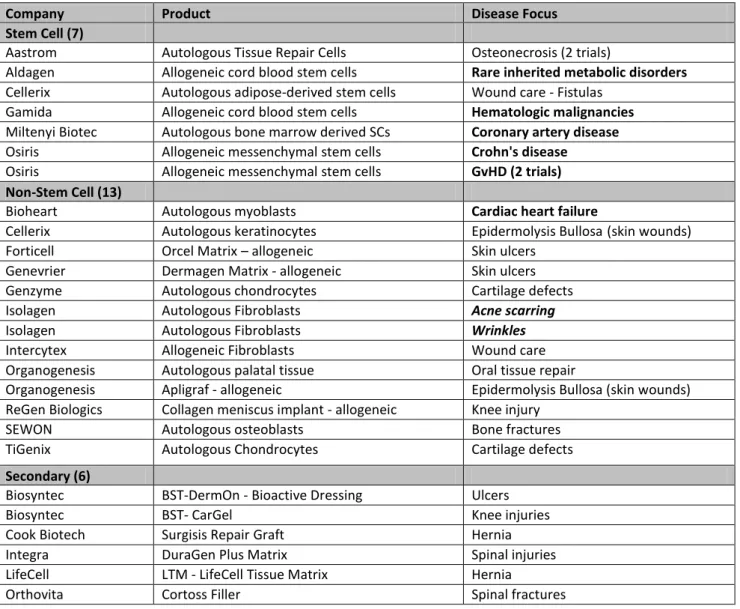
The disease targets of the trials have been analysed in detail, as they reveal important information about the types of products that may reach the market (see Table 13). Trials of non-stem cell based autologous products are mainly targeting ‘classical’ indications for skin, bone and cartilage (15 out of 21 trials; one bone, four cartilage, and four skin/wound, six other soft tissue), with a number focusing on new indications (hair loss, wrinkles, facial rejuvenation, damage to the vocal cords). In addition, a minority targeted cardiovascular conditions (heart failure, coronary bypass, A-V shunt in dialysis). This marks a shift away from the disease indications that have been the historical focus of autologous cell therapy, with greater emphasis on cardiovascular and cosmetic applications.
33
In January 2009 Geron received FDA approval for the first commercially sponsored trial using hESCs. However, it was not included in this study as it has not formally started and falls outside the study period.
34
Similarly, the majority (14 out of 17) of non-stem cell allogeneic trials are targeting ‘classical’ tissue engineering indications (12 skin and 2 cartilage), with only one trial using dermal fibroblasts for facial rejuvenation. The large number of skin trials is probably due to the commercial success of allogeneic products in this area. The other three allogeneic trials were for cardiovascular conditions. Furthermore, three of the non-stem cell metabolic trials were focussed on liver disease and one on diabetes. The focus of secondary trials is also similar, exclusively targeting classical tissue engineering applications in soft tissues, skin/ wounds, bone and cartilage (knee injuries, wounds, fistula, hernia, spinal injury, bone repair, breast reconstruction, varicose veins).
In contrast, the trials of stem cell based products are more mixed, and target both classical tissue engineering conditions (28/78: spinal fusion, knee injury, bone repair, dental bone grafts, osteoporosis, osteonecrosis, fistulas, Crohn’s disease, diabetic foot ulcers, muscular dystrophy and sinus, breast and bladder reconstruction.) as well as a number of cardiovascular related conditions (30/78: limb ischemia, cardiovascular and coronary artery disease, Angina, myocardial infarction and heart failure) and other well established haematopoietic stem cell therapy indications (13/78: haematological malignancies, other cancers and GvHD). Only three stem cell trials targeted metabolic disorders and only one was for a CNS disorder (Neuronal Ceroid Lipofuscinosis). As with autologous first generation trials, the focus on cardiovascular disorders marks an important change in direction for the cell therapy industry with a move away from bone, skin and cartilage. Table 13: Disease focus of all clinical trials
All trials
Stem Cell Non-Stem Cell Secondary TotalAuto Allo Auto Allo
Cardiovascular 22 8 6 3 39
Classical TE
Cartilage 1 3 4 2 2 12
Bone 9 3 1 4 17
Skin/Wound Care 3 2 4 12 6 27
Other Soft Tissue 5 2 6 2 15
Metabolic Diabetes 1 2 1 4 Liver 3 3 Other CNS 1 1 Blood/Immune 4 4 Cancer 3 6 9 Other 3 3 TOTAL 44 34 21 21 14 134
In summary, the majority (71 trials = 53%) of clinical activity is still focused on classical tissue engineering applications in cartilage, bone, skin and other soft tissues, although there is an increasing emphasis on cosmetic indications. These are evenly split between stem cell and non-stem cell based products, reflecting the change in the industries underlying technology. Furthermore, the growing importance of cord blood stem cells has formed the basis for trials focused on haematological disorders and cancer; these are well established clinical targets and whilst representing a broadening of the industry’s activity, this does not mark a significant new departure. In addition, a small number of trials (7 = 5%) continue the long-tradition of work on