4
Graduated compression hosiery
Louise Whitley
Graduated compression hosiery is used to provide compression and support in conditions related to venous insufficiency or oedema. Grad-uated compression garments exert the greatest degree of compression at the ankle, and the level of compression gradually decreases up the garment.
Support hosiery is used to prevent the development of leg circula-tory problems and to reduce the incidence of tired, aching legs. Support hosiery usually exerts considerably less compression than graduated compression hosiery, and the degree of compression is the same along the length of the garment.
Graduated compression hosiery may be supplied on NHS pre-scription if it conforms to Drug Tariff specifications (see Drug Tariff, Appliances Part IXA). Graduated compression hosiery may be pre-scribed by doctors on form FP10, or by nurses on form FP10(CN) or FP10(PN). Support hosiery is not available at NHS expense.
Indications for graduated compression hosiery Varicose veins
Graduated compression hosiery is used in the management of varicose veins, venous leg ulcers, post-operative deep vein thrombosis, and oedema. One indication for the use of compression hosiery is varicose veins. These irregular bulbous protrusions may occur in the oesophagus and rectum, but are commonest in the legs. Up to 20% of the population may suffer from varicosities to different degrees, with women being five times as likely as men to develop symptoms.
The causes, prevention and treatment of varicose veins may be best understood through a knowledge of the venous system in the legs.
Relevant physiology
When a person is standing, the flow of venous blood returning to the heart from the lower limbs must take place against gravity. Blood flows from the surface tissue capillaries to the short and long saphenous veins, which lie outside the main muscle mass of the leg (Figure 4.1). The long saphenous vein ascends on the inside of the leg; the short saphenous vein drains blood from the outside areas of the leg. The veins pass through the fibrous sheath which encases the muscle mass of the leg. The long saphenous vein penetrates the muscle sheath near the groin, and the short saphenous vein penetrates the sheath behind the knee. As these
Figure 4.1 The veins of the leg.
Valve at
saphenofemoral function
Long saphenous vein
Short saphenous vein
Mid thigh perforation Deep fascia
Femoral vein
Ankle perforators Lateral malleolus
veins lie outside the main muscle mass of the leg, the walls of the saphen-ous veins contain a greater proportion of muscle than other veins of comparable diameter.
The inward and upward movement of the blood continues via com-municating or perforator veins to the deep veins that lie within the leg muscle. The small perforator veins, which link the saphenous veins with the deep veins, contain a non-return valve at the point where they penetrate the muscular fibrous sheath (see below). The unidirectional flow of blood is aided by a number of factors:
• Bicuspid valves, which occur at intervals along the veins
• The residual pressure in the venous system from the heart contrac-tion (normally about 16 mmHg), which exerts a mild upward force • The blood within the deep veins is propelled along by contractions
of the leg muscle (the calf muscle pump)
• The pressure within the thorax is less than that in the external environment. A partial ‘suction’ effect therefore acts to draw blood up from the legs. The increased abdominal pressure that occurs during pregnancy reduces this effect, predisposing expectant women to the development of varicosities.
Varicose veins may develop as a result of detrimental effects on one or more of the above factors. Other positively identified contributory factors are described below.
Contributory factors
Genetics There is often a well-defined family history of varicose veins. Genetic disposition may even lead to the occurrence of varicosities in identical positions on the legs of a mother and her offspring. This may be partially explained by the observation that the distribution and number of the valves in leg veins may be genetically determined. Hormones Oestrogens and progestogens exert a relaxant effect on smooth muscle. The relatively high proportion of smooth muscle in the walls of the saphenous veins predisposes them to hormonal relaxation and therefore increases the susceptibility to pooling of blood and valvu-lar damage. The importance of hormonal influences on the occurrence of varicose veins is further highlighted by the cyclical development of symptoms in many women. In addition, women are up to five times more likely to develop the condition than are men, and painful symptoms are restricted almost entirely to women.
Pregnancy Hormonal changes in early pregnancy and the pressure of the baby on the pelvic veins in the later stages may cause varicose veins. After delivery most varicosities disappear spontaneously, although the mother may be predisposed to redevelop the condition in later life. Deep vein thrombosis Thrombotic episodes produce obstructions in the deep veins of the leg. The valves in the deep veins are frequently involved and may become ineffective through fibrosis. As a result, blood develops retrograde flow through the deep veins, increasing the pressure on and reducing the competency of valves in the perforating and super-ficial veins. Pooling of the blood occurs, producing the characteristic varicosities.
Posture Prolonged standing (e.g. at work) may accelerate the develop-ment of varicosities. Lack of movedevelop-ment when standing leads to pro-longed, unvaried pressure exerted by the leg muscles on the deep veins. This increases the resistance to the return of blood through the venous system and exerts increased pressure on the valves of the perforating and superficial veins.
Abdominal masses The presence of a large bulk within the abdomen over a long period of time can generate pressure changes within the venous system. Abdominal tumours may be a precipitating factor, and it has also been suggested that chronic constipation or obesity may pre-dispose susceptible individuals to the development of varicose veins. Symptoms
Varicose veins may be associated with aching, fatigue, and a feeling of warmth in the affected veins. Symptoms do not correlate well with the severity of the varicosity: patients with mild varicose veins may experi-ence severe pain, whereas those with severe leg involvement may be asymptomatic. Elevating the leg relieves symptoms. Many patients are concerned by the appearance of varicose veins and find them cosmeti-cally unacceptable.
Complications may occur. These include eczema or changes in the colour of the skin. If there is incompetence of the deep veins, oedema may occur. Ulceration may also develop. Ulcers caused by varicose veins tend to be small, superficial, and extremely painful; those due to deep vein incompetence are usually larger.
Treatment options
Pharmacists are concerned primarily with the use of graduated com-pression hosiery to alleviate varicose symptoms, but a brief account of other treatment methods is also relevant.
Varicose veins may be treated in one of three ways, although physical compression is invariably a component of compression sclerotherapy and surgery:
• Compression sclerotherapy • Surgery
• Physical compression.
Compression sclerotherapy In varicose veins, retrograde flow of venous blood through damaged valves (usually in the perforating veins) leads to pooling of blood in the superficial system. The aim of sclerotherapy is to shut off these damaged channels by local injection of an irritant material into an emptied vein. The irritant damages the inner wall of the vein and produces a microscopic clot. The two walls of the vein are clamped firmly together with a crepe bandage, which should ideally remain in place for four to six weeks. Graduated compression hosiery can be used over the bandage to help to keep it in place and to apply consistent pressure to the whole limb. It may also help prevent recurrence.
Walking is an essential part of postoperative care, and patients who are unable or unwilling to exercise fully after sclerotherapy (e.g. by walking on average four miles a day) are often deemed unsuitable for this treatment. Despite the relative ease of treatment (which may be done on an outpatient basis), the procedure is unsuccessful in 30% of patients. Surgery Surgery may be indicated if varicosities are extensive or sclerotherapy has proved unsuccessful. If the superficial veins are grossly dilated, surgery may be carried out. The most commonly used surgical procedures are ligation and stripping.
After surgery, the limb is dressed and firmly bandaged. It is rec-ommended that walking should be resumed as soon as possible after surgery, and that the bandaging is left undisturbed for up to five days. Bandaging may be required for a subsequent period of 10–14 days.
There is a relapse rate of about 20% with this form of treatment. This may be partially attributed to the increased stress to which the remaining veins are subjected as the venous blood finds alternative routes back to the heart. The use of graduated compression hosiery post-operatively can significantly reduce the recurrence of varicose veins.
Physical compression The use of physical compression is a conserva-tive measure which in no way cures varicose veins but aims to prevent their deterioration. However, in view of the relapse rate for sclerother-apy and surgery, the use of compression alone may be considered accept-able in many cases. This is particularly so in the early stages of the condition, in pregnancy, and also where the above techniques are contraindicated (e.g. in immobile or incapacitated patients).
Compression is beneficial to a patient with reduced venous function for a variety of reasons. Distension of the superficial veins caused by the presence of high internal pressure may be reduced and the accompany-ing achaccompany-ing and pain may be alleviated. The application of external pressure may also lead to an improvement in venous valve function.
Prevention of the development of oedema and improvements in the action of the calf muscle pump may also be possible, even with garments that produce only limited raised pressure at the ankle.
Compression may be achieved with bandages or with graduated compression hosiery. However, when a bandage is applied to the limb it is difficult to gauge what pressure is being exerted. Bandages may also be cosmetically unacceptable to patients. Tubular bandages are not appropriate when graduated compression is required.
Venous leg ulcers
Leg ulcers are a common and recurring problem. They occur in 1.5–3 per 1000 of the general population, increasing to about 20 per 1000 in those over 80 years of age. Leg ulcers are strongly associated with venous disease, but a fifth of patients have arterial disease, either alone or in conjunction with venous disease. Patients with arterial disease must be distinguished from those with venous disease, as their manage-ment differs. The use of compression hosiery in patients with arterial disease should be avoided, as it may cause necrosis and further ulcer-ation; in severe cases amputation may be necessary. Compression hosiery should be used with caution in those with diabetes mellitus or rheumatoid arthritis, as these patients are susceptible to small vessel disease.
Most leg ulcers are managed in the primary care setting by GPs and community nurses. Compression therapy is the treatment of choice for most venous leg ulcers. The ulcerated area should be kept clean and debrided if necessary. Although dressings are not thought to enhance healing, they are useful to absorb exudate, control odour, relieve pain and promote re-epithelialisation. Compression may be applied in the
form of compression bandages, graduated compression hosiery or both. Graduated compression hosiery has been shown to aid healing of venous ulcers. It is thought that it may also help to prevent recurrence, although evidence of the latter is more limited. There is some evidence that pentoxifylline used with compression therapy may be beneficial in ulcer healing. Topical applications should be avoided if possible, but metronidazole cream or gel and activated charcoal dressings are helpful in reducing odour in heavily colonised ulcers.
Prophylaxis of postoperative deep vein thrombosis
Deep vein thrombosis (DVT) in the lower limb and pelvic veins may occur following prolonged immobility after surgery or a medical illness. Graduated compression hosiery has been shown to reduce the incidence of DVTs in these patients. Antiembolism stockings (TED stockings) may be used for this purpose, but these are not allowed on NHS prescription.
Oedema
Oedema is a characteristic of several disease states, including heart failure, renal impairment and various malignancies (often due to lymphatic obstruction). Where possible, the underlying cause of the oedema should be identified and treated. However, in many patients oedema persists, and the use of graduated compression hosiery may be beneficial.
Lymphoedema is a chronic swelling that occurs because of inade-quate lymph drainage. It may be due to congenital abnormalities of the lymphatic system or to damage to this system following infection, malig-nancy, surgery or radiation. The management of lymphoedema has four main components:
• Skin care to reduce the risk of infection and to maintain the con-dition of the tissue
• External support/compression to reduce lymph formation and encourage lymph drainage
• Exercise to maximise lymph drainage
• Lymphatic drainage proximal to the swelling to stimulate drainage and to siphon away from the oedematous region.
Specialist garments are available to provide support/compression for patients with lymphoedema, but these are not available on NHS prescription.
Standards for graduated compression hosiery
A British Standard (BS 6612) for graduated compression hosiery was introduced in July 1985. Its introduction was made possible by the development of a suitable testing device, the Hosiery and Allied Trades Association (HATRA) hose pressure tester. Previously, the degree of com-pression exerted by individual garments could not be reliably assessed and the manufacture of hosiery was largely empirically based. The degree of pressure exerted by a garment can now be accurately defined.
The British Standard specifies that graduated compression hosiery must exert a minimum pressure of 6 mmHg at the ankle when the patient is standing, and that the degree of compression must decrease up the leg in order to prevent the garment exerting a tourniquet effect.
Hosiery compression profiles are defined in terms of the pressure exerted by garments at the ankle and the relative pressures at the calf and thigh, as outlined in Table 4.1.
No upper limit is specified in the British Standard for ankle pressure. However, it is recognised that pressures of 40 mmHg and more may prevent arterial blood from reaching the distal part of the limb.
In addition to defining the pressure requirements, BS 6612 also states that the garment must be capable of exerting at least 85% of its original pressure after having been washed 30 times. The expected life of each garment is at least three or four months.
Types of graduated compression hosiery
Historically, a bewildering array of garments was available, some of which are listed below:
• Two-way stretch, standard elastic yarn, circular knit, nylon • One-way stretch, seamless fine thread
• Lightweight elastic net (closed or open heel).
Table 4.1 Pressure exerted by garments at the ankle and the relative pressures at the calf and thigh
Ankle compression Proportion of ankle Proportion of calf value (mmHg) compression at calf (%) compression at thigh (%)
6–10 <100 <100
11–18 80 max 85 max
The introduction of British Standard 6612 considerably simplified the range of product categories. Garments are now classified according to the mean pressure exerted at the ankle, as described in Table 4.2.
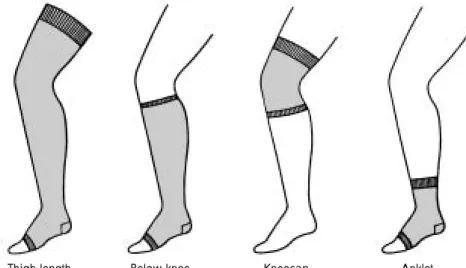
The range of garments has also been simplified (Figure 4.2). Pre-viously, anklets, kneecaps, leggings, below-knee stockings, above-knee stockings and thigh stockings were available, although not all were Types of graduated compression hosiery 7 1
Table 4.2 Classification of garments according to mean pressure exerted at the ankle
Class I Mean ankle compression 14–17 mmHg (formerly lightweight elastic yarn). These garments are used for light or mild support in cases of early or superficial varices. They are also used for prophylaxis and treatment of varicose veins in pregnancy
Class II Mean ankle compression 18–24 mmHg (formerly standard elastic yarn). These garments provide medium support for the treatment of mild oedema, the prevention and treatment of ulceration, and for varicosities occurring during pregnancy. They can also be used after surgery or sclerotherapy
Class III Mean ankle compression 25–35 mmHg (formerly known as one-way stretch). Class III garments provide the strong support necessary for gross varices, severe oedema, and venous insufficiency after deep vein thrombosis. They can also be used with dressings in the treatment of chronic leg ulceration, and for the prevention and recurrence of such ulcers
Figure 4.2 Graduated compression hosiery garments.
Anklet Kneecap
Below knee Thigh length
available in all materials or special types of knits. The garments avail-able for use in the prevention and treatment of varicose veins are now restricted to thigh stockings and below-knee stockings.
Anklets (socks) and kneecaps are also available in class II and class III compression profiles, although they are supplied primarily for sports injuries, strains and other non-varicose conditions.
Garments may be fully footed or have open heels or toes. The use of modern fibres has also increased the range of hosiery colours. Darker shades are now available, and these may encourage compliance in men as the garments are virtually indistinguishable from socks.
Hosiery accessories
Most garments are manufactured with a more highly elasticated portion at the upper end as an aid to keeping the hosiery in position. As tights cannot be prescribed by doctors, the use of a suspender belt (Figure 4.3) may be needed to ensure that thigh-length stockings stay in place during normal exercise. Some women may already possess a suspender belt which can be used for this purpose. For those who do not, and for men prescribed thigh-length garments, a one-size suspender belt is available. The belt consists of a rigid, two-piece waistband with adjustable fasten-ing. Four suspenders are sewn to the outside of the waistband.
An alternative usually more acceptable to men is the Y-shaped sus-pender, which can be fastened to buttons sewn in the trouser lining. The forked ends hang downwards to the top of the stocking. Suspenders are
automatically supplied for any thigh-length garment for men, but the doctor must order them separately for women.
Selecting the correct hosiery
The choice of the appropriate graduated compression garment depends on the indication, the area affected, and whether the patient is male or female. The doctor may order the garment in terms of the degree of com-pression required (mild, moderate or strong) or by the comcom-pression class (I, II, or III/1, 2 or 3).
Severe varicosities require a greater degree of compression than mild varicosities. The choice of the correct garment is determined by the position of the varicosities. The garment should preferably reach the highest level of the varices and extend at least 5 cm above that level.
Whereas the choice previously lay between nylon-covered or cotton-covered garments, the introduction of modern materials has limited the choice primarily to colours. Even when hosiery is concealed (e.g. beneath trousers) dark shades may be more appropriate for men, so that even thigh-length garments give the outward appearance of ordinary socks. Measuring and selecting the correct size of hosiery
In all cases, the usefulness of the hosiery product is entirely dependent on the accuracy of the limb measurements and the correct selection of garments based on those measurements. The following guidelines will ensure that the correct garment is chosen:
• Measurements should be taken as early in the morning as possible, preferably before the patient has been standing for long or taken any exercise. These precautions ensure that the leg has not swollen. If such precautions are not practicable and the patient has walked to the pharmacy, the limb should be rested in a horizontal position for as long as possible before the measurements are taken. • All manufacturers produce diagrams to indicate the number and
position of measurements necessary for satisfactory fitting. Cir-cumference measurements are commonly taken at the top of the thigh (for thigh-length stockings only), the knee, the calf and the ankle. The length of the foot may also be included.
• Measurements should be taken next to the skin and should be accurate to the nearest 5 mm; they should not be taken from old garments. Measurements should be taken starting at the top of the Measuring and selecting the correct size of hosiery 7 3
limb and working downwards, to prevent undue concern to the patient about where the highest measurement may be. A female member of staff should be present if a male pharmacist is measur-ing a female patient.
Measurements must not be adjusted to take into account differences in the pressure required to be exerted along the garment. All pressure differences are incorporated into the hosiery during manufacture. If a pair of garments is ordered, individual measurements of each limb must be taken. Most healthy legs can vary slightly in diameter and such differ-ences may be accentuated by the presence of varicosities of varying severity. Each time a new prescription is issued the patient should be measured, as changes in size may occur.
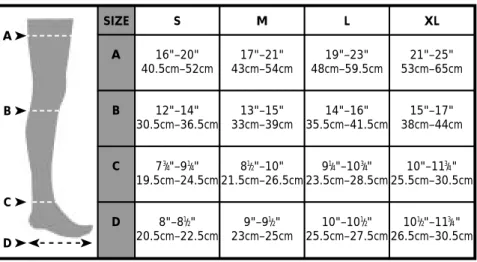
When the measurements have been recorded, manufacturers’ charts should be consulted. Most charts give a range of values (in centimetres or inches, or both) for the individual measurement points. The correct size of garment can be selected by choosing the size within whose ranges all the measurements lie (Figure 4.4). For example, a patient’s measure-ments for the points on the Scholl Ultima chart shown here might be: A – 45 cm; B – 34 cm; C – 25 cm; D – 24.5 cm. Although measurements A and B could apply to small and medium sizes, measurements C and D clearly fall exclusively within the ranges of the medium-sized garment, and this would be the appropriate size.
Figure 4.4 Scholl Ultima measuring chart for graduated compression hosiery (courtesy of Scholl). S M L XL 16"–20" 40.5cm–52cm 17"–21" 43cm–54cm 19"–23" 48cm–59.5cm 21"–25" 53cm–65cm 12"–14" 30.5cm–36.5cm 13"–15" 33cm–39cm 14"–16" 35.5cm–41.5cm 15"–17" 38cm–44cm 7 "–9 " 19.5cm–24.5cm 3/ 4 1/4 9 "–10 "1/4 3/4 23.5cm–28.5cm 3/ 4 10"–11 " 25.5cm–30.5cm 8 "–10" 21.5cm–26.5cm 1/ 2 SIZE A B C D 8"–8 " 20.5cm–22.5cm 1/2 9"–9 " 23cm–25cm 1/2 10"–10 " 25.5cm–27.5cm 1/2 10 "–11 " 26.5cm–30.5cm 1/2 3/4 A B C D
In 95% of cases the measurements taken are likely to conform to one of the stock sizes produced by a manufacturer. Where the measure-ments are significantly different, garmeasure-ments must be made to measure. Made-to-measure garments are available in all three compression classes.
Despite improvements in the appearance and comfort of graduated compression hosiery compliance is still poor. It may be helpful to reinforce the importance of wearing the garment and to discuss any con-cerns the patient may have.
Fitting and removing hosiery
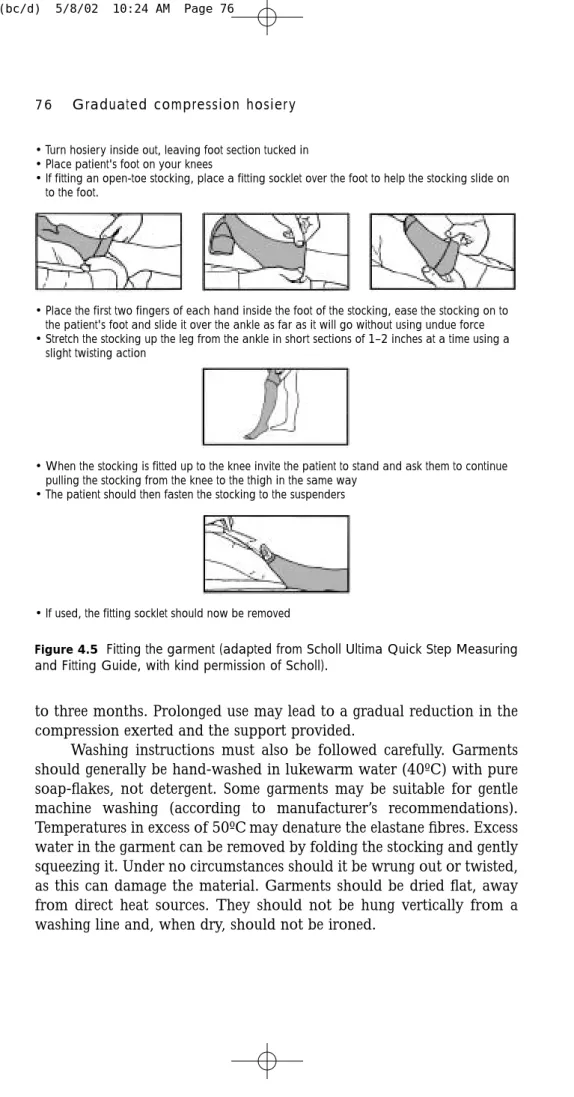
If the garment is fitted with confidence and ease, any apprehension the patient may have over wearing the hosiery could be reduced. Correct fitting is also essential to ensure the maximum life of the garment. The sequence of events in fitting and removing the garment is illustrated in Figure 4.5, and the following points should be taken into consideration: • Everyday hose should be removed and, if required, the leg may be
lightly coated with powder.
• The patient should remove all sharp objects (e.g. rings and bracelets) and trim long and rough nails on both fingers and toes. • The garment should be turned inside-out as far as the heel pouch. The heel should be laid flat so that the foot may slip in easily and the toes and heel be correctly positioned.
• The rest of the garment should be eased over the foot and ankle, ensuring that it does not become bunched at any one point as severe discomfort may result. The garment may then be gently pulled up the leg, but care should be taken not to damage the fibres with the fingers or nails.
Stocking aids are available for patients who find it difficult to put their stockings on, but these are not allowed on NHS prescription.
Removing the hosiery is usually easier than putting it on. The garment should be peeled down as far as the ankle, in effect turning it inside-out. It can then be removed from the leg by gently pulling the toe portion.
Care of graduated compression hosiery
If the manufacturer’s instructions for fitting and removing graduated compression hosiery are followed, garments may have a useful life of up Care of graduated compression hosiery 7 5
to three months. Prolonged use may lead to a gradual reduction in the compression exerted and the support provided.
Washing instructions must also be followed carefully. Garments should generally be hand-washed in lukewarm water (40ºC) with pure soap-flakes, not detergent. Some garments may be suitable for gentle machine washing (according to manufacturer’s recommendations). Temperatures in excess of 50ºC may denature the elastane fibres. Excess water in the garment can be removed by folding the stocking and gently squeezing it. Under no circumstances should it be wrung out or twisted, as this can damage the material. Garments should be dried flat, away from direct heat sources. They should not be hung vertically from a washing line and, when dry, should not be ironed.
Figure 4.5 Fitting the garment (adapted from Scholl Ultima Quick Step Measuring and Fitting Guide, with kind permission of Scholl).
• Turn hosiery inside out, leaving foot section tucked in • Place patient's foot on your knees
• If fitting an open-toe stocking, place a fitting socklet over the foot to help the stocking slide on
• to the foot.
• Place the first two fingers of each hand inside the foot of the stocking, ease the stocking on to
• the patient's foot and slide it over the ankle as far as it will go without using undue force • Stretch the stocking up the leg from the ankle in short sections of 1–2 inches at a time using a
• slight twisting action
• When the stocking is fitted up to the knee invite the patient to stand and ask them to continue
• pulling the stocking from the knee to the thigh in the same way • The patient should then fasten the stocking to the suspenders
If the original packaging in which the garment was supplied has been lost, washing instructions may be found on the upper portion of the hosiery.
Prescribing information
The prescriber must specify the following information on a prescription for graduated compression hosiery:
• The quantity of garments required: single (right or left)/pair • Type of garment: e.g. thigh-length stocking
• Compression class: I, II, or III
• Accessories (if required). Further reading
Foord-Kelcy G (2001). Guidelines – Summarising Clinical Guidelines for Primary
Care, Vol 13. Berkhamsted: Medendium Group Publishing.
Haynes B, Glasziou P (2001). Evidence-based Medicine. London: BMJ Publishing. National Pharmaceutical Association (1999). NPA Guide to the Drug Tariff and
NHS Dispensing for England and Wales. St Albans: National Pharmaceutical
Association.
NHS Centre for Reviews and Dissemination, University of York. Effective health
care: compression therapy for venous leg ulcers. 1997; 3: 1–12.