Much Ado About Nothing: A Comparison of Missing Data Methods
and Software to Fit Incomplete Data Regression Models
Nicholas J.
Horton
and Ken P.
Kleinman
Missing data are a recurring problem that can cause bias or lead to inefficient analyses. Statistical methods to address miss-ingness have been actively pursued in recent years, including im-putation, likelihood, and weighting approaches. Each approach is more complicated when there are many patterns of missing values, or when both categorical and continuous random vari-ables are involved. Implementations of routines to incorporate observations with incomplete variables in regression models are now widely available. We review these routines in the context of a motivating example from a large health services research dataset. While there are still limitations to the current imple-mentations, and additional efforts are required of the analyst, it is feasible to incorporate partially observed values, and these methods should be used in practice.
KEY WORDS: Conditional Gaussian; Health services research; Maximum likelihood; Multiple imputation; Psychiatric epidemi-ology.
1. INTRODUCTION
Missing data are a frequent complication of any real-world study. The causes of missingness are often numerous, some due to design, and some to chance. Some variables may not be col-lected from all subjects, some subjects may decline to provide values, and some information may be purposely excised, for ex-ample to protect confidentiality. While the use of complete case methods that drop subjects missing any observations are com-monly seen in practice, this approach has the disadvantage of being inefficient as well as potentially biased.
The development of methods for analysis of data with incom-plete values has been an active area of research. Models that incorporate partially observed predictors are of particular inter-est in many real-world settings, since missingness of just a few percent on each of a number of covariates may lead to a large number of observations with some missing information. The
ex-Nicholas J. Horton is Assistant Professor, Department of Mathematics and Statis-tics, Clark Science Center, Smith College, Northampton, MA 01063-0001 (E-mail:[email protected]). Ken P. Kleinman is Associate Professor, De-partment of Ambulatory Care and Prevention, Harvard Medical School and Harvard Pilgrim Health Care, Boston, MA. Helpful comments and assistance regarding details of the software implementations were provided by Frank Har-rell, Jr., Krista Kilmer, Gary King, Patrick Royston, Pralay Senchaudhuri, Stef van Buuren, and Yang Yuan. We thank Suzanne Switzer for assistance with the review of missing data methods in theNew England Journal of Medicineand James Carpenter, Amy Herring, as well as Owen Thomas for useful comments. We are grateful for the support provided by NIMH grant R01-MH54693 and the Smith College Picker Program.
cellent textbooks by Little and Rubin (2002), Schafer (1997), and Allison (2002) provide a comprehensive overview of meth-ods in this setting, focused primarily on multiple imputation. Although somewhat dated, Little (1992) describes a hierarchy of approaches to account for missing predictors, including the maximum likelihood approach of Ibrahim (1990). Publications by Meng (2000) and Raghunathan (2004) provide a general intro-duction, and the paper by Ibrahim et al. (2005) reviews recent de-velopments in a comprehensive fashion, though their application (cancer dataset) features incompleteness on only one variable. A useful online annotated bibliography provides a comprehensive reading list (Carpenter 2006a).
In this article, we update the prior review of Horton and Lipsitz (2001) and apply methods described by Ibrahim et al. (2005) to the logistic regression analysis of a dataset with incompleteness on four variables (both categorical and continuous) using a vari-ety of software packages. We discuss modeling assumptions, ap-proaches, and compromises required for estimation within cur-rent implementations. In Section 2, we briefly review methods for incorporating incomplete observations in regression models then summarize findings of two surveys of how missing data methods are used in practice in Section 3. We describe our moti-vating example (which features a large dataset with high propor-tion of missing values with a nonmonotone pattern) in Secpropor-tion 4, detail support for missing data software in Section 5, then apply these methods to the motivating dataset in Section 6. We contrast the strengths and limitations of these packages in practice, and suggest improvements for the future.
We focus on methods to incorporate partially observed pre-dictors; different issues arise when some outcomes are not fully observed. We also do not consider longitudinal or clustered out-comes, for which other complications arise (e.g. Laird 1988; Robins, Rotnitzky, and Zhao 1995; and Jansen et al. 2006).
2. INCOMPLETE DATA REGRESSION METHODS 2.1 Notation and Nomenclature
We begin by introducing notation that will be used through-out, assuming that data are collected on a sample ofnsubjects and that primary interest relates to the parameters governing the conditional distributionf (Yi|Xi, βββ). To simplify exposition, we suppress the subject indicator. For a given subject we can parti-tionXinto components denoting observed variables (Xobs) and those that are missing for that subject (Xmis). We denote byR a set of response indicators (i.e.,Rj =1 if thejth element of Xis observed, and equals 0 otherwise), governed by parame-tersφφφ. Little and Rubin (2002) introduced a nomenclature for missingness in terms of probability models forR. The missing completely at random (MCAR) assumption is defined as
where in addition φφφ and βββ are presumed distinct. Note that this depends on an assumed relationship betweenRand the un-observed and unknowableXmis. Heuristically, this assumption states that missingness is not related to any factor, known or unknown, in the study.
It may be more plausible to posit that missingness is missing at random (MAR), which assumes that
P (R|Y,X)=P (R|Y,Xobs, φφφ).
This assumption states that the missingness depends only on observed quantities, which may include outcomes and predictors (in which case the missingness is sometimes labeled covariate dependent missingness (CDM)). The assumption regarding the lack of association with unobserved quantities (Xmis) remains. We note that at first glance, the meaning of the term “missing at random” can be confusing, since missingness can actually be predicted (but is random after controlling for missingness due to observed quantities).
Researchers have noted that by including a relatively rich set of predictors in the model, the MAR assumption may be made more plausible (Collins, Schafer, and Kam 2001). Others have noted that incorporation of information regarding the outcome improves estimation of missing predictors (Moons et al. 2006). It is possible to formally test the MCAR assumption against the alternate hypothesis of MAR (Little 1988; Diggle et al. 2002). Finally, if the missingness lawP (R|Y,X)cannot be simplified (i.e., it depends on unobserved quantities), the process is termed
nonignorable (abbreviated NINR [nonignorable nonresponse] or MNAR [missing not at random]). In a NINR setting, the cor-rect specification of the missingness law must be given to yield consistent estimates of the regression parameters. Researchers have addressed issues in the NINR setting (Diggle and Ken-ward 1994; Little 1994). NINR models are particularly useful in assessing the sensitivity of results to deviations from MAR miss-ingness (Carpenter, Kenward, and Vansteelandt 2006). Without additional information, it is inherently impossible to test whether MAR holds (Little and Rubin 1987).
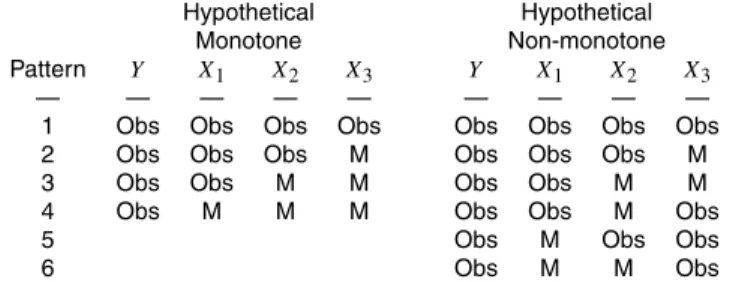
Another important concept regarding missing data, particu-larly where there are multiple variables with missing values, relates to the pattern of missing data. If the data matrix can be rearranged in such a way that there is a hierarchy of missingness, so that observing a particular variableXbfor a subject implies thatXais observed, fora < b, then the missingness is said to be
monotone. Figure 1 displays two hypothetical datasets. The left hand dataset has been rearranged to create a monotone (“stair-step”) pattern, though this is not possible in the right hand side of the figure. When missingness is nonmonotone, models for the missingness of one variable may include covariates which are also missing values. Simpler methods can be used if the pattern is monotone, though a monotone pattern is uncommon in most realistic settings (including our motivating example).
2.2 Complete Case Method
The simplest method for the analysis of incomplete data re-gression models involves the analysis of the set of observations with no missing values. When missingness is MCAR, then the complete case (CC) estimator is unbiased. The main drawback of
Hypothetical Hypothetical Monotone Non-monotone Pattern Y X1 X2 X3 Y X1 X2 X3
— — — — — — — — —
1 Obs Obs Obs Obs Obs Obs Obs Obs 2 Obs Obs Obs M Obs Obs Obs M 3 Obs Obs M M Obs Obs M M 4 Obs M M M Obs Obs M Obs
5 Obs M Obs Obs
6 Obs M M Obs
Figure 1. Monotone and nonmonotone patterns of missingness (Obs
=observed, M=missing)
the CC estimator is that if there are many different variables with missing values, then a large fraction of the observations may be dropped. For the example datasets in Figure 1, only data from pattern 1 is included, though partial information is available from the other patterns (e.g., the joint distribution off (Y, X1, X2)can be estimated from pattern 2). The efficiency losses of the com-plete case estimator can be substantial (Little and Rubin 2002, p. 42).
2.3 “Ad-hoc” Methods
A series of “ad-hoc” methods have been suggested to address missing data. One approach for continuous variables involves recoding missing values to some common value, creation of an indicator of missingness as a new variable, and including both these variables along with their interaction in the regression model. A similar approach for categorical variables involves the creation of an additional category for missing values. These ad-hoc approaches have the potential to induce bias and are not recommended (Jones 1996; Greenland and Finkle 1995).
A second approach involves dropping variables from the anal-ysis that have a large proportion of missing values. This is not attractive, since it may lead to the exclusion of important factors in the regression model, with consequent bias or unnecessarily large standard errors.
Two other approaches involve imputation of missing values using mean imputation (average of the observed values) or for longitudinal studies, the last observed value (also known as last value carried forward, LVCF or last observation carried forward, LOCF). Both methods have the potential of inducing bias as well as understating variability and are not recommended (Carpenter et al. 2004; Cook, Zeng, and Yi 2004; Jansen et al. 2006).
2.4 Multiple Imputation
Multiple imputation is a three-step approach to estimation of incomplete data regression models due to Rubin (1976). First, plausible values for missing observations are created that reflect uncertainty about the nonresponse model. These values are used to “fill-in” or impute the missing values (using an assumption of MAR). This process is repeated, resulting in the creation of a number of “completed” datasets. Second, each of these datasets is analyzed using complete-data methods. Finally, the results are combined, which allows the uncertainty regarding the imputation to be taken into account. Typically 5–10 imputations are created, though more are computationally feasible and better characterize
the variability introduced into the results due to the imputation process.
The method of multiple imputation was first proposed in a public use survey data setting. Multiple imputation remains ide-ally suited to this setting, since thecreatorsof the dataset can use auxiliary confidential and detailed information that would be inappropriate to include in the public dataset (Rubin 1996). Given the completed datasets,users may utilize existing soft-ware to analyse each of the datasets. Given the results for each analysis, an overall summary is straightforward to calculate.
Multiple imputation is, however, more commonly used in a setting where the imputer and the analyst are the same person. An extensive literature on the topic exists (Rubin 1987; Glynn et al. 1993; Rubin 1996; Schafer 1999; Barnard and Meng 1999; van Buuren et al. 1999; Allison 2000; Kenward and Carpenter in press) as do implementations in general purpose statistical soft-ware. A useful guide to software implementations can be found at themultiple-imputation.comWeb site (van Buuren 2006).
The key issue for the analyst is the appropriate specification of the imputation model, since if this is misspecified, there is the potential for bias. Often a multivariate normal model has been used, as it is computationally tractable (since only the mean vec-tor and variance-covariance matrix needs to be estimated). This model has been used even when some of the variables are not Gaussian, though this complicates analyses and if imputed val-ues are rounded, can lead to bias (Horton, Lipsitz, and Parzen 2003; Allison 2005; Bernaards, Belin, and Schafer in press). These issues are particularly salient when multiple categorical and continuous variables have missing values, as the joint distri-bution may be complicated. Finally, note that the analysis should not use a richer model than that used for imputation (Little and Rubin 2002).
We will now review a number of methods that have been pro-posed for imputation models for categorical and continuous vari-ables.
2.4.1 Conditional Gaussian
One approach to imputation when there are both continu-ous and discrete missing values is the Conditional Gaussian approach, popularized by Schafer (1997). A log-linear model (Bishop, Fienberg, and Holland 1975) is specified for the dis-crete random variables, and conditional on this distribution, a multivariate normal distribution is assumed for the continuous variables. This general location model (Olkin and Tate 1961) can be fit as a saturated multinomial with separate means and shared covariance, but this may lead to a proliferation of parameters in real-world applications with multiple categorical variables. As a result, simplification of the log-linear model is required in prac-tice. This approach has been implemented in the MIX programs of Schafer (assuming a form of monotonicity) as well as S-Plus missing data library.
2.4.2 Chained Equations
An alternative approach involves a variable-by-variable ap-proach using chained equations (van Buuren et al. 1999; Raghu-nathan et al. 2001; van Buuren et al. 2006; van Buuren in press). The imputation model is specified separately for each variable, involving the other variables as predictors. At each stage of the
algorithm, an imputation is generated for the missing variable, then this imputed value is used in the imputation of the next vari-able. This process repeats, imputing missing values using a Gibbs sampling procedure until the process reaches convergence. Sep-arate chains are used to generate the multiple imputations.
For continuous variables, the model may involve a linear re-gression model or use predictive mean matching (where the im-puted variables takes on the value of one of a set of nearest ob-served value in the dataset). For dichotomous variables, logistic regression can be fit, while polytomous models are needed for categorical variables. Implementations of the chained equation approach are available in the MICE library (for R and S-Plus), ICE (for Stata), IVEware (for SAS or standalone) or aregImpute (for R and S-Plus).
One problem with the chained equation approach is that it may not converge to a sensible stationary distribution if the sep-arate models are not compatible with a multivariate distribution (Raghunathan et al. 2001), though van Buuren et al. (2006) show in a series of simulation studies that reasonable imputations were obtained even when the separate models were incompatible. Ad-ditional work is needed to further establish the validity of the approach.
2.4.3 Methods for Monotone Datasets
A number of approaches are implemented in SAS PROC MI for datasets with monotone missing structure. The predictive mean matchingmethod can be used to impute a value randomly from a set of observed values whose predicted values are closest to the predicted value from a specified regression model. This process is straightforward when imputing a continuous random variable, but more complicated when imputing a categorical vari-able with more than two levels. The process begins with the observations with only one missing value, and then uses those values in the imputation of the observations with two missing values, and so on. Analysts are warned that Allison (2000) found that predictive mean matching approaches led to biased results when applied to missing predictor models.
Similarly, regression or propensity score models can be used to impute missing values.
One disadvantage of these approaches is that for datasets with nonmonotone missingness, some observations need to be dropped from the analysis, or some “ad-hoc” procedure used. As an example, consider the hypothetical nonmonotone patterns in Figure 1 (p. 80). It is possible to create a monotone dataset by only including patterns (1, 2, 3), (1, 3, 6), (1, 3, 4), or (1, 5, 6). In practice, however, in addition to being highly arbitrary, creation of a dataset with monotone missingness may exclude a large number of observations and be inefficient as well as potentially biased.
The analyst may be able to creatively exploit patterns of miss-ing values in a particular dataset. Consider, for example, usmiss-ing patterns (1, 2, 3) to estimatef (X2, X3|Y, X1), and using pat-terns (1, 4) to estimatef (X2|Y, X1, X3). We pursue this type of strategy to avoid dropping observations in our motivating exam-ple.
2.4.4 Other Issues With Imputation
There are many additional imputation issues that are beyond the scope of this article. For example, there may be bounds on
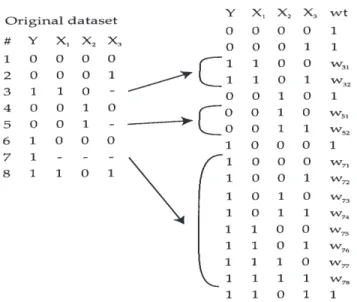
Figure 2. Use of likelihood-based approach with EM algorithm to incor-porate partially observed data.
imputed values which need to accounted for (e.g., as only zero values for years smoking are plausible for a nonsmoker) (Raghu-nathan et al. 2001). Similar issues arise when missing values are known to be within a certain range (e.g., between three and four on a five-point Likert scale), or when variables require trans-formations. While important issues, we do not further consider them.
2.5 Likelihood-Based Approaches
Maximum likelihood is an alternative approach which also assumes that missingness is MAR. Typically, primary interest relates to the regression parameters governing the conditional distribution:f (Y|X, βββ). When some of the predictors are miss-ing, however, Ibrahim (1990) suggested that information can be reclaimed by estimating the distribution of the covariates:
f (X|γγγ ). The joint distributionf (X, Y|βββ, γγγ )is maximized, typ-ically through use of the EM (expectation-maximization) algo-rithm (Dempster, Laird, and Rubin 1977). For each observation with missing data, multiple entries are created in an augmented dataset for each possible value of the missing covariates, and a probability of observing that value is estimated given the ob-served data and current parameter estimates (E-step). The aug-mented complete-data dataset can then be used to fit the regres-sion model, accounting for these weights. Figure 2 displays a hypothetical dataset with a completely observed outcome (Y) and three dichotomous covariates that are sometimes missing (X1, X2, andX3). Observation 3 is missingX3, so two entries are created in the augmented dataset, with w31 +w32 = 1,
w31=P (X3=0|Y =1, X1=1, X2=0, βββ, γγγ ). For observa-tion 7, there are 8 entries in the augmented dataset. Horton and Laird (1999) reviewed this methodology in detail, while Ibrahim et al. (2005) compared and contrasted it with other approaches.
One of the complications of this method is the need to model the nuisance distribution of the covariates. In some settings with
only a few categorical variables a saturated multinomial distri-bution can be fit. When there are more variables, some simpli-fication of the joint distribution is often necessary. Lipsitz and Ibrahim (1996) suggested a conditional approach where
f (X1, X2, X3, . . . , Xp)=f (X1)f (X2|X1)f (X3|X1, X2)
. . . f (Xp|X1, X2, . . . , Xp−1), where each of the marginal models typically involve only main effects. Further complications arise with continuous covariates, since some form of MCEM (Monte Carlo EM) is required (Ibrahim, Chen, and Lipsitz 1999).
Another complication for maximum likelihood relates to the calculation of the standard errors of estimates. Implementations of maximum likelihood that address these complications are available in LogXact version 7, the S-Plus missing data library and in SPSS (von Hippel 2004).
2.6 Weighting Methods
Another approach to accounting for missing predictor data is the use of weighting methods (Robins et al. 1995; Xie and Paik 1997; Horton and Lipsitz 1999; Horton et al. 2001; Carpenter et al. 2006). In this approach, a model for the probability of miss-ingness is fit, and the inverse of these probabilities are used as weights for the complete cases. Weighting approaches can be fit in software that allows for weights (e.g., Stata, SUDAAN, or SAS). This approach is detailed for a single missing predictor in Ibrahim et al. (2005) and Carpenter et al. (2006), but becomes considerably less tractable with multiple missing variables, par-ticularly when they are nonmonotone. Due to this limitation, and the fact that our motivating example is decidedly nonmonotone, we do not further pursue estimation using weighting methods.
2.7 Bayesian Approaches
While multiple imputation was derived from within a Bayesian framework (sampling from the posterior distribution of interest), Bayesian approaches have been applied more gen-erally. Ibrahim et al. (2005) described estimation with a prior distribution on the covariates, and the close relationship between the Bayesian approach and ML and MI methods. In part because these methods are so flexible, specific coding of prior distribu-tions and model reladistribu-tionships with a package such as WinBugs is required for estimation. Such coding is relatively straightfor-ward, and examples of missing data models are available (Car-penter, Pocock, and Lamm 2002; Carpenter 2006b), however we do not further discuss these approaches.
3. SURVEYS OF MISSING DATA METHODS USE IN PRACTICE
Despite the existence of principled methods for the analysis of incomplete data regression models, there is some evidence that their use in applied settings remains limited. We base this statement on two recent studies of statistical methods used in medical research.
Burton and Altman (2004) reviewed the reporting of miss-ing covariate data in 100 cancer prognostic studies published in
1. quantification of completeness of covariate data
(a) if availability of data is an exclusion criterion, specify the number of cases excluded for this reason, (b) provide the total number of eligible cases and the number with complete data,
(c) report the frequency of missing data for every variable considered. If there is only a small amount of overall missingness (e.g.>90% of cases with complete data), then the number of incomplete variables and the maximum amount of missingness in any variable are sufficient
2. approaches for handling missing covariate data
(a) provide sufficient details of the methods adopted to handle missing covariate data for all incomplete covariates (b) give appropriate references for any imputation method used
(c) for each analysis, specify the number of cases included and the associated number of events 3. exploration of the missing data
(a) discuss any known reasons for missing covariate data
(b) present the results of any comparisons of characteristics between the cases with or without missing data
Figure 3. Proposed guidelines for reporting missing covariate data (Burton and Altman 2004). Reprinted with permission of Macmillan Publishers Ltd:British Journal of Cancer, 2004 July 5; 91(1), 4–8.
2002. Extensive detective work by the authors determined that 81% of the articles had missing data (though the status was un-clear for 4 articles, and 13 had availability of data as an inclusion criteria). Of the 81 articles with missing data, 32 stated methods for the analysis of incomplete observations (several articles used more than one method). A total of 12 papers used a complete case approach, 12 available case, 6 omitted between one and four variables, 4 used a missing indicator approach, 3 used an ad-hoc single imputation procedure, and only 1 paper used multiple im-putation. In responses to these limitations, they proposed a set of guidelines for the reporting of studies with missing covariate data (Figure 3). In closing, Burton and Altman (2004) noted that:
We are concerned that very few authors have consid-ered the impact of missing covariate data; it seems that missing data is generally either not recognised as an issue or considered a nuisance that is best hidden (p. 6).
Horton and Switzer (2005) reviewed the use of statistical methods in original research articles published during an 18 month period of 2004–2005 in The New England Journal of Medicine, a widely read and highly cited medical journal. Of then=331 papers that were reviewed, 26 (8%) reported some form of missing data methods. For the purposes of this article we further reviewed those 26 manuscripts, finding that 12 used a variant of last value carried forward, 13 used an ad-hoc imputa-tion strategy (e.g., mean imputaimputa-tion), and 2 undertook sensitivity analyses where missing values were replaced by worst case val-ues. Two papers used multiple imputation (Smith et al. 2004; van de Beek et al. 2004). The entire description of this strategy in Smith et al. (2004) was that “missing values were estimated by multiple multivariate imputation” and a citation was given to the MICE approach of van Buuren et al. (1999). The article by van de Beek et al. (2004) noted that only 320 of the 696 patients had complete data, and all predictors were used to impute miss-ing values (usmiss-ing a multivariate normal model, though some of the variables were categorical). Neither of these two papers pro-vided the information suggested by Burton and Altman (2004)
that would be sufficient to replicate this analytic approach. Both reviews indicate that there is a considerable gap between statistical methodologies and methods that are commonly used in practice. Flexible comprehensive implementations of these methods may spur their use.
4. MOTIVATING EXAMPLE: KIDS’ INPATIENT DATABASE
These methods are demonstrated using the Healthcare Cost and Utilization Project (HCUP) KIDS’ Inpatient Database (KID) for the year 2000 (HCUP Kids’ Inpatient Database (KID) 2000). This dataset, which is publicly available for a fee from the Agency for Healthcare Quality and Research, collects data from states on child hospitalizations to improve the quality of health care. We investigated what factors predicted whether a pediatric subject with a psychiatric or substance abuse diagnosis had a routine discharge from the hospital.
More specifically, we included all 10–20 year-old subjects with a Clinical Classifications Software (CCS) category for pri-mary, secondary or tertiary diagnosis equal to (66) alcohol-related mental disorders, (67) substance-alcohol-related mental disor-ders, (68) senility and organic mental disordisor-ders, (69) affective disorders, (70) schizophrenia and related disorders, (71) other psychoses, (72) anxiety; somatoform; dissociative; and person-ality disorders; (73) pre-adult disorders, (74) other mental con-ditions, or (75) personal history of mental disorder; mental and behavioral problems; observation and screening for mental con-dition.
The outcome in our model was routine discharge versus non-routine discharge (including transfer to a short-term hospital, other facility, release to home health care, dying in hospital or leaving against medical advice).
Predictors in the logistic regression included an indicator of gender (FEMALE, 1=female, 0=male), AGE (in years), length of stay (LOS, in days), admission type (ATYPE, 1=emergency, 2=urgent, 3=elective), admission month (AMONTH, used to derive season of admission, NSEASON), admission on weekend
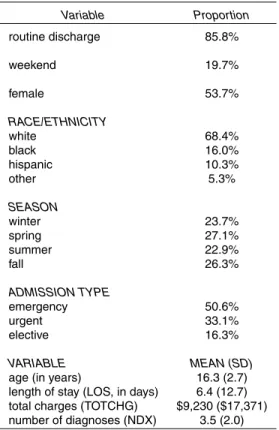
Table 1. Descriptive Statistics for KID Dataset Variable Proportion routine discharge 85.8% weekend 19.7% female 53.7% RACE/ETHNICITY white 68.4% black 16.0% hispanic 10.3% other 5.3% SEASON winter 23.7% spring 27.1% summer 22.9% fall 26.3% ADMISSION TYPE emergency 50.6% urgent 33.1% elective 16.3% VARIABLE MEAN (SD)
age (in years) 16.3 (2.7) length of stay (LOS, in days) 6.4 (12.7) total charges (TOTCHG) $9,230 ($17,371) number of diagnoses (NDX) 3.5 (2.0)
(WEEKEND, 1=Saturday or Sunday, 0=otherwise), number of diagnoses on original record (NDX), race/ethnicity (RACE, 1=white, 2=black, 3=hispanic, 4=other), and total charges (TOTCHG, in dollars).
4.1 Descriptive Statistics
Table 1 provides descriptive statistics for the observed data from the KID dataset. More than four-fifths of the sample were discharged in a routine fashion, one-fifth during the weekend, with more than half female and two-thirds white/caucasian. The average age was 16 years, and the length of stay, total charges and number of diagnoses were all skewed to the right.
4.2 Missing Data
A total of 133,774 observations were recorded. Data were complete for the ROUTINE, FEMALE, AGE, LOS, WEEK-END, and NDX variables.
There were missing values for TOTCHG (4% of dataset), ATYPE (11% of dataset), RACE (16% of dataset), and NSEA-SON (12% of dataset). AMONTH and ATYPE were missing by design since some states restrict the availability of informa-tion to minimize the possibility of inadvertent reidentificainforma-tion of subjects in smaller hospitals, while some states prohibited re-porting data on RACE. A total of 79,574 (59%) of observations had complete data.
Because LogXact requires variables with missing values to have no more than 5 levels (coded 0, 1, . . . , 4), the variable
AMONTH was recoded into a variable ASEASON where winter was defined as months December, January, or February, spring as months March, April, or May, and so on.
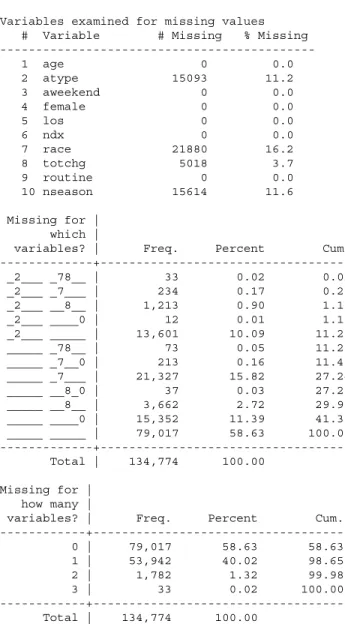
Figure 4 displays the pattern of missing data using routines within Stata; a similar presentation can be created with SAS, R or S-Plus.
4.3 Results
Table 2 displays the results from the complete case estimator
(n=79,017). However, the use of the complete case estimator means that incomplete observations are excluded from the anal-ysis, even though for almost all subjects, complete data on the outcome as well as all but one or two predictors are available. We now review software implementations to incorporate these incomplete observations.
5. SOFTWARE PACKAGES
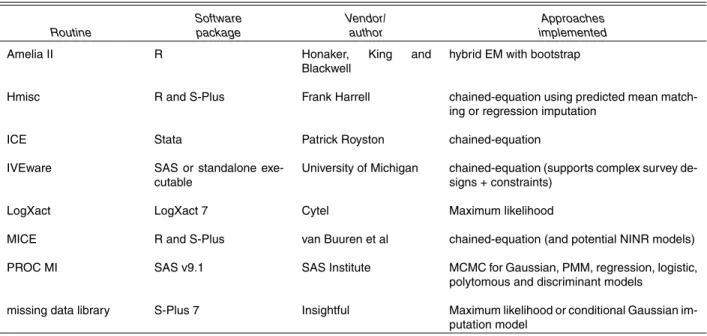
Table 3 lists the missing data implementations considered in this review. For each package, we provide a general introduction and discuss any particular issues related to the implementation, strengths or limitations. For each package, we have included the code to analyze the motivating dataset along with the relevant output in an Appendix posted at http:// www.math.smith.edu/ muchado-appendix.pdf.
5.1 Amelia II
Amelia II (Honaker, King, and Blackwell 2006) uses a bootstrapping-based EM algorithm (e.g., EMis, King et al. 2001) that is both fast and robust. It includes features for imputing cross-sectional surveys, time series data, and time-series/cross-sectional data. The package allows users to put priors on individ-ual missing cell values in the data matrix, when that knowledge is available. The article by Honaker and King (2006) provides additional description of the package.
Amelia II performs the imputation step. Separate analyses and combination of results can either be undertaken in R using the Zelig (Imai, King, and Lau 2006) software, or in a sepa-rate statistics package (e.g., SAS or Stata). The code to install AmeliaandZeligwithin R or S-Plus can be found in Figure A.1 (Appendix), along with the code to combine the multiple imputations. A screenshot ofAmeliaView()can be found in Figure A.3 (Appendix) while the output is displayed in Figure A.4 (Appendix).
In addition, a self-install package is available which allows a user to install Amelia II without any knowledge of, or even directly running, R. If this route it preferred, Amelia can output datasets for analysis and combination in another package. Figure A.2 (Appendix) displays the SAS code to read (lines 1–19), analyze (lines 21–34), and combine (lines 30–40) output datasets from Amelia; more information on SAS can be found in Section 5.7.
. net from http://www.indiana.edu/˜jslsoc/stata . net install spost9_ado
. misschk
Variables examined for missing values # Variable # Missing % Missing ---1 age 0 0.0 2 atype 15093 11.2 3 aweekend 0 0.0 4 female 0 0.0 5 los 0 0.0 6 ndx 0 0.0 7 race 21880 16.2 8 totchg 5018 3.7 9 routine 0 0.0 10 nseason 15614 11.6 Missing for | which |
variables? | Freq. Percent Cum. ---+---_2___ _78__ | 33 0.02 0.02 _2___ _7___ | 234 0.17 0.20 _2___ __8__ | 1,213 0.90 1.10 _2___ ____0 | 12 0.01 1.11 _2___ _____ | 13,601 10.09 11.20 _____ _78__ | 73 0.05 11.25 _____ _7__0 | 213 0.16 11.41 _____ _7___ | 21,327 15.82 27.24 _____ __8_0 | 37 0.03 27.26 _____ __8__ | 3,662 2.72 29.98 _____ ____0 | 15,352 11.39 41.37 _____ _____ | 79,017 58.63 100.00 ---+---Total | 134,774 100.00 Missing for | how many |
variables? | Freq. Percent Cum. ---+---0 | 79,017 58.63 58.63 1 | 53,942 40.02 98.65 2 | 1,782 1.32 99.98 3 | 33 0.02 100.00 ---+---Total | 134,774 100.00
Figure 4. Description of missing data (using Statamisschkfunction).
5.2 Hmisc
ThearegImputefunction with the HMisc package (Har-rell 2006) for R and S-Plus supports predictive mean matching with optional weighted probability sampling from similar cases. Predictive mean matching works for binary, categorical, and con-tinuous variables, without the need for computing residuals or constraining imputed values to be in the range of observed val-ues. This approach takes all aspects of uncertainty into account by using the bootstrap to approximate the full Bayesian pre-dictive distribution for imputations. There is also support for regression imputation within HMisc.
The packages is available for download from CRAN (the Comprehensive R Archive Network). Figure A.5 (Appendix) displays the code to read in the dataset (lines 1–12), create graph-ical displays (lines 13–15), impute usingaregImpute(lines 17–20), then assess convergence and combine results (lines 21–
28). Figure A.6 displays the output from aregImpute and Figure A.7 (Appendix) a series of graphical displays of missing data patterns (fromHmisc).
5.3 ICE/Stata
Patrick Royston’s ICE (imputation using chained equations), implemented within Stata, provides support for categorical miss-ing values (Royston 2005). Binary variables are predicted from other variables using logistic regression, while categorical vari-ables with more levels using either a multinomial or ordered logistic regression. Some housekeeping is needed when using indicator variables to represent the multiple levels of a categori-cal variable. Figure A.8 (Appendix) displays the code to analyze the KID dataset using ICE.
The software can be installed over the Internet from within Stata (lines 1–2). Much of the syntax involves the creation of
Table 2. Results from Complete Case Estimator (Stata)
. logistic routine age nseas1 nseas2 nseas3 aweekend r2 r3 r4 female
a2 a3 los totchg3 ndx
Logistic regression Number of obs = 79017
LR chi2(14) = 1100.68 Prob > chi2 = 0.0000
Log likelihood = -30802.402 Pseudo R2 = 0.0176
---routine | Odds Ratio Std. Err. z P>|z| [95% Conf. Interval]
---+---age | .9603541 .0038511 -10.09 0.000 .9528357 .9679318 nseas1 | .935468 .0278596 -2.24 0.025 .8824273 .9916969 nseas2 | .9818723 .0302025 -0.59 0.552 .9244255 1.042889 nseas3 | 1.038108 .0308933 1.26 0.209 .9792904 1.100459 aweekend | .9437081 .0246635 -2.22 0.027 .8965856 .9933072 r2 | .9825766 .0286533 -0.60 0.547 .9279919 1.040372 r3 | .8133424 .0320256 -5.25 0.000 .7529342 .878597 r4 | .8782054 .039837 -2.86 0.004 .8034966 .9598607 female | 1.093442 .0230012 4.25 0.000 1.049277 1.139465 a2 | 1.401183 .0343642 13.75 0.000 1.335424 1.470181 a3 | 1.474421 .0478478 11.96 0.000 1.383561 1.571248 los | .9960628 .0008627 -4.55 0.000 .9943734 .9977551 totchg3 | .9751805 .0067648 -3.62 0.000 .9620116 .9885298 ndx | .8979635 .0044983 -21.48 0.000 .8891901 .9068234 ---. logit
Logistic regression Number of obs = 79017
LR chi2(14) = 1100.68 Prob > chi2 = 0.0000
Log likelihood = -30802.402 Pseudo R2 = 0.0176
---routine | Coef. Std. Err. z P>|z| [95% Conf. Interval]
---+---age | -.0404532 .0040101 -10.09 0.000 -.0483128 -.0325936 nseas1 | -.0667083 .0297815 -2.24 0.025 -.1250789 -.0083377 nseas2 | -.018294 .0307601 -0.59 0.552 -.0785828 .0419947 nseas3 | .0374 .0297592 1.26 0.209 -.020927 .0957271 aweekend | -.0579384 .0261347 -2.22 0.027 -.1091615 -.0067153 r2 | -.017577 .0291614 -0.60 0.547 -.0747323 .0395783 r3 | -.2066032 .0393753 -5.25 0.000 -.2837774 -.1294289 r4 | -.1298747 .0453619 -2.86 0.004 -.2187824 -.0409671 female | .0893302 .0210356 4.25 0.000 .0481013 .1305592 a2 | .3373171 .0245251 13.75 0.000 .2892488 .3853855 a3 | .3882654 .0324519 11.96 0.000 .3246608 .45187 los | -.003945 .0008661 -4.55 0.000 -.0056425 -.0022475 totchg3 | -.0251326 .0069369 -3.62 0.000 -.0387288 -.0115365 ndx | -.1076259 .0050095 -21.48 0.000 -.1174442 -.0978075 _cons | 2.803206 .0730586 38.37 0.000 2.660013 2.946398
---Table 3. General Purpose Software Implementations of Missing Data Routines
Software Vendor/ Approaches
Routine package author implemented
Amelia II R Honaker, King and
Blackwell
hybrid EM with bootstrap
Hmisc R and S-Plus Frank Harrell chained-equation using predicted mean match-ing or regression imputation
ICE Stata Patrick Royston chained-equation IVEware SAS or standalone
exe-cutable
University of Michigan chained-equation (supports complex survey de-signs + constraints)
LogXact LogXact 7 Cytel Maximum likelihood
MICE R and S-Plus van Buuren et al chained-equation (and potential NINR models) PROC MI SAS v9.1 SAS Institute MCMC for Gaussian, PMM, regression, logistic,
polytomous and discriminant models
missing data library S-Plus 7 Insightful Maximum likelihood or conditional Gaussian im-putation model
indicator variables with appropriate missingness structure (lines 6–24). This must be done in advance so that ICE can create them from imputed values using the passiveandsubstitute statements (lines 32–35). To allow commands to be split onto separate lines, thedelimitstatement is used (lines 28 and 36). Multinomial logit models are used for the SEASON, RACE, and ATYPE variables, while a linear regression model is used for to-tal charges (line 31). The imputed datasets are saved into a dataset calledimputedand this is used to fit the regression model of interest (lines 40–41). Figures A.9 and A.10 (Appendix) display the output.
5.4 IVEWARE
IVEware (http:// www.isr.umich.edu/ src/ smp/ ive) by Raghu-nathan et al. is a SAS version 9 callable routine built using the SAS macro language or a standalone executable. In addition to supporting chained equations, it extends multiple imputation to support complex survey sample designs.
Installation of the SAS-callable version is straightforward, as it consists of 19 SAS command files. The distribution includes an example dataset to help verify the installation. Figure A.11 (Ap-pendix) displays the code to fit the logistic regression imputation model while Figure A.12 (Appendix) provides the output.
5.5 LogXact
LogXact is a standalone package for the analysis of gener-alized linear models. LogXact version 7 incorporates support for the likelihood methodology of Ibrahim (1990) for up to 10 categorical covariates with missing values (each with up to five levels). There is no practical limit on the number of fully ob-served predictors. The software functions via a graphical inter-face. Since our motivating example had a predictor (TOTCHG,
or total charges) that was continuous, we had to drop observa-tions where TOTCHG was not observed (approximately 4% of the dataset). One of our missing predictors was month of admis-sion; because only five levels were allowed we coded this into a SEASON variable with four levels. Figure A.13 (Appendix) displays a screenshot of LogXact’s results from the missing data model.
We ran into some precision or collinearity issues related to the range of TOTCHG (when this variable was divided by 1,000 the models worked, as well as when we fit the untransformed variable using only complete cases). There was also a minor bug in the display routines (Cytel reports that these bugs have been fixed and will ship in the next release). The requirement that categorical variables take on values starting from zero in sequence to a max of four required some tedious recoding.
Although there was an option to display the variance-covariance matrix of the regression parameters, there were fatal memory errors on the testing machine when these were checked. Access to the variance covariance matrix is needed to calculate functions of the regression parameters, or to conduct multiple-df tests.
5.6 MICE
MICE (Multiple Imputation by Chained Equations) is a li-brary for S-Plus and R. The package is available from the Com-prehensive R Archive Network. A variety of imputation models are supported, including forms of predictive mean matching and regression methods, logistic and polytomous regression, and dis-criminant analysis. In addition, MICE allows users to program their own imputation functions. In theory, this could facilitate sensitivity analyses of different (possibly nonignorable) miss-ingness models. The imputation step is carried out using the mice()function.
the logistic regression model. A patch is now available for release 1.14. Figure A.14 (Appendix) displays the code frommicefor reading in the dataset (lines 1–9), imputation (lines 10–11), and combination of results (lines 12–14). Figure A.15 (Appendix) displays the output and results.
5.7 SAS PROC MI
Analysis using multiple imputation in SAS/STAT is carried out in three steps. First, the imputation is carried out by PROC MI. Then, complete data methods are employed using any of the SAS procedures for complete data analysis (e.g., PROC GLM, GENMOD, PHREG, or LOGISTIC); the “BY” statement re-peats the analysis for each completed dataset. Finally, the results are combined using PROC MIANALYZE. No additional instal-lation was needed for PROC MI/PROC MIANALYZE, since it is part of the SAS/STAT product.
PROC MI incorporates a number of different imputation meth-ods. For nonmonotone missing data patterns, the MCMC state-ment can be used either for all missing data or to impute enough data so that the remaining missing data is monotone. At present only continuous variables (those not specified in the CLASS statement) can be included for MCMC imputation. Extensive control and graphical diagnostics of the MCMC methods are provided.
For monotone data, the MONOTONE statement is used to describe the imputation method. Continuous variables can be imputed using multivariate regression, regression using predic-tive mean matching (each of these assuming normality), or via propensity scores. Categorical variables, specified in the CLASS statement, can be imputed via logistic (or ordinal logistic) regres-sion, discriminant analysis (only continuous predictors allowed) or propensity scores. The approaches can be combined in the same PROC MI, allowing, for example, regression, propensity score, and discriminant analysis to be used in completing a single dataset.
The propensity score approach fits a logistic regression model predicting the missingness indicator, then orders the observa-tions by predicted probability of missingness. Next, the ordered observations are split into G equal-sized groups. Loosely, the imputed value is then chosen at random from among the ob-served values in the same one of the G groups as the missing observation Lavori et al. (1995); G can be chosen by the user.
The logistic (or ordinal logistic) regression approach is the standard one proposed by Rubin (1987). Analogous to the lo-gistic regression approach, the discriminant analysis approach creates a probability of each level of a categorical variable, then draws a random uniform variate and assigns an imputed level based on this. The distinction is that the probabilities are based on discriminant analysis, rather than logistic regression. The user has some control over details of the process used. The advantage of this approach is that nominally valued variables can be im-puted, rather than the ordinal values required for ordinal logistic regression.
The code to fit PROC/MI using a two-stage imputation is dis-played in Figure A.16 (Appendix), with output in Figure A.17 (Appendix). This approach exploits the particular patterns ob-served in the motivating example. Because so few observations
were missing for TOTCHG (approximately 4% missing), 20 imputed datasets were created as a function of the fully ob-served variables (lines 1–5). Imputation was then carried out for the three remaining variables (T=ATYPE, S=SEASON, R=RACE). Lines 15–17 create a variable that describes the missingness pattern (111=fully observed, 112=race and type observed, season missing, etc.). Separate monotone imputations are carried out for each pattern, based on what is observed (lines 26–46) and these imputed values are merged into a single data (lines 48–52). The logistic regression model is fit for each im-puted dataset (lines 56–61) and the results are consolidated using MIANALYZE (lines 72–76).
The three-stage approach used in SAS highlights the notion of using different software to impute, analyze, and combine meth-ods. For example, if a desirable imputation package does not ex-ist in one’s preferred analysis package, one could impute using a stand-alone imputation package, save the resulting completed datasets, and import them for data analysis. The analyses could then be exported to a third package for combining the results. This approach is demonstrated using Amelia for imputation and SAS for analysis in Figure A.2 (Appendix).
5.8 Missing Data Library for S-Plus
S-Plus version 7.0 includes a missing data library that ex-tends S-Plus to support model-based missing data models using the methodology of Schafer (1997), by use of the EM algorithm (Dempster et al. 1977), and data augmentation (DA) algorithms (Tanner and Wong 1987). DA algorithms can be used to gener-ate multiple imputations. The missing data library provides sup-port for multivariate normal data (impGauss), categorical data (impLoglin) and conditional Gaussian models (impCgm) for imputations involving both discrete and continuous variables.
Figure A.18 (Appendix) displays the code to access the library and read in the data (lines 1–14), create imputed datasets (lines 18–22), and combine results (lines 23–29). Figure A.19 (Ap-pendix) displays the output from the S-Plus missing data library. Infinite values were created for four observations with missing TOTCHG, which led to nonconvergence of the EM algorithm. These values were dropped in the imputations. This anomaly was reported to Insightful Technical Support, though resolution is unknown as of press time.
5.9 Other Packages and Routines
Other packages which provide support for imputation include Joseph Schafer’s free software (macros for S-Plus and standalone windows package NORM), SOLAS, and SPSS. Schafer’s soft-ware routines are an excellent companion to his book, but they do not support general-purpose regression modeling and more modern implementations are available in S-Plus. SOLAS is de-signed specifically for the analysis of datasets with missing ob-servations, and version 3.0 was reviewed previously (Horton and Lipsitz 1999). Because the current version of SOLAS (3.2) does not support estimation of logistic regression models, we did not fit models using the package. Support for missing data is in-cluded in the SPSS version 12.0 missing value library, reviewed by von Hippel (2004).
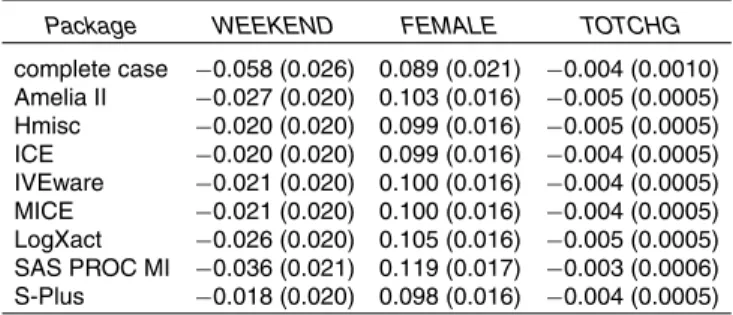
Table 4. Results (in terms of log OR and SE) for Selected Regression Parameters for a Variety of Incomplete Data Logistic Regression Models
Package WEEKEND FEMALE TOTCHG
complete case −0.058 (0.026) 0.089 (0.021) −0.004 (0.0010) Amelia II −0.027 (0.020) 0.103 (0.016) −0.005 (0.0005) Hmisc −0.020 (0.020) 0.099 (0.016) −0.005 (0.0005) ICE −0.020 (0.020) 0.099 (0.016) −0.004 (0.0005) IVEware −0.021 (0.020) 0.100 (0.016) −0.004 (0.0005) MICE −0.021 (0.020) 0.100 (0.016) −0.004 (0.0005) LogXact −0.026 (0.020) 0.105 (0.016) −0.005 (0.0005) SAS PROC MI −0.036 (0.021) 0.119 (0.017) −0.003 (0.0006) S-Plus −0.018 (0.020) 0.098 (0.016) −0.004 (0.0005)
Footnote: TOTCHG parameter represents change of $1,000
6. MISSING DATA MODELING IN KID DATASET We now return to the analysis of the motivating example. Table 4 displays the results (in terms of log OR and SE) for several of the regression parameters for the complete case and incomplete data logistic regression models.
In general, the parameter estimates for the FEMALE and TOTCHG are quite similar for all missing data models relative to the complete case estimator. For the WEEKEND parameter, the 95% confidence interval for the complete case estimator would not include zero, which is not the case for the other models. The differing results for the WEEKEND parameter may indicate a selection bias due to discarding all the partially observed ob-servations. The standard error estimates for the complete case estimator are as much as 30% larger than those of the missing data models.
7. CONCLUSION
It is critically important to address missing data, as it arises in almost all real-world investigations. Accounting for incomplete observations is particularly important for observational analyses with many predictors. In our motivating example, no predictor was missing more than 16% of the time, yet 41% of observations had at least one missing value. Dropping all these observations and fitting a model to only the complete cases would be hugely inefficient and potentially biased.
In this article, we have briefly described a series of principled methods that can be fit logistic regression models with incom-plete data, reviewed their implementation in general purpose statistical software, and applied them to our motivating exam-ple.
We found that it is feasible to fit imputation models in practice, though there are some limitations, complications and shortcom-ings of current implementations. Additional time and effort is needed to specify models in addition to the primary focus of in-ference, further assumptions are required and compromises may sometimes be necessary. However, the value of this additional work is often justified by the potential increase in efficiency and decrease in bias.
While not a focus of our article, sensitivity analyses are an important component of modeling when some data are missing,
and should be routinely conducted. Such additional analyses re-quire effort, but allow insight into the impact of missing data assumptions.
Reviews of methodologies used to account for missing values in practice indicate that for prognostic studies of cancer and research articles in theNew England Journal of Medicine, use of principled approaches is relatively rare. Despite some of their limitations, the existence of these implementations should help to foster increased use of missing data methods in practice.
APPENDIX
Figures describing code for analysis and results can be found athttp:// www.math.smith.edu/ muchado-appendix.pdf.
REFERENCES
Allison, P. D. (2000), “Multiple Imputation for Missing Data: A Cautionary Tale,”Sociological Methods and Research, 28, 301–309.
(2002),Missing Data, SAGE University Papers.
(2005), “Imputation of Categorical Variables with PROC MI” [ac-cessed July 30, 2006]. Available online athttp:// www2.sas.com/ proceedings/ sugi30/ 113-30.pdf.
Barnard, J., and Meng, X. L. (1999), “Applications of Multiple Imputation in Medical Studies: From AIDS to NHANES,”Statistical Methods in Medical Research, 8, 17–36.
Bernaards, C. A., Belin, T. R., and Schafer, J. L. (in press), “Robustness of a Multivariate Normal Approximation for Imputation of Incomplete Binary Data,”Statistics in Medicine.
Bishop, Y. M. M., Fienberg, S. E., and Holland, P. W. (1975), Discrete Multi-variate Analyses: Theory and Practice, Cambridge, MA: MIT Press. Burton, A., and Altman, D. G. (2004), “Missing Covariate Data Within Cancer
Prognostic Studies: A Review of Current Reporting and Proposed Guide-lines,”British Journal of Cancer, 91, 4–8.
Carpenter, J. (2006a), “Annotated Bibliography on Missing Data” [accessed July 30, 2006]. Available online at http:// www.lshtm.ac.uk/ msu/ missingdata/ biblio.html.
(2006b), “Missing Data Example Analysis” [accessed December 19, 2006]. Available online at http:// www.lshtm.ac.uk/ msu/ missingdata/ example.html.
Carpenter, J., Kenward, M., Evans, S., and White, I. (2004), “Last Observation Carry-Forward and Last Observation Analysis,” Statistics in Medicine, 23, 3241–3244.
Carpenter, J., Pocock, S., and Lamm, C. J. (2002), “Coping With Missing Data in Clinical Trials: A Model Based Approach Applied to Asthma Trials,Statistics in Medicine, 21, 1043–1066.
Carpenter, J. R., Kenward, M. G., and Vansteelandt, S. (2006), “A Comparison of Multiple Imputation and Doubly Robust Estimation for Analyses with Missing Data,”Journal of the Royal Statistical Society, Series A, 169, 571– 584.
Collins, L. M., Schafer, J. L., and Kam, C.-M. (2001), “A Comparison of In-clusive and Restrictive Strategies in Modern Missing Data Procedures,” Psy-chological Methods, 6, 330–351.
Cook, R. J., Zeng, L., and Yi, G. Y. (2004), “Marginal Analysis of Incom-plete Longitudinal Binary Data: A Cautionary Note on LOCF Imputation,” Biometrics, 60, 820–828.
Dempster, A. P., Laird, N. M., and Rubin, D. B. (1977), “Maximum Likelihood From Incomplete Data via the EM Algorithm,”Journal of the Royal Statistical Society, Series B, 39, 1–22.
Diggle, P., and Kenward, M. G. (1994), “Informative Drop-Out in Longitudinal Data Analysis,”Applied Statistics, 43, 49–73.
Diggle, P. J., Heagerty, P., Liang, K. Y., and Zeger, S. L. (2002), Analysis of Longitudinal Data(2nd ed.), Clarendon, TX: Clarendon Press.
Glynn, R. J., Laird, N. M., and Rubin, D. B. (1993), “Multiple Imputation in Mixture Models for Nonignorable Nonresponse With Follow-ups,”Journal of the American Statistical Association, 88, 984–993.
Greenland, S., and Finkle, W. D. (1995), “A Critical Look at Methods for Han-dling Missing Covariates in Epidemiologic Regression Analyses,”American Journal of Epidemiology, 142, 1255–1264.
Harrell, F. E. (2006), Hmisc package [accessed August 10, 2006]. Available online athttp:// biostat.mc.vanderbilt.edu/ twiki/ bin/ view/ Main/ Hmisc. HCUP Kids’ Inpatient Database (KID) (2000), Healthcare Cost and Utilization
Project (HCUP).http:// www.ahrq.gov/ data/ hcup/.
Honaker, J., and King, G. (2006), “What to Do About Missing Values in Time Series Cross-Section Data” [accessed December 17, 2006]. Available online athttp:// gking.harvard.edu/ files/ abs/ pr-abs.shtml.
Honaker, J., King, G., and Blackwell, M. (2006), Amelia Software Web Site [accessed December 15, 2006]. Available online athttp:// gking.harvard. edu/ amelia,
Horton, N. J., and Laird, N. M. (1999), “Maximum Likelihood Analysis of Generalized Linear Models with Missing Covariates,”Statistical Methods in Medical Research, 8, 37–50.
Horton, N. J., Laird, N. M., Murphy, J. M., Monson, R. R., Sobol, A. M., and Leighton, A. H. (2001), “Multiple Informants: Mortality Associated with Psychiatric Disorders in the Stirling County Study,” American Journal of Epidemiology, 154, 649–656.
Horton, N. J., and Lipsitz, S. R. (1999), “Review of Software to Fit Generalized Estimating Equation (GEE) Regression Models,”The American Statistician, 53, 160–169.
(2001), “Multiple Imputation in Practice: Comparison of Software Pack-ages for Regression Models With Missing Variables,”The American Statis-tician, 55, 244–254.
Horton, N. J., Lipsitz, S. R., and Parzen, M. (2003), “A Potential for Bias When Rounding in Multiple Imputation,”The American Statistician, 57, 229–232. Horton, N. J., and Switzer, S. S. (2005), “Statistical Methods in the Journal”
(research letter),New England Journal of Medicine, 353, 1977–1979. Ibrahim, J. G. (1990), “Incomplete Data in Generalized Linear Models,”Journal
of the American Statistical Association, 85, 765–769.
Ibrahim, J. G., Chen, M.-H., and Lipsitz, S. R. (1999), “Monte Carlo EM for Missing Covariates in Parametric Regression Models,”Biometrics, 55, 591– 596.
Ibrahim, J. G., Chen, M.-H., Lipsitz, S. R., and Herring, A. H. (2005), “Missing-Data Methods for Generalized Linear Models: A Comparative Review,” Jour-nal of the American Statistical Association, 100, 332–346.
Imai, K., King, G., and Lau, O. (2006), Zelig Software Web Site [accessed December 15, 2006]. Available online athttp:// gking.harvard.edu/ zelig. Jansen, I., Beunckens, C., Molenberghs, G., Verbeke, G., and Mallinckrodt, C.
(2006), “Analyzing Incomplete Discrete Longitudinal Clinical Trial Data,” Statistical Science, 21, 52–69.
Jones, M. P. (1996), “Indicator and Stratification Methods for Missing Ex-planatory Variables in Multiple Linear Regression,”Journal of the American Statistical Association, 91, 222–230.
Kenward, M. C., and Carpenter, J. (in press), “Multiple Imputation: Current Perspectives,”Statistical Methods in Medical Research.
King, G., Honaker, J., Joseph, A., and Scheve, K. (2001), “Analyzing Incomplete Political Science Data: An Alternative Algorithm for Multiple Imputation,” American Political Science Review, 95, 49–69.
Laird, N. M. (1988), “Missing Data in Longitudinal Studies,” Statistics in Medicine, 7, 305–315.
Lavori, P. W., Dawson, R., and Shera, D. (1995), “A Multiple Imputation Strategy for Clinical Trials with Truncation of Patient Data,” Statistics in Medicine, 14, 1913–1925.
Lipsitz, S. R., and Ibrahim, J. G. (1996), “A Conditional Model for Incomplete Covariates in Parametric Regression Models,”Biometrika, 83, 916–922. Little, R. J. A. (1988), “Missing-Data Adjustments in Large Surveys,”Journal
of Business and Economic Statistics, 6, 287–296.
(1992), “Regression With Missing X’s: A Review,” Journal of the American Statistical Association, 87, 1227–1237.
(1994), “A Class of Pattern-Mixture Models for Normal Incomplete Data,”Biometrika, 81, 471–483.
Little, R. J. A., and Rubin, D. B. (1987),Statistical Analysis With Missing Data, New York: Wiley.
(2002), Statistical Analysis With Missing Data(2nd ed.), New York: Wiley.
Meng, X.-L. (2000), “Missing Data: Dial M for ???,”Journal of the American Statistical Association, 95, 1325–1330.
Moons, K. G. M., Donders, R. A., Stijnen, T., and Harrell, F. E. (2006), “Using the Outcome for Imputation of Missing Predictor Values was Preferred,”Journal of Clinical Epidemiology, 59, 1092–1101.
Olkin, I., and Tate, R. F. (1961), “Multivariate Correlation Models With Mixed Discrete and Continuous Variables,”The Annals of Mathematical Statistics, 32, 448–465.
Raghunathan, T. E. (2004), “What Do We Do With Missing Data? Some Options for Analysis of Incomplete Data,”Annual Review of Public Health, 25, 99– 117.
Raghunathan, T. E., Lepkowski, J. M., van Hoewyk, J., and Solenberger, P. (2001), “A Multivariate Technique for Multiply Imputing Missing Values Using a Sequence of Regression Models,”Survey Methodology, 27, 85–95. Robins, J. M., Rotnitzky, A., and Zhao, L. P. (1995), “Analysis of Semiparametric
Regression Models for Repeated Outcomes in the Presence of Missing Data,” Journal of the American Statistical Association, 90, 106–121.
Royston, P. (2005), “Multiple Imputation of Missing Values,”Stata Technical Journal, 5, 527–536.
Rubin, D. B. (1976), “Inference and Missing Data,”Biometrika, 63, 581–590. (1987), Multiple Imputation for Nonresponse in Surveys, New York: Wiley.
(1996), “Multiple Imputation After 18+Years,”Journal of the American Statistical Association, 91, 473–489.
Schafer, J. L. (1997), Analysis of Incomplete Multivariate Data, New York: Chapman & Hall.
(1999), “Multiple Imputation: A Primer,”Statistical Methods in Medical Research, 8, 3–15.
Smith, G. C., Wood, A. M., Pell, J. P., White, I. R., Crossley, J. A., and Dobbie, R. (2004), “Second-Trimester Maternal Serum Levels of Alpha-Fetoprotein and the Subsequent Risk of Sudden Infant Death Syndrome,”New England Journal of Medicine, 351, 978–986.
Tanner, M. A., and Wong, W. H. (1987), “The Calculation of Posterior Distribu-tions by Data Augmentation,”Journal of the American Statistical Association, 82, 528–540.
van Buuren, S. (2006), Multiple Imputation Online [accessed August 19, 2006]. Available online athttp:// www.multiple-imputation.com.
(in press), “Creating Multiple Imputations in Discrete and Continuous Data by Fully Conditional Specification,” Statistical Methods in Medical Research.
van Buuren, S., Boshuizen, H. C., and Knook, D. L. (1999), “Multiple Imputation of Missing Blood Pressure Covariates in Survival Analysis,” Statistics in Medicine, 18, 681–694.
van Buuren, S., Brand, J. P. L., Groothius-Oudshoorn, C. G. M., and Rubin, D. B. (2006), “Fully Conditional Specification in Multivariate Imputation,” Journal of Statistical Computation and Simulation, 76, 1049–1064. van de Beek, D., de Gans, J., Spanjaard, L., Weisfelt, M., Reitsma, J. B., and
Vermeulen, M. (2004), “Clinical Features and Prognostic Factors in Adults with Bacterial Meningitis,”New England Journal of Medicine, 351, 1849– 1859.
von Hippel, P. (2004), “Biases in SPSS 12.0 Missing Value Analysis,” The American Statistician, 58, 160–164.
Xie, F., and Paik, M. C. (1997), “Generalized Estimating Equation Model for Binary Outcomes With Missing Covariates,”Biometrics, 53, 1458–1466.