R E S E A R C H
Open Access
Analysis of adenovirus
trans-complementation-mediated gene expression controlled by
melanoma-specific TETP promoter
in vitro
Alessandra Curioni Fontecedro
1, Verena Lutschg
1,2, Ossia Eichhoff
3,4, Reinhard Dummer
3, Urs F Greber
1,
Silvio Hemmi
1*Abstract
Background:Human adenoviruses (Ads) have substantial potential for clinical applications in cancer patients. Conditionally replicating adenoviruses (CRAds) include oncolytic adenoviruses in which expression of the immediate early viral transactivator protein E1A is controlled by a cancer cell-selective promoter. To enhance efficacy, CRAds are further armed to contain therapeutic genes. Due to size constraints of the capsid geometry, the capacity for packaging transgenes into Ads is, however, limited. To overcome this limitation, the employment of E1A-deleted replication-deficient viruses carrying therapeutic genes in combination with replication-competent CRAd vectors expressing E1A in transhas been proposed. Most trans-complementing studies involved transgene expressions from strong ubiquitous promoters, and thereby relied entirely on the cancer cell specificity of the CRAd vector.
Results:Here we tested the trans-complementation of a CRAd and a replication-deficient transgene vector containing the same cancer cell-selective promoter. Hereto, we generated two new vectors expressing IL-2 and CD40L from a bicistronic expression cassette under the control of the melanoma/melanocyte-specific tyrosinase enhancer tyrosinase
promoter (TETP), which we previously described for the melanoma-specific CRAd vector AdΔEP-TETP. These vectors
gave rise to tightly controlled melanoma-specific transgene expression levels, which were only 5 to 40-fold lower than those from vectors controlled by the nonselective CMV promoter. Reporter analyses using Ad-CMV-eGFP in
combination with AdΔEP-TETP revealed a high level of trans-complementation in melanoma cells (up to about 30-fold),
but not in non-melanoma cells, unlike the AdCMV-eGFP/wtAd5 binary vector system, which was equally efficient in melanoma and non-melanoma cells. Similar findings were obtained when replacing the transgene vector AdCMV-eGFP
with AdCMV-IL-2 or AdCMV-CD40L. However, the combination of the novel AdTETP-CD40L/IL-2 vector with AdΔ
EP-TETP or wtAd5 gave reproducible moderate 3-fold enhancements of IL-2 by trans-complementation only. Conclusions:The cancer cell-selective TETP tested here did not give the expected enforceable transgene
expression typically achieved in the Ad trans-complementing system. Reasons for this could include virus-mediated down regulation of limiting transcription factors, and/or competition for such factors by different promoters. Whether this finding is unique to the particular promoter system tested here, or also occurs with other promoters warrants further investigations.
Introduction
Cancer immunotherapy is an experimental approach for treatment of cancer patients. It aims at evoking immune-based responses against malignant cells by acti-vating and recruiting cells from the innate and adaptive
immune system, including T cells that recognize tumor-specific antigens [1]. Virus-mediated gene transfer has been widely used to enhance the susceptibility of cancer cells to immunotherapy. Therapeutic genes expressed by viral vectors included a broad number of immune mod-ulators, such as e.g. granulocyte macrophage colony sti-mulating factor (GM-CSF), interleukin-2 (IL-2), interferons or CD40 ligand (CD40L) [2-4]. These approaches have proven to be inefficient, however, since * Correspondence: [email protected]
1
Faculty of Mathematics and Natural Sciences, Institute of Molecular Life Sciences, University of Zürich, Winterthurerstrasse 190, CH-8057 Zürich, Switzerland
most tumors express weak tumor antigens and also lack co-stimulatory molecules necessary for induction of cel-lular immunity, and evade immune recognition. An additional major limitation of cancer immunotherapy has been the low rates of gene transfer.
Strategies to improve both, the potency of immune recognition of cancer cells and the efficacy of gene ther-apy are clearly required to successfully employ the pro-mising concept of cancer immunotherapy. One way to enhance the duration of therapeutic gene expression is to increase viral spreading [5], for example by replacing non-replicating therapeutic virus vectors with armed oncolytic viruses, which replicate selectively within can-cers and also express therapeutic genes [6-8]. Therapeu-tic genes include prodrug converting enzymes, suicide genes, and immunostimulatory proteins. The most widely used oncolytic viral vectors have been derived from non-integrating parental viruses, such as vaccinia virus, herpes simplex virus, measles virus and human Ad [9]. Human Ads have an excellent safety profile in cancer gene ther-apy [10]. In addition, they are easy to produce in large amounts, and efficient infection is possible with vectors derived from various serotypes or by tropism engineering [11]. The latter is based on the availability of adequate methods to generate recombinant vectors of choice, including CRAds for cancer treatment [12,13].
The number of inserted therapeutic genes is, however, limited for Ad due to the packaging capacity of the viral capsid [14]. One promising way to overcome this limita-tion is to use trans-complementing co-replicalimita-tion, where a CRAd is mixed with a second, E1-deleted and there-fore replication-deficient (RD) vector expressing the therapeutic gene(s) of interest. In such a system, the E1A gene expressed by the first vector complements the
second vectorin trans, which gives rise to efficient
repli-cation of both vectors, thereby strongly increasing the DNA copy number on a per cell basis. This concept was first confirmed by combining transduction of an E1-deleted Ad with transfection of a plasmid containing the E1 genes and subsequent production of progeny virus and enhanced viral transgene expression [15,16].
Subsequently, numerous variations of the binary virus system have been tested. The group of Alemany was the first to combine two defective viruses, a RD E1-deleted virus and a helper-dependent virus containing the E1 genes under the control of the liver tissue-specific pro-moter and demonstrated oncolytic spread following injection of a 1:1 mix into human hepatocarcinoma mouse xenograft model [17]. Several groups used RD
Ad vectors expressing reporter genes such asb
-galacto-sidase, luciferase or eGFP to show enhancement of virus replication and cell spreading [18-23]. More recently, this system has led to new exciting applications for
non-invasivein vivoimaging of tumor spread and assessment
of Ad replication [24-27]. Therapeutic genes utilized in binary vector systems included prodrug converting enzymes such as herpes simplex virus-thymidine kinase [28,29] and P450 enzyme [21], suicide genes like Bcl-xs
[30], p53 [31,32], p27 [25], tumor necrosis factor
a-related apoptosis-inducing ligand [23,33-36], dominant-negative insulin-like growth factor-1R [22], antiangio-genic soluble vascular endothelial growth factor receptor 2-Fc [26,37], and immunostimulatory proteins like GM-CSF [33,38], IL-2 and IL-12 [39]. In most studies, co-administration of RD therapeutic vectors and CRAds
was also tested in in vivo xenotransplant models.
Improved oncolytic efficacy was found and in some cases lead to complete and long lasting regression, which was not achieved when using the individual viral vectors alone [21-26,28,29,33-37,39].
The currently available dual vector co-replication sys-tems control the expression of the therapeutic genes by strong ubiquitous promoters lacking tissue or tumor spe-cificity. In this study we suggested to combine a CRAd and a RD vector containing the same cancer cell-selective promoter, and to test, whether a strong enhancement of transgene expression can be achieved by trans-comple-mentation. The results presented here show that when using the cancer cell-selective TETP promoter previously described for our melanoma/melanocyte-specific CRAd vector [40] in combination with two novel RD vectors expressing IL-2 and CD40L from a bicistronic expression cassette, only moderate 3-fold enhancements of IL-2 or CD40L were obtained, whereas controls including the CMV promoter allowed much stronger expression enhancement in the Ad vector co-replication system. Possible reasons for this finding are discussed.
Materials and methods Cells
The primary melanoma short time culture cells M000301 were grown in RPMI 1640 plus 8% FCS [41]. All other cell lines including the human embryonic retina cell line 911, the human lung carcinoma cell line A549, the human cervical carcinoma cell line HeLa and the human colon carcinoma cell lines SW480, DLD-1, the human melanoma cell lines M21-L4, MeWo and SK-Mel23 were grown in DMEM plus 8% FCS [40,42,43]. All cell lines were routinely screened for the absence of mycoplasma contamination.
Viruses
control of TETP and a genomic ClaI DNA fragment
isolated from AdMLP-lacZ. To generate the transfer
plasmids, aKpnI -BglII (blunt) TETP fragment of 1197
bp was released from the pGL3-4xTETP plasmid [40]
and was cloned in a first step into theKpn I -BamHI
(blunt)-restricted transfer plasmid pAdCMVΔlacZ-lnk1
to replace the CMV promoter. The resulting
pAdTET-PΔlacZ-lnk1 carried an E1 deletion from bp 449 to
3323. For the generation of the two bicistronic expres-sion cassettes, the IL-2 and CD40 ligand-encoding frag-ments were linked by an internal ribosomal entry site (IRES) derived from encephalomyocarditis virus [44]. For this, the CD40L sequence was PCR-amplified using
the forward primer 5′
-GCGCATGCGGTCTCCCATGA-TAGAAACATACAGCCAAC-3′ and the reverse primer
5′
-GCGCCTCGAGTGCAGCCTAGGACAGCGCACTG-3′, introducing a terminal BsaI site with aNco I
over-hang-matching sequence at the 5′-end and a terminal
XhoI site at the 3′-end. The BsaI -XhoI fragment was
cloned between theNcoI - Xho I-digested
pBlusecript-IRES [44]. In a second step, a Pst I (blunt) - Spe I
(blunt) IL-2 sequence containing fragment was cloned
into theXbaI-digested (blunt) pBlusecript-IRES-CD40L.
For the generation of the inverse construct, the IL-2 sequence was first PCR-amplified using the forward
pri-mer 5′
-GCGCATGCGGTCTCGCATGTACAGCATG-CAGCTCG-3′ and the reverse primer 5′-GCGCCTCGA
GGAGCCTTATGTGTTGTAAGCAG-3′, followed by
the same cloning strategy as above. APstI (blunt) - Sal
I (blunt) CD40L sequence containing fragment was
cloned into theXbaI-digested (blunt)
pBlusecript-IRES-IL-2. For the final ligation, theNotI (blunt) -SpeI
frag-ments of IL-2-IRES-CD40L and CD40L-IRES-IL-2 were
cloned into the Asc I (blunt) - Nhe I- digested
pAd-TETP.
Recombinant Ads were once plaque-purified, ampli-fied and CsCl-puriampli-fied. Viral titers were determined by plaque assay using 911 cells. Biological titers varied
between 3 × 10⁹ and 3 × 10¹⁰ plaque forming units
(pfu)/ml, when determined in a standard assay using 2 ml of medium and the cell layers contained in 6-well
plates. For AdΔEP-TETP, AdCMV-lacZ, AdCMV-IL-2,
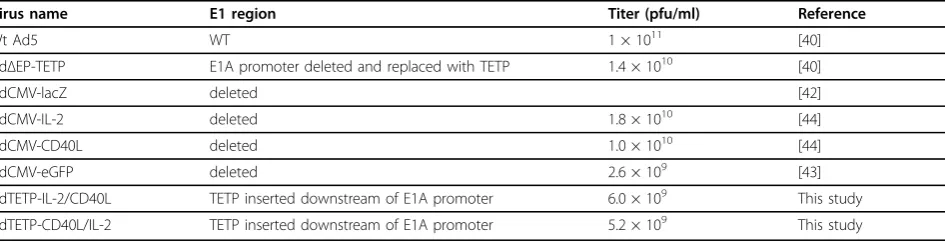
AdCMV-CD40L, AdCMV-eGFP see references in Table 1.
Expression analyses
For mouse CD40L and IL-2 expression analysis,
tripli-cates of 1 × 10⁵ cells seeded in 12-well plates were
infected at multiplicities of infection (MOIs) ranging from 10 to 810. Medium was replaced 5 h post infection (p.i.) and cells were analyzed two days p.i.. Levels of CD40L were determined by flow cytometric analysis as described earlier [42] using R-PE-labeled anti-mouse CD40L (CD154) (09025B) and appropriate isotype con-trols (Pharmingen, San Diego, USA). FACS measure-ments consisted of 10000 viable cells per sample. Mouse IL-2 levels were determined in duplicates by ELISA (Mouse IL-2 kit, PIERCE ENDOGEN) using pooled samples.
For RT-PCR of Microphthalmia-associated bHLH-LZ transcription factor (Mitf), total RNA was extracted using TRIzol reagent according to manufacturer instruc-tions (Invitrogen, Carlsbad, CA, USA). One microgram total RNA was used for cDNA synthesis using
Prome-ga’s Reverse Transcription System with supplied poly d
(T) primers according to manufacturer instructions (Promega, Madison, WI, USA). PCR was performed on
1 μg template cDNA using Roche’s LightCycler DNA
Master SYBR Green kit (Roche, Basel, Switzerland).
Pri-mers for 18sRNA were 5′
-AAACGGCTACCACATC-CAAG-3′ and 5′-CCTCCAATGGATCCTCGTTA -3′.
Primers for Mitf were purchased from Qiagen, QT00037737 (Qiagen, Hombrechtikon, Switzerland).
Co-replication experiments
Experiments to assess co-replication potency on trans-gene expression were performed in 12-well plates using
triplicate inputs. Four hours after seeding of 105 cells/
well, serial 3-fold dilutions of GFP- or transgene-expres-sing viruses were added, followed immediately by addi-tion of varying amounts of replicaaddi-tion-competent viruses. Medium was replaced 5 h p.i. and cells were
Table 1 Adenoviruses used in this study
Virus name E1 region Titer (pfu/ml) Reference
Wt Ad5 WT 1 × 10¹¹ [40]
AdΔEP-TETP E1A promoter deleted and replaced with TETP 1.4 × 10¹⁰ [40]
AdCMV-lacZ deleted [42]
AdCMV-IL-2 deleted 1.8 × 10¹⁰ [44]
AdCMV-CD40L deleted 1.0 × 10¹⁰ [44]
AdCMV-eGFP deleted 2.6 × 10⁹ [43]
AdTETP-IL-2/CD40L TETP inserted downstream of E1A promoter 6.0 × 10⁹ This study
analyzed two days p.i. by flow cytometric analysis for GFP or CD40L, and by ELISA for IL-2.
Results
Novel Ad vectors containing TETP allow melanoma-specific CD40L and IL-2 transgene expression
Tissue-specific promoters have been utilized to restrict expression of transgenes to target tissues, or to restrict viral replication to targeted cancer cells [45-47]. Here we intended to restrict Ad-mediated expression of immu-notherapeutic CD40L and IL-2 genes to melanoma cells by replacing the CMV promoter of a first-generation, E1/ E3-deleted Ad5-based vector with the melanoma/melano-cyte-specific TETP (Fig. 1) [40]. Two recombinant vectors were generated, IL-2/CD40L and AdTETP-CD40L/IL-2, containing IRES-linked, bicistronic expres-sion cassettes coding for mouse IL-2 and CD40L. Similar IRES-linked expression cassettes have been described in the literature, and it was anticipated that IRES-mediated
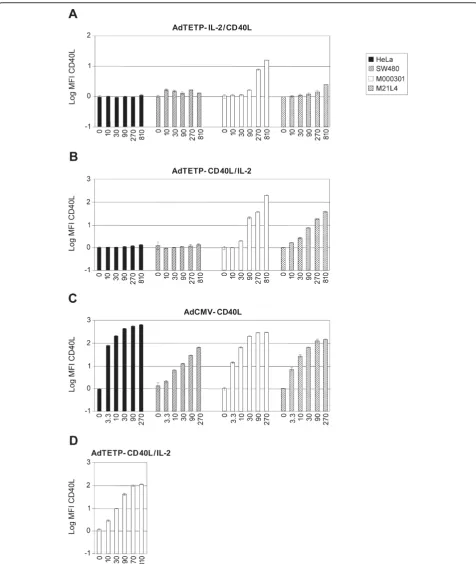
second gene expression was lower than first gene expres-sion [48]. When non-melanoma HeLa or SW480 cells were transduced with serial 3-fold increasing concentra-tions of the two novel viruses, no CD40L transgene expression was detected, even at the highest virus input of MOI 810 (Fig 2A, B). However, high levels of CD40L expression were achieved in these cells from control AdCMV-CD40L vector (Fig 2C). Of note, SW480 cells required about 80-fold more AdCMV-CD40L to reach comparable levels as HeLa cells, which are highly Ad sen-sitive [49]. In contrast to the non-melanoma cells, trans-duction of melanoma M000301 and M21L4 cells gave rise to robust CD40L expression with both, AdTETP-IL-2/ CD40L and AdTETP-CD40L/IL-2 (Fig 2A, B). The expres-sion levels were dependent on the relative CD40L gene position, as CD40L upstream of the IRES sequence gave rise to about 10- and 15-fold higher expression levels in M000301 and M21L4 cells, respectively, than CD40L posi-tioned downstream of IRES. When using AdCMV-CD40L,
the strong CMV promoter gave rise to 27- to 40-fold higher expression levels in M000301 and M21L4 cells, respectively, compared to the expression levels achieved with the AdTETP-CD40L/IL-2 vector. The transduction procedure applied here included virus inoculation for 5 h, followed by removal of the virus. In the virus input range from MOI 10 to 270, expression levels of CD40L could be further increased by a factor of 2 to 3 when the inoculum was not removed (Fig. 2B, D), in agreement with a 5 h virus adsorption efficiency of about 50% [50].
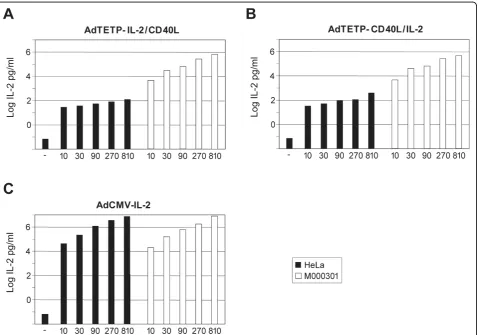
In a next step, IL-2 concentrations contained in the supernates of the above transduced HeLa and M000301 cells were determined. In supernates of HeLa cells, AdTETP-IL-2/CD40L of MOI 10 to 810 gave rise to IL-2 levels from 29 to 144 pg/ml (Fig. 3A). IL-2 production from AdTETP-CD40L/IL-2 was in the range of 36 to 424 pg/ml (Fig. 3B). In supernates of melanoma M000301 cells, both viruses led to very
similar expression levels from 5 × 10³ to 7 × 10⁵ pg/
ml (Fig. 3A, B). Thus, for MOIs of 10 and 810, AdTETP-IL-2/CD40L-mediated IL-2 expression levels
were 177- and 5652-fold higher in M000301 cells com-pared to HeLa cells. For AdTETP-CD40L/IL-2, the values were 149- and 1533-fold higher. In contrast to the CD40L gene, no consistent influence of the IL-2 gene position was noticed for IL-2 expression in the two different cell types. Of note also, detection of low IL-2 amounts in supernates of HeLa cells, as opposed to undetectable CD40L expression in these cells, is most likely explained by the difference of sensitivity and/or dynamic range of the assay systems used here. AdCMV-mediated IL-2 expression levels were compar-able in the two cell lines tested (Fig. 3C) and reached a minimal 5- to a maximal 12- fold higher levels in mel-anoma M000301 when compared to TETP-mediated expression levels in these cells. In HeLa cells, AdCMV-mediated IL-2 expression levels were between 1544-and 53472-fold higher compared to TETP-mediated expression levels.
In summary, replacement of the ubiquitously active and strong CMV enhancer promoter with the mela-noma/melanocyte-specific enhancer promoter TETP
resulted in 5 to- 40-fold lower, but cell type-specific transgene expression.
Enhancement of GFP transgene expression by adenovirus trans-complementation
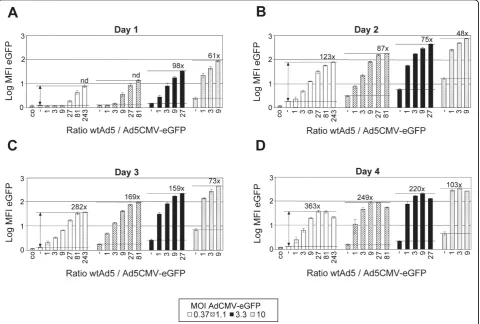
To determine concentration-dependence and kinetics of Ad trans-complementation-mediated enhancement of gene expression, we first used eGFP as a reporter sys-tem. Initial experiments with each four non-melanoma and melanoma cell lines revealed strongest co-replica-tion-mediated enhancement effects in SW480 colon car-cinoma cells (not shown). In a next step, we used SW480 cells to determine the kinetics of the enhance-ment effect in more detail. For this, SW480 cells were infected with AdCMV-eGFP at MOIs of 0.37, 1.1, 3.3 and 10 alone, or in combination with wtAd5 at concen-trations ranging from MOI 0.37 to 90, using serial 3-fold increases (Fig. 4). The resulting ratios of wtAd5/ AdCMV-eGFP amounted to 1, 3, 9, 27, 81 and 243 for the first set of six samples using AdCMV-eGFP at an
MOI of 0.37. Reporter eGFP expression analyses were performed at day 1, 2, 3 and 4, and enhancement was calculated after subtraction of auto-fluorescence of unin-fected cells (Fig. 4A-D). WtAd5-mediated enhancement of GFP expression was seen at all four time points, with highest absolute expression levels at day 2, when AdCMV-eGFP at MOIs of 0.37, 1.1, 3.3 and 10 alone resulted in eGFP expression levels of 1.8, 3.1, 5.6 and 15.9 arbitrary mean fluorescence intensity units, respec-tively. As a result of wtAd5 addition, these expression levels were enhanced by 123-, 87-, 75-, and 48-fold, from lowest AdCMV-eGFP input level of MOI 0.37 to highest AdCMV-eGFP input level of MOI 10. For all four time points, the enhancement effects were strongest for the lowest AdCMVe-GFP input of MOI 0.37, and then gradually decreased with higher input of AdCMVe-GFP. On the other hand, strongest enhancement corre-lated with the highest ratio of wtAd5/AdCMV-eGFP used, except at day 4, where enhancement effects at the highest ratios started to decline due to cytopathic effects
induced by the high wtAd5 input of MOI 90. When using a ratio of 1:1 for reporter vector to wtAd5, highest enhancement found was at day 4 amounting to 84-fold at MOI 10 of each virus.
We then tested the performance of our previously described melanoma replication-competent (RC) Ad
virus AdΔEP-TETP [40] in
trans-complementation-mediated expression assays. For co-infection, AdCMV-eGFP at MOIs of 0.37, 1.1, 3.3 and 10 were combined
with RC wtAd5 and AdΔEP-TETP, or as control, the
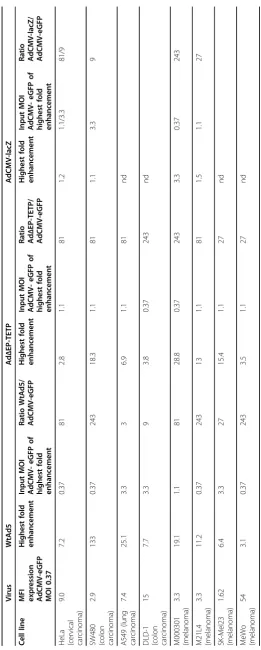
replication-defective E1-deleted AdCMV-lacZ at concen-trations ranging from MOI 0.37 to 90, using serial 3-fold increases as in the previous experiment. Reporter eGFP expression was recorded at day 2. The tested cells included HeLa cervical carcinoma cells, SW480 and DLD-1 colon carcinoma cells, and A549 lung carcinoma cells, and four melanoma cells M000301, MeWo, M21L4 and SK-Mel23 (Fig. 5, Table 2).
WtAd5 enhanced expression in all eight cell lines, although at variable extents depending on the ratios of RC virus/reporter vector. Enhancement factors were in the range of 133-fold in SW480 to 3.1-fold in MeWo. Cells with enhancement factors < 10 included HeLa, DLD-1, SK-Mel23 and MeWo cells, which all, except SK-Mel23, revealed relatively high transduction sensitiv-ity to the lowest dose of MOI 0.37 AdCMV-eGFP virus input, resulting in 9, 15 and 54 MFI units, respectively (Table 2). Cells with enhancement factors >10 included SW480, A549, M000301 and M21L4 and were less transduction-sensitive at this virus dosage, giving rise to 2.9, 7.4, 3.3, and 3.3 MFI units, respectively. In
mela-noma cells, enhancement mediated by AdΔEP-TETP
was similar, and in three of them even increased, when compared to wtAd5. In non-melanoma cells, enhance-ment factors with this virus were about 1.5- to 10-fold lower, always with the highest RC/reporter vector ratio used. This residual enhancement effect mediated by the
AdΔEP-TETP CRAd is most likely due to low E1A
expression from this vector, as replacement of the RC virus with the RD AdCMV-lacZ led to only very minor enhancement effects on transgene expression. This is in agreement with findings that traces of E1A expression are sufficient to induce replication of the therapeutic vector genome [40,51]. As seen for SW480 cells, enhancement was again in general strongest at the high-est ratio of RC/reporter vector used, unless the RC virus induced cytopahtic effects.
In summary, robust trans-complementation-mediated reporter expression enhancement was observed using the CMV-eGFP expression cassette, which, however, varied considerably depending on cell types and virus dosages. For melanoma cells, our previously described
melanoma-specific AdΔEP-TETP revealed
trans-comple-mentation enhancement comparable to wtAd5.
Comparison of adenovirus trans-complementation-mediated enhancement of CD40L and IL-2 from CMV and TETP promoters
Next we tested whether Ad trans-complementation also enhanced the expression of the immune modula-tor genes CD40L and IL-2. In a first experiment, AdCMV-CD40L (Fig. 6A, B) or AdCMV-IL-2 (Fig. 6C) at MOI 1.1 were combined with RC wtAd5 and
AdΔEP-TETP, or the RD E1-deleted AdCMV-lacZ at
concentrations ranging from MOI 0.37 to 90 using serial 3-fold increases. The resulting ratios of RC/ transgene vector were in the range from 0.33 to 27 when including RC viruses, and 0.33 to 81 when including RD AdCMV-lacZ control virus. At this low input of CD40L and IL-2 transgene vectors, trans-com-plementation resulted in high enhancement of immu-nostimulatory gene expression in both cell lines. Trans-complementation-mediated maximal expression enhancement for CD40L was 86-fold in SW480 cells, and 53-fold in M000301 cells. For IL-2, maximal enhancement amounted to 288-fold in M000301 cells. For non-melanoma SW480 cells, a significantly smaller CD40L expression enhancement was found when
replacing wtAd5 with AdΔEP-TETP. Inclusion of
AdCMV-lacZ as control revealed only very minor enhancement effects, reaching in M000301 cells about 7 and 5% of wtAd5-mediated enhancement of CD40L and IL-2 expression, respectively (Fig. 6A, C).
To see whether Ad trans-complementation could also enhance expression from a vector containing a tissue-specific promoter, the experiment was repeated with the transgene vector AdTETP-CD40L/IL-2. In contrast to the previous experiments, low but consistent enhance-ment effects were found for the expression of IL-2, and none for CD40L (Fig. 7A, B). When AdTETP-CD40L/
IL-2 was combined with AdΔEP-TETP in M000301
cells, trans-complementation-mediated enhancement of IL-2 amounted to 2.4- and 2.3-fold for the two lowest AdTETP-CD40L/IL-2 virus concentrations of 1.1 and 3.3, respectively. To exclude that the low enhancement effect is a peculiar feature restricted to M000301 cells, trans-complementation assays were also conducted in SK-Mel23 and M21L4 cells, with similar results (data not shown).
In order to evaluate possible competitions for limited transcription factors controlling TETP, the experiment
was repeated with wtAd5 replacing AdΔEP-TETP.
Again, no enhancement was seen for CD40L expression, and low 3.3-, 2.0- and 1.4-fold enhancement factors were recorded for IL-2 levels at virus inputs of 1.1, 3.3 and 10, respectively (Fig. 7C, D). IL-2 expression levels
decreased for all samples with AdΔEP-TETP ≥10, due
to cytopathic effects, whereas for wtAd5, cytopathic
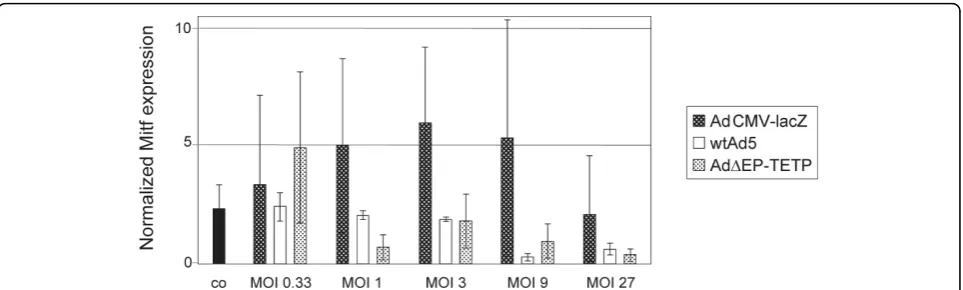
30 and were less strong. These findings do not a priori exclude that competition for an essential transcription factor is responsible for the low enhancement effect, in case such a factor is simultaneously involved in control-ling TETP as well as viral promoters (see discussion). However, it has earlier been reported that ectopic expression of Ad E1A resulted in down regulation of Mitf, which binds to the tyrosinase promoter and is a member of the basic helix-loop-helix transcription factor family [52]. We thus tested Mitf levels in infected
M000301 cells by real-time RT-PCR (Fig. 8). Although not of statistical significance, there was a clear trend for lower levels of Mitf expression in M000301 cells infected with the higher concentrations of the
E1A-expressing viruses wtAd5 and AdΔEP-TETP, compared
to E1A-deleted AdCM-lacZ or uninfected cells. As Mitf expression levels strongly influence activity of the tyrosi-nase promoter [53], this could contribute to the lack of strong trans-complemenation enhancement in the TETP trans-complementation system described here.
Discussion
Strategies to improve experimental cancer therapy include co-delivery of RC oncolytic Ads together with RD vectors expressing therapeutic genes [17,21,22,26,28,30,31,33-39]. There is a large choice of candidate therapeutic genes that has been evaluated, including tumor-suppressor,
immunomodulatory or cytotoxic genes. Depending on the type of cytotoxic genes used, premature death of trans-duced cells was found to reduce replication of oncolytic viruses, thereby antagonizing the therapeutic efficacy [54]. Genes with indirect antitumor effects such as immune sti-mulators might thus be advantageous. We have shown
earlier that the combination of IL-2 and CD40L had an improved efficacy over the use of single agents, when
applied for directin situtherapy or vaccination therapy in
a mouse melanoma model [44]. Moreover, we showed that intratumoral injection of an IL-2-expressing Ad vec-tor could induce tumor regression in patients with advanced melanoma [3]. The currently 287 ongoing or closed gene therapy protocols utilizing Ad vectors for can-cer treatment include 20 protocols with IL-2, and 11 pro-tocols with CD40L as therapeutic gene, respectively. Five protocols, mainly for treatment of leukemia, include com-bined expression of IL-2 and CD40L http://www.wiley.co. uk/genmed/clinical/.
Utilization of a binary vector system as compared to direct therapeutic expression from single oncolytic viruses poses disadvantages, including more demanding vector manufacturing and clinical handling. On the other side, possible advantages compared to armed oncolytic vectors include their flexible application in combination with an increase of the overall therapeutic gene capacity of the delivery system. For example, a sin-gle CRAd can be combined with numerous therapeutic RD vectors, which have been tested previously as single agents. Alternatively, efficacy of different CRAds could be compared side-by-side in combination with the same therapeutic vector. The binary vectors may also be safer than single viruses, as the amount of vector expressing the therapeutic gene can be delayed to later rounds of virus application, and can, in addition, be dose-adjusted. Dissemination of the therapeutic vector, however, remains a risk, in particular if strong ubiquitous promo-ters are used to control expression. Thorne et al., e.g.,
found that co-injection of an oncolytic AdΔ24 together
with RD CMV promoter/enhancer-controlled luciferase vector into xenotransplanted tumors not only gave rise to enhanced and more durable gene expression in the tumor tissue, but also led to secondary, weaker biolumi-nescence in the liver [26]. Thus, additional safety mea-sures are warranted for this kind of approach.
Here we suggest to utilize our previously described melanoma/melanocyte-specific TETP [40] to control expression of CD40L/IL-2 from a bicistronic expression vector. About 30 tissue-specific mammalian promoters have been evaluated in RC CRAds [47], and many more were tested for their fidelity to express transgenes from RD vectors (reviewed in [46]). The quest for such pro-moters was brought up following the findings that
in vivo, expression from vectors containing the
ubiqui-tously active and strong CMV promoter resulted in effi-cient transduction that peaked within a few days, but frequently became undetectable by one month after injection. These findings were ascribed to either elimina-tion of viral genomes by the immune system or to methylation-induced promoter silencing, and it was sug-gested that this could be overcome by using tissue-specific mammalian promoters [55,56].
We found that replacement of the CMV enhancer promoter with the TETP allowed tight melanoma-speci-fic transgene expression, as IL-2 expression levels amounted to a minimal 149-fold to a maximal 5652-fold higher expression levels in melanoma cells com-pared to HeLa cells. This is comparable with earlier
reports, where a recombinant Ad expressing b-Gal
under the control of two copies of the mouse tyrosinase enhancer in combination with a 770 bp mouse tyrosi-nase promoter gave rise to 100- to 200-fold higher expression in melanoma cells compared to non-mela-noma cells [57]. In our experiments, a comparison of TETP-controlled transgene expression levels with those derived from CMV-controlled vectors revealed, depend-ing on cell line and transgene, 5 to- 40-fold lower expression levels in melanoma cells. This is in line with findings that tissue-specific promoters frequently turned out to be relatively weak promoters compared to CMV or other strong viral promoters [58]. A slightly different version of tyrosinase promoter/enhancer combination has been claimed to reach, at least in a very limited number of melanoma cells, comparable expression
levels as from CMV promoter [57], whereas others found only maximal 1.3% of the CMV promoter-driven transcriptional activity [59]. In our hands, TETP-con-trolled luciferase expression was found to give rise to about 10- to 20-fold higher expression levels compared to SV40 promoter [40].
Variations in the expression levels of IRES upstream and downstream genes have been observed previously. In one study, IRES-dependent second gene expression has been reported to range from 6 to 100% of the first gene expression. This was found to be influenced by several factors, including the choice of optimal/nonopti-mal Kozak sequence of the ATG start codon, as well as the particular cell type used for expression [48]. In con-trast, in IRES-encoding RNA viruses, yields of transla-tion product from the downstream IRES-dependent cistron were also found to be higher than from the upstream cistron [60].
When we used the AdCMV-eGFP/wtAd5 binary vec-tor system, robust trans-complementation-mediated reporter expression enhancement was obtained in mela-noma and non-melamela-noma cells. In our eight cell types tested, four revealed enhancements in the range of 3 to 10, and four had enhancements larger than 10, with a maximal 363-fold for SW480 cells on day 4. Such a strong variation of trans-complementation-mediated enhancement has been found in other studies, and may depend on cell type used, exact transgene vector: CRAd ratio, time point of individual virus additions (variable in some studies), trans-activation of the CMV promoter by cellular and viral gene products [51], and most importantly, also the type and dynamic range of analysis system utilized for quantification. Enhancement values of > 50, e.g., were obtained by others when using luci-ferase assays [22,24,28], ELISA [38,39], and virus pro-geny titers [19] which have the largest dynamic range.
When replacing the transgene vector AdCMV-eGFP with AdCMV-CD40L or AdCMV-IL-2, 49- and 131-fold trans-complementation-mediated transgene expression enhancement was found in melanoma M000301 cells, when combined with wtAd5, and 53- and 288-fold
enhancement when combined with AdΔEP-TETP. To
our surprise, combination of the newly established
AdTETP-CD40L/IL-2 with AdΔEP-TETP or wtAd5
revealed an unexpectedly low trans-complementation-mediated expression enhancement of maximal 3.3 fold for the more sensitive IL-2 expression analysis. Possible reasons for this low enhancement effect could include competition for virus binding, similar entry pathways or post entry factors such as transcription factors or nuclear domains for replication. We consider entry competition unlikely, since trans-complementation with CMV-promoters from Ad5 capsids was highly efficient. All viruses tested here utilize the Coxsackie virus B Ad
receptor as attachment receptor and av integrins as
entry receptors [61].
The unique difference between the AdCMV-eGFP and AdTETP-CD40L/IL-2 vectors relates to the sequences of the CMV-eGFP and TETP-CD40L/IL-2 expression cassettes, whereas the rest of the viral genome is identi-cal (Fig. 1). Transcription factors could be a limiting fac-tor if they bound in a rate-limiting manner to the TETP sequence (but not to the CMV enhancer/promoter sequence), and at the same time also to one of the viral promoters. The human tyrosinase promoter sequence consists of the M-box (a conserved element found in other melanocyte-specific promoters) containing a first E-box motif, an SP1 site, and a highly conserved CR2 element comprising a second E-box motif and an over-lapping octamer element [62]. Both E-boxes were demonstrated to bind the basic helix-loop-helix tran-scription factor Mitf, which is essential for melanocyte differentiation. Of note, a related E-box motif is also contained in the Ad major late promoter (MLP), which usually is bound by USF, another ubiquitous member of the basic helix-loop-helix transcription factor family [63]. Based on band shift assays, it was found that Mitf also could bind to the E-box of the MLP, and conver-sely, the USF also could bind to the M-box of melano-cyte-specific promoters [53]. Similarly, band shift assays with an oligonucleotide containing the SP1 motif of the tyrosinase promoter were competed by a SP1 motif found in the Ad EII late promoter [53]. The tyrosinase enhancer sequence is less clearly characterized, but was suggested to contain a binding site for a member of the fos family transcription factor [64]. The strong CMV enhancer/promoter contains multiple transcription fac-tor binding sites, including the ubiquitous Sp1 family of
transcription factors, NF-B, retinoic acid nuclear
recep-tors and CREB/ATF [65]. Thus, depending on the cell type and expression levels of members of the basic helix-loop-helix transcription factor or SP1 family, com-petition for such factor(s) could possibly contribute to the lower enhancement of the Ad trans-complementa-tion system found here.
However, a more likely explanation relates to the find-ings by the group of Goding, which reported that ecto-pic expression of Ad E1A resulted in down regulation of Mitf in mouse melan-a melanoma cells, leading to repression of TRP-1 and tyrosinase levels and subse-quent loss of pigmentation [52]. This repression could be relieved by over expression of Mitf. We confirmed down regulation of Mitf transcripts in human M000301 melanoma cells following infection with E1A-expressing
wtAd5 and AdΔEP-TETP, but not with E1A-deleted
competition for transcription factors remains to be further studied. In addition, as strong and specific deliv-ery of therapeutic genes is one of the main goals of can-cer therapy, it may be of importance for the general usage of the binary Ad expression system to investigate whether this finding is unique to the TETP system tested here, or whether it also occurs with other tissue-or cell type-specific promoters.
Conclusions
In the current study we were able to demonstrate strong
in vitroenhancement of eGFP, IL-2 and CD40L transgene
expression by the Ad trans-complementation system when using CMV-controlled expression cassettes in com-bination with RC Ads. When using TETP as cancer cell-selective promoter to restrict IL-2 and CD40L transgene expression to melanoma cells, tight expression was demonstrated, which was only 5 to 40-fold lower than those from vectors controlled by the nonselective CMV promoter. However, when combining the
TETP-con-trolled transgene vectors with RC wtAd5 or the AdΔ
EP-TETP CRAd vector, very moderate trans-complementa-tion enhancement was noticed in melanoma cells. At least in part, this phenomenon may be due to Ad-mediated down-regulation of the limiting transcription factor Mitf. It remains to be investigated, whether this finding is unique for the particular promoter system used here, or whether it also occurs with other promoter systems. Tight cancer cell-selective promoter control remains a highly desirable feature to restrict transgene expression to the targeted tumor tissue and avoid collateral damage.
Abbreviations
Ad: adenovirus; CMV: cytomegalovirus; CRAD: conditionally replicating Ad; CD40L: CD40 ligand; GM-CSF: granulocyte macrophage colony stimulating factor; IL-2: interleukin-2; IRES: internal ribosomal entry site; MFI: mean fluorescence intensity; MITF: Microphthalmia-associated bHLH-LZ
transcription factor; MLP: major late promoter; MOI: multiplicity of infection; P.I.: post infection; pfu: plaque forming unit; RC: replication-competent; RD: replication-deficient; TETP: tyrosinase enhancer tyrosinase promoter;
Acknowledgements
The authors would like to thank Leta Fuchs for technical assistance, and Prof S. Calvieri, Department of Cutaneous and Venereal Diseases and Plastic Surgery, Policlinico Umberto I, University of Rome La Sapienza, Rome, Italy, for mentor support. This work was financially supported by the Cancer Society of the Kanton Zürich, the Anne-Feddersen-Wagner-Fonds, and the University of Zürich.
Author details
1Faculty of Mathematics and Natural Sciences, Institute of Molecular Life
Sciences, University of Zürich, Winterthurerstrasse 190, CH-8057 Zürich, Switzerland.2Faculty of Mathematics and Natural Sciences, Institute of Molecular Life Sciences, Zürich PhD Program in Molecular Life Sciences, University of Zürich, Winterthurerstrasse 190, CH-8057 Zürich, Switzerland. 3Department of Dermatology, University Hospital of Zürich, Gloriastrasse 31,
CH-8091 Zürich, Switzerland.4Faculty of Mathematics and Natural Sciences, Institute of Molecular Cancer Research, Cancer Biology PhD Program, University of Zürich, Winterthurerstrasse 190, CH-8057 Zürich, Switzerland.
Authors’contributions
ACF and SH designed the experiments, generated the Ad vectors and carried out the transduction studies. VL performed the IL-2 ELISA, and OS carried out the RT-PCR measurements. SH coordinated the study and wrote the manuscript. RD and UFG participated in the design and coordination and helped to draft the manuscript. All authors read and approved the final manuscript.
Competing interests
The authors declare that they have no competing interests.
Received: 27 May 2010 Accepted: 29 July 2010 Published: 29 July 2010
References
1. Blattman JN, Greenberg PD:Cancer immunotherapy: a treatment for the masses.Science2004,305:200-205.
2. Alton E, Ferrari S, Griesenbach U:Progress and prospects: gene therapy clinical trials (part 2).Gene Ther2007,14:1555-1563.
3. Dummer R, Rochlitz C, Velu T, Acres B, Limacher JM, Bleuzen P, Lacoste G, Slos P, Romero P, Urosevic M:Intralesional adenovirus-mediated interleukin-2 gene transfer for advanced solid cancers and melanoma.
Mol Ther2008,16:985-994.
4. Li CY, Huang Q, Kung HF:Cytokine and immuno-gene therapy for solid tumors.Cell Mol Immunol2005,2:81-91.
5. Vile R, Ando D, Kirn D:The oncolytic virotherapy treatment platform for cancer: unique biological and biosafety points to consider.Cancer Gene Ther2002,9:1062-1067.
6. Cody JJ, Douglas JT:Armed replicating adenoviruses for cancer virotherapy.Cancer Gene Ther2009,16:473-488.
7. Hermiston T:A demand for next-generation oncolytic adenoviruses.Curr Opin Mol Ther2006,8:322-330.
8. Kirn D, Martuza RL, Zwiebel J:Replication-selective virotherapy for cancer: Biological principles, risk management and future directions.Nat Med 2001,7:781-787.
9. Cattaneo R, Miest T, Shashkova EV, Barry MA:Reprogrammed viruses as cancer therapeutics: targeted, armed and shielded.Nat Rev Microbiol 2008,6:529-540.
10. Kanerva A, Hemminki A:Modified adenoviruses for cancer gene therapy.
Int J Cancer2004,110:475-480.
11. McConnell MJ, Imperiale MJ:Biology of adenovirus and its use as a vector for gene therapy.Hum Gene Ther2004,15:1022-1033. 12. Liu TC, Kirn D:Gene therapy progress and prospects cancer: oncolytic
viruses.Gene Ther2008,15:877-884.
13. Russell WC:Adenoviruses: update on structure and function.J Gen Virol 2009,90:1-20.
14. Bett AJ, Prevec L, Graham FL:Packaging capacity and stability of human adenovirus type 5 vectors.J Virol1993,67:5911-5921.
15. Dion LD, Goldsmith KT, Garver RIJ:Quantitative andin vivoactivity of adenoviral-producing cells made by cotransduction of a replication-defective adenovirus and replication-enabling plasmid.Cancer Gene Therapy1996,3:230-237.
16. Goldsmith KT, Dion LD, Curiel DT, Garver RI Jr:trans E1 component requirements for maximal replication of E1-defective recombinant adenovirus.Virology1998,248:406-419.
17. Alemany R, Lai S, Lou YC, Jan HY, Fang X, Zhang WW:Complementary adenoviral vectors for oncolysis.Cancer Gene Ther1999,6:21-25. 18. Doronin K, Toth K, Kuppuswamy M, Krajcsi P, Tollefson AE, Wold WS:
Overexpression of the ADP (E3-11.6K) protein increases cell lysis and spread of adenovirus.Virology2003,305:378-387.
19. Doronin K, Toth K, Kuppuswamy M, Ward P, Tollefson AE, Wold WS: Tumor-specific, replication-competent adenovirus vectors overexpressing the adenovirus death protein.J Virol2000,74:6147-6155.
20. Habib NA, Mitry R, Seth P, Kuppuswamy M, Doronin K, Toth K, Krajcsi P, Tollefson AE, Wold WS:Adenovirus replication-competent vectors (KD1, KD3) complement the cytotoxicity and transgene expression from replication-defective vectors (Ad-GFP, Ad-Luc).Cancer Gene Ther2002,
9:651-654.
22. Lee CT, Park KH, Yanagisawa K, Adachi Y, Ohm JE, Nadaf S, Dikov MM, Curiel DT, Carbone DP:Combination therapy with conditionally replicating adenovirus and replication defective adenovirus.Cancer Res 2004,64:6660-6665.
23. Shim SH, Lee CT, Hun Hah J, Lee JJ, Park SW, Heo DS, Sung MW:
Conditionally replicating adenovirus improves gene replication efficiency and anticancer effect of E1-deleted adenovirus carrying TRAIL in head and neck squamous cell carcinoma.Cancer Sci2010,101:482-487. 24. Guse K, Dias JD, Bauerschmitz GJ, Hakkarainen T, Aavik E, Ranki T, Pisto T,
Sarkioja M, Desmond RA, Kanerva A, Hemminki A:Luciferase imaging for evaluation of oncolytic adenovirus replication in vivo.Gene Ther2007,
14:902-911.
25. Lee CT, Lee YJ, Kwon SY, Lee J, Kim KI, Park KH, Kang JH, Yoo CG, Kim YW, Han SK,et al:In vivo imaging of adenovirus transduction and enhanced therapeutic efficacy of combination therapy with conditionally replicating adenovirus and adenovirus-p27.Cancer Res2006,66:372-377. 26. Thorne SH, Tam BY, Kirn DH, Contag CH, Kuo CJ:Selective intratumoral
amplification of an antiangiogenic vector by an oncolytic virus produces enhanced antivascular and anti-tumor efficacy.Mol Ther2006,13:938-946. 27. Umeoka T, Kawashima T, Kagawa S, Teraishi F, Taki M, Nishizaki M, Kyo S,
Nagai K, Urata Y, Tanaka N, Fujiwara T:Visualization of intrathoracically disseminated solid tumors in mice with optical imaging by telomerase-specific amplification of a transferred green fluorescent protein gene.
Cancer Res2004,64:6259-6265.
28. Oh JY, Park MY, Kim DR, Lee JH, Shim SH, Chung JH, Yoon HI, Sung MW, Kim YS, Lee CT:Combination gene therapy of lung cancer with conditionally replicating adenovirus and adenovirus-herpes simplex virus thymidine kinase.Int J Mol Med2010,25:369-376.
29. Wolkersdorfer GW, Morris JC, Ehninger G, Ramsey WJ:
Trans-complementing adenoviral vectors for oncolytic therapy of malignant melanoma.J Gene Med2004,6:652-662.
30. Hernandez-Alcoceba R, Pihalja M, Wicha MS, Clarke MF:A novel, conditionally replicative adenovirus for the treatment of breast cancer that allows controlled replication of E1a-deleted adenoviral vectors.Hum Gene Ther2000,11:2009-2024.
31. Haviv YS, Takayama K, Glasgow JN, Blackwell JL, Wang M, Lei X, Curiel DT:A model system for the design of armed replicating adenoviruses using p53 as a candidate transgene.Mol Cancer Ther2002,1:321-328. 32. van Beusechem VW, van den Doel PB, Grill J, Pinedo HM, Gerritsen WR:
Conditionally replicative adenovirus expressing p53 exhibits enhanced oncolytic potency.Cancer Res2002,62:6165-6171.
33. Burroughs KD, Kayda DB, Sakhuja K, Hudson Y, Jakubczak J, Bristol JA, Ennist D, Hallenbeck P, Kaleko M, Connelly S:Potentiation of oncolytic adenoviral vector efficacy with gutless vectors encoding GMCSF or TRAIL.Cancer Gene Ther2004,11:92-102.
34. Guo W, Zhu H, Zhang L, Davis J, Teraishi F, Roth JA, Stephens C, Fueyo J, Jiang H, Conrad C, Fang B:Combination effect of oncolytic
adenovirotherapy and TRAIL gene therapy in syngeneic murine breast cancer models.Cancer Gene Ther2006,13:82-90.
35. Shashkova EV, Kuppuswamy MN, Wold WS, Doronin K:Anticancer activity of oncolytic adenovirus vector armed with IFN-alpha and ADP is enhanced by pharmacologically controlled expression of TRAIL.Cancer Gene Ther2008,15:61-72.
36. Wirth T, Kuhnel F, Fleischmann-Mundt B, Woller N, Djojosubroto M, Rudolph KL, Manns M, Zender L, Kubicka S:Telomerase-dependent virotherapy overcomes resistance of hepatocellular carcinomas against chemotherapy and tumor necrosis factor-related apoptosis-inducing ligand by elimination of Mcl-1.Cancer Res2005,65:7393-7402. 37. Jin F, Xie Z, Kuo CJ, Chung LW, Hsieh CL:Cotargeting tumor and tumor
endothelium effectively inhibits the growth of human prostate cancer in adenovirus-mediated antiangiogenesis and oncolysis combination therapy.Cancer Gene Ther2005,12:257-267.
38. Chong H, Ruchatz A, Clackson T, Rivera VM, Vile RG:A system for small-molecule control of conditionally replication-competent adenoviral vectors.Mol Ther2002,5:195-203.
39. Motoi F, Sunamura M, Ding L, Duda DG, Yoshida Y, Zhang W, Matsuno S, Hamada H:Effective gene therapy for pancreatic cancer by cytokines mediated by restricted replication-competent adenovirus.Hum Gene Ther 2000,11:223-235.
40. Peter I, Graf C, Dummer R, Schaffner W, Greber UF, Hemmi S:A novel attenuated replication-competent adenovirus for melanoma therapy.
Gene Ther2003,10:530-539.
41. Geertsen RC, Hofbauer GF, Yue FY, Manolio S, Burg G, Dummer R:Higher frequency of selective losses of HLA-A and -B allospecificities in metastasis than in primary melanoma lesions.J Invest Dermatol1998,
111:497-502.
42. Hemmi S, Geertsen R, Mezzacasa A, Peter I, Dummer R:The presence of human coxsackievirus and adenovirus receptor is associated with efficient adenovirus-mediated transgene expression in human melanoma cell cultures.Hum Gene Ther1998,9:2363-2373. 43. Nagel H, Maag S, Tassis A, Nestle FO, Greber UF, Hemmi S:The
alphavbeta5 integrin of hematopoietic and nonhematopoietic cells is a transduction receptor of RGD-4C fiber-modified adenoviruses.Gene Ther 2003,10:1643-1653.
44. Peter I, Nawrath M, Kamarashev J, Odermatt B, Mezzacasa A, Hemmi S:
Immunotherapy for murine K1735 melanoma: combinatorial use of recombinant adenovirus expressing CD40L and other
immunomodulators.Cancer Gene Ther2002,9:597-605.
45. Saukkonen K, Hemminki A:Tissue-specific promoters for cancer gene therapy.Expert Opin Biol Ther2004,4:683-696.
46. Sadeghi H, Hitt MM:Transcriptionally targeted adenovirus vectors.Curr Gene Ther2005,5:411-427.
47. Dorer DE, Nettelbeck DM:Targeting cancer by transcriptional control in cancer gene therapy and viral oncolysis.Adv Drug Deliv Rev2009,
61:554-571.
48. Mizuguchi H, Xu Z, Ishii-Watabe A, Uchida E, Hayakawa T:IRES-dependent second gene expression is significantly lower than cap-dependent first gene expression in a bicistronic vector.Molecular Therapy: the Journal of the American Society of Gene Therapy2000,1:376-382.
49. Strunze S, Trotman LC, Boucke K, Greber UF:Nuclear targeting of adenovirus type 2 requires CRM1-mediated nuclear export.Mol Biol Cell 2005,16:2999-3009.
50. Mittereder N, March KL, Trapnell BC:Evaluation of the concentration and bioactivity of adenovirus vectors for gene therapy.J Virol1996,
70:7498-7509.
51. Fechner H, Wang X, Wang H, Jansen A, Pauschinger M, Scherubl H, Bergelson JM, Schultheiss HP, Poller W:Trans-complementation of vector replication versus Coxsackie-adenovirus-receptor overexpression to improve transgene expression in poorly permissive cancer cells.Gene Ther2000,7:1954-1968.
52. Yavuzer U, Keenan E, Lowings P, Vachtenheim J, Currie G, Goding CR:The Microphthalmia gene product interacts with the retinoblastoma protein in vitro and is a target for deregulation of melanocyte-specific transcription.Oncogene1995,10:123-134.
53. Bentley NJ, Eisen T, Goding CR:Melanocyte-specific expression of the human tyrosinase promoter: activation by the microphthalmia gene product and role of the initiator.Mol Cell Biol1994,14:7996-8006. 54. Lambright ES, Amin K, Wiewrodt R, Force SD, Lanuti M, Propert KJ, Litzky L,
Kaiser LR, Albelda SM:Inclusion of the herpes simplex thymidine kinase gene in a replicating adenovirus does not augment antitumor efficacy.
Gene Ther2001,8:946-953.
55. Brooks AR, Harkins RN, Wang P, Qian HS, Liu P, Rubanyi GM:Transcriptional silencing is associated with extensive methylation of the CMV promoter following adenoviral gene delivery to muscle.J Gene Med2004,
6:395-404.
56. Yang Y, Nunes FA, Berencsi K, Furth EE, Gonczol E, Wilson JM:Cellular immunity to viral antigens limits E1-deleted adenoviruses for gene therapy.Proc Natl Acad Sci USA1994,91:4407-4411.
57. Siders WM, Halloran PJ, Fenton RG:Transcriptional targeting of recombinant adenoviruses to human and murine melanoma cells.
Cancer Res1996,56:5638-5646.
58. Nettelbeck DM, Jerome V, Muller R:Gene therapy: designer promoters for tumour targeting.Trends Genet2000,16:174-181.
59. Rothfels H, Paschen A, Schadendorf D:Evaluation of combined gene regulatory elements for transcriptional targeting of suicide gene expression to malignant melanoma.Exp Dermatol2003,12:799-810. 60. Jackson RJ, Kaminski A:Internal initiation of translation in eukaryotes: the
61. Zhang Y, Bergelson JM:Adenovirus receptors.J Virol2005,79:12125-12131. 62. Goding CR:Mitf from neural crest to melanoma: signal transduction and
transcription in the melanocyte lineage.Genes Dev2000,14:1712-1728. 63. Young CS:The structure and function of the adenovirus major late
promoter.Curr Top Microbiol Immunol2003,272:213-249.
64. Ganss R, Montoliu L, Monaghan AP, Schutz G:A cell-specific enhancer far upstream of the mouse tyrosinase gene confers high level and copy number-related expression in transgenic mice.EMBO J1994,
13:3083-3093.
65. Stinski MF:Cytomegalovirus promoter for expression in mammalian cells.
Gene expression systems: using nature for the art of expressionSan Diego, Calif.: Academic PressFernandez JM, Hoeffler JP 1999, 211-233.
doi:10.1186/1743-422X-7-175
Cite this article as:Fontecedroet al.:Analysis of adenovirus trans-complementation-mediated gene expression controlled by melanoma-specific TETP promoterin vitro.Virology Journal20107:175.
Submit your next manuscript to BioMed Central and take full advantage of:
• Convenient online submission
• Thorough peer review
• No space constraints or color figure charges
• Immediate publication on acceptance
• Inclusion in PubMed, CAS, Scopus and Google Scholar
• Research which is freely available for redistribution