MODIFIED ANT COLONY OPTIMIZATION ALGORITHMS
FOR DETERMINISTIC AND STOCHASTIC INVENTORY
ROUTING PROBLEMS
LILY WONG
THESIS SUBMITTED IN FULFILMENT OF THE
REQUIREMENTS FOR THE DEGREE OF DOCTOR OF
PHILOSOPHY
INSTITUTE OF MATHEMATICAL SCIENCES
FACULTY OF SCIENCE
UNIVERSITY OF MALAYA
KUALA LUMPUR
ii UNIVERSITY OF MALAYA
ORIGINAL LITERARY WORK DECLARATION
Name of Candidate: LILY WONG (I.C/Passport No: 841204-13-5684) Matric No: SHB110013
Name of Degree: DOCTOR OF PHILOSOPHY
Title of Project Paper/Research Report/Dissertation/Thesis (“this Work”): MODIFIED ANT COLONY OPTIMIZATION ALGORITHMS FOR
DETERMINISTIC AND STOCHASTIC INVENTORY ROUTING PROBLEMS
Field of Study: APPLIED MATHEMATICS
I do solemnly and sincerely declare that:
(1) I am the sole author/writer of this Work; (2) This Work is original;
(3) Any use of any work in which copyright exists was done by way of fair dealing and for permitted purposes and any excerpt or extract from, or reference to or reproduction of any copyright work has been disclosed expressly and sufficiently and the title of the Work and its authorship have been acknowledged in this Work;
(4) I do not have any actual knowledge nor do I ought reasonably to know that the making of this work constitutes an infringement of any copyright work; (5) I hereby assign all and every rights in the copyright to this Work to the
University of Malaya (“UM”), who henceforth shall be owner of the copyright in this Work and that any reproduction or use in any form or by any means whatsoever is prohibited without the written consent of UM having been first had and obtained;
(6) I am fully aware that if in the course of making this Work I have infringed any copyright whether intentionally or otherwise, I may be subject to legal action or any other action as may be determined by UM.
Candidate’s Signature Date:
Subscribed and solemnly declared before,
Witness’s Signature Date:
Name: Designation:
iii MODIFIED ANT COLONY OPTIMIZATION ALGORITHMS FOR
DETERMINISTIC AND STOCHASTIC INVENTORY ROUTING PROBLEMS
ABSTRACT
Inventory routing problem (IRP) integrates two important components of supply chain management: routing and inventory management. In this study, a one-to-many IRP network comprises of a single depot (warehouse) and geographically dispersed customers in a finite planning horizon is presented. Multi products are transported from the warehouse by using a fleet of a homogeneous vehicle which located at the ware house to meet customer’s demand on time. The customers are allowed to be visited more than once in a given period and the demand for each product is deterministic and time varying. The problem is formulated as a mixed integer programming problem and is solved using CPLEX to obtain the lower and upper bound (the best integer solution) for each instance considered. The classical Ant Colony Optimization (ACO) is modified by including the inventory cost in the global pheromones updating is proposed in this study. The sensitivity analysis on important parameters that influence decision policy in ACO in order to choose the appropriate parameter settings is carried out. Among the two proposed algorithms, that is, ACO and ACO2, ACO2 outperform than ACO. Both ACO and ACO2 perform better on large instances compared to the upper bound and perform equally well for small and medium instances. In order to improve the proposed algorithms, population based ACO where the ants are subdivided into subpopulations and each subpopulation represents one inventory level is proposed. In addition, a new formulation for customer’s inventory pheromones is proposed and the selection of inventory updating mechanism is based on these pheromone values. The computational results show that the algorithms which implement this new formulation are able to
iv produce better solutions. The computational results also show that the algorithms of population based ACO performs better than the algorithms of non-population based ACO. The deterministic IRP model is then extended to solve the Stochastic Inventory Routing Problem (SIRP). The demands in SIRP are modeled by some probability functions and due to the stochastic nature of customer demands, the service levels constraint where it limits the stock out probability at each customer and the probability of overfilling the stock of each customer is introduced in this study. A two phase algorithm named SIRPACO1 is proposed to solve the SIRP. Phase I solved the inventory sub problem to determine the quantity to be delivered to each customer as well as inventory level at each customer while Phase II employs the population based ACO to determine the routes for each period. The algorithm was further enhanced by incorporating the inventory updating mechanism into Phase II with the aim of obtaining a set of inventory level which will give minimum overall cost and named as SIRPACO2. The computational experiments are tested on different combinations of two important parameters that are standard deviation and service level. The computational results showed that the enhanced SIRPACO2 gave better performance compared to SIRPACO1.
v ALGORITMA PENGOPTIMUMAN KOLONI SEMUT TERUBAH SUAI
UNTUK MASALAH LALUAN INVENTORI BERKETENTUAN DAN STOKASTIK
ABSTRAK
Masalah laluan inventori (Inventori Routing Problem (IRP)) mengintegrasikan dua komponen yang penting dalam pengurusan rantaian bekalan iaitu masalah laluan dan pengurusan inventori. Dalam kajian ini, satu masalah IRP rangkaian satu-ke-banyak yang terdiri daripada depot (gudang) tunggal dan pelanggan-pelanggan berserakan secara geografi dalam satu perancangan ufuk yang terhingga dikaji. Pelbagai produk akan dihantar dari gudang dengan menggunakan sejumlah kenderaan homogen yang berpusat di depot bagi memenuhi permintaan pelanggan dalam setiap tempoh masa. Pelanggan boleh dikunjungi lebih daripada satu kali dalam masa yang ditertukan dan permintaan bagi setiap produk adalah tetap dan tempoh masa adalah berbeza-beza. Masalah ini dirumuskan sebagai masalah pengaturcaraan integer campuran dan diselesaikan dengan menggunakan CPLEX bagi mendapatkan batas bawah dan atas (penyelesaian integer terbaik) bagi setiap kes yang dipertimbangkan. Kaedah klasik pengoptimuman koloni semut (Ant Colony Optimisation (ACO)) diubahsuai dengan mengambil kira kos inventori semasa mengemaskini feromon global dicadangkan dalam kajian ini. Analisis sensitiviti dijalankan untuk menentukan nilai parameter penting yang mempengaruhi ACO dalam membuat keputusan. Antara dua algoritma yang dibangunkan, ACO2 adalah lebih baik berbanding ACO. Kedua-dua algoritma ACO dan ACO2 memberi keputusan yang lebih baik jika dibandingkan dengan batas atas untuk kes besar dan keputusan yang setara bagi kes kecil dan sederhana. Penambahbaikan algoritma ACO dicadangkan iaitu ACO populasi di mana semut-semut dibahagikan kepada sub-populasi dan setiap sub-populasi mewakili satu tahap inventori.
vi Di samping itu, satu formula baru yang dikenali sebagai feromon inventori pelanggan telah dicadangkan dan juga pemilihan mekanisme mengemaskini inventori adalah berdasarkan kepada nilai-nilai feromon. Keputusan pengiraan menunjukkan bahawa algoritma yang menggunakan formula baru ini mampu menghasilkan keputusan yang lebih baik. Keputusan mengiraan juga menunjukkan algoritma ACO populasi memberi keputusan yang lebih baik jika dibandingkan dengan algoritma bukan ACO populasi. . Model IRP yang berketentuan kemudiannya dilanjutkan kepada masalah laluan inventori stokastik (Stochastic Inventory Routing Problem (SIRP)). Permintaan pelanggan dalam SIRP dimodelkan oleh beberapa fungsi kebarangkalian dan disebabkan permintaan pelanggan bersifat stokastik, kekangan aras perkhidmatan telah diperkenalkan di mana kekangan tersebut akan menghadkan kebarangkalian kehabisan stok pada setiap pelanggan dan juga kebarangkalian penambahan stok yang berlebihan bagi setiap pelanggan. Satu algoritma dua fasa yang dinamakan SIRPACO1 telah dicadangkan untuk menyelesaikan SIRP. Fasa I menyelesaikan sub masalah inventori untuk menentukan kuantiti penghantaran serta tahap inventori pada setiap pelanggan manakala Fasa II menggunakan ACO populasi untuk menentukan laluan kenderaan bagi setiap tempoh masa. Algoritma yang dicadangkan kemudiannya di tambah baik dengan memasukkan mekanisme mengemaskini inventori ke Fasa II dengan tujuan untuk mendapatkan satu set aras inventori yang akan memberikan minimum kos keseluruhan dan algoritma ini diberi nama SIRPACO2. Eksperimen komputasi dijalankan untuk kombinasi dua parameter yang penting iaitu sisihan piawai dan aras perkhidmatan. Keputusan pengiraan menunjukkan bahawa SIRPACO2 memberi keputusan yang lebih baik berbanding SIRPACO1.
vii ACKNOWLEDGEMENTS
First of all, I would like to express my infinite gratitude to Associate Professor Dr. Noor Hasnah Moin, my supervisor, for her guidance, encouragement, patience, advice and critical reviews towards completion of my study and thesis. Without her guidance and help, I could never accomplish this difficult task. I would like to take the opportunity to thank the University of Malaya and Ministry of Higher Education, Malaysia to support my tuition fees and living expenses via Skim Biasiswazah (Semester 1 and 2) and MyPhD (Semester 3 to Semester 8) respectively. This research is supported also by Postgraduate Research Fund (PG020-2012B). I would also like to extend my gratitude to those who give me the advice and providing related information throughout my study especially for the part of statistical. Without your help, I could have more difficulty in completion my study. In addition, I would also like to thank all my fellow friends who give me support and encouragement when I encounter problem and in the border of giving up. It is a great pleasure to acknowledge my deepest gratitude to my beloved husband for his support, encouragement and comprehensive. Thank you for being there with me every moment when I faced problem and under stress. And last but not least, my deepest appreciation goes to my dearest parents and family for their greatest encouragement and unlimited support. Thank you so much for kept me going and pushing me farther than I thought I could go.
viii TABLE OF CONTENTS
ABSTRACT iii
ABSTRAK v
ACKNOWLEDGEMENTS vii
LIST OF FIGURES xii
LIST OF TABLES xiii
LIST OF SYMBOLS AND ABBREVIATIONS xv
LIST OF APPENDICES xix
CHAPTER 1: INTRODUCTION 1
1.1 Introduction 1
1.2 Problem statements 3
1.3 Objective of this study 4
1.4 Contribution to Scientific Knowledge 5
1.5 Thesis Outlines 6
CHAPTER 2: LITERATURE REVIEW 8
2.1 Introduction 8
2.2 Classification of Different Type Of Inventory Routing Problem 9
2.3 Deterministic Inventory Routing Problem 12
2.3.1 Exact Algorithm 12
2.3.2 Heuristic Algorithms 15
2.4 Stochastic Inventory Routing Problem 21
2.5 Ant Colony Optimization 25
2.6 Summary of the Chapter 29
2.6.1 Summary of Literature Review 29
ix
CHAPTER 3: MODIFIED ANT COLONY OPTIMIZATION 31
3.1 Introduction 31
3.2 Model Formulation 33
3.3 Modified Ant Colony Optimization (ACO) 36
3.3.1 Initial Solution 37
3.3.2 Route Construction for ACO 39
3.3.3 The local pheromone-updating rule 39
3.3.4 The global pheromone-updating rule 40
3.3.5 Route improvement strategies 41
3.3.5.1 Swap for split customer 41
3.3.5.2 2 - opt 45
3.3.6 Updating the inventory level 45
3.4 Enhanced Modified Ant Colony Optimization (ACO2) 46
3.5 Data sets 47
3.6 Results and discussion 47
3.6.1 Sensitivity Analysis 48
3.6.2 Comparison Modified ACO and Enhanced Modified ACO 48
3.7 Summary of the chapter 56
CHAPTER 4: POPULATION BASED OF ANT COLONY OPTIMIZATION
57
4.1 Introduction 57
4.2 Population Based Ant Colony Optimization 59
4.2.1 First modification of population based ACO (ACOBF) 60
4.2.1.1 Initial Solution 60
4.2.1.2 Route Construction 61
4.2.1.3 The local pheromone-updating rule 61
x
4.2.1.5 Route improvement strategies 62
4.2.1.6 Updating inventory level 62
4.2.2 Second modification on population based ACO (ACOPher) 65 4.2.2.1 Local pheromones updating of customer’s inventory 65 4.2.2.2 Global pheromones updating of customer’s inventory 66 4.2.3 Enhanced version of second modification population based
ACO (ACOPher2)
69
4.3 Computational Results and discussion 70
4.3.1 Data sets 70
4.3.2 Results and Discussion 70
4.4 Statistical Analysis Results 78
4.4.1 Friedman Test 78
4.4.2 Iman and Davenport 79
4.4.3 Friedman Aligned Ranks test 79
4.4.4 Results of non-parametric tests 80
4.4.5 Post-hoc test 81
4.5 Summary of the chapter 82
CHAPTER 5: STOCHASTIC INVENTORY ROUTING PROBLEM 84
5.1 Introduction 84
5.2 Mathematical Formulation 86
5.3 Two-Phase Algorithm of SIRP (SIRPACO1) 91
5.3.1 Determination of Inventory Level for SIRPCO1 (Phase I) 92 5.3.2 Determination of Transportation Cost for SIRPACO1 (Phase II) 95
5.3.2.1 Initial Solution 95
5.3.2.2 Route Construction 97
xi
5.3.2.4 The global pheromone-updating rule 98
5.3.2.5 Route improvement strategies 98
5.4 Enhanced Version for The First Algorithm Of SIRP (SIRPACO2)
100
5.4.1 Updating Inventory Mechanism of SIRPACO2 100
5.5 Computational Results 101
5.5.1 Data sets 101
5.5.2 Results 102
5.5.3 Discussion 110
5.6 Summary of the Chapter 111
CHAPTER 6: CONCLUSIONS 113 6.1 Summary of thesis 113 6.2 Future Research 116 REFERENCES 118 LIST OF PUBLICATIONS 124 APPENDIX 125
xii LIST OF FIGURES
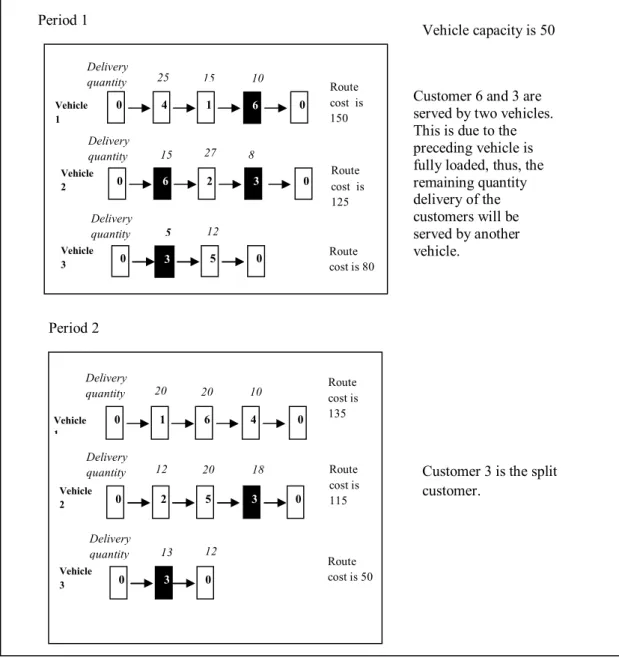
Figure 3.1: Inventory routing problem with split delivery 32
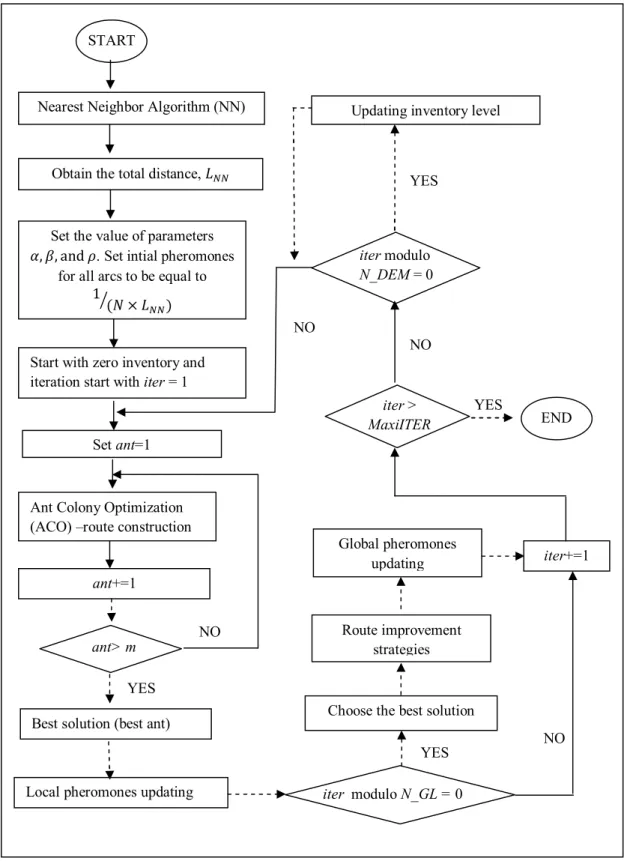
Figure 3.2: Algorithm of the developed method 38
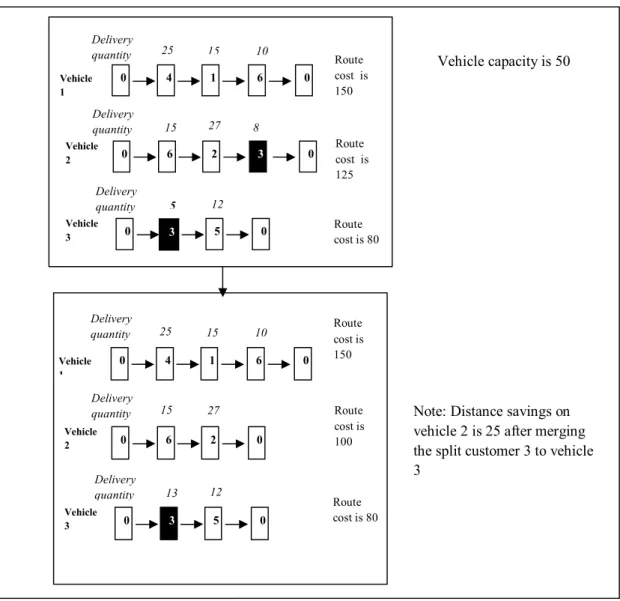
Figure 3.3: Swap procedure if the split customer is able to merge directly to the selected vehicle
42
Figure 3.4: Swap procedure if the split customer cannot be merged directly (a) Forward Possibility (b) Backward Possibility
44
Figure 3.5: Algorithm of updating inventory level 46
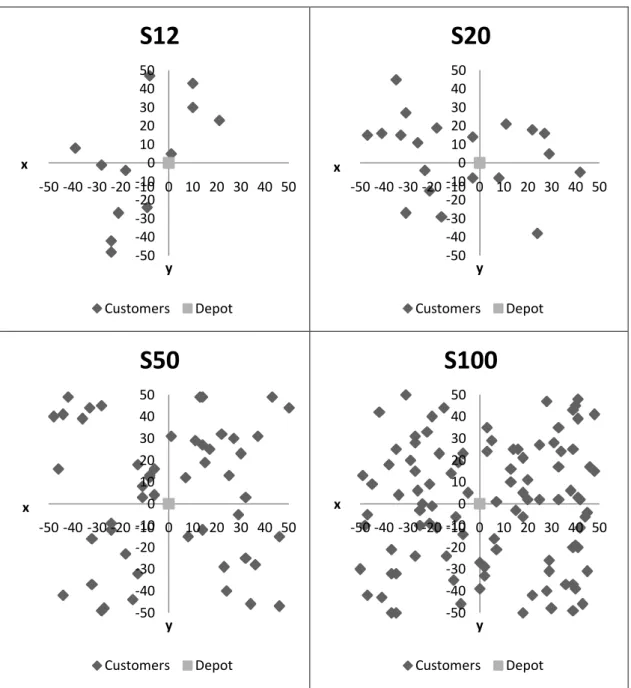
Figure 3.6: Distribution of the data sets 50
Figure 4.1: Algorithm of the population based ACO 59
Figure 4.2: Algorithm of updating inventory for ACOBF 64
Figure 4.3: Algorithm of updating customer’s inventory pheromones for the second modified algorithm of ACO
66
Figure 4.4: Algorithm of updating inventory for ACOPher 68
Figure 5.1: Flow chart of Phase I of SIRP algorithm 94
Figure 5.2: Flow chart of Phase II SIRP algorithm - Population Based ACO
99
Figure 5.3: Line chart for comparison the best cost between SIRPACO1 and SIRPACO2 in percentage
xiii LIST OF TABLES
Table 2.1: Classification on IRP 11
Table 3.1: The results of mean and standard deviation for different parameters settings over 5 runs.
51
Table 3.2: Comparison of the results for S12 with two different parameters
52
Table 3.3: Comparison of the results for S20 with two different parameters
52
Table 3.4: Results for both ACO and ACO2 53
Table 3.5: The details of the best solution between ACO and ACO2 54
Table 3.6: The average and standard deviation of total costs and CPU running time
55
Table 4.1: Results of the algorithms of population based ACO 73 Table 4.2: Results of the algorithms of non-population and population
based ACO
74
Table 4.3: The details of the best solution among the 5 algorithms; ACO,ACO2, ACOBF, ACOher, and ACOPher2
75
Table 4.4: Computational time of the algorithms 76
Table 4.5: The average and standard deviation of total costs and CPU running time over 10 runs (Population Based ACO)
77
Table 4.6: Statistical Analysis on results of ACO, ACO2, ACOBF, ACOPher and ACOPher2
80
Table 4.7: Ranking results based on Bonferroni-Dunn Procedure for the compared algorithms.
82
Table 5.1: Results for the Phase I of the algorithms 103
xiv for SIRPACO1
Table 5.3: Comparison the best cost under different scenario of parameter for SIRPACO2
105
Table 5.4: Comparison of the best costs of SIRPACO1 and SIRPACO2 106 Table 5.5: Comparison of the number of vehicles of SIRPACO1 and
SIRPACO2
108
xv LIST OF SYMBOLS AND ABBREVIATIONS
SYMBOLS
= 1, 2, … , period index
= 0 warehouse/depot
= 1, 2, … , a set of customers where customer i demands product i only
C vehicles capacity (assume to be equal for all the vehicles).
F fixed vehicle cost per trip (assumed to be the same for all
periods)
V travel cost per unit distance
M the number of vehicles and it is assumed to be ∞
(unlimited)
m predefined number of ants
travel distance between customer i and j where =
and the triangle inequality, + ≥ holds for any
different i, j, and k with ≠ , ≠ and ≠
ℎ inventory carrying cost at the customer for product i per unit product per unit time
demand of customer i in period t
,( , ) =∑ cumulative stochastic demand from period 1 to t
delivery quantity to customer i in period t
inventory level of product i at the customer i at the end of period t
= max (0, ) On-hand inventory of customer iat the end of period t, which excludes the stock-out ( < 0).
quantity transported through the directed arc ( ) in period t
number of times that the directed arc ( ) is visited by vehicles in period t
xvi
mean of customer i
standard deviation of customer i 2
^ i
R equal to the rank total of the ith problem
2 ^
j
R equal to the rank total of the jth algorithm
i
R the average rankings by the Friedman test of the ith
algorithms 0
R the average rankings by the Friedman test of the average
ranking of the control method.
the total of distance obtained from the heuristic algorithms.
xvii ABBREVIATION
N_DEM /
predefinedIterInvUpt Predefined number of iterations for updating inventory mechanism
MaxiITER Predefined number of iterations
N_GL /
PredefinedIterationForGL Predefined number of iterations for global pheromones updating
N_moveData maximum number of moves to be allowed for each data
N_moveTime the maximum number of move to be allowed per time
temp_move the current number of moves
sum_move the current accumulative moves that have been done
cur_move number of move generated by random number which is
no more than N_moveTime per time
the total distance obtained from nearest neighbor
algorithm
Predefinedprob predefined values of selecting the forward and backward transfer.
PredefinedIterChgInvMeth predefined number of iteration for selecting the customer deterministically or randomly for transferring their quantity delivery in inventory updating mechanism PredefinedMove Predefine number of transfer to be allowed per time
ℎ pheromones of customer’s inventory for customer j in period p
predefinedIterInvUptGL predefined number of iteration forglobal pheromones updating of customer’s inventory
xviii
N_prob predefined values of selecting the customers based on
attraction or using deterministic backward and forward mechanism
xix LIST OF APPENDICES
APPENDIX A: The results of 10 runs for ACO 125
APPENDIX B: The results of 10 runs for ACO2 129
APPENDIX C: The results of 10 runs for ACOBF 133
APPENDIX D: The results of 10 runs for ACOPher 137
APPENDIX E: The results of 10 runs for ACOPher2 141
APPENDIX F: The results of 10 runs for SIRPACO1 with standard deviation is 0.05 and service level ( and ) is 95%
145
APPENDIX G: The results of 10 runs for SIRPACO1 with standard deviation is 0.05 and service level ( and ) is 99%
149
APPENDIX H: The results of 10 runs for SIRPACO1 with standard deviation is 0.10 and service level ( and ) is 95%
153
APPENDIX I: The results of 10 runs for SIRPACO1 with standard deviation is 0.10 and service level ( and ) is 99%
157
APPENDIX J: The results of 10 runs for SIRPACO2 with standard deviation is 0.05 and service level ( and ) is 95%
161
APPENDIX K: The results of 10 runs for SIRPACO2 with standard deviation is 0.05 and service level ( and )is 99%
165
APPENDIX L: The results of 10 runs for SIRPACO2 with standard deviation is 0.10 and service level ( and ) is 95%
169
APPENDIX M: The results of 10 runs for SIRPACO2 with standard deviation is 0.10 and service level ( and ) is 99%
173
APPENDIX N: Data of DIRP for 12 customers (S12) 177
APPENDIX O: Data of DIRP for 20 customers (S20) 178
APPENDIX P: Data of DIRP for 50 customers (S50) 180
xx APPENDIX R: Data of SIRP for Set A and Set B where the standard
deviation is 0.05 of the mean
188 APPENDIX S: Data of SIRP for Set C and Set D where the standard
deviation is 0.10 of the mean
1
CHAPTER 1: INTRODUCTION
This chapter briefly gives the introduction to Inventory Routing Problem (IRP). The chapter starts by introducing the inventory routing problem (IRP), describing its importance and its relevance to the current economic situations. This is followed by a discussion on the problem statements of the study. The objectives of this study are outlined in the following section and finally, this chapter concludes by giving the organization of the thesis.
1.1 Introduction
Customers play important roles in logistics management as more companies are competing to improve their services including quality, on time delivery, warranty and repair services, pricing contracts, and remanufacturing. The timeliness and consistency of delivery are two aspects which are desired to be improved by many companies as it will offer greater values to their customers. The integration of different components of supply chain such as production, inventory and distribution yields new benefits to balance the setup, holding, inventory and delivery costs while tightly managing available resources. Moreover, the integration can have a significant impact on overall system performance.
Vendor Managed Inventory (VMI) is one of good examples of the type of integration which mentioned above. In VMI model, the supplier or manufacturer observes and controls the inventory levels of its customers or retailers. This is different from the conventional approach where the customers monitor their own inventory and decide the time and amount of products to reorder. One of the most important benefits of VMI is that it allows a more uniform utilization of transportation resources. This leads to a
2 higher level of efficiency and a much lower distribution cost that often constitutes the largest part of the overall cost. VMI created a win–win situation for both suppliers and customers where the vendors can have the savings in terms of distribution costs by being able to coordinate the deliveries to different customers in more efficient way while customers do not have to dedicate resources to inventory management.
Inventory management and transportation are two of the important components in Supply Chain Management (SCM). The coordination of these two components is often recognized as the Inventory Routing Problems (IRP). In addition, the other components such as production, location, marketing and purchasing (see Moin and Salhi, 2007 and Coelho et al., 2013a for an overview) can also be taken into account but it depends on the model of the IRP considered.
IRP is a challenging NP-hard problem that combines the vehicle routing problem (VRP) and inventory management. The VRP, itself is NP-hard (Cordeau et. al. (2007) that determines a set of routes to visit the customers and the inventory management which concerns the amount to be delivered to the customers.There are three simultaneous decisions that have to be made by the supplier: when to serve a given set of customers, the amount to deliver to the customer when it is served and how to combine the customers into the vehicle routes. The main objective of IRP is to minimize both the total transportation that consists of fixed and variable costs and inventory cost over the planning horizon. IRP arises in many distribution systems, especially in Vendor Managed Inventory (VMI). In general, applications of IRP arise in large variety of industries including liquefied natural gas and ship routing problems, distribution of automobile components and perishable items, groceries distribution, transportation for cement, blood as well as the waste organic oil.
3 IRP has been the focus of many researches and since it is NP-hard the exact algorithms proposed are able to solve relatively small instances. Hence many metaheuristic methods have been developed, such as genetic algorithms and tabu search to suit the problems that lead to optimal or near optimal solutions. We propose a modified and enhanced ant colony optimization (ACO) to solve our models. ACO is initially proposed by Dorigo and coworkers (Dorigo, 1992, Dorigo and Blum, 2005, and Di Caro and Dorigo, 1999) and also the first algorithm which targeting to find for an optimal path in a graph based on the nature behavior of ants to seek for a path between the source of food and their colonies. Further discussions on ACO are presented in Chapter 2.
1.2 Problem Statements
The integration of various aspects of supply chain management is an important component for companies to remain competitive. Since the IRP is known to be NP-hard, developing metaheuristic algorithms have been crucial and these have motivated us to seek good and efficient methods / algorithms to achieve the objective of the IRP problem. Several variants of IRP have been studied in the past literature, ranging from deterministic demand cases to stochastic models. Most models considered in vendor managed resupply require accurate and timely information about the inventory status of customers and often the customers’ demands are considered to be deterministic where the demand is known in advance. The model considers deterministic customer’s demand where consumption rate is fixed and known in advance. The main concern of the researchers who studied deterministic demand is to find the solution of which customer to be visited in each period, how much to deliver to each customer and also the delivery routes based on the known demand. However, in real world, there are many industries /
4 companies where their customer’s consumption rate are difficult to predict with certainty and can only be represented at best by a random variable with known probability distribution. This problem is modeled as stochastic. The natural objective of stochastic model is to minimize the total expected costs. The scope of this study covers both deterministic and stochastic IRP.
1.3 Objective of this study
The objective of this study is stated as below:
1. To modify the conventional Ant Colony Optimization (ACO) to solve our proposed model of Deterministic Inventory Routing Problem (DIRP).
propose a new modified model of DIRP which considers multi products in the model and also allows the customers to be served by more than one vehicle (i.e. split delivery),
modify conventional ACO by incorporating the inventory component in the local and global pheromone to reflect the importance of the inventory component, and
perform the sensitivity analysis in order to obtain the appropriate parameter which gives better solution to our proposed model.
2. To enhance the modification of ACO by proposing the population based ACO to solve our proposed model of DIRP,
develop the population based ACO which is different from the conventional ACO that only have one population to construct the solutions, and
5
develop a new mathematical formulation which can incorporate the information of transportation into the inventory management in order to attain the best set of inventory with minimum transportation costs.
3. To extend our study to cater for Stochastic Inventory Routing Problem (SIRP).
extend our DIRP model to SIRP in which the demand of customer is only known in probabilistic sense,
embed the service level constraint which prevent the stock out cost and also overloading at the customer’s warehouse, and
Propose a population based ACO to construct the solution.
1.4 Contribution to Scientific Knowledge
There are several scientific contributions that this thesis proposes to the literature of IRP, mainly consisting of the development of new models and algorithms. The specific contributions are outlined as follows:
Nowadays, many companies supply not only a single product to their customers but multi products, thus, in this study, we propose a one-to-many network of IRP that supplies multi products. We also allow split delivery in which each customer is allowed to be served by more than one vehicle. The aim of implementing the split delivery in our model is to increase vehicle utilization, thus reducing the number of vehicles. The details of the model are discussed in Chapter 3.
In literature, the conventional ACO only consists of one population to construct the solutions. In our study, we propose a new algorithm of ACO, in which we subdivide the ants into subpopulation to build the solution and this is discussed
6 in Chapter 4. By implementing this, we give the ants more exploration in order to obtain better results. A new mathematical formulation is introduced in the global updating scheme which carries the information on inventory in order to build a set of inventory level that can balance between the inventory and transportation cost.
The final contribution of this thesis is that we extend our DIRP model to solve SIRP (Chapter 5). We embed the constraint of service level which avoids excessive the stock out cost and overfilling at the customer’s warehouse in our model. In this study, we modify our population based ACO where each subpopulation starts with different initial solution (differentiated by level of inventory) instead of starting with the same initial solution for all the subpopulations. Different heuristics are employed to generate different initial solutions.
1.5 Thesis Outlines
The thesis consists of six chapters and the organization of the thesis is discussed below. In Chapter 2, a literature review on the variants of IRP model is discussed in details. The literature review is grouped based on the type of the demand which we consider in this study (i.e. deterministic and stochastic). In addition, a review regarding Ant Colony Optimization (ACO) for which our algorithm is based on is given in this chapter as well. The aim of this chapter is to identify the motivation that leads to the objectives behind the thesis.
Chapter 3 presents our proposed model of Deterministic Inventory Routing Problem (DIRP) where the demand of customer is known in advance. In this study, we focus on modifying ACO for solving the DIRP model and the details of the algorithms are
7 discussed in this chapter. The related computational results and the discussion are presented in the later part of this chapter.
Chapter 4 presents the population based ACO which subdivides the population into several number of population to build the solutions. This is different from the conventional ACO which only have one population to build the solution. Apart from proposing population based ACO, another objective of this enhancement algorithm in this chapter is to integrate the information of the transportation into the inventory updating mechanism in order to construct a set of customers’ inventory which can balance between the inventory and transportation cost. The corresponding results and discussion are given in the later part of this chapter.
Meanwhile, Chapter 5 presents the extension of our DIRP model to cater the problem where the customer demand is unknown in advance which is called stochastic inventory routing problem (SIRP). In this study, we modify our population based ACO such that it can be incorporated into our proposed algorithms for solving our SIRP model. The proposed algorithms are presented in details in this chapter. The computational results as well as the related discussion are explained in details in Chapter 5.
Finally, the last chapter (i.e. Chapter 6) gives the summary about the main findings of the thesis and concludes with the potential research directions for future research.
8 CHAPTER 2: LITERATURE REVIEW
This chapter presents the literature review of Inventory Routing Problem (IRP). The chapter starts with the introduction and followed by the discussion on the classification of different types of inventory routing problems. Then, the next two sections discuss the literature review on Deterministic Inventory Routing Problem (DIRP) and Stochastic Inventory Routing Problem (SIRP) respectively. Meanwhile, discussion of the literature review pertaining Ant Colony Optimization (ACO) is discussed in this chapter as well. Finally, the chapter concludes with a summary.
2.1 Introduction
Supply Chain Management (SCM) is the control of supply chain to manage the flow of commodity both within and among the companies. In order to remain competitive, companies are proposing innovative ways of optimizing their supply chain by integrating certain parts of the supply chain (see for example Moon et al. (2006) which coordinates the planning and scheduling of the supply chain and Yang and Liu (2013) when the coordination involves some uncertainties). Inventory Routing Problem (IRP) involves the integration and coordination of inventory management and transportation, where the customers rely on a central supplier to deliver the commodity on a repeated basis. The main objective of this problem is to minimize the corresponding costs (fixed and variable costs) under the constraint that the deliveries to customers are on time.
The IRP is relevant in the Vendor Managed Inventory (VMI) strategy. Under this strategy, the supplier or manufacturer decides when to visit their customers, the quantity of delivery and how to combine them into vehicle routes. VMI is argued to be beneficial to both the customer and the supplier although the supplier may take a longer period of
9
adjustment and reconfiguration before the benefits of VMI can be realized (Dong and Xu, 2002). Applications include the distribution of liquefied natural gas and ship routing problems, distribution of raw material to the paper industry, and food distribution to supermarket chains, among others. The literature on IRP has received considerable attention in the last decade. Methods of solving IRP can be divided into two categories: the exact methods and heuristics or metaheuristics approaches. The classification of IRP is presented next.
2.2 Classification of Different Types of Inventory Routing Problems
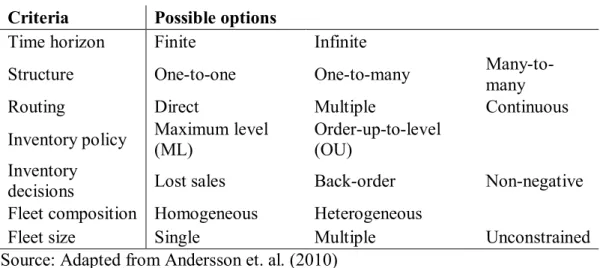
In the past researches, many different varieties of IRP have been developed and solved. Bell et al. (1983) first investigated the integration between inventory management and vehicle scheduling. There are various versions of IRP that have been studied extensively. IRP indeed can be modeled in different ways depending on its characteristic. In fact, there is no standard version of the problem. In paper by Coelho et al. (2013a), the authors cited that most of the research efforts have been concentrated on ‘basic versions’ while the study on extended models, denoted as ‘extension of the basic version’ are relatively new. The basic version of IRP is shown in Table 2.1. Generally, the basic version can be classified into seven different criteria; time horizon, structure, routing, inventory policy, inventory decisions, fleet composition and fleet size.
From Table 2.1, the criteria of time horizon is divided into finite and infinite. Most of the earlier works concentrates on an infinite planning horizon (see for example Anily and Fedegruen, 1990, Anily and Bramel, 2004 and Campbell and Savelsbergh, 2004). The number of customers and suppliers may vary, thus the structure can be one-to-one when only one supplier serves one customer, and one-to-many is the most common case where one supplier serves several customers while many-to-many is when several
10
suppliers serve several customers. However, in the recent literature, the structure of many-to-one having several suppliers serving one customer also has been proposed. Routing component can be categorized into direct when only one customer per route is allowed. Meanwhile multiple refer to the case in which several customers are on the same route, while continuous is the case without central depot, like some of the maritime applications such as ship routing and inventory management problem.
Inventory policies establish the rules on how to replenish customers. There are two common policies that are applied in most of the literature: Maximum Level (ML) and Order-up-to-level (OU). Under the policy of ML, the replenishment level is flexible but limited to the capacity available at the customer site. Under the policy of OU, the replenishment level is triggered when the inventory level on hand falls below specified minimum level and then the quantity delivered is that to fill its inventory capacity. Meanwhile, inventory decisions determine how the inventory management is modeled. If the inventory is allowed to become negative, then backordering occurs and the corresponding demand is delivered to customers at a later stage. However if backorder is not allowed, the corresponding demand will be considered as lost sales. For both cases, the penalty may be applied for the stockout. In most cases the inventory is not allowed to be negative especially for the deterministic model.
Fleet composition and fleet size are the two additional criteria considered. The composition can be divided either homogeneous or heterogeneous while the number of vehicles available can be fixed or unconstrained.
11 Criteria Possible options
Time horizon Finite Infinite
Structure One-to-one One-to-many
Many-to-many
Routing Direct Multiple Continuous
Inventory policy Maximum level
(ML)
Order-up-to-level (OU)
Inventory
decisions Lost sales Back-order Non-negative
Fleet composition Homogeneous Heterogeneous
Fleet size Single Multiple Unconstrained
Source: Adapted from Andersson et. al. (2010)
The time at which the demand is known can be classified into several categories. If the demand of customers is known at the beginning of the planning horizon, the problem is deterministic. However, if the demand is unknown and based on some probability functions, it yields the Stochastic Inventory Routing Problem (SIRP). Dynamic SIRP arises when demand is not fully known in advance, but is gradually revealed over time, as opposed to what happens in a static context. In this case, one can still exploit its statistical distribution in the solution process, then yielding a Dynamic and Stochastic Inventory Routing Problem (DSIRP). Although both demand of SIRP and DSIRP are known in probabilistic sense, however in DSIRP, the customer’s demand is gradually revealed over time, for an instance, at the end of each period, one must solve the problem repeatedly when the information becomes available.
12 2.3 Deterministic Inventory Routing Problem
Deterministic Inventory Routing Problem (DIRP), in which the customer’s demand is known in advance, is discussed. The initial studies published on IRP were mostly extended from the standard Vehicle Routing Problem (VRP) in which the heuristics developed are extended to take inventory costs into consideration. As discussed in Section 2.2, IRP can be modelled in different ways based on the assumptions that are taken into account in the model. The discussion of the literature review in this section is focused on exact and heuristic algorithm respectively.
2.3.1 Exact Algorithm
In this subsection, we present a literature review emphasizing those studies that implemented the exact algorithms to solve their proposed model. Several exact algorithms such as Branch-and Cut, Branch-and-Price and Lagrangian Relaxation algorithms have been implemented.
Archetti et al. (2007) were the first proposed branch-and-cut algorithms for a single product and single vehicle IRP. They have introduced a special formulation for maximum order policy. The instances solved are 30 customers and 6-period horizon and 50 customers with 3-period horizon. The formulation was improved by Solyali and Sural (2008, 2011) who introduced customer replenishment strategy by incorporating shortest path network and uses a heuristic approach to get initial bound to branch-and-cut algorithm. This new formulation enables the authors to solve 15 customers with 12 periods, 25 customers with 9 periods and 60 customers with 3 periods.
Recently, Coelho and Laporte (2013c) extended the formulation proposed by Archetti et al. (2007) by including the multiple vehicles known as Multi-vehicle IRP (MIRP). The
13
authors proposed a branch-and-cut algorithm for the exact solution of several classes of IRP. Several cases have been considered in their computational experiment namely MIRP solutions under the maximum level (ML) replenishment policy, MIRP solution with a homogeneous and heterogeneous fleet of vehicles, IRP with transshipment options and MIRP with additional consistency features. The computational experiments done on the benchmark instances and the computational results confirm the success of the proposed algorithm.
Coelho and Laporte (2013b) extended their work to propose branch-and-cut algorithm for solving multi product multi vehicle IRP (MMIRP) with deterministic demand and stockout cost is not allowed. In this paper, Coelho and Laporte (2013b) have implemented a solution of improvement algorithm after branch-and-cut identifies a new best solution. The purpose of solution improvement algorithm is to approximate the cost of a new solution resulting from the vertex removal and reinsertions. In this paper, the authors considered additional of two features namely the driver partial consistency and visiting space consistency. The driver partial consistency plays the role of increasing the quality of the solution provided by the IRP both to customers and suppliers in a multi-product environment. The results show that the visiting space helps in reducing the search space while providing meaningful solution. The computational experiments to test the efficiency of the algorithm for their proposed MMIRP model and MMIRP with the additional two consistency features are presented in this paper. The authors have proposed larger instances where the number of customers has increased to 50 and up to seven time periods.
In the most recent work, Desaulniers et al. (2015) works on a single supplier who produces a single product at each period over a finite horizon to fulfill the demand of a
14
set of customers by using a fleet of homogeneous capacitated vehicles. Each customer has their inventory capacity and initial inventory. The authors introduced an innovative formulation for the IRP and developed a state-of-the-art branch-price-and-cut algorithm for solving their proposed IRP model. The developed algorithm integrated known and new families of valid inequalities, appending an adaptation of the well-known capacity inequalities, as well as an ad hoc labeling algorithm in order to solve the column generation subproblems. The computational results showed that their algorithm outperforms existing exact algorithms for instances with more than three vehicles. The authors proved that the proposed valid inequalities, branching decisions, and other speed up strategies are effective.
Chien et al. (1989) is amongst the first to simulate a multiple period planning model where the model is based on a single period approach. This is achieved by passing some information from one period to the next through inter-period inventory flow. The authors have formulated their problem as a mixed integer program and developed a Lagrangian based procedure to generate both good upper bounds and heuristic solutions. Since then many researchers have focused their modeling on a finite planning horizon.
Yu et al. (2008) solved a large-scale IRP that delivers a single product with split delivery and vehicle fleet size constraint. The problem is solved by using a Lagrangian relaxation method and it combines with the surrogate subgradient method. The solution of the model obtained by the Lagrangian relaxation method is used to construct a near-optimal solution of the IRP by solving a series of assignment problems. Numerical experiments show that the proposed hybrid approach can find a high quality near-optimal solution for the IRP with up to 200 customers and 10 periods in a reasonable computation time.
15
Bard and Nananukul (2010) proposed a branch-and-price (B&P) algorithm for solving the production, inventory, distribution, routing problem (PIDRP), a variant of IRP. The model of this problem had included a single production facility, a set of customers with time varying demand, a finite planning horizon, and a fleet of homogeneous vehicles. The aim of this study is to construct a production plan and delivery schedule that minimizes the total cost while ensuring that each customer’s demand is met over the planning horizon. In this study, a new branching rule for dealing with an unstudied form of master problem degeneracy is introduced, while reducing the effects of symmetry and obtaining feasible solutions by combining a rounding heuristics and tabu search within B&P, and the use of column generation heuristics. The computational results indicated that the PIDRP instances with up to 50 customers and 8 time periods can be solved within 1 hour. The hybrid scheme performed better than CPLEX and standard branch and price alone.
2.3.2 Heuristic Algorithms
IRP is known to be NP-hard because the VRP reduces to TSP where the time horizon is one, the inventory costs are zero, the capacity of the vehicle is infinite, and all the retailers need to be served; hence it is unlikely that a polynomial time algorithm will be developed for its optimal solution. The largest instance that can be solved by exact algorithms consist of 50 customers with 7 periods (see Coelho and Laporte (2013b) and most researchers resort to heuristic or metaheuristic algorithm to solve large instances, which represents the real world problems. There are several heuristic / metaheuristic algorithms such as Tabu Search, Genetic Algorithm, Variable Neighborhood Search, Ant Colony Optimization (ACO) et cetera that have been developed widely to solve IRP. In this subsection, we present a literature review of those algorithms that implemented the heuristic / metaheuristic algorithms to solve their proposed IRP model.
16
Bertazzi et al. (1997) proposed a set of decomposition heuristics for the transportation of multi-product in multi-period with constant demand. In the first of phase of the algorithm, each destination is considered independently and direct shipping is solved using the algorithm of Speranza and Ukovich (1996). The second phase aggregates customers visited at the same frequency on the same route. Meanwhile, each set is considered separately and a heuristic procedure is used to determine an estimation of the minimum transportation cost to deliver the products to all the destinations of the given set in the third phase. Inventory cost will remain unchanged but reduction of the transportation may occur in third phase of the algorithm. The authors introduce the concept of split deliveries where the quantity of a product required at a destination can be served in different shipments, possibly with different frequencies. For simplicity, most multi-product models assume that each retailer requires only one type of product. The authors tested their proposed algorithms on a set of randomly generated problem instances. The computational results indicate the algorithms perform well on the instances but required more computational time.
Bertazzi et al. (2002) considered a multi-period distribution problem in which a set of products has to be delivered from a supplier to several retailers in a given time horizon and the demand of the retailers is known in advance (deterministic). The authors adopted the order up to a level inventory policy (S, s), where each retailer determines the maximum(S) and the minimum(s) levels of inventory of each product and the products have to be replenished before the minimum level is attained. The quantity of the product delivered is the amount such that the maximum level is reached at the retailer. The authors proposed a two-step heuristic algorithm. The first stage focuses on route construction algorithms. Meanwhile, the second stage attempts to improve the existing solution iteratively by performing simple swap operators that aim to remove or
17
insert customers at different positions on the route. The authors compared the cost of the solution generated by the heuristic algorithm with the optimal cost of two intuitive policies. The first policy, referred to the case that visit all the retailers in each discrete time instant on the basis of an optimal route while the second policy referred to the case that visit the set of retailer in each delivery time instant on the basis of an optimal route and stockout is occurred if not served at given time. The obtained results showed that the heuristic algorithm always outperforms the optimal solution of the two intuitive policies
Since split delivery is one of the important components, in our model thus, in this subsection some of the papers that include the split delivery into their DIRP model are reviewed. Dror and Trudeau (1989) first introduced the split delivery VRP (SDVRP) by relaxing the constraint of the VRP that requires every customer to be served by only one vehicle. The authors showed that the relaxation increased the flexibility of distribution and could lead to important savings, both in the total distance traveled and in the number of vehicles used. The SDVRP remains NP hard despite this relaxation (Dror and Trudeau, 1990). Several authors (see for example Mjirda et al., 2014, Moin et al., (2011) and Yu et al., 2008) have extended the concept of split delivery in the multi-period IRP.
Moin et al. (2011) proposed an efficient hybrid genetic algorithm to solve the IRP in a many-to-one network which involves multi products where each supplier supplies different products in multi period scenario. The problem is to find the minimum cost to pick up the products from a set of geographically dispersed suppliers over a finite planning horizon to the assembly plant by using a fleet of capacitated homogeneous vehicles which are housed at a depot and the split pick-ups are allowed. The proposed hybrid genetic algorithm is based on the allocation-first-route-second strategy and takes
18
both the inventory and the transportation costs (fixed and variable) into consideration. The computational experiments have been done on the data sets which were extended from the existing data sets to show the effectiveness of the proposed approach. Small, medium and large size problems are added to the existing data sets. With the increase of problem size, GA based algorithms performed relatively much better.
Mjirda et al. (2014) improved the results obtained by Moin et al. (2011) by proposing a two-phase Variable Neighborhood Search (VNS). The first phase develops an initial solution without considering the inventory but only focuses on minimizing the transportation cost by using VNS. While in the second phase the initial solution is iteratively improved to minimize both the inventory and transportation costs using Variable Neighborhood Descent (VND) and a VNS algorithm. For the part of inventory management in the second phase, Linear Programming (LP) formulations and a heuristic method (i.e. backward method to define the amount of products to deliver by each vehicle at each period in order to satisfy the demands of the preceding periods) which consider the priority of rules on suppliers and vehicles are developed to calculate the amount of products to collect from each supplier at each period during the planning horizon. The computational results showed that the proposed methods had given better results than the existing methods from the literature for both solution quality and the running time. Both Moin et al. (2011) and Mjirda et al. (2014) considered the many-to-one network, which is equivalent to many-to-one-to-many network under certain assumption.
Heuristic / metaheuristic algorithms have been widely used to solve different variants of IRP. Abdelmaguid (2004) studied the integrated inventory distribution problem (IIDP) in which they considered an environment such that the demand of each customer is relatively small compared to the vehicle capacity, and the customers are located closely
19
such that a consolidated shipping strategy is appropriate. In their model, they take into consideration the components of inventory holding, backorder, and transportation costs. The author proposed a construction heuristic for the IIDP, called the approximate transportation costs heuristic (ATCH). However, this strategy can give poor solutions if the order quantities of the customer are not significantly less than the vehicle capacity. To alleviate this, Abdelmaguid and Dessouky (2006) introduced a genetic algorithm (GA) approach for improving the constructed solution that allows partial deliveries. In their GA construction phase, they implemented a randomized version of their previously developed construction heuristic to generate the initial random population. Then, two random neighbourhood search mechanisms, the crossover and mutation operations are developed in their GA improvement phase. The main concern in designing the mutation operator was to develop a suitable mechanism that allows for deliveries to customers to cover part of their demand requirements, which is referred as partial deliveries. The computational results show that GA outperform the results produced in their earlier paper, Abdelmaguid (2004).
Abdelmaguid et al. (2009) improved the results of Abdelmaguid and Dessouky (2006) by introducing a constructive improvement heuristic which is based on the idea of allocating single transportation cost estimates for each customer. Two subproblems, comparing inventory holding and backlogging decisions with these transportation cost estimates, are formulated and their solution methods are incorporated in the developed heuristic. An improvement heuristic is developed to overcome some of the limitations of the constructive heuristic. This improvement heuristic is based on the idea of exchanging delivery amounts in between periods to allow for partial fulfilments of demands and exploit associated reductions in costs.
20
Bard and Nananukul (2009) developed reactive tabu search to solve Production Inventory Distribution Routing Problem (PIDRP) which involved the integration of both production and distribution decision. In this paper, the authors considered a single production facility, a set of customers with time varying demand, limited capacity of inventory at customer’s site, a finite horizon and a fleet of homogeneous vehicles for making the deliveries. The authors developed reactive tabu search to solve their proposed model. The authors applied the allocation model in the form of mixed integer program to find good feasible solutions as the starting points of tabu search. The allocation model is modified to attain lower bounds on the optimum. Computational experiments are tested on 90 benchmark instances with up to 200 customers and 20 periods and the results showed the improvements in all cases if compared with the existing greedy randomized adaptive search procedure (GRASP). In our algorithm of Stochastic Inventory Routing Problem (SIRP), we are inspired by the concept of the allocation model which was presented in this paper and modified it in order to solve our problem.
21 2.4 Stochastic Inventory Routing Problem
Stochastic Inventory Routing Problem (SIRP) is the problem in which the customer’s demand is only known in probabilistic sense. Since the demand is uncertain, shortages may occur and normally a penalty is imposed whenever a customer runs out of stock. The penalty is usually modelled as a proportion of the unsatisfied demand. Unsatisfied demand is typically considered to be lost, that is, there is no backlogging. The main objective of SIRP is similar to DIRP where the total of inventory and transportation cost are the main concerns to be minimized but is written to embed the stochastic and unknown future parameters: the supplier must determine a distribution policy that maximizes its expected discounted value (revenue minus costs) over the planning horizon, which can be finite or infinite. The discussion in this section is based on the studies that consider their model in infinite and finite horizon.
First, we discuss some of the literature that considers their model over an infinite planning horizon. Kleywegt et al. (2002) tackled the problem in which a supplier supplied a single product to serve a set of customers using a fleet of capacitated homogeneous vehicles. In the paper, the authors considered each vehicle route served one customer only (i.e. direct deliveries). The customer’s demand is uncertain and a penalty cost is taken into account if the stock out occurred. Backlogged is not allowed. The authors formulated the SIRP as a Markov decision problem (MDP) over an infinite horizon. They proposed approximate methods based on the dynamic programming in order to find good quality solutions with a reasonable computational effort. Kleywegt et al. (2004) extended the work where each vehicle services up to three customers. However, in the paper of Adelman (2004) there is no limit on the number of customers to be served in a route but restricted by maximal route duration and vehicle capacity.
22
The author studied the case in which the number of customers visited in every route is unbounded and a fleet of vehicles with an unlimited number of vehicles is available.
Qu et al. (1999) addressed a periodic policy for a multi-item joint replenishment problem in a stochastic setting with simultaneous decisions made on inventory and transportation policies. The authors proposed a heuristic decomposition method which applied a property of the combined problem to divide the model into subproblems, namely inventory and vehicle routing models. Each of the subproblems is solved using the methods from existing literature. The computational experiments were done on the divided groups that are based on the problem sizes of 15–50 items and the results showed that their method performed satisfactory on solving the problem.
Based on the literatures available, there are quite a number of articles that considered SIRP model with finite time horizon and this is closely related to our study. Federgruen and Zipkin (1984) are among the first who studied IRP by modifying the Vehicle Routing Problem of Fisher and Jaikumar (1981) to accommodate inventory and shortage costs where the customers’ demands are assumed to be random variables. The problem decomposes into a nonlinear inventory allocation problem which determines the inventory and shortage costs and a Travelling Salesman Problem (TSP) for each vehicle considered to represent the transportation costs.
Federgruen et al. (1986) considered the problem in which each product have a fixed lifetime (perishable items) during which it can be consumed, otherwise if the period is exceeded then the product has to be discarded. Computational experiments are done on two approaches, namely combined approach and separate approach. In the combined approach, the authors adopted the solution approach of Federgruen and Zipkin (1984)
23
but implemented a more complex subproblem by imposing extra constraints. The separate approach solved the allocations and routing decisions separately in the conventional way. The computational results showed that the combined approach produced less total costs compared to separate approach. However, the combined approach required more computational time.
Minkoff (1993) considered a dynamic and stochastic vehicle dispatching problem called the delivery dispatching problem. The author modeled the problem as a Markov decision process and adopted a decomposition heuristic approach to solve the problem. The heuristic solves a linear program to allocate joint transportation costs to individual customers and solves a dynamic program for each customer locally. In this paper, the author described how to compute bounds on the algorithm’s performance, and several examples is applied on the algorithm with good results. However, algorithm is applied for relatively small problem instances only (up to 6-customers).
Bertazzi et al. (2013) studied the IRP in which a supplier has to serve a set of retailers and the maximum inventory level is defined for each retailer. The demand of the retailer is stochastic and has to be satisfied over a given time horizon. The inventory policy of this study is order-up-to-level where the quantity delivery to each retailer is such that its inventory level reaches the maximum level whenever the retailer is served. Inventory holding cost is applied whenever the inventory level is positive while the penalty cost is imposed when the inventory level is negative. Backlogged is not allowed in their problem. The objective of the study is to minimize the expected total cost which is given by the sum of the expected total inventory both at the supplier and retailers and penalty cost at the retailers as well as the expected routing cost. The authors proposed a hybrid rollout algorithm to solve their problem. The computational results showed that
24
the proposed rollout algorithm provided significantly better solution than the one that obtained from the benchmark algorithm. The authors also implemented a branch-and-cut algorithm to solve their proposed mixed-integer linear programming model which is the deterministic counterpart of their problem (set the future demand equal to the average demand). The proposed approach was able to determine the optimal solution in reasonable time limit (within a time limit of 7000 seconds) in the majority of the considered instances otherwise the best obtained feasible solution is used.
Recently, Yu et al. (2012) presented a stochastic IRP with split delivery (SIRPSD), which implemented the service level to satisfy each customer’s demand by limiting the possibility of the stockout within a given value and also the service level to each customer’s warehouse measured in its overfilling probability. This paper studied the stochastic version of the deterministic one proposed by Yu et al. (2008). The authors proposed the transformation of stochastic components of a model of the SIRPSD into deterministic ones and used the Lagrangian relaxation to decompose the model into sub problem of inventory and routing. The partial linearization approach for the subproblem of inventory, the minimum cost flow for the subproblem of routing and the local search improvement of feasible solutions of the studied SIRPSD are proposed in this paper to solve their proposed model. The computational results showed that their proposed approach can obtain high quality solutions in a reasonable computational time.
25 2.5 Ant Colony Optimization
Swarm Intelligence (SI) is the discipline that manages the natural and artificial systems consist of many individuals that coordinate using decentralized control and self-organization. The properties of the typical swarm intelligence system are shown below (see Dorigo and Birattari, 2007):
Consists of many individuals;
The individuals are relatively homogeneous (i.e., they are either all identical or they belong to a few typologies);
The interactions among the individuals are based on simple behavioral pattern that
exploit only local information that the individuals exchange directly or via the environment (stigmergy);
The interactions between individuals and with their environment will give the overall behavior of the system, (i.e. the group behavior self-organizes).
Swarm-based algorithms have recently arisen as a family of nature-inspired, population-based algorithms which are able to produce low cost, fast, and robust solutions to several complex problems (see Panigrahi et al., 2011). SI can therefore be defined as a relatively new branch of Artificial Intelligence that is used to model the collective behavior of social swarms in nature. Examples of systems that are represented by SI are ant colonies, honey bees, bird flocking, animal herding, bacteria growth, fish schooling and microbial intelligence. These agents (insects or swarm individuals) are interacting together with certain behavioral patterns in order to carry out the necessary task for their survival. Through the study on the behavioral pattern of those agents, it leads the researchers to develop the nature-inspired metaheuristics for solving their problems. Since the computational modeling of swarms was proposed, the number of research papers reporting the successful application of SI algorithms in several optimization