Coaching through Principles of Play.
A Conceptualisation of the Coaches’ Process of Knowledge
Generation.
By:
Renzo Kerr Cumbo
A thesis submitted in fulfilment of the requirements for the degree of Doctor of Philosophy
The School of Education
The University of Sheffield
The candidate confirms that the work submitted is his own and that appropriate credit has been given where reference has been made to the work of others. This copy has been supplied on the understanding that it is copyright material and that no quotation from the thesis may be published without proper
acknowledgement.
ABSTRACT
In recognising the importance of coaches’ tactical content knowledge, in this study, I look at how coaches generate knowledge to coach through principles of play.
Coaches are seen as ongoing learners who are able to acquire and generate tactical content knowledge, and then, as teachers, transform that knowledge into pedagogical tactical content knowledge. The concept of coaching through Principles of Play underpins coaches’ tactical content knowledge. As early as in the 1960s, literature already referred to Principles of Play. Literature shows that both sports coaches and PE teachers who coach or teach through a tactical or game centred approach, may frame their tactical knowledge within the concept of principles of play.
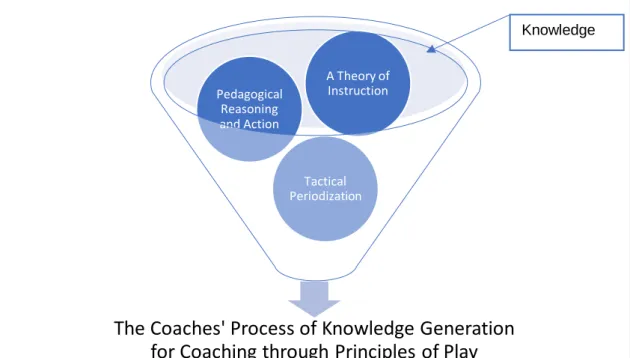
A theoretical framework was composed of; Shulman’s Model of Pedagogical Reasoning and Action, Bruner’s A Theory of Instruction and Tactical
Periodization. Together with the Categories of Knowledge, this theoretical framework made it possible to initiate a conceptualisation of the Coaches’ Process of Knowledge Generation for Coaching through Principles of Play.
Qualitative Content Analysis on the five sources selected to compose the theoretical framework led to the first level conceptualisation. This was further populated with the intervention of ten expert international soccer coaches, who were interviewed and asked to analytically criticise, from their point of view, the first version of this conceptualisation. Qualitative Content Analysis of these interviews led to the second level conceptualization of this process.
The final conceptualisation presented in this study demonstrates how a process of knowledge generation to coach through principles of play needs to be
contextualised through Scrutiny of the Environment, Conceptualisation, Acquisition of Knowledge, Transformation of Knowledge, Dissemination of Knowledge make the five outer components which all interact with the central component Regeneration of Knowledge.
ACKNOWLEDGEMENTS
The research work disclosed in this publication is partially funded by the ENDEAVOUR Scholarship Scheme.
I would like to start by showing my appreciation to Professor Cathy Nuthbrown and to Prof Peter Clough who supported me through this journey, and who in
different moments provided me with the necessary encouragement and self-belief.
I would like to thank my wife Sarah who joined in a journey of support, hope and persistence, a journey which she did not opt for. To my daughter, Emily, who came into the world in midst of writing this thesis and had to spend a lot of time
without a father, as I chose studying rather than time with her.
I dedicate this study to my parents who taught me the meaning of a humble life, to all my students who have pushed my boundaries to want to learn more, to the late Dr Michael Aquilina, who showed me the way into becoming an athlete, a PE teacher, a lecturer, and most importantly how to become a humble, down-
to-earth, non-pretentious educator.
I dedicate this study to those who helped me understand that I am just ‘r’, and that my studies are only necessary for the growth of a man towards a more
DEDICATION
This dissertation is dedicated to My wife Sarah,
first and foremost,
My daughter, Emily, whom I love without boundaries
My parents, grandparents and parents in law
All those expert and non-expert learners
TABLE OF CONTENTS
ABSTRACT _________________________________________________________________________ iv
ACKNOWLEDGEMENTS _______________________________________________________________ v
DEDICATION ________________________________________________________________________ vi
TABLE OF CONTENTS ________________________________________________________________ vii
TABLE OF FIGURES __________________________________________________________________ xvi
TABLE OF TABLES __________________________________________________________________ xviii
LIST OF ABBREVIATIONS _____________________________________________________________ xix
CHAPTER 1 INTRODUCTION ___________________________________________________________ 1
1.1 INTRODUCTION ________________________________________________________________ 2 1.2 AIM OF THE STUDY _____________________________________________________________ 5 1.3 POSITIONALITY, ASSUMPTIONS AND PERSONAL RATIONALE FOR THE STUDY ________________ 6
1.3.1 Positionality _______________________________________________________________ 7 1.3.2 Assumptions ______________________________________________________________ 7 1.3.3 Rationale for the study ______________________________________________________ 9
1.4 FRAMING THIS STUDY __________________________________________________________ 10
1.4.1 Tactical Periodization _______________________________________________________ 10 1.4.2 The Model of Pedagogical Reasoning and Action _________________________________ 11 1.4.3 A Theory of Instruction _____________________________________________________ 12
1.5 CONCLUSION _________________________________________________________________ 13
CHAPTER 2 LITERATURE REVIEW ______________________________________________________ 15
2.1 INTRODUCTION _______________________________________________________________ 16 2.2 SOCCER IS A COMPLEX GAME ____________________________________________________ 16
2.3 A TACTICAL COACHING APPROACH ________________________________________________ 17
2.4 COACHES’ KNOWLEDGE_________________________________________________________ 20
2.4.1 TACTICAL CONTENT KNOWLEDGE – THE MAIN FOCUS _____________________________ 20 2.4.2 TACTICAL TERMINOLOGY____________________________________________________ 22 2.4.3 PRINCIPLES OF PLAY________________________________________________________ 23 2.4.4 Terminology for Coaching through Principles of Play ______________________________ 24
2.5.1 Filling in the Gaps __________________________________________________________ 29 2.5.1.1 Gap 1: The Process of Coaching through Principles of Play ______________________ 30 2.5.1.2 Gap 2: Content Knowledge for CPP ________________________________________ 31
2.6 FRAMING THIS RESEARCH _______________________________________________________ 32
2.6.1 The Model of Pedagogical Reasoning and Action _________________________________ 34 2.6.1.1 Comprehension _______________________________________________________ 36 2.6.1.2 Transformation ________________________________________________________ 36 2.6.1.3 Instruction ___________________________________________________________ 37 2.6.1.4 Evaluation, Reflection and New Comprehension ______________________________ 37 2.6.2 A Theory of Instruction______________________________________________________ 38 2.6.2.1 Predisposition _________________________________________________________ 40 2.6.2.2 Optimal Structuring of Knowledge _________________________________________ 41 2.6.2.3 Optimal Sequence _____________________________________________________ 42 2.6.2.4 Consequences_________________________________________________________ 42 2.6.2.5 A Spiral Curriculum _____________________________________________________ 43 2.6.3 Tactical Periodization _______________________________________________________ 44 2.6.3.1 Fractals in Tactical Periodization __________________________________________ 44 2.6.3.2 The Model of Play in Tactical Periodization __________________________________ 45 2.6.3.3 The Principles of Play ___________________________________________________ 46 2.6.3.4 The Moments and Phases of the game in Tactical Periodization __________________ 46 2.6.3.5 Training Principles in Tactical Periodization __________________________________ 47 The Principle of Specificity ___________________________________________________ 47 The Principle of Horizontal Alternating Specificity ________________________________ 48 The Principle of Propensities _________________________________________________ 48 The Principle of Dismantlement/Disassembly and Hierarchisation of playing principles, __ 48 The Principle of Complex Progression __________________________________________ 48 The Principle of Tactical Fatigue and Concentration _______________________________ 49 Guided Discovery __________________________________________________________ 49 Performance Stabilization ___________________________________________________ 49
2.7 TEACHERS’ CATEGORIES OF KNOWLEDGE ___________________________________________ 50 2.7.1 Shulman’s and Berliner’s Categories of Knowledge Base ___________________________ 50
2.7.2 Shulman’s Categories of Knowledge and Collinson’s Triad of Knowledge _______________ 51 2.7.2.1 Professional Knowledge_______________________________________________ 52 2.7.2.2 Interpersonal Knowledge______________________________________________ 52 2.7.2.3 Intrapersonal Knowledge ______________________________________________ 53 2.7.3 The Three Knowledge Domains _______________________________________________ 54 2.7.4 Knowledge Categories in Coaching Research _____________________________________ 56 2.7.5 Knowledge Categories – A Conclusion __________________________________________ 56
2.8 CONCLUSION _________________________________________________________________ 59
2.9 SUMMARY OF THE LITERATURE REVIEW ____________________________________________ 60
CHAPTER 3 METHODOLOGY __________________________________________________________ 63
3.1 INTRODUCTION _______________________________________________________________ 64
3.1.1 Aim _____________________________________________________________________ 64
3.2 A METAPHOR _________________________________________________________________ 64 3.3 APPROACH TO QUALITATIVE RESEARCH ____________________________________________ 65
3.3.1 Epistemological Approach ___________________________________________________ 66
3.4 SELECTING A METHOD OF ANALYSIS _______________________________________________ 68
3.4.1 Qualitative Content Analysis _________________________________________________ 68
3.5 QUALITATIVE CONTENT ANALYSIS APPLIED _________________________________________ 70
3.5.1 Phases of data collection and analysis __________________________________________ 70 3.5.2 Selecting the Unit of Analysis for Phase 1 _______________________________________ 72 3.5.2.1 Rigour in the Selection of Sources _________________________________________ 73 3.5.2.2 Rigour in the Data Collection Process ______________________________________ 74 3.5.3 Selecting the Unit of Analysis for Phase 2 _______________________________________ 74 3.5.3.1 Sample Size, Selection and rigour _______________________________________ 74 3.5.3.2 Data Collection _____________________________________________________ 76 3.5.4 Ethics ___________________________________________________________________ 77 3.6 OBTAINING RIGOUR ___________________________________________________________ 79 3.6.1 Ensuring Trustworthiness ___________________________________________________ 79 3.6.2 Objectivity _______________________________________________________________ 80 3.6.3 Pilot Study _______________________________________________________________ 81 3.7 CONCLUSION _________________________________________________________________ 81
CHAPTER 4 A DETAILED EXPLANATION OF the process of ANALYSIS. __________________________ 83
4.1 INTRODUCTION _______________________________________________________________ 84
4.2 Conceptualising the COACHES’ process of knowledge generation for coaching through Principles of Play. ___________________________________________________________________________ 84 4.3 ANALYSIS PHASE 1.1 ___________________________________________________________ 85
4.3.1 Stage 1 - Decontextualisation ________________________________________________ 85 4.3.2 Stage 2 - Recontextualisation ________________________________________________ 86 4.3.3 Stage 3 - Categorisation _____________________________________________________ 87 4.3.3.1 Data Displays and Analysis _______________________________________________ 87 Framing Theory 1: The Model of Pedagogical Reasoning and Action __________________ 88
Framing Theory 2: Theory of Instruction ________________________________________ 89 Framing Theory 3: Tactical Periodization _______________________________________ 91 Integrating the Framing Theories _____________________________________________ 92 4.3.3.2 Categorisation following data displaying and analysis __________________________ 95
4.4 ANALYSIS PHASE 1.2 ____________________________________________________________ 96
4.4.1 Using NVivo in Qualitative Content Analysis _____________________________________ 96 4.4.1.1 Triangulation _________________________________________________________ 96 4.4.2 Stage 1 and 2 – Decontextualisation and Recontextualisation _______________________ 97
4.5 ANALYSIS PHASE 2.1 ___________________________________________________________ 100
4.5.1 The Process of Qualitative Content Analysis ____________________________________ 101 4.5.2 Computer-assisted Content Analysis __________________________________________ 101 4.5.3 Qualitative Content Analysis through direct Video and Audio Coding instead of transcripts102 4.5.4 Computer-assisted Content Analysis on Coaches’ Interventions _____________________ 103 4.5.5 Stage 1 - Decontextualisation________________________________________________ 103 4.5.6 Stage 2 - Recontextualisation ________________________________________________ 104 4.5.7 Stage 3 - Categorisation ____________________________________________________ 105
4.6 CONCLUSION ________________________________________________________________ 106
CHAPTER 5 The Conceptualisation of the coaches’ Process of Knowledge Generation for Coaching
Through Principles of Play. Findings Leading to Versions 1.1, 1.2 and 2.1 _____________________ 107
5.1 INTRODUCTION ______________________________________________________________ 108
5.2 USING VISUAL DISPLAYS ________________________________________________________ 109 5.3 THE NATURE OF KNOWLEDGE IN VIEW OF THE COACHES’ PROCESS OF KNOWLEDGE GENERATION FOR COACHING THROUGH PRINCIPLES OF PLAY. _______________________________________ 111 5.4 THE COMPILATION OF VERSION 1.1_______________________________________________ 112 5.5 THE COMPILATION OF VERSION 1.2_______________________________________________ 113
5.5.1 The Conceptualisation of the Coaches’ Process of Knowledge Generation for coaching through Principles of Play – Version 1.2 ____________________________________________ 113 5.5.2 A Simplified Explanation– Version 1.2 _________________________________________ 114 5.5.3 A Visual Representation of The Coaches’ Process of Knowledge Generation for coaching
through Principles of Play – Version 1.2 ____________________________________________ 117 5.5.4 Version 1.2 Explained ______________________________________________________ 119
5.5.4.1 Coaches’ Scrutiny of the Environment _____________________________________ 119
5.5.4.2 Coaches’ Acquisition of Knowledge _______________________________________ 120 5.5.4.3 Coaches’ Transformation of Knowledge____________________________________ 121
5.5.4.4 Coaches’ Dissemination of Knowledge _____________________________________ 124
5.6 THE COMPILATION OF VERSION 2.0 ______________________________________________ 125
5.7 THE COACHES’ PROCESS OF KNOWLEDGE GENERATION FOR COACHING THROUGH PRINCIPLES OF PLAY – VERSION 2.1 ______________________________________________________________ 130
5.7.1 Scrutiny of the Environment ________________________________________________ 130 5.7.1.1 The coach-player-club triangle___________________________________________ 133 The Coach (Self)__________________________________________________________ 134 The Players _____________________________________________________________ 139 The Club _______________________________________________________________ 147 5.7.1.2 The Game ___________________________________________________________ 152 Analysis of Own Team _____________________________________________________ 153 Analysis of Own League and opponents _______________________________________ 154 Analysis of Other Teams in Other Leagues _____________________________________ 156 5.7.1.3 Timeframe __________________________________________________________ 157 5.7.2 Conceptualisation ________________________________________________________ 158 5.7.2.1 Shared Strategy ______________________________________________________ 158 5.7.2.2 Model It - Model of Play _______________________________________________ 160 A Model of Play __________________________________________________________ 160 Principles of Play _________________________________________________________ 161 Sub-principles, sub-sub-principles, and individual principles _______________________ 163 Moments and Phases _____________________________________________________ 164 System of Play and Tactical Strategies ________________________________________ 164 5.7.2.3 Conceptualisation - Adaptation __________________________________________ 165 5.7.3 Generation of Knowledge __________________________________________________ 167 5.7.3.1 When do coaches need to generate knowledge? ____________________________ 168 5.7.3.2 What type of knowledge do coaches generate? _____________________________ 168 5.7.3.3 Where do coaches acquire knowledge from - in developing their Model of Play? ___ 170 5.7.3.4 How do coaches acquire knowledge – in developing their Model of Play? _________ 174 5.7.4 Transformation of Knowledge _______________________________________________ 175 5.7.4.1 Build it – Model of Play ________________________________________________ 176 5.7.4.2 Segment-It __________________________________________________________ 177 Principles of Play for every moment of the game ________________________________ 178 PoP for every phase in every moment of the game ______________________________ 178 Team-Sectors-Individual ___________________________________________________ 179 Scenarios: ______________________________________________________________ 179 The 4 corners ____________________________________________________________ 180 5.7.4.3 A continuous evolving process ___________________________________________ 180 5.7.4.4 Own-It _____________________________________________________________ 182 5.7.4.5 Adapt-it ____________________________________________________________ 184 Simplify-it ______________________________________________________________ 185
Framing Tactical Freedom __________________________________________________ 187 5.7.4.6 Plan-it ______________________________________________________________ 189 Sequence-it _____________________________________________________________ 189 Programme-it____________________________________________________________ 194 5.7.4.7 Design-it – the Session Plan _____________________________________________ 196 General Pedagogical Knowledge _____________________________________________ 197 The aims of the session ____________________________________________________ 198 Session Planning _________________________________________________________ 199 Verbalising ______________________________________________________________ 200 Demonstrating ___________________________________________________________ 203 Training ________________________________________________________________ 205 Deciding Methodology ____________________________________________________ 207 5.7.5 Dissemination of Knowledge ________________________________________________ 208 5.7.5.1 Creating a Learning Environment _________________________________________ 209 Productivity instead of Transfer of Learning ____________________________________ 209 Productivity of Principles of Play in Soccer Coaching _____________________________ 211 Self- Regulation __________________________________________________________ 212 5.7.5.2 Pre-Training _________________________________________________________ 213 5.7.5.3 In-Training __________________________________________________________ 214 Explain _________________________________________________________________ 214 Provide Experiences_______________________________________________________ 215 EvaluatINg and ReflectINg __________________________________________________ 219 5.7.6 Regeneration of Knowledge _________________________________________________ 221 5.7.6.1 Continuous EvaluatINg and ReflectINg _____________________________________ 222 Generating Feedback ______________________________________________________ 222 Evaluating and Consolidating Learning ________________________________________ 223 5.7.6.2 ReflectINg ___________________________________________________________ 225 5.7.6.3 Regenerate-it ________________________________________________________ 225
5.8 AN ONGOING CONCEPTUALISATION.______________________________________________ 226
CHAPTER 6 DISCUSSION: THE PROCESS OF COACHES’ KNOWLEDGE GENERATION FOR COACHING
THROUGH PRINCIPLES OF PLAY. ______________________________________________________ 228
6.1 INTRODUCTION ______________________________________________________________ 229 6.2 HOW TO READ THE VISUAL REPRESENTATION ______________________________________ 229
6.2.1 Components composing the Coaches’ Process of Knowledge Generation for Coaching through Principles of Play _______________________________________________________ 229 6.2.2 The Visual Representation Explained. _________________________________________ 232 6.2.2.1 The Spiral ___________________________________________________________ 232 6.2.2.2 Regeneration of Knowledge _____________________________________________ 234
6.2.2.3 The Horizontal Plane __________________________________________________ 238
6.3 THE THEORETICAL FRAMEWORK APPLIED _________________________________________ 239 6.3.1 Shulman’s Model of Pedagogical Reasoning and Action and the Conceptualised Process _ 240 6.3.1.1 Comprehension ______________________________________________________ 240 6.3.1.2 Transformation ______________________________________________________ 241 6.3.1.3 Instruction __________________________________________________________ 244 6.3.1.4 Evaluation __________________________________________________________ 246 6.3.1.5 Reflection ___________________________________________________________ 246 6.3.1.6 New Comprehension in the Model of Pedagogical Reasoning and Action _________ 247
6.3.2 Brunner’s A Theory of Instruction ____________________________________________ 248 6.3.2.1 Predisposition _______________________________________________________ 249 6.3.2.2 Structures ___________________________________________________________ 252 Economy and Power, and Productiveness _____________________________________ 253 Enactive, Ikonic and Symbolic representations __________________________________ 255 6.3.2.3 Sequence ___________________________________________________________ 256 6.3.2.4 Consequences _______________________________________________________ 257 6.3.3 Tactical Periodization ______________________________________________________ 258 6.3.3.1 Fractals _____________________________________________________________ 259 6.3.3.2 The Model of Play ____________________________________________________ 260 6.3.3.3 Principles of Play _____________________________________________________ 261 6.3.3.4 Moments and Phases __________________________________________________ 261 6.3.4 Knowledge ______________________________________________________________ 261
6.3.4.1 Shulman’s ‘Categories of Knowledge’ Base _________________________________ 262
6.3.4.2 Collinson’s Triad of Knowledge. __________________________________________ 264 Professional Knowledge ___________________________________________________ 264 Interpersonal Knowledge __________________________________________________ 265 Intrapersonal Knowledge __________________________________________________ 266
6.3.4.3 Challenging Collinson’s concept of reflection _______________________________ 267 6.3.4.4 Knowledge Domains – Declarative, Procedural and Conditional _________________ 269 6.3.4.5 From boxes to river tributaries. A metaphor for knowledge. ___________________ 270
6.3.4.6 Coaches’ Knowledge __________________________________________________ 271
6.4 A COACHING PROCESS _________________________________________________________ 274
6.4.1 VALUES AND CHALLENGES__________________________________________________ 275
6.5 CONCLUSION ________________________________________________________________ 283
CHAPTER 7 CONCLUSION ___________________________________________________________ 286
7.1 INTRODUCTION ______________________________________________________________ 287
7.1.2 Limitations ______________________________________________________________ 289 7.1.3 Contributions to knowledge _________________________________________________ 290 7.1.4 Suggestions for future research ______________________________________________ 292
7.2 CONCLUSIVE SUMMARY _______________________________________________________ 295
BIBLIOGRAPHY ____________________________________________________________________ 297
APPENDICES ______________________________________________________________________ 379
APPENDIX 1.1 TWO MODELS OF PLAY OF TWO OF THE PARTICIPATING COACHES _____________ 381 COACH HUGO VICENTE’S MODEL OF PLAY __________________________________________ 382 COACH SERGIO RAIMUNDO’S MODEL OF PLAY ______________________________________ 425
APPENDIX 3.1 ___________________________________________________________________ 445
QUALITATIVE CONTENT ANALYSIS APPLIED _________________________________________ 445
APPENDIX 3.2 ___________________________________________________________________ 447
THE COMPILATION OF VERSION 1.1 _________________________________________________ 447 Explanation of The Coaches’ Process of Knowledge Generation for coaching through Principles of Play – Version 1.1 _____________________________________________________________ 447
A Simplified Explanation of The Coaches’ Process of Knowledge Generation for coaching through
Principles of Play – Version 1.1 ___________________________________________________ 453
APPENDIX 3.3 ___________________________________________________________________ 455
CRITERIA CHECKLISTS __________________________________________________________ 455
APPENDIX 3.4 ___________________________________________________________________ 457 PARTICIPATING COACHES’ PROFILES ______________________________________________ 457
APPENDIX 3.5 ___________________________________________________________________ 461
PERMISSION _________________________________________________________________ 461
APPENDIX 3.6 ___________________________________________________________________ 462
TRUSTWORTHINESS (SHENTON, 2004) _____________________________________________ 462
APPENDIX 4.1 ___________________________________________________________________ 469
1st STAGE OF THE ANALYSIS PROCESS. VERSION 1.1- MANUAL QCA APPLIED _______________ 469 2nd STAGE OF THE ANALYSIS PROCESS. VERSION 1.2 - COMPUTER-ASSISTED QCA APPLIED ____ 471
APPENDIX 4.2 ___________________________________________________________________ 473
THE PROCESS OF CATEGORISATION – PHASE 1 ______________________________________ 473
APPENDIX 4.3 ___________________________________________________________________ 474
ANALYSIS SCHEDULE – PHASE 1 __________________________________________________ 474
APPENDIX 4.4 ___________________________________________________________________ 475
APPENDIX 4.5___________________________________________________________________ 480
CATEGORISATION COMPARISON PROCESS _________________________________________ 480
APPENDIX 4.6___________________________________________________________________ 484
DEDUCTIVE LIST OF CODES APPLIED _______________________________________________ 484
APPENDIX 4.7___________________________________________________________________ 485
SUMMARY OF THEMES CATEGORIES, SUB and SUB-SUB-CATEGORIES.____________________ 485
APPENDIX 4.8___________________________________________________________________ 489
TABLE OF FIGURES
Figure 2.1: A visual representation of the conceptual framework underpinning this study. ________ 33 Figure 2.2: Moments and Phases of the game ____________________________________________ 47 Figure 2.3: A simple application of the three domains of knowledge, declarative, procedural and
conditional. ___________________________________________________________________ 54
Figure 2.4: Integrating Abraham and Collins’ (1998) and Gréhaigne and Godbout’s (1995) work. ___ 57 Figure 2.5: Visualising the main contributions about knowledge in one diagram (Anderson, 1982;
Cassidy et al., 2009; Collinson, 1996; Larkin, 2010; Metzler, 2011; Shulman, 1986, 1987). _____ 58 Figure 3.1: The steps of the analysis process. _____________________________________________ 71 Figure 4.1: The process of analysis. _____________________________________________________ 86
Figure 4.2: Data Display – My interpretation of Tactical Periodization after a second reading of the two main texts (Oliveira, 2014b, 2014a). ___________________________________________ 93 Figure 4.3: Data Display - A representation of the authors’ ideas (Bruner, 1963, 1966, Oliveira, 2014b,
2014a; Shulman, 1987). _________________________________________________________ 94 Figure 4.4: The second and third triangulation processes. ___________________________________ 98 Figure 4.5: A screenshot of interview coding on NVIVO. ___________________________________ 105
Figure 5.1: The Coaches’ Process of Knowledge Generation for CPP __________________________ 113
Figure 5.2: The Coaches’ Process of Knowledge Generation for CPP 1.2. A Visual Representation. _ 117
Figure 5.3: The Coaches’ Process of Knowledge Generation for CPP 2.01. Synthesising the Data – Visual Representation 1. _____________________________________________________________ 126
Figure 5.4: The Coaches’ Process of Knowledge Generation for CPP 2.02. Synthesising the Data –
Visual Representation 2. _______________________________________________________ 126
Figure 5.5: The Coaches’ Process of Knowledge Generation for CPP 2.03. Synthesising the data –
Visual Representation 3. _______________________________________________________ 127
Figure 5.6: The Coaches’ Process of Knowledge Generation for CPP 2.04. Synthesising the data – Visual Representation 4. _____________________________________________________________ 127
Figure 5.7: The Coaches’ Process of Knowledge Generation for CPP 2.04. Synthesising the data – Visual Representation 4. _____________________________________________________________ 128
Figure 5.8: The Coaches’ Process of Knowledge Generation for CPP 2.05. Synthesising the data Visual Representation 5. ________________________________________ Error! Bookmark not defined. Figure 5.9: Rough sketch by coach Andy to show the importance of Scrutiny of the Environment. _ 131 Figure 5.10: The Coach-Players-Club Triangle. ___________________________________________ 134 Figure 5.11: The Coach. _____________________________________________________________ 139 Figure 5.12: The coach and the players. ________________________________________________ 147 Figure 5.13: The coach, the player and the club. _________________________________________ 152 Figure 5.14: The coach, the players, the club and the game. ________________________________ 157 Figure 5.15: Scrutiny of the Environment. ______________________________________________ 158 Figure 5.16: Transformation of Knowledge. _____________________________________________ 176 Figure 5.17: Transforming a Model of Play into exercises. __________________________________ 177
Figure 5.18: A template to construct the Model of Play. ___________________________________ 181 Figure 5.19: The three phases of attacking and defending. _________________________________ 192 Figure 6.1: Visual explaining the design of the process. ___________________________________ 229
Figure 6.2: The Coaches’ Process of Knowledge Generation for CPP (Soccer). __________________ 230 Figure 6.3: Nodes on different levels. __________________________________________________ 233
Figure 6.4: Visual showing Shulman’s process. __________________________________________ 235
Figure 6.5: Visual showing the different position of ‘new comprehension’ (regeneration). _______ 235 Figure 6.6: Evaluation – Reflection – Regeneration. ______________________________________ 247 Figure 6.7: A simplified explanation of how evaluation, reflection and reasoning lead to regeneration
or consolidation of knowledge and influence the implementation of adaptation and reviewing. ___________________________________________________________________________ 268 Figure 6.8: Knowledge in distinctive boxes. _____________________________________________ 270 Figure 6.9: (River) tributaries of knowledge. ____________________________________________ 271
Figure 6.10: Coaches’ Knowledge Interaction. ___________________________________________ 272
TABLE OF TABLES
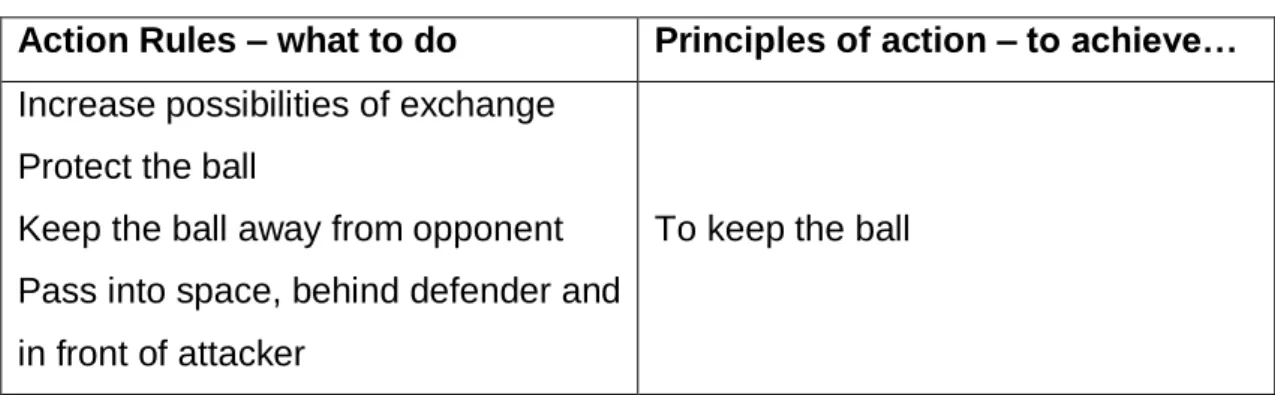
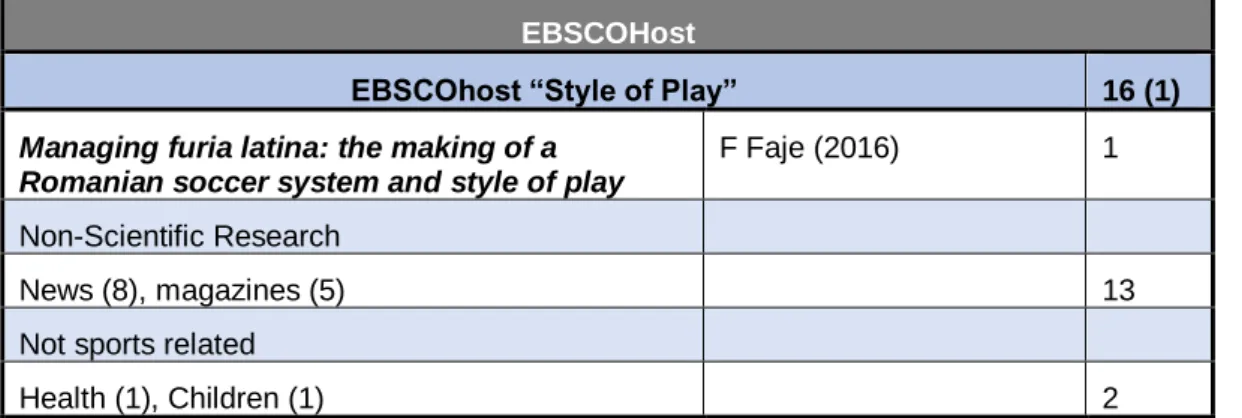
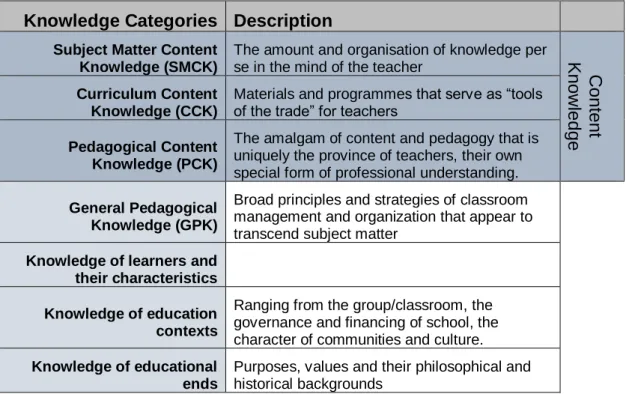
Table 2.1: An example of action rules that lead to a principle of action (Gréhaigne et al., 2005). ____ 22 Table 2.2: The fundamental offensive and defensive principles. ______________________________ 25 Table 2.3: Search on Google Scholar. ___________________________________________________ 27 Table 2.4: Search on EBSCOHost._______________________________________________________ 28 Table 2.5: Search on StarPlus. _________________________________________________________ 28 Table 2.6: Categories of the Knowledge Base (Shulman, 1986, pp. 9-10, 1987, p. 8). ______________ 51 Table 2.7: Categories of the Knowledge Base (Shulman, 1986, 1987) and the Triad of Knowledge
Categorisation (Collinson, 1996). __________________________________________________ 53 Table 2.8: Metzler's (2011) categories fitting Shulman’s (1986) Subsets as presented in sports coaching
(Cassidy et.al., 2009). ___________________________________________________________ 55 Table 3.1: QCA checklist for methodology selection. _______________________________________ 70 Table 3.2: The two phases of this research process. ________________________________________ 72 Table 3.3: The Participating Expert Coaches. _____________________________________________ 76 Table 3.4: The areas and phases making this study. ________________________________________ 82 Table 4.1: Data Display of The Model of Pedagogical Reasoning and Action. (Shulman, 1988, p. 15). 89 Table 4.2: A Data Display of A Theory of Instruction (Bruner, 1963). __________________________ 90 Table 4.3: The Coaches’ Process of Knowledge Generation for CPP 1.2. Categorisation table for Phase
1.2. _________________________________________________________________________ 99
Table 5.1: The Coaches’ Process of Knowledge Generation for CPP. Version 1.2 simplified._______ 116 Table 5.2: An example of PoP. ________________________________________________________ 162 Table 6.1: The VARK related data collected. _____________________________________________ 256 Table 6.2: Categories of the Knowledge Base (Shulman, 1986, 1987) featuring in the Coaches’ Process
of Knowledge Generation for CPP. _______________________________________________ 262 Table 6.3 The categories of the knowledge base as presented by Shulman (1988) and my personal
LIST OF ABBREVIATIONS
CK – Content Knowledge
CCK – Curricular Content Knowledge / Curriculum Knowledge SMCK – Subject Matter Content Knowledge
PCK – Pedagogical Content Knowledge
CPP® – Coach(ing) through Principles of Play®;
PoP – Principle of Play / Principles of Play MoP – Model of Play / Models of Play TI – A Theory of Instruction
FIGC – Federazione Italiana Giuoco Calcio TGfU – Teaching Games for Understanding
CHAPTER 1
INTRODUCTION
1.1 INTRODUCTION
This thesis grew out of my ongoing thirst for furthering my pedagogical tactical content knowledge as a soccer coach. More specifically, the study reported here will identify and conceptualise a deep understanding of knowledge generation for Coaching through Principles of Play (CPP). It asks:
- How do coaches generate knowledge to coach through Principles of Play?
This chapter will briefly consider a working definition of sports coaching and other concerns central to thesis and before setting out the structure and parameters of the thesis as a whole.
Sports coaching is central to this study, therefore it is important to clear from the onset, that whist the term ‘coaching’ also refers to executive-coaching (Kilburg, 1996; Thach & Heinselman, 1999), and coaching in educational contexts (Bloom, Castagna, & Betsy, 2003; Cornett et al., 2009), this study focuses on sports coaching (e.g. Cassidy, Jones, & Potrac, 2009; Côté & Gilbert, 2009b; Jones, 2007), and specifically soccer coaching.
Sports coaching is a complex and ambiguous activity (Jones & Thomas, 2016), marked by negotiated interactions, aimed primarily at athletes’ learning, which normally takes place at the ‘edge of chaos’ (Bowes & Jones, 2006). Coaches like pedagogues (Jones, 2006; Jones, Armour, & Potrac, 2004) need to become “good teachers of the game” (The Football Association, 2012, p. 9). Back in 1967 Allen Wade highlighted the importance of coaches teaching the
what to do, together with the why, when and how to do it. Côté and Gilbert (2009) explain that coaching effectiveness results from consistent application of coaches’ knowledge to improve athletes in their specific contexts. Gearity
(2012, p. 90) stresses the importance of content knowledge for coaches so that they can “effectively teach what needs to be done” and provide useful coaching instructions, which are crucial if coaches are not to be perceived as poor
teachers.
Gray and Hall (2015) claim that half of coaching instructions are tactical in nature, which shows the centrality and importance of tactical knowledge (Gray & Hall, 2015). They further explain that tactical knowledge “enables the
coach to make sense of the chaotic ebb and flow of tactical action information” (p. 149).
Instead of looking at coaching as an art, one can consider it as scientific and systematic (Jones et al., 2004, p. 37). When coaches conceptualise soccer coaching as a science, they can look at the complexity, systemic nature and internal logic of the game (Gréhaigne, Richard, & Griffin, 2005), and can appreciate that it can be studied in a scientific manner (Delgado-Bordonau & Mendez-Villanueva, 2012; Jankowski, 2016; Pimenta, 2014).
Tactical content knowledge has achieved central importance in both sports coaching and physical education, with the shift from conventional (Clemente & Rocha, 2013) and traditional coaching approaches (Gray & Hall, 2015, p. 163), to Game Based Approaches (e.g. Bunker & Thorpe, 1982; Duyn, 1997; Launder, 2001; Light, 2013). This shift proposes an approach which focuses on teaching in the context of the game as a whole (Light & Harvey, 2017) rather than uncontextualised skills and segregated physical or technical demands as discrete components of the game (Clemente & Rocha, 2013; Light, 2017; Light & Harvey, 2017).
This game based approach has gained international popularity across the whole world in the last twenty years, with the Game Concept Approach (Rossi, Fry, McNeill, & Tan, 2007), Tactical Games Approach (Mitchell, Oslin, & Griffin, 2013) and Tactical-Decision Learning Model (Gréhaigne et al., 2005) being also developed in Singapore, the USA and France respectively (Light, 2013). This shift has also infiltrated soccer coaching through coaching
methodologies such as the Global-Analytical-Global (Csabai, Reinkens, Dalla Pace, & Haines, n.d.; FIFA.com, n.d.) and Tactical Periodization (e.g. Delgado-Bordonau & Mendez-Villanueva, 2012; Tamarit, 2015).
It is not the intention of this thesis to show preference to one approach over another, nor to infer the incompatibility of the two approaches. The Global-Analytical-Global, and Tactical Periodization can, to an extent include
conventional and/or traditional approaches. A coach may wish to use more than one and integrating tactical coaching knowledge within the more conventionally or traditionally set training exercises or sessions may be appropriate.
The literature, and the same paradigm shift, confirm the importance of tactical content knowledge, yet recent literature reveals a huge concern about insufficient knowledge of the game (Harvey & Jarrett, 2014; Mitchell et al., 2013). Harvey and Jarrett (2014, p. 290) argue for further research to support teachers’ and coaches’ conceptual and pedagogical content knowledge. Roberts' (2011, p. 43) proclaims that the lack of appropriate Pedagogical
Content Knowledge is one of the reasons why teachers may move back to sole use of direct technical approaches.
Harvey and Jarrett (2014) and Roberts (2011) express concern about a vacuum around the level of pedagogical tactical content knowledge, referring to Pedagogical Content Knowledge, as a “form of teacher knowledge” (Wilkes, 1994), which re-strengthens the coaches’ pedagogical role.
Côté and Gilbert’s (2009) reference to specific contexts as a postulate to coaching effectiveness, highlights an inference to an important philosophical assumption of knowledge contextualisation. I suggest that tactical content knowledge needs to be generated by the coaches for the contexts they work in and the athletes they work with.
This shifts the gaze from coaching knowledge as unproblematic, with coaches as technicians involved in the transfer of knowledge (Cassidy et al., 2009), to coaches as learning expert participants (Sfard, 2008), who do not only repeat what they have learned in one context (for example coaching education), to the next (such as training and planning). Rather, with the focus as
pedagogical tactical content knowledge, they need to apply the concept of preparation for future learning (Bransford & Schwartz, 1999). This resonates with Bruner's (1963) concept of productiveness, and expects that coaches are able to generate new propositions from previously acquired knowledge. Hatano and Greeno (1999) have proposed replacing the term ‘transfer’ with
‘productivity’ focussing at the degree to which learning in one kind of activity can be effective in successive different activities. This thesis is not about coaches’ knowledge acquisition, rather the focus is coaches’ knowledge generation.
1.2 AIM OF THE STUDY
The study reported in this thesis focuses on the importance literature puts on coaches’ knowledge (e.g. Côté & Gilbert, 2009b; Gearity, 2012) specifically pedagogical content knowledge (Harvey & Jarrett, 2014; Roberts, 2011) which focuses on the tactical (knowledge) nature of the game (Gray & Hall, 2015; Harvey & Jarrett, 2014).
The pedagogical nature of the study reported here, more specifically the importance of pedagogical content knowledge (Shulman, 1986, p.9) brings us to the work of Shulman, known for his theory of pedagogical content knowledge (Wilkes, 1994) and for his Model of Pedagogical Reasoning and Action
(Shulman, 1987). These ideas are central to this study.
As Abraham et al., (2015, p. 27) note, to unpack all the ‘what’ of soccer tactical content knowledge is a large task. This lies beyond the scope of this thesis; as a minimum, tactical content knowledge would include ‘tactics’, ‘strategy’, ‘Principles of Play’ and ‘rules’, which, although normally used interchangeably, all have different meaning (Gray & Hall, 2015; Gréhaigne et al., 2005).
From the standpoint that pedagogical [tactical] content knowledge is the subject matter which takes the “dimension of subject matter for teaching”
(Shulman, 1986, p. 9), we can return to the explanation of coaching
effectiveness relying on the consistent application of coaches’ knowledge to improve athletes’ learning (Côté and Gilbert, 2009).
This thesis places the focus on Principles of Play (PoP) as the ideal pedagogical tactical content knowledge, because as Morales-Belando,
Calderón, and Arias-Estero (2018) explain, PoP can be used to assist players [learning] in making the appropriate tactical decisions. Gray and Hall (2015, p. 153) sustain this as they claim that ‘PoP’ are the rules that, players need to abide by, to [learn and] achieve goals more effectively. It is PoP that players need to learn during training sessions, because they need to apply these PoP during competition (Delgado-Bordonau and Mendez-Villanueva, 2012).
In this under-researched area, studies indicate the usefulness of PoP in Physical Education (Hopper, 1998; Morales-Belando et al., 2018; Ward & Griggs, 2011) and in sports coaching (Crespo, 2011; Ouellette, 2004).
Furthermore, Tactical Periodization (DiBernardo, 2015; Tamarit, 2015), is a coaching methodology which proposes training sessions to be organised around the PoP.
In this thesis PoP will frame the pedagogical tactical content knowledge that coaches need to generate, in order to be “good teachers of the game” (The Football Association, 2012, p. 9) who are able to teach the what the why the
when and the how (Wade, 1967), and this is my rationale for introducing the term ‘coaching through Principles of Play’ (CPP) in the study reported here which investigates the following research question:
- How do coaches generate knowledge to coach through Principles of Play?
This research question steered the process of this study, which was divided into two phases. In Phase 1, I have theoretically conceptualised the process coaches may engage in. Based on that conceptualisation, in Phase 2, I engaged in lengthy discussions with expert soccer coaches, who were involved in populating the conceptualisation further, to represent their actual practice.
My personal worldview and my academic and practical experiences in teaching and coaching have influenced my curiosities set within the rationale and gaps presented above. They have catalysed this study which will
conceptualise the coaches’ process of knowledge generation for
coaching through Principles of Play in soccer, in a way to provide an initial answer to the research question.
A peripheral and additional part of this study is the presentation of the body of tactical content knowledge of two of the participating coaches. This will be presented in the form of what is for them a Model of Play in Appendix 1.1.
1.3 POSITIONALITY, ASSUMPTIONS AND PERSONAL
RATIONALE FOR THE STUDY
With transparency and research contextualisation in mind, in this section I will introduce myself, and my world view. My positionality, assumptions and my rationale for the development of this study will be presented next.
1.3.1 Positionality
I am a graduate PE teacher, with an MSc in Sports Coaching, a post-graduate diploma in Soccer Physical Training and the UEFA B and UEFA A soccer coaching badges. Season 2018-2019 was my 18th season of soccer coaching.
In these eighteen years, I have coached children from 5-11 years of age, 14-19-year-old youths, assisted in the Maltese premier division and have also been employed as the first team coach in the 3rd, 2nd and 1st divisions in Malta.
I have been a full-time sports lecturer since 2011 and involved in coaching education with the University of Malta and with the Malta Football Association since 2013.
Notwithstanding my experience in the field, I have always been concerned about the nature and extent of my tactical content knowledge. Perhaps because I might be influenced by the assumption that “…if you’ve never been there and done it, and [if] all you’ve ever done is coached, you can’t explain it and you can’t effectively teach what needs to be done” (Gearity, 2012, p. 90). My thirst for more knowledge has underpinned my need to assure my coaching credibility.
In 2011, I participated in a coaching clinic led by Arrigo Sacchi and Maurizio Viscidi (Federazione Italiana Giuoco Calcio; FIGC). This is when I learned about the concept of Principles of Play (PoP), “I principi del giocho” for the first time. I was later surprised to realise that the FA introduced the concept of “principles of team play” back in 1967 (Wade, 1967). I was only forty-four years late! Coincidentally, or less, Teaching Games for Understanding (TGfU) had its roots in Alan Wade’s works, and later others (Forrest, Webb, & Pearson, 2006)
1.3.2 Assumptions
In terms of my position on the Pedagogical dimensions of Coaching, I see
teaching, learning, knowledge and the learning environment as core to coaching practice (Jones, Armour & Potrac, 2003, p. 4). Thus coaching of skills,
technique and tactics (Jones, 2006, p. 7) are pedagogical in nature (Wikeley & Bullock in Jones, 2006). This pedagogical dimension is argued in various studies of coaching pedagogy (see for example Gearity, 2012; Jones & Thomas, 2016; Light, 2017).
To contextualise sports coaching in its tactics (Gréhaigne, Wallian, & Godbout, 2005; Light, 2013, 2017), it is necessary to adopt a scientific and systematic ‘conscious activity…designed to enhance learning in another’
individual (Watkins & Mortimore, 1999, p. 3). This pedagogical dimension of the coaching process is a complex and difficult process which is demanding on the coach, who as a pedagogue (Jones, 2006) needs to continuously switch
between the roles of teacher and learner, so as to understand and generate her/his necessary knowledge, to be able to communicate this to athletes (Shulman, 1987).
Thus, coaching takes on a dimension of Pedagogical Reasoning and Action (Shulman, 1987). As I will explain later, the Model of Pedagogical Reasoning and Action is one of the pillars of the theoretical framework of this study.
When seeking ‘the actual knowledge’, one may easily fall in the pluralist
trap of thinking that there is only one truth (Patterson & Williams, 2002). To the contrary, with a constructivist view, I believe that knowledge, in all its forms, is highly personal and contextual, hence it changes, evolves or ‘regenerates’, as termed later in this study.
This view of an ongoing regenerated knowledge is underpinned by a focus on the coach, who instead of being looked at as the athletes’ teacher, this time, is seen as the learner (Nash, 2015), who, as an expert participant (Sfard, 2008, p. 33) engages in an ongoing learning and knowledge generation
process.
Therefore, while I aim at contributing to the development and deeper understanding of coaches’ tactical content knowledge, I fully acknowledge that in its fluidity, knowledge, is unique for every coach and every context. An ever-evolving context, like the soccer context, require one’s knowledge to be under constant evolution. That is because, sports coaches, like all human beings create meaning from their interaction with their environment (Ertmer & Newby, 2013).
Having said that, I need to clarify from the onset that when talking about the constructivist paradigm, I am here applying it only to the coaches’
interventions, which may take various approaches, not excluding a constructivist approach.
1.3.3 Rationale for the study
Literature highlights the importance of the coach’s role (Cassidy et al., 2009; Evans, 2007; Lyle & Cushion, 2017) as a “more capable other” (Potrac &
Cassidy, 2006, pp. 39-50). However, there remains a gap in terms of the role of the coach in generating tactical content knowledge (Abraham et al., 2015; Harvey & Jarrett, 2014; Mitchell et al., 2013). To sustain the role of ‘capable other’, technical and tactical content knowledge “is the most important
knowledge base…yet is often the knowledge base that coaches lack the most” (Abraham et al., 2015, p. 29). This knowledge base is even more important when one considers a paradigm shift that saw coaching moving towards a Game Based Approach and away from the more “coach-centred, skill-focused” traditional approaches (Gray & Hall, 2015, p. 162).
This study is, to my knowledge, the first to examine the concept of CPP from the perspective of pedagogical tactical content knowledge generation. The aim here is to provide a deeper understanding of how those CPP, may locate their role, as ongoing expert learners who continuously (and contextually) generate knowledge so that their coaching takes a pedagogical dimension.
The thesis aims to develop a conceptualised understanding of how coaches can generate tactical content knowledge and then transform that into pedagogical tactical content knowledge (Roberts, 2011; Shulman, 1986). The Pedagogical Content Knowledge of two participating soccer coaches is
presented in Appendix 1.1 as a subjective example. Whilst demonstrating what pedagogical tactical content knowledge might look like, it is not intended as a ready-made-formula.
While it focuses on soccer coaching, this study may also illuminate the issue raised by Ward and Griggs (2011) who proposed the use of PoP as the focus of primary games lessons in physical education, thus addressing the concerns of some PE teachers (Mitchell et al., 2013).
1.4 FRAMING THIS STUDY
The conceptualisation of the coaches’ process of knowledge generation for CPP, was made possible by the identification of the theoretical framework which was composed of:
- Tactical Periodization (Delgado-Bordonau & Mendez-Villanueva, 2012; Jankowski, 2016; Oliveira, 2014b, 2014a) which provides the conceptual understanding of CPP.
- The Model of Pedagogical Reasoning and Action (Shulman, 1987), which assured that the conceptualisation focuses on the coaches who “commute from the status of learner to that of teacher, from being able to comprehend subject matter for themselves, to becoming able to elucidate subject matter in new ways, reorganise and partition it…so that it can be grasped by” athletes (p. 12-13). - A Theory of Instruction (Bruner, 1963, p. 523), which assured that
this study conceptualises the ideas needed by one (the expert participant) to practically pass on the knowledge to others. In the following sections, I will be providing the rationale by which I identified the texts, models or theories that I have used to conceptualise the
‘Coaches’ Process of Knowledge Generation for Coaching through Principles of Play’.
1.4.1 Tactical Periodization
I start by acknowledging the importance of knowledge as one of the postulates for effective coaching (Côté & Gilbert, 2009). Specifically, tactical knowledge which is known for assuring good quality in coaches’ instruction and feedback (Boardley, Kavussanu, & Ring, 2016; Gearity, 2012). Decision making is a key aspect of effective soccer coaching; amongst many other things, soccer
coaches need to make decisions about tactics, positional play and type of feedback to be given. As Nash (2015, p. 185) explains, whenever a decision needs to be made, “basic elements are identified, and a solution is created from knowledge stored in the memory”. She suggests that expert coaches’
I believe that CPP, both needs (i) a way to generate the tactical knowledge base needed for effective coaching and (ii) an efficient way to structure this tactical knowledge, with a pedagogical approach.
With its focus on tactical content knowledge, this study moves away from the notion of a free and intuitive process so far as the selection and application of content knowledge (Cassidy et al. 2009, p. 126) is concerned, and moves towards an understanding of the systemic nature of the game (Gréhaigne et al., 2005), and how that guides the generation of tactical content knowledge.
Coaching soccer through PoP as proposed in Tactical Periodization (Carvalhal et al., 2014; Delgado-Bordonau & Mendez-Villanueva, 2012; Jankowski, 2016; Oliveira, 2014a, 2014b) frames this knowledge generation process.
The term ‘Principles of Play’ was for the first time mentioned by Wade in 1967, and subsequent authors have recognised the term, both as a mechanism to further understand games (Gray & Hall, 2015; Gréhaigne et al., 2005) or (particularly in PE lessons) as a framework for tactical [pedagogical] content knowledge (see Hopper, 1998; Ward & Griggs, 2011; Morales-Belando et al., 2018). The same concept is strongly recognised by Tactical Periodization
(Delgado-Bordonau & Mendez-Villanueva, 2012; DiBernardo, 2015; Tamarit, 2015), a soccer coaching methodology which was created by Victor Frade in 1998, and which follows the idea of organising training through the principles (Carvalhal et al., 2014) of the game. The literature indicates that PoP can support understanding of ‘what’ (Abraham et al., 2015) knowledge soccer coaches need to generate.
This has set out the rationale for considering Tactical Periodization (Delgado-Bordonau & Mendez-Villanueva, 2012; Jankowski, 2016; Oliveira, 2014b, 2014a), as the only coaching methodology that strongly refers to PoP, and therefore is the coaching methodology that underpins this study.
1.4.2 The Model of Pedagogical Reasoning and Action
The term Pedagogical Content Knowledge was introduced by Shulman in 1986 (Wilkes, 1994). Whilst I am interested in understanding what other coaches’ content knowledge might look like (Appendix 1.1), and the importance of
understanding how that content knowledge takes a new dimension, to become teachable, within its context.
Shulman's (1987) seminal work, conceptualises the knowledge base for teachers in seven categories which include content knowledge and pedagogical content knowledge. Further, he suggests the idea of Pedagogical Reasoning and Action (Smart, Sim, & Finger, 2014) seeing pedagogical reasoning “from
the point of view of the teacher, who is presented with the challenge of taking what he or she already understands and making it ready for effective
instruction” (Shulman, 1987, p. 14). Philosophically, I do not agree with
Shulman’s interpretation of some terms, yet I suggest that the main aim of the soccer coach who engages in CPP, is to generate PoP which have contextual grounding, and which are then transformed into more teachable PoP.
Therefore, the concept of Pedagogical Reasoning and Action
(Shulman, 1987) was found to be an important second theoretical underpinning of this study, allowing me to consider the coach as a processor of knowledge, who transforms his or her generated knowledge into knowledge that can be understood by the players (Shulman 1987, p. 14).
1.4.3 A Theory of Instruction
While the term instruction is not the exact term when considering a learner-centred approach such as GBA’s (Light, 2017), Bruner’s A Theory of Instruction (Bruner, 1963, p. 523) will contribute in looking at the coaches’ process of knowledge generation “…as practical a thing as one could possibly have, to guide one in the process of passing on the knowledge, the skills, the point of view…”. Practically speaking, Bruner’s work requires that this study considers how the generated pedagogical content knowledge can be put to practical use within the learning environment. That is to say, one can generate content knowledge, on PoP in defending, and transform that into pedagogical content knowledge, hence into PoP that athletes need. However, at what time, and in what form, sequence and method, that knowledge be made available to the learner must be understood. A Theory of Instruction can initiate the
1.5 CONCLUSION
This chapter has introduced two shifts that happened in sports coaching in recent decades. It has set out my rationale and my own positionality which give direction to this study. It has also presented the composition of the theoretical framework and the research question which guides this research about the Coaches’ Process of Knowledge Generation for CPP.
This study is organised into seven chapters. Following this introductory chapter are the literature review (Chapter 2) and the methodology (Chapter 3) which are followed by Chapter 4 which includes a detailed explanation of process of analysis. The findings, including the three versions of the
conceptualised process are presented in Chapter 5, and discussed in Chapter 6, with Chapter 7 concluding this thesis with a reflection on its achievements, limitations and potential for future research.
CHAPTER 2
2.1 INTRODUCTION
In this literature review, I start by introducing soccer as a complex, chaotic and random game and proceed to examine how an Integrated Tactical Approach acknowledges this complexity. This made me consider the importance of coaches’ knowledge, more specifically tactical content knowledge, which is the main focus of this study. This led to a clarification of the main terminology used in the field of tactics in soccer, and to the introduction of PoP. The terminology which is central for CPP was presented thereafter.
Following this first part of the literature review which introduces the main concept needed for one to understand CPP, I introduce how literature covers this field, and what gaps are being left, and tackled by this study.
The theories framing this study, namely the Model of Pedagogical Reasoning and Action (Shulman, 1987), A Theory of Instruction (Bruner, 1963, 1966), Tactical Periodization (Oliveira, 2014b, 2014a), and knowledge
categories (Anderson, 1982; Cassidy et al., 2009; Collinson, 1996; Larkin, 2010; Metzler, 2011; Shulman, 1986, 1987), will be covered in the last part of the literature review.
2.2 SOCCER IS A COMPLEX GAME
Traditionally, soccer is conceptualised such that game play is broken down into simple elements, with a team’s strength being equal to the sum of the individual players. Looking at soccer as a social microsystem in which there exists a reciprocal coordination of individual and collective actions, the structuralist model looks at a team as “more than the sum of the individuals who compose it”. In recognising that soccer is played between two opposing teams, the ‘systemic model’ switches its pedagogical focus by explaining game play within the oppositional relationship that exists between two opposing teams, which together with the environment in which they exist, make soccer a complex system (Gréhaigne et al., 2005, pp. 8-9).
This systemic view of soccer recognises the complexity in the chaotic, random and disorganised nature of soccer (Pimenta, 2014). The complexity of the game is known for its dynamic interactions between two sets of players (Garganta & Grehaigne, 1999). Targeted on an indisputable objective of
winning the game, like any other team sports, soccer is characterised by: (i) a rapport of strength, in which two teams confront each other fighting for control of a ball; (ii) a choice of motor skills, which players need to master as responses to the various situations in the game; and (iii) individual and collective strategies, which lead the implicit or explicit decisions taken by the athletes based on a common frame of reference (Gréhaigne & Godbout, 1995).
As in all team sports, opposition (to opponents), cooperation (with
teammates), attack (on the opponent’s side) and defence (of own side) are four central notions to the internal logic of soccer. In invasive games, these elements are at play simultaneously. This oppositional relationship that exists during each sequence of play requires ongoing decision making from all parties which
contributes to the same oppositional relationship. This ongoing process of problem-solving needs to be informed by the players’ interpretation of tactical knowledge (Gréhaigne et al., 2005).
Game tactics have a direct influence on player decision making in games, because “players have to solve problems; problems relating to
interpreting tactical information” (Gray & Hall, 2015, p. 152). As Gray and Hall explain, the level of success of a decision is directly related to the player’s tactical understanding of the situation. They further clarify that no matter how technically accurate a player’s motor-skill is, it is not successful unless it is appropriate for the given tactical problem/situation. It has long been argued that “mistakes commonly observed in young children in various sports may stem from a lack of knowledge about what to do in the context of a given sport situation” (French & Thomas, 2016, p. 17). Based on this tactical knowledge, athletes can make decisions which lead to the use of the appropriate or inappropriate technique. “Not understanding the game impairs the [learner’s] ability to identify the correct technique for a situation” (Mitchell et al., 2013, p. 9). This highlights how important tactical understanding is for soccer players.
2.3 A TACTICAL COACHING APPROACH
This view of soccer as complex, and the importance of decision making, have surely influenced the way coaching has shifted along the years. Until the last part of the twentieth century, soccer training was highly influenced by the
conventional training approach and dominated by fragmented drills, analytical exercises and physical conditioning. This approach has been criticised as unsuitable for a team sport involving a two-team relationship of opposition and cooperation (Clemente & Rocha, 2013).
With an attempt to contextualise soccer training within its technical and tactical properties, the integrated method was proposed as an alternative (see. Crespo, 2011; Delgado-Bordonau & Mendez-Villanueva, 2012; Oliveira, 2014b). This method may be seen as equally conventional, as instead of using the highly conditioning approach of the conventional training method, coaches would simply include a ball (above all, as the proverbial carrot in contrast to the stick). When it comes to teaching the game, analytical and individual technical exercises would be central to the training session. Passing drills and technical work in pairs (or any other variation of that) would normally form one part of the session, with physical conditioning forming the other part, and sometimes ending the session with actually playing a soccer (Clemente & Rocha, 2013).
The complexity of team sports leads us to consider the interrelation between space, time, team-mates, ball, and opponents in the context of the objectives of the sport itself. This is what comprises tactics. Soccer players need to apply their tactical knowledge, in action, in ways that enable tactical decision making. The tactical ability of the player involves a cognitive process which includes a decision-making process initiated by a randomly presented trigger or stimulus, based on previously acquired tactical knowledge. The decision made following this process leads the player to initiate the motor skill necessary to obtain the temporary micro-objective (Clemente & Rocha, 2013). A straight array made of these micro-processes including data processing, decision making and actions - by all players, all the time, in different situations and locations of the pitch - form one single attacking or defending action, until halted by the opposing team’s players who would be going through a similar process. This shows the complexity of the game of soccer which is anything but a simple pass, a run or a tussle without a context-based decision (Gréhaigne & Godbout, 1995).
“A coach’s work should be translated into some form of change in
athletes’ outcomes” (Côté & Gilbert, 2009, p. 309). A tactical coaching approach is inherently based on the desire to obtain better tactical decision making by
athletes. In fact, the Tactical Decision Learning Model (Gréhaigne et al., 2005; Gréhaigne, Wallian, & Godbout, 2005) proposes an operational teaching model, intended at enhancing learners’ construction of tactical knowledge and the development of their decision-making skills.
The latest applications of sports science and the latest applications of learning conceptualisation to soccer training methods, cannot but accentuate that segregated training, as applied in both the conventional and the integrated training methods, are not the ideal way to prepare soccer players. It is important that players participate in complex training exercises that emulate parts of the game so that the players will be able to act upon their reaction to perceived stimuli (Clemente & Rocha, 2013).
In recent decades, several methods aimed at countering
decontextualised training, have suggested an integrated tactical approach to coaching. The Teaching Games for Understanding (TGFU; Bunker & Thorpe, 1982), Tactical Games (Griffin, Mitchell and Oslin, 1997), Play Practice
(Launder, 2001), Tactical-Decision Learning Model (Gréhaigne, Richard, Griffin, 2005), Game Sense (Light, 2013; Zuccolo, Spittle & Pill, 2014), Games Concept Approach (GCA) (Rossi, Fry, McNeill & Tan, 2007), the GAG method, which stands for Global-Analytical-Global (Bonfanti & Pereni, 1998; Csabai et al., n.d.; “The Grassroots Soccer Session,” n.d.) and Tactical Periodization (Mendonça, 2013) are all methods intended to promote athletes learning through games (tactics) within a constructivist learner-centred, inquiry-based approach (Light, 2013).
It is this constructivist view, which looks for “knowledge construction within a social context” and which acknowledges that “learning is a process that is complex and cannot be reduced simply to additively learning component parts of the complex whole” (Zuccolo, Spittle and Pill, 2014, p. 21), that has led to the integrated tactical approach.
While I support the idea of coaching through game tactics, as discussed in the introduction, I do not exclude the possibility of tactical learning and decision-making development within a more traditional approach which boasts on the technical and physical development of the game.