EMERGO
a generic platform for authoring and playing
scenario-based serious games
EMERGO
EMERGO
The research reported in this thesis was carried out at the Open University of the Netherlands at the Faculty of Psychology and Educational Sciences
SIKS Dissertation Series No. 2018-21
The research reported in this thesis has been carried out under the auspices of SIKS, the Dutch Research School for Information and Knowledge Systems.
© 2018 Aad Slootmaker, Heerlen
Cover design: Sneldrukkerij Pasklaar, Sittard Printing: Datawyse | Universitaire Pers, Maastricht ISBN 978-94-92739-21-6
EMERGO
a generic platform for
authoring and playing
scenario-based serious games
Proefschrift
ter verkrijging van de graad van doctor
aan de Open Universiteit
op gezag van de rector magnificus,
prof. mr. A. Oskamp
ten overstaan van een door het
College voor promoties ingestelde commissie
in het openbaar te verdedigen
op vrijdag 14 september 2018 te Heerlen
om 16:00 uur precies
door
Adriaan Slootmaker
Promotor
Prof. dr. E.J.R. Koper, Open Universiteit
Co-promotor
Dr. H.G.K. Hummel, Open Universiteit
Leden beoordelingscommissie
Prof. dr. D. Griffiths, University of Bolton
Prof. dr. M.D. Kickmeier-Rust, Graz University of Technology and
Univer-sity of Teacher Education St. Gallen
Prof. dr. H. Drachsler, Open Universiteit and German Institute for
Inter-national Educational Research
Contents
Chapter 1 General introduction 7
Chapter 2 Developing scenario-based serious games for complex cognitive skills acquisition design, development and evaluation of the
EMERGO platform 23
Chapter 3 EMERGO platform components processes and architecture 47 Chapter 4 Evaluating the usability of authoring environments for serious games 91 Chapter 5 Evaluating the usability of player environments for serious games 115
Chapter 6 General discussion 137
References 151
Appendices 159
Summary 165
Samenvatting 173
Dankwoord 183
Chapter
1
1
Introduction
In this thesis we describe the design and evaluation of an online scenario-based serious game platform that enables online universities to efficiently develop their own scenario-based serious games and to deliver them to their students.
Online educators have always been interested and involved in integrating new technol-ogies and methods in their curricula to improve the quality, efficiency and effectiveness of their education. Motivation can be considered to be a key aspect of effective learning (Prensky, 2007). A higher intrinsic motivation often leads to a better performance, in-creased curiosity and more explorative and self-regulated study behavior (Ryan & Deci, 2000; Martens, Gulikers, & Bastiaens, 2004). Increased motivation may also lead to more satisfied students and to lower dropout rates. For institutes that provide online learning it is even more important to integrate new technologies and methods to literal-ly bridge the distance to their students because they lack facilities like lecture halls, laboratories, field trips or internships.
Nowadays higher education in general calls for more competency-based education and workplace learning. This kind of learning often requires acquiring complex professional and academic skills in authentic professional settings. These skills involve cognitive pro-cesses that are associated with higher-order activities like problem solving, reasoning, taking decisions or reflecting in context, which take a lot of time and practice to master. As a result, this kind of experiential education often is difficult to organize because these skills require a lot of time to teach, frequent training in different (protected) situa-tions and time-consuming guidance with the risk of guidance not given on time or to a sufficient extent in actual practice. In addition, higher education faces the problem how to ensure the transfer of acquired skills and knowledge to professional practice. Exer-cise situations that are equivalent to later professional practice will foster this transfer. Serious games offer a solution for aforementioned problems because they may offer built-in personalized teaching and guidance, offer different (protected) situations to practice and resemble professional practice.
The term “serious game” was first used by Abt (1970) to define a board or card game where players pursue serious goals. The term became popular since 2002 when the Serious Games Initiative promoted the use of video game technology and knowledge to improve game-based simulations in public organizations (Djaouti, Alvarez, Jessel, & Rampnoux, 2011). Since 2002 a serious game is no longer seen as a board or card game but as a special kind of video game. Michael and Chen (2006) defined serious games as games that do not have entertainment, enjoyment, or fun as their primary purpose. A game developer’s primary purpose, for instance, could be learning, but also behavioral change to improve health, public awareness of social issues, or marketing. According to the definition of Michael and Chen (2006) entertainment, enjoyment and fun are sub-ordinate to this primary purpose. However, Dörner, Göbel, Effelsberg, and Wiemeyer
(2016) do not rank the purposes of a serious game by their importance and define a serious game as “a digital game created with the intention to entertain and to achieve at least one additional goal (e.g., learning or health)”. The additional goals of a game developer are sufficient to categorize a game as a serious game and to characterize its type. The authors rightly point out that entertainment games may also be used serious-ly, e.g., to improve one’s skills.
As our context is online universities we assume the primary purpose of serious games to be learning. We comply with the “serious game” definition of Michael and Chen (2006) where the primary purpose of a serious game is not entertainment, enjoyment or fun. We believe that entertainment and fun should be subordinate to learning and should naturally arise during game development and not be imposed. According to Prensky (2002), the primary objective of a game designer is not entertainment but engagement that is generated by challenge and relaxation. In addition, in games for learning fun is not about amusement but about enjoyment and pleasure, which leads to relaxation and motivation. According to the author: “Relaxation enables learners to take things in more easily; motivation enables them to put forth effort without resentment.”. Franzwa et al. (2014) state that learning and fun should be in balance and that too much fun may distract a player or even stop his progress. We believe that the balance between learn-ing and fun may also depend on the characteristics of the target group, e.g., youngsters or adults, or on the characteristics of a learning task, e.g., more active or more passive. Serious games can be categorized into different types that correspond to entertainment game types like adventure games, strategy games, role-playing games, simulation games, exercise games, or pervasive games, or may be combinations of several types. Our focus is scenario-based serious games that combine aspects of adventure, strategy, role-playing and simulation games. This type of games present interactive narratives driven by exploration, problem-solving and decision-making to students playing roles in simulated complex problem spaces that closely resemble professional practice. Stu-dents are confronted with ill-defined problems, often allowing multiple solutions and requiring application of necessary methodologies or tools and collaboration with fellow learners (Westera, Nadolski, Hummel, & Wopereis, 2008). We call these games ‘scenar-io-based’ because the scenario plays such an important role as being the design of the game. The scenario extensively describes the problem space, which activities have to be done and which materials are needed to acquire required complex cognitive skills, and how the problem space should adapt to the individual students. In this thesis we will focus on scenario-based serious games that are aimed at learning.
Serious games are powerful means to provide learning in a more effective way and are able to increase learners’ motivation (De Freitas, 2006; Connolly et al., 2012; Backlund, & Hendrix, 2013; Boyle et al., 2016). In addition, engagement and challenge have a positive effect on learning (Hamari et al., 2016). The primary goal of serious games is to
motivate learners, give them appropriate feedback, improve their skills at the right level, and improve collaboration within groups (Ibrahim et al, 2012). The learner should be in control and learning should be situated and authentic, possibly based on a didacti-cal model or approach and should support transfer of learned skills (Dede, 2009; Clark, & Mayer, 2011; Thillainathan, & Leimeister, 2014). Serious game developers may im-prove learners’ motivation by providing players with an interesting storyline and enjoy-able interface, generating interest or curiosity, offering challenging, exciting and cus-tomized tasks, giving a feeling of being in control, offering immediate feedback and adapting to the individual learner (Dörner, Göbel, Effelsberg, & Wiemeyer, 2016). These aspects can foster active engagement and can support the intended goals of a serious game.
Given their potential benefits it is no surprise that the use of serious games is still grow-ing and that innovation of the field is stimulated, for instance, by the European Union. In 2015 the global games market grew by more than 9% and the serious games market also showed impressive growth figures (Games Monitor, 2015). In addition, from 2012 to 2015, the number of serious game developers in game studios in the Netherlands grew by more than 7% annually. This growth is still continuing since the video games market is expected to grow at 6.8% annually from 2017 to 2021 (PMC, 2017). Since the first decade innovation of the field of serious games is stimulated by the European Un-ion as is illustrated by numerous European projects such as the ELEKTRA project (2006 – 2008), the PlayMancer project (2007 – 2011), the 80days project (2008 – 2010), the ImREAL project (2010 -2013), the GALA project (2010 – 2014) and the RAGE project (2015 – 2019). The latter project is especially interesting for the field of serious games development because it will deliver self-contained gaming components that can be integrated into existing game engines or platforms to extend their functionality or to foster easier and more efficient game development.
Despite the growth in use of serious games their application within online universities faces a number of issues that are related to differences with the entertainment games sector. First, target groups are smaller in size because a game is generally developed for a specific course in a specific content domain resulting in lower available budgets. Sec-ond, in addition to regular game developers, a development team consists of educators responsible for the instructional design and domain experts responsible for the domain content where the latter often differ per development project and thus need to be recruited and reworked each time. Current development tools mostly have insufficient instructional design support for educators and are too complicated for the average educator or domain expert who has no technical background. In addition, serious games have to be playable and testable anytime to enable educators and domain ex-perts to provide correct input during authoring. Third, to enable personalized learning serious games often have to adapt more to the characteristics and needs of the individ-ual player or player group than entertainment games, which requires more game
con-tent to cater for all possible player paths and consequently more complex authoring and more extensive testing. Fourth, player environments have to support this specific type of adaptation by continuous performance monitoring and analysis which requires specific and extensive logging of player data. The same player data should also enable game evaluation for game improvement during development or deployment and enable research on learning effects of a game.
Above mentioned issues that are specifically related to application of serious games call for dedicated development and deployment environments. (i) Smaller budgets ask for efficient development. (ii) Co-authoring by educators and domain experts and adapta-tion to the individual player ask for specific tooling and more user-friendly user inter-faces. (iii) Game adaptation, evaluation and research ask for specific and extensive log-ging and analysis of player data.
The Open University of the Netherlands (OUNL) is an example of an online university providing bachelor and master degrees in various academic fields. To help students to acquire complex professional and academic skills in authentic professional settings, a scenario-based game platform has been developed and used. As the design of the plat-form is based on a long experience of developing serious games at the OUNL we first give an overview of this development and the underlying ideas in section 2. In section 3 we introduce EMERGO that consists of a method and a web-based platform and was developed by the OUNL in collaboration with a number of Dutch universities to enable developing and delivering serious games more efficiently. In section 4 we present the design questions that challenged us during the initial and ongoing development of the platform and that we try to answer in this thesis. We end with an outline of the next chapters in section 5.
2
Serious games development at the OUNL
In the eighties the OUNL started developing educational software that was used em-bedded in its academic courses and was called courseware. In the early years, mainly tutorials and simulations were developed that were based on some kind of physical, mathematical or computational model and were used within natural sciences or math-ematics to illustrate the working of these models and to improve their understanding by changing their parameters. This courseware was distributed on floppy disks or diskettes. Personal computers (PCs) were not yet widespread so many students had to visit one of the OUNL’s study centers spread around the country, especially if the courseware used video, which required a laser disc player.
In the nineties faculties of law, psychology, cultural sciences and management sciences became interested and involved in development of educational software. The compe-tences to be acquired within their curricula asked for more comprehensive applications in which students should perform complex tasks and didactical and substantive support
and guidance should be integrated. This development resulted in a shift from mainly tutorials and simulations to mainly environments that resembled working environ-ments. A student would be immersed and would work as a trainee, e.g., in a law firm or bungalow park, or as a researcher, e.g., within a public transport company or a psycho-logical clinic. The offered tasks often showed an increase in complexity over time and enabled students to acquire complex cognitive skills. At the time we called this kind of stand-alone applications competence-based multimedia practicals, because different media (text, images, audio and video) were combined to mimic realistic environments and their interaction possibilities (Gerrichhauzen et al., 1998; Hommes et al., 2000; Huysse et al., 1998; Ivens et al., 1998; Leinders et al., 1993; Vandermeeren et al., 1997; Wöretshofer et al., 2000).
Multimedia practicals presented a student’s working environments in 2D, used a space metaphor for visiting different locations and experts and usually used video for creating more realism. Occasionally, a mathematical model was used to calculate certain aspects of the environment, e.g., the occupancy rate of bungalows and the influence of market-ing campaigns or unexpected events on it. A number of these multimedia practicals were developed with and used by external partners. An internship or a research are large study tasks, which resulted in students spending many hours within these multi-media practicals, sometimes as much as 50 hours. This high study load and the use of different media required an extensive functional design with a scenario describing all student activities and materials needed. In addition, it required a careful planning of development activities and a large investment in time and money. Such an investment could only be justified in case of large student numbers when the investment was earned back during deployment because integrated student support and guidance would result in savings on human guidance.
Multimedia practicals were developed using ToolBook (http://tb.sumtotalsystems.com/) that could be used by ICT developers as well as interaction designers and allowed for efficient component-based development. The components we developed represented different functionalities to be provided to students, e.g., a map or a task overview. Each component had its own authoring and playing part where the authoring part could be realized in a short time by using and connecting standard input elements. Content was usually entered by educators or programmers, sometimes by domain experts. The play-ing part usually required customization, although reuse of parts of previously developed components was common. Multimedia practicals were extensively tested by students before they were distributed on CD-ROM (Compact Disc Read-Only Memory) or later on DVD (Digital Video Disc) and could be used by students on a Windows PC at home. These multimedia practicals would now be called serious games, although the engage-ment and game fun were not determined so much by intense interaction or flashy
graphics but by interesting storylines, challenging tasks and rich content, and the thrill of learning something new.
3
EMERGO
The rise of the World Wide Web in the nineties had no immediate impact on serious games development at the OUNL, because at the time web technologies could not yet provide the rich and direct interaction needed within this kind of applications. The in-troduction of the AJAX (Asynchronous JavaScript And XML) technology in 2004 and the emergence of frameworks supporting it was the right moment to switch to web-based development and deployment. AJAX allowed for communication between the client and the server in the background, so parts of a web page could be adapted dynamically without having to reload the page after each user action. From now on the World Wide Web would enable us to offer students one equally rich player environment as in the stand-alone serious games before, to offer teachers one authoring environment that could be used for all game authoring, to better support reuse of game content, to sim-plify delivery of games and updates, also of the platform itself, and to better monitor and support students. Our expectation was that we would be able to develop and de-ploy serious games more efficiently.
In 2006 four Dutch universities, led by the OUNL, started the EMERGO project (in Eng-lish EMERGE: Efficient Method for ExpeRiential Game-based Education), an educational innovation project that was co-funded by SURF foundation (the collaborative ICT organ-ization for Dutch higher education and research, https://www.surf.nl/). Based on the OUNL’s long experience of developing stand-alone scenario-based serious games, the four participating universities worked together to develop a method and a web-based platform that would enable online universities to develop and deliver scenario-based serious games more efficiently. Main requirements for the platform were to offer a set of reusable and adaptable components that covers most functionalities needed in this kind of games, to provide a user-friendly authoring environment and an intuitive and immersive player environment. In addition, five serious games about environmental decision making were developed that are still in use at two participating universities. During the Skills Labs project from 2008 to 2010, another educational innovation pro-ject co-funded by SURF foundation, three institutes, led by the OUNL, developed anoth-er four sanoth-erious games, about watanoth-er management. In addition, the platform was im-proved with respect to performance and usability and was extended with new compo-nents. During the years thereafter until now the platform has been used to develop and deliver new serious games in cooperation with external partners and faculties within the OUNL. At the moment 26 serious games have been developed. The number of plat-form components, which represent different platplat-form functionalities needed to acquire
complex cognitive skills, has increased from initially 12 to 30 at the moment. In addition, the platform’s performance and look and feel have been improved over the years.
4
This thesis: aim and design questions
The EMERGO project challenged us to design and develop a platform that would enable more efficient development and delivery of scenario-based serious games and would serve all stakeholders involved in development and delivery of games as well as in ex-tension of the platform itself.
We tried to answer the general design question of this thesis:
How to design and develop a generic platform for fast and flexible development and delivery of a wide variety of scenario-based serious games that enable com-plex cognitive skills acquisition?
The platform should be generic in the sense that it should enable online universities to realize a wide range of game scenarios for different content domains and learning pur-poses and that it should integrate development and delivery tasks that require different types of platform users in one system. Game development should be fast and flexible. Game authoring should be user-friendly so teachers would be able to author games that way lowering the threshold for developing serious games. Previewing and testing game content and reuse of developed game content should be supported and multiple game authors working in parallel should be possible. Game deployment should also be fast and flexible. Delivery of developed games should be easy, bug fixing of and interfering in already deployed games should be possible and student support in case of technical or functional problems should be supported. To enable complex cognitive skills acquisi-tion the platform should offer a set of common components that covers most of the needed functionalities to acquire this type of skills and should enable reuse of these components and their content in other games. To author these game components teachers would need a user-friendly authoring environment in which they could work independently. And to play developed games students would need an intuitive immer-sive player environment capable of being adapted to the individual student’s progress. In addition, the platform should be sustainable in the sense that it should allow for easy addition of new components and for playing as well as authoring of all previously devel-oped games.
Early evaluations of the authoring environment showed that its usability was subopti-mal. Teachers found two platform components, the Script and Conversations compo-nents, difficult to use and some of them had trouble to use the Script component inde-pendently, despite extensive instruction in advance. This made us question how we could improve the usability of the authoring environment, why components differ in their perceived usability, if our findings would be similar to findings for similar authoring environments and if we could derive some guidelines to improve the usability of this
kind of environments. These considerations led to the first additional design question of this thesis:
1. How to improve the usability of authoring environments for serious games? Early evaluations of the player environment showed students to be satisfied to very satisfied about its user interface. However, we did not evaluate its usability in detail and were curious whether students were still satisfied, whether we still could improve its usability, whether and how platform components differ in their perceived usability, whether our findings would be similar to findings for similar player environments and whether we could derive some guidelines to improve the usability of this kind of envi-ronments. These considerations led to the second additional design question of this thesis:
2. How to improve the usability of player environments for serious games?
5
This thesis: outline of chapters
The general design question is addressed in chapters 2 and 3, the first additional design question in chapter 4 and the second additional design question in chapter 5. We end with a general discussion in chapter 6.
Chapter 2 addresses the general design question with respect to the design and devel-opment of the platform and presents evaluation results.
The following main design steps have been taken to answer the general design ques-tion.
We identified the intended users of the platform, namely teachers, students, adminis-trators and ICT developers
We set up initial functional requirements for each intended user and non-functional requirements for the platform itself. Teachers should be able to author, preview and test game content, to monitor students and to possibly interfere in running games. Students should be able to play games and to send in outcomes. Administrators should be able to manage platform users, game runs and game teams. ICT developers should be able to rather easily extend the platform with new functionality. The platform itself should be efficient, reliable, stable and usable on multiple operating systems.
Based on the requirements we chose a multilayered client-server architecture, a web-based client, the Java EE platform, Open source frameworks and a centralized database for implementation.
We identified five platform roles that should have their own working environment with associated tasks. The administrator role manages all users and their platform roles. The
developer role authors games, game roles and game components. The run manager role manages game runs and teams and assigns students to runs and teams in a certain game role. The tutor role monitors students and may interfere in a running game. The student role plays games.
We designed a domain model containing all platform entities, e.g., components, games, runs and users, and their mutual dependencies. Our starting point was that the domain model should remain unchanged if new platform components are added, which simpli-fies extension of the platform. Therefore the domain model is kept simple and does not contain entities that represent game elements such as NPCs (Non-Playing Characters), materials or game rules. Instead, these entities are defined and stored as XML strings in attributes of certain domain model entities. This data-driven approach ensures maxi-mum flexibility.
We identified the initial set of platform components that should be implemented. Our starting point was a typical game scenario that was based on our previous experience in developing serious games. This scenario involved an environment with different loca-tions, interaction with NPCs representing supervisors, colleagues or experts and the use of a tablet with apps that provide background materials, enable communication with NPCs and PCs (Playing Characters) and enable students to acquire needed complex cognitive skills. A Script component should be used to adapt the environment to the individual student.
We devised a generic component design for both initial and future platform compo-nents. This design should allow for defining components, their properties, their mutual relations, their content and the structure and properties of their content. All compo-nent definitions are stored as XML strings. The same applies to all authoring and stu-dent data.
We chose a method to implement authoring of game script. As teachers were expected to do game authoring, programming of game script was out of the question. Popup dialogues are used to assemble game rules consisting of conditions to check property values and actions to change property values. A condition and its associated actions resemble an ‘if-then’ statement in a programming language. A condition is triggered by a change of a property value that is a result of a student action, a timer event or a script action.
After designing the platform we started its implementation. We subsequently imple-mented the domain model, the various role environments and the initial set of compo-nents, all of which demanded their own more detailed design decisions.
Chapter 2 ends with an evaluation of the platform. Evaluated is if the platform indeed caters for more efficient game development, how satisfied teachers and students are
about the platform, and if the platform’s functional and non-functional requirements are met.
Chapter 3 also addresses the general design question and is a further elaboration of important aspects of the platform, namely its components, processes, and architecture. We start with a further elaboration of the generic component design described in chap-ter 2 and present the general structure of all platform components and their XML defi-nitions that define their allowed properties and content. The components form a flat structure where dependencies on other entities are defined by relations, this way sim-plifying extension with new components. We also extensively describe all components to illustrate the type of game elements and (didactical) functions the platform supports. Next, we describe the main platform processes such as the authoring process, the play-ing process and processes that are supportive or conditional for authorplay-ing and playplay-ing. We describe the general authoring process for games, game roles and game compo-nents and focus on its most important and complex sub-process, the authoring of game component content, which includes game script. A single editor is used for authoring and validation of content. This editor uses a component’s XML definition to render the component’s content and input elements to manipulate it. Dedicated input elements are used to assemble script conditions and actions. The editor also allows for preview-ing and testpreview-ing game content in the player environment in every stage of authorpreview-ing, while authoring is in progress and from different points within the game scenario. For the playing process we describe the structure of the player environment and its differ-ent run compondiffer-ents, the rendering of these run compondiffer-ents, which involves personal-izing content using student’s progress, and the event handling process, which includes handling of student, timer, script and peer events. Other platform processes include monitoring or supporting students, managing game runs and populating the platform and game runs with users.
We end chapter 3 with the multilayered architecture we used for the implementation of the different platform components and processes. We describe its various layers with their main components, their responsibilities and the Open source software we used to implement them.
Chapter 4 addresses the first additional design question “1. How to improve the usability of authoring environments for serious games?”.
To be able to answer the design question we conducted an in-depth qualitative study of the EMERGO authoring environment to determine its usability. Because the number of authors was too small we could not apply quantitative evaluation methods. Instead, we conducted semi-structured interviews (Bryman, 2012) with some experienced game developers who authored a game for higher education and previously authored several
other games. The use of semi-structured interviews allowed us to not only investigate usability but also to get an idea of the user experience, i.e., the usefulness, emotional impact and context of use for a particular user. We prepared the interviews by setting up an interview guide with themes and associated questions. Themes were: the au-thor’s general impression of the authoring environment, to what extent the initial re-quirements for the environment were met, the authoring experience for the used com-ponents and the development process. We added the last theme because an insuffi-cient integration of authoring within the development process might influence experi-enced usability. To answer the design question we compared our usability findings with those found for comparable environments in literature and established usability guide-lines to improve authoring environments for serious games.
The use of the authoring environment is embedded in the EMERGO method. The meth-od supports a development team in ideation, the writing of a global game description based on answers to a list of standard questions, the writing of a game scenario in three steps where each step adds more detail and the use of the authoring environment to enter and test the scenario and upload assets. A development team consists of subject matter experts, educational technologists, interaction designers and ICT developers, and may, if necessary, be temporarily reinforced with other expertise.
Multiple usability definitions exist in literature. One of the first and best known is that of Nielsen (1994) who defines usability by its quality of five components: learnability (for novice users), efficiency (amount of time to accomplish task), memorability (for fre-quent users), errors (number, severity, recoverability), and satisfaction (pleasantness). Nielsen’s definition is general and can be applied to all kinds of devices. However, since the EMERGO authoring environment is software and the quality of the software may influence experienced usability, we will use ISO/IEC 25010:2011 (ISO/IEC, 2011) as the theoretical framework by which we will explain our findings. Its product quality model is composed of eight software quality characteristics of which usability is one. Usability is subdivided into six aspects: appropriateness recognizability, learnability, operability, user error protection, user interface aesthetics and accessibility. The seven other soft-ware quality characteristics are functional suitability, reliability, performance efficiency, compatibility, security, maintainability and portability. Note that for better readability, we replace ‘appropriateness recognizability’ with understandability and ‘functional suitability’ with functionality.
Tool complexity and the type of user may have a negative impact on experienced usabil-ity. Entertainment and serious game development usually requires highly complex au-thoring tools that are used by specialized developers. Hartson and Pyla (2012) and Mur-ray (2004, 2016) identified different complexity types involved. Tool complexity may be related to the interface, i.e., the intricacy or elaborateness of user actions or to the number of editor features and components. However, tool complexity may also be
related to the work domain, i.e., the degree of intricacy and technical nature of the corresponding field of work or to the number of abstract concepts, complex structures or dynamic structures that have to be understood, maintained or tested. Improved usability might surely reduce interface complexity but probably will have hardly any effect on work domain complexity because this type of complexity is inherent to the domain. Experienced usability may also depend on the type of user. For education, Murray (2004, 2016) identified five possible types of users with different complexity capacity. For instance, teachers have a low complexity capacity, so they cannot be ex-pected to use complex authoring tools. On the other hand, ICT developers have a high complexity capacity.
Chapter 5 addresses the second additional design question “2. How to improve the usability of player environments for serious games?”.
To be able to answer the design question we conducted a mixed method study of the EMERGO player environment. Students from four Dutch Regional Centers for Secondary Vocational Education each played one of two developed games. We used quantitative and qualitative methods to collect both more objective and more subjective and de-tailed usability data for the player environment. We used a pre-questionnaire just be-fore a game session, individual note taking during the game session, a post-questionnaire just after the game session and a group discussion afterwards. The ques-tionnaires were used to determine students’ prior ICT skills (to rule out their possible effect on experienced usability) their SUS (System Usability Scale; Brooke, 1996, 2013; Sauro, 2011) scores and their experienced general usability and component specific usability. The qualitative methods were used to collect as much points of improvement and points of satisfaction as possible regarding the usability of the environment and allowed us to also get an idea of the player experience, i.e., the level of autonomy, im-mersion, engagement, and challenge. To answer the design question we established guidelines for player environments for serious games.
Usability is a decisive success factor for entertainment games as well as serious games because it is essential for a good player experience. Poor usability may lead to annoy-ance and distraction and may have an impact on the learning outcomes of serious games (Olsen, Procci, & Bowers, 2011). Although usability is a very important quality factor of a software system, no single definition of usability exists which takes into ac-count all of its possible aspects (Dubey & Rana, 2010). In addition, measuring usability is complex as Lewis (2014, p. 664) emphasizes: “The measurement of usability is complex because usability is not a specific property of a person or thing. You cannot measure usability with a simple ‘usability’ thermometer (Dumas, 2003; Hertzum, 2009; Hornbæk, 2006). Rather, it is an emergent property dependent on interactions among users, products, tasks, and environments”. Validated questionnaires for summative usability evaluation, of which the SUS probably is most widely used (Lewis, 2014), either produce
a general score or scores on general usability aspects, which make them less appropri-ate to identify more detailed and specific interface relappropri-ated usability issues. Therefore, we also applied qualitative evaluation methods in our study. Just like for the authoring environment we will use ISO/IEC 25010:2011 (ISO/IEC, 2011) as the theoretical frame-work by which we will explain our qualitative findings for the player environment. An important concept in the context of gaming is playability. Playability is broader than usability and is defined as “the degree to which a game is fun to play and is usable, with an emphasis on the interaction style and plot-quality of the game; the quality of game-play” (Usability-First, 2017). Playability may be affected by the quality of the storyline, the degree of responsiveness, the intensity of interaction, pace, control, intricacy, cus-tomizability, realism, social and team support, and the quality of graphics and sound. Usability and playability are both important for games but for player environments for games usability is probably more important than playability. Usability of a game will mainly depend on the usability of the environment’s different components. However, playability of a game will mainly depend on playability aspects of the game itself, e.g., the quality of the storyline, feedback, graphics and sound. These playability aspects cannot be influenced by player environments, although the environments should of course support responsiveness and intensity of interaction. Therefore, to answer the design question we will focus on the usability of the player environment. We expect the operation of its components to be rather easy because complex concepts, structures and dynamics (Murray, 2004) that are visible during authoring are hidden for students. However, how components’ functions are translated into usable interfaces may leave room for improvement.
Finally, in chapter 6 we provide a review of our results and our main conclusions, recent and future development and research, and significance of the platform.
The development of a platform such as EMERGO requires teamwork. Many have con-tributed to the realization and extension of the platform. Appendix 1 therefore shows an overview of the estimated contribution of the author to the main development and evaluation tasks presented in chapters 2 to 5.
Chapter
2
Developing scenario-based serious games
for complex cognitive skills acquisition
design, development and evaluation
of the EMERGO platform
This chapter has been published as: Slootmaker, A., Kurvers, H. J., Hummel, H. G. K., & Koper, E. J. R. (2014). Developing scenario-based serious games for complex cognitive skills acquisition: Design, development and evaluation of the EMERGO platform. Journal of Universal Computer Science, 20(4), 561-582
Abstract
Serious games are considered to provide powerful and attractive ways to acquire com-plex cognitive skills for education and training. But existing platforms for development of game-based e-learning often appear either not to be very user-friendly or too rigid or costly. This article addresses the design, development and evaluation of a generic plat-form for fast and flexible development and delivery of a wide variety of scenario-based serious games that enables complex cognitive skills acquisition. We present the re-quirements for the EMERGO platform and which common components it offers to cater for most of the needed functionalities within scenario-based serious games. We explain how users in various roles can use the platform to manage, develop, deliver and play a broad variety of scenario-based games. Evaluation data are presented to back up the claim that the platform indeed allows for faster, more user-friendly and less costly de-velopment and delivery of scenario-based games. Seven years after the platform has been launched, it until now has proven successful and still continues to evolve. We close off with some conclusions and needs for further development.
1
Introduction
Serious games offer a solution for enabling professional learning at a distance, when the acquisition in actual practice would be impossible or rather hard to realize. Professional education requires students to practice complex cognitive skills in authentic profession-al settings. These skills involve cognitive processes, e.g., problem solving, reasoning, taking decisions or reflecting in context. This kind of experiential education often is difficult to organize in a practical, e.g., because there are more students than intern-ships available or because the supervision of students would be too time-consuming, risky or insufficient in actual practice.
Existing development frameworks for games often are inadequately tuned toward spe-cific learning needs (Nadolski, Hummel, Slootmaker, & Van der Vegt, 2012), and game engines often have been developed for just one specific aspect of a game (e.g., graph-ical rendering). There are frameworks that integrate a number of these more specific engines, but do not support teachers that well in the process of developing serious games, or have a steep learning curve (De Freitas et al., 2010). For further take-up in education there was a hard felt need to provide teachers with a user-friendly authoring environment. Besides this, existing frameworks often lack suitable logging of game pro-gress, which impedes research on the actual effects of serious games.
The Open University of the Netherlands, being a provider of distance education, has a longer experience in developing serious games for complex cognitive skills acquisition in various content domains and with different learning purposes. These serious games were developed on client computers and delivered on CD/DVD. Not all operating sys-tems were supported, delivery was demanding (reproduction), and technical or func-tional bug fixes could not be delivered easily. And there was little reuse of game com-ponents. Games were mostly built from scratch. There was a need for a platform that would simplify and broaden delivery. The platform should further foster reuse and ex-change between serious games for different content domains by offering reusable and
adaptable components for game development.
Developing serious games is often a costly business. Most games are developed as 3D environments requiring a vast investment in 3D graphics that cannot be reused easily in other games. However, use of 3D is not always needed, because maximum fidelity of the environment does not necessarily lead to better learning (Herrington, Reeves, & Oliver, 2007). Furthermore, the development and testing of the didactic scenarios of serious games is quite time consuming, because the intended complex skills require many steps to take and many hours to acquire. There was a need for an approach and platform that would support more cost-effective development of scenario-based serious games.
Some 10 years ago the need for a user-friendly authoring environment providing teach-ers with reusable and adaptable components to develop serious games cost-effective was commonly felt in many higher education institutes. This need then was expressed in the development of a number of online platforms that enabled teachers to develop their own serious games without programming. Examples are Fablusi (http://www.fablusi.com/), Unigame (http://www.unigame.net/) and Cyberdam (http://www.cyberdam.nl/). These platforms enabled the development of multi-role-playing games where learners take on the role profiles of specific characters or repre-sentatives of organizations. However, our focus was broader than just role-play. We wanted to offer a rich environment for experiential education where students mostly learn on their own and where other actors are mostly implemented as non-playing characters.
The central research question of this article is how to design and develop a generic plat-form for fast and flexible development and delivery of a wide variety of scenario-based serious games that enable complex cognitive skills acquisition. According to Westera (2001) cognitive skills are skills that involve mental processes that occur in the mind while using, transforming or supplementing available knowledge. Complex cognitive skills are associated with higher-order activities like problem solving, reasoning, think-ing, assessing and concluding. They include the mental processes of analysis, synthesis and evaluation to produce a re-ordering or extension of the existing cognitive structure. Scenario-based serious games are games where learners are placed in complex problem spaces, which mimic real world situations. They are confronted with ill-defined prob-lems, often allowing multiple solutions and requiring application of necessary method-ologies or tools and collaboration with fellow learners (Westera, Nadolski, Hummel, & Wopereis, 2008). To enable the acquisition of these complex cognitive skills and this type of games the scenario describes the problem space, which activities have to be done, which materials are needed and how the problem space should be adjusted while the student is playing.
To answer the research question, the remainder of this article will be structured as follows. In section 2 we elaborate on the type of scenario-based games the platform supports. In section 3 we present the requirements for the platform. In section 4 we describe how we developed the platform and present the history of versions. In section 5 we present the platform roles, the domain model and common reusable components and their underlying generic design. In section 6 we evaluate if the platform satisfies the requirements and compare it to related work. In section 7 we summarize our findings and present our plans for future work.
2
Scenario-based serious games supported by the platform
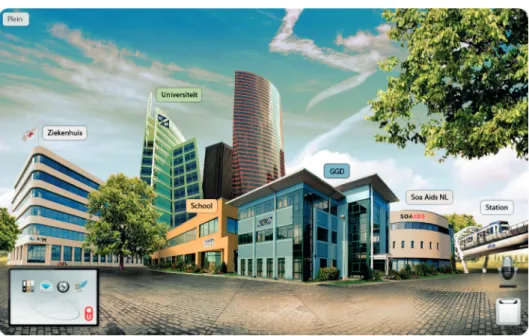
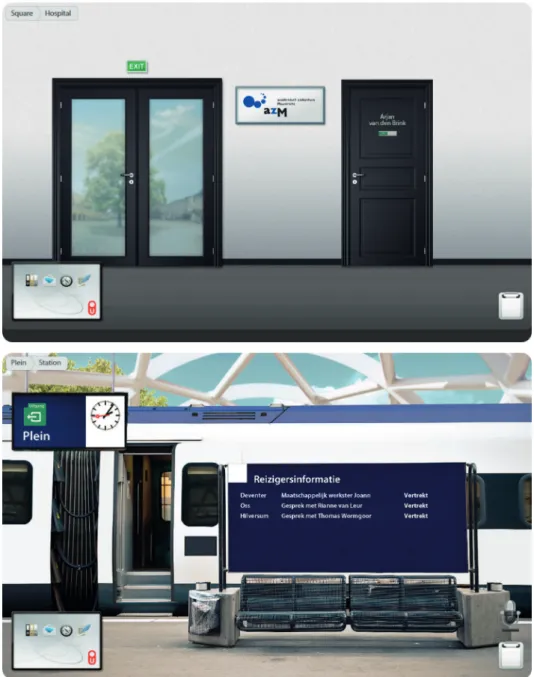
Figure 2.1. Screen of a game showing a square with buildings to visit. On the bottom left corner we see an icon for the tablet. On the bottom right corner we see a mike to record parts of interviews and a notepad to make
contextualised notes
The platform supports games where the student works as a trainee in an immersive virtual environment that resembles real-life environments like a law firm or an office environment. His virtual supervisor will give him assignments, and will react to and reflect on his outcomes. He will meet virtual experts or other people to gain background knowledge about the skills to acquire. Within the environment the student has a tablet with apps that provide background materials, enable communicating with virtual per-sons and other students, and help the student to acquire the skills. The student will be confronted with the consequences of his acts. This means that the environment must be able to respond to student actions by giving clear feedback, and adjust itself accord-ing to the progress of the student.
Within a game on Sexology, for instance, the student attends two patient interviews and a multidisciplinary meeting, and interviews four subject matter experts. He has to learn to prepare himself for the patient interview, to write a summary of the interview, to work out a model related to the causes of the patient’s problem, and to write a pro-posal for treatment. The student starts the game on a square with buildings related to the Sexology course: a hospital, a university, a school, a health service, an aids center and a station (see Figure 2.1). The station is used to visit virtual patients at home. With-in the hospital the student fWith-inds his supervisor, subject matter experts, rooms for
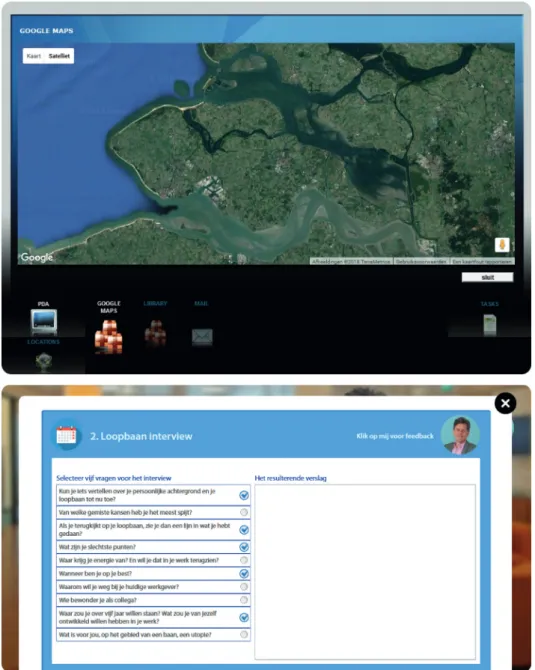
pa-tient interviews and meetings, and his own room. He has a notepad to make contextual-ized notes and a recorder to record parts of interviews. On his tablet the student finds background materials like the patient records, a log containing all notes made with the notepad, an app with all recordings made during interviews, a manual explaining the interface of the game and an email app to get mails and send in assignment outcomes.
3
Requirements for the platform
The objective of the platform is to enable the fast and flexible development and delivery of a wide variety of scenario-based serious games which enable complex cognitive skills acquisition. Intended users of the platform are teachers, students, administrators and programmers. Teachers will develop games by writing a game scenario, selecting rele-vant educational material and using the platform to enter game data, game materials and game script, and they will monitor students; Students will use the platform to play games; Administrators will manage platform users; and Programmers will extend the platform. Based on our experience and studies carried out by others (Aldrich, 2005), as well as on aforementioned problems with current development, we now list following functional (F) and non-functional (N) requirements for the platform (Table 2.1).
Table 2.1: Functional (F) and non-functional (N) requirements for the platform Requirement Description
F1 Offer teachers an intuitive and user-friendly authoring environment where they independently can create and edit games.
F2 Enable teachers to create and edit game roles, so students playing together in one game can have different roles.
F3 Offer teachers a set of common reusable and adaptable components that covers most of the needed functionalities to acquire complex cognitive skills using scenario-based serious games. Teachers should be able to select components they need and edit these now called game components.
F4 Enable several teachers working together on the same game so work can be divided. F5 Enable teachers to preview games or a single game component as a student, at any stage
of the development process.
F6 Enable teachers to test games as a student at any stage of the development process and starting from multiple points within the game script.
F7 Enable teachers to import and export games so games can be distributed to other platform instances and their content can be reused.
F8 Enable teachers to import and export game components so game content can be reused. F9 Enable teachers to monitor progress of students.
F10 Enable teachers to interfere in a running game, for instance, if outcome quality is insufficient or if a student is stuck in the game.
F11 Offer students an intuitive immersive player environment where they play developed
games. The player environment should be adjusted according to the actions and progress of a student by using game script.
F12 Enable to save and persist all student actions, for game script to operate on, and for evaluation and research purposes.
Requirement Description
F13 Enable students to send in assignment outcomes, allowing progression within the game (triggered by game script) and monitoring of progress.
F14 Enable students to enrich the running game with user generated content and share this content with other students.
F15 Enable administrators to manage platform users and their roles.
F16 Enable administrators to manage game runs, by assigning a cohort of students to a run and assigning students to game roles.
F17 Enable administrators to manage game teams, teams of students operating within the same game run.
F18 Enable programmers to easily extend the platform with new languages.
F19 Enable programmers to rather easily extend the set of common reusable components
with new components.
F20 Enable programmers to extend the player environment with new skins, to be able to offer (external) parties their own look and feel.
N1 Be reliable and stable.
N2 Be usable on multiple operating systems, e.g., at and across institutes.
N3 Offer efficient development and delivery of games. Delivering and updating the platform and developed serious games should be easy and not affect student’s progress.
N4 Be backward compatible, authoring and playing of earlier developed games should be possible.
N5 Be integratedwithinstitutionalinfrastructures.
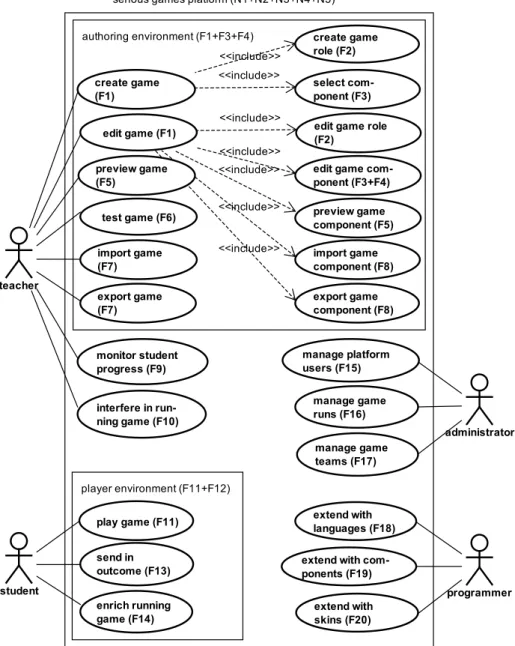
Requirements F3 and F11 directly relate to acquiring complex cognitive skills. Learners will perform authentic tasks in an environment that challenges and makes them curious, presents appropriate and unambiguous outcome goals and provides clear, constructive and encouraging feedback (Nadolski, Hummel, Slootmaker, & Van der Vegt, 2012). Requirements F1, F5 and F6 relate to aforementioned need for a more user-friendly authoring environment. Requirements F3, F7 and F8 relate to the need for reusable and adaptable components. Requirements F1, F2 to F8, and N3 relate to the need for more cost-effective development. The requirements are elaborated in a use case diagram (see Figure 2.2).
Figure 2.2. Use case diagram for the platform. Requirements are indicated
Rectangles indicate the boundaries of the authoring and player environment. These boundaries are debatable. For instance, previewing and testing a game could be done outside of the authoring environment, but we feel these options should be an integral part of it. In the next section we elaborate on the development of the platform.
teacher
student
administrator
programmer edit game role
(F2)
edit game com- ponent (F3+F4) export game (F7) import game component (F8) export game component (F8) preview game component (F5) test game (F6) monitor student progress (F9) interfere in run- ning game (F10) play game (F11) send in outcome (F13) enrich running game (F14) manage platform users (F15) manage game runs (F16) manage game teams (F17)
extend with com- ponents (F19) extend with languages (F18) extend with skins (F20) import game (F7)
serious games platform (N1+N2+N3+N4+N5)
create game (F1) edit game (F1) <<include>> <<include>> <<include>> <<include>> <<include>> create game role (F2) select com- ponent (F3) <<include>> <<include>> preview game (F5) player environment (F11+F12) authoring environment (F1+F3+F4)
4
Development of the platform
Version 1 of the platform was developed within the EMERGO project (2006-2007) that was co-funded by SURF foundation, and was intended to be used by all SURF members. The project had three outcomes: a methodology to support writing the scenario for scenario-based serious games (Nadolski et al., 2008), a platform for developing and delivering the games and five games that were used in education. This article will focus on the EMERGO platform. Version 2 of the platform was one of the outcomes of the Skills Labs project, also co-funded by SURF foundation, and was released in 2010. The project also delivered four games that were used in education. Version 3 was an out-come of a couple of projects and was released in 2013. The platform is Open source and can be found on SourceForge (EMERGO, 2013).
The first development step was to choose an application architecture. We choose for a multilayered client-server architecture, because one layer can be substituted by another implementation without affecting the other layers. To meet requirement F12 (save and persist all student actions) we choose to use a centralized database on a server so game script, also located on a server, can operate on student actions, and student data can be shared within multi-role games and is easily available for evaluation and research. To meet requirements N1 (reliable and stable) and N2 (usable on multiple operating sys-tems), and because we had broad experience with it, we choose the Java EE platform. To meet requirement N3 (efficient development and delivery of games), we choose the client to be web-based, requiring no installation of dedicated client software to develop or play a game and enabling easily updating the platform and developed games. To meet requirement N1 (reliable and stable) we choose the Spring application framework (Spring Framework, 2013), to implement our domain model and business logic, and the MySQL database server for data persistence in a centralized database. Both are proven technol-ogy and widely used within the Open source community. For the client web interface we choose ZK framework (ZK Framework, 2013) that runs on all common browsers. ZK framework is a so called RIA (Rich Internet Application) offering the same interactivity and responsiveness as a desktop application, and therefore offered the best guarantee to meet requirements F1 (intuitive and user-friendly authoring environment) and F11 (intuitive immersive player environment). ZK comes with a very rich set of visual compo-nents, which offered the best guarantee to be able to build our own compocompo-nents, meet-ing requirements F3 (common reusable and adaptable components) and F19 (extend with new components). ZK is very fast and Ajax-based, so all student actions can be saved immediately, meeting requirement F12 (save and persist all student actions). The platform was developed by a multidisciplinary team of educational technologists, interaction designers and programmers. For the development process we used an agile methodology similar to Scrum, implying always delivering working software, short itera-tions, quick response to change and close cooperation within the development team.
We started the development process with the design of the platform, which involved following five steps: (1) Identify needed platform roles; (2) Create a domain model for the platform; (3) Identify needed common reusable components, meeting requirement F3 (common reusable and adaptable components); (4) Create a generic component design, meeting requirement F19 (rather easily extend with new components); and (5) Design the component for handling game script, meeting requirement F11 (using game script, the player environment should be adjusted). In section 5 we will present the results of these five design steps.
Next we started the implementation of the platform. After implementing the domain model and business logic we could start implementing the use cases in a certain order. Most use cases depend on each other, e.g., before you can create a game, you must first be added as a platform user. While implementing the use cases, we also started
implementing components in a certain order, determined by their mutual dependency
and by the priority within the development team. Version 1 of the platform contained an initial set of common components. This set was extended with new components in version 2 and version 3.
The evaluation of the platform involved measuring if requirements F1 (intuitive and user-friendly authoring environment), F11 (intuitive immersive player environment) and N3 (efficient development of games) were met. The evaluations of the other require-ments were based on our experiences with the users of the platform, ourselves includ-ed. Versions 1 and 2 of the platform were evaluated on the aspects of intuitivity and user-friendliness for teachers using the authoring environment to enter data. Both versions were evaluated on the production ratio for developed games and on student satisfaction with the user-interface of the player environment. Besides this, version 1 was evaluated on student satisfaction, and version 2 on the aspects of quality, studiabil-ity and effectiveness of developed games as perceived by students. Intuitivstudiabil-ity and user-friendliness as perceived by teachers were operationalized by ‘the capacity to use the platform components independent without help’ and ‘the simplicity encountered when using platform components to enter data’, respectively. Intuitivity and user-friendliness were measured using a questionnaire containing questions, like ‘Were you able to use the component independently?’ and ‘How simple was it to use the component?’. Pro-duction ratio (as main indicator for efficient development) was measured by comparing development hours (as were recorded in the project administration) with the estimated or measured study time. Student satisfaction was operationalized and questioned as the appreciation of the player environment. Quality and studiability were operational-ized in 22 questions, like ‘Were the instructions for performing a task clear enough?’ and ‘Did you get enough background material to perform a task?’. Effectiveness of de-veloped games was determined by students’ grades, in one case also by comparing them with grades obtained in classroom education.
5
Design of the platform
In this section we present the design of the platform; the platform roles, the domain model, the implemented common reusable components, the underlying generic com-ponent design and the script comcom-ponent.
5.1
The platform roles
Starting from the use case diagram defined in section 3 (Figure 2.2) we identified five platform roles that should have their own working environment within the platform: administrator, developer, run manager, tutor and student. The administrator and run manager platform role are best filled in by user ‘administrator’. The developer and tutor platform role are filled in by the user ‘teacher’. The student platform role is filled in by the user ‘student’, or if a teacher has a role within the game, by the user ‘teacher’. The user ‘programmer’ has no counterpart as platform role, he has his own development environment to extend the platform.
The administrator platform role manages all users and their platform roles (requirement F15). Further he can help students who get technically stuck in a game, by inspecting a student’s progress in the player environment, and adjusting his progress if necessary (requirement F10). If, for instance, certain materials do not become available for a stu-dent, due to a bug, the administrator can make them available.
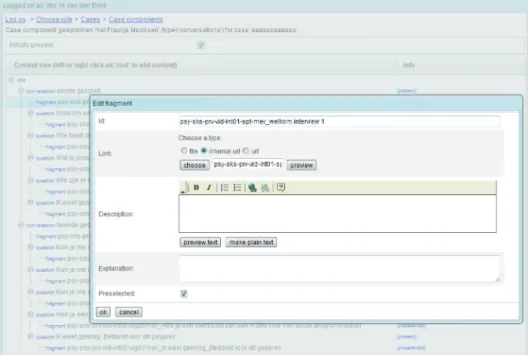
The developer uses the authoring environment to create and edit games (requirement F1). Per game he can create and edit game roles (requirement F2) and game compo-nents by selecting components to use and enter their content (requirement F3). If needed the game owner (the developer who created the game) can assign other devel-opers as author of certain game components (requirement F4). All game component content is entered using a single editor (see Figure 2.3). During authoring the developer can preview the game or a game component in the player environment (requirement F5). And he can test the game in the player environment from multiple points within the game script (so in time) (requirement F6) and for every game role, and even can test with multiple players. Finally, he can import and export a game or a game component as an IMS content package (IMSCP-IM, 2007) (requirements F7 and F8).
The run manager creates and updates runs of developed games (requirement F16) and he defines run users by assigning users to a run. Further, he can run users to a certain game role and define run teams of run users if appropriate (requirement F17).
The tutor monitors the progress of students (requirement F9). He gets overviews of tasks students have completed and assignment outcomes they have submitted. If need-ed, he can interfere in the game by sending an email as if it is sent by a non-playing character (requirement F10), so students do not notice the difference. This way thresh-olds can be raised, e.g., to guarantee the quality of students outcomes. Further, he can help students who get stuck in a game by inspecting a student’s progress in the player environment and instructing how to proceed (requirement F10).
The student sees an overview of games to play and can start the player environment (see Figure 2.1) with a chosen game (requirement F11). The player environment renders all developed games in 2D, and mimics the professional practice students later have to work in. All student progress is saved and persisted continuously (requirement F12).
5.2
The domain model
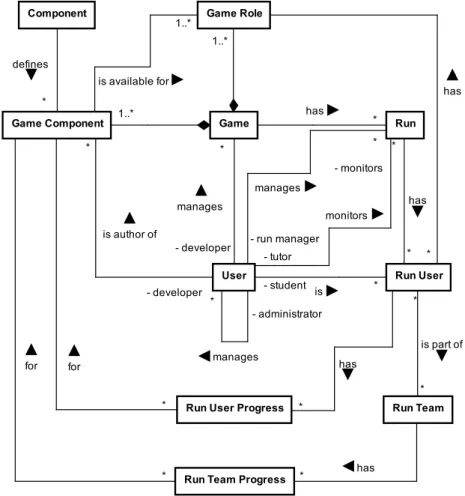
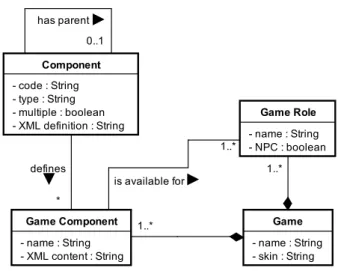
The resulting domain model (see Figure 2.4) shows all entities of the platform and how they are related. Components are the most important concept of the platform. Compo-nents are used to build and play a game. Programmers maintain the set of compoCompo-nents and can extend it. Users of the EMERGO platform can get multiple platform roles. As an administrator, a User can manage Users and give them platform roles. As a developer, a User can manage multiple Games and is the owner of the Games he creates. Per Game he is the author of multiple Game Roles and Game Components. He can make other developers author of his Game Components. The Game itself is not much more than a container for Game Roles and Game Components. Components can have multiple Game Component instances and a certain Game Component can be used by multiple Game Roles. As a run manager, a User manages Runs. A Game can have multiple Runs. The run manager allocates Users to a Run as Run Users. He also can create Run Teams
of Run Users. As a tutor, a User can monitor Runs. As a student, a User can participate in multiple Runs as Run User and can be member of multiple Run Teams. A Run User has Run User Progress within a Run and a Run Team has Run Team Progress. Note that both types of progress can be present in one Run. Progress is related to a Game Component.
Figure 2.4. Domain model of the platform
5.3
Common platform components
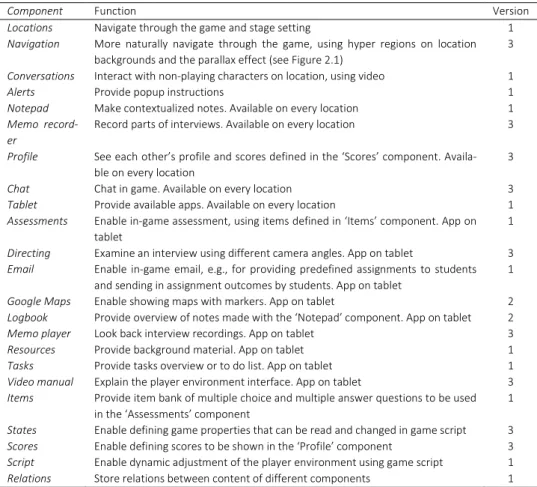
Based on our experience in developing scenario-based serious games over the years, we have identified a number of components that represent common functionalities for this kind of games. Students are always placed in an environment with multiple locations where they can interview people, and have a virtual tablet with apps to help them with their assignments. Table 2.2 lists all components that we have implemented and in which version of the platform.
User Component Game Game Component * for * has * * is part of * for * has * has * has - student is * * has 1..* is available for 1..* 1..* Game Role Run Run User
Run User Progress Run Team
Run Team Progress
- developer * is author of - developer * manages - run manager * manages - administrator * manages * defines - monitors - tutor * monitors