International Coffee Organization Organización Internacional del Café
Organização Internacional do Café Organisation Internationale du Café
18 July 2001
Executive Board/
International Coffee Council 25 - 28 September 2001 London, England
Proposed framework for a global system to improve coffee quality
Background
The attached document contains an interim report on a proposed framework of action for a global system to improve coffee quality. The report has been prepared by the staff of the International Coffee Organization (ICO) and the Association of Coffee Producing Countries (ACPC) and outlines 10 points which could guide a debate on a global Coffee Quality-Improvement Programme (CQP). A revised version of this document will be issued once further information and comments have been received.
Action
PREFACE – ONE HUNDRED YEARS AGO
1. “In 1887 world production increased dramatically, to 16 million bags, and prices fell to 8 cents a pound. The world’s visible supply (stocks) jumped to 5.4 million bags, which hung over the market like a price-suppressing sword of Damocles. The following year, Joaquim Murtinho, the new Finance Minister (Brazilian), reversed the inflationary policies. Murtinho saw that repeated devaluation of the milreis (the Brazilian currency) had made it increasingly difficult to service the federal government’s debt to foreign creditors. Meanwhile lower coffee prices also led to an unfavourable balance of trade payments. As the value of the milreis rose, the coffee growers’ profits, already narrow, dwindled.
2. A social Darwinist, Murtinho believed that in business and coffee only the fit would survive. The free market would produce optimal results, and if a few plantations failed, that would leave the industry in the hands of those better organized for the struggle.
3. In 1901 a bumper crop, the result of plantings 5 years earlier, shot total world production up to nearly 20 million bags, over half of which flowed through the port of Santos. The world consumed only 15 million bags or so, leaving a surplus amount of almost 5 million. The visible supply jumped to 11.3 million bags – over two-thirds of the entire world consumption that year! The price of a pound of coffee fell to 6 cents.
The first International Coffee Conference
4. Not only in Brazil but all the Latin American coffee-producing countries finally recognized that the coffee crisis was not going to resolve itself. In October 1902 most Latin American producers sent representatives to the first International Congress for the Study of the Production and Consumption of Coffee, held at the New York Exchange, to address “the lack of profit and ruinous price paid for the commodity to the producer.”
5. … Eventually, the delegates … suggested banning export of the worst grade of coffee, known as triage, along with a reduction of European coffee import taxes (the United States had abolished its coffee tax in 1873).1 They urged ‘a constant propaganda spoken or written’ to increase the use of coffee. Finally, they sought some mechanism to limit coffee exports so that the visible stock remained at a reasonable 3 million bags, and prices would rise – but the conferees could not agree on how to implement such a quota system. … On the final day of
1 The tax reduction was worded vaguely because of Puerto Rican concerns. After Puerto Rico became an
American protectorate in 1898, its coffee industry suffered terribly – not only from a devastating cyclone in 1899, but because the former Spanish colony could no longer export its beans duty-free to Spain. For years, the Puerto Ricans, as well as the Hawaiians – where coffee cultivation began in 1825 – lobbied U.S. politicians to impose a protective tariff on all other “foreign” coffee, in order to encourage the “domestic” coffee industry. They never succeeded.
the conference J.F. de Assis-Brasil, the Brazilian representative, … (concluded that) the cycle could only be broken through ‘the combined efforts of the interested governments’.”
From: Uncommon Grounds, by Mark Pendergrast. London, Texere Publishing, 2001.
CURRENT BACKGROUND
6. For some time the issue of quality has been assuming more and more importance to coffee exporting and coffee importing countries alike. It is generally recognized that one of the most dynamic market sectors is speciality coffee, catering to an increasingly quality-conscious consumer. At the same time the perception is growing that the current situation of low international market prices poses a particular threat to supplies of higher quality coffees as well as more general damage to the livelihood of growers and the economic situation of a number of developing countries.
7. It is in this context that the International Coffee Council adopted Resolution number 399 on 24 May 2001 encouraging Member countries of the International Coffee Organization to take measures to divert defective coffees from the market and requesting the Executive Director of the ICO to consider such further studies as may be needed in this connection. For its part the Council of the Association of Coffee Producing Countries on 16 May 2001 also took measures to encourage producing countries to eliminate low-grade coffees from the market. In both cases there was a clear understanding that high defect content occurred in both Arabica and Robusta beans and any quality improvement programme would need to address both types of coffee.
8. In view of this convergence the Executive Director of the ICO and the Secretary-General of the ACPC decided on 6 June 2001 to cooperate on a further study designed to identify ways in which a global coffee improvement scheme might be implemented. Ten points were identified which would need to be considered in depth (as listed below) and it was agreed to solicit further specific information from exporting countries by means of a questionnaire (Annex I). The present document should be seen as an interim report pending the receipt of further information and comments but nevertheless outlining a framework for action needed to implement a Coffee Quality-Improvement Programme.
I. MONITORING INSTRUMENTS
The use of Certificates of Origin as a monitoring tool for quality standards
9. The ICO Rules for the application of a system of Certificates of Origin (current and the new ones approved by the International Coffee Council (ICC) in May 2001) do not include compulsory information on quality/grading standards. It should be noted that some exporting Members already volunteer this information, which is being entered in box 10 (or box 15 – Other relevant information) in the current model of the Certificate of Origin
together with the ICO identification mark. In addition, when information relevant to the grade/quality of the coffee cannot be found directly from the Certificate it may have been entered on the Bill of Lading – again, not as a compulsory entry.
10. Although the new Certificate of Origin model, approved in May 2001, has been modified so that box 15 may bring compulsory data on the processing method, exporting Members may still use the last option in box 14 (Description of coffee) to enter the grade/quality of the coffee being shipped under “Other (specify)” where this information could be added.
11. For the purpose of the CQP the ICO Executive Board would have to agree to recommend that a draft Resolution (Annex II contains a draft text) be approved by the ICC where it would state that the grade/quality and moisture content of the coffee being shipped is to be entered on each Certificate of Origin on a compulsory basis.
II. DEFECTS STANDARD
The use of an appropriate defects standard
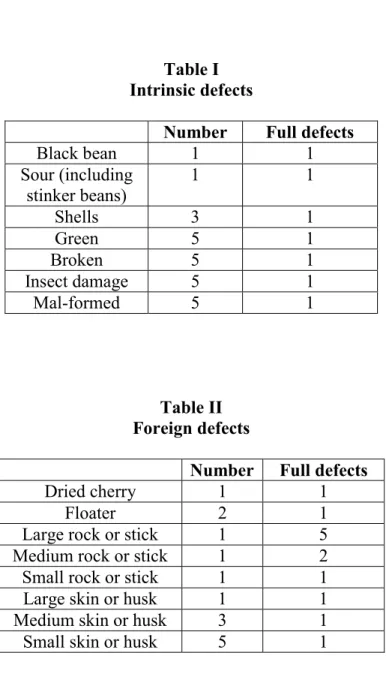
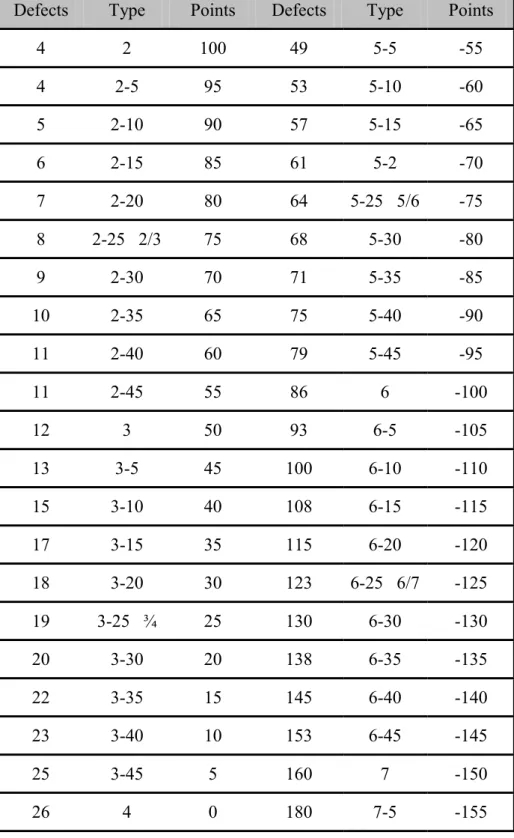
12. Monitoring the quality of the coffee being shipped would be facilitated if all exporting Members could use the same reference standard to grade their coffee. Although exporting countries will of course wish in the most part to maintain their normal grading systems, the New York Green Coffee Classification/Brazilian method is recommended as a reference model for the CQP, although work undertaken by the International Organization for Standardization (ISO) should be considered when completed, since it will take into account such a wide range of quality-related aspects. Details of various schemes are summarized in Annex III. However, the New York/Brazil method is well-known, long-established and clearly relates grading to defect content. In accordance with the New York/Brazil method, the number of intrinsic defects (Table I) would be identified and converted into full defects in a 300g sample. Similar procedures would be applied to foreign defects (Table II) present in the sample. After counting the number of total defects, Table III would be used to classify the type and its points rating. Details of the system are given below:
· The number of beans equivalent to one full defect is given below. For example, a set of three shells counts as one full defect. On the other hand one large rock counts as five full defects. If a bean has more than one defect the highest defect is counted. For example a bean that is black and damaged by insects counts as one full defect due to its black attribute.
Table I Intrinsic defects
Number Full defects
Black bean 1 1 Sour (including stinker beans) 1 1 Shells 3 1 Green 5 1 Broken 5 1 Insect damage 5 1 Mal-formed 5 1 Table II Foreign defects
Number Full defects
Dried cherry 1 1
Floater 2 1
Large rock or stick 1 5 Medium rock or stick 1 2 Small rock or stick 1 1 Large skin or husk 1 1 Medium skin or husk 3 1 Small skin or husk 5 1
Large rock or stick – Screen size 18/19/20 Medium rock or stick – Screen size 15/16/17
Table III
Green coffee classification
Defects Type Points Defects Type Points
4 2 100 49 5-5 -55 4 2-5 95 53 5-10 -60 5 2-10 90 57 5-15 -65 6 2-15 85 61 5-2 -70 7 2-20 80 64 5-25 5/6 -75 8 2-25 2/3 75 68 5-30 -80 9 2-30 70 71 5-35 -85 10 2-35 65 75 5-40 -90 11 2-40 60 79 5-45 -95 11 2-45 55 86 6 -100 12 3 50 93 6-5 -105 13 3-5 45 100 6-10 -110 15 3-10 40 108 6-15 -115 17 3-15 35 115 6-20 -120 18 3-20 30 123 6-25 6/7 -125 19 3-25 ¾ 25 130 6-30 -130 20 3-30 20 138 6-35 -135 22 3-35 15 145 6-40 -140 23 3-40 10 153 6-45 -145 25 3-45 5 160 7 -150 26 4 0 180 7-5 -155
Note: The CQP will need to establish a cut-off type or types below which coffee should be eliminated from the market.
13. Considerable information on grading systems in use has been obtained and is available for consultation on request. The question of whether exporting countries are able to grade coffee according to the New York/Brazil method was put to ICO exporting Members in the questionnaire (Annex I). Responses are summarised in Annex V but indicate in general an ability to implement the system.
III. MOISTURE CONTENT
Moisture content criteria
14. Moisture content examination is a relatively common process, using inexpensive moisture meters. Current recommendations (see document ED-1763/00 Rev. 1) are for moisture levels not to exceed 12.5 percent in green coffee. Such a criterion could be added to the CQP. In general, countries responding to the questionnaire (see Annex V) have indicated their ability to control moisture. A decision whether to include this criterion in the CQP would of course be needed, but might fit in well with the generally accepted mould prevention strategy.
IV. QUALITY CONTROL
Technical support for quality control in exporting countries
15. The issue of monitoring quality control was put to ACPC members in circular letter 039/2001 dated 31 May 2001 (see Annex IV). All countries grade and classify their coffees. Many countries grade their coffees in terms of number of defects such as black bean, broken bean, etc. Many others use the screen size to grade and classify their coffees. In the majority of cases countries use a dual system where both size of bean and the number of defects influence the overall grade of the coffee. In Latin America, countries tended to grade their coffees in terms of altitude grown. Where export quality controls existed they tended to be preliminary in nature, e.g. specifying botanical species, homogenous lots, etc. A small group of the countries surveyed had stricter export quality controls in place and a few would only permit exports once an export license had been granted. Out of those having stricter export controls, one of the most popular export quality requirements was a limit on moisture levels – that generally tended to be around the 12-13 percent mark. Nevertheless, the vast majority of countries have some agency/body which controls and monitors coffee. In countries where the government still plays a large role in coffee marketing, quality tended to be monitored directly by the government or government agency. For example coffee is monitored by the Coffee Board, in countries which have retained these structures. In other cases export associations or institutions monitor, advise or set quality standards. In a small number of countries surveyed, responsibility for quality had been placed in the hands of private companies following liberalization. Specific country by country detail is available for consultation on request.
V. COOPERATION WITH IMPORTING COUNTRIES
Possibilities of cooperation with importing countries
16. Some areas of possible cooperation appear more realistic than others. Ideally importing Members of the ICO should check Certificates of Origin once more and refuse entry to those indicating unacceptable grades and/or moisture levels (see draft Resolution in Annex II). Some support for technical assistance and capacity building may be obtainable. Initially the support by importing Members of the ICO for the CQP in principle would itself be helpful in terms of the signals given to markets and donor institutions.
VI. REPORTING
Reporting on volume of diverted coffee
17. Since exporting Members must comply with the Rules on Statistics contained in document EB-3510/94 by providing timely monthly reports the Executive Board could recommend a draft decision to be submitted to the Council whereby the volume of diverted coffee could be added as compulsory information included in the reports provided to the Organization.
VII. COMMERCIAL AGENCIES
Use of commercial inspection agencies
18. Commercial international inspection agencies can certainly be used to monitor adherence to the diversion plan, just as SGS audited the Retention Plan. This would be necessary and would add credence to the plan. However, more details of the specific operation of the plan would have to be agreed before any accurate and realistic estimation of the costs can be ascertained. For example, specific information regarding the number of checks to be carried out in each country over what period of time and the number of countries requiring monitoring.
VIII. VOLUME
Volume of diversion sought
19. The volume of diversion sought should be considered by Members in the light of a number of criteria, including:
(a) the volume of coffees currently exported with a high defects content, e.g. over 150 per 300 grammes, or moisture content above 12.5 percent;
(b) the predicted economic consequences of diversion given in the study conducted by the Free University of Amsterdam (see document EB-3778/01); (c) the world supply/demand balance; and
(d) specific conditions which may affect each participating country.
20. In addition consideration should be given to the impact of transitional provisions which may be needed for certain countries (see Equity issues, below).
IX. REFERENCE GRADES
Minimum reference grades for coffee exports
21. These would need to be established and incorporated into an implementing Resolution in the light of the factors listed under section VIII above and also in the light of the responses to the questionnaire.
X. EQUITY ISSUES
Avoidance of undue discrimination for categories of growers (e.g. smallholders) and countries
22. It is reasonable to consider whether the CQP would have a disproportionate impact on small farmers and on least developed countries. In the case of small farmers the ability to pick only ripe cherries favours quality production while difficulties of access to processing may operate against quality. These factors are likely to vary in the case of different countries. There is also the problem of countries producing relatively large quantities of low quality coffees. It is very likely that those countries would be reluctant to implement a plan that might entail a severe reduction in their exports. In order to prevent this, it is very important to stress that transitional provisions could be considered, which would allow those countries to export inferior quality coffee for a limited period in the expectation that, over time, they will improve their standards until they can fully comply with the general regulations. More information on the incidence of exports of high-defect content coffee is needed.
CONCLUSIONS
23. The ICO and ACPC consider that the present report, while of an interim nature, and still awaiting additional information from countries and from experts asked to comment on options in the areas covered, provides an outline of the way in which a coffee quality improvement programme could be designed and implemented. It is hoped that a revised version of the report can be issued in September 2001. The interim report is being circulated to provide Members with information of the nature of the proposed programme and to allow them time for further analysis and comment, with a view to facilitating decisions at the September meetings.
QUESTIONNAIRE TO EXPORTING MEMBERS
1. Is your country able to control coffee export quality for defects content?
2. If the New York/Brazil grading system is used (copy attached), could you establish grades for your coffee based on this system?2
3. If this is the case could you please quantify (bags or percentages) your current export volumes using this system; if not, could you give a breakdown of exports by the quality grading system currently used. In such a case wherever specific grades are named please relate where possible the grade to defect content.
4. Bearing in mind that implementation of a global quality control scheme should increase prices, what would be the maximum percentage of your coffee acceptable to you for elimination from the export market?
5. Assuming quantities of your export coffee with high defect content (e.g. more than 150 defects per 300 grams) are greater than your maximum acceptable quantities for diversion, would you accept transitional provisions? Please suggest details.
6. Is your country able to control moisture content of export coffee?
DRAFT RESOLUTION Identification of coffee grade
WHEREAS:
The International Coffee Council in May 2001 approved Rules for a system of Certificates of Origin in document EB-3775/01.
Provision is available in box 14 of the Certificate of Origin included in these rules to enter description of coffee.
The Council has adopted Resolution number xxx concerning a coffee quality improvement programme.
The programme requires exporting Member countries to prohibit exports of coffee below certain defects-related grades and above a maximum moisture content limit.
THE INTERNATIONAL COFFEE COUNCIL RESOLVES:
1. To require all exporting Members to enter the grade of coffee and moisture content of the lot covered by the Certificate of Origin in box 14, and when entering the grade to ensure that the grade used can be related to defect content or, should that not be the case, to enter a grade based on the New York/Brazil classification.
Specifications SCAA Occurrencies
Brazil Occurrencies
SCAA Full defect Brazil Full defect ISO Qualitative Grading (†)
ISO Organoleptic properties (†)
ISO Econ. aspects (†)
Parchment * 2 to 3 N/A 1 N/A M 1 1
Hull/Husk - Large skin or husk 2 to 3 1 1 1 M 1 1 S
Medium skin or husk N/A 3 N/A 1 M 1 1 S
Small skin or husk N/A 5 N/A 1 M 1 1 S
Broken/Chipped/Broken 5 5 1 1 M 1 1
Insect damage 2 to 5 5 1 1 M 1 S 0
Partial sour 2 to 3 N/A 1 N/A N/A 1 S 0
Partial black 2 to 3 N/A 1 N/A MS 1 S 0
Floater 5 2 1 1 MS N/A N/A
Shells 5 3 1 1 M 1 1
Small stones 1 1 1 1 M 0 1 S
Small sticks 1 1 1 1 M 0 1 S
Water damage 2 to 5 N/A 1 N/A N/A N/A N/A
Green N/A 5 N/A 1 N/A N/A N/A
Malformed N/A 5 N/A 1 M 1 1
Full black/Black bean 1 1 1 1 VS 1 S 0
Full sour/Sour (incl. Stinker beans) 1 1 1 1 VS 1 S 0
Pod**/Cherry/Dried cherry 1 1 1 1 VS 1 S 1 S
Large stones 2 1 1 5 VS 0 1 S
Medium stones 5 1 1 2 MS 0 1 S
Large sticks 2 1 1 5 VS 0 1 S
Medium sticks 5 1 1 2 MS 0 1 S
(†): 0=no influence/1=influence/VS=very serious/S=serious/MS=moderately serious/M=minor/N/A=no available data
* Parchment, in washed coffee. ** Pod, in unwashed coffee.
ASSOCIATION OF COFFEE PRODUCING COUNTRIES
Circular Letter no. 039/2001
(English only)
7
June
2001
ICO/ACPC Co-operation
on diversion of defective coffee
The Secretary General of the Association of Coffee Producing Countries
presents his compliments to Member Countries and the Signatories of the
London Agreement, and considering the co-operation with the ICO on the
issue of coffee quality, it will be appreciated if the ACPC Secretariat can
receive the following information, before 16th June 2001:
1. Any coffee export quality standards already implemented in your
country.
2. Any governmental body/institution that can monitor export quality.
The Secretary General avails himself of this opportunity to renew to
Members and the signatories of the London Agreement the assurance of his
highest consideration.
RESPONSE FROM EXPORTING MEMBERS TO THE QUESTIONNAIRE ON QUALITY
As at 16 July 2001, 10 exporting Members have replied to the questionnaire on quality which was faxed to them on 26 June 2001. This summary provides the answers received from these Members.
1. Is your country able to control coffee export quality for defects content?
Yes 8
No 0
Qualified answer 2
2. If the New York/Brazil grading system is used, could you establish grades for your coffee based on this system?
Yes 3
No 1
Not answered 6
3. If this is the case could you please quantify (bags or percentages) your current export volumes using this system; if not, could you give a breakdown of exports by the quality grading system currently used. In such a case wherever specific grades are named please relate where possible the grade to defect content.
· All exports follow this system – Cameroon
· Grade 3 (12 defects) = 6%; Grade 4 (26 defects) = 53%; Grade 5 (46 defects) = 3%; Grade 6 (86 defects) = 19% and Grade 7 (160 defects) = 19% – Cuba
· 25 grades classified for export; total quantity exported comprising all inferior coffees amounts to less than 1,000 tonnes/annum which represents only 0.4% of the total exports – India
· Current grading system provided – Madagascar
· Coffees known as “Desmanches – naturals type B” and washed coffees which present more than 30 defects/imperfections amount to 5% of the total green coffee exported – Mexico
· Percentage export/Grade - defects count/kg : AA/A - 10 = 4.3%; X - 20 = 8.9%; PSC - 35 = 19.6%; Y1 - 70 = 56.9%; T - <3% by weight per kg of husk, hull or foreign matter = 6.2%; Robusta = 4.1% (free of defects) – PNG
· Superior: max 36 defects = 0%; Standard: 58 defects = 18.5%; Ordinary: 100 defects = 72%; Ungraded + triage: > 100 defects = 10% – Rwanda
· Prima G I = 24%; Superior G II = 63%; “Couranie” G III = 4%; Broken beans = 4%; Triage = 5% – Togo
· Full UCDA quality specification provided – Uganda
· Contracts are signed showing percentage content for each of the following: moisture, black and broken bean and foreign matter – Vietnam
4. Bearing in mind that implementation of a global quality control scheme should increase prices, what would be the maximum percentage of your coffee acceptable to you for elimination from the export market?
· Low grade coffees are taken out of the market by the grower for improvement – Cameroon
· None – Cuba
· Difficult to earmark quantity for elimination – India
· 5% – Mexico
· <6.4% of total exports – PNG
· 10% – Rwanda
· Amount corresponding to broken beans + triage (9%) – Togo
· 5.4% – Uganda
· no answer – Cameroon and Vietnam
5. Assuming quantities of your export coffee with high defect content (e.g. more than 150 defects per 300g) are greater than your maximum acceptable quantities for diversion, would you accept transitional provisions? Please suggest details.
· All grades that do not comply with standards due to excess of defects are withdrawn from market – Cameroon
· No exports of coffee with high quantity of defects – Cuba
· No need to accept transitional provisions as there is no export of coffee graded with defects – India
· Yes, diversion volume be applied over production as this would ensure better quality coffee for export and for the internal market – Mexico
· Not applicable in this case but if there were to be a surplus it is suggested that each country declare in advance the amount of low quality coffee it would be exporting during the year ahead – PNG
· This assumption does not concern our country – Rwanda
· Although the acceptable number of defects is set at 120, the maximum number of defects of exported coffees is around 95. Therefore, the transitional provisions to adopt would concern only broken beans and triage – Togo
· Current regulations do not allow coffee to be exported with more than 150 defects/300 g – Uganda
· Low quality coffees rejected by consumers are diverted to the internal market – Vietnam
6. Is your country able to control moisture content of export coffee? Yes – all 10 exporting Members