e-ISSN 2355-3812
January 2017
DOI: 10.15294/jpfi.v13i1.10152
*Correspondence Address:
Jl. 62 Majapahit Mataram, 83125, Nusa Tenggara Barat, Indonesia E-mail: [email protected]
http://journal.unnes.ac.id/nju/index.php/jpfi
THE IMPLEMENTATION OF LEARNING DEVICES WITH
SCIENTIFIC APPROACH TO IMPROVE STUDENT LIFE
SKILLS
Hikmawati*, J. Rokhmat, Sutrio
Program Studi Pendidikan Fisika, Jurusan Matematika dan Pendidikan IPA, Fakultas Keguruan dan Ilmu Pendidikan, Universitas Mataram, Indonesia Received: 12 August 2016. Accepted: 18 September 2016. Published: January 2017
ABSTRACT
The purpose of this study was to test the effectiveness of the implementation of learning device with scientific approach to improve student life skills. The research uses one group pre test–post test design. Subjects in this study were students of grade ten (class X). Implementation of learning device supports effectively in learning activities if the implementation of a lesson plan by teachers, student social skills and student academic skills at least in a good category. The results showed that the implementation of lesson plan by teachers to get the average value of 3.38 are in the very good category, gain value of the student social skill at average value of 3.03 is in the very good category, and gain of student academic skill at average value of 76 is in the good category. It concludes that the implementation of learning tools with scientific approach support effectively in learning activities.
ABSTRAK
Tujuan penelitian ini adalah menguji efektivitas implementasi perangkat pembelajaran fisika dengan pendekatan saintifik untuk meningkatkan kecakapan hidup siswa. Penelitian ini menggunakan one group pretest-posttest design. Subjek dalam penelitian ini adalah siswa kelas X. Hasil penelitian menunjukkan bahwa pelaksanaan dari Rencana Pelaksanaan Pembelajaran oleh guru memperoleh nilai rata-rata sebesar 3,38 dan berada pada kategori sangat baik. Kecakapan sosial siswa memperoleh nilai rata-rata sebesar 3,03 dan berada pada kategori sangat baik. Adapun kecakapan akademik siswa memperoleh nilai rata-rata sebesar 76 yang berada pada kategori baik. Berdasarkan hasil-hasil penelitian tersebut dapat diimpulkan bahwa implementasi perangkat pembelajaran dengan pendekatan saintifik efektif menunjang kegiatan pembelajaran fisika dalam meningkatkan kecakapan hidup siswa.
© 2017 Jurusan Fisika FMIPA UNNES Semarang
Keywords: life skills; scientific approach
labus is a lesson plan on a particular subject that includes a standard competence, basic competence, subject matter or teaching mate -rials, learning activities, indicators of achieve -ment of competencies, assess-ment, allocation of time and sources of learning. Lesson plan is a plan for teachers which describes the pro -cedures and organizing the implementation of the learning process to achieve a basic com -petency that has been defined in the standard content and described in the form of syllabus. Student textbook is a guidebook for students in learning activities containing lesson material, concept-based inquiry activities, experimen
-INTRODUCTION
Preparation of learning tools is some-thing that must be done by teachers in plan -ning lear-ning activities so that the expected goal can be achieved. According to Ibrahim’s theory (2003), a component of the learning device to be prepared by teachers to manage the classroom well is the syllabus, lesson plan, student textbook, student worksheet, learning tools, and final examination. Trianto (2008) and Tim Pustaka Yustisia (2008), write that the
syl-tal activities, information, and examples of the application of concepts in everyday life. Stu -dent worksheet is a guideline of stu-dent work to facilitate students in the implementation of learning activities. Learning tools is a mes-senger from several sources to the recipient of the message. Final examination is a test item used to determine the student learning out-comes after following the learning activities. In this research, the learning device with scientific approach consisting of syllabus, lesson plans, Student textbook, student worksheet, learning tools and final examination developed with at -tention to student learning experience that will be gained through the learning process to ob -serve, ask, gather information, associates, and communicate.
The syllabus and lesson plan developed in this study use the 5E learning cycle model (Engage, Explore, Explain, Elaborate, and Evaluate). Scientifically-based student work -sheet have components such as experimental titles, purpose of the study, tools and materials, problem formulation, hypotheses, variables, operational definitions of variables, experimen -tal steps, observation data, data analysis, and conclusions. The medium used is a three-di -mensional media to assist students in complet -ing the tasks contained in the worksheet. Dur -ing the learn-ing process with the 5E learn-ing cycle model, teacher makes assessment using observation sheet to the observation skills of the social attitudes of students (social skills). Final examination in the cognitive domain (aca -demic skills) is done after the learning process is complete.
In making learning activities, teachers will define models, approaches, strategies, methods, and techniques of learning what will be used in the implementation of learning. Ac -cording to Suprihatiningrum’s theory (2013),
learning model is a design which illustrates a
learning process that can be done by teachers in transferring knowledge and values to stu-dents. Approach is a common way of looking at the problem or object of study, such as learn -ing. The term learning strategies are used to indicate the overall strategy or activities done by teachers to create learning atmosphere is very conducive to the achievement of educa -tional goals. Learning strategy can be said to be implementation of the learning model. Meth -ods are the ways teachers use to teach stu -dents. If a strategy refers to a plan for achiev -ing someth-ing, then the method refers to a way that can be used to execute the strategy. The
instructional technique refers to the distinctive variety of the application of a method accord -ing to the specific implementation background, such as the teacher’s ability and habits, the availability of equipment, the readiness of the students, and so on.
Jufri (2010) states that there are some things that must be considered by teachers in choosing or determining the models, ap -proaches, strategies, methods, and learning techniques to be applied. Things to consider are the learning objectives, activities and initial knowledge of the students, the nature of the learning materials, the allocation of time, the supporting facilities, the number of students, the experience and the authority of the teacher. In developing learning tools, teachers can use a scientific approach that is expected to provide a learning experience for students so that students’ life skills increase. Sani (2014) argues that the scientific approach is closely related to the scientific method. Scientific (sci -entific) methods generally involve observation or observation activities required for the for -mulation of hypotheses or collecting data. The scientific method is generally based on the ex -posure data obtained through research or ex -periments.
Indonesian Ministry of Education And Culture (2013) mentions that, the scientific ap -proach in learning includes: observing, asking, reasoning, trying, forming networks for all sub -jects. Learning process with scientific approach touching three domains, namely: attitude, knowledge, and skills, so that the learning out-comes produce students who are productive, creative, innovative, and affective. In other words, the application of scientific approaches to learning, including learning of physics, can improve students’ life skills. Machin’s research (2014) concludes that the scientific approach brings positive effect on the cognitive learning, affective and psychomotor and have reached the classical completeness set.
Mugambi & Muthui (2013) argue that the life skills curriculum plays a major role in enabling students to use their knowledge, at -titudes and values into abilities on what to do and how to do it. This study found several fac -tors that influence the implementation of Life Skills curriculum, namely: teaching approach, lack of life skills conceptualization, limited hu -man resources, lack of supervision, teacher preparation is lacking, lack of choice of teaching and learning strategies, limited use of learning resources, bad assessment, and the students’
negative attitudes toward life skills. Mugambi & Muthui concluded that the implementation of Life Skills Education depends primarily on the competence of teachers, on the other hand, are also influenced by extrinsic factors.
Agustina and Saputra (2012) said that the implementation of life skills-based learn -ing can be done by integrat-ing aspects of Life Skills on subjects in secondary schools,one of
them is physics. The problems that arise in the implementation of Life Skills based learning are how to design life skills based learning tools, how to develop life skills based learning activi -ties and how to understand the life skills as-pects in each subject and difficulties in integrat -ing every aspects of Life Skills in each subject matter in accordance with the available format. Life skills-oriented education program through a broad-based approach, or known as the Broad Base Education is very possible to
be implemented in every type and level of edu -cation. In addition to not changing the existing curriculum system, this program does not add to the burden of new subjects, but only change the orientation of the learning program (BBE Team of Ministry of Education, 2012).
Ibnu (2014) argues that the application of a scientific approach in the effort to develop the life skills of students through learning in schools still faces various obstacles, among others are the curriculum targets to pursue material ad -equacy facing examination (national examina -tion) and policies of educational authorities that are less precise, and public perceptions about the success of education has also been wrong. Parents were more likely to appreciate and be proud of ourselves if their son honored ranks in the classroom, school and even its society rather than to the skills their children to prac -tice the scientific approach and process skills. It educates children if necessary to take short -cuts to achieve mastery of teaching materials without good learning process.
Development of Life Skills (life skills), es -pecially social skills (skill) and academic skill, in this research is facilitated by the use of stu -dent worksheet and learning tools in the form of three dimensional media. Trianto (2008) de-fines that student worksheet is a student guide that is used to conduct the investigation and problem solving. Sukiman (2012) argues that learning media is anything that can be used to channel the message from the sender to the re -cipient so as to stimulate the thoughts, feelings, concerns, and interests and willingness of stu -dents in such a way that the learning process
occurs in order to achieve the learning objec -tives effectively. Sudjana & Rivai (2013) states that there are four types of learning media, namely: (1) two-dimensional media or graphic media is a medium that has a length and width such as pictures, photographs, graphs, charts or diagrams, posters, cartoons, comics, and etc. (2) three-dimensional media that is in the form of models such as solid model, cross-sec -tion model, stacking model, work model, mock-ups, dioramas, and others. (3) projection media such as slides, film strips, films, use of OHP and others. (4) the environment.
Three-dimensional media as one type of learning media can be a model, that is three-dimensional copy of some real objects that are too big, too far, too small, too expensive, too rare, or too complicated to be brought into the class and studied by students in the form its original (Sudjana & Rivai, 2013). Sudjana & Rivai disclose the benefits of three-dimensional media in the learning process, including phys -ics learning in secondary schools are: First, learning will attract more students so it can fos -ter motivation to learn; Second, teaching mate -rials will be more clear meaning so that it can be more easily understood by students and en -able students to master the learning objectives better; Third, teaching methods will become more varied, not merely verbal communication through the words of the words by the teacher, so that students are not bored and the teacher does not run out of energy, especially when the teacher teaches for every lesson; Fourth, stu -dents do more learning activities, because not only listen to the teacher’s description, but also other activities such as observing, performing, demonstrating, and others.
Three-dimensional media is a potential alternative to increases the quality of teaching physics in high school. A solid model usually shows the outer surface of the object rather than the object and often discards the con -fusing parts of its main ideas of shape, color, and composition. The cross-sectional model shows how an object is visible, when its sur -face is lifted to know its inner arrangement. The stacking model consists of several parts of a complete object, or at least an important part of the object. The work model is an imitation of an object that shows the outside of the original object, and has some portion of the real thing. Mock-ups are a simplification of the underlying arrangement of a process or a more intricate system. Diorama is a mini-three-dimensional landscape aimed at describing the true land
-scape. Three-dimensional media that has been developed in this research is three dimensional media “Dynamic Electricity”.
According to the World Health Organiza -tion (WHO), Life Skills (life skills) is the ability for adaptive behavior, and positive that allows students to deal effectively with the demands and challenges of everyday life. According to the United Nations International Children ‘s Emergency Fund (UNICEF), Life Skills is a behavioral change or behavioral development approach designed to address the balance of three areas of knowledge, attitude and skills. In other words, life skills are the skills needed to live successful (Khera and Khosla, 2012).
Anwar (2006) and Susiwi (2007) re-vealed that life skills consist of general life skills (General life skills) and life skills that are specific (Specific life skills). Life skills that are general in nature consist of personal and social skills, while life skills that are specific consist of academic and vocational skills. Personal skills (personal skills) consisting of: self-knowl -edge skills (self-awareness skills), and think-ing skills (thinking skills). Social skills (social skills) comprising: communication skills, and ability to cooperate (collaboration skills). Aca -demic skills are also called intellectual skills or scientific thinking skills and are the devel -opment of thinking skills. Academic skills have already led to academic or scholarly activities. This skill is important for people who pursue a job that emphasizes thinking skills. Therefore, this skill should get emphasis from the begin -ning of junior high school and especially on the academic program at the university. Vocational skills are also called vocational skills, these skills are associated with certain occupations in the community. This skill is more suitable for students who will pursue jobs that rely more on psychomotor skills. So this skill is more suit -able for Vocational High School students, skill courses or diploma programs. This study aims to test the effectiveness of the implementation of the learning device physics with a scientific approach to increase life skills of students in high school.
METHOD
The type of research is research devel -opment. The learning device which is devel -oped consists of Syllabus, Lesson Plans, Sub -ject Matter Books, Student Worksheet, Three Dimensional Media, and Learning Result Test are integrated with life skills. Learning device
development model used is Four D model (De -fine, Design, Develop, Disseminate). Accord -ing to Ibrahim (2003) and Trianto (2008), this model was adapted into model 4 P (Definition, Design, Development, Deployment).
Define phase aims to establish and define the requirements needed in learning based on a needs analysis, analysis of stu-dent, task analysis, concept analysis, formula -tion of learning objectives. Design phase aims to design prototype learning device to do the preparation of lesson plan, the selection of stu -dent textbook and stu-dent worksheet format, visual three-dimensional model, and final test. Develop phase aims to produce learning tools which have been revised based on feedback from the validator. Disseminate phase aimed
at implementation of the learning tools in the classroom. Phase Define, Design, and Devel-opment conducted in the first year.
Test of the effectiveness of the imple -mentation of learning tools in the research (second year) conducted in stages Spread (Disseminate), with the subjek were students of grade ten (Class X) 2nd Semester of Academic Year 2015/2016 in Madrasah Aliyah Dakwah Islamiyah Puteri Nurul Hakim Kediri, West Lombok. Research design to test the effective -ness of learning device implementation using One Group Pre-Post test design. According to Arikunto’s theory (2006), this design only uses one group only without any comparison group. This design has the disadvantage in terms of testing the effect of independent variables (sci -entific approach) on the dependent variable (life skills), because it does not use a control group. Therefore, in this study performed a sensitivity analysis items are obtained by the students of the initial test and final test. Accord -ing to Grounlund (1985) in Ibrahim (2005), the sensitivity index has values from 0 to 1. The value 0 means insensitive, while 1 is very sen-sitive.
Based on Ibrahim’s theory (2005), the sensitivity of a test is the test’s ability to mea -sure the learning effect. Question which has sensitivity means the matter can provide infor -mation that the measurement result is a result of learning.
Implementation of the learning device with a scientific approach and 5E learning cy -cle model is said to be effective in this physics study if the implementation of lesson plans by teachers, students’ social skills and academic skills of students at least have the good cat -egory. Here are the phases of learning with
5E learning cycle model to provide student learning experiences appropriate scientific ap -proaches such as observing, asking, gathering information, associating, and communicating. Table 1. Learning Cycle Model 5E.
Phase Teacher activity
Engage
Conditioning the students to be ready to follow the lessons by giving demonstrations or ques -tions to determine the ability of the beginning
Presenting indicators (learning objectives)
Explore Dividing the students in groups Guiding students to work on stu-dent worksheet
Explain
Providing an opportunity for group representatives to present their work based on student worksheet Explaining or straighten the con -cept of learning material based on data from student experiments
Elabo -rate
Directing student’s experiment results to answer problems in preliminary activities
Encouraging students to inquire material that remains poorly un-derstood by asking teachers Demonstrating application of con -cept about learning material in everyday life
Evalu-ate
Checking students’ understand -ing of learn-ing materials by ask -ing them back
Guiding students to make conclu -sions
Providing follow-up to give the as-signment or homework
Implementation of learning with scien -tific approach and 5E cycle learning model for Dynamic Electrical material conducted during 6 times meeting. The time allocation for each meeting is 2 hours of lesson.
RESULTS AND DISCUSSION
Some obstacles / problems can occur in the implementation of learning activities in the classroom, including in physics learning. Akinbobola & Afolabi (2010) mention that the challenge in teaching physics is to create ex
-periences that engage students and how to facilitate studensts in order to have the skills like observing, measuring, classifying, commu -nicating, concluding, using numbers, using the relationship of space / time, asking questions, controling and manipulating variables, crea -ting hypotheses, making the operational de-finition of variables, model making, designing experiments, and interpreting data. According to Oladejo, et.al. (2011), the strategies used by teachers is one of the factors that influen -ce academic achievement that is still lacking in physics lesson.
Implementation of the learning device physics with a scientific approach conducted in six sessions, with the stages of each meeting is to observe, inquire, try (experiment), asso -ciate (reasoning), communicate. Learning with a scientific approach is a student-based lear -ning activity. According Bonwell & Eison (1991) in Prince (2004), active learning is a teaching method that engages students in the learning process. In short, active learning requires stu -dents to do meaningful learning activities and think about what they do.
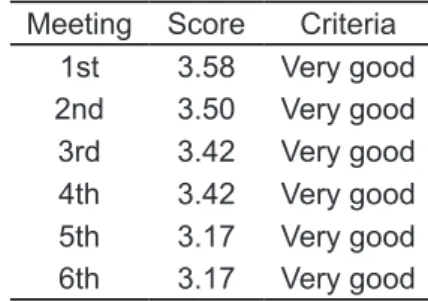
The results of observation on the imple -mentation of Lesson Plan (RPP) by teacher are as follows.
Table 2. Implementation of lesson plan by teacher.
Meeting Score Criteria 1st 3.58 Very good 2nd 3.50 Very good 3rd 3.42 Very good 4th 3.42 Very good 5th 3.17 Very good 6th 3.17 Very good
The mean adherence to the lesson plan by teacher of 3.38 are in the very good category. This is because the teacher has implemented the learning in accordance with the planning contained in the learning tool with a scientific approach. Stages of learning using a scientific approach have provided a learning experience for students so that students can develop life skills. This is in accordance with regulation of the Indonesian ministry of education No.81A In 2013, Appendix IV, that there is a link between the pace of learning with learning activities and their meanings, as follows.
Observe
process of observing are: reading, listening, listening, seeing (without or with tools). The de-veloped competencies are: training in sincerity, thoroughness, seeking information.
Ask
Questioning learning activities are con -ducted by asking questions about information that is not understood from what is observed or questions to get additional information about what is observed (starting from factual questi -ons to hypothetical questi-ons). The competen -cies developed is to develop creativity, curiosi -ty, the ability to formulate questions to establish the critical thinking necessary for intelligent life and lifelong learning.
Gathering information / Experiments (Trying)
Gathering information / experiments on learning activities include: conducting experi -ments, reading sources other than textbooks, clicking observe objects / events / activities, and interviews with sources.
Competencies developed in the pro -cess of gathering information / experiments are developing a meticulous, honest, courteo -us attitude, respecting the opinions of others, communication skills, applying information gat -hering skills through various ways learned, de-veloping lifelong learning and learning habits. Associate / Process information
Learning activities undertaken in the pro -cess of associating / pro-cessing information are as follows. First, process the information that has been collected either limited from the results of collecting activities / experiments as well as the results of observing activities and information gathering activities. Second, cre -ating information collected from nature to add breadth and depth to the information proces -sing that are looking for solutions from a variety of sources that have a different opinion to the contrary.
Competencies developed in the process of associating / managing information are De -veloping honest, meticulous, disciplined, obe -dient, hard work, ability to apply procedures and inductive and deductive thinking skills in concluding.
Communicating
Communicative learning activities are to deliver results of observations, conclusions based on the results of analysis orally, writ
-ten, or other media. Competents developed in communicating stages are developing honest, meticulous, tolerant, systematic thinking skills, expressing opinions briefly and clearly, and de -veloping good and correct language skills.
The observation of students’ social skills during the learning process with the scientific approach are as follows.
Table3. Student social skills. Meeting Score 1st 2.35 2nd 2.78 3rd 3.00 4th 3.38 5th 3.22 6th 3.46 Average 3.03
The average of students’ social skill of 3.03 is in very good category. This is because students are facilitated by the student’s work -sheet and the media of three-dimensional dy-namic electricity. Students’ social skills were observed during the learning with the scienti -fic approach is the ability to communicate and cooperative skills. According to the Ministry of Education’s theory (2002) as cited by Susiwi (2007), communication means communicate not just deliver the message, but communica -tions with empathy. Empathy, understanding attitudes, and the art of two-way communicati -on need to be developed in the communicati-on skills so that the contents of the message up and accompanied by a good impression that can foster harmonious relationships. Commu -nicating can be through oral or written. For oral communication, the ability to listen and convey ideas orally should be developed. Communi -cating oral with empathy means the ability to choose words and phrases that are easy to un -derstand by the other person. This skill is very important and needs to be grown in education. Communicating through writing is also a very important thing and has become a necessity of life. Skill pouring ideas through writing that is easily understood by others, is one example of the communication skills of writing. Further, he said that as social beings, in everyday life people will always need and cooperate with ot -her human beings. Cooperative skills are not just “working together” but cooperation is ac -companied by mutual understanding, mutual respect, and mutual help. Susiwi (2007) states
that cooperative skills can be developed in all subjects, for example, work on group assign -ments, field trips, and other forms of activity.
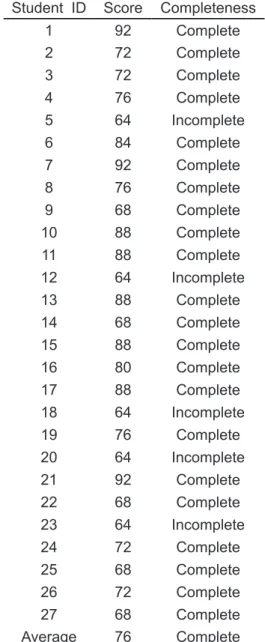
The learning outcomes of the cognitive domain as an indicator of students’ academic skills are as follows.
Table 4. Academic student skills.
Student ID Score Completeness
1 92 Complete 2 72 Complete 3 72 Complete 4 76 Complete 5 64 Incomplete 6 84 Complete 7 92 Complete 8 76 Complete 9 68 Complete 10 88 Complete 11 88 Complete 12 64 Incomplete 13 88 Complete 14 68 Complete 15 88 Complete 16 80 Complete 17 88 Complete 18 64 Incomplete 19 76 Complete 20 64 Incomplete 21 92 Complete 22 68 Complete 23 64 Incomplete 24 72 Complete 25 68 Complete 26 72 Complete 27 68 Complete Average 76 Complete The average student’s academic of 76 with classical completeness as much as 81%. Implementation of the learning device with a scientific approach to develop a student’s aca -demic skills include skills: identifying variables, explaining the relationship variables, formula -ting hypotheses, designing and conduc-ting ex -periments.
CONCLUSION
The observation of lesson plan with a scientific approach by teachers earn an ave -rage value of 3.38 are in the very good cate -gory, students’ social skills amounted to 3.03 are in the very good category, students acquire the academic skills average of 76 are in good category. Thus, it can be concluded that the implementation of learning tools with scientific approach is effective to support the learning activities in physics.
ACKNOWLEDGEMENTS
The writer would like to express since -re thanks to the DRPM, Ministry of Research, Technology And Education (Kemenristekdikti), which has facilitated the financing of this re -search through Competitive Re-search Grant Scheme 2015 until 2016. The writer would like to thank the other parties who have provided input into efforts to improve this paper.
REFERENCES
Agustina, P. and Saputra, A. (2012). Learning Im-plementation Problems of Life Skills-Based Biology (Life Skills) in Indonesia. Proceed
-ingNational Seminar IX. Surakarta: Biology Education FKIP University of Sebelas Maret (UNS).
Akinbobola, AO & Afolabi, F. (2010). Constructiv -ist practices through guided discovery ap -proach: The effect on students’ cognitive achievement in Nigerian senior secondary school physics. Eurasian Journal of Physics and Chemistry Education. 2 (1): 16-25. Anwar. (2006). Life Skills Education: Concepts and
Applications. Bandung: Alfabeta.
Arikunto, Suharsimi. (2006). Research Procedure: A Practice Approach. Jakarta: Rineka Cipta. Ibnu, S. (2014). Implementation of Curriculum 2013
In Science Lesson. Proceedings of the Na
-tional Seminar: Research, Science Learn-ing, and Curriculum 2013. Implementation Mataram: PPS Science Education Master program Mataram University.
Ibrahim, Muslimin. (2003). Learning Device Devel-opment. Jakarta: Dirjen Dikdasmen Depdik -nas.
Ibrahim, Muslimin. (2005). Sustainable Assessment: Basic Concepts, Stages of Development
and Examples. Surabaya: Unesa University
Press.
Jufri, A. Wahab. (2010). Learning and Learning Sci-ence. West Lombok: Arga Puji Press.
Kemendikbud. (2013). Teacher Training Content: Implementation of Curriculum 2013. Jakarta: Kemendikbud.
Khera, S. & Khosla, S. (2012). A Study Of Core Life Skills Of Adolescents In Relation To Their Self Concept Developed Through Yuva School Life Skills Program. International Journal of Social Science and Interdisciplin-ary Research, Vol.1 Issue 11.
Machin, A. (2014). Implementation of Scientific Ap -proach, Planting Character and Conservation Learning Materials On Growth . Indonesian Journal of Science Education, 3 (1), 28-35. Mugambi, MM & Muthui, RK ( 2013 ) . Structural
Influence Of Context On Implementation Of Secondary School Life Skills Curriculum In Kajiado County, Kenya. International Journal of Education and Research, Vol. 1 No. 3. Oladejo, MA, Olosunde, GR , Ojebisi, AO, Isola, OM
(2011). Instructional Materials and Students’ Academic Achievement in Physics: Some Policy Implications. European Journal of Hu-manities and Social Sciences, Vol. 2, 1. Rules Minister of Education and Culture of the Re
-public of Indonesia Number 81A Year 2013
about Curriculum Implementation .
Prince, M. (2004). Does Active Learning Work? A Review of the Research. Journal of Engi-neering Education, 93 (3), 223-231.
Sani, Ridwan Abdullah. ( 2014 ) . Scientific Learn-ing to Implement Curriculum 2013. Jakarta: Earth Literacy.
Sudjana, N., & Rival, A. ( 2013 ) . Teaching Media (Using and Making). Bandung: New Light Al-gensindo.
Sukiman. ( 2012 ) . Learning Media Development. Yogyakarta: Pustaka Insan Madani.
Suprihatiningrum, Jamil. ( 2013 ) . Learning Strat-egies: Theory and Applications. Jogjakarta: Ar-Ruzz Media.
Susiwi. Life Skills ( Life Skills ). Bandung: UPI 2007. BBE team mone. ( 2012 ) . Implementation Patterns
of Life Skills Education. Surabaya: SIC. Reader Tim Yustisia. ( 2008 ) . Complete Guide
KTSP (KurikulumTingkat Satuan pendidikan ). Jakarta: Pustaka Yustisia.
Trianto. ( 2008 ) . Designing Contextual Learning (Contextual Teaching and Learning) in the Class. Jakarta: Smart Reader.