On Message Authentication in 4G
LTE System
by
Teng Wu
A thesis
presented to the University of Waterloo in fulfillment of the
thesis requirement for the degree of Doctor of Philosophy
in
Electrical and Computer Engineering
Waterloo, Ontario, Canada, 2015
c
I hereby declare that I am the sole author of this thesis. This is a true copy of the thesis, including any required final revisions, as accepted by my examiners.
Abstract
After decades of evolution, the cellular system has become an indispensable part of modern life. Together with the convenience brought by the cellular system, many security issues have arisen. Message integrity protection is one of the urgent problems. The integrity of a message is usually protected by message authentication code (MAC).
Forgery attacks are the primary threat to message integrity. By Simon’s definition, forgery is twofold. The first is impersonation forgery, in which the opponent can forge a MAC without knowing any message-MAC pairs. The second is substitution forgery, in which the opponent can forge a MAC by knowing certain message-MAC pairs.
In the 4G LTE system, MAC is applied not only to RRC control messages and user data, but also to authentication of the identities in the radio network during the authentication and key agreement (AKA) procedure. There is a set of functions used in AKA, which is called A3/A8. Originally, only one cipher suite called MILENAGE followed the definition of A3/A8. Recently, Vodafone has proposed another candidate called TUAK.
This thesis first analyzes a MAC algorithm of the 4G LTE system called EIA1. The analysis shows that because of its linear structure, given two valid message-MAC pairs generated by EIA1, attackers can forge up to 232 valid MACs by the algorithm called linear forgery attack proposed in this thesis. This thesis also proposes a well-designed scenario, in which attackers can apply the linear forgery attack to the real system.
The second work presented in this thesis fixes the gap between the almost XOR universal property and the substitution forgery probability, and assesses the security of EIA1 under different attack models. After the security analysis, an optimized EIA1 using an efficient polynomial evaluation method is proposed. This polynomial evaluation method is analog to the fast Fourier transform. Compared with Horner’s rule, which is used in the official implementation of EIA1, this method reduces the number of multiplications over finite field dramatically. The improvement is shown by the experiment results, which suggests that the optimized code is much faster than the official implementation, and the polynomial evaluation method is better than Horner’s rule.
The third work in this thesis assesses the security of TUAK, and proves TUAK is a secure algorithm set, which meansf1, f1∗, and f2 are resistant to forgery attacks, and key recovery attacks; f3 -f5, andf5∗ are resistant to key recovery attacks and collision. A novel technique called multi-output filtering model is proposed in this work in order to study the non-randomness property of TUAK and other cryptographic primitives, such as AES, KASUMI, and PRESENT. A multi-output filtering model consists of a linear feedback shift register (LFSR) and a multi-output filtering function. The contribution of this research is
twofold. First, an attack technique under IND-CPA using the multi-output filtering model is proposed. By introducing a distinguishing function, we theoretically determine the success rate of this attack. In particular, we construct a distinguishing function based on the distribution of the linear complexity of component sequences, and apply it on studying TUAK’sf1 algorithm, AES, KASUMI and PRESENT. The experiments demonstrate that the success rate of the attack on KASUMI and PRESENT is non-negligible, but f1 and AES are resistant to this attack. Second, this research studies the distribution of the cryptographic properties of component functions of a random primitive in the multi-output filtering model. The experiments show some non-randomness in the distribution of the algebraic degree and nonlinearity for KASUMI.
The last work is constructing two MACs. The first MAC called WGIA-128 is a vari-ant of EIA1, and requires the underlying stream cipher to generate uniform distributed key streams. WG-16, a stream cipher with provable security, is a good choice to be the underlying cipher of WGIA-128 because it satisfies the requirement. The second MAC called AMAC is constructed upon APN functions. we propose two different constructions of AMAC, and both of these two constructions have provable security. The probability of substitution forgery attacks against both constructions of AMAC is upper bounded by a negligible value. Compared with EIA1 and EIA3, two message authentication codes used in the 4G LTE system, both constructions of AMAC are slower than EIA3, but much faster than EIA1. Moreover, both constructions of AMAC are resistant to cycling and linear forgery attacks, which can be applied to both EIA1 and EIA3.
Acknowledgements
First and foremost, I would like to extend my immeasurable appreciation and deepest gratitude towards my advisor Professor Guang Gong for her instructive guidance and tremendous support during the past four years. Her critical thinking and positive attitude towards work and life have always inspired and motivated me, and her extensive knowledge and experience have been the biggest help and resource for my studies. The last four years have been an enjoyable and unforgettable time that has given me great academic and personal development, thanks to the role model that Professor Gong has provided as a successful person, researcher, and professor.
I would also like to express my sincerest appreciation to Professor Rei Safavi-Naini from the University of Calgary for serving as my external examiner and providing many valuable suggestions. My deepest gratitude also goes to my thesis examining committee members, Professor David Jao, Professor Kshirasagar Naik, and Professor Mahesh Tripunitara, for their instrumental comments and their time on this thesis. I am deeply honored and blessed to have been guided by them. The thesis would not have been possible without their assistance.
I am particularly grateful for the knowledge, inspiration, and encouragement that I received from Professor Dong Zheng, Professor Kefei Chen and Professor Xuejia Lai at Shanghai Jiao Tong University during my Master’s study. It was they who motivated me and led me to pursue my interests in cryptography and security.
I am deeply obliged to many of my friends and colleagues at the University of Waterloo for their enormous support and inspiring suggestions during and beyond my PhD program: Professor Mark Aagaard, Dr. Xinxin Fan, Dr. Fei Huo, Dr. Bo Zhu, Dr. Kalikinkar Man-dal, Dr. Yin Tan, Dr. Valentin Suder, Qiao Liu, Yao Chen, Gangqiang Yang, Shasha Zhu, Nusa Zidaric and Kaveh Fazli. I want to thank all the wonderful members of the Commu-nication Security (ComSec) Lab of the University of Waterloo for always contributing to create a pleasant and stimulating group atmosphere.
Last but not least, I want to thank my family for their unconditional and endless love, trust, support and understanding. Thanks go to my father and mother for supporting and advising me at every important time of my life. Thanks are due to my wife for her thoughtful care that encourages me to adventure in the academic world. I also owe a special debt of gratitude to my daughter for the happiness brought by her. I would not be where I am today without my lovely family.
Dedication
I would like to dedicate my thesis
to my wife Ms. Luchen Tan,
my parent Mr. Hongju Wu and Ms. Shuqing Zhang,
and my daughter Tanya Wu.
Table of Contents
List of Tables xii
List of Figures xiii
1 Introduction 1
1.1 Historical View of Cellular Network . . . 2
1.2 Authentication and Key Agreement Procedure and Message Authentication in 4G LTE System . . . 3
1.3 Message Authentication Code . . . 6
1.3.1 Message Authentication Codes Based on Block Ciphers and Hash Functions . . . 8
1.3.2 Message Authentication Codes Based on Stream Ciphers . . . 10
1.4 Related Work . . . 12
Security Analysis on Keccak and TUAK . . . 12
Security Analysis of EIA1 and EIA3 . . . 13
MAC Design . . . 13
1.5 Contributions . . . 14
1.6 Organization . . . 15
2 Preliminaries 17 2.1 Notations . . . 17
2.2 Underlying Ciphers . . . 17
2.2.1 Snow3G and ZUC . . . 19
Snow3G . . . 19
ZUC . . . 20
2.2.2 WG-16 . . . 21
Initialization Phase . . . 21
Running Phase . . . 22
Randomness Properties of the WG-16 Key stream . . . 22
2.3 Details of TUAK, EIA1 and EIA3 . . . 23
2.3.1 TUAK . . . 23 Description of TOPC . . . 23 Description of f1 . . . 25 Description of f2 tof5 . . . 26 Description of f∗ 5 . . . 29 2.3.2 EIA1 . . . 29 2.3.3 EIA3 . . . 31
2.4 Universal Hash Functions and APN Functions . . . 32
3 Linear Forgery Attack on EIA1 35 3.1 IV Synchronization Mechanism and Derivation of IK . . . 36
3.2 Security Issue of EIA1 and EIA3 . . . 38
3.2.1 Quasi-Linearity Property of EIA1 and EIA3 . . . 38
3.2.2 Linear Forgery Attack Algorithm . . . 40
3.2.3 How To Find λ . . . 42
3.3 Application . . . 42
3.3.1 A Scenario of Fixing IV . . . 42
3.3.2 Counter Check Message . . . 45
3.3.4 Experimental Results . . . 46
Forgery Procedure . . . 47
Timing of Attack . . . 49
3.4 Summary . . . 51
4 Security Analysis and Efficient Implementation of EIA1 52 4.1 Security Analysis of EIA1 . . . 53
4.1.1 AXU Hash Is Secure . . . 53
4.1.2 Security Analysis of EIA1 . . . 55
Security under M0 . . . 56
Security under M1 . . . 58
Security under M2 . . . 61
Security under M3 . . . 62
4.2 An Efficient Implementation of EIA1 . . . 62
4.2.1 The Implementation Flaws of EIA1 . . . 63
4.2.2 Improvement with Modification to EIA1 . . . 63
Fix P,Q . . . 63
Choose another field . . . 64
4.2.3 Improvement without Modification to EIA1 . . . 64
A Faster Polynomial Evaluation Algorithm . . . 64
Optimize the Code . . . 66
4.2.4 Efficiency Analysis . . . 66
The efficiency of f9eva . . . 66
The efficiency of f9opt . . . 67
4.3 Summary . . . 69
5 Security Proof of TUAK 70 5.1 Security proof of the f1, f∗ 1 and f2 function construction . . . 70
5.2 Security proof off3, f4,f5 and f5∗ construction . . . 77
6 Multi-Output Filtering Model 79
6.1 Basic Definitions . . . 80
6.1.1 Basic definitions on sequences . . . 80
6.1.2 Basic definitions on Boolean functions . . . 80
6.2 Multi-Output Filtering Model . . . 81
6.2.1 Description of the Multi-Output Filtering Model . . . 82
6.2.2 Application to TUAK’s f1, AES, KASUMI and PREENT . . . 83
TUAK’s f1: . . . 83
AES, PRESENT and KASUMI: . . . 83
6.3 Distinguishing Attack Model . . . 84
6.4 Distinguishing Attack Based on Linear Complexity . . . 85
6.4.1 A generic framework to build a distinguisher . . . 86
6.4.2 Distribution of the linear complexity of component sequences . . . . 88
Test of the distribution of linear complexity. . . 88
Step 1 (Generating component sequences). . . 88
Step 2 (Computing linear complexity). . . 89
Step 3 (Comparing the distributions). . . 89
Distribution of f1, AES, KASUMI and PRESENT. . . 89
6.4.3 The new distinguishing attack . . . 89
Constructing the distinguishing function. . . 90
6.4.4 An example of the attack . . . 91
6.5 Distribution of the Algebraic Degree and Nonlinearity of the Component Functions . . . 92
6.5.1 Algebraic degree distribution . . . 92
6.5.2 Nonlinearity distribution . . . 94
7 Stream Cipher Based MACs Construction 98
7.1 WGIA-128 and Security Analysis . . . 99
7.1.1 Integrity Algorithm WGIA-128 . . . 99
Initialization. . . 100
Key Stream Generation. . . 100
MAC Generation . . . 100
7.1.2 Attack Models . . . 101
Model A . . . 101
Model B . . . 101
7.1.3 Ideal 32-Tuple Distribution Property of WG-16 . . . 102
7.1.4 Security of WGIA-128 under Model A . . . 102
7.1.5 Security of WGIA-128 under Model B . . . 106
7.2 AMAC and Two Constructions . . . 106
7.2.1 Construction I . . . 107
7.2.2 Construction II . . . 110
7.2.3 Security Analysis . . . 113
Cycling Attack. . . 113
Linear Forgery Attack. . . 114
7.3 Implementation and Efficiency . . . 114
7.3.1 Selection of Fields and APN Function . . . 114
Selection of Finite Fields. . . 115
Selection of APN Function. . . 115
7.3.2 Experiment Result of Efficiency . . . 116
7.4 Summary . . . 117
8 Conclusion and Future Work 118 8.1 Conclusion . . . 118
8.2 Future Work . . . 119
List of Tables
2.1 Notations . . . 18
3.1 Counter Check Messages . . . 46
3.2 Counter Check Messages in Hex . . . 47
4.1 Time costs of multiplying by 2n and shifting n bits . . . . 67
4.2 Time costs of Recursion and Loop . . . 68
5.1 OK t and Oa. . . 74
5.2 The game G to find the pre-image of f0 1. . . 74
6.1 Average success rate of our attack on f1, AES, KASUMI and PRESENT . 92 6.2 Distribution of the degree smaller than 7 . . . 94
6.3 Lower bound of the density of Boolean functions in B8 with nonlinearity greater than W . . . 95
6.4 The distribution of the nonlinearity of component sequences of f1, AES, KASUMI and PRESENT . . . 96
7.1 The Inputs of WGIA-128 . . . 99
7.2 The Output of WGIA-128 . . . 100
List of Figures
1.1 The AKA procedure of 4G LTE . . . 4
1.2 MILENAGE . . . 5
1.3 CBC-MAC . . . 8
1.4 GCM . . . 11
1.5 The Security Architecture of 4G LTE . . . 12
2.1 Snow3G . . . 19
2.2 ZUC . . . 20
2.3 The Initialization Phase of the Stream Cipher WG-16 . . . 21
2.4 The Running Phase of the Stream Cipher WG-16 . . . 21
2.5 The TOPc function of TUAK . . . 25
2.6 Thef1 function of TUAK for generating MAC . . . 27
2.7 EIA1 . . . 29
2.8 EIA3: based on ZUC . . . 31
3.1 Fixing IV . . . 43
3.2 Counter Check Message. . . 45
3.3 Retransmission times / SNR . . . 48
3.4 Decoding result . . . 50
6.1 Indistinguishability game . . . 85 6.2 Distribution of the Component Sequences with Linear Complexity 254 and
255 . . . 90 7.1 Efficiency comparison among EIA1, EIA3, and AMAC . . . 116 7.2 Efficiency comparison when using ZUC and Snow3G as underlying ciphers 117
Chapter 1
Introduction
In the past thirty years, wireless communication has acquired tremendous success. Now it is playing a key role in every corner of the human society. Cellular and Wi-Fi are two widely deployed wireless communication systems. Because of their outstanding mobility and flexibility, they offer great convenience to our lives.
The cellular system has already experienced four evolutions. The connection speed and the management method have been substantially improved. Compared with the cellular system, Wi-Fi is designed to cover much smaller areas. Thus, it is simpler than the cellular system. The Wi-Fi alliance concentrates on improving the coverage of a single access point (AP) and the speed of the network.
Together with its convenience, wireless communication also gives rise to security con-cerns. Since the data are transmitted over the air, the signal can be intercepted or modified easily by an attacker. Moreover, the expense of attacking a wireless communication system has decreased to an affordable level. Therefore, the vulnerability of a wireless communi-cation system is exposed to everyone. Protecting wireless communicommuni-cation systems has become an urgent problem to be solved. In this thesis, we focus on the integrity protection of the 4G LTE system. We remark that some methods can be extended to other wireless communication systems as well. But we will not discuss the extension in this thesis.
The rest of this chapter is organized as follows. Section 1.1 introduces the brief history of the Cellular system. Section 1.2 demonstrates the authentication and message authenti-cation in the 4G LTE system. Some well-known message authentiauthenti-cation code constructions are presented in Section 1.3. The last section, Section 1.6, illustrates the structure of this thesis.
1.1
Historical View of Cellular Network
Amazingly, the first “wireless” conversation happened in 1880. It was made by Alexander Graham Bell and Charles Sumner Tainter. This communication device was called “Pho-tophone”. As what it literally meant, the communication was conducted via light, and the communication distance could not be longer than the sight distance. Although the photophone was hardly practical in that era, as a precursor, it in fact started the age of wireless communications.
The concept of our daily used cellphone was proposed by AT&T’s BELL lab in the 1970’s, more than one hundred years after Heinrich Hertz showed the existence of electro-magnetic waves. In 1981, the first commercial cellphone network was deployed by Nordic Mobile telephone, which is the predecessor of Nokia. Two years later, the US also had its own commercial cellphone service called Advanced Mobile Phone Service. This generation of cellphone is usually referred to as the 1G network. The communication of the 1G net-work was conducted using analog signal. To serve multiple users simultaneously, the 1G network used Frequency Division Multiple Access (FDMA) to divide the channel.
In 1982, Europe began to work on the next generation communication technology, which was envisioned to be a digital cellular communication network. Five years later, the specification of the Global System for Mobile communications (GSM) was approved by the European countries and became the standard in Europe. The first phone call via GSM network was made in 1991, and in the next year, the first text message was sent through the GSM network. GSM is a digital communication network. It divides the channel by Time Division Multiple Access (TDMA). Besides GSM, there is another standard of the 2G network, which is called CDMA1 (IS-95 or TIA-EIA-95). CDMA1 was standardized by the US. As the commercial name suggests, it divides the channel by Code Division Multiple Access (CDMA).
At the beginning of GSM, it only allowed to transmit data through a circuit switched fashion. Thus, the data were charged per minute of connection time. As the General Packet Radio Service (GPRS) was developed, GSM had the capability to transmit data in a packet switched way, and the data was billed based on the volume of data transmitted. This GSM/GPRS network is usually called the 2.5G network. The difference between GSM and GSM/GPRS is that GSM/GPRS imported packet switching into the cellular system. GSM and CDMA1 were two mainstream standards in the age of the 2G network. As the competition of 3G network started, GSM and CDMA1 evolved to UMTS and CDMA2000 respectively. UMTS was standardized by an organization in Europe called 3GPP, and CDMA2000 was operated by a group in North America called 3GPP2. UMTS is based on
WCDMA, which is also a variant of CDMA. In the 3G network, all data is transmitted via packet switched network. However, the voice is still transmitted through the circuit switched network.
The competition between different standards and organizations were terminated by the rise of 4G LTE. Now, LTE has become the only standard of the 4G network. It evolved from UMTS. A new technology called Orthogonal Frequency Division Multiplexing (OFDM) was introduced in the LTE standard. Both data and voice should be transmitted via pack switched network. However, because of the legacy infrastructure in some network, the voice phone call is made by downgrading the network to 3G or 2G, which means the voice is transmitted by a circuit switched method in those systems. This downgrading brought some security issues to the LTE system.
1.2
Authentication and Key Agreement Procedure and
Message Authentication in 4G LTE System
There are two kinds of message authentications in the 4G LTE system: one used in the Authentication and Key Agreement (AKA) procedure and the other applied to RRC com-mands and the user data.
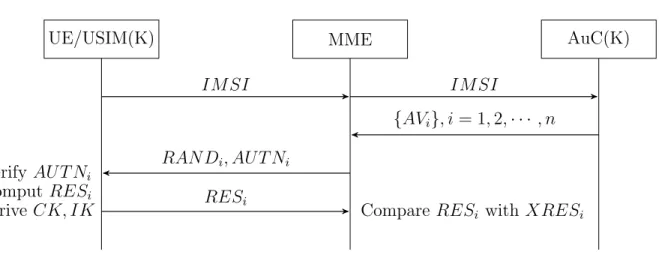
The AKA procedure is presented in Figure 1.1 [8, 38]. The cellphone is called User Equipment (UE) in the 4G LTE standard. The Subscriber Identity Module (SIM) is called USIM in both 3G UMTS and 4G LTE. MME is the Mobility Management Entity, which is called RNC in 3G UMTS. AuC is the Authentication Centre. K is the long term credential, which resides only in USIM and AuC. Note thatK is written in a secure ROM in USIM, and cannot be read out or be changed. USIM provides a computation interface for the cellphone using but not outputting the long term key. The interface is called A3/A8 algorithm. Although it is called an algorithm, in fact, it only specifies the input and output formats. The underlying cipher is chosen by the operator. In 2G GSM, because of the weakness of the first version of A3/A8, the long term key was exposed easily, and many SIM card cloning tools were seen in the market at that time. However, the evolution of the underlying cipher led to the current version of A3/A8, which is considered to be secure.
The AKA procedure starts with sending the International Mobile Subscriber Identity (IMSI) by UEs to the MME. The IMSI is an unique number, which associates the USIM card with an account. The MME forwards the IMSI to AuC. After AuC gets the identity, it retrieves the long term key K and generates the Authentication Vectors (AVs) using A3/A8. AuC generates several AVs and sends them all to the MME, which selects one
UE/USIM(K) MME AuC(K) IM SI IM SI {AVi}, i= 1,2,· · · , n RAN Di, AU T Ni VerifyAU T Ni Comput RESi
DeriveCK, IK RESi Compare RESi with XRESi
Figure 1.1: The AKA procedure of 4G LTE
AV each time to authenticate the UE. Before using up all the AVs sent by AuC, the MME can carry out the AKA for the same USIM by itself without involving the AuC again. This mechanism saves the bandwidth between the MME and AuC. This feature is important, because, especially when UE is roaming, the communication between the local MME and AuC is expensive. MME retrieves the random number RAN Di and the authentication token AU T Ni from the i-th AV, and sends them back to the UE. Upon receiving the response from the MME, the UE verifiesAU T Ni to authenticate the received sequence numberSQN and computes a response, which will be sent back to the MME. The Confidentiality Key (CK) and Integrity Key (IK) are also derived in this process. After the response RESi is sent back to MME, MME authenticates UE by comparing RESi with
XRESi, which is computed by AuC and written inAVi. In 3G UMTS, AV has five fields,
AVi ={RAN Di, XRESi, CKi, IKi, AU T Ni}.
As described above, RAN Di is a random number. XRESi is the expected response. CKi
and IKi are the confidentiality key and integrity key respectively. (In 4G LTE, these two keys are replaced by one master session key KASM E.) AU T Ni is the authentication token, which is defined by
AU T Ni ={SQNi⊕AKi, AM F, M ACi}.
AK is the anonymity key, which masks the sequence numberSQNi. Note that SQNi is a relatively sensitive data, by which an intruder can infer some information about the user, since the user utilizes it for the verification of the authenticity of the network. Thus, it
Rotate by r1 Rotate by r2 Rotate by r3 Rotate by r4 Rotate by r5
EK EK EK EK EK
c1 c2 c3 c4 c5
OPc OPc OPc OPc OPc f1 f1* f5 f2 f3 f4 f5*
OPc OPc OPc OPc OPc EK OPc RAND (SQN, AMF) expanded to 128 bits Figure 1.2: MILENAGE
is masked by a random number. AM F is the authentication management field, which indicates some parameters of the authentication. M ACi is the Message Authentication Code (MAC) computed over the information in AU T Ni. To verify AU T Ni, UE computes
M AC0
i and compares it with M ACi.
Together, all the message authentication and key derivation functions mentioned above make up the A3/A8 algorithm. Actually, A3/A8 algorithm contains seven functions. Orig-inally, only one algorithm set called MILENAGE followed the A3/A8 standard. Recently, Vodafone proposed another one called TUAK. Since TUAK is one of the research topic of this thesis, it is introduced in the next section together with other preliminaries of this thesis. In this section, we use MILENAGE as an example to illustrate the A3/A8 algorithm.
MILENAGE is presented in Figure 1.2. The ci and ri, for 1 ≤ i ≤ 5, are constants.
OPc is an operator specified constant. Ek is an arbitrary block cipher, whose block is 128-bit. Usually, the network operators choose AES as the underlying block cipher. The
function f1 generates the M AC of AU T N. In the specification, the f1 function is called the network authentication function, which means the UE uses this function to authen-ticate the network. The f2 function, called the user authentication function, generates the expected response and response. The f3 and f4 functions generate the CK and IK, respectively, which are legacies of the 3G UMTS network. They are the keys to protect the confidentiality and integrity. However, in 4G LTE, there is only one session key KASM E. Other keys are derived from this master session key. To reuse the infrastructure, KASM E
is derived from CK and IK by a key derivation function. Because the SQN may leak some information of the subscriber, the SQN is masked by an anonymity key generated by the function f5. Notice that the SQNs may be mismatched, i.e. the received one is smaller than the stored value. When such situation happens, the UE and the AuC run a re-synchronization routine. For security reasons, the M AC and AK in re-synchronization are generated by f∗
1 and f5∗, respectively.
After the AKA and security mode set-up procedure, the integrity and confidentiality of all the control messages are protected [8]. The integrity protection method, called
f9, is applied in radio resource control (RRC) layer. The f9 function takes four inputs:
COU N T−I,M ESSAGE,DIRECT ION andF RESH. COU N T−I is a counter, which counts how many times the integrity key is used. After COU N T −I reaches a threshold, the UE and MME must negotiate a new integrity key. M ESSAGE, as the name suggests, is the message the MAC is computed on. DIRECT ION indicates whether the message is sent in the uplink or downlink. This mechanism can prevent replay attacks. F RESH is the random number generated by the MME and sent to the UE during the (RRC) security mode command at the connection set-up procedure. This random number also helps the system avoiding replay attacks.
Upon the UE or other entities on the radio network receiving a message, it first checks the sequence number to see whether the message is fresh. If it is not, this message is discarded. Otherwise, UE or the network validates the message by checking MAC. If the message does not pass the validation, it is discarded.
1.3
Message Authentication Code
When the active wiretapper was proposed [112], integrity protection attracted more at-tention than ever before. Simmons [99] proposed the first authentication model using Message Authentication Code (MAC), and demonstrated two different attacking models against MAC: the impersonation forgery attack and the substitution forgery attack. Im-personation forgery means that the opponent can forge a MAC without intercepting any
message-tag pairs, and substitution forgery means that the opponent can forge by observ-ing message-tag pairs. The success rate of these two attacks are denoted by PI and PS, respectively.
There are several ways to construct a MAC, such as algebra [37, 82], combinatorics [101, 102], finite geometries [108], and coding theory [69].
Recently, people have begun to construct MACs on top of hash functions in one of two ways: the first is based on the universal hash functions, such as in Stinson’s work [103]; the second uses cryptographic hash functions to construct MACs as Krawczyk’s work [74]. Note that constructions using block ciphers also belong to the latter category, because block ciphers can be equivalent to keyed hash functions in the sense of CBC or other modes. For example, CBC-MAC [20] and XOR-MAC [19] are two MACs using block ciphers.
Originally, the keyed hash functions and block ciphers based MACs attracted most researchers’ attention. As stream ciphers were widely deployed in the wireless communi-cation related to our daily life, MACs based on stream ciphers became a hot reach topic. Constructions based on universal hash functions are naturally suitable for working with stream ciphers, because most of these constructions’ security proofs require a one-time pad. Usually, the period of the key stream generated by a stream cipher is guaranteed to be huge. Therefore, the key stream can be considered as a one-time pad required by the universal-hash-function-based constructions.
Krawczyk demonstrated that any Almost XOR Universal (AXU) hash function is equiv-alent to a secure message authentication code [73]. Krawczyk’s theory forms basis of many well-known MACs, such as GCM [82], EIA1 (UIA2) [3], etc. GCM has been standardized by NIST as an authenticated encryption (AE) scheme. EIA1 is the integrity protection algorithm deployed in the 4G LTE system. Note that an AE scheme encrypts and authen-ticates messages in one step. If we remove the encryption of GCM, it becomes GMAC, which is also a kind of MAC. EIA1 and GMAC are similar, because both are based on the evaluation of a polynomial. We call such MACs polynomial based MACs in this paper. The difference between these two is that EIA1 uses a method called secure truncation [21], while GCM just simply truncates the output to a fixed size.
In this section, we introduce two different kinds of MACs. Sub-section 1.3.1 presents the MACs based on block ciphers and hash functions, then Sub-section 1.3.2 demonstrates the MACs based on stream ciphers.
1.3.1
Message Authentication Codes Based on Block Ciphers
and Hash Functions
Here we take CBC-MAC [28] and HMAC [15, 74] as examples to show the MACs based on block ciphers. Of course, there are other outstanding MACs based on block ciphers, but these are omitted from this thesis.
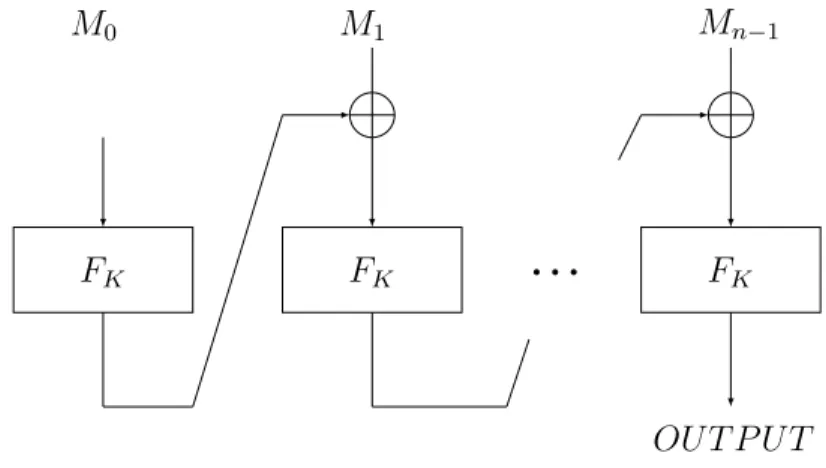
The structure of CBC-MAC is illustrated in Figure 1.3.
FK FK FK
M0 M1 Mn−1
...
OU T P U T
Figure 1.3: CBC-MAC
CBC-MAC is a variant of the Cipher Block Chain (CBC) mode of block cipher. The underlying cipher FK can be any block cipher or keyed hash function that maps a fixed-length input to a fixed-fixed-length output. Because CBC-MAC is computed in a chain, the computation cannot be parallelized.
When CBC mode is used for both authentication and encryption, using the same key for both authentication and encryption is forbidden [54] because of the following attack. Assume that Alice encrypts the message
P ={P0,· · · , Pn−1} to get the ciphertext
C ={C0,· · · , Cn−1},
and uses the last block Cn−1 as the MAC. Now Alice sends C to Bob. However, Eve intercepts and modifiesC to
Note that only the last block remains unchanged. Bob receives C0 and decrypts. What
Bob gets is different from the original P, but he is unaware of this modification.
Even using different keys for encryption and authentication, CBC-MAC is vulnerable to another well-known attack [28]. Assume that the MAC is computed on the ciphertext
C ={C0,· · · , Cn−1},
which is encrypted by a different key. The tag is computed in a recursive way.
Tn−1 =FK(Cn−1⊕Tn−2). Eve can construct another message
C0 ={C0,· · · , Cn−1, Tn−1⊕C0,· · · , Cn−1}.
The tag computed on the firstn blocks is Tn−1. When computing then-th block, we have
Tn=FK(Tn−1⊕Tn−1⊕C0) =FK(C0),
where Fk is the same block cipher as in Figure 1.3. Then this message and the original message have the same MAC (assume the initial vector of CBC-MAC is zero).
Since so many attacks are possible, numerous variants of CBC-MAC have emerged, such as EMAC [52], OMAC[105], TMAC [75], etc. Most of these variants improve CBC-MAC by encrypting the last block.
Unlike CBC-MAC, HMAC requires its underlying primitive to have the capability of mapping arbitrary-length input to fixed-length output. Most cryptographic hash functions fulfill this requirement, but all block ciphers do not have such capability. Thus, block ciphers cannot be the underlying primitive of HMAC without any modification. However, if we modify block ciphers a little bit, such as using Merkle-Damg˚ard construction [63], they can be utilized as the underlying cipher of HMAC. HMAC is defined by
T =H((K⊕opad)||H((K⊕ipad)||M)),
where H is a cryptographic hash function or a block cipher, opad and ipad are two con-stants, K is a key.
The two-layer design is to avoid the length extension attack [15], which is a kind of attack applied to Merkle-Damg˚ard hash constructions [42, 85, 86]. Merkle-Damg˚ard hash constructions assembly the compression functions like a chain. If HMAC has only one
layer, and the underlying cipher of HMAC is a Merkle-Damg˚ard hash function, the length extension attack can also be applied to HMAC.
Because of the Merkle-Damg˚ard construction, K⊕opadand K⊕ipad are prefixed to a message and its intermediate tag to increase the computation in an exhaustive search. For example, if HMAC is designed as
T =H(H(M||(K⊕ipad))||(K ⊕opad)),
the adversary can pre-compute the hash value t =H(M), and the hash value of t. Since the hash values of M and t are used in the computation of MAC, and these two values remain unchanged in the following computation, the pre-computation can reduce the time consumption of the exhaustive search.
1.3.2
Message Authentication Codes Based on Stream Ciphers
Several outstanding MACs, such as the one based on Grain-128 [10], cryptographic check sum [76], are based on stream ciphers. In this subsection, we introduce a very special case, GCM. This algorithm is proposed for the block cipher in counter mode. However, since the counter mode is actually a kind of stream ciphers, GCM can work not only with block ciphers, but also with arbitrary stream ciphers. Therefore, we consider it as a MAC based on stream ciphers. We remark here that GCM is an AE scheme. Therefore, the encryption and the authentication are done together. GCM has two blocks, GCTR and GHASH. GCTR encrypts messages, and GHASH generates the hash tag of messages. If the hash tag generated by GHASH is eventually encrypted by GCTR, GHASH and GCTR together are called GMAC.
Figure 1.4 demonstrates the structure of GCM. This figure takes AES as an example, but one can use any block cipher to replace AES in this figure. His the hash sub key, which is generated by encrypting0using the keyK. The notations “”, “” and “⊕” represent integer addition, multiplication over finite field and XOR respectively. J0, the pre-counter block, is initialized by IV in a complicated way as follows. Let s = 128dlen(IV)/128e −
len(IV). Then J0 = ( IV||031||1, If len(IV) = 96, GHASHH(IV||0s+64||[len(IV)] 64), If len(IV)6= 96.
Several works analyzed GCM, such as K¨asper and Schwabe [70], Iwataet al. [68], Zhu
AES IV J0 1 K 1 AES K P0 C0 · · · 1 AES K P1 C1 AES K Pn−1 Cn−1 · · · · · · M AC 0 AES K H Figure 1.4: GCM
1.4
Related Work
UE eNodeB MME AuC
Step 1. Authentication and Key Agreement
Step 2. Protected Communication
Figure 1.5: The Security Architecture of 4G LTE
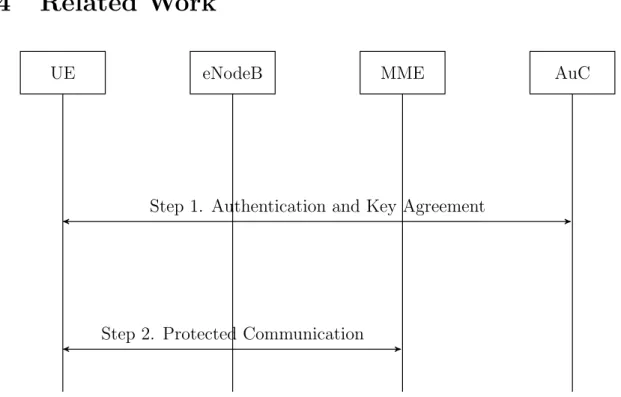
As shown in Figure 1.5, this thesis is about the integrity and authenticity protection in both Steps 1 and 2. The first step authenticates entities on the network and derives the session key, which will be used in Step 2. Both entity authentication and message authentication methods called A3/A8 are applied to Step 1. Step 2 is the communication after the security set-up in Step 1. The message integrity of Step 2 is protected by MAC using the key derived in Step 1.
Security Analysis on Keccak and TUAK
For Step 1, Vodafone has proposed an algorithm set called TUAK [53] to do the authen-tication and message authenauthen-tication, recently. TUAK is built upon Keccak [25], which was standardized as SHA-3 by NIST. The design of the Keccak hash function is based on the sponge function and its internal state size is 1600 bits [23, 91]. The Keccak cryp-tographic hash algorithm set contains four instances: 224, 256, Keccak-384 and Keccak-512 [91]. Several cryptanalytic attacks including differential attacks and
distinguishing attacks have been developed on the round-reduced Keccak hash function [12, 22, 44–46, 49, 77, 87, 89, 104]. A differential cryptanalytic technique is a method that can be used to produce a collision of a hash function. The differential attack for building a distinguisher or producing collisions on round-reduced Keccak can be found in several papers [44, 45, 49, 89]. Dinur et al. [44] proposed a collision attack on 4-round Keccak-224 and Keccak-256, and a near-collision attack on 5-round Keccak-Keccak-224 and Keccak-256. In another paper of Dinur et al. [45], the authors proposed a practical collision attack on 3-round Keccak-384 and Keccak-512, a collision attack on 4-round Keccak-384 with complexity of 2147 and a collision attack on 5-round Keccak-256 with complexity of 2115. Daemen and Van Assche studied the differential trails of the Keccak hash function in their paper [41]. Recently, Dinur et al. applied the cube attack on a message authentication code based on 6-round Keccak [46]. TUAK is a new application of Keccak. Although Keccak is proved to be secure, it does not necessarily mean TUAK is secure as well. This thesis proposes security proof and security assessment of TUAK for the first time to prove TUAK is as secure as Keccak.
Security Analysis of EIA1 and EIA3
In Step 2, message integrity is protected by the EIA family [3, 6]. EIA1 and EIA3 are two MACs based on stream ciphers. EIA1 is a kind of polynomial evaluation MAC, which computes the tag by evaluating a polynomial. Saarinen et al. presented an attack called cycling attack, and demonstrated the application of this attack on polynomial evaluation MACs in their paper [97]. Handschuh et al. showed key-recovery attacks [62] on univer-sal hash function based MACs. The authors used two different methods: weak key and birthday attacks. The cycling attack is a special case of the weak key attacks proposed by Handschuhet al. However, no attacks can be directly applied to EIA1, and cause seri-ous security flaws. EIA3 is equivalent to a polynomial evaluation MAC. The argument of EIA1 applies to EIA3 as well. Besides, a forgery attack [106] proposed by Thomaset al.
could forge MACs generated by EIA3 V1.3. The current version of EIA3 is V1.5, which is resistant against such attacks. In a nutshell, none of the existing attacks harm the security of EIA1 and EIA3 seriously. The forgery attack called linear forgery attack proposed in this thesis is the first applicable attack on EIA1 and EIA3.
MAC Design
MAC is used in every stage of the communication in Figure 1.5. Thereby, secure algorithms are highly demanded. Since the linear forgery attack is a relatively new attack, which
has not attracted much attention, two MACs proposed in this thesis are the first work resistant to such attacks. The first MAC is a variant of EIA1, and replaces the addition over a finite filed with the addition over a ring. There does not exist any work discussing such kind of MACs. The second MAC is based on APN functions, whose definition will be presented in Chapter 2. Chanson et al. [37] proposed MACs based on functions with optimal nonlinearity for the first time. Dinget al. [43] and Carlet et al. [34] continued the work of Chanson et al. Jian et al. [79] showed that the relationship between the perfect nonlinearity functions and the universal hash functions, and constructed an authentication code based on the universal hash function. None of the above MAC constructions can take an arbitrary-length input. The second MAC proposed in this thesis is the first MAC based on APN functions, and maps arbitrary-length inputs to fixed-length outputs just like CBC-MAC, HMAC, etc.
1.5
Contributions
Contributions of this thesis are listed as follows.
1. Linear Forgery Attack: This is the first practical attack on EIA1 and EIA3. Known two message-MAC pairs, attackers can forge up to 232 valid message-MAC pairs. This thesis also demonstrates an example that attackers can easily find meaningful messages among those 232 valid message-MAC pairs. By a well-designed scenario, attackers can apply the linear forgery attack to the real system. This practical attack makes the linear forgery attack more serious than existing attacks.
2. Security Proof of Almost XOR Universal MAC and EIA1: The security proof of
Almost XOR Universal (AXU) MAC left a gap between the AXU property and the probability of substitution forgery attacks. We fix this flaw, and show AXU MAC is secure under certain attack model. EIA1 as an AXU MAC is secure under this attack model. In addition, we consider the security of EIA1 under other attack models. This is the first time that EIA1 is examined under different models.
3. Improvement of EIA1: We point out several implementation flaws of EIA1 official implementation, and improve the official implementation by optimizing the multipli-cation over the finite field. Moreover, we introduce an efficient polynomial evalua-tion algorithm into EIA1 to make it faster than the official implementaevalua-tion using the Horner’s Rule.
4. Security Proof of TUAK: TUAK is a new algorithm set. The security proof pre-sented in this thesis is the first study on its security. This thesis considers the MAC algorithm and key derivation functions (KDFs) in TUAK, and proves the security of each algorithm. Based on the Keccak’s main document, this thesis suggests a tiny modification to TUAK to make it more secure.
5. Multi-Output Filtering Model and Its Applications: The Multi-Output Filtering Model (MOFM) is originally used in the communication system. We novelly apply it to the analysis of cryptographic primitives for the first time. This model utilizes LFSR as input, and arbitrary cryptographic primitive as the filtering function. By experiment, the MOFM may reveal some randomness of the primitive. For example, we test the linear complexities and algebra degrees of four primitives in this thesis. To test the linear complexity, we take the output as sequences, and compute the linear complex-ity for each component sequence. The distribution of the linear complexcomplex-ity shows differences between different primitives. For the algebra degree, we take the four primitives as vector Boolean functions, and compute the degree of each component function.
6. MAC Designs: The contribution is twofold. The first called WGIA-128 is a variant of EIA1. WGIA-128 replaces the addition over finite filed used in EIA1 with the addition over ring, which makes WGIA-128 resist the linear forgery attack. The second is AMAC, which is MAC based on APN functions. There exist many MAC constructions based on APN functions. However, all the existing works can deal the fixed-length message only. AMAC is the first F∗2-to-Fm2 MAC, like CBC-MAC or HMAC, based on APN functions. There are two different constructions of AMAC, and both have security proofs. The efficiency of AMAC is better than EIA1.
1.6
Organization
This thesis is organized as follows. Chapter 2 introduces the preliminaries, including the notations, definitions, etc. Chapter 3 presents a forgery attack on EIA1. This attack exploits the linear structure of EIA1. Inspired by the attack in Chapter 3, Chapter 4 ana-lyzes the security of EIA1 under different security models. Moreover, the implementation of EIA1 is improved by importing an efficient polynomial evaluation algorithm, which is better than Horner’s Rule. The next two chapters (5 and 6) discuss another set of authen-tication and message authenauthen-tication methods used in the 4G LTE system. The algorithm set, very recently proposed by Vodafone, is called TUAK. Chapter 5 is the security proof
of TUAK as MAC and KDF. Chapter 6 introduces a new analysis method called Multi-Output Filtering Model (MOFM), which is applied to TUAK later in this chapter. Chapter 7 presents two new MACs. One, an variant of EIA1, is resistant to the attack we propose in Chapter 3. The other MAC is based on APN functions. The last chapter, Chapter 8, concludes this thesis and points out some open problems, which are still unsolved.
Chapter 2
Preliminaries
This chapter presents the preliminaries of this thesis. Section 2.1 lists all notations used in the chapters that follow. Section 2.2 introduces three cryptographic primitives: Snow3G, ZUC, and WG-16. Snow3G and ZUC are both stream ciphers deployed in the 4G LTE system. They are the underlying ciphers of EIA1 and EIA3, two MACs discussed in this thesis. 16 is another stream cipher. Because one of our MAC designs is based on WG-16 (using its uniform distribution property), we demonstrate it in this chapter. Section 2.4 presents the concept of universal hash families, including universal and almost universal hash, strongly universal and almost strongly universal hash, and almost xor universal hash.
2.1
Notations
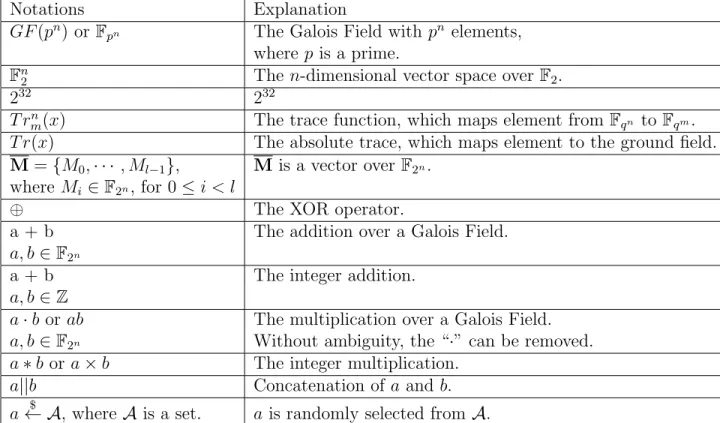
Table 2.1 lists the notations used in this thesis.
2.2
Underlying Ciphers
In this section, we present three stream ciphers: Snow3G, ZUC, and WG-16. The first two are the underlying ciphers of EIA1 and EIA3, respectively. We introduce them here because their structures can help us to understand the performance of EIA1 and EIA3 in Chapter 7. WG-16 is another stream cipher, and is the cipher underlying the MAC proposed in this research. To understand the security proof of this MAC, we demonstrate WG-16 and its properties in this section.
Notations Explanation
GF(pn) or
Fpn The Galois Field with pn elements,
where p is a prime.
Fn2 The n-dimensional vector space over F2.
232 232
T rn
m(x) The trace function, which maps element from Fqn toFqm. T r(x) The absolute trace, which maps element to the ground field.
M ={M0,· · · , Ml−1}, M is a vector over F2n.
where Mi ∈F2n, for 0≤i < l
⊕ The XOR operator.
a + b The addition over a Galois Field.
a, b∈F2n
a + b The integer addition.
a, b∈Z
a·b orab The multiplication over a Galois Field.
a, b∈F2n Without ambiguity, the “·” can be removed. a∗b ora×b The integer multiplication.
a||b Concatenation of a and b.
a ← A$ , whereA is a set. a is randomly selected from A. Table 2.1: Notations
2.2.1
Snow3G and ZUC
Snow3G s10 s9 s8 s7 s6 s5 s4 s3 s2 s1 s15 s14 s13 s12 s11 s0 R1 S1 R2 S2 R3 α−1 α Zt Figure 2.1: Snow3GSnow3G [2] is composed of a 16-stage linear feedback shift register (LFSR) and a finite state machine (FSM). Since each register of the LFSR can hold 32 bits, the operation of the LFSR is defined over GF(232). To define GF(232), we first define GF(28) by the polynomialg1(x) = x8+x7+x5+x3+1 overGF(2). Then we extendGF(28) toGF(232) by the polynomialg2(x) =x4+β23x3+β245x2+β48x+β239 overGF(28), whereβ ∈GF(28) is the root ofg1(x). The feedback polynomial of this LFSR isf(x) = αx16+x14+α−1x5+ 1, where α ∈ GF(232) is the root of g2(x). The FSM is composed of three 32-bit registers and two S-boxes. These two S-boxes, called S1 and S2, map 32 bits to 32 bits. S1 and
S2 are made of four juxtaposed 8-bit S-boxes, which rely on the Rijndael S-box, Dickson polynomial, and MixColumn operation. Notice that Snow3G combines the addition in
GF(232) together with the integer modular addition. To balance the key stream, the output of FSM is masked by the register s0. From the description above, we can see that Snow3G is a kind of nonlinear filter generator. The key stream is generated by passing the internal states of the LFSR through a nonlinear filtering function.
In the evaluation report on Snow3G [1], the authors proved only the period of the key stream generated by Snow3G, but no other randomness properties, such as k-tuple distri-bution, run distridistri-bution, etc. They also showed some properties of S-boxes and claimed that Snow3G resists distinguishing attacks and algebraic attacks. At the end of the evalu-ation report, the authors compared Snow3G with Kasumi and indicated that Snow3G has better throughput than Kasumi.
ZUC s10 s9 s8 s7 s6 s5 s4 s3 s2 s1 s15 s14 s13 s12 s11 s0 + mod 231−1 215 217 221 220 1 + 28 16 16 16 16 16 16 16 16 R1 R2 L16 SL1 SL2 Z Figure 2.2: ZUC
Similar to Snow3G, ZUC [7] is a nonlinear filtering generator as well. It also has a 16-stage LFSR and a FSM. However, the operation of the LFSR is defined over a prime fieldGF(231−1) (Snow3G is defined overGF(232)). Thus, each register has only 31 bits. The feedback polynomial isf(x) = 215x15+ 217x13+ 221x10+ 220x4+ 28+ 1. Because the registers of the LFSR are 31 bits each, which is not a power of 2, a bit reorganization layer is placed between the LFSR and the FSM in order to make each word 32 bits. The FSM has two 32-bit registers, which hold the intermediate states of the FSM. The nonlinear layer of the FSM is made up of the Rijndael S-box, Dickson polynomial, MixColumn, and ShiftRow.
2.2.2
WG-16
WG-16 is an efficient variant of the WG stream cipher family with 128-bit secret key and 128-bit initial vector (IV). It consists of a 32-stage LFSR with the feedback polynomial
l(x) followed by a WG-16 transformation module with decimation d = 1057. Therefore, it can be regarded as a nonlinear filter generator over finite fieldF216. WG-16 operates in two phases, namely an initialization phase and a running phase.
Initialization Phase
16
WGP-16(x1057) WGP-16(x1057): WG-16 Permutation Module with Decimationd= 1057
⊕
⊕
S0 S1 S2 S15 S16 S30 S31 ω2743 16 16 16 16 16 · · · S17 S29 · · · S8 S7 S6 · · ·⊕
16 16⊗
16⊕
S24 S25 16 S26 · · · 16Figure 2.3: The Initialization Phase of the Stream Cipher WG-16
Tr(·) 16 1 16 WGT-16(x1057) keystream
WGT-16(x1057): WG-16 Transformation Module with Decimationd= 1057
WGP-16(x1057): WG-16 Permutation Module with Decimationd= 1057
Tr(·): Trace Computation Module
WGP-16(x1057)
⊕
S0 S1 S2 S15 S16 S30 S31 ω2743 16 16 16 16 16 · · · S17 S29 · · · S8 S7 S6 · · ·⊕
16 16⊗
16⊕
S24 S25 16 S26 · · ·Figure 2.4: The Running Phase of the Stream Cipher WG-16
The key/IV initialization phase of WG-16 is illustrated in Fig. 2.3. Let the 128-bit secret key be K = (K127, . . . , K0)2, the 128-bit IV be IV = (IV127, . . . , IV0)2, and the internal state of the LFSR beS0, . . . , S31 ∈F216, where Si = (Si,15, . . . , Si,0)2 for i= 0, . . . ,31. The key/IV initialization process is conducted below:
Si =
(K8i+7, . . . , K8i, IV8i+7, . . . , IV8i)2 i= 0, . . . ,15,
Si−16 i= 16, . . . ,31.
Once the LFSR is loaded with the key/IV, the apparatus runs for 64 clock cycles. During each clock cycle, the 16-bit internal state S31 is sent to the WG-16 permutation with
decimation d = 1057 (i.e., the WGP-16(x1057) module) and the output is used as the nonlinear feedback to update the internal state of the LFSR. The LFSR state update procedure follows the recursive relation:
Sk+32= ω2743⊗Sk ⊕Sk+7⊕Sk+16⊕ Sk+25⊕WGP-16 Sk1057+31 , 0≤k < 64.
After the initialization phase, WG-16 starts the running phase and a bit key stream is generated per clock cycle.
Running Phase
The running phase of WG-16 is shown in Fig. 2.4. During the running phase, the 16-bit internal stateS31 is sent to the WG-16 transformation with decimationd = 1057 (i.e., the
WGT-16(x1057) module) and the output is a bit key stream. Note that the only feedback in the running phase is within the LFSR and the recursive relation for updating the internal state of LFSR is given below:
Sk+32= ω2743 ⊗Sk
⊕Sk+7⊕Sk+16⊕Sk+25, k≥64.
The WGT-16(x1057) module comprises of two sub-modules: a WG-16 permutation module
WGP-16(x1057) followed by a trace computation module Tr(·). While the WGP-16(x1057) module permutes elements over F216, the Tr(·) module compresses a 16-bit input to a bit key stream.
Randomness Properties of the WG-16 Key stream
The key stream generated by the stream cipher WG-16 has the following desired random-ness properties [38]:
1. The key stream has a period of 2512−1.
2. The key stream is balanced, i.e., the number of 0’s is only one less than the number of 1’s in one period of the key stream.
3. The key stream is an ideal two-level autocorrelation sequence.
4. The key stream has an ideal t-tuple (1 ≤ t ≤ 32) distribution, i.e., every possible output t-tuple is equally likely to occur in one period of the key stream.
2.3
Details of TUAK, EIA1 and EIA3
2.3.1
TUAK
TUAK is an algorithm set for the 3GPP authentication and key derivation functions. TUAK specification contains the functions TOPc, f1, f1∗, f2, f3, f4, f5 and f5∗ and all of them are built upon the Keccak-f[1600] permutation. For the convenience, we first list the following notations, which will be used throughout this thesis. They are the same as those notations in the specification of TUAK.
- The permutation Keccak-f[1600] is denoted by Π. Throughout this thesis we use Π to denote the Keccak permutation. According to the design of Π, it accepts an input of size 1600 bits that is represented by IN[0],· · · ,IN[1599] and outputs an element of 1600 bits that is represented by OUT[0],· · · ,OUT[1599];
- TOP is a 128-bit value decided by the operator and used as the input of the TOPc
function;
- ALGONAME is a fixed binary string of 56 bits, whose value can be found in the speci-fication;
- INSTANCE is a binary variable of 8 bits. It uses to instantiate different functions, TOPC, fi’s,f∗
1 and f5∗, in the TUAK algorithm set; - K denotes the subscriber key;
In the following, we provide a description of each algorithm in TUAK. In this thesis, we interchangeably use the terms “algorithm” and “function” for the functions in the TUAK algorithm set.
Description of TOPC
Authentication and key derivation functions of TUAK use the output of TOPC. We provide
a description of the TOPC function. The TOPc function takes a 256-bit value called TOP
(chosen by the operator) and the subscriber key (can be 128 or 256 bits) as inputs (the other bits are constants), and outputs a 256 bit value TOPc. More precisely, the inputs of
- The value of INSTANCE is given by
INSTANCE[0]..INSTANCE[6] = 0,0,0,0,0,0,0;
INSTANCE[7] = 0 if the length of K is 128,
= 1 if the length of K is 256.
- IN[0]..IN[255] = TOP[255]..TOP[0];
- IN[256]..IN[263] = INSTANCE[7]..INSTANCE[0]; - IN[264]..IN[319] = ALGONAME[55]..ALGONAME[0]; - IN[i] = 0, for 320 ≤i≤511;
- IN[512]..IN[767] = K[255]..K[0] if the length ofK is 256 bits; - IN[512]..IN[639] = K[127]..K[0] if the length ofK is 128 bits ; - IN[i] = 0 for 640 ≤i≤767 if the length of K is 128 bits ; - IN[i] = 1 for 768 ≤i≤772 ;
- IN[i] = 0 for 773 ≤i≤1086; - IN[1087] = 1;
- IN[i] = 0 for 1088 ≤i≤1599.
Figure 2.5 depicts an overview of an input assignment to the TOPC function. The T OPC function is given by
OUT = Π(INPUT) with
Π TOP
INSTANCE
ALGONAME 0192 K PADDING 0512
TOPc
Figure 2.5: The TOPc function of TUAK
Description of f1
The functionf1 is used to generate the MACs. An input of 1600 bits tof1 is constructed by the following binary strings: TOPc(256 bits, generated by the function TOPc), INSTANCE
(8 bits), ALGONAME (56 bits), RAND (128 bits), AMF (16 bits), SQN (48 bits), and the subscriber key K (128 or 256 bits). The output value MAC can be 64, 128 and 256 bits. Precisely:
- The value of INSTANCE is:
INSTANCE[0],INSTANCE[1] = 0,0
INSTANCE[2]..INSTANCE[4] = 0,0,1 if the MAC length is 64 bits = 0,1,0 if the MAC length is 128 bits = 1,0,0 if the MAC length is 256 bits INSTANCE[5],INSTANCE[6] = 0,0
INSTANCE[7] = 0 if the length of K is 64 or 128 = 1 if the length of K is 256.
- IN[0]..IN[255] = TOPc[255]..TOPc[0];
- IN[256]..IN[263] = INSTANCE[7]..INSTANCE[0]; - IN[264]..IN[319] = ALGONAME[55]..ALGONAME[0]; - IN[320]..IN[447] = RAND[127]..RAND[0];
- IN[448]..IN[463] = AMF[15]..AMF[0]; - IN[464]..IN[511] = SQN[47]..SQN[0];
- IN[512]..IN[767] = K[255]..K[0] if the length ofK is 256 bits ; - IN[512]..IN[639] = K[127]..K[0] if the length ofK is 128 bits ; - IN[i] = 0 for 640 ≤i≤767 if the length of K is 128 bits ; - IN[i] = 1 for 768 ≤i≤772;
- IN[i] = 0 for 773 ≤i≤1086; - IN[1087] = 1;
- IN[i] = 0 for 1088 ≤i≤1599.
A high-level overview of the input assignment is provided in Figure 2.6. The MAC function
f1 is defined as
OUT = Π(IN).
The output off1, i.e. the MAC, can be of length 64, 128, and 256 and is given by MAC[0]..MAC[63] = OUT[63]..OUT[0], if the MAC length is 64 bits,
MAC[0]..MAC[127] = OUT[127]..OUT[0], if the MAC length is 128 bits,
MAC[0]..MAC[255] = OUT[255]..OUT[0], if the MAC length is 256 bits.
Description of f2 to f5
The f2 function is used to generate a response (RES) over a random number, a sequence number (SQN), and an AMF for a fixed key. Thef3,f4andf5functions are used to generate a cipher key (CK), an integrity key (IK) and an anonymity key (AK), respectively for a random number. The input assignment of these functions are given below.
Π TOPc INSTANCE ALGORITM RAND AMF SQN K PADDING 0512 MAC
Figure 2.6: The f1 function of TUAK for generating MAC
- The value of INSTANCE is:
INSTANCE[0],INSTANCE[1] = 0,1
INSTANCE[2]..INSTANCE[4] = 0,0,0 if the RES length is 32 bits = 0,0,1 if the RES length is 64 bits = 0,1,0 if the RES length is 128 bits = 1,0,0 if the RES length is 256 bits INSTANCE[5] = 0 if the length of CK is 128 bits
= 1 if the length of CK is 256 bits INSTANCE[6] = 0 if the length of IK is 128 bits
= 1 if the length of IK is 256 bits INSTANCE[7] = 0 if the length of K is 128 bits
= 1 if the length of K is 256 bits.
- IN[0]..IN[255] = TOPc[255]..TOPc[0];
- IN[256]..IN[263] = INSTANCE[7]..INSTANCE[0]; - IN[264]..IN[319] = ALGONAME[55]..ALGONAME[0]; - IN[320]..IN[447] = RAND[127]..RAND[0];
- IN[i] = 0,448≤i≤511;
- IN[512]..IN[639] = K[127]..K[0] if the length ofK is 128 bits ; - IN[i] = 0 for 640 ≤i≤767 if the length of K is 128 bits ; - IN[i] = 1 for 768 ≤i≤772;
- IN[i] = 0 for 773 ≤i≤1086; - IN[1087] = 1;
- IN[i] = 0 for 1088 ≤i≤1599.
On receiving the input INPUT, the outputs off2−f5 and f5∗ are calculated as follows OUT = Π(INPUT).
The output off2 = RES, where:
RES[0]..RES[31] = OUT[31]..OUT[0] if the RES length is 32 bits RES[0]..RES[63] = OUT[63]..OUT[0] if the RES length is 64 bits RES[0]..RES[127] = OUT[127]..OUT[0] if the RES length is 128 bits RES[0]..RES[255] = OUT[255]..OUT[0] if the RES length is 256 bits The output off3 = CK, where:
CK[0]..CK[127] = OUT[383]..OUT[256] if the CK length is 128 bits CK[0]..CK[255] = OUT[511]..OUT[256] if the CK length is 256 bits The output off4 = IK, where:
IK[0]..IK[127] = OUT[639]..OUT[512] if the IK length is 128 bits IK[0]..IK[255] = OUT[767]..OUT[512] if the IK length is 256 bits The output off5 = AK, where:
Description of f∗
5 For thef∗
5 function, the INSTANCE is given by INSTANCE[0],INSTANCE[1] = 1,1 INSTANCE[2], ...,INSTANCE[6] = 0,0,0,0,0
INSTANCE[7] = 0 if the length of K is 128 bits = 1 if the length of K is 256 bits.
The assignment of INPUT is the same as the input assignment off2−f5 with the above INSTANCE and the following changes
IN[257] = 0,IN[258] = 0,IN[259] = 0,IN[260] = 0,IN[261] = 0,IN[263] = 1.
The output off∗
5 is given by
OUT = Π(INPUT) where
AK[0]..AK[47] = OUT[815]..OUT[768].
Different algorithms of TUAK produce outputs of different lengths. We denote byfi-M
the fi function/algorithm with output M bits.
2.3.2
EIA1
Figure 2.7 shows the structure of EIA1. P, Q∈GF(264) andOT P ∈GF(232) are generated by Snow3G. ... Truncate M0 M1 Mn-1 LEN Q P OTP OUTPUT Figure 2.7: EIA1
According to Figure 2.7, the MAC of the message M={M0,· · · , Mn−1}, where Mi ∈GF(264), is given by ( n−1 X i=0 Pn−iMi+LEN)Q T runcate+OT P, (2.1)
whereLEN is an element in GF(264). By the specification [3], “Truncate” means cutting the least significant 32 bits and leaving the most significant 32 bits. Specifically, if H ∈ GF(264) and H =h1||h
0, whereh0 andh1 are the least significant and the most significant 32 bits respectively,T runcate(H) =h1.
Lemma 1. Let p(x) = x2 +ax+b be the defining polynomial of GF(264) over GF(232),
where a, b∈GF(232). Then
T runcate(H) =T r6432(H)a−1, where T r64
32(x) = x2 32
+x is the trace function from GF(264) to GF(232).
Proof. Let α be a root of p(x) over GF(264). Thus we have
α2+aα=b. (2.2) LetH =h1+h2α. Sinceh1, h2 ∈GF(232), T r6432(H) = h1+h2α2 32 +h1+h2α=h2(α2 32 +α). Because of Eqn.(2.2), α a 2 +α a = b a2 α a 4 +α a 2 = b a2 2 · · · α a 232 +α a 231 = b a2 231
Sum the equations above together, we have
α a 232 + α a =T r b a2 .
Becausex2+ax+b has no roots over GF(232), it is easy to prove thatT r b a2 = 1. Thus, α232+α=a. Therefore, T runcate(H)a=T r6432(H). Sincea 6= 0, T runcate(H) =T r6432(H)a−1.
By Lemma 1, Eqn.(2.1) can be written in a mathematical way, which is easier to analyze. T r3264 ( n−1 X i=0 Pn−iMi+LEN)Q a−1+OT P.
2.3.3
EIA3
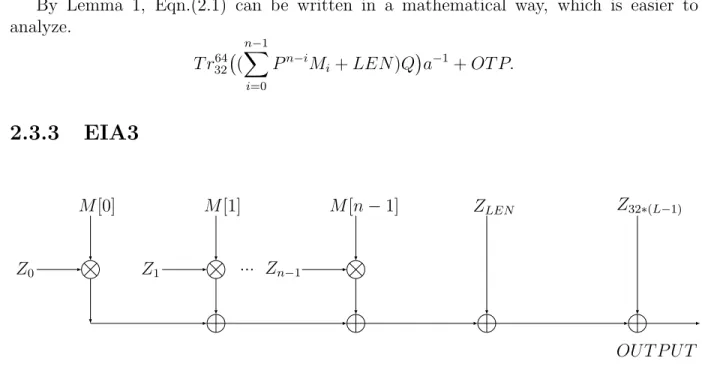
M[0] Z0 M[1] Z1 M[n−1] Zn−1 ... ZLEN Z32∗(L−1) OU T P U TFigure 2.8: EIA3: based on ZUC
Originally, ZUC is not in the UMTS standard. It is added to the standard after the system migrates to LTE. The integrity protection based on ZUC is EIA3 [6]. EIA3 borrows the idea of Krawczyk [73], which uses shifted key streams to generate the MAC. In Figure 2.8,M[i] is thei-th bit of message, and Zi is thei-th word of the key stream generated by ZUC. Assume the key stream generated by ZUC is
where each Z[i] is a bit. Then, Zi is defined by
Zi = (Z[i], Z[i+ 1],· · · , Z[i+ 31]).
EIA3 pads every message with a“1”. Z32∗(L−1) is the mask to encrypt the intermediate tag.
Lis equal to dLEN GT H/32e+ 2.
A mathematical expression of Figure 2.8 is given by
M AC(M) = n−1 X i=0 M[i]zi | {z } part1 +zLEN GT H +z32∗(L−1) | {z } part2 ,
The main observation of EIA3 is that Part 1 is a linear operation and Part 2 is a constant if the length is fixed.
2.4
Universal Hash Functions and APN Functions
We use the definitions ofδfunction anduniversal2 hash function in Carter and Wegman’s work [36] to illustrate the concept of universal hash function family.
Definition 1. Let H be a hash function family. ∀f ∈ H, f : A 7→ B. Define δf(x, y) as follows.
δf(x, y) =
(
1 x6=y and f(x) =f(y)
0 otherwise ,
where x, y ∈ A. Define δH(x, y) using δf(x, y).
δH(x, y) =
X f∈H
δf(x, y).
Definition 2. LetHbe a class of hash functions fromAtoB. We say that Hisuniversal2
if∀x, y ∈ A, δH(x, y)≤ |H|/|B|. That is, Hisuniversal2 if no pair of distinct keys collide
under more than 1/|B|-th of functions.
Carter and Wegman explained the subscript “2” as the intention to emphasize that the definition constrains the behaviour of H only on pairs of elements in A. Carter and Wegman defined the strongly universaln and strongly universalω hash function families in
Definition 3. Suppose H is a set of hash functions, each element of H being a function from A to B. H is strongly universaln if given any n distinct elements a0,· · · , an−1 of A and any n (not necessarily distinct) elements b0,· · · , bn−1 of B, then |H|/(|B|n)
func-tions take a0 to b0, a1 to b1, etc. A set of hash functions is strongly universalω if it is strongly universaln for all values of n.
Nevelsteen et al. formalized the definitions of Almost Universal (AU) hash function and Almost Strongly Universal (ASU) hash function based on the definitions proposed by Stinson [103] in their paper [90]. Besides, they also formalized the concept of Almost Xor Universal (AXU) hash function based on the definition in Krawczyk’s paper [73].
Definition 4. Let be any positive real number. An -almost universal family (or -AU family) H of hash functions from a set A to a set B is a family of functions from A to B such that for any distinct elements x, x0
∈ A
|{h∈ H :h(x) = h(x0)}|=δH(x, x0)≤· |H|.
Definition 5. Let be any positive real number. An-almost strongly universal family (or -ASU family) H of hash functions from a set A to a set B is a family of functions from
A to B such that
• for every x∈ A and for every y∈ B, |{h∈ H:h(x) =y}|=|H|/|B|,
• for every x1, x2 ∈ A (x1 6=x2) and for every y1, y2 ∈ B(y1 6=y2), |{h ∈ H: h(x1) =
y1, h(x2) =y2}| ≤· |H|/|B|.
Definition 6. Let be any positive real number. An -almost XOR universal family (or -AXU family) H of hash functions from a set A to a set B is a family of functions from
A to B such that for any distinct elements x, x0 ∈ A and for any b ∈ B
|{h∈ H :h(x) +h(x0) = b}| ≤· |H|.
Without ambiguity, we sometimes use AXU hash function to indicate the AXU hash function family throughout this thesis.
McGrew and Viega defined a class of message authentication code called Almost Xor
Universal MAC (AUX-MAC) [82] based on AXU hash function family.
Definition 7. A message authentication code is called -AXU MAC if it is defined as M AC =H(K,M) +R(N),
where K is the key; M is the message; N is the nonce; H is a -AXU hash function, and R is a random function.
When discussing the security of a message authentication code, Krawczyk proposed a concept called -otp-secure [73]. Before the definition, he proposed a secure model.
Secure model: LetMbe a message of lengthmauthenticated with the tagt=h(M)+r, where h ← H$ and r ← {$ 0,1}n. We say that an adversary that sees M and t succeeds
in breaking the authentication if it find M’ and t0, where M’ is different than M and
t0 =h(M0) +r. We assume that the adversary knows the family of hash functions, but not
the particular value of h or the pad r.
Definition 8. A family H of hash functions is called -otp-secure if for any message M no adversary succeeds in the above scenario with probability larger than .
Simmons defined two kinds of forgery attacks. Here we borrow the definition in [103].
Definition 9. When an opponent places a new message m0 = (s0, a0), where s0 is the
source state, and a0 is the authenticator, this is called impersonation forgery. When
the opponent sees a message m = (s, a) and changes it to a message m0 = (s0, a0) where
s6=s0, this is called substitution forgery.
Note that the impersonation forgery means the opponent can forge a message-MAC pair without accessing to the oracle. The substitution forgery means the opponent accesses to the oracle once, and then forge a message-MAC pair.
The AXU property is quite similar to the definition of the APN function, which is defined as follows.
Definition 10. Let f(x) :F2n 7→F2n. For anya, b∈F2n, we denote δ(a, b) = #{x∈F2n :f(x) +f(x+a) = b}. If
max
a6=0,b∈F2n
δ(a, b) = 2,
the function f(x) is called an almost perfect nonlinear (APN) function.