www.fke.utm.my/elektrika ISSN 0128-4428
Comparative study of Multiple Criteria Decision
Making methods for selecting the best Demand
Side Management options
Muhamad Rasydan Mokhtar
1,2*,
Md Pauzi Abdullah
1,2,
Mohammad Yusri Hassan
1,2and
Faridah Hussin
1,21 Centre of Electrical Energy Systems (CEES), Institute of Future Energy, Universiti Teknologi Malaysia, 81310 UTM Johor Bahru, Johor, Malaysia.
2 Faculty of Electrical Engineering, Universiti Teknologi Malaysia, 81310 UTM Johor Bahru, Johor, Malaysia. *
Corresponding author: [email protected], Tel: 6013-7024965
Abstract: This paper presents comparative study of multiple criteria decision making (MCDM) methods for analysing
Demand Side Management (DSM) options in improving energy efficiency. The solution of selecting the best DSM options contains of weighting the criteria and ranking the options. A method known as Analytical Hierarchy Process (AHP) is used to weighting the criteria. Preference Ranking Organization Method for Enrichment Evaluation (PROMETHEE), Technique for Order Preference by Similarity to Ideal Solution (TOPSIS) and Weighted Sum Method (WSM) used to rank the DSM options. Combination of AHP with PROMETHEE (AHP-PROMETHEE), AHP with TOPSIS (AHP-TOPSIS) and AHP with WSM (AHP-WSM) have been applied in a case study where 7 DSM options to be evaluated according to 6 criteria. The results shown 3 sets of ranking order where all approaches shown DSM1 is the most cost effective option while DSM5 is the least cost effective option. However there is slightly different in AHP-TOPSIS ranking order between second priority and third priority while PROMETHEE and WSM provide same ranking order. In addition, WSM and AHP-TOPSIS have an advantage over AHP-PROMETHEE where do not required any pairwise comparison to be completed in ranking process.
Keywords: Demand Side Management, Analytic Hierarchy Process, Preference Ranking Organization Method for
Enrichment Evaluation, Technique for Order Preference by Similarity to Ideal Solution, Weighted Sum Method
© 2017 Penerbit UTM Press. All rights reserved
1.INTRODUCTION
The rapid growth of electricity consumption in the worldwide becomes serious concern since there are having problem on limited power supply, exhaustion of energy sources and environmental impacts. The major factor of higher energy usage consists of technological and cultural developments, demographic and institutional factors and also economic growth [1]. All sectors which are commercial, industrial and industrial consume higher energy consumption and there should be an initiative from electric utilities to plan something to deal with this problem on rapid energy usage. Electricity utilities are responsible to supply power to consumers in whatever amount and time they need.
Demand Side Management (DSM) could possibly be an option to handle the problem of limited supply and also defer new power plants to serve during emergency period [2]. DSM also contributes to green environment if most generators use less because the production of electricity is from combustion of fossil fuels. Researchers have currently shown an interest in DSM where most of past research shown great impact of DSM that is the reduction of energy usage and peak demand that have been implemented at the consumer side [3-5].
According to Schweitzer et al. [6], successful DSM implementation consist of three phases which are identification of potential DSM resources, assessment of various identified DSM options and selection of the most suitable DSM options for further consideration. Ma et al. [7] stated that the optimal selection of DSM options can be developed by using model-based approach or model free approach. For the purpose of this study, special attention is given to model-free approach where it does not require a “model” of a problem. It just requires an expert opinion that is affected by the richness of knowledge database.
In this paper, three multi criteria decision making (MCDM) methods which are Preference Ranking Organization Method for Enrichment Evaluations (PROMETHEE), Technique for Order Preference by Similarity to Ideal Solution (TOPSIS) and Weighted Sum Method (WSM) used to rank the DSM options. Meanwhile, Analytic Hierarchy Process (AHP) is used to set relative importance to the criteria since it is most popular subjective weighting method. The combination of AHP-PROMETHEE, AHP-TOPSIS and AHP-WSM to evaluate the best DSM options will be compared and discussed in the case study.
2.MULTIPLECRITERIADECISIONMAKING METHODS
Multi Criteria Decision Making (MCDM) can be defined as making preference decisions such as selection, optimization, evaluation, and prioritization. It is a technique that very fast growing areas under Operational Research (OR). Basically, the proposed alternatives are been characterized by multiple conflicting criteria. MCDM consist of structuring the problem in matrix form that usually considering the decision maker’s preference [8].
2.1 Analytic Hierarchy Process
Analytic Hierarchy Process (AHP) is one of the MCDM methods that been introduced by Saaty in the 1970s [9]. This method used pairwise comparison on ratio scale to assign criteria weights. AHP is synthesized to compare both qualitative and quantitative using expert opinion to determine relative weight of all criteria using 1 to 9 scales. In AHP, one criterion is compared with another criterion at one time based from decision maker. Reciprocal is defined as multiplicative inverse and every number has a reciprocal value except zero. In the weighting process, reciprocally must be assigned in each of pair wise comparison matrix as shown below in matrix A. The terms of ‘i’ and ‘j’ represent the rows and columns of the matrix and ‘a’ represents the relative important for each criteria.
A
Matrix
=
1
1
1 1
n na
a
1 11
n na
a
where
i
,
j
1
,
...
,
n
2.2 Preference Ranking Organization Method for
Enrichment Evaluation
PROMETHEE was developed by Brans [10] that been used in different kind of decision making problems such as environmental management, hydrology and water management, business and financial management, chemistry, logistics and transportation, manufacturing and assembly, energy management, social and others. It is also known as outranking method that compares options with other options to determine preference index. Two options are compared according to their preference degree. In addition, finite options can be rank by considering multiple and conflicting criteria. PROMETHEE I is a partial ranking that can be obtained by comparing the outgoing flow, Ø+ and incoming flow, Ø-. The best options should have greater outgoing flow while having smaller incoming flow. Two options for example, a and b are incomparable if outgoing flow and incoming flow for a bigger than b and also outgoing flow and incoming flow for a smaller than b. Let define the two total preorders (P+ , I+) and (P- , I-) such that:
)
(
)
(
a
b
if
b
aP
)
(
)
(
a
b
if
b
aP
)
(
)
(
a
b
if
b
aI
)
(
)
(
a
b
if
b
aI
PROMETHEE II need to be taken into account since it provides complete ranking which options is ranked according to their net flow which is difference between outgoing and incoming flow [11]. The steps to apply PROMETHEE method is given as follows:
Step 1: Define the preference function - Usual criterion
- Quasi criterion
- Criterion with linear preference - Level criterion
- Criterion with linear preference and indifference area
- Gaussian criteria
Step 2: Calculate the preference index
)
(
)
(
)
,
(
a
b
g
a
g
b
d
j
j
j)]
,
(
[
)
,
(
a
b
F
d
a
b
P
j
j j)
,
(
a
b
=
k j j ja
b
w
P
1)
,
(
where
j
1
,
...
,
k
Step3: Calculate the value of outgoing flow, incoming flow and total net flow
A Xx
a
n
a
(
,
)
1
1
)
(
A Xa
x
n
a
(
,
)
1
1
)
(
)
(
)
(
)
(
a
a
a
2.3 Technique for Order Preference by Similarity to
Ideal solution
TOPSIS is also one of the MCDM methods that have been introduced by Hwang and Yoon [12]. This method is based on the concept that best alternative should has shortest distance from the Positive Ideal Solution (PIS) and the farthest distance from the Negative Ideal Solution (NIS). PIS has the best level for all attributes considered (maximize benefit and minimize cost) while NIS has the worst attribute values (minimize benefit and maximize cost). The steps to apply TOPSIS method is given as follows:
Step 1: Construct normalized decision matrix and weighted normalized decision matrix
2 ij ij ijx
x
r
ij ij ijw
r
v
Step 2: Determine the PIS and NIS
where
V
V
PIS
{
,
...
,
n},
* * 1
' *)
min(
;
)
{max(
v
if
j
J
v
if
j
J
v
ij
ij
ij
where
V
V
NIS
{
1',
...
,
n'},
' ')
max(
;
)
{min(
v
if
j
J
v
if
j
J
v
ij
ij
ij
Step 3: Calculate separation measures and relative closeness to ideal solution
n j j ij iv
v
s
1 2 * *)
(
n j j ij iv
v
s
1 2 ' ')
(
* ' ' i i i is
s
s
r
2.4 Weighted Sum Method
Weighted Sum Method (WSM) is known as simplest MCDM method that has ability to assess the score of each alternative which determined by simply multiplying value of alternative with the value of criteria itself. The best alternative is the one whose score is the maximum [13]. Thus, the final score of each alternative can be calculated as:
j i j ij ix
w
S
3. PREVIOUS WORKS USING MCDM METHOD
Traditionally, no cost DSM options could be determined as one of the best options. However, this option could not be guaranteed as the best option since low or high cost DSM options usually reduce more energy. Remarkably, different DSM options may have different impact on energy and peak reduction as well as customer acceptance which make the DSM selection very complex. Single criteria decision analysis is unavailable to handle with these kinds of problem because having more than one conflicting criteria.
Blondeau et al. [14] applied Elimination Choice Expressing Reality (ELECTRE) to determine best ventilation strategy in university building to increase indoor environment quality. Three criteria have been selected which are thermal comfort, indoor air quality and energy cost. Huang and Wang [15] utilized Grey Relational Analysis to assess the green performance of building products. 4 properties and 11 indices are selected
to evaluate the green performance of a building product for its whole life cycle. R. Mikučionienė et al. [16] employed decision tree method for evaluating energy efficiency measures in order to promote the process of existing buildings renovation. Five criteria are defined which are energy efficiency, environmental impact, economical rationality, comfort and duration in life cycle point of view that cover main fields of sustainable development concept and prioritize the measures.
4. Case study: Use of MCDM methods in DSM
The case study is taken from a study in [17]. 7 DSM options have been proposed which contains of five technological options and two policy options. The list of DSM options is given as follows:
DSM1: Thermostat setting DSM2: High efficiency lighting
DSM3: Efficient air conditioning equipment DSM4: Roof and wall insulation
DSM5: Efficient end use equipment DSM6: Increase of electricity tariff
DSM7: Energy efficiency labels and standards Six criteria which are saved energy (SE), peak load reduction (PLR), investment cost (IC), payback period (PBP), penetration rate (PR) and technology acceptance (TA) will be assigned for the relative importance using AHP to evaluate these seven DSM options. The proposed judgement from expert opinion and the pairwise comparison for the six criteria are stated in Table 1.
From the Table 1, row no. 1 which saved energy is equally important with peak load reduction in column no. 2. It is same as investment cost in row no. 3 that is equally important with payback period in column no. 4. Table 1 also described that saved energy and peak load reduction is the most important DSM criteria but technology acceptance is least important DSM criteria. Table 2 showed the proposed scores of identified DSM options. The description and explanation of each DSM options can be referred in [13]. Using PROMETHEE method, Table 3 indicated the preference parameters for all six criteria. Wi, qi and pi are refer to weight, indifference threshold and preference threshold for each criteria. For rating scale assessment like expert opinion, the PROMETHEE guidelines advise to apply a linear preference function.
Table 1. Rating for 6 criteria by expert opinion with complete priority vector using AHP [17]
SE PLR IC PBP PR TA Priority SE 9/9 9/9 9/7 9/7 9/5 9/3 0.225 PLR 9/9 9/9 9/7 9/7 9/5 9/3 0.225 IC 7/9 7/9 7/7 7/7 7/5 7/3 0.175 PBP 7/9 7/9 7/7 7/7 7/5 7/3 0.175 PR 5/9 5/9 5/7 5/7 5/5 5/3 0.125 TA 3/9 3/9 3/7 3/7 3/5 3/3 0.075 SUM 40/9 40/9 40/7 40/7 40/5 40/3 1.000
Table 2. Proposed scores of seven DSM options [17] SE PLR IC PBP PR TA DSM1 3 3 9 9 5 7 DSM2 5 3 5 7 5 5 DSM3 3 3 5 5 1 3 DSM4 5 5 5 5 1 5 DSM5 1 1 5 3 1 3 DSM6 3 1 9 7 3 1 DSM7 3 1 5 3 3 1
Table 3. Proposed preference parameters of six criteria using PROMETHEE method
Criterion Function wi pi qi SE Linear 0.225 0 2 PLR Linear 0.225 0 2 IC Linear 0.175 0 2 PBP Linear 0.175 2 4 PR Linear 0.125 0 2 TA Linear 0.075 2 4
After implementing PROMETHEE I (partial ranking) and the outgoing flow and the incoming flow, it clearly shows that DSM1 and DSM2 is incomparable and same goes to DSM3 and DSM6. It is because the incoming flow for DSM1 is bigger than DSM2 and the incoming flow for DSM6 is bigger than DSM3. The result from PROMETHEE I and the computation of the total net flow are shown in Table 4.
Table 4. Computation of total net flow for all DSM options Ø+ Ø- Ø DSM1 0.5667 0.1125 0.4542 DSM2 0.4875 0.0958 0.3917 DSM3 0.1500 0.2958 -0.1458 DSM4 0.4375 0.1708 0.2667 DSM5 0.0000 0.6167 -0.6167 DSM6 0.3042 0.3042 0.0000 DSM7 0.1000 0.4500 -0.3500
Table 5. Modified scores of DSM options in TOPSIS method SE PLR IC PBP PR TA DSM1 3 3 1 1 5 7 DSM2 5 3 5 3 5 5 DSM3 3 3 5 5 1 3 DSM4 5 5 5 5 1 5 DSM5 1 1 5 7 1 3 DSM6 3 1 1 3 3 1 DSM7 3 1 5 7 3 1
Next, before applying TOPSIS method for ranking DSM options, several assumptions must be made for cost criteria which maximum score is 1 and minimum score is 9. It is because investment cost and payback period are the cost criteria that need be minimized. Table 5 shows the modified score for investment criteria and payback period only. The score for other criteria is remains the
same. Using step no 1 and no 2, weighted normalized decision matrix is constructed using TOPSIS method that been shown in Table 6.
Table 6. Weighted normalized decision matrix and vector of PIS and NIS
SE PLR IC PBP PR TA DSM1 0.073 0.091 0.016 0.014 0.074 0.048 DSM2 0.121 0.091 0.078 0.041 0.074 0.034 DSM3 0.073 0.091 0.078 0.068 0.015 0.021 DSM4 0.121 0.152 0.078 0.068 0.015 0.034 DSM5 0.024 0.030 0.078 0.095 0.015 0.021 DSM6 0.073 0.030 0.016 0.041 0.044 0.007 DSM7 0.073 0.030 0.078 0.095 0.044 0.007 PIS 0.121 0.152 0.016 0.014 0.074 0.048 NIS 0.024 0.030 0.078 0.095 0.015 0.007
Table 7. Separation for PIS and NIS and relative closeness to ideal solution
PIS NIS Closeness
DSM1 0.078 0.147 0.653 DSM2 0.092 0.142 0.607 DSM3 0.130 0.084 0.393 DSM4 0.102 0.160 0.611 DSM5 0.197 0.014 0.066 DSM6 0.143 0.100 0.412 DSM7 0.174 0.057 0.247
Normalization process is required in TOPSIS method as the criteria are often of incongruous dimensions in MCDM problem. Next, it is important to determine set of positive ideal solution (PIS) and negative ideal solution (NIS) refers to step no 3. Using step no 4, separation for PIS and NIS for each DSM can be calculated and stated in Table 7. Finally, relative closeness to ideal solution which described the priority solution is also shown in Table 7.The last MCDM method that has been applied in this study is WSM. In WSM, the calculation is straightforward by multiplying score of each DSM options with the value of each criterion. Table 1 and Table 2 are needed in implementing WSM. The result of WSM is shown in Table 8.
Table 8. Total score for each DSM option using WSM Score DSM1 5.65 DSM2 4.90 DSM3 3.45 DSM4 4.50 DSM5 2.20 DSM6 4.15 DSM7 2.75
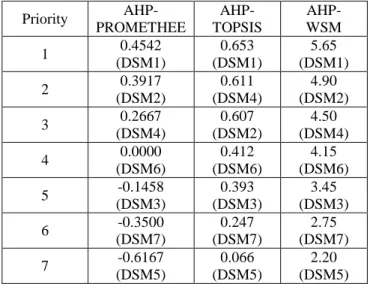
According to Table 9, all approaches stated that DSM1 which is thermostat setting contribute the best DSM options. Efficient end use equipment which is DSM5 is not an effective DSM option because having high investment cost but very little in energy saving and peak load reduction. As being mentioned in weighting criteria section, saved energy and peak load reduction is the most
important criteria in selecting DSM options because these two criteria are the highest score among others. Even though DSM1 contribute to low energy saving and peak load reduction, but DSM1 does not required any investment cost and thus payback period for DSM1 is very short.
It should be noted that, in the TOPSIS ranking process, maximum score for cost criteria which are investment cost and payback period should be 1 because the objective of TOPSIS itself to minimize the cost criteria. The result from AHP-WSM same as the result from AHP-PROMETHEE but slightly differ from the result in AHP-TOPSIS between second priority and third priority. This is due to the different method has different limitation and assumption in ranking process. However, these three approaches can be used in other decision making problem as long as could assist in finding the optimal choice.
Table 9. Comparison results using AHP-PROMETHEE AHP-TOPSIS and AHP-WSM
Priority AHP-PROMETHEE AHP-TOPSIS AHP-WSM 1 0.4542 (DSM1) 0.653 (DSM1) 5.65 (DSM1) 2 0.3917 (DSM2) 0.611 (DSM4) 4.90 (DSM2) 3 0.2667 (DSM4) 0.607 (DSM2) 4.50 (DSM4) 4 0.0000 (DSM6) 0.412 (DSM6) 4.15 (DSM6) 5 -0.1458 (DSM3) 0.393 (DSM3) 3.45 (DSM3) 6 -0.3500 (DSM7) 0.247 (DSM7) 2.75 (DSM7) 7 -0.6167 (DSM5) 0.066 (DSM5) 2.20 (DSM5) 5. CONCLUSION
In this paper, multi criteria decision making based on combination of AHP with PROMETHEE, TOPSIS and WSM were provided for analysing DSM options. The selection of the best DSM options includes variety of criteria thus the selection and evaluation of different DSM options could be classified as multi criteria decision making problem. This study employed AHP to assign weight to the criteria while PROMETHEE, TOPSIS and WSM were applied to rank the DSM options. The weight of all criteria is assigned using AHP by calculating ratio-scaled importance of criteria through pair-wise comparison of evaluation criteria.
PROMETHEE I and II are used in this paper to set the priority for all DSM options. Since it has an option that is incomparable with other options, PROMETHEE I could not provide a complete ranking for selecting best DSM options. PROMETHEE II can deal with the drawback of PROMETHEE I which can provide complete ranking by calculating the difference between total outgoing flow and total incoming flow to obtain complete ranking. Meanwhile, TOPSIS is based on the concept that the best DSM options should be closest to positive ideal solution and farthest to the negative ideal solution. According to
the author’s point of view, WSM is the simplest method compared to TOPSIS and PROMETHEE because the WSM does not required very complex operations. It is observed that the thermostat setting locates the first place in all evaluation DSM option while efficient end-use equipment has the lowest priority.
The combination of AHP and PROMETHEE is more complex since AHP need pairwise comparison in weighting process and PROMETHEE also need pairwise comparison in ranking process. Combination of AHP and TOPSIS and also combination of AHP and WSM need pairwise comparison but only in weighting process using AHP. There is no pairwise comparison to be completed during ranking process using TOPSIS and WSM. The further research in this study could be expanded by improving accuracy of DSM selection by integrating subjective weight and objective weight.
ACKNOWLEDGMENT
The authors would like to thank Universiti Teknologi Malaysia and Ministry of Energy, Green Technology and Water, Malaysia for providing the facilities and financial support to conduct this research (vote no. 4B111).
REFERENCES
[1] W. Abrahamse, L. Steg, C. Vlek and T. Rothengatter, “A review of intervention studies aimed at household energy conservation,” Journal of Environmental Psychology, vol. 25, pp. 273–291, September 2005.
[2] G. Strbac, “Demand side management: Benefits and challenges,” Energy Policy, vol. 36, pp. 4419-4426, December 2008.
[3] C. Lombard, E. H. Mathews and M. Kleingeld, “Demand-Side Management through thermal efficiency in South African houses,” Energy and Buildings, vol. 29, pp. 229–239, January 1999. [4] P. Finn, M. O’Connell and C. Fitzpatrick, “Demand
side management of a domestic dishwasher: Wind energy gains, financial savings and peak-time load reduction,” Applied Energy, vol. 101, pp. 678–685, January 2013.
[5] R. Rankin, P. G. Rousseau and M. van Eldik, “Demand side management for commercial buildings using an inline heat pump water heating methodology,” Energy Conversion and Management, vol. 45, pp. 1553-1563, June 2004. [6] M. Schweitzer, E. Hirst and L. J. Hill, “Factors
Affecting the Choice of Supply-and Demand-Side Programs by Electric Utilities,” Energy Studies Review, vol. 2, pp. 95-107, 1991.
[7] Z. Ma, P. Cooper, D. Daly and L. Ledo, “Existing building retrofits: Methodology and state-of-the-art,” Energy and Buildings, vol. 55, pp. 889-902, December 2012.
[8] G. Geng, Z. Wang, J. Zhao and N. Zhu, “Suitability assessment of building energy saving technologies for office building in cold areas of China based on an assessment framework,” Energy Conversion and Management, vol. 103, pp. 650-664, October 2015. [9] T. L. Saaty, “How to make a decision: The analytic
Operational Research, vol. 48, pp. 9-26, September 1990.
[10] M. Behzadian, R. B. Kazemzadeh, A. Albadvi and M. Aghdasi, “PROMETHEE: A comprehensive literature review on methodologies and applications,” European Journal of Operational Research, vol. 200, pp. 198-215, January 2010. [11] J. P. Brans, P. Vincke and B. Mareschal, “How to
select and how to rank projects: The PROMETHEE method,” European Journal of Operational Research, vol. 24, pp. 228-238, February 1986. [12] C. L. Hwang, Y. J. Lai and T. Y. Liu, “A new
approach for multiple objective decision making,” Computers and Operations Research, vol. 20, pp. 889-899, October 1993.
[13] J. J. Wang, Y. Y. Jing, C. F. Zhang and J. H. Zhao, “Review on multi-criteria decision analysis aid in sustainable energy decision-making,” Renewable and Sustainable Energy Reviews, vol. 13, pp. 2263-2278, December 2009.
[14] P. Blondeau, M. Spérandio and F. Allard, “Multicriteria analysis of ventilation in summer period,” Building and Environment, vol. 37, pp. 165-176, February 2002.
[15] M. Huang and B. Wang, “Evaluating green performance of building products based on gray relational analysis and analytic hierarchy process,” Environmental Progress and Sustainable Energy, vol. 33, pp. 1389-1395, December 2014.
[16] R. Mikučionienė, V. Martinaitis and E. Keras, “Evaluation of energy efficiency measures sustainability by decision tree method,” Energy and Buildings, vol. 76, pp. 64-71, June 2014.
[17] A. N. Al-enezi, “Demand Side Management for efficient use of energy in the residential sector in Kuwait: Analysis of options and priorities,” Ph.D. dissertation, Institute of Energy and Sustainable Development, De Montfort University, 2010.