8
8
MONASTERIES IN THE INTERNET:
A CASE STUDY OF POLISH WEBSITES
1Marcin Jewdokimow
Ph.D. e professor na Faculdade de Humanidades da Cardinal Stefan Wyszyński University – CSWU (Polônia). Chefe de Departamento do XXth Century Culture do
Institute of Classical and Cultural Studies da CSWU. E-mail: jewdokimow.marcin@ gmailcom
1 The article was funded by National Science Centre (Poland) – UMO-2013/09/D/
A B S T R A C T
The article presents an analysis of six websites of Polish Cistercian abbeys. Basing on content and visual analysis I seek to formulate more general theses on the role and functions of monasteries (religious institutions) to-day, and religion in general. The research shows that websites under scru-tiny play two functions: autopresentation of an abbey and communication with parishioners. Autopresentation bases on two strategies: historical nar-ratives and unveiling the life of community. Both strategies connect mon-asteries to the local culture. Monmon-asteries are being presented as beauty and mysterious objects and monks as people performing daily activities. These meanings ascribed to the monasteries and to monks are related with three broader frames constituting contemporary meaning of a monastery: reli-gious, heritage and tourism. The study shows that these three frames define representations of Cistercians monasteries in the websites under scrutiny. Intertwinement of these frames shows how religion is being rep-resented and function within the local culture.
K E Y W O R D S
Religion. Monastery. Secularization. Abbey. Cistercians.
1 . I N T R O D U C T I O N
Roles and functions of monasteries in Poland have changed over the last 200 years. These changed are related to
both broader civilization tendencies such as secularization, in-dividualization and technological shifts and the so-called waves of suppressions, which at the end of the 18th and throughout almost the entire 19th century led to the decline of a vast ma-jority of monasteries. In XX century a process of re-establish-ment of selected monasteries have been commenced. Previous research (JEWDOKIMOW; MARKOWSKA, 2013a, 2013b) shows that re-established monasteries perform a relevant role in local collective memories. They anchor local group identi-ties and structure narratives on origins of local communiidenti-ties. Locally monas teries are also being treated as a means of pro-motion of a town or a city. Monasteries and their contem-porary functions and meanings ascribed to them are worth studying due to their importance in constitution of the mo-dernity (FOUCAULT, 1975; WEBER, 1993) and – specifi-cally – secularization process. According to Peter L. Berger (1967, p. 107) secularization is “the process by which sectors of society and culture are removed from the domination of religious institutions and symbols”. Studying monasteries to-day one may observe a reverse process: they are getting under control of both contemporary society and culture. Bryan S. Turner (2010, p. 663) claims that one may observe “incorpora-tion of religion into modern consumerism”. A process of re-es-tablishment of monasteries in the virtual space is a very instance of this trend. Monks launch websites devoted to information and pastoral purposes, which are fueled by contemporary visual culture. As a result monastic websites frame a terrain of inter-twinement of religion and contemporary culture.
2 . R E S E A R C H O B J E C T I V E S A N D
M E T H O D O L O G Y
The study concerned all official Polish Cistercian web-sites. All Polish websites of Cistercian abbeys were analyzed which account for four websites of abbeys – Jędrzejów2,
Monasteries in the internet: a case study of Polish websites
Mogiłła3, Szczyrzyc4, Wąchock5 –, one major website of
Cistercian s in Poland6 and one website of Cistercian parish
(Willow Springs – USA7). I chose Polish Cistercian websites
because of two reasons. One, they are well designed and inter-related (by links) which indicates that virtual presence of the monks is deliberated. Two, a small quantity of websites allows for studying all cases. The analysis was structured around fol-lowing research questions:
1. What are the functions of Cistercian websites? 2. How monasteries are represent on the websites in
both content and visual dimension? What meanings are ascribed to them?
3. What these functions and meanings say about rela-tionship between monasteries and culture, and reli-gion and culture in general?
Content analysis of texts and photos presented in the websites was conducted. Visual analysis aimed at refining types of photos presented on the websites (ROSE, 2010). Hence, it was a qualitative not a quantitative analysis. The types of photos stand for modes of representations of monasteries (meanings ascribed to them). Content analysis of texts was focused on indicating types of presented information. Both visual and content analysis allowed answering research questions.
3 . A N A LY S I S
The first thing to be noted concerns organization of virtual presence of Polish Cistercian abbeys. The major site www.cystersi.pl has links to other pages under scrutiny which shows that the virtual politics of monks is organized and deliberated – abbeys are willing to be present and recognized in the virtual space. Sites are of different quality. The most advanced is from Mogiła’s abbey – there are, for instance,
3 Available at: <http://mogila.cystersi.pl/index.php>. 4 Available at: <http://szczyrzyc.cystersi.pl/>. 5 Available at: <http://wachock.cystersi.pl/>. 6 Available at: <http://www.cystersi.pl/>.
hi-res , 3D photos of the monastery’s interiors. All but one site (Jodłownik) are subdomains of the major site.
Content analysis points out that websites under scrutiny play following functions:
1. autopresentation of an abbey (by presenting their origins, ideas, characteristics, everyday life, sight-seeing tours etc.);
2. communication with parishioners (by presenting information on messes, christening, parish announ-cements etc.).
Monks textually autopresent themselves by two main strategies. First is built on historical narratives, second on un-veiling the life of the community.
First strategy of autopresentation bases on historical narratives published on websites. Websites presents history of Cistercian monks and history of the monks in the present place (a town or a city), a history of an abbey. By presenting historical and contemporary events monks show their connec-tion with the local community. For instance, Cistercians from Wąchock points out that these were monks efforts that re-sulted in granting to Wąchock city right of Magdeburg law. Moreover,
[...] local Cistercians played a major role in the economic field. The monks were involved in breeding, millers, weavers, as well as mining and metallurgy. The abbey received the privilege to search for ore in the Duchy of Krakow and Sandomierz (OPACTWO CYSTERSKIE W WACHOCKU, 2014b). By evoking historical events in the context of relationship to the local community monasteries do something more – they take part in constructing of local group identity. The case of Wąchock’s abbey is interesting because the monastery houses The Museum of the Memory of the Nation Independence Struggle and the tomb of Jan Piwnik “Pounry” who was a leader of a Home Army in Świętokrzyskie Mountains (where the monastery is situated). These both instan ces show that the rela-tionship may be built on events from past centuries but also on once from XIXth and XXth century. Historical narrative is built
Monasteries in the internet: a case study of Polish websites
history in which monks participated. As a result one may inter-pret websites under scrutiny as vehicles of rooting in the local. By the use of the websites monks gives evidence of their con-nection to the local and, hence, their local relevantness.
Second strategy of autopresentation bases on unveiling the life of a monastic community. This uncovering is conduct-ed twofold. One, websites depict composition of a convent and, two, offer a sightseeing of a monastery. Composition of convent is visual (photos of monks) or takes form of enu-meration of names and functions of monks. For instance, monks from Wąchock depicts the concept behind they or-ganization:
How is our life? Are we happy? Crossing the threshold of the monastery gate, leave behind the world of which we were bound, not because of his contempt, but to live in freedom, everything is submitted to Christ and His grace to be witnesses in a world of Hope8.
Monks from Mogiła publish information on relevant facts of their community, for instance on anniversaries of their priestly ordination9. Depending on a website sightseeing pages
are of dif ferent quality. The best quality offers Mogiła website which allows for a virtual visit (hi-res photos, 3D graphics).
One may interpret both strategies of autopresentation in relation to tourism. Autopresentation basing on opening or unveiling of the life of community may be treated, on the one hand, as a way of being close to local communities or parishioners but, on the other hand, it also constitutes the monastery and monks as place of sightseeing (which is said directly on the websites). Hence monasteries are being trans-formed into a space consumable for tourists (BAERENHOLDT et al., 2004), linking the monastery with consumer culture (BERGER, 2004). Also all websites inform on calling (admis-sion) which may be another reason for informing in details on the life of a monk.
8 Available at: <http://wachock.cystersi.pl/cystersi/nasze_zycie/0>.
9 Available at: <http://mogila.cystersi.pl/index.php?option=com_content&view=category
Websites under scrutiny encompass information rele-vant for parishioners such as hours of messes, christening, an-nouncements on events or indulgence, which allow for inter-preting them as vehicles of communication with parishioners. Visual analysis backs above-mentioned conclusions and develops it. Photos are present in all websites under scrutiny. Every website has a special page called “gallery” but their con-tent differs. Galleries from Jędrzejów and Szczyrzyc websites present the building of monastery in details and as a whole (Szczyrzyc website presents people but in section/page com-munity), while galleries of Mogiła and Wąchock abbeys show photos of architecture, monks, parishioners, tourists, everyday life of monks and events from the life of the parish such as confirmation.
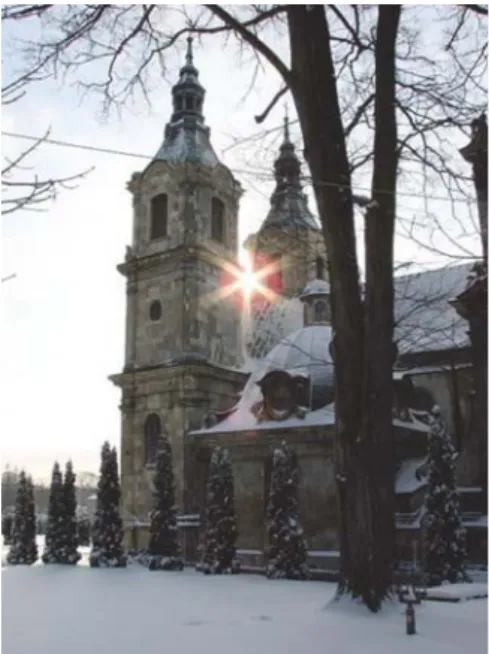
For instance, the photos of Archiabbey in Jędrzejowcie
present the monastery as a tourist object (an object to watch, to admire and to visit) and as a holy place. Photos of the mon-astery underline its beauty and mysteriousness. Photos show the buildings from different angles, in winter context, with the use of filters.
Figure 1 – A monastery presented as a beauty and mystery building
Monasteries in the internet: a case study of Polish websites
Figure 2 – A monastery presented as a beauty and mystery building
Fonte: Archiopactwo Cysterskie (2014).
In Mogiła’s webistes one finds smiling monks, which may represent their openness to potential visitors.
Figure 3 – A smiling monk during daily activities. A photo shows openness of monks
Fonte: Opactwo Cystersów (2014).
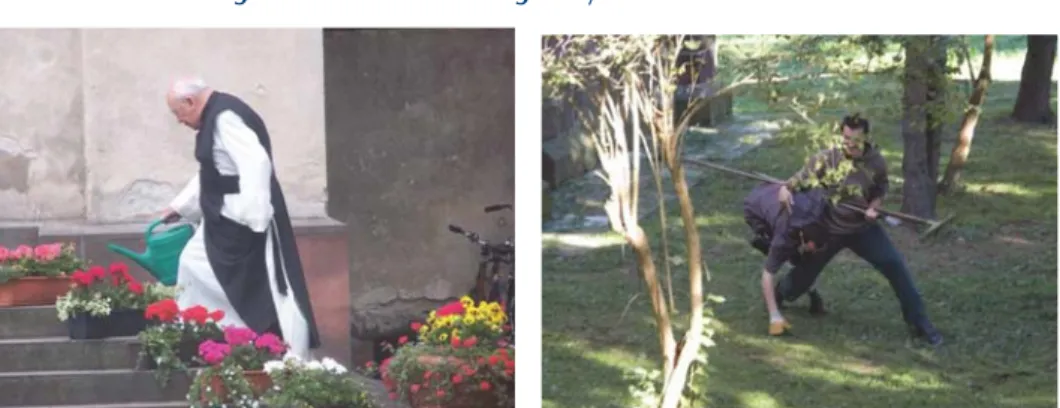
Websites unveil also a way of living of the monks. The monasteries are opened for the outer sight. Wąchock abbey has a page entitled “Brothers in the lenses” which presents their daily routine.
Figure 4 – Monks during daily activities
Fonte: Opactwo Cysterskie w Wachocku (2014).
Visual analysis shows that both monasteries and monks are presented as objects to see. On the one hand, they are to be seen as a tourist object, on the second, they are presented as mystery objects which relates to the holiness of a monastery. What is important is the fact that the two strategies intertwine indicating that religious institutions under scrutiny use con-temporary visual culture to represent themselves virtually.
4 . C O N C L U S I O N S
Monasteries under scrutiny present themselves not only as religious places but in their autodefinitions they refer to heritage and tourism frames. Archiabbey in Jędrzejowcie de-picts itself as a: “a place of pray and the work of the Cisteri-cans, and a statue of Christian European culture and a unique monument”10. This short autodefinition unveils main frames
constituting a virtual representation of a monastery: religious, heritage and tourist. The monastery is a place of pray and work which results from Cisterican regulae, but in the same time a statue and a monument, an object to see and to admire, but also to visit. The research shows that websites under scru-tiny play two functions: autopresentation of an abbey and communication with parishioners. Autopresentation bases on two strategies: historical narratives and unveiling the life of
Monasteries in the internet: a case study of Polish websites
community. Both strategies connect monasteries to the local and define a monastery in tourist and heritage frames. Monas-teries are being presented as beauty and mysterious objects and monks as people performing daily activities.
On other level the study shows the intertwinement of religious sphere with tourist and heritage once. One may say that the power of religion is being enforced by presenting it in relation to the culture and to the local. The monastery – a re-ligious institution – and, hence, the religion is part of the local history and is relevant and precious because of its heritage capital. Broadly speaking, this is an example of secularization process, which redefines religion by linking it to the contem-porary culture.
MONASTÉRIOS NA INTERNET: UM
ESTUDO DE CASO DE SITES
POLONESES
R E S U M O
Este artigo apresenta uma análise de seis sites de abadias cistercienses polo-nesas. Com base em conteúdo e análise visual, procuro formular teses mais gerais sobre o papel e as funções dos mosteiros (instituições religiosas) hoje e da religião em geral. A pesquisa mostra que sites sob escrutínio possuem duas funções: autorrepresentação de uma abadia e a comunicação com os paroquianos. A autorrepresentação é baseada em duas estratégias: narrativas históricas e revelação da vida da comunidade. Ambas as estratégias conec-tam os mosteiros com a cultura local. Os mosteiros são apresentados como belos e misteriosos objetos, e os monges, como as pessoas que realizam atividades diárias. Esses significados atribuídos aos mosteiros e monges es-tão relacionados com três quadros mais amplos que constituem de um mosteiro contemporâneo: religioso, patrimonial e turístico. O estudo mos-tra que esses três quadros definem as representações de mosteiros cistercien-ses nos sites analisados. O entrelaçamento desses quadros mostra como a religião está sendo representada e também sua função na cultura local.
PA L AV R A S - C H AV E
R E F E R E N C E S
ARCHIOPACTWO CYSTERSKIE. Disponível em: <http://www.jedrzejow-cystersi.pl/galeria.html>. Acesso em: 20 maio. 2014.
BAERENHOLDT, J. O. et al. Performing tourist places. Burlington: Ashgate, 2004.
BERGER, A. A. Deconstructing travel: cultural perspectives on tourism. Washington: Altamira Press, 2004.
BERGER, P. L. The Sacred Canopy. New York: Anchor Books, 1967.
FOUCAULT, M. Surveiller et punir: naissance de la prison. Paris: Gallimard, 1975.
JEWDOKIMOW, M.; MARKOWSKA, B. Study of the heritage of dissolved monasteries in local collective
memories. Hereditas Monasteriorum, v. 2, p. 19-34, 2013a. JEWDOKIMOW, M.; MARKOWSKA, B. The place of the Wąchock monastery in the local collective memory. Hereditas
Monasteriorum, v. 3, p. 189-217, 2013b.
OPACTWO CYSTERSKIE W WACHOCKU. Disponvível em: <http://www.wachock.cystersi.pl/galeria/2010_z_
obiektywem_wsrod_braci/>. Acesso em: 20 maio 2014a. OPACTWO CYSTERSKIE W WACHOCKU. Wachock. Disponível em: <http://wachock.cystersi.pl/opactwo/ wachock/>. Acesso em: 20 maio 2014b.
OPACTWO CYSTERSÓW. Z wizytą w ogrodzie Cystersów. Disponível em: <http://mogila.cystersi.pl/index.php?option= com_content&view=category&layout=blog&id=119&Item id=122>. Acesso em: 20 maio 2014.
ROSE, G. Visual methodologies: an introduction to researching with visual materials. London: Sage, 2010. TURNER, B. S. Religion in a Post-secular society.
In: TURNER, B. S. (Ed.). TheNew Blackwell Companion to
the Sociology of Religion. New Jersey: Wiley-Blackwell, 2010.
p. 649-667.
WEBER, M. Sociology of religion. Boston: Beacon Press, 1993.