M E T H O D O L O G Y A R T I C L E
Open Access
Progressive multiple sequence alignment
with indel evolution
Massimo Maiolo
1,2,4, Xiaolei Zhang
3, Manuel Gil
1,4†and Maria Anisimova
1,4*†Abstract
Background: Sequence alignment is crucial in genomics studies. However, optimal multiple sequence alignment (MSA) is NP-hard. Thus, modern MSA methods employ progressive heuristics, breaking the problem into a series of pairwise alignments guided by a phylogeny. Changes between homologous characters are typically modelled by a Markov substitution model. In contrast, the dynamics of indels are not modelled explicitly, because the computation of the marginal likelihood under such models has exponential time complexity in the number of taxa. But the failure to model indel evolution may lead to artificially short alignments due to biased indel placement, inconsistent with phylogenetic relationship.
Results: Recently, the classical indel model TKF91 was modified to describe indel evolution on a phylogeny via a Poisson process, termed PIP. PIP allows to compute the joint marginal probability of an MSA and a tree in linear time. We present a new dynamic programming algorithm to align two MSAs –represented by the underlying homology paths– by full maximum likelihood under PIP in polynomial time, and apply it progressively along a guide tree. We have corroborated the correctness of our method by simulation, and compared it with competitive methods on an illustrative real dataset.
Conclusions: Our MSA method is the first polynomial time progressive aligner with a rigorous mathematical formulation of indel evolution. The new method infers phylogenetically meaningful gap patterns alternative to the popular PRANK, while producing alignments of similar length. Moreover, the inferred gap patterns agree with what was predicted qualitatively by previous studies. The algorithm is implemented in a standalone C++ program:https:// github.com/acg-team/ProPIP. Supplementary data are available at BMC Bioinformatics online.
Keywords: Sequence alignment, Indel, Phylogeny, Dynamic programming, Poisson process
Background
Multiple sequence alignments (MSAs) are routinely required in the early stages of comparative and evolu-tionary genomics studies. Not surprisingly, accuracy of MSA inference affects subsequent analyses that rely on MSA estimates [1]. MSA estimation is among the old-est bioinformatics problems, yet remains intensely studied due to its complexity (NP-hard [2–4]). The progressive alignment approach has allowed to reduce the overall
*Correspondence:[email protected]
†Manuel Gil and Maria Anisimova contributed equally to this work.
1Institute of Applied Simulation, School of Life Sciences and Facility
Management, Zurich University of Applied Sciences (ZHAW), Grüentalstrasse 14, P.O. Box, CH-8820 Waedenswil, Switzerland
4Swiss Institute of Bioinformatics (SIB), Quartier Sorge - Bâtiment Génopode,
CH-1015 Lausanne, Switzerland
Full list of author information is available at the end of the article
computational complexity to polynomial time by break-ing the MSA problem into a series of pairwise alignments guided by a tree representing the evolutionary relation-ship of sequences. Today most popular alignment pro-grams employ the progressive approach (e.g., ClustalW [5], MAFFT [6], MUSCLE [7], PRANK [8,9] and T-Coffee [10] among others).
All state-of-the-art MSA programs nowadays use an evolutionary model to describe changes between homolo-gous characters, providing a more realistic description of molecular data and thus more accurate inferences. How-ever, a mathematical formulation of the insertion-deletion (indel) process still remains a critical issue. Describing the
© The Author(s). 2018Open AccessThis article is distributed under the terms of the Creative Commons Attribution 4.0 International License (http://creativecommons.org/licenses/by/4.0/), which permits unrestricted use, distribution, and reproduction in any medium, provided you give appropriate credit to the original author(s) and the source, provide a link to the Creative Commons license, and indicate if changes were made. The Creative Commons Public Domain Dedication waiver (http://creativecommons.org/publicdomain/zero/1.0/) applies to the data made available in this article, unless otherwise stated.
indel process in probabilistic terms is more challenging: unlike substitutions, indels often involve several sites, vary in length and may overlap obscuring the underlying mech-anisms. Instead, the popular PRANK program adopts a pragmatic approach; it uses an outgroup to distinguish insertions from deletions during the progressive align-ment procedure, so that insertions are not over-penalized [9]. As a result, PRANK produces exceptionally accurate alignments, notably with densely sampled data and given an accurate guide tree. Still, the method lacks a mathe-matical model describing the evolution of indels. Indeed, the computation of the marginal likelihood under the classical indel models TKF91 [11] and TKF92 [12] is expo-nential in the number of taxa due to the absence of site independence assumption.
A recent modification of TKF91 describes the evolution of indels on a phylogenetic tree as a Poisson process, thus dubbed the Poisson indel process or the PIP model [13]. The indels occur uniformly within a sequence. Standard mathematical results, particularly the Poisson thinning, allow achieving linear time complexity for computing the joint marginal probability of a tree and an MSA. This includes analytic marginalisation of unobservable homol-ogous paths which occur whenever an ancestral character is inserted and subsequently deleted, and consequently cannot be detected in the extant sequences. For a given MSA and a tree, a likelihood score under PIP can be com-puted in linear time. This score can be used to find the maximum a posteriori tree-alignment solution. Remark-ably, this breakthrough allows for a necessary rigorous way of combining models of substitutions and indels, and a tractable computation of the marginal likelihood function. At the moment the algorithm has only been applied in a Bayesian framework via tree-alignment space sampling.
Here we propose a new progressive algorithm to esti-mate an MSA under the explicit model of substitutions and indels. We have re-framed the original PIP equations into a dynamic programming (DP) approach. It aligns two MSAs –represented by their homology paths on the two corresponding subtrees– by maximum likelihood (ML) in polynomial time. The progressive algorithm traverses a guide tree in postorder; at each internal node the DP is applied to align the two sub-alignments at the child nodes. The procedure terminates at the root of the guide tree, with the complete MSA and the corresponding likelihood, which by construction is the likelihood under the PIP model. We have implemented the progressive MSA algo-rithm in a prototype program and verified its correctness by simulation. To our knowledge, this is the first pro-gressive MSA algorithm with polynomial time complexity, using a mathematical formulation of an explicit indel pro-cess. Note that an equivalent formulation under TKF91 or TKF92 –i.e. using the full marginal likelihood along the subtrees in question– would have exponential time
complexity. Quadratic time complexity under the TKF models could be obtained [14] by representing sequences at internal nodes through probability profiles, and align-ing those. However, this approach does not consider the evolutionary history in the subtrees.
The remainder of this manuscript is organized as fol-lows. We first introduce notation and the PIP model. Then, we describe our DP algorithm and provide the sim-ulation results. We conclude the paper with an illustrative real dataset, where we contrast our method with PRANK, as well as with MAFFT, representing a state of the art similarity based progressive method.
Methods
Preliminaries: the PIP model
Letτ = (V,E,b)represent a rooted binary phylogenetic tree with N leaves. τ is a directed, connected, labelled acyclic graph, with a finite set of branching pointsV of cardinality|V| = 2N−1 and a set of edgesE ⊂ V×V. LeavesL ⊂ V denotesN observed taxa, represented by strings of characters from a finite alphabet(nucleotides, amino acids or codons). There are N − 1 internal ver-tices v ⊂ V whereof the root is the most recent common ancestor of all leaves. Branch lengthb(v) asso-ciated with nodev ∈ V spans fromvto its parent node
pa(v). The total tree lengthτis a sum of all the branch lengths.
The PIP model describes a string-valued evolutionary process along the branches ofτ. We denote the distance from the root to a given point on the tree, by the same symbolτ. Atomic insertions are Poisson events with rate measureν(dt) = λ(τ(dt)+μ−1δ
(dt)), whereλ is the insertion rate,μthe deletion rate, andδ(·)Dirac’s delta function. This formulation guarantees that the expected sequence length remains constant during the whole evo-lutionary process. Point substitutions and deletions are modelled by a continuous-time Markov process on =
∪ {}, where is the deletion symbol. Accordingly, the generator matrix Q of the combined substitution and indel process extends the instantaneous substitution rate matrix Q by a row and a column to include , which is modelled as an absorbing state as there can be no substitutions after a deletion event. The quasi-stationary distribution ofQis denoted byπ. Roothas a virtual infinite length stem, reflecting the equilibrium steady state distribution at the root.
For an internal nodev, the probabilityι(v)of inserting a single character on branch pa(v) → v, is proportional to branch length b(v). Forv = it is given byι(v) = b(v)/(τ +μ−1); at the root atomic mass point proba-bilityι() = μ−1/(τ +μ−1)so thatv∈Vι(v) = 1. The survival probabilityβ(v)associated with an inserted character on branch pa(v) →vis given byβ()=1 and
The marginal likelihoodpτ(m)of MSAmof length|m|
is computable inO(N· |m|)and can be expressed as
pτ(m)=ϕ(p(c∅),|m|) c∈m
p(c), (1)
wherep(c)is the likelihood of a single columnc, andp(c∅) is the likelihood of an unobservable character history, rep-resented by a columnc∅with a gap at every leaf. The factor in (1)
ϕ(p(c∅),|m|)= ν|m|exp(ν(p(c∅)−1)) /|m|! (2)
is the marginal likelihood over all unobservable character histories, whereνis the normalising Poisson intensity.
The column likelihood can be expressed as
p(c)= v∈V
ι(v)fv, (3)
where fv denotes the probability of the homology path
underlying columnc, given that the corresponding char-acter was inserted atv. This probability can be computed inO(N)using a variant of Felsenstein’s peeling recursion [15]. LetSbe the set of leaves that do not have a gap in columnc, andAthe set of nodes ancestral toS. Then
fv= 1[v∈A]β(v)σ∈π(σ)f˜v(σ) ifc=c∅ 1−β(v)+β(v)σ∈π(σ)f˜v(σ) o.w., (4) where ˜ fv(σ)= ⎧ ⎪ ⎨ ⎪ ⎩ 1[c(v)=σ] ifv∈L w∈child(v) σ∈ exp(b(w)Q)σ,σf˜w(σ ) o.w., (5) and1[·] is the indicator function. In Eq.4, the term 1−
β(v)accounts for the probability that the inserted charac-ter does not survive till the first node below the insertion point. The recursive functionf˜vcomputes the probability
of the substitution-deletion process of a single character. Dynamic programming algorithm under PIP
Given an internal nodev, our DP algorithm proceeds to align the two sub-alignments obtained in the left and right sub-trees maximizing the likelihood (Eq. 1) of the tree rooted at v. Let X andY denote these sub-alignments, respectively with NX and NY sequences and alignment
lengths |X| and|Y|. If a tree is a leaf then the
sub-alignment, say X, is reduced to an input sequence, i.e.
NX=1 and|X|corresponds to the sequence length.
Note that the marginal likelihood functionpτ(m)(Eq.1) is not monotonically increasing in the alignment length |m|. While the product of column likelihoods is monoton-ically increasing, the marginal likelihood of unobserved histories ϕ(p(c∅),|m|) is non-monotonic (Fig. 1). This means that pτ(m) cannot be maximised by means of
a standard two-dimensional DP approach (in particular, because the alignment length is not known a priori). Similarly to TKF91 [11], we need three DP matrices, one for each state (i.e. match, gapX and gapY), however to account for the dependence on alignment length we have extended the matrices with a third dimension.
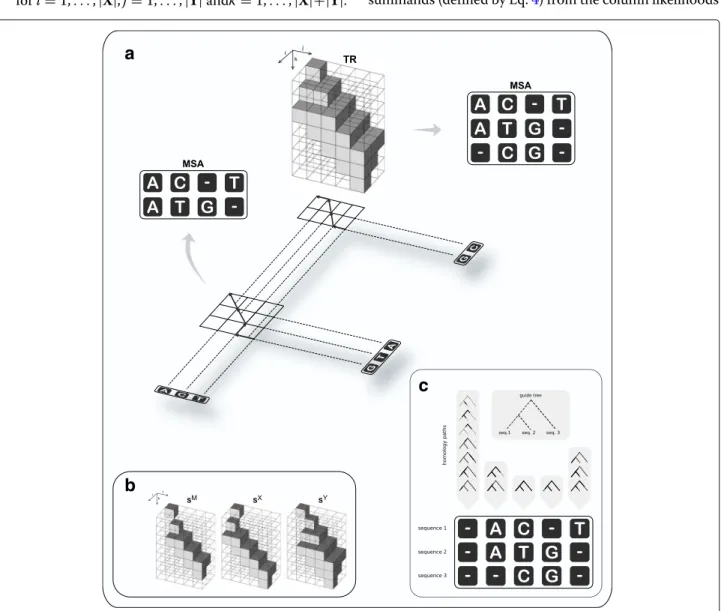
The algorithm works with three three-dimensional sparse matricesSM, SX andSY each of size(|X| +1)×
(|Y| +1)×(|X| + |Y| +1)with entries defined as follows (Fig.2b):
1. match cellSMi,j,kcontains the likelihood of the partial optimal MSA of lengthk betweenX1. . .Xiand
Y1. . .Yjwith the columnsXiandYjaligned.
Consequently, all characters in the two columns are inferred to be homologous.
2. gapX cellSXi,j,kcontains the likelihood of the partial optimal MSA of lengthk betweenX1. . .Xiand
Y1. . .Yjwith the columnXialigned with a column
of sizeNYcontaining gaps only. The characters in
the two columns do not share a common history, either because the ancestor character had been deleted on the right subtree, or because it had been inserted on the left subtree, below the nodev. 3. similarly,gapY cellSYi,j,kmatches columnYjwith a
column of sizeNXcontaining gaps only.
Forward phase
Each matrixSM,SXandSYis initialized withϕ(p(c∅)), 0) at position(0, 0, 0)and a zero in every other position. The DP equations are: SMi,j,k= ν k ·p Xi Yj ·max SMi−1,j−1,k−1, SXi−1,j−1,k−1, SYi−1,j−1,k−1 (6) 0 500 1000 1500 2000 0 20 40 60 m ϕ ( m )
Fig. 1An example ofϕ(|m|)(Eq.2), i.e. the marginal likelihood of all non-observable histories, as a function of MSA length|m|. The parameters are:τ=1,λ=10,μ=1,p(c∅)=0.5
SXi,j,k= ν k ·p Xi c∅ ·max SMi−1,j,k−1, SXi−1,j,k−1, SYi−1,j,k−1 (7) SYi,j,k= ν k ·p c∅ Yj ·max SMi,j−1,k−1, SXi,j−1,k−1, SYi,j−1,k−1 (8) fori=1,. . .,|X|,j=1,. . .,|Y|andk=1,. . .,|X|+|Y|.
The symbol c∅ in Eqs. 7 and 8 represents a column with gaps, respectively of length NY andNX. The factor
ν/ksuccessively constructsϕ(p(c∅),k)along the third dimension as columns are added into partial alignments.
As pointed out above, a column likelihood under PIP (Eq.1) can be computed recursively in linear time in the number of input sequences. The recursion corresponds to a postorder tree traversal (Eq.5), which coincides with the tree traversal of our progressive algorithm. As a conse-quence, during the progressive alignment a column likeli-hood for the DP (p(·)in Eqs.6–8) at a particular nodev
can be computed in constant time by re-using appropriate summands (defined by Eq.4) from the column likelihoods
a
b
c
Fig. 2Overview of the progressive algorithm. The algorithm traverses a guide tree (indicated by the shadow in Panela) in postorder. At each internal node, the evolutionary paths from the two children down to the leaves (doted lines in Panela) are aligned by full maximum likelihood under the PIP model, using a dynamic programming approach (DP). Since the likelihood function does not increase monotonically in the MSA length (see Fig.1), the DP accommodates the MSA length along a third dimension (indicated bykin Panelsa,b); thus, it works with cubic matrices (in contrast to the traditional quadratic DP alignment). The forward phase of the DP stores likelihood values in three sparse matrices (Panelb:SMfor matching columns; SXandSYto introduce new indel events). Further, matrixTR(Panela) at position(i,j,k)records the name of the DP matrix (either “SM”, “SX”, or “SY”) with highest likelihood at(i,j,k). An optimal alignment is determined by backtracking alongTR(indicated in Panelaby the arrows in the projection ofTRonto the plane). Note that the likelihood function marginalises over all indel scenarios compatible with putative homology (Panelc)
at the two children ofv. In particular, the setAcan be con-structed from the corresponding sets at the two children
AleftandAright:
A=
⎧ ⎨ ⎩
{v} for match state
Aleft ∪ {v} for gapX state
Aright ∪ {v} for gapY state
(9) Consequently, the total asymptotic running time of the forward phase isO(Nl3), wherelis bounded by the length of the longest input sequence. The independence struc-ture of the DP along the dimension of the MSA length (i.e. indexk) readily allows parallelisation; all the entries in the DP matrices for a fixedkcan be computed in parallel from the entries at the layerk−1, taking down the time toO(Nl).
Backtracking
An optimal alignment is determined by backtracking along a trace-back matrixTRof size(|X| +1)×(|Y| +1)×
(|X| + |Y| +1). In the forward phase,TRrecords at posi-tion(i,j,k)the name of the DP matrix (either “SM”, “SX”, or “SY”) with highest likelihood at the same position
(i,j,k). If the maximum is not unique then a uniform ran-dom choice is made. The backtracking algorithm starts at
TR(|X|,|Y|,k0), where
k0=arg maxk=max(|X|,|Y|)...(|X|+|Y|)s(k) with
s(k)=SM(|X|,|Y|,k),SX(|X|,|Y|,k),SY(|X|,|Y|,k)
is the length of the best scoring alignment. If k0 is not unique a random uniform choice is made. TR is then traversed from(|X|,|Y|,k0)to(0, 0, 0). Suppose the algo-rithm is at position(i,j,k). IfTR(i,j,k) =“SM” then the columns Xi and Yj are matched and all the indices are
decremented, i.e.i ← i−1,j ← j−1,k ← k−1. If
TR(i,j,k) is set to “SX” then the column Xi is matched
with a column of gaps of sizeNYand the indicesiandk
are decremented, and, ifTR(i,j,k)contains the value “SY” then the columnYjis matched with a column of gaps of
sizeNXand the indicesjandkare decremented.
Results
Since the main goal of the article is to describe a new method, it is desirable to evaluate the correctness of the implementation (i.e., likelihood values and optimisation) and the accuracy of the estimator. Correctness can be evaluated by simulations under the true model or by com-parison with existing implementations. The evaluation of alignment accuracy is more problematic ([16]), because the historical evolutionary events are not observable, so that we have no access to true alignments. Benchmarks like BAliBASE have attempted to provide sets of reference
alignments. Those, however, represent structural similar-ity, not necessarily reflecting homology, but also could be due to structural convergence. Moreover, benchmarks tend to represent alignments with highly compact and conserved cores offering little information about indel placement ([16]). Alternatively, synthetic data can be gen-erated, where the true alignments are known. However, simulations rely on a generative model, which never per-fectly correspond to the real process. The closer the gener-ative model is to the assumed by the estimator, the better the estimator should perform.
Recently, it has been shown that the results obtained from structural benchmarks and from phylogenetic sim-ulations have produced inconsistent results ([17–20]). Phylogeny-aware aligners like PRANK tend to perform well in simulations, while poorly on structural bench-marks. This can be explained by the fact that the objective of phylogenetic aligners is to infer evolutionary homology, rather than conserved structural features.
Below we provide results from some basic evaluations of our proposed method.
Empirical verification of correctness
To test the correctness of the algorithm and implemen-tation, we generated data under PIP using a simulator provided by the authors of PIP. We chose relatively small trees and short sequences to be able to perform analyti-cal tests during algorithm design and program debugging. Specifically, we simulated 120 datasets in total, on trees with 4, 5, 6 and 7 leaves, and using the following parameter combinations (λ,μ) ∈ {(0.1, 0.1),(0.1, 1),(1, 0.1),(1, 1)}. The resulting sequence lengths varied between 5 and 8 nucleotides.
First, we confirmed the correctness of the likelihoods obtained with the DP algorithm, by scoring the resulting MSAs with an independent implementation provided by the authors of PIP. In all cases the likelihoods matched. In a second test, we verified that the DP generates opti-mal pairwise MSA alignments. To this end, all the possible pairwise alignments were generated at each internal node of the guide-trees and scored with the independent imple-mentation. The DP algorithm always reconstructed an optimal MSA.
Aligning simulated data
To assess the quality of inferred alignments we have applied our method to simulated data that was previously used to evaluate PRANK [8]). These data sets were each 1000 nucleotides long and were generated under real-istic evolutionary parameters on 16- 32- and 64-taxon trees and with different degrees of divergence. Note that indel lengths were drawn from a Poisson distribution with a mean of 1.7 bases. Inferred MSA lengths and four standard quality scores obtained with our method
were compared to those inferred with MAFFT v7.402 (with option –auto) and PRANK v.140603 (with options -protein -termgap -nomissing -once, with and without the +F option). The results of this comparison are shown in Additional file1: Table S1 and Figure S1. No matter what evaluation score was considered, progressive alignment under PIP produced alignment quality similar to both PRANK and MAFFT. In terms of approaching the true MSA length, our method infers alignments of a similar length to PRANK but consistently outperform MAFFT. In many cases, our method also infers MSA lengths closer to the true compared to PRANK, albeit by a small margin. These results are encouraging, especially considering that the simulation scenario with long indels explicitly favours MAFFT and PRANK, both of which allow for long indels in their scoring schemes, although they are not explicitly modelled.
Aligning sequences from HIV/SIV envelope glycoprotein gp120
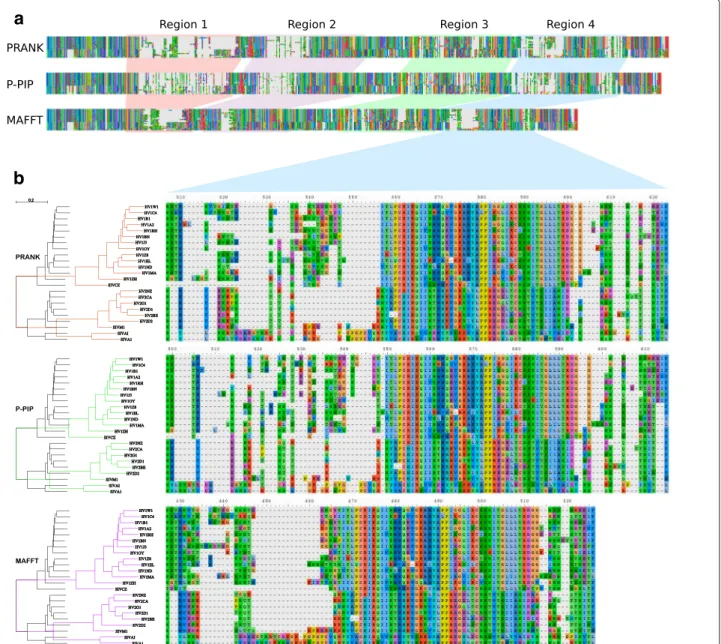
Using our new algorithm we inferred an MSA for a challenging dataset, 23 envelope glycoprotein gp120 sequences from HIV/SIV, previous analysed by Löytynoja and Goldman [8]. We compared the results of our algo-rithm with the MSAs inferred by MAFFT and PRANK. The resulting MSAs (Fig. 3) showed good agreement in the conserved regions. Indeed, the use of structural benchmarks [16], which are mainly restricted to such regions, has illustrated that it is difficult to distinguish state-of-the-art aligners. In contrast, variable regions dis-play distinctly different indel patterns, which was reflected in the MSA lengths. Consistent with previous reports [8, 21] MAFFT over-aligns the sequences resulting in a short alignment (579 columns). The alignment inferred with our method had similar length (661 columns) to the one inferred by PRANK (669 columns).
The indel patterns reflected the underlying indel model or scoring function of the methods. Our algo-rithm favoured shorter indels, compared to PRANK and MAFFT, which reconstructed visually tidier gap regions. A phylogenetic interpretation of MAFFT’s indel place-ment implies few insertions, followed by several subse-quent deletions, leading to a short MSA. PRANK infers a longer alignment, with phylogenetically meaningful and balanced number of insertions and deletions. Note that similar to MAFFT, PRANK also tends to block long indels. Our method infers a phylogenetically meaningful MSA, with multiple single amino-acid insertions, which some-times fuse to mimic long indels (e.g., 4 amino-acids from #501 to #504). Our method infers short indels, which allows for gap regions with higher conservation in terms of the substitution rates; we observe more conserved columns. To quantify this, we estimated tree-lengths (in expected substitutions per site), by fitting the
branch-lengths of the guide-tree topology based on the inferred MSAs using PhyML [22]. Consistent with the visual obser-vation, our algorithm leads to the shortest tree (4.35), compared to PRANK (4.60) and MAFFT (4.90).
Discussion
Here for the first time in the frequentist framework, we have developed and implemented a progressive MSA algorithm with an explicit evolutionary model of substitu-tions, insertions and deletions. The evolution of indels was described as a Poisson process as part of a continuous-time Markov model known as PIP. At the core of our method we have designed a new DP algorithm for the alignment of two MSAs by ML, which exploits PIP’s linear time complexity for the computation of marginal likeli-hoods. The overall complexity of the progressive algo-rithm isO(Nl3), whereN is number of taxa andlis the maximum sequence length. The cubic factor stems from the fact that the likelihood is not monotonically increasing in the MSA length, so that the length has to be incorpo-rated as an extra dimension in the DP. TheO(l2)entries in a specific matrix layer along that dimension (i.e. corre-sponding to one particular alignment length) depend only on the layer above (and not on each other). Therefore, their computation can be parallelized, taking down the running time toO(Nl), assuming O(l2)processors. Fur-ther, our empirical findings show that the likelihood has exactly one maximum, suggesting an early stop condition to the DP. We are currently optimising our implementa-tion with respect to this and other time-critical aspects. To date inference of MSAs under an evolutionary indel model (TKF91 or TKF92) has only been implement using a Bayesian framework. Such approaches are however com-putationally expensive with large datasets. Our method for MSA inference under PIP is the first step towards equivalent developments in the frequentist framework.
Despite only allowing single residue indels our method appears to fare surprisingly well compared to other state-of-the-art popular alignment tools such as PRANK and MAFFT. Indeed, our example above (as well as other preliminary data analyses, not shown) demon-strate that our new method allows inferring alignments with phylogenetically sensible gap patterns, similar to the phylogenetically-aware PRANK. In contrast to tradi-tional aligners that do not utilise phylogenetic informa-tion to distinguish inserinforma-tions and deleinforma-tions, our method produces longer alignments, avoiding the artificial com-pression of MSAs and inferring more indels, again similar to PRANK. According to the underlying indel model, our method appears to infer more shorter indels (e.g., compared to PRANK and MAFFT), while longer indels are described by several subsequent indel events. Includ-ing longer indels is considered desirable, however it has not been studied whether modeling one residue indels
a
b
Fig. 3MSAs inferred with PRANK+F (top), our algorithm (middle, denoted by P-PIP) and MAFFT (bottom) from 23 strains of gp120 human and simian immunodeficiency virus (always using the same guide-tree).a. The total MSA lengths are 669, 661 and 579 columns respectively. The three methods show good agreement in the conserved regions. Substantial differences are observed in regions 1–4, highlighted by colors.b. Magnification of Region 4. MAFFT over-aligns the sequences. Depicted on the left: The tree in black is the original guide-tree. The trees depicted in colour are the same guide tree but with re-estimated branch lengths. A detailed view of regions 1–3 is given in Additional file1: Figures S1-S3
at a time may also work well. For example, for sim-plicity models of codon substitution typically allow only one-nucleotide mutations. Despite this gross simplifica-tion codon models have been demonstrated to perform extremely well for practical analyses of protein-coding genes. As can be seen in our example of an HIV pro-tein gp120, it is unclear what inferred indel pattern is more realistic (given that alignments inferred by our methods and by PRANK have very similar length). Con-sidering the nature of HIV mutations, it is quite plausi-ble that indel evolution of gp120 is dominated by short
indel events [23]. Arguably, in our example, indel penal-isation of PRANK and MAFFT (affine penalty schemes allowing for long indels) might make these tools too restrictive to single-residue indels, leading to aesthetically more pleasing alignments. PIP might be more restric-tive to long indels but also more realistic for sequence data dominated by short indel events. Both alignment benchmarking and the parameter optimisation of gap penalties are extremely difficult due to the absence of sufficiently challenging datasets where true alignments are known.
Conclusion
Our new methods provides not only a first step towards the explicit modeling of indels in the frequentist frame-work but also enables to test a different hypothesis of indel evolution. In our follow up studies we intend to fur-ther scrutinise the various properties of our new method, its further development including less greedy algorithm versions, variation of indel rates across sites and the approximations to include longer indels.
Additional file
Additional file 1: Supplemental Materials. Qscores, MSA length and MSA magnifications. (PDF 3392 kb)
Abbreviations
DP: Dynamic programming; Indel: Insertion and deletion; ML: Maximum likelihood; MSA: Multiple sequence alignment; PIP: Poisson indel process
Acknowledgements
We thank Alexandre Bouchard-Côté for providing his code to simulate sequences and to compute marginal likelihoods under PIP.
Funding
This work was supported by the Swiss National Science Foundation (SNF) grants 31003A_157064 and 31003A_176316 to M. Anisimova. The funding body did not playe any role in the design of the study and collection, analysis, and interpretation of data and in writing the manuscript.
Availability of data and materials
The proposed algorithm has been coded using the code base of PrographMSA [24]. The code is written in C++ and tested on Linux. Our command-line tool, freely available on GitHub at https://github.com/acg-team/ProPIP, is distributed under the terms of the GNU GPLv3 license.
Authors’ contributions
MM, MG, MA designed the study; MM, XZ, MG performed research; MM analyzed data; MM, MG, MA interpreted the results and wrote the paper. All authors read and approved the final version of the manuscript.
Ethics approval and consent to participate
Not applicable.
Consent for publication
Not applicable.
Competing interests
The authors declare that they have no competing interests. Publisher’s Note
Springer Nature remains neutral with regard to jurisdictional claims in published maps and institutional affiliations.
Author details
1Institute of Applied Simulation, School of Life Sciences and Facility Management, Zurich University of Applied Sciences (ZHAW), Grüentalstrasse 14, P.O. Box, CH-8820 Waedenswil, Switzerland.2Institute of Molecular Life Sciences, University of Zurich, Winterthurerstrasse 190, CH-8057 Zurich, Switzerland.3National Heart and Lung Institute, Imperial College London, South Kensington Campus, SW7 2AZ London, UK.4Swiss Institute of Bioinformatics (SIB), Quartier Sorge - Bâtiment Génopode, CH-1015 Lausanne, Switzerland.
Received: 3 April 2018 Accepted: 3 September 2018
References
1. Wong KM, Suchard MA, Huelsenbeck JP. Alignment uncertainty and genomic analysis. Science. 2008;319(5862):473–6.
2. Just W. Computational complexity of multiple sequence alignment with sp-score. J Comput Biol. 2001;8(6):615–23.
3. Bonizzoni P, Della Vedova G. The complexity of multiple sequence alignment with sp-score that is a metric. Theor Comput Sci. 2001;259(1): 63–79.
4. Wang L, Jiang T. On the complexity of multiple sequence alignment. J Comput Biol. 1994;1(4):337–48.
5. Thompson JD, Higgins DG, Gibson TJ. Clustal w: improving the sensitivity of progressive multiple sequence alignment through sequence weighting, position-specific gap penalties and weight matrix choice. Nucleic Acids Res. 1994;22(22):4673–80.
6. Katoh K, Standley DM. Mafft multiple sequence alignment software version 7: Improvements in performance and usability. Mol Biol Evol. 2013;30(4):772.
7. Edgar RC. Muscle: a multiple sequence alignment method with reduced time and space complexity. BMC Bioinformatics. 2004;5(1):113. 8. Löytynoja A, Goldman N. Phylogeny-aware gap placement prevents
errors in sequence alignment and evolutionary analysis. Science. 2008;320(5883):1632–5.
9. Löytynoja A, Goldman N. Proceedings of the National Academy of Sciences of the United States of America. 2005;102(30):10557–62. 10. Notredame C, Higgins DG, Heringa J. T-coffee: a novel method for fast
and accurate multiple sequence alignment. J Mol Biol. 2000;302(1): 205–17.
11. Thorne JL, Kishino H, Felsenstein J. An evolutionary model for maximum likelihood alignment of dna sequences. J Mol Evol. 1991;33(2):114–24. 12. Thorne JL, Kishino H, Felsenstein J. Inching toward reality: an improved
likelihood model of sequence evolution. J Mol Evol. 1992;34(1):3–16. 13. Bouchard-Côté A, Jordan MI. Evolutionary inference via the poisson indel
process. Proc Natl Acad Sci. 2013;110(4):1160–6.
14. Holmes I, Bruno WJ. Evolutionary hmms: a bayesian approach to multiple alignment. Bioinformatics. 2001;17(9):803–20.
15. Felsenstein J. Evolutionary trees from dna sequences: A maximum likelihood approach. J Mol Evol. 1981;17(6):368–76.
16. Iantorno S, Gori K, Goldman N, Gil M, Dessimoz C. Who Watches the Watchmen? An Appraisal of Benchmarks for Multiple Sequence Alignment. Totowa: Humana Press; 2014, pp. 59–73.
17. Tan G, Gil M, Löytynoja AP, Goldman N, Dessimoz C. Simple chained guide trees give poorer multiple sequence alignments than inferred trees in simulation and phylogenetic benchmarks. Proc Natl Acad Sci. 2015;112(2):99–100.
18. Boyce K, Sievers F, Higgins DG. Simple chained guide trees give high-quality protein multiple sequence alignments. Proc Natl Acad Sci. 2014;111(29):10556–61.
19. Boyce K, Sievers F, Higgins DG. Instability in progressive multiple sequence alignment algorithms. Algoritm Mol Biol. 2015;10(1):26. 20. Nute MG, Saleh E, Warnow T. Benchmarking Statistical Multiple
Sequence Alignment. bioRxiv. 2018. Cold Spring Harbor Laboratory. https://www.biorxiv.org/content/early/2018/04/20/304659.
21. Szalkowski AM, Anisimova M. Graph-based modeling of tandem repeats improves global multiple sequence alignment. Nucleic Acids Res. 2013;41(17):162.
22. Guindon S, Dufayard J-F, Lefort V, Anisimova M, Hordijk W, Gascuel O. New algorithms and methods to estimate maximum-likelihood phylogenies: Assessing the performance of phyml 3.0. Syst Biol. 2010;59(3):307–21.
23. Abram ME, Ferris AL, Shao W, Alvord WG, Hughes SH. Nature, position, and frequency of mutations made in a single cycle of hiv-1 replication. J Virol. 2010;84(19):9864–78.
24. Szalkowski AM. Fast and robust multiple sequence alignment with phylogeny-aware gap placement. BMC Bioinformatics. 2012;13:129.