Markets, Chains and Sustainable Development
Strategy & Policy paper
Understanding institutional
arrangements
Fresh Fruit and Vegetable value chains in East
Africa
DEREK EATON,GERDIEN MEIJERINK AND JOS BIJMAN
Markets, Chains and Sustainable Development
Strategy & Policy Papers
Key words:
Institutional arrangements; Africa; poverty, marketing, producer organisation, contract farming, transaction costs
Recommended Citation:
Eaton, D., G. Meijerink, J. Bijman. 2008. Understanding institutional arrangements: Fresh Fruits and Vegetable value chains in East Africa. Markets, Chains and Sustainable Development Strategy and Policy Paper, no.XX. Stichting DLO: Wageningen. Available at: http://www.boci.wur.nl/UK/Publications/
About the author(s):
Derek Eaton and Gerdien Meijerink are researchers at the Agricultural Economics Research Institute (LEI) in The Hague. LEI is part of Wageningen University and Research Centre.
Jos Bijman is assistant professor at the Management Studies Group, Wageningen University.
© Copyright Stichting DLO, 2008
Readers are encouraged to use, quote or reproduce material from the Markets, Chains and Sustainable Development Strategy & Policy Papers. In the case of reproduction Stichting DLO, as copyright holder, requests due acknowledgement and a copy of the publication. The papers are not for commercial purposes or gain in any way.
ISBN 978-90-8585-228-5
Available online at: http://www.boci.wur.nl/UK/Publications/ Free electronic distribution
Table of Contents
Table of Contents... 3
Acknowledgements ... 6
I.
Introduction ... 7
Approach and outline of paper ... 8
II.
Understanding institutional arrangements... 10
1. Institutional arrangements and the institutional environment... 10
2. Transaction costs... 12
3. Factors influencing relative transaction costs ... 14
Asset specificity... 15
Uncertainty ... 16
Difficulty of performance measurement... 16
Coordination (connectedness to other transactions) ... 17
4. Summarising our approach ... 17
III.
Institutional arrangements explained ... 19
5. Spot markets... 20
6. Contract farming ... 21
7. Different types of contract farming ... 23
8. Contract farming as a transaction cost reducing arrangement ... 24
Asset specificity... 24
Uncertainty and performance measurement ... 24
Coordination ... 25
9. Producers’ organisations... 27
10. Contract farming with producer organisations... 29
11. Summary... 31
IV.
The development of the institutional environment for agriculture in Tanzania... 32
12. Background: from Ujamaa socialism to a liberalised economy... 32
13. Land tenure ... 35
14. Cooperative movement ... 36
15. The role of governmental bodies in shaping the institutional environment... 38
Product boards ... 38
District office... 38
16. The role of legal institutions on the institutional environment ... 39
V.
Transactions in the fresh fruit and vegetable (FFV) sector in Tanzania... 42
17. FFV Markets... 42
Asset specificity... 44
Uncertainty ... 44
Difficulty of performance measurement... 45
Coordination (connectedness to other transactions) ... 46
The impact of the institutional environment on FFV markets ... 46
18. Discussion... 47
Summary... 52
VI.
Institutional environment: comparison with other east African countries ... 54
19. The fresh fruit and vegetable sector: an overview ... 54
20. Government policies in East Africa ... 55
Kenya... 55 Ethiopia... 57 Uganda... 58 Tanzania ... 59 Conclusion ... 60 21. Governance ... 61 22. Discussion... 63
VII.
Conclusion ... 65
Annex 1 ... 68
Annex 2 ... 70
References... 71
NOTES... 75
List of Figures and tables
Figure 1: Study area Tanzania ... 9
Figure 2: Different levels and components of institutions ... 12
Figure 3: Three components of institutional arrangements... 13
Figure 4: Types of transaction costs related to determining factors ... 18
Figure 5: Characteristics of different institutional arrangements... 19
Figure 6: Price of tomato at Kilombera market in Arusha, 2005... 21
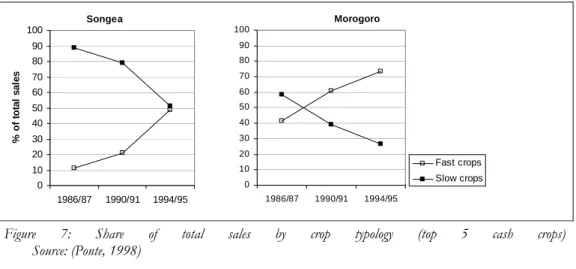
Figure 7: Share of total sales by crop typology (top 5 cash crops) Source: (Ponte, 1998) ... 34
Figure 8: Contract enforcement mechanisms of industrial firms in Tanzania 2001... 40
Figure 9: Areas suitable for growing vegetables in Tanzania ... 42
Figure 10: Production and export of vegetables 1990-2005... 54
Figure 11: Governance indicators for East Africa, 1998-2002 ... 62
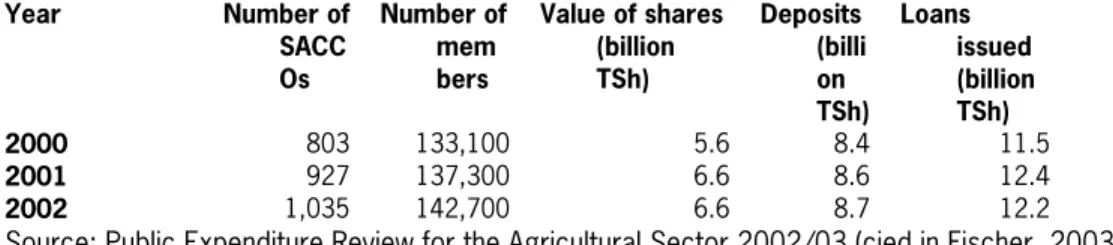
Table 1: Development of SACCOS in Tanzania, 2000-2002 ... 37
Glossary
BoT Bank of Tanzania
CF Contract farming
CBO Community Based Organization
CU Cooperative Union
DO District Office
EPOPA Export Promotion of Organic Products from Africa FFV Fresh Fruits and Vegetables
MA Market Association
MVIWATA Mtandao wa Vikudi vya Wakulima Tanzania (Swahili for National Network of Farmers’ Groups in Tanzania)
MVIWAMO Mtandao wa Vikudi vya Wakulima Moshe (MVIWAMO branch for Moshe)
NGO Non-governmental Organisation
PO Producer Organization
ROSCA Rotating Saving and Credit Association SACCO Savings and Credit Cooperative
TCCIA Tanzania Chamber of Commerce, Industry and Agriculture TSh Tanzanian Shilling (rate of December 2007: 1 € = TSh 1,714)
Acknowledgements
We would like to thank the Dutch Ministry of Agriculture, Nature and Food Quality for funding this research. We would further like to thank all the people we interviewed in 2007 for their time and valuable information, with special thanks to Tom Dixon.
I. Introduction
Agriculture is receiving increasing attention as an instrument for growth, especially with the World Development Report 2008 (WDR) titled “Agriculture for Development” (2007b). In that report institutional innovations are seen as key to achieve not only agricultural growth, but also to include poor smallholders in this growth. These institutional innovations are expected to be able to overcome various market failures, including missing or incomplete input and output markets, factor markets (including financial markets) and insurance markets. The Report sees a particular important role for the “third sector”—communities, collective action, and NGOs— in overcoming some of the market and state failures, with special attention for producer organisations (POs, which can be defined as an agreement among farmers to coordinate some activities, such as jointly purchasing inputs or delivering produce to clients) as fundamental to reducing transaction costs in markets, achieving market power and raising farmers’ voices in national and international policy forums. More pointedly, Dorward et al. (1995) argue that current emphasis in research and policy discussions on the institutional environment (such as property rights, regulations, policies, social norms, etc.) in Africa is at the expense of sufficient attention to institutional arrangements1. They call for more investigation of
arrangements, especially for those, such as producer organisations, that do not fit the textbook model of competition and exchange among relatively small market players.
In this paper we examine the case of institutional arrangements for marketing of farm produce in the fresh fruits and vegetable (FFV) sector of East Africa, with specific focus on Tanzania. FFV constitute high-value products that are increasingly seen as offering important growth opportunities for farmers in many developing countries. A concern for policy makers and other stakeholders involved in development efforts is thus how marketing arrangements for farmers’ sale of fresh vegetables can be supported in order to promote pro-poor growth? Here, we aim to contribute to the search for answers to the question, but limit ourselves to a more modest objective, given how little these arrangements have been systematically documented and analysed.
The principal research question addressed is in this paper is how alternative institutional arrangements for marketing fresh vegetables in Tanzania compare in terms of transaction costs, and how any differences are related to characteristics of the product, market structure, supply chain, quality requirements or farmers. The purpose of such a comparison is to develop a better understanding of how improvements in institutional arrangements come about and potentially how this process can be supported. We are thus less interested in trying to determine which arrangements are most efficient in a given situation, but more in what the constraints are to improvements within these arrangements. Such improvements could imply a shift to another arrangement but improvements within existing arrangements are equally interesting. Indeed we shall see that they may even be more interesting. Two alternative institutional arrangements for marketing fresh vegetables in Tanzania and other East African countries, can now be observed, next to the “default” option for most farmers of spot market transactions: (i) producer organisations (POs) and (ii) contract farming (or combinations of the two), which is important for high value, high quality crops (marketed to supermarkets and export markets). POs are currently seen by many NGOs donors as an important tool for strengthening market access of smallholder farmers, thereby increasing rural income, enhancing smallholder competitiveness and reducing poverty (IFAD, 2003; Stockbridge et al., 2003; Ton et al., 2007; World Bank, 2007b).
Aside from emphasis on innovations in institutional arrangements, the WDR also acknowledges that the state is important in confronting the extensive market failures and uncertainties in agriculture. The report recognizes thus that agricultural development can be constrained by good governance; in other
sector. In the current paper, we are also interested in how both the relative and absolute level of transaction costs are affected by elements of the institutional environment such as property rights, contract law, and even informal (i.e. social) norms governing behaviour.
This study can be seen as contributing to the research agenda identified at the most general level for the agricultural sector by Masten (2000), Ménard and Valceschini (2005), and Sykuta and Cook (2001). These questions have been posed in the African context by Dorward et al. (2005) and Fafchamps (2004) who emphasises how little is known about the operation and development of markets in Sub-Saharan Africa.
Approach and outline of paper
This paper is comprised of three parts. First, theoretical literature is used to establish a framework with which we could structure our research and which would help us to understand institutional arrangements. This framework is described in chapter 2. Chapter 3 then describes which institutional arrangements can be expected on the basis of the framework. Second, an empirical study was done in Tanzania to gather data that could highlight several issues present in marketing FFV by small-scale farmers and the different institutional arrangements that they use. This is described in chapter 4. Third, the extensive literature that exists on export marketing of and value chains for FFV in East Africa (Kenya, Uganda, Ethiopia) was reviewed. Government policies in these countries have been different, and have also contributed to a different institutional environment. We will review these to broaden the lessons learned in Tanzania. This is described in chapter 5. Chapter 6 concludes. Together, the three parts lead to a better understanding of the existing institutional arrangements in use in East Africa to market FFV.
The empirical study was conducted through semi-structured interviews. During two weeks, in-depth interviews were held with 47 different stakeholders in the fresh fruit and vegetable chain, ranging from NGOs, government officials, farmers, traders, representatives of POs and contractors of fresh fruit and vegetables (large scale farmers and processors). An overview of the stakeholders can be found in Annex 2. For the interviews a list of questions as well as a list of topics for further discussion was used. Not all items were relevant for each interview, and a selection was made where necessary. The checklist can be found in Annex 1. The interviews in Tanzania were conducted in different parts of the country (Figure 1).
Arusha
Tanga/Muheza
Dar
II. Understanding institutional arrangements
In this paper we want to understand why certain arrangements to market fresh FFV exist and how they are determined by transaction costs, characteristics of the production process and product, market structure, supply chain, quality requirements or famers. We also want to understand how changes in such arrangements come about, particularly in the form of reduced transaction costs, in order to identify possibilities of encouraging this process. In order to do this, we will outline a framework with which we can analyse these elements for Tanzania. We will first outline how we define the institutional environment within which institutional arrangements take place. We then focus on transaction costs, what they are and which factors contribute to their absolute and relative size. In the section on Tanzania we will use this framework to verify if and to what extent these elements exist and can explain the marketing arrangements we observed for the FFV in Tanzania.
1.
Institutional arrangements and the institutional environment
Institutional arrangement2 refers to a set of rules or agreements governing the activities of a specific
group of people pursuing a certain objective. Different types of examples include a contract (such as simply to exchange goods, or a sharecropping agreement between landlord and tenant farmer), a producers' organisation (an agreement among farmers perhaps to jointly purchase inputs or deliver produce to clients), and so on. Institutional arrangements thus involve agreements to exchange or coordinate goods or services (such as labour). Concluding and enforcing such agreements entails the expenditure of resources, referred to as transaction costs, which are discussed in more detail in the next section.
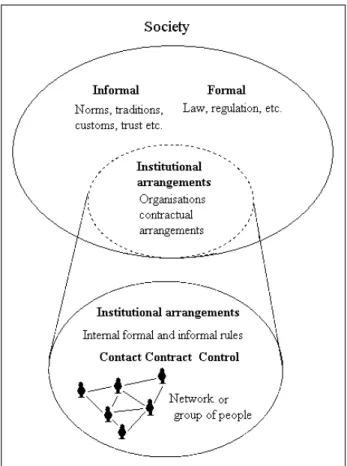
The institutional environment consists of the broader socio-economic framework within which different institutional arrangements take place, such as market transactions (agreements to exchange goods and services), or organizations (formal groups involving individuals working towards a common purpose). Figure 2 (based on Williamson, 1998) shows institutional arrangements in the middle of various formal and informal elements of the institutional environment.
In considering the institutional environment, a distinction is often made between formal and informal institutions. Formal institutions are “embodied in constitutions, laws, the structure of state decision (the number of veto players and their mode of selection) and regulations enforced by judges, courts, police, bureaucracy, and the like” whereas informal institutions are “norms of conduct, perhaps historical traditions or religious precepts” enforced by custom or habit. (Keefer and Shirley, 2000; cited in Williamson, 2002).
Within the various components making up the formal institutional environment, differences in terms of applicable scope and specificity are readily apparent. For example, legal frameworks, especially property and contract laws and their supporting institutions, have a fundamental and broad significance for the cost and uncertainty associated with exchanging goods and services in general. On the other hand, government macroeconomic policy, which may involve regulations concerning taxation, government spending, monetary policy and exchange policy, is also to be viewed as part of the institutional environment. But changes to these can be frequent and seen as influencing relative market prices in the economy.3
Legal institutions are in fact an essential component of the institutional environment with respect to underpinning economic growth and specialization, though this does not imply that there is a blueprint or single approach. Legal rules can foster efficient coordination and contracting by providing for: 1. Clear criteria for enforcing agreements
2. Effective means of adjudicating and resolving disputes
3. The functioning of information networks that facilitate screening of potential partners and policing of debtors and obligors and
4. A reasonably stable and honest policy environment that protects transactions against predation and erosion of value (2001: 3).
These mechanisms can act either directly, for example, by enabling parties to take disputes to court or to arbitral bodies; or indirectly, for example, by signalling the likelihood that state-provided rules and adjudication systems will yield a particular result within a reasonable time. This indirect influence helps set clear terms for party behaviour, for bilateral negotiations between the parties where problems arise, or for dispute-resolution by informal means.
A weak institutional environment, particularly in terms of legal frameworks, leads to difficulties in enforcing impersonal contracts, and rent-seeking behaviour by politicians, bureaucrats, criminals and the private sector. All these factors consume resources and inhibit economic and technological development, which inhibits access to markets and market development. Low levels of economic activity lead to thin markets, high transaction costs and risks, and high unit costs for infrastructural development. This is one way of describing the “low level equilibrium traps” afflicting the poor in many rural areas within low-income economies (Dorward et al., 2004b; Kydd and Dorward, 2004).
A well-functioning institutional environment is clearly important for economic development. But what explains why poorer countries have underdeveloped institutions, which institutions much function effectively if countries are to develop, and what countries can do to improve their institutions are all questions that are still largely open (Shirley, 2003). This paper aims to help fill this gap in knowledge, with particular attention to the FFV sector. The discussion above has identified the important role played by the institutional environment in the determination of transaction costs. The next section addresses this concept in more detail.
Figure 2: Different levels and components of institutions
2.
Transaction costs
Transaction costs are the resources expended in exchange relations, in other words, to agreements to exchange goods or services (i.e. buyer-seller relations). Transaction costs consist thus of the efforts devoted to finding a market, negotiating, signing a contract, controlling contract compliance, switching costs in case of premature termination of the contract, and any lost opportunities. In general, three types of transaction costs related to commercial exchange can be distinguished:
1. Search and information costs: someone considering a certain transaction must search for a suitable party with whom to trade and this search process involves costs. These costs may consist of visits to possible traders (e.g. in markets), communication (e.g. telephone calls), looking up prices, testing and quality control etc. Acquiring information plays an important role.
2. Bargaining and decision costs: these costs relate to time and (legal) advice that is put into bargaining and negotiating the agreement between parties. This agreement can be put into a formal (written) contract or an informal (verbal) deal. Again information plays an important role as some parties may have information that they do not disclose (called asymmetric information). 3. Supervision and enforcement costs: these costs are related to time put into and costs made to
monitor whether the agreement is implemented, to avoid opportunistic behaviour by parties, and to enforce agreements. Information also plays here an important role, as monitoring consists basically of gathering information, which may be costly. Parties may have an incentive to hide their actions and the fact that they are not complying with the agreement made.
These three types of costs correspond with stages in undertaking an exchange relation, respectively termed contact, contract and control (C-C-C) depicted in Figure 3 (North, 1990; Furubotn and Richter, 1998).
A large part of transaction costs consists of the expenditure of time on the part of buyers or sellers. And this time (or other resources) is generally devoted to acquiring information. In many cases, the acquisition of such information serves to reduce the extent of uncertainty the buyer or seller confronts.
Figure 3: Three components of institutional arrangements
The essence of transaction cost economics (TCE) is that rational economizing on transaction costs by buyers and sellers (bilaterally or unilaterally) supports the use of the most efficient institutional arrangement. Institutional arrangements can be classified on a continuum ranging from spot market to hierarchy (or vertical integration). In between these extremes, many hybrid forms can be found4.
Contract farming is a typical hybrid. Shifting from spot market through contracts and other hybrids to hierarchy means reducing incentive intensity, strengthening administrative control, reducing autonomous adaptation and strengthening coordinated adaptation (Williamson, 1991a). For a given type of exchange, TCE proposes that the choice of institutional arrangement is determined by the size and distribution of the transaction costs.
TCE is intended to be complementary to “traditional” economics with its focus on production costs. The total costs of an economic activity are made up of production costs (depending on technology and inputs used, among other factors) as well as transaction costs, which are intended to provide an additional concept for explaining the organization of economic activity. But these two cannot be completely separated, production costs depend also on how the activity is organised, and transaction costs usually also have to be considered in terms of specific products and technologies.
There are thus limits but also challenges to applying TCE (Milgrom and Roberts, 1992). One of these is empirical in nature. Transaction costs are difficult to specify, measure and compare with more conventional types of costs. Researchers have therefore emphasised the importance of undertaking comparative analyses where different arrangements can be found for comparable types of transactions. Transaction costs can then more easily be analysed in a relative, as opposed to absolute, manner. But still certain hypothetical arrangements often cannot be observed, and the supposition is then made that transaction costs of such arrangements must be higher. But if production and transaction costs cannot be clearly separated in such instances, then the explanation does not lie only in transaction costs. In general, this problem does not arise in the production and marketing of FFV which is the focus of this paper. Where we do not observe certain institutional arrangements, we thus consider the merits of an argument based on transaction costs relative to any other plausible explanations for why certain arrangements are not found.
The difficulties in measuring transaction costs (or separating them from other costs) can also lead to rather imprecise statements that ascribe all explanations to transaction costs. One strategy for avoiding this is to use a systematic approach to classifying different types of transaction costs as well as their determinants. Above we have distinguished between transaction costs at three stages of exchange and in the next section we systematically present the main factors influencing the relative size of transaction costs.
Another limitation to TCE, in its simplest form, is the proposition of the theory that efficient institutional arrangements minimize transaction costs, and that such efficient arrangements will be chosen (Milgrom and Roberts, 1992). Transaction costs are incurred though by both parties to a transaction. Each of these can be expected to pursue its own objectives, including minimizing its costs. But this is not necessarily the same as their trying to minimize the total of their costs. This may well be the case when the transacting parties have plenty of opportunity to bargain over additional payments and conditions, and equally importantly, where the parties’ behaviour is not influenced by differences in wealth or resources. But such assumptions are clearly not applicable to many situations in the context of developing countries. There, the organization of economic activity is often clearly characterized by larger inequalities between individuals in terms of access to various types of assets (financial, human capital, natural resources, etc.). This can support anti-competitive behaviour and the maintenance of dependency relationships, which may even be considered to be exploitative. For example, control of market facilities or information channels by traders or retailers might reduce the possibilities for potential competitors (constituting barriers to entry). This could allow the former to favour the use of institutional arrangements that increase their net benefits and discourage more efficient forms that would threaten their interests.
There may thus be large overall inefficiencies in the institutional arrangements. Understanding where such constraints lie and how efficiency gains are to be had, is thus a key ingredient in looking for recipes for economic improvement, including for those in unfavourable dependency exchange relationships. Douglass North (1990) has demonstrated how an understanding of both the extent and distribution of transaction costs is an important part of explaining economic development.
Finally, Dorward and Kydd (2004b) propose that the purpose of institutional arrangements is not to minimise transaction costs as such but to minimise transaction risks. For various reasons, parties in an exchange face risks that individual transactions will fail, with the loss of any investments in that transaction. They may therefore need to incur costs to protect themselves against such transaction failure. Dorward and Kydd view transaction costs as necessary investments. Their focus is thus not on reducing transaction costs but on reducing transaction risks and finding the most appropriate institutional arrangement that will reduce these risks.
In summary, we seek to understand how different sources of transaction risks and associated transaction costs, including their distribution between buyers and sellers, influence the institutional arrangements observed. In so doing, we do not suggest that these arrangements are necessarily the most efficient ones available. Indeed, if anything, we hope to shed light on how these arrangements could become both more efficient, as well as more equitable.
3.
Factors influencing relative transaction costs
Two behavioural assumptions on which TCE relies are bounded rationality and opportunism. Opportunism extends the assumption of self-interest. Opportunistic behaviour includes disguising attributes or preferences, distorting data, concealing issues and otherwise confusing or deceiving partners in exchange. Combined with asymmetric information it becomes very costly to distinguish opportunistic from non-opportunistic behaviour ex ante. Bounded rationality implies that agents experience limits in formulating and solving complex problems and in processing (receiving, storing, retrieving, transmitting) information. The main consequences of these behavioural assumptions for economic organisation are that all (complex) contracts are unavoidably incomplete and thus many
complex incentive alignment processes cannot be implemented, and that relying on “contract-as-promised” is fraught with transaction risks (because of opportunism) (Williamson, 1981; Williamson, 1991b). These assumptions provide the behavioural basis for factors influencing transaction costs. There are various classifications of the factors influencing transaction risks and the size of transaction costs (see, for example ). In this paper, we follow a simple approach in which transaction costs are affected by four kinds of attributes of the transaction in question5:
1. Asset specificity (the specificity of investments required) 2. Uncertainty
3. Difficulty of measuring performance in fulfilling the terms of an agreed transaction 4. The need for coordination with other transactions with other actors
These factors are discussed in turn below. The relative size of transaction costs is then used in chapter 3 to explain the use of alternative institutional arrangements for organizing exchange, ranging from market exchange to hierarchies (i.e. firms or vertical integration) with various hybrid forms such as contract farming or producers’ organisations.
Asset specificity
Asset specificity refers to the extent in which investments made by one or both parties to a transaction are specific to that transaction. This means that such investments have less value for alternative transactions with other parties. For poor rural areas, asset specificity is mostly the result of thin markets (i.e. few alternative transaction possibilities) (Dorward and Kydd, 2003). An agreement to sell a specific product to a specific buyer involves a certain amount of risk for the producer in case the buyer fails to buy the product or wants to renegotiate the price. Once the investments have been made the producer is “locked into” the transaction. Both parties may actually be reluctant to enter into an agreement in the first place because of these risks. These problems amount to a “hold-up” problem, which means that due to the risk of becoming exploited, economic actors refrain from making otherwise profitable investments. To avoid problems with asset specificity, parties may (a) refrain from making specific investments, (b) seek safeguards for the agreement, that is, seek enforcement mechanisms, and (c) will enter into even more personalised relationships (thus relying on trustworthy relationships).
Three types of asset specificity are relevant for agricultural products and each is discussed below: dedicated assets, temporal specificity and site specificity (cf. Masten, 2000)6.
Dedicated assets refer to investments in production techniques made for a particular customer. These investments may not be completely specific to that customer, but they cannot generate the same market value when used for another customer. For agricultural production this means that the buyer has specific requirements such as the type of product, specific characteristics (taste, colour, quality), or production process (e.g. organic, Eurep/GlobalGap certified), for which the producer has to made certain investments (e.g. seeds, fertiliser etc). For example, a farmer selling tomatoes to a trader may not have made many investments with only a certain transaction in mind. The farmer may have purchased some inputs and possibly some equipment. Markets with fewer options to sell will increase asset specificity. A farmer selling organic pineapples to an exporter may well have invested in certain facilities and training in order to meet the requirements for certified organic pineapple production. These investments have less value for transactions other than with the pineapple exporter, particularly if markets are thin and there is only one potential exporter.
There may also be a two-way nature to this kind of asset specificity. If farmers fail to produce the specific crops (e.g. do not completely comply with Eurep/GlobalGap standards), the buyer cannot sell them on and may have to break his contract with his customer. There is a potential two-way hold-up
problem. This may induce producers and buyers to establish close personal relationships and well-specified contracts.
The second type is temporal specificity in which timing of supply is important. The producer might have to make certain investments to be able to deliver on a specific time. For agricultural production this may involve investing in irrigation, greenhouses, cold storage etc. For many agricultural products such as FFV, temporal specificity is related to the product’s perishability, when the product is ripe it needs to be sold. In this sense, the farmer’s investment in the production process is specific in very thin markets (few potential traders available). This situation may also arise when a trader can enforce an exclusive trading relationship. Farmers can thus be in a disadvantaged position, compelled to sell against a lower price because if they wait for a better price, their produce will be unsellable. The potential for hold-ups is thus greater, implying higher transaction costs to cope with this. These may be expended, for example, in the development of personal relationships with traders.
The final type is site specificity, referring to transactions for which location of production is important. Some fruits and vegetables only grow well in certain locations, which may be far away from consumer locations. This means an increased role for traders such as collectors as well as transporters. Buyers are restricted to specific areas to source produce. Information and coordination costs increase with distance. Buyers may therefore choose to establish personal relationships with producers in these areas so that they are ensured of produce after they have incurred (transport) costs, which can be seen as fixed investment. If the seller has already sold to someone else, the buyer cannot recuperate this investment. This hold-up problem increases when there are many buyers and few sellers. However, the reverse may also be true. A producer located in a remote location may only be able to sell produce against a very low price (local supply being abundant) and therefore depends on traders from outside. In the extreme case of no asset specificity, the product that is produced by the farmer is completely standard and can be sold to various buyers in various markets, one would not expect any personalised relationships between seller and buyer, nor any specific agreement (or contract) on the transaction. The expected institutional arrangement would be a spot market, with many anonymous buyers and sellers. Some staple agricultural products come close to this extreme case.
Uncertainty
Uncertainty is a basic feature of agricultural production. The amount and quality of output that will result from a given bundle of inputs are typically not known with certainty, due to uncontrollable elements, such as weather. The effects of these uncontrollable factors are accentuated by the fact that time itself plays a particularly important role in agricultural production, because long production lags are dictated by the biological processes that underlie the production of crops and the growth of animals. Thus markets for agricultural products are often characterised by volatile and possibly cyclically fluctuating prices. In the face of such uncertainty, concluding agreements or contracts is difficult; in other words, transaction costs are high, because renegotiating and adaptation might be required when unforeseen events emerge (Williamson, 1979).
Difficulty of performance measurement
Transaction costs are also affected by the extent to which it is difficult for one contracting party to measure the performance of the other party in fulfilling the terms of the contract. When measuring performance is difficult, people commonly arrange their affairs to make measurement easier or to reduce the importance of accurate measurements (Milgrom and Roberts, 1992:32).
Usually performance measurement is not a problem with fruits and vegetables, as quantity and quality is relatively easy to determine. But some characteristics may not be easily determined, such as how the product was produced (e.g. without pesticides in the case of organic production). These types of transaction thus involve higher transaction costs.
As with asset specificity, the strategies for dealing with difficulties of measuring performance also involve the use of more elaborate agreements, in particular self-enforcing contracts. In such contracts, usually called relational contracts, the parties have economic and social incentives to honour it in all contingencies. The self-enforcement is based on trust and reputation. Trust is built up by repetitive interaction, which generates information about the trustworthiness of the trading partner. The repetition of short-term contracts often develops into what the contracting parties interpret as a long-term contractual relationship. The trust that is built up in the repetitive bilateral relationship has been called relational trust. The second mechanism that makes informal contracts self-enforcing is reputation. The basic idea is that if party A breaches the contract, party B will (unilaterally) take action to damage the reputation of the breaching party, for instance by informing third parties about the untrustworthiness of the party A, thereby reducing the opportunities for future trade by party A. Coordination (connectedness to other transactions)
Transactions usually do not take place in an isolated manner and are often dependent on other transactions in the supply chain or in the sector (see Kydd and Dorward, 2004; Dorward et al., 2007). For example, producers first need to procure inputs (cash, seeds, fertilisers) before they can start producing and selling. In developing countries, input markets may be relatively undeveloped, inputs are not available at the right time, in the right quantities or at the right quality. The efforts expended to coordinate these various transactions can also be viewed as a form of transaction cost (Milgrom and Roberts, 1992).
Another example of connectedness among agricultural transactions is manifested by the use of standard weights and measures which effectively reduce the costs of coordinating otherwise unrelated transactions by a range of actors. The transaction cost of selling a product in a given market is affected by whether or not buyers and sellers use a commonly accepted set of weights, and this will also affect the cost of transacting between farmers and traders.
4.
Summarising our approach
The issues that have been discussed above will form the structure with which we will analyse institutional arrangements for marketing FFV in East Africa. Together they constitute our approach and can be summarised in three main questions:
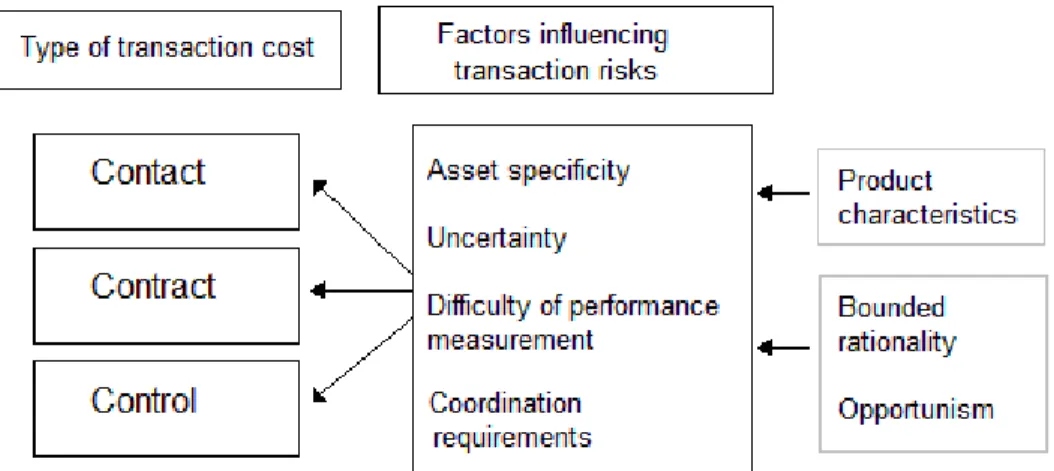
1. To what extent can different institutional arrangements be explained as a solution to high transaction risks resulting from the following factors (see Figure 4):
a. Asset specificity b. Uncertainty
c. Performance measurement d. Coordination requirements
2. Which institutional arrangements are observed for marketing FFV?
a. What is the way in which contact is established between the farmer and purchaser? b. What does the contract (agreement) entail?
c. How is the agreement monitored and enforced?
3. How has the institutional environment (including government policies) influenced the institutional arrangements?
Figure 4: Types of transaction costs related to determining factors
We will first apply the first question above to different institutional arrangements which will give us an indication of what one would expect to see. This is done in the next chapter (III). The second question has been addressed in the case of FFV sector in Tanzania. We look therefore in the subsequent chapter (IV) to see whether our expectations on the institutional arrangements put forward in chapter III were correct, and when not, what the reasons might be. The third question is addressed by comparing Tanzania with Kenya, Uganda and Ethiopia. These four countries have pursued different policies in the past, and also have different institutional environments. With this comparison, we attempt to provide an indication on how these policies and institutional environments have affected the FFV chains in East Africa (chapter VI).
III. Institutional arrangements explained
This chapter describes the various institutional arrangements for marketing of FFV and explains their occurrence in terms of transaction cost arguments, building on Chapter 2. We distinguish different institutional arrangements along a continuum with spot markets at one extreme, hierarchy at the other, and hybrid forms in between (Figure 5). These arrangements can be described by a number of characteristics of the transaction: (1) relationship, which varies from anonymous to personal; (2) coordination, which ranges from atomistic to integrated; (3) duration/iteration, which ranges from short/once to long/repetitive; (4) formalization, which ranges from no formalization to fully formalized. At the one extreme are spot markets in its purest form: transactions are characterized by anonymous relationships, atomistic coordination, short term execution, no formalization, and once-off exchange. Spot markets in this pure form hardly exist as most market transactions are taking place between persons that know each other and trade repetitively with each other.
A hybrid arrangement combines elements of market and hierarchy, more particularly it combines the coordination/governance mechanisms that are dominant in markets (i.e. price) and hierarchy (i.e. authority). Under a hybrid arrangement parties to the transaction are still motivated by monetary incentives (prices), but are restrained in their individual decisions because they have transferred part of their decision rights to the other party. Contract farming (CF), producer organisation (PO) or a combination of the two (PO+CF) can be considered as hybrid institutional arrangements. Both in a PO and under CF the producer has renounced part of her individual decision rights; in the PO she has to comply with the rules jointly agreed to, and under CF she has to comply with the agreements of the contract. Placing PO and CF on the continuum from spot market to hierarchy, we can say they involve personal relations, that coordination is partly integrated, that duration/iteration is variable: long + repetitive for PO, and short + repetitive for CF, that formalization is present (membership of a PO can be considered as a contract).
Institutional Arrangements Typology
TCE Market Hybrid Hierarchy
Detailed typology Pure Spot Marke t (SM) Personalized Market (PM) Multilateral Contrac ting (MC) Bilateral Contra cting (BC) Equity Particip ation (EP) Vertical Integra tion (VI)
Examples Auction Preferred
Supplier
PO Contract Farmin
g
Joint Venture Firm
Characteristic s
Relationship Anonymous Personal Personal Personal Personal Personal Duration /
Iteration
Once-off Repetitive Repetitive Once-off / Repetiti
ve
Repetitive Repetitive
Formalization No No Yes Yes Yes Yes Coordination of
activities
Individual Individual Multilateral Bilateral Bilateral Unilateral
5.
Spot markets
Spot markets can be seen as the “default” marketing option for small rural farmers. Fafchamps (2004:9) observes that “markets play a paramount role in Africa, arguably more so than in developed countries”7. There are usually many intermediaries and most transactions are very small. The market
participants are either individuals or very small firms (i.e. they are atomistic). In a pure spot market, no personal relationships are developed. The transaction is executed “on the spot” and the three phases of a transaction (contact, contract and control) are executed immediately. Note that there does not have to be a physical marketplace. The trader will contact the farmer (or vice versa), inspect her products, negotiate a price, seal the deal, pay and collect the products all within a few hours or less. In such a pure form of market transaction, transaction costs are very low for both parties.
In reality, markets in Africa are actually characterised by very high transaction costs (Fafchamps, 2004; Kydd and Dorward, 2004) and are far away from the theoretical ideal-type spot market (Jaffee and Gordon, 1992). Evidence collected in Africa and elsewhere suggests that input and output markets, as well as factor markets (e.g. for labour or credit) are beset with informational problems of moral hazard and adverse selection8, as well as with contract enforcement problems, that all shape
economic exchange and determine how efficient markets are (Bigsten et al., 1999). In this section we will discuss, using Figure 4, why there are such high transaction costs, what factors play a role, and what (organisational) solutions market agents have found to lower transaction costs.
Often, FFV only grow under very specific agro-climatic conditions, which limits the area where they can be grown and these areas may be removed from main markets (e.g. in the capital city) and consumers. The transaction costs, particularly for traders, involve the time obtaining information on the likely supply in terms of quantity and quality (has it been a good season or not), which may involve travelling to the production area several times. Establishing personal relationships may therefore be advantageous to traders – they can then call farmers by mobile telephone to check progress. Securing supply may be difficult when there are many buyers but few sellers and traders may prefer to secure an agreement in advance to assure supply. Thus within spot markets, not all transactions are characterised by impersonal trade.
Because the coordination task is complex (sourcing different types and quantities of FFV from different, remote location to different markets, traders operating in the main markets usually employ or contract other actors to contact farmers, gather information on supply, quality and prices, purchase, inspect, pack and transport goods. This can result in a long supply chain involving many middlemen and other actors such as transporters, farmer-collectors, packers etc.
In spot markets FFV, uncertainty and seasonality of production is reflected in pronounced price and quantity variations (see Figure 6 for an example). Due to climatic variability the quality and quantity of production cannot be accurately predicted and therefore the buyer needs information to form expectations on the likely supply, so that he can match it with demand and base price projections on this. When harvests for a certain product are likely to be bad, securing supply becomes more important. Price fluctuations reflect this uncertainty.
Figure 6: Price of tomato at Kilombera market in Arusha, 2005. Source: (Wiersinga and Jager, 2007)
Transactions in FFV spot markets are also shaped by the difficulty in monitoring performance. Information asymmetry supports opportunistic behaviour by traders, particularly when distances between production areas and main consumer markets are greater. Information about consumer preferences, prices on main markets may not be readily available for (remote) farmers, and obtaining them may be very costly. Thus traders having this information can decide not to share it with farmers or provide farmers with misinformation (e.g. state lower prices than those in main markets, not provide information on consumer preferences with respect to grades or product characteristics). The mobile phone has lowered this asymmetric information and other systems such as providing bus drivers with relevant market information are also being tried out in various developing countries.
As a result of these difficulties in checking performance, more personal relationships may form in spot markets with traders and farmers entering into (informal) agreements. But there is always the possibility of one of the parties not complying: a farmer may sell to another trader who offers a higher price or a quick sale, or a trader may purchase from another farmers for a lower price. When perishable produce such as FFV are involved and markets are thin, such breaches can impose high costs. For instance when a farmer cannot sell the produce to another trader and the crop has deteriorated and become unsellable. Reducing such uncertainty through personal relationships that establish trust become important, especially in the case where the institutional environmental does not offer suitable enforcement mechanisms (formal or informal).
6.
Contract farming
Contract farming has been defined as an agreement between farmers and processing and/or marketing firms for the production and supply of agricultural products under forward agreements, frequently at predetermined prices (Eaton and Shepherd, 2001). The agreement often includes the provision of production support by the buyer (the processing and/or marketing firm) to the producer, for instance the supply of production inputs or technical assistance. The basis of a contract farming arrangement is a commitment on the part of the farmer to provide a specific commodity in quantities and at quality standards determined by the buyer and a commitment on the part of the buyer to support the farmer’s production and to purchase the commodity.
Producing on a contractual basis is not new to agriculture. Contract farming has existed for a long time, particularly for perishable agricultural products going to the processing industry, such as fruits and vegetables for the preserved food industry. In the second half of the 20th century, contract farming has become more important in the agriculture and food industries of the developed countries (Royer and Rogers, 1998). Spurred by changes in (international) competition, consumer demands, technology and governmental policies, agricultural systems are increasingly organized into tightly aligned chains and networks, where the coordination of production, processing and distribution activities is closely managed. Contracting between producers and processing/marketing agribusiness is one of the methods to strengthen vertical coordination in the agri-food chain.
Also in developing countries, contract farming is becoming more important. Developing countries are impacted by the same trends in the agri-food system as developed countries. Thus, they also experience the effects of trade liberalization and therefore increased competition, the changes in consumer preferences, the introduction of stricter quality and safety regulations, both public and private. In addition, developing countries are experiencing a number of trends that particularly favour the rise of contract farming (Reardon and Barrett, 2000). One of these trends is the rapid rise of supermarkets in food retailing (Reardon and Berdegué, 2002). Supermarket procurement practices often include the application of private quality standards and a limitation of the number of suppliers (only working with preferred suppliers). Another trend relevant for contract faming in developing countries is the reduction of the role of the state in supporting activities and services provision. As independent commercial service and inputs provision is often weak in developing countries, contract farming can solve the problem of farmer access to inputs and technical assistance. Contract farming is often seen as one of the methods of linking smallholder farmers to domestic and even foreign markets (Kirsten and Sartorius, 2002; Sáenz-Segura, 2006).
Initiating actors for contract farming are usually buyers seeking to increase capacity utilisation of specific assets (in the case of processing), but they may also be driven by state concerns to promote critical commodity chains (for example in China), or they could be input suppliers who wish to expand input sales (examples can be found in the feed to meat chains of developed countries; often called chain integrators). Incentives for buyers to engage in contract farming with smallholder farmers usually arise from some combination of the following conditions (Poulton et al., 2005; Dorward et al., 2006b): a. limited opportunities to source farm produce from independent or vertically integrated larger farms
either because they do not exist or because larger farms have more profitable production alternatives;
b. limited opportunities to source farm produce from existing smallholder markets;
c. more labour intensive products (giving small family operated farms a competitive advantage). d. products with lower credence characteristics (that is where quality can be determined from
product inspection without, for example, quality or food safety monitoring processes during production);
e. small farmer motivations for participation that extend beyond short term direct profits from participation;
f. some form of horizontal farmer coordination (i.e., some firm of producers’ organisation)
Reviews of studies of contract farming (e.g. Kirsten and Sartorius, 2002; Singh, 2002) suggest that contract farming arrangements do allow small farmers to achieve higher yields, diversify into new crops, and to increase income. However, they also note a number of disadvantages and threats, such as the limits to the inclusivity of contract farming schemes (often restricted to the top tier of smallholder producers), the often unequal relations between monopsonistic buyers and many supplying farmers, the bearing of high risks by farmers, and the decline over time of terms for farmers in the process of “agribusiness normalisation”.
Modern (international) agri-food supply chains are highly demanding on the delivery conditions and the quality of the products. Requirements on suppliers include homogeneous and guaranteed quality, large uniform quantities, and complying with strict delivery conditions. Both the increase in international supply chains as well as the rise of supermarkets in domestic food retailing have major implications for all actors in their supply chain. Supermarkets in general favour centralized procurement system, specialized and dedicated wholesalers, preferred supplier systems, and private standards for fresh produce (Shepherd, 2005). These purchasing practices not only replace spot market transactions with contracting, but also have a tendency to exclude smallholder farmers.
Supply chain partnering among producers, traders, processors and retailers implies interdependencies among the activities of the individual chain actors. These interdependencies not only exist in improved logistics (such as reduced lead times and reduced inventories), but also in targeted marketing efforts and quality assurance systems. All of these activities require more vertical coordination and enhanced information exchange. Thus, supply chain management has become more important in the agri-food industry, also for small farmers seeking to strengthen their position in (international) agri-food markets.
7.
Different types of contract farming
Dorward et al. (2006a) conclude that the wide variety in existing contract farming arrangements and their varied success in benefiting smallholders and agribusiness farms demonstrate that these arrangements are complex and that their performance and potential benefits are highly sensitive to specific features of the products, firms, communities and contractual arrangements involved. Despite their complexity and contingency nature, several typologies of contracts in CF have been made. The classical typology by Mighel and Jones (1963) distinguishes between market-specification contracts, production-management contracts, and resource-providing contracts. These contracts can be compared in terms of the main objectives, the transfer of decision-rights (from the farmer to the buyer), and the transfer of risks:
1. A market-specification (or marketing) contract is a pre-harvest agreement between producers and buyers on the conditions governing the sale of the crop/animal. Besides time and location of sales, these conditions include the quality of the product, thus affecting a few of the production decisions of the farmer. The buyer reduces the producer’s uncertainty of locating a market for the harvest. Under the market-specification contract the farmer maintains most of the decision rights over his farming activities. Under this contract the farmer bears most of the production risk and some of the market risks. No pre-determined price has been agreed between contract parties.
2. The production-management contract gives more control to the buyer than the market-specification contract, as the buyer will inspect production processes and specify input usage. Under this type of contract, producers agree to follow precise production methods and input regimes. Under the production-management contract, the farmer has delegated a substantial part of his decision rights over cultivation and harvesting practices to the buyer; he is willing to do so because the buyer takes on most of the market risks and some of the production risks. Usually a predetermined price (or price range) has been agreed upon.
3. Under the resource-providing contract the buyer not only provides a market outlet for the product, but he also provides key inputs. Providing inputs is a way of providing in-kind credit, the cost of which is recovered upon product delivery. How much decision-rights and risk is transfer from the farmer to the buyer, depends on the actual contract. Resource-providing contracts can include production-management, thus shifting most decision-rights and risks to the buyer, but can also focus only on providing inputs and an output market and leaving most of the production decisions as well as a substantial part of the risk with the farmer. Under a resource-providing contract, some agreement on prices also has to be made.
Discussions of contract farming are often confusing because there are so many different types of contracts and actors (private sector firms, public sector firms and parastatals, international aid
arrangements that provide production and marketing services to farmers on their own land. According to Glover and Kusterer (1990) these arrangements are generally a government scheme with a public enterprise, purchasing crops from farmers, either on its own or as a joint venture with a private firm. They use the term contract farming to refer to the same arrangement in the private sector. Nucleus estate-outgrower schemes are arrangements in which a core estate and factory is established and farmers in the surrounding area grow crops on part of their own land, which they sell to the factory for processing. Multipartite arrangements is a term often used in the literature to emphasise the participation of several actors.
8.
Contract farming as a transaction cost reducing arrangement
In chapter 2 it was explained that institutional arrangements can be considered as solutions to transactional problems, particularly high transaction costs. It has been explained that high transaction costs are determined by a number of characteristics of the transactions, such as asset specificity, uncertainty, difficult performance measurement and coordination. Here we will discuss contract farming as a tool to reduce transaction costs related to those four characteristics of transactions. Asset specificity
Asset specificity is in general low in most FFV transactions: products are of a generic character, investments (by farmers) are usually low and generally not specific to a particular buyer. These characteristics would not favour an institutional arrangement like contract farming. However, under a number of conditions, contract farming becomes more attractive, both for producers and buyers. A classical example in the FFV industry is the production for the processing industry. Because processing requires substantial investments in plant and machinery which cannot be used for other purposes, processors want to be assured of sufficient quantity and quality of supplies. As spot markets usually cannot guarantee sufficient quantity and quality, processors often choose to source their raw material through contracts with farmers.
Another example is when products have to comply with specific quality requirements (such as organic or Eurep/GlobalGAP). Farmers will not make necessary investments to meet these requirements because they entail a high market risks. Investments include the effort in finding proper inputs and technical assistance. Thus, buyers of organic products enter into contracts with producers, providing them with resources, technical assistance, and marketing guarantees.
There are a few disadvantages for farmers with respect to production or resource-providing contracts. For instance, farmers lose flexibility in their choice of farming activities. Bound to a crop or livestock enterprise by a contract, farmers cannot adjust production mixes so as to benefit from market opportunities. Second, delivery schedules may be set by buyers so as to influence prices paid to farmers. This strategy can happen when prices are rapidly changing and buyers adjust the delivery schedule to benefit from market volatility. Third, the risks normally associated with monoculture practices are increased. Intensified production of single agricultural crops, or the concentration of animal herds, increases the chances of diseases.
Uncertainty and performance measurement
Contract farming can solve a number of problems related to uncertainty and difficulty of measuring contract performance, which may confront both the producer and the buyer. For the producer uncertainty about buyers and prices are reduced, as contracts provide a guaranteed outlet and typically specify at the beginning of the growing cycle the prices to be paid at product delivery. Thereby, income stability is obtained, particularly if the contract is a long term contract or can easily be renewed. For the buyer, contracts reduce the risk of obtaining sufficient produce at the right time and of the right quality, which may be crucial for processing but also for traders that have contracts for supplying supermarkets.
Farmers’ default on contracts can occur because of production failure or simply because farmers have sold the produce to competing buyers, partly to avoid repaying credit and inputs they received as part of the contract or to receive higher prices outside the contractual bond. This is especially problematic where alternative markets are easily accessible and where contractual enforcement is weak. In resource provision contracts, a known problem is the potential use of the distributed inputs in alternative crop and livestock activities.
Buyers might also renege on contractual terms if market circumstances change. For instance, if market prices at product delivery time are substantially different from prices agreed in the contract, buyer may force renegotiation or may engage in contractual hold-up. Such hold-up could be the rejection of products delivered under the pretext of non-conformity to quality regulations. For farmers it is usually impossible or at least very costly to check the appropriateness of the buyer’s claim. Buyers might also intentionally avoid transparency in the price determination mechanisms of the contract, making it very difficult for the farmer to assess whether he has received a proper remuneration. Besides reducing risk and transaction costs, buyers may experience a number of economic benefits resulting from lower purchase prices. By providing inputs to all of the contracted farmers, inputs costs per unit are reduced for the farmer, thus allowing output prices to be reduced. In addition, by contracting with small scale farmers buyers can benefit from the advantages of family farms, particularly for labour intensive crop and animal production systems. Moreover, buyer access to credit and subsidies is facilitated. The reduction of risks in the buyer’s supply chain and the economies of scale associated with contracting operations are conditions that in principle increase a financing institute’s willingness to lend.
Contract farming allows better performance measurement, as agreements have been made on how and when to monitor product quality. Under a production-management contract, the buyer has good options to influence the production process (indirectly by providing inputs, and directly by supervising the cultivation). Contracts also provide an opportunity for repeated interaction which generates information on the actions and products of particular producers.
However, when dealing with large numbers of farmers, buyers still face high transaction costs. Managing a commercial relationship with a myriad of partners is a complex task, requiring investments in personnel, in controls and in monitoring systems.
Coordination
Key and Runsten (1999) have argued that contract farming is considered an institutional response to imperfections in markets for credit, insurance, technical assistance, inputs for production, etc. Producers often face production risks because of the uncertainty about the availability and quality of inputs. Failures in input markets are circumvented by direct provision of these inputs through contract farming, and the economies of scale allowed by the larger purchases of inputs by the buyer which can be passed on to farmers via reduced costs. Contracts commonly include provisions on technical assistance, often to help farmers to raise product quality and thus obtain a higher product price. Without such assistance, farmers may not be willing or able to venture into innovative crop and livestock enterprises as these innovative activities involve higher risks. At the same time, this technical assistance can enhance farm production and the management skills of the farmer, and spill-over effects might happen if farmers also have non-contracted crop and livestock activities.
Access to credit is also enhanced under a resource-providing contract, in which the buyer supplies working capital in kind, via input provision. Such a transaction is guaranteed by the commercial commitment between farmer and buyer. By the same token, access to credit for both working capital and fixed capital is enhanced in the case of market specification contracts, because banks may accept the contractual commitment as a sufficient guarantee for the granting of loans. This credit can be seen as an advance payment. There are various systems possible for determining prices or sharing price
risk lies completely with the trader. The trader could offer the price that is current at the time of collecting the goods, or the price the trader received when selling the produce in the market, in which case the risk lies completely with the farmer. Any price between these two in which the trader and farmer share price risk is possible. The difference between the cost of inputs supplied and the price paid can be quite large, reflecting a high interest rate. The system is therefore often seen as a distortion, reflecting on the power imbalance between traders and farmers. However, Hayami and Kawagoe (2001) show that this does not always need to be the case, and that farmers may actually benefit from such schemes9, although the risk of indebtedness can be a problem. The downside of
easy access to credit is the possibility to incur mounting debts. As Da Silva (2005) has emphasized, most of these negative aspects of contract farming result from the fact that the relationship between individual farmers and the buyer is uneven, the latter often in a position to exercise power and uncompetitive conduct in the definition of the terms of the transactions.
Also for buyers, contract farming may have various benefits with respect to coordination costs as a greater regularity of agricultural product supplies makes possible a better coordination of processing activities or with the timing of the demands from their own clients. On the other hand, this may be costly to buyers, as they internalize the cost of support services, such as extension, transportation, quality monitoring and financial services, which in competing regions may be provided free of charge by public agencies. Finally, contract farming may lead a loss of flexibility to seek alternative supply sources, which is particularly problematic if economic conditions change in favour of seeking alternative sources.
Bogetoft and Olesen (2004) have applied the issue of coordination to the design of production contracts. They argue that coordination must ensure that production is optimized throughout the entire supply chain. Lack of coordination leads to sub-optimization where decision-makers “optimize” their own decisions without considering all the consequences for other decision makers in the supply chain. In a situation where many producers supply to one buyer (e.g. a processor), an important aspect of coordination is the minimization of production costs. From an efficiency perspective, producers with lower marginal costs should be allocated a larger share of the production. The allocation can be handled through a market approach, where producers compete for the right to produce through auctions. Another approach is centralized decision-making, where the buyer chooses the producers and their production levels. Coordination can generally be achieved using instructions or price signals, or a combination of the two. Bogetoft and Olesen (2004) state that it is often attractive to coordinate qualitative aspects as well as matching and synchronizing problems via instructions, and quantitative aspects via prices.
This implies that when quality and synchronization become more important, such as in high-quality chains, supermarket supply chains, and perishable product chains, contractual arrangements are more likely to include hierarchical coordination elements (i.e., centralized decision-making and giving instructions). Modern (international) agrifood supply chains are highly demanding on the delivery conditions and the quality of the products (thus on coordination in the supply chain). Requirements on suppliers include homogeneous and guaranteed quality, large uniform quantities, and complying with strict delivery conditions. Particularly the rise of supermarkets in retailing (fresh) agricultural products has major implications for all actors in their supply chain. Supermarkets in general favour centralized procurement systems, specialized and dedicated wholesalers, preferred supplier systems, and private standards for fresh produce (Shepherd, 2005). For traders/wholesalers to supply these demanding supermarkets, they need sufficient quantity and homogeneous quality. Spot markets have difficulty in meeting these retail requirements, thus providing an incentive for traders/wholesalers to set up contract farming arrangements with multiple producers.