Volume1 2008 Article10
Problem-Based Learning in Action: The
Development of the Virtual Health and
Wellness Centre
Helen Metcalfe
∗∗Edith Cowan University
Copyright c2008 by the authors. eCULTURE is produced by The Berkeley Electronic Press (bepress). http://ro.ecu.edu.au/eculture
Wellness Centre
Helen MetcalfeAbstract
Nursing education in Australia has undergone significant change over the past 30 years. Most notably, the transfer from a traditional apprenticeship model to that of a professional degree based course in the tertiary sector. Contemporary healthcare institutions demand graduates who are ‘work ready’ and able to ‘hit the ward running’. The demographics of the Australian population indicate that groups of culturally diverse individuals are seeking healthcare along with an ageing population of Australians who have unique needs. The growing demand for more highly trained, work ready nurses has landed squarely on the shoulders of universities providing comprehensive nursing education. The problem now for nurse educators is to facilitate teaching and learning strategies that will engage the student nurse in processes that promote critical thinking and prob-lem solving in the work place. While various models and curricula are in use across Australia in pre-registration nursing education, there is growing evidence to suggest that Problem-Based Learning (PBL) is perhaps the most suited to producing professionals who are able to problem solve and address the multiple demands of an ever changing environment. The introduction of a PBL curriculum will meet this demand. Here at Edith Cowan University, the School of Nursing Midwifery and Postgraduate Medicine has undertaken a pilot project introducing a web based re-source to align with the introduction of a hybrid PBL curricula. Undergraduate nursing students undertaking the Bachelor of Science (Nursing) were given the opportunity to meet a paediatric patient in the Virtual Health and Wellness Centre. This virtual site enables nursing students to explore case study in various nursing areas such as paediatrics, critical care, medical/surgical and aged care. Students progress through a scenario which incorporates theory relating to anatomy and physiology, pathophysiology, pharmacology, psychosocial issues, research, professional is-sues and relevant nursing skills. Each scenario is formulated around a set of learning outcomes, which are evaluated by the student at the completion of the case study. During practical laboratory sessions students are able to contextualise their learning and seek informal peer feedback. The development of these case scenarios are context rich and built around the central aim of engag-ing students in self-directed learnengag-ing. This discovery learnengag-ing leads to higher comprehension and transferability of knowledge. Students will be able to practice the skills and theory in practical laboratory sessions which adds a functional dimension to the online material making the mean-ings derived from the combination of theory and practice more profound and ‘real world’. Gibbon (2005) states that “in PBL we take a collection of information, pertinent to the problem. We learn a little about each and synthesise it to solve the problem, like a jigsaw” (p. 6)
Problem-Based Learning in Action: The Development of the Virtual Health
and Wellness Centre
Abstract: Nursing education in Australia has undergone significant change over the past 30 years. Most notably, the transfer from a traditional apprenticeship model to that of a professional degree based course in the tertiary sector. Contemporary healthcare institutions demand graduates who are ‘work ready’ and able to ‘hit the ward running’. The demographics of the Australian
population indicate that groups of culturally diverse individuals are seeking healthcare along with an ageing population of Australians who have unique needs. The growing demand for more highly trained, work ready nurses has landed squarely on the shoulders of universities providing comprehensive nursing education. The problem now for nurse educators is to facilitate teaching and learning strategies that will engage the student nurse in processes that promote critical thinking and problem solving in the work place.
While various models and curricula are in use across Australia in pre-registration nursing education, there is growing evidence to suggest that Problem-Based Learning (PBL) is perhaps the most suited to producing professionals who are able to problem solve and address the multiple demands of an ever changing
environment. The introduction of a PBL curriculum will meet this demand.
Here at Edith Cowan University, the School of Nursing Midwifery and Postgraduate Medicine has undertaken a pilot project introducing a web based resource to align with the introduction of a hybrid PBL curricula. Undergraduate nursing students undertaking the Bachelor of Science (Nursing) were given the opportunity to meet a paediatric patient in the Virtual Health and Wellness Centre. This virtual site enables nursing students to explore case study in various nursing areas such as paediatrics, critical care, medical/surgical and aged care.
Students progress through a scenario which incorporates theory relating to anatomy and physiology, pathophysiology, pharmacology, psychosocial issues, research, professional issues and relevant nursing skills. Each scenario is formulated around a set of learning outcomes, which are evaluated by the student at the completion of the case study. During practical laboratory sessions students are able to contextualise their learning and seek informal peer feedback.
The development of these case scenarios are context rich and built around the central aim of engaging students in self-directed learning. This discovery learning leads to higher
comprehension and transferability of knowledge. Students will be able to practice the skills and theory in practical laboratory sessions which adds a functional dimension to the online material making the meanings derived from the combination of theory and practice more profound and ‘real world’. Gibbon (2005) states that “in PBL we take a collection of information, pertinent to the
problem. We learn a little about each and synthesise it to solve the problem, like a jigsaw” (p. 6)
Introduction
Studies have shown that there are a variety of curricula models in use within pre-registration nursing education. (Clare, Edwards, Brown, & White, 2002) acknowledges that current literature concedes that critical thinking is an essential trait of the graduate nurse. This notion of critical thinking is embraced in Problem Based Learning. Clancy (2005) suggests that PBL may be considered one of the most significant educational innovations in the last thirty years. This innovation has been embraced at Edith Cowan University, Perth, Western Australia where a PBL approach has been introduced into a newly created Bachelor of Science (Nursing) 3 year program in 2008. (Ward & Hartley, 2006) acknowledges that paramount to the success of a PBL learning approach it is essential for educators to have access to a bank of authentic
scenarios. However there does appear to be a lack of evidence supporting the use of authentic scenarios within an online environment. This paper explores the development and
implementation of the Virtual Health and Wellness Centre (VHAWC and discusses some of the results obtained from on line feedback).
The Virtual Health and Wellness Centre (VHAWC) was named in recognition of the move to a purpose built nursing education facility planned for late 2007. After consultation with a university instructional designer, it was decided to pilot the site through Blackboard v7 (a software product chosen by the university because of its flexibility and ease of use).
Material was uploaded through the site for all students but in particular stage 4 students who would be the pilot group for the introduction of PBL. The Blackboard platform enabled statistics including number of hits on the site and access by time and day to be recorded for analysis.
Review of the Literature Problem Based learning
Problem Based Learning (PBL) evolved from the innovative health science curricula introduced in North America in the 1950’s (Boud & Feletti, 1997). As these authors noted, there is no single definition of PBL as it is considered an approach rather than a single method or technique. The principle idea behind Problem Based Learning is the starting point for the learner to focus on a problem. (Barrows, 1986) suggests the objectives of a Problem Based Curricula are:
• The acquisition of a knowledge base that is organised in a more useful way, more easy to recall in the clinical context and easily extended through self study
• Development of scientific or analytical reasoning skills (problem solving)
• Development in self directed learning skills
• Encouragement of independent and critical thinking
• Sensitivity to the patients needs
• Encouragement of the integration of information from the various preclinical sciences. The centrality of the PBL process is the ability to stimulate a questioning attitude and the search for a meaning (Margetson, Cooke, & Don, 1995). (Margetson, 1997) suggests that PBL is “a conception of knowledge, understanding and education that is profoundly different from the more usual concept underlying subject – based leaning” (p.2). Undoubtedly adopting PBL as a teaching strategy is attracting wide interest within nursing education. The move into higher education has meant greater numbers of students within each cohort than previously experienced and often two cohorts a year. Nursing however, with its skill base is not an easy subject to be taught to the masses (Gibbon, 2005).
The aims of PBL are to develop the student’s competency in a number of skills which will be important in their professional life, these include:
• Problem solving
• Self directed learning
• Small group learning
• Critical thinking skills
• Integration of different parts of the curriculum
(Boud & Feletti, 1997) Boud and Filetti (1997) state that PBL has been one of the most powerful teaching
methodologies to encourage students to take responsibility for their own learning. They suggest that the PBL approach provides students with motivation to actively pursue concepts and principles they need for life.
The Use of a Virtual Learning Environment
There are many terms in use when referring to environments that are involved in the management of the learning process:
Virtual Learning Environments (VLE’s) Managed Learning Environments (MLE’s)
Personal Learning Environments( PLE’s); are 3 popular definitions.
The joint steering group (Quality Improvement Agency, 2007) suggests that the term Virtual Learning Environment (VLE) refers to the components in which learners and tutors participate in 'on-line' interactions of various kinds, including on-line learning. Quite simply, a VLE is a software tool which can bring together in one integrated environment, all the features which may be in use in the classroom. Many emerging technologies and networks can be used to enrich and provide greater interactivity within the virtual learning environment. Advances in technology ensure that almost all traditional classroom equipment can be emulated in the virtual learning environment. Galloway, Boland & Benesova (2007) suggest that in terms of academic results, virtual learning environments can represent a more successful learning environment and have proven to be motivating contexts for learning. In these virtual environments the learning experience can be flexible, more accessible and inclusive. Not only are these environments often
a more economically viable option, but they also allow specialist tuition and knowledge to transcend geographical boundaries.
The UK Quality Assurance group suggest that a VLE is not a simple technical fix; it involves a shift in the way people teach and learn. VLEs are not about distance learning, as much as flexible and accessible learning; in most cases, the work done within a VLE by students will complement work they do in their face to face classes - not replace it. Therefore VLEs need to be integrated into other teaching, and should not be seen as a separate entity.
Again, this takes time. The literature suggests that rather than go for the big bang approach of implementing a VLE right across a college, it's almost certainly better to run a pilot project first. With this notion in mind it was decided to initially trial the VHAWC within one unit and using one case study.
Development of the Virtual Health and Wellness Centre
Development of the web based learning resource was enabled by a teaching and learning grant from Edith Cowan University. A portion of the grant was used to employ a Project
Manager who took over the planning and construction of the site for a pilot test.
The site was built within the existing web resource framework (Blackboard v7) which hosts online material for various units. By building the site within this existing framework, ease of access was ensured and likelihood of evaluating the site was enhanced as students visited the Blackboard site regularly.
The site was initially developed to support one paediatric scenario with learning objectives applicable to students from stage four to stage six. Content was researched and designed to include aspects of anatomy and physiology, pathophysiology, pharmacology, psychosocial and communication issues, research and professional issues and skills; core components of the undergraduate curriculum.
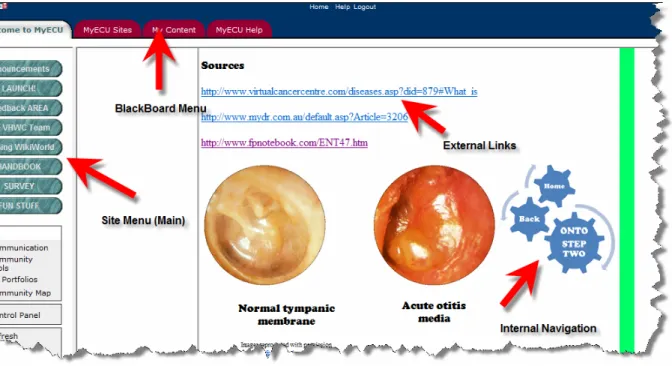
The sections were arranged logically and students were encouraged to navigate their way through the patient scenario by a series of steps. At each step of the scenario, options to go back or return to home were available as were various resource links (see diagram 1) related to the content from the relevant section the student was browsing.
Diagram 1 – Navigation views (Main site menu, BlackBoard menu, internal navigation)
The site was launched in October 2007 for a period of two weeks for evaluation. All students enrolled in the pre-registration nursing course (n = 1213) were given access to the site. Students enrolled in stage four (second year) of the course were given a 10 minute presentation about the site by the project team. This group was selected as the target group for the initial implementation of PBL in the following semester and were enrolled in the paediatric unit at the time.
Feedback and evaluation was obtained by two methods. Firstly, an evaluation forum was setup and made available from the main menu (see diagram 2). This forum enabled users to leave feedback in two areas: general comments and content. Feedback left in this area was not anonymous and user names were attached to responses but de-identified during analysis.
Diagram 2: Feedback forum
Secondly, statistical data regarding access was collected during the evaluation period including number of hits and access by day and time.
Findings/Results
The evaluation period was completed in early November 2007 and the responses
analysed. Additionally, comments made through the feedback forum and received by email were collated.
Forum participation
From the main site menu, students were able to enter a ‘feedback area’ where forums were created to allow students to leave comments relating to general thoughts and content. Due to a technical problem, students were unable to create new forum threads until the second week of the evaluation period. In total ten unique participants left written feedback within the forums.
However this has since escalated to over 50 .
Feedback reflected aspects of the site which students found useful to their learning needs such as multiple sources of information compiled into one central access area:
What a handy resource this will be. It provided a good revision for otitis media - just a shame there isn't more ready this year. The links to other sources is also great - provides a motivation to further research the topic without having to go to the library link. Its great there are some foreward thinkers out there that want students to do as well as they can.
Additional comments also showed the diversity of students accessing learning materials and the convenience of an online source to facilitate these needs and provide forum not only for networking but for collaborative learning experiences:
I hope wikiworld is utilised by students as it could build to be a very useful resource
USER #2
I love this. I already spend half my life on the computer, i guess I will never be off it. This will be a great learning tool for the next two years.
I like the idea of Wikiworld, as many of us have experiences that are uncommon and to share these would be a very valuable learning tool. I already have stuff I want to put on!!
I hope we have access to this site after we graduate as well.
USER #3
this is fantastic ...have downloaded all and have found it really informative , a great learning tool, and cant wait till you have more of it up and running. Sometimes I feel the students from the bush are a forgotten species but this is great to be able to access and utilise
USER #4
Email feedback
Unexpectedly, some student users chose to email the Project Manager directly with feedback from using the site. A total of four emails were received which again reflected positive experiences with the site.
Anecdotal feedback
While the evaluation period was taking place, students approached the Project Manager with comments about the site. They were very positive comments about the usefulness of the site.
Staff feedback
Three staff members emailed the Project Team to comment on the web site. All three comments were positive.
Congratulations on the work you have done on this site. It looks like a great way for students to engage with material! There is scope to do so much with online learning in the future. Well done!
STAFF USER #2
Access dispersion
In creating and evaluating an online forum, statistics which examine when students are accessing the resource are important to determine whether online resources are providing learning opportunities that could not be provided face-to-face at the most desired access times.
Site statistics show that peak access time was 1500hrs followed closely by 2000hrs – off-peak times for face-to-face teaching.
Diagram 4: Access of site by time day
Access by day of the week showed that users most frequently accessed the site on Tuesdays (22%), closely followed by Sundays (16.7%).
Usage characteristics suggests that the all hours availability of this resource is suited to students needs demonstrated by peak access times being out of traditional teaching contact hours. This feeds into the demographic structure of the program which consists predominantly of
Diagram 5: Access of site by day of week
While formal feedback was received by only a small proportion of participants, it is interesting to note that during the evaluation period there were a total of 2653 visits to the site which represents approximately 2.1 visits per enrolled user.
Discussion
Design
During the design phase, it became apparent that a more specialised software package needed to be introduced to enable specific content design. Therefore Dreamweaver Macromedia Studio 2003 was used to enable the development of high quality images interfaced with text.
Usage
It appears from the data that most hits occurred on Tuesday, this was the day lectures were scheduled for the majority of students. This would suggest that students make the most of the opportunities available whilst on campus. Interestingly, peak access times were also recorded out of teaching hours namely Friday evening and Sunday afternoons; suggesting that students use this time to access material relevant to their study.
The site was upgraded in semester 1, 2008 with a number of patients pertinent to the units studied in semester 5. This included the development of 3 complex patients in the Critical Care area in collaboration with nurse educators teaching these units. In addition there has also been an expression of interest from industry and indeed to Police Academy to develop this type of forum.
Conclusion
Feedback from the students was overwhelmingly positive, with students finding the site easy to use and relevant to their learning styles. Students were enthusiastic about the format of the site and were keen to see more patients added.
References
Barrows, H. S. (1986). A taxonomy of problem based learning methods. Medical Education, 20(6), 481-486.
Boud, D., & Feletti, G. (1997). challenge of problem based learning. London: Kogan Page Ltd.
Clancy, A. (2005). The Design, development and implementation of a PBL curriculum in nurse education. Paper presented at the International conference on problem based learning, Finland. Clare, J., Edwards, H., Brown, D., & White, J. (2002). Learning outcomes and curriculum development
in major disciplines: Nursing. Retrieved 23/05/2006, from
http://nursing.flinders.edu.au/research/reports/special_pubs_Clare_summary.pdf
COGNOS. (2006). Student Statistics. Perth: Edith Cowan University.
Galloway, W., Boland, S., & Benesova, A. (2007). Virtual Learning Environments. Retrieved 12/11/2007, from http://www.dcs.napier.ac.uk/~mm/socbytes/feb2002_i/3.html
Gibbon, C. (2005). A reflective account of a teaching and learning journey. SONIC Retrieved 12/11/2007, from http://www.uclan.ac.uk/facs/health/nursing/sonic/docs/SONICReportfinal.pdf
Margetson, D. (1997). Wholeness and educative learning: the question of problems in problem – based learning. Paper presented at the Changing to PBL, Brunel.
Margetson, D., Cooke, M., & Don, M. (1995). Beginning from where you are. Problem based learning in a health science curriculum. London: Routledge.
Quality Improvement Agency. (2007). Virtual Learning Environments. Retrieved 13/11/2007, from
http://ferl.qia.org.uk/display.cfm?page=76
Ward, K., & Hartley, J. (2006). Using a virtual learning environment to address one problem with problem based learning. Nurse Education in Practice, 6(4), 185-191.