Introduction
Table olive production is growing throughout the Mediterranean basin, where more than 90% of global production is located. The rest of the production is supplied by countries like the United States, Peru and Chile. Spain is currently the largest producer of table olives, representing 24% of world production, with an average production of 512,400 tons for the 2006-2011 period (IOOC, 2012). The ‘Manzanilla’ variety is the most common table olive cultivar and extends all around the world (Barranco et al., 2008). Traditionally, this cultivar has been harvested by hand. During this process, operators, provided with ladders, pick the fruit and let it fall into small baskets (Rejano et al., 2010). However, increasing production costs and the product price reduction severely limit the profitabili-ty of this sector. Therefore, it is necessary to replace manual labor with mechanical harvesting (Ferguson, 2006).
Trunk shakers are widely used in the mechanical harvesting of oil olive groves (Gil-Ribes et al., 2009). However, table olives present serious limitations that make the use of trunk shakers diff icult. Among the various factors that limit its use are: high fruit retention force to the shoot, high fruit bruise susceptibility and lack of tree pruning adaption to mechanical harvesting. All of these limitations imply a low harvesting effi-ciency and high percentage of damaged fruits (Kouraba et al., 2004; Ferguson et al., 2010). The quality of the fruits harvested is the most important factor limiting the use of trunk shakers in table olive groves due to the high level of damage presented by the fruits after har-vesting. Meanwhile, increasing the harvesting efficien-cy is a secondary factor to improve the mechanical har-vesting of this crop (Ferguson et al., 2010). Numerous studies have been conducted to improve harvesting efficiency with trunk shakers suggesting that the use of fruit abscission agents along with improved operating vibration parameters (acceleration and frequency) could aid in obtaining better harvesting efficiency results (Ben-Tal & Wodner, 1994; Barranco et al., 2002; Sessiz & Ozcan, 2006; Burns et al., 2008). However, the
Isolation of table olive damage causes and bruise time evolution
during fruit detachment with trunk shaker
F. Jiménez-Jiménez, S. Castro-García*, G. L. Blanco-Roldán,
E. J. González-Sánchez and J. A. Gil-Ribes
Departamento de Ingeniería Rural. Escuela Técnica Superior de Ingeniería Agronómica y de Montes. Universidad de Córdoba. Campus de Rabanales. Ctra. Nacional IV, km 396. Córdoba, Spain
Abstract
The high sensitivity of table olives to mechanical damage limits mechanical harvesting with trunk shakers. The objective of this study was the identification, evaluation and temporal evolution assessment of the sources of damage caused to the fruits. To do this, digital image analysis was used for the objective determination of damage produced to table olives. Harvesting tests were performed in an intensive olive orchard with trees of the ‘Manzanilla’ variety in Seville, Spain. Mechanical harvesting with trunk shakers and subsequent detachment of the fruits to the ground produced a level of bruise 12 times greater than the levels obtained from manual harvesting. Fruit-fruit and fruit-branch impacts and friction from the movement of the fruit in the tree canopy during vibration and detachment were the main causes of damage to the fruits. These causes represented a mean value of 60% of the damage produced to the fruits from mechanical harvesting. In addition, most bruising from mechanical damage occurred in the first hour after harvesting and followed an exponential tendency. The information obtained about table olive damage causes and bruise time evolution during fruit detachment with trunk shaker can be used by the producers to determine how to reduce and prevent bruising during harvesting operations.
Additional key words: bruise damage; hand harvesting; image analysis; mechanical harvesting; Olea europaea L.
* Corresponding author: [email protected] Received: 03-08-12. Accepted: 11-02-13.
variability of the results, the high dependence on weather conditions and the high diversity of the agents tested have not provided satisfactory results for commercial use.
Mechanical harvesting with trunk shakers produces a forced vibration that is transmitted from the trunk to the branches, causing fruit detachment. Usually, olives are collected with plastic nets spread underneath the trees and sent to storage or processing facilities in bins. This process poses many risks that can damage the fruit. The first problem results from the impact damage to the fruits upon detachment from the tree, followed by impacts with tree limbs during the fall and the catching surface or other fruits on the catching surface, and lastly, upon transport to the processing industry (Adrian & Fridley, 1959; Humanes & Pastor, 1977).
The mechanical damage during harvesting consists of local tissue degradation combined with an output of intracellular water and the oxidation of phenolic compounds after impact (Segovia-Bravo et al., 2009). The oxidation process produces a darkening of the green color on the olive surface. After some time, de-pending on the intensity and characteristics of the impact, the area affected begins to darken, first super-f icially, then spreading deeper into the super-flesh until it reaches the endocarp (Ben-Shalom et al., 1978). However, table olives are a fruit that requires industrial pro-cessing for consumption. The most widespread method of processing is the green ‘Sevillian style’ processing which requires that the Manzanilla olive be green or yellowish-green and free from defects (Fernández, 1985). The external appearance of the fresh fruit har-vested along with its size and variety are key determi-nants in the quality and price received by farmers. Therefore, the presence of defects, such as bruising of the olive skin, is inadmissible in the Spanish processing industry because it could provoke rejection by the con-sumers (Rejano, 1999; Riquelme et al.,2008).
Improving the harvesting process with trunk shakers requires the identification and quantification of fruit damage at different harvesting stages. Fast and objec-tive measurement techniques are needed to determine fruit quality after harvesting. Artificial vision systems have proven to be effective for measuring and assessing the characteristics of many agricultural products. Du-ring the last decade, advances in the hardware and soft-ware of digital cameras for image processing have prompted numerous studies on the use of these systems to evaluate the quality of food products as a potential rapid, objective and cost-tracking technique for the control of agricultural and agri-food processes (Locht
et al., 1997; Zheng et al., 2006; Narendra & Hareesh, 2010). Specifically in olives grown for oil, several image analysis techniques have been used to determine the quality of oil extracted based on information obtained through image processing and the relationship between color, texture, size and shape of harvested olives (Car-fagni et al.,2008; Ram et al., 2009). However, table olive studies have been more focused on industry conditions than on the stages of harvesting and transportation to the industry. These studies have focused primarily on the detection of defects presented in olive fruits and their classi-fication into categories using machine vision systems (Díaz et al.,2000, 2004; Riquelme et al., 2008).
The aim of this study was to assess and identify the source of damage in table olives harvested with trunk shakers in intensive olive groves and determine bruise time evolution using image analysis techniques. Know-ledge of the importance of each harvesting stage will allow producers to concentrate their efforts on the most important stages and minimize the bruising caused by the introduction of mechanical harvesting with trunk shakers on this cultivar.
Material and methods
Harvesting tests were performed on an intensive table olive grove of the ‘Manzanilla’ variety, located in Seville, Southern Spain, during the second week of October 2011. Trees were trained to a vase shape with a single trunk, 0.9 m in height and 0.23 m in diameter, under irrigated conditions and a tree distance of 7 m. The trees had a canopy volume of 19.7 m3, producing
approximately 80 kg tree–1at the age of 15 years old.
The fruits had an average weight of 2.22 ± 0.10 g and were optimal for harvest just before coloring.
An inertia trunk shaker generally used for the me-chanical harvesting of olives for oil production (Noli, VBFHG) attached to a tractor (John Deere, 6420) was employed for fruit detachment through a vibration time of 15 s, long enough to detach the olives that could be easily harvested by vibration (Blanco-Roldan et al., 2009). The featured parameters were a mean frequency between 28-30 Hz and a mean effective acceleration in the tree close to 250 m s–2.
The table olive damage was evaluated in three moments: 1. Before the shaking process. The fruits in the tree canopy were hand harvested before shaking in the same trees used them for mechanical harvesting. Hand harvesting was performed by the traditional procedure
of picking olives that involves handpicking the fruit and letting it fall into baskets which workers have hanging from their necks and suspended in front of them at waist level. These fruits showed bruises and scraping due to the manual harvesting process.
2. After fruit detachment. The fruits detached by vibration were intercepted with a bubble wrap contai-ning air-filled hemispheres manually place above the ground close to the canopy to catch the olives just as they passed through the tree branches. In this way, it is ensure that damage produced to the fruit was only the result of the movement of the fruit within the canopy due to vibration as well as impacts with other fruits and branches in the free fall after release.
3. In the container. After vibration, the fruits were caught on plastic nets spread on the ground underneath the trees, and were manually transported to a container box (bin). These fruits presented damage due to vibra-tion, the impact of the fruit with the canvas, transpor-tation and unloading to the container.
During mechanical harvesting, 12 trees were ran-domly selected from the orchard. Each harvesting damage location was assessed with six samples, with each fruit sample taken from two trees in a same row. A total of 100 fruits were used per each sample. Two methods were applied on each sample for estima-ting the magnitude of the fruit damage after harves-ting.
Evaluation of fruit damage imaging
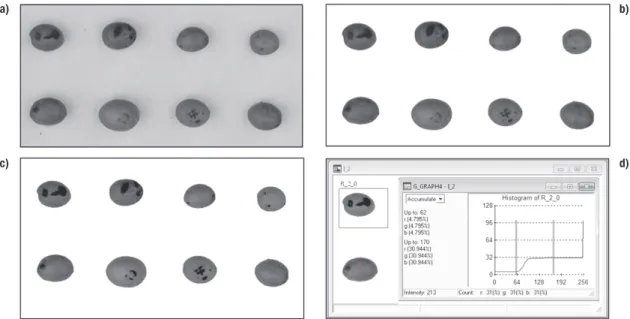
The fruits from each sample were randomly placed in the field over a white polyurethane surface with ori-fices. Images of the olives on the polyurethane surface were taken using a frame with a digital camera (Nikon D80 with 18-135 mm lens, 10.2 MP, 3.872×2.592) placed in a zenith position at a height of 1.5 m, avoiding shadows and lighting problems. Images were taken on the same fruit sample 0.5, 1, 1.5 and 2.5 h after harvesting. The analysis of images obtained in the f ield was performed in the laboratory using a specif ic image acquisition and analysis program (HarFA, Harmonic and Fractal Image Analyzer 119 5.4, Institute of Phy-sical and Applied Chemistry Brno University of Tech-nology, Czech Republic). A manual segmentation of the image was made by applying a threshold as a func-tion of the intensity values of the RGB image between 0 and 255 (Fig. 1). In this study the green channel was selected because it allowed the best identification of the area affected by bruising. The segmentation was perfor-med by sweeping the image pixel by pixel and labeling each pixel as black or white, depending on whether the pixel value was greater or less than the threshold (Gon-zález & Woods, 1992). Thus, a ratio of the percent bruising of the olives was obtained (Eq. [1]). This index is de-fined as the ratio between the total number of pixels corresponding to the bruised area (A1) and the number
Figure 1.Segmentation of table olive surface affected by bruise damage using image analysis. Origi-nal image (a), processed image to eliminate the background (b), bruise separation from the rest of the olive (c) and olive bruise and fruit surface measurement by manual segmentation (d).
a)
c)
b)
of pixels corresponding to the fruit (A2), with the result
expressed as a percentage (Carfagni et al., 2008). A1
Bruise index by image analysis = ——×100 [1] A2
Evaluation of visual fruit damage
Bruise damage after harvesting was visually evalua-ted in the laboratory by the same evaluator after 24 h. Each fruit was set into a category during the evaluation according to the severity of the damage in a 5-level scale (Fig. 2). A fruit damage index (FDI) was develo-ped as presented in Eq. [2].
0 ·X0+ 1 ·X1+ 2 ·X2+ 3 ·X3+ 4 ·X4
Bruise index by visual estimation = ————————————————— [2] X0+X1+X2+X3+X4
where X0,1,2,3,4=number of fruits without damage
(sound), slight damage, moderate damage, severe da-mage and fruits with cuts, respectively.
Results and discussion
The industrial processing of mechanically harvested fruits transported to the plant can reduce or eliminate some of the damage. Significant reductions of bruising on fruit have been made using products such as as-corbic acid, salicylic acid and sodium hydroxide (Ben-Shalom et al., 1978; Segovia-Bravo et al., 2011). Furthermore, transportation to the factory in a dilute alkaline solution with concentrations of 0.3% NaOH prevents browning of the areas affected by impact until the time of lye treatment in the processing plant (Rejano et al., 2008). Therefore, the analysis of fruit damage with values of 0 and 1 (sound olives and olives and with slight damage) were considered to be accep-table as they may be reversible during product prepara-tion. On the other hand, fruits with damage values of
2, 3 and 4 (moderate, severe and cut and mutilation) were considered unacceptable damages to the fruit quality. The table olives used in this study were at an ade-quate state of ripeness for industrial processing with a yellow-green color. Only information in the green channel was used for processing the RGB images as this waveband was found to be the most effective for the segmentation of bruises from the rest of the image. In contrast, other authors have studied the bruises of ripe olives in the red channel because the color of ripe olives is purple-black (Carfagni et al.,2008).
Both methods for the assessment of fruit damage showed similar results for the samples analyzed (Fig. 3). A good fit (R2= 0.952) was obtained between the
va-lues of bruise damage obtained in laboratory by visual estimation and the bruise index obtained in field condi-tions by image analysis. Moreover, as suggested by other authors (Tao et al., 1995; Díaz et al., 2000), image analysis is faster, more consistent, efficient, cheaper, and accurate and presents fewer errors than visual Figure 2.Visual evaluation of fruit damage 24 hours after harvesting by the magnitude of fruit damage.
Sound Slight Moderate Severe
Cut and mutilation
Figure 3.Lineal regression between bruise indexes estimated by image analysis 2.5 hours after harvesting and by visual es-timation 24 hours after harvesting.
r2 = 0.952
After fruit detachment At container Before shaking
Bruise index by ima
ge analysis (%)
0.0 0.2 0.4 0.6 0.8 1.0 1.2 1.4 1.6
Bruise index by visual estimation 6 5 4 3 2 1 0
assessment, which depends largely on the human factor. Fig. 4 shows the results of visual assessment of the fruit damage of the samples for each harvesting situa-tion. The methodology proposed using image analysis has demonstrated its usefulness for determining the bruise damage on table olive fruits in comparison with visual estimation. However, the method proposed in this study requires manual and not automated thres-hold. It is difficult to automatically establish thresholds because the threshold value depends on the illumina-tion condiillumina-tions, which cause the brightness of the image and, as a result, the gray-scale intensity values to vary. Furthermore, the robustness of the segmentation de-pends on the conditions of the image capture, which can vary significantly in the field (Rasmussen et al., 2007). Fruit damage was caused in all harvesting situations studied. The lowest damage values were obtained be-fore the shaking process, with only 5% of the fruits showing unacceptable damage. In this situation, the damage observed was mainly due to friction and brui-sing from manual harvesting. For the fruit samples collected after detachment by vibration, the percentage of fruit with unacceptable damage increased to 38%. These fruits were damaged by scratches and bruises. This damage could be generated in the multiple im-pacts and oscillations by the olives before detachment and by the fruit-to-fruit and fruit-to-plant structure contacts during the fall. In addition, considering the complete harvesting process with trunk shakers, that is, when these fruits also impacted with the ground and were transported to the containers, the percentage of
olives with unacceptable damage raised to an average value of 62%. Therefore, the olives harvested with trunk shakers and dropped to the ground showed a high degree of damage, 12 times higher than handpicked fruits. This increase corresponded to the impact damage of the fruits with the canvas interception system, im-pacts with other fruits, transporting and unloading to the container. These results agree with those obtained previously by Humanes & Pastor (1977) in similar studies to determine the damage to table olives by me-chanical harvesting.
According to the analysis of results from the diffe-rent situations where the fruit was damaged, it was found that the damage caused during tree vibration on fruit samples collected after fruit detachment represen-ted approximately 60% of the total damage caused during harvesting with trunk shakers and transporta-tion to the container. That is, most of the damage resul-ted from the impacts between fruit and tree branches during movement through the canopy. The design and improvement of the harvesting systems used in table olives must take special care with respect to fruit-tree interaction, avoiding the application of high levels of vibration that can damage the fruit (Castro-García et al.,2009) and the tree pruning and training systems that could increase the impacts of the fruit before and after release (Takeda et al.,2008).
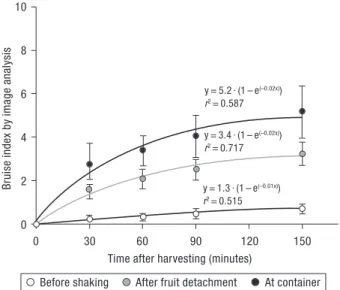
The results obtained with image analysis allowed the bruise time evolution to be obtained during the first hours after harvesting for the different samples (Fig. 5). The bruise index by image analysis rapidly increased Figure 4.Classif ication of olives according to magnitude of
fruit damage for different post-harvesting situations. Different letters indicate significant differences between damage groups (p< 0.05 HSD de Tukey). 100 80 60 40 20 0
Sound Slight Moderate Severe Cut
Fruit damage magnitude
Before shaking After fruit detachment At container
F ruits (%) a a a a a a a a b b b bb c c
Figure 5.Bruise index evaluation by image analysis over time after harvesting for the different situations studied.
10 8 6 4 2 0 0 30 60 90 120 150
Time after harvesting (minutes)
Bruise index by ima
ge analysis y = 5.2 · (1 – e(–0.02x)) r2 = 0.587 y = 3.4 · (1 – e(–0.02x)) r2 = 0.717 y = 1.3 · (1 – e(–0.01x)) r2 = 0.515
with time in situations where trunk shaker harvesting was used, following an exponential trend. The bruise index of manually harvested fruits presented a more moderate increase with time, following a linear trend during the time considered. These results are similar to those obtained by other authors in table olives who also argued that bruise time evolution during the first hours has a higher speed and tends to saturate in less than 24 h following a logarithmic evolution (Humanes & Pastor, 1977). Most of the darkening process (60-70%) occurred during the first 90 min. Similarly, Ingle & Hyde (1968) ensure that most of the bruise discolo-ration is achieved after 2 h. In the present work, the bruise index increase was due to an increase in inten-sity in the area affected by bruises rather than an in-crease in the surface affected by bruising. Thus, an increase in the percentage of pixels for the segmen-tation threshold set was obtained over time.
The mechanical harvesting of table olives with trunk shakers has been a very aggressive approach that seve-rely affects fruit quality. Hand-harvested fruits showed fruit damage values 12 times lower than those obtained with mechanically harvested fruits transported to con-tainers. Most of the damage source to the fruit during detachment was due to the movement of fruit in the canopy, during the fall due to vibration and fruit-to-fruit and fruit-to-fruit-to-branch impact or friction. The damage caused within the tree canopy represented 60% of the total damage during trunk shaker harvesting. The bruise damage was considerable and of a high intensity from the first hours after harvest, using either manual harvesting or trunk shakers due to the high velocity of the oxidation reactions during the bruise process. Most of the discoloration due to bruise damage took place during the first hour and followed an exponential trend. The information obtained about table olive damage causes and bruise time evolution during fruit detach-ment with trunk shaker can be used by the producers to determine how to reduce and prevent bruising during harvesting operations.
Acknowledgements
The authors acknowledge the financial support from the Organización Interprofesional de Aceituna de Mesa (INTERACEITUNA). The authors also acknowledge the financial support of the Regional Government of Andalusia (2008-00048; project PI45120) for the instrumentation used.
References
Adrian PA, Fridley RB, 1959. New concept of fruit catching apparatus tested. T ASABE 2(1): 30-31.
Barranco D, De Toro CC, Oria M, Rapoport HF, 2002. Mono-potassium phosphate (PO4H2K) for olive fruit abscission.
Acta Hortic 586: 263-266.
Barranco D, Fernández-Escobar R, Rallo L (eds), 2008. El cultivo del olivo. Mundi-Prensa. Madrid. 846 pp. Ben-Shalom N, Harel E, Mayer AM, 1978. Enzymic
brow-ning in green olives and its prevention. J Sci Food Agric 29: 398-402.
Ben-Tal Y, Wodner M, 1994. Chemical loosening of olive pe-dicel’s for mechanical harvesting. ActaHortic 356: 297-304. Blanco-Roldán GL, Gil-Ribes JA, Kouraba K, Castro-García S, 2009. Effects of trunk shaker duration and repetitions on removal efficiency for the harvesting of oil olives. Appl Eng Agric 25(3): 329-334.
Burns JK, Ferguson L, Glozer K, Krueger WH, Rosecrance RC, 2008. Screening fruit loosening agents for black ripe processed table olives. HortSci 43: 449-1453.
Carfagni M, Daou M, Furferi R, 2008. Real-time estimation of olive oil quality parameters: a combined approach ba-sed on ANNs and machine vision. Proc XII WSEAS Int Conf on Computers. Heraklion (Greece), Jul 23-25. pp: 387-392.
Castro-García S, Rosa UA, Gliever CJ, Smith D, Burns JK, Krueger WH, Ferguson L, Glozer K, 2009. Video evalua-tion of table olive damage during harvest with a canopy shaker. HortTechnol 19: 260-266.
Díaz R, Faus G, Blasco M, Blasco J, Moltó E, 2000. The application of a fast algorithm for the classif ication of olives by machine vision. Food Res Int 33: 305-309. Díaz R, Gil L, Serrano C, Blasco M, Moltó E, Blasco J,
2004.Comparison of three algorithms in the classification of table olives by means of computer vision. J Food Eng 61: 101-107.
Ferguson L, 2006. Tendencias en el tratamiento de las acei-tunas previo a su transformación industrial. Grasas y Acei-tes 57: 9-15.
Ferguson L, Rosa UA, Castro-García S, Lee SM, Guinard JX, Burns JK, Krueger WH, O’Connell NV, Glozer K, 2010. Mechanical harvesting of California table and oil olives. Adv Hort Sci 24: 53-63.
Fernández MJ, 1985. Aceitunas de mesa: hacia la calidad por la investigación. Olivae 9: 11-15.
Gil-Ribes JA, Blanco-Roldán GL, Castro-García S, 2009. Mecanización del cultivo y de la recolección en el olivar. Junta de Andalucía, Sevilla, Spain. 195 pp.
González RC, Woods RE, 1992. Digital image processing. Addison-Wesley Longman Publ Co, Inc, Boston, MA, USA. 528 pp.
Humanes J, Herruzo B, Pastor M, 1977. Recolección mecá-nica de aceituna de aceituna de mesa con posterior aderezo en verde. Agricultura 46(544): 617-619.
Ingle M, Hyde JF, 1968. The effect of bruising on discolora-tion and concentradiscolora-tion of phenolic compounds in apple tissue. Proc Am Soc Hort Sci 93: 738-745.
IOOC, 2012. World table olive figures. International Olive Council. Available in http://www.internationaloliveoil. org/ [12 June 2012].
Kouraba K, Gil-Ribes JA, Blanco-Roldán GL, De Jaime-Revuelta MA, Barranco D, 2004. Suitability of olive varie-ties for mechanical harvester shaking. Olivae 101: 39-43. Locht P, Thomsen K, Mikkelsen P, 1997. Full color image analysis as a tool for quality control and process develop-ment in the food industry. T ASABE 11: 901-906. Narendra VG, Hareesh KS, 2010. Quality inspection and
grading of agricultural and food products by computer vision – a review. Int J Comput Appl 2(1): 43-65. Ram T, Wiesman Z, Parmet I, Edan Y, 2009. Olive oil content
prediction models based on image processing. Biosyst Eng 105: 221-232.
Rasmussen J, Nørremark M, Bibby BM, 2007. Assessment of leaf cover and crop soil cover in weed harrowing research using digital images. Weed Res 47: 299-310.
Rejano L, 1999. La manzanilla fina sevillana. Grasas y Aceites 50: 60-66.
Rejano L, Sánchez AH, Vega V, 2008. Nuevas tendencias en el tratamiento alcalino “cocido” de las aceitunas verdes aderezadas al estilo español o sevillano. Grasas y Aceites 59: 197-204.
Rejano L, Montano A, Casado FJ, Sánchez AH, de Castro A, 2010. Table olives: varieties and variations. In: Olives and olive oil in health and disease prevention (Preedy VR, Wat-son RR, eds). Academic Press. San Diego (USA). pp: 5-15.
Riquelme MT, Barreiro P, Ruiz-Altisent M, Valero C, 2008. Olive classification according to external damage using image analysis. J Food Eng 87: 371-379.
Segovia-Bravo KA, Jaren-Galan M, García-García P, Garrido-Fernández A, 2009. Browning reactions in olives: mecha-nism and polyphenols involved. Food Chem 114: 1380-1385.
Segovia-Bravo KA, Jaren-Galán M, García-García P, Garrido-Fernández A, 2011. Effect of bruising on respi-ration, superf icial color, and phenolic changes in fresh Manzanilla olives (Olea europaea pomiformis): develop-ment of treatdevelop-ments to mitigate browning. J Agr Food Chem 59(10): 5456-5464.
Sessiz A, Ozcan MT, 2006. Olive removal with pneumatic branch shaker and abscission chemical. J Food Eng 76: 148-153.
Takeda F, Krewer G, Andrews EL, Mullinix B, Peterson DL, 2008. Assessment of the V45 blueberry harvester on rabbiteye blueberry and southern highbush blue-berry pruned to V-shaped canopy. Hortechno1 18(1): 130-138.
Tao Y, Heinemann PH, Varghese Z, Morrow CT, Sommer III HJ, 1995. Machine vision for colour inspection of potatoes and apples. T ASABE 38(5): 1555-1561.
Zheng C, Sun DW, Zheng L, 2006. Recent developments and applications of image features for food quality evalua-tion and inspecevalua-tion – a review. Trends Food Sci Tech 17: 642-655.