Seton Hall University Dissertations and Theses
(ETDs) Seton Hall University Dissertations and Theses
Spring 5-13-2017
The Effectiveness of Pre-Service Principal
Preparation Programs on Instructional School
Leadership in High Stakes Testing Grades
Glen T. Pinder
Follow this and additional works at:https://scholarship.shu.edu/dissertations
Part of theEducational Assessment, Evaluation, and Research Commons, and theEducational Leadership Commons
Recommended Citation
Pinder, Glen T., "The Effectiveness of Pre-Service Principal Preparation Programs on Instructional School Leadership in High Stakes Testing Grades" (2017).Seton Hall University Dissertations and Theses (ETDs). 2291.
The Effectiveness of Pre-Service Principal Preparation Programs on Instructional School Leadership in High-Stakes Testing Grades
Glen T. Pinder
Dissertation Committee Daniel Gutmore, PhD, Mentor Elaine Walker, Ph.D., Committee Member Donald Leake, Ph.D., Committee Member Dennis Copeland, E.D., Committee Member
Submitted in Partial Fulfillment Of the Requirements for the Degree of
Doctor of Education Seton Hall University
ABSTRACT
In today’s world of accountability, the preparation of school leaders has never been more critical. Many states are now developing policies and processes that seek to enhance school leadership preparation programs. Enhancing school leadership preparation programs is particularly important in the area of instructional leadership because research suggests that instructional leaders have a significant direct effect on student outcomes. The purpose of this study was to explore principals’ perceptions of relationships between training in their pre-service principal preparation programs and their effectiveness as in-service instructional leaders in New Jersey schools. The study is significant because the preparation of school leaders impacts the success of their students. Twelve in-service principals participated in semi-structured interviews designed to explore their perceptions of the emphasis that their pre-service programs placed on three skills associated with effective instructional leadership: 1) setting high expectations, 2) establishing a positive school climate, and 3) instructional practice. Results of the interviews showed that while all principals used these skills in their current practice, they did not attribute their training primarily to their pre-service principal preparation programs. Instead, they relied on alternative methods of training to gain these critical skills. Based on participant responses, recommendations are made for ongoing research to improve principal preparation programs through embedded practical opportunities.
Keywords: instructional leadership, leadership preparation, positive school climate, establishing high expectations, instructional practices
ACKNOWLEDGEMENTS
I am thankful to my Aunt Margaret, Scott, David, Lori, Sandi, and Denise for your encouragement, guidance, and support from the beginning to the completion of this process. I offer peace and blessings to all of those family and friends who also supported me during all of
the highs and lows. I am eternally grateful.
DEDICATION
I dedicate this work to my deceased mother, Esther Pinder, whose love was unconditional. Her life lessons of respect and kindness have carried me further in this world than anything else.
TABLE OF CONTENTS
INTRODUCTION 10
Background 10
Statement of the Problem 12
Purpose of the Study 16
Research Questions 17
Study Design and Methodology 17
Significance of the Study 18
Limitations and Delimitations 18
Assumptions 19
Definition of Terms 19
Organization of the Study 20
REVIEW OF RELATED LITERATURE 21
Historical Overview 21
Research on Leadership 22
Leadership in Educational Organizations 29
Standard-Based Leadership Preparation 36
Research on Leadership Preparation Programs 42
Instructional Leadership Preparation/Intern Experiences 51
Summary 58
METHODOLOGY OF THE STUDY 59
Setting 59
Population and Sample 60
Data Collection 60
Human Subjects Protection 61
Research Design 61
Instrumentation 63
Introduction 65
Defining Leadership 65
Perceptions of pre-service 64
Content and Face Validity of Research Instruments 66
Qualitative Data Analysis 67
Summary 68
Findings 70
Findings from Initial Survey: Demographic Data 71
Findings from the Semi-Structured Interview 81
Research Question 1 82
Research Question 2 85
Research Question 3 89
Establishing Expectations 90
Triangulation and Themes 92
Summary, Conclusions, and Recommendations for Further Study 94
Summary 94
Conclusions 96
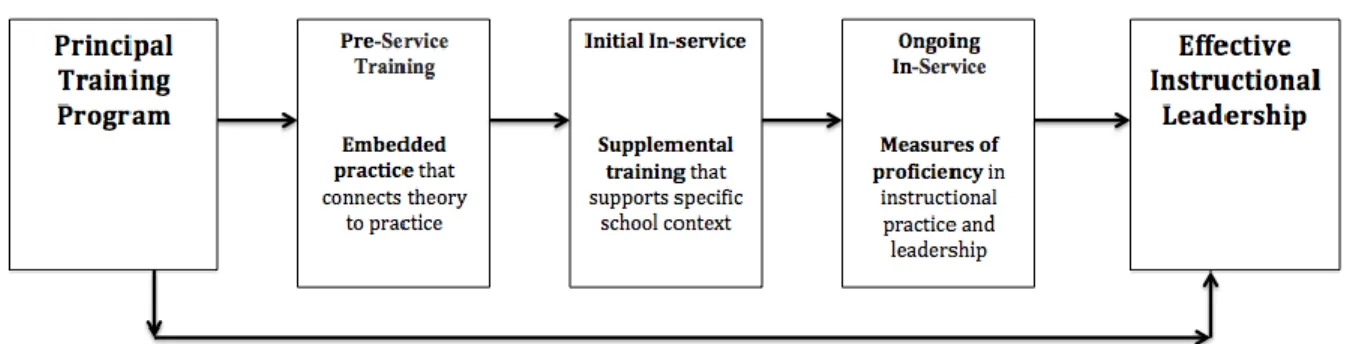
Model of Effective Instructional Leadership Training (EILT) 99
Recommendations for Further Study 101
REFERENCES 103
Appendix A: Interview Protocol 114
Appendix B: Demographic Survey Questions 118
Appendix C: Reflective Survey Questions 121
Appendix D: HSIRB Approval 124
Appendix E: Recruitment Letter 110
LIST OF TABLES
Table Page
Table 1: Variations in Language Comparing Instructional Focus 38
Table 2: Definitions of Instructional Leadership Themes 63
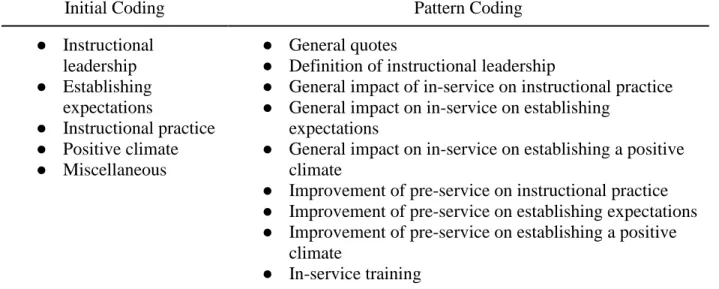
Table 3: Research Codes 67
Table 3: Demographic Variables 73
Table 4: Participant Interview Data 73
Table 5: Outcomes of Reflective Survey: Establishing Expectations 75
Table 5-1: Shared Vision & Mission 75
Table 5-2: Identify goals 75
Table 5-3: Create Implement Plans 76
Table 5-4: Promote Continuous & Sustainable Improvement 76
Table 5-5: Monitor and Evaluate Progress and Revise Plans 76
Table 6: Outcomes of Reflective Survey: Positive Learning Environment 77
Table 6-1: Promote & Protect Welfare and Safety 77
Table 6-2: Teacher Organization Time for Quality Instruction 77
Table 6-3: Build & Sustain Positive Relationships 77
Table 7: Outcomes of Reflective Survey: Instructional Practices 78
Table 7-1: Develop Instructional & Leadership Capacity of Staff 78
Table 7-2: Promote the Use of Technology 78
Table 7-3: Monitor & Evaluate Instructional Programs 79
Table 7-4: Supervise Instruction 79
Table 7-5: Use or Develop Data Systems to Identify Student Strengths 79
Table 7-6: Provide Coherent & Effective Guidance 80
Table 7-7: Provide & Monitor Differentiated Teaching Strategies 80
Table 7-8: Use Aligned Standards-based Accountability Data 80
Table 7-9: Regular Analyses and Disaggregation of Data 81
LIST OF FIGURES
Figure Page
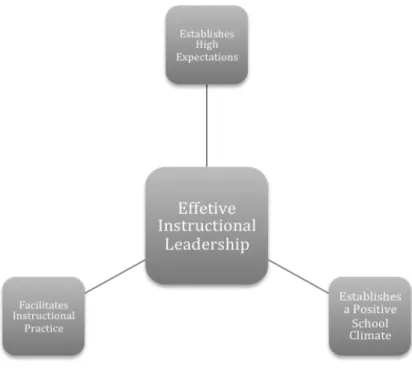
Figure 1: Effective Leadership 56
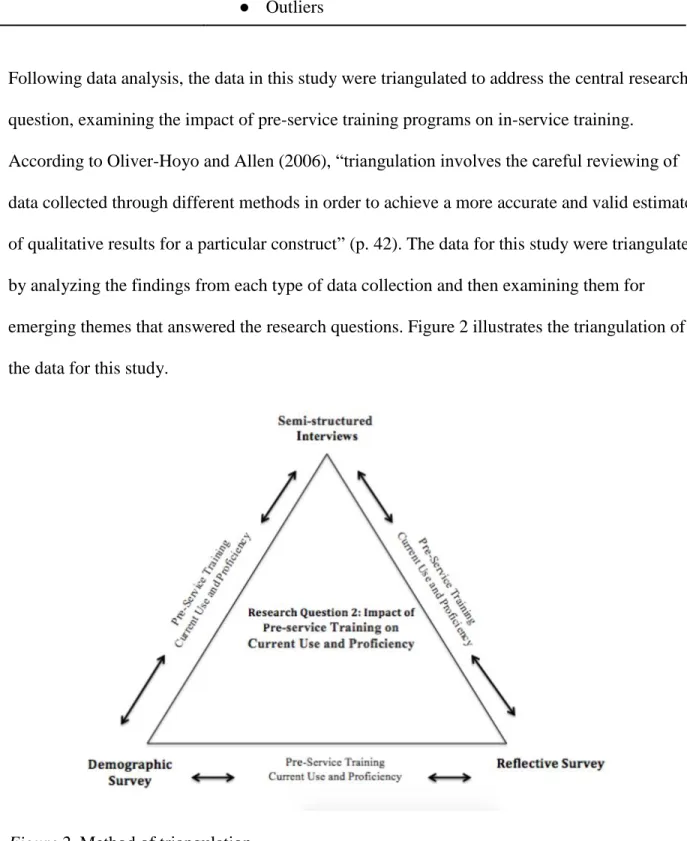
Figure 2: Method of Triangulation 67
Figure 3: Triangulation of Research Findings 93
CHAPTER 1: INTRODUCTION Background
The academic achievement of K-12 students is one of the top concerns in America today. Although America has been on a mission to revamp its educational system since Sputnik
(Powell, 2007), recent reforms such as No Child Left Behind (NCLB), Race to the Top (RTT), and the Every Child Succeeds Act (ECSA) mandate that schools make significant improvements in academic outcomes for all children (U.S. Department of Education, 2016). For school leaders, however, these mandates also highlight the importance of the role of school leadership in
improving teaching and learning in schools. This is because the goals of these mandates cannot be achieved without school leaders who are prepared to meet them. That is, in today’s world of accountability, the preparation of school leaders has never been more critical. In fact, only the impact of the teacher surpasses the level of influence of school leadership on student
achievement (Creemers & Reezigt 1996; Seashore, Louis, Leithwood, Wahlstrom & Anderson, 2010). To that end, many states have already developed, or are in the process of creating, new policies that will enhance administrator licensure requirements and ensure that school leaders are prepared to meet the demands of today’s schools and students (Davis, 2010).
Leadership preparation has been a critical component of American education for decades. In 1987, the National Commission on Excellence in Education Administration reported on a policy study that identified several key areas of concern in leadership preparation. The report findings identified the lack of a clear definition of good leadership, an absence of collaboration between school districts and colleges and universities, poor quality of leadership candidates, irrelevance of the modern content included in preparation programs, and the need for licensure
systems that promote excellence and a national sense of cooperation (Hale & Moorman, 2003). Research on leadership preparation has also consistently identified key skillsets and attributes required to obtain success as a school leader. Along with how principals are being prepared, extensive research has been conducted to identify leadership styles that create the most effective learning environment. For instance, Burton & Vidic (2011) examined motivational correlates of four leadership styles—servant, transformational, transactional, and passive/avoidant to
determine what style was most effective in creating intrinsic motivation.
However, while an extensive body of research has already identified critical components of excellent school leadership, a closer examination of what qualities actually define effective leadership is required to analyze how principals are being prepared, as well as their behaviors in their roles as school leaders. For example, leadership has been defined as supporting change or influencing others (Bellamy, Fulmer, & Muth, 2007). However, in education, the prescribed role as principal and district-wide administrator is to lead others to meet the goals and objectives set by the state and local school board. True leadership is definitely not just “making things happen” or exercising a “strong influence over others” since individuals with good management skills can accomplish these tasks. These types of school leaders, often referred to as “paper shufflers,” are not visionary or courageous in their decisions. In the current educational landscape, these
managerial skillsets are not reflective of any other qualities associated with great leadership, and only seek to meet bureaucratic requirements of the position.
Statement of the Problem
It is the premise of the current study that we must first distinguish which characteristics an effective leader possesses before there can be a discussion on how school leaders are best prepared and/or what leadership styles are best suited to meeting the challenges of today’s
educational landscape. School reform efforts are in motion nationwide in an effort to address many concerns. New mandates, such as NCLB and RTT, now require immediate and significant increases in student outcomes or school leaders are penalized by sanctions. The National Staff Development Council (NSDC) contends that only one course of action, strengthening school leadership, can control all of the concerns at once (Van Roekel, 2008).
A considerable amount of evidence has been produced over the last few decades to support the view that the principal plays a major role in the success of a school and the
achievement of its students. Marzano and Waters (2009) suggested that there can be as much as 25% variance in student learning that can be attributed to school-related factors as a result of the actions of the school principal. Researchers contend that instructional leaders shape the
environment in which teachers and students succeed or fail (Van Roekel, 2008). Additional research suggests that there is an equal relationship between district leadership and student achievement (Marzano & Waters, 2009).
In 2009, Marzano and Waters evaluated relationships between district-level leaders’ competencies and student achievement in a district based on data from 1,210 districts,
summarized in 14 reports. The computed correlation between district leadership and achievement was 0.24, and was found to be statistically significant at the 0.05 level. Marzano and Waters (2009) applied the most common interpretations and examinations of the expected change in the dependent variable associated with a one standard deviation gain in the independent variable (Magnusson, 1966, as cited by Marzano & Waters, 2009). In the Marzano study, the independent variable was district leadership, and the dependent variable was average student achievement in the district. To interpret the correlation of 0.24, one might consider an average superintendent who was at the 50th percentile in terms of his or her leadership skills and who was leading a
district in which the average student achievement was also at the 50th percentile. If the
superintendent improved his or her leadership abilities by one standard deviation, rising to the 84th percentile of all district leaders, Marzano and Waters (2009) predicted that the average student in the district would rise by 9.5% percentile points to the 59.9 percentile.
These findings support the notion that district leadership is an instrumental part of increasing student achievement (Marzano & Waters, 2009). This research debunked the notion that district leadership only absorbs costly resources without adding anything to a district’s effectiveness. In contrast, according to Marzano and Waters (2009), district leaders who carried out their leadership responsibilities effectively had a positive effect on student outcomes across a district. The study conducted also sought to identify those behaviors in which district leaders engage that lead to increased student outcomes.
A secondary research question from the study conducted by Marzano and Waters (2009) examined specific behaviors of district leaders that were associated with student achievement. This study found five district leadership responsibilities and initiatives to be statistically significant, based on changes in student academic performance. According to Marzano and Waters (2009), the following district level behaviors contributed significantly to student achievement: 1) establishing and maintaining goal-setting behaviors, 2) establishing
non-negotiable goals for achievement and instruction, 3) creating board alignment with the support of district goals, 4) monitoring achievement of instructional, and 5) allocating resources to support the goals for achievement and instruction.
The findings of Marzano and Waters (2009) suggest that effective leadership focuses on academic outcomes or instructional leadership. However, these findings are tempered by the lived experiences of many school principals, who would like to transition from their roles as
building managers or “paper shufflers” to effective instructional leaders, but admit that this paradigm shift is often difficult because they are already overwhelmed by the sheer number of managerial and administrative tasks that consume their time and attention (Van Roekel, 2008). The challenges of finding effective instructional leaders at the principal level, defined by Pepper (2010) as school leaders who possess a skillset that includes the ability to plan and implement the use of effective instructional strategies, coupled with the management skills to maintain a
smoothly run organization, are underscored by the concerns of superintendents who indicate that there is a lack of effective building leaders and a limited talent pool from which to choose. Even highly skilled and well-trained principals feel overwhelmed when faced with multiple, fast-paced challenges required for the position (Williams & Szal, 2011). As a result, university programs preparing candidates for school leadership positions are receiving increasing pressure to align programs with the realities of practice.
RTT specifically links its definitions of effective leadership and leadership preparation to student achievement growth. Researchers contend, however, that there is a gap between what principals do and what research says they should be doing (Van Roekel, 2008). It goes without saying, therefore, that the manner in which school leaders are prepared is vital for the successful future of a school leader and student achievement. Several studies have been conducted in an attempt to ascertain the type of principal preparation programs that are most effective in
preparing school leaders to meet today’s challenges. Among the leading leadership preparation programs that exist today are traditional, cohort, and school district–university partnership programs. However, there is a lack of information about the capacity of current leadership preparation programs to equip instructional leadership candidates with the skills needed to be effective school leaders.
Thus, leadership preparation programs continue to produce leaders that may not have the skillset or knowledge needed to be an effective instructional leader. While different models of principal training are available, including traditional course delivery in which an individual navigates their own training with a stand-alone field experience, a cohort model in which a group of individuals participate in a sequenced training program, and school district–university
partnership leadership programs in which universities provide both coursework and experiences to potential candidates in a district (Chandler, Chen, & Jiang, 2013), scant empirical literature exists about the differences between traditional, cohort, and school district–university partnership leadership preparation programs effectiveness. The importance of understanding the relationship between what is taught in leadership preparation programs and what is required to meet the needs of students in today’s accountability culture is an important step in understanding the contextual factors that impact principal preparation programs.
Purpose of the Study
The purpose of this study is to conduct research that explores relationships between principal preparation programs and effective instructional leadership. For the purpose of this study, instructional leadership will be defined as school leaders who possess a skillset that includes the ability to plan and implement the use of effective instructional strategies, coupled with the management skills to maintain a smoothly run organization (Pepper, 2010). Although research has identified skillsets and attributes that are necessary for successful school leadership, researchers contend that principal preparation programs fail to prepare graduates for the role of instructional leader, especially in reference to students with disabilities (Lynch, 2012). The failure to prepare graduates for their role as instructional leaders results in the challenge of not meeting today’s mandate of increasing student achievement as principals obtain positions in the
field. There is a need, therefore, to assess the quality of principal preparation programs in preparing graduates for the role of instructional leaders who can meet the mandate of increasing student achievement. Since new mandates now require immediate and significant increases in student outcomes, or school leaders are penalized by sanctions, leadership preparation programs must effectively equip candidates with the skills needed to be successful leaders. A further examination, such as the one conducted in the current study, could offer insight on creating a successful model for principal preparation programs.
Research Questions
The current study will use a qualitative, exploratory approach to research the following questions.
Research Question 1: How do in-service principals trained with the Interstate School Leaders Licensure Consortium (ISLLC) Standards define instructional leadership in their own practice?
Research Question 2: What are principals’ perceptions of the impact of their pre-service principal preparation programs on their in-service practices as instructional leaders?
Research Question 3: What is the perception of school leaders about the degree to which three key instructional leadership functions from the ISLLC standards—supervising instructional practice, establishing a positive school environment, and establishing high expectations—were emphasized in their pre-service principal training?
Study Design and Methodology
This exploratory qualitative study evaluated the perceptions of K-12 school administrators in New Jersey about their pre-service principal training and its impact on their current in-service practice as instructional leaders. Specifically, the purpose of this study was to investigate
principals’ perceptions of their pre-service principal preparation programs and the impact these programs had on their success, or lack thereof, in affecting student achievement. The following sections will provide the significance of the study and a review of the existing literature.
Significance of the Study
The significance of this study may be that it provides resourceful information about the impact of principal preparation programs on key skillsets required to produce effective
instructional leaders. This study is significant in that a model may be developed, based on the findings of this research, to guide more effective leadership preparation programs. Using the model to guide leadership preparation programs would be advantageous to leadership preparation programs because they would have a blueprint to follow when preparing school leadership candidates to be effective instructional leaders. The findings of this study may contribute to the existing literature on the ISLLC standards (which are currently called Professional Standards for School Leaders) and their role in defining leadership skills in principal training programs. The study may also be significant to classroom teachers and educational leaders who are responsible for student achievement outcomes.
Limitations and Delimitations
The following limitations may be present in this study:
1. The idiosyncratic nature of an effective instructional leader. Effectiveness can be
subjective because it has different meanings for individual readers. Thus, while this study uses the ISLLC standards as a framework for an effective instructional leader, it also notes that effectiveness is unique to an individual.
2. The results of this study are limited to the principals in the research and school leaders with similar characteristics.
Assumptions
The following assumptions may be present in this study:
1. Those who participate in the study obtained their leadership preparation under the guide ISLLC standards published in 2008 or earlier.
2. This study reasonably assumes that participants are providing answers honestly.
Definition of Terms
The following definitions were used in the current study.
1. Interstate School Leaders Licensure Consortium (ISLLC)Standards are national standards for school leadership licensure programs that were developed by the National Policy Board on educational Administration and the Council of Chief State School Officers. They were developed to improve school leadership training programs (Van Meter & Murphy, 1997).
2. No Child Left Behind Act of 2001 (NCLB) is a reauthorization of the Elementary and Secondary Education Act of 1965. At the time of this study, this act was the principal federal law affecting education from kindergarten through high school. NCLB was designed to improve student achievement and close achievement gaps. States were required to develop challenging academic standards, to educate all students to 100% proficiency by 2014, and to create and implement a single, statewide accountability system (Klein, 2015).
3. Effective instructional leadership: Instructional leadership is defined by Pepper (2010) as school leaders who possess a skill set that includes the ability to plan and implement the use of effective instructional strategies, coupled with the management skills to maintain a smoothly run organization.
school’s vision for instructional practice, curriculum and pedagogy, instructional delivery, organizational time, and assessment and accountability systems (Council of Chief State School Officers CCSSO, 2008).
5. Establishing expectations: Instructional leaders establish expectations by promoting a school culture in which all school members demonstrate their beliefs that all students can achieve their highest potential and that the staff are able to facilitate their achievement (Levine & Lezotte, 1995).
6. Positive school learning environment: Instructional leaders promote a positive learning environment by creating a learning environment that is free of chaos and disruptive behaviors. They promote and protect the welfare and safety of students and staff (Kirk & Jones, 2004).
Organization of the Study
Chapter One presented the introduction to the problem, background of the study,
statement of the problem, purpose of the study, rationale, research questions, and significance of the study. It also discussed the definition of terms, assumptions, limitations, and nature of the study. The remainder of this study will be divided up as follows: Chapter Two will present a literature review of the history of effective school leadership preparation programs analysis as well as current research related to effective school leadership preparation program analysis along with a summary of the literature review. Chapter Three will detail the type of research
methodology to be utilized in this study, and the appropriateness of the research design. Chapter Four will present the data collection, the data collection method, and analysis of the data.
CHAPTER 2: REVIEW OF RELATED LITERATURE Introduction
Historical Overview
According to Bass (1981), the study of leadership is an ancient art. Studies of leadership appear in works that can be traced back as far as Plato, Caesar, and Plutarch. Leadership is a full-bodied concept that transpires commonly amid all people, irrespective of culture. Given this definition, theories of leadership flourish. They embrace approaches such as the great man theory, which suggests that history is shaped by the leadership of great men. According to this theory, without Moses, the Jewish nation would have remained in Egypt, and without Churchill, the British would have acquiesced to the Germans in 1940. The trait theories speak to the different qualities of leaders and their identification, and contend that leaders are endowed with superior qualities that differentiate them from followers. For instance, common traits of leaders according to this theory include knowledge of an industry or field, initiative, flexibility,
confidence, and charisma (Derue, Nahrgang, Wellman, & Humphrey, 2011). Situational
leadership theories assert that leaders adjust their styles based on the needs of the individuals he or she is leading. For instance, in some situations, leaders may need to tell followers a decision and then direct it while in other situations they may try to obtain buy-in to a decision from followers and then coach their followers in the implementation of a decision (Hersey & Blanchard, 1993). Regardless of the theory used to explain it, leadership has been intimately linked to the effective functioning of complex organizations throughout the centuries.
Leadership is considered to be vital to the successful functioning of many aspects of a school. One aspect of schooling in particular that has been linked to leadership in a school building is students’ opportunity to learn. The 1971 U.S. Senate Committee Report on Equal
Educational Opportunity identified the principal as the single most influential person in a school (Marzano, Waters, & McNulty, 2005; U.S. Department of Health, Education, & Welfare, 1971). School leadership, with the principal in the central role, is perceived to be the key to success. However, leadership practices in schools are not based on a clear, well-articulated body of research spanning decades. In fact, there has been far less research on school leadership than one might expect. For instance, Marzano et al. (2005) note that previous literature of reviews of school leadership and academic achievement only found 40 students that examined relationships between school leadership and student achievement. Further, Marzano et al. (2005) noted that they found 69 articles that used quantitative research to examine relationships between school leadership and academic achievement during a 35-year time span. This report from Marzano et al. (2005) suggests a need for additional studies that explore relationships between school leadership and academic achievement.
Research on Leadership
Many theories on leadership have been influential in guiding school leaders. Given the various lenses through which to view leadership, practitioners are hard-pressed to operationally define the concept of leadership. As a result, different preparation programs tend to emphasize different approaches for pre-service leaders. In clearly defining leadership, the “situational” or “contingent” nature of leadership, and the extensive focus on the measurement of trait
personalities; characteristics, makes it difficult to identify the exact mechanisms of leadership development. Some theories are more challenging than others to examine, such as the
passive/avoidance model of leadership. The passive/avoidance leadership is labeled as an ineffective style because of its weak and indifferent nature. According to this model,
or absence of leadership) and management by exception (passive), where the leader waits reactively for errors to occur and then takes necessary corrective action. Due to the newness of this concept, limited empirical evidence is available for this type of leadership. However, because of the indifferent passive corrected approach, passive avoidant leadership is
hypothesized to promote lower levels of intrinsic motivation compare to other leadership styles (Bass & Avolio, 2004).
Prominent theories of leadership include: Transformational, Transactional and Servant Leadership. Both transformational and transactional have their roots in the works of James Burns. He is considered the founder of modern leadership theory. Burns made a fundamental distinction between transactional and transformational. Transactional Leadership is defined as a style in which individuals typically believe that their job is to maintain the “status quo”.
Transactional leadership has been demonstrated to be effective in various emergency situations where the risk of failure is high due to mortality threats and or financial costs. Leaders who demonstrate management-by-exception actively pay attention to issues that arise, set standards, and carefully monitor behavior. They are so aggressive in their management behavior that followers of this leadership style believe that they should not take risks or demonstrate initiative. Constructive transactional leadership is the most effective and active of the transactional
leadership styles (Marzano et al., 2005). This type of transactional leader sets goals, clarifies desired outcomes, exchanges rewards and recognition for accomplishments, suggest or consults, provides feedback, and gives employees praise when it is deserved. The transactional leader is a process of social exchange in which rewards are given to followers in exchange for effective performance. Due to its pragmatic approach, transactional leadership is most likely effective at lower levels of management in which followers are inexperienced and thus will benefit from
order and structure. Followers are invited into the management process more than in the case with the other two styles. Followers generally react by focusing on and achieving expected performance goals (Bass & Avolio, 2004).
Transformational leadership is considered a favored style of leadership because it is assumed to produce results beyond expectations (Marzano et al., 2005). Transformational leaders form a mutual stimulation and elevation relationship that converts followers into leaders.
Effective leaders and followers often determine the wellness of an organization. Effective leadership alone, however, does not guarantee the success of an organization. Another major factor that impacts a leader’s effectiveness and capacity to lead its followers is an organization’s structure. Vidic and Burton (2011) contends that transformational leadership is based on
developing and selling a vision for what is possible, and that transformational leaders initiate change by challenging the status quo. The transformational leader should be better suited to more fluid situations that call for visionary leaders and highly committed and intrinsically motivated followers. A leader’s capacity to lead its followers in an organization that is tightly coupled will have a different outcome than that of an organization that is loosely coupled (Marzano et al., 2005). Tightly-coupled can be defined as an environment which consists of domains that are typically closely related to each other and collaborate to pursue some specific common tasks. Such common tasks cannot be completed without proper interoperations, and such interoperation needs are constant and can be predefined (Zhang, 2010). Loosely-coupled can be defined as an environment consisting of domains that are independent of each other and are able to carry out their major functions without interoperating with each other. There are typically no specific common tasks that need to be done through interoperations of all participating domains. Instead, the interoperation needs are usually driven “on-demand” to facilitate dynamic information
sharing needs. Thus, the interoperation needs in loosely coupled environments are dynamic and may not be predefined (Zhang, 2010).
A leadership style that infuses many transactional and transformational leadership characteristics is what Greenleaf describes as Servant Leadership (Greenleaf, 1977). This
leadership style proposes the notion of serving others’ needs while developing future leaders. In 1970, Greenleaf entitled this leadership style as one that emphasizes the need for a leader’s motivation to serve those who he or she seeks to lead. The research contends that this type of leadership is best suited for higher management levels in which followers are highly motivated and competent. The leader who seeks to utilize this approach toward leadership serves as a facilitator in providing assistance to subordinates in accomplishing organizational goals (Vidic & Burton, 2011). According to Vidic and Burton (2011), a servant leaders’ main focus is on serving the needs of the followers through vision, empathy, open communication, and problem-solving; by doing so, they model the skills and provide opportunities needed for followers to become effective leaders. These servant leaders possess the intent of transforming those served to
advance personally and professionally, and seek to have those served become more autonomous, and increase the likelihood of becoming servants themselves (Spears & Lawrence, 2004). The servant leader seeks to place others’ needs within the organization before themselves by
assuming a non-focal position within the various teams while providing the necessary resources and support without expectation of acknowledgment (Black, 2010). The research suggests that followers of servant leaders are only effective when their needs are being met; an effective servant leader understands and is sensitive to followers’ needs (Rowe, 2003). According to Black (2010), servant leaders do not allow themselves to become isolated from their subordinates by layers of hierarchy; instead, they are physically present at the work site and maintain a visible
presence. Black states that one way to assess a servant leader’s level of effectiveness is to observe whether their followers grow as people within the organization by becoming more autonomous. The growth-of-followers test, recommended by Greenleaf, served as the basis for his rationale behind the development of the Organizational Leadership Assessment (OLA; Laub, 1999). The OLA quantitatively measures the perceived servant leadership in organizations and schools. The characteristic to serve others is not defined as “doing for others” in the common sense of the word. Instead, those who employ servant leadership focus on making the person or persons served more competent to meet their own needs and better equipped to serve the organization as a whole (Black, 2010).
In 2009, Heifetz, Grashow and Linsky found that it was important to distinguish between leadership and authority. Their research proposed that there is a considerable difference from having authoritative know-how and from holding a high position in an organizational hierarchy. They went on to distinguish from having enormous informal power in forms of credibility, trust, respect, admiration and moral authority. Heifetz et al. (2009) highlighted that often times people hold positions of authority or senior leadership often do so without ever successfully leading their organization through a difficult but needed “adaptive change”. In their text, The Practice of Adaptive Leadership: Tools and Tactics for Changing Organization of the World, the authors highlight that others with or without significant formal authority but large admiring groups of “followers” also frequently failed to mobilize those followers to address the toughest challenges. To protect and increase their informal authority, they often pander to their constituents
minimizing the costly adjustments that followers will need to make and place the requirement of change elsewhere at “the others who must change, or will be changed as they deny or delayed the day of reckoning.” In an effort to better define “leadership” it is essential at this juncture that it
be distinguished between the notion of “leadership” with authority, power and influence.
Research has often viewed leadership as a practice and activity that some people do some of the time. Heifetz et al. (2009) view leadership as a verb, not a job. While necessary resources authority, power and influence can be used for all sorts of purposes and tasks that may or may not have little to do with leadership in and of itself.
The powers and influence that come from formal and informal authority relationships have the same basic structure. The social contract is identical: Party A entrust Party B with power in exchange for services. One or more people on the assumption that you will do what they want you to do then grant authority: centrally in organizational life to promptly provide solutions to problems. People will substantiate power or volunteer to follow you because they are looking for you to “provide a service, be a champion, a representative an expert who can provide solutions within the terms they understand the situation” (Heifetz et al., 2009, p. 24).
Heifetz et al. (2009) assert that as long as you do what is expected of you, your authorizers are happy. This leads to expansion in the way of promotions, bonuses and a more impressive title. The most seductive way for an organization to reward compliance of carrying out mandates without question is to label you as a “leader.” The research suggests that this tactic is effective because most people aspire to have that label, and conferring it on an individual is effective in keeping them in the middle of the scope of their authority and far away from taking on adaptive leadership work that is required for effectual change. Meeting the expectations of the authorizers is important, but often in these scenarios doing an excellent job usually has nothing to do with helping the organization deal with the challenges required to realize meaningful transformations. Adaptive Leadership, as defined by Heifetz et al. (2009), emphasizes that it is not about meeting or exceeding the expectations of an authorizer, but more importantly
challenging some of those expectations and seeking ways to disappoint people without totally demoralizing the organization. The challenge is to balance the need to question the status quo of the very people who have given you your informal and or formal power authority. According to the research, by applying adaptive leadership beyond authoritative management one risks telling people what they need to hear instead of what they want to hear, but also helps the organization make the necessary progress toward addressing its complex challenges (Heifetz et al., 2009).
Other theorists propose that a closer examination of the cross section of context and leadership is required to better grasp an understanding of “leadership” practices. The traditional contingency theory, seek to merge leadership traits and situational approaches. According to the traditional contingency theory, one type of leader is more likely to be effective under one set of circumstances, while under another set of circumstances, another leader is required. The
assertion that leadership effectiveness depends on the fit between the personality characteristics of a leader in the situation variables, such as task structure, position power, and subordinate skills and attitudes, may be helpful for matching a particular type of leadership to a particular situation. However, it does not take into account the dynamic nature of educational leaders’ work
environments. For instance, Leithwood, Harris, and Hopkins (2008) suggested that successful leaders of turnaround schools employ a core set of leadership practices in concert with each stage of school improvement. The researchers go on to add that the ways in which leaders apply their leadership practices, not the practices themselves, demonstrate responsiveness to rather than dictation by the context in which they work. Scholars agree that the context is relevant in terms of the leader behavior and its end product. Some in the field propose evidence that the
significance of leaders is related to features of organizational context, such as geographic location (urban, suburban, rural), level of schooling (elementary, secondary), and district size
and poverty. This researcher suggests that there is no such thing as a “superintendency” but more appropriately “superintendencies” that are often more dissimilar than similar to each other (Leithwood, Louis, Wahlstrom, & Anderson, 2004). In addition, further investigations of district leadership in context reveal that new mandates on school principals also contribute to the manner in which district and building leadership interrelate, thus supporting the notion that context of the situation plays a major role in the district leaders’ function and by default how principals arrive at their perspective leadership decisions and styles.
Leadership in Educational Organizations
School leadership is key to school improvement. School principals have to serve as front-line managers, small business executives, the battlefield commanders charged with leading their teams to new levels of effectiveness. In the new era of high-stakes testing and accountability, where school leaders are expected to demonstrate bottom-line results and use of data to drive decisions, the skills and knowledge of principals matter more and more as policy-makers demand results. The rise of school choice and more flexible teacher compensation and hiring have
granted school leaders the opportunity to exercise discretion and operate with previously unprecedented latitude. District leaders are clear that they are now required to hold new and more demanding expectations for principals (Hess & Kelly, 2005).
The research over the last 35 years provides strong guidance on specific leadership behaviors for school administrators in that these behaviors have well-documented effects on student achievement, and that the educational role of the principal is more appropriately
configured as a catalyst of such processes as collaborative inquiry, problem-solving, and school development (Marzano et al., 2005; Sergiovanni & Starrett, 1998). This research concludes that
what matters most as an instructional leader is the capacity to lead teachers and promote professional dialogue and the ability to build within the organization purposeful dedication to improving student outcomes (Marzano et al., 2005; Sergiovanni & Starrett, 1998). In other words, “instructional leadership is basically teaching people how to teach” (Mitchell & Castle, 2005, p. 414).
Instructional leadership theories in the 1970s and 1980s took center stage through effective school research, which argued that schools, regardless of socioeconomic status, can obtain high academic performance (Edmonds, 1979). According to Ylimaki (2007), research supports the idea that, across effective schools, principals that are characterized as instructional leaders with strong backgrounds in curriculum and instruction are able to improve classroom practice. For instance, Edmonds (1979) found that effective principals use their scholarly knowledge to develop written curricula from the ground up, providing specialized development and supervising the implementation of new learning in the classroom. Effective school research also found that effective principals create positive school learning cultures with high
expectations for all students (Edmonds, 1979). Similarly, Hallinger (2003) highlighted a
comprehensive set of instructional leadership behaviors that affected classroom practice, such as framing school goals, maintaining high visibility, supervising and evaluating instruction,
coordinating the curriculum, and monitoring student progress.
Instructional leadership models of the 1980s were criticized, however, for being too directive and principal-centered, and for largely ignoring the voices of teachers, parents, and school leaders. However, instructional leadership approaches were prominent in the United States administrator training programs until the mid-1990s, when school restructuring and decentralization trends shifted attention towards a new model of transformational leadership
(Leithwood, 2000). In the mid-1990, principals who functioned as transformational leaders modeled desired behaviors and then empowered others to achieve extraordinary results (Hallinger, 2003).
Whether a school operates effectively or not also increases or decreases a student’s chance of academic success. Researcher Karl Weick (1976) developed the concepts of tight and loose coupling to describe organizational structure in educational institutions. Weick contended that, in tightly coupled organizations, supervisors know exactly what all their employees are doing, and management can coordinate the activities of different departments according to a central strategy. However, he also contended that, in loosely coupled organizations, employees have more autonomy, and that different departments may operate without much coordination (Weick, 1976). As previously discussed in Chapter One, instructional leaders are increasingly pressed to improve student learning as documented by student achievement on standardized tests or higher graduation rates. Teachers are increasingly evaluated in terms of improving student learning (as measured by test scores); administrators are increasingly measured by the degree to which their schools improve learning for all students. Thus, reform efforts have challenged instructional leaders to reshape the traditions that have emerged around loose coupling.
According to Weick (1976), school systems are especially likely to be loosely coupled because authority is not particularly strong, and the technical core is not very clear. Thus, attending to instruction requires leaders to tighten the coupling between administrative and instructional practices (Spillane & Burch, 2006).
Many organizations are tightly coupled on paper but loosely coupled in practice.
Employees in any organization tend to push back or try to circumvent attempts to supervise them too closely. The fact that teachers do not always do exactly what principals tell them is
well-established in organization theory literature as the principal-agent problem (Allison & Zelikow, 1999). For example, teachers might follow procedures perfectly when their administrator is watching but disregard the rules entirely when the administrator is out. Specifically, teachers easily ignore principals and superintendents by closing their doors (Brazer & Keller, 2015). Some teachers have specialized skills that administrators may not understand well enough to supervise in detail, such as the gifted teacher or special needs teacher. Additionally, the
possibility of acting independently of central authority is further enhanced by the difficulty of a principal to fully understand effective teaching for every grade level or subject area (Brazer & Keller, 2015). Administrators sometimes find it more convenient to allow a looser structure in practice to keep the organization running. A potential disadvantage of loose coupling is
inconsistency. However, a potential advantage is flexibility. Another potential advantage is that problems in one department can sometimes be quarantined from other departments because they all function independently. A potential disadvantage is that implementing any strategic change across the whole organization can be difficult.
Some may regard loose coupling as negative; however, certain purposes can be served by having a system in which the components are loosely coupled. The basic contention is that loose coupling permits some parts of an organization to continue (Anderson, 2010). Loose coupling lessens the probability that the organization will have to or be able to respond to each little change in the environment that occurs (Anderson, 2010). A loosely coupled system may be a good system for localized adaptation. If all of the elements in a large system are loosely coupled to one another, then any loosely coupled system’s one element can adjust to and modify a local unique contingency (Anderson, 2010). In loosely coupled systems where the character,
number of metamorphoses and innovative solutions than would be the case with a tightly coupled system. A loosely coupled system could preserve more cultural protection to be drawn upon in times of drastic transformation than in the case for more tightly coupled systems. Loosely coupled systems may be solutions to the challenge that adaptation can prevent adaptability. When a specific system fits into an ecological position and does so with great success, this change can be expensive. It can be expensive because resources that are of no use in a current environment might worsen or vanish even though they could be vital in an altered environment. It is possible that loosely coupled systems maintain more diversity in responding than do tightly coupled systems, and therefore, they can adjust to a significantly broader radius of changes in the environment than would be true for tightly coupled systems (Anderson, 2010). Essentially, effective leaders must not only have the capacity to lead followers, but must also be able to discern the organizational structure and operate within it effectively.
Current educational realities require that research now focus on identifying leadership behaviors within educational institutions that seek to advance student achievement. Many in the field propose that leaders can learn the skill sets and disciplines that will assist them in staying focused on improving teaching and learning. It is equally important that school leaders be aware of and properly manage certain obstacles that prevent the educational environment from reaching its academic goals. Current research consistently acknowledges school leadership as a crucial factor in enhancing teaching and learning, yet the research has been relatively random in how school leaders are prepared and supported as they navigate the challenges of improving student outcomes. D’Auria (2015) found that, by overcoming certain pitfalls and establishing specific leadership skills and knowledge that can be learned and practiced, administrators can be
(2015), those obstacles include the following four pitfalls:
1) Undervaluing the importance of culture: D’Auria (2015) asserts that, while effective teachers developed a positive and inspiring classroom climate, leaders were less comfortable acknowledging and embracing the concept of the importance of overall school climate
influencing adult learning. By shaping the climate of the organization, the study concluded that school leaders can have a significant positive impact on the overall organization, similar to successful classroom teachers.
2) Letting the problem of the moment move the organization off course and away from strategies that will lead to improvement in student learning: The research revealed that leaders lack the skill of “staying the course” in the face of draining day-to-day problems. Staying strategic in the face of urgent but less important issues requires what was described as a “21st- century” skillset. “21st-century skills” are core skills, such as collaboration, digital literacy, critical thinking, and problem-solving that are needed to thrive in today’s world (Rich, 2010). The daily management of students, teachers, and parents alike can be extremely distracting and consume an enormous amounts of energy. Their research found that this skill can be one of most challenging aspects of today’s leadership.
3) Balancing our focus on what we are doing with the effect of what we are doing:
School leaders must establish an equilibrium in planning and implementing initiatives, with a focus on measuring the effect of those activities. The research found that, for a leader to be effective, they must continually assess their impact along the way to be able to make the necessary modifications and adjustments to achieve the desired results. Without this balance, blame often substitutes for responsibility, and that keeps the organization from continuous improvement.
4) Underestimating the importance of skillful practice: Leaders need to know what to do and how to apply their knowledge to the circumstance at hand (Hill & Lineback, 2011). Leaders must evolve beyond management and operations; skillful leaders must now possess the skillset to observe and analyze instruction; collect, examine, and mine data; and conduct effective
meetings, collaborate, and manage conflicts. The study proposed that leaders must model and practice at all times to hone their skills to continually improve their effectiveness (D’Auria, 2015).
Standards-Based Leadership Preparation
The implementation of the No Child Left Behind Act (NCLB) of 2001 focused on confronting the weakness of contemporary school leadership and has made it impossible to ignore the escalating need for high-quality principals—individuals who have been prepared to provide the instructional leadership necessary to improve student achievement (Hale &
Moorman, 2003). Attention is being focused on one of the variables critical to effective
education: leadership (Hale & Moorman, 2003). The systems that produce our nation’s principals are complex and interrelated, and governed by the state (Hale & Moorman, 2003). Each state establishes licensing, certification, and recertification requirements for school leaders and, in most places, approves the college and university programs that prepare school leaders (Hale & Moorman, 2003). It appears that neither organized professional development programs nor formal preparation programs based in higher education institutions have adequately prepared principals to meet the priority demands of the 21st century, namely, improved student
achievement (Hale & Moorman, 2003).
One step toward changing the profession was the development by the Council of Chief State School Officers (CCSSO) in 1996 of a set of standards for school leaders by the Interstate
School Leaders Licensure Consortium (ISLLC), a representative body of most of the major stakeholders in educational leadership including national associations, states, and colleges and universities (Hale & Moorman, 2003). Since 1996, 46 states have adopted the ISLLC standards and used them to guide policy and practice related to principal preparation (Canole & Young, 2013). Further, the ISLLC standards have been revised twice, most recently in 2015, to reflect national changes in educational leadership (Canole & Young, 2013). State and local policy-makers are now establishing leadership development around the conception of teaching, learning, and leading that is reinforced in a number of ways to become a central mission for schools, rather an isolated activity on the margins (Darling-Hammond, LaPoint, Meyerson & Orr, 2007).
The ISLLC standards have drawn criticism. Some suggest that the standards are not anchored in a rigorous research or knowledge base, that they unduly reinforce the status quo, and that they lack sufficient specificity or operational guidance to help school leaders figure out what to do (Hale & Moorman, 2003). However, despite the criticism, the ISLLC standards are an important development in the field of educational leadership (Hale & Moorman, 2003). Rather, they were intended as indicators of knowledge, dispositions, and performances important to effective school leadership (Hale & Moorman, 2003). The standards confirmed the centrality of the principal’s role in ensuring student achievement through an unwavering emphasis on “leadership for student learning” (Hale & Moorman, 2003, p. 3). To date, the ISLLC standards have served in many states and institutions as the framework for revising principal preparation programs and in-service professional development activities (Hale & Moorman, 2003).
Some researchers contend that “those who seek entrance to leadership programs gravitate toward programs based on convenience and ease of completion; quality of program is hardly a
leading criterion” (Hale & Moorman, 2003, p. 5). However, because leadership plays a role in whether a school is effective or ineffective, and a school’s impact on student achievement is due to the leadership displayed, school programs should be measured by the ISLLC Educational Leadership Policy Standards. These standards can serve as indicators by which the effectiveness of leadership preparation program can be measured. These standards suggest that effective educational leaders promote the success of every child by collaborating with faculty and community members, responding to diverse community interests and needs, and mobilizing community resources. The functions assert that an effective school leader collects and analyzes data pertinent to the educational environment. Effective school leaders promote understanding, appreciation, and use of a community’s diverse cultural, social, and intellectual resources. An effective school leader builds and sustains a positive relationship with families and caregivers. An effective school leader builds and sustains a productive relationship with community partners. They also suggest that effective educational leaders promote the success of every student by acting with integrity and fairness, and in an ethical manner. The specific functions associated with them include: a) an effective school ensures a system of accountability for every student’s academic and social success; b) a school leader models principles of self-awareness, reflective practice, transparency, and ethical behavior; c) an effective school leader safeguards the values of democracy, equity, and diversity; d) an effective school leader considers and evaluates the potential moral and legal consequences of decision-making; and e) effective school leaders promote social justice and ensure that individual student needs inform all aspects of schooling.
The challenge of identifying standards of leadership and the functions that will lead to proficiency within each skillset continues to be daunting. Although the ISLLC standards sought
to provide a framework for the states that could be commonly accepted, each state provided its own interpretation of what each standard represents. Similar in nature, the actual descriptors represent variations in its language. According to Clayton (2014), the challenge continues to be to determine which skills, knowledge, and dispositions are required for effective school
leadership capacity. As previously noted, the ISLLC standards were established to clarify those skills and behaviors associated with being effective in school leadership. Clayton asserted that the purpose was to inform preparation, licensure, induction, and professional development for school leaders. In addition, several other leadership standards have emerged to provide clarity for administrative preparation programs, such as the Council for the Accreditation of Educators Program (CAEP), which adopted standards specific to leadership as well as standards for instructional supervision and use of technology. Clayton (2014) also provided evidence that the underlying premise of ISLLC standards can be found in the language each state adopted, which included an emphasis on visioning, instructional focus, organizational management, community collaboration, integrity and ethical behavior, and an understanding of the political and social context of what is required in today’s educational landscape. The study conducted by Clayton (2014) created a “comparison and crosswalk” for standards and administrators using the states of New Jersey, Virginia, and Florida. The comparison revealed that, although the terminology was similar, the level of specificity was varied, with New Jersey being the most general and both Florida and Virginia providing a higher level of detail that reflected more of the functional requirements for each standard to be mastered. Below is a sample from the crosswalk that represents the variations in language from each state, comparing the theme of Instructional Focus.
Table 1:
Variations in Language Comparing Instructional Focus (Clayton, 2014)
Theme New Jersey Virginia Florida
Instructional Focus School
administrators shall be educational leaders who promote the success of all students by ensuring management of the organization, operations, and resources for a safe, efficient, and effective learning environment.
The school leader effectively employs various processes for gathering, analyzing, and using data for decision-making.
The school leader plans, implements, supports, and
assesses instructional programs that
enhance teaching and improve student achievement in student learning.
The school leader supervises the alignment, coordination, and delivery of instructional programs to promote student learning and oversees an accountability system to monitor student success. The school selects, inducts, supervises, supports, evaluates, and retains quality instructional High-performing leaders promote a positive learning culture, provide an effective instructional program, and apply best practices to student learning, especially in the area of reading and other foundational skills.
High-performing leaders monitor the success of all students in the learning environment; align curricula, instruction, and assessment processes to promote effective student performance; and use a variety of
benchmarks, learning expectations, and feedback measures to ensure accountability for engaging in the educational process.
High-performing leaders plan
effectively, use critical thinking and
and support personnel. The school provides professional development programs designed to improve instruction and student
performance that are consistent with division initiatives and the School Improvement Plan.
The school leader demonstrates effective organization skills to achieve school, community, and division goals. problem-solving techniques, and collect and analyze data for continuous improvement.
High-performing leaders recruit, select, nurture, and where appropriate, provide trained personnel development tours and partnership programs and design and implement comprehensive progress professional growth plans for all staff.
Using the ISLLC standards as a guide, many states and local districts have enacted leadership criteria tailored to their own needs. New York City established a district-wide initiative to encourage building principals and teachers to use data more effectively. The district’s “school leadership competencies” provide highly detailed requirements for assessing how effective principals are at applying and promoting effective use of data to drive instruction. An “exemplary leader must demonstrate, among other things, that he or she “creates a school culture in which staff reflects on data to determine their professional needs and create learning opportunities to address their own needs” and “create[s] excitement around the tracking progress and develops a school culture that uses data to drive continuous improvement.” The main point
of leadership standards is that they only have the desired effect when districts actually use them to shape how they select, hire, train, and evaluate school leaders (Mendels & Mitgang, 2013).
Further research on effective school leadership skillsets and functions will provide the profession with additional insight into best practices on how school leaders can be prepared to effect the change within their school communities required to achieve success in today’s world of high-stakes accountability. By applying a standards-based approach to the preparation and support of school leaders, we can create a shared language that identifies those leadership behaviors deemed to be most effective.
Research on Leadership Preparation Programs
Consistent throughout most administrative preparation programs is a curriculum consisting of heavy emphasis on school law, school finance, human resource management, leadership principles, and curricula management is representative of the norm generally accepted. The consensus in the field of school leadership is that school law and finance are important and necessary to protect the school community as a whole. To the contrary, Streshly and Gray (2010) argued that the above-mentioned knowledge base is important but to a lesser extent when compared to what Collins (2001) described as being the main target of what administrators should really know. Their research determined that the focus of educational leadership preparation programs should be developing leadership behaviors and characteristics typical of exemplary leaders in any field and that impacts school success the most. They contended that leadership training programs should concentrate on the behaviors of excellent school leaders and how their behaviors positively impact schools. In addition, they assert that research-based determinants should drive the shaping of leadership preparation programs as opposed to traditional consensus-based standards. Most in the field will acknowledge that not all
potential school leaders can be educated to be great leaders; therefore, it is imperative that pre-service programs be designed to ensure that the school leader has the best possible opportunity to achieve success upon program completion.
School leaders are critical in establishing the educational focus for schools deemed to be successful, but the current research on the best ways to prepare and develop top-notch school leaders is minimal. According to researchers, principal preparation programs fail to prepare graduates for the role of instructional leader, especially in reference to students with disabilities (Lynch, 2012). The job description of today’s school leader may include a litany of roles, including visionary instruction and curriculum leaders, assessment experts, disciplinarians, community builders, public relations experts, budget analysts, facility managers, special program experts, as well as overseers of legal, contractual, and policy mandates. School leaders are also required to mediate conflicts that arise between parents, teachers, students, district offices, unions, state and local mandates, as well as the ever-increasing needs of the student populations (Davis, Darling-Hammond, Lapointe, & Meyerson, 2005).
In determining whether pre-service programs adequately prepare school leaders as instructional leaders, it is important to discuss the impact of the various delivery systems and determine if what they are delivering is what prospective leaders need in order to be successful instructional leaders. Critics in the field continue to raise concerns about the quality of programs in which school leaders are prepared. The method by which principals are prepared has
continued to receive intense scrutiny; some research has gone as far as to describe “the majority of programs as ranging from inadequate to appalling, even at some of the country’s leading universities” (Levine, 2005, p. 23).
(2002) argued that, in spite of the leadership shortages, educational administrator programs are graduating an increasing amount of certified school leaders. Their report concludes that the process by which many principal preparation programs traditionally screen, selecting graduate candidates is often ill-defined, irregularly applied, and lacking in rigor. Their study found that, as a result, administrators are too easily accepted into and pass the system on the basis of their performance on academic coursework rather than a comprehensive assessment of the knowledge, skills, and disposition needed to successfully lead schools. The study goes on to state that
administrators who are now fully certified and seeking their first positions in school leadership may not be equipped for the new paradigm shift from the role as manager to effective
instructional leadership. This has required an increasing number of districts to create intensive support systems for principals to build the skills they need to effectively lead schools (NCATE, 2002, as cited by Davis, Darling-Hammond, Lapointe, & Meyerson, 2005).
The Wallace Foundation (2007) commissioned another study of pre-service training programs, indicating that they need to be more selective in identifying promising leadership candidates instead of open enrollment. The case study was a collaboration of selected pre-service programs representing California, Georgia, Kentucky, Mississippi, and New York with
in-service programs from selected school districts within their respective states. The distinguishing factor in the respective programs was the willingness of all parties in both, district and
universities, to facilitate cross-sector collaboration." For example, one district provided subsidies for credits and streamlined hiring, and in some cases collaborated with the development of university curricula. Likewise, universities provided tuition waivers, mentors, and coaches for the new principals and faculty for district-based professional development. The evidence suggests that the partnerships and collaborations were effective in helping to prepare principals