TACTICAL CONVOY
HANDBOOK
U.S. ARMY TRANSPORTATION SCHOOL
TACTICAL TRANSPORTATION BRANCH
FORT EUSTIS, VA
1
TABLE OF CONTENTS
CHAPTER 1 - DOCTRINAL EXTRACTS... 3
EXTRACT FROM FM 55-15, TRANSPORTATION REFERENCE DATA ... 3
APPENDIX B ROAD MOVEMENT ORDER FORMAT ... 3
EXTRACT FROM FM 55-30, ARMY MOTOR TRANSPORT OPERATIONS... 5
OPERATIONAL ENVIRONMENT... 5
CONVOY DEFENSE TECHNIQUES... 9
VEHICLE HARDENING... 16
SAMPLE CONVOY BRIEFING... 23
EXTRACT FROM FM 100-23, PEACE OPERATIONS ... 24
RULES OF ENGAGEMENT, JTF FOR SOMOLIA GROUND FORCES ... 24
EXTRACT FROM FM 101-5-1, OPERATIONAL TERMS AND GRAPHICS ... 25
MAP GRAPHICS ... 25
CHAPTER 2 - CONVOY SPECIFIC TE&OS ... 27
TASK: DEFEND MARCH ELEMENTS (63-2-1006)... 27
TASK: CONDUCT TACTICAL ROAD MARCH (63-2-1003)... 31
TASK: CONDUCT KFOR CONVOY... 34
CHAPTER 3 - FSB CONVOY TACSOP... 39
GENERAL TACTICAL CONVOY OPERATIONS... 39
CONVOY COMMANDER'S CHECKLIST... 48
CONVOY BRIEFING CARD... 49
CONVOY REHEARSALS CHECKLIST ... 50
ROUTE RECONNAISSANCE CHECKLIST ... 50
CHAPTER 4 – CONVOY TACTICS, TECHNIQUES & PROCEDURES (TTPs)... 51
TACTICAL CONVOY OUTLINE... 51
CONVOY RISK MANAGEMENT CARD ... 58
CONVOY PCI CHECKLIST... 62
BATTLE DRILLS ... 63
CONVOY RAT PATROLS ... 71
METHODS AND TECHNIQUES FOR CONVOY PROCEDURES IN PEACE OPERATIONS ... 74
CONVOY DEFENSE AT THE NATIONAL TRAINING CENTER ... 80
TACTICAL CONVOY LESSONS LEARNED... 84
CHAPTER 5 – GUNTRUCKS ... 88
EXTRACT FROM FM 55-30, ANNEX O... 88
GUNTRUCKS OF AMBUSH ALLEY ... 89
VIETNAM CONVOY SOP ... 94
CHAPTER 6 – QUICK REFERENCE... 96
PLATOON LEVEL OPORD FORMAT... 96
9 LINE MEDEVAC REQUEST... 101
WEAPONS DATA... 101
UXO REPORT ... 102
MINE SENSE... 102
CALL FOR FIRE ... 103
PREFACE
The purpose of this handbook is to provide the tactical convoy commander with a handy reference for doctrine, tactics, techniques and procedures on convoy operations. This handbook contains extracts from doctrine as well as various convoy products. This handbook is intended to be used as a field guide for tactical convoy operations.
The primary audience for this handbook is the commissioned and non-commissioned officers charged with leading tactical convoys. However, the information contained herein can be used to plan and conduct convoys anywhere and under any conditions. Local reproduction is authorized and encouraged.
The proponent for this handbook is the Tactical Transportation Branch of the United States Army Transportation School at Fort Eustis, Virginia. Point of contact for this handbook is:
CPT Dean J. Dominique
Tactical Transportation Instructor U.S. Army Transportation School Fort Eustis, VA 23604
DSN: 927-6420
Commercial : (757) 878-6420
3
CHAPTER 1 - DOCTRINAL EXTRACTS
The following chapter contains extracts from convoy related field manuals.
EXTRACT FROM FM 55-15, TRANSPORTATION REFERENCE DATA
APPENDIX B ROAD MOVEMENT ORDER FORMAT
(Classification)
Copy of copies Issuing headquarters
Place of issue (may be in code) Date-time group of signature Message reference number ROAD MOVEMENT ORDER NO.
(OR: ANNEX (ROAD MOVEMENT) to OPERATION ORDER NO) References: Maps, tables, and other relevant documents.
Time zone used throughout the order: Task organization:
1. SITUATION
a. Enemy Forces. b. Friendly Forces.
c. Attachments and Detachments. 2. MISSION
3. EXECUTION
a. Commander’s Intent. b. Concept of Movement. c. Tasks of Subordinate Unit. d. Detailed Timings. e. Coordinating Instructions. (1) Order of march. (2) Routes. (3) Density. (4) Speed. (5) Method of movement. (6) Defense for move.
(7) Start, release, or other critical points. (8) Convoy control.
(9) Harbor areas. 1 (10) Halts.
(11) Lighting. (12) Air support. f. Other (as necessary). 4. SERVICE SUPPORT
a. Traffic Control. b. Recovery. c. Medical.
d. Petroleum, Oil, and Lubricants. e. Water.
5. COMMAND AND SIGNAL a. Commanders.
b. Communications.
c. Position of Key Vehicles. Acknowledgment instructions. Last name of commander Rank
Authentication: Appendixes: Distribution:
NOTES
1. A harbor area is a space set aside for normal halts, traffic control, and emergency congestion relief. Harbor areas are used–
• To hold vehicles at both ends of a crossing or defile. • To make changes in density, especially at first or last light.
• To contain spillovers in serious delays (likely to be caused by enemy air attack or its results).
• To allow columns to rest and carry out maintenance and decontamination. • To allow elements to change position in column if there is a change in priorities. 1. Only the minimum number of headings should be used. Include any information common to two or more movement numbers under the general data paragraphs.
2. Since the table may be issued to personnel concerned with traffic control, security must be remembered. It may not be desirable to include dates or locations.
3. If the table is issued by itself, not as an annex to a more detailed order, the table must be signed or authenticated in the normal way.
4. Critical point is defined as “a selected point along a route used for reference in giving instructions.” Critical points include start points, release points, and other points along a route where interference with movement may occur or where timing is critical.
5. The movement number identifies a column or element of column during the whole of the movement.
5
EXTRACT FROM FM 55-30, ARMY MOTOR TRANSPORT OPERATIONS
OPERATIONAL ENVIRONMENT
3-2. OPERATIONS SECURITY. There are four steps in the OPSEC planning sequence:
• Determine enemy capabilities for obtaining information about motor transport operations.
• Determine what information obtained by the enemy can compromise the operation.
• Determine which actions taken by motor transport units before an operation, if known and analyzed by the enemy, would give the enemy the information he needs.
• Determine what protective measures are necessary and where they must be implemented to maximize operations security.
Operations security measures include:
• Counter surveillance.
• Signal security.
• Physical security.
• Information security.
a. Counter surveillance. Counter surveillance includes all active or passive measures taken to prevent threat forces from seeing your area, equipment, movements, and so forth. Counter surveillance techniques include--
• Camouflaging and toning down trucks, including the headlights and windshields, when they are not moving.
• Moving at night or during periods of reduced visibility using blackout lights.
• Using terrain as concealment.
• Maintaining noise, litter, and light discipline.
b. Signal Security. Signal security is the use of communications and electronics security techniques to prevent the disclosure of operational information. It includes the use of
communications codes, secure voice equipment, and proper positioning of antennas. Techniques for motor transport units include--
• Keeping radio transmissions short.
• Maintaining signal silence whenever possible.
• Using wire communications when possible.
• Using low power in radios.
c. Physical Security. Physical security is the use of security forces, barriers, dispersal,
concealment, and camouflage to deny enemy access to facilities, areas, equipment, materiel, and personnel. Physical security protects operational information or activities. Some practical
techniques include--
• Employing security elements to the front and rear and, when required, to the flanks of convoys.
• Using listening and observation posts when in garrison and operations areas.
• Employing obstacles that impede the enemy.
• Using challenge and passwords.
• Using early warning devices.
d. Information Security. Information security is the control of written, verbal, and graphic information to prevent the disclosure of operational information. To ensure information security-
• Never post information out in the open, such as on a vehicle windshield.
• Do not allow local civilians without clearances into work and assembly areas.
• Handle all classified and sensitive documents properly.
5-5. UNIT SOP. A complete SOP facilitates planning. At company level, SOPs should conform with those prepared by the next higher headquarters. At a minimum, the SOP should cover the following subjects:
• Duties of the convoy commander and other convoy control personnel.
• Convoy organization.
• Weapons and ammunition to be carried.
• Hardening of vehicles.
• Protective equipment to be worn.
• Preparation of convoy vehicles; for example, information on tarpaulins, tailgates, and windshields.
• Counter ambush actions.
• Operations security measures.
• Immediate action drills.
• Actions during scheduled halts.
• Maintenance and recovery of disabled vehicles.
• Refueling and rest halts.
• Communications.
• Actions at the release point.
• Reporting.
5-6. PREPARING VEHICLES FOR CONVOY. This paragraph discusses the responsibilities of key personnel, as well as the elements needed, in preparing vehicles for convoy.
a. Command Responsibilities. The commander of the moving unit is responsible for the mechanical condition of his vehicles. Leaders must inspect all vehicles according to appropriate TMs before departing for the mission. Convoy commanders should also ensure that--
• Additional fuel, water, and lubricants are provided for en route requirements.
• Loads are inspected.
• Tarpaulin, troop safety straps, and end curtains are provided when required.
• Vehicles are hardened when required.
• Columns are identified with appropriate markings.
• Weapons are inspected.
7
they proceed to the inspection point for final checks and driver briefings. Unit level maintenance personnel may be available to assist unit leadership in correcting last-minute minor deficiencies. Trucks with major problems will be returned to the parent unit and replaced with serviceable vehicles.
c. Hardening Vehicles. Cover the cargo bed of troop-carrying vehicles with at least a double interlocking layer of sandbags. Cover the cab floor of all vehicles with a double layer of
sandbags under the driver's seat. Take care not to hamper pedal movement or hamper the driver's access to them. As an additional precaution, place a heavy rubber or fiber mat over the sandbags to reduce danger from fragments such as sharpened stones, sand, and metal parts of the vehicle. This also prolongs the life of sandbags. Sandbags may also be placed on the fuel tank, fenders, and hood. See Appendix O for more information on vehicle hardening.
When contemplating hardening vehicles for escort and/or gun truck duty, use one escort/gun truck for every eight task vehicles. Prior approval from higher headquarters must be received before task vehicles are converted into escort/gun trucks.
e. Convoy Identification. Each column should be identified by a blue flag on the lead vehicle and a green flag on the rear vehicle. Flags should be mounted on the left of the vehicles, either front or rear. They must be positioned so that they do not interfere with driver vision or
functional components of the vehicle. When movement is at night, the lead vehicle shows a blue light and the rear vehicle a green light. The vehicle of the convoy commander and the march unit commanders must display a white and black diagonal flag on the left front bumper. This flag is divided diagonally from the lower left corner to the upper right corner with the upper left triangle white and the lower right triangle black. Trail party vehicles carry an international orange safety flag. State and local police or MP escort vehicles do not display convoy identification flags. See Figure 5-3 for illustrations of flags and flag placement.
The convoy movement order includes a CCN which identifies the convoy during its entire movement. The CCN is placed on both sides of each vehicle in the convoy and, if possible, on the front and back of each vehicle (see Figure 5-4,). It is also placed on the top of the hood of the lead and rear vehicles of each march unit. See Appendix M for detailed information on convoy clearance procedures, to include the assigning of CCNs to both AC and RC convoys. See Appendix P for specifications for convoy warning signs.
f. Final Preparation. Final convoy preparation includes organizing the convoy, briefing personnel, and inspecting individual equipment and vehicles. Convoy personnel are usually briefed after the vehicles are lined up. After the convoy commander's briefing, personnel are returned to the control of the march unit commanders who give final instructions. Leaders make final inspections of loads to ensure that they are properly secured and that vehicles are ready to move. See Appendix Q for a sample convoy briefing. Radio operators are instructed to check their equipment and enter the net.
5-7. NIGHT CONVOYS. Although night convoys are extremely vulnerable to ambush and sniper fire, CSS doctrine requires that the preponderance of resupply operations be conducted during hours of darkness. Units must be trained in techniques for night convoys, night loading and off-loading, and night refueling. Heed the following guidelines for night convoys--
• Use roads that drivers know.
• Make maximum use of night vision devices.
• Rehearse movements.
• Conduct leader reconnaissance.
• Plan night moves in the same manner as daylight moves. However, night moves take longer and there is greater chance for mistakes, injury, and fratricide. When planning a night move, determine if the convoy will operate in an area that requires blackout drive. This decision will be made by the area commander.
9
CONVOY DEFENSE TECHNIQUES
The motor transport commander must ensure that his troops are trained in convoy defense techniques. The payoff is reduced vulnerability to hostile action and successful mission accomplishment. The damage a convoy incurs when attacked depends on the adequacy of convoy defense training. It also depends on the adequacy of the briefing that convoy personnel receive before the operation (Appendix Q).
6-1. AIR ATTACK. The air threat varies from UAV, cruise missiles, and armed helicopters to high-performance aircraft. Convoys face the greatest danger of an air attack while moving along open roads or during halts where there is little or no overhead cover.
An air attack is a type of ambush. Accordingly, many of the procedures used during a ground ambush also apply to the air attack. For example, the convoy commander must--
• Prescribe alarm signals (unit SOP) (see FM 44-3 for more information on alarms).
• Give instructions for actions to take when under attack.
• Prescribe actions to take in the absence of orders.
• Ensure that defense procedures are rehearsed.
• Review the procedures with convoy personnel before the convoy moves out.
The convoy commander should remember that enemy pilots will seek out and try to surprise the convoy. They will fly at a low, terrain masking altitude. If they attack from higher than 350 meters, small arms fire will have no effect against them, but air defense weapons can be used against them effectively. Enemy pilots will also fly at high speed to make air defense weapons and small arms fire less effective.
a. Active Defense. The key to effective small arms fire against aircraft is volume. Put up a large volume of fire with small caliber weapons. Volume small arms fire comes from knowing the effectiveness of small arms fire on low-flying aircraft. Training ensures accuracy and builds confidence.
(1) Firing positions. Except for the prone position, the riflemen's basic firing stances stay the same. Maximum use of cover and concealment is essential. A crew served weapons gunner should fire from a protected position if possible.
(2) Tips for small arms defense. The following are tips for small arms defense:
• Shoot any attacking aircraft or unauthorized UAV.
• Fire at the nose of an aircraft; fire at the fuselage of a hovering helicopter or slightly above the nose of a moving helicopter.
• Fire in volume--everybody shoots.
• Lead aircraft crossing your position (M16 and M60 lead jets the length of one football field).
• Take cover if time allows.
• Lie on your back if caught in the open.
• Aim mounted machine guns slightly above the aircraft nose for head-on targets.
• Control small arms fire so attacking aircraft flies throughout it.
b. Passive Defense. For a logistical convoy, normally without significant air defense firepower, passive measures are most effective. The key is to prevent attacks by hostile aircraft.
(1) Dispersion. The formation used by the convoy is a type of passive defense. Factors influencing selection of the best vehicle distance include:
• Mission.
• Cover and concealment along the route.
• Length of the road march.
• Type of road surface.
• Types of vehicles.
• Nature of cargo.
• Enemy threat (ground and air).
• Available defense support.
• Small arms potential.
(2) Open column. Open column convoys generally maintain an 80- to 100-meter distance between vehicles. This formation offers an advantage of fewer vehicles damaged by air-to-ground rockets, cannons, or cluster bomb units. However, open columns make control more difficult for the convoy commander when it is necessary to give orders to stop, continue, disperse and seek concealment, or engage aircraft. The column may be more susceptible to attack. It is exposed for a longer period and, if attacked, its defense is less effective since its small arms fire is less concentrated.
(3) Close column. Close columns maintain a distance of less than 80 meters between vehicles. This formation has none of the disadvantages noted for the open column formation. However, presenting a bunched up target could be an overriding disadvantage. Where an air attack is likely, it may be wise for the convoy commander to move close column convoys only at night. (4) Camouflage and concealment. Camouflage and concealment techniques can make it more difficult for the enemy to spot the convoy. Not much can be done to change the shape of a
vehicle moving down the road, but the type of cargo can be disguised or concealed by covering it with a tarpaulin. Bulk fuel transporters (tankers) are usually priority targets. Rigging tarps and bows over the cargo compartment conceals the nature of the cargo from the enemy pilot. The following are other effective passive measures:
• The operator should look for a bush, tree, or some other means of concealment to break the shape as seen from the air (Figure 6-2).
• Smooth surfaces and objects, such as windshields, headlights, and mirrors, will reflect light and attract the pilot's attention. Camouflage or cover all shiny items before the convoy moves out.
• If vehicles are not already painted in a pattern to blend with the terrain and to break the outline, mud can be used to achieve this effect.
11
(5) Air guard duties. Assign air guard duties to specific individuals throughout the convoy, and give each specific search areas. If the road march lasts more than an hour, soldiers should take shifts at air guard duty. Scanning for a long period dulls the ability to spot aircraft. Seeing the enemy first tips the odds in favor of the convoy, giving it time to react. See FM 44-3 for search and scan procedures.
(6) Communications security. Today's communications equipment can be very useful for controlling convoys, but it can also help enemy pilots find you. Use the radio only when necessary and be brief. See Appendix S for added COMSEC precautions.
c. Passive Reactions. When aircraft are spotted or early warning is received, the convoy
commander has three options: stop in place, continue to march, or disperse quickly to concealed positions.
• If the convoy commander chooses to halt the convoy, the vehicles simply pull to the shoulder of the road in a herringbone pattern. This technique has several advantages:
• It is harder for the enemy pilot to see the convoy when it is halted than when it continues to move.
• It is easy to continue the march after the attack.
• The volume and density of organic weapons will be higher than if the convoy disperses.
• A disadvantage to this option is that a convoy stopped on the open road makes a good target and an enemy attack has a better chance of causing greater damage to the unit.
• The mission and/or terrain may dictate that the march continue. If this is the case, convoy speed should be increased. Continuing the march offers the advantage of presenting a moving target, making it more difficult for the enemy to hit. However, detection is easier and volume and density of small arms fire are reduced.
A simple technique to disperse vehicles is to establish a method in the SOP that, in the event of an attack, odd-numbered vehicles go to the left and even-numbered vehicles go to the right. The key to dispersion is not to make two straight lines out of what was one long line; the vehicles must be staggered (Figure 6-4). This should not be much of a problem if the drivers have been trained to go to trees, bushes, folds in the ground, and so forth, that will give concealment. Once the convoy is dispersed, all personnel, except for vehicular-mounted weapon gunners, dismount and take up firing positions.
Advantages of this option are that it is more difficult for the enemy pilot to detect the vehicles and get multiple hits. However, this method has several disadvantages:
• It is easier for the enemy pilot to spot the convoy as it begins to disperse.
• The volume and density of small arms fire are reduced.
• It takes longer to reorganize the convoy after the attack.
6-2. ARTILLERY OR INDIRECT FIRE. Enemy artillery units or indirect fire weapons may be used to destroy logistical convoys or to harass and interdict the forward movement of supplies and personnel.
a. Active Defense. Active defensive measures against artillery are extremely limited but must not be overlooked. Active measures include--
• Directing counterbattery fire if the direction and approximate distance to the enemy artillery can be estimated.
• Directing small arms fire or artillery fires against the enemy FO if he can be located.
• Coordinating air strikes against the enemy artillery.
b. Passive Defense. The formation in which the convoy moves can be a type of passive defense. See the discussion of open and closed convoys under Passive Defense for Air Attacks.
• The convoy commander has three options when confronted with incoming artillery rounds: halt in place, continue to march, or disperse quickly to concealed positions. Regardless of the option selected, the actions to be taken and the signal directing the action should be covered in the unit SOP. The primary consideration is the immediate departure from the impact area.
• The convoy should only be halted when the artillery concentration is ahead of the convoy. The convoy commander should look for an alternate route around the impact area and the convoy should remain prepared to move out rapidly.
• The mission or terrain may require the convoy to continue. If this is the case, increase speed and spread out to the maximum extent the terrain will allow. Casualties can be reduced by avoiding the impact area, increasing speed, wearing protective equipment, using the vehicle for protection, and increasing dispersion.
6-3. SNIPER FIRE. Take extreme caution when sniper fire is received to ensure that any return fire does not harm friendly troops or civilians in the area. The best actions are passive. Ensure all personnel wear Kevlar helmets and available body armor at all times. All vehicles should move through the area without stopping. Escort personnel should notify the march element commander by giving a prearranged signal, like a smoke grenade thrown in the direction of fire, and attempt to locate and destroy the sniper by long-range fire if in a free-fire zone.
NOTE: Prevent convoy personnel from random firing by designating personnel to return fire. Do not return fire in a no-fire zone.
The convoy commander may order additional fire or supporting forces into the area to destroy, capture, or drive off the sniper. Convoy personnel should be aware that a heavy volume of fire is frequently used by the enemy to slow down a convoy before an ambush.
NOTE: Remember all details so the incident can be reported to higher headquarters.
6-4. AMBUSH. This paragraph provides guidance in developing and employing counterambush tactics and techniques. The very nature of an ambush--a surprise attack from a concealed
position--places an ambushed unit at a disadvantage. Combat situations may prevent a convoy from taking all the measures necessary to avoid being ambushed. Therefore, a convoy must take all possible measures to reduce its vulnerability. These are passive measures supplemented by active measures taken to destroy or escape from an ambush. For information on the types of ambushes, see FM 21-75.
No single defensive measure, or combination of measures, will prevent or effectively counter all ambushes in a situation. The effectiveness of counterambush measures is directly related to the state of training of troops and the leadership ability of the leaders.
13
The best defense is to avoid being ambushed. Take the following actions to avoid an ambush:
• Select the best route for your convoy.
• Make a map reconnaissance.
• Make a ground reconnaissance.
• Make an aerial reconnaissance.
• Obtain current intelligence information.
• Use OPSEC to deny the enemy foreknowledge of the convoy.
• Do not present a profitable target.
• Never schedule routine times or routes.
Take the following actions to reduce the effectiveness of ambushes:
• Harden vehicles.
• Cover loads.
• Space prime targets throughout the convoy.
• Wear protective clothing.
• Use assistant drivers.
• Carry troops and supplies.
• Use prearranged signals to warn the convoy of an ambush.
• Use escort vehicles (military police, tanks, armored vehicles) or gun trucks.
• Thoroughly brief all convoy personnel on immediate action drills.
• Practice immediate action drills.
• Maintain the interval between vehicles.
• Move through the kill zone, if possible.
• Stop short of the ambush.
• Do not block the road.
• Rapidly respond to orders.
• Aggressively return fire.
• Counterattack with escort vehicles.
• Call for artillery support.
• Call in TACAIR support.
• Call for the reserve force.
• In the event of ambush during night convoy operations under blackout drive, turn on service drive lights and increase speed to clear the ambush area. Be aware that drivers wearing night vision goggles will be temporarily blinded when service drive is turned on.
a. Road Not Blocked. Guerrillas are seldom able to contain an entire convoy in a single kill zone. This is due to the extensive road space occupied by even a platoon-size convoy and because security or lack of available forces may limit the size of the ambushing force. More often, a part of a convoy is ambushed--either the head, tail, or a section of the main body. That part of the convoy that is in the kill zone and receiving fire must exit the kill zone as quickly as possible if the road to the front is open. Vehicles disabled by enemy fire are left behind or, if blocking the road, pushed out of the way by following vehicles. Armored escort vehicles must not block convoy vehicles by halting in the traveled portion of the road to return fire.
Vehicles that have not entered the kill zone must not attempt to do so. They should stop and personnel should dismount, take up a good defensive position, and await instructions. Since
escort vehicles may have left the road to attempt to overrun a hostile position, elements of the convoy should not fire on suspected enemy positions without coordinating with the escort forces. Other actions that convoy personnel can take to neutralize the ambush force include:
• Call for artillery fire on enemy positions.
• Call for gunship or tactical air or army aviation fire on enemy positions.
• Direct gun trucks and other vehicles mounted with weapons to lay down a heavy volume of fire on the ambush force.
• Call for reaction forces.
• Direct all nondriving personnel to place a heavy volume of fire on enemy forces as rapidly as possible as vehicles move out of the kill zone.
NOTE: Vehicles must keep their distance to reduce the number of vehicles in the kill zone. A motor transport convoy with a limited escort is seldom able to defeat a hostile force and should not attempt to do so. When part of the convoy is isolated in the kill zone, vehicles that have not entered the ambush area must not attempt to do so. They should stop; personnel should dismount, take up a good defensive position, and await instructions until supporting forces have cleared the ambush. Normally, a transport unit will not deploy to attack a hostile force unless it is necessary to prevent destruction of the convoy element. It relies on supporting air, artillery, escorts, and reaction forces.
b. Road Blocked. When an element of a convoy is halted in the kill zone and is unable to proceed because of disabled vehicles, a damaged bridge, or other obstacle, personnel will dismount, take cover, and return a maximum volume of fire on enemy positions. When
dismounting, exit the vehicle away from the direction of enemy fire. Security/escort troops from vehicles that have passed through the ambush area dismount and lay down a base of fire on the ambush position. Reaction forces should be called in as soon as the ambush attack is launched. When a security escort is provided and a combat emergency arises, the escort commander has operational control of the security element to attack and neutralize the hostile force. Normally, the security force will take action to neutralize the ambush while the convoy escapes from the kill zone. In an ambush situation, immediate reaction and aggressive leadership are essential to limit casualties and damage to vehicles, cargo, and personnel. If immediate air or artillery support is available, personnel will be restricted to a specified distance from the road to avoid casualties from friendly fire. In this situation, personnel in the kill zone establish a base of fire, while others take up defensive positions away from their vehicles and wait while supporting fire is called in on the enemy positions. Fire in the kill zone may be from only one side of the road with a small holding force on the opposite side. To contain the convoy element in the kill zone, mines and booby traps are frequently placed on the holding force side. The security escort must take care in assaulting the main ambush force as mines and booby traps are commonly used to protect its flanks.
When the enemy is dislodged, the road must be cleared and convoy movement resumed as soon as possible. Wounded personnel are evacuated using the fastest possible mode. When disabled vehicles cannot be towed, their cargo should be distributed among other vehicles if time permits. When it is not feasible to evacuate vehicles and/or cargo, they will be destroyed upon order from the convoy commander. If at all possible, radios and other critical items will be recovered before
15
the vehicles are destroyed. Under no circumstances will they be allowed to fall into enemy hands.
c. Mines and Booby Traps. Mines and booby traps are frequently part of an ambush.
Command-detonated mines are often used to start an ambush. Mines will also be planted along the shoulder of the road for harassment and interdiction. A booby trap system may be used against personnel in vehicles and could consist of hand grenades. Claymore mines or artillery shells may be suspended from trees and command-detonated when a vehicle passes.
The following guidelines have proven effective in decreasing damage by mines in convoy operations:
• Track the vehicle in front.
• Avoid driving on the shoulder of the road.
• Whenever possible, do not run over foreign objects, brush, or grass in the road.
• Avoid fresh earth in the road.
• Watch local national traffic and the reactions of people on foot. (They will frequently give away the location of any mines or booby traps.)
• When possible, arrange for the engineers to sweep the road immediately before the convoy is scheduled to move over it.
• Use heavy vehicles such as tanks to explode small mines when deployed in front of the convoy.
• Harden vehicles.
VEHICLE HARDENING
As the nature of conflict changes, so does the threat to logistics units. War and certain other operations--especially peacekeeping or peacemaking--place renewed emphasis on convoy security and reinforce lessons learned in Vietnam. Current threats include the use of command-detonated and pressure-sensitive mines placed on, above, or along the shoulders of roads traveled by military vehicles and the ambushing of convoys and harassment with sniper fire. These methods of disrupting military operations are highly effective, cheap, require limited time and labor, are easy to coordinate, and can be accomplished by an unsophisticated enemy. To counter these threats, motor transport units may be provided with security forces and supporting arms firepower. Also, special vehicle-hardening techniques using sandbags and other improvised material have proved successful in protecting convoy personnel, equipment, and cargo. This appendix describes these techniques. Although effective, vehicle-hardening techniques must be tailored to fit the specific environment in which the motor transport units are operating.
O-1. HARDENED VEHICLES. A hardened vehicle is made less vulnerable to the effects of explosives and small arms fire by adding sandbags, armor plating, ballistic glass, and other protective devices. Hardening may make certain vehicle components and cargo less vulnerable. Its primary purpose, however, is to protect the truck's occupants. The protection afforded is significant and often means the difference between injury and death.
O-2. SANDBAGS. Sandbags are effective in reducing the effects of blasts, preventing fire from reaching the driver, and providing protection from small arms fire and fragmentation. Sandbags are usually readily available and do not permanently impair the flexibility of vehicles. Sandbags can easily be added or removed from the vehicle as the situation dictates. One drawback to using sandbags is that their weight limits the vehicle's capability to haul cargo.
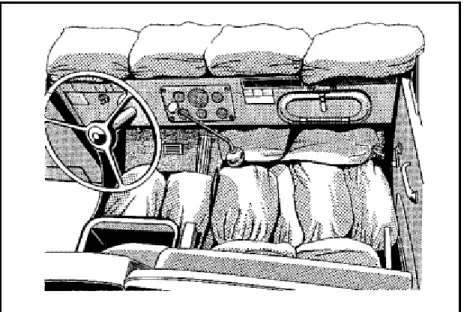
a. Cab. Experience shows that using sandbags to harden vehicle cabs for protection against mine blasts saves lives (Figure O-1). Normally, the cabs of all vehicles subject to detonating mines are hardened. Certain cautions, however, must always be observed. Sandbags should be placed so that they--
• Do not restrict the movement of foot pedals, levers, or controls.
• Do not interfere with the normal functions performed by the driver.
• Do not restrict driver vision.
To reduce the sandblast effect when a mine is detonated near the vehicle, various materials may be placed on top of the floorboard sandbags (such as rubber mats, light metal plates, plywood, or scraps of runway membrane material). Wetting down the sandbags is also effective but
contributes to deterioration of the metal.
17
possible. Remove the tools from the BII storage compartment and place them inside the bed. Place sandbags in the storage compartment to give the driver required protection. As an added precaution, place a heavy rubber or fiber mat over the sandbags. This reduces danger from fragments (such as stones, sand, and metal parts from the vehicle).
NOTES:
1. If the tools remain in the BII storage compartment and the vehicle detonates a mine, the tools may become secondary projectiles that can injure the driver. Also, if sandbags cannot be placed under the passenger seat because batteries are located there, then stack the sandbags on the seat. Never place sandbags directly on the batteries.
2. The cab of a 5-ton M923 cargo truck needs about 14 to 20 sandbags, while a 2 1/2-ton truck requires about 12 to 18 sandbags.
Figure O-1. Proper placement of sandbags in the cab
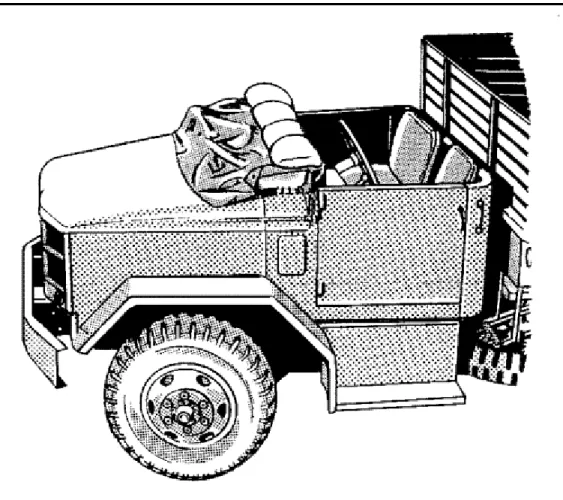
Cover side windows and the front windshield with wire mesh to protect personnel from rocks and grenades. The convoy commander will decide whether to have windshields removed, lowered, or left in place. If the windshield interferes with the use of weapons and blackout operations and must be lowered, place a single layer of sandbags under the windshield, lower the windshield onto the bags, place a second layer of sandbags over the windshield, and then cover both with canvas (Figure O-2). Placing sandbags under the windshield ensures that--
• Constant vibrations of the vehicle do not damage the windshield.
• Sand is not blown into the driver's face.
• Glass will not shatter and injure the driver and passenger.
NOTE: Leaving the windshield in place protects against heavy and driving rain, incoming grenades, and decapitation of personnel from wire stretched across the road.
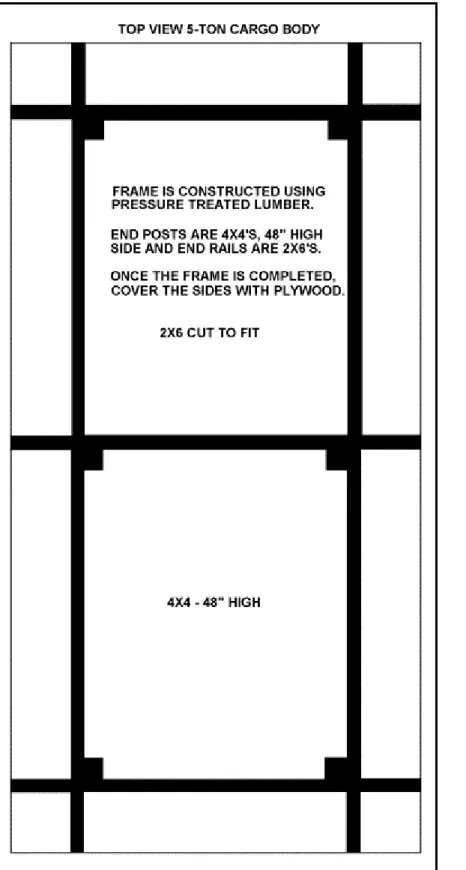
b. Cargo Bed. Depending on the type of load, the cargo bed may or may not be hardened. For example, if troops are being transported, the bed needs to be hardened with a double layer of sandbags. The bags also need to be properly fitted to the contours of the vehicle. Stack the bags
five high around the sides of the vehicle to add protection. To hold the sandbags in place,
construct a support structure and place it inside the bed of the vehicle. This structure can be made by using four-by-fours on the corners and two-by-sixes in between (Figure O-3).
NOTE: Caution must be taken to ensure that the sandbags do not exceed the allowable weight of the vehicle bed. Double stacking the sandbags increases the possibility of exceeding the vehicle's payload capacity. The mission, coupled with the enemy threat, must determine the extent of hardening (single- or double- layer sandbags). The bottom line is to ensure soldier safety.
19
Figure O-3. Support structure for the bed of the truck (continued)
It takes about 226 sandbags (dry, weighing about 40 pounds each) to prepare the bed of a 5-ton, M923 cargo truck. Distribution is as follows: 86 on the floor bed (single layer); 5 high on each side (50 per side = 100 bags); 20 in the front; and 20 in the rear of the bed (Figure O-4).
Figure O-4. Sandbagged 5-ton M923 cargo truck
c. Fuel Tanks. Protective plating around the fuel tank will lessen the damage to the fuel tank. It will also help to ensure that the fuel tank is not pierced, thus immobilizing the vehicle. This protective measure is especially critical when a vehicle is caught in the kill zone of an ambush. An alternative solution to this problem is to hook up a 5-gallon can of fuel in a safe location for use as an auxiliary fuel tank. This will allow the vehicle to travel a safe distance outside the kill zone if all the fuel is drained from a damaged fuel tank.
NOTES:
1. A 5-ton M923 cargo truck requires about five sandbags to provide top protection. Consider placing protective plating around the sides and bottom of the fuel tank to increase protection.
2. Older vehicles in the Army inventory may still be operating on MOGAS. If a tank filled with MOGAS is ruptured, the fuel may ignite and seriously burn operating personnel.
3. When putting sandbags or protective plating on or around the fuel tank, ensure that the hanger straps of the fuel tank do not crack or break.
O-6. GUN TRUCKS. Logistical convoys cannot always depend on military police support or added firepower. To provide more firepower for a convoy, units developed the gun truck. The purposes of a hardened gun truck are to--
• Provide a base of fire.
• Help counter enemy attacks.
• Increase survivability of the convoy.
The gun truck is equipped with a crew-served weapons system, preferably in a protective position. In Vietnam this principle worked well and provided convoys a means of self-defense.
21
Deploy the gun truck in the convoy where it can best provide the needed firepower. If adequate communications assets are available, they should be located with the gun truck and the convoy commander. This enables the convoy commander to call the gun truck forward when needed. (A predesignated signal is required to bring the gun truck forward and inform the crew-served weapon system personnel of the enemy location.) If communications assets are not adequate, pyrotechnics may be used to signal the gun truck to move forward.
The gun truck should not be pulled up right on top of the enemy location. The crew-served weapons on the gun truck can cover a significant distance. Therefore, the vehicle should be situated where it has a clear field of fire to engage the enemy with the maximum effective range of the weapon. If necessary and if available, multiple gun trucks can be used. When using multiple gun trucks in a convoy, overlapping fields of fire greatly increases the convoy's chance of survival.
NOTES:
1. Based on availability, types of weapon systems, and size of the convoy, the placement and number of gun trucks may vary. With company-size and larger convoys, a minimum of two gun trucks should be used to provide overlapping fire. One gun truck for every eight vehicles in the convoy is recommended.
2. Consider using the MK19 or M203 to penetrate prepared defensive positions since small arms fire may not be capable of destroying enemy positions
O-7. BALLISTIC TEST RESULTS. It is critical that the most protective material available be used to harden a vehicle. Ballistic tests show that sand is about twice as effective as clay in hardening vehicles. At a maximum velocity of 3,250 feet per second at a range of zero feet, it takes about .6 feet of sand and 1.2 feet of clay to stop a 5.56-mm round. At a maximum velocity of 2,750 feet per second, it takes about .9 feet of sand or 1.7 feet of clay to stop a 7.62-mm round. Finally, at the maximum velocity, it takes about 1.4 feet of sand or 2.6 feet of clay to stop a 50-caliber round. Using the most protective substance could mean the difference between life and death for our most precious resource--our soldiers.
O-8. CAMOUFLAGE AND CONCEALMENT. Camouflage and concealment techniques can be used to make it more difficult for the enemy to spot the convoy. The type of cargo being transported can be disguised or concealed by a tarpaulin. Other effective measures include the following:
• Camouflaging or covering shiny surfaces before convoy departure.
• Painting vehicles in a pattern to blend in with the terrain and break the outline.
• Training operators to look for other means of concealment to break the outline of the vehicle.
• Covering vehicle bumper markings. The vehicle bumper markings can provide a great deal of intelligence information to the enemy.
O-9. MINES AND BOOBY TRAPS. Forces engaging in ambush frequently use mines and booby traps. Command-detonated mines are often used to initiate an ambush. Mines may also be planted along the shoulder of the road to harass and interdict. A booby trap system may be used against personnel and equipment. Convoys have employed the following guidelines to
• Track the vehicle in front.
• Avoid driving on the shoulder of the road.
• Whenever possible, do not run over foreign objects on the road.
• Avoid potholes and fresh earth on the road.
• Watch local national traffic and the reactions of people on foot (they will often give away the location of any mines or booby traps).
• When possible, arrange for the engineers to sweep the road ahead before the convoy moves over it.
• Use a 2 1/2-ton or larger truck as the lead vehicle instead of a HMMWV. Hard vehicles such as tanks are useful in exploding small mines in front of the convoy.
Harden vehicles.
- Use water in vehicle tires when there is a threat of mines exploding under the tires. - Increase ground clearance distance between the point of explosion and the vehicle, if possible.
Use the following personal safety measures: - Wear protective equipment.
- Use safety belts. Ensure seat belts are tight; otherwise, whiplash may occur during an explosion. Also, fasten the seat belt as low as possible on the stomach. - Use correct posture. Keep the backbone straight and supported by a backrest (to better absorb shock) and place feet flat on the floor.
Slow the vehicle's speed to reduce the potential of accidents. Adjust the speed based on the situation.
Disperse vehicles and maintain intervals.
NOTE: In Somalia, around Mogadishu, the Army experienced command-detonated mines of 30, 50, and 60 pounds. These devices were placed in one of the many potholes in the road and wired for command-detonation. To avoid such obstacles and/or minimize damage, implement the above techniques.
Some indicators that have proven effective in identifying the location of potential mines are--
• Damaged vehicles.
• Signs of digging, holes in the road, potholes, concrete removal, or puddles.
• Boxes along the roadside.
• Wires on the road surface.
• Evidence of vegetation disturbance.
• Disturbances in previous tire tracks.
• Differences in plant growth, such as wilting or dead foliage.
• Irregularities in color or texture of the ground.
• Signs warning local populace.
• The enemy is likely to place mines on--
• Frequently used roadways leading to and from construction sites.
• Brush and other traffic obstructions placed on roadways.
• Bridge bypasses.
23
SAMPLE CONVOY BRIEFING
This appendix contains an outline for a comprehensive and effective prebriefing of convoy personnel. It is properly organized and covers the critical information needed to execute any conceivable convoy operation.
1. Situation: a. Friendly forces. b. Support units. c. Enemy situation. 2. Mission: a. Type of cargo. b. Origin. c. Destination. 3. Execution:
a. General organization of the convoy. b. Time schedule. c. Routes. d. Convoy speed. e. Catch-up speed. f. Vehicle distance. g. Emergency measures. - Accidents. - Breakdowns. - Obstacles
- Separation from convoy. - Ambush.
-- Action of convoy personnel if ambushed. -- Action of security forces during ambush. -- Medical support.
h. Hazards of route and weather conditions. i. Defensive driving.
4. Administration and Logistics: a. Control of personnel. b. Billeting arrangements. c. Messing arrangements.
d. Refueling and servicing of vehicles, complying with spill prevention guidelines. 5. Command and Signal:
a. Location of convoy commander. b. Succession of command.
c. Action of security force commander. d. Serial commander's responsibility. e. Arm and hand signals.
f. Other prearranged signals.
g. Radio frequencies and call signs for-- - Control personnel.
- Security force commander. - Fire support elements. - Reserve security elements. - Medical evacuation support.
EXTRACT FROM FM 100-23, PEACE OPERATIONS
“Meanwhile, I shall have to amplify the ROE so that all commanding officers can know what I am thinking, rather than apply their own interpretation, which might range from "ask them for lunch to 'Nuke' em for breakfast."
Admiral "Sandy" Woodward Commander of the Task Force (Falkland Islands, 1982)
RULES OF ENGAGEMENT, JTF FOR SOMOLIA GROUND FORCES
Nothing in these rules of engagement limits your right to take appropriate action to defend yourself and your unit.
1. You have the right to use force to defend yourself against attacks or threats of attack. 2. Hostile fire may be returned effectively and promptly to stop a hostile act.
3. When US forces are attacked by unarmed hostile elements, mobs, and/or rioters, US forces should use the minimum force necessary under the circumstances and proportional to the threat. 4. You may not seize the property of others to accomplish your mission.
5. Detention of civilians is authorized for security reasons or in self-defense. Remember
The United States is not at war.
Treat all persons with dignity and respect. Use minimum force to carry out the mission. Always be prepared to act in self-defense.
25
EXTRACT FROM FM 101-5-1, OPERATIONAL TERMS AND GRAPHICS
MAP GRAPHICS
PRINCIPAL DIRECTION
OF FIRE
TARGET REFERENCE POINT
ASSEMBLY AREA
AMBUSH
CHECK POINT (CP8)
COORDINATION POINT
START POINT
RELEASE POINT
MINEFIELD
WIRE
CONCERTINA
TRIPLE STRAND
CONCERTINA
101 AA 8 S P R Pxxxxxxx
ooooooo
ooooooo
FOXHOLE
MOVING CONVOY
HALTED CONVOY
MAIN SUPPLY ROUTE
ALTERNATE SUPPLY
ROUTE
ENEMY UNIT
FRIENDLY UNIT
TRANS UNIT
M16
SAW
.50 CAL
M203
MK19
LAW/AT4
MSR
ASR
O
O
HMMWV GUNTRUCK WITH .50 CAL
PLS
PLS GUNTRUCK WITH .50 CAL
COMMAND POST
LP/OP
DEAD SPACE
STREAM
CLAYMORE
O O O
O O O
CP
O O
27
CHAPTER 2 - CONVOY SPECIFIC TE&OS
The following chapter contains task, condition, and standards for convoy operations.
TASK: DEFEND MARCH ELEMENTS (63-2-1006)
CONDITION: Threat forces attack the march column. The unit is conducting a tactical road march. The threat is capable of launching ground, air, and indirect fire attacks. The march column has radio communications with higher HQ staff element. CAS sorties and indirect fire support have been allocated, but with low priority. Pyrotechnics are available for signaling and marking locations. Higher HQ movement order and TSOP are available.
Some iterations of this task should be performed in MOPP4.
TASK STANDARD: Attacks are repelled by proper immediate action techniques and march is resumed IAW TSOP and movement order.
TASK STEPS and PERFORMANCE MEASURES GO
NO GO *1. March commander supervises reaction to sniper fire.
a. Locates approximate location of sniper incident on map from march element reports. b. Identifies whether area is a free fire zone or restricted fire zone.
c. Authorizes return fire only if sniper(s) are located.
d. Directs march elements to increase march speed and interval between vehicles until they have cleared the area.
e. Provides instructions to follow-on march elements. f. Forwards incident report to higher HQ staff element.
2. Unit takes action against sniper fire . (071-311-2007, 071-312-3031) a. Reports sniper fire to march commander immediately upon contact.
b. Returns fire immediately that kills snipers or suppresses their fire (designated personnel only).
c. Increases column rate of march and vehicle interval.
*3. March commander supervises defense against ambush, road blocked or road not blocked. (04-3303.01-0019, 061-283-6003)
a. Identifies location of ambush site on map with map overlay.
b. Directs march elements under attack to employ correct protective actions as prescribed in higher HQ movement order and TSOP.
c. Provides instructions on halt points and security requirements to all march elements. d. Forwards initial incident report to higher HQ staff element.
concentrated fire on threat position(s).
f. Directs the march elements ahead and march element following to organize security teams to attack flanks of threat ambush party.
g. Maintains constant communications with all march elements engaging threat to immediately make adjustments to tactical situation.
h. Forwards subsequent SITREP reports to higher HQ staff element as situation changes.
i. Requests immediate CAS and/or indirect fire support from higher HQ staff element. j. Directs use of pyrotechnics for signaling or marking areas.
k. Develops contingency plans to displace elements not under attack and withdraw elements under attack.
4. Unit defends against ground ambush (road not blocked). (311-2007, 071-312-3031)
a. Reports ambush to march commander immediately upon contact. b. Identifies threat location(s).
c. Returns fire immediately that kills threat and suppresses their fire (non-driving personnel).
d. Stops vehicles (not in kill zone).
e. Increases rate of march until out of kill zone (vehicles in kill zone). f. Keeps roadway clear by pushing disabled vehicles aside.
g. Organizes security element(s) of soldiers not in kill zone (senior member present). h. Directs fire and maneuver of security elements to allow remaining vehicles to pass through kill zone (senior member present).
i. Forwards SITREP to march commander.
5. Unit defends against ground attack (road blocked). (071-311-2007, 071-312-3031, 071-326-0503, 071-326-0513)
a. Reports ambush to march commander immediately upon contact. b. Dismounts vehicles on opposite side of direction of ambush.
c. Returns fire immediately which kills threat or suppresses their fire (soldiers in kill zone).
d. Takes up firing positions while awaiting orders (soldiers not in kill zone).
e. Organizes security element(s) of soldiers not in kill zone (senior member present). f. Directs fire and maneuver of security elements to allow removal of road block (senior member present).
29
*6. March commander requests indirect fire support. (061-283-6003)
a. Requests fire support IAW instructions in the higher HQ movement order or TSOP. b. Identifies grid direction to threat location.
c. Identifies threat target location using grid coordinates or shift from a known point. d. Transmits call for fire in proper sequence.
e. Transmits fire adjustments information in proper sequence to the fire support element, if an "Adjust" fire mission.
f. Transmits "end of mission" and surveillance report if fire was sufficient. *7. March commander requests CAS.
a. Verifies threat position(s).
b. Requests CAS by means prescribed in higher HQ movement order. c. Supervises preparation of unit personnel for friendly strike.
d. Directs marking of friendly unit location(s) with prescribed colored smoke. e. Communicates strike effectiveness to higher HQ staff element.
8. Unit employs passive defense measures against air attack . (071-326-0513, 441-091-1040)
a. Provides the prescribed signal to alert column. b. Staggers vehicles to avoid linear patterns. c. Drives vehicle in shadows or woodline. d. Assumes firing positions.
e. Fires only upon command.
f. Reports all aircraft actions to higher HQ staff element.
9. Unit employs active defense measures against air attack . (441-091-1040, O1-0401.20-0001)
a. Employs the prescribed signal to alert march elements. b. Identifies threat aircraft visually.
c. Disperses vehicles to concealed locations. d. Assumes firing positions.
e. Prepares crew-served weapons for firing.
f. Fires weapons at attacking aircraft only if fired upon or on command. *10. March commander supervises reorganization after attack.
reports.
b. Coordinates requirements within march elements for load transfer, vehicle repairs, mortuary affairs, and medical transportation.
c. Requests emergency destruction authorization from higher HQ staff element for unrepairable items.
d. Forwards SITREP to higher HQ staff element.
11. Unit reorganizes after the attack. (081-831-0101, 081-831-1000, 081-831-1005, 1007, 1016, 1017, 1025, 1026, 081-831-1033, 081-831-1034, 081-831-1040, 081-831-1041, 081-831-1042, 101-515-1900, O3-4995.90-0010)
a. Maintains 360-degree surveillance. b. Treats casualties.
NOTE: See task 8-2-0003 for detailed treatment procedures. c. Reports casualties.
d. Requests air ambulance support through march commander. e. Reestablishes chain of command, if necessary.
f. Secures landing zone, if air ambulance is required. g. Transports casualties.
NOTE: See task 63-2-R316 for detailed casualty transportation procedures. h. Performs mortuary affairs functions.
NOTE: See task 10-2-C318 for detailed mortuary affairs procedures.
i. Assesses damage to vehicles and cargo to determine operability and reparability. j. Performs BDAR for recoverable vehicles.
k. Removes critical items from unrecoverable vehicles.
l. Requests emergency destruction of vehicles and non-medical equipment from march commander.
m. Forwards SITREP to march commander. n. Reorganizes march elements.
31
TASK: CONDUCT TACTICAL ROAD MARCH (63-2-1003)
CONDITION: Time specified in movement order to cross SP has arrived. All equipment is uploaded and vehicles are positioned for departure. The route of march is identified. Convoy operations may be performed during daylight or darkness, including blackout conditions. The convoy may go through an urban area. Radio and visual signals are used for march column control. The higher HQ TSOP and OPORD with movement order are available. Maps and overlays with checkpoints, RP, and critical points are available. Column may conduct halts during movement.
Some iterations of this task should be performed in MOPP4.
TASK STANDARD: SP, checkpoints, and RP are crossed at times specified in the movement order or times adjusted on the road movement table by higher HQ staff element. At MOPP level 4, performance degradation factors increase travel time.
TASK STEPS and PERFORMANCE MEASURES GO NO GO
*1. March commander initiates convoy. (O1-7200.75-0100) a. Directs lead vehicle to cross SP at specified time.
b. Verifies vehicles have crossed the SP.
c. Forwards SP crossing report to higher HQ staff element when unit elements have crossed the SP.
*2. March commander reports convoy information to higher HQ staff element. a. Forwards checkpoint(s) clearance report as checkpoints are crossed.
b. Reports all ground sightings that conflict with maps and map overlays. c. Forwards en route NBC information.
d. Reports all threat sightings using SALUTE format. e. Employs correct SOI/SSI codes in all transmissions.
*3. March commander enforces march discipline. (O1-7200.75-0100)
a. Assumes position(s) along march route that provides command presence at points of decision for reaction to changing tactical situation.
b. Enforces all movement policies defined in the TSOP and movement order, with emphasis on formation, distances, speeds, passing procedures, and halts.
c. Adjusts formation distances and speed consistent with NBC, terrain, and light conditions.
d. Enforces security measures, with emphasis on air guards surveillance, manning of automatic weapons, and concealment of critical cargo.
violations of march discipline, security procedures, or changes to current orders. f. Enforces COMSEC measures, including radio silence periods IAW the movement order and SOI/SSI.
4. Unit employs march discipline.
a. Maintains designated march speed specified in movement order or as prescribed by the march commander.
b. Maintains proper vehicle interval as specified in movement order or as adjusted by the march commander.
c. Adjusts formation distances and speed consistent with NBC, terrain, and light conditions.
d. Dons eye protection goggles if driver or passenger is in a vehicle without cover or when windshield is lowered.
e. Crosses all check points as scheduled.
f. Reacts correctly to march commander's arm/hand signals.
g. Maintains ground and air surveillance that covers 360 degrees until movement is completed.
5. Unit conducts scheduled halt(s).
a. Stops column at prescribed time and location.
b. Moves vehicles off road to positions that provide overhead cover while maintaining the prescribed interval between vehicles.
c. Occupies hasty defensive positions with 360 degree protective coverage (passengers).
d. Reports scheduled halt to the battalion CP.
e. Performs during-operation PMCS on vehicles (operators). f. Inspects vehicle loads for safety and security.
g. Begins departure at specified time in the movement order. h. Reports resumption of march to higher HQ staff element. 6. Unit conducts unscheduled halt(s).
a. Alerts march column with prescribed arm/hand signal.
b. Reports halt and circumstances immediately to higher HQ staff element. c. Moves vehicles off the road while maintaining the prescribed interval between vehicles.
d. Occupies hasty fighting position with 360 degree protective coverage. e. Resumes march as soon as reason for halt is rectified.
33
7. Trail party recovers disabled vehicle. (O3-4995.90-0010)
a. Posts guard to maintain surveillance until recovery operation is completed. b. Inspects disabled vehicle for reparability.
c. Repairs disabled vehicle, when possible.
d. Tows disabled vehicle to applicable maintenance facility. e. Reports vehicle status to march commander.
8. Unit conducts a night convoy. a. Briefs drivers on night conditions.
b. Provides visual adjustment period if march began during daylight. c. Prepares vehicles for blackout conditions IAW the TSOP.
d. Maintains prescribed interval between vehicles. e. Wears night vision goggles (selected personnel).
f. Wears regular eye protection goggles (all other personnel). g. Employs ground guides during poor visibility periods. 9. Unit conducts convoy through an urban area.
a. Verifies all weight, height, and width restrictions along route of march. b. Employs close column formation.
c. Obeys traffic control directions unless escorted by military or HN police. d. Employs directional guides at all critical intersections.
*10. March commander monitors unit crossing RP. (O1-7200.75-0100) a. Verifies that lead vehicle has crossed RP at specified time.
b. Verifies that vehicles that have crossed RP. c. Forwards SITREP to higher HQ staff element.
TASK: CONDUCT KFOR CONVOY
CONDITIONS: The platoon is a component of a larger force conducting Stability and Support Operations. The unit receives an order to conduct a convoy planned by the higher headquarters to gather information; monitor an agreement; or demonstrate a U.S. force presence. Local populace and factions may or may not be cooperative. The unit is based in a secure site (base camp, observation post or checkpoint). The larger force has established a QRF. The unit has guidance provided by the Rules of Engagement (ROE) and from Mission Instructions such as a peace mandate, Terms of Reference (TOR), Status of Forces Agreement (SOFA), and Rules of Interaction (ROI). Civilians are in the area. Government agencies, nongovernmental
organizations, and local and international media may be in the area. This task should not be trained in MOPP4.
TASK STANDARDS: Plt accomplished its mission in accordance with the OPORD. The convoy leader reported information as required during the convoy and provided an after action report to higher headquarters IAW unit SOP. Civilians were treated with respect. The unit complied with the ROE, Mission Instructions, higher headquarters order and other special orders.
TASK STEPS AND PERFORMANCE MEASURES GO
NO-GO NOTE: Presence patrols reassure the local population of the presence and commitment
of US forces. They also provide an opportunity to gather information. The size of the element will vary depending on the mission
* 1. Unit leader conducts mission analysis and troop leading procedures
with special emphasis on the following:
a. Complies with requirements specified and implied in operations order. b. Develops necessary security measures.
c. Provides for overwatch element (e.g., a sniper team or a rifle/weapons squad) if appropriate.
d. Identifies higher headquarters Critical Combat Information Requirements (CCIR) and Information Requirements (IR).
e. Obtains sufficient information about persons who are to be apprehended if encountered so as to be able to identify them.
f. Requests liaison officers, local guides, and interpreters as needed. g. Coordinates check points and reporting procedures with higher headquarters.
h. Identifies requirements for overt recognition methods IAW unit SOP and OPORD (flag or guidon, placard, lights, vests, etc.).
i. Identifies special equipment requirements to accomplish task(s). j. Selects tactical movement techniques and formation options.
35
TASK STEPS AND PERFORMANCE MEASURES GO
NO-GO k. Establishes casualty evacuation (CASEVAC) procedures.
* 2. Unit leader coordinates with the QRF commander. At a minimum the platoon leader:
a. Confirms QRF radio frequency(ies), call sign(s), and recognition signals.
b. Identifies probable link-up points.
c. Confirms link-up procedures.
d. Confirms battle hand off procedures.
e. Confirms procedures for transfer of information. * 3. Unit leader briefs patrol plan.
a. Selects members to attend briefing.
b. Employs modified patrol order format. Order covers as a minimum: (1) General situation: Include faction elements' locations and activities, danger areas (e.g., minefields), presence and missions of other patrols, cultural considerations, and weather forecast.
(2) Mission (primary and secondary). (3) ROE relevant to mission.
(4) CCIR and IR collection requirements.
(5) Route.
(6) Timing Departure, return, contact times, etc.. (7) Checkpoints and control measures.
(8) Radio procedures (code words, frequencies, reporting frequency and interval, emergency procedures).
(9) Coordination measures and requirements with other units and patrols.
(10) CASEVAC procedures.
(11) Debriefing requirements.
(12) Required equipment.
(13) Schedule for precombat checks, inspections, and rehearsals. (14) QRF request procedures.
c. Reviews ROE provisions and Mission Instructions on the use of force. * 4. Unit conducts Pre Combat Checks (PCI).
TASK STEPS AND PERFORMANCE MEASURES GO NO-GO b. Requires each soldier to demonstrate his understanding of the ROI and
Mission Instructions as pertains to use of force.
c. Requires each soldier to demonstrate his knowledge of the patrol mission, route, radio frequencies, and call signs.
* 5. Unit conducts rehearsals in order of priority by time available. a. Employs force IAW ROE and MI.
b. Establishes contact with a group/element from a faction, or a group, or a person whose status is unknown.
c. Reacts to hostile action (e.g. sniper). d. Apprehends a wanted person.
e. Reacts to special situations as identified in the unit order or SOP. f. Implements casualty evacuation (CASEVAC) as necessary. * 6. Platoon Leader conducts final coordination prior to beginning patrol
a. Receives information on latest civilian/FWF situation (S2), friendly situation (S3), and minestrikes (ENG/S2)
b. Disseminates information to all soldiers 7. Unit conducts patrol.
a. Implements the patrol plan.
b. Does not deviate from specified route.
c. Maintains radio contact, using code words and reporting at intervals specified in the patrol plan.
d. Collects information IAW the operations order (OPORD). e. Collects incidental information.
f. Reports information as required in unit SOP and OPORD. 8. Lane Events
a. Report an Illegal Check Point. (XVIII ABN CORPS KOSOVO TTPs) Upon discovery of an illegal detention or checkpoint immediately contact higher headquarters and provide SPOT report.
b. Report Illegal Wood Cutting (XVIII ABN CORPS KOSOVO TTPs). Inform Company HQ’s. This infraction is handled by the UNMIK-P.
37
TASK STEPS AND PERFORMANCE MEASURES GO
NO-GO (1) Patrol leader informs higher headquarters.
HQ notifies TFF through their LNO
EOD/ MPs/ Maneuver CDR receive notification from LNO MPs will notify UNMIK-P
Makes a tentative plan.
In all cases the maneuver element cordons/secures the scene with 360-degree security but does not disrupt the crime scene.
Identify and detain (hold) potential witnesses.
MPs arrive and establish C2 node to provide connectivity with TFF HQ and serve as an interface between UNMIK-P and the maneuver force on the ground.
Upon arrival UNMIK-P is in charge of the crime scene and KFOR forces are in support of the UNMIK-P efforts.
UNMIK-P conducts their investigation with KFOR in support.
d. React to Mine Strike (JRTC TE&Os).
(1) Convoy halts, All personnel remain mounted, no vehicles move Senior person assesses situation, determines casualties based on reports from all vehicles in convoy
(3) Establish 360 degree security from vehicles
(4) Senior person accounts for all sensitive items SEND SITREP to higher HQ
(5) Senior engineer (If available), or senior person, designates a sweep team to clear a footpath to the affected vehicle using non-metallic probes and/or mine
detectors. Mark left and right limits of footpath using non-metallic materials (spray paint, chem lights, HEMMS poles, wooden stakes, engineer tape held down with rocks, etc.) every 3 meters
(6) At the same time, the last vehicle in the convoy clears a footpath to the rear and establishes radio commo-link with higher HQ. Distance to clear to rear is designated by senior person or rear vehicle commander.
(7) Sweep team clears footpath to injured personnel and begins first aide. (8) Mark any mines found with engineer tape or any non-metallic material. Do not put the marking object closer the 12 inches from the suspected mine. Do not probe to find a mine.