Adolescents’ use of the Internet is becoming a matter of great concern for different sectors of society. The psychological and behavioural consequences of problematic Internet use in young people demands quick and effective answers. One of the major challenges in this context is the development of empirically validated tools, which would facilitate early detection and screening for potential risk cases. This is precisely the aim of this paper. Based on a sample of 1,709 secondary-school students from Galicia (a region in northern Spain) aged 11 to 17 (M = 13.74, SD = 1.43), the analysis carried out permitted us to present a brief and simple tool (with just 11 items). It has substantial theoretical support, since both the existing background information and the views of experts from the academic and professional spheres were taken into account in the course of its development. The scale is adapted to the Spanish cultural context and to the language of young people. It has satisfactory psychometric properties in terms of reliability of the scores (α= .82), evidence of its internal structure (tested via a Confirmatory Factorial Analysis), sensitivity (81%), and specificity (82.6%). Moreover, its use enables the gradation of adolescents on a risk or problematic Internet use continuum. In our view, all of this lends it enormous applied potential in both the educational and clinical contexts.
Key words: addiction, adolescents, early detection, Internet, problematic use, screening.
Abstract
Received: May 2014; Accepted: November 2014 Address for correspondence:
Antonio Rial Boubeta. Facultad de Psicología, C/ Xosé María Suárez Núñez, s/n. Campus Vida-Universidad de Santiago de Compostela. 15782- Santiago de Compostela (Spain). E-mail: [email protected]
PIUS-a: Problematic Internet Use Scale in adolescents.
Development and psychometric validation
EUPI-a: Escala de Uso Problemático de Internet en
adolescentes. Desarrollo y validación psicométrica
Antonio Rial Boubeta*; Patricia Gómez Salgado*; Manuel Isorna Folgar**;
Manuel Araujo Gallego*; Jesús Varela Mallou*
*Universidad de Santiago de Compostela **Universidad de Vigo
El uso que los adolescentes hacen de Internet viene suscitando una enorme preocupación en diferentes sectores de la sociedad. Las consecuencias a nivel psicológico y conductual que el uso problemático de la Red provoca entre los más jóvenes demandan una respuesta tan rápida como eficaz. Uno de los grandes retos en este contexto es el desarrollo de herramientas validadas empíricamente, que permitan hacer un cribado o detección precoz de posibles casos de riesgo. Ese es precisamente el objetivo de este trabajo. A partir de una muestra de 1709 escolares de Enseñanza Secundaria Obligatoria de la comunidad gallega, de edades comprendidas entre los 11 y los 17 años (M = 13,74; DT = 1,43), los análisis realizados permiten presentar una herramienta breve y sencilla (compuesta por solo 11 ítems), que goza de un importante aval teórico, ya que para su elaboración se tuvieron en cuenta tanto los antecedentes existentes en la literatura, como las opiniones de expertos del ámbito académico y profesional. Dicha escala, además de estar adaptada al contexto cultural español y al lenguaje de los adolescentes, presenta unas propiedades psicométricas satisfactorias, tanto en términos de fiabilidad de las puntuaciones (α = ,82) y evidencias de su estructura interna (probada a través de un Análisis Factorial Confimatorio), como de sensibilidad (81%) y especificidad (82,6%), permitiendo “escalar” a los adolescentes en un continuum de riesgo o uso problemático de Internet. Todo ello le confiere, a nuestro modo de ver, un notable potencial a nivel aplicado, tanto en el contexto educativo como clínico.
Palabras clave: adicción, adolescentes, cribado, detección precoz, Internet, uso problemático.
O
ne of the defining characteristics 21st-cen-tury society is the generalized use of so-ca-lled New Technologies (NT) or Information and Communications Technology (ICT). Accor-ding to Spain’s National Institute of Statistics (Instituto Nacional de Estadística [INE], 2014), in Spain 92% of minors aged 10 to 15 are Internet users. The Web provi-des access to multiple sources of information, learning, leisure and personal, academic and professional develo-pment, as well as to innovative forms of communication, relation and expression. Without questioning its benefits, we should not overlook the fact that its use also involves certain associated risks and dangers (loss of privacy, con-tact with strangers, isolation), in addition to disconcer-ting practices such as cyberbullying, grooming or sexdisconcer-ting, which are affecting increasing numbers of adolescents, considered one of the most vulnerable groups in this new environment (Castellana, Sánchez-Carbonell, Graner, & Beranuy, 2007; Echeburúa & Corral, 2010; Yang & Tung, 2007).The use that teenagers make or are able to make of In-ternet is a topic of concern in Spain and elsewhere (Oliva et al., 2012; Puerta-Cortés & Carbonell, 2014; Ruiz-Oli-vares, Lucena, Pino, & Herruzo, 2010; Smahel et al., 2012; Tsitsika, Tzavela, Mavromati and EU consortium NET ADB, 2012; Valedor do Pobo, 2011). This general concern has been heightened in recent years by the so-metimes sensationalist way in which the subject is treated in the media. This has helped to create some degree of social alarm and no little scepticism among researchers and professionals, who do not consider it appropriate to speak of Internet addiction per se (Estallo, 2001; Grohol, 1999; Matute, 2001). However, others have indeed taken this step, attempting to scientific credibility to the use of this term (Cao & Su, 2007; Young, 1998). Various studies have tried to provide evidence that the behaviour of some individuals in relation to the Web fulfils the general crite-ria of an addiction (Echeburúa, 1999; Griffiths, 1998), or even proposed diagnostic criteria (Ko, Yen, Chen, Chen, & Yen, 2005; Tao et al., 2010; Young, 1996). And while it is true that neither of the diagnostic manuals of reference (CIE-10 and DSM-5) currently includes such a category, it is interesting to mention two innovations that appear in the DSM-5 (American Psychiatric Association [APA], 2013): on the one hand, Internet Gaming Disorder has been included in Section III of the manual, reserved for po-tential new diagnostic categories that require further re-search and evidence from clinical contexts; on the other hand, compulsive gambling has been classified as a behaviou-ral addiction, which leads us to think, in line with other authors (Cía, 2014; Petry & O’Brien, 2013), that other behaviours capable of generating the psychopathology characteristic of addiction could also be fully incorpora-ted into coming editions of the manual.
Despite the enormous amount of scientific work that this area has been generating for almost two decades now, there is still a degree of controversy (García, Beltrán, & Pérez, 2012; Douglas et al., 2008; Rial, Gómez, Braña, & Varela, 2014; Sánchez-Carbonell, Beranuy, Castellana, Cha-marro, & Oberst, 2008; Spada, 2014). An example of this is the disparity in the prevalence figures estimated by diffe-rent studies. In the Spanish context the data range from 0.76% of adolescents and young people with severe level of Internet addiction to 21.88% with moderate addiction (Oliva et al., 2012), or 3.3% of problematic users and 43.3% of risk users in young people aged 14 to 18 (Estévez, Bayón, de la Cruz, & Fernández-Líria, 2009), to 19.9% of problematic users among secondary-school students (Gómez, Rial, Bra-ña, Varela, & Barreiro, 2014).
In the case of Europe-wide studies, the data range from 1% of pathological levels of Internet use found in chil-dren aged 11 to 16 (Smahel et al., 2012), or the 1.2% of adolescents aged 14 to 17 with Internet addiction behaviours and 12.7% at risk (Tsitsika et al., 2012), to 4.4% of patholo-gical Internet users and 13.5% of maladaptive users (Durkee et al., 2012)
The figures in studies outside Europe also show dispa-rities: Cao, Sun, Wan, Hao and Tao (2011) report 8.1% of problematic users of Internet among Chinese adolescents, whilst Lam, Peng, Mai and Jing (2009) speak, in relation to Chinese secondary-school students, of 10.2% modera-tely addicted and 0.6% severely addicted to the Web. At the same time, the range of prevalence found in studies with adolescents and university students in the USA is from 0% to 26.3% (Moreno, Jelenchick, Cox, Young, & Chris-takis, 2011).
In sum, although more and more research is being done on this issue, the data are confusing, and at times even contradictory. The “risk” estimated in each case tends to be an excessively diffuse term, given the under-lying conceptual controversy that must be resolved first: what do we actually want to assess? It is necessary to cla-rify what we are talking about: Internet addiction (Chou & Hsiao, 2000; Young, 1996), compulsive use (Greenfield, 1999; Meerkerk, Van Den Eijnden, Vermulst, & Garret-sen, 2009), pathological use (Davis, 2001; Morahan-Martin & Schumacher, 2000), problematic use (Caplan, 2002; Sha-pira et al., 2003), excessive use (Hansen, 2002), unregulated use (LaRose, Lin, & Eastin, 2003) or Internet dependence (Anderson, 2001; Scherer, 1997). Do these terms form part of a single continuum of risk? And if so, what sequen-ce do they follow? Which of them accounts for the hi-ghest level of risk? Where should we set the boundaries between one concept and another? The heterogeneity of terms makes it seriously difficult to compare and integra-te results, so that the first task for research integra-teams and the scientific-professional community is to reach a consensus on both the term to use and its defining criteria. Thus,
although it might be acceptable to speak of addiction to Internet, in the name of rigour and orthodoxy (and pen-ding the necessary consensus), a prudent solution would be to employ the term problematic use. Authors such as Ceyhan, Ceyhan and Gürcan (2007), Pulido-Rull, Esco-to-de la Rosa and Gutiérrez-Valdovinos (2011) or That-cher and Goolam (2005) advocate the use of this expres-sion.
But beyond this controversy, what is certain is that sig-ns are increasing of the existence of the problem, so that it must be addressed as soon as possible. In this context, one of the greatest challenges for research is the deve-lopment of screening instruments, permitting early de-tection or the identification of possible risk cases, which would redound to the benefit of prevention initiatives.
The Appendix to this article includes a list of the prin-cipal instruments or tests developed to date. Its length serves only to highlight the enormous degree of hetero-geneity there is, from both the conceptual and methodo-logical points of view. Despite the large number of scales available, if our goal is to develop a tool with sound gua-rantees that permits early detection of cases of proble-matic Internet use among adolescents, the truth is that many of them present some kind of limitation: (1) they are not adapted to the adolescent population or the items are unsuitable for the specific reality of this age group (Armstrong, Phillips, & Saling, 2000; Nichols & Nicki, 2004); (2) they do not provide sufficient data on their psychometric properties, or they are not as reliable as they should be (Frangos, Frangos, & Sotiropoulos, 2012; García et al., 2008; Orman, 1996); (3) the samples used for their empirical validation are too small (Lam-Figue-roa et al., 2011; Morahan-Martin & Schumacher, 2000); (4) their factor structure is unclear (Chang & Law, 2008; Widyanto & McMurran, 2004); (5) they are difficult to use as screening tools, given their large numbers of items (Davis, Flett, & Besser, 2002; Li & Yang, 2007) or because they do not provide cut-off points (Beranuy, Chamarro, Graner, & Carbonell, 2009; Meerkerk et al., 2009); (6) there is no suitably adapted version in Spanish (Deme-trovics, Szeredi, & Rózsa, 2008); or (7) they were develo-ped in a culture very different from that of Spain (Chen, Weng, Su, Wu, & Yang, 2003; Huang, Wang, Qian, Zhong, & Tao, 2007).
The objective of the present work is precisely to de-velop a screening scale for problematic Internet use in ado-lescents, with sufficient theoretical and empirical gua-rantees, and that is both brief and easy to use. Such a scale must integrate the different antecedents from the literature and present acceptable psychometric proper-ties, with regard to score reliability, evidence of validity, sensitivity and specificity. In addition to being brief and simple, its items must be in accordance with the language and cultural context of adolescents.
Method
ParticipantsTo achieve our objective we used purposive sampling, in an effort to access the largest and most heteroge-neous sample possible. Through contact with 11 secon-dary schools in 7 different municipalities (both urban and rural) of the province of A Coruña (north-western Spain), it was possible to assemble a sample of 1709 ado-lescents (835 girls and 874 boys) aged 11-17 (M = 13.74; SD = 1.43). Of these, 30.2% were in the first grade (1º de ESO), 25.2% in the second grade, 23.8% in the third grade and 20.8% in the fourth grade. As regards parents’ educational level, 4% of fathers and 3.2% of mothers had no formal education, whilst 36.9% of fathers and 34.5% of mothers had primary education. Those with secon-dary/high-school education accounted for 48.6% of the fathers and 46.3% of the mothers, and 10.4% of fathers and 15.9% of mothers had a university education.
Instruments
For the construction and development of the scale we followed the phases set down in the American Educatio-nal Research Association’s Standards (American Psycholo-gical Association and National Council on Measurement in Education, 1999). First of all, we defined the purpose of the scale, which was to produce a screening instrument for problematic Internet use in adolescents, as well as defi-ning the scope of the construct or domain to be measu-red. We next specified certain aspects of the scale, such as item format, response format and the procedure for calculating the scores obtained by each participant. Spe-cifically, it was decided that the items would be statements in the first person, and that the response format would be based on a Likert-type scale with 5 options, since this maximizes score reliability and improves the chances of obtaining good validity evidence. For calculating the sco-res we established a range of 0 to 4 in the 5 categories of the agreement scale, 0 signifying Totally disagree and 4 sig-nifying Totally disagree. Next, we implemented the phase of development, assessment and selection of the items, and finally, we drew up the final version of the scale and carried out its empirical evaluation.
These four phases were developed through three com-plementary strategies. The first of these involved a review of the extensive literature on the subject, summarized in the Appendix, which lists the main scales previously proposed and their defining characteristics. We also took into account the DSM-5 diagnostic criteria for pathologi-cal gambling and Internet Gaming Disorder.
The second strategy was the development of a quali-tative study, which involved the creation of a multidisci-plinary team of experts consisting of 12 professionals (3 clinical psychologists, 3 psychiatrists, 3 community
edu-cation workers and 3 experts in drug-dependence pre-vention), with three specific objectives: (1) To carry out a critical review of the existing literature, highlighting the current limitations in this area; (2) To provide evidence of the content validity of the scale and the items making it up; and (3) To establish criteria for analyzing its discri-minative capacity, given the absence of consensus-based diagnostic criteria.
For the work with the experts we used the Delphi tech-nique, structured in three phases: the initial meeting was for discussing the state of the issue and the possible crite-ria indicating the problem; the experts then individually presented their reflections on the problem and their con-sidered proposals for the items to be included in the scale and the response format to be used; finally, they agreed on the indicators or reference criteria for considering an
adolescent’s behaviour as “risk”, as well as other, more te-chnical elements such as the order of presentation of the items.
Furthermore, we took into account the results of the preliminary study by Gómez et al. (2014), which presen-ted an 8-item scale that can be considered the starting point of the scale used in the present study. Nevertheless, it should be noted that, given its additional contributions, the present scale can be considered a priori a more com-prehensive and rigorous instrument, with greater theo-retical support (thanks to the extensive literature review and the work carried out with the experts).
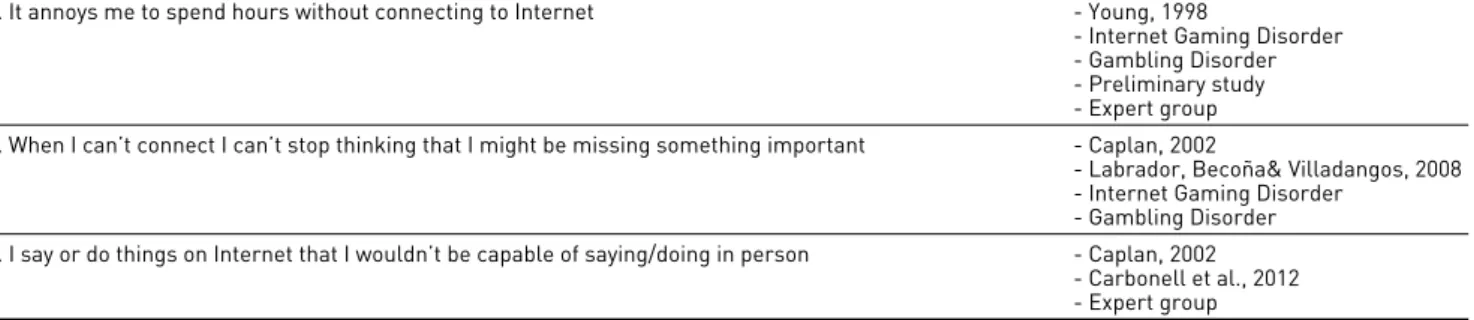
As a result of the four phases mentioned above and the three complementary strategies used, we drew up an initial version of the 14-item scale, as shown in Table1.
Table 1
Items of the scale and sources
ITEMS OF THE SCALE SOURCES
1. When I’m online I feel that time flies and hours pass without me realizing it - Beranuy et al., 2009 - Huang et al., 2007 - Preliminary study - Expert group 2. I’ve sometimes tried to control or reduce my Internet use, but I couldn’t - Echeburúa, 1999
- Young, 1996
- Internet Gaming Disorder - Gambling Disorder 3. I sometimes prefer to be online than to be with people (family or friends) - Chen et al., 2003
- García et al., 2008 - Young, 1998 - Preliminary study - Expert group 4. I’ve sometimes even managed to neglect certain tasks or perform below par (in exams, sport, etc.) - De García et al., 2008
because I put connecting to Internet first - Internet Gaming Disorder
- Preliminary study 5. I’m starting to like more and more spending hours connected to Internet - Chen et al., 2003
- Greenfield, 1999 - Internet Gaming Disorder - Gambling Disorder 6. I sometimes get irritated or in a bad mood because I can’t connect to Internet - Demetrovics et al., 2008
or because I have to disconnect - Young, 1998
- Internet Gaming Disorder - Gambling Disorder - Preliminary study 7. I prefer that my parents don’t know how long I spend online because they would think it was too much - Huang et al., 2007
- Morahan-Martin & Schumacher, 2000 - Internet Gaming Disorder
- Gambling Disorder - Expert group 8. I’ve stopped going to places or doing things that interested me before so as to connect to the Internet - Armstrong et al., 2000
- Internet Gaming Disorder - Preliminary study - Expert group 9. Connecting to the Internet helps me to not think about problems and to relax - Beranuy et al., 2009
- Huang et al., 2007 - Internet Gaming Disorder - Gambling Disorder 10. I’ve even put relationships or important things at risk because of the Internet - Beranuy et al., 2009
- De Gracia et al., 2002 - Internet Gaming Disorder - Gambling Disorder - Preliminary study
11. I’ve sometimes got into trouble because of the Internet - Caplan, 2002
- Morahan-Martin& Schumacher, 2000 - Expert group
Procedure
Data were collected in the classrooms of the schools participating in the study, in small groups (20 or less), after the corresponding instructions had been given. Co-llection of the information was carried out by the experts in drug-dependence prevention who developed the edu-cation for health programmes at the different schools, as an extra activity of the same programme, within the mo-dule on responsible use of New Technologies. A training session was held with technicians who assisted with data collection in order to standardize the procedure as much as possible and resolve any doubts at the technical level. Special emphasis was placed on the confidentiality of in-formation and anonymity of responses was guaranteed, since at no time were the adolescents asked about their names or personal information. The cooperation and consent of both the schools’ head teachers and parents’ associations were obtained. Participation in the study was completely voluntary and unpaid. Rate of refusal to par-ticipate in the study was 1.2%. Finally, it should also be pointed out that the study was approved by the Bioethics Committee of the University of Santiago de Compostela.
Data analysis
First of all we carried out a missing values analysis. Once confirmed the low percentage of missing values for each of the variables (ranging between 0% and 1.8%), and the randomness of such values, we decided to remove from the analysis those participants with missing values in any of their answers. Thus, an initial sample of 1772 adolescents became a final sample of 1709 adolescents for the analysis. We then calculated the descriptives (M, SD, skewness and kurtosis) for each scale item, as well their corrected homogeneity indices (HIc). The multivariate normal distribution was evaluated by means of the Mardia coefficient and the internal consistency with Cronbach’s alpha. To study the dimensionality or factor structure of the scale we carried out first of all an Exploratory Fac-tor Analysis (EFA), followed by a first-order ConfirmaFac-tory Factor Analysis (CFA). Given the absence of consensus-ba-sed diagnostic criteria with which to define problematic Internet use among adolescents, in order to explore the scale’s capacity for screening, we first divided the total
sample into two groups: (a) a first group whose use of Internet could be considered moderate, and (b) a second group whose use could be considered problematic (they go online every day, usually for more than 5 hours a day, and report frequent arguments with their parents for this reason). Next, based on this categorization as moderate or problematic users, we calculated the sensitivity and specificity values for different cut-off points, and comple-mentary to this, we carried out a ROC curve analysis. Fina-lly, in addition to providing the descriptive statistics of the final scale for the total sample, we made comparisons of means by the adolescents’ sex (through application of the Student t test) and age (through a one-factor ANOVA and a Tukey post-hoc comparison). All the analyses were carried out using IBM SPSS Statistics 20.0 (IBM Corp. Released, 2011) and IBM SPSS AMOS 21.0 (Arbuckle, 2012).
A large part of the decisions made on a methodologi-cal level took as a reference studies such as those of Cuen-ca-Royo, Torrens, Sánchez-Niubó, Suelves and Domin-go-Salvany (2013) or Muñiz and Fonseca-Pedrero (2008).
Results
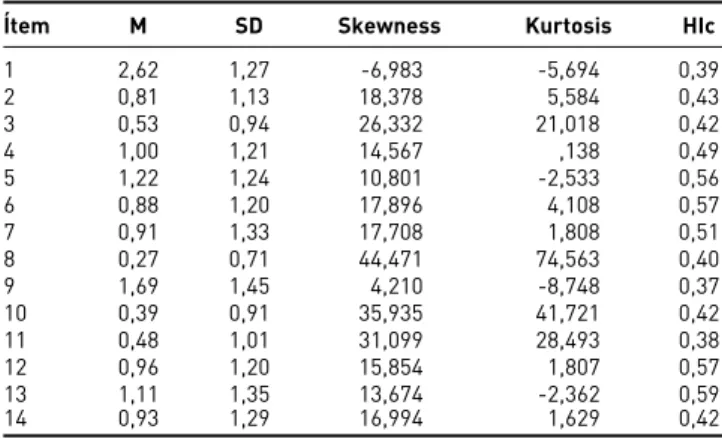
Table 2 shows the descriptive statistics for each one of the 14 items in the initial version. The highest avera-ges correspond to items 1 (When I’m online I feel that time flies and hours pass without me realizing it) with a mean of 2.62, followed by item 9 (Connecting to the Internet helps me to not think about problems and to relax), with an average of 1.69. The lowest average corres-ponds to item 8 (I’ve stopped going to places or doing things that interested me before so as to connect to the Internet), with a mean of 0.27, and item 10 (I’ve even put relationships or important things at risk because of the Internet), with 0.39. As regards the variability of res-ponses, the item that presents the most heterogeneous responses (with a standard deviation of 1.45) is item 9, while item 8 is the most homogeneous, with a standard deviation of 0.71. As regards the standardized skewness values, we can observe a marked positive skewness in all the items, except in the case of the first one, which pre-sents marked negative skewness. Regarding the kurtosis, many of the items show a leptokurtic distribution (items
12. It annoys me to spend hours without connecting to Internet - Young, 1998
- Internet Gaming Disorder - Gambling Disorder - Preliminary study - Expert group 13. When I can’t connect I can’t stop thinking that I might be missing something important - Caplan, 2002
- Labrador, Becoña& Villadangos, 2008 - Internet Gaming Disorder
- Gambling Disorder 14. I say or do things on Internet that I wouldn’t be capable of saying/doing in person - Caplan, 2002
- Carbonell et al., 2012 - Expert group (Continued from previous page)
2, 3, 6, 7, 8, 10, 11, 12 and 14), though some have a pla-tykurtic distribution (items 1, 5, 9 and 13). However, only four of the items have a value above 10, the rest falling within reasonable limits (Kline, 2005). The Mardia multi-variate normality coefficient is 77.97, which leads to rejec-tion of the multivariate normality hypothesis. The correc-ted homogeneity index (HIc) of the items ranges from .37 to .59 and the internal consistency of the initial scale is in general highly acceptable, with a Cronbach’s alpha coefficient of .83. As Pardo and Ruíz (2001) state, “values of over .80 are generally considered sound, and those of over .90, excellent” (p. 598).
To study the factor structure of the scale we began by dividing the aggregate sample into two random halves of the same size. With the first we carried out an Explora-tory Factor Analysis (EFA), and with the second, a Confir-matory Factor Analysis (CFA), in an effort to confirm or validate the structure found. It was also found that there
were no significant differences in the composition of the two subsamples, or by sex (χ2 = 0.02; p = .88), or age (t =
1.27; p = .20).
For carrying out the EFA we used the Principal Compo-nents Method. The KMO index value was .88, and that of the Bartlett Sphericity Test, 2539.47 (p <.01). The analy-sis provided three factors, which together accounted for 49.40% of the variance of the data, even though the first one explained 32.90%, the other two factors showing a much more residual character, which fits at a theoretical level with the unidimensional nature of the Gomez et al. (2014) scale that was used as a basis. Following this first analysis we conducted a CFA, starting out from a theore-tical model with a single dimension. Despite the absence of normality, for parameter estimation we used the Maxi-mum Likelihood (ML) method, since works such as those of Curran, West and Finch (1996) or Thomas and Oliver (1998) have indicated that this method is sufficiently ro-bust against non-fulfilment of this assumption when
sam-ples are large, as in this case (n = 1709). In any case, and in accordance with Levy, Martin and Norman (2006), we used complementarily other methods, such as Generalized Least Squares (GLS), Unweighted Least Squares (ULS) and Asymptotically Distribution Free (ADF), obtaining very similar results. The estimated parameters were statis-tically significant (p <.01) and the factor loadings greater than .40, except in the case of item 9 (see Figure 1).
Goodness of fit of the model was assessed by means of different indices, as recommended by Byrne (2009) or Kline (2005): χ2, χ2/df, Goodness of Fit Index (GFI), Adjusted
Goodness of Fit Index (AGFI), Comparative Fit Index (CFI), Normed Fit Index (NFI), Tucker Lewis Index (TLI) and Root Mean Square Error of Approximation (RMSEA). Following the recommendations of Steiger (1998), we also included the 90% confidence intervals in the case of RMSEA. The
different indices show that the scale fits only moderately with the unidimensional theoretical model (see Table 3). Although the GFI and AGFI values were over .90, those of the NFI, TLI and CFI were around .85, and the RMSEA value was .074. The low HIc values of some items (3, 9 and 10) and their low factor loadings (.46, .35, and .45, respectively), together with the modification indices pro-vided by the program, advised a respecification of the ini-tial model, deleting the 3 items mentioned.
Table 2
Descriptive Statistics for the Elements of the Initial Scale
Ítem M SD Skewness Kurtosis HIc
1 2,62 1,27 -6,983 -5,694 0,39 2 0,81 1,13 18,378 5,584 0,43 3 0,53 0,94 26,332 21,018 0,42 4 1,00 1,21 14,567 ,138 0,49 5 1,22 1,24 10,801 -2,533 0,56 6 0,88 1,20 17,896 4,108 0,57 7 0,91 1,33 17,708 1,808 0,51 8 0,27 0,71 44,471 74,563 0,40 9 1,69 1,45 4,210 -8,748 0,37 10 0,39 0,91 35,935 41,721 0,42 11 0,48 1,01 31,099 28,493 0,38 12 0,96 1,20 15,854 1,807 0,57 13 1,11 1,35 13,674 -2,362 0,59 14 0,93 1,29 16,994 1,629 0,42
Figure 1. Estimated standardized parameters of the Initial CFA Model
Next, on the re-specified model with only 11 elements, a new CFA was conducted, giving a better overall fit of the scale, with a GFI value of .96, AGFI, NFI, TLI and CFI values of between .92 and .95, and an RMSEA value of under .06, as recommended by Hu and Bentler (1999). It should be borne in mind that even differences below 0.1 in the GFI or AGFI can be considered as relevant (Levy, Martin, & Norman, 2006). All estimated parameters were statistically significant (p <.01) (Figure 2). Finally, the in-ternal consistency of the final scale was analyzed, yielding a Cronbach’s alpha of .82. Additionally, since the respon-se format urespon-sed was an ordered categorical scale, the ordi-nal alpha index (Elosúa & Zumbo, 2008) was calculated, yielding a slightly higher value (83).
As regards the total descriptive statistics for the final 11-item scale, for a theoretical minimum score of 0 and a maximum of 44, the average score attained for the whole sample was 11.18, and the standard deviation was 7.70. As shown in Table 4, no significant differences were found by sex, but there were differences according to age group (F = 10.32; p <.001), with a higher average on the scale in the older age groups.
To study the scale’s capacity for screening, in the ab-sence of consensus-based diagnostic which could enable us to have a clinical sample, the total sample was divided
into two groups: (a) a first group whose Internet use could be considered moderate, and (b) a second group whose use could be considered problematic. This second group would be made up those adolescents who: 1) connect the Internet every day, 2) are usually online for more than 5 hours a day, and 3) report frequent arguments with their parents for this reason. The sensitivity and specifi-city values obtained for different cut-off points are shown in Figure 3. As it can be seen, values 15 and 16 permit the attainment of a balance between these two indicators. Specifically, if we use as a cut-off point a score of 16, we obtain a sensitivity of 81% and a specificity of 82.6%. In other words, the screening instrument is capable of de-tecting true positives in 81% of cases and of rejecting true
negatives in 82.6% of cases, both results being highly ac-ceptable. By way of a complement, we carried out a ROC curve (Receiver Operating Characteristic) analysis, obtai-ning an area under the curve of 0.88.
Finally, participants’ response pattern was analyzed by comparing the profile of adolescents who make modera-te use of the Inmodera-ternet with those who use is problematic. As can be seen in Table 5, at both the global score level and that of each of the items individually, the two groups showed statistically significant differences (p <.01). This confirms the capacity of each of the items for detecting problematic Internet use and justifies their presence in the final version of the scale.
Discussion
One the main concerns among professionals and re-searchers in the field of addictions today is adolescents’ problematic use of the Internet. In this context, various authors have highlighted the need to reach a consensus, from both the conceptually and methodological points of view, on the denomination, definition and evaluation of
Table 3
Goodness of fit indicators of the CFA Model for the Screening Tool
χ2 df p χ2/df GFI AGFI NFI TLI CFI RMSEA [CI]*
Initial model 325.38 77 <.001 4.22 .93 .90 .84 .85 .87 .074 [.066-.083]
Respecified model 118.39 44 <.001 2.69 .96 .95 .92 .94 .95 .054 [.042-.065]
Note: * 90% Confidence Interval for the RMSEA statistic
Figure 2. Estimated standardized parameters of the Final CFA Model
Table 4
Comparison of total scores on the scale by sex and age M SD t p
Sex Men 10,76 7,24 -1,87 ,062
Women 11,60 8,13 M SD t p Age group 11 – 13 years 10,18 7,43 10,321 < ,001
14 – 15 years 11,78 7,92 16 – 17 years 13,18 7,61
the problem (Byun et al., 2009; Gómez et al., 2014; Ko-ronczai et al., 2011). Although there is considerable con-troversy insofar as it is not entirely clear whether we can really speak of cyberdependence or Internet addiction, the progressive emergence of cases of abuse or problema-tic use at increasingly younger ages means that those wor-king in the field of prevention need scientifically valida-ted instruments for the early detection of possible cases of risk. The aim of the present study was to make progress in the search for practical solutions in this context, through
the development and validation of a new screening tool, backed up by the knowledge accumulated over the past two decades and with proven psychometric properties.
Despite the existence of numerous previous scales, a large part of them have certain shortcomings or limita-tions, especially if our aim is to have available a tool with guarantees that would permit early detection of proble-matic Internet use among Spanish adolescents. Many of the scales developed previously have not been validated in our country, are not adapted to the adolescent
popu-Figure 3. Sensitivity and Specificity values for the different cut-off points Table 5
Comparison between adolescents with moderate use and problematic use
Item Moderate Problematic t p
use use
1 When I’m online I feel that time flies and hours pass without me realizing it 2,50 3,25 -4,59 < ,001 2 I’ve sometimes tried to control or reduce my Internet use, but I couldn’t 0,72 1,43 -3,22 < ,01 3 I’ve sometimes even managed to neglect certain tasks or perform below par (in exams, sport, etc.) 0,86 2,09 -5,67 < ,001 because I put connecting to Internet first
4 I’m starting to like more and more spending hours connected to Internet 1,12 2,32 -4,99 < ,001 5 I sometimes get irritated or in a bad mood because I can’t connect to Internet or because I have to disconnect 0,69 2,16 -6,13 < ,001 6 I prefer that my parents don’t know how long I spend online because they would think it was too much 0,72 2,32 -6,37 < ,001 7 I’ve stopped going to places or doing things that interested me before so as to connect to the Internet 0,19 0,67 -2,88 < ,01
8 I’ve sometimes got into trouble because of the Internet 0,36 1,28 -3,66 < ,001
9 It annoys me to spend hours without connecting to Internet 0,82 1,89 -4,56 < ,001
10 When I can’t connect I can’t stop thinking that I might be missing something important 0,97 2,41 -6,32 < ,001 11 I say or do things on Internet that I wouldn’t be capable of saying/doing in person 0,81 1,84 -4,09 < ,001
TOTAL 9,67 21,62 -9,70 < ,001
lation, or fail to provide data on their psychometric pro-perties. Sometimes the samples used for their validation are too small, their factor structure is unclear, they are too long, or they or simply do not provide the cut-off points needed for their used as screening instruments.
Analyses carried out with a sample of 1709 schoolchil-dren in the Spanish region of Galicia made it possible to present a new scale (PIUS-a) that may prove extremely useful for practitioners and researchers in this field. This scale was developed on the basis of a thorough re-view of the literature and enriched by the contributions from a multidisciplinary team of experts; moreover, it has highly acceptable psychometric properties, in terms of both internal consistency (α = .81), and evidence of internal structure and content, attaining an interesting balance between levels of sensitivity (81%) and specifi-city (82.6%), as far as screening capaspecifi-city is concerned. In short, the work carried out has made available to re-searchers, clinicians and community education workers a brief and simple scale (with just 11 items), adapted to the cultural context of our country and the language of
young people – qualities that lend it great potential for everyday practice.
Although in this paper we have been prudent and cho-sen to use the term problematic Internet use, it would not be unreasonable, as various authors have proposed, to employ terms such as pathological Internet use or In-ternet addiction (Durkee et al., 2012; Tsitsika et al., 2012; Young, 1996). The facts that the selection of scale items was made on the basis of previous work along these lines, that we took into account the judgements of experts in the clinical and educational spheres, and that we used as references the criteria for diagnostic categories of a simi-lar nature, makes the use of these terms quite plausible. Official recognition of a pathology associated with the use of Internet and the availability of clinical samples, as is the case in the Asian context (Huang et al., 2007; Ko, Yen, Yen et al., 2005), would help resolve these types of controversy.
Moreover, despite the unidimensionality of the scale developed, we cannot discard the possibility of a multi-dimensional approach, given the complexity of the
pro-blem at hand. However, many of the works that adopt a multidimensional approach (Günüç & Kayri, 2010; Wid-yanto & McMurran, 2004) provide a global α, which im-plicitly entails some unidimensionality. Furthermore, the fact that the calculation of an overall score and the setting of a cut-off point are necessary to enable screening for possible cases of risk makes it preferable to opt initially for the existence of a single factor.
However, this study does have some limitations. First, all the variables are self-reported, so it is impossible to know the extent to which the adolescents may have un-derestimated or overestimated their Internet use. On the other hand, self-report questionnaires on the use of alco-hol and other drugs have shown themselves to be relia-ble and even comparatively better than other detection methods in the field of substance use (Babor, Kranzler, & Lauerman, 1989; Winters, Stinchfield, Henly, & Schwartz, 1990), so that self-report measures may well be relevant in this context also. It is also true that the use of a social desirability scale or an instrument for the detection of random response patterns could of great use. Moreover, given the still-unresolved conceptual controversy and lack of consensus on the defining criteria of the problem, the sensitivity and specificity values were calculated based on criteria established by the authors, even though it must be said that they have been used in works and endorsed by the group of experts. The availability in the future of duly consensus-based criteria will be what finally permits the validation of the instruments developed, which from a purely psychometric perspective is not currently possible.
It is important to note, finally, that the scale presented constitutes a tool for screening, and never for diagnosis, as the latter must be based on the clinical act itself. Such instruments would play a complementary role, facilita-ting the early detection of adolescents whose use of the Internet could constitute a problem, on interfering in a crucial way in their everyday life. The scale is specifically designed for use by counsellors, community education workers and drug-prevention experts in the school con-text, in which it has been validated empirically. Future research would need to test its behaviour in clinical set-tings, linked in (as occurs in other countries) to primary care services.
Acknowledgements
This study was supported by the Valedor do Pobo ins-titution, a part of the Galician Regional Administration (Xunta de Galicia).
Conflicts of interests
The authors declare that there are no conflicts of in-terests.
References
American Educational Research Association, American Psychological Association & National Council on Mea-surement in Education (1999). Standards for educational and psychological testing. Washington, DC: American Ed-ucational Research Association.
American Psychiatric Association [APA]. (2013). Diagnos-tic and statisDiagnos-tical manual of mental disorders. Fifth edition. Washington, DC: American Psychiatric Publishing. Anderson, K. J. (2001). Internet use among college
stu-dents: An exploratory study. Journal of American College Health, 50, 21-26.
Arbuckle, J. L. (2012). AMOS 21.0. Crawfordville, FL: Amos Development Corporation.
Armstrong, L., Phillips, J., & Saling, L. (2000). Potential determinants of heavier Internet usage. International Journal of Human-Computer Studies, 53, 537–550.
Babor, T. F., Kranzler, H. R., & Lauerman, R. J. (1989). Early detection of harmful alcohol consumption: com-parison of clinical, laboratory, and self-report screening procedures. Addictive Behaviors, 14, 139-157.
Beard, K. W. (2005). Internet addiction: A review of current assessment techniques and potential assess-ment questions. CyberPsychology & Behavior, 8, 7-14. doi:10.1089/cpb.2005.8.7
Beranuy, M., Chamarro, A., Graner, C., & Carbonell, X. (2009).Validación de dos escalas breves para evaluar la adicción a Internet y el abuso de móvil. Psicothema, 21, 480-485.
Brenner, V. (1997). Psychology of computer use: XLVII. Parameters of Internet use, abuse and addiction: the first 90 days of the internet usage survey. Psychological Reports, 80, 879-882. doi:10.2466/pr0.1997.80.3.879 Byrne, B.M. (2009). Structural equation modeling with AMOS:
Basic concepts, applications, and programming (2nd ed.).
London: Psychology Press.
Byun, S., Ruffini, C., Mills, J. E., Douglas, A. C., Niang, M., Stepchenkova, S.,… Blanton, M. (2009). Internet addic-tion: metasynthesis of 1996-2006 quantitative research. CyberPsychology & Behavior, 12, 203–207. doi:10.1089/ cpb.2008.0102
Cao, F., & Su, L. (2007). Internet addiction among Chi-nese adolescents: prevalence and psychological fea-tures. Child: Care, Health and Development, 33, 275–281. doi:10.1111/j.1365-2214.2006.00715.x
Cao, H., Sun, Y., Wan, Y., Hao, J., & Tao, F. (2011). Prob-lematic Internet use in Chinese adolescents and its re-lation to psychosomatic symptoms and life satisfaction. BMC Public Health, 11, 802. doi:10.1186/1471-2458-11-802
Caplan, S. E. (2002). Problematic Internet use and psy-chosocial well-being: Development of a theory-based cognitive-behavioral measurement instrument. Comput-ers in Human Behavior, 18, 553–575.
Caplan, S. E. (2010). Theory and measurement of general-ized problematic Internet use: A two-step approach. Com-puters in Human Behavior, 26, 1089-1097. doi:10.1016/ j.chb.2010.03.014
Castellana, M., Sánchez-Carbonell, X., Graner, C., & Bera-nuy, M. (2007). El adolescente ante las tecnologías de la información y la comunicación: Internet, móvil y video-juegos. Papeles del Psicólogo, 28, 196-204.
Ceyhan, E., Ceyhan, A. A., & Gürcan, A. (2007). The va-lidity and reliability of the Problematic Internet Usage Scale. Educational Sciences: Theory & Practice, 7, 411–416. Chang, M. K., & Law, S. P. M. (2008). Factor structure
for Young’s Internet Addiction Test: A confirmato-ry study. Computers in Human Behavior, 24, 2597-2619. doi:10.1016/ j.chb.2008.03.001
Chen, S. H., Weng, L. C., Su, Y. J., Wu, H. M., & Yang, P. F. (2003). Development of Chinese Internet Addiction Scale and its psychometric study. Chinese Journal of Psy-chology, 45, 279–294.
Cho, H., Kwon, M., Choi, J. H., Lee, S. K., Choi, J.S., Choi, S. W., & Kim, D. -J. (2014). Development of the Internet Addiction Scale based on the Internet Gaming Disor-der criteria suggested in DSM-5. Addictive Behaviors, 39, 1361-1366. doi:10.1016/ j.addbeh.2014.01.020
Chou, C., Chou, J., & Tyan, N. N. (1998, febrero). An Ex-ploratory Study of Internet Addiction, Usage and Communica-tion Pleasure. Trabajo presentado en el Annual meeting of the Association for educational communications and technology, St. Louis, MO.
Chou, C., & Hsiao, M. C. (2000). Internet addiction, usage, gratification, and pleasure experience: The Taiwan col-lege student’s case. Computers & Education, 35, 65–80. Chow, S. L., Leung, G. M., Ng, C., & Yu, E. (2009). A
Screen for Identifying Maladaptive Internet Use. Inter-national Journal of Mental Health & Addiction, 7, 324-332. doi:10.1007/s11469-008-9170-4
Cía, A. H. (2014). Las adicciones no relacionadas a sustan-cias (DSM-5, APA, 2013): un primer paso hacia la inclu-sión de las Adicciones Conductuales en las clasificacio-nes categoriales vigentes. Revista de Neuro-Psiquiatría, 76, 210 - 217.
Cuenca-Royo, A.M., Torrens, M., Sánchez-Niubó, A., Suel-ves, J.M., & Domingo-Salvany, A. (2013). Comorbilidad psiquiátrica en jóvenes-adultos consumidores de canna-bis. Adicciones, 25, 45-54.
Curran, P. J., West, S. G., & Finch, J. F. (1996). The robust-ness of test statistics to nonnormality and specification error in confirmatory factor analysis. Psychological Meth-ods, 1, 16-29.
Davis R. A. (2001). A cognitive–behavioral model of patho-logical Internet use. Computers in Human Behavior, 17, 187–195.
Davis, R. A., Flett, G. L., & Besser, A. (2002). Validation of a new scale for measuring problematic Internet use:
impli-cations for pre-employment screening. CyberPsychology & Behavior, 5, 331–345. doi:10.1089/109493102760275581 De Gracia, M., Vigo, M., Fernández, J., & Marcó, M. (2002).
Problemas conductuales relacionados con el uso de In-ternet: Un estudio exploratorio. Anales de Psicología, 18, 273-292.
Del Miglio, C., Gamba, A., & Cantelmi, T. (2001). Cos-truzione e validazione preliminare di uno strumento UADI per la rilevazione delle variabili psicologiche e psicopatologiche correlate all’uso di Internet. Giornale Italiano di psicopatologia, 7, 293-306.
Demetrovics, Z., Szeredi, B., & Rózsa, S. (2008). The three-factor model of Internet addiction: The develop-ment of the Problematic Internet Use Questionnaire. Behavior Research Methods, 40, 563-574. doi:10.3758/ BRM.40.2.563
Douglas, A. C., Mills, J. E., Niang, M., Stepchenkova, S., Byun, S., Ruffini, C.,… Blanton, M. (2008). In-ternet addiction: Meta-synthesis of qualitative re-search for the decade 1996–2006. Computers in Hu-man Behavior, 24, 3027–3044. doi:10.1016/j.chb.2008. 05.009
Durkee, T., Kaess, M., Carli, V., Parzer, P., Wasserman, C. Floderus, B.,… Wasserman, D. (2012). Prevalence of pathological internet use among adolescents in Europe: demographic and social factor. Addiction, 107, 2210-2222. doi:10.1111/j.1360-0443.2012.03946.x
Echeburúa, E. (1999). Las nuevas adicciones: juego, sexo, comida, compras, trabajo, internet. Bilbao: Desclée de Brouwer.
Echeburúa, E., & de Corral, P. (2010). Adicción a las vas tecnologías y a las redes sociales en jóvenes: un nue-vo reto. Adicciones, 22, 91-96.
Elosúa, P., & Zumbo, B. D. (2008). Coeficientes de fiabili-dad para escalas de respuesta categórica ordenada. Psi-cothema, 20, 896-901.
Estallo, J. A. (2001). Usos y abusos de internet. Anuario de Psicología, 32, 95-108.
Estévez, L., Bayón, C., de la Cruz, J., & Fernández-Líria, A. (2009). Uso y abuso de Internet en adolescentes. En E. Echeburúa, F. J. Labrador y E. Becoña (Eds.), Adicción a las nuevas tecnologías en adolescentes y jóvenes (pp. 101-130). Madrid: Ediciones Pirámide.
Ferraro, G., Caci, B., D’amico, A., & Di Blasi, M. (2007). In-ternet Addiction Disorder: An Italian study. CyberPsychol-ogy & Behavior, 10, 170-175. doi:10.1089/cpb.2006.9972 Fortson, B. L., Scotti, J. R., Chen, Y., Malone, J., & Del
Ben, K. S. (2007). Internet use, abuse, and dependence among students at a Southeastern Regional University. Journal of American College Health, 56, 137-144.
Frangos, C. C., Frangos, C. C., & Sotiropoulos, I. (2011). Problematic internet use among Greek university stu-dents: an ordinal logistic regression with risk factors of negative psychological beliefs, pornographic sites, and
online games. Cyberpsychology, Behavior, and Social Net-working, 14, 51-58. doi:10.1089/cyber.2009.0306
Frangos, C. C., Frangos, C. C., & Sotiropoulos, I. (2012). A meta-analysis of the reliabilty of Young‘s Internet Ad-diction Test. En S. I. Ao, L. Gelman, D. W. L. Hukins, A. Hunter y A. M. Korsunsky (Eds.), Proceedings of the World Congress on Engineering: Vol. 1. The 2012 Interna-tional Conference of ComputaInterna-tional Statistics and Data Engineering (pp. 368-371). Londres, Reino Unido: Newswood Limited.
García, A., Beltrán, P., & Pérez, C. (2012). Uso y consumo de redes sociales e Internet entre los adolescentes es-pañoles. Características y prácticas de riesgo: Revisión bibliográfica. Documentación de las Ciencias de la Informa-ción, 35, 253-273.
García, J. A., Terol, M. C., Nieto, M., Lledó, A., Sánchez, S., Martín-Aragón, M., & Sitges, E. (2008). Uso y abuso de Internet en jóvenes universitarios. Adicciones, 20, 131-142.
Goldberg, I. (1995). Internet addictive disorder (IAD) diagnos-tic criteria. Retrieved from www.psycom.net/iadcriteria. html
Gómez, P., Rial, A., Braña, T., Varela, J., & Barreiro, C. (2014). Evaluation and early detection of problemat-ic Internet use in adolescents. Psproblemat-icothema, 26, 21-26. doi:10.7334/ psicothema2013.109
Greenfield, D. N. (1999). Psychological characteristics of compulsive Internet use: a preliminary analysis. CyberPsy-chology & Behavior, 2, 403-412.
Griffiths, M. (1998). Internet addiction: does it really exist? En J. Gackenbach (Ed.), Psychology and the Internet: intra-personal, interintra-personal, and transpersonal implications. New York: Academic Press.
Grohol, J. M. (1999). Internet Addiction Guide. Retrieved from http://psychcentral.com/ netaddiction/
Günüç, S., & Kayri, M. (2010). The profile of internet de-pendency in Turkey and development of internet ad-diction scales: study of validity and reliability. Hacettepe
Üniversitesi Egitim Fakültesi Dergisi, 39, 220–232. Hansen, S. (2002). Excessive Internet usage or “Internet
addiction”? The implications of diagnostic categories for student users. Journal of Computer Assisted Learning, 18, 232–236. doi:10.1046/j.1365-2729.2002.t01-2-00230.x Hawi, N. S. (2013). Arabic validation of the Internet
Addic-tion Test. Cyberpsychology, Behavior, and Social Networking, 16, 200-204. doi:10.1089/cyber.2012.0426
Hu, L., & Bentler, P. M. (1999). Cutoff criteria for fit in-dexes in covariance structure analysis: convention-al criteria versus new convention-alternatives. Structurconvention-al Equa-tion Modeling: A Multidisciplinary Journal, 6, 1-55. doi:10.1080/10705519909540118
Huang, Z., Wang, M., Quian, M., Zhong, J., & Tao, R. (2007). Chinese Internet addiction inventory: Develop-ing a measure of problematic Internet use for Chinese
college students. CyberPsychology & Behavior, 10, 805-812. doi:10.1089/cpb.2007.9950
IBM Corp. Released (2011). IBM SPSS Statistics for Windows, Version 20.0. Armonk, NY: IBM Corp.
Instituto Nacional de Estadística [INE]. (2014). Encuesta sobre equipamiento y uso de tecnologías de información y comu-nicación en los hogares (TIC- H). Madrid: Instituto Nacio-nal de Estadística. Retrieved from http://www.ine.es/ prensa/np864.pdf
Jelenchick, L. A., Eickhoff, J., Christakis, D. A., Brown, R. L., Zhang, C., Benson, M., & Moreno, M. A. (2014). The Problematic and Risky Internet Use Screening Scale (PRIUSS) for adolescents and young adults: Scale devel-opment and refinement. Computers in Human Behavior, 35, 171–178. doi:10.1016/j.chb.2014.01.035
Jenaro, C., Flores, N., Gómez-Vela, M., González-Gil, F., & Caballo, C. (2007). Problematic Internet and cell-phone use: Psychological, behavioral and health correlates. Addiction Research & Theory, 15, 309-320. doi:10.1080/16066350701350247
Kline, R. B. (2005). Principles and Practice of Structural Equa-tion Modeling (2ª ed.). New York: The Guilford Press. Ko, C. H., Yen, J. Y., Chen, C. C., Chen, S. H., & Yen,
C. F. (2005). Proposed diagnostic criteria of Inter-net Addiction for adolescents. The Journal of Nervous and Mental Disease, 193, 728–733. doi:10.1097/01. nmd.0000185891.13719.54
Ko, C. H., Yen, J. Y., Yen, C. F., Chen, C. C., Yen, C. N., & Chen, S. H. (2005). Screening for Internet addiction: an empirical study on cut-off points for the Chen Internet Addiction Scale. The Kaohsiung Journal of Medical Sciences, 21, 545-551. doi:10.1016/S1607-551X(09)70206-2 Koronczai, B., Urbán, R., Kökönyei, G., Paksi, B., Papp,
K., Kun, B.,… Demetrovics, Z. (2011). Confirmation of the three-factor model of problematic internet use on off-line adolescent and adult samples. Cyberpsychology, Be-havior, and Social Networking, 14, 657–664. doi:10.1089/ cyber.2010.0345
Labrador, F.J., Villadangos, S., Crespo, M., & Beco-ña, E. (2013). Desarrollo y validación del cuestio-nario de uso problemático de nuevas tecnologías (UPNT). Anales de Psicología, 29, 836-847. doi:10.6018/ analesps.29.3.159291
Lam, L. T., Peng, Z., Mai, J., & Jing, J. (2009). Factors as-sociated with Internet addiction among adolescents. CyberPsychology & Behavior, 12, 551–555. doi:10.1089/ cpb.2009.0036
Lam-Figueroa, N., Contreras-Pulache, H., Mori-Quispe, E., Nizama-Valladolid, M., Gutiérrez, C., Hinostroza-Cam-posano, W.,... Hinostroza-CamHinostroza-Cam-posano, W.D. (2011). Adicción a Internet: desarrollo y validación de un instru-mento en escolares adolescentes de Lima, Perú. Revista Peruana de Medicina Experimental y Salud Pública, 28, 462-469. doi:10.1590/S1726-46342011000300009
LaRose, R., Lin, C.A., & Eastin, M. S. (2003). Unregulated Internet Usage: Addiction, Habit, or Deficient Self-Reg-ulation? Media Psychology, 5, 225-253. doi:10.1207/ S1532785XMEP0503_01
Lee, K., Lee, H. K., Gyeong, H., Yu, B., Song, Y. M., & Kim, D. (2013). Reliability and validity of the Korean version of the Internet Addiction Test among college students. Journal of Korean Medical Sciences, 28, 763-768. doi:10.3346/jkms.2013.28.5.763
Lévy, J.P., Martín, M.T., & Román, M.V. (2006). Optimiza-ción según estructuras de covarianzas. En J.P. Lévy & J. Varela (Eds.), Modelización con estructuras de covarianzas en ciencias sociales (pp. 11-30). A Coruña: Netbiblo. Li, L., & Yang, Y. (2007). The development and validation
of Adolescent Pathological Internet Use Scale. Acta Psy-chologica Sinica, 39, 688- 696.
Lopez-Fernandez, O., Freixa-Blanxart, M., & Honrubia-Se-rrano, M. L. (2013). Problematic Internet Entertain-ment Use Scale for Adolescents: prevalence of problem Internet use in Spanish high school students. Cyberpsy-chology, Behavior, and Social Networking, 16, 108-118. doi:10.1089/cyber.2012.0250
Matute, H. (2001). La adicción a Internet no existe. Retrieved from http://eciencia.com/blog/ divulgacion/la adic-cion a internet_no_existe_195/
Meerkerk, G. J., Van Den Eijnden, R. J. J. M., Vermulst, A. A., & Garretsen, H. F. L. (2009). The Compulsive Internet Use Scale (CIUS): Some psychometric prop-erties. CyberPsychology & Behavior, 12, 1-6. doi:10.1089/ cpb.2008.0181
Mitchell, K. J., Sabina, C., Finkelhor, D., & Wells, M. (2009). Index of problematic online experiences: Item charac-teristics and correlation with negative symptomatology. CyberPsychology & Behavior, 12, 707–711. doi:10.1089/ cpb.2008.0317
Morahan-Martin, J., & Schumacher, P. (2000). Incidence and correlates of pathological Internet use among col-lege students. Computers in Human Behavior, 16, 13–29. Moreno, M. A., Jelenchick, L., Cox, E., Young, H., &
Chris-takis, D. A. (2011). Problematic Internet Use among US youth: A systematic review. Archives of Pediatrics & Ado-lescent Medicine, 165, 797-805. doi:10.1001/archpediat-rics.2011.58
Muñiz, J., & Fonseca-Pedrero, E. (2008). Construcción de instrumentos de medida para la evaluación universita-ria. Revista de Investigación en Educación, 5, 13-25. Nichols, L. A., & Nicki, R. (2004). Development of a
psy-chometrically sound Internet Addiction Scale: a prelim-inary step. Psychology of Addictive Behaviors, 18, 381-384. doi:10.1037/0893-164X.18.4.381
Oliva, A., Hidalgo, M. V., Moreno, C., Jiménez, L., Jimé-nez, A., Antolín, L., & Ramos, P. (2012). Uso y riesgo de adicciones a las nuevas tecnologías entre adolescentes y jóvenes andaluces. Sevilla: Editorial Agua Clara.
Orman, M. (1996). Internet Stress Scale o test d’Orman. Re-trieved from http://www.stresscure.com/hrn/addic-tion.html
Pardo, A., & Ruíz, M. A. (2001). SPSS 11. Guía para el aná-lisis de datos. Madrid: McGraw-Hill.
Petry, N. M., & O’Brien, C. P. (2013). Internet gaming disorder and the DSM-5. Addiction, 108, 1186–1187. doi:10.1111/add.12162
Pratarelli, M. E., Browne, B. L., & Johnson, K. (1999). The bits and bytes of computer/Internet addiction: A fac-tor analytic approach. Behavior Research Methods, Instru-ments, & Computers, 31, 305-314.
Puerta-Cortés, D. X., & Carbonell, X. (2014). El modelo de los cinco grandes factores de personalidad y el uso problemático de Internet en jóvenes colombianos. Adic-ciones, 26, 54-61.
Puerta-Cortés, D. X., Carbonell, X., & Chamarro, A. (2013). Análisis de las propiedades psicométricas de la versión en español del Internet Addiction Test. Trastor-nos Adictivos, 14, 99-104.
Pulido-Rull, M. A., Escoto-de la Rosa, R., & Gutiérrez-Val-dovinos, D. M. (2011). Validez y confiabilidad del Cues-tionario de Uso Problemático de Internet (CUPI). Journal of Behavior, Health & Social Issues, 3, 25–34. doi:10.5460/jbhsi.v3.1.27681
Rial, A., Gómez, P., Braña, T., & Varela, J. (2014). Actitu-des, percepciones y uso de Internet y las redes sociales entre los adolescentes de la comunidad gallega (Es-paña). Anales de Psicología, 30, 642-655. doi: 10.6018/ analesps.30.2.159111
Rotunda, R. J., Kass, S. J., Sutton, M. A., & Leon, D. T. (2003). Internet use and misuse. Preliminary findings from a new assessment instrument. Behavior Modifica-tion, 27, 484-504. doi:10.1177/0145445503255600 Ruiz-Olivares, R., Lucena, V., Pino, M. J., & Herruzo, J.
(2010). Análisis de comportamientos relacionados con el uso/abuso de Internet, teléfono móvil, compras y juego en estudiantes universitarios. Adicciones, 22, 301-310.
Sánchez-Carbonell, X., Beranuy, M., Castellana, M., Cha-marro, A., & Oberst, U. (2008). La adicción a Internet y al móvil: ¿moda o trastorno? Adicciones, 20, 149-160. Scherer, K. (1997). College life on-line: healthy and
un-healthy Internet use. Journal of College Student Develop-ment, 38, 655-665.
Shapira, N. A., Lessig, M. C., Goldsmith, T. D., Szabo, S. T., Lazoritz, M., Gold, M. S., & Stein, D. J. (2003). Problematic internet use: Proposed classification and diagnostic criteria. Depression and Anxiety, 17, 207–216. doi:10.1002/da.10094
Smahel, D., Helsper, E., Green, L., Kalmus, V., Blinka, L., & Ólafsson, K. (2012). Excessive internet use among Euro-pean children. London: EU Kids Online, London School of Economics & Political Science.
Spada, M. M. (2014). An overview of problematic In-ternet use. Addictive Behaviors, 39, 3-6. doi:10.1016/ j.addbeh.2013.09.007
Steiger, J. H. (1998). A note on multiple sample extensions of the RMSEA fit index. Structural Equation Modeling: A Multidisciplinary Journal, 5, 411-419.
Tao, R., Huang, X., Wang, J., Zhang, H., Zhang, Y., & Li, M. (2010). Proposed diagnostic criteria for inter-net addiction. Addiction, 105, 556–564. doi:10.1111/ j.1360-0443.2009.02828.x
Thatcher, A., & Goolam, S. (2005). Development and psy-chometric properties of the Problematic Internet Use Questionnaire. South African Journal of Psychology, 35, 793-809.
Tomás, J. M., & Oliver, A. (1998). Efectos de formato de respuesta y método de estimación en el análisis factorial confirmatorio. Psicothema, 10, 197-208.
Tsai, C. C., & Lin, S. S. J. (2001). Analysis of attitudes to-ward computer networks and Internet addiction of Tai-wanese adolescents. CyberPsychology & Behavior, 4, 373-376. doi:10.1089/109493101300210277
Tsitsika, A., Tzavela, E., Mavromati, F., & el consorcio EU NET ADB. (Ed.). (2012). Research on Internet addictive behaviours among European adolescents (Proyecto EU NET ADB). Athens: National and Kapodestrian University of Athens.
Valedor do Pobo. (2011). Informe extraordinario: Adolescentes e Internet en Galicia. Santiago de Compostela: Valedor do Pobo. Retrieved from http://www.valedordopobo.com/ index.php?s=115&i=104&l=es
Watters, C. A., Keefer, K. V., Kloosterman, P. H., Summer-feldt, L. J., & Parker, J. D. A. (2013). Examining the structure of the Internet Addiction Test in adolescents: A bifactor approach. Computers in Human Behavior, 29, 2294-2302.
Widyanto, L., & McMurran, M. (2004). The psychometric properties of the Internet Addiction Test. CyberPsychology & Behavior, 7, 443-450. doi:10.1089/1094931041774578 Winters, K. C., Stinchfield, R.D., Henly, G.A., & Schwartz,
R.H. (1990). Validity of adolescent self-report of alcohol and other drug involvement. International Journal of the Ad-dictions, 25, 1379-1395. doi:10.3109/10826089009068469 Yang, S. C., & Tung, C. -J. (2007). Comparison of Inter-net addicts and non-addicts in Taiwanese high school. Computers in Human Behavior, 23, 79–96. doi:10.1016/j. chb.2004.03.037
Young, K. S. (1996, August). Internet addiction: The emergence of a new clinical disorder. Work presented at the 104th
An-nual Convention of the American Psychological Associa-tion, Toronto, Canadá.
Young, K. S. (1998). Caught in the Net: How to recognize the signs of Internet addiction and a winning strategy for recovery. New York, NY: John Wiley & Sons, Inc.
Yuen, C. N., & Lavin, M. J. (2004). Internet depen-dence in the collegiate population: the role of shyness. CyberPsychology & Behavior, 7, 379 – 383. doi:10.1089/1094931041774587
Yuen, C. N. y Lavin, M. J. (2004). Internet dependence in the collegiate population: the role of shyness. CyberPsychology & Behavior, 7, 379 – 383. doi:10.1089/1094931041774587
Appendix. Table A1 Compilation of the most relevant assessment tools or screening instruments published YEAR AUTHORS INSTRUMENTS COUNTRY VALIDATION SAMPLE CONSTRUCT Nº ITEMS Nº FACTORS 1995 Goldberg
Internet Addiction Disorder scale
– Qualitative scale USA -Internet addiction 7 criteria -1996 Orman
Internet Stress Scale (ISS)
USA -Internet addiction 9 YES/NO items -1996 Young
Young’s Diagnostic Questionnaire
(YDQ)
USA
496 participants online (Adult popula
-tion) Internet addiction 8 YES/NO items 1 1997 Brenner Internet-Related Addicitive Be
-havior Inventory (IRABI)
USA
563 users (Mean age: 34 years)
Internet addiction
32 TRUE/FALSE items
1
1997
Scherer
Clinical symptoms of Internet
dependency (CSID) USA 531 university students Internet dependence 10 clinical symptoms -1998
Chou, Chou & Tyan
Chinese Internet-Related Addic
-itive Behavior Inventory version I
(C- IRABI- I)
Taiwan
104 participants online (Mean age:
22,3 years; SD = 3.13) Internet addiction 32 TRUE/FALSE items 1 1998 Griffiths
Addiction Core components
criteria
UK
5 case studies (ages 15 to 35 years)
Addiction 6 principal components of addiction -1998 Young
Internet Addiction Test (IAT)
USA
-Internet addiction
20 items (Likert 5-point scale)
-1999
Pratarelli, Browne
& Johnson
Computer Use Survey
USA
341 university students (Mean age: 22.8
years; SD = 5.88) Internet addiction 55 items 4 1999 Greenfield
Virtual Addiction Survey (VAS)
USA
& Canada
17251 participants online
Compulsive Internet use
36 YES/NO items
-1999
Echeburúa
Test de Adicción a Internet
Spain -Internet addiction 9 YES/NO items -2000
Chou & Hsiao
Chinese Internet-Related Addici
-tive Behavior Inventory version II
(C- IRABI- II)
Taiwan
910 university students (Mean age:
21.11 years;
SD
= 210)
Internet addiction
37 items (Likert 4-point agreement
scale)
6
2000
Morahan-Martin &
Schumacher
Pathological Internet Use Scale
(PIUs)
USA
277 university students (Mean age:
20.72 years;
SD
= 2.35)
Pathological Internet use
13 TRUE/FALSE items
-2000
Armstrong et al.
Internet Related Problem Scale
(IRPS)
Australia
50 participants (75% aged 25 to 30
years)
Internet addiction
20 questions (Likert 10-point
agreement scale)
-2001
Tsai & Lin
Internet Addiction Scale for Tai
-wan high school students (IAST)
Taiwan
753 secondary-school students (Age
range: 16-17 years)
Internet addiction
29 items (Likert 4-point scale)
4 2001 Anderson Sin nombre USA 1302 university students Internet dependence 7 YES/NO items -2001
Del Miglio, Gamba &
Cantelmi
Use, Abuse and Dependence on the Internet inventory (UADI
scale)
Italy
244 participants (Age range: 13-57
years; Mean age: 28.7 years)
Internet dependence
75 items (Likert 5-point scale)
5
2002
Caplan
Generalized Problematic Internet
Use Scale (GPIUS)
USA
386 university students (Age range: 18- 57 years; Mean age: 20 years;
SD
= 2.22)
Generalized problema
-tic Internet use
29 items (Likert 5-point agreement
scale)
YEAR AUTHORS INSTRUMENTS COUNTRY VALIDATION SAMPLE CONSTRUCT Nº ITEMS Nº FACTORS 2002 Davis et al.
Online Cognition Scale (OCS)
Canadá
211 Psychology students (Mean age:
21.73 years;
SD
= 4.4)
Problematic Internet use
36 items (Likert 7-point
agreement scale)
4
2002
De Gracia, Vigo, Fer
-nández & Marcó
Problemas Relacionados con
Internet (PRI)
Spain
1664 Self-selected internauts (Age
range: 15- 54 years)
Problematic Internet use
19 items
(Likert frequency scale)
-2003
LaRose et al.
Deficient Internet self-regulation
USA
465 university students
Unregulated Internet use
7 items (Likert 7-point scale)
-2003
Rotunda, Kass, Sut
-ton & Leon
Internet Use Survey (IUS)
USA
393 university students (Age range:
18-81 years; Mean age: 276 years)
Abuse of Internet
Impairment index
of the IUS:
32 items (Likert 5-point
frequency scale)
4
2003
Chen et al.
Chinese Internet Addiction Scale
(CIAS)
Taiwan
-Internet addiction
26 items (Likert 4-point scale)
5
2004
Yuen & Lavin
No name
USA
283 university students (adults
Internet dependence
7 items adapted from the DSM- IV criteria for substance dependence (Likert 5-point agreement scale)
-2004
Nichols & Nicki
Internet Addiction Scale (IAS)
Canada
233 university students
Internet addiction
31 items (Likert 5-point frequency
scale)
1
2004
Widyanto
& McMurran
Internet Addiction Test (IAT)
UK
86 participants online (Age range: 13-67 years; Mean age men: 25.45 years (
SD = 8.91); Mean age women: 31.44 years ( SD = 10.34)) Internet addiction
20 items (Likert 5-point scale)
6
2005
Beard
Screening Interview Assessing Problematic Internet Use
USA
-Problematic Internet use
72 questions
-2005
Thatcher & Goolam
Problematic Internet Use Ques
-tionnaire (T- PIUQ)
South Africa
Pilot study: 279 participants; Validation:
1795 participants
Problematic Internet use
20 items (Likert 5-point scale)
3
2007
Fortson, Scotti, Chen, Malone & Del Ben Reported Behaviors Related to Internet Abuse and Dependence
USA
411 university students (Age range: 18-56 years;
Mean age: 20.4 years;
SD
= 3.2)
Internet abuse and/or
dependence
9 items (Likert scale)
-2007
Li & Yang
Adolescent Pathological Internet
Use Scale
China
1331 secondary-school students and 30 Adolescents diagnosed as pathological
users
Pathological Internet
use
38 items (Likert 5-point scale)
6
2007
Ceyhan et al.
Problematic Internet Usage Scale
(PIUS)
Turkey
1658 university students
Problematic Internet use
33 items (Likert 5-point scale)
3
2007
Huang et al.
Chinese Internet Addiction
Inventory (CIAI)
China
Study 1: 516 university students
(Age range: 17-24 years; mean age: 20.5 years;
SD
= 1.47); Study 2:
513 university students (Age range:
17-24 years; Mean age: 20.7
years; SD = 1.51); Study 3: 54 partici -pants (27 clinical sample) Internet addiction
31 items (Likert 5-point frequency
scale)