Curricular Development for Engineering Education to Meet the
Challenges of the XXI Century from a Complexity Perspective
Luis Fernando Cruz MD., Ph.D.
Wilfrido Moreno Ph.D., P.E.
Abstract
The development of science and technology in the last fifteen years has shown new dimensions of reality characterized by complex interactions on the physical, quantum, biological, cognitive, social and ecological areas, enabling new ways of producing information and knowledge. This paper aims to show a framework of a new curricular development approach that is based on the paradigm of complexity that shall meet the knowledge needs of the society of the XXI century. This proposed framework highlights the importance and the responsibility of engineering within the techno-scientific and social context, the role that the new engineer represents, the required skills and the new role that the university faculty member must play to facilitate meaningful learning. It is presently being evaluated for implementation at the Department of Electrical Engineering, University of South Florida (USF) – Tampa, Florida in collaboration with the College of Education at the Universidad del Bosque – Bogotá, Colombia.
Keywords: engineering curriculum, transdisciplinarity, education, curriculum, complexity, engineering, assessment, educational modeling and simulation
1. I
NTRODUCTIONThe contemporary society is characterized by globalization, technological development, dynamic change, multiculturalism, the complexity of its phenomena and the rapid creation of knowledge [1]. Its challenges are sustainability, quality of life and survival on the planet, and to solve them will require a joint effort of states, communities and organizations from different sectors including the need for collaboration among university, industry and society. In this context, engineering plays a leading role in innovation and creation of systems, processes, devices, equipment and cutting-edge technology, as well as the practical application of solutions that improve the living conditions for the community [2]. Therefore, the contemporary society’s responsibility is not just techno-scientific, but also social, humanistic and ethical. This goal is achieved through appropriate educational processes that stimulate the formation of future engineers in a comprehensive manner so that they are prepared to respond to the new challenges of the XXI century. Education seeks to respond to the needs and demands of society in a historical moment. To be effective, its epistemological fundamentals must be consistent with the scientific development and the evolution of educational processes [3]. Pedagogical models and curricular strategies for engineering programs must go hand in hand with the way knowledge is produced.
2. E
DUCACIONALE
VOLUTION ANDC
URRICULUMEducational research and curriculum processes have evolved in their scientific basis through different epistemological orientations covering new aspects of teaching and learning processes [4] [5] [6]. Education went from being a pedagogical and didactic guidance of medieval roots characterized by historical and philosophical reflection, focusing on rhetoric and content delivery, to a scientific approach focused on the needs of the technological, industrial and social development of modernity, mediated by educational technology, assessment and curricular guidance [7].
Curriculum is defined as the scientific study of academic programs starting from a need analysis to the design of effective graduate profiles, program/course objectives, content, sequencing, methodologies and learning assessment. In addition, a well-designed curriculum gives educational processes a scientific foundation that would allow for efficiency, efficacy and effectiveness in the workplace and industry within a specific social, political, economic and cultural context. Curriculum becomes the strategic platform within this framework to achieve objectives focused on planning, forecasting and control, responding to the needs of the industrialized and modernized world (beyond the educational discourse) [8] [9] [10]. Its design and operationalization was possible thanks to the support of engineering processes that favored its implementation. According to Bobbitt, [8] author of the first text on curriculum, the function of the person(s) in charge of preparing curriculum follows a systematic approach just like an engineer follows for identifying, formulating and solving engineering problems.
Although this approach has been effective for many of the purposes above, it has relegated the university professor from the educational thinking of the academic community and its active role in the design of teaching and learning processes, leading him/her on many occasions, to a decontextualized and mechanical educational technification with a negative impact on the formation of university students, who do not respond effectively to the labor force and social needs. To correct the deficiencies found in the pedagogical limitations of the scientific method and optimize the teaching and learning processes in the last decades of the twentieth century, educational research epistemologically focused on social-critical, historical-hermeneutic and
systemic approaches, taking into account the context, the inter-subjectivity, the interrelation and the understanding of educational phenomena [11] [12]. Even though these epistemological approaches are more holistic and flexible, the curriculum design still remain linear and does not adequately respond to the complex phenomenal inherent to the challenges of sustainability. The postmodern society of the XXI century is characterized by constant change, multiculturalism, uncertainty, instability, plurality, rapid advance of the society of knowledge, swift scientific and technological development [1], and due to the understanding of the complexity of reality, as evidenced by the different disciplines (complex mathematics, quantum physics, artificial life, biological computation, genetic engineering and cognitive neurosciences, among others). It therefore requires an education with pedagogical approaches supported by theoretical fundamentals that are consistent with the new understanding of scientific knowledge [3], a reformulation of curriculum processes based on a complex epistemology that complements the previous approaches.
To generate the design and implementation of new curricular strategies, we must first clearly understand the paradigm on which the theoretical or conceptual foundations are based, the trends and curriculum models. It requires a culture change in the academic community and specifically the faculty (the main barrier to change) [13].
3. Towards a New Curricular Paradigm
The reality at its different levels and phenomena, as evidenced by the emerging paradigm of complexity, is characterized by linear processes that suffer ruptures, bifurcations and fluctuations, whose interactions engender new patterns or structures that self-organize [14] [15]. These sudden changes or chaotic situations occur in an area of uncertainty, irreversibility and randomness that are difficult to predict [16]. These processes are part of other major systems with which there is permanent exchange of energy under a dynamic stability. It is a disorder that creates order through the interaction of multiple factors in constant motion. Thanks to the bifurcations and the turbulences, superior organization forms (evolution) are possible with different dynamics [17].
From the pedagogical point of view, turbulence and chaos are sources of creativity, evolution and organization. The important thing is to identify and understand the collective structures that emerge from the interactions. The order is not imposed as in the traditional Taylorist curriculum but it arises from the dynamics itself [17]. Complexity works with future possibilities and is not based on certainties [14].
The study of complex phenomena does not rule out the linear phenomena that occur in the different dynamics, but rather integrates them. The important thing is to know when the linearity of the curriculum process suffers breakdowns and becomes disorganized. The challenge for education in the XXI century is to design new curricular dynamics that respond to the complexity of reality.
4. Curriculum
The curriculum shows the institutional road map to be followed for the formation of the students; guiding the design of the learning environments. It encompasses the group of organizing elements from which the study plans are defined. It is the backbone of the educational process [18] [19]. It should be integrated with the mission and learning objectives of the department, the
academic strategic plan of the university, the institutional pedagogical model and the legal framework.
Curriculum development is a complex adaptive system that integrates many elements such as resources, information, context, people and processes. Although Bobbit [8] [20], Charters [9] and Tyler [10]established different curriculum models that vary in structure as those of Taylor [21], Taba [22], Johnson [23], Perez [24], Stenhouse, [25] Wheeler [26], Sacristan [27] and Zubiria [28], among others. They all have tranversal elements, such as: educator, student, context, purpose or meaning, content, thematic axes, sequencing, methodologies or mediations that favor instruction, educational experiences, didactic resources and assessment. These elements interact with each other and any variation in a factor impacts on the whole.
The curriculum seeks to address the same questions of pedagogical models at a lower level of abstraction and generalization [28]. However, the pedagogical models are designed in a linear
and sequential manner and "their expressed intent has not been to describe or penetrate the
essence of teaching itself, but to regulate and standardize the educational process" [29].
5. Curriculum Model in Engineering from a Complex Approach
5.1. PurposeTo meet the challenges of contemporary society and its complexity, engineering programs require comprehensive and flexible curriculum designs that provide the student with adequate education for the new context. It involves mechanisms to read trends (local, regional and global) and understand the dynamics that occur in the relationship among industry, society and academia on the basis of the identification of needs, shortages and demands of the communities [30]. This requires the development of three core competences:1) identify and understand complex phenomena or behavior, 2) formulate problems including managing uncertainty and nonlinear processes, y 3) solve engineering problems.
The above described context requires from the engineer a capability to adapt to changes in the globalized world, to the rapid advance of science &technology and ambiguous/unpredictable open work force conditions [31] [32]. In addition, it will require the ability to work in teams with a multicultural, interdisciplinary and transdisciplinary [33] approach since society's problems cannot be solved by isolated disciplines. Nowadays, it is a must to actively participate in existing networks [34] in order to be part of learning and leadership communities from all over the world.
Contemporary education does not emphasize on the amount of content and its vertical transmission from educator to student, but rather on the management and intelligent economy of knowledge, to learn to learn throughout life, to be able to select the essential and apply it in a practical manner to solve problems [30], a useful knowledge that allow know-how in context
[35] and. “taking into account the specific requirements of the surroundings, personal needs,
processes of uncertainty, with intellectual autonomy, critical consciousness, creativity and spirit of challenge, accountability and looking for human well-being"[36]. Consequently, higher education learning should be based on active learning, mediated didactically by contexts from the work force and social reality via projects, problem-based learning and perform simulations to analyze possible futures scenarios.
The engineer of the future must know the basic aspects of the different sciences and disciplines, including humanity, arts & social sciences, as the only way to reach true transdisciplinarity [37].The future engineer will require, among others, knowledge of complex mathematics,
quantum physics, biology, genetics, neuroscience, informatics and cyber computing. In fact, converging technologies of the XXI century, nano-bio-info-cogno, involve knowledge in these areas [38]. However, in addition to taking the abstract knowledge of science and apply it with viable, feasible and achievable actions to solve practical problems, it must be highly creative, original and innovative [39]. Finally, the education of the future engineer would be incomplete without a resilient foundation in values, ethics, community engagement, and social sensitivity & responsibility.
5.2. 5.2.1.
Curricular Structure and Dynamics Description
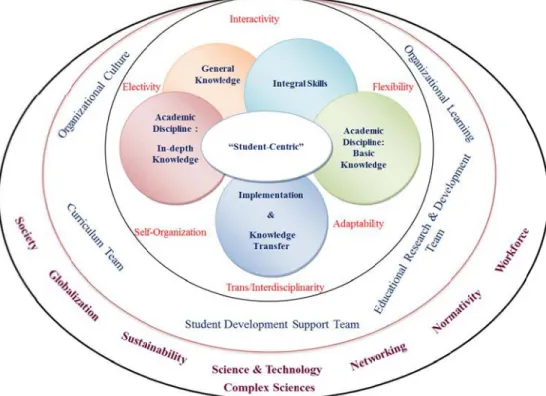
With respect to the purpose of education stated above, the design and implementation of the curriculum structure from a complex approach starts from a culture change in the academic community led by the top academic administrators of the university. It must be participatory and significant, to not generate pseudo changes [13], dynamic, nonlinear and open to futures changes and trends; and subject to processes of continue and dynamic research. The proposed curriculum system is composed of different interrelated units that constantly interact with each other, giving feedback among the mand generating diverse patterns of self-organization. There are five interrelated development units, namely: General knowledge, skills, basic knowledge by discipline, in-depth knowledge by discipline, and apply and transfer knowledge, see figure 1.Each unit has defined competencies in the Self (human dimension, respect, multiculturalism, teamwork), in the knowledge (basic knowledge), in the Know-How (application, problem solving, proposals, projects, simulations), and in the learning to learn (autonomy, accountability, needs assessment, selection, search skills and reading comprehension, communication, second and third language).
The units are developed with different methodologies that promote autonomous learning, collaborative work and particular guided learning. They have a great level of flexibility, interdisciplinarity and adaptability. Each handles thematic axes that focus on high electivity credits, which allows students to design their dynamic education based on their needs, inclinations and interests, according to a minimum structure given by the department.
Each unit has thematic axes that should be seen by the students according to their level within their program of study with the compliance with defined competencies, but with a great degree of electivity and interdisciplinarity. From the interactions between the subjects taken from the different units or possible external factors, it could lead to situations not foreseen by the student or by the university, which could be of personal, motivational, group related, social, cognitive and learning nature, marked by uncertainty and chaos. These situations must be properly attended during the complete program of study by mentors, teachers, counselors or coordinators, members of the student development support team. This group identifies problems, provides advice and explores possibilities together with the student, so that he/she can make adjustments or carry out new interactions within a specific unit or between different units if applicable. Students have the responsibility to restructure their own curriculum process under the guidance of the student development support team.
A student may develop skills in several units at the same time, for example: cognitive processes of creativity and innovation while working in networks, communication skills and decision making. These skills can be strengthen, adjusted or new combinations could be formed from more or less units and skills according to the case. The key is in the reading of the emerging patterns that these interactions generate in the students which are manifested in his/her Self Being, in his/her knowledge, and in his/her Know-how. Based on these three elements, new pedagogical strategies can be designed. These pedagogical strategies are personalized and based on each particular student. There are not rigid structures but dynamic and ever-changing.
The proposed curriculum framework is presently being evaluated for implementation at the Department of Electrical Engineering, University of South Florida (USF) – Tampa, Florida in collaboration with the College of Education at the Universidad del Bosque – Bogotá, Colombia.
5.2.2. Curriculum Team
The curriculum team, formed from an interdisciplinary perspective, integrates representatives of the academic community such as mentors, advisors, program coordinators and students. The curriculum team is responsible for designing, implementing, monitoring, assessment and continuously adjusting the curricular structure. The members of the Committee must have the ability to identify individual and collective behavior patterns. The different detected phenomena are investigated by the educational research & development team of each department via research projects involving students. Therefore, all members must be trained in complex educational behaviors &systems. The committee is actively interconnected with the student development support team and the different committees of other departments around the units. The members of the Committee must have pedagogical and complex systems knowledge for being the paradigm on which the model is structured.
5.2.3. Student Development Support Team
It aims to provide permanent assistance to students in specific difficulties of personal nature such as adaptability, motivation and stress or academic nature such as self-learning, study skills and basic skills reinforcement. It is also responsible for monitoring the complex behavior of curriculum dynamics. It sends feedback to the curriculum committee.
5.3. Development Units 5.3.1. General Knowledge Unit
A unit that is concerned with offering comprehensive academic fundamentals that prepares the student in the necessary knowledge to face the challenges of the XXI century. These challenges are characterized by multiculturalism, globalization and the need to perform transdisciplinary collaboration. It includes basic concepts of social, biological and human sciences, ethics and values in addition to a historical and contemporary view of society. It analyzes the political, economic and socio-cultural knowledge at the local, regional, and global levels. The concepts of the unit allow for the understanding of the articulation of the world and its different interactions, with emphasis on the relationship between knowledge, industry and society.
General knowledge is cross-cutting to the program of study and it is designed in thematic axes that are carried out by required and elective courses. In each thematic axis there a significant number of electives that meet the inclinations and needs of the student.
5.3.2. Integral Skills Unit
It is divided into four groups of skills, namely: cognitive - linear and nonlinear, emotional and social intelligence, languages and arts and physical skills. The skills require a level of competence. It is a cross-cutting process to the study program that requires time and dedication. Cognitive skills include structuring and optimization processes of oral and written communication that seeks the development of linear mental operations of synthesis, argumentation, analysis, categorization, conceptualization, critical thinking, symbolic analysis, and mathematical reasoning; and nonlinear mental operations given by learning processes aimed at creating new neurobiological computing networks that enable the identification and solution of complex problems. This training is required to develop creativity and innovation.
Emotional and social intelligence skills such as assertiveness, effective communication, empathy, teamwork, intrapersonal - interpersonal and social competencies; skills in a second and third languages and ultimately artistic skills that complement the comprehensive training such as music, painting, dance etc...and physical skills. Based on the student skill evaluations, this unit allows strengthening weak areas in the integral formation of the student by taking the respective necessary courses.
5.3.3. Academic Discipline: Basic Knowledge Unit
It has to do with the necessary knowledge required for the basic conceptual organization of engineering. It relies on the transfer of knowledge: useful, necessary and sufficient by the educator in an inter-structuring pedagogical climate of empathy, participation, reflection,
analysis and debate. Core competencies, at its first level, are available to apply knowledge and solve linear and complex problem.
5.3.4. Academic Discipline: In-depth Knowledge Unit
It expands on basic knowledge according to the proposed outcomes and educational needs. Specific competencies, at its second level, are available to apply knowledge and solve linear and complex problem including access to laboratories, simulations tools, academic internships and co-op opportunities.
5.3.5. Implementation and Knowledge Transfer Unit
This unit is mainly focus on the application of knowledge in specific contexts according to the lines of research of the department. It includes networking, internships, inter and transdisciplinary research projects, creation and innovation, modeling and simulation processes [40]. Specific competencies, at its third level, are available to apply knowledge and solve non- linear and complex problem. At this level it is required the development of neurobiological computing processes to solve complex problems.
5.4. Teaching and Learning Processes of the Curriculum Structure
For the curriculum process to be satisfactory, the methodological strategies used must be consistent with the same epistemological orientation based on the paradigm of complexity, i.e., they cannot be linear. In this sense, although there is a set of reference competencies to be developed, there are several ways to achieve them. The dynamics that occur in the classroom are numerous and diverse and of multiple possibilities depending on the interactions that emerge at a certain time, thus teaching cannot be pre-established in rigidly planned models.
The educator must manage the instability and uncertainty in the classroom. It requires training in complex systems in order to identify the patterns and bifurcations that are generated in the interaction between educator, student, content, and context. It must be able to mediate the neurological dynamics resulting from such inter-subjectivity in order to bring the student into a state of cognitive efficiency that facilitates the integration, transformation and application of knowledge in creative processes and meaningful learning [3]. According to the specific situation, learning scenarios are designed and contemporary didactics strategies can be used and adjusted to best suit the needs, e.g. problem-based learning and/or projects, simulations, laboratories and independent and collaborative work among others. Therefore, the educator is a mediator of the teaching and learning processes. He/she helps the student execute his/her potentiality.
5.5. Evaluation
The curriculum is evaluated in terms of purpose, process and impact across different axes such as the curriculum committee, student development support team, development units, the academic community and society in general. The academic or education evaluation is cross- cutting to the development of interactions and it includes self-assessment processes, and hetero- evaluation and co-evaluation, taking into account the units, competencies and educational purposes.
5.6. Possibilities of the Curriculum Structure.
Nonlinear curriculum dynamics mediated by comprehensive development units based on competencies, student development support team, clear training axes, dynamic system of credits, interdisciplinarity, electivity, adaptability, interactivity and flexibility allow for different academic options, such as the initial exploration by the student before deciding for an engineering program, program transfer, restructuring and adjustment of the curriculum structure, curriculum design and adjustment by the student, Co-ops and internships, dual and 5-year programs and networking.
6.
ConclusionTo address the challenges of the contemporary society requires a rethinking of the curriculum processes in engineering, based on the emerging paradigm of complexity. The comprehensive education of the engineer in the XXI century guided towards the management of uncertainty and change, transdisciplinarity, multiculturalism, adaptability to scenarios and unstable phenomena, intelligent management of knowledge and technology requires educational processes different from the traditional ones. Therefore, it is required a restructuring of the engineering programs based on complex systems that must originates from an educational policies changes and a cultural one within the academic community. The restructuring of the curriculum designs demand a systematic strategy for training in management of complex phenomena in education, which is indispensable for the design of innovative didactics that facilitate the process of creation of new neurocognitive networks that would enable the engineer to identify, formulate and solve complex problems that improve the quality of life and ensure sustainability for future generations.
References
[1] Z. Zeraoui, “Modernity and Postmodernity”, Limusa Publishing, D.F., Mexico,2000
[2] National Academy of Engineering. “ The Engineer of 2020: Visions of Engineering in the New Century”, National Academies Press. Washington DC.USA. 2004.
[3] Cruz, L.F. “Complex Systems as a Basis for Education and Pedagogy in the 21st Century.” En XVIII IberoAmerican Science and Technology Education Consortium General Assembly ISTEC. E-Books. SeDiCI.Universidad Nacional de La Plata .Argentina. (2011a). pp. 25-34.
[4] Ary,D. Cheser, J.E. Sorensen, C & Razavieh, A. “Introduction to Research in Education 8Th”. Edition.Library of Congress.USA. 2010.
[5] Díaz, B.F. Lule, L., Pacheco, D., Rojas, S. & Saad, E. “Design Methodology Curriculum for HigherEducation” Editorial Trillas. México. 1990.
[6] Arnal, J. Del Rincón, D. & Latorre, A. “Investigación educativa fundamentos y metodologías” Primera edición. Editorial Labor, S.A. España. 1994.
[7] Díaz, B.F. Lule, L., Pacheco, D., Rojas, S. & Saad, E. “Metodología de diseño curricular para educación superior”. Editorial Trillas. México. 1990.
[8] Bobbitt, J.F. “The curriculum”. Boston; Houghton Mifflin Company.USA. 1918. [9] Charters, W.W. “Curriculum construction”. The Macmillan company, USA. 1923
[10] Tyler, .R.W. “Principles of curriculum and instruction”. The University of Chicago Press. United States of America. 1949.
[11] Goetz, J.P & LeCompte, M.D. “ Etnografía y diseño cualitativo en investigación Educativa”. Ediciones Morata. Madrid. 1988.
[12] Martínez, M. M. “La investigación cualitativa etnográfica en educación”. Editorial Trillas. México. 2007. [13] Fullan, M. & Stiegelbauer, S. “El cambio educativo guía de planeación para maestros”. Trillas. México.1997. [14] Bar- Yan, Y. “Dynamics of Complex Systems”. Westview Press, USA. 2003.
[15] Maldonado, C & Gómez, N. “ El mundo de las ciencias de la complejidad”. Editorial Universidad del Rosario.Colombia. 2011.
[16] Holland, J.H. “Hidden Order: How Adaptation Builds Complexity”. Fondo de Cultura Económica. México. 2004.
[17] Doll,W. “Complexity and the Culture of Curriculum”. Complicity: An International. 2008. [18] Posner, G,J. Analyzing the curriculum. McGraw-Hill, USA. 1995
[19] Grundy, S . “Curriculum: product or praxis” . First published. Routledge falmer.USA. 1987. [20] Bobbitt, J.F. “How to make a curriculum”. Houghton Mifflin company.USA. 1924. [21] Taylor, G.R. “Curriculum strategies”. Library of Congress. USA. 1997.
[22] Taba, H. “Curriculum development; theory and practice”. Editor Harcourt, Brace & World. United States ofAmerica. 1962.
[23] Johnson, R.K. “The Second Language Curriculum”. Cambridge University Press.USA.1989. [24] Pérez, R. “El currículum y sus componentes”. Oikos-tau. Barcelona. 1994.
[25] Stenhouse, L. “ Investigación y desarrollo del curriculum”. Quinta edición editorial Morata. España.2003. [26] Wheeler, D.K. “Curriculum Process”. University of London Press. London. 1967.
[27] Sacristán, J.G. “El curriculum: una reflexión sobre la práctica”. Novena edición. Editorial Morata. España. 2007.
[28] De Zubiría. “Tratado de pedagogía conceptual. Los modelos pedagógicos”. Segunda Edición . Editorial Magisterio. Colombia. 2006.
[29] Flórez. R. “Hacia una pedagogía del conocimiento”. McGraw-Hill pp161-162.Colombia. 1998.
[30] OCDE. “ La administración del conocimiento en la sociedad del aprendizaje. Educación y aptitudes” Primera edición. Mayol Ediciones. México. 2006.
[31] National Academy of Engineering. Grand Challenges for Engineering, National Academies Press. Washington DC USA. 2008
[32] ABET . Engineering Accreditation Commission Effective for Evaluations During the Accreditation Cycle United States of America. 2011-2012.
[33] Moreno, W. “La importancia de utilizar principios de sistemas complejos y Systems Engineering como abordaje transdisciplinario de la investigación en educación, nanotecnología y ciencias de la salud”, Simposio Internacional Sobre Calidad de la Docencia en Educacion Superior, Universidad El Bosque Colombia. 2011 [34] Bula, Martínez, López & cols .” Nuevo examen de estado para el ingreso a la educación superior.” ICFES.
Colombia.. 1999.
[35] Tobón, S. “Formación basada en competencias. Pensamiento complejo, diseño curricular y didáctica” . ECOE,ediciones, Colombia. 2005.
[36] International Center for Transdisciplinary Research. Extracto del libro. “ La Transdisciplinariedad”- Manifiesto de Basarab Nicolescu [Electronic Version]. Retrieved Fri, Mar 2, 2007
fromhttp://nicol.club.fr/ciret/. 2007
[37] Roco M. C, & Montemagno, C. D. “Science and Technology Integration for Increased Human Potential and Societal Outcome.”In Roco M.C & C. D. Montemagno (Eds.), The Coevolution Human Potential and Converging Technologies. New York, NY: Annals of The Academy of Sciences of New York. 2004. [38] Pawley, A. Universalized Narratives: Patterns in How Faculty Members Define “Engineering”, Journal of
Engineering Education, 309-319. 2009.
[39] Cruz, L.F. (2011b). Modelamiento y Simulación Educativa como Base del Desarrollo Sostenible. IV Simposio Bienal Internacional "Complejidad 2011 - Por un Desarrollo Sostenible” Educación, Complejidad, Interdisciplinariedad, Transdisciplinariedad Universidad de Camaguey, Cuba