Using Peerwise to Improve Engagement and Learning
Biggins D, Crowley E, Bolat E, Dupac M, Dogan H, Bournemouth University, UK
The European Conference on Education 2015 Official Conference Proceedings
Abstract
This paper assesses the experiences of Bournemouth University in using the online multiple choice question (MCQ) tool, Peerwise, in student learning and engagement.
MCQs are excellent for developing and testing knowledge, providing reassurance and identifying development needs. The creation of MCQs reinforces learning by tasking students to generate challenging questions. Peerwise supports self-direction and flexibility, which is embraced by students.
Bournemouth University started embedding Peerwise within teaching units in 2014. The intention was to transform the approach of students towards the non-assessed elements of the unit. Peerwise was used in an undergraduate business unit consisting of 50 students over at 15 week period. 804 questions were created and 3,345 answers were recorded. 10% of the unit marks were allocated to Peerwise use. Qualitative feedback from students was very positive. Correlation analysis showed a very weak relationship, 0.120, between the number of questions answered and the overall unit mark. Self-assessment of the change in learning was statistically significantly better for students who used Peerwise compared to those who did not.
Overall, the evaluation of the Peerwise was positive with many lessons learnt. Six recommendations for the further use of Peerwise were developed, including improving the scaffolding to students, refining the way quality is assessed and developing evaluation criteria.
Keywords: Peerwise, MCQ, student engagement, gamification, technology-enhanced learning
Introduction
The engagement of students in the learning process has received a great deal of attention in education literature. Different cognitive levels of engagement can be characterised on a continuum from surface learning which has low engagement to deep learning in which there is a high level of cognitive engagement (Bloxham 2007). Low engagement can lead to poor learning outcomes because the students’ focus is often on how to pass the unit rather than engaging more deeply in the subject matter (Entwistle, 2000).
The influence of assessment on students’ focus and attention is well documented by authors such as Biggs (2003). By choosing appropriate assessment strategies, students can be encouraged to take more interest in and develop a strong understanding of their subject. In addition to assessment, good teaching requires active student participation in the learning process engendering student independence and control over the learning process (Ramsden, 2003 as cited in Denny, Luxton-Reilly & Hamer et al., 2008).
The purpose of this paper is to provide a case study of the use of the learning tool, Peerwise, in an undergraduate unit in the 2014-15 academic year, as a solution to low student engagement in the non-assessed components of the unit. The appropriate use of this blended learning environment, which integrates teaching and online learning, was intended to transform the approach of students to the unit and improve the learning experience (Prosser & Trigwell, 1999). The intended outcome of using Peerwise was to deepen students’ knowledge of project management in ways that could be quantitatively and qualitatively measured.
This paper begins with a description of the teaching unit in which Peerwise was used and then explores the current levels of engagement and the benefits of improving engagement. The benefits of technology enhanced learning (TEL) are then highlighted and a description of the Peerwise tool is provided. How Peerwise was trialled at Bournemouth University is followed by an explanation of how it was embedded in the unit and assessed. Data on the use of Peerwise during the semester is presented. The paper concludes with an evaluation of the use of Peerwise and a set of recommendations for its future use.
Background to the unit
At Bournemouth University, Advanced Project Management (APM) is a 20 point, final year, undergraduate unit that forms part of the BA in Business Studies (BABS) programme. The unit spans one semester (15 weeks) and there are typically 60 students per annum.
The intended learning outcomes (ILOs) seek to widen and deepen students’ knowledge of project management, understand multiple perspectives and help students to make a positive contribution in project environments that can be uncertain and fluid. The unit is assessed solely by coursework; 25% for a group presentation and 75% for individual activities.
The delivery of the unit consists of one lecture of two hours and a one hour seminar each week. Each lecture typically concentrates on an aspect or theme within project management using a variety of techniques including slides, student activities and
guest lectures. The seminar focuses on the same topic as the lecture and permits more interaction and discussion with students often framed around the set course text or a relevant case study.
While a tutor-led, didactic model is used for most material, teams of four students are asked to prepare and present on a topic in project management. The student-led, collaborative presentations actively engage students to interact deeply with their chosen topic. Their experience of presenting is also used as a practice to prepare them for a summatively assessed element of the unit in which the same team presents a different topic in project management. Another positive outcome of that deeper learning was that many students chose to continue with similar topics in their dissertations written at the end of their final year.
Levels of student engagement
End of unit feedback from APM students in the previous year had shown that the practice presentation was enjoyed by students. The assessment was seen to possess the key attributes of transparency, feasibility, reliability, validity and to be aligned to the unit’s objectives (East, 2010). Having spent a year on a work placement prior to commencing their final year of study, students understood the benefit and need to develop good presentation skills and the positive effect this can have on their employability. Students understood clearly how the activities, outcomes and assessment connected. The assessment was constructively aligned (Biggs, 2003) and this explains why engagement was high for this component.
As the three other summatively assessed elements derived the remaining 75% of the unit mark, students were very driven to complete the activities. However, the level of engagement from students, as subjectively perceived by the tutor and supported by student feedback, was lower than for the presentation. This decreasing trend in student engagement was evident in those elements of the unit that represented project management threshold concepts (Meyer & Land, 2006), content which was not assessed. For these topics, in the opinion of the tutor, the absolute level of engagement was low. This view was supported by a mid-unit assessment which demonstrated low levels of recall of material covered in the first 6 weeks of the unit. While some students approach project management with a deep learning aim (Bloxham, 2007), enjoy the subject and have high motivation and engagement, the tutor’s perception was that this approach is not universal. Many students appeared to adopt a surface approach to learning (Race, 2015) for those elements that had low constructive alignment because they are were assessed. From the student perspective, this was not an unreasonable approach. Students want to perform well at university and have other projects, units and a myriad of other activities that vie for their attention and form component parts of their overall student experience.
Increasing engagement
The focus of this paper is on one approach that was adopted to increase student engagement in the elements of the unit that are not summatively assessed. Engagement can take many forms such as student-tutor contact, cooperation between students, promoting active learning, providing prompt feedback and respecting diversity and ways of learning (Chickering & Gamson, 1987). The tutor has a major role in engagement. Conventional teaching sees the expert tutor dispensing knowledge to passive students and motivating them using extrinsic techniques such as
grades and praise. In student-centred learning the student is given the responsibility for planning what and how to learn. The tutor takes the role of guide and facilitator and the students are motivated and engaged by intrinsic interest and a sense of ownership.
Establishing communities and emphasising student-centred working is very much a constructivist approach to education. Immersed in this environment, students construct their own meaning through incremental learning, building and amending the knowledge in their minds, and reflecting on their interactions with others in a social context (Huxley-Binns, 2015). This very personalised approach supports students in developing knowledge in ways that are appropriate as they undergo individual transformations (Biggs & Moore, 1993). Students are encouraged to learn for themselves, be self-reliant and take some responsibility for their learning (Bruner, 1990).
As face-to-face time with students is limited, solutions to the issue of engagement were sought that took advantage of the benefits of technology and supported students in transforming their learning.
Benefits of technology enhanced learning (TEL)
TEL is defined as the use of computers and networks to support the learning process (Shepherd, 2013). Many studies have shown the benefits from using technology to support learning with the key benefits listed by Draper (2009), Overton (2013) and Universities and Colleges Information Systems Association (UCISA) (2014) as:
Students learn faster
The material can be accessed at times suitable to the student and on multiple occasions
More students can be reached than with lectures and the material is scalable for large groups
There can be no or low cost implications because the infrastructure is often already in place
Students enjoy using technology
As a result of these benefits, student satisfaction and engagement can improve. For these reasons, a TEL tool that supported student-led learning was sought for the APM unit and Peerwise was chosen.
What is Peerwise?
Peerwise is an online repository of multiple choice questions (MCQs) that students create, share and answer. In creating questions, students indicate the correct answer and a number of wrong or distracting answers. Question creators should also provide an explanation for why the answer is correct with some students going further to explain why the distractors are incorrect. Students are encouraged to rate questions according to difficulty and quality. Questions can be tagged to group them into themes and categories which are searchable when answering questions, a feature which allows students to target their use of Peerwise to specific areas of their learning. Students earn virtual trophies for their work in Peerwise and this acts as a motivational factor. Leveraging the benefits of gamification, leader boards of the
students who have created the best questions and those with the most correct answers engage participants and encourage frequent access.
The MCQ, which is at the heart of Peerwise, has proved to be a very effective device in the learning process. Tulving (1967) evaluated three different learning strategies: study – test – study – test; study – study – study – test; study – test – test – test. Of the three approaches, Tulving found the third (study – test – test – test) to have much greater effectiveness than the alternatives. A similar study concluded that “repeated retrieval of information is the key to long-term retention” (Karpicke & Roediger, 2007 p. 151).
Providing timely feedback to students is very important (Gibbs & Simpson, 2006). As soon as a student answers a question in Peerwise, they discover if they are correct and also see how other participants have answered the question. This immediate feedback indicates a student’s level of understanding of the topic and allows a comparison with peers. Self-assessment facilitates knowledge development (Luxton-Reilly, Denny, Plimmer, & Sheehan, 2012). Identifying areas of uncertainty or gaps in knowledge has been acknowledged as important in indicating areas for future improvement, optimising what has been learned and raising attainment (Hounsell, 2007, Sadler, 2013).
Hanrahan (1998) reported that the control the educator has over the learning process and curriculum demotivates students. For the student, Peerwise promotes a self-directed, independent approach to learning where the student takes the initiative to formulate and achieve goals they set for themselves, determines the quality of their own work, the quality of the work of others and successfully filters information to satisfy their needs (Luxton-Reilly, Denny, Plimmer, & Sheehan, 2012). The success of self-directed learning initiatives can dependent on how the learning is framed (Foley, 2000). Studies show that Peerwise provides an effective frame to encapsulate this learning for students (Denny et al., 2008).
From the tutor perspective, Peerwise increases student involvement in teaching and learning. Co-creating with students benefits the institution because of the fresh perspective brought by students, whilst students benefits through the sense of empowerment they attain (JISC, 2014). Using Peerwise, tutors can also monitor whether a particular topic is causing problems for students allowing interventions to be made that are timely and effective. For a tutor, Peerwise can be highly efficient as it has a low maintenance demand and high student engagement (Walsh, Denny & Smith, 2015).
While there are many applications that provide similar functionality, Peerwise was chosen because it is stable, continues to be developed, is free to use, is accessible to staff and students and has generated support in literature for the benefits it offers in student learning (Denny et al. 2008; Denny, 2010; Luxton-Reilly et al., 2012; Walsh et al., 2015). One approach to incorporating MCQs in the APM unit would have been to evaluate all the contending products and then choose one or two to trial. The approach taken here was to undertake a proof of concept test to gain some experience in using the software.
Peerwise trial
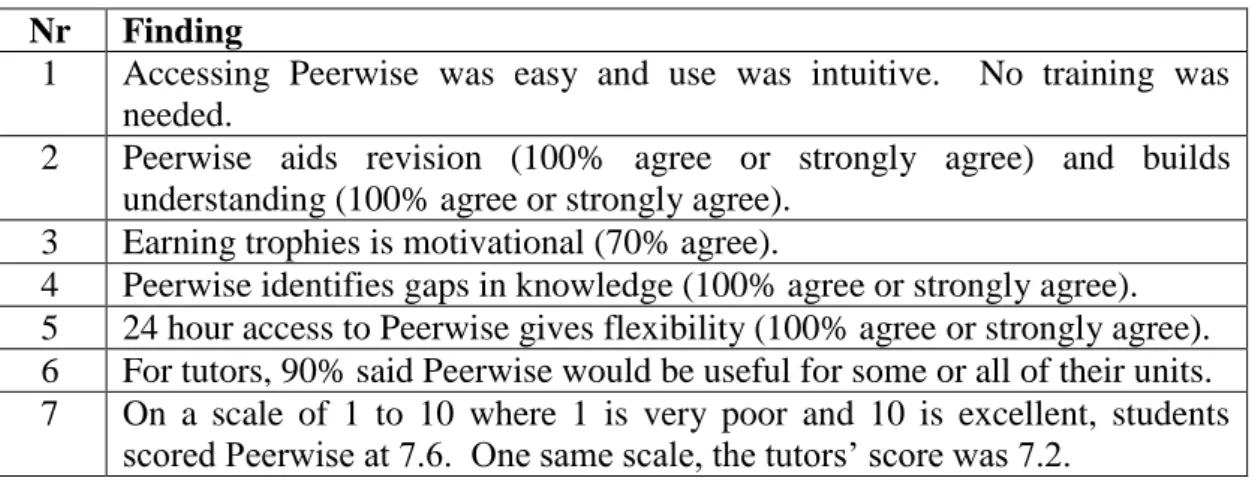
This trial involved 10 people (including staff, students and university learning technologists). A project management repository was created within PeerWise and participants were then asked to use the tool and subsequently comment on their experience via a survey. Whilst only small in size, the survey of the trial participants generated a positive view of Peerwise and echoed the findings of other, larger surveys that had been undertaken in other institutions (Denny et al., 2008). Table 1 lists the survey’s 7 main findings:
Nr Finding
1 Accessing Peerwise was easy and use was intuitive. No training was needed.
2 Peerwise aids revision (100% agree or strongly agree) and builds understanding (100% agree or strongly agree).
3 Earning trophies is motivational (70% agree).
4 Peerwise identifies gaps in knowledge (100% agree or strongly agree). 5 24 hour access to Peerwise gives flexibility (100% agree or strongly agree). 6 For tutors, 90% said Peerwise would be useful for some or all of their units. 7 On a scale of 1 to 10 where 1 is very poor and 10 is excellent, students
scored Peerwise at 7.6. One same scale, the tutors’ score was 7.2. Table 1: Findings from the Peerwise trial
In addition to the physical trial, literature was also searched for guidance. The checklist of 67 resource-based learning materials and processes (Race 2015) proved a useful assessment tool for projects such as Peerwise. Using subjective assessment Peerwise scored well against the checklist but not in every criterion. The gaps highlighted where additional work was required, for example, what to do if the software was not available to students because the server was down. Other potential deficiencies, for example the quality of questions, were addressed in the scaffolding session with students (described below).
As a result of the trial, it was decided to utilise Peerwise within the APM unit and to use this experience to learn about the benefits of online collaborative applications, so that an informed decision could be taken about their usefulness and wider application within Bournemouth University.
Embedding Peerwise in the APM unit
Building on the experience of the trial and reflecting on the experiences of other institutions, a plan was developed to embed Peerwise within student learning. Before the unit began, a repository was established in Peerwise and student identifiers were generated, so that the students were able to create Peerwise accounts and link to the APM repository. Linking the student account to the identifier prevented any student from outside the APM unit from accessing the material in the repository.
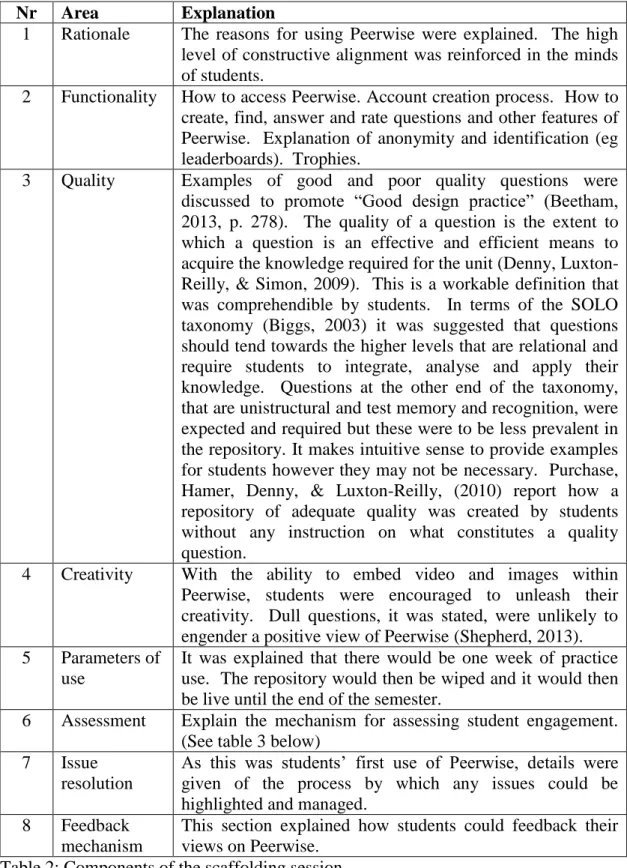
In the second week of the unit, a two hour scaffolding session was held with all students to set and communicate expectations about Peerwise to students. The scaffolding session had 8 components. These are described in table 2. The scaffolding session was well received by students. Of the 7 areas, most time was spent discussing quality.
Nr Area Explanation
1 Rationale The reasons for using Peerwise were explained. The high level of constructive alignment was reinforced in the minds of students.
2 Functionality How to access Peerwise. Account creation process. How to create, find, answer and rate questions and other features of Peerwise. Explanation of anonymity and identification (eg leaderboards). Trophies.
3 Quality Examples of good and poor quality questions were discussed to promote “Good design practice” (Beetham, 2013, p. 278). The quality of a question is the extent to which a question is an effective and efficient means to acquire the knowledge required for the unit (Denny, Luxton-Reilly, & Simon, 2009). This is a workable definition that was comprehendible by students. In terms of the SOLO taxonomy (Biggs, 2003) it was suggested that questions should tend towards the higher levels that are relational and require students to integrate, analyse and apply their knowledge. Questions at the other end of the taxonomy, that are unistructural and test memory and recognition, were expected and required but these were to be less prevalent in the repository. It makes intuitive sense to provide examples for students however they may not be necessary. Purchase, Hamer, Denny, & Luxton-Reilly, (2010) report how a repository of adequate quality was created by students without any instruction on what constitutes a quality question.
4 Creativity With the ability to embed video and images within Peerwise, students were encouraged to unleash their creativity. Dull questions, it was stated, were unlikely to engender a positive view of Peerwise (Shepherd, 2013). 5 Parameters of
use
It was explained that there would be one week of practice use. The repository would then be wiped and it would then be live until the end of the semester.
6 Assessment Explain the mechanism for assessing student engagement. (See table 3 below)
7 Issue resolution
As this was students’ first use of Peerwise, details were given of the process by which any issues could be highlighted and managed.
8 Feedback mechanism
This section explained how students could feedback their views on Peerwise.
Table 2: Components of the scaffolding session
It was anticipated that the students would raise concerns about the pedagogical assumption that students were good teachers of other students but no such issues were raised by this cohort. While students have implicit trust in tutors, they are less trusting in the knowledge of their peers. However, students’ trust in tutors can lead to acceptance of what is said without any critical assessment, behaviour which acts to suppress deep learning in students (Draper, 2009). One study found that students are
effective judges of question quality and that there is a willingness to accept the judgements of other students when choosing questions to answer (Denny et al., 2009).
Concerns were raised about the quality of questions created in Peerwise. With no tutor to oversee the questions, will students create simple, poor or incorrect questions? These potential problems have in-built solutions within the Peerwise application. If students create poor questions, they will be rated as such by fellow students and these questions will be bypassed by students looking for better quality questions. If students indicate the wrong answer to a question, feedback from other students is likely to encourage the question creator to revise and correct the question, due to perceived peer pressure, competition or an inherent desire to be viewed as knowledgeable and accurate by class colleagues.
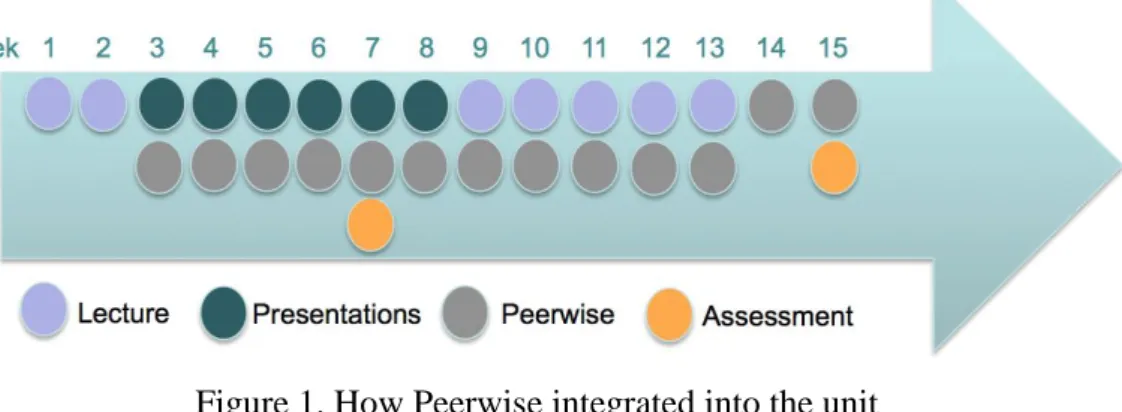
Figure 1 shows how Peerwise was to be used throughout the semester and in association with other unit elements. Students were asked to create questions based on weekly lectures, their own presentations and any other questions linked to project management, for example, recent news reports that contained aspects relevant to the unit.
Figure 1. How Peerwise integrated into the unit
Assessment
To encourage students to use Peerwise, the assessment strategy for the unit was changed to allocate 10% of the unit mark for Peerwise use. A maximum of 10 marks were allocated to the most active and highest achieving students based on quality of question, with fewer marks being awarded for less engagement (Table 3).
Marks Criteria
4 For creating 5 questions and answering 10 questions correctly. 6 For creating 10 questions and answering 20 questions correctly. 8 For creating 15 questions and answering 30 questions correctly.
10 For being in the top 15% of students based on the quality of question as voted by other students.
Table 3: Assessment criteria
Use of Peerwise during the semester
After the practice period, the repository was available to students between 13 October 2014 and 31 January 2015. During that period, 50 of the 52 eligible students used Peerwise. No student raised any issues with the use of Peerwise during the semester. The usage figures are shown in Table 4.
Parameter Total Mean Standard deviation Range Questions contributed 804 16.1 2.0 11 – 24 Answers submitted 3,345 66.9 61.9 30 – 380 Comments 66 1.3 2.5 0 – 11 Distinct trophies 427 8.5 3.4 4 – 19
Trophies (including duplicates) 941 18.8 15.0 4 – 88
Answers per question 3,273 4.1 4.0 0 – 20
Questions ratings 2,897 3.6 3.7 0 – 20
Average rating 1.8 1.2 0 – 5
Days of distinct activity 7.0 7.3 1 – 46
Table 4: Usage metrics
Note that there is a difference between the number of answers submitted and number of answers per question. This difference is caused by the dynamic nature of Peerwise. For example, a student may create a question that is answered by students. The question raiser may then delete that question causing an imbalance between the two parameters.
16 tags relating to project management were created at the start of the semester. In addition, students could create their own tags. By the end of the semester, the tags had been used 665 times and 83% of questions had been tagged. Tagging of questions was useful as students could search for questions based on this metadata and thus target their learning in specific areas. A tag cloud was available showing the tags and approximately how many questions used each tag.
Charts depicting, by day, the number of questions contributed and answers submitted are displayed in figures 2 and 3 respectively.
Figure 3: Number of answers submitted by day
Evaluation
Draper (2009) highlights that the use of TEL, such as Peerwise, is only beneficial if teaching methods are improved as a result. Evaluating Peerwise was difficult because, other than the performance measure related to compliance with the assessment requirements, no criteria were established to derive objective measures of its effectiveness. There are however a number of subjective and qualitative points that can be made as shown in the Evaluation Table below:
Nr Aspect Comment
1 Overall success (tutor’s view)
From a tutor perspective, the use of Peerwise in the APM unit was a success. The application was used by 96% of students. Two students failed to engage in Peerwise and also in the unit as a whole due to external circumstances. Of the students who did engage, 96% attained the criteria to gain 8 marks of the 10 possible. Two students failed to reach this level because they created 11 and 14 questions respectively, mistakenly believing they had created the requisite 15 questions. All students answered at least 30 questions correctly. The upper range for this metric was 385 questions answered by one student during the semester. 6 students answered more than 100 questions.
2 Identifying the top 15% of students
Data on student participation and the number of correct answers was available within the Peerwise administration function. Supplementary data was obtained from the Peerwise support team to allow the top 15% of students to be identified. The fact that students could not access this data themselves reduced its use as a motivator.
3 Question creation Figure 2 reflects how several students waited until the end of the usage period to create questions. 112 questions (14% of the total) were submitted in the last
Nr Aspect Comment
two days. This helps to explain why 115 questions were not answered by any student.
4 Rating of questions
87% of answers included a rating. No clear guidelines were included for rating.
5 Knowledge building
Two assessments were undertaken which tried to evaluate the whether knowledge has been increased through the use of Peerwise.
1. At the beginning and end of the semester all APM students completed a knowledge self-assessment of their competence in project management across 64 knowledge areas. An independent samples t test was conducted to evaluate the hypothesis that the change in the self-reported level of knowledge (calculated as the difference between the two self assessments) for students using Peerwise would be higher than for students who did not use Peerwise. The data from 67 students consisted of 8,025 data points. The mean change score for non-Peerwise students (M = 0.546, sd = 0.331) was statistically significantly lower (t = -2.385, df = 65, one-tailed p = 0.01) than that of Peerwise users (M = 0.726, sd = 0.284). This test showed that Peerwise users had a greater increase in the change in their knowledge during the semester. This could be attributable to a number of factors including Peerwise, but also the different cohorts, self-reporting bias and other factors.
2. A Pearson’s correlation was calculated to determine if there was any significant relationship between the student’s overall unit mark and the number of questions answered in Peerwise. The correlation between unit mark and questions answered is +0.120 which is not significant, meaning that there is a slight, even random relationship between these two variables. The APM correlation is low when compared to others studied. For example, a study of medical students by Abdullah and Nor (2014) found much stronger correlation coefficients, between 0.634 and 0.739, for the relationship of Peerwise activity and unit mark.
6 Overall students’ feedback
At the end of the semester, students were asked to complete an online questionnaire about their Peerwise experience. 13 students did so. These students ranked Peerwise 7.9 out of 10 (1 is poor and 10 is excellent) for the usefulness of Peerwise. Using a 5 point Likert scale where 5 equated to ‘strongly agree’ and 1 to ‘strongly disagree’, students gave the following responses: Easy account creation (M = 4.5, sd = 0.5); No training needed (M = 4.7, sd = 0.9); Adequate speed of response (M = 4.1, sd = 0.8); Creating questions builds knowledge required for the unit (M = 4.0, sd = 1.2); Creating
Nr Aspect Comment
questions builds understanding (M = 4.6, sd = 0.5); Creating distractors is challenging (M = 4.2, sd = 0.8); Trophies are motivational (M = 4.0, sd = 1.4); Access progress against peers (M = 3.5, sd = 1.3); Highlights new information (M = 4.0, sd = 1.0). While Peerwise was not universally appreciated by all students, the questionnaire feedback suggested was of a positive student view of Peerwise.
7 Group and individual use
It was found that some students worked in groups to create and answer questions. While not originally envisaged, students commented that the discussion and engagement with other students that accompanied the activity was very rewarding.
8 Peerwise username and password
Peerwise is an application separate from the University’s virtual learning environment (VLE). It would be easier for students if Peerwise was integrated within the VLE so that the username and password required for Peerwise were the same as for the VLE. 9 Preparation for
exams
While there are no exams in the APM assessment, several students commented that Peerwise would be very useful as a learning aid for exams.
10 Engagement in Peerwise
The days of distinct activity metric shows how one student used Peerwise on 46 distinct days. The average was 7 days of use with 3 students completing all their engagement within a single day.
Table 5: Evaluation
Recommendations for further use
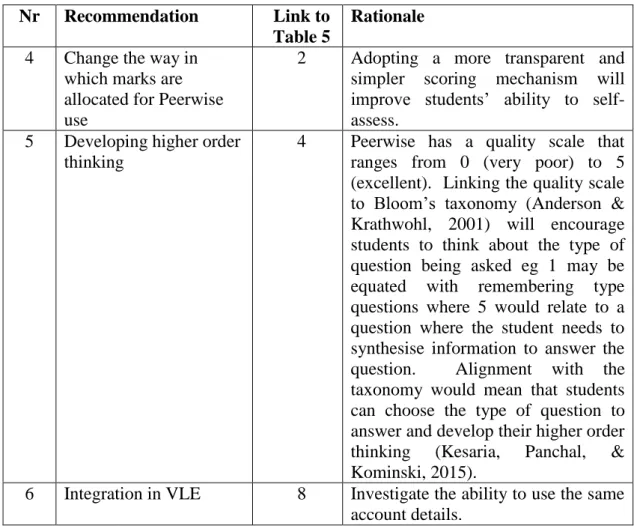
The experiences gained and reflective evaluation of Peerwise in the APM unit have been combined to generate a set of recommendations for the future use of the application within Bournemouth University. The six recommendations are detailed in Table 6.
Nr Recommendation Link to Table 5
Rationale 1 Further develop the
scaffolding for students
3, 4, 7, 10 Utilise the experience gained to improve the way Peerwise is explained to students.
2 Raise the awareness of colleagues
1, 6, 7, 9 Make more staff and learning technologists aware of Peerwise so that they may evaluate its use for themselves.
3 Develop evaluation criteria
5 While students believed Peerwise was helpful in their learning, it was not possible to demonstrate this other than qualitatively. Considering how Peerwise can be evaluated would provide support to recommendation 2.
Nr Recommendation Link to Table 5
Rationale 4 Change the way in
which marks are allocated for Peerwise use
2 Adopting a more transparent and simpler scoring mechanism will improve students’ ability to self-assess.
5 Developing higher order thinking
4 Peerwise has a quality scale that ranges from 0 (very poor) to 5 (excellent). Linking the quality scale to Bloom’s taxonomy (Anderson & Krathwohl, 2001) will encourage students to think about the type of question being asked eg 1 may be equated with remembering type questions where 5 would relate to a question where the student needs to synthesise information to answer the question. Alignment with the taxonomy would mean that students can choose the type of question to answer and develop their higher order thinking (Kesaria, Panchal, & Kominski, 2015).
6 Integration in VLE 8 Investigate the ability to use the same account details.
Table 6: Recommendations for future use
Conclusion
The authors have been impressed with the initial deployment of Peerwise and much has been learnt during the period. It is hoped that the experiences detailed in this paper will help others who decide to follow a similar path. The authors will continue to implement Peerwise within the University and take forward the recommendations that resulted from this initial use of the application.
The extent to which Peerwise helped to increase engagement in the non-assessed elements of the unit is unclear. The level of engagement from most students complied with the assessment requirements to guarantee 80% of the available 10 marks. Questionnaire feedback from students was mostly very positive and anecdotal feedback was supportive and encouraging. The low level of correlation between questions answered and the overall unit mark shows that more work is needed to investigate how Peerwise can add value to students.
The authors are currently developing several connected papers based on Peerwise; the first considering how the recommendations were implemented in other teaching units that incorporated Peerwise and the second addressing how the effectiveness of Peerwise can be evaluated.
References
Abdullah, M. H. N. & Nor, H. M. (2014). The Impact of Peerwise Approach on the Academic Performance of Medical Students. Malaysian Online Journal of Educational Technology, 2(4), 37-49.
Anderson, L. W.& Krathwohl, D. R. (Eds.). (2001). A taxonomy for learning, teaching, and assessing. New York, NY: Longman.
Beetham, H. (2013). Designing for learning in an uncertain future. In H. Beetham & R. Sharpe (Eds.) Rethinking pedagogy for a digital age: Designing for 21st century learning (2nd ed.) (pp.258-279). Abingdon: Routledge.
Biggs, J. & Moore P. (1993). The process of learning. New York: Prentice Hall.
Biggs, J. (2003). Aligning teaching and assessing to course objectives. Teaching and Learning in Higher Education: New Trends and Innovations, University of Aveiro, 13-17 April, 2003 .
Bloxham, S. (2007). The busy teacher educator’s guide to assessment. Retrieved from http://dera.ioe.ac.uk/13028/
Bruner, J. (1990). Acts of meaning. Cambridge: Harvard University Press.
Chickering, A. W., & Gamson, Z. F. (1987). Seven principles for good practice in undergraduate education. AAHE bulletin, 3-7.
Denny, P, Luxton-Reilly, A, & Hamer, J. (2008). Student Use of the PeerWise System. In ITICSE `08: Proceedings of the 13th Annual Conference on Innovation and Technology in Computer Science Education, Madrid, Spain, 30 June – 02 July 2008 (pp. 73-77). New York, NY: Association for Computing Machinery.
Denny, P. (2010). Motivating Online Collaborative Learning. In ITiCSE '10: Proceedings of the 15th annual conference on Innovation and technology in computer science education, Ankara, Turkey, 26-30 June 2010 (pp. 300-300). New York, NY: Association for Computing Machinery
Denny, P, Luxton-Reilly, A & Simon, B. (2009). Quality of student contributed questions using Peerwise. In ACE '09: Proceedings of the 11th Australasian Conference on Computing Education, Wellington, New Zealand - Volume 95 (pp.55-63). Darlinghurst: Australian Computer Society.
Denny, P. (2013). The effect of virtual achievements on student engagement, In CHI '13: Proceedings of the SIGCHI Conference on Human Factors in Computing Systems, 28 April – 2 May 2013, Paris France, (pp. 763-772). New York, NY: Association for Computing Machinery
Draper, S W. (2009). Catalytic assessment: understanding how MCQs and EVS can foster deep learning. British Journal of Educational Technology, 40(2), 285-293.
East, R. (2010). Effective assessment strategies in law. Coventry: UK Centre for Legal Education (UKCLE), Retrieved from http://78.158.56.101/archive/ law/resources/assessment-and-feedback/effective/index.html
Entwistle, N. (2000). Promoting deep learning through teaching and assessment: conceptual frameworks and educational contexts. In ESRC Teaching and Learning Research Programme (TLRP), First Annual Conference, University of Leicester, November 2000.
Foley, G. (2000). Understanding adult education and training. Sydney: Allen and Unwin
Gibbs, G. & Simpson, C. (2004). Conditions under which assessment supports students’ learning. Learning and teaching in higher education, 1(1), 3-31.
Hanrahan, M. U. (1998). The effect of learning environment factors on students’ motivation and learning. International Journal of Science Education, 20(6), 737-753. Retrieved from http://eprints.qut.edu.au/1352/#?
Higher Education Academy (2012). The UK Professional Standards Framework for teaching and supporting learning in higher education 2012. Retrieved from http://www.heacademy.ac.uk
assets/documents/ukpsf/UKPSF_2012_v2_050912_1044.pdf
Hounsell, D. (2007). Towards more sustainable feedback to students. In N. Falchikov & D. Boud (Eds.) Rethinking assessment in higher education (pp.101-13). London: Routledge.
Huxley-Binns, R. (2015). Law. In H. Fry, S. Ketteridge, & S. Marshall (Eds.) A handbook for teaching and learning in higher education: Enhancing academic practice (pp. 311-325). Abingdon: Routledge.
JISC (2014). Students as agents of change. Retrieved from http://www.jisc.ac.uk/ guides/students-as-agents-of-change.
Karpicke, J D & Roediger III, H L. (2007). Repeated retrieval during learning is the key to long-term retention. Journal of Memory and Language, 57(2), 151-162.
Kesaria, J M, Panchal, H K & Kominski, C. (2015). Peerwise Study for Assessment of Higher Order Thinking in Students. UNT Health Science Center Research Appreciation Day 2015. Retrieved from http://digitalcommons.hsc. unt.edu/rad/RAD15/Education/4/
Luxton-Reilly, A, Denny, P, Plimmer, B, & Sheehan, R. (2012). Activities, affordances and attitude: how student-generated questions assist learning. In ITiCSE'12 - Proceedings of the 17th ACM Conference on Innovation and Technology in Computer Science Education, 3-5 July 2012, Haifa, Israel. New York, NY: Association for Computing Machinery
Meyer, J H F & Land, R. (2006). Overcoming barriers to student understanding. London: Routledge.
Overton, L. (2013). Getting the business on board. In: R. Hubbard (Ed) 2013. The really useful elearning instruction manual. Chichester: John Wiley.
Prosser, M, & Trigwell, K. (1999). Understanding learning and teaching: The experience in higher education. Buckingham: Society for Research into Higher Education & Open University Press
Purchase, H., Hamer, J., Denny, P. & Luxton-Reilly, A. (2010). The quality of a PeerWise MCQ repository. ACE '10: Proceedings of the Twelfth Australasian Conference on Computing Education, Brisbane; Australia, - Volume 103 (pp. 137-146). Darlinghurst: Australian Computer Society.
Race, P. (2015). The Lecturer's tooklit. London: Kogan Page.
Sadler, D R.(2013). Opening up feedback: teaching learners to see. In S. Merry, M. Price, D. Carless & M. Taras (Eds.) Reconceptualising feedback in higher education: Developing dialogue with students (pp. 54-63). Abingdon: Routledge.
Shepherd, C. (2013). So what is elearning? In R. Hubbard, (Ed.), 2013. The really useful elearning instruction manual (pp. 1-18). Chichester: John Wiley.
Tulving, E. (1967). The effects of presentation and recall of material in free-recall learning. Journal of Verbal Learning and Verbal Behavior, 6(2), 175-184.
Universities and Colleges Information Systems Association (UCISA). (2014). Mobile learning: How mobile technologies can enhance the learning experience. Retrieved from https://www.ucisa.ac.uk/publications/effective_use.aspx
Walsh, J. L., Denny, P. & Smith, P. E. (2015). Encouraging maximal learning with minimal effort using PeerWise. Medical Education, 49(5), 521-522. doi:10.1111/medu.12720