Disorders and Hearing Problems
A thesis submitted to the
College of Engineering and Natural Sciences
by
Nahid
Nasiri
in partial fulfillment for the
degree of Master of Science
in
"Creativity, problem solving, critical and analytical thinking, decision making, risk taking, all found in game-based learning.".
Problems
NahidNasiriAbstract
Speech impediment affecting children with hearing difficulties and speech disorders requires speech therapy and much practice to overcome. In fact, speech therapy via serious games gives an opportunity to children with speech disorders and hearing problems to overcome their problems. As far as children are more inclined to play games, so we intend to learn them by entertainments like serious games. In this thesis, we have designed and implemented a serious game that can be used both as a therapy and as a tool to measure the performance of children with speech impediments in which children will learn to speak specific words that they are expected to know before the age of 7. And then we will teach them how to make sentences. The game consists of three steps. The first step provides information for parents or therapists to decide if their child needs speech therapy or not. In the second step, the child starts to learn specific words while playing the game. The third step aims to measure the performance of the child and evaluate how much the child has learned at the end of the game. The game has an avatar which can be controlled by the child through speech, with the objective of moving the avatar around the environment to earn coins. The avatar is controlled by both voice commands such as Jump, Ahead, Back, Left, Right, and arrow keys of the keyboard. The child will be guided by an arrow during the game instead of getting help from a therapist or a teacher to guide the child to the next goal. This allows the child to practice longer hours, compared to clinical approaches under the supervision of a therapist, which are time-limited. Our preliminary performance measurements indicate an improvement of 40% for children who play our game at least 5 times and a specific period of time. Keywords:Serious Games, Speech Impediment, Voice Commands, Play Therapy, Hearing Disorders, Hearing Difficulties, Speech Therapy,
Konu
ş
ma Bozuklu
ğ
u ve
İş
itme Engelli Çocuklar
İ
çin Ciddi Bir Oyun
NahidNasiriÖz
Konuşma bozukluğu, duyma bozukluğu ve konuşma güçlüğü çeken ve bunun üstesinden gelmek için konuşma terapisi ve alıştırma terapisine ihtiyaç duyan çocukları etkiler. Bu yüzden, uygulamalı oyunlar vasıtasıyla konuşma terapisi yapmak duyma bozukluğu ve konuşma güçlüğü çeken çocuklara sorunlarının üstesinden gelmeleri için bir imkan sunar. Çocuklar oyun oynayama meyilli oldukları müddetçe biz onlara uygulamalı oyunlar gibi eğlenceli bir yolla yardım etmeyi planlamaktayız. Bu tezde, hem terapi hem de konuşma bozukluğu olan çocukların performansını ölçecek bir alet olarak kullanılabilecek uygulamalı bir oyun tasarladık. Konuşma bozukluğunun tedavisi için bu oyunda çocuklar, 7 yaşından önce bilmeleri gereken kelimeleri söylemeyi öğrenecekler. Ve sonrasında biz onlara nasıl cümle kurmaları gerektiğini öğreteceğiz. Oyun üç kısımdan oluşmaktadır. İlk kısım ebeveynlere ve terapistlere çocuğun konuşma terapisi konusunda yardıma ihtiyacı olup olmadığı hakkında bilgi sağlamaktadır. İkinci kısımda çocuk oyunu oynarken belli başlı kelimeleri öğrenir. Üçüncü kısım ise çocuğunun performansını ve oyunun sonunda çocuğun ne kadar öğrendiğini ölçmeyi amaçlamaktadır. Oyunda, çocuğun konuşarak kontrol edebildiği, madeni para kazanmak için oyun ortamında hareket ettirdiği bir avatar mevcuttur. Avatar hem Atla,İleri, Geri, Sağ, Sol gibi ses komutlarıyla hem de klavyedeki ok tuşlarıyla hareket ettirebilir. Oyun boyunca çocuk avatarın başının üzerinde bulunan büyük bir ok ile yönlendirilecektir, herhangi bir terapistin veya öğretmenin yardım etmesine gerek yoktur. Bu, zaman kısıtlamalı therapist denetimi altındaki klinik yaklaşımlarla kıyaslanınca çocuğun daha uzun süre boyunca alıştırma yapmasına imkan sağlar. Yaptığımız ilk deneylerden aldığımız sonuçlara göre oyunumuzu en az 5 kere ve belirli periyotlarla oynayan çocuklar %40’lık bir gelişme göstermektedir.
Anahtar Sözcükler: Uygulamaları Oyunlar, Konuşma Bozukluğu, Ses Komutları, Duyma Bozukluğu, Oyun Terapisi
all over the world.
Acknowledgments
I would like to thank my advisor, Prof. Dr. Shervin. Shirmohammadi for his scientific support throughout my thesis. I would also like to extend my deepest appreciation for his valuable comments regarding my thesis and all the publications, assistance in developing this thesis and giving responses to my e-mails so quickly. I would like to thank, Prof. Dr. Mehmet Serkan Apaydin, Prof. Dr. Ahmet Ademoglu for their valuable comments and suggestions regarding my thesis. A special thanks goes to my love, my beloved husband Majid Moghadam, who has encouraged me, stayed with me whenever I needed, listened to me carefully although I talked too much and also accompanied with me in this exciting adventure of working on my thesis. . . .
Contents
Declaration of Authorship ii Abstract iv Öz v Acknowledgments vii List of Figures x List of Tables xi Abbreviations xii 1 Introduction 1 1.1 Introduction . . . 1 1.1.1 Learning definition . . . 11.1.2 Does gamification work? . . . 2
1.2 Introduction to Serious Games: . . . 4
1.2.1 What is serious games? . . . 4
1.2.2 First Serious Game . . . 5
1.2.3 Background on Serious Games . . . 5
1.3 Research Problems . . . 7 1.4 Motivation . . . 8 1.5 Research Contributions . . . 9 1.5.1 Research Publications . . . 9 1.6 Thesis Outline . . . 9 2 Background 11 2.1 Related Works . . . 11
2.2 An overview of Serious Games in health . . . 13
2.3 Does speech therapy and language recovery work? . . . 14
2.4 A literature survey of serious games for speech disorder . . . 14
2.5 Main Characteristics ofInto the ForestGame . . . 15
3 Proposed System 19 3.1 Game engine analysis . . . 19
3.2 Avatar . . . 20
3.3 Proposed Game . . . 21 viii
Contents ix
4 Implementation 30
4.1 Preliminary Testing . . . 30 4.2 Testing . . . 32
5 Conclusion and Future Work 37
5.1 Conclusion . . . 37 5.1.1 Future Work . . . 38
List of Figures
3.1 Game Engines . . . 20
3.2 Overview of game stages . . . 22
3.3 Flowchart of the game . . . 23
3.4 Diagnosis part of the game . . . 24
3.5 Proposed system . . . 25
3.6 Avatar Control by Voice Commands. . . 27
3.7 Far From the Goal in the Scene . . . 27
3.8 Reaching the goal . . . 28
3.9 Counting the number of objects avatar met so far . . . 28
3.10 Which fruits are shown around this robot? . . . 28
3.11 Practicing phase of the game . . . 29
4.1 Practicing phase of the game . . . 32
4.2 Mispronounced word in the sentence . . . 32
4.3 Bad result of the game . . . 32
4.4 Progress of first child . . . 34
4.5 Progress of second child . . . 34
4.6 Progress of third child . . . 35
4.7 Progress of fourth child . . . 35
4.8 Progress of fifth child . . . 35
4.9 Progress of sixth child . . . 36
4.10 Progress of all children . . . 36
List of Tables
2.1 Serious Games for Improving Children’s Speech Disorder . . . 16 3.1 Matrix of the Game Based on ISG Project . . . 26 4.1 Test results during 7 days . . . 34
Abbreviations
ISG IntelligentSeriousGgames STD StandardDeviation DTW DynamicTimeWrapping
ICT Information andCommunicationTechnology NLP NaturalLanguageProcessing
SAS SharedActiveSurface
ASHA AmericanSpeech-LanguageHearingAssociation
Chapter 1
Introduction
1.1 Introduction
1.1.1 Learning definition
Learning is a bearing alteration in behavior and manner and every person learns in a different way which is not a new thing. There are different styles of learning in which everyone has his/her own specific way of learning with respect to his/her interest. In general, we can have three different style of learning such as visual, physical (learn by doing something), or audible. In more detailed, most probably children will be categorized in one of seven styles of learning:
• Visual: These human beings want to utilize images, pictures, graphs, colors, and
mind maps.
• Physical: These are the "learn by doing" individuals that utilization their body to
aid their learning. Drawing outlines, utilizing physical objects, or pretending are all methodologies of the Physical learner.
• Aural: Individuals who incline toward utilizing sound (clearly), rhythms, music, recordings, smart rhymes, etcetera.
• Verbal: The verbal learner is a person who tends towards utilizing words, both in dialogue and in writing to aid their learning. They benefit as much as possible from word based procedures, scripting, and reading content out loud.
• Logical: The general population who incline toward utilizing rationale, thinking, and "systems" to clarify or comprehend concepts. They expect to realize the explanations for the learning and have a good capacity to figure out the bigger picture.
• Social: These individuals are the ones who appreciate learning in meetings or with other individuals and plan to work with others as much as it is possible.
• Solitary: The singular learner likes to learn alone and through self-study.
Regarding to different mild disabilities between children, we can focus on a specific style to improve their learning by different skills. For instance, in order to come up with the visual problem of children, we can use other techniques like physical or audible to help them learn easily. There are different kind of teaching methods such as traditional that is usual one in which children attend the classes and cooperate with teacher and other children. This way of teaching can be tough for children with some cognitive competence disabilities. The other way is tutoring still can be hard for teacher to cooperate and communicate with child easily. In order to come up with different problems, we need to find a way to encourage and motivate children to help them in an indirect way to learn, grow and change. Almost all children intend to play in their leisure time with mobile, iPad and other different devices that we can utilize them to help children to learn about themselves and world around them.
The methodology we have used is a combination of all these techniques. We have utilized Visual, Physical, Aural, Verbal, Logical, Social, and solitary all together.
1.1.2 Does gamification work?
The gamification of training has defined learning goals with related to learning results to be attained. Educational games are supported by computer games theory and learning theory. The pedagogical establishment guaranteeing that effective learning results are the essential drivers. By instructional objectives and suitable applications serious games have significant ability to draw in, persuade and impact the behaviors of a corporate workforce. It is the properties of games, for example, convincing story-lines, achievable challenges, prizes, acknowledgment and control that make them so intense for learning. use of serious
Chapter 1. Introduction 3
game 6/40 There is an expanding body of experimental examination to support the effectiveness of game based learning. Enhancements in states of mind, engagement and inspiration have been illustrated. Some research evidences illustrate significant impact on higher order skills like decision making and problem solving.
Some of outstanding serious games can help children with cancer treatment (Re-Mission) to cure dietary habits and nutrition (Escape from Diab). In the following some of serious games in different purposes are mentioned [1].
Cheese Factory: The purpose of this game is to help children to learn fractions, decimals and percentages. They are supposed to find the slices to match the cheese [2].
My Appearance: This game teaches the students daily tasks in the morning to get ready before leaving home [3].
VR Supermarket: This game helps children to improve their money management skills. The user has a virtual wallet and enters a virtual supermarket and according to his/her budget he/she does shopping [3].
By using the idea to teach while playing games can be absorbing for most of the users specially children. In fact, many researches have proven that children are interested to play computer games. Most of the time, they expend too much time with a significant attention and interest. So, by serious games we can help to improve their skills behind the games.
Here is a game special for children and adults with intellectual disabilities related to the following cognitive domains: The main character of the game is Tom. He is responsible to find a relic by the control of the user. Tom is supposed to find a key inside of a room between other rooms have been attached to his current room [4].
Another game has been designed to help the children with visual perception aged between 6-12 years. The learner is shown an intermixed picture and he/she supposed to find and identify the elements which appears in the picture during the allocated time [4]. Retrospectively, the main goal of the games is trying to help children with different disabilities to improve their skills in a best way. Here I showed some sample of games that are teaching time management, money management, responsibility, and math.
1.2 Introduction to Serious Games:
1.2.1 What is serious games?
Serious Games have remarkable roll in order to enhance motivation for education and training. Serious Games have the goal of solving problems. They have been designed to help children and adults to solve real world problems and create an environment that conducts to better problem solving. In fact, serious games have been designed for an initial purpose different than pure amusement [5].
The main focus of educational video games is to help learners to improve their cognitive skills [6]. Specially for teacher video games with educational aim has more value because they can engage students to the relevant material easier than before. So, video games provide immerse learning system that make us to experience real world game-play by the use of digital technology. As far as we are going to design games for a primary goal other than pure entertainment, so, we will call these kind of games for children with special needs serious games in which we will combine exercising, communication skills, and teaching with leisure elements.
By utilizing serious games students and children practice flexibility, critical thinking, and the most important part problem solving skills by recognizing various solutions for problems. Through serious games parents, teachers, and therapists make children enthusiastic in technical skills and technology from childhood.
Serious games are so important for individualized learning [6]. In the other words, every player is different, therapists are searching for sufficient games that meet their goals with an individualized learning aim. Serious games provide children to learn independence of their parents or teachers. By recording children’s performance during the game we can see their progress after a while [7]. In addition, serious games balance enjoyment with a suitable level for a child that it can increase motivation of the child to play the game in an optimally challenging and engaging learning zone.
Investigations prove that children who play serious games have sharpened visual attention skills. For example, a simple digital game with a virtual world can help children to explore freely and imagine science subjects in a way that motivate them to play the game and learn better. Children get immersed in these virtual environment, where they
Chapter 1. Introduction 5
can rehearse and make better their abilities and knowledge without taking any risks and getting bored. Moreover, serious games keep children’ attention more than any other contents. This feature can be significantly beneficial for children with cognitive, speech, and intellectual disabilities, as far as they almost suffer from attention deficit, which is main drawback of learning.
1.2.2 First Serious Game
Serious games have been used for children with special needs to improve their cooperation and adherence during the therapy process and support mental health care treatment as well (Resnick, 1986 cit. in Szczesna, A., et al., 2012), by making an effective connection between patients and therapist (Resnick, 1986 cit. in Szczesna, A., et al., 2012), engagement among treatment in children who are truly resistant of helping treatment, children and students who have behavior disorder and already dropped out of treatment many times (Kokish, 1994 cit. in Szczesna, A., 2012).
The first recorded serious game which is supporting cognitive-behavioral therapy, is Treasure Hunt. By utilizing Treasure Hunt therapists could reach positive reports in the perspective of pilot studies, where patients responded in a positive way to the treatment, producing an alter in manner that engaged in the duties of the game freely. However, decisions about the game’s efficacy for treatment were constrained (Szczesna, An., et al., 2012) [8].
1.2.3 Background on Serious Games
Hearing and speech disorders are the third most common cause of communication problems for preschool children [9]. It is estimated that 40 million Americans have communication disorders such as speech or hearing impairments, and that almost 8 percent of U.S. children have speech disorders especially between 3-17 years old, while 4 percent of preschool children have significant language disorders, totaling to around $186 billion annually in treatment cost [9]. Children who have hearing loss are more exposed to have spoken problems, but if these problems are distinguished before the age of three the children can have significant improvements using different solutions [10] [11].
Having a speech or language disorder is a journey. To improve children’s speech, they need therapy sessions that have these important characteristics: Convenient, high-quality, and affordable. But, there are some barriers to getting that therapy, such as:Limited time, mobility, and access. To come up with mentioned problems we are planning to help children to have the most sufficient sessions instead of having boring sessions. So, on the computers children can find their special therapists according their needs anywhere and anytime. Sessions are personal and designed based on their special needs.
Educators and trainers discovered the power of educational computer games in 1970s and 1980s [12]. For children, games are an ideal approach to breaking out of the ordinary language therapy or home-school speech routines, as children are willing to play games. Research has shown that video games with a combination of education and entertainment have a significant role in helping children with special needs [13]. Research has also shown that children who play educational video games could improve their skills more easily compared to those who did not play educational video games [14].
So combining the children’s therapy with games will not only give them entertainment, but also more speech therapy exercises than what they can get from a clinical setting [15]. According to some reports from teachers, the communication skills of children with hearing loss and language problems can be strengthened significantly via serious games [16] [17]. Especially in developing countries, there are too many children with speaking problems [18]. Some of them are unwilling to speak, some of them have psychological problems and disinclined to talk to anyone, and some have cleft problems. For every problem, there are clinical solutions, but unlike adults, children are not motivated to undergo clinical solutions, and without motivation, progress is slow. For example, a child who has psychological problems and does not like to communicate with anyone can have a therapist to practice with, but after a while the child gets bored and does not like to communicate with the therapist anymore. Another problem is cleft which is the main issue in developing countries [18]. Although cosmetic surgery can physically correct cleft, still those children need to do speech therapy and practice speaking to improve their talking skills [13] [18].
In the instrumentation and measurement community’s research literature, we can find some works related to speech recognition and therapy. For example, [19] proposes a rehabilitative speech recognition system which can be used to interact with a home
Chapter 1. Introduction 7
computer to control appliances like an electric wheelchair. The system is developed for individuals who suffer from Quadriplegia, Paraplegia, Thyrotrophic lateral sclerosis, paralysis, congenital defect(s) or accident, leading to the de-generated growth of or amputated limbs. In [20], the authors present a speech fluency treatment as the therapy for individuals with speech stuttering problems. The software works by using computer generated audio and visual cues to illustrate to the stuttering patient when his/her speech is irregular or different from the clinician’s expectation. The patient can then visually compare his/her profile shape to that of the reference. A score is assigned corresponding to the client’s performance. As the final example, in [21] authors propose a tool to help stuttering children and Parkinson disease clients improve their speech fluency. It provides visual and audio feedback required for patients to be aware of their speech patterns. The tool plays a goal phrase and displays its amplitude plot of the signal. The patient then repeats the phrase, the plot of which is then superimposed over the goal phrase plot in real-time [21].
1.3 Research Problems
According to [22], there are some common problems in preschool children that if they are recognized and solved before the school time, children will be able to come up with most of those problems. The most common communication problems in children are as follows 23:
Oral Language:
• Difficulty with oral directions
• Difficulty in pronouncing words properly
• Unable to concentrate on and figure out spoken language
• Not being able to follow fast speaking, which can cause a big problem in taking
notes or following the instructions Hearing Loss:
Attention and Concentration:
• Difficulty of focusing on doing a task • Easily distracted by a small distraction
• Overloaded quickly and getting tired of doing a task and needing frequent breaks
Foreign Language skills:
• Difficulty or feeling shy to speak aloud
• Difficulty in pronouncing words properly
Memory:
• Difficulty in retrieving word from memory quickly • Difficulty in memorizing words
Spelling:
• Disability in spelling common words
1.4 Motivation
My main motivation of making this game is related to my experience in real life. I have a cousin who has speech difficulties. He has a therapist who is expert enough on her field and she is working with him more than two hours during a day to learn him just some simple words to repeat. It is so hard to communicate with him while he is interested in to spend hours and hours to watch a cartoon or play a game in his room alone. While in a game we can create a friendly environment for him to practice enthusiastically and independently. Retrospectively, I have decided to make a game to meet our goal to help and motivate him to learn by this way.
Having a speech or language disorder is a journey. To improve children’s speech, they need therapy sessions that have these important characteristics: Convenient, high-quality,
Chapter 1. Introduction 9
and affordable. But, there are some barriers to getting that therapy, such as: Limited time, mobility, and access. To come up with mentioned problems we are planning to help children to have the most sufficient sessions instead of having boring sessions. So, on the computers children can find their special therapists according their needs anywhere and anytime. Sessions are personal and designed based on their special needs. To create more opportunities for children with the mentioned problems, we propose a serious game in which the child is supposed to have enough motivation to play the game and behind playing the game he/she will learn independently.
1.5 Research Contributions
This serious game has been developed in the context of our European project Intelligent Serious Games for Social and Cognitive Competence [24]. Our contribution is to do the best of knowledge that no one has done no other work.
1.5.1 Research Publications
1. [22] N. Nasiri, S. Shirmohammadi, A. Rashed, "A Serious Game for Children with Speech Disorders and Hearing Problems",5th IEEE Conference on Serious Games and Applications for Health (SEGAH’17), Perth, Western Australia, Apr. 2016.
2. [25] N. Nasiri, S. Shirmohammadi, "Measuring Performance of Children with Speech and Language Disorders Using A Serious Game", 2017 IEEE International Symposium on Medical Measurements and Applications (MeMeA’17), Rochester, MN, USA, May. 2017.
3. An upcoming IEEEAccess Journal
1.6 Thesis Outline
The rest of this paper is organized as follows: section II presents the previous efforts in how to help children improve their oral language via speech and hearing therapy. In section III, our proposed game design is described. Section IV reports the implementation
of our game. The last section includes the conclusion and what to do to improve our game as future work.
Chapter 2
Background
2.1 Related Works
In this section, we will see what researchers have done to help children regarding the most common communication disorders to improve their skills via serious games. Speech Language pathologies are one of the most common places where people can work on their speech problems. Especially children can improve their spoken skills in those environments. But not only collaborating with therapists can be boring for children, but also having to be present in a hospital or institute for speech therapy can cause another difficulty for children. Besides, these institutions are not available in all locations. It therefore follows that having a therapy system that is accessible and motivates the children to use it, would be a good contribution to solving this problem. To create such a system, we have to understand how speech therapy works. Essentially, children who have spoken difficulties and hearing-impairment have therapists at home or school who reads these words to the child during a session and the child has to repeat them after hearing.
Speech therapy drills via multimedia devices [18] and 3D game environments [15] to make it easier for a patient to meet his/her goals according to the problem that he/she has. In top of that, therapists can utilize video games at home to motivate the child to play the game to improve his/her oral language problems [18]. Studies show that combining education with entertainment can be a tricky way in the rehabilitation process of children with special needs [15].
Another way to strengthen the auditory perception of children with auditory processing disorders or hearing losses is TheToy video game in which the child must use hearing to follow a character, who can be pursued by the sound that it emits, and who frequently disappears from the scene through one of two doors [10]. Another game which has been designed for this purpose is DiDuDa, which can treat children’s hearing loss or oral language problems if the problem has been diagnosed at an early age [11]. Another approach uses a voice recognition system in a digital game with two different methods in English and Spanish to help children with oral language difficulties [26]: the first one is Dynamic Time Warping or DTW that is an algorithm and measures the similarity between two sequences and the second one SPHINX4 is a voice recognition system. Based on the game, when the word is pronounced by the child properly, the word will be shown in small boxes.
In [26], they have used a static design in their games, which allows the system to keep the teenager concentrated and motivated. This motivation leads them to better results. The cards are shown to the child and s/he should pronounce the word correctly. After all words are done, the game is successfully over.
To increase children’s fluency in speech, and in order to increase their communication skills, Information and communication Technology (ICT) [27] based special education games have been used that are based on story telling [28]. These kinds of serious games will help children to learn some colors, numbers, and language in their mother tongues. To see the effect of spoken language and audio content on children with speech difficulties, in paper [1], Authors have explored outcomes of these kinds of serious games to improve children’s speech skills by Natural Language Processing techniques. They have selected 11 serious games leveraging on Natural Language Processing methods.
To relieve children’s anxiety in face-to-face conversations between children, in [29], the authors have made a game in which children can talk to each other using headsets with microphones. In these kinds of social conversations games the children are supposed to have enough practice to improve their skills. The game has five stages: ’Greet’, ’Initiate’, ’Maintain’, ’Switch’ and ’Exit’. The authors use multi-touch surfaces like shared active surface (SAS) to give this opportunity to children to speak together and have cooperative gestures [22].
Chapter 2. Background 13
The American Speech-Language Hearing Association (ASHA) classifies pathological disorders into five categories, namely (i) speech disorders, (ii) language disorders, (iii) social communication disorders, (iv) cognitive communication disorders, and (v) swallowing disorders. With the advancement of scientific instruments and procedures, pathologists have made large steps in the comprehension of pathological disorders in all of these categories. So, accordingly, there are different ways in order to asses children’s speech progress and watch their pronunciation carefully. To assess a person pronunciation and train him/her according to his/her needs in [30], authors have presented a smart phone-assisted pronunciation learning technique to give ambient intelligent to users. In their proposed system they have used Google voice search (GVS) as the speech recognition system. Their main goal is to help users to find out their difficulties in a bunch of words. For instance, if a user mispronounced a word like "vase", he/she is most probable to mispronounce "valance", "various", and so on. So, this system will will display a set of most effective words to be rehearsed by the user again and again to achieve better results. In [31], authors have used machine learning and signal processing tools to the domain of speech pathology. In [32], authors have used Dynamic Time Warping to do speech quality assessment. All these works are so valuable and we can utilize their proposed works to make them more practical in our daily usage. Especially their works served as motivation for us to create our own game that would provide motivation and accessibility for children at home to practice their speaking and watch their progress in a short period of time.
2.2 An overview of Serious Games in health
Playing games are one of the most favorites for all children. However, they have some negative consequences on the children, but recently studies prove their mostly positive incomes [33]. In the following you can find a list of some games which are related to health and psychology.
• health promotion games, like Re-Mission [34], game that helps improve the lives of
young people who has cancer and by playing games they will be able to increase their self-management behaviors [35],
• training and simulation games which can be used for training medical personnel,
• rehabilitation games like serious games for upper limb rehabilitation following a stroke [36],
• games for cognitive distraction during painful medical procedures [37],
• games with speech disorders content which are described in next section.
2.3 Does speech therapy and language recovery work?
According to investigations almost 6% of children in all over the world have language difficulties [38]. While most of their problems will be solved unless their difficulties are recognized after entering to school which will need a long-term treatment. To see the effectiveness of speech and language delay/disorder, authors have concluded from twenty-five studies that language therapy is useful for all children with phonological or vocabulary difficulties. In another study, in evaluating an early intervention on improving children speaking skills, scientists resulted positive effects. They have emphasized that anxiety problems were reduced significantly at the post-treatment phase [39]. In [40], three therapists took forty-two children under speech therapy weekly. Based on their experiments, all children had almost similar improvement percentage.In the next part, we have listed a series of games which were helpful for children with speech disorders.
2.4 A literature survey of serious games for speech disorder
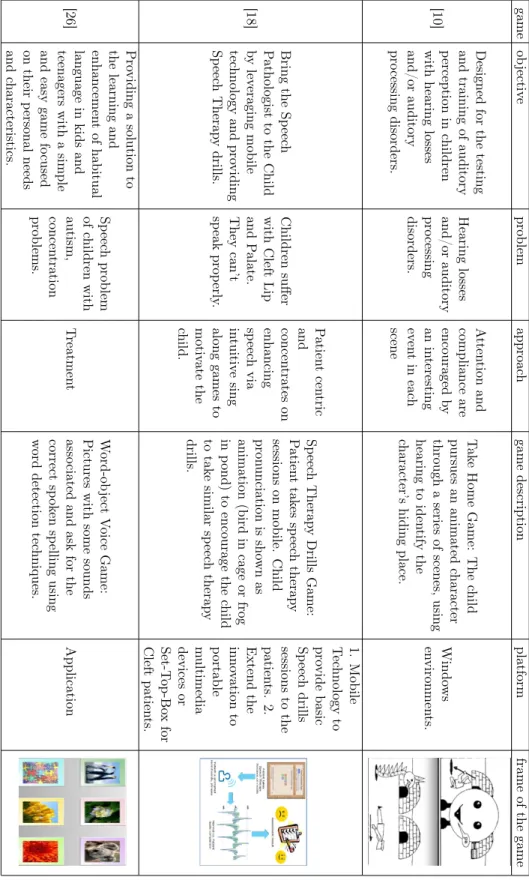
Table ?? shows some of the above games specifically for speech therapy and hearing impairment, ordered from old to new. These served as motivation for us to create our own game that would provide motivation and accessibility for children at home to practice their speaking.Chapter 2. Background 15
2.5 Main Characteristics of
Into the Forest
Game
What distinguishes our game from the above are; the diagnosis, training, and testing phase.
• In diagnosis, the child is asked to utter particular words, each for five times. The reason behind selecting these particular words are discussed in section 4.1. Then a confidence score is calculated to see if he/she needs therapy or not. If this score is less than 70%, the child is supposed to enter the training phase of the game. Otherwise, he/she can play the game for fun.
• When it comes to training, the child is asked to repeat the word said by the object that he/she collides. The child is guided by an arrow throughout the scene and independent of any therapist or teacher, to reach the objects to gain coins. The game is equipped with avatar control by voice commands using a word detection package [41]. For children with severe speech impediments, we also offer a keyboard option, so that the child does not get stuck and feel frustrated.
• In the final phase which is the evaluation, the child is supposed to utter the words that he/she have learned in the game so far and his/her assessment will be shown on the screen.
The game has no negative feedback to the child because this can be discouraging and frustrating for him/her. We just show the similarity score of the pronounced words with the original ones using a predefined dictionary. These scores help parents and therapists to receive information about their child’s improvement.
All words in sentences to be recognized should be known by the Ispikit plugin. The plugin comes with a large dictionary that contains most English words. It can be viewed in ’upalbundle.bundle/libdictionary.so’ which is an ASCII text file. However, new words can be added with ’addWord’, using the [CMU sphinx pronunciation dictionary] syntax [42].
Table 2.1: Serious Games for Improving Children’s Speech Disorder game ob ject iv e pr ob lem approac h ga m e des cr ip tio n pla tfo rm fr am e of th e ga m e [10 ] D es ig ned fo r th e tes tin g and training of auditory per cep tio n in ch ild ren wi th hea rin g lo sses and/or auditory pr oces sin g dis or der s. H ea rin g lo sses and/or auditory pr oc es sin g dis or der s. A tten tio n an d co m pli an ce ar e en co ur ag ed by an in ter es tin g ev en t in ea ch scen e T ak e H om e Ga m e: Th e ch ild pu rsu es an an im at ed ch ar act er th ro ug h a ser ies of scen es ,u sin g hea rin g to id en tify th e ch ar act er ’s hid in g pla ce. W in do ws en vir on m en ts. [18 ] Br in g th e Sp eec h Pa th olo gis t to th e C hil d by lev er ag in g m ob ile tec hn olo gy an d pr ov id in g Sp eec h Th er ap y dr ills . Ch ild ren su ff er wi th Cl eft Lip an d P ala te. Th ey ca n’t sp ea k pr op er ly. P at ien t cen tri c and co ncen tra tes on en ha nci ng sp eec h via in tuit iv e sing alo ng ga m es to mot iv at e the child. Sp ee ch Th er ap y D rill s Ga m e: P at ien t ta kes sp eec h th er ap y ses sio ns on m ob ile. Ch ild pr on un ci at io n is sh own as an im at io n (b ird in ca ge or fr og in po nd ) to en co ur ag e th e ch ild to ta ke sim ila r sp eec h th er ap y dr ills. 1. Mobile T ec hn olo gy to pr ov ide basic Sp ee ch dr ills ses sio ns to th e pa tien ts. 2. E xt en d th e inno vat ion to po rta ble m ult im ed ia dev ices or Set -T op -Bo x fo r Cl eft pa tien ts. [26 ] Pr ov iding a solut ion to th e lea rn in g an d en ha ncem en t of ha bit ua l language in kids and teen ag er s wi th a sim ple an d ea sy ga m e fo cu sed on th ei r per so na ln eed s an d ch ar act er ist ics . Sp ee ch pr ob lem of ch ild ren wi th autism, co ncen tra tio n pr ob lem s. T rea tm en t W or d-o bject V oice Ga m e: P ict ur es wi th so m e so un ds as so cia ted an d as k fo r th e co rrect sp ok en sp el lin g us in g w or d det ect io n tec hn iq ues . A pp lica tio n
Chapter 2. Background 17 game ob ject iv e pr ob lem approac h ga m e des cr ip tio n pla tfo rm fr am e of th e ga m e [15 ] R ep or ts th e ad va nt ag es of 3D ga m e en vir on m en ts fo r sp eec h an d la ng ua ge th er ap y of ch ild ren an d be nefi ts of m ak in g th e trea tm en t pr oces s acces sib le fr om an ywh er e an d an ytime are dem on str at ed . Ch ild ren wi th sp eec h and language dis or der s T rea tm en t D es cr ip tio ns ab ou t th e ga m e ob ject s wi th tw o scen ar io s: Th e fir st on e is des ig ned to in tro du ce th e en vir on m en t to cl ien ts. Th e seco nd scen ar io of th e ga m e in ter fa ce is pr ep ar ed fo r fr ee in ter act io ns wi th th e ob ject s. P C, m ob ile [27 ] H el p ch ild ren wh o ha ve inabilit y to en ga ge in lea rn in g in a reg ula r m an ner be ca us e of so m e ph ys ica l, m en ta lo r ps yc ho lo gica l dis ab ilit ies . Ch ild ren wi th ph ys ica l, m en ta lo r ps yc ho lo gica l pr ob lem s. O ver co m e th e di ffi cu lties of stu den ts wi th sp ec ia ln eed s. A dju sta ble V irt ua lCl as sro om Ga m e: an in ter act iv e co m pu ter ga m e ha s been dev el op ed fo r au tis tic ch ild ren to in cr ea se th e flu en cy in th ei r sp eec h by A . A nw ar et al. In th at ga m e th e pla yer ha s to ut ter th e na m e of th e im ag es th at ar e vis ib le in th e co m pu ter scr een wi th in a sh or t per io d of tim e. Mob ile dev ices , w eb br ows er [11 ] E xer ci se so m e sp eec h ab ilit ies . Ch ild ren wi th hea rin g lo ss dia gn os ed at an ea rly ag e D ia gn os ed hea rin g dis ab ilit y an d wh o ar e us in g some kind of aid, su ch as a co ch lea r implan t. D id u da Ga m e: Th e m on key wi ll be ab le to gr as p th e vin e wh en th e co rres po nd in g sy lla ble is pr on ou nced co rre ct ly ; ot her wi se th e m on key wi ll fa ll. W eb , m ob ile, P C
game ob ject iv e pr ob lem approac h ga m e des cr ip tio n pla tfo rm fr am e of th e ga m e [29 ] Fa ci lit at e ch ild ren wi th A ut ism Sp ect ru m Co nd itio ns (A SC) lea rn in g so ci al co m pet en ce sk ills th rou gh tec hn olo gy -d el iv er ed Co gn itiv e-Beh av io ra l Th er ap y (CBT) . A ut ism Sp ect ru m Co nd itio ns T rea tm en t: ac hiev e e ff ect iv e co nv er sa tio n wi th an ot her pa rti ci pa nt T alk A bo ut Ga m e: Th is is a CV E co m pu ter pr og ra m in wh ich ch ild ren ar e en co ur ag ed to lea rn ab ou t an d pr act ice th e sta ges of so ci al co nv er sa tio n. DT su rfa ce, m ult i-u ser ta blet op sh ar ed act iv e su rfa ce (S A S). [13 ] Th ey us e a ro bu st ph on em e reco gn itio n so lu tio n fo r as ses sin g ch ild ren ’s per fo rm an ce in V isu al Sp eec h wi th ou t fa lse neg at iv e th at is th e ca us e of fr us tra tio n of th e child. Sp eec h so un d dis or der s T rea tm en t: Sp eec h ex er ci ses Ice cr ea m : th ey ha ve m ot iva tio na lel em en ts th at en co ur ag e th e ch ild to ha ve m or e m ot iva tio n an d fo cu s. V ITH E A sy stem giv es an opp ortunit y to ch ild ren to pr act ice sp ea kin g by vis ua l sp eec h.
Chapter 3
Proposed System
3.1 Game engine analysis
Everyday play and communication can help your child with disability explore her/his world, learn new skills and increase her/his confidence and ability. You can spark your child’s motivation to learn by building on her interests by different computerized games. In addition, play and friendships help your child learn about sharing, cooperating, working out what other people are feeling and making friends with other children. You can help your child learn to cooperate and share by playing board games or interactive games where you have to take turns.
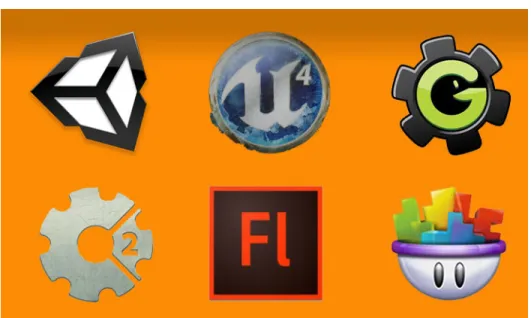
By considering advantages and disadvantages of different engines as it is shown on Fig. 3.1, we have chosen Unity5 3D as far as is a perfect solution for mobile games. I will illustrate my reason to choose Unity 3D in the following:
• Programming Language: Unity 3D mainly uses Java or C#, two of the most popular languages. While Unreal Engine, Blender, Panda 3D are using C++ that is not purely object-oriented programming language. As far as I am more familiar with Java I would prefer these kind of engines.
• It is free to get started with Unity: Unity 3D free version is feature-complete. • It is multi-platform: iOS, Windows Phones, Android, Macs, PCs, Play-station,
X-box, and etc. Unity make it easier it to take your game from one platform to another.
Figure 3.1: Game Engines
• The asset store: The Unity asset store is a great place to find what you need for your game without making it from scratch.
• The ability to create multi-player games: Most of the biggest multi-player games on the web and mobile are built with Unity.
• Online tutorials make it easy to learn: The really nice thing about Unity is how
easy it is to learn and create your game with very low cost.
However, there are a few things to consider as cons like being heavy (engine takes a lot of space on your HDD), Using the engine requires you to agree with their policies (like if you unexceptionally make too much money; you must purchase the Pro version or they may prosecute you), but still we can ignore them.
Retrospectively, as far as we want to focus on Mobile Games so we chose Unity 3d which is more compatible than other engines with our goals.
3.2 Avatar
In Serious Games for health, there are numerous ways to increase attention of the child to play the game [43]. Having different levels of the game and being able to repeat the
Chapter 3. Proposed System 21
game or continue the game from the place the child left are common techniques. In addition, simulation games, in which the child participate in a virtual representation of the "real world" situation [44] and role playing games, where the child is supposed to have the role of main character during playing, help them to find a close relationship between virtual world and real world [45].
The utilization of Avatars [46] are also a helpful technique for advancing personal dominance. Avatars are powerful models since players usually identify with their avatar [47]and children are more inclined to have an appearance near to the main character of the game. children have deliberately performed physical activity when confronted with situations where their activities influenced their character, particularly when the avatar’s appearance was like theirs [48]. Based on social cognitive theory [49], an important role to learn a new thing to children is to perform it in a best way. Serious video games are good solutions to address all of these difficulties. Retrospectively, we have used an avatar as a virtual teacher in our game to help children to learn far from stress and boring environments at schools. Accordingly, the child has no real person as a teacher and he/she will follow the avatar as a virtual teacher to learn by playing.
3.3 Proposed Game
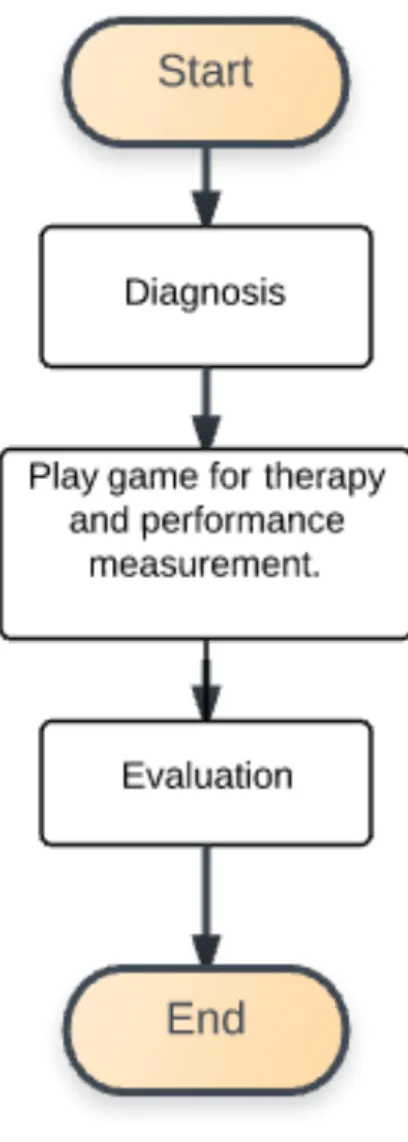
We designed a 3D game called "Into the Forest" [22] by Unity 3D in C# programming language. An overall view of the game is shown in Fig. 3.2. In the game, we have three stages to reach our main purpose. The first one is diagnostic part to see if the child needs speech therapy or not. The second stage is training process by playing the main game. The last one is to test and evaluate the child learning. In the following, we will present the game with more details. In Fig. 3.3 the flow of the game is shown step by step. In the diagnostic part of the game, the child is asked to pronounce five different words. The child is supposed to try every word five times. For every word, the system will show us the Confidence Score of the word as it is shown in Fig. 3.4. Confidence Score means how much the child pronounced the words properly. If from five times of pronunciation the child received three times less than 0.7 for confidence score then s/he is diagnosed with needing speech therapy treatment. Otherwise, s/he can enter the game for fun.
Figure 3.2: Overview of game stages
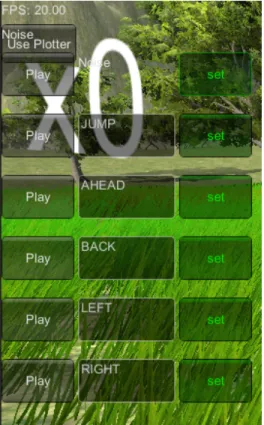
After entering to the playground the child can start the game from beginning or continue from where s/he left the game for the last time and earned enough coins till now. The number of coins means how many words or sentences s/he has learned so far. After s/he entered the scene, we have two choices to control the avatar. The first option is for children who are crippled and not able to use their hands properly. For this purpose, the avatar will be controlled by the child with voice commands such as jump, ahead, back, left, right as it is seen in the Fig. 3.6. The second choice is using arrow keys for directions and space bar to jump and shift key for running fast.
Chapter 3. Proposed System 23
Figure 3.3: Flowchart of the game
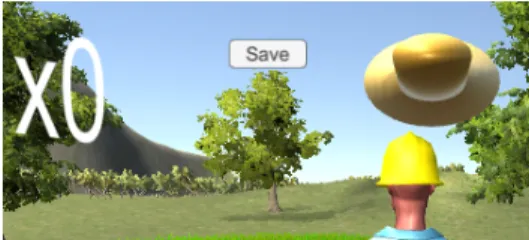
Avatar control is supported for all languages and before recording the sound as a sample, we can use Noise Plotter to recognize the noise in the environment that is so important during recording. Besides, we have an arrow key into the scene as it can be seen in Fig. 3.7 to orient the child where to find the next object without getting help from someone else. As the child collides with an object, it will be disappeared and its sound will be played. Then another one will appear in the scene with random distance from the avatar. This arrow guides the child where to find the next goal during the game and some of objects are shown in Fig. 3.8.
Having this arrow as a guide during the game makes the child play the game independently and autonomously to find objects into the forest and listen to them carefully and repeat as s/he has been asked into the scene. As it is shown in Fig. 3.9, X0 is counting the
Figure 3.4: Diagnosis part of the game
number of objects during the play. It means how many objects the child could meet and practiced so far into the forest. In addition, there is a save button which saves the number of objects avatar found till now. If we considered 30 words to teach the child, at the end of the play this X0 should be 30. After the child finished this teaching phase, s/he will enter the testing phase and system will show us her/his improvement by giving the score for his/her pronunciation. We have four robots in this scene and one main avatar which will be controlled by the child. As the child collides with one of the four robots, a sound will be played to ask a random question from the child. For example, as the child collides with one of these robots, that robot will ask vocally from the child "Which fruits do you see around this robot?" as it is shown in Fig. 3.10. Then the child should answer that question. Another question is that "Which numbers do you see around me?", or "Can you please tell me the name of seasons?", and so on. Then the child will answer accordingly. Answers can be just words or sentences which the child has learned from the game.
Chapter 3. Proposed System 25
Figure 3.5: Proposed system
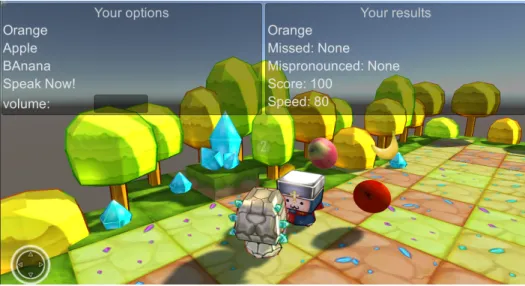
Those objects came from the game she/he already played and found them in the forest. Then the results will be shown on the screen as Fig. 3.11.
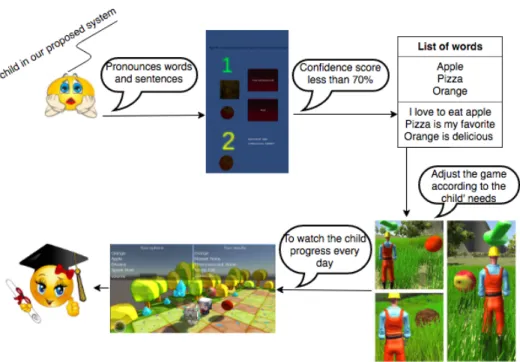
To enhance the effectiveness of our proposed system that is shown in Fig. 3.5 , we have decided to use this diagnosis application to collect words and sentences to teach the child during the game stage. So, if the child has received less score in confidence score from this application, we have created a list of words and sentences to use in our main game. Here has been explained how score is calculated by this plug-in. Score is between 0 (bad pronunciation) and 100 (perfect pronunciation). Pronunciation assessment is performed by looking at the phonemes of the child’s input compared with several possible inputs. By pitch tracking, we can record the child’ intonation which are separated by spaces. Speed shows how many phonemes have been uttered by the child in ten seconds.
Table 3.1: Matrix of the Game Based on ISG Project
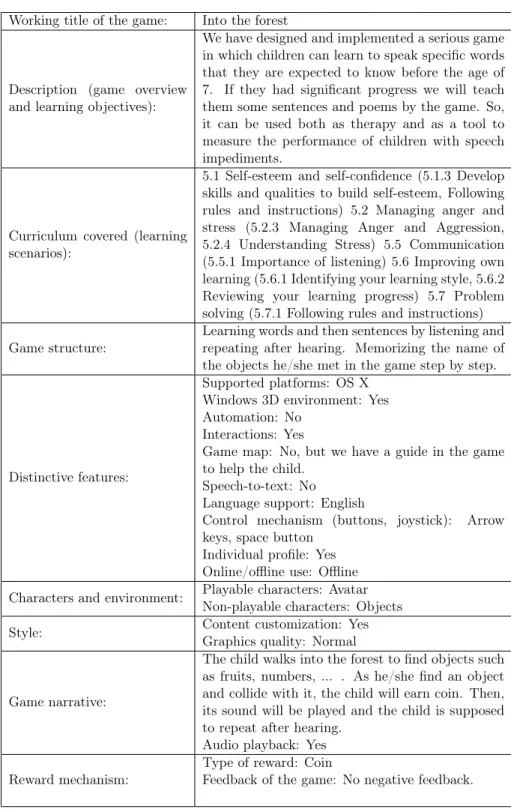
Working title of the game: Into the forest
Description (game overview and learning objectives):
We have designed and implemented a serious game in which children can learn to speak specific words that they are expected to know before the age of 7. If they had significant progress we will teach them some sentences and poems by the game. So, it can be used both as therapy and as a tool to measure the performance of children with speech impediments.
Curriculum covered (learning scenarios):
5.1 Self-esteem and self-confidence (5.1.3 Develop skills and qualities to build self-esteem, Following rules and instructions) 5.2 Managing anger and stress (5.2.3 Managing Anger and Aggression, 5.2.4 Understanding Stress) 5.5 Communication (5.5.1 Importance of listening) 5.6 Improving own learning (5.6.1 Identifying your learning style, 5.6.2 Reviewing your learning progress) 5.7 Problem solving (5.7.1 Following rules and instructions) Game structure: Learning words and then sentences by listening andrepeating after hearing. Memorizing the name of
the objects he/she met in the game step by step.
Distinctive features:
Supported platforms: OS X Windows 3D environment: Yes Automation: No
Interactions: Yes
Game map: No, but we have a guide in the game to help the child.
Speech-to-text: No Language support: English
Control mechanism (buttons, joystick): Arrow keys, space button
Individual profile: Yes Online/offline use: Offline Characters and environment: Playable characters: AvatarNon-playable characters: Objects Style: Content customization: YesGraphics quality: Normal
Game narrative:
The child walks into the forest to find objects such as fruits, numbers, ... . As he/she find an object and collide with it, the child will earn coin. Then, its sound will be played and the child is supposed to repeat after hearing.
Audio playback: Yes
Chapter 3. Proposed System 27
Figure 3.6: Avatar Control by Voice Commands.
Figure 3.8: Reaching the goal
Figure 3.9: Counting the number of objects avatar met so far
Chapter 3. Proposed System 29
Implementation
4.1 Preliminary Testing
Into the Forest is developed for children between 2 to 6 years old with speech disorders and hearing loss in English language. This age range was chosen according to [50], which states that children are supposed to learn some specific words before the age of 6 that are related to Numbers (One, Two, Three, Four, Five, Six, Seven, Eight, Nine, Ten, Twenty, Thirty), Animals (Dog, Cow, Frog, Horse, Bird, Lion, Mouse, Cat, Chicken, Monkey), Fruits (Strawberry, Apple, Coconut, Orange, Kiwi, Cherry, Grapes, Pears, Lemon, Banana), Colors (Strawberry, Apple, Coconut, Orange, Kiwi, Cherry, Grapes, Pears, Lemon, Banana), Days (Monday, Tuesday, Wednesday, Thursday, Friday, Saturday, Sunday), Months (Monday, Tuesday, Wednesday, Thursday, Friday, Saturday, Sunday), Seasons (Winter, Fall, Spring, Summer). Even if we intend to learn sentences to the child, we will include these words as well.
During the game, an object will appear in the scene and avatar will collide with that object and object’s sound will be played and repeated by the child. Then, in the test phase, those objects that s/he has learned so far, will appear on the scene around a robot. This time, s/he pronounces those words and her/his assessment will be given by percentage on the scene. The higher accuracy s/he has in uttering words, the more scores she/he will receive.
By utilizing the SpeakNow package [51], we will decide if the child needs treatment on speech or not. By making use of the word detection package [41], we assign verbal
Chapter 4. Implementation 31
commands to our game-play and we control the character just by adding Spectrum Microphone to the scene. Voice commands are recognized by the word detection package in which the child’s voice recorded in wave format is passed through an Auto-check to compare it to the waves that are already set at the beginning of the game as it is shown in Fig. 3.6. In order to assess the child’s learning, we have used the Ispikit Unity Plug-in [42] that gives us the score of the child’s pronunciation by speech to text. Then we transfer mispronounced words to the real game to be practiced by the child.
To make sure that the child utters exact words we intend to teach him/her, we need to initialize the game based on the child’s needs. For instance, some children need to practice simple words, others need to practice sentences. As the child pronounces a word, this will be compared with the words that we already assigned them to robots to get their similarity by speech to text. We are using a dictionary that includes a list of most English words in an ASCII text file. In addition, new words can be added with the add-word function by the CMU sphinx pronunciation dictionary syntax [42] to this plug-in as well.
In upper levels of the game, we can ask questions in which the child should answer the question in one sentence as is shown in Fig. 4.1. In this figure, we tested the game with a four-year-old child after finishing Into the Forest game. For the first few times, she had some missing words and mispronounced words too much as Fig. 4.3 shows. So, her score was less than 40%. After five times of trying the test phase, she finally could utter all words in the sentence without missing anything, but because she could not pronounce the words very well, her score is 74.
In another test with a six-year-old child, she has received 93% at the end of the test. Again she had the same problems. Finally, she just mispronounced "my" as it is shown in Fig. 4.2 after five times of trying. Because her overall score is higher than 70, it means she passed the test successfully. However, she can repeat the game to receive better results from the testing part. Before starting to speak in the scene, the child will be given 3 seconds to speak.
If the child mispronounces the words in the sentence and the score of the sentence is less than 70%, an audio file will be played to ask her to repeat the words or sentences again and this will be done five times. If there was no improvement, the child should play Into the Forest game from the beginning. If the child has a higher score in this game-play,
Figure 4.1: Practicing phase of the game
Figure 4.2: Mispronounced word in the sentence
those words will be removed from the main game which means the child has learned them properly.
Figure 4.3: Bad result of the game
4.2 Testing
We have tested the game with 8 children between the age of 3 to 7 with speech difficulties. By diagnosis application we could recognize that 6 of 8 children need speech therapy and 2 of them were almost unable to utter any word.
We asked them to make a sentence from the objects he/she sees in the diagnosis application as it is shown in Figure. 3.4. After 6 times of trying we could decide if the child needs speech therapy sessions or not. If 4 out 6 times the Confidence Score in the test phase was less than 50 percent we could undertake the child to therapy sessions.
Chapter 4. Implementation 33
As far as every child had a different level of disorder, so, we customized the game based on their needs. For instance, some children were able to repeat normal sentences, while other children could just rehearse short sentences. Children were supposed to play the game four hours for a day.
We have recorded their performance before and after playing the game and in Table??, we show their progress before and after playing the game. In our outcomes, we found out that before playing the game, not only their score in uttering words and sentences were low, but also their speed in talking were so slow.
To encourage children to collaborate with us easily, we have decided to give them real coins for the number of coins they have earned by playing the game at the end of every day. Besides, we gave them chocolates and toys as a real prize if they were not encouraged by real coins. This lead us to have almost no problem in our testing and have a happy environment all together.
To have accurate results, we asked every child to try test phase of the game 5 times at the end of every day and here in the table we put their average of trying and we have rounded values to the nearest integer (3.6=4, 3.3=3). In table 4.1, we show their average speed and score before and after playing the game during two weeks and almost 20 hours with specific words in sentences.
To find evidence of a significant difference between the first day and last day of test, we have calculated t-test value for children’s score progress. t-test value is 7.98494E-08 which means we have a big difference in results between our pretest and post-test of the game.
In figures 4.4 to 4.9 the progress of children are shown after 7 days of trying. Accordingly, the result of all children are shown in Fig. 4.10. As it is clear in the plot, their progress is increasing by the days go on and their number of practice increase.
For the first child who was 3 years old, after 3 days of trial, from her progress outcomes as it is shown in Fig. 4.4, we find out that we need to make some small changes in the game. So, we modified the game based on her needs and we had better results at the end.
Table 4.1: Test results during 7 days child durationof play Pretest average speed Post-test average speed pretest
score Score at the end ofevery 5 days last day result mean STD child1 4hours [12] [65] [30] [35, 38, 40, 59, 73] [75] 50 18.7 child2 4hours [9] [56] [35] [37, 41, 45, 58, 71] [76] 51 16.6 child3 4hours [21] [55] [21] [26, 37, 48, 55, 79] [70] 48 21.7 child4 4hours [11] [68] [31] [34, 38, 47, 55, 73] [74] 50 17.7 child5 4hours [16] [60] [29] [38, 40, 41, 54, 75] [74] 50 18.1 child6 4hours [14] [74] [45] [42, 49, 55, 60, 78] [85] 56 17.9
Figure 4.4: Progress of first child
Second child had ascending improvements as is clear in Fig. 4.5 and the main reason behind his progress was earning coins in the scene. As we mentioned before, we pay them real coins at the end of the game.
Figure 4.5: Progress of second child
In Fig. 4.6, the third child progress is shown. He was 6 years old and he was so stressful. For the first times of testing the game, he used to had the lowest score after testing the game for both score and speed. By going on, his advance was so significant. But the last day, he was sick and his improvement declined.
Chapter 4. Implementation 35
Figure 4.6: Progress of third child
For the fourth child, we had almost no problem and her progress was satisfactory at the end as is shown in Fig. 4.7.
Figure 4.7: Progress of fourth child
Again in fifth child in Fig. 4.8, however we observed better results for the first days, but after the third day we have decided to alter the game based on the child needs and interests. In addition, she had minor mental problems and she couldn’t remember what to utter in the test phase.
Figure 4.8: Progress of fifth child
In the sixth child in Fig. 4.9, outcomes were outstanding. He was 5 years old and so happy by playing our game. His progress was strictly ascending and we made his game day to day a little bit harder to play. Last but not least, we observed better results in our experiments. In Fig. 4.10, we show children’s progress from the first day to the seventh day. As children had more practice, we reached better results.
Figure 4.9: Progress of sixth child
In Fig. 4.10, an overview of children’s improvement is shown. After fourth day children’s progress has increased significantly. In fact, it took three days for children to get used to game environment and learn how to play the game and where to find objects and for us to modify the game based on their needs.
Chapter 5
Conclusion and Future Work
5.1 Conclusion
As you have probably noticed by now, video games have a great capacity in children education if they lead in a true way. Several studies shown that video games help children to reduce stress, relieve depression, and release anger. In addition, they all claim that video games are stimulating and educational.
Here we described a game that developed to relieve some problems that therapists have with speech disorder children. According to our research, we have realized that if speech disorder problems are recognized before the age of 6 and 7 years old, they are easy to solve and confront.
We can use these kinds of games outside speech therapy clinics to give children the opportunity to learn autonomously. Besides their learning, we can assess their progress from the first time they play the game.
The developed game is used during the treatment process of speech difficulties in English language. This thesis reports the insights taken from the case studies we have examined the game by the support of the game. In addition, we have reported main characteristics of the game environment and treatment process as well. We believe that 3D games have a great potential to suggest several advantages for treatment meetings and sessions with children with language and hearing impairments as well as creating opportunities to make the treatments accessible and affordable anytime and anywhere. The therapist
and mother of children also stated that their children were convenient with this way of learning either at home or at the office. They also claimed that this way of learning is not only an entertainment but also a good way to earn knowledge that their children are supposed to learn at elementary school. They also stated that, by using this game they could help the children to increase their confidence as far as they were able to play the game independently. However, we have received promising results from our tests, we are going to perform the test with more students to increase the reliability of the experiment.
5.1.1 Future Work
For future work, we will add a story-based game in which the child will stand more to play the game and have the opportunity to hear words more during playing. By having enough practice and taking more time, children will be able to increase their confidence of pronunciation. To show the accuracy of uttering words, we are planning to use colors instead of the percentage to show children their improvement at the moment. For example, if his/her accuracy is low, the color of object will be lighter. If the accuracy of pronunciation is high, the color of object will be strong enough as well.
In addition, we are planning to teach children some basic knowledge of the books taken from elementary school books such as math, reading, science, and history. For instance, we will divide Literature book to 5 levels and in every level we will teach the child specific words and sentences and at the end of level we will ask questions and record his/her voice during speaking. Then, we can assess his/her progress on behalf of the child to be far from any stress or pressure. By recording the child voice during the play, we will be bale to watch his/her progress from the first time of try till the last time. Although, now we are able to watch the child’ progress daily, but we are required to ask the child to try another application to receive the result. By recording their voice during the play and saving in a file, we can assess improvement easily and modify the game accordingly.
Bibliography
[1] D. Picca, D. Jaccard, and G. Eberlé. Natural language processing in serious games: a state of the art. Int J Serious Games, 2(3):77–97, 2015.
[2] C. S. Lányi, D. J. Brown, P. Standen, J. Lewis, and V. Butkute. Results of user interface evaluation of serious games for students with intellectual disability. Acta Polytechnica Hungarica, 9(1):225–245, 2012.
[3] C. S. Lányi and D. J. Brown. Design of serious games for students with intellectual disability.IHCI, 10:44–54, 2010.
[4] K. Sehaba. Tailoring serious games with adaptive pedagogical scenarios. InIEEE Int. Conf. Advenced Learn. Techonolgies, volume 11, 2011.
[5] R. Berta A. De Gloria, F.Bellotti. Serious games for education and training. International Journal of Serious Games, 1(1), 2014.
[6] S. Stavros S. Tsikinas and M. Xinogalos. Review on serious games for people with intellectual disabilities and autism. InEuropean Conference on Games Based Learning, page 696. Academic Conferences International Limited, 2016.
[7] J. Alvarez and L. Michaud. Serious games: Advergaming, edugaming, training and more.France, IDATE, 2008.
[8] R. J. D. A. Ferreira. Systematic review about serious games. Master’s thesis, 2015. [9] T. Dennis. Prevalence and cost in the united states, 2013.
[10] A. Boothroyd, L. Hanin, E. Yeung, and Q. Y. Chen. Video-game for speech perception testing and training of young hearing-impaired children. InComputing Applications to Assist Persons with Disabilities, 1992., Proceedings of the Johns Hopkins National Search for, pages 25–28. IEEE, 1992.
[11] D. Loaiza, C. Oviedo, A. Castillo, A. Portilla, G. Álvarez, D. Linares, A. Navarro, and G. A. Ivarez. A video game prototype for speech rehabilitation. In Games and Virtual Worlds for Serious Applications (VS-GAMES), 2013 5th International Conference on, pages 1–4. IEEE, 2013.
[12] R. Wainess H. F. O’Neil and E. L. Baker. Classification of learning outcomes: Evidence from the computer games literature. The Cirriculum Journal, 16(4): 455–474, 2005.
[13] J. Magalhaes A. Grossinho, I. Guimaraes and S. Cavaco. Robust phoneme recognition for a speech therapy environment. In 2016 IEEE International Conference on Serious Games and Applications for Health (SeGAH), pages 1–7, May 2016.
[14] M. Szwoch. Evaluation of affective intervention process in development of affect-aware educational video games. In 2016 Federated Conference on Computer Science and Information Systems (FedCSIS), pages 1675–1679, Sept 2016.
[15] G. Tokdemir M. E. Cagatay, P. Ege and N. E. Cagiltay. A serious game for speech disorder children therapy. InHealth Informatics and Bioinformatics (HIBIT), 2012 7th International Symposium on, pages 18–23. IEEE, 2012.
[16] C. J. Hawthorn, K. P. Weber, and R. E. Scholten. An interdisciplinary look into the design of a video game toward the strengthening of communicative, linguistic and cognitive skills of children aged 4-6 years. pages 189–198, February 2015. [17] R. J. D. A. Ferreira. Systematic review about serious games. Master’s thesis, 2015. [18] K. Dhaky, M. Bulsara, and B. Sethna. Speech therapy and assessment (via multimedia devices for cleft lip and palate patients). In Global Humanitarian Technology Conference (GHTC), 2011 IEEE, pages 415–418. IEEE, 2011.
[19] V. Agarwal C. Chandramouli. Speech recognition based computer keyboard replacement for the quadriplegics, paraplegics, paralytics and amputees. InMedical Measurements and Applications, 2009. MeMeA 2009. IEEE International Workshop on, pages 241–245. IEEE, 2009.
[20] S. S. Awad. The application of digital speech processing to stuttering therapy. In Instrumentation and Measurement Technology Conference, 1997. IMTC/97.
Bibliography 41
Proceedings. Sensing, Processing, Networking., IEEE, volume 2, pages 1361–1367. IEEE, 1997.
[21] M. W. Coreless S. S. Awad and R. Merson. Computer assisted treated for motor speech disorders. In Instrumentation and Measurement Technology Conference, 1999. IMTC/99. Proceedings of the 16th IEEE, volume 1, pages 595–600. IEEE, 1999.
[22] A. Rashed N. Nasiri, S. Shirmohammadi. A serious game for children with speech disorders and hearing problems. 2017.
[23] Educational resources for special needs. A resource for individuals with special needs. URLhttp://do2learn.com/.
[24] ISG4Competence. Intelligent serious games for social and cognitive competence. URLwww.ISG4Competence.com.
[25] S. Shirmohammadi N. Nasiri. Measuring performance of children with speech and language disorders using a serious game. 2017.
[26] M. Frutos, I. Bustos, B. G. Zapirain, and A. M. Zorrilla. Computer game to learn and enhance speech problems for children with autism. InComputer Games (CGAMES), 2011 16th international conference on, pages 209–216. IEEE, 2011.
[27] I. S. Wijerathne N. T. Perera, A. T. Dharmarathne M. M. Wijesooriya, and A. R. Weerasinghe. Ict based education for students with special educational needs in sri lanka. In Advances in ICT for Emerging Regions (ICTer), 2012 International Conference on, pages 156–164. IEEE, 2012.
[28] K. Kanenishi Y. Noda, H. Mitsuhara and Y. Yano. Real world edutainment based on flexible game story. In Proceedings of the 18th International Conference on Computers in Education, Putrajaya, Malaysia, pages 509–516, 2010.
[29] M. Zancanaro L. Giusti-S. Cobb L. Millen T. Hawkins T. Glover D. Sanassy P. L. Weiss, E. Gal and S. Eden. Usability of technology supported social competence training for children on the autism spectrum. InVirtual Rehabilitation (ICVR), 2011 International Conference on, pages 1–8. IEEE, 2011.
[30] D. W. Kim J. Lee, C. H. Lee and B. Y. Kang. Smartphone-assisted pronunciation learning technique for ambient intelligence. IEEE Access, 5:312–325, 2017.