2018
From Research Skill Development to Work Skill
Development
Suniti Bandaranaike
James Cook University, [email protected]
Follow this and additional works at:
https://ro.uow.edu.au/jutlp
Research Online is the open access institutional repository for the University of Wollongong. For further information contact the UOW Library:
Recommended Citation
Bandaranaike, Suniti, From Research Skill Development to Work Skill Development,
Journal of
University Teaching & Learning Practice
, 15(4), 2018.
Available at:https://ro.uow.edu.au/jutlp/vol15/iss4/7
although this transition may be facilitated before and during Work Integrated Learning [WIL] experiences,
there is typically a gulf between the skills taught in higher education and skill requirements of industry. To
address these challenges faced by WIL, and to connect students more effectively with contemporary and
future employer needs, the first objective of this paper is to provide an overview of the use of a validated
generic employability framework, the Work Skills Development [WSD] framework, and the second objective
is to provide evidence about the framework’s effectiveness when used to articulate work skills and student
autonomy. This overview of the WSD and its uses contributes to WIL pedagogy and has direct applicability to
tertiary educators’ contribution to the development of student work mindset to bridge the gap between
tertiary institutions and industry requirements.
Keywords
Research skills, work skills, learner autonomy, Work Integrated Learning, Work Skill Development [WSD]
framework
Introduction
University students are encouraged to seek and discover new knowledge, make connections and build communities of excellence (Mezirow 1998). This is often enabled through a learning and teaching culture that identifies and links opportunities in the curriculum for students to develop a range of critical reflective skills and practices engendered through student engagement in research and inquiry. To this end, the Research Skill Development (RSD) framework (Willison & O’Regan 2006/2018, see the first article in this issue) guides educators in this endeavour by offering “a conceptual framework for the explicit, coherent, incremental and cyclic development of the skills associated with researching” (Willison & O’Regan 2007, p. 395). Willison, Sabir and Thomas (2016) extend this notion by positing the need to enhance employability skills by connecting these explicitly to students’ developing research skills. Such a connection value-adds to students’ attributes as professionals who investigate problems, make judgements based on sound evidence, take decisions on a rational basis, and understand themselves, others and their actions (Brew 2001). In this context, the Work Skill Development (WSD) framework (Bandaranaike & Willison 2009/2018: Table 1) aligns the skills needed for employability with the research skills articulated
in the RSD framework.
The
focus of the WSD is to deliver best practice in employability throughteaching and assessment in Work Integrated Learning (WIL). WIL includes a range of educational activities that integrate academic learning with its practical application in the workplace, yet lacks pedagogical tools to guide formative assessment.
The paper provides a brief critical review of WIL, critical self-reflection, work-readiness and the role of research based learning in employment contexts. This is followed by an overview of the contextual background to the Work Skill Development framework and its role in filling some of the major gaps in WIL. Next, specific applications of the WSD to contemporary employability, and the outcomes of its use will be discussed. The paper concludes with apparent limitations in the use of the WSD and offers suggestions for future use.
Overview of WSD
Work Integrated Learning
Work Integrated Learning (WIL) is a nexus between content knowledge developed through higher education institutions and their application in the workplace. It refers to a range of pedagogic and assessment practices focussed on helping students to gain job experience, and include; workplace experience, project-based learning, placements, practicums, internships and blended learning. Patrick et al. (2008) define WIL as “an umbrella term used for a range of approaches and strategies that integrate theory with the practice of work within a purposefully designed curriculum”(p.9). In this paper, the term ‘Work Integrated Learning’ is used generically to identify all types of student traineeships that integrate academic learning with practical applications in the workplace. Two of the major criticisms of WIL teaching are the lack of connectivity between the triad of students, educators and, employers, and the lack of formative assessment and feedback (Tymon 2013; Jackson 2010). The WSD addresses these criticisms using a set of comprehensively-researched employability work skills (Figure 1). It connects the triad through feedback
mechanisms (feedback surveys/interviews), and is used in formative student assessment (progress reports, reflective journals, reflective essays, student and employer interviews/surveys;
Level of Autonomy è Prescribed Direction
Highly structured directions & guidance from mentor, where student…
Bounded Direction
Boundaries & limited direction from mentor, where student…
Scaffolded Direction
Works independently & within guidelines provided by mentor, where student…
Open-ended
Student develops own abilities & works innovatively with limited guidance, to…
Unbounded
Works within self-determined guidelines which are context appropriate to …
INITIATIVE What is my role?
Goal directed and motivated to clarify role and adapt to new situations, mindful of ethical, cultural, social/team issues.
Identifies role relying on a high degree of guidance & taking into account ethical, cultural, social/ team considerations.
Identifies & clarifies r o l e with some degree of guidance, including ethical, cultural, social/ team issues.
Adapts to role independently & with minimal guidance to achieve the placement requirements.
Critically evaluates role and is creative in identifying new opportunities, while addressing original requirements of placement.
Determine future goals & projects to create innovative, strategic outcomes, while satisfying original requirement.
RESOURCEFULNESS What do I need?
Find and generate information, data/ & ideas using appropriate resources, technology and digital skills
Uses basic technology & digital skills with a high degree of guidance to find & generate information /data.
Uses technology & digi tal skill s with some degree of guidance to find & generate information/data.
Uses technology & digital skills independently to find & generate a range of artefacts, information/data that satisfy placement requirements.
Selects and uses a range of resources and digital tools demonstrating a high degree of sophistication and aptitude, to produce pertinent artefacts, information/data.
Efficiently select and use only the technology and resources needed, demonstrating context-sensitive digital skills.
LIFELONG LEARNING How do I improve?
Evaluate and reflect on skills required for lifelong learning and work in cross cultural environments.
Uses simple reflective practices to understand others & develop social responsibility.
Displays interpersonal understanding with limited direction to capture diverse beliefs, values, & behaviours.
Uses self-determined criteria to align behaviour with organisational culture & protocols.
Using a high degree of sensitivity, critically evaluates interpersonal & cross cultural environments.
Demonstrates inclusive practice for achieving a healthy organisational culture & responsibility for develop-ment of others and self.
SELF-MANAGEMENT How do I arrange?
Organise and manage self while being perceptive to managing the needs of others.
Organises information & establishes role using a prescribed structure.
Organises information & establishes clear project goals & deliverables with limited direction.
Organises information using self-determined structures to manage self & needs of others within the placement requirements.
Organise & manage time & resources, & plan for contingencies while prioritising tasks for self and others.
Organise information to articulate visions, goals & innovative strategies in managing and socialising teams..
PROBLEM SOLVING How do I create?
Critically analyse and synthesise information to identify problems, consolidate strengths, create solutions and initiate necessary change
Applies a simple structure to understand the placement context & contribute towards creating solutions
Applies a structured format to interpret & synthesise existing information to create solutions for pre-identified problems.
Interprets and synthesises given information and data independently & a p p l i e s new understanding to prioritise problem solving
Applies critical thinking & works collaboratively to analyse, synthesise and produce innovative & creative solutions to self-identified problems.
Applies critical thinking & works collaboratively to analyse, synthesise, produce & implement pertinent solutions & to extrapolate outcomes.
COMMUNICATION & TEAMWORK How do I relate?
Communicate with professionalism and show sensitivity in interpersonal communication, heeding ethical, cultural, social/team (ECST) issues.
Uses prescribed structures that model interpersonal & cultural considerations, to interpret spoken, written & non-verbal communication
Communicates using prescribed language and genre to understand interpersonal & cross cultural communication.
Communicate using appropriate language & assertiveness in sharing information and providing feedback.
Communicates professionally and openly with teams using mutual respect & shared understanding, including. provision of, and response. to, constructive feedback.
Communicates with a high degree of inter-personal and cultural sensitivity in asserting own values & respecting those of others in the team.
Work Skill Facet, where each student demonstrates:
WSD
Table 1: Work Skill Development framework
For the explicit and coherent development of student employability skills [email protected] www.melt.edu.au Creative Commons 4.0Employability frameworks in WIL to date have been one-dimensional, with some only listing work skill competencies (Core Skills for Work developmental framework 2013; Australian Qualifications Framework Council 2013; DEEWR 2012; van der Heijden & van der Heijden 2006), others referring to mere ‘qualifications’ needed for employability (Hillage & Pollard 1998), or factors leading to career preparedness and teamwork requirements (Bradshaw 1989; Riebe et al. 2010) and some others focussing on the need for critical reflection (Harvey 2001; van Woerkom et al. 2002) in employability. The WSD framework is a two-dimensional conceptual framework that incorporates both generic work skills and student autonomy to capture the connection between critical self-reflection and teaching and learning in the quest for employability. One of its greatest strengths is its ability to monitor and assess the proactive participation of students and their associated level of autonomy across each work skill facet during their placement. It also recognises that a focus of student learning should be critical self-reflection.
Critical Self-Reflection
Critical self-reflection is a state of learning in one’s own mind. Learning induces students to reflect by asking questions, and to actively monitor this process to produce further understanding
(Dewey 1938).Reflection refers to the ability to learn on one’s own. Mezirow (1998) describes
critical awareness of meaning and self-knowledge as a critical dimension to self-directedness. Empowering learners to develop autonomy through critical self-reflection is pivotal to the transition from teaching to learning, and employability (Bandaranaike & Willison 2017). The WSD provides students with a self-reflective tool to monitor and facilitate awareness of how autonomously they are able to perform certain skills. In this process, it is important for the student to reflect and ask questions about what the work experience means to them, thinking actively about it and making changes where required. In self-reflecting, the student recognises the progress made from beginning to end whilst simultaneously considering improvements that can be made (Drucker 2011), as learning occurs through experience and making mistakes. Self-reflection enables the movement from just experiencing, to understanding, the sense of being able to know progress has been made, to boost motivation and promote self-confidence. Developing this habit leads to an automatic process of evaluation and feedback. Most importantly, self-reflection facilitates change in student reflection as a cyclical process enabling improvements in the student’s level of autonomy. This kind of self-monitoring is an awareness to think about thinking, in order to integrate new ideas and concepts (Garrison 1997).
Research Based Learning
Brew (2001, p.7) appropriately identifies that research and inquiry do not exist solely to help students pursue an academic career, but are central to professional life in the twenty-first century. She says “… for the students who are the professionals of the future, developing the ability to investigate problems, make judgments on the basis of sound evidence, take decisions on a rational basis, and understand what they are doing and why, is vital”. Healey and Jenkins (2009) firmly support the premise that all higher education students should experience learning through, and about, research and inquiry. Others, like Shore, Pinkler and Bates (1990), suggest that research may serve as a model for teaching, and Barnett (1997) calls for teaching to become more research-like, with Hattie and Marsh (1996) suggesting that by marrying teaching and research, the relationship between them is enhanced and that the output becomes desirable. However, none of these researchers clearly articulate how to develop the connection between research and teaching. The WSD framework on the other hand, mirroring the RSD framework, is modelled on skills associated with research and critical self-reflection, and skills required in the workplace. Thus, the
WSD guides educators to extrapolate and articulate employability skills embedded in the research activities that students experience as part of their everyday learning.
Work-Readiness
Work-readiness is indicative of graduate potential to predict long-term job performance and career progression. Cabellero and Walker (2010) argue that work-readiness is an important selection criterion, and should be assessed in the graduate assessment process, as a construct in itself. Work-readiness entails the understanding and practice of both cognitive and affective work skills (Bandaranaike & Willison 2015b). Ferns, Campbell and Zegwaard (2014) state that traditional assessment methodologies focus on knowledge acquisition rather than proficiency in employment capabilities and therefore poorly facilitate work-readiness. Similarly, contemporary teaching of WIL emphasises mainly cognitive skills because of the competition to have graduates ready for the workforce (Krahn, Lowe & Lehman 2002). However, from the employers’ point of view, social skills and personality type are more important than graduates’ degree qualifications (Archer & Davison 2008). This suggests that graduates need to engage in ways that are socially and emotionally savvy, and that these affective ways of operating are crucial to unlocking the potential of cognitive skills in the workplace. Several WSD studies have addressed how to bridge the cognitive and affective domains within the workplace (Bandaranaike and Willison 2014), as well as addressing the role of emotional work-readiness for becoming a professional (Bandaranaike and Willison 2015a; 2015b).
Contextual Background to the WSD Framework
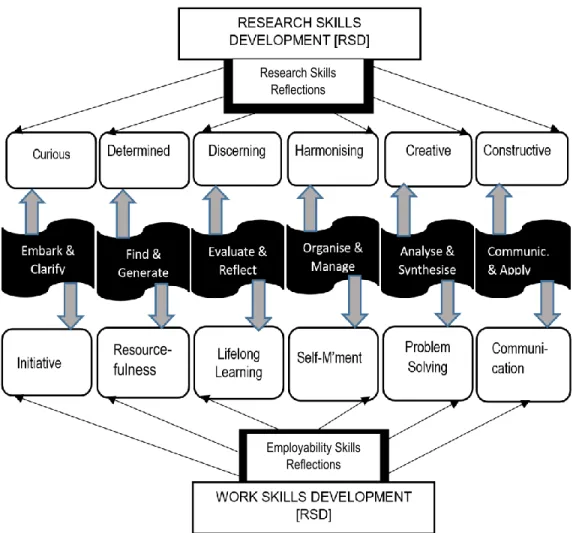
The WSD is a sister framework to the RSD, named as one of the Models of Engaged Learning and Teaching (MELT) in this special issue. It explores and mirrors the connections and segue between reflections on research skills and reflections on work skills (Figure 1). The WSD framework (Bandaranaike & Willison 2009/2018) is based on RSD methodology (Willison & O’Regan 2006/2018), and mapped using a combination of graduate attributes (Donleavy 2012), Australian Government employability skills (DEST 2006) and Bloom’s taxonomy (Bloom et al. 1956). Subsequently, the WSD framework was revised in 2018 (Bandaranaike & Willison 2009/2018) based on The Australian Blueprint for Career Development (MCEECDYA 2010) to articulate the emotional, social and cultural intelligence requirements in workplace training.
Skill Facets and Levels of Autonomy
The Work Skill Development framework monitors and assesses the proactive participation of students during their placement using work skill facets and levels of autonomy. The six
comprehensive work skills facets - Initiative, Resourcefulness, Lifelong Learning,
Self-Management, Problem Solving, and Communication & Teamwork – were compiled as a summary from the multitude of skill facets and graduate attributes and outcomes of Australian universities.
Figure 1. Connecting research skills and work skills reflections.Based on: Willison and O’Regan, Research Skills Development Framework, 2006/13; Bandaranaike and Willison, Work Skill Development Framework, 2009/16.
Learner autonomy ranges from Prescribed Direction, Bounded Direction, Scaffolded Direction,
Open-ended direction through to Unbounded (Table 3).These levels map the transition from a high degree of guidance from a mentor/supervisor to working within self-determined guidelines. The WSD has been used by students and employers as a reflective tool to assess self-reliance before and after the placement experience. For example, using critical self-reflection, students make entries in their reflective journal on their daily/weekly performance at the workplace during the placement. Following on, they self-assess their individual level of autonomy on a list of reflective statements replicating the five-point scale for each of the WSD work skills. At the end of the placement, employers likewise assess the level of autonomy for each student. These perceived positions on the five-point autonomy scale can be compared and tested to assess the difference between the student’s perception and the employer’s perception. In one such
comparison of student and employer perceptions, it was found that overall, the students tended to exaggerate their level of autonomy at the end of the placement, while employers provided a more
Research Skills Reflections Employability Skills Reflections Resour
ce-fulness
conservative rating in the levels of autonomy at the end of the placement (Bandaranaike & Willison 2010). These critical self-reflections and perceived levels of autonomy are significant to WIL pedagogy in that they provided an overall understanding of how a student perceived each work skill and whether there were any particular work skills where the student’s understanding was minimal.
Applications of the WSD Framework
Students apply critical reflective thinking to elucidate their understanding and practice of work skills during a placement (Bandaranaike & Willison 2015a). Assessment modules studied previously (Bandaranaike & Willison 2010) include a placement proposal, reflective journal, progress report, reflective essay, feedback surveys and interviews. The interview component comprises closed and open-ended questions and Likert scale statements to document pre- and post-placement positioning on a linear scale of learner autonomy.
The WSD contributes to research based inquiry in WIL through the following modes of assessment (in parenthesis) piloted during the delivery of the course (Bandaranaike & Willison 2010; 2014; 2015a; 2015b; 2017).
o
Critical self-reflection of work skills in ‘pre’ (beginning) and ‘post’ (completion)placement (reflective essay)
o Educator assessment of work skills for individual students (levels of autonomy)
o Employer perceptions, attitudes and assessment of placement students (employer survey
feedback)
o Reflections on personal learning outcomes from the placement and strengths and
weaknesses in specific work skills (reflective diary; pre/post-placement assessment)
o Preparation for job interviews including addressing selection criteria (mock interview)
o Looking at challenges, limitations and strengths in the workplace (reflective journal).
In using reflective practice, students develop an understanding of work skills not just as a theoretical entity, but as something that requires critical self-reflection and evidence-based research to adapt theory to practice. For example, one of the questions in the WSD face-to-face interview for students involves reflecting on key life events (Bandaranaike & Willison 2014). Students reflect on their social and environmental background and discuss what inspired them to take on a specific career, as well as who in particular influenced their decision. These reflections give them a deeper understanding of the background against which they grew up and the way in which this has impacted their choice of career path.
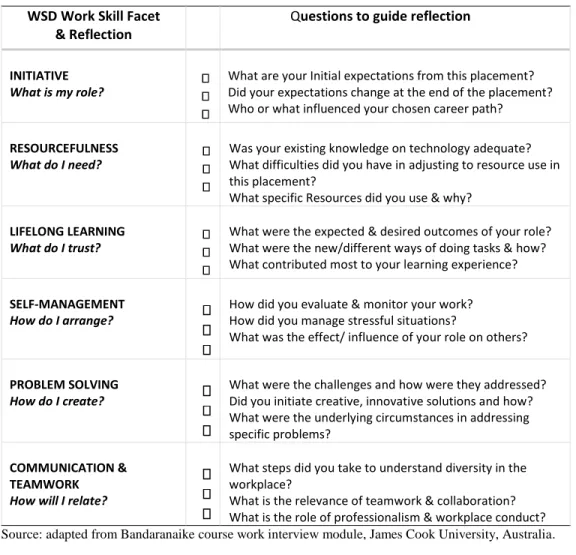
Table 2 reconstructs the essence of face-to-face interviewing [a formative assessment used with WSD background] - and how each of the six WSD work skills encourage critical thinking and reflection in WIL.
In order to connect students more effectively with contemporary and future employer needs, the WSD framework was used to articulate the progress made by each student during the placement in each of the six work skills indicated above, and their level of autonomy (Table 3).
Table 2. Questions based on the WSD to guide reflective practice in WIL.
WSD Work Skill Facet & Reflection
Questions to guide reflection
INITIATIVE
What is my role?
What are your Initial expectations from this placement? Did your expectations change at the end of the placement? Who or what influenced your chosen career path? RESOURCEFULNESS
What do I need?
Was your existing knowledge on technology adequate? What difficulties did you have in adjusting to resource use in this placement?
What specific Resources did you use & why? LIFELONG LEARNING
What do I trust?
What were the expected & desired outcomes of your role? What were the new/different ways of doing tasks & how? What contributed most to your learning experience? SELF-MANAGEMENT
How do I arrange?
How did you evaluate & monitor your work? How did you manage stressful situations?
What was the effect/ influence of your role on others? PROBLEM SOLVING
How do I create?
What were the challenges and how were they addressed? Did you initiate creative, innovative solutions and how? What were the underlying circumstances in addressing specific problems?
COMMUNICATION & TEAMWORK How will I relate?
What steps did you take to understand diversity in the workplace?
What is the relevance of teamwork & collaboration? What is the role of professionalism & workplace conduct?
Source: adapted from Bandaranaike course work interview module, James Cook University, Australia.
Table 3Level of Student Autonomy – generic description.
Level of Student Autonomy
Descriptor for Student Autonomy in the Workplace
1. Prescribed Direction Student requires highly structured direction & guidance
2. Bounded Direction Student works within boundaries set & limited direction
3. Scaffolded Direction Student works independently & within guidelines provided
4. Open-ended Student develops own abilities & works innovatively with limited guidance
5. Unbounded Student works within self-determined guidelines appropriate to discipline /context
Pre- and post-placement variationson the learner autonomy scale were measured on a continuum
of 1 to 5, with Level 1 being the lowest [Prescribed Direction] and 5 being the highest
[Unbounded Direction]. Maximum pre-post change was indicated by a score of 4, and minimum change by a score of 1. A student’s level of autonomy was determined through a series of reflexive questions referred to in Table 1.
Pre and Post Comparisons
One of the unique properties of the WSD is its ability to plot student performance outcomes and document progress over time to compare perceived change from pre- to post-placement on a linear continuum ranging from 1 to 5. These perceived changes individually profile a student’s strengths and weaknesses in a placement, and identify average performance across work skills for a select cohort. The outcomes can then be used to monitor teaching and learning methodology.
An Australian study (Bandaranaike & Willison 2010) used the WSD framework in the disciplines of environmental science, marine biology, earth science, geology, and urban and regional
planning, to enable both students and employers to monitor qualitatively and quantitatively the progress of students throughout their placement. It also gave the students the opportunity to self-assess their strengths and weaknesses in each of the WSD work skills during the placement. Student perceptions were then compared with employer perceptions. The research demonstrated that the WSD facets frequently enabled the employer to explore readily and meaningfully the performance of the student across a comprehensive range of nationally-accredited employability skills. The findings include that students have a stronger sense of improvements in work skills after completing WIL than do their employers. Both groups, however, agree that there is an overall improvement across skills, and the degree of improvement varies with individual skill sets in industry. While traditional assessment is focussed mostly on quantitative assessment, the WSD focuses on qualitative assessment as well, giving valuable feedback to the student and assessing future employability. Students were able to review, reflect on, and so adjust their workplace engagement and receive critical feedback from mentors and employers.
The above survey was translated to Spanish at the Universidad de Guadalajara (Mexico), and replicated among students only (not employers), in the disciplines of marketing, human resources, management, finance management systems, accounting, and international business. The student learning outcomes were compared with those of the Australian study (Quijano & Bandaranaike 2017a; 2017b). A similar study was conducted at the Suranaree University of Technology, Bangkok, where the original survey was translated into Thai and administered among students in the disciplines of engineering, social technology, agriculture and public health to compare the performance of Thai students in pre- and post-placement assessments (Khampirat, Pop & Bandaranaike 2018).
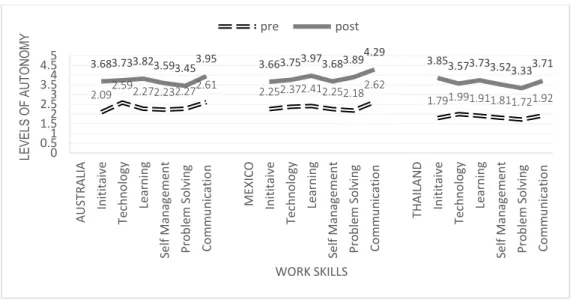
Figure 2. Comparative perceived learner autonomy across work skills: Australia, Mexico and Thailand.
More recently (Bandaranaike et al. 2018), a three-country pre- and post-placement comparison was made across Australia, Mexico and Thailand, with important outcomes for WIL (Figure 2). The study assessed changes between pre- and post-placement autonomy levels, both within and across countries. There was a statistically significant increase in perceived levels of autonomy in
work skills from the beginning to completion of the placement (p ≤ 0.01). A mean difference of 4
indicates maximum change, and a mean difference of ≤ 1.0 indicates minimal change. For example (Fig. 2), in Thailand, the maximum change in autonomy for an individual skill (i.e.,
between pre- (1.79) and post- (3.85) placement) was observed for Initiative (2.06); in Mexico, it
was Problem Solving (1.71), and in Australia, Technology1(1.14).
The above method illustrates the range of learner autonomy common to a cohort of WIL students. Likewise, the above technique has also been used to assess progress between pre- and post-placement for individual students, to assess their strengths and weaknesses across each work skill, and also assess individual rates of progress (Bandaranaike & Willison 2010). This has provided an opportunity to locate discrepancies in student learning or teaching. It also helps to assess the level of performance of an individual student or a given cohort in relation to contemporary employer needs.
The research also indicated that the level of autonomy for Resourcefulness in the workplace displayed minimal change between pre- and post-placement across all three countries
(Bandaranaike et al. 2018). However, the reasons behind this outcome were different for each of the three countries. In Thailand, state-of-the-art technologies were available for students to practice and improve their skills before the internship, leading to technological independence. Thus, the difference between the range of autonomy in pre- and post-placement was reduced in
relation to Technology skills. On the other hand, in Australia and Mexico, the specific disciplines
1 The term Technology [for skill facet 2] was revised to ‘Resourcefulness’ in the revised WSD framework 2018 2.092.592.272.232.272.61 2.252.372.412.252.182.62 1.791.991.911.811.721.92 3.683.733.823.593.453.95 3.663.753.973.683.89 4.29 3.853.573.733.523.333.71 0 0.51 1.52 2.53 3.54 4.55 A U ST R A LIA In iti tai ve Te ch n o lo gy Le arn in g Se lf Man ag eme n t Pro b le m S o lv in g Co m mu n ic ati o n ME XICO In iti tai ve Te ch n o lo gy Le arn in g Se lf Man ag eme n t Pro b le m S o lv in g Co m mu n ic ati o n TH A IL A N D In iti tai ve Te ch n o lo gy Le arn in g Se lf Man ag eme n t Pro b le m S o lv in g Co m mu n ic ati o n LE VEL S OF AU TON OMY WORK SKILLS pre post
sampled had minimal demands on skills related to Technology in their placements, thus reducing the gap between pre- and post-placement autonomy. These findings address the strengths and shortcomings of a student cohort, providing evidence on how best to improve on possible perceived limitations in work skills and focus on contemporary and future employability requirements.
Measures of Work-Readiness
Using the WSD framework as a base, a student’s level of work-readiness was assessed using the following variables:
o The level of autonomy
o Student and employer feedback
o Application of both cognitive and affective skill sets
o Understanding of cultural diversity.
The WSD’s scaffolded range of autonomy, from Prescribed to Unbounded, elucidate
empowerment in learner autonomy, and are pivotal in the transition from teaching to learning, to employability. While knowledge and application of work skills per se do not support
employability, critical self-reflection recognises individual accountability for autonomy in the workplace. A study using the WSD framework concluded that variations in levels of autonomy in work skills were primarily related to four independent variables: Motivation, Adaptability, Communication and Mentor Support (Bandaranaike & Willison 2017).
Student and employer feedback via a questionnaire is part of the on-course assessment at James Cook University, Australia, with the feedback evidencing extremely valuable information to assess which work skills are most relevant to specific industries. In general, student and employer feedback is critical to motivate students and to assess strengths and weaknesses in WIL pedagogy. WSD research has noted and endorsed the essence of face-to-face interview assessment in achieving validity, reliability and contextual authenticity in work-based learning research (Bandaranaike & Willison 2014).
Work-readiness of students relates to the understanding and practice of both the cognitive and the affective domains in the workplace (Bandaranaike & Willison 2015a). In a WSD study of 138 multi-disciplinary WIL students, statistical analysis was used to compare variations in the application of cognitive and affective skills across gender, age, discipline and previous work experience. The study concluded that while overall students had limited understanding of affective skills, employers emphasised the need for greater use of affective skills in the workplace.
Addressing cultural boundaries in the workplace is a contemporary challenge for WIL. Demographic and generational change, varying technological, socioeconomic,
political/religious beliefs impacting on individuals and society have prompted discrete
incremental change in the acceptance of cultural diversity. The WSD framework was also used as a base to articulate a ‘cross-cultural competency’ (CCC) framework to accommodate these cultural variations in the contemporary workplace (Bandaranaike & Willison 2016) and promote globally proficient professionals (Bandaranaike & Gurtner 2016).
WSD Adaptations and Applications
at The University of Adelaide (Australia) compiled a new framework to mirror WSD in their clinical skills and use in placements. The paper discusses the framing and planned implementation
of an applied model of reflective practice, the Clinical Reflective Skills (CRS) framework for
undergraduates in clinical placements (Bandaranaike, Snelling, Karanicolas & Willison 2012). The value of this framework lies in its ability to measure the more holistic aspects of developing the professional skills required by all health professionals through reflective practice.
Career Development
The WSD is not used exclusively in WIL pedagogy and assessment. Researchers have used the WSD to develop career pathways and to map careers for professionals. Career management competencies impact on long-term career success and employee mobility (Jackson & Wilton
2016). In this context, a modified version of the WSD, the Allied Health Career Development
Framework (AHCD), was designed for use by practicing health professionals, in order to facilitate their transition from the status of novices to that of professionals (Bandaranaike & Kimmerly 2014). The objective of the framework was to monitor professional growth, use reflective practice and peer coaching and help create a more goal- and career-oriented employee. A similar model has been developed for medical professionals (Rasalam & Bandaranaike 2019, in press).
Rubinowski (2016, pers. comm., 17 November) from the Monash University Library confirmed that the WSD framework was used to construct the Library’s own Academic Librarian
Competencies Model (ALCM) for early career Library Professionals, and presented a paper at the Australian Library and Information Association (ALIA) National Conference in Adelaide, 2016. More recently, the School of Mines (Laurentian University, Canada) has commenced a survey using the WSD skill facets to map career pathways for professionals to meet the current needs of the mining industry (Tardif, Bandaranaike & Orozco 2018).
Discussion
Major criticisms of WIL curriculum were the lack of connectivity between the triad of students, educators and, employers, and the lack of formative assessment and feedback. In this overview, the WSD has attempted to address these gaps and connect the triad through feedback mechanisms (feedback surveys/interviews). It must be noted, however, that while the WSD is a practical framework, it needs to be backed by solid oncourse assessment that supports the framework, such as reflective journals, reflective essays, feedback via interviews and self-administered
questionnaires. Thus, the WSD is backed up by on-course assessment that promotes critical self-reflection.
This study looked at the efficacy of using the WSD to fill the gap between university teaching and industry requirements for success in employability. This was achieved by providing an overview of the existing known applications of the WSD.
The innovative two-dimensional WSD framework facilitates employability thinking in terms of specific work skills compiled with graduate attributes, employability requirements of the Australian government (AQF 2013) and Bloom’s taxonomy (Bloom et al. 1956). The WSD’s six comprehensive skill sets, together with five levels of learner autonomy, have been used globally across disciplines to generate international outcomes significant to WIL. The WSD framework is therefore a comprehensive and practical tool that can be understood easily and used across disciplines.
The self-reflective learning embedded in the WSD develops students’ thinking skills to link research and employability skills and encourages them to discover new knowledge and make connections with industry. While critical self-reflection facilitated valuable student feedback, as in the case of pre- and post-placement perceptions on levels of autonomy, the WSD also facilitates student autonomy, self-confidence and the motivation to engage in the placement.
Whilst the vast amount of WIL literature focused more on pedagogical aspects, and some included one-dimensional frameworks, few studies indicated how to access student feedback. Furthermore, the current WIL models lack formative assessment. A significant strength of the WSD framework is that it has been purposefully designed as a pedagogical tool to guide the teaching and
assessment of WIL. The WSD does this by articulating the cognitive and affective skills required in the workplace across a learning continuum. The WSD is invaluable in facilitating student transition from higher education institutions to the workplace. Given the documented research gap in the mastery of work skill competencies, the WSD can assist educators in identifying where students lack proficiency. In doing so the WSD has the potential to inform WIL strategies and contribute to pre- and post-placement WIL research (Bandaranaike & Willison 2010). One of the major limitations in a number of these studies was the application of the WSD
framework in regional areas where there was a scarcity of available placements. Often, in regional towns, there are a restricted number of placements that can be offered. Therefore, assessing a student’s progress in terms of their developing self-reliance and autonomy may be inhibited owing to the lack of available facilities. Connected with this is the difficulty in regulating scope and type of placement and inconsistencies in the end product. In placements undertaken within industry or institutional workplaces, the WSD requires close monitoring of students’ levels of autonomy through mentorship. Mentors need to be willing and available time-wise to assist students and to provide feedback to them. It was noted that one of the major issues with accessing employer feedback was the reluctance to provide written feedback via the survey instrument provided to them. Modules comprising WSD use in project-based learning as part of an overall learning program in WIL are more cost-effective and scalable; however, they are not as likely to develop the deep understandings and skills possible in work placements.
The WSD has proven to be a flexible tool and has the potential to accommodate changes in the labour market, technology, communication, innovative problem solving and critical analysis. Using the WSD to analyse long-term trends or time series analysis of student cohorts within a discipline will contribute to improving teaching practices and providing a better understanding of the student perspective. The WSD is a flexible tool which can help create conceptual and collegial connections that enable international comparative studies to identify differences in applying work skills across industry, disciplines and countries. As WIL increasingly takes on compulsory status in many higher education institutions, the expanding use of digital methods to facilitate critical self-reflection, student/employer feedback and other assessment will be a priority.
Conclusion
The purpose of this paper was to explain the background to the WSD framework and provide an overview of evidence on how it has been used to articulate employability skills, including career development pathways. This is significant to WIL pedagogy, since its application incorporates input from students, their mentors and employers in reflective practice on the whole WIL process.
practice-based assessment, more long-term data collection is required for a better understanding of student performance in the workplace and to further support the WSD as a pedagogical tool in WIL. Whilst there has been previous literature on approaches to WIL, critical self-reflection, work-readiness and work-based learning, the practicality of the teaching and assessment was unclear. The WSD therefore makes a significant contribution to WIL in that it provides a
methodology to apply critical self-reflection and develop employability skills and career pathways.
Connectivity is the common thread for jobs of the future. Global demands of the 21st century
workplace, with its rapidly advancing technological changes, will require further adjustments in the Work Skill Development framework to prepare the workforce to meet these demands of a more future-oriented workplace. The question is, how well do WIL models adjust to change if they are to create the new human capital conduits required for the future, including, for example, the reality of artificial intelligence replacing humans (Smith & Anderson 2015; CBS News 2015)? A generic and internationally applied framework such as the WSD has the potential to absorb these changing settings in its framework. The WSD is an effective pedagogical tool to facilitate student employability and bridge the current gap among higher education institutions, students and industry.
References
Archer, W & Davison, J 2008, Graduate employability: What do employers think and want?
VOCED plus. NCVER’s international tertiary education research database. National Centre for Vocational Education Research (NCVER), Adelaide.
Australian Qualifications Framework Council2013, Australian Qualifications Framework[AQF],
Second Edition, viewed 30 July 2018, <https://www.aqf.edu.au/sites/aqf/files/aqf-2nd-edition-january-2013.pdf>.
Baafi, E, Tolhurst, R & Marston, K 2017, ‘The Work Skills Development Framework, applied to
minerals industry employability’, in Proceedings of the International Conference on Models of
Engaged Learning and Teaching, Adelaide, 11-13 December, viewed 2 April 2018, <https://www.adelaide.edu.au/rsd/i-melt/program/IMELT_booklet_181217.pdf>.
Bandaranaike, S & Willison, J 2009/2018, The Work Skills Development Framework, viewed 10
April 2018, <http://www.adelaide.edu.au/rsd/framework/frameworks/>.
Bandaranaike, S & Willison, J 2010, ‘Work Skill Development Framework: an innovative
assessment for Work Integrated Learning’, in Work Integrated Learning – Responding to
Challenges: Proceedings of the 2010 ACEN National Conference, Curtin University, Perth,
September 27 – October 1, viewed 21 July 2014, <
http://cdn1.acen.edu.au/wp-content/uploads/2012/07/ACEN-2010-Proceedings.pdf>.
Bandaranaike, S, Snelling, C, Karanicolas, S & Willison, J 2012, ‘Opening minds and mouths wider: Developing a model of student reflective practice within clinical placements’, in
Proceedings of the 9th International Conference on Cooperative & Work–Integrated Education, Bahçeşehir University, Istanbul, Turkey, 20-22 June, viewed 29 April 2015, <
http://waceinc.org/bahcesehir2012/cp/refereed/Australia/Suniti%20Bandaranaike,%20James%20C ook%20University%20and%20Catherine%20Snelling,%20Sophia%20Karanicolas,%20John%20
Willison,%20The%20University%20of%20Adelaide%20(Research)%20Opening%20Minds%20a nd%20Mouths%20Wide.pdf>.
Bandaranaike, S & Kimmerly, A 2014, ‘Building career pathways in the allied health industry: A
practical framework’, in Symposium Proceedings of WACE 10th International Symposium on
Cooperative & Work Integrated Education, University West, Trollhattan, Sweden, 2-4 June, viewed 23 July 2018, <http://www.waceinc.org/uwest2014/proceedings.html>.
Bandaranaike, S & Willison, J 2014, ‘Boosting graduate employability: Bridging the Cognitive
and Affective domains’, in Proceedings of the Australian Collaborative Education Network
National Conference, Gold Coast, Australia, 1-3 October, viewed 21 April 2016,
<http://acen.edu.au/2014Conference/2014-ACEN-Conference-Full-Proceedings.pdf?x99824>.
Bandaranaike, S & Willison, J 2015a, ‘Understanding Emotional Work-Readiness in the
Workplace’, in Proceedings of the 19th World Conference on Cooperative & Work Integrated
Education, Kyoto Sangyo University, Kyoto, 18-21 August, viewed 23 May 2018, < http://www.waceinc.org/kyoto2015/assets/proceedings/Bandaranaike.pdf>.
Bandaranaike, S & Willison J 2015b, ‘Building capacity for work-readiness: Bridging the
Cognitive and Affective Domains’, Asia-Pacific Journal of Cooperative Education, Special Issue,
vol. 16, no. 3, pp. 223-233.
Bandaranaike, S & Gurtner, Y 2016, ‘Integrating cross cultural sensitivity in the workplace:
Developing globally proficient professionals’, in Proceedings of the 2nd International Research
Symposium on Cooperative and Work Integrated Education, Victoria, BC, 12-15 June, viewed 21 April 2017,
<http://www.waceinc.org/uvictoria2016/assets/WACE_IRS_2016_Refereed_Conference%20Proc eedings.pdf>.
Bandaranaike, S & Willison, J 2016, ‘WIL 2020: A framework for cross-cultural competency in
the workplace’, in Proceedings of the 2016 ACEN National Conference, Macquarie University,
Sydney, 28-30 September, viewed 23 July 2017, <
http://acen.edu.au/wp-content/uploads/2016/10/ACEN-2016-Proceedings.pdf>.
Bandaranaike, S & Willison, J 2017, ‘Building learner autonomy into work-integrated
learning: Challenges for the 21st Century’, in Proceedings of the 20th World Conference on
Cooperative and Work Integrated Learning, Chiang Mai, 5-8 June, viewed 23 June 2018, <http://www.waceinc.org/worldconf2017/assets/WACE_Refereed_Conference_Proceedings_Thai land_2017.pdf>.
Bandaranaike, S, Pop, C, Quijano, P & Khampirat, B 2018, in press, ‘Embedding learner
autonomy in future employability: International case studies’, in Proceedings of the2018 ACEN
National Conference,Brisbane, 3-5 October.
Barnett, R 1997, ‘A knowledge strategy for universities’, in R Barnett & A Griffin (eds),
The end of knowledge in higher education, Cassell, London, pp. 166-179.
Bloom, B, Engelhardt, MD, Furst, EJ, Hill, WH & Krathwohl, DR 1956, Taxonomy of educational
Boud, D & Falchikov, N 2007 ‘Developing Assessment for informing judgement’, in D Boud & N
Falchikov (eds), Rethinking assessment in higher education: Learning for the longer term,
Routledge, London, pp. 181-197.
Bradshaw, D 1989, ‘Higher education, personal qualities and employment: Teamwork’, Oxford
Review of Education, vol. 15, no. 1, pp. 55-71.
Brew, A 2001, The nature of research: Inquiry in academic contexts, Routledge/Falmer, London.
Cabellero, CL & Walker, A 2010, ‘Work readiness in graduate recruitment and selection: A
review of current assessment methods’, Journal of Teaching and Learning for Graduate
Employability, vol. 1, no. 1, pp. 13-25.
CBS News 2015, ‘Will artificial intelligence overtake humans in the workforce?’ CBS Interactive
Inc, 5 Sept.
Core Skills for Work developmental framework [CSfW] 2013, Department of
Industry, Innovation, Climate Change, Science, Research and Tertiary Education and Department of Education, Employment and Work Relation, Commonwealth of Australia, Canberra.
Department of Education, Employment and Workplace Relations [DEEWR]
2012, Employability Skills Framework, Stage 1, (Final report), DEEWR, Canberra.
Dewey, J 1938, Experience and education, Collier Books, Macmillan, New York.
Donlevy, G 2012, ‘Proclaimed graduate attributes of Australian Universities: Patterns,
problems and prospects’, Quality Assurance in Education, vol. 20, no. 4, pp. 341-356.
Drucker, PE 2011, Management challenges for the 21st century, Routledge, London.
Ferns, S, Campbell, M & Zegwaard, K 2014, ‘Work Integrated Learning’, in S Ferns (ed.),
HERDSA Guide: Work integrated learning in the curriculum, Higher Education Research and Development Society of Australasia, Australia, pp. 1-6.
Goleman, D 1998, Working with emotional intelligence, Bantam Books, New York.
Garrison, DR 1997, ‘Self-directed learning: Toward a comprehensive model’, Adult Education
Quarterly, vol. 48, no. 1, pp. 18-33.
Harvey, L 2001, ‘Defining and measuring employability’, Quality in Higher Education, vol. 7, no.
2, pp. 97-109.
Hattie, J & Marsh, HW 1996, ‘The relationship between research and teaching: A meta-analysis’,
Review of Education Research, vol. 46, no. 4, pp. 507-542.
Healey, M & Jenkins, A 2009, Developing undergraduate research and inquiry,
The Higher Education Academy, York.
Heck, D 2017, ‘Reframing the Research and Work Skill Development Framework facets to
Engaged Learning and Teaching, Adelaide, 11-13 December, viewed 2 April 2018, <https://www.adelaide.edu.au/rsd/i-melt/program/IMELT_booklet_181217.pdf>.
Hillage, J & Pollard, E 1998, Employability: Developing a framework for policy analysis.
Research Brief85, Department for Education and Employment, London.
Jackson, D 2010, ‘An international profile of industry-relevant competencies and skill gaps in modern graduates’, International Journal of Management Education, vol.8, no.3, pp. 29–58.
Jackson, D & Wilton, N 2016, ‘Developing career management competencies among
undergraduates and the role of work-integrated learning’, Teaching in Higher Education, vol. 21,
no. 3, pp. 266-286.
Kathpalia, S & Heath, C 2008, ‘Reflective writing: Insights into what lies beneath’, RELC
Journal: A Journal of Language Teaching and Research, vol. 39, no.3, pp. 300-317.
Khampirat, B, Pop, C & Bandaranaike, S 2018, in press, ‘Efficacy of Work Integrated Learning:
Pre and post perceptions among cooperative education students’, in Proceedings of the Third
International Research Symposium, WACE, Stuttgart.
Krahn, H, Lowe, GS & Lehman, W 2002, ‘Acquisition of employability skills by high school
students’, Canadian Public Policy, vol. 28, no. 2, pp. 275-295.
Mayorga, D 2017, ‘Adapting the Work Skills Development Framework for the professional skills
and values required for aspiring professional accountants’, in Proceedings of the International
Conference on Models of Engaged Learning and Teaching, Adelaide, 11-13 December, viewed 12 April 2018, <https://www.adelaide.edu.au/rsd/i-melt/program/IMELT_booklet_181217.pdf>.
Ministerial Council for Education, Early Childhood Development and Youth (MCEECDYA)
2010, The Australian Blueprint for Career Development, Miles Morgan Australia, Commonwealth
of Australia, Canberra.
Mezirow, J 1998, ‘On Critical Reflection’, Adult Education Quarterly, vol. 48, no. 3, pp. 185-198.
Patrick, CJ, Peach, D, Pocknee, C, Webb, F, Fletcher, M & Pretto, G 2008, The WIL [Work
Integrated Learning] report: A national scoping study [Final Report], Queensland University of Technology, Brisbane.
Quijano, PO & Bandaranaike, S (2017a), ‘The Challenges of Understanding Work Skills through
Pre and Post Perceptions of WIL students in Mexico’, in Proceedings of the 20th World
Conference on Cooperative and Work Integrated Learning, Chiang Mai, 5-8 June, viewed 23 June 2018,
<http://www.waceinc.org/worldconf2017/assets/WACE_Refereed_Conference_Proceedings_Thai land_2017.pdf>.
Quijano, PO & Bandaranaike, S 2017b, ‘The Work Skills Development Framework applied to
Students in Mexico’, in Proceedings of the International Conference on Models of Engaged
Learning and Teaching, Adelaide, 11-13 December, viewed 8 April 2018, <https://www.adelaide.edu.au/rsd/i-melt/program/IMELT_booklet_181217.pdf>.
Rasalam, R & Bandaranaike, S 2019 (in press), ‘Bridging the gap in health professionals from
novice to advanced practitioner’, Asia Pacific Medical Education Conference (APMEC), Short
Communications, Singapore, 9-13 January 2019.
Riebe, L, Roepen, D, Santarelli, B & Marchioro, G 2010, ‘Teamwork: Effectively teaching an employability skill’, Education & Training, vol. 52, no. 6/7, pp. 528-539.
Rowland, R 1996, ‘Relationships between teaching and research’, Teaching in Higher
Education,vol. 1, no. 1, pp. 7-20.
Salovey, P & Mayer, JD 1990, ‘Emotional intelligence’, Imagination, Cognition and Personality,
vol. 9, no. 3, pp. 185-121.
Shore, B, Pinker, S & Bates, M 1990, ‘Research as a model for university teaching’, Higher
Education, vol. 19, no. 1, pp. 21-35.
Sullivan, M & Bandaranaike, S 2017, ‘Challenges of the New Work Order: A Work Skills
Development approach’, in Proceedings of the 20th World Conference on Cooperative and Work
Integrated Learning, Chiang Mai, 5-8 June, viewed 23 June 2018, <
http://www.waceinc.org/worldconf2017/assets/WACE_Refereed_Conference_Proceedings_Thaila nd_2017.pdf>.
Sykes, C & Dean, B 2012, ‘A practice-based approach to student reflection in the workplace
during a Work-Integrated Learning placement’, Studies in Continuing Education, vol. 35, no. 2,
pp. 179-192.
Smith, A & Anderson, J 2015, AI, Robotics, and the Future of Jobs, Pew Research Center,
Washington, DC, viewed 13 May 2018, <http://www.pewinternet.org/2014/08/06/future-of-jobs/>. Tardif, N, Bandaranaike, S & Orozco, P 2018, ‘A pathway for professionals to meet the current
needs of the mining Industry’, poster presented at the Third International Research Symposium,
Stuttgart, June 23-27.
Torres, L, Bandaranaike, S & Yates, S 2014, ‘What Skills Do I Have? What Skills Will I Need? - Building an Employability Skills Profile through an online Reflective and Learning Program’, in
Symposium Proceedings of WACE 10th International Symposium on Cooperative & Work
Integrated Education, University West, Trollhattan, Sweden, 2-4 June, viewed 23 July 2018, <http://www.waceinc.org/uwest2014/proceedings.html>.
Tymon, A 2013, ‘The student perspective on employability’, Studies in Higher Education, vol.
38, no. 6, pp. 841-856.
Van der Heijde, CM & Van der Heijden, BIJM 2006, ‘A competence-based and multi-dimensional
operationalization and measurement of employability’, Human Resource Management, vol. 45, no.
3, pp. 449-476.
Van Woerkom, M, Loek, N & Nieuwenhuis, FM 2002, ‘Critical reflective working behaviour: A
survey research’, Journal of European Industrial Training, vol. 26, no. 8, pp. 375-383.
Willison, J & O’Regan, K 2006/2018, Research Skill Development framework, viewed 30 June
Willison, J & O’Regan, K 2007, ‘Commonly known, commonly not known, totally unknown: A
framework for students becoming researchers’, Higher Education Research and Development, vol.
26, no. 4, pp. 393-409.