The effectiveness of comprehensive corrective feedback-direct
and indirect- on EFL learners’ language accuracy, structural
complexity and lexical diversity
A thesis submitted in partial fulfilment of the requirements of Nottingham
Trent University for the degree of Doctor of Philosophy
By
Amina Elbadri Dabboub
i
Declaration
I hereby declare that this thesis, which is submitted for a PhD degree, is the result of my own humble work and effort, except where clear reference is specifically made and acknowledged. This research has not been submitted for any other degree at Nottingham Trent University or any other universities.
Signature:
ii
Abstract
This study investigates the effectiveness of direct and indirect written corrective feedback in improving EFL learners’ written language accuracy, complexity and lexical diversity. It also examines the students’ strategies in dealing with feedback. It explores students’ experiences and students’ attitudes towards written corrective feedback. It identifies the factors that affect learners’ responses to written corrective feedback. These objectives are achieved by conducting a quasi-experiment followed by students’ interviews and case studies.
The results reveal that the effectiveness of corrective feedback varies according to its type and the error type over time. Direct feedback is more effective in improving learners’ overall language accuracy, both during revision and in subsequent writing. This finding is attributable to the fact that the participants preferred to have direct corrective feedback, as it is easy to understand and less time consuming when applying it. On the other hand, indirect corrective feedback effectively improves learners’ overall accuracy in new written texts. This can be related to the fact that some learners prefer indirect corrective feedback because they believe that indirect correction encourages them to search for the correct forms to their errors and assists them to recognise the errors nature as well as remembering them and not repeating them in their subsequent writing. In addition, this study investigates whether the direct and indirect corrective feedback have different value for grammatical and non-grammatical errors. Results showed that both direct and indirect corrective feedback are beneficial in developing learners’ grammatical and non-grammatical accuracy. Moreover, neither direct nor indirect corrective feedback resulted in simplified writing. The findings also revealed that learners value and appreciate to receive corrective feedback on their errors in their writing. They also prefer to have explicit corrections on all their errors (comprehensive CF). There are some difficulties that learners faced when processing feedback such as the teacher’ hand writing and the time allocated for revision. In order to overcome these challenges, learners use some strategies, which may include asking for help from their teacher, revising their work carefully and using a grammar book or dictionary.
The findings from this study imply that comprehensive corrective feedback- direct and indirect- have shown to be valuable practice in improving EFL learners’ accuracy and its effectiveness is durable.
iii
Dedication
To my dear father Elbadri, and to my beloved mother Fatema
To my husband Salah, my daughter Mariah and my son Ahmed
To the soul of my brother Sodiq and to my brothers Mohsen, Anwer and Mohammed
To my sisters Fathia, Lyla, Mona and Najmia
To My father in law Nasrideen, and to my mother in law Soaad
To my sisters and brothers in law
iv
Acknowledgements
Praise be to Allah, the most Gracious, the most Merciful, for giving me health, patience and the ability to complete this study.
I would like to express my deep and sincere gratitude to my supervisor Dr Donald Hassett for his constant support, guidance and invaluable constructive feedback, which has assisted me in completing this study. His broad wealth of knowledge has enriched my research skills, and I have learnt a lot from his experience. I wish him a prosperous and successful life.
I would like to express my gratitude to Dr Gloria Gutierrez and Dr Lia Blaj-Ward for their support and valuable feedback.
I would like to thank all my friends, especially Amal Elali, Fatma Tarhuni, Marta Oraniec and Hamida Al jaridi
I would also like to thank all the students who participated in this study and the teacher who corrected students’ work and other teachers who double checked for corrections. Finally, I am also grateful to the Department of English, Faculty of Arts, Azzawia University for nominating me to pursue my PhD study, to the Libyan Ministry of Education for sponsoring my study and for the Libyan Embassy in London for administrating this sponsorship.
v
Abbreviations
BA Bachelor of Arts
EFL English as a Foreign Language
ESL English as a Second Language
CF Corrective Feedback
FL Foreign Language
L1 First Language
L2 Second Language
SLA Second Language Acquisition
vi
Table of Contents
DECLARATION ...I ABSTRACT ... II DEDICATION ... III ACKNOWLEDGEMENTS ... IV ABBREVIATIONS ... V TABLE OF CONTENTS ... VI LIST OF TABLES ... XIV LIST OF FIGURES ... XVIICHAPTER 1. INTRODUCTION ... 1
1.1. CHAPTER OVERVIEW ... 1
1.2. BACKGROUND OF THE STUDY ... 1
1.3. WRITING IN THE LIBYAN CONTEXT ... 2
1.4. APPROACHES TO TEACHING WRITING IN LIBYA ... 5
1.4.1. Product Approach ... 5
1.4.2. Process Approach ... 7
1.4.3. Genre Approach ... 9
1.4.4. Process Genre Approaches ... 10
1.5. THE CONTEXT OF THE STUDY ... 11
1.6. FOCUS OF THE PRESENT STUDY ... 16
1.7. AIMS OF THE STUDY ... 16
1.8. RESEARCH QUESTIONS ... 16
1.9. THE SIGNIFICANCE OF THE STUDY ... 17
1.10. THESIS OUTLINE ... 18
CHAPTER 2. THE LITERATURE REVIEW ... 20
2.1. CHAPTER OVERVIEW ... 20
2.2. EARLY PERSPECTIVES ON ERROR AND WRITTEN CF IN SLA ... 21
2.3. CORRECTIVE FEEDBACK DEFINITIONS ... 23
2.4. CORRECTIVE FEEDBACK TYPES ... 25
vii
2.4.1.1. Direct Corrective Feedback ... 25
2.4.1.2. Indirect Corrective Feedback ... 26
2.4.2. Reformulation ... 28
2.4.3. Written Commentary ... 29
2.4.4. Computer-Mediated Corrective Feedback ... 30
2.5. SOURCE(S) OF CORRECTIVE FEEDBACK ... 31
2.6. PURPOSE OF WRITTEN CORRECTIVE FEEDBACK ... 33
2.7. THEORETICAL FOUNDATIONS OF THE USE OF CF IN SL/FLTEACHING ... 34
2.7.1. First Language and Second Language: Different Process and different Methods ... 35
2.7.2. Corrective Feedback as Focus-on-Form Mediator ... 36
2.7.3. Corrective Feedback as Noticing Facilitator ... 38
2.7.4. Learner Production and Corrective Feedback ... 39
2.8. DOUBTS AGAINST THE USE OF CORRECTIVE FEEDBACK IN FL/L2TEACHING ... 40
2.8.1. Procedural and Declarative L2/ FL Knowledge ... 40
2.8.2. Learners’ Readiness Stage ... 42
2.8.3. Possible Negative Side-Effects of Corrective Feedback ... 43
2.9. DEBATES ABOUT CORRECTIVE FEEDBACK USE IN L2/FLTEACHING ... 44
2.9.1. Which Corrective Feedback Methodology to Use ... 44
2.9.1.1. Focused and Unfocused Corrective Feedback ... 44
2.9.1.2. Direct and Indirect Corrective Feedback ... 45
2.9.2. Which Errors to Correct ... 47
2.10. EMPIRICAL WORK ON WRITTEN CORRECTIVE FEEDBACK ... 48
2.10.1. Research on the Effectiveness of Written Corrective Feedback ... 49
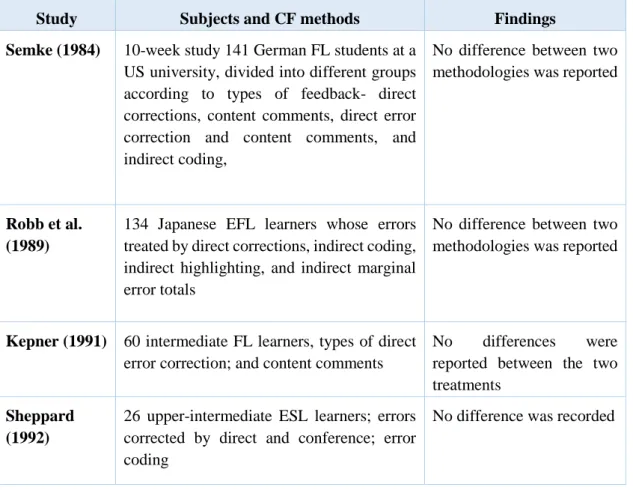
2.10.2. Early Studies on Written Corrective Feedback ... 49
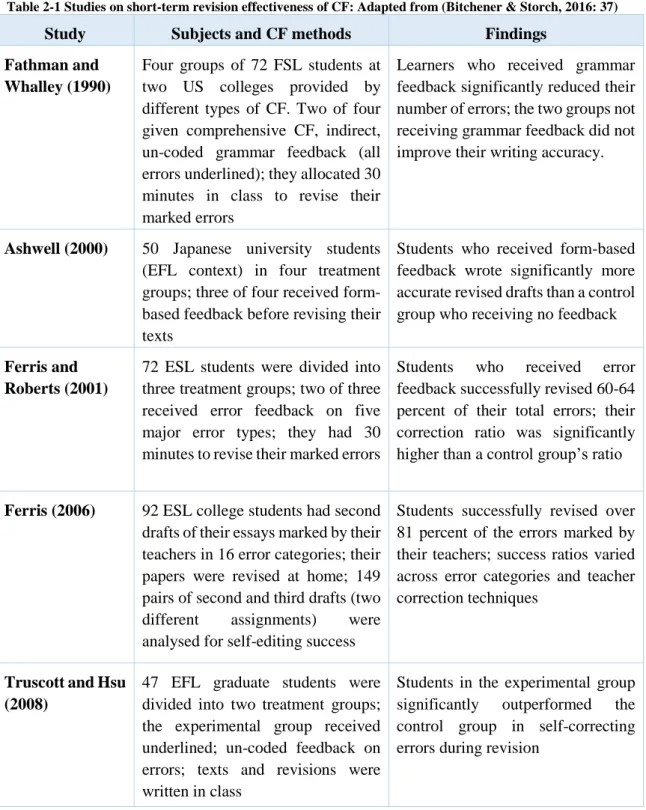
2.10.2.1. Short-Term Revision Effectiveness of Written Corrective Feedback ... 50
2.10.2.2. Long-Term Effectiveness of Written Corrective Feedback ... 51
2.10.3. Recent Studies on Written Corrective Feedback ... 53
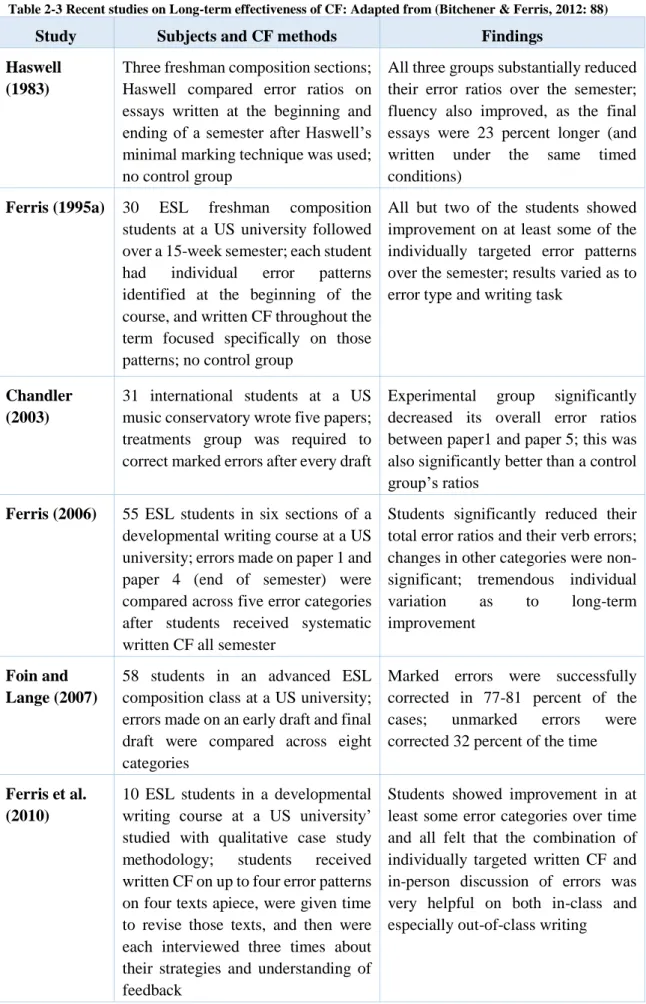
2.10.3.1. Long-Term Effectiveness of Written CF ... 53
2.10.3.2. Direct and Indirect Corrective Feedback Effects ... 57
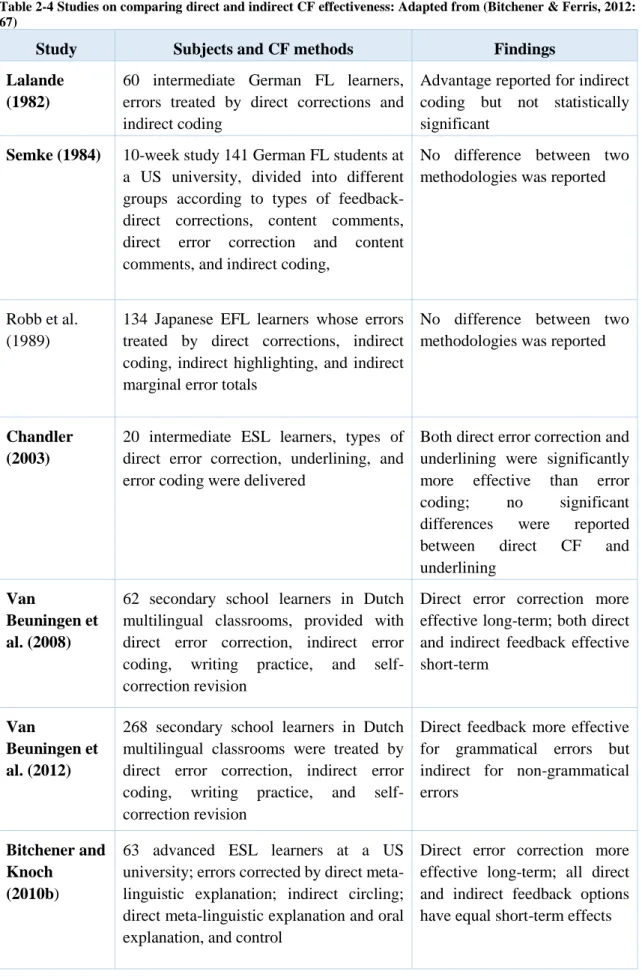
2.10.3.3. Direct vs Indirect Corrective Feedback Effects ... 58
viii
2.10.3.5. Focused (Targeting Specific Error Categories) Corrective Feedback Effects ... 62
2.10.3.6. Unfocused (Comprehensive) Corrective Feedback Effects ... 67
2.11. RESEARCH INTO THE VALUE OF CORRECTIVE FEEDBACK FOR DIFFERENT ERROR TYPES ... 68
2.12. RESEARCH ON LEARNERS’RESPONSE AND PREFERENCE OF CORRECTIVE FEEDBACK ... 69
2.13. RESEARCH ON LEARNERS’VIEW TOWARDS SPECIFIC ASPECTS OF CF ... 70
2.13.1. The Value of Corrective Feedback ... 70
2.13.2. Form or/and Content ... 71
2.13.3. Comprehensive or Selective Corrective Feedback ... 72
2.13.4. Direct or Indirect Corrective Feedback ... 73
2.13.5. EFL and ESL Learners’ Preferences ... 74
2.13.6. Learners’ Challenges when Processing Corrective Feedback ... 77
2.13.7. Learners’ Strategies in Processing Corrective Feedback ... 79
2.14. CASE STUDY RESEARCH ON WRITTEN CF ... 80
2.15. RESEARCH INTO CFHYPOTHETICAL HARMFUL SIDE-EFFECTS ... 81
2.16. SUMMARY AND RESEARCH GAPS ... 82
2.17. CONCLUDING REMARKS ... 84
CHAPTER 3. METHODOLOGY ... 86
3.1. CHAPTER OVERVIEW ... 86
3.2. RESEARCH METHODOLOGY ... 86
3.3. QUANTITATIVE METHOD ... 87
3.3.1. Setting and Participants ... 87
3.3.2. The Administration of the Written Tasks ... 88
3.3.3. Treatments and Categories of the Errors ... 89
3.3.4. Direct, Indirect Treatments and General Comments ... 92
3.3.5. Writing Tasks ... 92
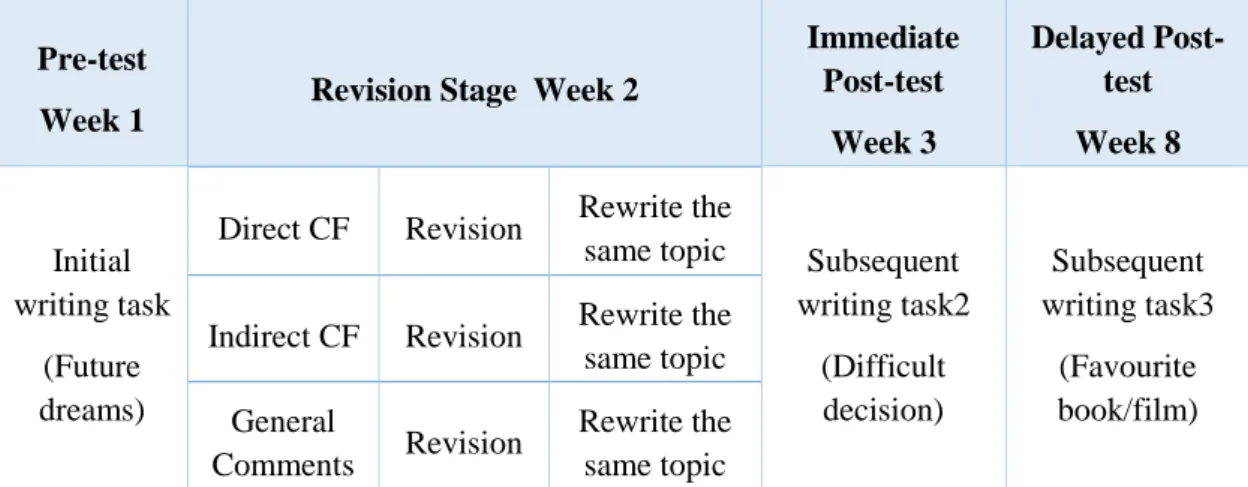
3.3.6. Experimental Set-Up ... 93
3.3.7. Quantitative Data Processing ... 94
3.3.7.1. Linguistic Accuracy Measures for the Dependent Variables ... 95
3.3.7.2. Statistical Procedures ... 98
3.3.8. Qualitative Method ... 101
ix
3.3.9.1. The Interview ... 103
3.3.9.2. The Interview Piloting ... 105
3.3.9.3. The Interview Procedures ... 105
3.3.10. Case Study Analysis Procedures ... 106
3.3.10.1. Across Case Analysis ... 106
3.3.10.2. Within Case Analysis ... 110
3.4. ETHICAL ISSUES ... 112
3.5. CONCLUDING REMARKS ... 113
CHAPTER 4. THE EXPERIMENTAL DATA ANALYSIS ... 114
4.1. CHAPTER OVERVIEW ... 114
4.2. RESULTS ... 114
4.2.1. Overall Accuracy ... 114
4.2.1.1. Checking for Sphericity Assumption ... 114
4.2.1.2. Descriptive statistics ... 115
4.2.1.3. Pre-test performance ... 116
4.2.2. Effects of Comprehensive Corrective Feedback on Overall Written Accuracy ... 116
4.2.2.1. Revision Effects ... 117
4.2.2.2. Short-Term Learning Effects (Immediate Post-Test)... 118
4.2.2.3. Long-Term Learning Effects (Delayed Post-Test)... 119
4.3. GRAMMATICAL ACCURACY ... 121
4.3.1. Checking for Sphericity Assumption ... 121
4.3.2. Descriptive Statistics ... 122
4.3.3. Pre-test Performance ... 123
4.4. EFFECTS OF COMPREHENSIVE CORRECTIVE FEEDBACK ON GRAMMATICAL ACCURACY ... 123
4.4.1. Revision Effects ... 123
4.4.2. Short-Term Learning Effects (Immediate Post-Test) ... 124
4.4.3. Long-Term Learning Effects (Delayed Post-Test) ... 125
4.5. NON-GRAMMATICAL ACCURACY ... 127
4.5.1. Checking for Sphericity Assumption ... 127
4.5.2. Descriptive Statistics ... 127
x
4.6. EFFECTS OF COMPREHENSIVE CORRECTIVE FEEDBACK ON NON-GRAMMATICAL ACCURACY129
4.6.1. Revision Effects ... 129
4.6.2. Short-Term Learning Effects (Immediate Post-Test) ... 130
4.6.3. Long-Term Learning Effects (Delayed Post-Test) ... 130
4.7. STUDENTS’STRUCTURAL COMPLEXITY PERFORMANCE OVER TIME ... 132
4.7.1. Checking for Sphericity Assumption ... 133
4.7.2. Descriptive Statistics ... 133
4.7.3. Pre-Test Performance ... 134
4.8. EFFECTS OF COMPREHENSIVE CORRECTIVE FEEDBACK ON STRUCTURAL COMPLEXITY ... 135
4.8.1. Revision Effects, Short Learning Effects and Long Learning Effects ... 135
4.9. STUDENTS’LEXICAL DIVERSITY PERFORMANCE OVER TIME ... 136
4.9.1. Checking for Sphericity assumption... 137
4.9.2. Descriptive Statistics ... 137
4.9.3. Pre-test Performance ... 138
4.10. EFFECTS OF COMPREHENSIVE CORRECTIVE FEEDBACK ON LEXICAL DIVERSITY ... 138
4.10.1. Revision Effects, Short Learning Effects and Long Learning Effects ... 138
4.11. DISCUSSION ... 140
4.11.1. Comprehensive CF and the Potential Language Learning ... 140
4.11.2. Interactions between Feedback Methodology and Error Type ... 141
4.11.3. The Possible Harmful Side Effects of CF ... 142
4.12. CONCLUDING REMARKS ... 144
CHAPTER 5. THE QUALITATIVE DATA: CROSS CASES AND WITHIN CASES ... 146
5.1. CHAPTER OVERVIEW ... 146
5.2. COMMON CHARACTERISTICS IN STUDENTS ... 146
5.2.1. Error Categories and Accuracy Development ... 147
5.2.2. Revising Behaviour and Self-Correction Strategies ... 148
5.2.3. Revision Experience ... 150
5.2.4. Former Grammar and Recent Grammar Instructions ... 151
5.2.5. Prior Writing and Feedback Experience ... 153
5.2.6. University Writing and Feedback Experience ... 155
xi
5.2.8. Limitation of Timed Writing ... 156
5.2.9. Limitations of Non-Drafting Writing ... 157
5.2.10. Students’ General Feelings and Attitudes towards their Level in Writing ... 158
5.2.11. Reactions on the Feedback Provision ... 160
5.2.12. Clarity and Ambiguity: Direct & Indirect ... 162
5.2.13. Comprehensive Feedback and Focused Feedback ... 163
5.2.14. Language, Content and Organisation ... 164
5.2.15. Oral Communication afterwards ... 165
5.2.16. Learners’ Challenges while Processing CF ... 166
5.3. SUMMARY OF CROSS-CASES ANALYSIS ... 167
5.4. IN-DEPTH INSIGHTS INTO THE CASES (WITHIN CASES ANALYSIS) ... 169
5.5. CASES OF THE IMPROVED STUDENTS OVERTIME ... 169
5.5.1. DS1 ... 169
5.5.1.1. Background Information ... 171
5.5.1.2. Self-identified Strengths and Weaknesses ... 171
5.5.1.3. Opinion about Error Correction Feedback ... 171
5.5.1.4. Errors and Revisions ... 172
5.5.1.5. Insights about Language and Editing Process ... 173
5.5.1.6. Summary ... 174
5.5.2. IDS1 ... 174
5.5.2.1. Background Information ... 176
5.5.2.2. Self-Identified Strengths and Weaknesses ... 176
5.5.2.3. Opinion about Error Corrective Feedback ... 176
5.5.2.4. Errors and Revisions ... 177
5.5.2.5. Insights about Language and Editing Process ... 178
5.5.2.6. Summary ... 179
5.5.3. CS1 ... 179
5.5.3.1. Background Information ... 181
5.5.3.2. Self-Identified Strengths and Weaknesses ... 181
5.5.3.3. Opinion about Error Corrective Feedback ... 182
xii
5.5.3.5. Insights about Language and Editing Process ... 184
5.5.3.6. Summary ... 184
5.6. CASES OF STUDENTS WITH OVERALL ACCURACY DECLINE... 185
5.6.1. DS3 ... 185
5.6.1.1. Background Information ... 187
5.6.1.2. Self-Identified Strengths and Weaknesses ... 187
5.6.1.3. Opinion about Error Corrective Feedback ... 187
5.6.1.4. Errors and Revisions ... 188
5.6.1.5. Insights about Language Knowledge and Editing Processes ... 189
5.6.1.6. Summary ... 189
5.6.2. IDS3 ... 190
5.6.2.1. Background Information ... 192
5.6.2.2. Self-Identified Strengths and Weaknesses ... 192
5.6.2.3. Opinion about Error Corrective Feedback ... 193
5.6.2.4. Errors and Revisions ... 193
5.6.2.5. Insights about Language and Editing Process ... 195
5.6.2.6. Summary ... 195
5.7. INSIGHTS FROM THE CASES ... 196
5.7.1. Insights from both Cross and Within Cases ... 197
5.7.1.1. Students’ Perceptions of Corrective Feedback ... 197
5.7.1.2. Students’ Strategies in Processing Corrective Feedback ... 198
5.7.1.3. Students’ Difficulties when Processing Corrective Feedback ... 199
5.8. CONCLUSION REMARKS ... 200
CHAPTER 6. DISCUSSION AND CONCLUSION ... 201
6.1. CHAPTER OVERVIEW ... 201
6.2. DISCUSSION OF THE RESULTS ... 201
6.3. ANSWERS TO THE RESEARCH QUESTIONS ... 206
6.3.1. How effective is comprehensive written feedback (direct & indirect) in developing EFL learners’ writing accuracy and complexity during revision? ... 206
6.3.2. How effective is comprehensive written feedback (direct & indirect) in developing EFL learners’ writing accuracy and complexity when producing new texts?... 207
xiii
6.3.3. How effective is comprehensive written feedback (direct & indirect) in improving
grammatical and non-grammatical errors over time? ... 208
6.3.4. How do EFL (Libyan) students apply direct and indirect comprehensive feedback to improve their writing accuracy? ... 209
6.3.5. What factors might enhance or hinder students to benefit from written corrective feedback? ... 209
6.4. IMPLICATIONS ... 212
6.4.1. Implications for Pedagogy ... 213
6.5. LIMITATIONS OF THE STUDY ... 215
6.6. FURTHER RESEARCH IMPLICATIONS ... 215
6.7. CONCLUSION ... 216
REFERENCES ... 219
APPENDICES ... 1
-APPENDIX 1. ESSAY SAMPLE FROM DIRECT GROUP ... -1
-APPENDIX 2. ESSAY SAMPLE FROM INDIRECT GROUP ... -2
-APPENDIX 3. ESSAY SAMPLE FROM CONTROL GROUP (TEACHER’S GENERAL ... -3
-APPENDIX 4. STUDENT’S ESSAY TRANSCRIBED ON WORD DOCUMENT ... -4
-APPENDIX 5. STUDENT’S ESSAY TRANSCRIBED ON WORD DOCUMENT AND CODED FOR MAIN CLAUSES AND SUBORDINATE CLAUSES SAMPLE ... -5
-APPENDIX 6. STUDENTS’ DATA IN EXCEL ... -6
-APPENDIX 7. CONTROL GROUP’S ERROR CALCULATIONS ... -7
-APPENDIX 8. DIRECT GROUP’S ERROR CALCULATIONS ... -8
-APPENDIX 9. INDIRECT GROUP’S ERROR CALCULATIONS ... -9
-APPENDIX 10. STUDENTS’DATA IN SPSS ... -10
-APPENDIX 11. RESULTS OF NORMALITY TEST ... -11
-APPENDIX 12. WRITING TASKS ... -13
-APPENDIX 13. INTERVIEW GUIDE (ENGLISH VERSION) ... -14
-APPENDIX 14. INTERVIEW GUIDE (ARABIC VERSION) ... -16
-APPENDIX 15. PARTICIPANT INFORMATION SHEET (ENGLISH VERSION) ... -18
-APPENDIX 16. PARTICIPATION INFORMATION SHEET (ARABIC VERSION) ... -20
-APPENDIX 17. CONSENT FORM (ENGLISH VERSION) ... -22
-xiv
List of Tables
Table 1-1 The subjects taught at the department of English at Azzawia University ... 15
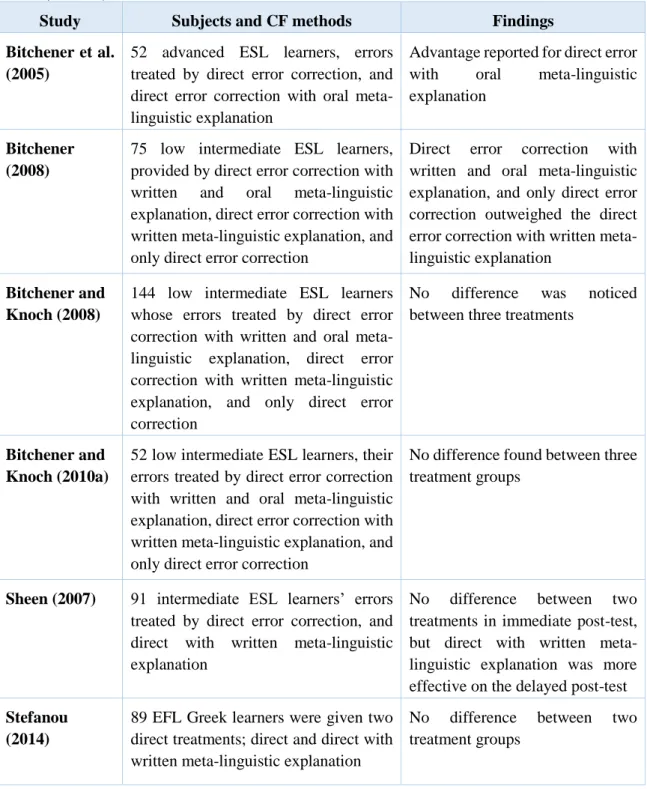
Table 2-1 Studies on short-term revision effectiveness of CF: Adapted from (Bitchener & Storch, 2016: 37) ... 51
Table 2-2 Early studies on the long-term effectiveness of CF: Adapted from (Bitchener & Ferris, 2012: 54) ... 53
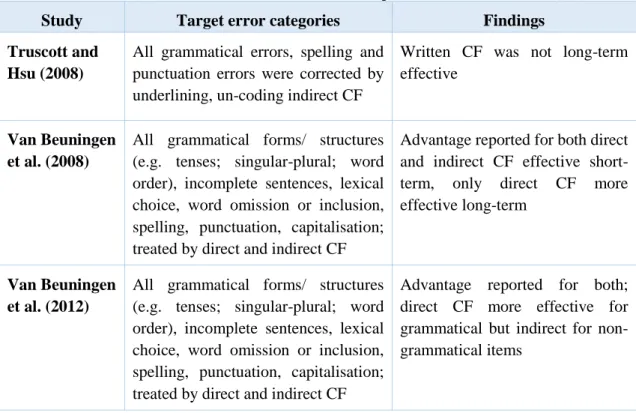
Table 2-3 Recent studies on Long-term effectiveness of CF: Adapted from (Bitchener & Ferris, 2012: 88) ... 56
Table 2-4 Studies on comparing direct and indirect CF effectiveness: Adapted from (Bitchener & Ferris, 2012: 67) ... 60
Table 2-5 Studies on comparing direct with different types of direct CF effectiveness: Adapted from Bitchener & Ferris, 2012: 68) ... 62
Table 2-6 Studies about CF effectiveness on linguistic errors focus: Adapted from (Bitchener & Storch, 2016: 53-54)... 66
Table 2-7 Studies about CF effectiveness on unfocused errors: Adapted from (Bitchener & Storch, 2016: 59) ... 68
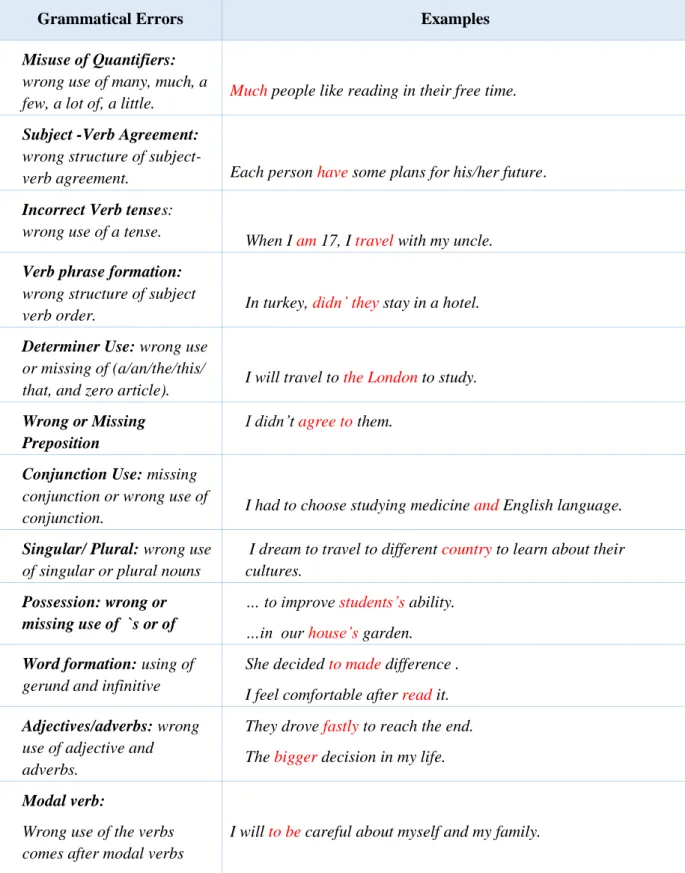
Table 3-1 Error categories adapted from Ferris 2006 ... 90
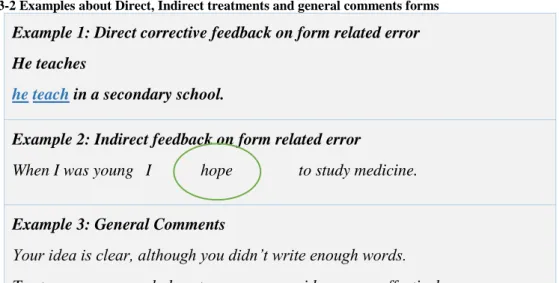
Table 3-2 Examples about Direct, Indirect treatments and general comments forms .... 92
Table 3-3 Experiment Stages ... 94
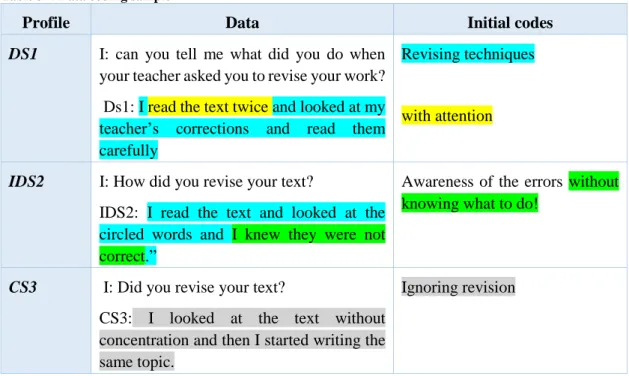
Table 3-4 Data coding sample... 109
Table 3-5 Creating themes sample ... 110
Table 3-6 A sample of initial codes creating ... 111
Table 3-7 A sample of creating case studies themes... 112
Table 4-1 Mauchly's Test of Sphericitya ... 115
Table 4-2 Descriptive statistics: overall accuracy by type of feedback and time of testing ... 116
Table 4-3 Summary of significant contrasts between Feedback groups in overall accuracy with associated Cohen’s d effect sizes ... 120
xv
Table 4-4 Summary of significant contrasts within Feedback groups in overall accuracy with associated Cohen’s d effect sizes and P values ... 121 Table 4-5 Mauchly's Test of Sphericitya ... 121 Table 4-6 Descriptive statistics: grammatical accuracy by type of feedback and time of testing ... 122 Table 4-7 Summary of significant contrasts between Feedback groups in grammatical accuracy with associated Cohen’s d effect sizes ... 126 Table 4-8 Summary of significant contrasts within Feedback groups in grammatical accuracy with associated Cohen’s d effect sizes and P value ... 126 Table 4-9 Mauchly's Test of Sphericitya ... 127 Table 4-10 Descriptive statistics: non-grammatical accuracy by type of feedback and time of testing ... 128 Table 4-11 Summary of significant contrasts between Feedback groups in non-grammatical accuracy with associated Cohen’s d effect sizes ... 132 Table 4-12 Summary of significant contrasts within Feedback groups in non-grammatical accuracy with associated Cohen’s d effect sizes and P value ... 132 Table 4-13 Mauchly's Test of Sphericitya ... 133 Table 4-14 Descriptive statistics: structural complexity by type of feedback and time of testing ... 134 Table 4-15 Summary of significant contrasts within Feedback groups in structural complexity with associated p value... 136 Table 4-16 shows the students’ essay average length by number of words from each group over time... 136 Table 4-17 Mauchly's Test of Sphericitya ... 137 Table 4-18 Descriptive statistics: lexical diversity by type of feedback and time of testing ... 138 Table 4-19 Summary of significant contrasts between Feedback groups in lexical diversity with associated Cohen’s d effect sizes ... 139 Table 4-20 Summary of significant contrasts within Feedback groups in lexical diversity with associated p value... 140
xvi
Table 5-1 Percentage of error rates of the direct group over time ... 147
Table 5-2 Percentage of error rates of the indirect group over time ... 147
Table 5-3 Percentage of error rates of the control group over time ... 148
Table 5-4 DS1’s error trends over time... 170
Table 5-5 DS1’s error rates over time ... 171
Table 5-6 IDS1’s error trends over time ... 175
Table 5-7 IDS1’s error rates over time ... 176
Table 5-8 CS1’s error trends over time ... 180
Table 5-9 CS1’s error rates over time ... 181
Table 5-10 DS3’s error trends over time... 186
Table 5-11 DS3’s error rates over time ... 187
Table 5-12 IDS3’s error trends over time ... 191
xvii
List of Figures
Figure 2-1 Sample student text excerpt with direct correction. Source: Ferris (2008: 102) ... 26 Figure 2-2 Sample student text excerpt with indirect (un-coded) correction. Source: Ferris (2008: 103) ... 27 Figure 2-3 Sample student text excerpt with coded correction. Source: Ferris (2008)... 27 Figure 2-4 Sample Student’s Original Text Excerpt with Reformulated Version. Source: Luchini & Roldan (2007: 236) ... 29 Figure 4-1 Overall error rate mean scores per type of feedback and time of testing .... 116 Figure 4-2 Grammatical error rate mean scores per type of feedback and time of testing ... 123 Figure 4-3 Non-grammatical error rate mean scores per type of feedback and time of testing ... 128
1
Chapter 1.
Introduction
1.1.
Chapter Overview
This chapter presents the study and some relevant issues such as background of the study, writing in Libyan context, common approaches to teaching writing in Libya and the description of the context where the study took place. This is followed by an outline of the aims and the significance of this research. It also presents the research focus and questions. Finally, a presentation of the thesis structure and outline is given.
1.2.
Background of the Study
This study tries to analyse the current written corrective feedback research and attempts to apply its methodologies and broaden the findings by utilising quantitative (quasi-experiment) and qualitative (interview and case study) methodologies, applying insights and paradigms from previous studies on SL/FL learners and different forms of corrective feedback. This research adds to previous studies by concentrating attention on the effectiveness of comprehensive direct and indirect written feedback in improving learners’ overall written accuracy, structural complexity as well as lexical diversity. Specifically, this study aims to determine whether the conclusions of the current controlled quantitative research (e.g., Bitchener & Knoch, 2010b; Manchon, 2011; Van Beuningan, et al., 2008; Van Beuningan, et al., 2012), which compared written corrective feedback direct and indirect, could be effective on learners’ overall accuracy, grammatical accuracy and non-grammatical accuracy. In addition, it also aims to examine whether CF leads learners to avoid making errors by simplifying their writing. Furthermore, employing a case study methodology is to investigate other different aspects, which can be linked to the quantitative findings in order to provide a clearer view about FL/SL learners’ response to teachers’ written feedback. This study’s design and data collection process has been influenced by the following findings:
Focused written corrective feedback (i.e., correction is provided for particular error types) is more valuable than unfocused (comprehensive) corrective feedback (i.e., major correction of learner’s all errors noted by the teacher) (e.g., Bitchenere & Knoch, 2009. 2010a, 2010b; Ellis, Sheen, Murakami & Takashima, 2008; Sheen, 2007, Sheen, Wright, & Moldawa, 2009; Van Beuningan, et al., 2012).
2
Regarding writing development, indirect written corrective feedback is likely to be more beneficial for the long-term learning than direct written corrective feedback (e.g., Ferris, 2006; Hendrickson, 1980; Lalande, 1982). On the other hand, in contexts where language acquisition is the chief focus, not writing development, direct written corrective feedback is more valuable as it efficiently delivers clear information about the errors being corrected (e.g., Bitchener & Knoch, 2010b; Manchon, 2011; Van Beuningan, et al., 2008; Van Beuningan, et al., 2012).
1.3.
Writing in the Libyan Context
Writing plays a significant role in second language improvement, not only in the improvement of accuracy but also in the development of new structures (e.g., Roca de Larios, Manchón, & Murphy, 2006). One of the choices used by teachers to promote productive language use is involving learners to write. Even in the native language context, writing has been argued to be a challenging task as it requires consistent concentration on the content of the text, its organisation, its construction and its linguistic accuracy (e.g., Kellog, 1994; Schoonen et al., 2003). It involves student writers to be fully engaged in continual process of planning, organising, reading, and revising their text in order to produce a text that achieves the requirements of writing (e.g., Flower & Hayes, 1980). Undeniably, writing and learning to write in English as SL/FL could be recognised even more challenging. While producing grammatically accurate sentences tend to be a habitual procedure in one’s first language (L1), this is not the case in SL/FL (e.g., Zimmerman, 2000). The perspective ‘learning-to-write’ is one of the tasks SL/ FL teachers face as they have to guide their learners through the demanding process of being able to write in the target language.
While writing in SL/FL has been claimed to be demanding, it could at the same time be recognised of fundamental significance to SL/FL development. Contemporary opinions on second language acquisition (SLA) have implicated that exposing learners to ample L2 input is not sufficient, and that it is essential for SL/FL students to be encouraged to ‘actively use and produce the target language’ (e.g., Ellis, 2003; 2005; Skehan, 1995; Swain, 1985; 1995). The active use of language forms, functions, and concepts is considered to play a vital role in learners’ language learning process, as output production pushes learners to process language more intensely and make more intellectual effort than they need to do while they are listening and reading (Van Eerde & Hajer, 2008).
3
Encouraging learners to engage in SL/FL, writing could be seen as a way to learn the language. This is the main focus of this study “writing to learn”.
Many SL/FL learners in general and Libyan learners in particular, often consider their level in writing is low and usually ask their teachers how to develop their writing abilities. The most common issues in writing that Libyan learners find hard to overcome are mostly in vocabulary, syntax, morphology and discourse. For instance, when they come to write, students lack the necessary vocabulary items and grammatical structures that service a particular discourse.
Regarding accuracy in particular, most students writing in English commit several grammatical errors such using the proper verb tense, auxiliaries (that is entirely different in Arabic), word order (as in adjective and noun), cohesion, prepositions, definite and indefinite articles and other types. Therefore, some students find it difficult to structure an accurate and simple sentence in English.
Furthermore, Libyan learners face a number of difficulties in terms of paragraph organisation. For instance, based on the researcher’s personal experience, learners do not often consider the target readers when they write, since they are not aware of the importance of impression they convey through their writing to the audience. Consequently, learners encounter difficulties in setting their targets and arranging their thoughts and ideas. That results in the fact that some students translate their ideas and thoughts from Arabic in to English when they write in English.
Learners do not only have difficulties with organisation, but they also face challenges with discourse markers, as they are not able to write cohesively or produce well linked structures. In general, they have problems in producing their writing in different genres. Learners do not normally know the appropriate vocabulary and style which are necessary for particular tasks in writing.
Learners also do not practice in first and the target languages sufficiently. In their Arabic language classes, the teaching of writing is mainly focused on micro level aspects and attempts to employ the grammatical learnt rules in producing accurate sentences. Furthermore, the teachers of written Arabic assume that learners are aware of how to produce long pieces of writing as Arabic language is their native language. Therefore, insufficient practice is provided and often teachers do not give sufficient attention to style and organisation. The lack of practice in writing can also be linked to the cultural factor.
4
In Libya, it is not common to communicate through writing letters or sending cards to people.
As a lecturer in English and a former student myself in Libya, I believe that writing is viewed as a challenging skill because students face previously mentioned difficulties. Consequently, most teachers of English in Libyan schools rarely devote time and effort to teaching writing. This can also lead to the fact that students become demotivated and may lose hope in passing the subject. Linking these attitudinal concerns is that English competence of Libyan students seems to be limited due to the insufficient exposure to the language, as they only use it in the classroom and never use it outside. Furthermore, the materials and sources that can help in developing and improving students’ ability such as books, magazines, articles and stories are not available, even if they are, they are written in Arabic. In other words, English written materials are not widely available in Libya (and even the internet connections are not good) and culturally Libyans do not have the habit of wide reading, even in their own language, which is an additional challenge for them in writing.
Another concern related to the difficulties faced by Libyan learners and leading to their lack of writing skills, is their mother tongue interference. In SL/FL contexts in general and in Libyan context in particular, English is significantly different from their mother tongue, and because learners normally write in L1 and afterwards translate into English; consequently, this affects negatively on the English writing quality of the students. In this way, the learners transfer the aspects needed such as their ideas, forms, sayings, idioms, meaning and sentence structures from first language to the target language. This results in a mismatching in the language system and thus leads students to commit errors in their writing. Furthermore, due to the students’ lack of required knowledge in the target language, they tend to rely on their first language. This can be related to learners’ learning experiences in secondary school, where they are used to being taught by the grammar translation method, in which learners translate texts into the Arabic language. Consequently, learners tend to translate their Arabic thoughts and ideas and write them in English sentences. As a result, many errors such as word order and wrong collocations occur in students’ writing. For instance, in the English language the adjectives come before the nouns whereas in Arabic they follow the noun.
5
1.4.
Approaches to Teaching Writing in Libya
This section presents the main approaches to teaching writing in Libyan classrooms: product approach, process approach, genre approach and process-genre approach. In this section I will discuss the mechanisms of these approaches, the materials required in each approach as well as teachers’ and students’ roles when applying these methodologies. Besides, it highlights the focus and limitations of these approaches.
1.4.1.
Product Approach
This approach typically focuses on linguistic knowledge such as using vocabulary, grammatical rules and cohesive devises of the target language appropriately (Tribble, 2003). The product approach is characterised by the focus on the written text production regardless of the process needed to produce it. This approach is considered as a traditional, text-based approach that is still utilised in different ESL/EFL classrooms, including the Libyan writing classes (Grabe & Kaplan, 1996). In the Libyan context, the focus of this teaching method is mainly on form and accuracy, and the learners’ ability to use the grammatical structures learnt in the classroom that is simply assessed by means of the written text (Richards, 1990).
The product approach extremely concentrates on the language input because it provides an essential basis for imitation and manipulation of the provided models. Accordingly, the product approach considers writing as being primarily about linguistic knowledge, and thus focuses on the syntax, grammar and word choice of the written context. Most of the time students are encouraged by the writing tasks to imitate the texts and models provided by teachers or textbooks. Consequently, the final product that reveals the writer’s language knowledge is very valued (McDonough & Show, 2003).
The product approach materials mainly focus on the final product accuracy (i.e., what the learners write and produce at the end of the lesson). These materials are based on several aspects such as description and topic sentences (Richards & Lockhart, 1995). Libyan teachers think that it is essential for learners to write accurate sentences, the product approach materials are commonly utilised to teach writing in Libya. With regard to the teachers’ assumptions that grammar is the backbone of the language and the importance of writing accurate grammatical structures, most Libyan teachers of writing select their materials, which are designed to cover selection of grammatical structures and sentence patterns to be taught to their students. These grammatical structures include tenses,
6
adjectives, and clauses which are gradually presented in the syllabuses (Nunan, 1988). In addition, these materials are also organised around vocabulary in use.
Writing instruction in the product approach has four phases: familiarisation; controlled writing; guided writing and free writing. Familiarisation stage requires students to learn particular aspects of grammatical structures and vocabulary. During the controlled phase, students write sentences using the knowledge they have already learnt in the familiarisation phase. In the guided writing phase, learners are provided with a topic and asked to write about it through a presentation of a model text. Finally, the phase of free writing is when learners have much freedom to utilise the writing skills in authentic activities such as writing descriptions, letters or stories. The standard application of the product approach might engage learners to learn different forms of descriptions. For instance, if they are asked to write a description of a person, in this case students are required to learn the language they need to use in their descriptions such as adjectives, which normally happens in the familiarisation stage. At the controlled and guided phases, the learners write some basic sentences about people or use a piece of guided writing based on a picture of a person. Finally, during the free phase, the learners produce error free a description of a person who has inspired them by imitating the models provided in the guided stage (Badger & White, 2000).
The teachers’ main role in this approach is to improve learners’ good language habits, which can be mostly achieved by pattern drills, memorisation and repetition of structural forms (Cook, 1992). Brook and Brooks (1999) clarify that the teacher’s role is often to shift their attention to the passive learners. The learners have a little chance for engaging, asking questions, thinking critically or interacting with each other (Grab & Kaplan, 1996). The reasons behind using product approach in Libyan classrooms can be linked to that most writing classrooms in Libya are teacher-centred classes, as the teachers often clarify the information and dominate the talk in the classroom. Learners normally take notes from the board to use this information for their exams. The textbook is the main source of knowledge and teachers usually rely heavily on them. Students do not have much opportunity to practice long pieces of writing. The teaching practice is thus characterised by the teaching of grammatical rules, occasionally by translating them into the learners’ mother tongue, and these activities are commonly provided on the sentence level. The teaching practice values students’ knowledge about the language rather than their comprehension or fluency of the text they produce in the end. From this perspective, it is
7
important that the learners are able to write accurately grammatical sentences, instead of fluent communicative writing.
Based on the expectations that Libyan teachers have about their principal roles of the class as a “source of knowledge”, the approach used widely is the one focuses on PPP (i.e., presentation, practice and performance). These mechanisms are similar to the product approach stages. Teachers often present the new grammatical patterns such as adjectives for describing peoples’ personality (familiarisation stage). Then the practice stage when the learners start to use the new patterns of the language by writing sentences that practice using the presented adjectives (controlled stage). In the performance stage, students try to describe themselves or each other (free writing stage). This type of practice is used to check the learners’ understanding of the lesson (Richards & Renandya, 2004). It might be noted that the product approach, the Libyan version in particular, has some limitations. Firstly, the students’ role is typically a passive one; they are oriented to respond correctly to stimuli. This approach focuses on the accurate response and does not enable students to learn from their errors. Secondly, product approach ignores the importance of the processes required in the language used, as well as the processes that can lead to language learning. Finally, the students have a limitation in the opportunities that enable them to engage in real process of interaction and analysis to learn more efficiently or examine significant aspects of the communicative language. The use of the product approach in Libya develops students’ ability to write at the sentence level but not at length.
1.4.2.
Process Approach
The process approach is a way to teach writing in which the focus is transferred from students’ final texts to the way of writing them. This means that the emphasis moves from the text to the learners (writer) (Tribble, 2003). As a result, the teacher’s role is to evaluate and facilitate the learning process, by providing writing activities that enable students to go through different steps, such as idea generation and data collection then the production of final text. The typical four stages of the process approach are: prewriting, composing, drafting, revising and editing (Wyse & Jones, 2001).
The role of the student in the process approach transforms from a passive receiver of knowledge to an active applicant in the learning process. Learners actively construct their information rather than just automatically receiving it from the teacher or the text book.
8
In this view, the learners’ errors are recognised as a positive sign of their development (Schunk, 2004).
The courses of writing that employ the process approach consider skills and processes of brainstorming, organising the ideas, drafting, and revising (Richards & Renandya, 2004). The syllabuses are process-based and focus on the change from conveying information to learners to communicative approaches as well as they emphasise learners’ development. A standard pre-writing activity requires learners to generate their ideas on the topic of descripting people, or to note down a list of thoughts and ideas to be used in the writing practice (Nation, 2009). During the writing drafts stage, the students would plan to write a description of a person which is based on their brainstorming and ideas generating. This is followed by a discussion and then learners might review their first draft independently, or with their peers, or in groups. The final step is when students edit their writing to produce the final draft. During this process, the teachers assist the learners’ writing and aid them in organising their ideas and reviewing their drafts by providing group activities, teacher and student conference, and peer work (Susser, 1994).
Teachers’ role in the process approach is to assist students to construct their knowledge and give learners the opportunities and encourage them to build it up. The teachers are guiders as they introduce new ideas as well as facilitators so that they provide the support to the students.
In Libyan classrooms, some teachers of writing try to employ the process approach. Some of these teachers obtain their degrees of MA/ PhD from countries like the UK, USA and Canada where they learnt various teaching methodologies. Some teachers in Libyan universities are from other countries, and they attempt to use different methods instead of using the traditional ones. However, the way of teaching English writing in Libya is not broadly influenced by the process approach. There are different factors that can influence the use of the process approach in writing classrooms in Libya. Firstly, teachers find it easy when adopting the same methodologies, they have been taught with. As a result, they tend to use the traditional methods they inherited from their teachers such as grammar translation method and audio-lingual approach. This could be attributed to the fact that some teachers are not aware of new teaching methodologies, or they might lack the confidence that enables them to try different approaches.
Consequently, some teachers are not confident enough to leave the safety of the traditional methods and take the risk of attempting other teaching approaches. Secondly,
9
selecting the teaching methods depends on the teachers’ roles in the classroom. As the teachers see their roles as evaluators and their main obligation is to teach learners how to write accurate sentences and structures, they tend to choose the approaches that help them to control the classroom. Thirdly, teachers avoid co-operative work such as letting students work in pairs or small groups due to the low proficiency level of students and their big number. Besides, working in groups will decrease teachers’ control over the classroom. Finally, some writing teachers in Libya cannot apply this approach due to their obligation of covering grammar focused teaching and exam-oriented syllabus. The process approach lets learners write and review the drafts which are not suitable for timed exams.
1.4.3.
Genre Approach
This approach enables teachers to classify the types of texts which learners are obligated to compose in the target contexts and to organise their courses to achieve their goals and meet their students’ needs. The texts in this approach are means by which the writer communicates with readers. The main focus of a Genre approach is to emphasise the readers’ role in writing, in addition, a social feature to writing research by expanding the way in which the writer engages with a reader in producing a coherent text (Tribble, 2003).
The Genre approach enables teachers and students to consider that writing differs according to the social context in which it is created. For instance, writing business letters, and writing different reports related to different situations are used to serve different purposes (Hyland, 2007).
Materials for Genre writing are often organised on different themes. These themes are linked to authentic activities in which students achieve specific things through writing. Applying authentic themes, such as education work could encourage learners to rely on their knowledge and personal experience.
This approach emphasises the notion of scaffolding which focuses on the role of peers’ interaction and “experienced others” and focuses on what students are able to do without teachers’ assistance rather than what they can do now. Allowing learners to work with each other can lead to far more effective learning than when learners work independently (Hyland, 2007). This collaborative work relies on the teachers’ choice of activities and participation to scaffold writing from utilising controlled activities to free activities because learners steadily grasp the processes of writing the provided genre successfully.
10
With regard to Libyan writing classes, scaffolding is achieved in different procedures such as modelling and analysing the texts, and teachers’ instructions as a form of input. The teachers use writing frames: plans utilised to scaffold and prompt learners’ writing. Such frames provide students with a genre outline, which helps them to begin, unite and improve their writing effectively while focusing on what they tend to include in their texts. The frames also provide a structure for writing that takes different forms relying on the genre, the reason of writing and students’ proficiency level. The teacher typically provides modelling and then the frames after providing comprehensive clarification of the forms required for a specific type of text.
1.4.4.
Process Genre Approaches
This approach is a compensation of the aforementioned methodologies in which writing requires the language knowledge (similar to product and Genre approaches), the context knowledge and the writing purposes (similar to Genre approach), and the use of language skills (similar to process approach). Writing development of students involves input provision to which learners respond (similar to product and Genre approaches) and attention on learners’ skills (similar to process approach) (Badger & White, 2000). A typical task in process genre writing could be exemplified by writing a car description of a car to sell it. The purpose implications are the focus issue, and the relationship between writer and reader. The genre analysis concentrates on the use of language in a certain text (about the car) while the teachers need to consider the processes that enable learners to write a text reflecting the components of the process genre approach (i.e., language knowledge, the context knowledge, and the use of the language skills). The genre analysis also focuses on the process that enables learners to select the features of the car they should consider in their description as well as their competence of using the appropriate expressions and structures (Badger & White, 2000).
The role of the teachers is to help their learners to be aware of the writing purpose of the text and the social context. Consequently, learners need to recognise the purpose of the task: selling the car, writing descriptions in different ways, vocabulary and grammar knowledge, and revising and redrafting skills in order to write a description of a car. Learners’ proficiency level and their knowledge of the topic can play an important role in providing the suitable tasks by the teachers. Referring to the previous example, learners who have knowledge of different adjectives for describing a car might require less input compared with learners who do not. In the case when learners do not have sufficient
11
knowledge, teachers of writing could support them through different sources: the input in terms of instructions and clarifications, students to work in groups, samples of the target text and use them as models to be followed (Hyland, 2007).
Like ESL/EFL writing teachers, some writing teachers in Libya usually attempt to utilise a combination of different approaches and they combine these methods to fit their plans and goals that they aim to achieve in their courses. However, the product approach is commonly used in Libyan classrooms with some attempt to adopt the process approach.
1.5.
The Context of the Study
To undertake the fieldwork for this study, Azzawia University in Libya was selected to be the context of this study. The target participants were undergraduate students at the department of English in the Faculty of Arts. All participants were first-year undergraduate students and the study took place during their first semester. Azzawia University was chosen because it is one of the well-known universities in Libya and the department of English has a time-honoured history in teaching English language. Furthermore, I have been a teacher of English in this university for more than three years. This enables me to easily communicate freely with the university, as most of the university staff and administrators are well known to me, especially those who work at the department of English.
The Faculty of Arts at Azzawia University consists of different departments and the department of English is one of them. This department provides a BA programme (in English) where students can attend after finishing their secondary school and would like to be specialists in the English language, or as teachers of English, whether in primary or secondary schools. This course aims at providing students with a thorough knowledge of English language and preparing them to become teachers of English at different type of schools, to complete their postgraduate studies in English language, and to satisfy the job market needs in the diverse arenas where English language has a significant role, such as in the oil industry and in different ministries.
Students who successfully get a secondary certificate may continue their studies in the department of English, but they must have a grade average of not less than 65% in order to be admitted to the Faculty of Arts. They study in a four-year programme (full-time) to gain a BA degree in English language. This programme includes English language skills, English literature, linguistics, applied linguistics as well as translation (see Table 1.1 for
12
the full list of subjects at the department). The instruction and examinations are in English
language. Most of the graduates work as English teachers.
University lecturers must have PhD Degrees and Master’s Degrees in either English teaching or applied linguistics from the organisations of higher studies in Libya such as the Academy of Higher Studies.
Furthermore, the Libyan education ministry encourages the students to study abroad, thus there is a number of university lecturers who gain their degrees from English speaking countries such as the UK, the USA, and Canada. In addition, due to the small number of English language teachers in Libya, Libyan universities recruit a number of Arab and Asian teachers from Iraq, India, and Philippines. With respect to teachers’ workloads, most of the teachers in the department of English teach more than one subject due to the insufficient number of the teachers and to the large number of students. Apart from general subjects, all specialised subjects have to be taught twice a week.
The teachers are flexible in designing their courses and selecting syllabus and materials for their teaching. They are also responsible for selecting the suitable methods to teach, the type of classroom interaction that can best support their teaching, and accordingly the materials, tasks and activities. Besides, the students at the university level do not need to take national exams. The tests thereby are designed without the demands of finishing the entire curriculum and without the stresses of preparing students for their final exams. Teachers’ instruction is influenced by learners’ different levels, large class size (about 60-80 in each class) and a limited choice of textbooks. The curriculum is used in teaching English skills (i.e. writing and speaking) and it is skill-based syllabus. This kind of syllabus links linguistic competences such as grammar, vocabulary and pronunciation with general language skills, such as writing paragraphs or giving oral presentations. The skill-based syllabus aims at teaching a particular language skill and improving linguistic competence in FL/ SL language (Richards, 1990).
With regard to the teaching of writing, the product approach still dominates the teaching practice in teaching writing at Azzawia University because it enables teachers to concentrate on teaching the rules of grammar and hold control over the classroom. On the other hand, applying the process approach can be a challenge as it needs learners to write in multiple drafts which would consume a lot of time to be corrected. Furthermore, as process approach requires students to work in groups or in pairs, this might lead to a reduction in the control over the classroom.
13
Writing teachers select their teaching materials relying on their experience of students and context. They could get recommendations from the head of the department or colleagues who suggest materials that can be utilised in their teaching. The university writing teachers have the assumption that the teaching of writing in secondary school is not effective because it is exam-oriented practice and students do not sufficiently practise writing. The university teachers, especially first year teachers’ duty is to treat the learners as novices and focus more on accuracy. The emphasis on form manipulates their teaching practice in the selections of materials, tasks and roles. For the first year, students do
Writing I course, which mainly focuses on familiarising learners with paragraph writing and enabling them to write different types of descriptive paragraphs. During this course, the teachers start by giving the learners a revision on the structure of English sentences and provide them with chances to practice writing the different types of sentences such as simple sentences, compound sentences, complex sentences, and compound-complex sentences. Then the learners are given the opportunities to write their own descriptive paragraphs about topics chosen by their instructor to describe people, places, things and events. In the second half of the academic year, students should be familiarised with the aspects of academic paragraphs including: topic sentences, supporting sentences and concluding sentences as well as with the paragraph unity and coherence. The teachers provide the learners with samples of academic paragraphs as well as some written activities that aid students to learn the basics of the academic paragraph.
In the second year, the students take Writing II. During this course, students are required to be familiar with different types of paragraphs such as example, process, opinion and narrative paragraphs. The course starts with a revision of the sentence structures and the basic features of the academic text. This is followed by analysing some samples of the different types of texts. In addition, the teachers provide different exercises that help students to understand the structures of these paragraphs and develop students’ grammatical and lexical awareness that they need to use in such texts. Finally, the students are asked to write their own texts of different types such as an example text which requires examples to support their ideas, a process paragraph that needs explaining how to do something gradually, an opinion text that requires stating and giving evidence to support their views about a certain topic or issue and describing their stories by focusing on main events and plots in their narrative paragraph.
In the third year, students do Writing III course, which its main aim is to qualify students to write essays, Curriculum Vitae and formal and informal letters. Students are
14
familiarised with academic essay structure and provided with exercises that consolidate their understanding of unity and coherence in essay writing. The teachers provide the learners with writing opportunities to practice writing their essays, describing people, places, objects or events. Furthermore, the students are taught the types of formal and informal letters and are asked to write formal letters (e.g. applying for a place at a university, applying for job, hotel reservation) and informal letters (e.g. for friends, member of family/ relatives). Moreover, the learners are familiarised with the format of CVs and then are asked to write their own CVs.
Writing IV course for the fourth-year students aims to familiarise learners to write different types of five paragraph essays like process analysis essays, cause and effect essays and argumentative essays. In this course, students learn how to distinguish and recognise the essay organisations and the sentence structures and appropriate lexis needed for these types of essays. The teachers assist the students by providing samples of different types of essays. They also give learners the chances to apply the knowledge they have learnt by writing different types of essays about different topics. The essay topics and essay questions are about different issues such as describing a process, explaining causes and solutions, and arguing stances and opinions. During the final year of the writing course, the students learn how to produce a research paper to enable them to submit the required 3000-word project paper before they graduate from the department of English.
Students have to take a mid-term exam, which weights 50% from the total mark of the writing course; 40% is given for the exam and 10% for the attendance and participation. The final exam weights 50%. The test papers are marked by the tutor of the subject and not by another teacher. All test papers are individually marked and there is no second marking. No marking standardisation takes place (i.e., students’ papers are not marked against a standardised test paper where a group of teachers agree on the final mark of that paper). In addition, there is no marking code that the teacher uses. However, the teacher’s comments on the test paper tend to be simple, clear and straightforward for students to understand, highlighting all major areas of error and correction (e.g., Grammar, Sentence and paragraph structure, Vocabulary, etc.) (See Appendix 3 for teacher’s comments). There is no writing criteria scheme, but the paper is given a final score. There may not be criteria but there might be certain descriptions (main areas of focus) which the teacher looks at when marking such as essay structure, organisation, sentence structure and punctuation, and has the student answered the essay question.
15
The aims and the outcomes of teaching the writing course in the department of English in Azzawia University are to enable students to be aware of different writing genre such as formal and informal letters, writing stories, writing short reports, filling in forms, writing academic essays. The students will be familiarised with grammatical and lexical features in the sentence level, and with structural and organisational rules in writing in a paragraph level. The University writing course is an essential course for the students because they will become teachers of English to teach English language as a foreign language in different schools (i.e., primary and secondary schools). In addition, some of them will complete their postgraduate studies in English language, and the Couse of writing is also important to satisfy the job market needs in the diverse arenas where English language has a significant role, such as in the oil industry and in different ministries. The writing course’ outcomes can be summarised as the following, by the end of the course the students will be able:
➢ to be familiar with paragraph writing and enables them to write different types of descriptive paragraphs.
➢ to be aware of different types of paragraphs such as example, process, opinion and narrative paragraphs.
➢ to write essays, Curriculum Vitae and formal and informal letters.
➢ to write different types of five paragraph essays like process analysis essays, cause and effect essays and argumentative essays.
Table 1-1 The subjects taught at the department of English at Azzawia University
First year Subjects Second year Subjects Third year Subjects Fourth year Subjects Grammar I Grammar II Literary Criticism Morphology
Oral Practice I Oral Practice II Phonology Varieties of English Reading Comprehension I Reading Comprehension II Reading Comprehension III Novel II
Phonetics I Phonetics II Translation I Translation II
Writing I Writing II Writing III Writing IV
French Language I French Language II Research Methodology
Poetry
Arabic Language I Arabic Language II Novel I Applied linguistics History of Libya Linguistics Grammatical
Structure I
Grammatical Structure II
Psychology Literature Drama I Drama II
Geography of Libya Islamic Culture
16
1.6.
Focus of the Present Study
The value of written corrective feedback on second language learners’ writing accuracy has been investigated for decades (e.g., Ferris, 1999, 2006; Lalande, 1982; Truscott, 1996, 2007; Chandler, 2003; Bitchener, 2008; Bitchener & Knoch, 2008, 2010; Ellis et al., 2008; Sheen et al., 2009; Kepner, 1991; Semke, 1984; Robb et al., 1986, Sheppard, 1992), and the findings are still inconclusive. However, writing teachers still consider learners writing as an essential component of pedagogical practice, and they consequently devote much time and effort marking, correcting errors and giving comments on content and organisation. Thus, the inquiry into corrective feedback concerns both foreign language researchers and pedagogues. The present study focused on exploring the effectiveness of teacher comprehensive written corrective feedback on the improvement of overall accuracy, written structural complexity as well as vocabulary richness of learners’ writing. In addition, it focuses on how learners process and engage with the CF they receive, and identifying learners’ strategies, and difficulties when dealing with CF as well as their preferences and attitudes towards corrective feedback.
1.7.
Aims of the Study
The main aims of this study are to investigate the effectiveness of two different types of written corrective feedback (i.e. direct and indirect corrective feedback) in improving learners’ accuracy, structural complexity and lexical diversity. More specifically, the study analyses the differences in learners’ overall accuracy, grammatical accuracy, non-grammatical accuracy, structural complexity, and lexical diversity during the revision and when producing new texts over time. It also investigates learners’ engagement with corrective feedback to broaden the awareness on how learners use corrective feedback, what strategies they utilise when dealing with corrective feedback, what difficulties encountered by learners when processing CF, what learners’ preferences and attitudes towards corrective feedback.
1.8.
Research Questions
Conclusive evidence has not been provided on the question whether and how corrective feedback should be provided. The present study is focused on what, how & why and is aimed at contributing to the corrective error feedback debate by adopting a rigorous carefully designed methodology (quasi-experimental method) and addressing the following research questions:
17
1. How effective is comprehensive written feedback (direct & indirect) in developing EFL learners’ writing accuracy and complexity during revision?
2. How effective is comprehensive written feedback (direct & indirect) in developing EFL learners’ writing accuracy and complexity when producing new texts? 3. How effective is comprehensive written corrective feedback (direct & indirect) on
grammatical and non-grammatical errors over time?
4. How do EFL (Libyan) students apply direct and indirect comprehensive feedback to improve their writing accuracy?
5. What factors might enhance or hinder students to benefit from written corrective feedback?
1.9.
The Significance of the Study
Despite the increased amount of scholarly research on written corrective feedback in relation to both foreign and second language contexts, there is need for further research on the effectiveness of written corrective feedback. This research is an attempt to heed Van Beuningen’s 2012 and Ferris’ 2013 call for more research on written corrective feedback and continue the line of feedback research that focuses on the effectiveness of comprehensive corrective feedback as well as the learners’ engagements and their strategies, difficulties and attitudes towards corrective feedback. The findings of this study will propose suggestions and implications that could help teachers to exploit the effectiveness of their feedback on improving their learners’ writing.
Moreover, the importance of this research is that it could aid to give a fully clear picture about how the EFL learners process written feedback during the revision and how they apply the knowledge they learnt to their subsequent writing. It might also help to give insights on the strategies students employed while dealing with written corrective feedback as well as identify the challenges they faced. The results of the current work would also provide more clarification about the type of the corrective feedback the students preferred and the reasons behind their preferences.
Research that statistically compares error rates in consecutive pieces of writing may show an improvement in accuracy, but it cannot show how the error correction was responsible for the improvement. Qualitative research with individual students can at least begin to fill in the gaps in explaining how learners process corrections and how it enables them to write more accurately in subsequent papers (if they do). In the published literature, few studies have sought to link learner engagement with error correction feedback (e.g., Ferris, 2006, 2010; Flahive, 2010; Goldstein, 2005, 2006, 2010; Hyland, 2003; Hyland & Hyland, 2006a; Reynolds, 2010). There are also other studies (e.g. Cohen & Robbins,