PLEASE SCROLL DOWN FOR ARTICLE
On: 5 March 2010Access details: Access Details: [subscription number 918642523] Publisher Routledge
Informa Ltd Registered in England and Wales Registered Number: 1072954 Registered office: Mortimer House, 37-41 Mortimer Street, London W1T 3JH, UK
Journal of Gay & Lesbian Psychotherapy
Publication details, including instructions for authors and subscription information: http://www.informaworld.com/smpp/title~content=t904385604
The Prevalence of Alcoholism and Feelings of Alienation in Lesbian and
Heterosexual Women
Carrie Jaffe a; Pauline Rose Clance b; Margaret F. Nichols b; James G. Emshoff c
a A drug and alcohol prevention and treatment program for youths, Hayward, CA, USA b Psychology, Georgia State University, USA c Community Psychology, Georgia State University, USA
To cite this Article Jaffe, Carrie, Clance, Pauline Rose, Nichols, Margaret F. and Emshoff, James G.(2000) 'The Prevalence of Alcoholism and Feelings of Alienation in Lesbian and Heterosexual Women', Journal of Gay & Lesbian
Psychotherapy, 3: 3, 25 — 35
To link to this Article: DOI: 10.1300/J236v03n03_03 URL: http://dx.doi.org/10.1300/J236v03n03_03
Full terms and conditions of use: http://www.informaworld.com/terms-and-conditions-of-access.pdf This article may be used for research, teaching and private study purposes. Any substantial or systematic reproduction, re-distribution, re-selling, loan or sub-licensing, systematic supply or distribution in any form to anyone is expressly forbidden.
The publisher does not give any warranty express or implied or make any representation that the contents will be complete or accurate or up to date. The accuracy of any instructions, formulae and drug doses should be independently verified with primary sources. The publisher shall not be liable for any loss, actions, claims, proceedings, demand or costs or damages whatsoever or howsoever caused arising directly or indirectly in connection with or arising out of the use of this material.
and Feelings of Alienation
in Lesbian and Heterosexual Women
Carrie Jaffe, PhD
Pauline Rose Clance, PhD
Margaret F. Nichols, PhD
James G. Emshoff, PhD
SUMMARY. Although only a handful of studies have examined alco-holism among lesbians, high rates of alcoalco-holism among lesbians are often reported. This study investigated the prevalence of alcoholism and its relation to feelings of alienation in samples of lesbian and het-erosexual women. It was hypothesized that alienation would correlate with alcoholism. The sample consisted of 87 lesbian and 89 heterosexu-al women obtained from women’s groups. Questionnaires included the Michigan Alcoholism Screening Test, the Dean Alienation Scale, and the Kinsey Rating Scale. Significant differences were found between lesbian and heterosexual women on alcoholism and on the Powerless-ness subscale of the Dean. Alienation did not correlate with alcoholism in the lesbian sample. [Article copies available for a fee from The Haworth Document Delivery Service: 1-800-342-9678. E-mail address: <getinfo@haworth pressinc.com> Website: <http://www.HaworthPress.com>]
Dr. Carrie Jaffe is a director of a drug and alcohol prevention and treatment program for youths in Hayward, CA. Dr. Pauline Rose Clance is Professor of Psychology, Georgia State University. Dr. Margaret F. Nichols is Adjunct Professor of Psychology, Georgia State University and has a private practice in Atlanta. Dr. James G. Emshoff is Professor of Community Psychology, Georgia State University. Address correspondence to: Dr. Carrie Jaffe, Dr. Pauline Rose Clance, and Dr. James G. Emshoff, all at the Psychology Department, Georgia State University, University Plaza, Atlanta, GA 30303. Dr. Margaret F. Nichols can be reached at 1293 Peachtree Street, Suite 730, Atlanta, GA 30309.
[Haworth co-indexing entry note]: ‘‘The Prevalence of Alcoholism and Feelings of Alienation in Lesbian and Heterosexual Women.’’ Jaffe, Carrie et al. Co-published simultaneously in Journal of Gay & Lesbian Psychotherapy (The Haworth Medical Press, an imprint of The Haworth Press, Inc.) Vol. 3, No. 3/4, 2000, pp. 25-35; and: Addictions in the Gay and Lesbian Community (ed: Jeffrey R. Guss, and Jack Drescher) The Haworth Medical Press, an imprint of The Haworth Press, Inc., 2000, pp. 25-35. Single or multiple copies of this article are available from The Haworth Document Delivery Service [1-800-342-9678, 9:00 a.m. - 5:00 p.m. (EST). E-mail address: [email protected]].
E 2000 by The Haworth Press, Inc. All rights reserved. 25
KEYWORDS. Alcoholism, lesbian, alienation, powerlessness, Michi-gan Alcoholism Screening Test, Dean Alienation Scale
Recently, there has been an increase in the attention paid to drinking patterns and the rate of alcoholism in the lesbian community. Statements can easily be found in the psychological literature that are suggestive of alcohol problems in the lesbian community (Saghir, Robins, Walbran, & Gentry, 1970; Fifield, Latham, & Phillips, 1977; Lewis, Saghir, & Robins, 1982). For example, Nicoloff and Stiglitz (1987) asserted, ‘‘alcohol abuse and alcohol-ism are significant problems for the lesbian population; [they] appear to be more severe for lesbians than for heterosexual women or for the heterosexual community at large.’’ McKirnan and Peterson (1989) noted, ‘‘homosexuals are substantially more likely than the general population to have an alcohol or drug problem.’’ Finally, Zehner and Lewis (1984) stated, ‘‘among the gay and lesbian population, probably 20%-30% are alcoholic, twice to three times as large a percentage as in the general population’’ (p. 75).
However, a recurrent problem in the field of research with lesbians and gays is a habitual paucity of literature. In 1982, Nardi found only 42 refer-ences listed under homosexuality in the index of the Journal of Studies on Alcohol,a primary publication in the field of alcoholism. Only 10 of those 42 directly examined alcohol use by lesbians and gay men. The remainder con-sisted of psychoanalytic research and studies which utilized sexual prefer-ence for demographic data only. Four years after Nardi’s review, in 1986, Israelstam and Lambert found 32 articles in their review of the literature on alcoholism and gays. Our own review of the literature revealed an additional 10 articles, resulting in a grand total of 42 (the same number found by Nardi in 1982). As has been the case with heterosexual women in substance abuse studies, lesbians have typically been studied as a part of larger groups of gay men. Findings from these studies are expected to generalize to both women and men, although the overwhelming majority of these groups is male.
In 1988, Mosbacher found only five studies that examined lesbian alcohol-ism. Two focused solely on lesbians while three others included lesbians only as part of another population. Mosbacher noted some methodological limita-tions of these studies, including small sample sizes, a lack of operational definitions (often absent in studies which measure alcohol problems and alcoholism and categorize women as lesbian), and the use of instruments which do not demonstrate adequate validity or reliability.
Recently, several studies have emerged, in which the authors, in addition to investigating rates of alcoholism, examined social and political alienation and internalized homophobia as possible reasons lesbians often turn to alco-hol. Schilit, Lie, and Montagne (1990) stated, ‘‘alienation, isolation, and oppression are facts of life for lesbians in this country. Many lesbians are finding an escape with alcohol . . . ’’ Glaus (1989) theorized that internalized
homophobia, or the internalization of societal homophobia creates internal conflict for lesbians that can lead to high rates of alcohol use. Saunders and Valente (1987) stated gays and lesbians experience alienation from society due to societal homophobia. They further stated alienation in gay men and lesbians is likely to continue as long as they are denied equal rights and privileges of larger society.
LITERATURE REVIEW
Saghir, Robins, Walbran, and Gentry (1970) examined psychiatric disor-ders in lesbians. Fifty-seven lesbian women, obtained from lesbian organiza-tions, and 43 single heterosexuals obtained from an apartment complex and ‘‘word of mouth’’ were interviewed to determine and compare the degree of psychiatric disorder and disability in these two groups. The criterion for defining sexual orientation was exclusive sexual behavior with one gender or the other after the age of 18. All subjects were Caucasian. Results indicated 10% (6) of the lesbian subjects were alcohol dependent, compared to none of the heterosexual subjects; an additional 25% (14) lesbian women were found to drink excessively, compared to 5% (2) of the controls. The 35% figure of alcohol problems exhibited in the lesbian women was considered the preva-lent finding of this study.
Bradford and Ryan (1987) investigated the amount and frequency of alco-hol use of 1971 lesbians as part of the National Lesbian Health Care Survey, a large study concerning general health care issues for lesbians. Questions concerning amount and frequency of alcohol use were included as part of a comprehensive health survey that was distributed to lesbians in major metro-politan cities throughout the United States. Results indicated approximately one-third of the sample used alcohol regularly, and 14% of the sample re-ported feeling worried about their alcohol use. Specifically, 6% of the sample drank daily, 25% drank weekly, 30% drank monthly, and 17% abstained.
McKirnan and Peterson (1989) distributed questionnaires to 3400 lesbians and gays, 22% of whom were lesbian. Twenty-three percent of the lesbian sample reported alcohol problems, compared to 8% of the general population.1
Lewis, Saghir, and Robins (1982) did the only investigation that focused solely on the comparison of lesbian women with heterosexual women on problem drinking. They utilized a structured interview that queried sexual orientation, drinking history, familial alcoholism, and frequency of gay bar attendance. The criterion for inclusion as a lesbian subject was a self-reported history of lesbian orientation and overt same sex behavior past age 18. The instrument used to assess alcoholism was a modification of a questionnaire used in a previous study by Guze (1976), an instrument that lacks validity and reliability data. The sample consisted of 43 Caucasian heterosexual women, obtained from an apartment complex, and 57 Caucasian lesbian women who
were obtained from a national lesbian organization, referrals from previous subjects, and gay bars.
Results were three fold: 33% of the lesbian women reported heavy drinking or questionable alcoholism compared to 7% of the heterosexuals; 28% of the lesbian women were found to be alcoholic, compared with 5% of the hetero-sexuals, and; overall, lesbian subjects had a significantly higher rate of alcohol consumption than heterosexuals. Unfortunately, however, this study’s general-izability is questionable due to its small, all white sample, its lack of operation-al definitions, and its use of instruments that lack voperation-alidity and reliability data.
The purpose of the current study is to conceptually replicate important aspects of the Lewis, Saghir, and Robins (1982) study, while instituting fundamental changes. Conceptually, the Lewis et al. study is a good one, but it has problems in several essential areas. First, the Lewis et al. study lacks a large and broad enough subject population. Thus it is generalizable only to its three subject sources and only to white women who are without any serious clinical or legal histories (which many alcoholics are prone to have). Second, no reliability or validity data are available for the instruments used in Lewis et al. Finally, clear operationally defined constructs were not used in Lewis et al. to define sexual orientation. This study is an attempt to improve on the above three weaknesses of the original study by using operationally defined constructs, reliable and valid instruments, and a broad sample size.
There were two hypotheses: (a) the prevalence of alcoholism among the lesbian subject sample would be higher than among the heterosexual sample, and (b) societal alienation would correlate with alcoholism in the lesbian sample.
METHOD
Subjects were 87 lesbian and 89 heterosexual women obtained through local women’s associations, such as professional groups, religious groups, and bookstores. Wherever possible, equal numbers of heterosexual and les-bian women were obtained from comparable settings. In situations where this was not possible, as in cases of exclusively lesbian groups, data were ob-tained from matched heterosexual groups. Groups were matched based on their purpose and socioeconomic status of the members.
Sexual orientation was defined with a modified version of the Kinsey Rating Scale (Kinsey, Pomeroy, and Martin, 1953), a self report instrument which measures overt sexual behavior for the preceding two years. Lesbians were defined as women who had sexual relationships exclusively with women for at least the past two years. Heterosexuals were defined as women who had sexual relationships exclusively with men for at least the past two years. Bisexuals were not included in the study.
Subjects were also given the Michigan Alcoholism Screening Test
(MAST, Selzer, 1971), the Dean Alienation Scale (Dean, 1961), and a ques-tionnaire gathering demographic information. Instruments were paper and pencil measures that were completed by the subjects; they were given in person by the experimenter. These measures are described below.
Instruments
Michigan Alcoholism Screening Test (MAST). The MAST is a self-report instrument, which screens for alcoholism. It consists of 25 true/false questions, which measure frequency, pattern, and consequences of drinking. Alcoholism is defined as a score of five or higher. Skinner and Sheu (1982) found reliabil-ity for the MAST to be high, at .84. Mischke and Venneri (1987) demonstrated internal consistency reliability, and Zung and Charalampous (1975) found the MAST to be valid in a sample of DWI offenders.
Due to its sensitivity, the MAST is more likely to result in overreporting rather than underreporting of alcoholism (Moore, 1972). Moore stated that, because the MAST is a screening instrument, rather than a diagnostic tool, overreporting is preferable to underreporting. This sensitivity is also viewed as a strength in the present study.
Dean Alienation Scale. The scale is divided into three subscales: Power-lessness, which relates to feelings of helplessness in the areas of one’s eco-nomic destiny and influence over the course of public and political events; Normlessness, which relates to an uneasy or anxious ‘‘feeling of separation from group status’’ (Dean, 1961; p. 754) and a feeling of loss of direction in one’s life; and Social Isolation, which is related to a feeling of ‘‘isolation from group standards’’ (Dean, p. 755). It is a Likert-type scale with a total of 24 questions. According to Dean, reliability coefficients for the three sub-scales are .78, .73, and .84, respectively. The total Alienation Score has a reliability coefficient of .78.
RESULTS
A multivariate analysis of variance (MANOVA) was performed to test for differences between groups of lesbian and heterosexual women on mean scores for the MAST and the Dean Alienation Scale.
Table 1 presents the means and standard deviations for MAST and Dean Alienation Scale scores for lesbian and heterosexual women. The MANOVA indicated significant differences between groups. Analyses showed that les-bian women reported higher levels of alcoholism than heterosexual women,
F(1, 176) = 5.11, (p < .05). A significant difference was also found on the Dean Powerlessness subscale. Heterosexual women scored significantly higher than lesbians on this scale, F(2,176) = 4.62, p < .05. No differences were found on the Normlessness or Social Isolation subscales, or the total Alienation score.
TABLE 1. Descriptive Statistics for Major Variables Lesbian/Heterosexual Women
Standard
Variable Mean Deviation Minimum Maximum MAST 7.76/4.29 11.38/8.84 0/0 51/49 Dean Alienation Scale
Total Score 63.31/66.2 11.18/10.67 38/38 101/91 Normlessness 14.36/15.18 3.58/3.71 6/6 22/23 Isolation 23.07/22.83 7.54/4.69 12/10 77/36 Powerlessness 26.58/28.18 5.00/4.91 16/16 43/38
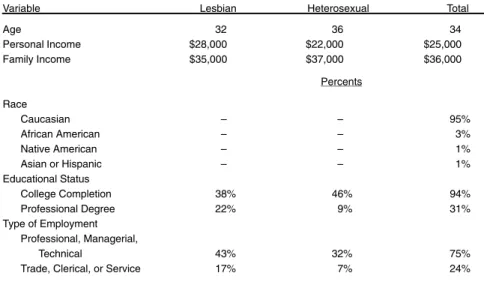
Chi-square analyses were performed to determine whether there was a relationship between sexual orientation and demographic characteristics (see Table 2). Age, educational status, personal and family income, and type of employment were tested. The lesbian and heterosexual samples were distrib-uted equally across age and personal and family income, while significant differences were found for educational status and type of employment. Twenty-two percent of the lesbian sample had either a Master’s degree, PhD, or MD, compared to 9% of the heterosexual sample (X2 (7, 176) = 18.88, p < .001). Forty-three percent of the lesbian sample held professional, managerial or technical jobs compared to 32% of the heterosexual sample, while 17% of the heterosexual sample held trade-related, clerical, or service positions, compared to 7% of the lesbian sample (X2(4, 176) = 13.93, p < .01).
Chi-square analysis was also performed on all relationship variables. Rela-tionship variables included whether the subject was in a relaRela-tionship, and if so, the status of the relationship as monogamous or non-monogamous, the length of the relationship, the presence of a formal commitment in the rela-tionship, cohabitation status, and whether the couple was married or dating (Table 3). The two groups were found to be distributed equally across rela-tionship variables, with the exception of marital status. Four percent of the lesbian sample described their relational status as ‘‘married,’’ while 48% of the heterosexual sample were married.
To investigate the interrelationships among measures, pearson product moment correlations were computed for all pairs of variables. As shown in Table 4, none of the correlations was statistically significant.
DISCUSSION
Lesbian subjects in this sample had a significantly higher prevalence of alcoholism than did a matched cohort of heterosexual women, as predicted. Eighteen percent of the lesbian sample scored six or higher on the MAST
TABLE 2. Demographic Variables Means
Variable Lesbian Heterosexual Total
Age 32 36 34 Personal Income $28,000 $22,000 $25,000 Family Income $35,000 $37,000 $36,000 Percents Race Caucasian – – 95% African American – – 3% Native American – – 1% Asian or Hispanic – – 1% Educational Status College Completion 38% 46% 94% Professional Degree 22% 9% 31% Type of Employment Professional, Managerial, Technical 43% 32% 75%
Trade, Clerical, or Service 17% 7% 24%
TABLE 3. Distribution of Subjects Across Relationship Variables % Lesbian Heterosexual Monogamous 96% 98% Non-Monogamous 4% 2% Committed Relationship 51% 42% Non-Committed Relationship 8% 10% Dating 6% 13% No Relationship 35% 35% Living Together 32% 18% Married 4% 48%
compared to 7% of heterosexual subjects, demonstrating higher levels of alcoholism. This is consistent with previous findings, although the preva-lence of alcoholism among lesbians is slightly higher in this study. One possible reason for this is the MAST, as a screening instrument, is likely to overreport rather than underreport alcoholism (Moore, 1972). Therefore, higher rates are expected with the MAST than with diagnostic interview
TABLE 4. Correlational Matrix of Variables
MAST Normlessness Isolation Powerlessness Total Length *.14* *.05 *.10 *.00 *.05 MAST .02 .06 *.05 *.00 Normlessness .36** .59** .81** Isolation .37** .59** Powerlessness .85** *p < .05 **p < .001
assessments reported in other studies (e.g., Lewis, Saghir, & Robins, 1982; McKirnan & Peterson, 1989; Bradford & Ryan, 1987).
Our hypothesis that a higher level of alcoholism in lesbian women could be accounted for by feelings of alienation was not supported, as groups did not differ in alienation, nor did alienation correlate with alcoholism. Al-though it cannot be concluded from this research that higher levels of alco-holism are due to feelings of societal alienation in lesbians, higher levels of alcoholism in the gay community may be attributed to societal oppression and internalized homophobia. This possibility has been noted in other studies (Glaus, 1989; Schilit, Lie, & Montagne, 1990), as well as in Fifield et al. (1977) and Lohrenz, Connelly, Coyne, and Spare (1978) who examined alcoholism in gay males.
The type of societal alienation experienced by lesbians may be different from that which was measured in this study. The alienation scale used here measures hopelessness and powerlessness, but because of the recent gain in political power seen by lesbians and gay men, lesbians may not feel hopeless and powerless in society. Rather, their alienation may be experienced as an internalization of society’s homophobia. It is possible that a measure of stress or internalized homophobia may prove fruitful in future studies.
This hypothesis is supported by arguments made by Saunders and Valente (1987), who stated that gays experience alienation in society due to their limited access to societal privileges because of discrimination against them which, in this country is legal. They further stated that groups who have been cut off from larger society in this way decrease alienation by banding togeth-er into close communities with shared norms and values. An alttogeth-ernative society is, therefore, formed which acts to reduce the alienation and power-lessness within that group.
Heterosexual women were found to experience feelings of powerlessness significantly more frequently than lesbian women. It is likely that women (the heterosexual sample, in this case) with lower levels of personal income, education, and employment would be more likely to experience feelings of powerlessness than women (the lesbian sample) with higher levels of
al income, education, and employment, as these are greatly valued in society. Higher income, education level, and employment status likely correspond with feelings of powerfulness in women.
This study illustrates several issues of consequence for therapists to bear in mind when providing mental health services to lesbians. First and foremost, because alcoholism rates are high in the lesbian community, it is important to take a thorough history of the lesbian client’s alcohol use, regardless of the presenting problem. Second, although it was not tested in this study, several authors have focused on the issue of internalized homophobia, stress, and/or alienation among lesbians, which is likely to be a contributing factor to alcoholism or other symptoms of inner conflict. It is important that therapists who work with lesbians attend to these issues within the context of any presenting problem.
Of equal importance is the need for addiction and substance abuse treat-ment services specifically designed for lesbians. The etiology of alcoholism among lesbians is as yet unknown. However, the fact that alcoholism has been found to be more prevalent for lesbians than heterosexual women is evidence that addiction services need to be tailored to the special needs of lesbians. These special needs include a safe place to be ‘‘out’’ without being stigmatized or subject to other forms of homophobia. On the other hand, if a lesbian is more comfortable not disclosing her emotional and sexual orienta-tion, this decision must be respected. Addiction programs that include family treatment as a part of the program must be supportive of significant others, whether they include lovers or friends. Finally, because little is known about the etiology of alcoholism in lesbians, a stance of open acceptance is encour-aged concerning individual factors in the client’s life that may be related to alcohol abuse or dependence.
An interesting finding in the present study was that groups were similar in terms of relationship variables. It is frequently believed that gay relationships are less monogamous and committed than those of heterosexual relation-ships, but subjects in this sample were involved in relationships which were relatively similar on those variables. The only difference, a significant one, was that of marital status, an obvious difference due to legal sanctions against lesbian marriages. For this reason, many lesbian couples who describe them-selves as monogamous do not describe themthem-selves as married. Even though such a large difference exists on this variable, the difference seems to be one of labelling, not relationships, per se. Groups were equally distributed across variables of monogamy, length of relationship, and level of commitment.
As is common in most research with gays, this study is limited by sample bias, as all women were obtained through organized groups, resulting in the exclusion of lesbians who are either not out, or choose not to participate in the lesbian community. Although an effort was made to reach all
nomic groups, the majority of subjects who participated in this inquiry were from well-educated and professional backgrounds. Minority women were also underrepresented in this study. Further research is needed with a greater diversity of samples. In light of its limitations, our results provide further evidence of alcohol abuse and dependence as an important mental health issue for lesbians.
NOTE
1. General population data are based on an earlier study by Clark and Midanik (19), in which the epidemiology of alcoholism was measured in a general population sample.
REFERENCES
Bradford, J., & Ryan, C. (1987), National lesbian health care survey mental health implications. Washington DC: National Lesbian and Gay Health Foundation. (NTIS No. PB88-201496).
Dean, D. (1961), Alienation: its meaning and measurement. American Sociological Review, 26: 753-758.
Diamond, D., & Wilsnack, S. (1978), Alcohol abuse among lesbians: a descriptive study. Journal of Homosexuality, 4(2): 123-141.
Fifield, L., Latham, D., & Phillips, C. (1977), Alcoholism in the gay community: the price of alienation, isolation, and oppression. Available from the Los Angeles Gay Community Center, Los Angeles, California.
Guze, S. (1976), Criminality and psychiatric disorders. New York: Oxford Universi-ty Press, p. 34-35.
Kinsey, A., Pomeroy, W., & Martin, C. (1953), Sexual behavior in the human female. Philadelphia: Saunders.
Lewis, C., Saghir, M., Robins, E. (1982), Drinking patterns in homosexual and heterosexual women. Journal of Clinical Psychiatry, 43(7): 277-279.
Lohrenz, L., Connelly, J., Coyne, L., & Spare, K. (1978), Alcohol problems in several midwestern homosexual communities. Journal of Studies on Alcohol, 39(11): 1959-1963.
McKirnan, D., & Peterson, P. (1989), Alcohol and drug use among homosexual men and women: epidemiology and population characteristics. Addictive Behaviors, 14: 545-553.
Mischke, H., & Venneri, R. (1987), Reliability and validity of the MAST, Mortimer-Filkens questionnaire and CAGE in DWI assessment. Journal of Studies on Alco-hol, 5: 492-501.
Moore, R. (1971), The prevalence of alcoholism in a community general hospital.
American Journal of Psychiatry, 128: 638-639.
Moore, R. (1972), The diagnosis of alcoholism in a psychiatric hospital: a trial of the Michigan Alcoholism Screening Test. American Journal of Psychiatry, 128(12): 1565-1569.
Mosbacher, D. (1988), Lesbian alcohol and substance abuse. Psychiatric Annals, 18(1): 47-50.
Nardi, P. (1982), Alcoholism and homosexuality: a theoretical perspective. In Alco-holism & Homosexuality. Edited by Ziebold, T. & Mongeon, J. New York: The Haworth Press, Inc.
Nicoloff, L., & Stiglitz, E. (1987), Lesbian alcoholism: etiology, treatment, and recovery. In Lesbian Psychologies. Edited by The Boston Lesbian Psychologies Collective. Urbana and Chicago: University of Illinois Press.
Saghir, M., Robins, E., Walbran, B., & Gentry, K. (1970), Homosexuality. IV. psy-chiatric disorders and disability in the female homosexual. American Journal of Psychiatry, 127(2): 65-72.
Selzer, M. (1971), The Michigan Alcoholism Screening Test: the quest for a new diagnostic instrument. American Journal of Psychiatry, 127(12): 1653-1658. Skinner, H., & Sheu, W. (1982), Reliability of alcohol use indices, the lifetime
drinking history and the MAST. Journal of Studies on Alcohol, 43(11): 1157-1169.
Stevens (1986), Applied multivariate statistics for the social sciences. Lawrence Erlbaum Associates: New Jersey, 113-228.
Zung, B., & Charalampous, K. (1975), Item analysis of the Michigan Alcoholism Screening Test. Journal of Studies on Alcohol, 36(1): 127-132.