Cracow University of Economics
Discussion Papers Series
http://www.papers.uek.krakow.pl
I S S N 2 0 8 1 - 3 8 4 8
Mária UJHELYI
Education Institutions - Case Studies
Innovation Practice in Foreign Higher
“CRACOW UNIVERSITY OF ECONOMICS DISCUSSION PAPERS” (CUE DP)
EDITORIAL BOARD:
Prof. Kazimierz ZIELIŃSKI - editor-in-chief Prof. Stanisław MIKLASZEWSKI
Prof. Aleksander SURDEJ Dr. Piotr STANEK
Dr. Krzysztof WACH
PUBLISHER:
Cracow University of Economics
Faculty of Economics and International Relations Rakowicka 27, 31-510 Krakow, Poland
phone +48 12 293 5327, 293 5508 fax +48 12 293 5042, 293 5037
e-mail: [email protected]; [email protected]; [email protected] http://www.papers.uek.krakow.pl
ISSN 2081-3848
© Copyright by Authors of the Presented Papers
Discussion Papers are in draft form. This discussion paper is distributed for the purposes of comment and discussion only. It may not be reproduced without permission of the copyright holder.
STAIR PROJECT
Studies in Trans-Atlantic International Relations
project no. 2008-1747/001-001 CPT-USTRAN
realized within ALTANTIS PROGRAMME – EU-US Cooperation in Higher Education and Training (Atlantis Programme is a cooperative enterprise between the U.S. Department of Education and the European Commission)
THIS DISCUSSION PAPER came into being
within the STAIR-ATLANTIS project and the financial support of
the European Commission - Education, Audiovisual and Culture Executive Agency the U.S. Department of Education - Fund for the Improvement of Postsecondary Education
This project has been funded with the support of the European Commission. This communication reflects the views only of the author(s),
and the Commission cannot be held responsible
for any use which may be made of the information contained therein.
www.stair.uek.krakow.pl www.papers.uek.krakow.pl
Innovation Practice in Foreign Higher Education Institutions
-
Case Studies
Mária Ujhelyi, PhD University of Debrecen
Faculty of Economics and Business Administration Department of Management and Marketing Hungary H-4028 Debrecen, Kassai ut 26, Hungary
tel. +36 52 416 580/77037, fax +36 52 419 728 e-mail: [email protected]
Abstract:
This paper makes an attempt to analyze and compare the organization structure and innovation practice of four foreign higher education institutions. The analysis of different practices gives us the possibility to learn and to adopt approaches which strengthen the innovation activities of Hungarian higher education institutions.
Key words:
Innovation Practice in Foreign Higher Education Institutions
Case Studies
Mária Ujhelyi 1. Introduction
This paper makes an attempt to analyze and compare the organization structure and innovation practice of foreign higher education institutions. The staff exchange within the STAIR project gave me the opportunity to meet representatives of foreign universities and prepare deep interviews with specialists in this area. This field research is part of a project whose aim is to define the “Distinctiveness of the Hungarian Higher Education Innovation and the Possibilities for Change” and is sponsored by the Hungarian Research and Technology Office.
The analysis of different practices gives us the possibility to learn and to adopt approaches which strengthen the innovation activities of Hungarian higher education institutions. I try to compare the structure, the leadership, the division of labor, the chain of command, and the formal and informal mechanisms which may influence innovation and creativity within an organization. In this paper four higher educational institutions were compared, the special features were emphasized, factors which obstruct innovation were revealed, and opportunities for improvement were presented.
2. Research method
Statements made in this paper are based on deep interviews, document analysis, and my personal experiences of these institutions. I studied two American and two European higher education institutions. In order to make the interviews comparable the questions were structured; at the same time I gave the freedom to the respondents to explain their opinions freely about the issues (you can find the questionnaire in the appendix).
I asked questions related to the macro environment, and similar ones related to the universities. The aim of my questioning was to understand how different factors influence the innovation performance of higher education.
The questions related to the macro environment try to define the opinions of university representatives regarding the efficiency of the countries’ science and innovation policy and whether laws and regulations stimulate the innovation performance of universities. An important question regarding universities is whether they have a centrally coordinated tendering system, or if this activity is decentralized. It is also interesting to know how frequent the collaboration between the university and economic actors is. I would like to know how important an area research and innovation is strategically and at what level of the hierarchy these types of decisions are made.
3. Higher education institutions analyzed
In the selection of universities I used our own international connections. First I sent out a letter requesting the co-operation of partner institutions. Four institutions undertook to participate in the research. I asked more than one researcher at each university, and also conducted interviews with the deputy or director responsible for research and development. Two American and two European higher education organizations were analyzed. I have not been authorised to name the institutions in this paper, so I will present only their most significant general characteristics.
One of my American examples is a college offering mainly bachelor programs and only a few master programs. It is member of a significant university network and has about 8,000 students. Similarly to other American universities it is divided into schools, and not faculties. Currently they have four of them, and are planning to establish a fifth.
They consider education their primary function. They try to augment their financial resources by recruiting more students, and in addition to this they also consider fundraising important. Another financial resource generating activity is research co-operations supported from external resources. The college shows an increasing interest toward this possibility too. The other American example is a university located in a large city, having approximately 20,000 students on three campuses. Its eight colleges have significantly different profiles and offer diverse opportunities for their students. They offer a wide variety of bachelor and master programs. They consider education and research two equally important activities and also assign special importance to programs and projects designed to generate resources.
From Poland I studied a relatively large university in a big city, with about 21,000 students in its 4 faculties. This university offers a wide variety of bachelor, master and PhD programs.
They attribute special importance to research, and consider tendering activity which generates additional resources to be important.
The fourth analyzed university was a Romanian private university. It is located in a medium size town close to the Hungarian border. It has about 20,000 students. The university is 20 years old. They offer programs on three levels (bachelor, master and PhD) for their students. It is divided into nine significantly different faculties. They consider research and education equally important. As a private university they emphasize resource generating activities. In addition to recruitment and fundraising they also undertake active tendering activity. They try to participate in international programs, too.
4. Comparison of the universities analyzed
In this chapter I compare the innovation practice of the two American, the Polish and the Romanian universities. I preview the macro environment and the organizational background, the operational practice of university, faculty and department levels which may support or set back research and development and innovation.
4.1 Macro environment
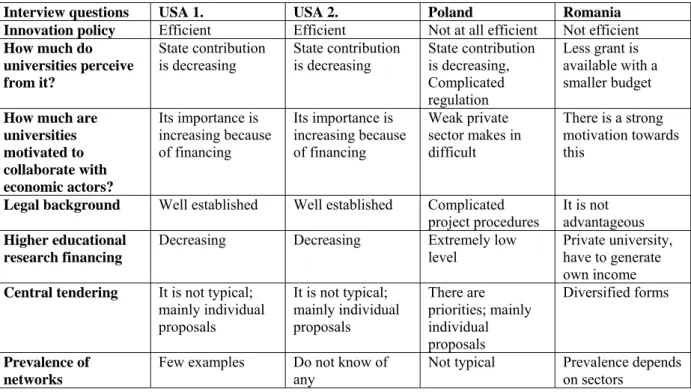
The American innovation policy is considered to be efficient. The legal background is also perceived to be supportive by representatives of universities, contrary to the opinions held in the Polish and Romanian universities. Their opinion is that the financial resources allocated to research and development are modest, and the institutional background is highly bureaucratic, which makes successful applications difficult.
All higher education institutions feel that the financial resources available for research are decreasing, so institutions are motivated, or even forced, to search for additional means of support from different projects, external orders, and to try to cooperate with economic actors in the field of research and development.
So far none of the respondents’ organizations define centrally the research fields of their units; they do not want to direct innovation activity through uniform research projects. The prevalence of networks is not typical, although there are differences between sectors in this field.
Table 1 The comparison of answers related to the macro environment
Interview questions USA 1. USA 2. Poland Romania Innovation policy Efficient Efficient Not at all efficient Not efficient How much do
universities perceive from it?
State contribution
is decreasing State contribution is decreasing State contribution is decreasing, Complicated regulation
Less grant is available with a smaller budget
How much are universities motivated to collaborate with economic actors? Its importance is increasing because of financing Its importance is increasing because of financing Weak private sector makes in difficult There is a strong motivation towards this
Legal background Well established Well established Complicated
project procedures It is not advantageous
Higher educational research financing
Decreasing Decreasing Extremely low
level Private university, have to generate own income
Central tendering It is not typical;
mainly individual proposals It is not typical; mainly individual proposals There are priorities; mainly individual proposals Diversified forms Prevalence of networks
Few examples Do not know of
any
Not typical Prevalence depends
on sectors
4.2 Institutional, university level
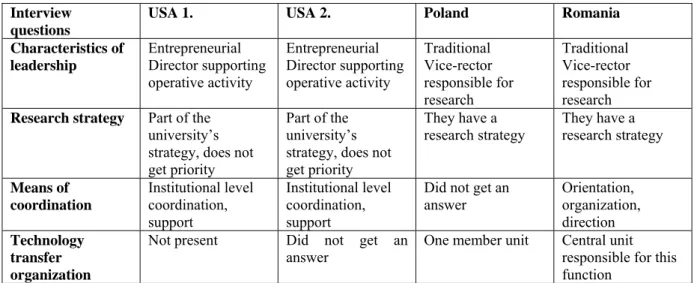
There are considerable differences between the American and European examples in their institutional background. While leadership at European universities conforms to the leadership concept common in traditional research universities, the American examples work as entrepreneur universities. The joint application of centralization and decentralization at American universities is an interesting contradiction. The majority of mainly operative and administrative activities are directed centrally; at the same time professional decisions are delegated to departmental level. Faculty level (or the equivalent) exists only formally at these institutions.
All of the four institutions have a strategy, but research is clearly mentioned mainly at the European universities. Every respondent declared that the research strategy and the strategies of the faculties are separated from the mission, vision and strategic objectives of the university.
At the American universities the director (or the manager in the highest position) responsible for research and development does the practical administrative, informative, and coordinating
activity, writes applications, and helps department members in preparing project proposals, while these leaders at European universities fulfill directional and organizational tasks too. The rudiments of technology transfer organization have already appeared at the European universities. One individual deals with this activity at one of them, and a central unit is responsible for it at the other.
Table 2 The comparison of answers related to university level
Interview questions
USA 1. USA 2. Poland Romania Characteristics of leadership Entrepreneurial Director supporting operative activity Entrepreneurial Director supporting operative activity Traditional Vice-rector responsible for research Traditional Vice-rector responsible for research
Research strategy Part of the
university’s strategy, does not get priority
Part of the university’s strategy, does not get priority
They have a
research strategy They have a research strategy
Means of coordination Institutional level coordination, support Institutional level coordination, support
Did not get an answer Orientation, organization, direction Technology transfer organization
Not present Did not get an
answer One member unit Central unit responsible for this function
4.3 Faculty level
The organizational structure is traditional in the case of European universities. They are divided into faculties, and then into departments. Both of the analyzed European universities are relatively big and have many faculties.
In the American higher education institutions hierarchical levels have much less importance. University by university the term used can be different. At one of them they are called ‘schools’; at the other institution they use the term ‘college’. According to my experience and the respondents view they have much less independence and significance than similar units at European universities.
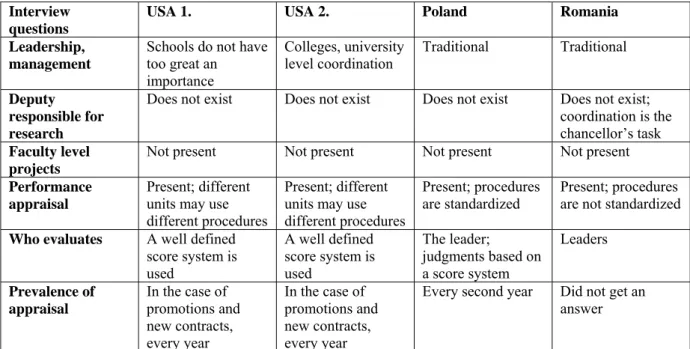
None of the institutions have a vice dean for research, or a deputy at the same level of the hierarchy. At the Romanian university the faculty chancellor coordinates this activity, in the other cases this activity is organized at university level.
None of the institutions have general, faculty level research projects; rather research teams and individual projects are typical.
Table 3 The comparison of answers related to faculty level
Interview questions
USA 1. USA 2. Poland Romania Leadership,
management
Schools do not have too great an importance Colleges, university level coordination Traditional Traditional Deputy responsible for research
Does not exist Does not exist Does not exist Does not exist;
coordination is the chancellor’s task
Faculty level projects
Not present Not present Not present Not present
Performance appraisal
Present; different units may use different procedures
Present; different units may use different procedures
Present; procedures
are standardized Present; procedures are not standardized
Who evaluates A well defined
score system is used A well defined score system is used The leader; judgments based on a score system Leaders Prevalence of appraisal In the case of promotions and new contracts, every year In the case of promotions and new contracts, every year
Every second year Did not get an answer
Performance evaluation is carried out in every institution. In principle an elaborated score system is used to evaluate lecturers’ and researchers’ performance. In most cases the development of these performance evaluation systems are done by departments, as a result special circumstances are considered. Although the prevalence of appraisal is different, in the case of promotion evaluations are used at every institution.
4.4 Department level
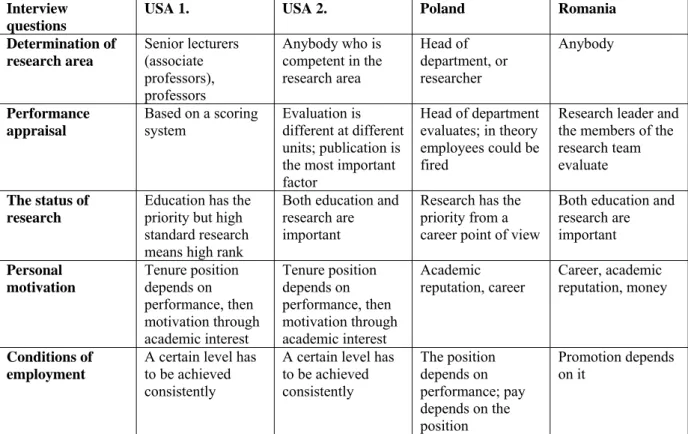
The determination of research topics is not centralized. Leading lecturers and researchers possessing adequate research experience and competence can define their topic individually or as a research team; however at European universities the legal representative of the university - the rector - signs most of the research projects and applications (especially those financed from European Union funds).
Performance evaluation is done on an individual level, generally based on a scoring system. In most institutions the most important indicator is the number and quality of publications. Only the Polish university representative declared that - in theory - an employee of the
university could be fired if he or she receives negative evaluations in two consecutive evaluation periods (4 years).
So far such a case has never occurred, but in this institution a so called ‘lecturer only’ position has been introduced. From these employees research activities are not required, but they teach more classes.
I have not received uniform answers to the question related to the status of research. Research of high standard is acknowledged and indicates high prestige everywhere, but at some institutions teaching has a higher priority. According to the respondent’s opinion, at the Polish university research counts unequivocally when a career is considered. At the other institutions both research and education are regarded as important
Table 4 The comparison of answers related to department level
Interview questions
USA 1. USA 2. Poland Romania Determination of research area Senior lecturers (associate professors), professors Anybody who is competent in the research area Head of department, or researcher Anybody Performance appraisal Based on a scoring
system Evaluation is different at different units; publication is the most important factor
Head of department evaluates; in theory employees could be fired
Research leader and the members of the research team evaluate
The status of research
Education has the priority but high standard research means high rank
Both education and research are important
Research has the priority from a career point of view
Both education and research are important Personal motivation Tenure position depends on performance, then motivation through academic interest Tenure position depends on performance, then motivation through academic interest Academic reputation, career Career, academic reputation, money Conditions of employment
A certain level has to be achieved consistently
A certain level has to be achieved consistently The position depends on performance; pay depends on the position Promotion depends on it
The individual components of motivation are fundamentally similar at all the four institutions: career (tenure position, promotion up the academic ladder) and academic interest. At all institutions the condition of the tenure position is the particular level of research activity (PhD, followed by regular publications). In the case of ambitious career objectives exceptional research performance is required.
5. Conclusion
Finally I will summarize the findings I have reached after studying the four universities. First I will list and explain similarities, and then I will analyze the distinctiveness of American and European universities, before finally defining the opportunities for improvement for higher education institutions in the field of innovation.
5.1 Similarities
Comparing the four higher education organizations I found several similarities among them. Some of these characteristics obstruct and set back the innovation of higher education; on the other hand, other factors indicate the initial steps in the process of transformation into an entrepreneurial university (Hrubos, 2004).
One of the factors which set back higher education innovation is the decline in the quantity of resources available for research and development, especially the decreased proportion of state financing. At the same time new solutions and techniques which would help to withdraw external resources have not yet appeared.
Although the research and development expenditures of the analyzed countries as a proportion of GDP show different levels (Polónyi, 2010), we can detect a decrease in these expenditures at all institutions. All of them feel the decrease in higher education financing, and within that a decrease in the financing of research and development. Although every university knows the importance of cooperation between higher education and business, so far none of the institutions excels in that field.
Similarly we can state that it is not typical to undertake large-scale faculty or university level projects, and networks have appeared only exceptionally.
None of the universities have a deputy responsible for research at faculty level, but behind this we can find different management practices and chains of command.
It is a progressive feature that all of the institutions apply performance appraisal. The number of publications is an important performance indicator, and one of the most important personal motivators is recognition and the academic interests of researchers.
5.2 Differences: USA
Considering the examples, it becomes clear that the American universities have better organized institutions with an entrepreneurial management structure. They are ahead of the Polish and Romanian universities in the process of generating revenue, although at the two institutions analyzed different forms of fundraising emphasized better. They considered more effective than research co-operations, business orders or similar types of research activities. An interesting, slightly contradictory ‘American solution’ is the centralization and standardization of highly routine, administrative activities applied in tandem with the relatively strong departmental autonomy in professional questions.
Cooperation with the local community is an indicator of a tendency for universities to become entrepreneurial or even more service universities. These co-operations are built on joint interests and result in synergy.
The requirement for continuous research performance enhances motivation and the sustaining of academic interest.
5.3 Differences: EUROPE
At the two analyzed European institutions I have found environmental background and institutional approaches which obstruct innovation. One of them is the complicated legal regulation, which makes it difficult to co-operate with economic actors. The traditional research university structure and the centralized decision making processes which help to maintain present approaches, do not support large-scale projects which satisfy market needs and generate revenue. So currently the formation of small research teams around leading lecturers, or isolated individual researches are typical (Polónyi, 2008)
5.4 Possibilities for improvement
The removal of obstacles, the acceptance of best practices, and the stimulation of successful approaches can guarantee the improvement of higher education innovation.
The development of simple, stimulating laws and regulations are required. The existing resources, research funds and project frameworks have to be devoted to projects which generate profit, result in practically useful solutions and bring significant added value. Organizational innovation of higher education institutions has to be stimulated in order to start and move forward on the road to becoming an entrepreneurial university (Hrubos, 2004).
6. References
Carnegie Doctoral/Research Universities-Extensive (2001):
http://www.washington.edu/tools/universities.htm (downloaded: 15 June, 2010)
Hrubos, Ildikó (2004): Gazdálkodó egyetem. (Entrepreneurial University) Új Mandátum Kiadó, Budapest
Orosz, Ágnes – Kovács, Olivér (2010): A tudománypolitika lehetőségei a felsőoktatási innováció gazdasági hasznosulásában. (The role of science policy in the economic utilization of higher educational innovation) In: Kotsis Ágnes – Polónyi István (szerk.): Innováció és felsőoktatás. (Innovation and Higher Education) Competitio Könyvek 8., Debreceni Egyetem Közgazdaság- és Gazdaságtudományi Kar, Debrecen, pp. 9–53
Polónyi, István (2008): Felsőoktatási kutatás és a gazdaság. A hazai felsőoktatási innováció sajátosságai és az elmozdulás lehetőségei. Pályázat az NKTH INNOTARS_08 Gazdasági és társadalomtudományi kutatások pályázati felhívásra. (Higher education research and the economy. Features of the innovation of Hungarian higher education and the possibilities for change. NKTH INNOTARS_08 project,
Polónyi, István (2010): A felsőoktatási oktatók – mint kutatók. (Lecturers at higher education institutions – as researchers) In: Kotsis Ágnes – Polónyi István (szerk.): Innováció és felsőoktatás. (Innovation and Higher Education) Competitio Könyvek 8., Debreceni Egyetem Közgazdaság- és Gazdaságtudományi Kar, Debrecen, pp. 54–100
7. Appendix
Factors influencing the innovation performance of higher education
Interview questions for institutions Questions related to the macro
environment
- science and innovation policy - government and governmental orientations
How efficient is the country’s science and innovation policy?
How much do universities perceive from it?
How much are universities motivated to increase their innovation performance, and to collaborate with economic actors?
- laws, regulations How much do laws and regulations stimulate or hinder the innovation
performance of universities, and the collaboration with economic actors?
- higher education and higher
educational research financing How much are universities forced, and reduced to generate financial resources from research projects, research commissions and research and innovation collaborations with economic actors?
How is research activity at higher education institutions financed by the government? (Is there a channel which gives financial assistance to research, within institutional financing?)
(If there is) How much money comes into the university? (How many % of the total costs, how many % of the total financial assistance?)
- central tendering Which are the most important research and development projects
(tenders)? What are their priorities?
Are there tenders where
o only institutions (universities)
o only institutions together with companies o only research teams
o only individual researchers
can apply?
How many % of the revenue comes from research at the university? - networks
- organizations’/ universities’/ companies’ self-organization activity to create and initiate innovations
Are there networks which serve as frameworks in the collaboration between the university and economic institutions?
How many collaborations does the university have with companies in the field of research and development? (How many multinational companies; how many small and medium size enterprises?)
Which party is the main initiator in the development of these
collaborations (the university, the company, the government)?
Interview questions for institutions Questions related to universities
University level Please indicate if you are at this level: yes no
- leadership, management How conventional is the leadership of the university (rector with
scientific background – senate), or is it rather company-like (director, president with management background)? What kind of hierarchical levels and decision making bodies does the university have?
Is there a vice rector who coordinates research, development and innovation?
Is there a director/directory who/that coordinates research,
development and innovation?
- research and innovation strategy Does the university have a research, development and innovation strategy?
- coordination, orientation What kind of instruments does university management use in
research, development and innovation (orientation and/or organization and/or direction)?
- technotransfer organizations Does the university have a central unit responsible for technology transfer / innovation-exploitation?
Faculty/department level Please indicate if you are at this level: yes no
- leadership, management How conventional is the leadership of the faculties (faculty council,
dean with scientific background elected by the faculty council) or is there a manager type leadership (there is no faculty council, the dean is an organizer, appointed by the rector)?
Is there a vice dean or manager at the faculty who directs/coordinates research, development and innovation?
Is there a central research coordinator at the faculty, or faculties? - research and innovation strategy Does the university have research, development and innovation
strategy? - faculty level initiatives,
organization of research and external connections
What kind of instruments does faculty management use in research, development and innovation (orientation and/or organization and/or direction)?
Are there research and development tenders/programmes in which the whole faculty takes part?
- performance appraisal of
organizational units Does the faculty/department apply research, development, innovation performance appraisal?
If they apply appraisal who and what do they evaluate
(lecturers/researchers, or organizational units)?
If they apply appraisal, how frequently and what performance
measures do they evaluate in particular?
Institution/department level Please indicate if you are at this level: yes no
- determination of theme Who has the right at the institute/department to define the theme of
research, and who can apply? (everybody – senior lecturers – professors – leaders of research teams – directors of institutes/head of departments)
- performance appraisal Does the institute/department apply research, development,
innovation performance appraisal?
If they apply appraisal who evaluates (dean – director of institute/head of department/team leader of research – collectively)?
If they apply appraisal, how frequently and what performance measures do they evaluate in particular?
What does performance appraisal affect?
- organizational culture How important is (what is the rank of) research beside education?
How much is applied research and development (research, targeted economic exploitation) recognised?
How strong is the competition between lecturers in research
performance?
Individual level
- components of motivation (money, scientific reputation, career)
CALL FOR PAPERS / NOTE FOR CONTRIBUTORS:
The mission of the CUE DP is to disseminate the results of research within economics, management, international relations, econometrics and informatics and social sciences in the context of global and regional change.
The editors will consider for publication all kind of academic papers and research reports up in any length. The papers written in English are highly recommended to be accepted, but Polish will be also accepted is some cases.
Editorial Requirements:
1. Each author should provide on the first page of the paper the following information: the title of the paper, the name and the scientific degree or title, the affiliation, full address, telephone, fax, e-mail, key words as well as JEL classification.
2. The paper should include five main parts: introduction, literature review, material and methods, results and discussion, conclusions (as well as reference list - bibliographies).
3. Each submitted paper must also be accompanied by an abstract of no more than 200 words. Papers without abstracts will not be accepted for publication. Abstracts must be written in English.
4. Authors should submit their papers to the editorial office via e-mail (Please use rather personal e-mails of the editors instead of the common e-mail). Text files should be in
MS Word 6/95/97/2000/2007 or "rtf" format (MS Word 2007 is highly recommended). It is necessary to send editable format (PDF files are not accepted). 5. Authors are requested to limit formatting commands to italics for non-English words 6. References should be listed alphabetically by author. Each entry should contain full
bibliographical data: author(s), year of publication, title, editor(s), volume/issue (for journals), city/publisher (for books), page numbers. Foreign titles should always be followed by an English translation in square brackets. Please use APA style
references.
7. Tables and graphs should be prepared in MS Excel 6/95/97/2000/2007 format. Authors may include tables, graphs and drawings prepared using other software (e.g., Corel Draw, Statistica, SPSS, Harvard Graphics) provided they are in "wmf" or "eps" format, with all the necessary fonts included. Alternatively, bitmap files (300 dpi resolution) may be used. Graphs and drawings must be prepared in monochrome format; fields can be delineated using grey scales and/or monochrome pattern fills. 8. Copyright by Authors of the Presented Papers, nevertheless the author bears full
responsibility for any infringements of copyright or other intellectual rights connected with the content the paper.
9. Papers should be presented in clear, concise English and may be subject to approval by the English editor. The editors do not return submitted texts. The author shall receive no remuneration for the publication of the text.
10.In the case of an paper written by several authors, the author submitting the paper is obliged to seek the agreement of his or her co-authors regarding all the publishing requirements specified above.
11.Each contributor can supply a short biographical note for inclusion in the journal. This should comprise at least the following information: name/title/position, research interests, most important publications. The bio will be attached to the paper at the end of the discussion paper volume.
“CRACOW UNIVERSITY OF ECONOMICS DISCUSSION PAPERS” ISSN 2081-3848
So far we have published:
Number Author Title
CUE DP 2009, no. 1(1) Piotr STANEK Transmission of the Global Crisis to the Baltic States. Implications for Their Accession to the EMU
CUE DP 2010, no. 1(2) Laszlo ERDEY Structural Changes of Mexico-US Merchandise Trade in the Light of Intra-Industry Trade
CUE DP 2010, no. 2(3) Aleksander SURDEJ EU – US Food Safety Disputes and International Food Safety Regime
CUE DP 2010, no. 3(4) Krzysztof WACH Regional Context of Small and Medium-Sized Enterprise’ Development. Case Study of Southern Poland
CUE DP 2010, no. 4(5) Piotr STANEK Travels of a CDO in the Global Financial Markets
CUE DP 2010, no. 5(6) Anna KARWIŃSKA The Importance of Cultural Diversity for the Processes of Social Life
CUE DP 2010, no. 6(7) Krzysztof WACH Support for Business Succession in the European Union
CUE DP 2011, no. 1(8) Tamás MIHÁLYDEÁK General Logical Systems of Functor Argument Decomposition
CUE DP 2011, no. 2(9) Mária UJHELYI Innovation Practice in Foreign Higher Education Institutions. Case Studies