The enigmatic molar from Gondolin, South Africa: Implications for
Paranthropus
paleobiology
Frederick E. Grine
a,b,*, Rachel L. Jacobs
c, Kaye E. Reed
d, J. Michael Plavcan
e aDepartment of Anthropology, Stony Brook University, Stony Brook, NY 11794-4364, USAbDepartment of Anatomical Sciences, Stony Brook University, Stony Brook, NY 11794-8081, USA
cInterdepartmental Doctoral Program in Anthropological Sciences, Stony Brook University, Stony Brook, NY 11794-4364, USA dSchool of Human Evolution and Social Change, Institute of Human Origins, Arizona State University, Tempe, AZ 85827-4101, USA eDepartment of Anthropology, University of Arkansas, Fayetteville, AR 72701, USA
a r t i c l e i n f o
Article history:Received 21 October 2011 Accepted 28 June 2012 Available online 16 August 2012 Keywords: Gondolin Taxonomy South Africa East Africa Paranthropus robustus Paranthropus boisei Molar size Variation Cusp proportions Species biogeography Taphonomy Swartkrans Drimolen
a b s t r a c t
The specific attribution of the large hominin M2(GDA-2) from Gondolin has significant implications for the paleobiology ofParanthropus. If it is a specimen ofParanthropus robustusit impacts that species’size range, and if it belongs toParanthropus boiseiit has important biogeographic implications. We evaluate crown size, cusp proportions and the likelihood of encountering a large-bodied mammal species in both East and South Africa in the Early Pleistocene. The tooth falls well outside theP. robustussample range, and comfortably within that for penecontemporaneousP. boisei. Analyses of sample range, distribution and variability suggest that it is possible, albeit unlikely tofind a M2of this size in the currentP. robustus
sample. However, taphonomic agents - carnivore (particularly leopard) feeding behaviors - have likely skewed the size distribution of the Swartkrans and Drimolen P. robustus assemblage. In particular, assemblages of large-bodied mammals accumulated by leopards typically display high proportions of juveniles and smaller adults. The skew in theP. robustussample is consistent with this type of assem-blage. Morphological evidence in the form of cusp proportions is congruent with GDA-2 representing
P. robustus rather than P. boisei. The comparatively small number of large-bodied mammal species common to both South and East Africa in the Early Pleistocene suggests a low probability of encountering an herbivorous australopith in both. Our results are most consistent with the interpretation of the Gondolin molar as a very large specimen ofP. robustus. This, in turn, suggests that large, presumptive male, specimens are rare, and that the levels of size variation (sexual dimorphism) previously ascribed to this species are likely to be gross underestimates.
Ó2012 Elsevier Ltd. All rights reserved. Introduction
Fossils ofParanthropus robustusare known fromfive sites situ-ated within a 5 km radius of one another in the Bloubank Valley of South Africa (Fig. 1). All represent clastic sediment infillings of karst caves that formed in the Precambrian Malmani dolomitic lime-stones of the Monte Cristo Formation. A small, albeit significant collection, including the type specimen, is known from Kromdraai (Broom, 1938;Grine, 1982), but the species is best represented at Swartkrans (e.g., Broom and Robinson, 1952; Grine, 1989) and Drimolen (Keyser et al., 2000;Moggi-Cecchi et al., 2010). Several molars attributed to P. robustus have also been recovered from Sterkfontein Member 5B (Kuman and Clarke, 2000), and a badly crushed facial skeleton and a few teeth have been found at Cooper’s (Berger et.al., 2003;Steininger et al., 2008;de Ruiter et al., 2009).
The geochronological ages of these Paranthropus-bearing deposits have been the subject of prolonged investigation. Ignoring the spectacularly bizarre range - 4.38 Mae0.36 Ma - derived from ESR dating of tooth enamel (Blackwell, 1994;Curnoe et al., 2001, 2002), most faunal estimates indicate accumulation between about 1.9 Ma and 1.5 Ma (Vrba, 1985;Delson, 1988;McKee et al., 1995; Keyser et al., 2000; Kuman and Clarke, 2000). Palaeomagnetic determinations (Thackeray et al., 2002;Herries et al., 2009) are, of course, concordant because they are grounded by these bio-chronological estimates. The UePb determinations from speleo-thems at Cooper’s and Swartkrans (de Ruiter et al., 2009;Pickering et al., 2011) do not contradict the faunal estimates.
Gondolin
In 1997, two hominin teeth were discovered in a“breccia”dump at Gondolin, some 20 km northwest of the other Paranthropus -bearing sites (Menter et al., 1999) (Fig. 1). The Gondolin cave
*Corresponding author.
E-mail address:[email protected](F.E. Grine).
Contents lists available atSciVerse ScienceDirect
Journal of Human Evolution
j o u rn a l h o m e p a g e : w w w . e l s e v i e r . c o m / l o c a t e / j h e v o l
0047-2484/$esee front matterÓ2012 Elsevier Ltd. All rights reserved.
system, which developed in Eccles Formation dolomites, is sur-rounded by greater topographic relief than those in the Bloubank Valley (Herries et al., 2006). Gondolin presents a number of “breccia”dumps created by lime-mining activity, and two in-situ fossiliferous deposits. In 1979, E.S. Vrba conducted a brief excava-tion of one of the in-situ deposits, designated GD 2, which yielded a number of vertebrate fossils, but no primates (Watson, 1993).
The fossils from Vrba’s excavations include “stage III”
Metri-diochoerus andrewsi, which suggests an age of between 1.9 and
1.5 Ma (Watson, 1993). Using this species as a basis for interpolation, Herries et al. (2006)argued that the normal geomagnetic polarity of GD 2 indicates deposition during the Olduvai (C2n) subchron between 1.95 and 1.78 Ma (Cande and Kent, 1995). Subsequent excavation of the in-situ GD 1 deposit produced a vertebrate fauna equivalent to that from GD 2, but these sediments preserve a wholly reversed polarity signature. This has been interpreted as suggesting deposition either just prior to or immediately following the Olduvai subchron (Adams et al., 2007).Adams et al. (2007)argued that GD 1 is the likely source for the “breccia” blocks in Dump GDA that yielded two hominin teeth (Menter et al., 1999).
Thus, the Gondolin (GD 1¼GDA) fossils might be ca. 2.0 Ma (or older), or perhaps 1.7e1.5 Ma. Neither estimate places them outside the probable range of the Bloubank Valley Paranthropus-bearing deposits. These dates also fall comfortably within the geochrono-logical range ofParanthropus boiseiin East Africa, which extends from about 2.3 Ma in lower Member G of the Shungura Formation (Suwa, 1988) to some 1.4 Ma at Konso (Suwa et al., 1997; Katoh et al., 2000).
TheParanthropusmolar from Gondolin
Thefirst hominin recovered from Gondolin (GDA-1) consists of the distolingual third of a lower molar. Menter et al. (1999) concluded that although it was not possible to attribute this frag-ment to any taxon, it was unlikely to belong toParanthropus.
The second hominin specimen (GDA-2) is a very large mandibular left second molar crown lacking roots (Fig. 2). Its size and the presence of a large tuberculum sextum (C6) ledMenter et al. (1999)to attribute it toParanthropussp. indet. Although its mesiodistal (MD) and buccolingual (BL) diameters were observed to be substantially larger than those of knownP. robustus homo-logues, because of the geographic proximity of Gondolin to the Bloubank Valley sites,Menter et al. (1999: 305) were“content to conclude only that this tooth is a surprisingly large-sized specimen
representing a population of South African robust hominids”, and that it“would probably be acceptable to attribute this tooth toP. cf.
robustus”.
Tobias (2000) quickly enumerated the three possibilities entailed by this molar: 1) it is indeed a very large specimen of
P. robustus, 2) it is thefirst indication ofP. boiseiin South Africa and, his least favorite, 3) it attests to the presence of a novel species of “robust australopithecine”. Each of these possible interpretations has significant implications for our appreciation ofParanthropus
paleobiology.
Some workers have likenedP. robustussize variation to a chim-panzee-like level of dimorphism, whereas others have inferred higher (e.g., gorilla-like) levels for it (e.g.,Steudel, 1980;McHenry, 1991; Lockwood et al., 2007). If GDA-2 is attributable to
P. robustus, the degree of size variation (possibly sexual
dimor-phism) ascribed to this species is likely to be notably under-estimated. The resultant substantial increase in its size range would have significant biological consequences (Calder, 1984).
On the other hand, if GDA-2 is attributable toP. boisei, it would have major implications for Early Pleistocene hominin biogeog-raphy (Strait and Wood, 1999). Fossils attributable toP. boisei, or the presumptiveP. aethiopicus-P. boiseilineage are known from sites that extend from southern Ethiopia to northern Malawi (Suwa et al., 1997;Kullmer et al., 1999) (Fig. 3). The discovery of the
Par-anthropusmaxilla at Malema more than doubled the previously
known NortheSouth range ofP. aethiopicus-P. boisei. Malema is nearly 2000 km from Konso, Ethiopia, and another 2000 km separates Malema from the South African Paranthropus-bearing localities.
If the GDA-2 molar attests to the presence of eitherP. boiseior a novel species ofParanthropusin South Africa, this might have paleoecological implications (Giacominia et al., 2009). The notion that theParanthropusspecimens from Kromdraai and Swartkrans represent two species, namelyP. robustusandParanthropus crassi-dens, as proposed by Broom (1938,1949), gained some support from cranial and especially deciduous dental comparisons (Howell, 1978;Grine, 1982,1985), but subsequent discoveries at Drimolen (Keyser et al., 2000;Moggi-Cecchi et al., 2010) have blurred these apparent differences. Even though there is scant evidence for the recognition of two species ofParanthropusin the Bloubank Valley deposits, this should neither cloud nor preclude such interpreta-tions for the Gondolin fossils.
Because of the significant implications that follow from the specific attribution of the Gondolin Paranthropus molar, we Figure 1.Location of Early PleistoceneParanthropus-bearing sites in South Africa.
undertake its taxonomic assessment using two lines of evidence: 1) overall crown size, and 2) the proportional sizes of the cusps. While the taxonomic assessment of any fossil should be morphologically driven, contextual information is not wholly irrelevant. In
particular, the level of biogeographic correspondence between East and South Africa in the ranges of penecontemporaneous large-bodied mammal species may inform on the probability of encountering a given species ofParanthropusin both regions. Thus, Figure 2.The Gondolin GDA-2ParanthropusM2reconstructed from stacked micro-CT images. A) occlusal view, mesial to top and buccal to left; B) occlusal view showing delineation of the cusps and reconstruction of the mesial and distal crown contours; C) distobuccal view; D) mesiobuccal view. Images courtesy of M. Skinner.
Figure 3.Location of theParanthropus-bearing localities in East Africa. Malema is situated some 2000 km from Omo Shungura and Konso; a further, 2000 km separates Malema from theParanthropus-bearing sites of South Africa.
following our assessment of the morphological characteristics of the Gondolin molar, we review the biogeographic context of the South African Paranthropus fossils to provide a probabilistic framework within which to interpret these results.
Crown size
Menter et al. (1999)observed that the GDA-2 crown diameters fall above the observed ranges and more than three SDs above the correspondingP. robustussample means, but within the observed ranges of theP. aethiopicus/boiseisample. However, theirP. robustus
sample did not include specimens from Drimolen, and there is some discrepancy between the GDA-2 diameters recorded by Menter et al. (1999) and Kuykendall and Conroy (1999). The discrepancies in these values (Table 1) may reflect simple inter-observer error, or differences in the definitions that were employed. The MD diameter recorded here (by FEG) is much closer to that obtained byMenter et al. (1999); it was measured according to the definition used byTobias (1967), where the maximum distance between the mesial and distal surfaces is determined by the longitudinal axis of the crown. The pristine MD diameter estimated here is somewhat less than that estimated byMenter et al. (1999). The maximum BL diameter, which pertains to the talonid, was here measured according to the definition employed byTobias (1967), where the maximum distance between the buccal and lingual surfaces is determined at a right angle to the longitudinal axis of the crown. Our determination of the maximum BL diameter falls between the values recorded by Menter et al. (1999) and Kuykendall and Conroy (1999), albeit slightly closer to the latter.
The BL and reconstructed MD diameters recorded here for GDA-2 fall above the correspondingP. robustussample ranges, and some 3.5 and 3.0 SDs from the respective means (Table 2). At the same time, however, the GDA-2 dimensions fall within the observed
P. boiseisample ranges, and within one SD of the means. Given the
similarities of the GDA-2 values to those forP. boiseihomologues, the questions to be addressed pertain to its relationship to the
P. robustussample (Fig. 4). Four such questions can be phrased. 1)
What is the probability of encountering a tooth that is some 3.0 to 3.5 SD from the mean in a large sample of a highly dimorphic, large-bodied hominid species? 2) Does the inclusion of GDA-2 in the
P. robustussample increase its degree of relative variation beyond
that seen in a living species? 3) What does the inclusion of GDA-2 in
the P. robustus sample do to its range structure vis-à-vis other
species samples? 4) What is the likelihood of drawing an outlier such as GDA-2 and at the same time drawing 24 other specimens that display variation comparable to that of theP. robustussample when sampling the distributions of highly dimorphic, large-bodied extant hominids? We address these sequentially below.
Assessment of probability
Bootstrapping has been used extensively in assessing the taxo-nomic homogeneity of fossil hominin assemblages (e.g.,Lockwood et al., 1996;Miller, 2000), and is utilized here to assess the proba-bility of recovering a P. robustusmolar as large as GDA-2 on the
basis of molar size distributions in the most dimorphic large-bodied hominids,Gorilla gorillaandPongo pygmaeus.
Reference samples may be chosen based on the degree of ex-pected variation in the fossil sample or, more conservatively, by selecting extant species that exhibit high degrees of variation (Plavcan and Cope, 2001). Because Paranthropus(P. robustus and
P. boisei) has been argued by some to exhibit degrees of
cranio-dental dimorphism similar to that ofGorilla(Lockwood et al., 2007), we employ G. gorilla as a conservative reference. Orangutans exhibit higher degrees of postcanine dental variation than gorillas (Kelley and Plavcan, 1998) and are likewise also included here. The MD and BL measurements for balanced-sex samples ofG. gorilla
andPo. pygmaeus M2s were compiled from Mahler (1973),
sup-plemented with data provided by S. King and M.H. Wolpoff (Table 3). The gorilla sample consists primarily of specimens from West-Central Africa. In light of current debate over orangutan alpha taxonomy (e.g., Muir et al., 2000; Brandon-Jones et al., 2004; Steiper, 2006), that sample was restricted to specimens from Bor-neo. As such, our comparative samples minimized geographic variation.
The bootstrap analyses were performed in MATLAB using a script written by Anne Su. Sample sizes of 25 and 29 (which represent theP. robustusþGDA-2 sample sizes for the MD and BL diameters respectively) were selected from the two comparative samples. The re-sampling procedure was conducted 1000 times (with replacement) for each dimension to determine the proba-bility of recovering a sample with a specimen as large as GDA-2 for each extant species. The bootstrap results for the P. robustus
samples reveal the probabilities of recovering a gorilla sample with
Table 1
Maximum mesiodistal (MD) and buccolingual (BL) crown diameters recorded for the GDA-2ParanthropusM2from Gondolin.
MD meas. MD est. BL meas. Source
18.8 19.6 18.1 Menter et al. (1999)
18.4 e 17.8 Kuykendall and
Conroy (1999)
18.7 19.3 17.9 This study
Table 2
M2crown dimensions forParanthropus robustusandP. boiseisamples.
n Mean SD SE Obs. Range
MD diameter P. robustus 24 16.21 1.02 0.208 13.8e17.7 P. boisei 15 18.37 1.30 0.335 16.4e20.3 BL diameter P. robustus 28 14.70 0.92 0.174 13.0e16.5 P. boisei 14 17.01 1.07 0.285 14.7e18.5
Paranthropus robustusspecimens derive from Kromdraai, Swartkrans and Drimolen. Specimens attributed toP. aethiopicusare excluded from theP. boiseisample. The majority ofP. boiseicrowns were measured by one of us (FEG); values for Omo 47-1968-46 are fromCoppens (1971), KNM-ER 404, KNM-ER 818 and Peninj 1 from
Wood (1991), KNM-ER 25520 fromBrown et al. (2001), and KGA 10-525 and KGA 10-2705 fromSuwa et al. (1997).
Figure 4.Mesiodistal (MD) and buccolingual (BL) diameters of the GDA-2 M2 compared with those of theParanthropus robustus andP. boiseisamples. Vertical line¼sample mean; horizontal line¼observed sample range; shaded rectangle¼ 1 SD of mean; open rectangle¼ 1 SE of mean.
a molar as MD and BL aberrant as GDA-2 are 0.5% (p¼0.005) and 0.8% (p ¼0.008) respectively. The probabilities of recovering an equivalent orangutan sample are 9.1% (p ¼ 0.091) and 0.1% (p ¼ 0.001) respectively. Thus, in three of the four possible comparisons, it is highly unlikely that one would sample at random a molar as unusually large as GDA-2.
Assessment of variability
A separate question is whether the inclusion of GDA-2 in the
P. robustussample serves to increase its degree of relative variation
beyond that seen in a living species (Pilbeam and Zwell, 1972;Cope and Lacy, 1992,1995;Plavcan, 1993;Donnelly and Kramer, 1999). Of course, as noted byPlavcan and Cope (2001), it is not possible to falsify a single-species hypothesis for a fossil sample on the basis of relative variation alone since comparatively high levels of variation in fossil samples may be interpreted as suggesting a greater degree of sexual dimorphism in some extinct taxa (e.g., Kelley and Xu, 1991;Richmond and Jungers, 1995). Nevertheless, the coefficient of variation (CV¼[SD/Mean]100) is commonly used to gauge whether the degree of variation exhibited by a fossil sample is excessive in comparison to similarly-sized samples of other, closely related extant and/or extinct species.
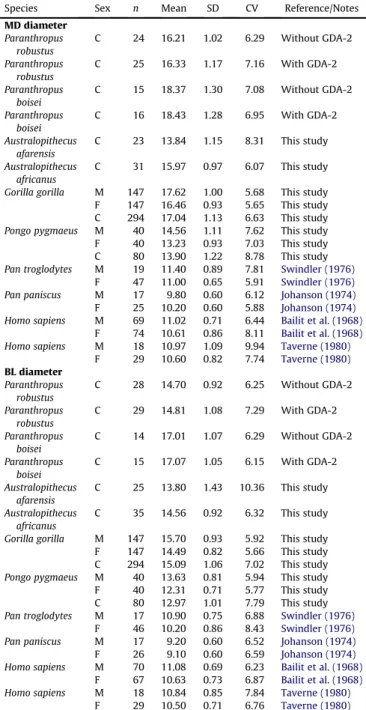
Table 4lists CVs of theP. robustusandP. boiseisamples with and without the GDA-2 specimen included in each. As expected, there are slight increases in the MD and BL means as well as their asso-ciated standard deviations in the expanded P. robustus sample. However, the CVs of the expandedP. robustusare not remarkable by comparison with those of other species. In both diameters, the
P. robustus CVs exceed those for Australopithecus africanus and
P. boisei, but are lower than those forAustralopithecus afarensis. The
P. robustusMD CV is also exceeded by those for one or both sexes in
samples ofPongo pygmaeus,Pan troglodytesand even some human populations. The BL CV for theP. robustusM2sample is exceeded by those for a sample of female chimpanzees, and a sample of human males. Moreover, if the same bootstrapping methods described above are employed, the probabilities of recovering similar
P. robustusMD and BL CVs are 20.2% and 34.8% respectively for the
gorilla sample, and 84.4% and 67.3% respectively for the orangutan sample.
Thus, the addition of the Gondolin molar to the P. robustus
sample does not appreciably increase its metric variability. Indeed, its level of relative variability is comparable to that ofP. boiseiand
A. africanus, and lower than that ofA. afarensis.
Of course, a problem with the use of the CV in this exercise is the number of M2s that comprise theP. robustussample. Withn¼24 for the MD diameter andn¼28 for the BL diameter, a single molar
would have to be much larger than GDA-2 to inflate the CVs enough to match those of theA. afarensissample. Such a tooth would have to measure 21 mm MD and 21.6 mm BL to inflate theP. robustusCVs to 8.31 and 10.36 respectively.
Assessment of range
Another means by which to address the question of what the inclusion of GDA-2 does to the structure of theP. robustussample vis-à-vis other species samples is to examine their ranges. The relationship of the minimum and maximum diameters within Table 3
M2Crown dimensions forGorilla gorillaandPongo pygmaeussamples.
Species Sex n Mean SD Obs. Range
MD diameter
Gorilla gorilla Male 147 17.62 1.00 15.5e20.4
Female 147 16.46 0.93 13.8e18.9
Combined 294 17.04 1.13 13.8e20.4
Pongo pygmaeus Male 40 14.56 1.11 12.6e17.5
Female 40 13.23 0.93 11.7e16.0
Combined 80 13.90 1.22 11.7e17.5 BL diameter
Gorilla gorilla Male 147 15.70 0.93 13.3e18.7
Female 147 14.49 0.82 12.8e16.9
Combined 294 15.09 1.06 12.8e18.7
Pongo pygmaeus Male 40 13.63 0.81 12.2e16.0
Female 40 12.31 0.71 11.0e14.5
Combined 80 12.97 1.01 11.0e16.0
Table 4
Univariate statistics and coefficients of variation (CVs) for M2crown diameters of Plio-Pleistocene hominin and extant hominid samples.
Species Sex n Mean SD CV Reference/Notes
MD diameter Paranthropus robustus C 24 16.21 1.02 6.29 Without GDA-2 Paranthropus robustus C 25 16.33 1.17 7.16 With GDA-2 Paranthropus boisei C 15 18.37 1.30 7.08 Without GDA-2 Paranthropus boisei C 16 18.43 1.28 6.95 With GDA-2 Australopithecus afarensis C 23 13.84 1.15 8.31 This study Australopithecus africanus C 31 15.97 0.97 6.07 This study Gorilla gorilla M 147 17.62 1.00 5.68 This study F 147 16.46 0.93 5.65 This study C 294 17.04 1.13 6.63 This study Pongo pygmaeus M 40 14.56 1.11 7.62 This study F 40 13.23 0.93 7.03 This study C 80 13.90 1.22 8.78 This study Pan troglodytes M 19 11.40 0.89 7.81 Swindler (1976)
F 47 11.00 0.65 5.91 Swindler (1976)
Pan paniscus M 17 9.80 0.60 6.12 Johanson (1974)
F 25 10.20 0.60 5.88 Johanson (1974)
Homo sapiens M 69 11.02 0.71 6.44 Bailit et al. (1968)
F 74 10.61 0.86 8.11 Bailit et al. (1968)
Homo sapiens M 18 10.97 1.09 9.94 Taverne (1980)
F 29 10.60 0.82 7.74 Taverne (1980) BL diameter Paranthropus robustus C 28 14.70 0.92 6.25 Without GDA-2 Paranthropus robustus C 29 14.81 1.08 7.29 With GDA-2 Paranthropus boisei C 14 17.01 1.07 6.29 Without GDA-2 Paranthropus boisei C 15 17.07 1.05 6.15 With GDA-2 Australopithecus afarensis C 25 13.80 1.43 10.36 This study Australopithecus africanus C 35 14.56 0.92 6.32 This study Gorilla gorilla M 147 15.70 0.93 5.92 This study F 147 14.49 0.82 5.66 This study C 294 15.09 1.06 7.02 This study Pongo pygmaeus M 40 13.63 0.81 5.94 This study F 40 12.31 0.71 5.77 This study C 80 12.97 1.01 7.79 This study Pan troglodytes M 17 10.90 0.75 6.88 Swindler (1976)
F 46 10.20 0.86 8.43 Swindler (1976)
Pan paniscus M 17 9.20 0.60 6.52 Johanson (1974)
F 26 9.10 0.60 6.59 Johanson (1974)
Homo sapiens M 70 11.08 0.69 6.23 Bailit et al. (1968)
F 67 10.63 0.73 6.87 Bailit et al. (1968)
Homo sapiens M 18 10.84 0.85 7.84 Taverne (1980)
F 29 10.50 0.71 6.76 Taverne (1980)
The two human samples included here reflect those with the highest CVs for males and females among a selection of six studies with reasonable sample sizes. The other four studies are those ofMoorrees (1957),Van Reenen (1966),Jacobson (1982)and
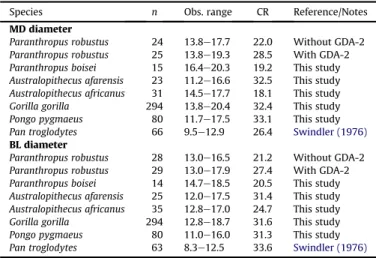
a sample may be expressed as a scale-free ratio, the“coefficient of the range”(CR¼[(maxemin)/max]100). The CR is a means by which the range of variation in a fossil assemblage can be gauged in comparison to similarly-sized samples of other, closely related species (Table 5).
The CR for the M2MD diameter of theP. robustussample without GDA-2 (22.0%) is comparable to those ofP. boiseiandA. africanus, and even with the inclusion of GDA-2, the relative range of the
P. robustus sample (28.5%) is smaller than those of A. afarensis,
G. gorilla and Po. pygmaeus. A molar would have to measure
20.5 mm MD in order to increase theP. robustusCR to the level seen in orangs and A. afarensis. The CR for the BL diameter of the
P. robustussample without GDA-2 (21.2%) already matches that of
P. boisei, but even with the inclusion of GDA-2, the P. robustus
sample CR is smaller than those ofA. afarensisand the ape species. A molar would have to measure 19.0 mm BL in order to increase the
P. robustusCR to the levels seen in these other species samples.
Thus, in neither dimension does GDA-2 match what one would expect for the largest M2ofP. robustusgiven the relative size ranges
ofA. afarensisand living great apes. As such, inclusion of GDA-2 in
theP. robustussample does not sample either the potential or
ex-pected extremes of the species.
Assessment of distribution
The foregoing analyses demonstrate that it is possible to draw a specimen as different from theP. robustussample as GDA-2 in the distributions of highly dimorphic apes such asGorillaorPongo, and that relative variation that results from the inclusion of GDA-2 in
theP. robustussample is not excessive in comparisons to extant
great ape and other fossil hominin samples. However, skewed sex ratios and unbalanced sample sizes may frustrate the straightfor-ward use of CV and CR analyses.
Fig. 5shows the size distribution of gorilla and orangutan M2s, with the P. robustus and Gondolin specimens superimposed (Fig. 5A). With reference to the notable gap between GDA-2 and the next largestP. robustusmolar, the question to be addressed is the likelihood, when sampling aGorilla- orPongo-like distribution, of drawing such an outlier and at the same time drawing 24 other specimens that display variation comparable to that of the
P. robustus sample. To approach this, a program was written in
MATLAB by one of us (MJP) where specimens were randomly drawn with replacement from samples ofGorillaandPongountil the sample size matched that ofP. robustusinclusive of GDA-2 for the MD and BL dimensions. BecausePongo,GorillaandP. robustus
differ in tooth size, data were ln-transformed to control for the effect of size on variances (Sokal and Braumann, 1980;Sokal and Rohlf, 1995; Plavcan and Cope, 2001). The program then calcu-lated the standard deviation of the sample exclusive of the largest drawn specimen, and the mean of that same subsample. This procedure was repeated 1,000,000 times for each dimension of each extant taxon, counting 1) the number of times that the largest specimen fell more than the number of SDs from the sample mean that GDA-2 falls from that of theP. robustusmean, 2) the number of times that the sample SD exceeded that of theP. robustussample, and 3) the number of times that both conditions were met.
The results are summarized inTable 6. It is exceedingly unlikely that one would draw a sample like that ofP. robustusplus an outlier such as GDA-2 from a sample ofGorillaorPongomolars.
However, examination of Fig. 5B reveals a rather striking comparison between theP. robustusþGDA-2 distribution and that
ofGorilla. TheP. robustussample overlaps almost exactly the female
gorilla distribution, while GDA-2 falls in the upper part of the male gorilla distribution. This is not to suggest that all of theP. robustus
specimens in the present sample are female and GDA-2 is a male. Rather, the P. robustus sample clearly comprises a number of undoubted male specimens (Broom and Robinson, 1952; Keyser et al., 2000;Lockwood et al., 2007). We feel reasonably confident that SK 1, SK 6/100, SK 12, SK 34, SK 81, SK 858, SK 876, SK 3976, SKX 4446 and DNH 68 can be so attributed on the basis of tooth and/or corpus size. Those for which both diameters of the M2could be recorded (SK 1, SK 858, SK 3976, SKX 4446 and DNH 68) are highlighted inFig. 5B. We do not presume these specimens to be exhaustive, but choose to illustrate a selection of probable male specimens for heuristic purposes. Interestingly, they all fall within
thelowerpart of the male gorilla distribution.
It is both noteworthy and telling that, when combined with GDA-2, the range of presumptiveP. robustusmales falls comfortably within that of male gorillas, while the presumptive P. robustus
female range is nearly identical to that of female gorillas. Cusp proportions
The utility of molar cusp proportions in taxonomic (species-level) comparisons has been explored in a number of studies (Lavelle, 1978;Wood et al., 1983;Uchida, 1992;Matsumura et al., 1992;Suwa et al., 1994;Grine et al., 2009). These data appear to be particularly effective in sorting mandibular molars, and have proved useful in taxonomic evaluations of Plio-Pleistocene hominin fossils (Wood et al., 1983;Suwa et al., 1994). Although the GDA-2 crown is wornflat, the occlusalfissures separating the principal and subsidiary cusps are clearly visible, enabling them to be delineated (Fig. 2). The planimetric cusp areas were measured (by FEG) using an occlusal image generated from stacked micro-CT slices courtesy of Matt Skinner. The image was imported into Adobe Photoshop 7.0, where the occlusalfissures were highlighted and the mesial and distal contours corrected for interproximal wear. Areas of the adjusted image were measured using Image J 1.41o (NIH;http://rsb. info.nih.gov/ij). Each cusp area was tracedfive times; the highest and lowest values were discarded, and the average of the remaining three values was used to compute relative cusp area.
The GDA-2 crown has a large tuberculum sextum and a smaller distoconulid wedged between it and the hypoconulid. This configuration has been referred to as a“double”,“bifid”or“duplex” C6 by some workers. The methods employed here to define cusp boundaries followed those ofWood et al. (1983), where the areas of Table 5
Observed sample ranges and the“coefficient of the range”(CR) for M2crown dimensions in fossil hominin and combined-sex extant hominid species samples.
Species n Obs. range CR Reference/Notes
MD diameter
Paranthropus robustus 24 13.8e17.7 22.0 Without GDA-2 Paranthropus robustus 25 13.8e19.3 28.5 With GDA-2 Paranthropus boisei 15 16.4e20.3 19.2 This study Australopithecus afarensis 23 11.2e16.6 32.5 This study Australopithecus africanus 31 14.5e17.7 18.1 This study Gorilla gorilla 294 13.8e20.4 32.4 This study Pongo pygmaeus 80 11.7e17.5 33.1 This study Pan troglodytes 66 9.5e12.9 26.4 Swindler (1976)
BL diameter
Paranthropus robustus 28 13.0e16.5 21.2 Without GDA-2 Paranthropus robustus 29 13.0e17.9 27.4 With GDA-2 Paranthropus boisei 14 14.7e18.5 20.5 This study Australopithecus afarensis 25 12.0e17.5 31.4 This study Australopithecus africanus 35 12.8e17.0 24.7 This study Gorilla gorilla 294 12.8e18.7 31.6 This study Pongo pygmaeus 80 11.0e16.0 31.3 This study Pan troglodytes 63 8.3e12.5 33.6 Swindler (1976)
CR¼[(maxmin)/max]100. TheGorillaandPongosamples comprise equal numbers of males and females; thePansample comprises 47 females and 19 males for the MD diameter, and 46 females and 17 males for the BL diameter.
the principal cusps and the tuberculum sextum were recorded separately. In this instance, the tuberculum sextum and dis-toconulid were treated as a single entity.
The relative proportions of the GDA-2 cusps are compared to those recorded bySuwa et al. (1994)forP. robustusandP. boiseiM2s in Table 7andFig. 6. The proportional sizes of the trigonid cusps (pro-toconid and metaconid) do not differ significantly betweenP. robustus
andP. boisei, and nor does the relative size of the hypoconulid. On the other hand,P. robustusandP. boiseidiffer significantly in the relative sizes of the hypoconid and entoconid. The hypoconid is significantly larger inP. robustus(t¼3.7044; df¼23;p<0.01), whereas the entoconid is significantly larger inP. boisei (t ¼3.4298; df¼23;
p<0.01). The relative sizes of these two cusps on GDA-2 are nearly identical to the correspondingP. robustusmeans.
AlthoughP. robustusandP. boiseido not differ significantly from one another in the relative size of the C6, GDA-2 exceeds both means by more than 2 SD (Table 7). The tuberculum sextum on GDA-2 has achieved its size primarily at the expense of the hypo-conulid (Fig. 6).
A“bifid”C6, such as possessed by GDA-2, is reasonably common amongP. robustushomologues, where approximately 42% have two (e.g., DNH 60; SK 37) or even three (e.g., SK 25, SK 3976) cuspulids between the entoconid and hypoconulid. A“bifid”C6 is also not
uncommon onP. boiseiM2s, although at a somewhat lower incidence (c. 33%). Here too, some molars possess two cusps (e.g., KNM-ER 3230), while others have three (e.g., KNM-WT 17396) in this region. Biogeographic context
As noted above, if the GDA-2 molar is attributable toP. boisei, it would have major implications for Early Pleistocene hominin biogeography and for South African australopith paleoecology. We address this issue by examining the exchange of other mammals between East and South Africa during this period of time. It is difficult to assess possible biogeographic ranging patterns from the few large-bodied mammals that have been identified to species from GD1 (Adams et al., 2007) or GD 2 (Adams, 2006) at Gondolin (Table 8). However, it is possible to compare mammalian species presence between the two regions using data from other South and East AfricanParanthropus-bearing sites. The species that have been identified in the literature at 13 East and 8 South African localities are recorded inTable 9.
Because we are particularly interested in the species rather than the genera that are shared between regions, only those taxa that have been identified to the species level are included. Thus, taxa that have been identified as“Genus sp.,” compared with a given species (i.e., those prefixed“cf.”), or seen as sharing affinities with a given species (i.e., those prefixed“aff.”) have been excluded. The only exceptions pertain to Homo habilisand Homo erectus.With regard to the former, we ignore the questions that have been raised as to its specific identification in South Africa (Grine et al., 1996), and follow MacLatchy et al. (2010) on its possible presence in Sterkfontein Member 5A. As such, we do not subscribe to argu-ments to the effect that the Stw 53 cranium representsA. africanus
(Kuman and Clarke, 2000;Clarke, 2008;Berger et al., 2010). With regard toH. erectus, we follow numerous workers (Rightmire, 1990, 1998;Antón, 2003;Gilbert et al., 2003;Baab, 2008) in regarding
Homo ergasteras a subjective junior synonym, and recognize the
existence of H. erectus at the South African sites of Swartkrans (Members 1e3) and Sterkfontein (Member 5B).
An important consideration in comparisons such as those in Table 9is the possibility that species identification, more so than generic identification, depends upon the alpha taxonomy employed Figure 5.Scatterplots of the mesiodistal (MD) and buccolingual (BL) diameters of M2s comprising extant, highly dimorphic hominid samples withParanthropus robustusand GDA-2 crowns superimposed. A)PongoandGorillasamples compared. Gold diamonds arePongomales and females; blue triangles areGorillamales and females; black circles are Par-anthropus robustusmolars from Kromdraai, Swartkrans and Drimolen; black star is GDA-2. B)Gorillamales and females compared. Gold diamonds areGorillafemales, blue boxes are Gorillamales; black and red circles areParanthropus robustusmolars from Kromdraai, Swartkrans and Drimolen. Red circles denote a number of the specimens considered to be male byLockwood et al. (2007)and us (i.e., SK 1, SK 858, SK 3976, SKX 4446 and DNH 68); note that all fall within the lower part of the maleGorilladistribution. The black star is the GDA-2 crown. This highlights the distance between GDA-2 and the next largestP. robustushomologue being equivalent to that separating a largeGorillamale from smaller male and female conspecifics. (For interpretation of the references to colour in thisfigure legend, the reader is referred to the web version of this article.)
Table 6
Likelihood, when sampling aGorilla- orPongo-like distribution, of drawing an outlier such as GDA-2 and at the same time drawing another 24 specimens that show relative variation comparable to that of theParanthropus robustussample.
Condition met Range SD Both
Pongo MD 0.0662 0.2053 0.0094 BL 0.0019 0.2814 0.0011 Gorilla MD 0.0086 0.2858 0.0035 BL 0.0019 0.1569 0.0001
This procedure was repeated 1,000,000 times for each tooth dimension of each extant taxon, counting 1) the number of times that the largest specimen fell more than the number of standard deviations from the sample mean that GDA-2 falls from theP. robustusmean, 2) the number of times that the sample standard deviation exceeded that of theP. robustussample, and 3) the number of times that both conditions were met.
by different workers who might havefirst-hand familiarity with fossils from only one of the regions or site areas. However, a number of researchers in the recent past have compared fossils in both regions, with the result that such biases (i.e., mis-identification of the same species) have likely been reduced (e. g., Vrba, 1995;Gentry, 2010;Werdelin and Peigné, 2010).
The results of this comparison show that while there is considerable generic correspondence, there are comparatively few species that are common to both South and East Africa in the Early Pleistocene. Thus, of the 157 species that have been identified from
theParanthropus-bearing sites, only 20 (12.7%) are common to both
geographic regions. Therefore, it is possible but improbable tofind the same species in eastern as well as southern Africa. Moreover, seven of the species common to both are faunivorous (six large carnivores and the aardvark), which is interesting in light of their rarity in the fossil record. Given the abundance of artiodactyl remains in these deposits, there are surprisingly few bovid species represented in both regions, and this does not appear to be attributable to sampling error given the occurrence of the fauniv-orous species. With regard to the shared herbivfauniv-orous species, four are grazers, two are browsers, and two are mixed feeders. While many of the herbivores are large (species ofElephasand Cerato-therium), others are fairly small (e.g.,Antidorcas recki).
The number of primate species common to both regions is, in some measure, dependent upon the alpha taxonomy subscribed to by individual researchers.Theropithecus oswaldiis recognized here as occurring in three East African and three South African localities, and there is also only one colobine (Cercopithecoides williamsi) common to both regions. Like.T. oswaldi, it was a large terrestrial folivore (Delson, 1992;Benefit, 2000).
With regard to theHomofossils, if bothH. habilisandH. erectus
are recognized in South African sites, then there are possibly two Early Pleistocene hominin species whose ranges extended from East to South Africa. However, while the existence ofH. erectusin South Africa is universally accepted for fossils that derive from
Swartkrans Member 2 (Grine, 2005), other of the South African
Homofossils have been argued to possibly attest to a species lineage unknown in East Africa (Grine et al., 1996). Thus, ifH. habilisdoes not exist in South Africa, the similarity between the two biogeo-graphic provinces is further reduced.
Large and medium-sized carnivores are found across sub-Saharan Africa today and, for the most part, they are not limited by habitat. The Early Pleistocene large-bodied carnivores are presumed to have the same eurytopic ecological requirements as those living today. If faunivores are removed from the comparison, then only 8.9% of the remaining species are common to both regions (reducing the number of shared species to 14). Of the herbivores, four are large to very large species and today these types of animals (rhinos, giraffes, zebra) are also present in both regions. This, then, leaves eight shared medium-sized mammals: two hominins (both of which are species ofHomo), two cercopi-thecids, two grazing pigs,A. recki(a mixed feeder that appears to have preferred grass),Kobus leche(a specialized grazer) and
Trag-elaphus strepsiceros(a browser).
AlthoughTragelaphus(cf. or aff.)scriptushas been identified at many of the sites in both regions, there is no site in which a defi n-itive attribution has been made. Recent DNA analyses suggest that living populations of Tragelaphus scriptus have been separated
Figure 6.Histogram of relative cusp areas of the M2 recorded forParanthropus robustus,P. boiseiand GDA-2. The proportional contributions of the hypoconid and entoconid differ significantly betweenP. robustusandP. boisei; in each instance the GDA-2 value accords with theP. robustus sample mean.
Table 8
The large-bodied mammalian fauna recorded from Gondolin.
GD 1 GD 2
Artiodactyla Bovidae
Oreotragus oreotragus
Antidorcascf.A. recki Antidorcas recki Reduncasp. Redunca sefulathabeng
Damaliscus (?niro) Connochaetessp. Taurotragus oryx Tragelaphus angasi Tragelaphus strepsiceros Suidae Metridiochoerus andrewsi Carnivora Canidae Canis mesomelas Hyaenidae Crocuta crocuta Perissodactyla Equidae Equussp. Equussp. Rhinocerotidae Ceratotherium simum Hyracoidea Procavidae Procavia antiqua Rodentia Hystricidae Hystrix makapenensis Data are fromAdams (2006)andAdams et al. (2007).
Table 7
Relative cusp proportions ofParanthropusM2s.
n Protoconid Metaconid Hypoconid Entoconid Hypoconulid C6
Mean SD Mean SD Mean SD Mean SD Mean SD Mean SD
GDA-2 0.216 0.206 0.204 0.158 0.105 0.112
P. robustus 16 0.227 0.017 0.217 0.017 0.203 0.012 0.160 0.023 0.123 0.021 0.071 0.016
P. boisei 9 0.221 0.017 0.219 0.020 0.185 0.011 0.191 0.019 0.120 0.025 0.064 0.021
between northwestern and southeastern Africa for an estimated 3.0 Myr, with only small amounts of geneflow between adjacent populations (Moodley and Bruford, 2007). Indeed, because the bushbuck exhibits a distinct mtDNA haplotype from the Cape to KwaZulu-Natal, it may warrant separate specific status as
Trag-elaphus sylvaticus, as originally described by Sparrman in 1780
(Moodley et al., 2009).
To further examine the distribution of species between East and South African biogeographic provinces, we collected data from the literature on species recovered from 25 Late Pliocene - Early Pleistocene sites dated to between ca. 2.5e1.2 Ma. In this instance, the rationale for collection was the general time period over which
Paranthropus fossils are distributed rather than specific
Para-nthopus-bearing localities. As such, this analysis expands our
previous species comparison, and serves to further estimate how much species interchange is evident between the two regions. Species indices between each pair of sites were calculated using the Jaccard measure of similarity (Cj¼j/aþbj), which is based on the
presence/absence of individual species (not their abundance) and creates an index between 0 and 1 (Cheetham and Hazel, 1969). We placed these pairwise indices in a matrix and calculated a minimum spanning tree that connects sites based on their taxo-nomic similarity such that the sites that share the most species have a much shorter distance or span between them.
Plotting these results on a graph scaled to latitude and longitude for purposes of visualization (Fig. 7) reveals that the Late Pliocene -Early Pleistocene fossil localities display clear regional groupings that correspond to major differences between East and South Africa despite temporal and/or habitat differences among them. The South African sites are tightly clustered with one another. It is perhaps significant that while they show low affiliation to West Turkana, Kenya, they exhibit virtually none with the much closer Chiwondo Beds in Malawi. Although the Omo, West Turkana and Koobi Fora localities are tightly clustered, they are also distinct from Table 9
Species shared between Early Pleistocene East and South African fossil sites. East South Artiodactyla Bovidae Antidorcas recki 7 6 Kobus leche 3 2 Tragelaphus strepsiceros 9 3 Suidae Metridiochoerus andrewsi 7 5 Metridiochoerus modestus 6 2 Giraffidae Sivatherium marusium 10 2 Carnivora Canidae Canis mesomelas 1 6 Felidae Acinonys jubatus 1 2 Caracal caracal 1 3 Panthera leo 2 4 Panthera pardus 5 5 Hyaenidae Crocuta ultra 3 4 Perissodactyla Equidae Equus burchelli 3 3 Rhinocerotidae Ceratotherium simum 13 1 Primates Cercopithecidae Cercopithecoides williamsi 1 3 Theropithecus oswaldi 3 4 Hominidae Homo habilis 3 4 Homo erectus 3 4 Proboscidea Elephantidae Elephas recki 11 1 Tubulidentata Orycteropodidae Orycteropus afer 1 3
Numbers refer to the number of localities/strata in East and South Africa respec-tively from which the species were recovered (e.g., Shungura Member C¼1 Locality; Swartkrans Member 2¼1 Locality).
East African sites are: Shungura Formation, Ethiopia, Members C - G; Koobi Fora Formation, Kenya, Upper Burgi, KBS, Okote Members; Nachukui Formation, Kenya, Lokalalei, Kaitio Members; Olduvai Gorge, Tanzania, Beds IeII; Chiwondo Beds, Malawi. Data for East African sites fromLeakey (1967),Harris (1991),Reed (1997),
Turner et al. (1999),Sandrock et al. (2007),Bishop (2010),Werdelin and Peigné (2010),Gentry (2010),MacLatchy et al. (2010). South African sites are: Swart-krans Members 1e3; Sterkfontein Member 5; Drimolin; Kromdraai B; Gondolin; Cooper’s D. Data for South African sites fromReed (1997),Turner et al. (1999),de Ruiter (2003),Adams (2006),Adams et al. (2007),de Ruiter et al. (2009);Bishop (2010),Werdelin and Peigné (2010);Gentry (2010),MacLatchy et al. (2010).
Figure 7.A stylized minimum spanning tree based on species similarities among late Plioceneeearly Pleistocene (ca. 2.5e1.2 Ma) fossil sites in East and South Africa, adjusted so as to be mapped onto a grid of African latitudes and longitudes. Lower indices of association are indicated by dotted lines. The distances among the South African sites are exaggerated for display purposes.East African sites: Koobi Fora (Upper Burgi, KBS and Okote members), Shungura Formation (members C - G); West Turkana (Lokalalei, Kaitio, Natoo and Kalachoro members plus the Nariokotome, KNM-WT 17000 locality); Hadar (Maka’amitalu [A.L. 666 locality]); Olduvai (Beds IeII); Uraha (Chiwondo Beds).South African Sites: Drimolin, Sterkfontein (Members 4 and 5); Swartkrans (Members 1e3), Kromdrai (A and B). Data for East African sites from
Leakey (1967);Harris (1991);Reed (1997);Turner et al. (1999);Sandrock et al. (2007). Data for South African sites fromReed (1997),Turner et al. (1999),de Ruiter (2003),de Ruiter et al. (2008).
one another. Given that regional fossil sites group tightly together, these data are consistent with South Africa having been relatively isolated in the Early Pleistocene.
In sum, there are very few species of large-bodied mammals common to both East and South Africa in the Early Pleistocene. Consideration of their ecology and body sizes suggests that some barrier prevented wholesale movement between the two regions. Although there are several notable exceptions (mostly relating to faunivores), it would seem possible, but not probable to encounter a large-bodied mammal species, and especially one that is herbiv-orous, in the Early Pleistocene of both East and South Africa. Discussion
The specific attribution of the very large, hominin M2 crown (GDA-2) that was discovered in 1997 at the site of Gondolin has important implications for the paleobiology ofParanthropus. If this very large molar is, indeed, attributed to P. robustus, this has significance for the size range of that taxon, and if it is attributable toP. boisei, it holds significant biogeographic implications. As such, we examined the likelihood that GDA-2 represents a specimen of eitherP. robustusorP. boisei.
Using the sample distributions of highly dimorphic apes such as
GorillaandPongoas comparators, wefind that it is possible, albeit
unlikely to draw a specimen as different from the conventional
P. robustusassemblage as GDA-2, but that the level of variation that
results from the inclusion of GDA-2 in theP. robustussample does not differ substantially from that of ape and other australopith samples. Thus, inclusion of GDA-2 in theP. robustushypodigm does not sample its potential, expected extremes. At the same time, it is exceedingly unlikely that one would draw a sub-sample like that represented by theP. robustusmolars with an outlier such as GDA-2 from orangutan or gorilla samples. However, it is important to note that the analyses relating to overall crown size employed extant hominid samples that were not selected by the same taphonomic agent(s) that were likely responsible for the structure of the Swartkrans and DrimolenP. robustusassemblages. This is especially relevant when considering the results of our resampling experi-ment on sample distributions.
Size, taphonomy, and the structure of theP. robustusassemblage
Brain (1981,1993,1994)has presented convincing evidence that the large-bodied mammals, including the australopiths, found in the South African cave sites, and especially at Swartkrans, were very likely accumulated through a taphonomic filter governed primarily by large carnivore feeding behavior. The relative abun-dance of baboon and hominin fossils, which together comprise over 40% of all individuals at Swartkrans, is most reasonably explained in terms of carnivore food debris, with the leopard (Panthera pardus) having been implicated as a primary agent of accumulation. There is solid evidence of leopard canine puncture marks on the calotte of at least oneParanthropusindividual (SK 54) from Swartkrans (Brain, 1969,1970,1974). While the possible involvement of other large-bodied carnivores (e.g., Dinofelisand Hyaena) at Swartkrans has been raised, leopards are seen as the major contributor to the site, having likely used the cave as a feeding lair throughout the depo-sition of theParanthropus-rich Member 1 deposit (Pickering et al., 2008). Although puncture pits that correspond to hyaena tooth sizes appear on bones in Members 2 and 3, leopards cannot be eliminated as having contributed to these accumulations as well (Pickering et al., 2004).
Modern African leopards will attack a fairly broad range of prey sizes, including small (ca. 165 kg) buffalo. However, they prefer game no larger than themselves (i.e., ca. 37e61 kg for females and
males respectively (Bailey, 1993)), and the majority of successful attacks are on animals that weigh less than half their mean body weights. Pivotal success rates for kills entail prey species between 30 and 100 kg (Pienaar, 1969;Radloff and Du Toit, 2004; Owen-Smith and Mills, 2008), and the average prey body masses for female and male leopards is 25.2 kg and 34.2 kg respectively (Radloff and Du Toit, 2004). Thus, average prey body mass is some 60e70% that of an adult leopard.
Reliable body weights forP. robustusare difficult to determine because of the dearth of postcranial bones that can be confidently attributed to this taxon. This is because of the presence ofHomoin the same deposits (Grine, 2005; Moggi-Cecchi et al., 2010). Nevertheless, the clear numerical superiority of craniodental fossils
ofParanthropusvis-à-visHomoat both Swartkrans and Drimolen
(Moggi-Cecchi et al., 2010), and the occasional morphological distinction between homologous elements (e.g., the proximal radius (Grine and Susman, 1991)) enable the attribution of fossils to the former with at least a reasonable likelihood.
McHenry (1976) obtained estimates for several postcranial bones from Swartkrans that he regarded as belonging toP. robustus. The SK 3981 vertebrae yielded a value of 36.1 kg, while the SK 82 and SK 97 femoral head diameters suggested 49.8 kg and 52.7 kg respectively. The SK 82 and SK 97 femoral shafts yielded somewhat higher weights of 55.1 kg and 56.5 kg respectively forMcHenry (1988), whereas Steudel (1980)obtained estimates of ca. 69 kg (the average weight of a male orangutan) from their diaphyseal circumferences.Jungers (1988) reported values from Swartkrans hip joints between 37.1 kg and 57.5 kg. Expanding the sample to include all of the postcranial elements from Swartkrans led McHenry (1991)to note that the Member 1 specimens yielded estimates of less than 54 kg, while those from Member 3 suggested weights around 45 kg. Subsequent estimates reported byMcHenry (1992)for Swartkrans and Kromdraai postcrania range from 30.0 kg (the SK 3981b lumbar vertebra) to 59.8 kg (the SK 97 femoral shaft). He perceived the smaller and larger fossils as likely representing females and males, with respective averages of 31.9 kg and 40.2 kg for the sexes.
Several studies have explored the potential of cranial measurements to predict body mass in fossil hominins (e.g., Steudel, 1980;Aiello and Wood, 1994;Kappelman, 1996), and with a few notable exceptions (Braga and Thackeray, 2003;Schwartz and Tattersall, 2003) distinguishing between the skulls and teeth of
Paranthropus and Homo is a fairly straightforward task. Steudel
(1980) found orbital width, palate breadth and bizygomatic breadth to be particularly powerful predictors among extant hominoids, but was cautious about employing the latter two vari-ables to estimate body size inP. robustusbecause of their obvious relationship to its hypertrophied masticatory apparatus. Accord-ingly, she obtained estimates of around 37 kg (the average weight of a female orangutan) for the SK 46, SK 48 and SK 79 crania. Kappelman (1996)predicted a weight of 46.8 kg for SK 48 using orbital area, whileSpocter and Manger (2007)obtained values of between 48 kg and 52 kg for it from a variety of upper facial and orbital dimensions.
Regardless of their derivation (i.e., specific measurement, element or regression model), the body weight estimates based on the postcranial remains are quite consistent, ranging between about 30 and 60 kg, and the cranial variables have yielded estimates that are consistent between 37 and 52 kg. These values fall within the range for pivotal prey kill success for modern leopards, and the higher estimates for someP. robustusspecimens from Swartkrans and Kromdraai begin to push that envelope somewhat.
In this context, it is significant that the Paranthropus assem-blages from Swartkrans and Drimolen (and even Kromdraai, despite its comparative paucity of fossils) are notable for their high
proportion of juvenile individuals (McKinley, 1971; Mann, 1975; Brain, 1981;Keyser et al., 2000;Shaaban, 2002;Moggi-Cecchi et al., 2010). Assemblages that have been taphonomically skewed by predation are expected to contain inordinately high proportions of juvenile individuals and limited body weight variation among adults. It is precisely in such assemblages that very large (presumptive male) specimens are expected to be rare.
Lockwood et al. (2007)have argued that theP. robustusadults comprising the Swartkrans assemblage are dominated by younger, smaller (non-dominant) males. Although the sex assignment of some of the specimens they considered may be open to question, their observation that large (“Rank 9”) individuals are compara-tively rare in the collection is a matter of record.McHenry (1992) observed that, in comparison to other Plio-Pleistocene hominin taxa, the estimates for P. robustus body weights attest to a comparatively low level of intraspecific variation. In this context, it is perhaps revealing that the observedP. robustusþGDA-2 molar size distribution overlaps that ofG. gorilla.More specifically, most of the Swartkrans, Drimolen and Kromdraai specimens overlap almost exactly the distribution of female gorillas. While a number of these specimens, which almost certainly include some male individuals, also overlap the lower part of the maleGorilla distri-bution, the GDA-2 molar sits comfortably within the upper reaches of that distribution.
By comparison with highly dimorphic gorillas, then, one might reasonably conclude that GDA-2 likely represents a large male individual, and that theP. robustusassemblage from Swartkrans, Drimolen and Kromdraai is dominated by females and small males. This suggests that the degree of sexual size dimorphism inferred for
P. robustusbyLockwood et al. (2007)and others before has likely
been grossly underestimated.
Other evidence bearing on alpha taxonomy
Is there any other evidence to suggest that GDA-2 represents an expectedly rare, very large (presumptive male) individual of
P. robustus rather than another larger-toothed species such as
P. boisei?Paranthropus robustusandP. boiseidiffer significantly in
the relative sizes of the M2 hypoconid and entoconid, and the proportional sizes of these cusps on GDA-2 are nearly identical to the corresponding P. robustus means. Moreover, the “bifid” C6 displayed by GDA-2 is relatively common among P. robustus
homologues (42%), and somewhat rarer amongP. boiseispecimens. Among other large-bodied mammals, and especially non-carnivorous forms, there are very few species common to both South and East Africa in the Early Pleistocene. Of some 151 iden-tified species, less than 15% are common to both regions, and a good proportion of these are faunivores. Thus, it would seem possible, but not probable to encounter a large-bodied herbivorous mammal in both East and South Africa during the temporal range of
Para-nthropus. With regard to the Plio-Pleistocene hominin fossils, we
are unaware of any authority who currently maintains that any australopith species is known from both East and South Africa. Thus, despite the initial attribution of fragmentary East African fossils toA. africanus(e.g.,Howell, 1969,1978;Tobias, 1980), this view has not prevailed under the weight of evidence. Similarly, neitherA. afarensisnorA.garhiare known in South Africa, despite the presence of like-aged deposits there. On the other hand, if the
Homo fossils from Sterkfontein, Swartkrans and Drimolen are attributable toH. habilisandH. erectus, then there is at least one, if not two penecontemporaneous hominin species whose range(s) extended from South Africa to Ethiopia. Regardless of their ultimate specific attributions, however, early Homo taxa almost certainly possessed broader ranges of dietary behaviors than either
P. robustusorP. boisei(Ungar et al., 2006).
Taken together, various lines of evidence and reasoning indicate thatMenter et al. (1999)were correct in their initial assessment of GDA-2. The most likely interpretation of the Gondolin molar is that is a very large (and expectedly rare) specimen of P. robustus. As such, the levels of size variation (sexual dimorphism) that have been ascribed to this species are likely to be gross underestimates. The resultant substantial increase in its constituent size range has significant consequences for our understanding of the paleobiology ofP. robustus.
Conclusions
The hominin M2(GDA-2) from Gondolin is substantially larger than any other P. robustus homologue known; its MD and BL diameters fall some 3.0 to 3.5 SD above the corresponding
P. robustus sample means, but within the ranges for
pene-contemporaneous P. boisei samples from East Africa. We have explored the likelihood that it represents a specimen of either taxon by evaluating 1) overall crown size using various metrics of assessment, 2) crown morphology through cusp proportions, and 3) the biogeographic likelihood of encountering a large-bodied mammal species in the Early Pleistocene in both East and South Africa.
Observations on overall crown size are mixed. Although anal-yses of sample range, distribution and variability suggest that it is possible, albeit unlikely to find a M2 of this size in the current sample representing P. robustus, the extant hominid samples employed in these comparisons were not selected (skewed) by the same taphonomic agent(s) responsible for the structure of the Swartkrans and DrimolenP. robustusassemblages. These were very likely accumulated as a result of carnivore (especially leopard) feeding behaviors. Given the prey body mass preferences of leop-ards, assemblages accumulated by them are expected to be taphonomically skewed, displaying inordinately high proportions of juvenile individuals and limited body weight variation among adults. This describes the Swartkrans assemblage, and it is precisely in such an assemblage that very large (presumptive male) speci-mens are expected to be rare.
Evidence from cusp proportions is congruent with the inter-pretation that GDA-2 represents a rare, large (presumptive male) individual ofP. robustusrather than another larger-toothed species such asP. boisei. The two species ofParanthropusdiffer significantly in the relative sizes of the hypoconid and entoconid, and those on GDA-2 are nearly identical to the correspondingP. robustusmeans. Finally, there are comparatively very few large-bodied (non-hominin) mammal species common to Early Pleistocene sites in both South and East Africa. Less than 15% of identified species are common to both, and a good proportion of these are carnivores. Thus, it is possible, albeit not probable to encounter a large-bodied mammal, and especially one that is herbivorous, in East and South Africa in the Early Pleistocene.
Taken together, these various lines of evidence indicate that Menter et al. (1999)were correct in their initial assessment of GDA-2. The most likely interpretation of the Gondolin molar is that is a very large (and expectedly rare) specimen ofP. robustus. As such, the levels of size variation (sexual dimorphism) ascribed to this species have been grossly underestimated.
Acknowledgments
We are grateful to M. Dagosto and M.H. Wolpoff for providing Paul Mahler’s data and to S. King and M.H. Wolpoff for sharing additional data on extant hominid molar sizes. We thank A. Su for the MATLAB bootstrapping script; E. Delson, S. Frost, O. Kullmer and F. Schrenk graciously shared their data on species composition of
Early Pleistocene sub-Saharan African localities. For access to specimens we thank M. Raath and B. Zipfel (University of the Witwatersrand), C. Menter (University of Johannesburg), S. Potze (Ditsong National Museum of Natural History), and E. Mbua, F. Manthi and S. Muteti (National Museums of Kenya). Thanks to M. Skinner for generously permitting us to use his reconstructions of the GDA-2 molar crown from micro-CT scans. The late Charles Lockwood generatedFig. 7. We thank the anonymous reviewers for their comments, and the editor, M.F. Teaford, for his careful scrutiny and cogent suggestions for improvements to our manuscript.
References
Adams, J.W., 2006. Taphonomy and Paleoecology of the Gondolin Plio-Pleistocene Cave Site, South Africa. Ph.D. Dissertation, Washington University.
Adams, J.W., Herries, A.I.R., Kuykendall, K.L., Conroy, G.C., 2007. Taphonomy of a South African cave: geological and hydrological influences on the GD 1 fossil assemblage at Gondolin, a Plio-Pleistocene paleocave system in the Northwest Province, South Africa. Quat. Sci. Rev. 26, 2526e2543.
Aiello, L.C., Wood, B.A., 1994. Cranial variables as predictors of hominid body mass. Am. J. Phys. Anthropol. 95, 409e426.
Antón, S.C., 2003. Natural history ofHomo erectus. Yearbk. Phys. Anthropol. 46, 126e170.
Baab, K.L., 2008. The taxonomic implications of cranial shape variation inHomo erectus. J. Hum. Evol. 54, 827e847.
Bailey, T.N., 1993. The African Leopard. Columbia University Press, New York. Bailit, H.L., de Witt, S.J., Leigh, R.A., 1968. The size and morphology of the Nasioi
dentition. Am. J. Phys. Anthropol. 28, 271e288.
Benefit, B.R., 2000. Old World monkey origins and diversification: an evolutionary study of diet and dentition. In: Whitehead, P.F., Jolly, C.J. (Eds.), Old World Monkeys. Cambridge University Press, Cambridge, pp. 133e179.
Berger, L.R., de Ruiter, D.J., Steininger, C.M., Hancox, J., 2003. Preliminary results of excavations at the newly investigated Coopers D deposit, Gauteng, South Africa. S. Afr. J. Sci. 99, 276e278.
Berger, L.R., de Ruiter, D.J., Churchill, S.E., Schmid, P., Carlson, K.J., Dirks, P.H.G.M., Kibii, J.M., 2010.Australopithecus sediba: a new species ofHomo-like austral-opith from South Africa. Science 328, 195e204.
Bishop, L.C., 2010. Suidae. In: Werdelin, L., Sanders, W.J. (Eds.), Cenozoic Mammals of Africa. University of California Press, Berkeley, pp. 821e842.
Blackwell, B.A., 1994. Problems associated with reworked teeth in electron spin resonance (ESR) dating. Quatern. Geochron. (Quatern. Sci. Rev.) 13, 651e660. Braga, J., Thackeray, J.F., 2003. Early Homo at Kromdraai B: probabilistic and
morphological analysis of the lower dentition. C.R. Palevol 2, 269e279. Brandon-Jones, D., Eudey, A.A., Geissmann, T., Groves, C.P., Melnick, D.J.,
Morales, J.C., Shekelle, M., Stewart, C.B., 2004. Asian primate classification. Int. J. Primatol. 25, 97e164.
Brain, C.K., 1969. The probable role of leopards as predators of the Swartkrans australopithecines. S. Afr. Archaeol. Bull. 24, 170e171.
Brain, C.K., 1970. Newfinds at the Swartkrans australopithecine site. Nature 225, 1112e1119.
Brain, C.K., 1974. A hominid skull’s revealing holes. Nat. Hist. 83, 44e45. Brain, C.K., 1981. The Hunters or the Hunted? University of Chicago Press, Chicago. Brain, C.K., 1993. A taphonomic overview of the Swartkrans fossil assemblages. In: Brain, C.K. (Ed.), Swartkrans, a Cave’s Chronicle of Early Man. Transvaal Mus. Monographs, vol. 8, pp. 258e264.
Brain, C.K., 1994. The Swartkrans palaeontological research project in perspective: results and conclusions. S. Afr. J. Sci. 90, 220e223.
Broom, R., 1938. The Pleistocene anthropoid apes of South Africa. Nature 142, 377e379.
Broom, R., 1949. Another new type of fossil ape-man. Nature 163, 57.
Broom, R., Robinson, J.T., 1952. Swartkrans Ape-man Paranthropus crassidens. Transvaal Museum Memoir 6. Transvaal Museum, Pretoria.
Brown, B., Brown, F.H., Walker, A., 2001. New hominids from the Lake Turkana Basin, Kenya. J. Hum. Evol. 41, 29e44.
Calder, W.A., 1984. Size, Function and Life History. Harvard University Press, Cambridge.
Cande, S.C., Kent, D.V., 1995. Revised calibration of the geomagnetic polarity time scale for the Late Cretaceous and Cenozoic. J. Geophys. Res. 100, 6093e6095. Cheetham, A.H., Hazel, J.E., 1969. Binary (presence-absence) similarity coefficients.
J. Paleontol. 43, 1130e1136.
Clarke, R.J., 2008. Latest information on Sterkfontein’sAustralopithecusskeleton and a new look atAustralopithecus. S. Afr. J. Sci. 104, 443e449.
Cope, D.A., Lacy, M.G., 1992. Falsification of a single species hypothesis using the coefficient of variation: a simulation approach. Am. J. Phys. Anthropol. 89, 359e387.
Cope, D.A., Lacy, M.G., 1995. Comparative application of the coefficient of variation and range based statistics for assessing the taxonomic composition of fossil samples. J. Hum. Evol. 29, 549e576.
Coppens, Y., 1971. Les restes d’Hominidés des séries supérieures des formations plio- villafranchiennes de l’Omo en Ethiopie. C.R. Acad. Sci. Paris 272, 36e40.
Curnoe, D., Grün, R., Taylor, L., Thackeray, J.F., 2001. Direct ESR dating of a Pliocene hominin from Swartkrans. J. Hum. Evol. 40, 379e391.
Curnoe, D., Grün, R., Thackeray, J.F., 2002. Electron spin resonance dating of tooth enamel from Kromdraai B, South Africa. S. Afr. J. Sci. 98, 540.
Delson, E., 1988. Chronology of South African australopith site units. In: Grine, F.E. (Ed.), Evolutionary History of the “Robust” Australopithecines. Aldine de Gruyter, New York, pp. 317e324.
Delson, E., 1992. Evolution of old world monkeys. In: Jones, J.S., Martin, R.D., Pilbeam, D., Bunney, S. (Eds.), Cambridge Encyclopedia of Human Evolution. Cambridge University Press, Cambridge, pp. 217e222.
de Ruiter, D.J., 2003. Revised faunal lists for Members 1e3 of Swartkrans, South Africa. Ann. Transvaal Mus. 40, 29e41.
de Ruiter, D.J., Sponheimer, M., Lee-Thorp, J.A., 2008. Indications of habitat associ-ation ofAustralopithecus robustusin the Bloubank Valley, South Africa. J. Hum. Evol. 55, 1015e1030.
de Ruiter, D.J., Pickering, R., Steininger, C.M., Kramers, J.D., Hancox, P.J., Churchill, S.E., Berger, L.R., Backwell, L., 2009. NewAustralopithecus robustus fossils and associated UePb dates from Cooper’s Cave (Gauteng, South Africa). J. Hum. Evol. 56, 497e513.
Donnelly, S.M., Kramer, A., 1999. Testing for multiple species in fossil samples: an evaluation and comparison of tests for equal relative variation. Am. J. Phys. Anthropol. 108, 507e529.
Gentry, A., 2010. Bovidae. In: Werdelin, L., Sanders, W.J. (Eds.), Cenozoic Mammals of Africa. University of California Press, Berkeley, pp. 741e796.
Giacominia, H.C., De Marco, P., Petrere, M., 2009. Exploring community assembly through an individual-based model for trophic interactions. Ecol. Model. 220, 23e39.
Gilbert, W.H., White, T.D., Asfaw, B., 2003.Homo erectus, Homo ergaster, Homo “cepranensis”, and the Daka cranium. J. Hum. Evol. 45, 255e259.
Grine, F.E., 1982. A new juvenile hominid (Mammalia: Primates) from Member 3, Kromdraai Formation, Transvaal, South Africa. Ann. Transvaal Mus. 33, 163e239.
Grine, F.E., 1985. Australopithecine evolution: the deciduous dental evidence. In: Delson, E. (Ed.), Ancestors: The Hard Evidence. Alan R. Liss, New York, pp. 153e167. Grine, F.E., 1989. New hominid fossils from the Swartkrans formation (1979e1986
excavations): craniodental specimens. Am. J. Phys. Anthropol. 79, 409e449. Grine, F.E., 2005. EarlyHomoat Swartkrans, South Africa: a review of the evidence
and an evaluation of recently proposed morphs. S. Afr. J. Sci. 101, 43e52. Grine, F.E., Susman, R.L., 1991. Radius ofParanthropus robustusfrom Member 1,
Swartkrans formation, South Africa. Am. J. Phys. Anthropol. 84, 229e248. Grine, F.E., Jungers, W.L., Schultz, J., 1996. Phenetic affinities among earlyHomo
crania from East and South Africa. J. Hum. Evol. 30, 189e225.
Grine, F.E., Smith, H.F., Heesy, C.P., Smith, E.J., 2009. Phenetic affinities of Plio-Pleistocene Homo fossils from South Africa: molar cusp proportions. In: Grine, F.E., Fleagle, J.G., Leakey, R.E. (Eds.), The First Humans - Origin and Early Evolution of the GenusHomo. Springer, Dordrecht, pp. 49e62.
Harris, J.M., 1991. Koobi Fora Research Project. Clarendon, Oxford.
Herries, A.I.R., Adams, J.W., Kuykendall, K.L., Shaw, J., 2006. Speleology and mag-netobiostratigraphic chronology of the GD 2 locality of the Gondolin hominin-bearing paleocave deposits, North West Province, South Africa. J. Hum. Evol. 51, 617e631.
Herries, A.I.R., Curnoe, D., Adams, J.W., 2009. A multi-disciplinary seriation of early HomoandParanthropusbearing palaeocaves in southern Africa. Quat. Int. 202, 14e28.
Howell, F.C., 1969. Remains of Hominidae from Pliocene/Pleistocene formations in the lower Omo Basin, Ethiopia. Nature 223, 1234e1239.
Howell, F.C., 1978. Hominidae. In: Maglio, V.J., Cooke, H.B.S. (Eds.), Evolution of African Mammals. Harvard University Press, Cambridge, pp. 154e248. Jacobson, A., 1982. The Dentition of the South African Negro. Higginbotham,
Anniston, ALA.
Johanson, D.C., 1974. Some metric aspects of the permanent and deciduous denti-tion of the pygmy chimpanzee (Pan paniscus). Am. J. Phys. Anthropol. 41, 39e48. Jungers, W.L., 1988. New estimates of body size in australopithecines. In: Grine, F.E. (Ed.), Evolutionary History of the “Robust” Australopithecines. Aldine de Gruyter, New York, pp. 115e125.
Kappelman, J., 1996. The evolution of body mass and relative brain size in fossil hominids. J. Hum. Evol. 30, 243e276.
Katoh, S., Nagaoka, S., WoldeGabriel, W., Renne, P., Snow, M.G., Beyene, Y., Suwa, G., 2000. Chronostratigraphy and correlation of the Plio-Pleistocene tephra layers of the Konso Formation, southern main Ethiopian Rift, Ethiopia. Quat. Sci. Rev. 19, 1305e1317.
Kelley, J., Plavcan, J.M., 1998. A simulation test of hominoid species number at Lufeng, China: implications for the use of the coefficient of variation in paleo-taxonomy. J. Hum. Evol. 35, 577e596.
Kelley, J., Xu, Q.H., 1991. Extreme sexual dimorphism in a Miocene hominoid. Nature 352, 151e153.
Keyser, A.W., Menter, C.G., Moggi-Cecchi, J., Pickering, T.R., Berger, L.R., 2000. Dri-molen: a new hominid-bearing site in Gauteng, South Africa. S. Afr. J. Sci. 96, 193e197.
Kieser, J.A., Groeneveld, H.T., Preston, C.B., 1985. A metrical analysis of the South African Caucasoid dentition. J. Dent. Assoc. S. Afr. 40, 121e125.
Kullmer, O., Sandrock, O., Abel, R., Schrenk, F., Bromage, T.G., Juwayeyi, Y.M., 1999. ThefirstParanthropusfrom the Malawi Rift. J. Hum. Evol. 37, 121e127. Kuman, K., Clarke, R.J., 2000. Stratigraphy, artefact industries and hominid