N
ETWORK
C
ODING
E
NABLED
N
AMED
D
ATA
N
ETWORKING
A
RCHITECTURES
Inauguraldissertation
der Philosophisch-naturwissenschaftlichen Fakultät
der Universität Bern
vorgelegt von
Jonnahtan Eduardo Saltarin De Arco
von Venezuela
Leiter der Arbeit:
Professor Dr. Torsten Braun
Institut für Informatik
Original document saved on the web server of the University Library of Bern
This work is licensed under a Creative Commons Attribution-Non-Commercial-No derivative works 2.5 Switzerland licence. To see the licence go to http://creativecommons.org/licenses/by-nc-nd/2.5/ch/ or write to Creative Commons, 171 Second Street, Suite 300, San Francisco, California 94105, USA.
N
ETWORK
C
ODING
E
NABLED
N
AMED
D
ATA
N
ETWORKING
A
RCHITECTURES
Inauguraldissertation
der Philosophisch-naturwissenschaftlichen Fakultät
der Universität Bern
vorgelegt von
Jonnahtan Eduardo Saltarin De Arco
von Venezuela
Leiter der Arbeit:
Professor Dr. Torsten Braun
Institut für Informatik
Von der Philosophisch-naturwissenschaftlichen Fakultät angenommen.
Der Dekan:
Copyright Notice
This document is licensed under the Creative Commons Attribution-Non-Commercial-No derivative works 2.5 Switzerland. http://creativecommons.org/licenses/by-nc-nd/2.5/ch/
You are free:
to copy, distribute, display, and perform the work
Under the following conditions:
Attribution.You must give the original author credit.
Non-Commercial.You may not use this work for commercial purposes.
No derivative works.You may not alter, transform, or build upon this work.
For any reuse or distribution, you must take clear to others the license terms of this work.
Any of these conditions can be waived if you get permission from the copyright holder.
Nothing in this license impairs or restricts the author’s moral rights according to Swiss law.
The detailed license agreement can be found at:
Dedicated to my mother. . .
Acknowledgements
The work here presented was carried out as part of my doctoral studies at the Univer-sity of Bern, and it would not have been possible without the guidance and support of many people to whom I would like to express my gratitude.
Foremost, I would like to thank my thesis supervisor,Prof. Dr. Torsten Braun, for giving me the opportunity to join the Communications and Distributed Systems lab (CDS) of the University of Bern, and for guiding me towards the achievement of the doctoral degree. I am grateful for all the advice, ideas and corrections you have given me, and which helped me publish my work and complete this thesis. I would also like to thank you for allowing me the freedom to pursue my own ideas during my doctoral studies, in the frame of the Swiss National Science Foundation project “Network Coding Based Multimedia Streaming in Content Centric Networks”.
I would also like to express my deepest gratitude toProf. Dr. Nikolaos Thomos (Nikos), for all the patience, support, ideas and motivation he has given me. Thank you for all the detailed comments and corrections of the papers and this thesis. I have learned a lot of my writing skills from you. Moreover, without your encouragement during this four years, the way towards the Ph.D. would have been much more difficult. Many thanks also for participating in the preparation of the Swiss National Science Foundation project “Network Coding Based Multimedia Streaming in Content Centric Networks”, in which I worked during my doctoral studies.
Many thanks also toDr. Eirini Bourtsoulatze, who was always there to discuss interest-ing ideas and propose interestinterest-ing points of view. Your attention to detail saved this thesis and our previous publications from many mistakes. Thanks!
I would like to extend my gratitude to the Swiss National Science Foundation, which funded my doctoral studies under grant number 149225.
A big thanks goes to all my CDS colleagues, who have contributed to my good time at the University of Bern. Ali, thanks for being a nice officemate, always ready to help.José, thanks for your camaraderie, the nice talks in Spanish, and for being my
gym companion.Dima,Haider,Islam,Eirini B.,Imad,José, thanks for bringing food from home and making the lunches a nice time. Many thanks toErykandAndréfor having our computer infrastructure in good shape. João, Carlos, Zhongliang,Zan,
Eirini K.,Mikael,Mustafa,Matthias,Florian,Almerima,Desislava, thanks for the good conversations, the advices and for making my time at CDS a wonderful time, even in the most difficult times. Thank you all!
Special thanks to Daniela Schroth. Thanks for your disposition to help me with all the administrative procedures from the university and beyond. I really have to acknowledge your patience in times when I went to your office full of questions and requests for help. Thanks also for being my voice and writer at times when I needed to communicate in German. Merci vilmal!
To my friend,Francisco, thanks for encouraging me during the most difficult times as a doctoral students, and for the good friendship you have always shared with me. I would like to thank my family for all their support. This has to be in Spanish. Gra-cias mamá, por tu amor incondicional hacia mí, y por darme las bases que me han permitido obtener este logro. Gracias por los incontables sacrificios que hiciste para ayudarme a llegar a donde estoy. Gracias tambien a mis tías y tíos, siempre dispuestos a ayudarme cariñosamente. No podría estar aquí si no fuese por ustedes.
Last but not least, my best friend and soul-mate,Ana. You are my most important source of encouragement, knowledge, and love. Thanks for always sticking by my side, even in the most complicated times, academically and personally. Thanks also for the technical discussions we had and the writing advice that helped me a lot during this doctoral journey.
Abstract
The volume of data traffic in the Internet has increased drastically in the last years, mostly due to data intensive applications like video streaming, file sharing,etc.. This motivates the development of new communication methods that can deal with the growing volume of data traffic. To this aim, Named Data Networking (NDN) has been proposed as a future Internet architecture that changes how the Internet works, from the exchange of content between particularnodesof the network, to retrieval of par-ticularcontentin the network. The NDN architecture enables ubiquitous in-network caching and naturally supports dynamic selection of content sources, characteristics that fit well with the communication needs of data intensive applications. However, the performance of data intensive applications is degraded by the limited throughput seen by applications, which can be caused by (i)limited bandwidth, (ii) network bottlenecks and(iii)packet losses. In this thesis, we argue that introducingnetwork coding into the NDN architecture improves the performance of NDN-based data intensive applications by alleviating the three issues presented above. In particular, network coding(i)enables efficient multipath data retrieval in NDN, which allows nodes to aggregate all the bandwidth available through their multiple interfaces;(ii)
allows information from multiple sources to be combined at the intermediate routers, which alleviates the impact of network bottlenecks; and(iii)enables clients to effi-ciently handle packet losses. This thesis first provides an architecture that enables network coding in NDN for data intensive applications. Then, a study demonstrates and quantifies the benefits that network coding brings to video streaming over NDN, a particular data intensive application. To study the benefits that network coding brings in a more realistic NDN scenario, this thesis finally provides a caching strategy that is used when the in-network caches have limited capacity. Overall, the evaluation results show that the use of network coding permits to exploit more efficiently available network resources, which leads to reduced data traffic load on the sources, increased cache-hit rate at the in-network caches and faster content retrieval at the clients. In
particular, for video streaming applications, network coding enables clients to watch higher quality videos compared to using traditional NDN, while it also reduces the video servers’ load. Moreover, the proposed caching strategy for network coding enabled NDN maintains the benefits that network coding brings to NDN even when the caches have limited storage space.
Contents
Acknowledgements i Abstract iii Contents v List of Figures ix 1 Introduction 1 1.1 Background . . . 1 1.2 Research Proposal . . . 4 1.3 Motivation . . . 51.3.1 Efficient Multipath Content Retrieval . . . 5
1.3.2 Throughput Gains in Case of Network Bottlenecks . . . 9
1.3.3 Resilience to Packet Losses . . . 10
1.4 Thesis Objective . . . 11
1.5 Thesis Contributions . . . 12
1.5.1 NetCodNDN: A Network Coding Enabled NDN Architecture . . 13
1.5.2 Adaptive Video Streaming over Network Coding Enabled NDN . 14 1.5.3 Caching Policy for Network Coding Enabled NDN . . . 16
1.6 Thesis Outline . . . 17
2 State of the Art 19 2.1 Overview . . . 19
2.2 Content Retrieval over the Internet . . . 20
2.3 Information-Centric Networking . . . 21
2.3.1 Data-Oriented Network Architecture . . . 22
2.3.2 Publish-Subscribe Internet Routing Paradigm . . . 22
2.3.4 Content-Centric Networking . . . 23
2.4 Named Data Networking . . . 24
2.4.1 Content Object Partitioning and Naming in NDN . . . 24
2.4.2 Data Structures of the NDN Architecture . . . 25
2.4.3 Interest Processing . . . 28
2.4.4 Data Message Processing . . . 29
2.4.5 Multipath Data Delivery in NDN . . . 29
2.5 Fountain Codes . . . 31
2.5.1 LT codes . . . 32
2.5.2 Raptor Codes . . . 33
2.5.3 Fountain Codes in NDN . . . 34
2.6 Network Coding . . . 35
2.6.1 Random Linear Network Coding . . . 36
2.6.2 Network Coding in NDN . . . 37
2.7 Video Streaming . . . 39
2.7.1 Dynamic Adaptive Streaming over HTTP . . . 39
2.7.2 Dynamic Adaptive Streaming over NDN . . . 40
2.8 Caching in Named Data Networking . . . 41
3 A Network Coding Enabled NDN Architecture 45 3.1 Introduction . . . 45
3.2 Network Coding Enabled NDN . . . 46
3.3 Challenges of Enabling Network Coding in NDN . . . 47
3.4 The NetCodNDN Architecture . . . 48
3.4.1 Content Object Fragmentation . . . 49
3.4.2 Data Packet Naming . . . 50
3.4.3 Data structures in NetCodNDN . . . 50
3.4.4 Interest Processing . . . 53
3.4.5 Data Message Processing . . . 56
3.4.6 Complexity . . . 57 3.5 Evaluation . . . 57 3.5.1 Evaluation Setup . . . 58 3.5.2 Metrics . . . 59 3.5.3 Butterfly Topology . . . 60 3.5.4 PlanetLab Topologies . . . 64 3.6 Conclusions . . . 67
Contents
4 Adaptive Video Streaming over Network Coding Enabled NDN 69
4.1 Introduction . . . 69
4.2 The DAS-NetCodNDN Architecture . . . 71
4.2.1 Video Fragmentation . . . 71
4.2.2 Adaptive Video Streaming Implementation . . . 72
4.2.3 Improvements to the NetCodNDN Architecture . . . 74
4.3 Evaluation . . . 80 4.3.1 Implementation . . . 81 4.3.2 Network Topology . . . 82 4.3.3 Evaluation Setup . . . 84 4.3.4 Evaluation Results . . . 85 4.4 Conclusions . . . 91
5 Caching Policy for Network Coding Enabled NDN 93 5.1 Introduction . . . 93
5.2 Caching in Network Coding Enabled NDN . . . 95
5.3 The PopNetCod Caching Policy . . . 96
5.3.1 Popularity Prediction . . . 97
5.3.2 PopNetCod Placement . . . 98
5.3.3 PopNetCod Eviction . . . 99
5.4 Practical Implementation of PopNetCod . . . 100
5.4.1 Signaling Between Routers . . . 100
5.4.2 Status Information at Routers . . . 101
5.4.3 Interest Processing . . . 102
5.4.4 Data Packet Processing . . . 106
5.5 Evaluation . . . 107 5.5.1 Evaluation Setup . . . 108 5.5.2 Benchmarks . . . 109 5.5.3 Evaluation Results . . . 109 5.6 Conclusion . . . 114 6 Conclusions 115 6.1 Main Contributions . . . 116 6.2 Future Directions . . . 117 Bibliography 123 Declaration of Consent 133
List of Figures
1.1 NDN content retrieval process. . . 2
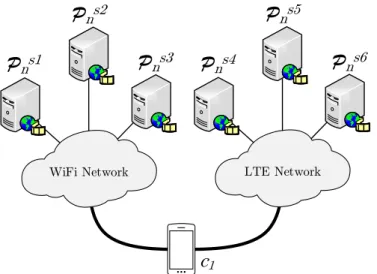
1.2 Devices retrieving Data packets over LTE and Wi-Fi: multi-source single client. . . 7
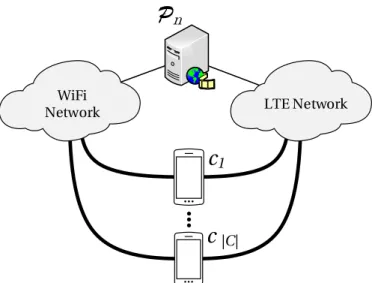
1.3 Devices retrieving Data packets over LTE and Wi-Fi: single-source multi-client. . . 8
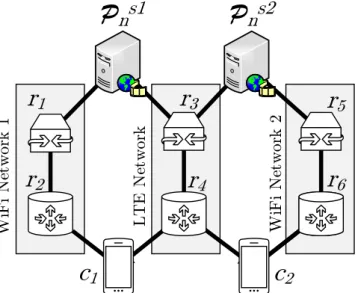
1.4 Devices retrieving Data packets over LTE and Wi-Fi: source multi-client (butterfly network). . . 9
2.1 Forwarding Information Base (FIB). . . 25
2.2 Content Store (CS). . . 26
2.3 Pending Interest Table (PIT). . . 27
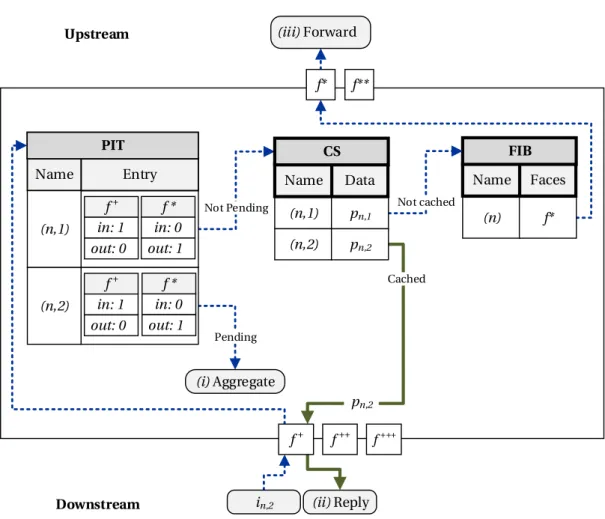
2.4 Interest processing in NDN. . . 28
2.5 A metaphorical example of fountain codes. . . 31
2.6 Tanner graph produced by LT encoding. . . 32
2.7 Encoding of non-systematic Raptor codes. . . 33
2.8 Information coding at each node. . . 35
2.10 Representation of the Media Presentation Description (MPD) file. . . . 39
3.3 Normalized delivery delay vs. the bandwidth of the bottleneck link in the butterfly network. . . 61
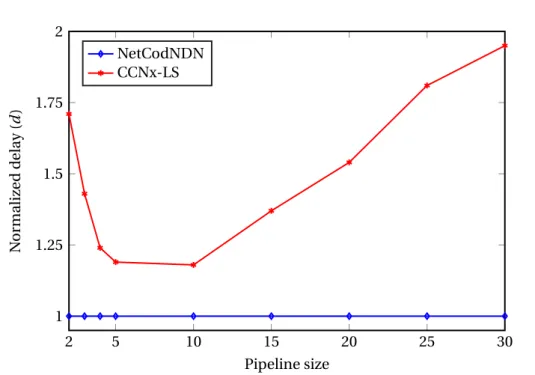
3.4 Normalized delivery delay vs. the pipeline size in the butterfly network. 62 3.5 Normalized delivery delay vs. the packet loss rate in the butterfly network. 63 3.6 Normalized delivery delay vs. source Data replication probability in the butterfly network. . . 64
3.7 PlanetLab topology used. . . 65
3.8 Normalized delivery delay vs. the number of clients in the network in the PlanetLab topology. . . 65
3.9 Normalized delivery delay vs. the packet transmission error rate in the
PlanetLab topology. . . 66
4.2 Redesigned NetCodNDN Content Store (CS). . . 76
4.3 Redesigned NetCodNDN Pending Interest Table (PIT). . . 77
4.4 Layered topology used in the evaluation. . . 82
4.5 Clients’ bandwidth distribution. Each client has two faces, the average bandwidth isµ=2×4Mbps and the standard deviation isσ=p2×1.5. 83 4.6 Representation of the segments received by the clients with respect to different core links bandwidth, for DAS-NetCodNDN. . . 85
4.7 Representation of the segments received by the clients with respect to different core links bandwidth, for DAS-NDN. . . 86
4.8 Cache-hit rate at the ISP layer. . . 87
4.9 Cache-hit rate at the IXP layer. . . 88
4.10 Total data delivered by the source. . . 88
4.11 Representations requested by the clients with DAS-NetCodNDN. . . . 89
4.12 Representations requested by the clients with DAS-NDN. . . 90
4.13 Average goodput measured by the clients. . . 90
5.1 Overview of the caching policy. . . 96
5.2 Popularity prediction for the name prefix (n,g). . . 97
5.3 Access to the CS and the Status Information during the Interest process-ing in a CSM configured with the PopNetCod cachprocess-ing policy. . . 104
5.4 Access to the CS and the Status Information during the Data packet processing in a CSM configured with the PopNetCod caching policy. . 105
5.5 Layered topology used in the evaluation of PopNetCod. . . 108
5.6 Average cache-hit rate in the routers. . . 110
5.7 Average goodput perceived by the clients. . . 111
5.8 Percentage of video segments delivered in each of the available repre-sentations, with the PopNetCod caching policy. . . 112
5.9 Percentage of video segments delivered in each of the available repre-sentations, with the LCE+LRU caching policy. . . 112
5.10 Percentage of video segments delivered in each of the available repre-sentations, with the LCE+NoLimit caching policy. . . 113
5.11 Load reduction in the source, measured as the percentage of Data pack-ets delivered to the clients not sent by the source. . . 113
1
Introduction
1.1 Background
Nowadays, Internet users care more about the attributes of the content that they want to obtain (e.g., name of the content, quality of the content,etc.) rather than where this content is located in the network. However, in the current Internet architecture, each packet is routed based on the network location of the destination host, without considering the attributes of the content that it carries. To address the mismatch between the users’ behavior and the Internet architecture, Named Data Network-ing [38,104] has been proposed. NDN is a new communication paradigm in which the importance is shifted fromwherethe content is located, towhatthe content is. In the NDN architecture, the content is described by itsname, which includes the content attributes (e.g., for video content, it could include the video filename, quality, segment id,etc.). The users demand content with the help ofInterestmessages that contain the name of the requested content. The Interests are transmitted over the network until they reach a node holding a copy of the content object whose name matches that of the Interest. This node creates aData packetthat contains a copy of the requested
In te r e s t C o n te n t Network
Figure 1.1: NDN content retrieval process.
content object and sends it back to the client. The Data packet follows the reverse path of that followed by the Interest. As the Data packet is transmitted backwards to the client, intermediate routers can cache copies of it, so they can reply to future Interests for the same content. An example of content retrieval in NDN is presented in Fig. 1.1
One of the main issues that future Internet architectures like NDN will need to face is the high amount of data traffic, mostly due to the high number of devices connected to the Internet and to the popularization of data intensive applications (e.g., video streaming). Nowadays, data intensive applications are the major sources of content traffic on the Internet, and their predominance is expected to further increase in the near future [21]. To satisfy the expectations of the end-users (e.g., receiving high quality video), these applications require a high and stable amount of throughput between the sources and the clients. However, the following issues may potentially degrade the throughput seen by the applications.
• Limited bandwidth on links connecting the network nodes may reduce the throughput seen by the clients to the point where it does not meet the require-ments of data intensive applications. The use of multiple interfaces to retrieve content permits the network nodes to aggregate the bandwidth of their multiple
1.1. Background
interfaces, increasing the throughput seen by the applications compared to a using a single interface [81]. In particular, clients with limited access bandwidth could use their multiple interfaces (e.g., LTE, Wi-Fi, Bluetooth,etc.) to distribute the Interests needed to retrieve the desired content. In scenarios in which mul-tiple clients in the network are interested in the same content objects (e.g., a popular movie), and/or when the Data packets that compose a content object are distributed across multiple sources for load sharing (e.g., in a multi-cloud storage system [84]), optimal multipath content retrieval is only attained if the Data packets are delivered over the optimal set of multicast trees [101]. The opti-mal set of multicast trees can only be computed by a central entity that is aware of the network topology and the content demands. However, this requires a high number of signaling messages to inform the central entity about topology and content demand changes in a timely manner. Hence, computing the optimal set of multicast trees is both computationally hard and difficult to implement in large dynamic networks.
• Bottlenecks in the networklimit the flow of Data packets that is transmitted from the sources to the clients. In-network caching [24] and Interest aggregation [23] are two NDN characteristics that help to alleviate this issue, by reducing the number of Data packets transmissions in the network. However, in NDN, both in-network caching and Interest aggregation only work for exact name matching, which limits the scope of this solution.
• Packet lossesin the network delay the content retrieval process since they require that clients detect which Data packet has not arrived in order to retransmit the corresponding Interest. In NDN, Interests have an expiration time, after which the client considers that the Interest will not be satisfied and can retransmit it. However, adapting the expiration time of each Interest to the current network conditions is a complicated task, since it should be short enough to detect packet losses in a timely manner, and long enough to allow a Data packet facing acceptable congestion to arrive without triggering a retransmission. Moreover, the expiration time of the Interests also depends on the requirements of the application that is requesting the content object. For example, a video streaming application requires low latency and, thus, it sets short Interest expire times, while a file download application for software updates may not need low latency, but prefers to avoid network congestion, thus, it sets long Interest expiration times.
1.2 Research Proposal
It is clear from Section 1.1 that content retrieval in NDN is problematic for data inten-sive applications, especially when multiple clients and/or multiple sources exist in the network. In this thesis we argue that introducing network coding [7] into the NDN architecture improves the performance of NDN-based data intensive applications, by alleviating the throughput loss for the applications due to limited bandwidth and inefficient content retrieval over multiple interfaces, network bottlenecks and packet losses.
Network coding has been proposed in previous works as a possible solution to the problems presented in Section 1.1, for host-centric Internet architectures [34,101] and for content-centric Internet architectures [59, 100]. The main idea of network coding is to allow intermediate routers not only to forward Data packets, but also combine them before forwarding. This can potentially increase the throughput seen by the applications by allowing different Data packets of the same content object to use the full capacity of shared links [7] and facilitating multi-client and multi-source content retrieval via random network coding [34].
Unlike the original NDN architecture, in which clients sequentially request the Data packets that compose a content object, in a network coding enabled NDN architecture, the clients request a set of network coded Data packets that are generated by com-bining the Data packets that compose the requested content object. When network coding is enabled in NDN, the network coded Data packets contain information from all the Data packets that have been combined to generate them. Thus, all network coded Data packets with a specific name prefix are “equivalent” in terms of contained information. This reduces the granularity of the information and subsequently of the content requests,i.e., in a network coding enabled NDN the Interests do not request specific Data packets but rather any network coded Data packet that belongs to the requested content object. Moreover, in a network coding enabled NDN architecture, the intermediate routers can apply network coding operations to the received Data packets before forwarding them, increasing the Data packet diversity in the network and allowing information belonging to the same content object that is stored in differ-ent sources to be combined into a single Data packet in the network. The clidiffer-ents can retrieve the original content object as soon as they receive a decodable set of network coded Data packets,i.e., a set of Data packets that has as many linearly independent network coded Data packets as the number of Data packets composing the content
1.3. Motivation
object.
As a result of enabling network coding in NDN, the nodes do not need to forward each Interest over the particular face that makes it travel over the optimal set of multicast trees, eliminating the need for coordination among clients. Instead, since the granularity of Data packets is reduced, the node could forward Interests over any face that is configured in to forward Interests with the requested name prefix, and still the data delivery will be optimal. This enables efficient multipath content retrieval, which enhances the bandwidth utilization. Moreover, since information from multiple sources can be combined by applying network coding at the intermediate nodes, the degradation of the throughput seen by the applications caused by network bottlenecks is alleviated. Additionally, the use of network coding simplifies the design of the clients, since the client does not need to keep track of the reception of each particular Data packet, but only the number of received innovative network coded Data packets. This means that clients can send an adequate number of Interests, taking into account the measured packet loss rate of the network, to receive the number of network coded Data packets they need to decode the requested content object, without any delay in case of packet losses.
1.3 Motivation
In the following subsections, we provide more details of the benefits that network coding brings to NDN, and illustrate them through motivating examples.
1.3.1 Efficient Multipath Content Retrieval
Nowadays, most client devices,e.g., mobile phones, laptops,etc., have two or more network interfaces over which they can receive the demanded content (e.g., LTE, Wi-Fi, Bluetooth,etc.). However, in traditional host-centric networking, support for multi-path is not extended. Recent efforts to support multimulti-path communications on TCP (MP-TCP) [28] have been developed by the IETF. The drawback of these proposals is that they require end-to-end connections to be established for each host, which complicates load-balancing in the network and the dynamic selection of the sources. In comparison, NDN provides natural support for multipath content retrieval, without requiring end-to-end connections. This is achieved by allowing clients to distribute all the Interests needed to retrieve a video segment over all their available interfaces,
without knowing a priori which source or in-network cache can provide the partic-ular Data packet that each Interest requests. However, despite having the necessary components for enabling multipath content retrieval, the original NDN architecture still lacks appropriate mechanisms for the optimal use of the multiple paths available for content retrieval in scenarios where multiple sources store different parts of the content (e.g., in-network caches, content distributed in multiple clouds [84], etc.) and/or multiple clients are interested in the same content (e.g., streaming popular videos, updating popular software,etc.).
Optimizing multipath content retrieval in multi-source and multi-client scenarios implies coordinating the forwarding of Interests, so that all the Interests for a specific Data packet are(i)forwarded towards the source storing the requested Data packet, and(ii)forwarded on the optimal paths, such that more Interests are aggregated and the Data packets are cached in optimal points of the network. This can be achieved if the Data packets are delivered over the optimal set of multicast trees [101]. The latter implies that each node in the network needs to know where to forward each Interest, such that the Interests and the Data packets follow the computed multicast trees, which does not scale in large and dynamic networks. Moreover, the optimal set of multicast trees can only be computed by a central entity that is aware of the network topology, which is both computationally hard and difficult to implement in large dynamic networks.
An alternative solution to the use of an optimal set of multicast trees is to use network coding [7]. When network coding is enabled, the nodes perform coding operations on the received Data packets (i.e., combine the Data packets), instead of just forwarding them, as in traditional networks. The network coded Data packets contain information from all the Data packets that have been combined to generate them. This reduces the granularity of the information and subsequently of the content requests. As a result, clients do not need to request specific Data packets, but rather network coded Data packets. Therefore, the nodes do not need to coordinate the faces where they forward Interests, which enables efficient multipath communication without explicit coordination mechanisms and enhances network bandwidth utilization.
In the following three examples, we illustrate the benefits that the introduction of network coding into NDN brings to multipath content retrieval.
1.3. Motivation WiFi Network
P
ns1P
ns2P
ns3 LTE NetworkP
ns4P
ns5P
ns6c
1Figure 1.2: Devices retrieving Data packets over LTE and Wi-Fi: multi-source single client.
a client is interested in a content object composed of a set of Data packets. Let us also consider that the Data packets that compose the content object are distributed across multiple sources, such that each source stores a subset of Data packets. In this case, the client and the routers need to select properly the face over which they forward each Interest, so that it reaches the source that stores the requested Data packet. This can be accomplished by carefully configuring the NDN forwarding tables, which store information about the faces that a node could use to forward Interests with a particular name prefix, of all the nodes, such that each Interest reaches the right source. However, for content objects comprised of a large number of Data packets,i.e., content objects for data intensive applications, keeping the forwarding tables of all the nodes updated for each Data packet does not scale well. Specifically, in large networks and in the presence of unreliable sources that can become available or unavailable at any moment, keeping the forwarding tables updated may require a lot of signaling messages, and thus waste network resources. Differently to the original NDN, in a network coding enabled NDN architecture, the clients and the routers do not need to know which sources store each Data packet and over which interface they can locate it, since the Interests are for network coded Data packets that are stored at any source rather than for specific Data packets that are stored at specific sources. This implies that the forwarding tables can be smaller than those of original NDN. Specifically, only one entry for the name prefix of the content object is needed in network coding enabled NDN, while
WiFi
Network LTE Network
...
c
1c
|C|P
nFigure 1.3: Devices retrieving Data packets over LTE and Wi-Fi: single-source multi-client.
in original NDN a distinct entry is required for the name prefix of every Data packet composing the content object, since they can be located in different sources.
• Single-source multi-client— Let us now examine the case where a single source stores the complete set of Data packets that compose a content object, and that multiple clients are interested in the content object, as illustrated in Fig. 1.3. To minimize the time needed for each client to receive the complete set of Data packets that compose the content object, while also minimizing the number of duplicated Data packet transmissions in the network, the Data packets need to travel over an optimal set of multicast trees [101], which, as discussed above, is does not scale well with the network size and dynamics. In the illustrative example shown in Fig. 1.3, clients are connected to the source through both LTE and Wi-Fi interfaces. If all the clients send the Interest for a particular Data packet over the LTE interface, then the requested Data packet will only be sent through the LTE network. However, if a fraction of the clients decides to send the same Interest over the Wi-Fi interface, the requested Data packet will also be sent from the source to the Wi-Fi network, wasting network resources. When multiple clients send Interests for the same content object in a network coding enabled NDN, they do not need to coordinate the Interests (i.e., select the sequence numbers) that they send over each face. This is due to the fact that the Interests are for network coded Data packets. Thus, they can be aggregated
1.3. Motivation
c1
r2
r1
r4
r3
r6
r5
c
2 W iF i Ne tw or k 1 W iF i Ne tw or k 2 LT E N et w or kP
n
s1
P
n
s2
Figure 1.4: Devices retrieving Data packets over LTE and Wi-Fi: source multi-client (butterfly network).
at any node, which leads to more efficient network utilization.
• Multi-source multi-client — Another problematic scenario is when multiple clients are interested in a content object composed of a set of Data packets that are distributed across multiple sources. In this scenario, multipath data retrieval in the original NDN suffers from the shortcomings of both the multi-source single-client and the single-source multi-client scenarios that we previously discussed. To illustrate this, let us consider the network in Fig. 1.4. In this network, two clients need to coordinate where to send each Interest, such that the LTE access routerr4is able to aggregate the Interests for the same Data
packet. Moreover, when each of the sources has a disjoint set of Data packets, the clients also need to know which Data packets each source stores, to avoid sending Interests to the source that does not store a copy of the requested Data packet. With network coding enabled, no coordination is needed at the clients nor at the routers. This is because the Interests can be satisfied by any network coded Data packet.
1.3.2 Throughput Gains in Case of Network Bottlenecks
In addition to the throughput gains due to the use of optimal multipath content retrieval, enabling network coding in NDN can alleviate throughput degradation when
bottlenecks are present in the network. In order to illustrate how the throughput is degraded by network bottlenecks, let us consider the widely known butterfly network topology shown in Fig. 1.4. In this topology, both clientsc1andc2are interested in
a content object composed of two Data packets which are distributed across both sources, with sources1storing a copy of the Data packetp1and sources2storing a
copy of the Data packetp2. It is clear that the clientsc1andc2can retrieve the Data
packetsp2andp1, respectively, only over the LTE interface. In this case, if network
coding is not enabled, the LTE access noder4cannot aggregate the Interests sent by
the clientsc1andc2, since they are for different Data packets. This means that the
link between the nodesr3andr4becomes a bottleneck for the Data packetsp2andp1
traveling to the clientsc1andc2, respectively. Thus, one of the clients will see a higher
delay in receiving the complete set of packets, which is critical for time-constrained applications such as video streaming. In contrast, in a network coding enabled NDN architecture, the noder4is able to aggregate the Interests sent by the clientsc1and
c2, as these Interests are for any network coded Data packet. If the noder3applies
network coding to the Data packets received from the sources, the resulting network coded Data packet will contain information from both sources and thus will be useful for both clientsc1andc2. In content intensive applications, where the content objects
are formed by a large number of Data packets, the delay reduction that network coding brings to the clients accumulates over all the Data packets, bringing noticeable gains to the client’s throughput.
1.3.3 Resilience to Packet Losses
Furthermore, we illustrate how the integration of network coding in the NDN architec-ture improves the resilience to Interest and Data packet losses. This property has been widely studied in state-of-the-art host centric content delivery scenarios [82, 88]. Sim-ilarly to traditional content delivery architectures, in NDN, network coding can deal efficiently with packet losses by eliminating the need for explicit packet retransmis-sions. To illustrate this, let us consider an NDN network with Interest and Data packet losses. Let us also consider that a client is interested in a content object composed of a set of Data packets, and that one of the Interests sent by the client or one of the Data packets sent to the client is lost in the network. Hence, one of the Data packets that the client is expecting will not arrive. If network coding is not enabled, the client should wait until one of the Interests that it has sent expires before realizing which Data packet will not arrive. Then, the node should retransmit the same Interest and
1.4. Thesis Objective
wait again for the Data packet. In contrast, if network coding is enabled, a proactive client that knows the average packet loss rate can send a few additional Interests, where the number of additional Interests sent depends on the packet loss rate and the finite field where the coding operations are performed. This is possible because, in the event of an Interest or Data packet loss, any other network coded Data packet will be useful to the client, even if it is not an exact copy of the missing Data packet. This reduces the time that the client needs to retrieve the complete set of Data packets, since it does not need to wait for Interest expiration to send new Interest that will compensate for the lost packets.
1.4 Thesis Objective
Motivated by the predominance of data intensive applications on the Internet, and by the promising results presented in previous attempts to integrate network coding into the NDN architecture [59, 100], the main objective of this thesis is the following:
to investigate how data intensive applications on NDN could benefit from the use of network coding.
To reach the main objective of this thesis, we have the following specific objectives. First, we need an architecture that enables network coding in NDN and that supports data intensive applications. However, the literature lacks a well defined practical architecture that integrates network coding into NDN. Previous schemes integrating network coding into NDN [59, 100] were not complete, only providing brief descrip-tions of simple architectures that consider specific scenarios. Thus, this thesis has the following specific objective:
to design, implement and evaluate a complete architecture that integrates network coding into NDN and that supports data intensive applications.
Second, we need to choose a data intensive application that will be the subject of our study to evaluate the benefits of network coding in NDN. Since video streaming is the most important data intensive application nowadays [21], the second specific objective of this thesis is the following:
to evaluate the benefits that network coding bring to video streaming ap-plications over NDN, for end-users and video content providers.
Third, since the default behavior of intermediate routers in NDN is to cache all the Data packets that they receive, the caches in the intermediate nodes should be extremely large in order to store the high amount of Data packets that data intensive applications require. This is unfeasible in real-world scenarios, and for that reason the third specific objective of this thesis is the following:
to design and evaluate a caching policy that takes into account the par-ticularities of network coding enabled NDN architectures, and maintains the benefits that network coding brings to data intensive applications over NDN.
1.5 Thesis Contributions
As mentioned in the previous Section, one of the objectives of this thesis is to design a complete architecture that integrates network coding into NDN. Thus, the first contribution of this thesis is theNetCodNDN architecture, which enables network coding for data intensive applications in NDN. The design, implementation and evaluation of the NetCodNDN architecture is provided in Chapter 3.
Based on the proposed NetCodNDN architecture, the next contribution of this thesis is the study of the benefits that network coding brings to data intensive applications in NDN. Since video streaming is the most popular data intensive application [21], this thesis studies video streaming over network coding enabled NDN, in particular, dynamic adaptive video streaming. Hence, this thesis provides a Dynamic Adap-tive Streaming architecture for NetCodNDN, calledDAS-NetCodNDN. The details of the DAS-NetCodNDN architecture and the study of the benefits that network cod-ing brcod-ings to video streamcod-ing applications over NDN, for both end-users and video content providers, are presented in Chapter 4.
The two previous contributions of this thesis, namely NetCodNDN and DAS-NetCodNDN, consider a scenario in which nodes have sufficient storage space to cache all the Data packets that they receive, which is infeasible in real-life. For this reason, the final contribution of this thesis is a caching policy calledPopNetCodthat
1.5. Thesis Contributions
complements the design of the NetCodNDN and DAS-NetCodNDN architectures. The PopNetCod caching policy uses content popularity information to decide which network coded Data packets routers store in their caches, in order to maintain the benefits that network coding brings to data intensive applications, even when the routers have limited caching capacity.
In the following subsections, these contributions are further explained.
1.5.1 NetCodNDN: A Network Coding Enabled NDN Architecture
Motivated by the improvements that network coding brings to content retrieval over NDN, presented in Section 1.3, and in order to study the benefits that network coding brings to NDN data intensive applications, the first contribution of this thesis is
NetCodNDN, an architecture that enables network coding in NDN. The NetCodNDN architecture is based on the NDN architecture [38, 104], with a redesigned PIT table, and new procedures for Interest and Data packet processing.
Our proposed architecture solves the shortcomings of previous proposals to enable network coding in NDN [59, 100]. Specifically, previous works propose that each Interest carries information about the Data packets retrieved by the client that sent the Interest. Then, nodes holding Data packets that match the name prefix of the Interest reply only if they can provide a network coded Data packet that is innovative to the client, based on the information added to the Interest. However, in the presence of multiple clients,(i)the aggregation of Interests is problematic, since Interests for the same Data packet but from different clients contain different information about the Data packets retrieved by each client, and it is not clear how this information could be aggregated for different clients; and(ii), when a client sends multiple Interests in parallel to receive multiple different Data packets, it includes the same information about the Data packets it already has retrieved. This is undesirable, as a node that has a matching Data packet will reply to these Interests with the same Data packet, which will be duplicated for the client.
The NetCodNDN architecture(i)eliminates the need to include in the Interests the information about the Data packets available at the client, thus, simplifying Interest aggregation;(ii)allows the network nodes to keep information about the Data packets they have sent on each face, reducing the number of duplicate Data packets; and(iii)
same content object, by modifying the way in which the nodes process the Interest messages.
The NetCodNDN architecture has been implemented using open-source and well-known libraries, and follows the NDN project guidelines to simplify its re-usability and expansion. In particular, it uses the NDN Forwarding Daemon (NFD) codebase [61] as a base for the NetCodNDN architecture. To enable network coding, it uses Kodo [69], an industry standard C++ library that implements network coding functionality in an optimized way.
The experimental evaluation shows that NetCodNDN leads to significant improve-ments in terms of content retrieval delay compared to the original NDN. Our results demonstrate that NetCodNDN improves multipath content retrieval which offers large gains in terms of the time needed to retrieve content objects. This translates into increased throughput seen by the clients. Moreover, it permits to exploit more efficiently the available network resources in multi-source and multi-client scenarios, even when bottlenecks are present in the network. Finally, it also shows increased robustness to packet losses.
The research work related to this contribution has resulted in the following publica-tion:
Jonnahtan Saltarin, Eirina Bourtsoulatze, Nikolaos Thomos, and Torsten Braun. “NetCodCCN: A Network Coding Approach for Content-Centric Networks”. In:Proc. of IEEE INFOCOM’16. San Francisco, USA, Apr. 2016. doi:10.1109/INFOCOM.2016.7524382
1.5.2 Adaptive Video Streaming over Network Coding Enabled NDN
The next contribution of this thesis is an architecture that enables adaptive video streaming over NetCodNDN. As of 2015, video accounted for 70% of consumer Internet traffic, and it is expected to reach 82% by 2020 [21]. This increase in the volume of video traffic is fueled by the emergence of applications such as social video, virtual reality (VR), augmented reality (AR), etc., that have become popular and involve the delivery of large amounts of video content. For this reason, this thesis focuses on the study of the benefits that network coding brings to video streaming over NDN, for both end-users and video content providers.
1.5. Thesis Contributions
One of the most popular and efficient approaches available for video streaming is Dynamic Adaptive Streaming over HTTP (DASH) [37, 85]. The advantage of DASH compared to previous video streaming methods is that the clients are in control of the streaming logic. Thus, the clients are able to decide the appropriate bitrate and resolution of the requested video, among the multiple options offered by the video content providers. This requires that the sources encode the video in different representations,i.e., different bitrates and resolutions. Each representation is further divided into a series of video segments with a duration of a few seconds. This allows clients to adapt in real-time the demanded video resolution and bitrate in response to changes in the network conditions.
The client driven video adaptation property has ranked DASH as an attractive option for video streaming in future Internet architectures [99], in particular for NDN. The content retrieval mechanism of NDN resembles the video retrieval mechanism of DASH [46]. In particular, NDN and DASH are both client driven. Hence, clients request content by sending requests with the names assigned to each piece of content,i.e., a content object in NDN or a video segment in DASH. It is, therefore, natural to consider DASH for implementing adaptive streaming in the NetCodNDN architecture.
Thus, to study the benefits that network coding bring to video streaming over NDN, this thesis proposes a Dynamic Adaptive Streaming over NetCodNDN (DAS-NetCodNDN) architecture. In comparison to previous works proposing dynamic adaptive streaming over NDN [25, 45, 46, 73, 98], DAS-NetCodNDN exploits network coding to efficiently use the multiple paths connecting the clients to the sources. Moreover, DAS-NetCodNDN enables efficient multi-source video streaming and improves resiliency to Data packet losses. The performance gains are verified through simulations in a Netflix-like scenario. The evaluation shows that video streaming applications over NDN benefit from the use of network coding in the form of reduced load on the video sources, increased cache-hit rate at the in-network caches and improved video quality at the clients.
The research work related to this contribution has resulted in the following publica-tion:
Jonnahtan Saltarin, Eirina Bourtsoulatze, Nikolaos Thomos, and Torsten Braun. “Adaptive Video Streaming with Network Coding Enabled Named Data Networking”. In: IEEE Transactions of Multimedia, vol. 19, no. 10,
Aug. 2017. doi:10.1109/TMM.2017.2737950
1.5.3 Caching Policy for Network Coding Enabled NDN
The study of the benefits that network coding brings to data intensive applications presented in Sections 1.5.1 and 1.5.2 assumes that the intermediate routers have enough caching capacity to store all the Data packets that are transmitted through them. This allows to focus on studying the benefits that network coding brings to NDN data intensive applications, without the need to take into consideration the impact that the different caching policies may have on the proposed architectures. However, assuming unlimited caching capacity for the intermediate routers is not realistic.
To study the benefits that network coding brings to data intensive applications in the presence of intermediate routers with limited caching capacity, we enhance the design of the NetCodNDN architecture and propose PopNetCod, a popularity based caching policy for NetCodNDN. In PopNetCod the intermediate routers distributedly estimate the popularity of the content objects based on the received Interests. Then, based on this information, each node decides which Data packets it inserts into or evicts from its cache. The decision to cache a particular Data packet is taken before the Data packet arrives at the node, while processing the corresponding Interest. Since the first nodes to process Interests in their path to the source are the edge nodes, this helps to cache the most popular Data packets closer to the network edges, which reduces the content delivery delay [24, 26, 87]. To avoid that two independent nodes cache the same Data packet, when a node decides to cache the Data packet that is expected as a reply to a received Interest, it informs the nodes upstream in the path by setting a binary flag in the Interest. This increases the diversity of network coded Data packets in the caches. When the cache of a node is full and a Data packet should be cached, the node decides the name prefix and number of Data packets that should be evicted from its cache based on the popularity information. Since network coded Data packets with a specific name prefix are equivalent in terms of contained information, the node does not need to decide which particular Data packets to evict, and can choose random Data packets with the selected name prefix.
The research work related to this contribution has resulted in the following manuscript, currently submitted for publication:
1.6. Thesis Outline
Jonnahtan Saltarin, Torsten Braun, Eirina Bourtsoulatze, and Nikolaos Thomos. “PopNetCod: A Popularity-based Caching Policy for Network Coding enabled Named Data Networks”.Submitted for publication.
1.6 Thesis Outline
The rest of this thesis is organized as follows.
Chapter 2 provides a background and overview of the existing works in the area of content retrieval, Named Data Networking, information coding, dynamic adaptive video streaming, and caching algorithms, which are the base of this thesis.
Chapter 3 presents NetCodNDN, an architecture for enabling network coded content retrieval over Named Data Networking.
Chapter 4 presents a Dynamic Adaptive Streaming over NetCodNDN (DAS-NetCodNDN) architecture. Moreover, Chapter 4 presents the results of the study of the benefits that network coding brings to video streaming over NetCodNDN. Chapter 5 presents PopNetCod, a popularity based caching policy that complements the design of the NetCodNDN architecture.
Chapter 6 concludes this thesis and presents future directions for network coding enabled NDN architectures.
2
State of the Art
2.1 Overview
Retrieving content (e.g., files, video streams, personal messages,etc.) over the Inter-net is intensely growing and expected to continue growing in the near future [21]. Moreover, the way in which users retrieve content over the Internet is changing, from connecting to a particular network node to obtain the content that it publishes, to requesting particular content objects, without caring where the content is being served from. This growth in content transmission and the change in user behavior have prompted the development of new paradigms for future Internet architectures. Information-Centric Networking (ICN) is a novel Internet paradigm that gives more importance to the characteristics of the content than to its location in the network. Named Data Networking (NDN) is one of the multiple ICN architectures that have been proposed, and which has became very popular due to its large research com-munity and its open-source implementations. However, the NDN architecture does not achieve optimal content retrieval in multi-client and multi-source scenarios in which bandwidth is limited, bottlenecks exist in the network, and packet losses occur.
One approach to alleviate these issues is to enable information coding in the network. Fountain coding is a popular class of information coding in which the source is able to generate a large number of coded Data packets, and the client only needs to retrieve a subset of those coded packets to decode the original content. However, it has been demonstrated that by allowing the intermediate nodes to apply coding operations, the performance of content retrieval increases. For this reason, network coding has been proposed as an alternative information coding approach. The benefits of network coding have been demonstrated in traditional Internet architectures, and also a few studies demonstrate that they could be beneficial to the NDN architecture.
In this Chapter, we provide a detailed description of the concepts that we will use during this thesis, and an analysis of the most relevant related works. We start by describing the process of content retrieval over the Internet. Then, we introduce ICN and its most popular realizations. Among those, in this thesis we use the NDN archi-tecture, and thus we provide a detailed description of it, including its data structures and packet processing procedures. Next, we discuss the most relevant information coding methods that are used to solve the issues of the NDN architecture presented in Chapter 1. Then, we focus on network coding, the information coding method that we choose to use in this thesis, and discuss some previous attempts to integrate network coding into the NDN architecture. Then, since nowadays video streaming is one of the most popular Internet applications, we present some concepts of video streaming, in particular dynamic adaptive video streaming and its integration into the NDN architecture. Finally, since one of the most important features of the NDN architecture is in-network caching, we discuss some of the most important caching algorithms for NDN.
2.2 Content Retrieval over the Internet
Content retrieval over the Internet consists in transmitting a copy of a certain content object from a content provider to a set of end-users that have expressed interest in the content object. The end-users can use different methods to express interest in one or more content objects. For example, in the current Internet, the end-users can send
HTTP GET[27] requests to the network address of the server containing the content,
or they can subscribe to aPUSH[92] service, among other methods.
2.3. Information-Centric Networking
content providers and that serve content objects, a set of clientsC that are associated
with end-users and that request content objects, and a set of routersRthrough which
the content requests and content objects are transmitted. In this thesis, we consider that sources are network nodes that reply to content requests with the content data. Content retrieval in the current Internet, based on the IP protocol [18], requires clients to know not onlywhat content they desire, but alsowherethe desired content is located in the network, i.e., the IP address of the source that holds a copy of the requested content. This requires a system that permits clients to resolve a name into an IP address,e.g., the Domain Name System (DNS) [57, 58]. In turn, the sources also need to know the IP address of the client to which they should send each requested content object. The routers in the network forward the content requests and content objects based on the IP address of the destination node.
However, content retrieval in the current Internet is not aligned with the behavior of the Internet users nowadays: users care more about the characteristics of the content they want to obtain rather than where this content is located in the network. To address the mismatch between the Internet users’ behavior and the Internet archi-tecture, new communication paradigms have been proposed in an attempt to define a future Internet architecture. In particular, Information-Centric Networking (ICN) is a new communication paradigm in which the importance is shifted fromwhere
the content is located, towhatthe content is. In ICN, each piece of content has a
nameassociated to it, which is used to route the content through the network. In this way, content becomes independent from location, application, storage, and means of transportation. The benefits of such content-centric approach are improved content retrieval efficiency, better scalability with respect to information/bandwidth demand and higher robustness in challenging communication scenarios [71]. In the following Section, we provide details of multiple ICN proposals available in the literature.
2.3 Information-Centric Networking
Multiple ICN based Internet architectures have been proposed in the literature, such as the Data-Oriented Network Architecture (DONA) [42], the Publish-Subscribe In-ternet Routing Paradigm (PSIRP) [29, 94], the Network of Information (NetInf ) [6] architecture, and the original Content-Centric Networking (CCN) [38] and its suc-cessor Named Data Networking (NDN) [104]. Next, we give a brief description of
the aforementioned ICN architectures. For a more comprehensive description of the available ICN proposals, the interested reader is referred to [5] and [102] for complete surveys.
2.3.1 Data-Oriented Network Architecture
In the Data-Oriented Network Architecture (DONA) [42], content objects are published byprincipals, and named by a combination of the principal ID and the object ID given by the principal. The principals register the content name in their local Resource Handler, which are content routers. Then, the registration message is propagated in the network, such that other resource handlers know where to find that particular content object. Clients interested in a certain content object send aFindmessage to its associated resource handler, which forwards the request towards the appropriate resource handler. The content object is delivered to the client following the same route as the Find message, or an alternative route. Resource handlers can cache content objects as they are forwarded to the clients.
2.3.2 Publish-Subscribe Internet Routing Paradigm
In the Publish-Subscribe Internet Routing Paradigm (PSIRP) [29, 94] architecture,
publishersare sources that provide content objects to the PSI network. Thesubscribers
are clients that explicitly express their interest in a particular content object by issuing subscription messages. Each content object is associated with a scope, which could be a physical scope,e.g., only available at the campus of the “University of Bern”, or a logical scope,e.g., only available for users of the social network “Facebook”. Thus, the scope is used to limit the reachability of the content object to clients that have access to that particular scope. Moreover, each content object has a unique name that allows subscriber interests to be matched with the content object. The matching between subscriber interests and content objects occur in a node called Rendezvous Point (RP). The RPs are able to store subscriptions for a certain time, until the content object becomes available. This functionality allows the publication and subscription operations to be decoupled in time and space, since clients can send subscription messages for content objects that still do not exist in the network.
2.3. Information-Centric Networking
2.3.3 Network of Information
The Network of Information (NetInf ) [6] architecture enables two types of content retrieval. In the first approach, content object requests are routed towards their source locations based on the names of the requested content objects. The content objects are forwarded from their source locations to the requesting clients also based on their name. In the second approach, a name resolution step is introduced, which provides the location of the content object sources based on the content object names. This enables a graceful transition between the current location-based Internet architecture and a purely name-based Internet architecture. Three types of messages exist in the NetInf architecture:(i)PUBLISH, which is used by sources to announce their available content objects, such that the requests can be routed towards them and the name resolution mechanism is able to resolve names into its correct location(s);(ii)GET, which is used by clients to request content objects; and(iii)SEARCH, which allows clients to query the network by sending a set of keywords, and receiving specific names and possibly also locations of content objects that match the query.
2.3.4 Content-Centric Networking
Content-Centric Networking (CCN) [38] is an architecture in which the content is described by anameand the clients demand content with the help ofInterestmessages that contain the name of the requested content. The Interests are transmitted over the network until they reach a node holding a copy of the content whose name matches that of the Interest. This node creates a Data packet that contains a copy of the requested content and sends it back to the client. The Data packet follows the reverse path of that followed by the Interest. As the Data packet is transmitted backwards to the client, intermediate routers can store copies of it, so they can reply to future Interests sent by other clients for the same content.
Based on the CCN architecture, the Named Data Networking (NDN) [104] architecture has been proposed as part of a large research project [105] conducted by multiple research institutions, including the authors of the CCN architecture. After a few years of common design decisions, the NDN architecture has parted away of the CCN architecture, and evolved in a different direction. For example, NDN routers perform longest prefix match to identify matching Data packets in the cache, while CCN routers perform exact matching in order to simplify the forwarding procedures.
A comprehensive list of differences between NDN and CCN could be found at [36]. Nevertheless, both architectures share the same basic principles,e.g., communication is based on the content name, content is requested with Interests and delivered in Data packets.
Among the proposals described in Section 2.3, CCN and NDN are the most popular in the literature, due to their active research community and their open-source im-plementations. In this thesis, we use a software implementation based on the CCN architecture for the evaluation presented in Chapter 3, and a software implementation based on the NDN architecture for the evaluations presented in Chapters 4 and 5. However, the most prominent features that we use from CCN and NDN are similar in both architectures. In this thesis, we will focus on the NDN architecture, but the work presented here could be easily implemented in the CCN architecture. In the following Section, we provide a detailed description of the NDN architecture.
2.4 Named Data Networking
As presented in Section 2.2, a content retrieval scenario consists of a set of source nodes S that generate and store content objects, a set of clientsC that demand
content objects and a set of intermediate nodesRthrough which the content objects
are requested and transmitted. Every node ν∈S ∪C ∪R is connected with its
neighboring nodes through a set of facesFν.
2.4.1 Content Object Partitioning and Naming in NDN
Since the size of content objects is usually larger than the Maximum Transmission Units (MTU), the content objects are divided into smaller Data packets that fit into an MTU. Therefore, we consider that a content object is composed of a set of Data packets
Pn={pn,1, . . . ,pn,
|Pn|}, wherenis the name of the content object, which serves as a
name prefix for the Data packets, and|Pn|is the number of the Data packets that
compose the content objectPn. The name of each Data packetpn,j∈Pnis generated
by appending the segment ID j to the namen of the content object. For instance, the name of the Data packetpn,1is/provider/videos/largevideo.h264/1, where
n =/provider/videos/largevideo.h264 is the name of the content object and
j =1 is the segment ID. To retrieve a content object composed of the set of Data packetsPn, a clientc∈C should send a set of InterestsIn={in,1, . . . ,in,
2.4. Named Data Networking Faces Name NDN FIB (n) (n (n f** f*,f*** f*,f**
Figure 2.1: Forwarding Information Base (FIB).
|In|=|Pn|,i.e., there is one Interest for each Data packet. Note that the actual number
of Interests that the clientcshould send to retrievePnmay be higher than|Pn|, since
in a lossy network some Interests and Data packets may be lost. Thus, some of the Interests inInwill need to be sent more than once. Interests have an expiration time,
which is used to define the validity of the content request. When Interest expires, the client could consider that the Data packet that was supposed to arrive as a reply to this Interest will not arrive (e.g., because of a packet loss), and retransmit the Interest. The clients can send multiple Interests of the setInin parallel,i.e., without waiting to
receive Data packets before sending new Interests, to speed-up the retrieval of the set of Data packetsPn. This process is known asInterest pipelining.
2.4.2 Data Structures of the NDN Architecture
NDN nodes have three tables in which they store information used to facilitate the content retrieval process. This tables are: theForwarding Information Base, where the node stores information about the faces that it can use to forward Interests for a specific name prefix; theContent Store, where the node caches Data packets that pass through it, and that could be usefull to reply to future Interests; and thePending Interest Table, where the node keeps track of the Interests that it has forwarded and the faces over which these Interests have arrived. In the following subsections, we describe these three tables of the NDN architecture.
Forwarding Information Base
The Forwarding Information Base (FIB) is a table in which the nodeνstores the faces
Fν
correspond-Entry Name NDN CS (n,1) (n,2) (n,3) pn,1 pn,2 pn,3
Figure 2.2: Content Store (CS).
ing Data packets. The FIB entries are of the form (n,Fν
n), as depicted in Fig 2.1.
Content Store
An NDN nodeνmaintains a cache with a set of Data packetsPν
n that it has received
and are considered useful to store, in order to reply to future Interests for the name prefixn. Each Data packetpn,j ∈Pnν is stored as an entry in the CS, as depicted in
Fig. 2.2. When a nodeνreceives an Interestin,j, it looks into its CS to find all the
entries that match the name prefix (n,j) of the Interest. Since the name prefix (n,j) refers to a specific Data packet, only one entry will match.
The CS provides methods to insert new Data packets and to get Data packets that it holds. This methods are detailed below.
• GetCS(n,j)– Gets the Data packetpn,j that matches the name prefix (n,j), if it
exists in the CS of the nodeν.
• InsertCS(pn,j)– Inserts a new Data packetpn,j into the CS of the nodeν, if it
is not already cached in the CS.
Pending Interest Table
An NDN nodeνstores the information about the Interest that were forwarded up-stream in the Pending Interest Table (PIT). The PIT is a collection of entriesT =
{tn,j. . . }. Each PIT entrytn,j keeps track of the received Interests with name prefix
(n,j) that were forwarded and are pending,i.e., have not been consumed by a Data packet. Each entrytn,j has two components for each face f,(i)anin-record tnf,(ji n)that