302
Sequence classification with human attention
Maria Barrett1 Joachim Bingel2
Nora Hollenstein3 Marek Rei4 Anders Søgaard2
1Department of Nordic Studies and Linguistics, University of Copenhagen, Denmark 2Department of Computer Science, University of Copenhagen, Denmark
3Department of Computer Science, ETH Zurich, Switzerland
4Department of Computer Science and Technology, University of Cambridge, United Kingdom
[email protected] {bingel, soegaard}@di.ku.dk [email protected] [email protected]
Abstract
Learning attention functions requires large volumes of data, but many NLP tasks sim-ulate human behavior, and in this paper, we show that human attention really does pro-vide a good inductive bias on many atten-tion funcatten-tions in NLP. Specifically, we use estimated human attention derived from eye-tracking corpora to regularize attention func-tions in recurrent neural networks. We show substantial improvements across a range of tasks, including sentiment analysis, grammat-ical error detection, and detection of abusive language.
1 Introduction
When humans read a text, they do not attend toall
its words (Carpenter and Just, 1983; Rayner and Duffy,1988). For example, humans are likely to omit many function words and other words that are predictable in context and focus on less pre-dictable content words. Moreover, when they fix-ate on a word, the duration of that fixation depends on a number of linguistic factors (Clifton et al.,
2007;Demberg and Keller,2008).
Since learning good attention functions for re-current neural networks requires large volumes of data (Zoph et al.,2016;Britz et al.,2017), and er-rors in attention are known to propagate to classi-fication decisions (Alkhouli et al., 2016), we ex-plore the idea of using human attention, as esti-mated from eye-tracking corpora, as an inductive bias on such attention functions. Penalizing atten-tion funcatten-tions for departing from human attenatten-tion may enable us to learn better attention functions when data is limited.
Eye-trackers provide millisecond-accurate records on where humans look when they are reading, and they are becoming cheaper and more easily available by the day (San Agustin et al.,
2009). In this paper, we use publicly available
eye-tracking corpora, i.e., texts augmented with eye-tracking measures such as fixation duration times, and large eye-tracking corpora have ap-peared increasingly over the past years. Some studies suggest that the relevance of text can be inferred from the gaze pattern of the reader (Salojärvi et al., 2003) – even on word-level (Loboda et al.,2011).
Contributions We present a recurrent neural architecture with attention for sequence classi-fication tasks. The architecture jointly learns its parameters and an attention function, but can alternate between supervision signals from labeled sequences (with no explicit supervision of the attention function) and from attention trajectories. This enables us to use per-word fixation durations from eye-tracking corpora to regularize attention functions for sequence classification tasks. We show such regularization leads to significant improvements across a range of tasks, including sentiment analysis, detection of abusive language, and grammatical error detection. Our implementation is made available
at https://github.com/coastalcph/
Sequence_classification_with_ human_attention.
2 Method
We present a recurrent neural architecture that jointly learns the recurrent parameters and the at-tention function, but can alternate between super-vision signals from labeled sequences and from at-tention trajectories in eye-tracking corpora. The input will be a set of labeled sequences (sentences paired with discrete category labels) and a set of sequences, in which each token is associated with a scalar value representing the attention human readers devoted to this token on average.
train-ing data of sentences paired with discrete cate-gories, and the eye-tracking corpus, need not (and will not in our experiments) overlap in any way. Our experimental protocol, in other words, does not require in-task eye-tracking recordings, but simply leverages information from existing, avail-able corpora.
Behind our approach lies the simple observa-tion that we can correlate the token-level atten-tion devoted by a recurrent neural network, even if trained on sentence-level signals, with any mea-sure defined at the token level. In other words, we can compare the attention devoted by a recur-rent neural network to various measures, including token-level annotation (Rei and Søgaard, 2018) and eye-tracking measures. The latter is particu-larly interesting as it is typically considered a mea-surement ofhumanattention.
We go beyond this: Not only can we compare machine attention with human attention, we can also constrain or inform machine attention by hu-man attention in various ways. In this paper, we explore this idea, proposing a particular architec-ture and training method that, in effect, uses hu-man attention toregularizemachine attention.
Our training method is similar to a standard ap-proach to training multi-task architectures (Dong et al.,2015;Søgaard and Goldberg, 2016;Bingel and Søgaard,2017), sometimes referred to as the
alternatingtraining approach (Luong et al.,2016): We randomly select a data point from our training data or the eye-tracking corpus with some (poten-tially equal) probability. If the data point is sam-pled from our training data, we predict a discrete category and use the computed loss to update our parameters. If the data point is sampled from the eye-tracking corpus, we still run the recurrent net-work to produce a category, but this time we only monitor the attention weights assigned to the input tokens. We then compute the minimum squared error between the normalized eye-tracking mea-sure and the normalized attention score. In other words, in multi-task learning, we optimize each task for a fixed number of parameter updates (or mini-batches) before switching to the next task (Dong et al., 2015); in our case, we optimize for a target task (for a fixed number of updates), then improve our attention function based on human at-tention (for a fixed number of updates), then return to optimizing for the target task and continue iter-ating.
2.1 Model
Our architecture is a bidirectional LSTM ( Hochre-iter and Schmidhuber, 1997) that encodes word representationsxiinto forward and backward rep-resentations, and into combined hidden states hi (of slightly lower dimensionality) at every timestep. In fact, our model is a hierarchical model whose word representations are concatenations of the output of character-level LSTMs and word em-beddings, followingPlank et al.(2016), but we ig-nore the character-level part of our architecture in the equations below:
− →
hi =LST M(xi,
−−→
hi−1) (1)
←−
hi =LST M(xi,
←−−
hi+1) (2)
e
hi = [
− →
hi;
←−
hi] (3)
hi= tanh(Whhei+bh) (4)
The final (reduced) hidden state is sometimes used as a sentence representations, but we instead use attention to computesby multiplying dynam-ically predicted attention weights with the hidden states for each time step. The final sentence pre-dictionsyare then computed by passingsthrough two more hidden layers:
s=X
i
e
aihi (5)
y=σ(Wytanh(Wy˜s+by˜) +by) (6)
From the hidden states, we directly predict token-level raw attention scoresai:
ei = tanh(Wehi+be) (7)
ai =Waei+ba (8)
We normalize these predictions to attention weightsaei:
e
ai = ai
P
kak
(9)
Our model thus combines two distinct objectives: one at the sentence level and one at the token level. The sentence-level objective is to minimize the squared error between output activations and true sentence labelsy.b
Lsent=
X
j
The token-level objective, similarly, is to mini-mize the squared error for the attention not align-ing with our human attention metric.
Ltok =
X
j
X
t
(a(j)(t)−ba(j)(t))2 (11)
These are finally combined to a weighted sum, us-ingλ(between 0 and 1) to trade off loss functions at the sentence and token levels.
L=Lsent+λLtok (12)
Note again that our architecture does not require the target task data to come with eye-tracking in-formation. We instead learn jointly to predict sen-tence categories and to attend to the tokens hu-mans tend to focus on for longer. This requires a training schedule that determines when to op-timize for the sentence-level classification objec-tive, and when to optimize the machine attention at the token level. We therefore define an epoch to comprise a fixed number of batches, and sample every batch of training examples either from the target task data or from the eye-tracking corpus, as determined by a coin flip, the bias of which is tuned as a hyperparameter. Specifically, we define an epoch to consist of nbatches, where n is the number of training sentences in the target task data divided by the batch size. This coin is potentially weighted with data being drawn from the auxiliary task with some probability or a decreasing proba-bility of E+11 , whereE is the current epoch; see Section4for hyper-parameters.
3 Data
As mentioned in the above, our architecture re-quires no overlap between the eye-tracking cor-pus and the training data for the target task. We therefore rely on publicly available eye-tracking corpora. For sentiment analysis, grammatical er-ror detection, and hate speech detection, we use publicly available research datasets that have been used previously in the literature. All datasets were lower-cased.
3.1 Eye-tracking corpora
For our experiments, we concatenate two publicly available eye-tracking corpora, the Dundee Cor-pus (Kennedy et al., 2003) and the reading parts of the ZuCo Corpus (Hollenstein et al.,2018), de-scribed below. Both corpora contain eye-tracking measurements from several subjects reading the
same text. For every token, we compute the mean duration of all fixations to this token as our mea-sure of human attention, following previous work (Barrett et al.,2016a;Gonzalez-Garduno and Sø-gaard,2018).
Dundee The English part of the Dundee corpus (Kennedy et al.,2003) comprises 2,368 sentences and more than 50,000 tokens. The texts were read by ten skilled, adult, native speakers. The texts are 20 newspaper articles fromThe Independent. The reading was self-paced and as close to natural, contextualized reading as possible for a laboratory data collection. The apparatus was a Dr Bouis Oculometer Eyetracker with a 1000 Hz monocu-lar (right) sampling. At most five lines were shown per screen while subjects were reading.
ZuCo The ZuCo corpus (Hollenstein et al.,
2018) is a combined eye-tracking and EEG dataset. It contains approximately 1,000 individ-ual English sentences read by 12 adult, native speakers. Eye movements were recorded with the infrared video-based eye trackerEyeLink 1000 Plusat a sampling rate of 500 Hz. The sentences were presented at the same position on the screen, one at a time. Longer sentences spanned mul-tiple lines. The subjects used a control pad to switch to the next sentence and to answer the con-trol questions, which allowed for natural reading speed. The corpus contains both natural reading and reading in a task-solving context. For compat-ibility with the Dundee corpus, we only use the subset of the data, where humans were encour-aged to read more naturally. This subset contains 700 sentences. This part of the Zuco corpus con-tains positive, negative or neutral sentences from the Stanford Sentiment Treebank (Socher et al.,
2013) for passive reading, to analyze the elicita-tion of emoelicita-tions and opinions during reading. As a control condition, the subjects sometimes had to rate the quality of the described movies; in approx-imately 10% of the cases. The Zuco corpus also contains instances where subjects were presented with Wikipedia sentences that contained seman-tic relations such asemployer,awardandjob_title
TASK TRAINS SET DEV.SET TEST SET
DOMAIN nSENT DOMAIN nSENT DOMAIN nSENT
Sentiment
SEMEVALTWITTER 7,177 SEMEVALTWITTER 1,205 SEMEVALTWITTER 2,870
Sentiment SEMEVALSMS 2,094
Grammatical error FCE 28,731 FCE 2,222 FCE 2,720
Abusive language WASEEM(2016) 5,529 WASEEM(2016) 690 WASEEM(2016) 690 Abusive language WASEEM ANDHOVY(2016) 11,225 WASEEM ANDHOVY(2016) 1,403 WASEEM ANDHOVY(2016) 1,403
Table 1: Overview of the tasks and datasets used.
Preprocessing of eye-tracking data Mean fixa-tion durafixa-tion (MEAN FIX DUR) is extracted from the Dundee Corpus. For Zuco, we divide to-tal reading time per word token with the num-ber of fixations to obtain mean fixation duration. The mean fixation duration is selected empirically among gaze duration (sum of all fixations in the first pass reading of the a word) and total fixation duration, andnfixations. Then we average these numbers for all readers of the corpus to get a more robust average processing time. Eye-tracking is known to correlate with word frequency (Rayner and Duffy,1988). We include a frequency base-line on the eye tracking text, BNC INV FREQ. The word frequencies comes from the British Na-tional Corpus (BNC) frequency lists (Kilgarriff,
1995). We use log-transformed frequency per mil-lion. Before normalizing, we take the additive in-verse of the frequency, such that rare words get a high value, making it comparable to gaze.
MEAN FIX DUR and BNC INV FREQare min-max-normalized to a value in the range 0-1. MEAN FIX DUR is normalized separately for the two eye tracking corpora. We expect the experi-mental bias – especially the fact that ZuCo con-tains reading of isolated sentences and Dundee contains longer texts – to influence the reading and therefore separate normalization should preserve the signal within each corpus better.
3.2 Sentiment classification
Table1presents an overview of all train, develop-ment and test sets used in this paper.
Our first task is sentence-level sentiment clas-sification. We note that many sentiment analysis datasets contain document-level labels or include more fine-grained annotation of text spans, say phrases or words. For compatibility with our other tasks, we focus on sentence-level sentiment anal-ysis. We use the SemEval-2013 Twitter dataset (Wilson et al., 2013; Rosenthal et al., 2015) for training and development. For test, we use a same-domain test set, the SemEval-2013 Twitter test
set (SEMEVAL TWITTER POS | NEG), and an out-of-domain test set, SemEval-2013 SMS test set (SEMEVALSMS POS | NEG). The SemEval-2013 sentiment classification task was a three-way classification task with positive, negative and neu-tral classes. We reduce the task to binary tasks detecting negative sentences vs. non-negative and vice versa for the positive class. Therefore the dataset size is the same for POS and NEG experi-ments.
3.3 Grammatical error detection
Our second task is grammatical error detection. We use the First Certificate in English error detec-tion dataset (FCE) (Yannakoudakis et al., 2011). This dataset contains essays written by English learners during language examinations, where any grammatical errors have been manually annotated by experts. Rei and Yannakoudakis (2016) con-verted the dataset for a sequence labeling task and we use their splits for training, development and testing. Similarly toRei and Søgaard(2018), we perform sentence-level binary classification of sentences that need some editing vs. grammati-cally correct sentences. We do not use the token-level labels for training our model.
3.4 Hate speech detection
Our third and final task is detection of abusive language; or more specifically, hate speech detec-tion. We use the datasets ofWaseem (2016) and
Waseem and Hovy (2016). The former contains 6,909 tweets; the latter 14,031 tweets. They are manually annotated for sexism and racism. In this study, sexism and racism are conflated into one category in both datasets. Both datasets are split in train, development and test splits consisting of 80%, 10% and 10% of the tweets respectively.
4 Experiments
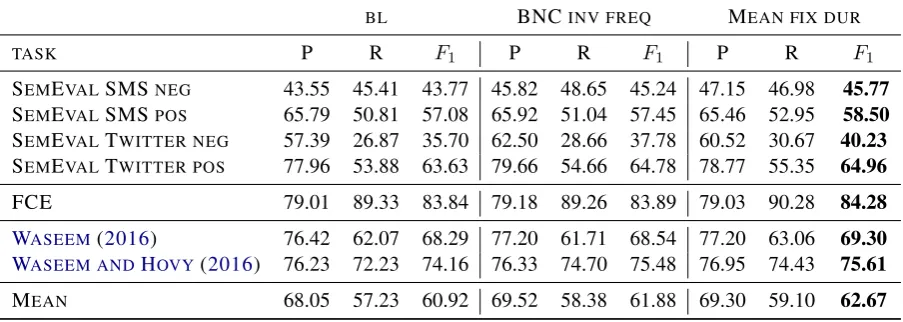
BL BNCINV FREQ MEAN FIX DUR
TASK P R F1 P R F1 P R F1
SEMEVALSMSNEG 43.55 45.41 43.77 45.82 48.65 45.24 47.15 46.98 45.77 SEMEVALSMSPOS 65.79 50.81 57.08 65.92 51.04 57.45 65.46 52.95 58.50 SEMEVALTWITTER NEG 57.39 26.87 35.70 62.50 28.66 37.78 60.52 30.67 40.23 SEMEVALTWITTER POS 77.96 53.88 63.63 79.66 54.66 64.78 78.77 55.35 64.96
FCE 79.01 89.33 83.84 79.18 89.26 83.89 79.03 90.28 84.28
WASEEM(2016) 76.42 62.07 68.29 77.20 61.71 68.54 77.20 63.06 69.30 WASEEM ANDHOVY(2016) 76.23 72.23 74.16 76.33 74.70 75.48 76.95 74.43 75.61
[image:5.595.72.524.64.225.2]MEAN 68.05 57.23 60.92 69.52 58.38 61.88 69.30 59.10 62.67
Table 2: Sentence classification results. P(recision), R(ecall) andF1. Averages over 10 random seeds. The best
averageF1score per task is shown in bold.
function regularized by information about human attention, and finally, (c) a second baseline using frequency information as a proxy for human atten-tion and using the same regularizaatten-tion scheme as in our human attention model.
Hyperparameters Basic hyper-parameters such as number of hidden layers, layer size, and activa-tion funcactiva-tions were following the settings of Rei and Søgaard (2018). The dimensionality of our word embedding layer was set to size 300, and we use publicly available pre-trained Glove word em-beddings (Pennington et al., 2014) that we fine-tune during training. The dimensionality of the character embedding layer was set to 100. The recurrent layers in the character-level component have dimensionality 100; the word-level recurrent layers dimensionality 300. The dimensionality of our feed-forward layer, leading to reduced com-bined representationshi, is 200, and the attention layer has dimensionality 100.
Three hyper-parameters, however, we tune for each architecture and for each task, by measuring sentence-levelF1-scores on the development sets. These are: (a) learning rate, (b)λin Equation (12), i.e., controlling the relative importance of the at-tention regularization, and (c) the probability of sampling data from the eye-tracking corpus dur-ing traindur-ing.
For all tasks and all conditions (baseline, frequency-informed baseline, and our human at-tention model), we perform a grid search over learning rates [ .01 .1 1. ], Latt weightλvalues
[ .2 .4 .6 .8 1. ], and probability of sampling from the eye-tracking corpus [ .125 .25 .5 1., decreasing ] – wheredecreasingmeans that the probability of
sampling from the eye-tracking corpus initially is 0.5, but drops linearly for each epoch (E+11 ; see
2.1. We apply the models with the best averageF1 scores over three random seeds on the validation data, to our test sets.
Initialization Our models are randomly initial-ized. This leads to some variance in performance across different runs. We therefore report averages over 10 runs in our experiments below.
5 Results
Our performance metric across all our experiments is the sentence-level F1 score. We report preci-sion, recall andF1scores for all tasks in Table2.
Our main finding is that our human attention model, based on regularization from mean fixa-tion durafixa-tions in publicly available eye-tracking corpora, consistently outperforms the recurrent ar-chitecture with learned attention functions. The improvements over both baseline and BNC fre-quency are significant (p <0.01) using bootstrap-ping (Calmettes et al., 2012) over all tasks, with one seed. The mean error reduction over the base-line is 4.5%.
preci-sion either. For the negative SEMEVALtasks, we also see larger improvements for precision.
The observation that improvements are primar-ily due to increased recall, aligns well with the hypothesis that human attention serves as an effi-cient regularization, preventing overfitting to sur-face statistical regularities that can lead the net-work to rely on features that are not there at test time (Globerson and Roweis, 2006), at the ex-pense of target class precision.
6 Analysis
We illustrate the differences between our baseline models and the model with gaze-informed atten-tion by the attenatten-tion weights of an example sen-tence. Though it is a single, cherry-picked exam-ple, it is representative of the general trends we observe in the data, when manually inspecting at-tention patterns. Table 3 presents a coarse visu-alization of the attention weights of six different models, namely our baseline architecture and the architecture with gaze-informed attention, trained on three different tasks: hate speech detection, negative sentiment classification, and error detec-tion. The sentence is a positive hate speech exam-ple from the Waseem and Hovy (2016) develop-ment set. The words with more attention than the sentence average are bold-faced.
First note that the baseline models only attend to one or two coherent text parts. This pattern was very consistent across all the sentences we exam-ined. This pattern was not observed with gaze-informed attention.
Our second observation is that the baseline models are more likely to attend to stop words than informed attention. This suggests that gaze-informed attention has learned to simulate human attention to some degree. We also see many dif-ferences between the jointly learned task-specific, gaze-informed attention functions.
The gaze-informed hate speech classifier, for example, places considerable attention on BUT, which in this case is a passive-aggressive hate speech indicator. It also gives weight to double standardsandcertain rules.
The gaze-informed sentiment classifier, on the other hand, focuses more onsorry I am not sexist
which, in isolation, reads like an apologetic dis-claimer. This model also gives weight to double standardsandcertain rules
The gaze-informed grammatical error detection
model gives attention tostandards, which is un-grammatical, because of the morphological num-ber disagreement with its determiner a; it also gives attention tocertain rules, which is disagree-ing, again in number, with there’s. It also gives attention to the non-wordfem.
Overall, this, in combination with our results in Table 3, suggests that the regularization effect from human attention enables our architecture to learn to better attend to the most relevant aspects of sentences for the target tasks. In other words, human attention provides the inductive bias that makes learning possible.
7 Discussion and related work
Gaze in NLP It has previously been shown that several NLP tasks benefit from gaze information, including part-of-speech tagging (Barrett and Sø-gaard,2015b;Barrett et al.,2016a), prediction of multiword expressions (Rohanian et al.,2017) and sentiment analysis (Mishra et al.,2017b).
Gaze information and other measures from psy-cholinguistics have been used in different ways in NLP. Some authors have used discretized, single features (Pate and Goldwater,2011,2013;Plank,
2016; Klerke et al., 2016), whereas others have used multidimensional, continuous values ( Bar-rett et al., 2016a;Bingel et al., 2016). We follow
Gonzalez-Garduno and Søgaard(2018) in using a single, continuous feature. We did not experiment with other representations, however. Specifically, we only considered the signal from token-level, normalized mean fixation durations.
Fixation duration is a feature that carries an enormous amount of information about the text and the language understanding process. Carpen-ter and Just (1983) show that readers are more likely to fixate on open-class words that are not predictable from context, andKliegl et al. (2004) show that a higher cognitive load results in longer fixation durations. Fixations before skipped words are shorter before short or high-frequency words and longer before long or low-frequency words in comparison with control fixations (Kliegl and En-gbert,2005). Many of these findings suggest cor-relations with syntactic information, and many au-thors have confirmed that gaze information is use-ful to discriminate between syntactic phenomena (Demberg and Keller,2008;Barrett and Søgaard,
2015a,b).
FCE SEMEVALTWITTERNEG WASEEM ANDHOVY(2016)
BL MFD BL MFD BL MFD
@CharlesClassiqk: @CharlesClassiqk: @CharlesClassiqk: @CharlesClaqqqqqqqssiqk: @CharlesClassiqk: @CharlesClassiqk:
sorry sorry sorry sorry sorry sorry
I’m I’m I’m I’m I’m I’m
not not not not not not
sexist sexist sexist sexist sexist sexist
BUT BUT BUT BUT BUT BUT
there there there there there there
is is is is is is
a a a a a a
double double double double double double
standards standards standards standards standards standards
there’s there’s there’s there’s there’s there’s
certain certain certain certain certain certain
rules rules rules rules rules rules
for for for for for for
dudes dudes dudes dudes dudes dudes
and and and and and and
there’s there’s there’s there’s there’s there’s
certain certain certain certain certain certain
rules rules rules rules rules rules
for for for for for for
[image:7.595.75.524.61.305.2]femâ ˘A˛e femâ ˘A˛e femâ ˘A˛e femâ ˘A˛e femâ ˘A˛e femâ ˘A˛e
Table 3: One sentence marked as containing sexism from Waseem and Hovy(2016) development set. Using trained baseline (BL) and gaze model (MFD) for three tasks: error detection, sentiment classification, and hate speech detection. Words with more attention than sentence average are boldfaced.
sentiment analysis before (Mishra et al.,2017b,a).
Mishra et al.(2017b) augmented a sentiment anal-ysis system with eye-tracking features, including first fixation durations and fixation counts. They show that fixations not only have an impact in de-tecting sentiment, but also improve sarcasm detec-tion. They train a convolutional neural network that learns features from both gaze and text and uses them to classify the input text (Mishra et al.,
2017a). On a related note,Raudonis et al.(2013) developed a emotion recognition system from vi-sual stimulus (not text) and showed that features such as pupil size and motion speed are relevant to accurately detect emotions from eye-tracking data.
Wang et al.(2017) use variables shown to correlate with human attention, e.g. surprisal, to guide the attention for sentence representations.
Gaze has also been used in the context of gram-maticality (Klerke et al., 2015a,b), as well as in readability assessment (Gonzalez-Garduno and Søgaard,2018).
Gaze has either been used as features (Barrett and Søgaard, 2015a; Barrett et al., 2016b) or as a direct supervision signal in multi-task learning scenarios (Klerke et al.,2016;Gonzalez-Garduno and Søgaard, 2018). We are, to the best of our knowledge, the first to use gaze to inform attention functions in recurrent neural networks.
Human-inspired attention functions Ibraheem et al. (2017), however, uses optimal attention to simulate human attention in an interactive ma-chine translation scenario, andBritz et al.(2017) limit attention to a local context, inspired by find-ings in studies of human reading.Rei and Søgaard
(2018) use auxiliary data to regularize attention functions in recurrent neural networks; not from psycholinguistics data, but using small amounts of task-specific, token-level annotations. While their motivation is very different from ours, technically our models are very related. In a different context,
Das et al.(2017) investigated whether humans at-tend to the same regions as neural networks solv-ing visual question answersolv-ing problems. Lindsey
(2017) also used human-inspired, unsupervised at-tention in a computer vision context.
Other work on multi-purpose attention func-tions While our work is the first to use gaze data to guide attention in a recurrent architectures, there has recently been some work on sharing at-tention functions across tasks. Firat et al. (2016), for example, share attention functions between languages in the context of multi-way neural ma-chine translation.
than annotated data to learn sentiment analysis models that generalize better. Felbo et al.(2017), for example, use emoji prediction to pretrain their sentiment analysis models. Mishra et al. (2018) use several auxiliary tasks, including gaze predic-tion, for document-level sentiment analysis. There is a lot of previous work, also, leveraging informa-tion across different sentiment analysis datasets, e.g.,Liu et al.(2016).
Error detection In grammatical error detection,
Rei (2017) used an unsupervised auxiliary lan-guage modeling task, which is similar in spirit to our second baseline, using frequency informa-tion as auxiliary data. Rei and Yannakoudakis
(2017) go beyond this and evaluate the usefulness of many auxiliary tasks, primarily syntactic ones. They also use frequency information as an auxil-iary task.
Hate speech detection In hate speech detection, many signals beyond the text are often leveraged (seeSchmidt and Wiegand(2017) for an overview of the literature). Interestingly, many authors have used signals from sentiment analysis, e.g., Gitari et al.(2015), motivated by the correlation between hate speech and negative sentiment. This correla-tion may also explain why we see the biggest im-provements with gaze-informed attention on those two tasks.
Human inductive bias Finally, our work relates to other work on providing better inductive biases for learning human-related tasks by observing hu-mans (Tamuz et al.,2011;Wilson et al.,2015). We believe this is a truly exciting line of research that can help us push research horizons in many ways.
8 Conclusion
We have shown that human attention provides a useful inductive bias on machine attention in re-current neural networks for sequence classification problems. We present an architecture that enables us to leverage human attention signals from gen-eral, publicly available eye-tracking corpora, to in-duce better, more robust task-specific NLP mod-els. We evaluate our architecture and show im-provements across three NLP tasks, namely sen-timent analysis, grammatical error detection, and detection of abusive language. We observe that not only does human attention help models distribute their attention in a generally useful way; human
attention also seems to act like a regularizer pro-viding more robust performance across domains, and it enables better learning of task-specific at-tention functions through joint learning.
References
Tamer Alkhouli, Gabriel Bretschner, Jan-Thorsten Pe-ter, Mohammed Hethnawi, Andreas Guta, and Her-mann Ney. 2016. Alignment-based neural machine translation. InProceedings of the First Conference on Machine Translation, pages 54–65.
Maria Barrett, Joachim Bingel, Frank Keller, and An-ders Søgaard. 2016a. Weakly supervised part-of-speech tagging using eye-tracking data. In Pro-ceedings of the 54th Annual Meeting of the Associa-tion for ComputaAssocia-tional Linguistics (ACL), volume 2, pages 579–584.
Maria Barrett, Frank Keller, and Anders Søgaard. 2016b. Cross-lingual transfer of correlations be-tween parts of speech and gaze features. In Pro-ceedings of the 26th International Conference on Computational Linguistics (COLING), pages 1330– 1339.
Maria Barrett and Anders Søgaard. 2015a. Reading be-havior predicts syntactic categories. InProceedings of the nineteenth conference on computational natu-ral language learning (CoNLL), pages 345–249.
Maria Barrett and Anders Søgaard. 2015b. Using read-ing behavior to predict grammatical functions. In
Workshop on Cognitive Aspects of Computational Language Learning (CogACLL), pages 1–5.
Joachim Bingel, Maria Barrett, and Anders Søgaard. 2016. Extracting token-level signals of syntactic processing from fMRI-with an application to POS induction. InProceedings of the 54th Annual Meet-ing of the Association for Computational LMeet-inguistics (ACL), volume 1, pages 747–755.
Joachim Bingel and Anders Søgaard. 2017. Identify-ing beneficial task relations for multi-task learnIdentify-ing in deep neural networks. InProceedings of the 15th Conference of the European Chapter of the Asso-ciation for Computational Linguistics (EACL), vol-ume 2, pages 164–169.
Denny Britz, Melody Y. Guan, and Minh-Thang Lu-ong. 2017. Efficient attention using a fixed-size memory representation. InProceedings of the 2017 Conference on Empirical Methods in Natural Lan-guage Processing (EMNLP), pages 392–400.
Patricia A Carpenter and Marcel Adam Just. 1983. What your eyes do while your mind is reading. Eye movements in reading: Perceptual and language processes, pages 275–307.
Charles Clifton, Adrian Staub, and Keith Rayner. 2007. Eye movements in reading words and sentences. In
Eye Movements: A Window on Mind and Brain, pages 341–371. Elsevier, Amsterdam, The Nether-lands.
Aron Culotta, Andrew McCallum, and Jonathan Betz. 2006. Integrating probabilistic extraction models and data mining to discover relations and patterns in text. InProceedings of the main conference on Hu-man Language Technology Conference of the North American Chapter of the Association of Computa-tional Linguistics, pages 296–303. Association for Computational Linguistics.
Abhishek Das, Harsh Agrawal, Lawrence Zitnick, Devi Parikh, and Dhruv Batra. 2017. Human attention in visual question answering: Do humans and deep net-works look at the same regions? Computer Vision and Image Understanding, 163:90–100.
Vera Demberg and Frank Keller. 2008. Data from eye-tracking corpora as evidence for theories of syntactic processing complexity. Cognition, 109(2):193–210.
Daxiang Dong, Hua Wu, Wei He, Dianhai Yu, and Haifeng Wang. 2015. Multi-task learning for mul-tiple language translation. In Proceedings of the 53rd Annual Meeting of the Association for Compu-tational Linguistics and the 7th International Joint Conference on Natural Language Processing (Vol-ume 1: Long Papers), volume 1, pages 1723–1732.
Bjarke Felbo, Alan Mislove, Anders Søgaard, Iyan Rahwan, and Sune. Lehmann. 2017. Using millions of emoji occurrences to pretrain any-domain mod-els for detecting emotion, sentiment, and sarcasm. In Proceedings of the 2017 Conference on Empiri-cal Methods in Natural Language Processing, pages 1615–1625.
Orhan Firat, Kyunghyun Cho, and Yoshua Bengio. 2016. Multi-way, multilingual neural machine translation with a shared attention mechanism. In
Proceedings of 14th Annual Conference of the North American Chapter of the Association for Computa-tional Linguistics (NAACL), pages 866–875.
Njagi Dennis Gitari, Zhang Zuping, Hanyurwimfura Damien, and Jun Long. 2015. A lexicon-based approach for hate speech detection. International Journal of Multimedia and Ubiquitous Engineering, 10(4):215–230.
Amir Globerson and Sam Roweis. 2006. Nightmare at test time: robust learning by feature deletion. In
Proceedings of the 23rd International Conference on Machine Learning (ICML), pages 353–360.
Ana Gonzalez-Garduno and Anders Søgaard. 2018. Learning to predict readability using eye-movement data from natives and learners. In Proceedings of the Thirty-Second Association for the Advancement of Artificial Intelligence Conference (AAAI).
Sepp Hochreiter and Jürgen Schmidhuber. 1997. Long short-term memory. Neural computation, 9(8):1735–1780.
Nora Hollenstein, Jonathan Rotsztejn, Marius Troen-dle, Andreas Pedroni, Ce Zhang, and Nicolas Langer. 2018. ZuCo: A simultaneous EEG and eye-tracking resource for natural sentence reading. Sci-entific data,Under Review.
Samee Ibraheem, Nicholas Altieri, and John DeNero. 2017. Learning an interactive attention policy for neural machine translation. InMTSummit.
Alan Kennedy, Robin Hill, and Joël Pynte. 2003. The dundee corpus. InProceedings of the 12th European conference on eye movement.
Adam Kilgarriff. 1995. BNC database and word fre-quency lists. Retrieved Dec. 2017.
Sigrid Klerke, Héctor Martínez Alonso, and Anders Søgaard. 2015a. Looking hard: Eye tracking for de-tecting grammaticality of automatically compressed sentences. InProceedings of the 20th Nordic Con-ference of Computational Linguistics (NODALIDA 2015), pages 97–105.
Sigrid Klerke, Sheila Castilho, Maria Barrett, and An-ders Søgaard. 2015b. Reading metrics for estimat-ing task efficiency with MT output. InProceedings of the Sixth Workshop on Cognitive Aspects of Com-putational Language Learning (CogACLL), pages 6–13.
Sigrid Klerke, Yoav Goldberg, and Anders Søgaard. 2016. Improving sentence compression by learning to predict gaze. InProceedings of 14th Annual Con-ference of the North American Chapter of the As-sociation for Computational Linguistics (NAACL), pages 1528–1533.
Reinhold Kliegl and Ralf Engbert. 2005. Fixation du-rations before word skipping in reading. Psycho-nomic Bulletin & Review, 12(1):132–138.
Reinhold Kliegl, Ellen Grabner, Martin Rolfs, and Ralf Engbert. 2004. Length, frequency, and predictabil-ity effects of words on eye movements in reading.
European Journal of Cognitive Psychology, 16(1-2):262–284.
Jack Lindsey. 2017. Pre-training attention mecha-nisms. In NIPS Workshop on Cognitive Informed Artificial Intelligence.
Pengfei Liu, Xipeng Qiu, and Xuanjing Huang. 2016. Deep multi-task learning with shared memory. In
Tomasz D Loboda, Peter Brusilovsky, and Jöerg Brun-stein. 2011. Inferring word relevance from eye-movements of readers. In Proceedings of the 16th international conference on intelligent user inter-faces, pages 175–184. ACM.
Minh-Thang Luong, Quoc V. Le, Ilya Sutskever, Oriol Vinyals, and Lukasz Kaiser. 2016. Multi-task sequence-to-sequence learning. In International Conference on Learning Representations (ICLR).
Abhijit Mishra, Kuntal Dey, and Pushpak Bhat-tacharyya. 2017a. Learning cognitive features from gaze data for sentiment and sarcasm classification using convolutional neural network. In Proceed-ings of the 55th Annual Meeting of the Association for Computational Linguistics (Volume 1: Long Pa-pers), volume 1, pages 377–387.
Abhijit Mishra, Diptesh Kanojia, Seema Nagar, Kuntal Dey, and Pushpak Bhattacharyya. 2017b. Leverag-ing cognitive features for sentiment analysis. In Pro-ceedings of the 20th SIGNLL Conference on Com-putational Natural Language Learning (CoNLL), pages 156–166.
Abhijit Mishra, Srikanth Tamilselvam, Riddhiman Dasgupta, Seema Nagar, and Kuntal Dey. 2018. Cognition-cognizant sentiment analysis with mul-titask subjectivity summarization based on annota-tors’ gaze behavior. In Proceedings of the Thirty-Second AAAI Conference on Artificial Intelligence (AAAI).
John K Pate and Sharon Goldwater. 2011. Unsuper-vised syntactic chunking with acoustic cues: compu-tational models for prosodic bootstrapping. In Pro-ceedings of the 2nd Workshop on Cognitive Model-ing and Computational LModel-inguistics, pages 20–29.
John K Pate and Sharon Goldwater. 2013. Unsu-pervised dependency parsing with acoustic cues.
Transactions of the Association for Computational Linguistics (TACL), 1:63–74.
Jeffrey Pennington, Richard Socher, and Christopher Manning. 2014. Glove: Global vectors for word representation. InProceedings of the 2014 confer-ence on empirical methods in natural language pro-cessing (EMNLP), pages 1532–1543.
Barbara Plank. 2016. Keystroke dynamics as signal for shallow syntactic parsing. In Proceedings of the 25th International Conference on Computational Linguistics (COLING), pages 609–618.
Barbara Plank, Yoav Goldberg, and Anders Søgaard. 2016. Multilingual part-of-speech tagging with bidirectional long short-term memory models and auxiliary loss. In Proceedings of the 54th Annual Meeting of the Association for Computational Lin-guistics (ACL), pages 412–418.
Vidas Raudonis, Gintaras Dervinis, Andrius Vilka-uskas, Agne Paulauskaite-Taraseviciene, and Gintare Kersulyte-Raudone. 2013. Evaluation of human emotion from eye motions. Evaluation, 4(8).
Keith Rayner and Susan A. Duffy. 1988. On-line com-prehension processes and eye movements in reading. InReading research: Advances in theory and prac-tice, pages 13–66, New York, NY, USA. Academic Press.
Marek Rei. 2017. Semi-supervised multitask learn-ing for sequence labellearn-ing. In Proceedings of the 55th Annual Meeting of the Association for Compu-tational Linguistics (ACL), volume 1, pages 2121– 2130.
Marek Rei and Anders Søgaard. 2018. Zero-shot se-quence labeling: Transferring knowledge from sen-tences to tokens. Proceedings of the 16th Annual Conference of the North American Chapter of the Association for Computational Linguistics: Human Language Technologies (NAACL 2018), pages 293– 302.
Marek Rei and Helen Yannakoudakis. 2016. Composi-tional sequence labeling models for error detection in learner writing. Proceedings of the 54th Annual Meeting of the Association for Computational Lin-guistics (ACL), pages 1181–1191.
Marek Rei and Helen Yannakoudakis. 2017. Auxiliary objectives for neural error detection models. In Pro-ceedings of the 12th Workshop on Innovative Use of NLP for Building Educational Applications, pages 33–43.
Omid Rohanian, Shiva Taslimipoor, Victoria Yaneva, and Le An Ha. 2017. Using gaze data to predict multiword expressions. In Proceedings of the In-ternational Conference Recent Advances in Natural Language Processing (RANLP), pages 601–609.
Sara Rosenthal, Preslav Nakov, Svetlana Kiritchenko, Saif Mohammad, Alan Ritter, and Veselin Stoyanov. 2015. Semeval-2015 Task 10: Sentiment analysis in Twitter. InProceedings of the 9th international workshop on semantic evaluation (SemEval 2015), pages 451–463.
Jarkko Salojärvi, Ilpo Kojo, Jaana Simola, and Samuel Kaski. 2003. Can relevance be inferred from eye movements in information retrieval. InProceedings of WSOM, volume 3, pages 261–266.
Javier San Agustin, Henrik Skovsgaard, John Paulin Hansen, and Dan Witzner Hansen. 2009. Low-cost gaze interaction: ready to deliver the promises. In
CHI’09 Extended Abstracts on Human Factors in Computing Systems, pages 4453–4458. ACM.
Anna Schmidt and Michael Wiegand. 2017. A survey on hate speech detection using natural language pro-cessing. In Proceedings of the Fifth International Workshop on Natural Language Processing for So-cial Media, pages 1–10.
for semantic compositionality over a sentiment tree-bank. In Proceedings of the 2013 conference on empirical methods in natural language processing, pages 1631–1642.
Anders Søgaard and Yoav Goldberg. 2016. Deep multi-task learning with low level tasks supervised at lower layers. InProceedings of the 54th Annual Meeting of the Association for Computational Lin-guistics, volume 2, pages 231–235.
Omer Tamuz, Ce Liu, Serge Belongie, Ohad Shamir, and Adam Tauman Kalai. 2011. Adaptively learning the crowd kernel. InProceedings of the 28th Inter-national Conference on Machine Learning (ICML), pages 673–680.
Shaonan Wang, Jiajun Zhang, and Chengqing Zong. 2017. Learning sentence representation with guid-ance of human attention.Proceedings of the Twenty-Sixth International Joint Conference on Artificial In-telligence, pages 4137–4143.
Zeerak Waseem. 2016. Are you a racist or am i seeing things? Annotator influence on hate speech detec-tion on Twitter. InProceedings of the first workshop on NLP and computational social science, pages 138–142.
Zeerak Waseem and Dirk Hovy. 2016. Hateful sym-bols or hateful people? Predictive features for hate speech detection on Twitter. In Proceedings of the NAACL student research workshop, pages 88–93.
Andrew Wilson, Christoph Dann, Chris Lucas, and Eric Xing. 2015. The human kernel. InAdvances in neural information processing systems (NIPS), pages 2854–2862.
Theresa Wilson, Zornitsa Kozareva, Preslav Nakov, Sara Rosenthal, Veselin Stoyanov, and Alan Ritter. 2013. Sentiment analysis in Twitter. InProceedings of the Seventh International Workshop on Semantic, pages 312–320.
Helen Yannakoudakis, Ted Briscoe, and Ben Medlock. 2011. A new dataset and method for automatically grading esol texts. InProceedings of the 49th An-nual Meeting of the Association for Computational Linguistics (ACL), volume 1, pages 180–189. Asso-ciation for Computational Linguistics.