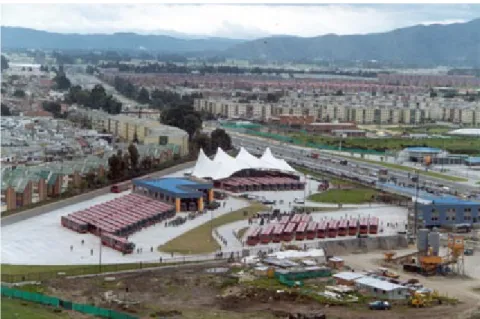
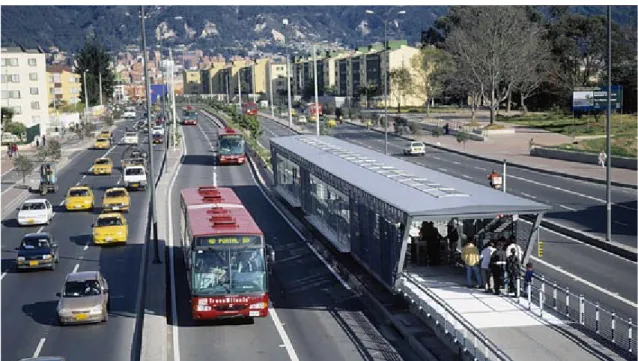
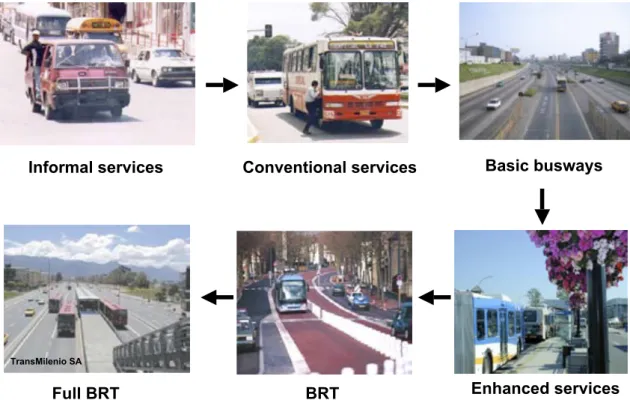
Bus Rapid Transit
Planning Guide
Developed through the support of:
The William and Flora Hewlett Foundation Global Environment Facility /
United Nations Environment Programme Deutsche Gesellschaft für Technische Zusammenarbeit (GTZ) GmbH Editors: Lloyd Wright
Researcher
Bartlett School of Planning, University College London Walter Hook
Executive Director Institute for
Transportation & Development Policy
Published by: Institute for
Transportation & Development Policy 127 W. 26th Street, Suite 1002
New York, NY 10001 USA
3rd edition, June 2007
Cover photos: Front cover:
Bogotá’s TransMilenio; Photo by Karl Fjellstrom Back cover:
Bogotá's TransMilenio; Photo by Lloyd Wright Layout: Klaus Neumann, SDS, G.C.
Contents: The editors the Bus Rapid Transport Plan-ning Guide take full responsibility for the contents of the document. The sponsoring organisations are not responsible for any errors or omissions resulting from the publication of this document.
Contributing authors:
(in alphabetical order)
4 César Arias, A & Y Consultores Cia. Ltda. 4 Angélica Castro, TransMilenio SA
4 Wagner Colombini Martins, Logit Engenharia Consultoria 4 Paulo Custodio, Public transport consultant
4 Juan Carlos Diaz, Akiris Consultants 4 Karl Fjellstrom,
Institute for Transportation & Development Policy (ITDP) 4 Dario Hidalgo, Booz Allen Hamilton
4 Walter Hook,
Institute for Transportation & Development Policy (ITDP) 4 Michael King, Nelson / Nygaard Consultants
4 Lin Wei, Kunming Urban Transport Institute
4 Todd Litman, Victoria Transport Policy Institute (VTPI) 4 Gerhard Menckhoff, World Bank consultant
4 Peter Midgley, World Bank consultant 4 Carlos F. Pardo,
GTZ Sustainable Urban Transport Project (SUTP) 4 Edgar Enrique Sandoval, Public transport consultant 4 Pedro Szasz, Public transport consultant
4 Geetam Tiwari, Indian Institute of Technology – Delhi 4 Jarko Vlasak, Business strategy consultant 4 Luis (Pilo) Willumsen, Steer Davies Gleave 4 Lloyd Wright, University College London and Viva 4 Sam Zimmerman, The World Bank Group
Bus Rapid Transit
Planning Guide
ii
Preface
“We wander for distraction, but we travel for
fulfillment.”
– Hilaire Belloc, writer, 1870–1953 The ability to access jobs, education, and public
services is a fundamental part of human devel-opment. An efficient and cost-effective public transport system essentially connects people to daily life. For many cities, though, effective public transport has been forgone, leaving mobility needs exclusively in the hands of private vehicles and uncoordinated paratransit operators. These cities have been largely unpre-pared for the consequences, including severe traffic congestion, air and noise pollution, ac-cidents, and the loss of a sense of community. A high-quality public transport system remains an indispensable element in creating a city where people and community come first.
Bus Rapid Transit (BRT) is increasingly recognised as amongst the most effective solu-tions to providing high-quality transit services on a cost-effective basis to urban areas, both in the developed and developing world. The growing popularity of BRT as a viable solution to urban mobility underscores the success of initial efforts in cities such as Curitiba, Bogotá, and Brisbane. By allowing cities to provide a functional network of public transport corridors, BRT permits even low-income cities to develop a high-quality mass transit system that serves the public’s daily travel needs.
However, BRT is not just about transporting people. Rather, BRT represents one element of a package of measures that can transform cities
into more liveable spaces. Integration of BRT with non-motorised transport, progressive land-use policies, and car-restriction measures forms part of a sustainable package that can underpin a healthy and effective urban environment. In this sense, BRT represents one pillar in efforts to better urban quality of life for all segments of society, and especially in providing greater equity across an entire population.
The Bus Rapid Transit Planning Guide has been the culmination of over five years of efforts to document and improve the state of the art in cost-effective public transport solutions for cit-ies. This current document is the third edition of the Planning Guide. The production of new versions in a short span of time is indicative of the pace by which the BRT concept is growing and evolving. The first two versions of the Plan-ning Guide were developed by Lloyd Wright and published through the Sustainable Urban Transport Project (SUTP) of the German Tech-nical Cooperation (GTZ). This new edition has been expanded to include inputs from a wide range of professionals with direct experience in implementing actual systems. Further, as new projects have been implemented, the base of knowledge on issues such as route design, infor-mation technology, fare collection options, and BRT vehicles has expanded significantly. This Planning Guide first provides an overview of the BRT concept, including its definition and historical development. The Planning Guide then proceeds to give a step-by-step description of the BRT planning process. The
iii
Preface
Planning Guide encompasses six major compo-nents in BRT planning: I. Project preparation; II. Operational design; III. Physical design; IV. Integration; V. Business plan; and VI. Evalua-tion and implementaEvalua-tion. In total, there are 20 different chapters covering a comprehensive set of planning issues including communications, demand analysis, operational planning, cus-tomer service, infrastructure, modal integration, vehicle and fare collection technology, institu-tional structures, costing, financing, marketing, evaluation, contracting, and construction plan-ning. Finally, this publication also lists a range of information sources that can assist a city’s BRT planning efforts.
The BRT Planning Guide is intended as a guid-ance document for a range of parties involved in delivering public transport services to urban areas. Municipal planning professionals and planning consultants will particularly benefit from the step-by-step documentation of the BRT development process. However, non-gov-ernmental organisations and civic organisations involved in transport, environment, and com-munity development will likewise find this information of use in realising their objectives. Additionally, other stakeholders, including busi-ness groups, regional and national governmental agencies, and international development organi-sations are also key partners who will benefit from knowledge on the BRT option.
The BRT Planning Guide was originally developed principally for officials in developing-nation cities, and most of the expertise
presented here has been developed in the cities of developing nations. Given that the most successful applications of BRT to date have been from cities such as Bogotá, Curitiba, and Guayaquil, developed nations have much to learn from the developing world. Further, as en-ergy security and the spectre of climate change have become topics of increasing global concern, providing effective public transport should be a fundamental objective for all cities, regardless of a nation’s economic designation.
BRT alone will not solve all the myriad of social, environmental, and economic challenges facing our various urban centres across the globe. However, BRT has shown to be an effec-tive catalyst to help transform cities into more liveable and human-friendly environments. The appeal of BRT is the ability to deliver a high-quality mass transit system within the budgets of most municipalities, even in low-income cities. BRT has proven that the barrier to effec-tive public transport is not cost or high technol-ogy. Planning and implementing a good BRT system is not easy. This guide aims to make the task a little easier. The principal ingredient, however, is not technical skill: It is the political will to make it happen.
Lloyd Wright
University College London (UCL) and Viva
Walter Hook
Institute for Transportation & Development Policy (ITDP)
v
Acknowledgements
The development of this Bus Rapid Transit Planning Guide has benefited from the experi-ences of cities and professionals from around the world. In many respects, BRT owes its existence to the creativity and determination of Jaime Lerner, the former mayor of Curitiba (Brazil) and the former governor of the state of Paraná. Curitiba marked a vital first step in understanding a customer-based view of public transport provision. Former Mayor Lerner and his municipal team used a great deal of creativ-ity in developing a “surface metro” system that was the forerunner of BRT.
Subsequently, the leadership of former Bogotá Mayor Enrique Peñalosa resulted in the develop-ment of the Bogotá TransMilenio system in the late 1990s. The Bogotá system proved the ap-plicability of BRT in even the largest and most complicated urban settings. Further, former Mayor Peñalosa has gone on to be a worldwide ambassador of sustainable urban transport. Together, the stories of Curitiba and Bogotá are now the basis for more and more cities engaged in urban transformation led by BRT and a package of other sustainable transport measures. It is no coincidence that many of the persons involved with this BRT Planning Guide have played a central role in planning and imple-menting BRT systems around the world. The experience of planners from Brazil, Colombia, and elsewhere has helped to dramatically improve the quality of this third edition of the BRT Planning Guide.
This guide has drawn most heavily on the team that designed Bogotá’s TransMilenio system. The consulting firm Akiris, especially Juan Carlos Diaz, have helped to draft the sections of the Planning Guide on project preparation, communications, and technology. Under the guidance of Luis (Pilo) Willumsen, staff from Steer Davies Gleave contributed inputs to the demand analysis and operations sections. Jarko Vlasak formerly helped lead the team that de-veloped the business and institutional structure for TransMilenio, and he has provided inputs on these topics to the Planning Guide. Angélica Castro, the current Managing Director of Trans-Milenio SA, and other members of Bogotá’s public BRT company, TransMilenio SA, also
provided many highly useful ideas and inputs. Further, the former director of TransMilenio, Edgar Enrique Sandoval, has applied his experi-ence to provide a wide spectrum of suggestions to the Planning Guide. Likewise, Dario Hidalgo, formerly the Deputy Director of TransMilenio and now with the firm of Booz Allen Hamilton, has assisted with an array of inputs, including insights into initial project development.
Pedro Szasz, a world leading transport engineer who played a key role in helping TransMilenio reach its current unrivalled capacity and speed, contributed greatly to the sections on operational and design issues. Likewise, the inputs and ongoing interactions from Brazilian consultants such as Wagner Colombini (Logit Enghenaria), Paulo Custodio, and Arthur Szasz have provided invaluable insights to this Plan-ning Guide.
César Arias, who played a key role in developing the Quito BRT system and is now doing the same in the city of Guayaquil, has provided inputs from BRT development in these cit-ies. Likewise, Hidalgo Nuñez and Cecilia Rodriguez of Quito’s Department of Transport have provided much assistance in documenting Quito’s experiences.
For Asia, valuable lessons emerged from our partnership with the Guangzhou Municipal Technology Development Corporation under the Guangzhou Construction Commission, and from the Energy Foundation’s Beijing Office. Special recognition should also be extended to Lin Wei and the entire team from the city of Kunming who developed China’s first BRT project. Additionally, the inputs of Dr. Jason Chang and Kangming Xu have helped to document early experiences in China and Taiwan. In India, Dr. Dinesh Mohan and Dr. Geetam Tiwari of the Indian Institute of Technology in Delhi are at the forefront of efforts there, and many elements of this guide result from the richness of their inputs. With particular attention to the integration of pedes-trian access and small vendors into the station environment, Dr. Tiwari has provided insights for this Planning Guide. Recognition must also be extended to DKI Jakarta and the valuable lessons learned during the development of the TransJakarta BRT system.
vi
In Africa, the city of Dar es Salaam has em-barked upon a path to prove that a high-quality public transport system is possible even in cities with limited financial resources. The rise of the Dar es Salaam BRT system may well spur on similar efforts across the African continent. Interactions with Raymond Mblinyi and Asteria Mlambo of the Dar es Salaam Project Manage-ment Unit, along with the team from Logit En-genharia provided invaluable guidance on issues appropriate to working in the African context. The Planning Guide has benefited not only from
leading developing-nation experiences but also from the growing level of interest in BRT in Australia, Western Europe, Japan, and North America. A similar compendium of experiences
developed under the United States Transit Cooperative Research Program (TCRP) has been a rich source of world-wide experiences in BRT. Sam Zimmerman, now with the World Bank, and Herbert Levinson, an independent transport consultant, have been leading these efforts and have helped to provide insightful contributions to this Planning Guide.
Heather Allen and the entire team at the Inter-national Union of Public Transport Operators (UITP) have helped to share the experiences of their membership in order to strengthen this Guidebook. François Rambaud of French Research Centre on Transport and Urbanism (CERTU) has also been most helpful in not-ing BRT developments in France, as has been Werner Kutil of Veolia Transport. Appreciation
is also extended to Dave Wetzel, the Vice Chair of Transport for London (TfL), who has contributed greatly to innovative financing strategies such as the concept of a Land Benefit Levy (LBL).
Additionally, efforts to raise awareness of the BRT option have been furthered by several US-based organisations, including the US Federal Transit Administration (USFTA), the American Public Transport Association (APTA), and WestStart-CALSTART. The team of Dennis Hinebaugh, Georges Darido, and Alasdair Cain at the National BRT Institute at
the University of South Florida have been quite gracious in providing data and images for this Planning Guide. Also, Bill Vincent of Break-through Technologies has been an inspirational
lead for BRT in the US and elsewhere, and has helped to develop one of the most effective videos on BRT to date. Kate Blumberg of the International Council on Clean Transporta-tion (ICCT) contributed many insights on air quality and fuel technology for this Planning Guide. At the city level, the efforts of officials in Brisbane, Nagoya, Ottawa, and Rouen have also made a significant difference in furthering the BRT concept.
Several international transport professionals are working to ensure that concepts like BRT are integrated within the local context. Michael King of Nelson/Nygaard Consultants is the principal author of the Planning Guide’s sec-tion outlining the integrasec-tion of BRT with pedestrian access. Todd Litman of the Victoria Transport Planning Institute (VTPI) gave major contributions to the sections on BRT integration with land use planning and BRT within a framework of transit-oriented develop-ment (TOD). The VTPI remains a valuable resource within the sustainable transport move-ment. Also, through co-operation with Nancy Kete, Lee Schipper, and the entire team at the Embarq programme of the World Resources Institute (WRI), and the Center for Sustainable Transport in Mexico City, valuable insights have been gained.
Several international organisations are now at the forefront of making BRT a mainstream option for cities worldwide. The World Bank and the Global Environment Facility (GEF) have teamed up to support BRT initiatives in a range of cities, including Hanoi, Lima, Mexico City, and Santiago. Gerhard Menckhoff, a World Bank consultant, has been particularly instrumental in this process, and he has made substantial contributions to many elements of this Planning Guide. Likewise, Peter Midgley, a former World Bank transport specialist, who has been a pioneer in forming the BRT con-cept, also provided assistance to this Planning Guide. Other World Bank staff who are closely involved in making BRT projects a reality include Mauricio Cuéllar, Pierre Graftieaux, and Shomik Mehndiratta. Further, Cornie Huzienga and his team at the Clean Air Initia-tive for Asian Cities (CAI-Asia) are working to improve air quality of Asian cities through the
vii
promotion of measures such as BRT. Efforts in Asia are also assisted through the Environmen-tally-Sustainable Transport (EST) programme of Kazunobu Onogawa, Choudhury Mohanty, and others at the United Nations Centre for Regional Development (UNCRD).
This most recent version of the Planning Guide would not have become a reality without the vision and support of several key organisations. The Hewlett Foundation stands out as one of the principal catalyst organisations making BRT possible in countries such as Brazil, China, and Mexico. Much appreciation must be extended to Joseph Ryan and Hal Harvey of the Hewlett Foundation for their belief in BRT as a sustain-able option for developing-nation cities. Like-wise, Sheila Aggarwal-Kahn and Lew Fulton of the United Nations Environment Programme (UNEP) worked with the Secretariat of the
Glo-bal Environment Facility (GEF) to also make both a substantive and a financial contribution to this document’s publication. Additionally, Manfred Breithaupt and the Sustainable Urban Transport Project (SUTP) of GTZ have played
a pivotal in supporting the development of the first two versions of this Planning Guide. Like-wise, GTZ has also given support to this third edition as well as continues to support BRT
knowledge dissemination through workshops and training courses.
Finally, much has been learned by turning the ideas of BRT into on-the-ground realities. Most of the valuable lessons presented here resulted from the persistence and patience of key people often in often difficult situations. Several key staff members at the Institute for Transporta-tion & Development Policy (ITDP) have been at the forefront of bringing direct technical assistance to developing cities pursuing sustain-able transport options. From ITDP’s team, Oscar Diaz played a critical role in collecting information about TransMilenio; likewise, John Ernst’s work in Jakarta, Eric Ferreira’s work in Brazil, Karl Fjellstrom’s work in China and Tanzania, and Aimee Gauthier’s work in Dakar and South Africa, was the basis for many of the insights shared here. A special thanks is also extended to Klaus Neumann who provided the design and formatting of this document. In total, the Bus Rapid Transit Planning Guide is the sum of some of the most experienced minds that are striving to improve public trans-port conditions worldwide. The contents of this Planning Guide give the reader a revealing look at the promise and latest accomplishments of Bus Rapid Transit systems.
viii
Acronyms
AEI Access Exchange International AIJ Activities Implemented Jointly APTA American Public Transport
Association
AfDB African Development Bank ALS Area Licensing Scheme ADB Asian Development Bank AGV Automatic Guided Vehicle AVL Automatic Vehicle Location BNDES Banco Nacional de
Desenvolvi-mento Econômico e Social (Brazilian National Development Bank) BOT Build-Operate-Transfer BRT Bus Rapid Transit CH4 Methane
CIDA Canadian International Development Agency
CO Carbon monoxide CO2 Carbon dioxide
CFD Car-free day
CBD Central business district COE Certificate of entitlement CER Certified Emission Reduction CAI Clean Air Initiative
CDM Clean Development Mechanism CNG Compressed Natural Gas COP Conference of the Parties DANIDA Danish International Development
Agency dB Decibel
DLT Development Land Tax
DFID UK Department for International Development
ERP Electronic Road Pricing
EIA Environmental Impact Assessment EST Environmentally-Sustainable
Transport EU European Union EOI Expression of Interest GEF Global Environmental Facility GST Goods and services tax GTZ Deutsche Gesellschaft für
Technische Zusammenarbeit (GTZ) (German Technical Cooperation) HCBS High-Capacity Bus System HOV High-occupancy vehicle
IADB Inter-American Development Bank IBRD International Bank for
Reconstruction and Development IDA International Development
Association
IEA International Energy Agency ICT Information and communications
technologies
IFC International Finance Corporation IPCC Inter-governmental Panel on Climate
Change
ITDP Institute for Transportation & Development Policy
ITS Intelligent Transportation Systems JBIC Japanese Bank for International
Co-operation
JICA Japanese International Co-operation Agency
JI Joint Implementation JIT Just-in-time
KfW Kreditanstalt für Wiederaufbau (German Bank for Reconstruction) kph Kilometres per hour
LVT Land-value taxation LOS Level of service LPG Liquid Petroleum Gas LRT Light Rail Transit LBL Location Benefit Levy MRT Mass Rapid Transit
NBRTI National Bus Rapid Transit Institute NOx Nitrogen oxides
N2O Nitrous oxide
NGO Non-governmental organisation NMT Non-motorised transport OMV Open market value O-D Origin-Destination
OECD Organisation for Economic Co-operation and Development
O3 Ozone
PM Particulate matter PCU Passenger car units
pphpd Passengers per hour per direction PC Personal computer
PDA Personal digital assistant PRT Personal Rapid Transit PV Photovoltaic
PPQ Por el País que Queremos (For the Country that We Want) PPP Public-private partnership PSA Public service announcement PT Public transport
ix
PTTF Pune Traffic & Transportation Forum
QIC Quality incentive contract RATP Régie Autonome des Transports
Parisiens (Paris Regional Public Transport Agency)
RF Registration fee SMS Short message service SOx Sulphur oxides
Sida Swedish International Development Agency
SUMA Sustainable Urban Mobility in Asia SUTP Sustainable Urban Transport Project TOR Terms of Reference
TDM Transportation Demand Management
TOD Transit-Oriented Development TfL Transport for London
TRB Transportation Research Board TVR Transport sur Voie Reservée
(Transport on Reserved Lane) UITP International Association of Public
Transport
UNCRD United Nations Centre for Regional Development
UNCED United Nations Conference on Environment and Development UNDP United Nations Development
Programme
UNEP United Nations Environment Programme
UNFCCC United Nations Framework Convention on Climate Change US AID United States Agency for
International Development US EPA United States Environmental
Protection Agency
US FHWA United States Federal Highway Administration
US FTA United States Federal Transit Administration
US NCHRP United States National Cooperative Highway Research Program US TCRP United States Transit Cooperative
Research Program UCL University College London VTPI Victoria Transport Policy Institute VOCs Volatile organic componds WBCSD World Business Council for
Sustainable Development WRI World Resources Institute
Contents
Executive Summary
1
Introduction
10
I. Project Preparation
34
1. Project initiation
35
2. Public transport technologies
47
3. Project set-up
92
4. Demand analysis
124
5. Corridor selection
154
6. Communications
189
II. Operational Design
212
7. Network and service design
213
8. System capacity and speed
244
9. Intersections and signal control 278
10. Customer service
316
III. Physical Design
342
11. Infrastructure
343
12. Technology
406
IV. Integration
462
13. Modal integration
463
14. TDM and land-use integration 520
V. Business Plan
546
15. Business and
institutional structure
547
16. Operational costs and fares
576
17. Financing
613
18. Marketing
665
VI. Evaluation
and Implementation
686
19. Evaluation
687
20. Implementation plan
718
Resources
744
Annexes
753
A.1: BRT system comparisons
754
A.2: Consultant directory
779
A.3: Templates for
consultant solicitation
793
A.4: List of financing organisations 797
A.5: Template for
concession contract
801
References
805
1
Bus Rapid Transit - Planning Guide 2007
Executive Summary
Executive Summary
Public transport is a critical means by which citizens can effectively access goods and services across the expanse of today’s cities. Bus Rapid Transit (BRT) has been found to be one of the most cost-effective mechanisms for cities to rapidly develop a public transport system that can achieve a full network as well as deliver a rapid and high-quality service. While still in its early years of application, the BRT concept offers the potential to revolutionise the manner of urban transport.
Bus Rapid Transit (BRT) is a high-quality bus-based transit system that delivers fast, comfortable, and cost-effective urban mobility through the provision of segregated right-of-way infrastructure, rapid and frequent operations, and excellence in marketing and customer service. BRT essentially emulates the performance and amenity charac-teristics of a modern rail-based transit system but at a fraction of the cost. A BRT system will typically cost 4 to 20 times less than a tram or light rail transit (LRT) system and 10 to 100 times less than a metro system.
To date, “full BRT” systems encompassing almost all high-quality service features have been developed in Bogotá (Colombia) and Curitiba (Brazil). Other leading developing-nation systems include Guayaquil (Ecuador), Jakarta (Indonesia), and Pereira (Colombia). In the developed world, high-quality systems have been implemented in Brisbane (Australia), Ottawa (Canada), and Rouen (France). In total, approximately 40 cities on six continents have implemented “BRT” systems, and an even greater amount of systems are either in planning or construction. The elements that constitute the BRT concept include high-quality infra-structure, efficient operations, effective and transparent business and institutional arrange-ments, sophisticated technology, and excellence in marketing and customer service.
The Bus Rapid Transit Planning Guide details the steps within the six major planning areas for delivering a successful BRT system. These planning areas include: 1. Project preparation; 2. Operational design; 3. Physical design; 4. Integration; 5. Business plan; and 6. Evaluation and implementation.
1. Project preparation
Project initiation
A new public transport system does not create itself. Somewhere, some how, someone must act as the catalyst to set out a dramatic new vision for a city’s public transport system. This catalyst for change may be a political official, a non-gov-ernmental organisation, or simply a concerned citizen. Ultimately, though, political leader-ship must take upon the task of turning a vision into a realisable project. The most successful BRT systems to date have been initiated and led by charismatic political leaders, such as former Mayors Jaime Lerner of Curitiba and Enrique Peñalosa of Bogotá.
Public transport technologies
BRT is not the only mass transit option available to a city. Metro rail, light rapid transit (LRT), monorail, suburban rail, and standard bus sys-tems are all options that municipal leaders may consider. There is no one single right or wrong technology since much depends on the local cir-cumstances. The factors affecting the technology choice include capital costs (infrastructure and land costs), operational costs, design and im-plementation considerations, performance, and
Fig. 1
Bogotá TransMilenio BRT system.
2
Bus Rapid Transit - Planning Guide 2007
Executive Summary
economic, social and environmental impacts. The rise of BRT as an effective option relates mostly to its relatively low infrastructure costs and ability to operate without subsidies. BRT’s ability to be implemented within a short period (1-3 years after conception) also has proven to be a significant advantage. The flexible and scalable nature of BRT infrastructure also means that the systems can be cost-effectively adapted to a range of city conditions.
Project set-up
Once the decision has been made to develop a BRT system, forming a project team will be amongst the first activities. The project team will likely consist of both local government officials and outside consultants, and will involve a range of skilled positions, including administrators, financial specialists, engineers, designers, and marketing and communications professionals. In general, a BRT project can be planned within a period of 12 to 18 months. A BRT plan will generally cost in the range of US$1 million to US$3 million, depending on the complexity and size of the city as well as the extent to which outside consultants are required. The financing of BRT planning activi-ties can be gained through a variety of sources, including local and national transport budgets, international and regional development banks, and the Global Environment Facility (GEF).
A BRT project will likely encompass a multi-phase process since it would be unrealistic to build a complete network in a single, brief period. The size of the initial phase will depend upon many factors, but generally a project’s first phase should capture enough passengers to establish the new system on a sound financial basis. Generally it will encompass one to two major corridors for a total of 15 to 60 kilometres of exclusive busways as well as 40 to 120 kilo-metres of feeder services.
Demand analysis
A city’s demand profile for daily trips provides the basis for designing the BRT system. Under-standing the size of customer demand along the corridors and the geographical location of ori-gins and destinations permits planners to closely match system characteristics to customer needs. The BRT Planning Guide presents two options for estimating customer demand: 1.) Quick assessment method; 2.) Assessment with a full transportation model. As its name suggests, the “quick assessment method” allows cities to roughly estimate demand in a relative short period of time and within a modest budget. In this case, basic traffic counts are combined with boarding and alighting surveys of existing public transport services. The likely demand for the new BRT system will be roughly equal to the existing public transport ridership along the corridor plus a percentage of new passengers from private vehicles (e.g., perhaps a 10 percent shift from private vehicles, depending on local circumstances).
However, if a city already possesses the basis for documenting trips through a full transportation demand model, then such a model can provide a level of detail that will produce a more precise demand estimation. Using one of the recognised transport modelling software packages in conjunction with surveys, counts, and analysis will give greater certainty in the likely ridership but will also require more time and resources to complete.
Corridor selection
Corridors are generally chosen based on a range of factors, including customer demand, net-work advantages, roadway characteristics, ease of implementation, costs, political considerations, Fig. 2
Quito Ecovía line. Photo by Lloyd Wright
3
Bus Rapid Transit - Planning Guide 2007
Executive Summary
and social equity. In a project’s first phase, the chosen corridor(s) will likely serve popular ori-gins and destinations in order to prove the tech-nology as well as achieve financial sustainability from the outset. However, project developers may wish to avoid the densest and most difficult corridors in the first phase since the technical and political risks can be quite high.
A standard BRT lane requires approximately 3.5 metres of width while stations are generally 2.5 metres to 5.0 metres wide. A standard busway with a single lane in each direction will require from 10 to 13 metres of road width. A system utilising express services and therefore passing lanes at stations may require 20 metres of road width just for BRT usage. While narrow road-way segments in historical centres and business districts can restrict BRT design, many solutions exist to overcome roadway limitations. Some of these solutions include use of median space, expanding roadway width, transit-only streets (“transit malls”), fixed guideways, grade separa-tion, and operation in mixed traffic lanes. In general, system designers have found solutions even in the most spatially constrained environ-ments, such as the historical centre of Quito.
Communications
A failure to communicate the new public trans-port plan to key stakeholders and the general public can greatly undermine the ultimate viability of the project. Misunderstandings and misconceptions can be quite common at the outset of a project. Those organisations and individuals who feel threatened by the new system may act to hinder or even halt the project’s progress and ultimate implementation. As the initial step in a communications plan, a stakeholder analysis of all persons and entities affected by the new system should be com-pleted. Such stakeholders may include existing public transport operators, taxi owners and drivers, car owners, retailers, environmental and other civic organisations, governmental agen-cies, and the traffic police. Strategies should be developed to address the possible concerns that could be expressed by these groups. A strategy should also be established for communications with the news media, including newspapers, radio, and television. Finally, the planning and design process can particularly benefit from the
direct inputs of citizens. Few individuals are more qualified to provide insight on customer needs than the customers themselves. A sub-stantive public participation process in which ideas and recommendations are solicited from a range of citizens (e.g., public transport users, motorists) may be an effective means to a high-quality design.
2. Operational design
Network and service design
At the outset of the project, a few basic decisions regarding operational design will have profound ramifications on the quality of the service and the overall financial sustainability. To an extent, the system’s business structure will be largely defined by whether to choose a closed system or an open system. A “closed system” implies that the corridor access is limited to a prescribed set of operators and a restricted number of vehicles (e.g., Bogotá and Curitiba). By contrast, an “open system” generally permits any existing operator to utilise the busway (e.g., Kunming, Taipei). To date, most open-type systems have been of somewhat lower quality than closed systems and have been prone to busway conges-tion, particularly at stations and intersections.
Fig. 3
Curitiba BRT system. Photo courtesy of Volvo Bus Corporation
4
Bus Rapid Transit - Planning Guide 2007
Executive Summary
Another major initial operational decision involves whether to choose a trunk-feeder configuration or a direct services configuration. A “trunk-feeder” system allows smaller vehicles to be utilised in lower-density areas while the main corridors can operate more efficiently with larger, trunk-line vehicles. Although this con-figuration can lead to high system efficiencies, it can also mean that many customers will require a terminal transfer. By contrast, “direct services” will generally use a single vehicle to connect a residential area to the central districts of the city. Thus, direct services will help reduce the number of transfers required but potentially at the expense of operational cost efficiency. While to date direct services have been utilised within lower-quality open systems, the advent of new systems utilising “direct services” in a closed system offer the potential to deliver highly-flex-ible operating conditions and a high-quality service.
Unlike rail-based transit systems, BRT holds the advantage of easily accommodating a large number of route permutations. With multiple options at the disposal of the customer, the number of required transfers can be greatly reduced. Express and limited-stop services can be particularly popular with customers, especially when significant travel time savings are realised.
System capacity and speed
From a customer’s perspective, a car-competitive public transport service is one that competes in terms of total travel time, comfort, cost, and convenience. Thus, designing a BRT system to handle high passenger demand in a rapid manner is one of the pillars to delivering a car-competitive service. The capacity and speed characteristics of BRT are defining features that set it apart from conventional bus services. To date, the highest-capacity BRT system serves approximately 45,000 passengers per hour per direction (Bogotá’s TransMilenio). A standard BRT system without passing lanes for express services will provide a maximum of approxi-mately 13,000 passengers per hour per direc-tion. Most high-quality BRT systems achieve average commercial speeds of approximately 23 to 30 kilometres per hour.
Achieving a high-speed and high-capacity system depends on a range of operational design characteristics, including multiple stopping bays at stations, express and limited-stop services, articulated vehicles with multiple wide doorways, off-board fare collection and fare verification, platform level boarding, and optimum station spacing. In general, the bottleneck point for most BRT systems will be vehicle congestion at the stations. Mechanisms that help to de-congest the station area and lead to rapid boarding and alighting of passengers will likely return the greatest dividends in terms of speed and capacity.
Intersections and signal control
Intersections represent a critical point along any BRT corridor. A poorly designed intersection or a poorly timed signal phase can substantially reduce system capacity. Finding solutions to optimising intersection performance can do much to improve system efficiency.
There are normally design solutions which optimise the total time savings for all modes. In developing countries, where typically the number of passengers and the number of buses per hour is much higher, where intersections tend to be fewer, and where traffic signal main-tenance is less reliable, BRT system designers tend to rely more heavily on turning restric-tions to improve intersection performance. Turning movements for mixed traffic vehicles, though, can be accommodated through selective turning strategies.
The efficiency of the intersection will also be influenced by the location of the BRT station. Fig. 4
Brisbane busway.
5
Bus Rapid Transit - Planning Guide 2007
Executive Summary
Stations located near the intersection may be more convenient at times for passengers, but a mid-block location may be preferred if mixed traffic will be turning at the intersection. Finally, priority traffic signal control can be option to consider in some circumstances.
Customer service
If a system is designed around customer needs and wants, then success is almost assured. If customer service issues are ignored, then failure is also almost assured. From the customer’s perspective, small and simple measures that improve comfort, convenience, safety, and security are more important than sophisticated vehicle technologies or busway designs. Many persons do not utilise public transport simply because they do not understand how the system works. Clear signage and system maps can do much to overcome the information barriers to usage. Electronic displays and digital voice announcements both within vehicles and stations can also ease system understandability. Friendly, professional staff dressed in smart uniforms helps to create the right system image that bolsters customer confidence. High-qual-ity illumination and the presence of security personnel can do much to encourage ridership, even during the late evening hours. The cleanli-ness and aesthetic appearance of the system infrastructure also sends a message regarding the customer friendliness of the system.
3. Physical design
Infrastructure
The system’s design and engineering depends upon several key factors that will dictate the eventual form of the infrastructure. Theses fac-tors include: cost, functional attributes, climatic and topological conditions, aesthetic attributes, and cultural preferences. The physical design and engineering of the system directly follows from the chosen operational and customer service characteristics. The corridor selected, expected capacities, and service options all influence the physical design.
The infrastructure design must encompass a wide range of system components, including busways, stations, intermediate transfer
stations, terminals, depots, control centres, traffic control signals, integration facilities, public utilities, and landscaping. The choice of asphalt or concrete as the busway material will hold long-term ramifications on performance and maintenance costs. In general, concrete will be required at station locations in order to maintain a level platform height. Stations must be designed not only for functional purposes but also customer comfort and convenience. Passive solar design techniques can do much to moder-ate outside temperatures. The profile of many BRT systems has been raised through creative architectural designs for the stations. Terminals must be properly sized to efficiently handle feeder-to-trunk transfers. Likewise, depot areas must be designed to handle a range of tasks including re-fuelling, cleaning, maintenance and repair, and vehicle parking. A control centre al-lows system controllers to ensure a timely service to the customer as well as the ability to respond to any problems or emergencies.
Unlike other public transport options, BRT’s infrastructure costs are relatively affordable, even for a developing-nation city. In general, a BRT system will cost between US$1 million and US$8 million per kilometre. The actual capital cost of the system depends on a range of factors including the complexity of the street environment, the need for flyovers or under-passes, the number of busway lanes, and the need for property acquisition. Frequently costs escalate because when reconstructing a corridor the municipality will decide to address other
Fig. 5
BRT depot in Bogotá. Photo courtesy of TransMilenio SA
6
Bus Rapid Transit - Planning Guide 2007
Executive Summary
infrastructure issues not directly related to the BRT project. If extensive road widening and property acquisition is required, the total cost can quickly escalate. Any expropriation of prop-erty must be handled in a transparent, open, and fair manner, especially if the confidence of the international finance community is to be retained. The typical cost components within a BRT project include busways, stations, transfer stations, terminals, depots, pedestrian infra-structure, bicycle and taxi integration facilities, control centre, and property acquisition.
Technology
Few decisions in the development of a BRT sys-tem invoke more debate than the choice of bus propulsion technology and bus manufacturer. However, it should always be remembered that BRT is far more than just a bus. The choice of bus technology is important, but not necessarily more so than the myriad of other system choices. Vehicle technology options involve both the vehicle size as well as propulsion system. For high-demand corridors, 160-passenger articu-lated vehicles have become standard. Feeder vehicles from lower-density residential areas will typically range from small mini-buses or vans to standard-sized buses, depending on the demand profile of the area. Innovative new technologies and fuels have substantially reduced BRT vehi-cle emissions. EURO III vehivehi-cle emission levels are increasingly becoming the standard world-wide. Such clean vehicle technologies include
clean diesel, compressed natural gas, liquid petroleum gas, biofuels, hybrid-electric vehicles, and electric trolleys.
Fare collection and verification systems also represent a range of technology options that vary by cost and features. The versatility of smart card systems has prompted many leading BRT systems to adopt this technology option. However, there also exist many lower-cost technologies that provide excellent value to the customer. Magnetic-strip technology has long been utilised in leading metro systems world-wide. Additionally, simple coin-operated machines, as applied in Quito, have proven to be a robust and highly cost-effective solution. Finally, through intelligent transportation systems (ITS) such as real-time information displays, customers gain vital system knowledge that makes journeys more efficient and less stressful. ITS also sometimes plays an important role in system management by giving the BRT authority the power to track and control the speed and location of operators.
4. Integration
Modal integration
BRT systems cannot be designed and imple-mented in isolation. Instead, such systems are just one element in a city’s overall urban frame-work and set of mobility options. To be most effective, BRT should be fully integrated with all options and modes. By maximising the BRT system’s interface with other options, system designers are helping to optimise the potential customer base. The BRT system does not end at the entry or exit door of the station, but rather encompasses the entire client capture area. If customers cannot reach a station comfortably and safely, then they will cease to be customers. If it is not convenient or easy to walk to a BRT station, then customers will be discouraged from using the system. Providing a Safe Route To Transit is therefore the first step to providing an effective BRT service. High-quality pedes-trian access can be defined through design factors such as directness and connectivity, aesthetics, ease of movement, legibility, safety, and security. Mapping the quality of pedestrian facilities around the BRT station is a basic first Fig. 6
Pedicabs can be the perfect zero-emission feeder service. Photo courtesy of INSSA
7
Bus Rapid Transit - Planning Guide 2007
Executive Summary
step to identify barriers and difficulties faced by the customer. Pedestrian-only zones, shared space, and covered walkways are some of the design solutions that can encourage a strong linkage between a community and the BRT service. In general, customers prefer secure at-grade crossings over pedestrian bridges and tunnels, although the latter can also be effective if designed properly.
Integrating the BRT system with bicycle usage can significantly increase the customer catch-ment area. Allowing bicycles to enter the BRT vehicle permits the customer to use the bicycle as a feeder service on both sides of their journey. Alternatively, secure bicycle parking facilities at stations gives customers the confidence to leave the bicycle at the station during the day. Integrating BRT with taxis can produce a win for both the taxi operators and the BRT system. Formal taxi parking facilities next to the BRT station provides each mode with a complemen-tary set of customers. Pedicabs are increasingly seen as a clean taxi alternative, especially for connecting BRT to nearby residential areas.
Transportation demand management and
land-use
A high-quality public transport system is the “carrot” to encourage car owners to try an alter-native. Transportation demand management (TDM) measures are an effective “stick” to help further discourage car and motorcycle use. Such measures include congestion charging, park-ing fees, vehicle ownership fees, and day usage restrictions.
Finally, BRT should also be fully integrated with land-use policies in order to ensure the growth of transit-oriented development around stations. The location of shops, services, and residences within walking distance of stations can ensure that as the city grows, the BRT system will serve the mobility needs of new residents.
5. Business plan
Business and institutional structure
The best BRT systems achieve a high quality of service not only because of the “hardware”, (buses, stations, busways, and other infrastruc-ture), but because BRT redefines the way public transport services are managed and regulated.The infrastructure investments can help the transport authority to negotiate a better quality of service from private operators. Traditional bus services tend to either operate as a single public monopoly or as thousands of individu-ally-owned and operated businesses. Neither of these business structures have proved satisfac-tory in terms of delivering high-quality, subsidy-free services.
The experiences to date indicates that giving appropriate roles to both the public and private sectors can lead to optimum results for both the customer and the operator. A privately operated system through a system of competitively-tendered concessions can provide the right set of incentives for profit and customer service. In conjunction with a strong oversight role by a public agency, this type of system can deliver a high-quality product to the customer.
Bogotá’s TransMilenio system provides one of the best examples of combining private sector competition with strong public oversight. In this case, there is much competition for the market but little of the competition in the market that can produce poor-quality service. Typically, concessioned operators are paid by the number of kilometres travelled rather than by the number of passengers. Further, opera-tors can be penalised or awarded depending on their performance levels. Such incentives do much to focus operator efforts on providing a quality service.
A range of options exist over the institutional and regulatory arrangements presiding over the system. In some cases, focused specialised agencies are effective in catalysing a new type of public transport service for a city. Some cities such as Bogotá intentionally create new agencies or public companies to oversee the project’s development. Bypassing the established regulatory agencies helps to create a new system unbounded by past problems and restrictions. Alternatively, a single department with respon-sibility over planning, infrastructure, and op-erational oversight helps ensure each component of the process is mutually compatible. A single agency approach also ensures that the system accountability is clearly defined.
In all cases, a strong hands-on role by the lead-ing political official, a Mayor or a Governor, is
8
Bus Rapid Transit - Planning Guide 2007
Executive Summary
recommended. The direct involvement by the leading political official ensures that the project remains a priority and that any difficulties can be swiftly addressed.
Operational costs and fares
In the developing world, BRT systems should always be designed to function with no op-erational subsidies from the project’s outset. By carefully understanding operational cost components and the expected revenues from an affordable fare level, a cost equation can be developed to the benefit of all.
If the expected passenger fare level is sufficient, then equipment items such as vehicles and even fare systems can be included as operational costs. Alternatively, equipment costs can be capitalised and included in the initial infra-structure budget financed by the public sector. The traditional components of operational costs include repayment of capital (e.g., vehicle depreciation and cost of capital), fixed operating costs (e.g., driver salaries, administrative costs, insurance), and variable operating costs (e.g.,
fuel, parts, and maintenance).
The distribution of revenues relates closely to the business structure. Generally, an independ-ently concessioned fare company will collect the passenger revenues. A “trustee” company will then distribute the revenues based on the previ-ously agreed upon contractual arrangements. The parties that will likely receive a share of passenger revenues include trunk-line operators, feeder operators, a fare collection company, and possibly the public transport authority as well. A highly transparent and accountable revenue distribution system is imperative to ensuring the confidence and participation of all parties.
Financing
Financing is rarely an obstacle to implementing a successful BRT project. In comparison to other mass transit options, BRT’s relatively low capital and operational costs puts the systems within the reach of most cities, even relatively low-income developing cities. Some develop-ing-nation cities have actually found that loans and outside financing are unnecessary. Internal municipal and national funding may be suf-ficient to fully finance all construction costs.
However, in the event some financing is required to implement the system, many lo-cal, national, and international resources are available to interested cities. At the local level, existing transport budgets, congestion charges, parking fees, petrol taxes, and vehicle ownership fees are all possibilities. Additionally, cities can generate revenue from property development around stations and corridors as well as from system advertising and merchandising. Private sector lending and investment may also be options to consider. Private-Public Partnerships (PPPs) typically involve private firms funding all or part of infrastructure development in exchange for exclusive, long-term operational concessions. While PPPs have a mixed record of both successes and problems, such investment schemes will likely increasingly be an option for cities to consider.
Finally, international development banks have been increasingly interested in supporting BRT projects. The World Bank has been par-ticularly active in financing BRT initiatives.
Marketing
While marketing BRT as a new public transport option to the public is not an easy task, the public is also rarely satisfied with current transit service. The negative stigma of existing bus systems may be a formidable barrier to over-come in selling any bus-based concept, but it is also creates an opportunity to bring change. The marketing strategy will likely begin with the appropriate branding of the system through the system’s name and logo. System names such as TransMilenio, TransJakarta, TransMetro, and Rapid have done much to create a new image for bus-based transport.
The marketing plan will also include a media strategy involving promotions and announce-ments placed in newspapers, magazines, com-munity flyers, radio, and even television. This media strategy may not only promote the new system, but also highlight public dissatisfaction with the existing system. A public education plan helps to describe the BRT concept to the public and to explain how the specific system will work. Information kiosks, demonstration stations, and direct community outreach may be some of the tools utilised by a city to introduce the new system.
9
Bus Rapid Transit - Planning Guide 2007
Executive Summary
6. Evaluation and implementation
Evaluation
In many respects, the success or failure of a system can be apparent from public reactions to the system. The customer’s opinion is perhaps the single most important measure. However, to obtain an objective and quantifiable indication of a system’s overall performance, a defined monitoring and evaluation plan is funda-mental. The feedback from such a plan can help identify system strengths as well as weaknesses requiring corrective action. Projected environ-mental and social impact analysis may also be an important step in securing financing from an international development bank.
On-going performance indicators, such as passenger satisfaction levels, ridership numbers, on-time performance, and average travel times, will help system developers judge the system’s value as well as suggest areas for improvement. Information collection will likely involve both real-time quantitative data as well as qualitative inputs from surveys.
Additionally, the system’s impact on the economy, the environment, and the city’s social well-being will indicate BRT’s overall value to the city and may be the determining factor if further system expansion is to occur. Economic impacts can include both direct and indirect employment, shop turnover and sales, and property values. Environmental impacts will include local air quality improvements (i.e.,
CO, NOx, PM, SOx), greenhouse gas emis-sion reductions, and noise level improvements. Social impacts will encompass social equity issues, social interactions, and crime levels.
Implementation plan
The production of a BRT plan is not the end ob-jective of this process. Without implementation, the planning process is a rather meaningless exercise. The final stage of the planning process should be the formal preparation for construc-tion and full implementaconstruc-tion.
The construction plan will address not only the physical work to be completed but the procedures to ensure the minimal disruption to the functioning of the city. The closing of road-ways, the construction noise, and the blowing dust can all give the new system a negative first
impression to the population. Thus, organising the construction work in a city-friendly manner should be a top consideration.
A contracting plan will help to ensure that the entire process of legal and concession agree-ments take place in an open, transparent, and competitive environment. Many different types of contractual arrangements will be developed as the implementation process unfolds. Some of the parties to be contracted include consult-ants, trunk-line operators, feeder operators, fare collection company, fiduciary company, and construction firms. These contracts will specify the activities to be undertaken, the expected final products, the duration of the activity, and the means for receiving compensation.
Fig. 7
The ultimate test of any public transport system is the happiness of the customer. Photo courtesy of TransMilenio SA
10
Bus Rapid Transit - Planning Guide 2007
Introduction
Introduction
“By far the greatest and most admirable form
of wisdom is that needed to plan and beautify
cities and human communities.”
—Socrates, Greek philosopher and dramatist, 469–399 BC Effective public transport is central to develop-ment. For the vast majority of developing city residents, public transport is the only practical means to access employment, education, and public services, especially when such services are beyond viable walking and cycling distances. Unfortunately, the current state of public transport services in developing cities often does little to serve the actual mobility needs of the
population. Bus services are too often unreliable, inconvenient and dangerous.
In response, transport planners and public of-ficials have sometimes turned to extremely costly mass transit alternatives such as rail-based met-ros. Due to the high costs of rail infrastructure, cities often can only construct such systems over a few kilometres in a few limited corridors. The result is a system that does not meet the broader transport needs of the population. Nevertheless, the municipality ends up with a long-term debt that can affect investment in more pressing areas such as health, education, water, and sanitation. Moreover, the probable need to subsidise the relatively costly rail operations can place a con-tinuing strain on municipal finances.
Fig. 8
Bogotá's TransMilenio system clearly illustrates the potential of BRT to provide a metro level of quality in mass transit through BRT. Photo courtesy of Volvo Bus Corporation
i. Defining BRT ii. History of BRT
iii. Public transport in developing cities iv. Overview of the BRT planning process However, there is an alternative between poor
public transport service and high municipal debt. Bus Rapid Transit (BRT) can provide high-quality, metro-like transit service at a fraction of the cost of other options (Figure 8). This BRT Planning Guide provides municipal
officials, non-governmental organizations, con-sultants, and others with an introduction to the concept of BRT as well as a step-by-step process for successfully planning a BRT system.
This introductory section to BRT includes the following topics:
11
Bus Rapid Transit - Planning Guide 2007
Introduction
i. Defining Bus Rapid Transit
“Cities are an invention to maximise exchange
opportunities and to minimise travel… The
role of transport is to help maximise exchange.”
—David Engwicht, writer and activist (1999, p. 19) What is BRT?
Bus Rapid Transit (BRT) is a high-quality bus-based transit system that delivers fast, comfort-able, and cost-effective urban mobility through the provision of segregated right-of-way infra-structure, rapid and frequent operations, and excellence in marketing and customer service. BRT essentially emulates the performance and amenity characteristics of a modern rail-based transit system but at a fraction of the cost. A BRT system will typically cost 4 to 20 times less than a light rail transit (LRT) system and 10 to 100 times less than a metro system.
The term “BRT” has emerged from its applica-tion in North America and Europe. However, the same concept is also conveyed around the world through different names, including:
n High-Capacity Bus Systems; n High-Quality Bus Systems; n Metro-Bus;
n Surface Metro;
n Express Bus Systems; and n Busway Systems.
While the terms may vary from country to country, the same basic premise is followed: A high quality, car-competitive public transport service at an affordable cost. For simplicity, the term “BRT” will be utilised in this document to generically describe these types of systems. However, it is recognised that the concept and the term will undoubtedly continue to evolve. Several previous documents have also contrib-uted definitions for BRT. These include:
BRT is “a flexible, rubber-tired rapid-transit mode that combines stations, vehicles, serv-ices, running ways, and Intelligent Transporta-tion System (ITS) elements into an integrated system with a strong positive identity that evokes a unique image.”
(Levinson et al., 2003, p. 12)
“BRT is high-quality, customer-orientated transit that delivers fast, comfortable and cost-effective urban mobility.” (Wright, 2003, p. 1)
BRT is “a rapid mode of transportation that can combine the quality of rail transit and the flexibility of buses” (Thomas, 2001).
All of these definitions set BRT apart from conventional bus services. In fact, the defini-tions tend to suggest that BRT has far more in common with rail-based systems, especially in terms of operating performance and customer service. Rather than represent a lower-quality upstart to rail interests, BRT is actually a com-pliment to what many urban rail systems have achieved to date. BRT has attempted to take the aspects of LRT and metro systems most cher-ished by public transport customers and make these attributes more accessible to a wider range of cities. The main difference between BRT and urban rail systems is simply that BRT can usually provide high-quality public transport services at a cost most cities can afford.
Today, the BRT concept is becoming increasingly utilised by cities looking for cost-effective transit solutions. As new experiments in BRT emerge, the state of the art in BRT will undoubtedly con-tinue to improve. Nevertheless, BRT’s customer focus will likely remain its defining characteristic. The developers of high-quality BRT systems in cities such as Bogotá, Brisbane, Curitiba, Ottawa, Guayaquil, and Rouen astutely observed that the ultimate objective was to swiftly, efficiently, and cost-effectively move people rather than cars. Features of BRT
BRT can be defined more precisely through an analysis of the features offered by the system. While few systems have achieved status as a complete BRT system, the recognition of the key characteristics can be invaluable to system designers and developers. The following is a list of features found on some of the most successful BRT systems implemented to date:
1. Physical infrastructure
n Segregated busways or bus-only roadways
(Figure 9), predominantly in the median of the roadway;
n Existence of an integrated “network” of
routes and corridors;
n Enhanced stations that are convenient,
com-fortable, secure, and weather-protected;
n Stations provide level access between the
plat-form and vehicle floor;
Fig. 9
Segregated median busway in Seoul. Photo courtesy of the Seoul Development Institute