KNOWLEDGE TOWARDS HUMAN PAPILLOMA VIRUS (HPV) AND ACCEPTABILITY OF HPV DNA
SELF SAMPLING TESTING FOR CERVICAL CANCER PREVENTION IN RURAL POPULATION
Azrai, A., Nirmala, C. K., *Nur Azurah
Yulianty
Department of Obstetrics and Gynaecology, Faculty of Medicine, Universiti Kebangsaan Malaysia,
ARTICLE INFO ABSTRACT
Purpose:
among female adult in rural population in East Malaysia. Methods:
village, Sabah were recruited in this cross sectional study. Demographic data were recorded through face to face interview for age, race, educational status, marital status,
monthly income, parity, social background, Pap smear status, knowledge regarding HPV and cervical cancer. All women were shown a Delphi Screener specimen collection kit (Delphi Bioscience, Scherpenzeel, The Netherlands) for HPV
instructions about how it would be used by the main researcher. The respond to perform the test documented and factors that may contribute to the willingness were obtained.
Findings:
median score of 1(0
self sampling due to the needs to perform the test rather than the thought they were at risk fo infection. There was a positive association regarding the level of education with the willingness to perform the test. Beside that, 92% women who were not willing to perform gave a reason of worried regarding improper technique. There was no associat
DNA self sampling. Implication for practice
population in East Malaysia thus call for the need of more educational program to be widely distributed. The acceptability of HPV DNA self sampling was good in the rural area hence it would be an alternative in improving cervical cancer screening program in these rural area.
Copyright © 2015 Azrai et al. This is an open access article distributed
distribution, and reproduction in any medium, provided the original work is properly cited.
INTRODUCTION
Cervical cancer remains a leading cause of morbidity and mortality among women in developing world. Each year more than half a million women develop cervical cancer and 275000 women die from the disease and more than 85% of these deaths occur in developing countries where screening and
treatment are unavailable (Parkin et al., 2002
cervical cancer is now the second most common cancer and it’s the fourth common cause of death among women
(Domingo et al., 2008). In 2006, the incidence rate of cervical
cancer in peninsula Malaysia was 12.2 per 100000 women (National Cancer Registry, 2006). The incidence was highest among the Indian, followed by Chinese and Malays
et al., 2007).Human papillomavirus (HPV) is the associated with the development of cervical cancer (Doorbar
*Corresponding Author: Nur Azurah, A. G.,
Department of Obstetrics and Gynaecology, Faculty of Medicine, Universiti Kebangsaan Malaysia, Kuala Lumpur, Malaysia
ISSN: 0975-833X
Article History:
Received 19th October, 2014
Received in revised form 17th November, 2014 Accepted 31st December, 2014
Published online 31st January,2015
Key words:
Knowledge, Acceptability, HPV DNA, Self sampling, Rural population.
RESEARCH ARTICLE
KNOWLEDGE TOWARDS HUMAN PAPILLOMA VIRUS (HPV) AND ACCEPTABILITY OF HPV DNA
SELF SAMPLING TESTING FOR CERVICAL CANCER PREVENTION IN RURAL POPULATION
Nur Azurah, A. G., Hatta, M. D., Lim, P. S., Omar, M. H.,
Yulianty, A. and Sulaiman, A. S.
Department of Obstetrics and Gynaecology, Faculty of Medicine, Universiti Kebangsaan Malaysia,
Kuala Lumpur, Malaysia
ABSTRACT
Purpose: To evaluate knowledge regarding HPV and acceptability of HPV DNA self sampling among female adult in rural population in East Malaysia.
Methods: Ninety eight women aged 18 to 65 years old who attended medical camp in Kaingaran village, Sabah were recruited in this cross sectional study. Demographic data were recorded through face to face interview for age, race, educational status, marital status,
monthly income, parity, social background, Pap smear status, knowledge regarding HPV and cervical cancer. All women were shown a Delphi Screener specimen collection kit (Delphi Bioscience, Scherpenzeel, The Netherlands) for HPV self-sampling and given clear pictorial and verbal instructions about how it would be used by the main researcher. The respond to perform the test documented and factors that may contribute to the willingness were obtained.
Findings: Majority of the participant had deficient knowledge towards HPV and cervical cancer with median score of 1(0-4). However, a total of 73 (74.5%) of the women agreed to perform HPV DNA self sampling due to the needs to perform the test rather than the thought they were at risk fo infection. There was a positive association regarding the level of education with the willingness to perform the test. Beside that, 92% women who were not willing to perform gave a reason of worried regarding improper technique. There was no association factors identified for the willingness of HPV DNA self sampling.
Implication for practice: The knowledge of HPV and cervical cancer were deficient in rural population in East Malaysia thus call for the need of more educational program to be widely ributed. The acceptability of HPV DNA self sampling was good in the rural area hence it would be an alternative in improving cervical cancer screening program in these rural area.
is an open access article distributed under the Creative Commons Attribution License, which distribution, and reproduction in any medium, provided the original work is properly cited.
Cervical cancer remains a leading cause of morbidity and mortality among women in developing world. Each year more than half a million women develop cervical cancer and 275000 more than 85% of these deaths occur in developing countries where screening and 2002). In Malaysia, cervical cancer is now the second most common cancer and it’s the fourth common cause of death among women, In 2006, the incidence rate of cervical cancer in peninsula Malaysia was 12.2 per 100000 women . The incidence was highest among the Indian, followed by Chinese and Malays (Zainal
Human papillomavirus (HPV) is the associated
Doorbar et al., 2006).
Department of Obstetrics and Gynaecology, Faculty of Medicine, a Lumpur, Malaysia.
An earlier study showed that 99.7% of cervical cancer were caused by HPV, mainly high risk oncogenic HPV 16 and
HPV 18 (Walboomers et al., 1999)
detected in 88% of cervical carcinoma in Malaysia. Despite high prevalence HPV among Malaysian population, only 14% of urban populations have ever heard about HPV
2013). Therefore, knowledge, attitude and beliefs on
individual’s personal susceptibility to cervical cancer and knowledge of the seriousness of the disease were among factors that have shown to lead to women being never or rarely
screened (Domingo et al., 2008;
et al., 2004). As the awareness and knowledge towards cervical cancer was still low, only 26% of wom
screening in Malaysia after implementation of national Pap smear screening programme since 1969.
A single lifetime HPV testing in a large unscreened population has been shown to significantly reduce cervical cancer incidence and mortality when
visual inspection with acetic acid International Journal of Current Research
Vol. 7, Issue, 01, pp.12052-12056, January, 2015
KNOWLEDGE TOWARDS HUMAN PAPILLOMA VIRUS (HPV) AND ACCEPTABILITY OF HPV DNA
SELF SAMPLING TESTING FOR CERVICAL CANCER PREVENTION IN RURAL POPULATION
Omar, M. H., Zainuddin, A. A.,
Department of Obstetrics and Gynaecology, Faculty of Medicine, Universiti Kebangsaan Malaysia,
regarding HPV and acceptability of HPV DNA self sampling
Ninety eight women aged 18 to 65 years old who attended medical camp in Kaingaran village, Sabah were recruited in this cross sectional study. Demographic data were recorded through face to face interview for age, race, educational status, marital status, religion, occupation, total monthly income, parity, social background, Pap smear status, knowledge regarding HPV and cervical cancer. All women were shown a Delphi Screener specimen collection kit (Delphi Bioscience, sampling and given clear pictorial and verbal instructions about how it would be used by the main researcher. The respond to perform the test documented and factors that may contribute to the willingness were obtained.
ipant had deficient knowledge towards HPV and cervical cancer with 4). However, a total of 73 (74.5%) of the women agreed to perform HPV DNA self sampling due to the needs to perform the test rather than the thought they were at risk for HPV infection. There was a positive association regarding the level of education with the willingness to perform the test. Beside that, 92% women who were not willing to perform gave a reason of worried ion factors identified for the willingness of HPV
: The knowledge of HPV and cervical cancer were deficient in rural population in East Malaysia thus call for the need of more educational program to be widely ributed. The acceptability of HPV DNA self sampling was good in the rural area hence it would be an alternative in improving cervical cancer screening program in these rural area.
ribution License, which permits unrestricted use,
An earlier study showed that 99.7% of cervical cancer cases were caused by HPV, mainly high risk oncogenic HPV 16 and , 1999).These two HPV types were detected in 88% of cervical carcinoma in Malaysia. Despite of high prevalence HPV among Malaysian population, only 14%
of urban populations have ever heard about HPV (Wong et al
Therefore, knowledge, attitude and beliefs on individual’s personal susceptibility to cervical cancer and ness of the disease were among factors that have shown to lead to women being never or rarely
., 2008; Goldman et al., 2004; Waller
. As the awareness and knowledge towards cervical cancer was still low, only 26% of women had undergone screening in Malaysia after implementation of national Pap smear screening programme since 1969.Kuala Lumpur (1999). A single lifetime HPV testing in a large unscreened population has been shown to significantly reduce cervical cancer dence and mortality when compared to cervical cytology, visual inspection with acetic acid (VIA) or no screening. HPV
testing of self-collected vaginal specimens helps to overcome
religious and socio-cultural barriers towards pelvic
examination amongst women in developing countries. Studies have compared the accuracy of diagnostics obtained using self-collected cervical samples with that obtained from samples
collected by medical staff (Ogilvie et al., 2005). However,
other studies are needed to assess the willingness of women from resource-poor community to provide self-collected samples as part of an outreach program dedicated to reproductive health.
The aim of this study was to evaluate the knowledge regarding HPV among female adult in rural population in East Malaysia. It is also aim to determine acceptability of HPV DNA self sampling and identify predictors for the acceptability of HPV DNA self sampling. It is hope that this study will be able to provide the local statistical data on the knowledge towards HPV and acceptance on self sampling HPV DNA testing for cervical cancer screening especially among rural population.
MATERIALS AND METHODS
Sample and population selection
Tambunan is a valley district located in the Interior Division of the state of Sabah., East Malaysia. The district covers an area
of 1,347 km2. Its population was estimated to be around 35667
(17808 female population) in 2010, based on the 2010 Population Census conducted by the Department of Statistics, Malaysia. The majority of the population is Dusun while the rest are Malay, Chinese and other Sabahan ethnic groups. Kaingaran Village is located about 30 kilometres from the Tambunan town and it takes one and half-hour to reach there by a four-wheel drive.
Research Design
In this cross-sectional study, a total of 98 participants were recruited by convenience sampling at the medical camp in
Kaingaran village, Tambunan, Sabah on 2nd December 2013.
Face-to-face interviews were used to administer the questionnaire to eligible participant. The questions were translated where appropriate and the interview was conducted in the language of the participant’s choice (English, Bahasa Melayu or Dusun). Before conducting the questionnaire survey, the researcher provided each participant with basic information about HPV. All women were shown a Delphi Screener specimen collection kit (Delphi Bioscience, Scherpenzeel, The Netherlands) for HPV self-sampling and given clear pictorial and verbal instructions about how it would be used by the main researcher. It should be noted that women were only asked about their knowledge to HPV and attitudes to HPV self-sampling.
Data Colllection Instrument
The questionnaire is based on earlier study published by other authors in different regions with different sample culture and attitude background. It consisted of three sections. The first section (Section A) questionnaire is developed to assess the current level of knowledge of HPV and acceptability of HPV
DNA self sampling its relation to cervical cancer among rural population in Sabah, East Malaysia. The questionnaire is divided into three sections: Section A: Respondent’s demographic data which consists of gender, age, ethnicity, religion, educational level, marital status, parity, previous sexual contact with age at first sexual contact, smoking history, the use of condom, HPV vaccination status and Pap smear status. Section B: This section consists of 11 close-ended questions regarding respondent’s knowledge of HPV and cervical cancer. A score of 1 was assigned to a correct answer and a score of 0 to an incorrect answer. The maximum score is
11 with higher score indicating better knowledge. Section C: This section consists of 8 questions pertaining to
acceptability to HPV self sampling. It is aim to assess respondents’ willingness to perform HPV self sampling and factors affecting it. (Section B and C were validated and permission were obtained from respective authors)
Data Collection and Analysis
Data collection was analysed using SPSS version 17.0 by Chi
square test (x2) and Pearson correlation coefficient (r), student
T test or linear regression test/correlation. The p value < 0.05 was considered as statistically significant.
Ethical Dimensions
Permission to conduct the study was obtained from the ethics committee, UKM Medical Centre. Confidentiality and anonymity were assured by the use of a coded system on questionnaires and also during data analysis. These information were only accessible by the researchers.
RESULTS
Demographics
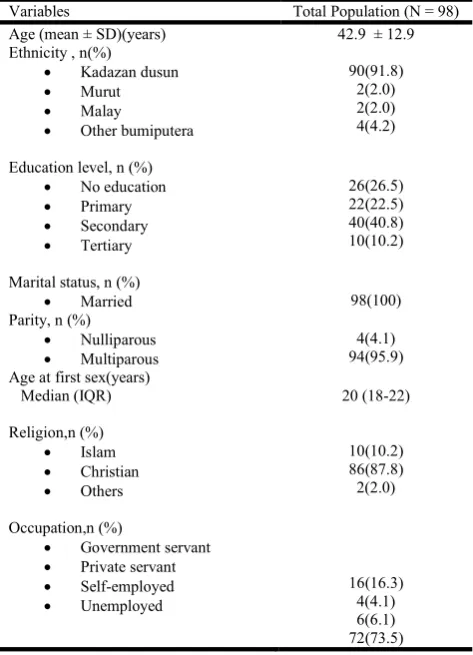
The demographical characteristics of the study participants are summarized in Table 1. The mean age of women participated in this study was 42 ± 12 years old with the youngest at 20 years old and the eldest at 64 years old. All the participants were married and 92.9% were multiparous with the mean parity of 5. The median age for the women in this study to have first sexual experience was at 20 (18-22) years old. A total of 86 (87.8%) of the women were Christian and the rest was either Islam or other religion. In this study, 72 (73.5%) of the women were unemployed either being a farmer or a housewife.
Willingness for HPV DNA self-testing
the most common reason gave by those who were unwilling to perform the HPV DNA self sampling. The next common reason was due to afraid of having an abnormal result (76%), followed by feeling of embarrassment (8%) and experiencing pain during the procedure (8%).
Table 1. Demographic characteristics of the study population
Variables Total Population(N = 98)
Age (mean ± SD)(years) 42.9 ± 12.9
Ethnicity , n(%)
Kadazan dusun
Murut
Malay
Other bumiputera
90(91.8) 2(2.0) 2(2.0) 4(4.2)
Education level, n (%)
No education
Primary
Secondary
Tertiary
26(26.5) 22(22.5) 40(40.8) 10(10.2)
Marital status, n (%)
Married 98(100)
Parity, n (%)
Nulliparous
Multiparous
4(4.1) 94(95.9) Age at first sex(years)
Median (IQR) 20 (18-22)
Religion,n (%)
Islam
Christian
Others
10(10.2) 86(87.8) 2(2.0)
Occupation,n (%)
Government servant
Private servant
Self-employed
Unemployed
16(16.3) 4(4.1) 6(6.1) 72(73.5)
The demographic data of those who were willing and those who decline to perform HPV DNA self-testing were summarized in Table 2. Those who agreed to perform HPV DNA self sampling test was in younger age group with the mean age of 40 ±11 years old however it was not statistically significant. Majority of multiparous women willing to perform HPV DNA self sampling test accounting for 75.5% of the sample population. All the participants had only one single partner and only one women had HPV vaccination at the age of 20 years old. Those who at least had a background primary education agreed towards HPV DNA self-sampling test and it was statistically significant. A total of 59 (76.6%) women who had performed pap smear before will agree to perform HPV DNA self sampling test.
However, it was not statistically significant. Smoking is one of the risk factor to develop cervical cancer and it was not surprise 18 (90%) women who smoke agreed towards performing HPV DNA self sampling test. In this study population, median age first to sexual experience was 20(18-23) years old in those who agreed towards HPV DNA self sampling test and it was similar in the group that decline the test. Therefore, it was not statistically significant.
Table 2. Demographic data on those who agreeable and not agreeable for HPV DNA self sampling test
Variables Agreed For Self
Sampling
Decline For Self Sampling
P Value
Age (mean ± SD)(years) 40 ( ±11) 45 ( ± 12) 0.056 a
Parity, n (%)
Nulliparous
Multiparous
2 (50) 71(75.5)
2(50)
23(24.5) 0.574 b
Age of first sexual intercourse (years)
Median (IQR) 20 (17-23) 20(18-22) 0.370 c
Smoking status ,n(%)
Yes
No
18 (90) 55(70.5)
2 (10)
23 (29.5) 0.074 b
Educational status,n (%)
No education
Primary
Secondary
Tertiary
13 (50) 16(72.7)
36(90) 8(80)
13(50) 6(27.3) 4(10)
2(20) 0.003 b
Pap smear status,n (%)
Yes
No
59(76.6) 14(66.7)
18(23.4)
7(33.3) 0.350 b
Note : a = t Test b =Chi Square c = Mann Whitney test
None of the identifying factors was found to be significantly associated with the willingness to perform HPV DNA self sampling (Table 3). It is interesting to note that women with tertiary education were 2.2 times more likely to perform HPV DNA self sampling however was not statistically significant.
Knowledge on HPV and its association with the willingness to perform self-testing
The responses of study population on the knowledge of HPV were summarized in Table 4. In this sample population, 49% of them knew that HPV can cause cervical cancer and 42% of them knew vaccine towards HPV do exist. Otherwise, all the other questions regarding HPV infection and cervical cancer were answered incorrectly. In this sample population, those who willing to do HPV DNA self sampling score higher knowledge value at median 3(0-5) compared to those who not agreed whom score median 0(0-0.5) (Table 5).This difference in median score is statistically significant at p< 0.005 using Mann Whitney test. As a whole, the median total score is 1(0-4) which is low. Only 12.2% of the sample population did score above 50th percentile which consider as adequate knowledge of HPV and cervical cancer.
DISCUSSION
Most of the studies on knowledge towards HPV and cervical cancer were confined to urban population. There is a paucity of data on the rural population. This study was carried out on the rural population in low socioeconomic population in East Malaysia. Majority of the participant had deficient knowledge towards HPV and cervical cancer with median score of 1(IQR
0-4). Only 12.2% (n=12) of the participants scored above 50th
percentile and a vast majority (87.8%) scored below the 50th
[image:3.595.45.282.146.474.2]However, only one person received the HPV vaccination although 49% of the sample populations were aware that HPV can cause cervical cancer.
Previous study done by (Shafiee et al., 2013) among university
students Malaysia showed 76% were awareness towards HPV
vaccines. However, earlier local study by Wong et al. (2010)
before implementation of local HPV vaccination and Ali SF et
al14 in 2009 in low socioeconomic population in Pakistan
revealed only 10 % awareness of HPV vaccine. In our population, 42% of them knew about the vaccine. Therefore, the impact of national policy towards HPV vaccination in mass media and medical society were probably responsible for the awareness in the rural area. Unfortunately, the understanding of the disease and vaccination were still poor as reflected by incorrect answers in these areas.
In Malaysia, the cervical screening coverage rate was remain
low as 47% despite being free of charge.13 Practical barriers
such as difficulty making an appointment, not having time to perform the test and not trusting the test were more predictive of screening uptake than emotional factors such as
embarrassment. (Jo, Marta and Laura et al., 2009)
Furthermore, evidence suggests that self sampling for HPV DNA testing is a viable screening option in under resourced areas or for women who reluctant to participate in clinician led primary screening programs. However, the characteristic of women who are interested in performing self sampling have not been well studied. In this study population, a total of 73 (74.5%) of the women agreed to perform HPV DNA self
sampling. This finding was slightly lower than the previous
study done by Mitchell et al. (2011) in low resource district in
Uganda (86.0%) and by Tisci et al. (2003) in rural China
which showed 91% willingness towards HPV DNA self sampling. There was a positive association regarding the level of education with the willingness to perform HPV DNA self sampling. Those who at least with the background of primary education will agree toward this test. The finding was
comparable with Tisci et al. (2003) which found that
better-educated women felt more comfortable performing self-sampling. However, the association of the HPV and cervical cancer knowledge with the willingness towards HPV DNA self sampling was not statistically significant but the median knowledge score for women who were willing to perform HPV DNA self sampling was higher than the unwilling group. Beside that, those who were willing to perform HPV DNA
self sampling was in a younger age group. Dzuba et al. (2002)
reported that women in a higher income were more likely to prefer self sampling however our study does not support this finding. Factors such as pap smear status, age of first sexual experience, smoking status, number of sexual partner and parity were not found to be associated with the willingness to perform HPV DNA self sampling.
[image:4.595.80.521.80.178.2]In this study, the barriers towards the willingness to perform the test were concerned about improper sampling, afraid of abnormal result, fear of painful procedure and embarrassment. A vast majority (92%) were not keen as they were concerned on improper sampling technique. Neither religious beliefs nor partner approval were found to be the barrier towards the test.
Table 5. Factors associated with acceptibility to perform HPV DNA self sampling
Variable B Df(SE) Wald P value Adjusted odd ratio 95% confidence interval
Age 0.120 0.310 0.141 0.708 1.012 (0.952-1.075)
Education status
No education
Primary education
Secondary education
Tertiary education
-1.670
0.459
0.772
1.010
0.937
1.001 6.801 2.764
0.240
0.595
0.079 0.096
0.624
0.441
0.187
0.632
2.164
(0.026-1.350)
(0.101-3.964)
(0.304-15.380)
[image:4.595.108.497.209.326.2]Pap smear status -0.507 0.584 0.754 0.385 0.602 (0.192-1.893)
Table 4. Frequency of response to questionnaire on knowledge regarding HPV
Question On HPV Infection, Detection And Transmission Correct (%) Incorrect (%)
HPV can cause genital warts 12 (12.2) 86 (87.8)
HPV can cause cervical cancer 48 (49) 50 (51)
Most people with genital HPV have no visible signs or symptoms 10 (10.2) 88 (89.8)
If a woman’s Pap smear is normal, she does not have HPV 8 (8.2) 90(91.8)
Changes in a Pap smear may indicate a woman has a HPV 22(22.4) 76 (77.6)
Pap smear will almost always detect HPV 10 (10.2) 88 (89.8)
HPV can be passed from mother to baby during birth 6 (6.1) 92 (93.9)
A negative test for HPV means you do not have HPV 18 (18.4) 80 (81.6)
A vaccine exist to prevent HPV infection 42 (42.9) 56 (57.1)
Having one type of HPV means that you cannot acquire a new type 14 (14.3) 84 (85.7)
I can transmit HPV to my partner even if I have no HPV symptoms 22(22.4) 76 (77.6)
Table 5. Association between knowledge on HPV and willinness to perform HPV DNA self sampling
Variables Total Population Agreed For Self Sampling Decline For Self Sampling P Value
Total knowledge score
[image:4.595.70.527.361.393.2]This finding was similar to previous study by Mitchell et al.
(2003) although the main concern was towards embarrassment to perform the self sampling test. As the knowledge towards HPV and cervical cancer was deficient, the needs to perform the test were the main factors towards willingness for this self sampling test rather than the thought they were at risk for HPV
infection. Tischi et al. (2003) also reported that 84.7% of the
women had poor knowledge towards this test hence making the common barrier in performing HPV DNA self sampling. Furthermore, none of the identifying factors was found to be significantly associated the willingness to perform HPV DNA self sampling. It is interesting to note that women with tertiary education is 2.2 times more likely to perform HPV DNA self sampling however was not statistically significant.
Overall, educating women in the rural population regarding HPV and cervical cancer, explaining to them clearly how to collect a sample and sharing experience on how this test was not painful should be a priority when this self sampling program are implemented.
Limitation of the study
This study had several limitations thus findings of this study may not be generalized to overall rural population with different believes and culture due to small sample size. Secondly, the study used convenience sampling during one of the medical camp visit and only behavioral intentions were measured. Thirdly, the survey performed in a language that sometimes was not the first language of the participant.
Conclusion
The knowledge of HPV and cervical cancer is deficient in rural population in East Malaysia. Although half of the study population were aware of the relationship of HPV with cervical cancer however only one had benefitted from HPV vaccination. Nonetheless, continued health education by outreach worker will be required to increase the awareness towards HPV and cervical cancer. Majority of the women agreed to perform HPV DNA self sampling test especially those with higher educational status. The main barrier for willingness towards performing this test was concerned of improper sampling.
Thus, HPV DNA self sampling will be a good option in rural population after properly explained the correct self sampling technique.
REFERENCES
Ali, S.F., Ayub, S., Manzoor, N.F. et al. 2010. Knowledge and
awareness about cervical cancer and prevention amongst inters and nursing staff in tertiary care hospitals in
Karachi, Pakistan. PLos One, 1: 36-39.
Domingo, E.J., Noviani, R., Noor, M.R. et al. 2008.
Epidemiology and prevention of cervical cancer in Indonesia, Malaysia, the Philippines, Thailand and
Vietnam. Vaccine, 19 (26) :71–79.
Doorbar, J. 2006. Molecular biology of human
papillomavirusinfection and cervical cancer. Clin. Sci.,
110: 525–41.
Dzuba, I.G., Diaz, E.Y., Allen, B., Leondard, Y.F. et al. 2002.
The acceptability of self-collected samples for HPV testing vs. the pap test as alternatives in cervical cancer
screening. J Womens Health Gend Based Med., 11: 265–
75.
Goldman, R.E. and Risica, P.M. 2004. Perceptions of breast and cervical cancer risk and screening among Dominicans
and Puerto Ricans in Rhode Island. Ethn. Dis. 14 (1):32–
42.
Jo, W., Marta, B., Laura, M. et al. 2009. Barriers to cervical
cancer screening attendance in England: a
population-based survey. J. Med. Screen, 16: 199–204.
Kuala Lumpur 1999.National Health and Morbidity Survey. Institute of Public Health. Ministry of Health Malaysia
Mitchell, S. G. Ogilvie, M. Steinberg et al. 2011. Asssesing
women’s willingness to collect their own cervical samples for HPV testing as part of the ASPIRE cervical cancer
screening project in Uganda. Int J Obs and Gynecol., 114:
111-115.
National Cancer Registry, 2006. Malaysian Cancer Statistics— Data and Figure Peninsular Malaysia
Ogilvie, G.S., Patrick, D.M., Schulzer, M. et al. 2005.
Diagnostic accuracy of self collected vaginal specimens for human papillomavirus compared to clinician collected human papillomavirus specimens: a meta-analysis.
SexTransm Infect, 81(3):207–12
Parkin, D.M., Bray, F., Ferlay, J. et al. 2005. Global cancer
statistics, 2002. CA Cancer J Clin., 55(2):74–108.
Shafiee, M.N., Chew,K.T., Kampan, N. et al. 2013.
Perception, knowledge and attitude towards Human Papilloma Virus infection and vaccination for cervical
cancer prevention among university students. Brunei Int
Med J., 9(5): 315-324.
Tisci, S., Shen, Y.H., Fife, D., Huang, J., Goycoolea, J., Ma,
C.P. et al. 2003. Patient acceptance of self-sampling for
human papillomavirus in rural China. J LowGenit Tract
Dis., 7:107–16
Walboomers, J.M.M., Jacobs, M.V., Manos, M.M. et al. 1999.
Humanpapillomavirus is a necessary cause of invasive
cervical cancer worldwide. J Pathol., 189:9-12.
Waller, J., McCaffery, K., Wardle, J.2004.Beliefs about risk
factors for cervical cancer ina British population sample.
Prev. Med., 38: 745–753
Wong, L.P. and Sam IC. 2010. Ethically diverse female university students’ knowledge and attitides towards human papillomavirus (HPV), HPV vaccination and
cervical cancer. Euro J Obs and Gynecol and Rp Biology,
148(1):90-95.
Wong, Y.L. et al. 2013. Correlates between risk perception of
cervical cancer and screening practice. Prev. Med., 57:
24-26.
Zainal, A.O., Nor Saleha. NCR Report 2007, Ministry of Health, Malaysia